Category Archives: Leadership

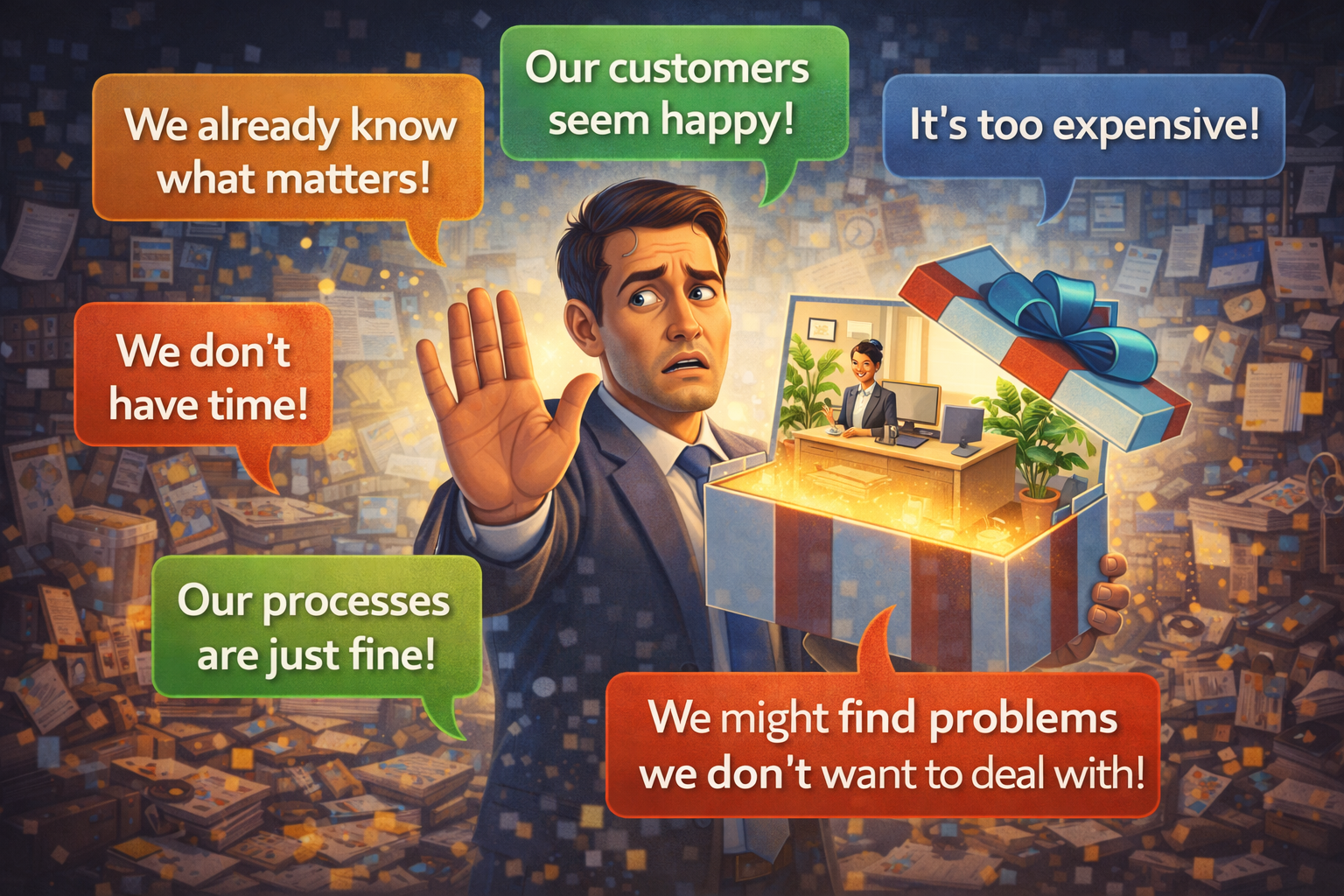
Is Your Customer Experience a Lie?

LAST UPDATED: May 29, 2026 at 10:40 AM
Is Your Customer Experience a Lie?

by Braden Kelley and Art Inteligencia

In the high-stakes theater of modern business, many leaders have developed a remarkable talent for a dangerous form of “experience narcissism.” They stand in boardrooms, surrounded by glowing dashboards and rising Net Promoter Scores (NPS), convincing themselves of a comforting delusion: that they already know exactly what it feels like to be their customer. They assume that because the machine is running, it must be well-oiled. But as a champion of Customer Experience Audits (aka Customer Experience Risk and Revenue Leakage Diagnostic), I have seen far too many organizations fail not because they lacked a great product, but because they lacked the courage to look in the mirror.

The refusal to conduct regular, rigorous customer experience audits is rarely a matter of resources; it is a defensive reflex. It is the Corporate Antibody Response protecting the status quo. Leaders tell themselves that their digital analytics tell the whole story, or that “if it were truly broken, we’d hear about it.” These are the lies that create Invisible Friction — the silent, compounding drag that prevents an invention from ever reaching its potential as a true innovation.

When we avoid the audit, we aren’t just saving time; we are actively choosing to ignore the hurdles that drive customers into the arms of more agile competitors. We treat the customer journey as a static map we drew five years ago, rather than a living, breathing, and often messy reality. To be a leader in the age of Purpose-Driven Innovation, you must be willing to trade your comfortable assumptions for the uncomfortable truth.

1. The Lie of “We Already Know Our Customers”

The first, and perhaps most seductive, lie that leaders tell themselves is the myth of the “Static Persona.” This is the belief that because the leadership team spent six months on a deep-dive research project three years ago, they now possess a permanent, intuitive understanding of their customer’s psyche. They treat customer knowledge as a milestone to be reached rather than a perishable asset. Competitors change the baseline for “convenience,” global events shift priorities, and technology alters how customers view value. Without a regular audit, leaders are effectively navigating today’s stormy seas using a map of a coastline that has already eroded.

This lie often manifests as “Experience Narcissism,” where executives assume their own personal interactions with the brand are representative of the average user’s journey. They use the latest flagship hardware on a high-speed corporate network and wonder why the front-line customer, using a three-year-old device on a spotty cellular connection, is frustrated. They confuse their authority with empathy. A rigorous audit acts as a necessary “ego-check,” stripping away the polished executive view to reveal the Invisible Friction that customers face every single day.

Furthermore, leaders frequently mistake “Customer Data” for “Customer Truth.” They point to demographic reports and purchase histories as proof of their intimacy with the market. But data tells you the what, while an audit tells you the why. You might know that a customer abandoned their cart, but without an audit of the experience, you won’t know if they left because of a technical glitch, a confusing shipping policy, or a sudden moment of brand distrust. To ignore the audit is to choose to lead from a spreadsheet rather than from the soul of the customer journey.

2. The Lie of “Digital Analytics Tells the Whole Story”

The second great deception is the worship of the “Dashboard Delusion” — the belief that a green arrow on a conversion chart is synonymous with a satisfied customer. Leaders often hide behind quantitative data because it feels objective, safe, and controllable. They see a steady flow of traffic and a predictable checkout rate and conclude that the Value Access path is clear. However, digital analytics are purely evidentiary; they show you where the footprints are, but they never show you the “ghosts”—the thousands of potential customers who looked at your landing page, felt a subtle pang of confusion or distrust, and vanished without leaving a single data point behind.

An audit is required because analytics cannot measure what didn’t happen. They don’t capture the frustration of a user who successfully completed a task but vowed never to return because the process was emotionally draining. They don’t show the Invisible Friction of a customer who had to open a separate tab to search for an explanation of your jargon. When leaders skip the audit, they are essentially trying to understand a symphony by looking at a spreadsheet of decibel levels; they see the volume, but they completely miss the dissonance.

Furthermore, relying solely on digital metrics often leads to “Local Maxima” thinking. You might optimize a button color or a headline to increase a click-through rate by $2\%$, but an experience audit might reveal that the entire feature is redundant or misaligned with the customer’s actual goal. Analytics tell you how to do the wrong thing more efficiently, while auditing tells you if you are doing the right thing at all. As I often emphasize, true Value Translation happens in the heart of the user, a place where Google Analytics has no login credentials.

3. The Lie of “We’ll Hear About It If It’s Broken”

The third lie is perhaps the most comfortable, and therefore the most catastrophic: the “Silence is Golden” fallacy. Leaders often operate under the assumption that their customers act as a free, 24/7 quality assurance team. They believe that if a friction point were truly detrimental to the brand, it would trigger a flood of support tickets or a viral social media outcry. This creates a false sense of security that I call the Reactive Trap. In reality, the vast majority of customers do not have the time, energy, or desire to help you fix your business. When they encounter a broken experience, they don’t complain — they simply evaporate.

This silence is not a sign of health; it is the sound of Silent Churn. For every one customer who takes the time to write a detailed email about a confusing interface or a lackluster service interaction, there are dozens more who quietly moved their business to a competitor who made the “Value Access” feel effortless. By the time a problem is “loud” enough to reach the executive suite without an audit, the organization has likely already lost significant market share. An audit is a proactive hunt for these silent killers, allowing for Human-Centered Change™ before the damage becomes irreversible.

Relying on complaints also skews a leader’s perspective toward “extreme” failures while ignoring the “death by a thousand cuts” that truly defines a brand’s reputation. A customer might not complain about a slightly slow load time, a mildly confusing confirmation email, or a repetitive form field, but the cumulative Cognitive Load of these micro-frictions erodes trust over time. As an innovation speaker, I frequently remind my clients that “no news” is often just a polite way of saying “I’ve found someone better.”

4. The Lie of “It’s Too Expensive and Time-Consuming”

The fourth lie is a classic case of “Accounting Myopia” — the belief that a customer experience audit is a discretionary expense rather than a fundamental investment in Value Creation. Leaders often look at the price tag of a comprehensive audit or the internal hours required to map a journey and immediately relegate it to the “maybe next year” pile. They view the audit as a cost center, a luxury to be indulged only when the budget is flush. What they fail to realize is that they are already paying for the audit every single day — not in invoices, but in the “Friction Tax” of lost conversions, increased support costs, and skyrocketing customer acquisition fees.

When you refuse to audit, you are essentially pouring expensive marketing “water” into a leaky bucket. You might spend millions on a new brand campaign, but if your Value Access path is riddled with Invisible Friction, a significant portion of that investment is being wasted. I’ll argue that if you think an audit is expensive, you haven’t calculated the cost of the “Experience Void” — the revenue left on the table by customers who encountered a hurdle and walked away. An audit doesn’t cost money; it recovers stolen profit.

Furthermore, the “Time-Consuming” argument is often a mask for a lack of organizational agility. Leaders fear that an audit will uncover a mountain of technical debt or procedural flaws that they aren’t prepared to fix, so they avoid the diagnosis to avoid the surgery. But in the age of Purpose-Driven Innovation, time is your most precious commodity. Every month you spend operating with a flawed experience is a month you give your competitors to build a better relationship with your audience. Let’s be honest: “You don’t have time not to audit.” You can either spend the time now to fix the journey, or spend the time later explaining to the board why your market share has evaporated.

5. The Lie of “Our NPS Score is Great”

The final, and perhaps most insidious, deception is the “Metric Shield” — the belief that a high Net Promoter Score (NPS) is a definitive certificate of health that renders a customer experience audit unnecessary. Leaders often cling to this single, shiny number as a way to soothe their egos and pacify the board. They argue that if the “score is up,” the customers must be happy. However, as any customer experience practitioner knows, NPS is a trailing indicator that is notoriously easy to manipulate and dangerously void of context. It tells you the temperature of the room, but it doesn’t tell you if the air is toxic.

When leaders use NPS to bypass an audit, they are choosing to prioritize a vanity metric over Value Translation. An NPS score can be high simply because your customers have no better alternative at the moment, or because your team has learned to “game” the survey by sending it only after successful interactions. It fails to capture the Invisible Friction of the silent majority who were too frustrated to even take the survey. An audit, by contrast, dives into the “Why” behind the number. It reveals the cracks in the foundation that a single-digit score is designed to cover up.

Relying on NPS without an audit is like checking your heart rate and assuming you’re fit for a marathon without checking if your legs are broken. You might have “Promoters” who love your brand’s mission but are secretly exhausted by your checkout process. These are “Fragile Promoters” who will defect the moment a competitor offers a lower Cognitive Load. Often the most dangerous place for a leader to be is standing on top of a high NPS score, refusing to look down at the crumbling experience beneath their feet.

Conclusion

The greatest threat to your organization’s future isn’t a lack of vision or a shortage of capital — it is the comfort of your own assumptions. Every lie you tell yourself about the state of your customer journey acts as a Corporate Antibody, attacking the very innovation you claim to champion. By avoiding the regular, rigorous mirror of a customer experience audit, you are essentially choosing to drive a high-performance vehicle with the windshield blacked out, relying solely on a GPS map that hasn’t been updated in years. True leadership requires the humility to admit that what you think you know about your customer is likely outdated, and what your dashboards are telling you is likely incomplete.

The path to success in 2026 is paved with the friction you choose to remove today. If you are ready to stop hiding behind “Experience Narcissism” and vanity metrics, you must treat auditing not as a chore, but as a strategic competitive advantage. For those ready to take the first step toward a clearer perspective, I encourage you to explore my deep-dive guide in Customer Experience Audit 101 or understand the shifting landscape in Why a Customer Experience Audit is Non-Negotiable in 2026. The wilderness of the market is moving fast, and only those who constantly tend to their “customer garden” will survive.

I have spent my career helping leaders turn their Invisible Friction into visible opportunity. Don’t wait for your customers to tell you it’s broken by leaving; be proactive and reclaim the experience excellence they deserve. Do you need help conducting a transformative customer experience audit?

Let’s work together to ensure your innovation doesn’t just look good on paper, but feels incredible in the hands of your customers.
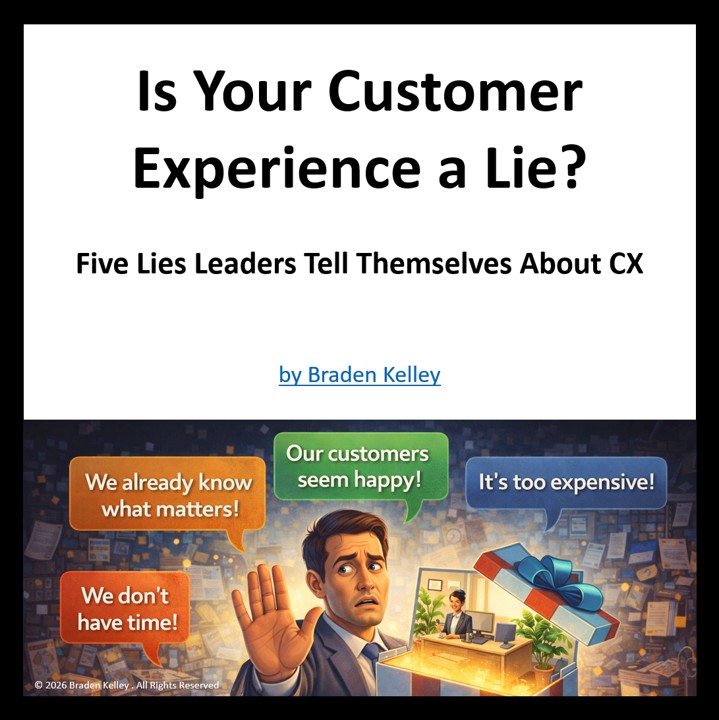
Five Lies Leaders Tell Themselves About CX

Download the Five Lies Leaders Tell Themselves About CX Flipbook as a PDF by clicking the link or the image above.

Image credits: ChatGPT

Content Authenticity Statement: The topic area, key elements to focus on, etc. were decisions made by Braden Kelley, with a little help from Google Gemini to clean up the article and add citations.

Subscribe to Human-Centered Change & Innovation WeeklySign up here to get Human-Centered Change & Innovation Weekly delivered to your inbox every week.
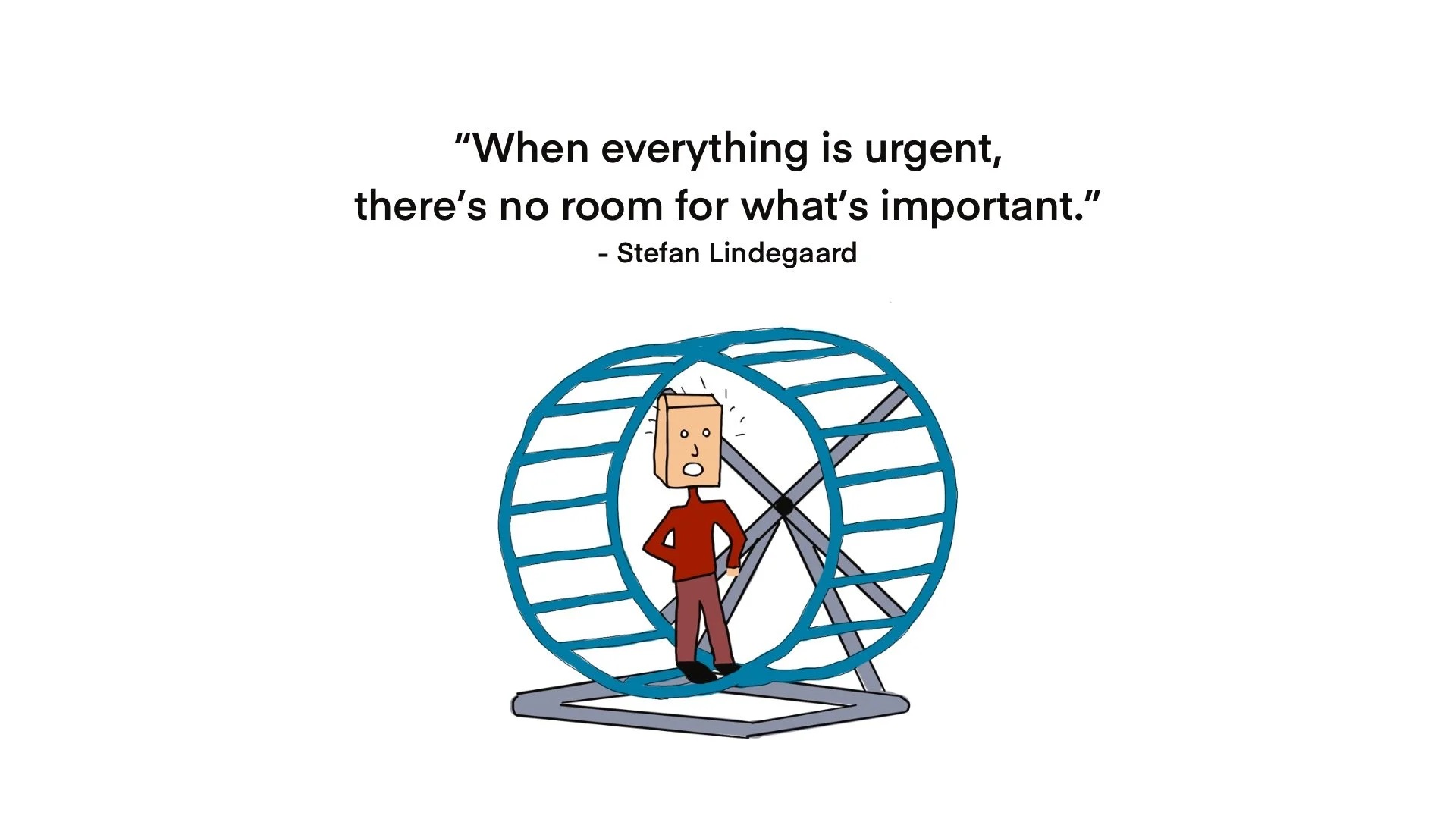
Important or Urgent?

Important or Urgent?

GUEST POST from Stefan Lindegaard

People in the corporate world today are busy – overwhelmingly so. Calendars are packed. Emails never stop. Meetings bleed into each other. On paper, it all looks like progress. But under the surface, something more critical is being lost.

This constant busyness creates the illusion of high performance. Output is visible. Actions are taken. Projects get delivered. But the deeper elements that actually build high performance – leadership development, trust, team learning, shared direction – are quietly being squeezed out.

In my work with leadership teams, I’ve seen this again and again: the very things that drive long-term success get de-prioritized, not because people don’t care, but because there’s simply no time left for them.

We talk a lot about performance, but real high-performance leadership isn’t built on urgency. It’s built on clarity, consistency, learning, and the ability to step back and make deliberate choices. When people are in constant motion, there’s no time for that. No time to coach. No time to reflect. No time to ask, “Are we even moving in the right direction?”

I often say that strong, high-performance teams are not just built – they are strategically designed and developed. That takes effort, intent, and most of all, space. But in the middle of never-ending activity, space is exactly what we don’t have.

This isn’t just a feeling. Research backs it up. Cal Newport’s Deep Work explores how modern work habits – from multitasking to nonstop notifications – have eroded our ability to do focused, meaningful work. Teresa Amabile and Steven Kramer, in The Progress Principle, found that what truly motivates people is making meaningful progress. But we interrupt that progress constantly with check-ins, firefighting, and shallow coordination. And studies like the Microsoft Work Trend Index show that most people feel they don’t get even a single hour of true focus time during their day.

It’s not that productivity is bad. But when busyness becomes the default mode, it turns into a trap – one that quietly undermines performance over time.

From a leadership and organizational development perspective, this is deeply concerning. I work with leaders who want to create better environments, who want to strengthen collaboration, sharpen execution, and grow their teams. But when every hour is accounted for, and every conversation is focused on delivery, there’s little room to ask the deeper questions that lead to change.

Worse still, in this kind of environment, team dynamics suffer. Feedback becomes reactive instead of developmental. Learning becomes fragmented. Strategy becomes surface-level. Psychological safety fades, because no one has the space to truly listen or adjust.

And that’s where Amy Edmondson’s research is so relevant. In her work on The Fearless Organization, she defines psychological safety as the shared belief that it’s safe to take interpersonal risks — to speak up, ask questions, make mistakes. It’s a cornerstone of high-performing teams. But here’s the catch: psychological safety doesn’t thrive in a culture of nonstop urgency. It requires time. Presence. Real conversations. If everyone is too busy, no one feels heard – and when people don’t feel heard, they stop contributing fully.

So it’s not just performance that suffers. It’s innovation. It’s trust. It’s the core of how teams work together.

What’s needed instead is a shift from reactive busyness to intentional performance. That means protecting time and mental space for what matters: coaching, alignment, leadership reflection, and team growth. It means giving teams the tools and structure to act with purpose, not just speed. It means creating a rhythm where delivery and development coexist.

High-performance isn’t about doing more. It’s about doing what matters – consistently, deliberately, and together.

So if your team is always too busy to reflect, to connect, to lead – that’s the signal something deeper needs to shift. Because when everything is urgent, we lose sight of what’s truly important.

And without that, performance is just motion.

Image Credit: Stefan Lindegaard

Subscribe to Human-Centered Change & Innovation WeeklySign up here to get Human-Centered Change & Innovation Weekly delivered to your inbox every week.

5 Simple Keys to Becoming a Powerful Communicator

5 Simple Keys to Becoming a Powerful Communicator

GUEST POST from Greg Satell

Sometimes the hardest thing is merely to make yourself understood. Things that change the world, or even a small part of it, always arrive out of context because, by definition, the world hasn’t changed yet. That’s why innovators need to be great communicators, because an idea that doesn’t gain traction is an idea that fails.

That’s easier said than done. As Fareed Zakaria has put it, “Thinking and writing are inextricably intertwined. When I begin to write, I realize that my ‘thoughts’ are usually a jumble of half-baked, incoherent impulses strung together with gaping logical holes between them.” Clearly, if he struggles, we all do.

Yet the good news is that most people can immensely improve their communication skills by following a few simple rules. While, like any skill, they take a lifetime of practice to hone and perfect, you can start seeing progress within a few hours. It doesn’t matter if you’re an entrepreneur, a senior executive or just starting out, you need to communicate effectively.

1. Clarity Before Creativity, Always

Most people want their writing and speaking to be impressive. They have an idea in their heads of what a “professional” sounds like and they try to emulate those traits. They use big words, infuse acronyms and technical language or try to pluck a choice term or two out of the zeitgeist.

Yet trying to conform to some abstract notion of “professional” or “impressive” is a sure way to garble your message. Instead of trying to impress, just try to be clear. Different people have different conceptions of what they consider to be professional or impressive, but everyone knows what is clear.

The truth is that nobody cares how clever you are if they can’t understand what you’re trying to tell them and few will take the time and effort to figure it out. Most probably, they will assume you haven’t really thought things through and move on to other things.

So as you formulate your message, whether it’s an email, a pitch, a keynote or whatever, continually ask yourself, “how can I make it more clear?”

2. When In Doubt, Take It Out

Born in the late 13th century, William of Ockham was a giant of his age. As one of the few intellectual lights of medieval times, his commentaries on reason, logic and political theory are studied even today. His ideas about the separation of church and state were literally centuries ahead of their time and formed the basis for our own constitutional principle.

Yet he’s best known for Ockham’s Razor, sometimes known as the “principle of parsimony.” Often, the principle is interpreted as “Keep It Simple Stupid,” but that’s not quite right. A much more accurate translation would be, “entities should not be multiplied beyond necessity.” In other words, if something doesn’t need to be there, it shouldn’t be.

A useful device I use for applying Ockham’s razor is to imagine my audience, whether that is a reader or a listener, as having an internal “cognitive budget” they are willing to devote to whatever I’m trying to tell them. Then I judge everything I include by the standard of, “is this worth using up my cognitive budget?”

So be cautious and respectful with your audience’s attention. If you have any doubts whether it needs to be there, it probably doesn’t. Take it out and see if anything meaningful is lost. If not, keep it out and don’t look back.

3. If It Sounds Like Writing, It’s Probably Not Good

When we’re taught to write in school, we’re usually urged to follow a certain form. This often involves an academic, detached tone of voice. For many of the same reasons, when we speak to an audience, our tone takes on a “speaker’s voice. In both cases, the result is that we come off as performative and inauthentic.

Your communication, whether you’re speaking or writing, should sound like you, not someone you’re trying to be at a particular moment. Your vocabulary shouldn’t be significantly different when you write than when you speak. Your grammar and turns of phrase shouldn’t vary too much either. There’s absolutely no reason for you to come off as someone else.

Style should be invisible. If your audience is focusing on how you’re writing or speaking, then that steals cognitive energy away from concentrating on the message you’re trying to communicate. Don’t fall into the trap of trying to sound a certain way, just focus your energy on being as clear as possible.

4. Default To One Point

If you’re going to rob a bank, as a general rule anything you say after “put the money in the bag or I’ll blow your head off,” will be somewhat superfluous. That one simple point is perfectly sufficient for the job at hand. In fact, the uncomfortable pause that follows will probably accentuate the impact of your message.

Now, clearly there are exceptions to the “default to one point” rule. For example, if you kidnapped the teller’s family, that kind of time and effort might warrant adding a second point. Even then though, you might want to let your first point sink in and keep your second point in reserve in case you need to overcome an objection.

Obviously, I’m being facetious and not suggesting anyone actually rob a bank, but the point stands. In most contexts, but especially if you’re on a panel or doing a Q&A session, you’re usually, although not always, better off sticking to one point and making it well than trying to jam in a too much information

And, of course, if they like your one point they’ll be likely to ask for more. That’s how you build a conversation.

5. Dare to be Crap

The hardest thing about starting a project of any sort is that we always compare initial efforts to finished products and, not surprisingly, those efforts always seem to come up short. As Pixar President Ed Catmull wrote in his book, Creativity, Inc., “early on, all of our movies suck.” If it’s true of Pixar movies, it’s probably true of our work.

That makes it really hard to begin writing or scripting, because whatever you first put down is bound to be a disappointment. Your wording will be clumsy, your points will be unclear and you’ll begin to realize that your great idea is actually, as Fareed Zakaria put it, “a jumble of half-baked, incoherent impulses strung together with gaping logical holes between them.”

Your first efforts are always crap. Yet that shouldn’t blind you to the fact that all great works start out that way. As Vladimir Nabokov put it, “writing is rewriting.” The greatness comes not from the initial spark of inspiration, but from the long hours spent honing it down to reveal its core. But before you do that, you need to dare to be crap and produce a first draft.

The truth is that communicating even fairly simple ideas can be very hard work. As in most things, talent is overrated. You produce good work not from having a knack for a clever turn of phrase, but by putting in the effort to express your ideas clearly.

— Article courtesy of the Digital Tonto blog
— Image credit: Unsplash

Subscribe to Human-Centered Change & Innovation WeeklySign up here to join 17,000+ leaders getting Human-Centered Change & Innovation Weekly delivered to their inbox every week.

Allocating Resources to Solve Horizon 2

Another Tough Challenge

Allocating Resources to Solve Horizon 2

GUEST POST from Geoffrey A. Moore

We’ve known about this problem forever—how do you find a principled way to allocate budget across three different horizons of ROI.

  • Horizon 1 pays off in the current year and equates to the funding needed for you to make your operating plan and meet or beat investor guidance.
  • Horizon 3 pays off downstream, typically by making a speculative bet on an emerging category or market that would come to fruition in the out years. Since it is still early days, these bets are relatively small and can be measured by and managed to venture milestones.
  • Horizon 2 is the troublemaker. It calls for a material investment in gaining power in the near term in order to compete effectively in the mid-term. That investment will come out of Horizon 1, either from the Performance Zone trying to make the number or from the Productivity Zone trying to supply the needed support to do so, and most likely both.

In short, both internally and externally, Horizon 2 investments are not popular, even though everyone recognizes that they are critical to long-term success. So what is the process by which one can do right by them?

The key is to recognize that the ROI from Horizon 2 is measured in units of power, whereas that from Horizon 1 is measured in units of performance, and that the two must not be mixed. Now, to be clear, performance creates the funding for power, and power creates the foundation for performance, so they are deeply intertwined. But each has its own metrics of success, and the time lag between them says they cannot be blended.

Power always precedes performance. To underfund power is to jeopardize your future performance, the ultimate result being the liquidation of your franchise. To underfund performance, on the other hand, is to jeopardize the cash flow that you need to fund power, putting your market cap at risk, the ultimate result being to attract an activist investor who will oversee the liquidation of your franchise. There is no safe path to take, only a precarious middle way to traverse.

Now, again to be fair, in good times when your category is enjoying secular growth, you get to have your cake and eat it too. That is, you produce amazing cash flow, have a fabulous market cap, and have resources aplenty to invest as you choose. My colleagues still refer to the period leading up to the first tech bubble as “ the time of the great happiness.” Be that as it may, for most of us in 2024 (our friends in GenAI being a notable exception), this is not such a year. We have to make tough choices, and we have to make them now.

So, back to process — and CFOs, take note because you’re likely the one to be leading it.

  1. Separate strategic planning from annual budgeting by at least one quarter.
  2. Charge each business unit to pitch a strategic plan that would create returns substantially above and beyond their current operating model. Included in this plan is a ballpark estimate of the funding that would be required to implement it.
  3. Facilitate an Executive Leadership Team review of the overall portfolio of opportunities, culminating in a rank-ordered list.
  4. Consult with the CEO to determine how much of next year’s operating budget can be allocated to strategic investments, and in that context, which investments should be prioritized for funding. This funding will be allocated in advance of the operational budgeting and ring-fenced to ensure it is spent as intended.
  5. Most strategic investments will be funded as nested incubations, meaning they will be managed within an existing business unit, and are funded as part of their operating budget. However, you must insist that these efforts be isolated, measured, and accounted for separately from the core business, as they are intended to deliver power outcomes, not performance outcomes, and need to be held accountable to different success metrics. (If you do not do this, their operating budget funds will drift away to supplement Horizon efforts to make the number, and the strategic initiative will falter for lack of sufficient investment.)
  6. Truly disruptive incubations, on the other hand, need to be funded outboard of the current business unit structure, in a corporate Incubation Zone, governed by an Incubation Zone board managing a ring-fenced Incubation Zone fund, following the operating model of venture capital. This is covered in detail in Zone to Win.
  7. At this point budgeting can turn its attention to Horizon 1 and how best to allocate funding to hit the current year’s financial targets.

This process solves for two perennial missteps in annual budgeting. The first we might call “the leftovers approach.” First, you allocate all the resources needed to make your Horizon 1 commitments, and then you look to what’s left to fund strategic initiatives. There will be some resources in the kitty, but not as much as there could be since Horizon 1 managers want to reserve some contingency funding. The result is a bias toward modest investing in incremental innovations that do not create future power but rather extend the current footprint.

The second misstep we can call “the variable approach.” Here you allocate half the resources at the beginning of the year and make the second half allocation contingent upon meeting the Horizon 1 plan for that period. The problem here is that strategic initiatives require sustained investment throughout their time in the J-curve. If you flinch and pull back at any point, you lose momentum, never to be regained. This is a big advantage venture-backed companies have over in-house efforts and one of the reasons why VCs love to invest in a downturn.

That’s what I think. What do you think?

Image Credit: Unsplash

Subscribe to Human-Centered Change & Innovation WeeklySign up here to join 17,000+ leaders getting Human-Centered Change & Innovation Weekly delivered to their inbox every week.

How to Figure Out What’s Next

How to Figure Out What's Next

GUEST POST from Mike Shipulski

Every day starts and ends in the present. Sure, you can put yourself in the future and image what it could be or put yourself in the past and remember what was. But, neither domain is actionable. You can’t change the past, nor can you control the future. The only thing that’s actionable is the present.

Every morning your day starts with the body you have. You may have had a more pleasing body in the past, but that’s gone. You may have visions of changing your body into something else, but you don’t have that yet. What you do today is governed and enabled by your body as it is. If you try to lift three hundred pounds, your system as it is will either pick it up or it won’t.

Every morning your day starts with the mind you have. It may have been busy and distracted in the past and it may be calm and settled in the future, but that doesn’t matter. The only thing that matters is your mind as it is. If you respond kindly, today’s mind is responsible, and if your response is unkind, today’s mind system is the culprit. Like it or not, your thoughts, feelings and actions are the result of your mind as it is.

Change always starts with where you are, and the first step is unclear until you assess and define your systems as they are. If you haven’t worked out in five years, your first step is to see your doctor to get clearance (professional assessment) for your upcoming physical improvement plan. If you’ve run ten marathons over the last ten months, your first step may be to take a month off to recover. The right next step starts with where you are.

And it’s the same with your mind. If your mind is all over the place your likely first step is to learn how to help it settle down. And once it’s a little more settled, your next step may be to use more advanced methods to settle it further. And if you assess your mind and you see it needs more help than you can give it, your next step is to seek professional help. Again, your next step is defined by where you are.

And it’s the same with business. Every morning starts with the products and services you have. You can’t sell the obsolete products you had, nor can you sell the future services you may develop. You can only sell what you have. But, in parallel, you can create the next product or system. And to do that, the first step is to take a deep, dispassionate look at the system as it is. What does it do well? What does it do poorly? What can be built on and what can be discarded? There are a number of tools for this, but more important than the tools is to recognize that the next one starts with an assessment of the one you have.

If the existing system is young and immature, the first step is likely to nurture it and support it so it can grow out of its adolescence. But the first step is NOT to lift three hundred pounds because the system-as it is-can only lift fifty. If you lift too much too early, you’ll break its back.

If the existing system is in it’s prime and has been going to the gym regularly for the last five years, its ready for three hundred pounds. Go for it! But, in parallel, it’s time to start a new activity, one that will replace the weightlifting when the system can no longer lift like it used to. Maybe tennis? But start now because to get good at tennis requires new muscles and time.

And if the existing system is ready for retirement, retire it. Difficult to do, but once there’s public acknowledgement, the retirement will take care of itself.

If you want to know what’s next, define the system as it is. The next step will be clear.

And the best time to do it is now.

Image credit: Pixabay

Subscribe to Human-Centered Change & Innovation WeeklySign up here to join 17,000+ leaders getting Human-Centered Change & Innovation Weekly delivered to their inbox every week.

How Bill Gates and Jeff Bezos Learn About Customer Experience

When the CEO Picks Up the Phone

How Bill Gates and Jeff Bezos Learn About Customer Experience

GUEST POST from Shep Hyken

Jeff Bezos, the former CEO of Amazon, shared a fascinating leadership story on the Lex Fridman Podcast about how he wanted to ensure his customers received the best customer experience (CX). In Amazon’s early days, Bezos noticed a discrepancy between the “wait times” the customer support department was reporting and the feedback customers shared. The support team reported wait times of less than 60 seconds, but customers told a different story. Instead of asking for more data, Bezos took matters into his own hands. He picked up the phone during a meeting with the leadership team and called Amazon’s customer service number himself.

The result was a ten-minute wait!

That one phone call did more than just expose a problem. It demonstrated the kind of leadership that sets the tone for others to follow. When the CEO is willing to experience what customers experience, it sends a clear message: customer service and CX are more than a department or a strategy. They are everyone’s responsibility.

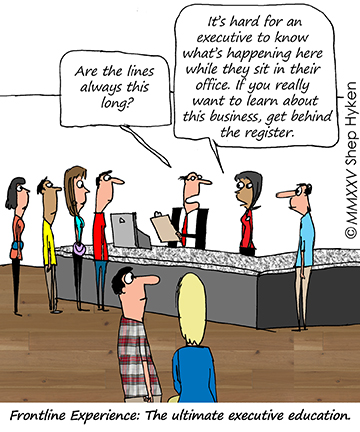
Frontline Experience

When Leaders Get Out of Their Offices

This story illustrates the importance of leaders getting out of their offices and experiencing what’s happening in the field or on the front line. Reading reports and analyzing data are part of the job, but when it comes to customer experience, nothing beats getting firsthand information.

Bezos, in effect, mystery shopped his company, pretending to be a customer. What he was really doing was trying to get to the truth. Sometimes the truth can be experienced directly, or it can be observed.

For example, as I wrote about in my book I’ll Be Back: How to Get Customers To Come Back Again and Again, Bill Gates, the founder of Microsoft, visited the company’s product support center and talked to customers. He sat down at a desk in a cubicle, put on a headset, picked up the phone and said, “Hello, this is Microsoft Product Support, William speaking. How can I help you?”

The beauty of these simple strategies, which provide firsthand information about what customers are experiencing, what they’re asking or what they’re complaining about, is that, for the cost of a little time and effort, they’re incredibly revealing. You don’t need surveys. You need to be willing to see your company through your customers’ eyes.

One other thought about what Bezos and Gates did. They didn’t keep their efforts a secret. When your team sees you personally calling your company or taking customer support calls, they understand that customer service and CX are a priority that starts at the top.

So, take a page from the Jeff Bezos and Bill Gates playbooks. Pick up the phone. Visit a store. Experience your website. Spend time on the front line. Experience and learn about your business as your customer would. You might be surprised by what you discover, and your customers are sure to appreciate the changes that follow.

Image credits: Unsplash

Subscribe to Human-Centered Change & Innovation WeeklySign up here to join 17,000+ leaders getting Human-Centered Change & Innovation Weekly delivered to their inbox every week.

Do You Have What It Takes to be a Visionary?

Do You Have What it Takes to be a Visionary?

Exclusive Interview with Mark C. Winters

Visionaries are often celebrated for their ideas, their intensity, and their ability to see what others can’t. But what’s far less understood — and far more consequential — is how Visionaries actually win over time. Not just by dreaming bigger futures, but by building the clarity, structure, and self-awareness required to make those futures real without burning themselves or their organizations to the ground.

In this wide-ranging interview, we explore what it truly means to be a Visionary inside a growing organization. From the essential partnership between Visionary and Integrator, to the hidden blind spots that slow progress, to the role of health, self-knowledge, and what “winning” really looks like, this conversation goes well beyond mythology. It offers a grounded, experience-tested look at how Visionaries can amplify their impact, reduce chaos, and create the kind of freedom they were chasing in the first place.

Today we dive deep into the characteristics and interactions of the Visionary with our special guest.

From Vision to Reality: What It Really Takes to Lead What’s Next

Mark C. WintersMark C. Winters is an entrepreneurial leader with 30-plus years building and advising companies, from startups sketched on a napkin to global enterprises like Proctor & Gamble and BP.

This range of experience helps him spot patterns fast and apply what works to almost any business scenario. Author of Visionary, co-author of Rocket Fuel, founder of Rocket Fuel University, and host of the Rocket Fuel podcast, Mark helps visionary entrepreneurs get unstuck and expand their unique freedom — exponentially.

He’s delivered 1,000+ full-day EOS® workshops with clients from around the world.

Below is the text of my interview with Mark and a preview of the kinds of insights you’ll find in Visionary: How Driven Entrepreneurs Get What They Want Without Doing It All Themselves presented in a Q&A format:

1. What is a Visionary and why does every successful organization have one?

A Visionary is the person who sees the future before it arrives. Endless ideas to help us get there. Big external relationships.

They live in the world of possibility. They connect dots others don’t yet see. They define where the organization is going and why that matters.

Every ambitious organization has one, whether they acknowledge it or not. Progress doesn’t come from squeezing more out of what we have… It comes from seeing a future that doesn’t yet exist. Absent a Visionary, organizations tend to stay pretty much where they are. Maybe they do more of the same. Or maybe they do the same stuff a little better. But they’re unlikely to actually change the game.

That said, here are two important notes:

  1. Every organization doesn’t require the same amount of Visionary. There’s actually a range that we call the “visionary spectrum.” It needs to be a match.
  2. Visionaries don’t win by themselves. Vision alone, without execution, is merely hallucination. And that’s quite often the biggest challenge.

2. How does the Visionary differ from the Integrator and why do you need both?

The Visionary sees the future. They “make it up.”
The Integrator “makes it real.”

Visionaries think in leaps. Integrators think in projects, processes, and systems. Visionaries are energized by what could be. Integrators are energized by what must get done.

You need both because they solve different problems. Visionaries break through ceilings. Integrators remove friction and create traction. When they’re aligned, you get clarity, momentum, and leverage. When they’re not, you get chaos, burnout, and frustration.

This is an intentional pairing of two very different capability sets. When surrounded by the right structure (which we call the 5 Rules), the friction of these polar differences gets blended into a powerful positive force. Thus the name of our first book, ROCKET FUEL (with Gino Wickman).

3. What are the key elements of the Entrepreneurial Operating System (EOS) that make it so powerful?

EOS works because it does three things exceptionally well:

  1. It creates clarity and focus: vision, priorities, roles, and expectations are no longer fuzzy.
  2. It instills discipline: weekly pulses, data, and accountability replace good intentions.
  3. It strengthens the leadership team. They get healthy. Important issues get surfaced and solved – instead of avoided.

For Visionaries, a “business operating system” such as EOS is powerful because it aligns the energy of all the people in the organization. It’s very powerful when all those arrows are pointed in the same direction.

4. Why is it so important for a Visionary to understand themselves — and what are they trying to understand?

Because “Knowing Thyself” is the big multiplier.

It all starts with figuring out who you are now, and where you want to go.

From there, you must understand how this business is going to help you make that happen.

And then become aware of how your behavior is either helping or hurting that process.

Visionaries don’t need to become different people. They need to become clearer versions of who they already are.

They’re trying to understand:

  • What truly energizes them
  • What drains them
  • Where they create the most value
  • Where they unintentionally cause damage

Without that clarity, Visionaries tend to overstep, under-delegate, or send mixed signals. With it, they make better decisions, build better teams, and experience more freedom.

5. Why is the crashing together of the wellness and biohacking trends so important for entrepreneurs?

Because Visionaries are high-output humans running long races. This demands that you maintain “Warrior Shape.”

You can’t separate performance from health anymore. Energy, focus, emotional regulation, and recovery all directly impact leadership effectiveness.

The danger is chasing hacks instead of fundamentals. Biohacking without the proper foundation can become another form of self-sabotage.

Elite performance starts with basics: sleep/recovery, fitness/movement, nutrition, and boundaries. Get those right first. Then optimize from there.

6. What are some of the most common blind spots for visionaries?

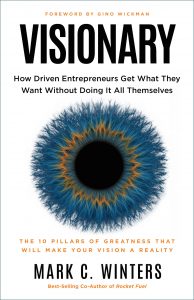
Visionary book coverA few show up again and again:

  • Thinking out loud without context
  • Changing direction too quickly (or too often)
  • Holding onto too much for too long (becoming the bottleneck)
  • Confusing passion with priority
  • Underestimating the impact of their words

These blind spots don’t come from ego or bad intent. They come from the very natural instincts and habits of people who are wired as Visionaries. However, left unchecked, they slow everything down. In turn, slowing the Visionary themselves from getting what they want.

7. Tell us more about Intrinsic Genius and why it matters.

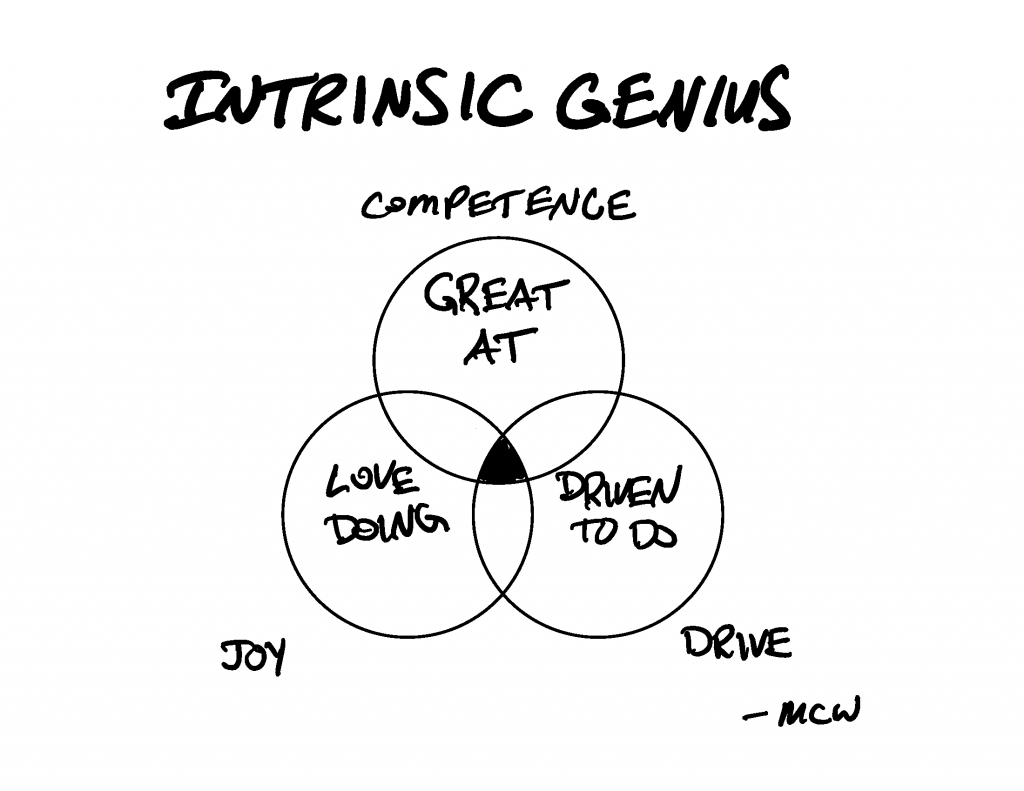
Intrinsic Genius lives at the intersection of three things:

  • Competence – what you’re naturally good at
  • Joy – what energizes you most
  • Drive – the purpose and cause that propel you forward

When Visionaries operate inside that zone, their impact compounds. When they drift outside it, everything feels heavier than it should.

Understanding Intrinsic Genius isn’t about self-indulgence. It’s about tapping fully into the unique contribution you were built to make. And your maximum impact.

Intrinsic Genius

8. Are all Visionaries the same?

Not even close.

I talked earlier about the Visionary Spectrum. And that’s one way to think about it – as a defined function of the business that requires a certain set of capabilities.

While the Visionary patterns are similar, they certainly show up in different ways. Some are bold and extroverted. Others are quiet and introverted. Some thrive on disruption. Others on pulling things together. What they share isn’t style, it’s their orientation toward the possible future.

9. Besides partnering with an Integrator, what other roles should surround a Visionary?

Visionaries need what I call a “shield wall” to surround them. Protecting them from dangerous external threats, and preparing them to engage the world from their most powerful base.

A great shield wall is made up of 7 unique “posts” that support the Visionary by providing 7 special “forces.”

That includes:

  • Truth-tellers who challenge their thinking
  • Operators who translate ideas into action
  • Coaches who help them see patterns
  • Peers who can relate to the journey

Isolation is a common feeling for a Visionary. Having the right people around them can stabilize and amplify their signal.

10. People lionize Visionaries like Steve Jobs. How do Visionaries go off-track?

Usually in three ways:

  1. They start believing their own mythology
  2. They confuse intensity with effectiveness
  3. They stop listening

Visionaries go off-track when their strengths run unchecked. Greatness isn’t about being right more often. (In fact, intellectual humility is a healthy attribute.) Instead, it’s about building structure that creates clarity, alignment, and focus in everyone else, while you pursue what’s possible.

11. What is Visionary Chaos and how is it avoided?

Visionary chaos is what happens when ideas outpace clarity, alignment, and execution. They flood the system. They tamper.

It shows up as initiative overload, organizational whiplash, confused priorities, exhausted teams, uncertainty, and slow execution.

It’s avoided through structure, cadence, and restraint. Not by silencing the Visionary, but by sequencing their best ideas. Go slow to go fast.

12. Why is it dangerous for leaders to think out loud?

Because Visionaries don’t always realize how loud their voice is to the people around them .

What feels like a passing thought to a Visionary often feels like a directive to those who hear it. Thinking out loud creates false urgency, unnecessary work, and more whiplash.

This can be avoided by creating safe places to think out loud – where everyone present knows that’s what’s happening… and label the brainstorming. “No Action Needed.”

13. Is there a question you wish I had asked?

Yes.

How does a Visionary know if they’re actually winning?

In my experience, this question is not just about financial numbers, but about your Unique Freedom. Your definition of that is different than mine, is different than theirs, and is different than every other Visionary’s. It’s truly unique to you. So you must first solve for that. This is why I created the Exponential Freedom Model, and the 9 Domains of Freedom.

Clarify the future you want. Draw a line back to the present. Then focus on the near-term activities (and habits) that will increase the probability of making that future real.

“Clarity. Focus. Freedom.”
It’s that simple – just not easy.

To experience more of the Unique Freedom you seek, without being trapped by the business you built. That’s the real promise of becoming a great Visionary.

Conclusion

Thank you for the great conversation Mark!

I hope everyone has enjoyed this peek into the mind of the man behind the insightful new title Visionary: How Driven Entrepreneurs Get What They Want Without Doing It All Themselves!

Image credits: Mark C. Winters, ChatGPT

Subscribe to Human-Centered Change & Innovation WeeklySign up here to join 17,000+ leaders getting Human-Centered Change & Innovation Weekly delivered to their inbox every week.

6 Leadership Conferences For Those Without a Davos Invite

6 Leadership Conferences For Those Without a Davos Invite

GUEST POST from Robert B. Tucker

If you didn’t receive an invitation to Davos, the annual World Economic Forum happening now in Davos, Switzerland, don’t feel deprived. By most accounts, Davos is no longer what it once was.

For decades, Davos was the most prestigious conference attended by global political and business leaders committed to improving the state of the world. Topics frequently included sustainability, corruption, and income inequality. But in an era defined by acceleration, authoritarianism, and disruptive technologies, Davos increasingly resembles what it has tried to avoid becoming: just another elite business meeting, heavy on power, light on moral imagination.

This year’s willingness to set aside core principles to accommodate political spectacle underscores how much the event has drifted from its founding spirit.

But the fading luster of Davos should not diminish the value of leadership conferences. As a business futurist and innovation speaker, these are my favorite and I highly recommend them. Stepping away from daily demands to engage in perspective-shifting conversation is especially important today when there is so much change. As someone who has participated in all sorts of conferences across industries and continents, I’ve found leadership conferences — done well — to be among the most personally rewarding investments leaders can make.

Unlike plain-Jane business conferences that focus on tactics or transactions, the best leadership gatherings expose you to ideas that stretch your assumptions. They introduce you to movers and shakers outside your usual orbit. And they help you align your organization — and your life — with the Mega-Forces shaping the future. At their best, such conferences allow you to “trade minds” with thinkers and practitioners who are wrestling seriously with the same questions you are.

What follows are six leadership conferences worth considering in 2026. Each offers a different doorway into the ideas, values, and conversations leaders need in the Age of Acceleration. Attend even one, and you’re likely to return changed — not just better informed.

1. SXSW Austin, Texas | March 12–18, 2026

I was so impressed after my attendance at SXSW in 2018 that I wrote a Forbes column about the experience. Founded in 1987 as a music festival, SXSW has evolved into one of the world’s most influential cross-disciplinary gatherings, drawing leaders from technology, media, film, music, and culture.

The conference endured a near-fatal crisis in 2020, when it was forced to cancel just days before opening due to COVID-19 — the first cancellation in its history. Subsequent virtual and hybrid iterations helped it survive, though many would agree the event is still rediscovering its pre-pandemic rhythm.

That said, if you can handle large crowds, SXSW remains a powerful collision point for ideas and serendipity. It offers a rare opportunity to see how cultural, technological, and societal shifts intersect — and where new possibilities may emerge.

2. Lead Where You Stand Conference, Santa Barbara, California | June 4–5, 2026

Founded in 2015 by visionary leader, Dr. Gayle Beebe, this intimate West Coast conference has become a quiet must-attend for business and NGO leaders seeking to create greater impact, no matter where they are planted. Anchored in Christian moral values, this annual gathering emphasizes character, community, and forward-thinking responsibility in leadership.

Since its inception, The New York Times columnist David Brooks has been a central voice and a guiding light. (Full disclosure: I’ve been invited to speak this year on “Leading and Flourishing in the Age of Acceleration.”)

Formerly held on Westmont College’s bucolic Montecito campus, sell-out demand has pushed Lead Where You Stand to move to a nearby resort hotel. The test ahead will be preserving its reflective intimacy as it scales.

3. ALIVE: Intentionally Evolving Our Futures, Asheville, North Carolina | April 23–25, 2026

ALIVE is not a conference in the conventional sense — it is an immersive experience designed for leaders who believe the future is not something to predict, but something to shape. Limited to 100 participants, the gathering brings together foresight practitioners and organizational leaders from around the world.

There are no traditional panels or slide decks at this conference. Instead, ALIVE unfolds as a co-creative journey organized around becoming future-ready, future-empowered, and future-conscious. Participants are invited to sit with uncertainty, learn alongside peers, and renew their sense of agency and empowerment to build a better future.

In an era saturated with screens and algorithms, the value of in-person, human-to-human engagement — free of bots and buzzwords—cannot be overstated.

4. The Future of Everything Festival, New York City | May 4–5, 2026

Produced by The Wall Street Journal, this high-impact convening brings together CEOs, scientists, policymakers, technologists, and cultural thinkers to examine the forces reshaping business and society. Topics range from AI and geopolitics to climate, health, and the future of work.

What distinguishes this conference is its intellectual range and seriousness. Big ideas are grounded in real-world implications. Attendees leave with sharper insight into emerging risks, overlooked opportunities, and the strategic choices leaders must make in an age of relentless change. This one is not about tactics — it’s about perspective.

5. Harvard Flourishing Summit, Cambridge, Massachusetts | March 18–19, 2026

Conceived by Harvard professor Tyler J. VanderWeele, Director of the Human Flourishing Program, this summit invites leaders to ask deeper questions about what success truly means. Drawing on research across public health, psychology, economics, and philosophy, the gathering reframes flourishing as a rigorous, evidence-based framework encompassing meaning, relationships, character, health, and contribution.

At a time when leadership conversations are dominated by speed and scale, the Summit offers something rare: space to reflect on values, direction, and purpose — and to ask not just how fast we are moving, but toward what kind of future.

6. Aspen Ideas Festival Aspen, Colorado | June 25 – July 1, 2026

Founded in 2005 by the Aspen Institute, a liberal think tank, the Aspen Ideas Festival has become a flagship gathering for exploring the world’s most pressing issues. Policymakers, business innovators, scientists, artists, and authors converge for a week of deep dialogue across disciplines.

With roughly 3,000 attendees and hundreds of sessions, the festival blends structured programming with informal exchanges over meals and mountain walks. Topics span public policy, technology, health, culture, economics, and leadership — offering both breadth and depth in equal measure.

Why One Leadership Conference a Year Matters

In a world moving faster than our institutions — and often our leadership capabilities — can keep up with, attending at least one leadership conference each year is no longer a luxury. It is a discipline. The right gathering can restore your sense of perspective, sharpen your foresight, and reconnect you to the values that first called you to leadership.

You don’t need an invitation to Davos to engage seriously with the many forces driving the future. You simply need the courage to step out of the day-to-day, enter an environment where ideas and values still matter, so that you return home prepared to build a better future.

This article originally appeared in Forbes

Image credit: Unsplash

Subscribe to Human-Centered Change & Innovation WeeklySign up here to get Human-Centered Change & Innovation Weekly delivered to your inbox every week.

Building Trust as a New Leader

Building Trust as a New Leader

GUEST POST from David Burkus

Most new leaders know they need to build trust with their team. But here’s where it gets tricky: what if it’s not your team — at least, not yet?

Imagine stepping into a leadership role where you didn’t get to pick the team. Maybe you were hired from outside the organization. Maybe you were promoted from another department. Either way, you’re the new leader, and the team you’re inheriting doesn’t know you yet. You don’t know if they’ve been burned before by a previous boss. You don’t know what scars or successes they carry. What you do know is that you need to build trust — and fast.

This is where most new leaders stumble. They try to shortcut the process. They launch a flurry of team-building exercises. They host lunches. They schedule marathon one-on-one meetings. These efforts come from a good place, but they often miss the mark. Because trust isn’t actually built. Trust isn’t even earned. Trust is reciprocated.

And if you’re serious about developing trust with a new team, you need to understand how that trust loop really works — and how to keep it moving forward.

Why Traditional Trust-Building Strategies Fall Short

When stepping into a new leadership role, it’s tempting to think that trust builds linearly — more lunches, more meetings, more smiles equals more trust. But that’s not how trust actually grows.

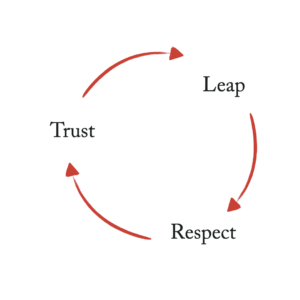
Trust moves in a loop, not a line. It starts with a small trust connection — maybe a conversation over coffee — and invites a tiny leap of faith from your team. Someone shares a new idea or dares to give you honest feedback. If you respond with respect — if you listen, appreciate, and show genuine curiosity — you complete the loop. You signal: It’s safe to trust me.

That small leap leads to slightly bigger risks. More candid conversations. More creative ideas. More vulnerability across the board. If you keep meeting those risks with respect, the trust loop keeps spinning faster and stronger. But if you miss those moments — or worse, get defensive — you stop the loop cold.

For a new leader, mastering this trust loop is everything.

Trust Loop

How a New Leader Can Truly Build Trust

Building trust with a team you didn’t pick requires deliberate, daily actions. Here are four research-backed strategies to get the trust loop turning — and keep it spinning.

1. Signal Vulnerability Early

Everyone already knows you’re new. They know you don’t have all the answers yet. Pretending otherwise just makes you seem insecure or out of touch. Instead, lean into your newness.

Say things like, “I’m still learning how this team works.” Then prove it by listening. Create a space where people feel safe to teach you. This early show of vulnerability sparks empathy — and empathy is the gateway to trust.

When a new leader admits they don’t have it all figured out, it invites others to open up, too. It shows that you’re not just here to impose your will — you’re here to learn and lead together.

2. Share Information Transparently

Eventually, as the new leader, you will need to drive change. That’s probably part of why you were brought in. But when you do, don’t operate behind closed doors.

Instead, treat your team like insiders. Pull back the curtain. Share early information about strategy shifts or organizational changes. Say things like, “This isn’t finalized yet, but here’s what I’m hearing and thinking — and I’d love your perspective.

Transparency builds belonging. It signals, I trust you with this information. And when people feel trusted, they’re much more likely to trust you in return.

3. Respond to Vulnerability with Respect

When your team members finally take a risk — whether it’s sharing a frustration, giving you feedback, or floating a bold idea — recognize it for what it is: a test.

They’re not trying to undermine you. They’re trying to see if you’re the real deal.

Your job isn’t to defend your decisions or your leadership history. It’s to listen. Ask clarifying questions. Thank them for being honest. Engage with their ideas sincerely — even if you don’t ultimately agree.

The way you respond to those early leaps of faith will define whether the trust loop accelerates — or seizes up.

4. Amplify Unheard Voices

One of the easiest ways to build trust with a new team is to ensure every voice is heard, especially the quieter ones. When historically quiet team members finally speak up, make it clear their input matters. Amplify their ideas in meetings. Circle back to them in discussions. Let the entire team see that contributions aren’t just tolerated — they’re valued. Without open communication, hierarchy and politics creep in fast. By contrast, when people feel heard and respected, they lean in with greater commitment and creativity.

Trust First, Change Second

Inheriting a team is tough. You’re stepping into a culture you didn’t create, with dynamics you don’t fully understand yet. And because you’re the new leader, it’s tempting to rush into action — prove yourself, make changes, shake things up. Resist that temptation.

The real work of a new leader is not about being liked. It’s about being vulnerable. Encouraging interpersonal risks. Meeting those risks with deep respect. That’s how you build trust. That’s how you turn a group of individuals into a committed team.

Because at the end of the day, you don’t want a compliant team that simply does what they’re told. You want a committed team that’s ready to go above and beyond — and commitment always starts with trust.

Image credit: Pixabay

Subscribe to Human-Centered Change & Innovation WeeklySign up here to get Human-Centered Change & Innovation Weekly delivered to your inbox every week.

11 Signs Your Transformation Is Managing the Deck, Not the Work

11 Signs Your Transformation Is Managing the Deck, Not the Work

by Braden Kelley and Chateau G Pato


What Does It Mean When a Transformation Manages the Deck, Not the Work? (Short Answer)

Your transformation is managing the deck, not the work, when governance energy goes to RAG colors, narrative polish, and workstream theater while the median employee’s Tuesday — tools, handoffs, incentives, and authority — stays the same. Eleven signs: RAG greener than reality, slide time over floor time, status agendas without decisions, activity reporting instead of behavior, risks that only live in registers, change as cascade and completions, dependencies as Gantt arrows, problems parked until next steering, go-live as finish line on the roadmap, vendor demos owning the room, and shadow process “managed” as residual risk.

A deck is a mirror. When the program starts performing for the mirror, the work has already left the room.

Green Decks, Red Tuesdays

I have sat in enough steering rooms to recognize the smell of a program that has become a reporting product. The slides are crisp. The RAG is mostly green. Workstreams have spoken. Risks have been “mitigated.” Someone thanks the PMO for the pack.

Then you walk the floor — or talk to the median person trying to do the new job with the old incentives — and Tuesday is still red.

That gap is not a communication problem. It is governance theater: managing the artifacts of transformation as if they are the transformation. The work — redesigned jobs, owned handoffs, killed shadow processes, practiced capability, and behavior after go-live — never gets the same energy as the deck.

Sign Deck reality Work reality
1. RAG greener than Tuesday Status looks healthy Workarounds still run the day
2. Slides over floor time Pack is polished Nobody watched the median user
3. Status, not decisions Tour complete Nothing killed or funded
4. Activity, not behavior Milestones hit Old path still preferred
5. Risks in the register Rated and reviewed Broken handoff still daily
6. Cascade = change Completions high Capability thin
7. Dependencies as arrows Gantt looks integrated Seams have no owner
8. Problems parked On next month’s agenda Blocker lives this week
9. Go-live as climax Roadmap peaks at cutover Adoption is a footnote
10. Vendor demos own the room Product theater Adopters absent
11. Shadow process “managed” Labeled residual / out of scope Old path still easy

1. Why Is a Green RAG a Warning Sign When Tuesday Is Still Red?

The sign: Status is amber or green while frontline effort, workarounds, and adoption quality are clearly red.

Why it seduces: Color coding is legible in fifty minutes. Lived experience is not. Leaders can leave the room feeling informed.

Manage the work instead: Dual truth — system status and human success. A green RAG cannot close the review if the experience is red. If status and Tuesday disagree, Tuesday wins.

2. What Does It Mean When Slide Production Outruns Floor Time?

The sign: The team’s scarce hours go to deck assembly, appendix hygiene, and “story alignment” — not ride-alongs, floor walks, or watching the median user struggle.

Why it seduces: The pack is a visible deliverable. Floor time looks soft and does not photograph in the steering invite.

Manage the work instead: Cap slide hours. Require evidence from contact with the work in every steering pack — a quote, a timed task, a workaround still in use. No floor signal, no green story.

3. How Do You Spot a Steering Agenda That Is Status, Not Decisions?

The sign: Steering meetings are tour updates. Few tradeoffs named. Few things stopped. Few owners assigned for next Tuesday.

Why it seduces: Status feels safe. Decisions create losers, vendors, and uncomfortable clarity.

Manage the work instead: Decision-first agenda — what must we choose, kill, fund, or unblock before we leave? If the meeting ends with “thanks for the update,” you managed the deck.

4. Why Is Reporting Activity Instead of Behavior a Transformation Trap?

The sign: Workstreams celebrate milestones, tickets closed, training launched, and “progress against plan” — not whether humans stopped the old path or succeeded on the new one.

Why it seduces: Activity is countable. Behavior change is political and harder to put in a chart.

Manage the work instead: One behavior metric per workstream — adoption quality, workaround retired, time-to-confidence. Progress that cannot name a human behavior is still theater.

5. When Do Risk Registers Become Governance Theater?

The sign: Risks are rated, mitigated on paper, and reviewed monthly — while the broken handoff still happens daily.

Why it seduces: Registers look like governance. Fixing the workflow looks like operations, which someone else is supposed to own.

Manage the work instead: Every top risk must map to an owned workflow change this sprint — or it is a slide, not a control. Mitigation without a Tuesday owner is fiction.

6. Why Isn’t Cascade Decks and Training Completions Real Change Management?

The sign: Comms plans, town halls, and training completion percentages are the change scorecard. Practice, coaching, and permission to stop the workaround are missing.

Why it seduces: Completions are procurable and reportable. You can screenshot the cascade. You cannot screenshot someone’s third Tuesday failing with the old incentives still in force.

Manage the work instead: An enablement scorecard — practice on real work, manager coaching, protected learning time. Informed is not enabled.

7. What Goes Wrong When Dependencies Are Arrows Instead of Owned Handoffs?

The sign: The Gantt shows neat dependencies. Nobody can name who owns the seam between teams when it breaks on Tuesday.

Why it seduces: Planning software creates the illusion of integration. Arrows feel like ownership.

Manage the work instead: Name seam owners. Design the handoff. Test the seam before you celebrate the milestone. Integration that only exists in the plan does not exist.

8. Why Is Parking Problems Until the Next Steering Pack a Red Flag?

The sign: Issues escalate into “for discussion next month” rather than a 48-hour fix with an owner. The deck becomes a waiting room.

Why it seduces: Cadence protects calendars. Urgency threatens the narrative and the RAG.

Manage the work instead: Fast-path ownership for anything blocking the median user’s success this week. If it can wait a month, it was never blocking the work — only the story.

9. Why Shouldn’t Go-Live Be the Finish Line on the Roadmap Slide?

The sign: The visual climax of the program is cutover. Hypercare is a thin bar. Adoption and BAU ownership are footnotes.

Why it seduces: Vendors and PMOs get paid at go-live. Steering committees want a date they can declare. Adoption is someone else’s Tuesday.

Manage the work instead: Make the roadmap climax a durable new way of working. Go-live is a technical event. Transformation is behavior that survives after the PMO leaves.

10. What Does It Mean When Vendor Demos Own the Room and Adopters Don’t?

The sign: Steering time goes to product walkthroughs and roadmap theater. The people who must live the change are absent, summarized, or reduced to a survey chart.

Why it seduces: Demos photograph well. Adopters complicate the story with workarounds, missing authority, and truths that do not fit the narrative.

Manage the work instead: Adopter voice as a standing agenda item — what broke, what workaround returned, what decision rights are missing. If adopters are not in the room, you are managing a brochure.

11. Why Is “Managing” Shadow Process as Residual Risk Still Failure?

The sign: The old spreadsheet, parallel path, or “just in case” process is acknowledged on a slide and left alive — draining adoption while status stays green.

Why it seduces: Killing the old way is political. Labeling it residual or out of scope feels tidy and keeps the RAG calm.

Manage the work instead: Explicit kill date and owner for the shadow path. Make the new way the only easy way. A residual risk that still runs the business is not residual. It is the operating model.

How Do You Test Whether You’re Managing the Deck or the Work?

Before the next RAG review, run five go/no-go questions. If you cannot answer them, you are performing transformation for an audience that can leave the room:

  1. What evidence from the floor is in this pack — not only from the plan?
  2. What decision will we make today — choose, kill, fund, or unblock?
  3. What behavior changed since last month for the median person?
  4. What will we stop — not only mitigate on a register?
  5. Who owns the median user’s Tuesday after go-live when the PMO leaves?

If the beliefs underneath the theater need naming, see 8 Change Myths Leaders Still Believe in 2026. If the pilot worked and scale did not, use 9 Reasons Digital Transformations Stall After the Pilot. Before the next funded experiment, run 11 Questions Before Funding Any Innovation Pilot.

If the deck is healthier than the work, you are not transforming. You are managing the mirror. Put the energy back into Tuesday — and let the slides catch up to reality, not the other way around.

Frequently Asked Questions

What does it mean when a transformation manages the deck, not the work?

It means the program optimizes RAG status, narrative polish, and workstream reporting while the median person’s tools, handoffs, incentives, and authority stay unchanged. Governance energy goes to slides instead of redesigned work, owned seams, killed shadow processes, and behavior after go-live.

How do you know a transformation is failing?

Warning signs include green status with red frontline experience, steering agendas that never make decisions, activity metrics instead of behavior change, risks that only live in registers, go-live treated as victory, and old shadow processes left alive while labeled “mitigated.”

What should a transformation steering committee focus on?

Focus on decisions — what to choose, kill, fund, or unblock — plus floor evidence, behavior change since last month, and who owns the median user’s Tuesday after go-live. Status tours and vendor demos are insufficient if adopters and seams have no voice or owner.

Why are transformation RAG statuses misleading?

RAG colors often track plan, milestones, and system readiness — not human success, workaround retirement, or adoption quality. A green RAG can coexist with a red Tuesday when the scorecard rewards narrative hygiene over lived experience.

How do you fix transformation governance theater?

Require floor evidence in every pack, run decision-first steering, add one behavior metric per workstream, map top risks to owned workflow changes, fund enablement over cascade completions, name seam owners, kill shadow paths on a date, and treat go-live as a technical event — not the finish line.

Image credits: Google Gemini

Content Authenticity Statement: The topic area, key elements to focus on, etc. were decisions made by Braden Kelley, with a little help from Google Gemini and Cursor to clean up the article, add images and create infographics.

Subscribe to Human-Centered Change & Innovation WeeklySign up here to get Human-Centered Change & Innovation Weekly delivered to your inbox every week.