Category Archives: Change

Architecting the Organization for Change

Architecting the Organization for ChangeIn my last article and the first free download from the Change Planning Toolkit™ on The Five Keys to Successful Change™ we looked at the five different disciplines that must come together to make any organizational change effort (or even a project) successful. They included:

  1. Change Planning
  2. Change Leadership
  3. Change Management
  4. Change Maintenance
  5. Change Portfolio Management

While most people would agree that change is a constant, it is not however a constant focus for the business. One of the reasons many organizations are so bad at change is that they are not architected for change and pay attention to only one or two of The Five Keys to Successful Change™. Instead most organizations focus on executing the day-to-day business and they focus on executing a portfolio of projects, hopefully on time and on budget. In some cases, projects may incorporate some elements of Change Management (usually too late in the process) and ignore Change Planning, Change Leadership, Change Maintenance, and Change Portfolio Management.

As a result, most organizations are terrible at change. And ultimately, most organizations are bad at innovation because they’re bad at change.

Most companies focus on delivering a set of new systems, products, and services prioritized purely on the ROI they may return, instead of consciously executing ‘Big C change efforts’ and ‘Little C change projects’ to support a constantly evolving business architecture that changes in support of a fluid strategy driven by constantly changing customer behaviors (including wants/needs), regulation and competition, and influencing changes in employee, supplier, and partner behaviors. Continuous improvement and innovation then are effectively tools used to keep the organization successfully aligned to maintain the optimum levels of competitiveness and customer connection.

In this article we will explore some of the ways that organizations need to re-think the way that the firm is structured, in order to place change purposefully at the center, enabling enable increases in organizational agility and the building of continuous change capabilities.

Architecting the Organization for Change

Architecting the Organization for Change helps organizations:

  • Visualize a new way to increase organizational agility
  • Integrate changes in the marketplace and customer behavior into the strategy
  • Create a new organizational architecture that integrates all five elements of organizational change
  • Make project, behavior and communications planning and management a central component of your change efforts

One thing that should immediately jump out as you look at the image of the Change Planning Toolkit™ download titled Architecting the Organization for Change, is that The Five Keys to Successful Change™ are embedded in the framework.

Change Maintenance forms the foundation of a change-centric organization, ensuring that the changes necessary to ensure a healthy firm continue to persist (or are “maintained”), while the top of the organizational pyramid is driven by a conscious strategy that evolves over time, informed by changes in customer behavior and changes in the marketplace.

The strategy of the firm then determines the appropriate business architecture, and as the organization’s strategy changes, the business architecture may also need to change. Any necessary changes in the architecture of the business (new or updated capabilities or competencies) then will lead to modifications to the portfolio of change initiatives and projects (and remember every project is a change effort). These projects and initiatives will consist of innovation initiatives and efforts to create positive changes in the operations of the business.

The change efforts and projects identified as necessary and invested in as part of the change portfolio then represent projects that impact the innovation and operations for the firm, and in order to successfully execute them in the short term includes change planning, management, and leadership, and in the longer term the maintenance of the required changes.

And for the change efforts and projects to be successful the organization must also focus on project planning and management, behavior planning and management, and communications planning and management. The related projects, behaviors, and communications must all be effectively planned and managed in a way that keeps all three in sync.

I hope you see that by increasing your focus on the Change Planning discipline and increased use of the Change Planning Toolkit™ and tools like the Architecting the Organization for Change framework will allow businesses to more collaboratively and visually plan each change effort and prepare the plans for the Change Management and Change Leadership teams to execute with help from the Project Planning, Project Management, and Change Maintenance professionals in the organization.

I hope you’ll come join me on this journey to improve the pace and execution of change efforts in our organizations!

Sign up for Change Planning Toolkit™ launch updates

Click to access this framework as a scalable 11″x17″ PDF download

Accelerate your change and transformation success

Subscribe to Human-Centered Change & Innovation WeeklySign up here to get Human-Centered Change & Innovation Weekly delivered to your inbox every week.

The Future of Fractional Employees

The Future of Fractional Employees

In my last article 10 Reasons to Hire a Part-Time Chief Innovation Officer, I looked at the reasons why an organization might want to hire someone part-time to lead their innovation efforts (a follow-up to my previous post Hiring the Right Chief Innovation Officer).

Now I’d like to explore the idea of a fractional employee in a much broader context with you. A few years ago in my popular white paper Harnessing the Global Talent Pool to Accelerate Innovation commissioned by Innocentive, I introduced the idea of building a global sensing network along with other ways that companies can reach outside their four walls to speed up their ability to innovate. I have continued since then to hypothesize that successful organizations of the future will possess more porous boundaries, becoming less like castles keeping everything inside their walls and more like atoms, freely combining with other atoms to form the molecules the market requires just-in-time.

Organization of the Future

Purpose and Passion

One of the key tenets of this belief is that purpose and passion are the key to unlocking the full potential of any human, and that inherently companies do a very job of unlocking either in their quest to match resumes with job descriptions.

In an effort to develop and retain employees, and fill discrete project needs, some companies are reaching beyond the job description to try and tap into more of the knowledge, skills, and abilities of the people they hire. One way this happens is through HR initiatives like the internal internships at Cisco, where a Finance employee with an interest or passion for marketing, could do an internal internship in Marketing, spending a small number of hours each week working on a discrete project with a resource need.

Outside of the organization, there are an increasing number of avenues for employees to use their un-tapped knowledge, skills, and employees to satisfy their quest for passion and purpose. These include challenge driven marketplaces for both crowdsourcing and open innovation, places like Innocentive, 99 Designs, Idea Connection, Crowdspring, and others.

Traveling the Hyperloop Ten Hours a Week

But now, we are starting to see direct to talent (DTT) models emerge. The latest example of the fractional employee model comes from Dirk Ahlborn of Hyperloop Transportation Technologies (HTT), rethinking how companies are built in the first place. Instead of hiring full-time, salaried employees, Ahlborn has decided to crowdsource the labor to part-time workers and offer stock options in lieu of salary, successfully attracting about 450 workers, based in more than a dozen countries, moonlighting from organizations like NASA and Boeing.

HTT requires crowdsourced labor to commit to a 10-hour workweek to be eligible for stock. “The guys are working for stock options — they’re doing 10 times better job [than paid employees],” says Dirk Ahlborn.

Companies like Aecom, one of the world’s largest engineering design firms, are joining individuals in participating in the potentially “transformative” project, as a way to get employees executing mundane projects for the company to also get excited about building something new.

“I always tell everyone it’s a marathon, not a sprint,” Ahlborn says. With 450 workers accumulated over the past couple of years and growing, Ahlborn adds, “It is becoming a movement.”

The Way Forward

From internal internships, to challenge-driven external innovation, to crowdsourced projects, to fractional employee initiatives, the world of work is changing as companies seek to accelerate to match the pace of continuous change and the continuous innovation expectations that come along with it.

If we go back to the Organization of the Future graphic above, you’ll see that job descriptions often overlap not just with employee knowledge, skills, and abilities but those of customers, partners, suppliers, and other employees as well.

Organizations seeking to increase their organizational agility will not only use tools like the Change Planning Toolkit™ but will also change their thinking about how they get work do

ne and will do a better job of recognizing when and where to tap into the abilities of other employees, partners, suppliers, and even customers to achieve the outcomes that will allow them to continue to surprise and delight their customers, clients, or constituents.

And this means embracing a fractional employee future.

Are you ready?

Get the Harnessing the Global Talent Pool to Accelerate Innovation white paper

Sources: Innovation Excellence, MSN

This article was originally featured on Linkedin


P.S. If you’re looking to hire a Chief Innovation Officer (an Innovation Enablement Leader) on a full-time or part-time basis, drop me an email and I can either tackle the role or find someone else who can!


Accelerate your change and transformation success

Subscribe to Human-Centered Change & Innovation WeeklySign up here to get Human-Centered Change & Innovation Weekly delivered to your inbox every week.
Hiring the Right Chief Innovation Officer

Hiring the Right Chief Innovation Officer

Every company begins as the nimble startup, organized around the solution to a single customer problem and executing that solution better than anyone else in the market (including the incumbents with deep pockets). But at some point the hunter inevitably becomes the hunted and that nimble startup as it evolves and scales, eventually becomes that more complex (but capable) incumbent. Inevitably it finds itself so focused on capturing all of the business for its existing solutions, that it finds itself at risk of missing the next evolution in customer needs.

The companies that last the longest, manage to fulfill existing customer needs with well delivered solutions, and identify new customer needs they can satisfy as customer needs (or wants) continue to evolve. But many companies fail to do so quickly enough, especially in our new reality where it is easier than ever to start and scale a solution around the globe with limited resources. Innovation is the key to remaining relevant with customers. Innovation is the key to remaining alive.

It’s innovate or die, and this new reality leaves all companies focused on Winning the War for Innovation.

This quest to win the war for innovation has led many organizations to begin hiring Chief Innovation Officers (CINO), Innovation Managers, VP’s of Innovation, or Innovation Directors.

But many organizations have done so in haste…

There is a right way and a wrong way to hire a Chief Innovation Officer (or other innovation leader).

In this article we will look at the Do’s and Don’ts of successfully hiring the right Chief Innovation Officer.

First, the Don’ts:

  1. Don’t hire a Chief Innovation Officer before the Board of Directors and senior leadership understands what innovation is (AND ISN’T)
  2. Don’t hire a Chief Innovation Officer before the Board of Directors and senior leaders are all publicly committed to innovation
  3. Don’t hire a Chief Innovation Officer before the Board of Directors and senior leadership have created a budget to fund discrete innovation projects
  4. Don’t hire a Chief Innovation Officer before you move beyond the innovation as a project mindset to view innovation as a process and a capability that you need to build (like good governance or operational excellence)
  5. Don’t hire a Chief Innovation Officer before you understand how new product development (NPD), research and development (R&D), and innovation will differ in your organization

Being cognizant of the Don’ts will help you avoid hiring a Chief Innovation Officer before you’re able to help set them (and the organization) up for success.

We are now ready to look at the Do’s, the characteristics, skills, and abilities to look for as you search for a great Chief Innovation Officer (and team).

As I’ve written before in Death of the Chief Innovation Officer, when we think about hiring a Chief Innovation Officer (CINO) or an Innovation Director, VP of Innovation, or Innovation Manager, it is important to view your innovation leader, not as the person responsible for innovating, but instead as the person responsible for enabling innovation, encouraging it, inspiring it, facilitating it, and coordinating it. In short, what you are looking for is more of an Innovation Enablement Leader.

The implication? This person’s job should be to lead not to manage, and to enable instead of control. What you’re looking for is someone to facilitate the Seven C’s of a Successful Innovation Culture:

  1. Cultivating a Culture of Curiosity
  2. Collection of inspiration and insight
  3. Connections
  4. Creation
  5. Collaboration
  6. Commercialization
  7. Communications

1. Cultivating a Culture of Curiosity

Curiosity drives innovation, and so the more curious people you have in your organization, the more innovation you are going to be able to generate. A good Chief Innovation Officer (Innovation Enablement Leader) can help cultivate a culture of curiosity. Amplifying curiosity in your organization is one of the most important improvements you can make in your culture.

Many of my views on improving your innovation culture have been detailed in this white paper Five Ways to Make Your Innovation Culture Smell Better I wrote for Planview and in my popular book Stoking Your Innovation Bonfire.

2. Collection of Inspiration and Insight

Curiosity is driven by inspiration and insight, and so a good Innovation Enablement Leader excels at collecting and sharing inspiration and insight. This can include:

  • Teaching people inspiration gathering frameworks like the Four Lenses of Innovation from Rowan Gibson and idea generation methods like SCAMPER
  • Installing an insight gathering tool (which may or may not be merged together with an idea management solution)
  • Building a Global Sensing Network (click the link to learn more)

Building a Global Sensing Network

3. Connections

Innovation is about collecting and connecting the dots. A good Innovation Enablement Leader is good at building the connections inside (and outside) the organization that help to accelerate the gathering and dissemination of inspiration, insight, and the other elements crucial to effective (and sustained) innovation. Building on the idea of building a global sensing network (see #2), innovative organizations increasingly turn their attention outwards for innovation, recognizing that there are more smart people outside the organization than inside. This leads a good Innovation Enablement Leader to focus on Harnessing the Global Talent Pool to Accelerate Innovation.

4. Creation

The job of an Innovation Enablement Leader (or Innovation Facilitator) is to serve the rest of the organization and to work across the organization to help remove barriers to innovation and to focus on the Seven C’s of a Successful Innovation Culture. This could also mean providing a set of tools and methodologies for creative problem solving and other aspects of innovation work, organizing events, and other activities that support deepening capabilities across the Seven C’s of Successful Innovation Culture.

And because innovation is all about change, a good Innovation Enablement Leader will have a strong organizational change understanding and capabilities, including an understanding of the Five Keys to Successful Change from the Change Planning Toolkit™ (coming soon) and from my upcoming book Charting Change (Feb 2016):

Five Keys to Successful Change 550

A good Innovation Enablement Leader will know when to create a new innovation in-house, when to partner with an external entity like a University, startup, supplier, or other organization, and when to license a piece of technology or to acquire another company or startup in order to realize the desired innovation result for the company’s customers.

A good Innovation Enablement Leader knows which elements of the successful innovation they can best help to facilitate and where they need to call in help. This leads us nicely into #5.

5. Collaboration

Too often we treat people as commodities that are interchangeable and maintain the same characteristics and aptitudes. Of course, we know that people are not interchangeable, yet we continually pretend that they are anyway — to make life simpler for our reptile brain to comprehend. Deep down we know that people have different passions, skills, and potential, but even when it comes to innovation, we expect everybody to have good ideas.

I’m of the opinion that all people are creative, in their own way. That is not to say that all people are creative in the sense that every single person is good at creating lots of really great ideas, nor do they have to be. I believe instead that everyone has a dominant innovation role at which they excel, and that when properly identified and channeled, the organization stands to maximize its innovation capacity. I believe that all people excel at one of nine innovation roles, and that when organizations put the right people in the right innovation roles, that your innovation speed and capacity will increase.

Nine Innovation Roles

Here are The Nine Innovation Roles:

1. Revolutionary

  • The Revolutionary is the person who is always eager to change things, to shake them up, and to share his or her opinion. These people tend to have a lot of great ideas and are not shy about sharing them. They are likely to contribute 80 to 90 percent of your ideas in open scenarios.

2. Conscript

  • The Conscript has a lot of great ideas but doesn’t willingly share them, either because such people don’t know anyone is looking for ideas, don’t know how to express their ideas, prefer to keep their head down and execute, or all three.

3. Connector

  • The Connector does just that. These people hear a Conscript say something interesting and put him together with a Revolutionary; The Connector listens to the Artist and knows exactly where to find the Troubleshooter that his idea needs.

4. Artist

  • The Artist doesn’t always come up with great ideas, but artists are really good at making them better.

5. Customer Champion

  • The Customer Champion may live on the edge of the organization. Not only does he have constant contact with the customer, but he also understands their needs, is familiar with their actions and behaviors, and is as close as you can get to interviewing a real customer about a nascent idea.

6. Troubleshooter

  • Every great idea has at least one or two major roadblocks to overcome before the idea is ready to be judged or before its magic can be made. This is where the Troubleshooter comes in. Troubleshooters love tough problems and often have the deep knowledge or expertise to help solve them.

7. Judge

  • The Judge is really good at determining what can be made profitably and what will be successful in the marketplace.

8. Magic Maker

  • The Magic Makers take an idea and make it real. These are the people who can picture how something is going to be made and line up the right resources to make it happen.

9. Evangelist

  • The Evangelists know how to educate people on what the idea is and help them understand it. Evangelists are great people to help build support for an idea internally, and also to help educate customers on its value.

As you can see, creating and maintaining a healthy innovation portfolio requires that you develop the organizational capability of identifying what role each individual is best at playing in your organization. It should be obvious that a failure to involve and leverage all nine roles along the idea generation, idea evaluation, and idea commercialization path will lead to suboptimal results. To be truly successful, you must be able to bring in the right roles at the right times to make your promising ideas stronger on your way to making them successful. Most organizations focus too much energy on generating the ideas and not enough on developing their ideas or their people.

A good Innovation Enablement Leader will recognize which of the Nine Innovation Roles they excel at and bring in other people into their organization that can help create a well rounded innovation team, and utilize the Nine Innovation Roles to build well-balanced innovation project teams during the execution phase.

Successful Innovation Enablement Leaders typically will be strong Revolutionaries, skilled Evangelists and passionate Customer Champions, but they also must work hard to be an impartial Judge.

At the same time, skilled Innovation Enablement Leaders will build strong relationships with the heads of strategy, digital, customer insight, research and development (R&D), new product development, and operations to both understand where to focus on creating new and differentiated value for customers, and how to create innovation that the company can successfully make, distribute, and support at scale.

6. Commercialization

You are hiring an Innovation Enablement Leader (whether that is a Chief Innovation Officer, VP of Innovation, Innovation Director, or Innovation Manager) not to shepherd a single potential innovation project from insight to market, but to build a sustainable, continuous source of innovation, and a culture that reinforces your method for creating continuous innovation. One tool I’ve created for all types of Innovation Enablement Leaders is the Eight I’s of Infinite Innovation™, which as you can see, places inspiration at the center of looping, infinite process (see #2).

Eight I's of Infinite Innovation

7. Communications

Most organizations have innovated at least once in their existence, and in many organizations people are still innovating. A true Innovation Enablement Leader is more of a coach, supporting emergent innovation, and helping people test and learn, prototype and find the right channel to scale the most promising insight-driven ideas (or work with the organization to create new channels).

A good Innovation Enablement Leader excels at helping to define AND consistently communicate and reinforce the organization’s common language of innovation. Several companies all around the world have purchased my book Stoking Your Innovation Bonfire in large quantities for their senior leadership team (and even substantial parts of their organization) to help build their common language of innovation, or brought me in to help facilitate innovation workshops and knowledge transfer to help jumpstart their innovation program.

Conclusion

Are you seeking to control innovation with a Chief Innovation Officer or to facilitate it with an Innovation Enablement Leader?

Ultimately, the responsibility for innovation should remain with the business, under an innovation vision, strategy and goals set by the CEO and senior leadership. It’s okay to bring someone in from the outside to help get things off to a strong start, to build a strong foundation, and to set your Innovation Enablement Leader up for success.

Many organizations will want to have someone full-time on their payroll facilitating their innovation efforts, but as I’ll describe in my next post, some organizations may feel more comfortable bringing in a fractional (or part-time) Chief Innovation Officer (CINO) or Innovation Enablement Leader because of their size or their innovation maturity (or readiness), and that’s okay too.

So, stay tuned for an article on fractional or part-time Chief Innovation Officers (CINOs), and keep innovating!


P.S. If you’re looking to hire a Chief Innovation Officer (an Innovation Enablement Leader) on a full-time or part-time basis, drop me an email and I can either tackle the role or find someone else who can!


Image credit: blog.internshala.com


Accelerate your change and transformation success

Subscribe to Human-Centered Change & Innovation WeeklySign up here to get Human-Centered Change & Innovation Weekly delivered to your inbox every week.
The Five Keys to Successful Change

5 Keys to Successful Change

by Braden Kelley

My next book, Charting Change, is a followup to Stoking Your Innovation Bonfire and is now available for pre-order. While my first book helped people identify and remove barriers to innovation, my next book is designed to make the process of planning change efforts less overwhelming and more human.

Charting Change will introduce a visual, collaborative Human-Centered Change™ methodology designed to help get everyone literally all on the same page for change.

The toolkit begins by painting a different background for the landscape of organizational change. Here we introduce the first of more than fifty tools and frameworks comprising that make up the Human-Centered Change™ methodology.

When it comes to organizational change, most people focus on change management and there is even a couple of professional associations organized around the practice of change management, including the Association of Change Management Professionals (ACMP).

But change management is only one of the Five Keys to Successful Change:

Five Keys to Successful Change 550

Leave one out and eventually your change effort, no matter how big or small, will eventually fail. If you’re setting setting out to change the world, even a small corner of it, then you’ll want to be sure to consider each of the five keys and make sure that you proceed in a measured way that takes each into account.

Let’s look at each briefly in turn before we look at each area in more detail in future posts, and eventually in my new book in February 2016.

The Five Keys to Successful Change

1. Change Planning

Change Planning is the first key to successful organizational change, and it focuses on drawing out the key issues of the necessary change and puts some structure and timeline around them. You will find you have a better experience and a more successful outcome if you use a more visual, collaborative method using something like the Human-Centered Change™ methodology I will be releasing soon to help you create the necessary change plans, goals, metrics, etc.

2. Change Leadership

Change Leadership is the second key to successful organizational change, and is important because good change leadership provides the sponsorship, support and oversight necessary for the change activities to receive the visibility, care, and attention they need to overcome inertia and maintain momentum throughout the process of transformation.

3. Change Management

Change Management represents the third key to successful organizational change, and it is probably the one most people think of when they think about organizational change because it focuses on managing the change activities necessary to achieve the change objectives. The term itself has some challenges however as the term also refers to the management of code changes during the software development process and its relationship with project management is confused. We will dig more into the relationship between project management and change management in a future article.

4. Change Maintenance

Change Maintenance represents the fourth and probably most neglected key to successful organizational change. Many change leaders lose interest after the major launch milestones are achieved, and this is a real risk to sustained success of the change effort. During the change maintenance phase is when you measure the outcomes of the planned change activities and reinforce the change, to make sure the change effort has met the change objectives and when you ensure that the behavior change becomes a permanent one. Neglect this phase and people often slip back into their old, well worn patterns of behavior.

5. Change Portfolio Management

Every organization will have a broad collection of larger change efforts (digital transformation, merger integration, layoffs, etc.) and smaller change efforts (including all projects) underway or in the planning or maintenance stages at all times. This portfolio of change efforts must be managed and Change Portfolio Management represents the necessary activities for balancing all of the resource needs of this variety of change efforts.

Conclusion

This is the first step in the Human-Centered Change™ approach to organizational change that you can use to help change the world in the series of Big C and Little C change efforts that you may lead throughout your life. Big C change efforts are what most people think as change initiatives (mergers and acquisitions, layoffs, transformations, etc.) while Little C change efforts are any project that you might undertake (after all every project changes something).

If we want to do better than the 70% failure rate that change practitioners face in their work, we must look beyond change management or change leadership, and instead think more holistically about change, and to consider all Five Keys to Successful Change.

I hope you have found the article and the framework a useful first building block as we work together to build a strong foundation for successful organizational change. To be alerted when the Human-Centered Change™ methodology becomes available, please be sure and click the link below to join the mailing list, and stay tuned for the next article in this series!

Click to access this framework as a scalable 11″x17″ PDF download

Subscribe to Human-Centered Change & Innovation WeeklySign up here to get Human-Centered Change & Innovation Weekly delivered to your inbox every week.

Flaws in the Crawl Walk Run Methodology

The Flawed Crawl Walk Run Methodology

Many of you may have heard of the Crawl Walk Run project methodology. For those of you that haven’t the idea is that if a project team is trying to achieve something big, that sometimes you have to evolve your approach in stages rather than trying to make all the changes all at once. Many people are quite fond of this approach and can be heard repeating the mantra “Let’s crawl before we walk, let’s walk before we run.” Others have evolved Crawl Walk Run into Crawl Walk Run Fly. One of those groups is Edelman (a public relations firm), which in the following image proposes the following Crawl Walk Run Fly approach to social media:

Crawl Walk Run Fly Edelman

Ultimately the Crawl Walk Run Fly project approach looks back to the following Martin Luther King, Jr. quote for its inspiration and structure:

“If you can’t fly then run, if you can’t run then walk, if you can’t walk then crawl, but whatever you do you have to keep moving forward.” – Martin Luther King, Jr.

But the flaw in the Crawl Walk Run project approach was exposed in a conversation I had yesterday with Stewart Pearson, a former client and friend, who happens to be the founder of Consilient Group, an emerging consulting group focused on helping clients undertake data-driven, insight-driven digital transformations to empower organizations to ignite sustainable growth and innovation.

Stewart was speaking about how some companies get stuck in this Crawl Walk Run mindset, and potentially jeopardize their future as a going concern. The truth is that Crawl Walk Run is only applicable to a small subset of projects, and definitely not appropriate for strategic projects because of the imminent danger of the competition transforming faster than you to better serve (and thus take) customers in the marketplace. Stewart captured this in the following way (slightly modified here by me):

“The danger of Crawl Walk Run is that while you’re busy crawling, a competitor is going to walk over you, right before another competitor runs over both of you.”

Then of course we can add in to this that if the customers wants and/or needs have changed, then simultaneously startups will not be crawling, or walking, or running, but FLYING by those incumbents engaged in a crawl, walk, or run strategies to maintain their relevance to the customers in the marketplace. But startups face their own danger in their FLY strategy, embodied in their lack of experience and infrastructure, and in many cases, their need to educate. This can cause startups to fly past the place where customers wants and needs have moved. So the flying strategy is not without risk.

Consulting clients or people inside your firm (depending on your context) may push back against this idea and again something like “Let’s crawl before we walk.” and it’s really seductive to give into this and tow the company line that achieving something is better than achieving nothing. But at the same time, the financial, human and capital resources that you might invest in implementing a broad crawl effort could potentially be more smartly implemented in a narrow run or fly effort off to the side that may then have the potential to be rolled out in a broad manner.

So, in situations where the company potentially faces more risk from moving slowly than from moving too fast, look for opportunities to craft a strategy that allows you to pick a small part of your business (possibly a single project or a single client) that you can begin building out a run strategy for (a strategy that leverages the existing experience and infrastructure of the organization) or a fly strategy (one that completely re-imagines your market approach).

The idea here being to prototype, test, learn, and then scale your transformative new market approach rather than gradually transforming your market approach in a series of phases. This is more like the approach we use in the innovation space, and has a lot of potential in helping to accelerate your ability to continuously transform your organization the maintain optimal value exchanges with your customers.

What do you think?

Do you think your organization could move away from the siren’s song of Crawl Walk Run, or are you stuck on all fours for the rest of your career with your existing client or employer?

This article originally was featured on Linkedin


Accelerate your change and transformation success

Subscribe to Human-Centered Change & Innovation WeeklySign up here to get Human-Centered Change & Innovation Weekly delivered to your inbox every week.

The Digital Innovation Talent Shortage

The Digital Innovation Talent ShortageI was watching our Seattle Seahawks lose to the Green Bay Packers on Sunday and was surprised to see a series of television ads air during the game from GE, not touting how great their products are, but why GE is a great place for software developers to come work.

Each 30 second advertisement will have cost GE nearly $700,000, meaning that GE probably spent $2 million last Sunday. First I’ll share the ads and then I’ll share my thoughts on their significance.

All three advertisements are in this single video from ad agency BBDO:

  • Advertisement #1 (Parents’ reaction to Owen taking a developer job at GE)
  • Advertisement #2 (Fellow students’ reaction to Owen taking a job with GE)
  • Advertisement #3 (Friends’ reaction to Owen taking a developer job with GE)

All three ads highlight the gap between most people’s industrial age thinking and our new digital reality, and close with the tagline:

“The digital company. That’s also an industrial company.”

A year ago, together with Linda Bernardi, a Chief Innovation Officer at IBM, the two of us wrote about this very subject in our article for the world’s most popular innovation web site, Innovation Excellence:

You’re Either a Technology Business or You’re Out of Business

The sad truth is that most companies don’t realize this. GE, based on this ad campaign, obviously does. I won’t re-visit all of the points in the article, but instead I encourage you to read it, and for now I’ll focus on additional thoughts emerging since then. One thing I did after publishing this article with Linda, was ask the following question at my previous employer:

“Are we a technology company that happens to serve customers in the health insurance industry, or are we a health insurance company with an IT department?”

Does anyone want to guess what the majority of people answered?

The healthcare industry is undergoing a period of incredible change, but they are not the only ones. Technology is transforming market and customer expectations faster than executives and employees can transform their thinking. Customers expect more, they demand more, in every industry, and this is opening the door both for new entrants and for existing competitors to rearrange the market share picture, IF they take strategic actions focused on transforming into a more digital, more collaborative, more innovative organization. The questions every organization should be asking themselves include:

  1. How can we modify the architecture of our organization to cope with the increasing pace of change?
  2. How can we increase our organizational agility?
  3. How can we retain the talent we need to power a true digital transformation?
  4. How can we attract the talent we need to fill the gaps in our skills base to empower a successful digital transformation and to drive success in the marketplace as a social business?

I see GE’s ad campaign as the canary in the coal mine, an example of a large company awakening to one of the major challenges every organization faces in continuing to stay relevant (and profitable) in a rapidly changing, digital, always connected world.

The fact is that almost every organization needs more digital innovation talent…

And you know what?

There is a shortage…

Keeping up with the pace of technological change is hard enough. Conducting a digital transformation, and becoming a true social business is even harder, but INCREDIBLY important to your current and future success. The companies that realize this and commit to a coordinated digital transformation, embracing the fact that they are a technology company serving a particular industry and a certain set of customers will have a better chance of attracting the scarce talent they need to complete the work to emerge out the other side. And you MUST do this before every other company out there piles on and causes an incredibly bloody fight for the scarce digital innovation talent out there, and the market share that is at risk.

I will be writing more about how to increase your organizational agility and to achieve a successful digital transformation in the coming months in the run up to the publishing of my second book by Palgrave Macmillan on organizational change and the Change Planning Toolkit™.

Are you going to be like GE and admit that you need to change the way you think of yourself as an organization and change the perception potential employees have of you in the marketplace?

Are you ready to become a social business?

Do you have what you need to achieve a successful digital transformation?

Are you ready to admit that you need help getting there?

Image credit: news-leader.com


Accelerate your change and transformation success

Subscribe to Human-Centered Change & Innovation WeeklySign up here to get Human-Centered Change & Innovation Weekly delivered to your inbox every week.

Confessions of a Business Artist

Confessions of a Business Artist

I am an artist.

There, I’ve said it. This statement may confuse some people who know me, and come as a shock to others.

Braden, what do you mean you’re an artist? You’ve got an MBA from London Business School, you’ve led change programs for global organizations, helped companies build their innovation capabilities and cultures, are an expert in digital transformation, and you can’t even draw a straight line without a ruler. What makes you think you’re an artist?

Well, okay, that may all be true, but there are lots of different kinds of artists. I may not be a painter, a sculptor, a musician, an illustrator, or even a singer, but I am an artist, a business artist.

What is a business artist you ask?

A business artist sees through complexity to what matters most. A business artist loves working with PowerPoint and telling stories, often through keynote speeches and training facilitation, or through writing. A business artist loves to share, often doing so for the greater good, sometimes to their own financial detriment, in an effort to accelerate the knowledge, learning, and creating new capabilities in others. A business artist is a builder, often creating new businesses, new web sites, and new thinking. A business artist is comfortable stepping into a number of different business contexts and bringing a different energy and a different approach to creating solutions to complex requirements. Part of the reason a business artist can do this is because a business artist values their intuitive skills just as much as they value their intellectual skills, and may also consciously invest in getting in touch with higher levels of intuitive capabilities, enabling them to excel in roles that involve a great deal of what might be termed ‘organizational psychology’.

A business artist often appears to be a jack of all trades, sometimes bordering on what was portrayed in the television show The Pretender, and can be an incredibly powerful addition to any team tackling a big challenge, but a business artist’s incredible ability to contribute to the success of an organization is often discounted by the traditional recruiting processes of most human resource organizations because of its emphasis on skill matching and experience, skewing hiring in favor of someone with a lot of experience at being mediocre at a certain skillset over someone with limited experience but greater capability. A business artist often appears to be ahead of the curve, often to their own detriment, arriving too early to the party by grasping where organizations need to go before the rest of the organization is willing to accept the new reality. This is a real problem for business artists.

Now is the time for a change. Given human’s increasing access to knowledge, and the shorter time now required to acquire the necessary knowledge and skills required to perform a task, people who are comfortable with complexity, ambiguity, and capable of learning quickly are incredibly valuable to organizations as continual change becomes the new normal. Because experience is increasingly detrimental to success instead of a long-lived asset, given the accelerating pace of innovation and change, we need business artists now more than ever.

So how do we create more business artists?

Unfortunately our public schools are far too focused on indoctrination than education, on repetition over discovery. Our educational system specializes in creating trivia masters and kids that hate school, instead of building a new generation of creative problem solvers that love to learn and explore new approaches instead of defending status conferred based on mastery of current truths (which may be tomorrow’s fallacies). We are far too obsessed with STEM (Science Technology Engineering and Math) when we should be focused on STEAM (Science Technology Engineering Art and Music). Music is creative math after all. My daughter’s school has a limited music program and NO ART. How is this possible?

To create more business artists we need to shift our focus towards art, creative problem solving and demonstrated learning, and away from memorization, metrics, and repetition. Can we do this?

Can we create an environment where the status quo is seen not as a source of power through current mastery and instead towards a system where improvements to the status quo are seen as the new source of power?

Organizations that want to survive will do so. Countries that want to stay at the top of the economic pyramid will do so. So what kind of country do you want to live in? What kind of company do you want to be part of?

Do you have the courage to join me as a business artist or to help create a new generation of them?

Image credit: blogs.nd.edu

This article originally appeared on Linkedin


Accelerate your change and transformation success

Subscribe to Human-Centered Change & Innovation WeeklySign up here to get Human-Centered Change & Innovation Weekly delivered to your inbox every week.
13th Annual Change Management Conference Wrapup

13th Annual Change Management Conference WrapupRecently I had the opportunity to attend the 13th Annual Change Management Conference in New York, NY, hosted by The Conference Board. The event represented a convening of 200+ change management professionals from around the United States.

200+ attendees is a pretty decent size, but this larger number of attendees is quite small when you consider the number of people serving in official or unofficial change management roles around the world (either as employees or consultants), or when compared to the number of project managers (estimated at 16.5 million people around the world) and potentially as many as 1.5 million six sigma black belts and green belts sprinkled around the world.

Meanwhile, a couple of the leading training organizations in the change management space have trained just short of 100,000 people in the principles of change management.

If you agree that proactively managing change in organizations is at least as important as the practice of Six Sigma, and potentially as important as project management, that means that as the pace and importance of change continues to gather steam, there could be the need to train between 1.4 million and 16.4 million change management professionals in the next few years.

Insights from The Conference Board’s Council on Change Management

The tweet stream kicked off with a tweet from Joe Rafter of PG&E (@jrafter65) capturing the essence of what was to come:

“Investing in better change & transformation today. Change is in everyone’s role.”

The first session highlighted the Council’s Five Guiding Principles for Changing How We Change:

  1. Agile, Conitnuous and Iterative
  2. Future Focused
  3. Dynamic Conversation & Engagement
  4. Change Leadership From All Levels
  5. Adoption & Behavior Change

Kinthi Sturtevant of IBM highlighted that they are rarely seeing 2, 3 or 4 year projects. Now it’s 30-60-90 day change projects.

We heard John Horn of Prudential talking about their transformation to a focus on talent as a differentiator that is not hr led, but leader led. Interesting that Prudential has talent catalysts in the same way as Intuit has design catalysts.

We heard Barbara Mitchell of Mayo Clinic talking about the importance of embedding your change plan in your project plan. But I disagree with this strategy. The focus should be the reverse. Your project plan should be part of your change plan. In my estimation, project planning should be part of our change planning efforts, but to make this happen we need more change planning tools like my upcoming Change Planning Toolkit™.

Wendy Branche of Tyco spoke about how organizations must make change a capability not just a competency. Distributing and democratizing change must be a priority. At Tyco change is a business process and a leadership competency and positioning change in such a manner has accelerated participation in change.

People First in Change Management

Gisela Paulsen of Genentech spoke about leading people through a difficult transition, and her feelings were captured well in this quote:

“If you lead change with integrity and transparency you can’t go wrong.”

The company had to deal with a product that was dying in two years as a superior product came on the market from a competitor, and one of the ways they dealt with it was by allowing employees to start spending 40% of their time on career development activities.

She spoke about the importance of paying attention to the community and its well-being during the change process, and how leading on the way down is a lot harder and you learn more about leadership than learning during a growth phase.

One other key message from Gisela was that as a change leader, you must be courageous, and not be afraid to ask for things. Who knows? Leadership might say yes!

The Innovation Accelerator

Roberto Masiero and Dr. Eric Hieger of ADP spoke about their efforts to accelerate innovation, and it was funny that they intentionally dressed different to highlight the difference between the old ADP and the new ADP. There

One key question they asked was:

Do we intentionally accelerate pace amplitude scale and complexity in a VUCA environment?
(VUCA being Volatile, Uncertain, Complex, and Ambiguous)

How Do You Measure Change Success?

Tim Creasey of ProSci spoke a lot about the importance of metrics and scorecards. Here are a couple of the key takeaways:

Tim Creasey’s definition of Change Management is “catalyzing individual transitions to deliver organizational results.”

  1. Most of the people at the conference feel they do a poor job of measuring change management performance
  2. My big takeaway was that many times the ROI of change mgmt activities are likely baked into the overall ROI for systems projects especially, but the investment and the commitment is not. You need to highlight this for people. Vendors are going to highlight their most successful projects in helping calculate ROI, but those projects are also most likely to have invested in change management.

Rethinking Change

Lior Arussy of Strativity spoke about rethinking change including the following question:

What would happen if your scorecard was stories you collected instead?

Change is not an island.

The talk prompted this question in my mind:

Does everyone agree that transformation is used for change with a capital c?

Most organizations still don’t recognize need for a sustainable change management practice. This must change.

The $1 Billion Wakeup Call

Melanie Francis spoke about her observations of how as organizations approach $1 Billion in revenue that change management begins to become formalized into the organization.

Do You Speak Digital?

Sheila Chavda of McDonald’s spoke about some of the changes they’ve undergone in building a stronger digital focus at the company, including some of their focus areas:

  1. Direction and Leadership
  2. Culture, Climate, and Accountability
  3. Coordination and Control
  4. Capabilities, Motivation and External Orientation
  5. Innovation and Learning

Sheila shared a great story about an ophthalmologist who created an application called Peek that is capable of turning a smartphone into an eye exam tool (without the corresponding usual expense), making eye care more accessible worldwide.

Here is a great quote from Sheila:

“Game changing insights aren’t enough, without repeatable processes they become hallucinations of a really smart guy.”

Meanwhile, in the other session Chris Gray of Bridge Consulting shared this gem – “A butterfly is not a better caterpillar.”

Korn Ferry Research Results

Scott Stevenson of Korn Ferry shared some of their findings from research focusing on learning agility and change leadership. Their findings included:

  • People must decide to learn something new for change success to occur
  • Change management requires accurately predicting how a group will learn what is needed and managing to their individual/collective learning styles
  • Innovation strategies require more mental agility and change agility

Finally, Scott shared how he was always surprised by how little organizations invest in understanding employee drivers.

Leading Through Change

Shannon Wallace of GM shared stories of their transition in HR from executive HR to shared services model and the unexpected resistance they faced from HR employees.The resistance came from people being used to being the person people depended on. People were used to being firefighters. They decided to use pie charts to show difference in how people will spent their time before the change and how they will spend it post change. They also developed a “What would you do?” set of scenarios based on all of the different questions they got from people. They also created ~50 different modules to help people understand how different scenarios were going to change in the new model.

Creating the Future Together

Kelley Kurtzman of Verizon Wireless spoke about how as technology shifts, peoples expectations shift, and how their approach to employees and change focuses on three stages:

  1. Engage
  2. Educate
  3. Empower

Kelley also mentioned that any great employee engagement program has to be grounded in employee concerns.

One thing Verizon Wireless did to increase employee engagement and cooperation was to create ride-along video snippets so people can see what different tasks look like. Kelley talked about the power of involving employees in designing the solutions that will make them more productive. One result was to provide front line call center supervisors at Verizon Wireless with tablets with call metrics on them so they can be on the floor instead of off in a separate cubicle.

Finally, Kelley shared a great metaphor about the interaction between EQ and IQ as it relates to Emotional Intelligence:

“EQ is the front wheel of bicycle (Direction) while IQ is the back wheel (Power).”

Is Your Change Management Agile?

Paul O’Keeffe and Randy Wandmacher of Accenture Strategy spoke first about how in the digital age, expectations are different. We’ve heard people say at the conference that if they can’t see results this quarter, it’s too slow.

They continued on by discussing how research shows that change doesn’t cause organizations to go off track, it exposes organizational dysfunction. Too much change too fast is not destructive, high performing organizations go at a pace slightly faster than that of ordinary ones. The reason this is true is that people don’t have to go through the prototypical change ‘valley of despair’. High performing organizations have the agility to skip the ‘valley of despair’. One way they do is by building and maintaining a high level of trust in the organization.

People’s acceptance of #change is not a smooth curve, but a step function, increasing where intellectual understanding intersects with emotional agreement. The best organizations realize the benefits of change, build people’s change capabilities, end in good place with each change effort, so there is an appetite to do more change and to continue to improve business performance.

Becoming change agile means building a capability to successfully manage change on a daily basis. The steps in our change model to enable agility include:

  1. Clearly define the intended business performance and desired benefits
  2. Understand the organizational context/health
  3. Vision
  4. Leadership
  5. Resources
  6. Discipline
  7. Energy

The insights from Vision, Leadership, Resources, Discipline and Energy are used to master the dynamics occurring in the organization.

Poor performing organizations have a disconnect in perceived performance on Leadership and Teamwork. Poor performing organizations have a higher level of fear and frustration. Organizations that attain the highest levels of performance are those that truly thrive on change.

Most organizations would like to be more agile according to votes here at the conference, but few have it as C-suite priority. In fact, most organizations miss an opportunity during big projects like ERP to build capabilities for the future in change and agility.

The future of change agility should be to focus on insight-driven change, building capabilities and being change navigators.

Finally, it’s crazy that @innovate has more Twitter followers than @AccentureStrat. 😉

Closing Session with The Conference Board’s Council on Change Management

In the closing session Molly Breazeale shared this quote to keep in mind about relationships as you think through your change efforts:

“The conversation is the relationship.” – Susan Scott

Kent Greenes of The Conference Board spoke about co-creation and the difference between involvement and inclusion and the importance of organizing management and non-management input together in a common group to help move people from ‘I’ to ‘We’. “Imagine the look you’re going to get from your CEO when you say that leading change from the top is not enough.”

Isabelle Suares of Cisco spoke about how the speed of market changes requires greater speed internally in order to realize an ROI on our products. Increasingly shorter windows of opportunity to monetize intellectual property before newer technology supplants it. Co-Design embedded in all initiatives at Cisco, in all phases, in an iterative process with full participation.

Lauren Chesley of Verizon Communications spoke about how they wanted leaders to drive transformation, deliver on priorities, and be strong people managers for culture.

Andrea Tennyson of Cargill spoke about how they focus on nine key stakeholders including: customers, suppliers, consumers, employees, communities, governments, and three more. Some of their key focus areas sometimes conflict and from a change standpoint this can be difficult as they look to co-create. For transformation they leveraged their Leadership Forum (1,575 participants – 1,325 virtual & 250 local), and their Change Leader Network, Change Community of Practice, Leadership Academy Alumni, and Corporate Center. They made a shift in decision making away from Change Leadership Team and pushed the ability farther down into the organization.

Finally, a closing thought from Twitter from Tim Creasey of ProSci, and I’m not sure who to attribute it to, but I definitely heard it at the event:

“Go where the bright spots are in your organization – on gaining sponsorship for change management.”

The conference definitely was a whirlwind, and I’d like to thank The Conference Board for putting on a great 13th Annual Change Management Conference and to the organizers for inviting me to cover the event for the Innovation Excellence audience. Hopefully they’ll have me back as a speaker next year at their 14th annual event.

In 2016 my new change management content site will be in full swing and my second book for Palgrave Macmillan (@PalgraveBiz) comes out in January 2016 to highlight the best practices and next practices of organizational change and introduces my new collaborative, visual Change Planning Toolkit™. I’ve got some great guest experts and case studies to include in the book, so stay tuned!


Accelerate your change and transformation success

Subscribe to Human-Centered Change & Innovation WeeklySign up here to get Human-Centered Change & Innovation Weekly delivered to your inbox every week.
Measuring Organizational Agility – The Triple T Metric v1.0

Measuring Organizational Agility - The Triple T MetricThere is an increasing amount of chatter and confusion out there around what organizational agility is and feeling that it must be important to organizational success.

But, before we discuss organizational agility, it is important to define what we mean by the term.

BusinessDictionary.com has a decent definition:

“The capability of a company to rapidly change or adapt in response to changes in the market. A high degree of organizational agility can help a company to react successfully to the emergence of new competitors, the development of new industry-changing technologies, or sudden shifts in overall market conditions.”

Usually people begin speaking about organizational agility and its importance to the success of the organization when they speak about the increasing pace of change, and the challenge the organization faces in keeping up.

Because of this, one of the key measures of organizational agility you may want to consider using, I like to call the Triple T Metric:

Time
to
Transform

The Triple T Metric is a measure of how long it takes an organization to make a transformation. But to measure your progress on the Triple T Metric over time, you must define it and measure it in a consistent manner. So, if a transformation is like a trip from Point A to Point B, we must define Point A and Point B.

  • Point A = the point in time at which the organization recognizes a change is needed away from the steady state
  • Point B = the point in time at which the organization successfully arrives at the new steady state

You’ll notice that Point A doesn’t start at the point at which people AGREE that a change is needed and AGREE to make it, but at the point the organization RECOGNIZES a change is needed. This is because there is great opportunity to increase your organizational agility by increasing the speed at which the organization moves from recognizing the need for change, to agreeing to change, to planning the change, to executing the change.

This is just v1.0 of our discussion of the Triple T Metric, to introduce the concept. We’ll get into more detail in a future post.

All of these transitions must be included because organizational agility is ultimately about how quickly the organization can successfully plan, lead, and execute (manage and maintain) a change effort, increasing your organizational agility requires that you increase both your change capability and your change capacity.

How fast can your organization change?

If you want to learn how to change faster, and make your organization more agile, grab a copy of Charting Change and the supporting materials for book buyers!


Accelerate your change and transformation success

Subscribe to Human-Centered Change & Innovation WeeklySign up here to get Human-Centered Change & Innovation Weekly delivered to your inbox every week.
Change the World – Step Two

Change the World - Step TwoAre you and your organization ready for change?

Too often organizations define the change effort they want to pursue without first identifying whether there are people, resources, legislation, etc. present that must be in place before the change effort can begin. We will explore the circumstances you may want to explore before beginning any change effort and the areas to explore as potential prerequisites to the change program and its eventual success.

During the course of any change initiative many different challenges will appear, and the most successful change efforts will anticipate those challenges and have a plan for dealing with them. Part of that anticipation begins with identifying how ready the organization is for change and understanding what some of the top challenges are.

In a 2008 global CEO study conducted by IBM on the enterprise of the future, IBM identified the top challenges to successfully implementing strategic change as:

  1. Changing mindsets and attitudes (58%)
  2. Corporate culture (49%)
  3. Underestimation of complexity (35%)
  4. Shortage of resources (33%)
  5. Lack of higher management commitment (32%)
  6. Lack of change know-how (20%)
  7. Lack of motivation of involved employees (16%)

You will notice that many of the items on this list are more about the people factors of change rather than the process or technology factors of change. The weight of the human dimensions of change is reflected in my PCC Change Readiness Framework™. This framework focuses on the psychology of key groups surrounding the identified change, the capabilities needed to successfully execute the change, and the organization’s capacity to tackle this change effort (along with everything else).

PCC Change Readiness Framework

You will notice that I don’t speak about organizational psychology or culture in my PCC Change Readiness Framework™. The reason I don’t highlight culture in the same way that many other people do is that in today’s more social, customer-centric business, we must look more broadly than the typical inward focus of company culture when it comes to identifying the readiness of not only employees, but leaders, customers, and partners too. Inevitably many of our change efforts will have some impact on one or more external groups (possibly even non-profit entities and one or more governments).

You will notice that within the PSYCHOLOGY box there is a common focus on the mindsets, attitudes, beliefs and expectations of the individuals. Culture is incorporated into the psychology realm by focusing on what the shared understandings are around the potential change, but more broadly too. And, finally you will notice that my PCC Change Readiness Framework™ highlights the need for successful change efforts to move towards gaining commitment to the change from leadership, acceptance of the change by employees, and a desire for the change from customers and partners.

Within the CAPABILITY box of my PCC Change Readiness Framework™ we must investigate whether our change effort has any regulatory or statutory implications and whether we are ready to adapt, adopt or influence the changes necessary in this sphere. We must also ask ourselves a series of questions:

  • “Do we need to get permission from anyone to do this?”
  • “What knowledge, skills, and abilities needed for this change do we already possess?”
  • “What knowledge, skills, and abilities needed for this change do we need to acquire?”
  • “What relationships do we possess that will be useful in advancing the change?”
  • “What relationships do we need to build to help advance the change?”
  • “What are the enablers of making this change successful?”

Within the CAPACITY box we have to look at where our resources are approaching, or have already achieved, change saturation. This means they are unable to productively participate in any more change efforts or adopt any more change. But we also have to look at the availability of our resources:

  • Human
  • Financial
  • Physical
  • Information
  • Executive Sponsors
  • Space in our desired communication channels

It is easy to take for granted that the organization will have the capacity to undertake your change effort, but often there are capacity constraints that you will run into, especially as the pace and volume of change increases inside an organization. The one that is easiest to overlook and fail to plan for, is making sure that you’re going to be able to communicate your change messages in your desired messaging channels (they may already be full).

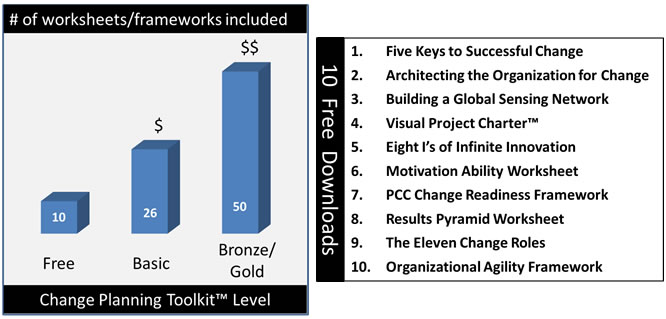
In my upcoming collaborative, visual Change Planning Toolkit™ you will find the companion tools for the PCC Change Readiness Framework™, two large format change readiness worksheets to download for printing that will help you collaboratively explore all of these topics and more.

Be sure and sign up for the Braden Kelley newsletter to receive the latest news on my new book on the best practices and next practices of organizational change (January 2016) and the licensing options for the Change Planning Toolkit™.

Finally, when you consider all of the potential stumbling blocks in advance of the change that we highlighted above, evaluate your readiness in each area, and make a plan for closing any gaps (before you even begin your change effort), you will greatly increase the chances of its success. But, there are certain items that are not just good to know in advance, but are actually prerequisites for change, and we will explore that topic in the book, so stay tuned!

EDITOR’S NOTE: I’ve gone ahead and created a free downloadable flipbook PDF for people to grab. It was inspired by Art Inteligencia’s article titled Change Readiness: What It Is and How to Achieve It.

PCC Change Readiness Framework Flipbook

P.S. In case you missed it, click to read Change the World – Step One


Accelerate your change and transformation success

Subscribe to Human-Centered Change & Innovation WeeklySign up here to get Human-Centered Change & Innovation Weekly delivered to your inbox every week.