Category Archives: Change

Standardizing Change

In The Five Keys to Successful Change I highlight five key areas for organizations to focus on if they are serious about building a strong, sustainable capability in organizational change, including:

  1. Change Planning
  2. Change Leadership
  3. Change Management
  4. Change Maintenance
  5. Change Portfolio Management

Five Keys to Successful Change 550

As you can see Change Management is but one of five keys to sustainable change success, but it is one of the most important. It is also the only one of the five that has its own professional association and working to establish itself as a recognized profession, complete with its own certification.

To get to a place where you can have a certification, you must have a collection of shared knowledge. In project management, they have the Project Management Body of Knowledge (PMBOK) maintained by the Project Management Institute (PMI) in support of the certification of Project Management Professionals (PMP). For change management professionals, this is The Association of Change Management Professionals (ACMP) Standard for Change Management, also referred to as ACMP’s Standard.

ACMP Standard Components

The main components of the standard according to the ACMP brochure include:

1. Evaluating Change Impact and Organizational Readiness

  • Reviews the overall change and how it will impact the organization
  • Establishes whether the organization is ready and able to handle the proposed change

2. Formulating Change Management Strategy

  • Develops the approach for moving an organization from current state to desired future state in order to achieve specific organizational outcomes

3. Developing Change Management Plans

  • Documents the scope, actions, timelines and resources needed to deliver the change

4. Executing Change Management Plans

  • Addresses the implementation processes for performing the change activities by monitoring, measuring, and controlling delivery against baseline plans

5. Closing the Change Management Effort

  • Documents the actions and resources needed to close the change once the Change Management Strategy is achieved and activities are deemed sustainable and maintainable

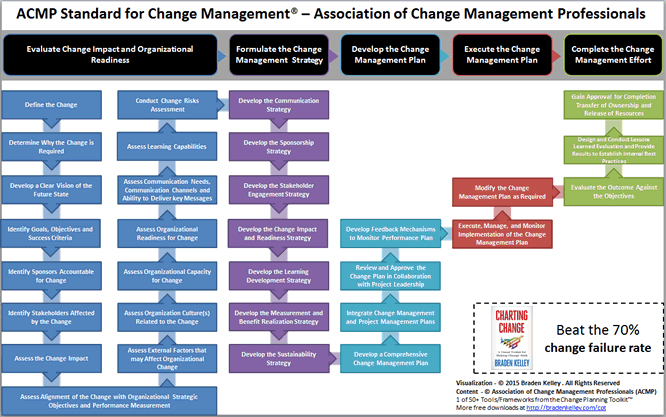
But managing change is extremely complicated and there is much more involved in doing it well than can be achieved just looking at these five high level phases, so there is a lot more detail contained in ACMP’s Standard, highlighted for you below:

5.1 Evaluate Change Impact and Organizational Readiness

— 5.1.1 Define the Change
— 5.1.2 Determine Why the Change is Required
— 5.1.3 Develop a Clear Vision of the Future State
— 5.1.4 Identify Goals, Objectives, and Success Criteria
— 5.1.5 Identify Sponsors Accountable for the Change
— 5.1.6 Identify Stakeholders Affected by the Change
— 5.1.7 Assess the Change Impact
— 5.1.8 Assess Alignment of the Change with Organizational Strategic Objectives and Performance Measurement
— 5.1.9 Assess External Factors that may Affect Organizational Change
— 5.1.10 Assess Organization Culture(s) Related to the Change
— 5.1.11 Assess Organizational Capacity for Change
— 5.1.12 Assess Organizational Readiness for Change
— 5.1.13 Assess Communication Needs, Communication Channels, and Ability to Deliver Key Messages
— 5.1.14 Assess Learning Capabilities
— 5.1.15 Conduct Change Risks Assessment

5.2 Formulate the Change Management Strategy

— 5.2.1 Develop the Communication Strategy
— 5.2.2 Develop the Sponsorship Strategy
— 5.2.3 Stakeholder Engagement Strategy
— 5.2.4 Develop the Change Impact and Readiness Strategy
— 5.2.5 Develop the Learning and Development Strategy
— 5.2.6 Develop the Measurement and Benefit Realization Strategy
— 5.2.7 Develop the Sustainability Strategy

5.3 Develop the Change Management Plan

— 5.3.1 Develop a Comprehensive Change Management Plan
— 5.3.2 Integrate Change Management and Project Management Plans
— 5.3.3 Review and Approve the Change Plan in Collaboration with Project Leadership
— 5.3.4 Develop Feedback Mechanisms to Monitor Performance to Plan

5.4 Execute the Change Management Plan

— 5.4.1 Execute, Manage, and Monitor Implementation of the Change Management Plan
— 5.4.2 Modify the Change Management Plan as Required

5.5 Complete the Change Management Effort

— 5.5.1 Evaluate the Outcome Against the Objectives
— 5.5.2 Design and Conduct Lessons Learned Evaluation and Provide Results to Establish Internal Best Practices
— 5.5.3 Gain Approval for Completion, Transfer of Ownership, and Release of Resources

Obviously there is a lot more value in looking at this more complete view of the content of ACMP’s Standard than in looking at the five components of the standard. A number of different people provided input into ACMP’s Standard and so there is a lot of good information in it, and I’d encourage you to download it and check it out. For my part, I’ve been all the way through it as part of the research for my new book Charting Change, in part because I wanted to ensure that my new book and the accompanying Human-Centered Change™ methodology are consistent with ACMP’s Standard so that practicing change management professionals can pick up my Change Planning Toolkit™ and begin using it right away to simplify their change planning process and increase their rate of successful change adoption.

ACMP Standard Visualization

Click to access this ACMP Standard for Change Management visualization as a FREE scalable 11″x17″ PDF download

Click to access this ACMP Standard for Change Management visualization as a FREE scalable 35″x56″ PDF poster size download

But the ACMP’s Standard for Change Management, because of its breadth, can be difficult for people to digest and easily access quickly and so to help with that challenge I have created a visualization of the standard (pictured above) as a scalable 11”x17” free download for people to download and share with others or post on their cubicle or office wall for easy reference, with a free 35”x56” poster size version available now too! The visualization will help you see at a glance how the main components and all of their sub-components inter-relate and come together to create a comprehensive approach to change management. I hope you download and enjoy the ACMP Standard for Change Management visualization, share it freely with your friends and colleagues, and get added value from the other free downloads from the Change Planning Toolkit™!

Sign up for Change Planning Toolkit™ launch updates

Buy the Change Planning Toolkit™ NowNow you can buy the Change Planning Toolkit™ – Individual Bronze License – Advance Purchase Edition here on this web site before the book launches.

Subscribe to Human-Centered Change & Innovation WeeklySign up here to get Human-Centered Change & Innovation Weekly delivered to your inbox every week.

The Human-Centered Change™ Methodology is Now Available

Human-Centered Change™The Change Planning Toolkit™ is finally here!

Following the success of Stoking Your Innovation Bonfire, it has become abundantly clear in my work with clients that for any organization to be good at innovation they must be good at change.

Not surprisingly, research shows that 70% of change efforts fail. There are many reasons why, including that many people find the planning of a change effort overwhelming and lack tools for making the process more visual, collaborative and human.

Putting my two decades of research together with my project management and change leadership experience with clients, I have distilled key insights into the Human-Centered Change™ methodology and captured it in a new book Charting Change (Feb 2016) and a suite of tools to help get everyone literally on the same page for change.

Get 10 Free Downloads from the Change Planning Toolkit™I am making 10 Free Human-Centered Change™ Tools from the toolkit available as 11″x17″ samples,
Get 26 of the 50+ Change Planning Toolkit™ toolsbut book buyers will get access to the Change Planning Toolkit™ Basic License (26 of 50+ tools) at 11″x17″ size — a $500 value,
Get all 50+ tools in the Change Planning Toolkit™and buyers of the Change Planning Toolkit™ Bronze License will get access to all 50+ tools for individual educational use at an 11″x17″ size — a $1,200 value.

Change Planning Toolkit Levels and Free Downloads

Innovation and Change Speaker and Author Braden KelleySite licenses are available for professional or commercial use starting at $2/yr per employee*, and include access to poster size versions of many of the tools (35″x56″), along with public or private training sessions. Click here for more information and pricing.

I am very excited to share with you the Change Planning Toolkit™, including the popular Visual Project Charter™, Change Planning Canvas™ and many other great tools for increasing your change success!

Increase your consulting revenue or your organizational agility and get a jump on your competition!

Click here to access the Human-Centered Change™ tools

*Bronze Site Licenses have a one-time setup fee of $299. Site License fee based on total number of employees in the organization.

Below you’ll find a downloadable presentation that gives you five reasons to invest in the Change Planning Toolkit™ in case you need help convincing your boss to let you make the nominal expenditure or to fund a site license or private event to train you and your team and trainers.

Subscribe to Human-Centered Change & Innovation WeeklySign up here to get Human-Centered Change & Innovation Weekly delivered to your inbox every week.

Measuring Change Readiness

Measuring Change ReadinessAre you and your organization ready for change?

Too often organizations define the change effort they want to pursue without first identifying whether there are people, resources, legislation, etc. present that must be in place before the change effort can begin. We will explore the circumstances you may want to explore before beginning any change effort and the areas to explore as potential prerequisites to the change program and its eventual success.

During the course of any change initiative many different challenges will appear, and the most successful change efforts will anticipate those challenges and have a plan for dealing with them. Part of that anticipation begins with identifying how ready the organization is for change.

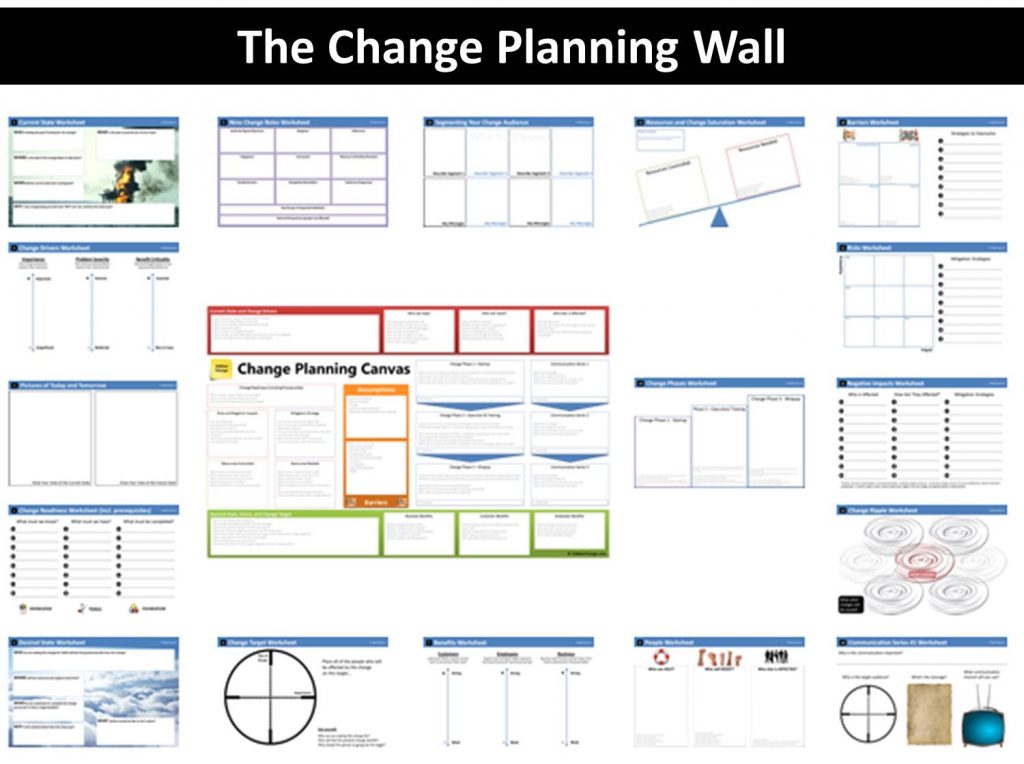
The Change Planning Toolkit™ is designed to assist your change planning team by making the planning process easier with its collection of 50+ frameworks, methodologies and other tools.

One of the keys to change planning success is carefully identifying the prerequisites for change, including:

  1. What must we know? (Knowledge)
  2. What must we have? (Tools)
  3. What must be completed? (Foundation)

This information is captured in one of the worksheets in the toolkit.

One other concept we should stop and discuss briefly is the idea of change saturation. This concept captures the idea that organizations in general, and certain individuals in specific, can only absorb so much change at one time. One frequent occurrence with change efforts is the situation where more than one project or larger change effort may require the same human, financial, physical, information or other resources at the same time. To become aware of this situation and to enable you to work to mitigate the effects of change saturation, you will want to build a heat map identifying the different timing, duration, and intensity of the different requirements all of the different projects and change efforts will place on the different types of resources within the organization. This too is a prerequisite.

Another prerequisite for change is having a deep understanding for what the current state looks like, including having answers for the following:

  • Who is feeling the pain? Pushing for the change?
  • What is the pain caused by the current state?
  • Where is the bulk of the change likely to take place?
  • When did the current state start causing pain?
  • Why is the change being pursued

These questions can be asked and answered during your change planning session, but they must be asked and the answers must be integrated into your examination of your readiness for this change BEFORE you actually begin the change.

An additional prerequisite for change is also having a deep understanding for what the desired state will look like, including answers for the following:

  • Who are we making this change for? Who will feel the greatest benefit from this change?
  • Where will the resources and support come from?
  • When do we need/want to complete the change process by? Is there a legal deadline?
  • What solution would we like to see in place?
  • Why is this solution better than the status quo?

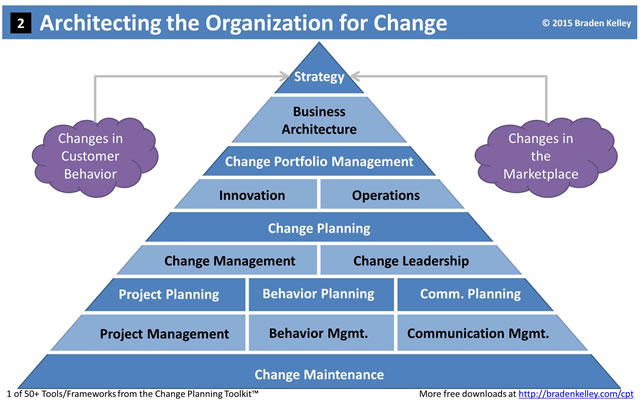
Finally, to be ready to pursue a change the organization must have people in place to look after each of the Five Keys to Successful Change and should be familiar with both the Architecting the Organization for Change framework and my PCC Change Readiness Framework (these are three of the free downloads from the toolkit).

My PCC Change Readiness Framework focuses on the psychology of key groups surrounding the identified change, the capabilities needed to successfully execute the change, and the organization’s capacity to tackle this change effort (along with everything else).

PCC Change Readiness Framework

You will notice that I don’t speak about organizational psychology or culture in my PCC Change Readiness Framework. The reason I don’t highlight culture in the same way that many other people do is that in today’s more social, customer-centric business, we must look more broadly than the typical inward focus of company culture when it comes to identifying the readiness of not only employees, but leaders, customers, and partners too. Inevitably many of our change efforts will have some impact on one or more external groups (possibly even non-profit entities and one or more governments).

You will notice that within the PSYCHOLOGY box there is a common focus on the mindsets, attitudes, beliefs and expectations of the individuals. Culture is incorporated into the psychology realm by focusing on what the shared understandings are around the potential change, but more broadly too. And, finally you will notice that my PCC Change Readiness Framework highlights the need for successful change efforts to move towards gaining commitment to the change from leadership, acceptance of the change by employees, and a desire for the change from customers and partners.

Within the CAPABILITY box of my PCC Change Readiness Framework we must investigate whether our change effort has any regulatory or statutory implications and whether we are ready to adapt, adopt or influence the changes necessary in this sphere. We must also ask ourselves a series of questions:

  1. “Do we need to get permission from anyone to do this?”
  2. “What knowledge, skills, and abilities needed for this change do we already possess?”
  3. “What knowledge, skills, and abilities needed for this change do we need to acquire?”
  4. “What relationships do we possess that will be useful in advancing the change?”
  5. “What relationships do we need to build to help advance the change?”
  6. “What are the enablers of making this change successful?”

Within the CAPACITY box we have to look at where our resources are approaching, or have already achieved, change saturation. This means they are unable to productively participate in any more change efforts or adopt any more change. But we also have to look at the availability of our resources:

  1. Human
  2. Financial
  3. Physical
  4. Information
  5. Executive Sponsors
  6. Space in our desired communication channels

It is easy to take for granted that the organization will have the capacity to undertake your change effort, but often there are capacity constraints that you will run into, especially as the pace and volume of change increases inside an organization. The one that is easiest to overlook and fail to plan for, is making sure that you’re going to be able to communicate your change messages in your desired messaging channels (they may already be full).

There is a worksheet that goes with the PCC Change Readiness Framework that will help you capture information around the:

  • History
  • Capability
  • Capacity
  • Partners
  • Context
  • Leadership
  • Employees
  • Customers
  • Shared Understanding
  • Strategic Alignment (Commitment)
  • Cultural Alignment (Acceptance)
  • Brand Alignment (Desire)

EDITOR’S NOTE: I’ve gone ahead and created a free downloadable flipbook PDF for people to grab. It was inspired by Braden’s article titled Change the World – Step Two, which was the follow-up predictably to Change the World – Step One.

PCC Change Readiness Framework Flipbook

You will find these companion tools for the PCC Change Readiness Framework in the Change Planning Toolkit™ to download for printing and use in your collaborative exploration of your change readiness.

Get Your Copy of Charting ChangeIn my next book Charting Change we will investigate additional aspects of change readiness and have a special section from one of my invited guest experts in the book, Beth Montag Schmaltz of PeopleFirm looking at several topics including change fatigue, where the change threshold lies, why people resist change, how to reduce change fatigue, how to build change capability, what change capable employees look like, and how you can embed change behavior into the very fabric of your organization.

The book is available for pre-order, and has received several strong endorsements, so I hope you’ll pick up a copy (or one for each member of your team). You can find more information on the Charting Change book page.

Subscribe to Human-Centered Change & Innovation WeeklySign up here to get Human-Centered Change & Innovation Weekly delivered to your inbox every week.

The Pyramid of Results, Motivation and Ability

Changing Outcomes, Changing Behavior

Pyramid of Results, Motivation and Ability

by Braden Kelley

When engaging in a change effort it is important to focus not on outputs but on outcomes. The difference is sometimes subtle for people, but the biggest difference is that outputs are usually activity-based where outcomes are behavior-based.

There are several good behavior modification frameworks out there including the Six Boxes framework from Carl Binder, the Six Sources of Influence framework from VitalSmarts, and the Results Pyramid® from Partners in Leadership that start with the desired performance changes, results or outcome shifts and work backwards.

Six Boxes Approach - Carl Binder

Six Boxes Approach – Carl Binder

Potential Benefits of Using the Six Sources of Influence

The Six Sources of Influence framework from VitalSmarts, a framework designed for personal change has some usefulness as we look at organizational change. Here are some of my thoughts on how this personal change framework is relevant, centered on the fact that successful change happens one individual at a time. The Six Sources of Influence framework looks at motivation and ability on one axis, and how they are affected across three other variables, which include:

  1. Personal
  2. Social
  3. Structural

Taken together they form the Six Sources of Influence (see the Motivation Ability Worksheet in Figure 1) and can be used to change behavior one individual at a time. And it is from these changes in behavior that the transitions towards the new way of doing things begin to happen.

Motivation Ability Worksheet

Figure 1

To utilize personal ability to influence the change will require teaching people the new skills to be successful at the new way of doing things. Consider breaking up the learning into short intervals where you can give people immediate feedback and prepare for people to have regressions back to the status quo. Work to identify those moments where people will be most tempted to regress to the status quo and create strategies that reinforce the new way of doing things.

To influence the change through personal motivation will require visualizing the change for people and utilizing physical and other cues (including vivid storytelling) to help reinforce that the change is desirable. Help people see, feel and believe in the new way of doing things (the desired state).

Social motivation can be used to influence change adoption by turning accomplices (status quo advocates) into friends (people practicing and supporting the new way of doing things), while any attempt to use social ability as an influencer for change adoption will require open and honest conversations to transform people from accomplices into friends .

Finally, utilizing structural motivation will require selling the problem in a way that people are influenced to abandon the status quo (visualize it, prototype it, etc.) and structural ability can be used to motivate people by changing the physical environment to reinforce the change. Instead of using a stick to motivate people to change, consider using carrots and the threat of losing carrots. It’s a slight twist away from using a stick, but it’s a powerful one. Finally, reward small wins and use incentives (carrots) in combination and in moderation.

Devotees of the Six Sources of Influence may find the free Motivation Ability Worksheet useful.

Using the Results Pyramid® to Create New Results

The Results Pyramid® framework from Tom Smith and Roger Connors’ book titled Change the Culture, Change the Game focuses on the importance of building a culture of accountability. Leaders can accelerate the change and results that they seek by working with the bottom half of the pyramid (“beliefs” and “experiences”). The Results Pyramid® has four main components that I would love to show below in Figure 2 but can’t:

Figure 2 would have gone here

Transformational change is most often lasting and sustainable in achieving the desired new results when leaders work to change the beliefs and experiences that people have and ensuring that people begin having new experiences that lead to new beliefs that lead to new actions that ultimately support the desired new results.

I was trying to help bring additional readers to the authors via the Results Pyramid® Worksheet, but it didn’t quite work out, so you’ll have to do without the visuals and imagine how the tool from Change the Culture, Change the Game could be used to:

  1. First focus on identifying the new results that the group wants to achieve after making the change.
  2. Second, ask employees and partners what new experiences they think that people will need to have in order to not only begin to leave the old way of doing things behind, but to both support the new results you want to achieve AND to help them believe the organization is serious and committed to the new results and that the leadership can be trusted.
  3. Third, ask what new beliefs they think that people will need to have in order to commit to leaving the old way of doing things behind and prepare them to take new actions.
  4. Finally, ask what new actions they think that people will need to take in order to achieve the new results that you are hoping to have in the desired state.

In most cases you will find that your current set of experiences, beliefs, actions, and results have achieved a sort of equilibrium or alignment and that one of the keys to achieving successful change is to move from your current state of equilibrium or alignment to a new set of experiences, beliefs, and actions that create a new state of equilibrium centered around your new results. By identifying where you want to move the top of the pyramid, your can start moving the base of the pyramid followed sequentially be the layers above it, and in doing so, prevent the pyramid from toppling over.

Potential Benefits of Using the Results Pyramid®

The Results Pyramid® is based on the idea that too many organizations focus on the results they want to achieve in the shift from the current state to the desired state and that just by communicating the desired results that the organization will see these new results manifest. But, the reality that the Results Pyramid® captures is that in order to achieve a shift from the current state to the desired state, and to achieve a new set of results, you must do more than define the new results you want to achieve. And you must provide a new set of experiences, beliefs, and actions that will help you achieve those results. The other key component of the Results Pyramid® theory is that too often companies demand new actions to get new results, but the truth is that these four things (results, actions, beliefs, and experiences) are organized like a pyramid and you can’t just move the top of the pyramid without also moving the supporting layers as well.

Meaning, that to create a shift in results (or outcomes), you must create a new set of experiences that lead to a new set of beliefs that lead to a new set of actions that result in the new results that you are hoping for as a result of your change effort. And of course by planning out consciously the shift in results that you’re trying to achieve, you can work as a change planning team to identify the new experiences, beliefs, and actions that you need to create in order to achieve the new results

I find this a useful tool to consider using as you analyze the desired behavior changes and new outcomes you are seeking to achieve with your change effort as you go through your change planning meetings or off-site.

Devotees of the Results Pyramid® would have found the Results Pyramid® Worksheet useful but, sigh, you can’t see it.

Conclusion

In this article we looked at the role of changing behaviors in achieving changed outcomes, and how we might use a couple personal behavior modification frameworks, the Six Sources of Influence and the Results Pyramid® to help us organize our conscious attempts to modify the behavior of individuals as part of our attempts to achieve our desired group behavior change and to ultimately to achieve the intended successful outcomes of our change effort.

So, check out the work of Carl Binder and grab yourself copies of Change the Culture, Change the Game and Change Anything and get started!

Get our Human-Centered Change & Innovation Weekly newsletter in your inbox

Click to access your FREE scalable 11″x17″ PDF downloads

Image source: ecsellinstitute.com

Buy the Human-Centered Change™ methodology nowNow you can buy the Change Planning Toolkit™ Basic License – Instant Access Edition here on this web site.

Accelerate your change and transformation success

Subscribe to Human-Centered Change & Innovation WeeklySign up here to get Human-Centered Change & Innovation Weekly delivered to your inbox every week.

Change Resistance is Not Inevitable

Change Resistance is Not InevitableThe idea that people always resist change is a lie, and it is extremely damaging to organization’s seeking to increase their organizational agility.

The truth is that people only resist changes that they either do not understand or for which they do not interpret there to be benefits great enough to offset the costs of their participation.

The truth is also that the natural response to a potential change in an organization is greatly impacted by the level of trust in an organization.

While it is a lie that change resistance is inevitable, it is true that executing change is hard. If it wasn’t, 70 percent of change efforts wouldn’t fail, but they do. There are many reasons for this, including the fact that most change efforts are communicated not explained.

Let’s look at definitions of both words from Dictionary.com to see the root of this difference:

Communication: A document or message imparting news, views, information, etc.

Explanation: A mutual declaration of the meaning of words spoken, actions, motives, etc., with a view to adjusting a misunderstanding or reconciling differences

You’ll notice here a big difference between the two mindsets – seeking to communicate versus seeking to explain. When you focus on explaining the change, you are focusing on ensuring UNDERSTANDING, and when people understand the change, and the purpose for the change they will be more likely to support the change.

We don’t resist change, WE RESIST THAT WHICH WE DON’T UNDERSTAND.

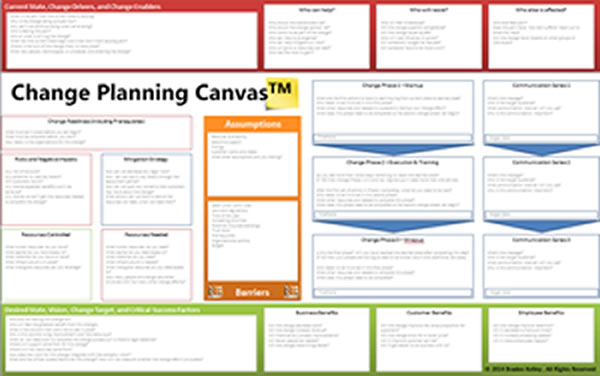
One great way for increasing your ability to explain change is the use of a tool like the Change Planning Canvas™ to involve more people in the planning of a change, which increases the number of people capable of explaining the change and its purpose, plus it provides a visual map of the change effort that explains the change at a glance.

This is not say that even when people completely understand a potential change and the purpose for it, that they still might not not fight against it, but they will be more likely to support the change.
.

Change Planning Canvas

(For Illustration Purposes Only – Get the toolkit or the book for a clear copy)

.

The Change Planning Canvas™ is one of the more than fifty tools that make up my new Change Planning Toolkit™ that is now available via individual licenses for educational use and site licenses for professional and commercial use. It helps you move away from the incredibly counter-productive practice of planning change in isolation.

Organizations that do a better job of explaining their changes and the purposes for them, not coincidentally also tend to build up a higher level of trust over time, and organizations that do a better job at change explanation and maintain higher levels of trust are able to change faster!

But some people may still resist, why?

Some people may resist your change effort for a number of different reasons, but you need to identify up-front not only why people resist but also who will likely resist. Change Planning Toolkit™ users will want to capture the group’s thoughts on who will resist in the middle box of the People Worksheet from the toolkit and the corresponding box on the Change Planning Canvas™.

Some of the typical reasons why people will resist include:

  • inability to see the need for change or relevance;
  • loss of certainty (includes fear of job loss);
  • loss of purpose, direction, or status;
  • loss of mastery (includes loss of expertise/recognition);
  • loss of control or ownership;
  • loss of connection or attachment;
  • lack of trust or clarity;
  • fear of failure (feel unprepared);
  • see proposed change as irrelevant or a bad idea;
  • feel overwhelmed by thought of change.

You’ll want to identify the individuals or groups who have one of the above reasons for resisting change, and you will want to plan from the start to overcome that resistance in the same way that any good salesperson plans for objections, learns to hear them, and practices how to overcome them (for example, by developing and sharing strategies with coworkers).
.

Overcoming Resistance Worksheet

(For Illustration Purposes Only – Get the toolkit for a clear copy)

.

In the Change Planning Toolkit™ I’ve provided space in the Overcoming Resistance Worksheet for your team to brainstorm both the groups and individuals likely to feel any of these reasons for resistance, together with space to capture some ideas for overcoming these objections (aka resistance).

The Change Planning Toolkit™ also provides the Five Change Reactions Worksheet which allows you to identify which groups and individuals tend towards each of the five change reactions highlighted in this worksheet and explained in my book Charting Change.. These five change reactions typically occur in a standard distribution (aka bell curve) and you can increase the chances of your change success by shifting enough people to the left along the curve.

So, there you have it, a quick look at The Big Change Management Lie about the inevitability of change resistance and some ways that it can be avoided or at least mitigated, and an introduction to how some of the tools from the Change Planning Toolkit™ can provide even more help.

Accelerate your change and transformation success

Subscribe to Human-Centered Change & Innovation WeeklySign up here to get Human-Centered Change & Innovation Weekly delivered to your inbox every week.

Give the Gifts of Innovation and Change

Stoking Your Innovation Bonfire2015 is quickly coming to a close and perhaps you have a little bit of money left in your budget. What better way to spend it than to get everyone on your team a copy of the popular book Stoking Your Innovation Bonfire?

Getting everyone on your team (or in your organization) a copy of this five-star book from John Wiley & Sons will not only help build a common language for innovation in your team or organization, but will also help you identify and remove barriers to innovation and begin building a continuous innovation capability.

Download the sample chapter if you’re not already convinced the book will make a great gift. 😉

excel iconAnother great way to close out 2015 and prepare your team or organization for an innovative 2016 is to have everyone on your team or key people in your organization complete my innovation audit (free download).

Charting Change - Pre-Order NowAnd if you’re thinking that change is more what you need than innovation in 2016, then be sure and pre-order my next book Charting Change for your team and help beat the 70% change effort failure rate by spreading a more visual, collaborative way to plan change effort (or even projects) across your organization. Charting Change will start shipping in February and I have just released an advance purchase edition of the Change Planning Toolkit™.

Buy the Change Planning Toolkit™ NowNow you can buy the Change Planning Toolkit™ – Individual Bronze License – Advance Purchase Edition here on this web site before the book launches.

I’ve already made four of ten (4 of 10) free downloads available from the Change Planning Toolkit™ as my special gift to you. Be sure and download them here.

Accelerate your change and transformation success

Subscribe to Human-Centered Change & Innovation WeeklySign up here to get Human-Centered Change & Innovation Weekly delivered to your inbox every week.

Google’s Insights into Successful Teams and Managers

A little over five years ago I created an evolution of a Gary Hamel framework from The Future of Management that I titled The Innovator’s Framework and included in my popular first book Stoking Your Innovation Bonfire.

The Innovator's Framework

Recently Google recently released some of its extensive research into the skills and character traits of good managers and effective teams, and surprisingly the secret to a high-performing team lies less in the individual team members and more in the broader team dynamics: “Who is on a team matters less than how the team members interact, structure their work, and view their contributions.” High-performing teams, they found, almost always displayed five characteristics:

Google High Performing Teams

According to their research, by far the most important team dynamic is psychological safety – the ability to be bold and take risks without worrying that your team members will judge you. Now have a look at Google’s previous findings on the Eight Characteristics of Great Managers:

Google High Performing Managers

Eight Characteristics of Great Managers

When you compare the traits of a successful team, a successful manager, and the heirarchy in The Innovators’ Framework its interesting where the three overlap and where they diverge.

What do you see?

Sources: World Economic Forum
Image Credits: Google re:Work

Accelerate your change and transformation success

Subscribe to Human-Centered Change & Innovation WeeklySign up here to get Human-Centered Change & Innovation Weekly delivered to your inbox every week.

Visualizing Project Planning Success

Visualizing Project Planning Success for 2016

The first three of ten free downloads from the Change Planning Toolkit™ were focused on innovation and change:

  1. Five Keys to Successful Change
  2. Architecting the Organization for Change
  3. Building a Global Sensing Network

The goal of these three frameworks was to get people visualizing more holistically how to build a strong foundation for a successful continuous change capability for the organization and a strong, vibrant innovation ecosystem. The next free download will tackle one of many project managers’ least favorite project planning activities – the creation of a project charter.

The Visual Project Charter™

The truth is that for most of us project managers, whether we want to admit it or not, the process of creating a project charter is one that we often dread. We sit there in front of a Microsoft Word template like the one in figure 1 blinking at us on the screen and realize just how much missing or incomplete information we have when we begin typing into the one of the very first, and potentially most important, project artifacts for any project. We know we face the sending of a series of emails, follow up emails, follow up to the follow up emails, and maybe even some escalation emails and phone calls just to get the information we need to create the first draft of a project charter. And that’s before we even begin trying to get alignment, buy-in, and sign-off on the document.

Project Charter Template

Figure 1

It doesn’t have to be this way!

Because every project ultimately changes something, as part of the Change Planning Toolkit™ I have designed a Visual Project Charter™ (see figure 2) to help project managers make the project planning process and the creation of the project charter a more visual, more collaborative, and more enjoyable process, providing an opportunity to improve the chances of project success by creating upfront improvements in a AAA project experience:

  1. Alignment
  2. Accountability
  3. Action

The Visual Project Charter™ helps organizations:

  • Move beyond the Microsoft Word document
  • Make the creation of Project Charters more fun!
  • Kickoff projects in a more collaborative, more visual way
  • Structure dialogue to capture the project overview, project scope, project conditions and project approach

Visual Project Charter

Figure 2

Get your sticky notes and pens ready and gather the people with the knowledge and information necessary to accurately shape the project!

The Visual Project Charter™ is designed to be used in place of, or in advance of populating your normal Project Charter template in Microsoft Word. It MUST be used in a cross-functional project team meeting before project kickoff to initiate the conversations necessary to surface the assumptions, issues, risks, constraints, and definitions of success. As you know, identifying the potential land mines before you even begin a project will both increase the chances of success and decrease the chances of schedule or cost overruns.

The canvas helps you ask, visualize and collaborate on some of the following questions:

  • What is the purpose of this project?
  • What is the key information to include in the Project Overview?
  • What is the Project Scope?
  • What are the Project Conditions we must consider?
  • What Project Approach are we going to use?

The goal is to capture all of your typical project charter information:

  1. Purpose of the Project
  2. Project Overview
    • Executive Summary
    • Business Needs
    • Business Justification
  3. Project Scope
    • Stakeholders
    • Objectives, Goals and Success Criteria
    • Deliverables
    • Deliverables Out of Scope
    • Estimated Budget and Costs
    • Organizational Impacts
    • Departmental SOW
    • Estimated Duration
  4. Project Conditions
    • Assumptions
    • Issues
    • Risks
    • Constraints
  5. Project Approach
    • Structure
    • Project Team Roles and Responsibilities

This is a lot more FUN and SUCCESSFUL approach to building a project charter. Most project managers who see benefit in this approach will probably choose to use the Visual Project Charter™ as a tool to gather the inputs necessary to populate the traditional project charter template on ProjectManagement.com or one that you’ve created yourself.

But, the advantage of potentially of using the Visual Project Charter™ in place of a traditional project charter document is that you can make large format prints of your drafts and post them in the halls of the involved workgroups for additional comments before creating a final draft that can then be signed off on by the project sponsor and other key accountable parties for all the world to see and to help drive a AAA project experience by maintaining:

  1. Alignment
  2. Accountability
  3. Action

I’m making a free download of the Visual Project Charter™ available to the readers of this article and purchasers of my new book Charting Change (Feb 2016) as an 11”x17” format PDF. A larger format (poster size – 35″x56″) version will be made available to individual licensees and site licensees of the Change Planning Toolkit™ (coming soon) or can be purchased separately at a nominal fee here (UPDATE: You can now access the poster size version for free too):

Click here to access the poster size version (35″x56″) of the Visual Project Charter™

Remote Project Management

UPDATE (October 9, 2021): A few months ago I created a video example of how to use the Visual Project Charter™ that you’ll see below in part to show how you can not only print the Visual Project Charter™ as a 35″x56″ poster BUT you can also use it a background in online whiteboarding tools like Miro, Mural, LucidSpark, and Microsoft Whiteboard and then have people place their virtual sticky notes on top of it.

So, what do you think?

Is the Visual Project Charter™ a potentially useful additional tool for your project planning process?

Do you plan on trying it?

Or do you perhaps already use something similar?

Is there anything conspicuously absent that threatens its effectiveness as an additional project planning tool?

Sign up to get the Human-Centered Change & Innovation Weekly newsletter in your inbox

Click to access this framework as a scalable 11″x17″ PDF download

Click here to access the poster size version (35″x56″) of the Visual Project Charter™

Accelerate your change and transformation success

Subscribe to Human-Centered Change & Innovation WeeklySign up here to get Human-Centered Change & Innovation Weekly delivered to your inbox every week.

Change Agents and the Future of Change Management

Change Agents and the Future of Change ManagementRecently I was identified in a mini research study as one of the top Key Opinion Leaders in change management on Twitter by Maven7, and they were curious about some of my opinions about organizational change, and asked me these two questions for an article titled ’14 Insightful Quotes from Influencers in Change Management’ on their blog.

1) In your opinion, how will change management evolve in the next 10 years?

2) Why is change agent involvement essential during a change initiative, and what best practices are there to involve them?

The article on their site just highlights a few quotes from the insights I shared with them surrounding these two questions, so if you’re more interested in hearing the full responses, please continue reading.

Question: In your opinion, how will change management evolve in the next 10 years?

I believe that the field of organizational change will evolve first by moving beyond change management. We currently speak about change management and maybe change leadership, but I believe we need to make the conversation about The Five Keys to Successful Change™ more pervasive. These five keys are:

  1. Change Planning
  2. Change Leadership
  3. Change Management
  4. Change Maintenance
  5. Change Portfolio Management

When we start moving the conversation beyond change management, we can start focusing as change professionals on achieving excellence in practice in all five areas, creating more efficient and effective tools and techniques for each. The new Change Planning Toolkit™ introduced in my book Charting Change (Feb 2016) is focused on making the planning of a change effort of any size (up to the level of mergers & acquisition, and down to the level of the project) more visual, more collaborative, and more human.

In today’s environment it is innovate or die, and the reason that most organizations are bad at innovation is that they are bad at change. So, the ability to create a culture of continuous change in an organization, and a commitment to empowering employees with the tools, techniques, and mindsets that lead to the creation of a new organizational capability in change for the organization, will lead to THE most important competitive advantage an organization could possibly possess – greater organizational agility.

This evolution of change management will lead to a group of companies with incredible organizational agility and a collection of companies that will join Blockbuster, Montgomery Ward, Borders, and Tower Records not because of mismanagement, but because of a refusal to move beyond change management to embrace The Five Keys to Successful Change™. Which will you be?

Question: Why is change agent involvement essential during a change initiative, and what best practices are there to involve them?

I don’t like the notion of a change agent. Instead I prefer the notion of a change movement inspired by a motivated change leadership team. The notion of the change agent confers the idea that one person can affect lasting change, and that’s just not reality. We might like to attribute a successful change to a single individual, but the truth is that in those situations a movement was created where people eagerly participated in affecting a certain change, where imagination and creativity were captured and harnessed to create a new reality.

The truth is that successful changes are led by a passionate change leadership team with a clear plan that empowers and engages people with a clear, and often tailored, vision for the new reality they hope to create with the broader team. Successful change leadership teams build a clear plan that can be easily shared in order to start creating movement, in order to overcome the inertia of the organization, and then they focus on building and sustaining the momentum necessary to realize the desired transformation, whether that is a “BIG C” change or a “little c” change.

Successful change leadership teams build a shared vision of the change process, and a common language for the change effort, with the support of something like the Change Planning Toolkit™. Unfortunately, 70% of change efforts fail, and one of the big reasons is the lack of alignment, and frankly, an understanding of why the change is necessary, important, and how it might be achieved. At the same time, organizations fail to provide the support necessary to help the change participants successfully adopt the desired change. If you focus on change agents instead of empowered change leadership teams, people will be less likely to adopt the change, or to sustain it. So, choose wisely.

Accelerate your change and transformation success

Subscribe to Human-Centered Change & Innovation WeeklySign up here to get Human-Centered Change & Innovation Weekly delivered to your inbox every week.

Building a Global Sensing Network – Revisited

Building a Global Sensing Network - RevisitedWhen I first wrote about Building a Global Sensing Network I wrote in the specific context of the war for innovation and the need to make sure you’re fighting it outside your organization — not inside.

We looked at how most organizations hire the most clever, educated, experienced and motivated people you could afford and then direct them to come up with the best customer solutions possible, organize and execute their production and marketing predictably and efficiently, and do their best to outmaneuver the competition.

In short, most organizations pursue success by building a fortress from which the organization can defend its intellectual property and its market position utilizing the human resources it can assemble within the castle walls. At the same time most organizations focus on achieving organizational success by achieving the greatest overlap possible between the skills, abilities and talents of each job applicant and the job description for each role.

But most organizations (referred to as Typical Organizations in the graphic below) fail to harness ALL of the skills, abilities and talents of the individuals they have in their organization to achieve greater performance as a collective. In my mind this is painful, wasted human capital – painful for the organization (lost potential revenue and profitability) and painful for the individual (boredom, stress, and disappointment).

Typical Organization

But, a handful of more progressive, innovative organizations are trying to do better to harness the passions AND the skills, abilities, and talents of their individuals to better achieve the collective’s ability to generate revenue and profits (or other appropriate benefits) by engaging their employees in the innovation efforts of the organization, and allowing their employees to take some of their skills, abilities and talents and apply them to help fulfill other job descriptions. This looks something more like this:

Innovative Organization

But in the most progressive organizations, they not only provide a way to better harness a more complete set of their employees’ skills, abilities and talents to more than one job description, but they also find a way to harness more of the skills, abilities, and talents that employees are currently realizing outside the organization in their hobbies, volunteer work, or other places.

And the successful organizations of the future will not stop there. They will also harness the connections their employees have outside the organization to increase the innovation capacity of the organization, and better engage not only partners in helping to fulfill the needs of different job descriptions, but they will also even engage their customers in achieving the work of the organization.

Where customer or partner skills, abilities and talents intersect with the job requirements, work can get done, and where customer or partner skills, abilities or talents intersect with employee skills, abilities or talents intersect, communities and connections have the chance to form and be nurtured. This is what organizations of the future will look like:

Organization of the Future

In this scenario, where innovative organizations begin to move beyond better harnessing the internal innovation capacity of their employees, to also harnessing the external capacity to work (and to innovate) of individuals outside of the organization (and to expand the scope of the collective), and to attract partners and customers to participate, organizations that allow and even encourage employees to develop a personal brand and greater external connections, will claim an outsized share of the potential benefits to both the mission of the organization and to its innovation efforts.

If your employees lack the external exposure, the external connections, and the external personal brand equity and awareness, how much harder will it be for your organization to:

  • Attract the best partners to your innovation efforts
  • Recruit the best customers to co-create with you
  • Build a strong pipeline of potential future internal talent

Through this lens you can see that in the future, successful innovation and change will be determined not just by how strong the brand of your organization is (or the collective), but also will be shaped by the strength of the personal brands of the collective’s component individuals.

As the commercial battlefield continues to change, future business success will be built upon more fluid boundaries and the ability to leverage skills, abilities and talents of people and other organizations outside the company and also the ability to:

  1. Utilize expert communities.
  2. Identify and gather technology trend information, customer insights and local social mutations from around the globe.
  3. Mobilize the organization in organic ways to utilize resources and information often beyond its control.
  4. Still organize and execute production and marketing predictably and efficiently in the middle of all this complexity.

Market leaders in our evolving reality will be increasingly determined not by an organization’s ability to outmaneuver the competition in a known market, but by their ability to identify and solve for the key unknowns in markets that will continue to become more global and less defined. Future market leaders will be those organizations that build superior global sensing networks and do a better job at making sense of the inputs from these networks to select the optimal actionable insights to drive innovation and change.

By this point, hopefully you are asking yourself three questions:

1. How do I create more fluid boundaries in my organization?

2. What does a global sensing network look like?

3. How do I build one?

One View of a Global Sensing Network

Building a Global Sensing NetworkThe purpose of a global sensing network is to allow an organization to collect and connect the partial insights and ideas that will form the basis of the organization’s next generation of customer solutions. This involves collecting and connecting:

Click to access this framework as a scalable 11″x17″ PDF download

1. Customer Insights

  • Ethnography
  • Private Communities
  • Focus Groups
  • Surveys
  • Lead User Observation

2. Core Technology Trends

3. Adjacent Technology Trends

4. Distant technology trends

5. Local social mutations

  • Demographic trends
  • Sociological trends
  • Economic trends
  • Political trends (including regulation)
  • Behavioral trends

6. Expert Communities

  • University Research
  • Government Research
  • Corporate Research
  • Charitable Research
  • Hobbyists

To actually build a global sensing network you need to start from the inside out. You have to take a look around inside your organization and see what employees you have, what natural connections they have, and where they are currently located on the globe. At the same time you need to understand how employees in your organization naturally connect with each other and define what core, adjacent and distant technologies mean in the context of your organization. You must also look and see what tools you have inside the organization for managing insights, expertise and information within the organization, and what expert communities you may already have connections into.

I would recommend beginning to establish your global sensing network inside your organization before venturing to build it out completely with the resources and connections that you will naturally need outside your organization. This will enable you to get some really great feedback from employees on the connections that will be necessary to foster and manage outside of your organization and to prepare your information sharing systems and internal communications to enable increased sharing and improved innovation inputs and outputs.

Accelerate your change and transformation success

It is likely that many organizations will already be gathering some level of customer insight information from ethnography, private communities, focus groups, surveys, lead user observation, etc. but not have a good infrastructure, policies or procedures in place for sharing this information. If you’re truly serious about creating a deep innovation capability and working to achieve innovation excellence in the same way that you pursue operational excellence, you should experiment with your systems by making customer information more available.

Next, you should leverage your employees and existing partnerships to reach outside the organization to organize and establish stronger communication channels with the relevant expert communities, including those focused on university research, government research, charitable research, corporate research (industry associations and competitors), and even to inventors or hobbyists.

And then finally from the connections you’ve built to this point, you should have identified where you have good people internally to provide information on local social mutations (local developments of interest spawned by local demographic, sociological, economic, political and behavioral trends), and where you have gaps. Hopefully by this point you may have also identified people outside your organization in countries around the world that you already have formal or informal connections to that can be leveraged to fill the gaps in your global sensing network footprint.

Conclusion

If you’re already involved in innovation and change, or have read a lot on the topic, it should be obvious to you why your organization needs a global sensing network.

Building a global sensing network helps organizations:

  • Accelerate their innovation efforts
  • Create more fluid organizational boundaries
  • Embrace a more open approach to innovation
  • Monitor emerging and evolving technologies
  • Track changes in customer behavior in the unending search for new insight-driven ideas

But the main that should jump out as you look at the download titled Building a Global Sensing Network is that innovation can come from anywhere, so you need to be listening everywhere.

The purpose for building a global sensing network is much like the purpose for having a SETI program. We know that there must be intelligent life outside the four walls of our organization, but to find it, we must be listening. And we must be listening so that we can amplify, combine and triangulate the weak signals that we might pick up so that we can find the next innovation and change that our organization is capable of delivering – before the competition. After all, there is a war for innovation and change out there. The only true unknown is who’s going to win.

I hope you’ll come join me on this journey to improve the pace and execution of innovation and change efforts in our organizations!

Sign up for Change Planning Toolkit™ launch updates

Click to access this framework as a scalable 11″x17″ PDF download

Subscribe to Human-Centered Change & Innovation WeeklySign up here to get Human-Centered Change & Innovation Weekly delivered to your inbox every week.