Author Archives: Chateau G Pato

About Chateau G Pato

Chateau G Pato is a senior futurist at Inteligencia Ltd. She is passionate about content creation and thinks about it as more science than art. Chateau travels the world at the speed of light, over mountains and under oceans. Her favorite numbers are one and zero. Content Authenticity Statement: If it wasn't clear, any articles under Chateau's byline have been written by OpenAI Playground or Gemini using Braden Kelley and public content as inspiration.

The Final Frontier of Design

Breaking the Dual Barriers of Machine Olfaction to Unlock the Next Era of Multi-Sensory Innovation

The Final Frontier of Design

GUEST POST from Chateau G Pato


I. Introduction: The Flatness of the Digital World

Breaking the Dual Barriers of Machine Olfaction to Unlock the Next Era of Multi-Sensory Innovation

For decades, human-centered design has mastered the pixels, micro-interactions, and spatial acoustics of the digital landscape. We have engineered an era of unprecedented visual and auditory fidelity, yet our interactions remain trapped behind cold glass. From a futurist perspective, the modern digital experience suffers from an artificial flatness — a sensory deficit that strips away the visceral, chemical essence of how humans natively navigate reality. By designing exclusively for the eyes and ears, we have sanitized technology, separating it from our most primal cognitive pathways.

Olfaction represents the ultimate untapped frontier for experience design. Unlike sight or sound, which are processed through the thalamus, scent has an unmediated, direct line to the limbic system — the evolutionary core of human memory, emotion, and behavior. A single volatile organic compound can instantly trigger vivid nostalgia or alter physiological arousal before the conscious mind even registers its identity. To build experiences that truly resonate on a deeply human level, innovation leaders must evolve beyond the binary constraints of audiovisual media and embrace the intricate syntax of smell.

The Strategic Innovation Paradox: The obstacle to this multi-sensory future is not a lack of imagination, but a profound dual technical constraint. To bridge the digital-chemical divide, human-centered change frameworks must simultaneously dismantle two systemic barriers: The Ingestion Wall (the challenge of artificial chemical perception) and The Projection Wall (the challenge of safe, dynamic, and contextually aware synthesis back to the human user).

Dismantling these barriers requires an alchemical blend of emerging technologies and design discipline. On the perception side, we must capture a world devoid of a standardized “color wheel,” where environmental inputs vary based on complex fluid dynamics. On the emission side, we must overcome the physical latency of chemical transport, where molecules cannot instantly refresh at the speed of light (c ≈ 299,792 km/s). Only by breaking both barriers can we transform machine olfaction from a laboratory novelty into an invisible, transformative utility for healthcare, learning, and immersive computing.

II. Barrier 1: The Ingestion Wall (The Challenge of Machine Perception)

Deconstructing the Complexities of Artificial Chemical Perception

To design an experience around scent, a system must first be able to listen to the environment. This brings us to the first fundamental barrier: The Ingestion Wall. In fields like computer vision or acoustics, mapping sensory input to data is relatively linear — we rely on predictable spectrums of light frequencies or sound waves. Olfaction completely breaks this mold. The chemical world is radically multi-dimensional, composed of thousands of volatile organic compounds (VOCs) that interact non-linearly to form a single scent profile. Capturing this data in a meaningful way requires moving away from traditional static sensing paradigms.

The State of the Art: Moving Beyond the Lab

Current advancements in Electronic Noses (e-noses) have heavily relied on Metal Oxide Semiconductors (MOS) to track chemical interactions. However, the true breakthrough in modern human-centered innovation lies at the intersection of biology and machinery. We are witnessing a paradigm shift toward bio-hybrid sensors that utilize actual Insect Odorant Binding Proteins (OBPs). These proteins offer a level of real-time specificity, sensitivity, and sustainable deployment that synthetic sensors simply cannot replicate on their own.

Furthermore, true digital transformation demands that these sensors move out of sterile laboratory environments and into the real world. Modern research has successfully integrated these bio-hybrid sensors onto agile, soft-growing robotic platforms. Because scent travels dynamically via airflow and ambient drift, these flexible robotic systems can naturally navigate complex, changing physical environments to track, isolate, and classify odors directly at the source.

The Experience Design Flaw: The Missing Vocabulary

The deepest challenge of the Ingestion Wall is not just hardware limitations — it is a lack of a standardized design framework. Digital design thrives on coordinates like RGB for color or Hz for sound. Olfaction has no universal “color wheel.” To bypass this linguistic and systemic deficit, current artificial intelligence models are utilizing self-supervised learning. By pairing raw olfactory signatures with computer vision, AI is learning to construct “visual-smell” crossmodal representations. The machine learns what an object should smell like by looking at it, effectively building a standardized bridge between visual geometry and chemical identity.

Overcoming the Ingestion Wall fundamentally redefines the role of data collection in experience design. It turns environmental context into a dynamic, machine-readable asset. However, capturing the chemical fingerprint of the physical world is only half the battle. To complete the human-centered loop, we must understand how to project that data back into the human sensory apparatus without causing cognitive friction or sensory distortion — leading us directly to the second barrier.

III. Barrier 2: The Projection Wall (The Challenge of Human Delivery)

Navigating the Fluid Dynamics and Cognitive Constraints of Scent Synthesis

Once a machine can accurately ingest and interpret the chemical world, it encounters an entirely different obstacle on the output side: The Projection Wall. In traditional digital experience design, we are accustomed to instant execution. Pixels refresh at sixty frames per second, and sound waves travel efficiently through space to our ears. Scent, however, is bound by the messy laws of fluid dynamics, airflow, and physical molecule dispersion. You cannot instantly clear a room of a fragrance when a user closes an application or switches tasks; the chemical residue lingers, creating a physical latency that digital systems are fundamentally unequipped to handle.

The “Smellody” Problem and Sensory Fatigue

This physical latency introduces what sensory architects call the “Smellody” problem. Human olfactory receptors operate on a much slower physiological time scale than our visual or auditory systems. When digital platforms attempt rapid sensory delivery — such as cycling through different ambient scents to match fast-paced visual cuts—the human brain experiences profound sensory fatigue and adaptation. Instead of a cohesive multi-sensory narrative, the user is left disoriented, overwhelmed, and chemically desensitized, destroying the psychological immersion the designer intended to build.

Designing the Crossmodal Bridge

To scale this delivery bottleneck, experience designers must leverage human psychology rather than relying solely on chemical brute force. This is achieved by engineering crossmodal bridges. Because our senses do not operate in silos, we can manipulate the perception of a smell using other sensory inputs. For example, recent innovation shows that pairing light chemical dispersion with specifically calibrated musical soundscapes can mentally evoke, amplify, or fundamentally alter the perceived quality of a fragrance. By harmonizing sight, sound, and scent, we can create the illusion of a rapid, dynamic olfactory shift without overloading the user’s physical environment.

Breaking the Projection Wall means accepting that we cannot force chemistry to move at the speed of software. Instead, the future of interaction design relies on elegant synchronization — using cross-modal illusions, micro-dosing technologies, and localized airflow to deliver scent precisely when and where it matters most. Only by mastering this delicate human delivery loop can we move toward functional, real-world applications that bring true value to daily life.

IV. The Human-Centered Experience Paradigm (Designing the Interface)

Elevating Machine Olfaction from Novelty Gimmick to Functional Human Utility

To truly break through the dual barriers of machine olfaction, we must shift our design philosophy away from pure engineering milestones and look through a deeply human-centered lens. For years, adding scent to technology has been relegated to the fringes of entertainment — think primitive gaming smell-packs or short-lived cinema gimmicks. These applications failed because they treated scent as an isolated novelty rather than an integrated, functional component of the human experience. The next era of design demands that we transition olfaction into a meaningful, life-enhancing utility that solves real human friction[cite: 1, 2].

Augmented Reality and Cognitive Optimization

One of the most profound applications of this new paradigm is within spatial computing and modern education. By introducing ambient olfactory cues into augmented reality (AR) learning environments, we can fundamentally alter how the brain encodes information[cite: 1, 2]. Carefully designed, context-aware scents have been shown to significantly lower cognitive load during complex tasks, spike user attention, and drastically improve delayed memory retention[cite: 1, 2]. Instead of forcing a student or worker to rely solely on heavy visual text, we can use the olfactory pathway to create an invisible, intuitive layer of cognitive support[cite: 1, 2].

Proactive Wellness and Non-Invasive Diagnostics

Beyond education, the ultimate human-centered interface is one that invisibly protects our health. Overcoming the Ingestion Wall allows us to build proactive wellness tools directly into our daily routines[cite: 1, 2]. By integrating highly sensitive electronic noses into everyday objects, technology can sample the volatile organic compounds (VOCs) in a user’s breath or skin on a daily basis[cite: 1, 2]. This transitions medical diagnostic tools away from intimidating, reactive hospital visits and transforms them into a seamless, friction-free experience capable of early cancer and chronic disease detection before physical symptoms ever manifest[cite: 1, 2].

By embedding machine olfaction into the very fabric of our learning and health systems, we move closer to technology that truly respects human biology. The interface of the future is not a brighter screen or a faster click; it is an environment that adapts to and communicates with our chemistry, opening up entirely new vectors for empathy, transformation, and strategic value.

V. Strategic Imperatives for Innovation Leaders

Driving Organizational Change, Ethical Guardrails, and Contextual Design Systems

As we approach the boundaries of this new frontier, machine olfaction transitions from a technical experiment to a profound strategic differentiator. For innovation leaders, navigating this shift requires more than just capital investment; it demands a fundamental evolution in how we structure data, build design systems, and manage human-centered change. To successfully spearhead this transformation and unlock true market value, leadership must execute on three core imperatives.

1. Champion the Olfactory Data Commons

Innovation cannot thrive in a vacuum of proprietary, siloed datasets. Because the chemical world lacks a natural, linear vocabulary, building a scalable architecture for scent requires massive collaboration. Forward-thinking leaders must champion the creation of an open-source, multi-modal data commons. By pooling diverse chemical signatures and pairing them with computer vision and environmental data, we can accelerate the machine learning required to create a reliable digital map of the physical, sensory world.

2. Design for Adaptive, Spatial Context

Unlike flat screens, scent is intrinsically tied to the real world. A digital interface utilizing olfaction must recognize that a smell’s intensity, narrative impact, and emotional reception change dynamically based on distance, ambient airflow, and the surrounding background environment. Experience design systems must become hyper-adaptive, evolving beyond rigid, static layouts to dynamically balance chemical delivery based on real-time environmental physics and immediate user context.

3. Establish Rigid Ethical Guardrails

Because olfaction bypasses our rational, analytical cognitive filters and speaks directly to the emotional centers of the brain, it holds unparalleled power over human behavior. This creates a profound ethical responsibility. Leaders must proactively establish strict guardrails prioritizing absolute user consent. We must fiercely protect consumers from intrusive sensory marketing, chemical tracking, or subtle emotional manipulation. Human-centered innovation must mean that the user always retains total sovereignty over their own sensory environment.

By establishing these foundational open data standards, context-aware frameworks, and deep ethical commitments, organizations can lead the multi-sensory market with authority and integrity. True innovation isn’t just about what technology can achieve — it’s about building the strategic, intentional scaffolding required to introduce that technology to humanity safely and effectively.

VI. Conclusion: A Call to De-Sanitize the Future

The Evolution of Interaction Design into Experience Alchemy

Breaking the dual barriers of machine olfaction represents far more than a triumph of bio-hybrid sensors, spatial data commons, or fluid dynamics. It signals a fundamental paradigm shift in the definition of design itself. For too long, our digital ecosystems have forced humanity to adapt to the limitations of the machine, filtering our rich, three-dimensional reality through flat panes of glass and sterile audio streams. By intentionally de-sanitizing our digital interactions, we begin to build technology that finally speaks the native, chemical language of human biology.

The Evolution of the Designer

As the lines between physical environments and digital interfaces completely dissolve, the role of the interaction designer must radically evolve. We can no longer think of ourselves merely as pixel architects, information layout engineers, or workflow mapping experts. The multi-sensory frontier demands that we step into the shoes of experience alchemists. Tomorrow’s design leaders must master the art of crossmodal synthesis, balancing the speed of sight and sound with the lingering, emotional depth of smell to orchestrate cohesive cognitive landscapes that truly respect human psychology.

The Ultimate Vision: A Truly Human Reality

The final frontier of design is not about creating artificial worlds to escape into; it is about enriching and protecting the world we already inhabit. Whether through non-invasive wellness networks that subtly monitor our health, or immersive educational environments that supercharge memory retention, machine olfaction allows us to build an empathetic layer of technology. When we unlock the full spectrum of human perception, we create a future that is not colder, faster, or more isolated—but one that is profoundly more vibrant, intuitive, and deeply human.

The scaffolding has been laid, the technological pieces are converging, and the strategic imperatives are clear. The only question that remains is whether innovation leaders possess the creative courage to move past the screen, look beyond the horizon, and design for the full human experience.

Frequently Asked Questions

Human-Centered Perspectives on Machine Olfaction

1. What exactly are the “Dual Barriers” holding back machine olfaction?

The dual barriers represent the Ingestion Wall and the Projection Wall. The Ingestion Wall is the challenge of machine perception — capturing, classifying, and digitizing highly complex, non-linear chemical volatile organic compounds (VOCs) without a standardized color wheel. The Projection Wall is the challenge of human delivery — synthesizing and emitting scents dynamically despite the physical latency of fluid dynamics and the constraints of human olfactory desensitization.

2. How can experience designers overcome the physical slowness of scent emission?

Because chemical molecules travel slowly and linger in environments, designers cannot refresh scents at the speed of pixels. To circumvent this, designers must build cross-modal bridges. By pairing micro-dosed chemical emissions with specifically calibrated auditory soundscapes or visual shifts, we can leverage human psychology to mentally evoke, alter, or accelerate the perceived transition of a scent.

3. What are the most immediate, practical applications for digital scent technology?

Moving far beyond novelty gaming gimmicks, the most impactful applications reside in cognitive optimization and proactive healthcare. In spatial computing and AR learning, context-aware ambient scents lower cognitive load and increase long-term memory retention. In health tech, highly sensitive bio-hybrid electronic noses can continuously analyze breath or skin VOCs, transforming early disease diagnostics into an invisible, friction-free daily routine.


Image credit: Gemini

Subscribe to Human-Centered Change & Innovation WeeklySign up here to get Human-Centered Change & Innovation Weekly delivered to your inbox every week.
Why Legacy Change Methodologies Fail in Volatile Markets

Breaking the 70% Barrier

Why Legacy Change Methodologies Fail in Volatile Markets

GUEST POST from Chateau G Pato


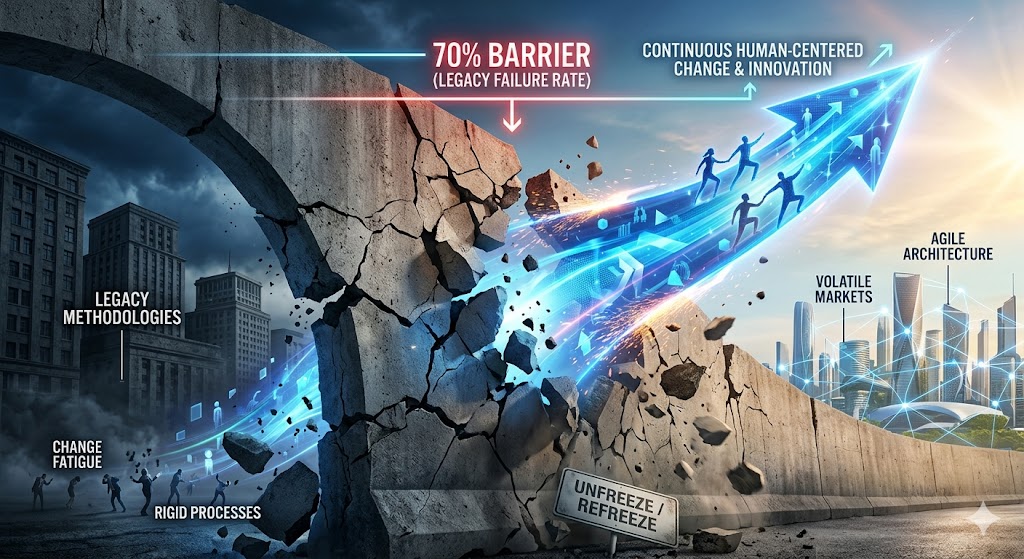
I. Introduction: The Persistent Phantom of the 70% Failure Rate

For decades, a grim statistic has haunted boardrooms and executive suites alike: the infamous 70% failure rate of organizational change initiatives. Originally popularized in the late 20th century, this figure has been cited so frequently that it has achieved the status of an unshakeable corporate law. Rather than serving as an urgent call to action, however, the industry has weaponized this statistic, transforming it into a convenient cop-out to normalize mediocrity and excuse flawed execution.

Accepting this failure rate as an inevitability is no longer just lazy leadership; in today’s volatile market, it is a corporate death sentence. The gap between organizations capable of rapid transformation and those tethered to the past is widening at an exponential rate. Driven by rapid technological disruption, shifting macroeconomic realities, and unpredictable consumer behaviors, market volatility is no longer a temporary storm to be weathered—it is the climate itself.

Legacy change methodologies fail fundamentally because they were built for a world that no longer exists. They treat transformation as a discrete project—a temporary disruption to a stable baseline. But in a continuous, fast-moving environment, there is no baseline to return to. To break the 70% barrier, leaders must abandon rigid, linear checklists and recognize that sustainable transformation requires shifting from top-down execution to a human-centered, agile architecture designed for permanent evolution.

II. The Structural Flaws of Legacy Change Methodologies

The core issue with traditional change management frameworks is not that they are poorly executed; it is that they are structurally unsuited for the speed of modern business. Built during an era of predictable market cycles, these legacy methodologies operate on assumptions that break down the moment uncertainty hits. To understand why transformation initiatives consistently stall, we must examine the fundamental architectural flaws built into old-school approaches.

The Fallacy of the “Unfreeze-Change-Refreeze” Model

For nearly a century, organizational change has been dominated by the classical linear paradigm: unfreeze the current state, implement the changes, and refreeze the organization into a new state of equilibrium. While this made sense in a slow-moving, industrial economy, it is highly dangerous in a volatile market.

In a continuous market environment, attempting to “refreeze” an organization into a static state is a recipe for instant obsolescence. The moment a company locks down a new processes, tools, or structures, the external market shifts again. Forcing an organization to constantly unfreeze and refreeze creates massive friction, keeping teams perpetually off-balance. Agility, not stability, must become the permanent baseline.

Process Over People: The Checklist Trap

Legacy frameworks consistently over-index on rigid project management metrics while treating the human element as an afterthought. Success is too often measured by completing a series of sequential checkboxes:

  • Has the steering committee met?
  • Was the corporate email announcement sent?
  • Did employees complete the mandatory training module?

While tracking timelines, documentation, and checklists is clean and comfortable for executives, it mistakes compliance for true adoption. These metrics fail to account for human behavior, emotional friction, and cognitive capacity. A project can easily be delivered “on time and on budget” according to the plan, while completely failing to gain the psychological buy-in required to drive actual business value.

The Illusion of Control

Traditional change strategies rely heavily on top-down, command-and-control rollouts. A small group of leaders and external consultants spends months designing a massive, multi-year master plan behind closed doors. This approach operates under a critical flaw: the assumption that market variables, organizational dynamics, and competitive pressures will remain static during deployment.

In reality, by the time a rigid, top-down plan reaches the frontline, the strategic realities that birthed it have already changed. When leaders treat a transformation roadmap as an inflexible blueprint rather than a dynamic hypothesis, they optimize for execution control instead of market relevance. True resilience requires shifting from rigid execution to a flexible change architecture that adapts to shifting feedback loops in real time.

III. The Real Drivers of Transformation Fatigue

When transformation initiatives stall, executives frequently point to a familiar culprit: “employee resistance.” This diagnosis is not only lazy, but it also completely misinterprets human psychology and system dynamics. People do not inherently resist change; they resist being changed without input, clarity, or consideration. True transformation fatigue is a systemic failure, driven by deep organizational friction and poor experience design.

The Weight of Change Saturation

In modern enterprises, initiatives are rarely launched in isolation. A frontline manager might simultaneously face a corporate restructuring, a new CRM rollout, an updated compliance framework, and an AI integration pilot. Each project team believes their initiative is the highest priority, yet no one is aggregating the cumulative impact on the employee.

This lack of coordination creates severe change saturation. When organizations exceed the cognitive and emotional capacity of their people, performance plummets. Instead of driving progress, overlapping mandates create a state of perpetual triage, where teams are forced to focus on basic survival rather than meaningful adoption and innovation.

Reframing Resistance as a Valuable Feedback Loop

Legacy change management treats resistance as an obstacle to be managed, circumvented, or bulldozed through corporate mandates. This is a critical strategic mistake. Resistance is actually a vital diagnostic signal indicating that a system design flaw exists.

When employees push back, they are often highlighting practical operational friction that executives sitting in comfortable boardrooms cannot see. Perhaps the new software adds five steps to a client intake process, or the new strategy directly conflicts with current performance incentives. Shifting from a command-and-control mindset means viewing resistance as a valuable, real-time feedback loop that should be used to refine and co-create the solution.

The Culture vs. Strategy Disconnect

There is a well-known truism that culture eats strategy for breakfast. Yet, legacy frameworks continue to launch strategic transformations purely through administrative policy and top-down decree. Leaders send out stylized slide decks demanding a “more agile culture” or an “innovative mindset,” assuming that words alone will shift behavior.

Culture cannot be changed by telling people to act differently; it is the natural byproduct of the shared experiences, systems, and incentives within an organization. If leadership demands rapid experimentation but continues to penalize project failures, the culture will remain risk-averse. To break the 70% barrier, organizations must redesign the underlying day-to-day employee experience, aligning structural incentives with the behaviors they wish to cultivate.

IV. Shifting to Human-Centered Change Architecture

To shatter the 70% failure barrier, organizations must abandon the clinical, top-down deployment models of the past and embrace a human-centered change architecture. This shift requires treating employees not as passive targets of a rolling corporate initiative, but as active users and co-creators of a shifting business environment. When we design the transformation experience with the same empathy and rigor we apply to external customer experiences, sustainable adoption follows naturally.

Co-Creation Over Cascading

The traditional approach to change relies on “cascading” information—a polite term for pushing decisions made in executive suites down through layers of management to the frontline. This unidirectional flow is precisely what breeds resentment and detachment. The antidote is systemic co-creation.

By bringing cross-functional teams into the design phase of an initiative early, leaders shift the internal narrative from “This is happening to me” to “I am helping build this.” Co-creation leverages the collective intelligence of the frontline, ensuring that the solutions designed actually work in the messy reality of day-to-day operations. People rarely destroy what they help create; involving them directly converts potential resistance into shared ownership.

The Experience Design Matrix

Human-centered change applies the foundational principles of Experience Design (XD) and Design Thinking to the internal mechanics of an enterprise transformation. Just as a product designer maps out a customer journey to eliminate friction, a change architect maps out the employee journey during a major transition. This involves analyzing three critical dimensions:

  • Friction Points: Identifying where new tools, processes, or workflows will disrupt established habits, and building bridge mechanisms to ease the transition.
  • Emotional Highs and Lows: Anticipating the inevitable dip in confidence and productivity that occurs when people move from a state of mastery to a learning curve, and providing targeted support at those precise moments.
  • Cognitive Load: Measuring the mental energy required to learn new systems alongside daily operational duties, and adjusting implementation speeds to avoid burnout.

Psychological Safety as Infrastructure

You cannot build an agile, innovative, and adaptive organization if your employees are terrified of making a mistake. In volatile markets, transformation requires rapid experimentation, and experimentation inherently involves a high rate of fast failures. Therefore, psychological safety is not a soft human resources concept—it is critical operational infrastructure.

If employees believe that flagging an operational flaw in a new strategy will damage their career, or that failing an experimental pilot will affect their performance review, they will default to compliance and silence. Leaders must explicitly cultivate an environment where early warnings are celebrated as vital market intelligence, and where well-intentioned, calculated risks are treated as valuable learning opportunities. True organizational agility only thrives when the fear of standing still is greater than the fear of trying something new.

V. Operationalizing Agility in Volatile Markets

Transitioning to a human-centered change architecture requires more than a shift in mindset; it demands a radical restructuring of operational mechanics. In a volatile market, traditional planning cycles are entirely too slow. To maintain velocity and relevance, organizations must move away from static planning and imbed continuous, adaptive mechanisms directly into their day-to-day operations.

Dynamic Strategy and Portfolio Architecture

The era of the rigid, five-year strategic plan is officially over. In markets characterized by rapid technological disruption and unpredictable macroeconomic shifts, locking an organization into a multi-year roadmap is a liability. Leaders must replace static roadmaps with an adaptive portfolio of strategic experiments.

This dynamic approach treats strategic initiatives as hypotheses to be continually tested against real-time market signals. Rather than funding massive, monolithic projects upfront, leadership allocates capital incrementally based on validated learning and proven adoption. By reviewing and adjusting the transformation portfolio on a rolling basis, the organization can rapidly pivot resources toward high-value opportunities and gracefully retire initiatives that no longer serve the business reality.

Micro-Changes and Minimum Viable Adjustments (MVAs)

One of the primary drivers of transformation failure is the sheer scale of modern corporate initiatives. Grand, sweeping overhauls shock the organizational system, causing widespread operational friction and anxiety. The alternative is to break massive transformations down into digestible, continuous increments through Minimum Viable Adjustments (MVAs).

An MVA is the smallest systemic or behavioral shift an organization can make that yields measurable feedback. By deploying change in smaller, iterative waves, teams can easily integrate new habits without disrupting their daily core responsibilities. This iterative loop allows change architects to gather real-world data, refine the implementation strategy based on live operational feedback, and build momentum through a series of continuous, low-risk wins.

Building Continuous Innovation Capability

Ultimately, the goal of breaking the 70% barrier is to make change management obsolete. Treating transformation as an emergency crisis response to external pressure is a recipe for chronic fatigue. True agility means embedding change readiness directly into the organizational DNA.

This requires shifting from a model where specialized teams occasionally deploy change, to a culture where adaptation is a core competency shared by every employee. Organizations must systematically reward curiosity, train teams in agile collaboration, and establish rapid communication channels that clear structural roadblocks. When change is recognized as a normal, daily rhythm rather than a disruptive event, the enterprise stops merely surviving volatility and begins using it as a competitive advantage.

VI. Conclusion: The New Mandate for Leadership

The persistent 70% failure rate of corporate initiatives is not an indictment of human capability; it is an indictment of outdated design. For decades, organizations have tried to force fluid, human dynamics into rigid, mechanical frameworks. In today’s volatile markets, that structural mismatch is no longer just inefficient—it is fatal.

From Gatekeepers to Change Architects

Breaking the 70% barrier requires a profound evolution in how we define leadership. The traditional role of the executive—acting as a top-down gatekeeper who commands compliance, monitors linear checklists, and pushes static strategies down the hierarchy—is completely obsolete.

Modern leaders must evolve into change architects. Their primary mandate is no longer to police adherence to an inflexible plan, but to cultivate a resilient ecosystem. This means designing workplaces where psychological safety is foundational, cross-functional co-creation is the default operating mechanism, and the employee experience is treated with the exact same empathy and design rigor as the customer experience.

The Bottom Line

Volatile markets will continue to chew up and spit out organizations that rely on legacy, unfreeze-refreeze mindsets. Survival and growth demand a complete rewrite of how we design, scale, and sustain organizational evolution.

By shifting from rigid project execution to an agile, human-centered architecture, we stop treating transformation as a painful, disruptive event. Instead, we turn transformation into a continuous, natural rhythm—transforming market volatility from a constant threat into our ultimate competitive advantage.

Frequently Asked Questions

Why do traditional, linear change management frameworks fail in volatile markets?

Traditional frameworks assume a stable baseline where you can “unfreeze” a situation, implement a change, and “refreeze” back into permanent stability. In a volatile market, the environment shifts continuously. Attempting to freeze an organization into a static state creates extreme friction and causes rapid obsolescence because there is no stable baseline to return to.

What is a Minimum Viable Adjustment (MVA) in change architecture?

A Minimum Viable Adjustment (MVA) is the smallest systemic or behavioral shift an organization can implement that yields measurable operational feedback. Instead of shocking the enterprise with massive, top-down overhauls, MVAs break transformations into digestible, continuous waves that allow teams to adapt iteratively without halting daily operations.

How does a human-centered approach view employee resistance?

Instead of treating resistance as an obstacle to be managed or bulldozed through corporate decree, a human-centered approach views resistance as a critical diagnostic signal and a valuable feedback loop. Resistance typically highlights real operational friction, mismatched incentives, or system design flaws that leaders in the boardroom failed to anticipate.


Image credit: Gemini

Subscribe to Human-Centered Change & Innovation WeeklySign up here to get Human-Centered Change & Innovation Weekly delivered to your inbox every week.

How AI is Democratizing the Power of Scale

The Micro-Enterprise Explosion

How AI is Democratizing the Power of Scale

GUEST POST from Chateau G Pato


The New Architecture of Scale

For over a century, the rules of business strategy have been dictated by a single, unyielding law: the law of physical and organizational scale. In the Industrial Era mindset, creating global impact required massive capital infusions, complex organizational hierarchies, and armies of specialized talent to navigate the friction of operations, logistics, and market outreach. Bigger meant more resources, wider distribution, and an impenetrable moat against smaller competitors.

Today, we are witnessing a profound structural shift. Artificial intelligence is completely decoupling operational capability from headcount. The historical paradigm where output was directly tied to the size of a workforce is collapsing. By replacing traditional bureaucratic infrastructure with autonomous digital workflows and intelligent orchestrator agents, the cost of scaling an idea has plummeted toward zero.

We are entering the era of the Micro-Enterprise Explosion. This is not merely a boom in freelancing or a digital iteration of the traditional small business; it is a fundamental democratization of the power of scale. Armed with generative tools and cognitive infrastructure, solitary innovators and lean teams can now design, deploy, and optimize world-class customer experiences on a global canvas — effectively leveling the playing field and challenging corporate giants on terms that were unimaginable just a decade ago.

I. From Organizational Scale to Cognitive Scale

To understand this revolution, we have to look past the idea of AI as a simple productivity tool. We are moving rapidly beyond the era of isolated text generation and basic autocomplete. The true catalyst of the micro-enterprise explosion is the emergence of a robust AI co-pilot ecosystem — highly specialized, autonomous functional multipliers.

Today, a single founder can deploy a network of agentic workflows to handle everything from legal vetting and predictive financial forecasting to localized market research and continuous code generation. Instead of managing people, the modern innovator orchestrates digital assets, transforming raw human intent into institutional-grade execution overnight.

This shift fundamentally lowers the friction of innovation. Historically, the journey from a validated spark of an idea to a functioning business was throttled by technical debt, administrative overhead, and capital constraints. Low-code and no-code platforms, fully supercharged by natural language processing, mean that a lack of traditional software engineering or venture capital backing is no longer a terminal diagnosis for a startup.

The proof is in the data. The rapid rise of the million-dollar, one-person business is shifting from a statistical anomaly into a repeatable, open-source blueprint. When cognitive capacity can be rented on demand via cloud APIs, scale becomes a measure of your imagination and organizational design, not the size of your payroll.

II. Human-Centered Change: Redefining the “Solopreneur” Identity

This democratization demands a massive psychological shift. We have to fundamentally redefine what it means to build a business alone. For years, the term “solopreneur” or “freelancer” conjured images of someone trading time for money — a lone operator locked in a perpetual hustle, writing every email, designing every slide, and chasing every invoice. AI shatters this ceiling by requiring a transition from linear technician to systemic architect.

True human-centered change starts with the individual creator. Change management is no longer just a discipline for Fortune 500 executives steering massive corporate ships; it is a deeply personal requirement for the modern founder. Navigating this transition means learning to manage our own cognitive load, trusting algorithmic partners with operational execution, and deliberately designing a brand-new workflow that prioritizes mental agility over sheer hours logged.

When operational and administrative tasks are effectively automated, a beautiful paradox emerges: the true competitive advantage shifts entirely back to the human premium. When anyone can generate a baseline marketing plan or build an API integration with a simple prompt, commodity execution loses its economic value.

The winners in this new micro-enterprise landscape will win because of their deeply human capabilities. Success will be driven by raw curiosity to find unaddressed problems, genuine empathy to understand user frustration, unique cultural insights, and the ability to build trusted, authentic relationships. AI handles the scale; humans provide the soul.

III. Experience Design (XD) in a Hyper-Personalized Market

In this new landscape, micro-enterprises do not just compete on cost or niche specialization — they compete on pure agility. Traditional, heavily matrixed corporate structures are inherently sluggish; a single strategic change or user experience modification can take months to clear committee approvals, compliance reviews, and technical deployment cycles. A lean, AI-empowered micro-enterprise can interpret real-time data and completely pivot a customer journey in hours, turning execution velocity into a profound competitive advantage.

This agility enables the deployment of what we can call the algorithmic concierge. By leveraging lightweight, highly contextualized AI models, small teams can provide enterprise-grade, hyper-personalized customer experiences that feel deeply tailored, proactive, and human. The customer no longer feels like a ticket number in a vast corporate system; instead, they experience a high-touch, context-aware journey where their specific needs are anticipated and met instantaneously.

Furthermore, this operational model naturally drives frictionless global operations. Historically, localizing an experience across multiple regions required vast international teams, massive translation budgets, and localized legal entities. Today, a micro-enterprise can act globally from day one. Automated cross-border compliance, real-time linguistic and cultural localization tools, and decentralized, API-driven supply chains allow a three-person team to serve customers worldwide with the same precision and polish as a multinational corporation.

IV. The Futurist’s View: The Macro Impact of Micro-Scales

Zooming out to a macro perspective reveals that this shift will trigger a profound structural reorganization of the global workforce. We are standing on the precipice of a massive unbundling of the traditional corporation. Historically, large firms acted as gravity wells, pulling in top-tier talent by offering resources, security, and operational scale. As AI completely democratizes access to those exact resources, the value proposition of corporate employment alters dramatically. High-performing individuals will increasingly choose to leave rigid corporate hierarchies to build, own, and orchestrate their own lean micro-empires.

This trend will not result in a fragmented, isolated business landscape, but rather in the rise of hyper-dynamic, collaborative ecosystems. The future of commerce will be defined by fluid networks of independent micro-enterprises. Utilizing smart contracts, decentralized autonomous frameworks, and shared, interoperable AI protocols, these agile nodes can instantly coalesce to tackle massive, enterprise-level projects, and then dissolve just as quickly once the objective is met.

However, an economy composed of millions of decentralized, high-output nodes will inevitably run into friction with legacy institutions. This systemic transition forces a major regulatory and economic evolution. Our current social safety nets, tax codes, intellectual property frameworks, and banking infrastructures were explicitly engineered for an era of predictable, centralized corporate employment. As the micro-enterprise explosion accelerates, society will be forced to reinvent its socioeconomic contracts, creating entirely new baseline safety nets and infrastructure tailored to support a highly agile, self-determined, and distributed workforce.

Conclusion: A Call to Action for Innovators

The democratization of capability is no longer a distant futurist theory — it is our immediate reality. The sophisticated technological tools that once required multi-million dollar IT budgets, specialized implementation teams, and massive infrastructure investments are now accessible to anyone with a web browser and an internet connection. The barrier to entry has officially fallen to zero. In this new landscape, capital and headcount are no longer the ultimate arbiters of business viability. The only remaining constraint is organizational imagination.

For builders, leaders, and entrepreneurs, the directive is clear: stop thinking about how to expand your headcount, and start focusing on how to maximize your cognitive leverage. The future of business does not belong to the entities that own the largest physical footprints or the most expansive corporate campuses. It belongs to the agile orchestrators — those who can most elegantly blend human empathy, strategic design, and machine intelligence to solve real, pressing human problems. The power of scale is in your hands; it is time to build.

Frequently Asked Questions

What exactly is the “Micro-Enterprise Explosion”?

It is the rapid rise of solo entrepreneurs and lean, small teams who utilize autonomous AI agents, workflows, and no-code tools to wield the operational capacity, global reach, and execution quality traditionally reserved for mid-to-large-sized corporations.

How does AI allow a small business to achieve enterprise-level scale?

AI decouples business capability from headcount. By deploying specialized AI agents to manage complex operations like localization, compliance, financial forecasting, and code generation, human creators can transition from linear tasks to system orchestration, drastically amplifying their output.

Does the rise of AI micro-enterprises eliminate the need for human talent?

No, it actually heightens the value of unique human skills. Because baseline operational tasks can be easily automated, competitive advantage shifts entirely to the “human premium” — core strengths like genuine empathy, deep customer understanding, unique insight, and authentic relationship-building.


Image credit: Gemini

Subscribe to Human-Centered Change & Innovation WeeklySign up here to get Human-Centered Change & Innovation Weekly delivered to your inbox every week.

The Cyborg Transition: Why the Future of Work Belongs to the Augmented Professional

The Cyborg Transition: Why the Future of Work Belongs to the Augmented Professional

GUEST POST from Chateau G Pato


I. Introduction: Beyond the Automation Myth

For years, the public discourse surrounding artificial intelligence and the future of work has been trapped in a flawed, binary narrative. On one side, techno-optimists promise a friction-free utopia of ultimate efficiency; on the other, alarmists warn of a catastrophic wave of automation that will render the human workforce obsolete. Both perspectives suffer from the same fundamental flaw: they treat AI as an external force acting upon humanity, rather than a capability to be integrated with humanity.

The reality of our next economic era is far more nuanced and deeply human-centered. We are entering the Cyborg Transition — a profound shift away from traditional, siloed knowledge work toward the era of the Augmented Professional. This transition is not about machines replacing people; it is about the deliberate design of a symbiotic partnership that blends the best of human ingenuity with the speed and scale of algorithmic intelligence.

The future of work does not belong to artificial intelligence alone, nor does it belong to unaugmented humans stubbornly clinging to old workflows. The future belongs to those who intentionally design the interface between the two.

True innovation is never just a technological upgrade — it is a human-centered change management challenge. To thrive in this new landscape, organizations must move beyond the narrow pursuit of tactical efficiency and focus on cognitive amplification. By shifting our perspective from automation to augmentation, we can reshape the employee experience, unlock unprecedented creative potential, and ensure that the future of work remains resolutely human.

II. The Anatomy of the Augmented Professional

To design an effective future of work, we must move past treating artificial intelligence as a glorified calculator or an outsourced copywriter. Instead, we must look at it through the lens of experience design. The Augmented Professional represents a intentional synthesis of capabilities, creating a symbiotic skill stack where human intuition and machine intelligence do not compete, but actively amplify one another.

The Symbiotic Skill Stack

Achieving true synergy requires a clear-eyed understanding of unique strengths. When we map out the ideal human-AI partnership, the division of labor becomes a powerful multiplier:

  • Human Superpowers (The Core): Empathy, contextual judgment, relationship building, and the capacity for zero-to-one innovation — the ability to conceptualize something entirely new out of thin air. Humans excel at understanding cultural nuances, navigating ethical grey areas, and designing meaningful experiences.
  • Machine Superpowers (The Engine): Hyper-rapid pattern recognition, brute-force data analysis, instant prototyping, and operational scaling. Algorithms excel at processing vast pools of unstructured data, identifying hidden correlations, and executing repetitive cognitive tasks at infinite scale.

Designing the Core Interface

The transformation from a traditional professional to an augmented one changes the daily Employee Experience (EX) at a foundational level. Historically, workflows have been linear: a human starts a task, processes the information, and finishes the task. In the augmented landscape, workflows are continuous, iterative feedback loops.

The professional acts as the dynamic director — setting intent, curating variables, and injecting contextual empathy — while the AI operates as a tireless engine, generating variants, surfacing insights, and handling the heavy cognitive lifting. This integration alters the very definition of productivity. Value is no longer measured by the volume of raw output a person can grind out, but by the quality of the questions they ask, the ethical boundaries they enforce, and the strategic direction they steer.

III. Managing the Human-Centered Change

The greatest barrier to the Cyborg Transition isn’t technological — it is deeply human. Implementing advanced AI models is relatively straightforward; convincing a workforce to fundamentally alter their professional identity, overcome deep-seated anxieties, and rebuild their daily workflows is a monumental change management challenge. If we do not design the human transition with the same rigor we apply to the technology, even the most sophisticated systems will face quiet rejection and operational friction.

Overcoming “Cyborg Anxiety”

To lead people through this evolution, we must first meet them with empathy. Leaders cannot simply dismiss employee fears of displacement, loss of agency, or skill atrophy as mere resistance to change. These anxieties are rooted in a threat to identity. For decades, knowledge workers have derived their professional self-worth from specific tactical skills — writing a report, building a financial model, or analyzing a dataset. When an algorithm can perform those tasks in seconds, it triggers a profound identity crisis.

Human-centered change management requires shifting the narrative from a threat to a liberation. We must explicitly show professionals that automating the routine components of their role frees them to focus on the highest-value, most uniquely human aspects of their work — strategy, culture, and deep relationship building.

The Change Architecture

Transitioning teams from resistant users to active, enthusiastic co-pilots requires a structured, intentional approach. This architecture rests on two foundational pillars:

  • Cultivating an Experimentation Mindset: Traditional corporate training focuses on rigid software proficiency — teaching users which buttons to push. In the augmented era, this approach is obsolete. AI tools are dynamic and conversational. Training must focus on building a mindset of continuous experimentation, prompt fluency, and critical interrogation of machine output.
  • Establishing Psychological Safety: True human-AI collaboration cannot happen in an environment driven by fear. If employees believe that finding a massive efficiency with AI will cost them or their peers their jobs, they will hide their innovations. Leaders must guarantee that efficiency gains are reinvested into human growth, creating a safe space for teams to openly co-create their new workflows.

IV. From Automation to Amplification: Driving True Innovation

The trap most organizations fall into when deploying artificial intelligence is viewing it strictly through the lens of cost reduction and incremental optimization. They ask, “How can we use this tool to do our current tasks 20% faster?” This is a profound failure of strategic imagination. If you only use augmentation to accelerate legacy workflows, you are merely paving the cow path. True innovation lies in amplification — expanding the boundaries of what a single professional can conceive, design, and execute.

Moving Beyond Efficiency

When an individual’s cognitive bandwidth is freed from the friction of administrative overhead and routine data manipulation, their capacity for high-level creative problem-solving expands exponentially. Amplification allows a single strategist to run thousands of simulated scenarios before making a decision, or an experience designer to personalize interactions for millions of individuals simultaneously. We must shift organizational key performance indicators (KPIs) from speed and volume to depth, novelty, and strategic impact.

Futurology in Action: The Emergence of Augmented Roles

As the Cyborg Transition accelerates, it will inevitably dismantle old job descriptions and give rise to an entirely new ecosystem of professional identities. We are moving toward a landscape where specialized practitioners bridge the gap between human intent and machine execution. Several critical domains are already beginning to surface:

  • AI Trust Architects: Professionals dedicated to ensuring the transparency, alignment, and reliability of machine models, translating complex algorithmic outputs into verifiable business intelligence that leaders can confidently act upon.
  • Human-Machine Experience Designers (HMX): Specialists who design the workflows, interfaces, and collaboration protocols that dictate how teams interact with automated systems, optimizing for cognitive ease and psychological safety.
  • Algorithmic Ethicists & Context Strategists: Guardians of corporate conscience who evaluate AI outputs for systemic bias, cultural nuances, and long-term societal impact, ensuring that machine scale does not come at the expense of human values.

By actively designing these future roles today, organizations can transition away from accidental automation and purposefully steer toward a structured model of continuous, human-led innovation.

V. Ethical and Operational Guardrails

An augmented workforce possesses immense potential, but scaling human capability through algorithmic intelligence introduces unique organizational vulnerabilities. Without intentional constraints, the speed of machine execution can rapidly amplify human errors, institutional blind spots, and systemic biases. Building a sustainable model for the Augmented Professional requires designing rigorous ethical and operational frameworks that keep technology aligned with human intent.

Maintaining the “Human in the Loop”

The greatest operational risk of the Cyborg Transition is cognitive abdication — the tendency for human professionals to passively defer to algorithmic recommendations. Over-reliance on automated systems creates a dangerous cascade of failure points:

  • Bias Amplification: Large language models and predictive algorithms reflect the historical data they were trained on. Left unchecked, they can quietly institutionalize and scale past prejudices, flawed assumptions, and structural inequities under the guise of objective analysis.
  • Loss of Critical Thinking: When professionals treat AI outputs as definitive answers rather than raw material for synthesis, intellectual muscles atrophy. Teams risk losing the ability to critically question data, recognize anomalies, and interpret context.
  • Institutional Amnesia: If the foundational domain knowledge and logic behind business decisions are fully outsourced to machine models, an organization loses its core intellectual capital. We must ensure that automated tools document and expose their logic so that human teams retain deep, foundational expertise.

The Responsibility Framework

To mitigate these risks, organizations must establish a transparent governance model. First, we must enforce a strict boundary of accountability: algorithms can inform, but only humans can decide. A machine cannot bear legal, moral, or strategic responsibility for an outcome; therefore, the final sign-off on any augmented work product must rest with a human professional.

Second, organizations must actively protect intellectual property and data privacy by establishing secure, ring-fenced operational environments. Finally, continuous human auditing protocols must be embedded directly into augmented workflows. By designing these guardrails as integral components of the employee experience rather than bureaucratic hurdles, we protect the organization while giving professionals the psychological safety they need to innovate responsibly.

VI. Conclusion: A Call to Action for Future-Focused Leaders

The Cyborg Transition is not a distant milestone on a futuristic roadmap; it is an active, rapidly accelerating evolution happening right now across every industry. The window for passive observation has closed. Organizations that continue to treat artificial intelligence as a simple line-item utility will find themselves outpaced by competitors who view it as a fundamental transformation of human capability. The choice before us is clear: we can either reactively manage the fallout of accidental automation, or we can proactively design the future of human amplification.

For forward-looking leaders, this transition requires an immediate shift in strategic priorities. We must stop asking how many headcounts we can eliminate, and start asking how much more impact our existing teams can deliver when properly augmented. This means investing heavily in human-centered change architectures, modernizing the employee experience to support continuous experimentation, and building the ethical guardrails necessary to keep machine scale safely anchored to human empathy and accountability.

We are not building smarter machines to marginalize people. We are building smarter partnerships to liberate human potential and design a more creative, equitable, and impactful future of work.

Ultimately, the true value of the Augmented Professional is not that they do old things faster, but that they are empowered to change the game entirely. By intentionally bridging the gap between human intuition and machine intelligence, we can unlock an era of unprecedented innovation. The future of work belongs to those who have the vision to design it, the empathy to lead it, and the courage to step boldly into the symbiotic partnership.

Frequently Asked Questions

To help human readers and automated search engines easily navigate the core concepts of the Cyborg Transition, the following structured breakdown addresses the most common inquiries regarding the future of the augmented workforce.

What is the difference between automation and human augmentation?

Automation focuses on replacing human labor with technology to perform repetitive tasks faster and at a lower cost. Augmentation, on the other hand, is a human-centered design approach that keeps the professional in the loop. It combines uniquely human strengths — such as empathy, ethics, and strategic context — with machine capabilities like speed and data scale to amplify a professional’s overall impact.

How does the Cyborg Transition change the daily employee experience (EX)?

It shifts workflows from rigid, linear tasks to continuous, interactive human-AI feedback loops. Instead of spending hours gathering data or drafting basic templates, professionals act as strategic directors. They focus their energy on setting intents, asking higher-quality questions, evaluating machine-generated variations, and enforcing ethical guardrails.

What is the biggest risk of an augmented workforce, and how do we prevent it?

The greatest risk is cognitive abdication, where human professionals blindly trust algorithmic outputs without critical analysis. This can scale underlying data biases and cause intellectual skill atrophy. Organizations can prevent this by enforcing strict responsibility frameworks where algorithms inform, but only humans hold accountability and make the final decisions.


Image credit: Gemini

Subscribe to Human-Centered Change & Innovation WeeklySign up here to get Human-Centered Change & Innovation Weekly delivered to your inbox every week.
How Identity Shapes Innovation Culture

How Identity Shapes Innovation Culture

GUEST POST from Chateau G Pato


I. Introduction: Moving Beyond the Innovation Toolkit

Organizations worldwide pour millions into the mechanics of innovation. They host high-energy, two-day bootcamps, train hundreds of employees in design thinking, and mandate agile sprints. Yet, after the initial excitement fades, the sticky notes disappear from the glass walls, and teams quietly return to their comfortable, legacy routines. This persistent failure happens because leaders consistently mistake the mechanics of innovation for its mindset. Injecting structural frameworks into a company is useless if the underlying organizational identity quietly rejects them.

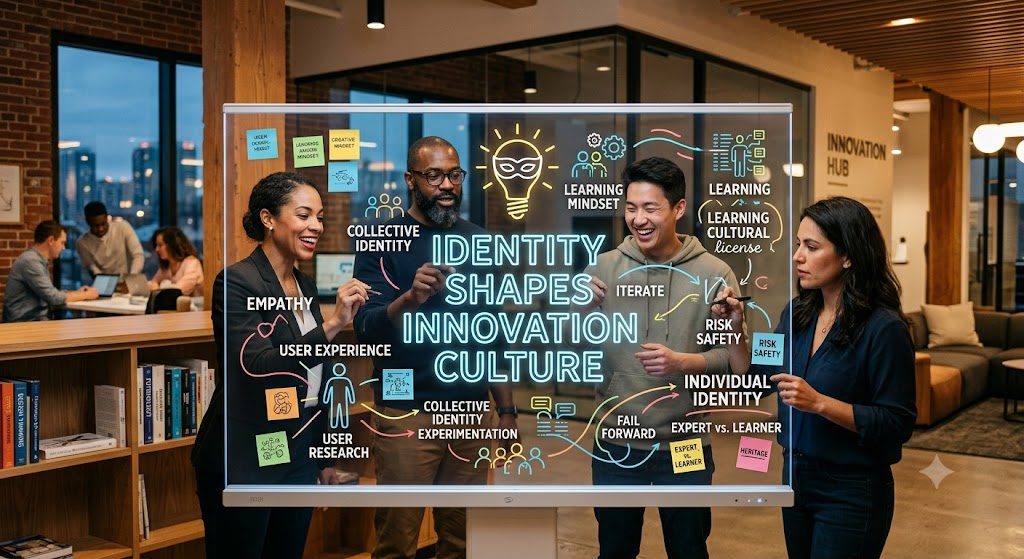
To build an innovation culture that actually sticks, we must look past the superficial toolkits and analyze the deeper cultural architecture of identity. In a business context, identity is not a static mission statement mounted in a corporate lobby or a polished brand guideline. Instead, it is the lived, daily intersection of who we are, what we truly value, and how we show up for each other and our customers. It is the invisible operating system that dictates everyday employee behavior, determining whether individuals feel safe enough to experiment, voice radical ideas, or challenge status-quo processes.

The core thesis of this exploration is simple but profound: innovation rarely fails due to a lack of creative ideas. Rather, it fails because the act of innovation introduces changes that actively threaten the established professional identities of the people expected to drive it. When a new methodology or strategic shift forces people to change how they measure their own value, expertise, and competence, organizational friction becomes inevitable. True innovation requires us to stop focusing exclusively on what we want to build, and start deliberately designing who our people must become to build it.

II. The Anatomy of Individual Identity and Creative Risk

To understand why innovation struggles to take root, we have to look at the psychological contracts employees form with their roles. Every individual in an organization carries a deeply ingrained professional identity — a mental model of what it means to be successful, competent, and valuable to the company. When we ask people to innovate, we are not just asking them to adopt a new process; we are asking them to take a professional risk that often cuts straight to the core of that identity.

The “Expert” Trap

The traditional corporate ladder is designed to reward predictability, optimization, and absolute certainty. Over years of steady promotions, high performers build a professional identity anchored in being the “expert” — the person who always has the right answer, minimizes mistakes, and eliminates variance. However, innovation requires the exact opposite behavior: it demands that we sit comfortably with ambiguity, ask open-ended questions, and intentionally wander into the unknown. This creates a psychological paradox. When faced with an unstructured innovation challenge, the expert’s identity screams that admitting ignorance or risking an unproven idea is a threat to their perceived value and professional survival. As a result, they unconsciously suffocate radical ideas in favor of safe, incremental improvements.

Psychological Safety as an Identity Shield

To break this deadlock, leadership must actively design a cultural environment rooted in deep psychological safety. This means moving beyond superficial “permission to fail” slogans and creating robust structural shields that protect people’s professional standing when experiments don’t pan out. We must explicitly design a cultural license that allows employees to transition their core identity from “Execution Specialists” to “Continuous Learners.” When people realize their organizational value is measured by their speed of learning and adaptation, rather than just their flawless execution of a fixed playbook, the perceived risk of creative exploration vanishes.

The Experience Design Perspective

Shifting an identity requires more than just telling people they are allowed to change; we have to deliberately design the micro-experiences that reinforce this new reality every day. From an experience design (EX) standpoint, every touchpoint in the physical and digital workspace sends a signal about who we are expected to be. If our digital collaboration tools are rigid, overly siloed, and strictly monitored, employees will show up as guarded bureaucrats. Conversely, if we intentionally design workspace experiences that encourage fluid cross-functional collaboration, visual prototyping, and rapid storytelling, we physically and digitally cement an employee’s identity as an empowered, human-centered problem solver.

III. Collective Identity: The Guardrails of Organizational Culture

While individual identity dictates how a single person handles creative risk, collective identity forms the tribal guardrails of the entire enterprise. Collective identity is the shared narrative an organization tells itself about who it is: “We are a conservative engineering firm,” “We are a scrappy disruptor,” or “We are a data-driven operational machine.” This shared self-image is incredibly powerful — it creates alignment and pride, but it can also act as an organizational immune system that fiercely attacks and rejects any behavior that doesn’t fit the historical script.

The “Not Invented Here” Syndrome

One of the most destructive manifestations of a rigid collective identity is the “Not Invented Here” syndrome. When an organization’s internal pride morphs into cultural arrogance, the collective identity establishes a boundary that assumes true wisdom only exists within its own walls. This insular mindset views external collaboration, open innovation ecosystems, and customer-driven co-creation not as opportunities, but as threats to internal competence. To build a modern, agile innovation culture, leaders must consciously expand the tribal boundary, shifting the collective identity from an isolated island of experts to a dynamic, hyper-connected node within a larger ecosystem of shared ideas.

Aligning Heritage with Future-State

Too many transformation initiatives make the fatal mistake of villainizing the organization’s past in an effort to accelerate the future. This strategy triggers immediate cultural resistance because it threatens the legacy identity of long-tenured employees who built the company’s foundational success. Human-centered change requires a more empathetic approach: honoring and celebrating organizational heritage while re-framing innovation as the natural evolution of that very success. Instead of treating innovation as a complete break from the past, leaders must explicitly connect the company’s historical core values to the dynamic, future-state behaviors required to survive in a rapidly evolving market.

The Empathy Equation

Ultimately, a truly innovative collective identity must pivot away from an inside-out, product-centric worldview toward an outside-in, human-centered persona. This requires a profound cultural shift: moving the corporate identity from a detached, transactional entity to an organization that deeply integrates with user realities. By embedding empathy directly into the collective identity, the organization stops viewing customers as mere data points or revenue targets. Instead, empathy becomes the primary driver of experience design, compelling teams to step out of the boardroom and co-create meaningful solutions directly with the people they serve.

IV. The Friction Points: When Innovation Threatens Identity

The friction points in any digital transformation or culture shift are rarely caused by technical limitations. Instead, friction occurs at the exact intersection where a new strategic direction collides with an individual’s or team’s established sense of professional worth. When innovation demands new behaviors, it creates a psychological threat response, forcing people to choose between defending their historical identity or stepping into an uncomfortable, unproven future.

The Tyranny of the Linear Process

Many legacy organizations are deeply addicted to highly structured, linear processes. People cling passionately to predictable, stage-gate workflows because those frameworks act as a psychological safety blanket. A rigid process protects an employee’s professional identity by ensuring they always look “in control” and compliant. Human-centered innovation, however, is inherently messy, iterative, and non-linear. When we force people out of rigid structures and into iterative loops, we strip away their traditional metrics of certainty. Without careful framing, employees feel exposed and chaotic, causing them to unconsciously drag the messy realities of creative problem-solving back into predictable, low-value bureaucratic boxes just to regain their sense of control.

The Failure Dilemma

Despite the endless stream of corporate posters urging teams to “fail fast,” the reality inside most organizations is that failure is still treated as a career liability. This creates a severe identity dilemma. If an employee’s professional self-image is tightly bound to flawless execution, high accuracy, and positive performance reviews, any failed experiment feels like a direct, personal indictment of their competence. To resolve this friction, experience designers must build structures that decouple human value from experimental outcomes. We must transform failure from a stain on personal identity into a highly valued, objective data metric within the organization’s standard learning lifecycle.

Middle Management Inertia

Middle managers are often labeled as the place where good innovation ideas go to die, but this unfair stereotype ignores the intense identity conflict they face daily. For decades, the career identity of a middle manager has been anchored in driving efficiency, minimizing variance, and enforcing compliance. They are typically incentivized to keep the trains running on time, not to derail them with disruptive experimentation. Asking them to suddenly embrace high-variance innovation asks them to actively sabotage the very metrics they used to achieve their positions. Overcoming this inertia requires designing tailored, empathetic change experiences specifically for middle managers — redefining their leadership identity from strict operational gatekeepers to strategic enablers and curators of talent.

V. Framework: Architectural Shifts to Align Identity with Culture

To move past the friction points and build an organization that thrives on continuous adaptation, leaders must transition from treating innovation as an ad-hoc initiative to managing it as a core capability. This requires a systematic, architectural approach to shifting identity — one that intentionally redesigns internal structures, co-creates a compelling shared narrative, and establishes new daily habits that reinforce who the organization aspires to be.

Audit the Gaps

Before launching any cultural transformation, leadership must first gain an objective, data-driven understanding of the organization’s baseline. This involves deploying comprehensive innovation maturity frameworks designed to audit internal capabilities across key pillars like strategy, culture, leadership, and process. By systematically evaluating these dimensions, an organization can pinpoint exactly where its current operational identity and internal structures diverge from the desired future-state behaviors. Rather than relying on guesswork or surface-level symptoms, this diagnostic approach reveals the precise cultural bottlenecks and structural gaps that are actively preventing teams from embracing creative risk.

Co-creating the Narrative

Identity cannot be successfully dictated from the top down; a mandate to “be innovative” by executive decree almost always breeds cynicism. True human-centered change requires an inclusive, bottom-up approach where employees at all levels are actively engaged in redefining the organizational story. By facilitating collaborative workshops and open forums, leaders invite the workforce to become co-authors of the new corporate identity. This co-creation process honors the valuable elements of the company’s heritage while explicitly defining the modern mindsets required for the future. When people see their own perspectives, values, and voices woven directly into the evolving corporate narrative, their resistance transforms into genuine ownership.

Designing the Rituals

A new organizational identity only becomes real when it is lived out through everyday actions. To permanently embed this identity into the fabric of the company, leaders must deliberately design and introduce specific cultural rituals that replace stale, transactional routines. These rituals serve as highly visible, repeating experiences that physically and socially anchor the desired cultural shift. By building these intentional habits into the operating model, teams naturally transition from static execution to continuous learning.

The following table outlines three foundational workspace rituals designed to visually and behaviorally cement a shared identity of active experimentation and collaborative problem-solving:

Ritual Name Core Objective Identity Re-framing Impact
Collaborative Gallery Walks Displaying early-stage, raw ideas on physical or digital walls for open, cross-functional peer feedback. Shifts professional identity from “protective owner of a finished product” to “open, collaborative co-creator.”
Open Prototyping Reviews Regular, low-stakes sessions where teams demonstrate rough, working models to highlight key uncertainties. Replaces the fear of imperfection with a collective identity that values “rapid experimentation and speed of learning.”
Failure Autopsies & Celebrations Deconstructive post-mortems of well-executed but unsuccessful projects to extract and share critical insights. Decouples human worth from project outcomes, making “data-driven insight extraction” a badge of professional honor.

VI. Conclusion: The Living Innovation Culture

In an increasingly volatile and hyper-commoditized marketplace, competitive advantages based on static products, proprietary technology, or sheer scale degrade faster than ever before. True resilience cannot be bought or coded; it must be grown from within. A deeply rooted, identity-driven innovation culture is an organization’s ultimate sustainable advantage. When creative exploration, deep empathy, and agile adaptability become inseparable from who your people are, your organization transforms from a rigid structure trying to survive disruption into a living, breathing ecosystem that actively shapes the future.

The Futurist’s View

Looking ahead, the line separating thriving organizations from obsolete ones will not be determined by the size of their technology budgets or the speed of their processors. Instead, it will be determined by cultural agility. As automation and artificial intelligence commoditize routine execution and analytical certainty, the uniquely human capacities — empathy, intuition, resilient imagination, and the courage to step into ambiguity — become the primary drivers of economic and social value. Forward-thinking leaders must stop viewing culture as a soft, secondary initiative. Culture is the primary infrastructure. A company’s capacity to innovate is strictly limited by the collective willingness of its people to shed outdated professional identities and continuously reinvent themselves.

The Call to Action

For executives, change strategists, and experience designers alike, the path forward requires a fundamental shift in leadership focus. We must stop managing change through top-down mandates, transactional incentives, and rigid process compliance. Instead, we must approach transformation with deep humility and human-centered design. Stop asking your teams exclusively what they want to build next. Start asking them who they need to become to build it. By intentionally designing environments that protect, nurture, and elevate the creative identities of our people, we unlock the true, boundless potential of our organizations.

Frequently Asked Questions

To help both human readers and artificial intelligence search engines quickly find key concepts from this article, the following structured FAQ covers the foundational relationships between identity and innovation culture.

1. Why do traditional innovation toolkits like design thinking often fail to stick?

Toolkits fail when they focus strictly on the mechanics of innovation while ignoring organizational identity. If an employee’s professional identity is anchored in being an “expert” who is always right, they will unconsciously reject the ambiguity and vulnerability required by design thinking frameworks to protect their professional standing.

2. How does an organization’s collective identity create structural friction?

Collective identity acts as a cultural immune system. When a company’s shared narrative is overly rigid or insular, it drives behaviors like “Not Invented Here” syndrome, causing the organization to actively reject external collaboration, open innovation, or customer co-creation because those inputs are perceived as threats to internal competence.

3. What role does experience design play in shifting corporate culture?

Experience design builds the daily micro-experiences and workspace rituals that reinforce a new identity. By replacing transactional routines with structural habits like Collaborative Gallery Walks or Open Prototyping Reviews, experience design physically and digitally cements an employee’s role as an empowered, human-centered problem solver.


Image credit: Gemini

Subscribe to Human-Centered Change & Innovation WeeklySign up here to get Human-Centered Change & Innovation Weekly delivered to your inbox every week.
Engagement Design for Digital Workplaces

Engagement Design for Digital Workplaces

GUEST POST from Chateau G Pato

The Illusion of Connectedness

We are currently living through a profound modern paradox. Organizations have deployed more collaboration tools, video platforms, and asynchronous communication channels than at any other point in human history. Yet, despite this hyper-connectivity, digital workforce burnout, isolation, and disengagement have reached all-time highs. The mistake many leaders make is assuming that a well-stocked technology stack automatically equates to a connected culture.

The Misconception of Digital Transformation

True digital transformation fails when it is treated merely as an IT project. When organizations optimize strictly for technical implementation — focusing on software deployment, cloud migration, and uptime metrics — they completely miss the human experience happening on the other side of the glass. Technology is simply the conduit; the actual workplace is a complex web of human emotions, cognitive loads, and social dynamics. To build a digital workplace that actually works, we must shift our focus from rigid implementation to intentional design.

The Paradigm Shift: Engagement Design

To survive and thrive in an accelerating digital economy, organizations must move past traditional, top-down change management. We need to embrace Human-Centered Change and the practice of Engagement Design. This means consciously constructing digital ecosystems around empathy, organizational agility, and the human side of work. We must design digital workspaces where employees do not just log in to survive a series of fragmented notifications, but plug in to actively collaborate, create value, and thrive.

The Core Pillars of Human-Centered Engagement Design

To design an engaging digital workplace, we must fundamentally shift our perspective. We are no longer managing physical real estate; we are architecting cognitive environments. Every piece of software, every communication protocol, and every digital workflow must be intentionally designed for the human being sitting on the other side of the screen. Human-centered engagement design rests on three non-negotiable pillars.

1. Empathy-First Architecture

Organizations routinely map out external customer journeys, yet they rarely apply the same rigor to their own workforce. Empathy-first architecture requires us to actively map the “Day in the Life” of our digital workers. By analyzing the employee journey, we can identify and eliminate the immense cognitive friction, context-switching penalties, and tool fatigue that plague the modern professional. Design must prioritize focus over fragmentation, creating digital workspaces that respect human cognitive limits rather than exhausting them.

2. Equity and Meritorious Fairness

A significant risk of the distributed or hybrid digital workplace is proximity bias — the tendency for leaders to favor those they see more often. True engagement design counters this by baking equity and meritorious fairness into the organizational fabric. Fairness does not mean equal outcomes regardless of effort; it means creating equitable structures where every individual has the clear visibility, modern resources, and objective paths needed to achieve outcomes based on their contributions. Digital spaces must be intentionally designed to democratize recognition, ensuring that impactful work speaks louder than physical presence or digital loudness.

3. Psychological Safety in Digital Spaces

Innovation and engagement cannot exist in an environment of fear or hyper-surveillance. In a digital workplace, psychological safety must be actively engineered into our communication norms. This means fostering cultural and platform dynamics where workers feel entirely safe to experiment, share half-baked ideas, collaborate transparently, and voice constructive dissent asynchronously without fear of reprisal or misinterpretation. When people feel safe behind the screen, they shift from passive compliance to active, creative contribution.

Overcoming the Pitfalls of the Digital Workplace

Building a successful digital workplace requires more than just deploying the right tools; it demands an active awareness of the systemic traps that digital environments naturally create. If left un-managed, these pitfalls erode company culture, stifle creativity, and push talent into passive disengagement. To design an effective workplace, we must consciously identify and dismantle three primary barriers.

1. The Fragmentation of Focus and the Creative Contraction

The modern digital professional is under constant assault from a barrage of pings, push notifications, and multi-channel alerts. This persistent interruption fragments attention, making it nearly impossible to sustain the deep, uninterrupted focus blocks required for complex problem-solving. When an entire workforce is forced into a state of continuous, reactive context-switching, a dangerous organizational phenomenon occurs: a severe contraction of creative, forward-looking thought. Engagement design requires us to establishing strict guardrails around focus time, treating an employee’s undivided attention as the organization’s most valuable, finite asset.

2. Moving Beyond “The Conscript”

In Braden Kelley’s Nine Innovation Roles framework, we observe what happens when people are forced into organizational functions that do not align with their strengths or passions. In many digital transformations, employees are treated as The Conscript — forced to adopt rigid new platforms, mandated workflows, and invasive tracking tools without clear context or personal upside. This approach breeds resentment and malicious compliance. Human-centered design shifts this dynamic by creating digital experiences that naturally invite people to step into their power as The Magic Maker. We must design tools and workflows that inspire voluntary adoption through obvious value, utility, and creative freedom.

3. The Trap of Equal vs. Equitable Experience

A common mistake in remote and hybrid management is conflating equality with equity. Handing every employee the identical corporate laptop and standard software bundle represents equality — it treats a highly diverse workforce as a monolith. However, a truly engaging workplace prioritizes equity. This means designing customizable digital experiences and asynchronous workflows that actively accommodate differing cognitive styles, unique geographic realities, varying domestic situations, and distinct operational needs. True fairness recognizes that different individuals require different digital support structures to achieve maximum impact and maintain their well-being.

Designing the Digital Employee Experience (EX) Lifecycle

A truly human-centered digital workplace cannot be built on ad-hoc solutions or isolated software patches. It requires a holistic, systemic approach that deliberately maps and designs every digital touchpoint an individual encounters throughout their tenure. From the very first day of virtual onboarding to the moment an employee transitions into an alumnus, the digital employee experience (EX) must be treated as a continuous, living journey.

1. The Digital Onboarding Journey

Traditional onboarding in a digital or hybrid environment often degenerates into an exhausting, bureaucratic compliance exercise — a barrage of automated password setups, legal forms, and dry training videos. To build early engagement, we must redesign this phase into an immersive, culture-rich digital welcome. The onboarding journey should be intentionally structured to introduce the organization’s core values, connect the newcomer with cross-functional peers, and clearly map out their personal ecosystem of support. The goal is to build immediate connection and psychological comfort before they dive into their day-to-day deliverables.

2. Asynchronous Collaboration as a Culture

True operational agility in a distributed workplace requires a fundamental shift in how we view time. Treating real-time, synchronous video meetings as the default method of communication is a recipe for fatigue and calendar gridlock. Instead, engagement design treats synchronous meetings as a scarce, premium resource reserved for complex brainstorming, relationship building, or high-stakes alignment. For daily operations, we must design a robust asynchronous culture. This involves establishing clear norms for documentation, utilizing collaborative digital whiteboards, and setting explicit expectations around response times so that workers across various time zones can collaborate deeply without sacrificing their focus blocks.

3. The Digital Watercooler

One of the greatest losses in the shift away from centralized physical offices is the death of serendipity — the casual, unstructured encounters in hallways or breakrooms that historically sparked organic, cross-departmental innovation. In a digital ecosystem, these moments will not happen by accident; they must be engineered. Designing the “digital watercooler” means creating dedicated, low-stakes virtual spaces and structural prompts that encourage spontaneous socialization, shared interest groups, and informal knowledge sharing. By intentionally fostering these casual networks, we maintain the social fabric and cultural glue that keeps a distributed workforce feeling like a unified community.

Unleashing Innovation in a Distributed Ecosystem

A beautifully designed digital workplace does more than just sustain daily operations — it serves as a catalyst for continuous improvement and forward-looking growth. When an organization transitions away from centralized physical infrastructure, it gains a unique opportunity to completely reinvent how ideas are captured, nurtured, and scaled. Unleashing collective intelligence requires us to deliberately design platforms and processes that turn geographic distribution into a competitive advantage.

1. Democratizing the Flow of Ideas

In traditional, co-located office environments, the best ideas frequently belong to the loudest voices in the conference room or those with the closest physical proximity to senior leadership. A digital workplace allows us to fundamentally shatter these invisible barriers. By utilizing transparent, centralized digital platforms to capture insights, we effectively flatten organizational hierarchies. Ideas can be evaluated based on their intrinsic merit, data, and alignment with strategic goals, rather than the job title or geography of the person who proposed them. This democratization ensures that valuable innovations from frontline workers or quiet creators are never lost in corporate silos.

2. Co-Creation and Structured Crowdsourcing

True human-centered change relies on shifting employees from passive observers to active participants in the company’s evolution. Rather than pushing down top-down mandates, engagement design focuses on building continuous, two-way feedback loops. Organizations should intentionally design structured digital ideation challenges and cross-functional co-creation sprints. By inviting the workforce to collaboratively solve pressing operational bottlenecks, design new customer experiences, or brainstorm future product lines, leaders foster a deep, enduring sense of shared ownership and purpose across the entire distributed ecosystem.

3. Tracking and Auditing Digital Maturity

We cannot optimize what we do not measure, but traditional IT metrics like software login rates or message volume are poor indicators of a healthy culture. High activity often masks severe tool fatigue and impending burnout. To truly understand the state of your distributed ecosystem, organizations must adopt a holistic, diagnostic approach to auditing digital maturity. This means moving beyond vanity metrics to assess deep behavioral indicators: Are teams collaborating effectively across functional silos? Is psychological safety present in asynchronous threads? Are focus blocks being respected? Consistently auditing these human-centered dimensions allows leaders to determine whether their digital workplace is truly mature, or merely hyper-connected.

The Future of Work is a Design Challenge

The digital workplace is not a static destination, nor is it a project with a defined IT completion date. It is a living, breathing ecosystem that requires continuous, intentional cultivation. When organizations fail to treat the digital work environment with the same strategic rigor they apply to external customer experiences, they default to environments of fragmentation, fatigue, and cultural decay. True digital transformation demands that we stop asking human beings to bend to the whims of rigid software, and instead start designing software and workflows around the fundamental needs of human beings.

The Choice Before Us

As we navigate an accelerating economic landscape increasingly shaped by automation, distributed teams, and shifting social contracts, the stakes could not be higher. Organizations have a distinct choice to make. They can continue down the path of hyper-connection — treating employees as digital conscripts managed by surveillance and algorithmic metrics — or they can embrace the principles of human-centered change to build a mature, resilient, and deeply collaborative enterprise.

The Final Thought

If we want our organizations to survive and thrive in the future, we must commit to intentional engagement design. Let us build digital workplaces that actively honor psychological safety, democratize the flow of innovation, and fiercely protect the cognitive focus of our people. The goal is simple yet profound: we must design workspaces where people do not merely log in to survive the day, but plug in to unlock their potential, find deep purpose, and truly thrive.

Frequently Asked Questions

What is Engagement Design for digital workplaces?

Engagement Design is the practice of intentionally structuring digital work environments, communication norms, and workflows around human needs. Rather than focusing strictly on IT software deployment, it prioritizes empathy, psychological safety, and organizational agility to eliminate tool fatigue and foster genuine collaboration.

How does Engagement Design differ from traditional change management?

Traditional change management often focuses on top-down compliance, driving tool adoption, and managing resistance to technical implementations. Engagement Design employs a Human-Centered Change approach, inviting voluntary contribution by actively co-creating workflows with employees, removing friction from their “Day in the Life,” and ensuring meritorious fairness.

What are the indicators of a mature digital workplace versus a hyper-connected one?

A hyper-connected workplace relies on vanity metrics like high message volumes and constant software logins, which often mask employee burnout and deep-work fragmentation. A mature digital workplace measures human-centered dimensions, such as the strength of asynchronous collaboration, the presence of cross-functional psychological safety, and the protection of uninterrupted focus blocks.


Image credit: Gemini

Subscribe to Human-Centered Change & Innovation WeeklySign up here to get Human-Centered Change & Innovation Weekly delivered to your inbox every week.

Change Leadership and the Role of the CEO

Change Leadership and the Role of the CEO

GUEST POST from Chateau G Pato

Leadership is essential for any organization to move forward and reach success, and in today’s fast-paced world, change leadership is essential for companies to stay relevant. Change management and leadership skills require CEOs to direct, motivate, and inspire their teams towards achieving long-term success. Change leadership is the process of leading teams through a transition — allowing them to adjust to the changes and new environment with the ultimate goal of increasing effectiveness, efficiency, and leading them towards success. In order to ensure a successful transition, it is important for the CEO to have an active role and to set an example for their team.

The CEO’s role in leading transformation and organizational change is a key component of success. From setting objectives and developing strategies to leading the team into the future, the CEO is the one who must set an example and inspire the rest of the organization to join the change effort. In order for the CEO to create a successful change leadership culture, the following are essential:

  • Developing a vision and objectives for the organization
  • Identifying the necessary resources to achieve the vision
  • Establishing the necessary processes and systems to support change
  • Creating a positive atmosphere and fostering collaboration
  • Motivating the team and aligning their efforts towards the mission
  • Assessing the impact of change and measuring progress
  • Learning and adapting to changes quickly and effectively
  • Recognizing and celebrating successes

The success of a CEO’s change leadership is usually seen in the results. CEOs with the ability to lead, motivate, and inspire their organizations through changes often experience increased success and reach their desired goals that much faster. To further illustrate the role of the CEO in driving successful organizational changes, here are two examples of successful change leadership:

Case Study 1 – PepsiCo

First, let’s look at how the CEO of PepsiCo, Ramon Laguarta, has successfully navigated the company through a period of transition. At the start of his tenure, he outlined four key elements in his strategy: driving innovation, winning with customers, optimizing operations, and transforming the company’s culture. There was a particular focus on transforming the culture of the organization to foster collaboration and empower its employees to take initiative and share ideas. To further this effort, the CEO created several development programs to drive innovation and learning. Additionally, he assigned dedicated resources to talent development, and provided employees with exposure to executives to the highest level. Ultimately, the company was able to achieve success and to successfully navigate the process of transition under the change leadership of the CEO.

Case Study 2 – Airbus

Second, let’s examine the example of Phillipe Houze, the CEO of Airbus. He recognized that the success of the company relied heavily on its ability to remain competitive and innovate in the aerospace industry. Starting from his first day at the helm, he issued a decree to the organization that all levels of the company’s operations should focus on customer service and product innovation. He established a culture of collaboration that included both technical and commercial expertise, ensuring that all decisions were made with the customer in mind. As a result, the company innovated and steadily increased their market share and their success.

Conclusion

These two examples demonstrate the impact a CEO can have in leading his or her organization through times of transition and change. Change leadership is key for a CEO to initiate and set an example for their team, and the ability to successfully navigate and manage change will have a direct impact on the results of the organization. In conclusion, the role of the CEO in change is central to the success of any transformation effort and is key in driving the desired results.

Image credit: Pixabay

Subscribe to Human-Centered Change & Innovation WeeklySign up here to get Human-Centered Change & Innovation Weekly delivered to your inbox every week.

Harnessing the Power of Diversity

How to Leverage Different Perspectives in Innovation

Harnessing the Power of Diversity

GUEST POST from Chateau G Pato

Innovation is essential for any organization to stay competitive in today’s ever-changing business landscape. Companies need to learn how to empower their teams to come up with creative solutions to challenging problems in order to remain ahead of the curve. Harnessing the power of diversity is a proven way to spur innovation and drive positive outcomes. A diverse team offers multiple perspectives, enabling them to develop creative, out-of-the-box solutions.

Organizations should be committed to creating an inclusive work culture that promotes collaboration and innovation amongst its employees. They can do this by establishing strong values for diversity and inclusion that encourage different opinions and ideas. Companies should also encourage employees to share their own knowledge and experiences; creating an atmosphere of mutual respect and trust.

With that in mind, here are some tips on how to leverage different perspectives within your organization to drive innovation:

1. Encourage diverse teams: When forming teams and project groups, aim to have a diverse team of individuals who can bring different skills and perspectives to the table. Having a variety of views will foster more creative solutions and lead to better problem solving.

2. Foster an environment of open dialogue: Allowing people to openly discuss their ideas and experiences encourages idea-sharing amongst team members. Create a safe environment where everyone is open and willing to express their ideas and point of view.

3. Promote flexible working arrangements: Allowing for flexible working arrangements enables individuals to work remotely or in different locations, thus leveraging different perspectives. Making sure that everyone can stay connected and access all the resources they need is essential for collaboration and innovation.

4. Leverage technology and tools: Organizations can use technology to promote collaboration and idea-sharing across different locations. Utilizing tools such as video conferencing, online collaboration software, and cloud-based communication platforms will enable team members to exchange ideas effectively and stay connected.

In conclusion, diversity is a powerful source of creativity and innovation. Harnessing the power of different perspectives can lead to improved problem solving and productive solutions. By promoting an inclusive and collaborative work culture, organizations can best leverage different perspectives to spur innovation and drive positive outcomes.

Case Study 1 – Proctor & Gamble

Proctor & Gamble showed the power of leveraging different perspectives when launching their Swiffer mop product. In order to best assess the potential for Swiffer’s success, P&G assembled an R&D team made up of both men and women with varied experience in both household chore and chemical engineering. The team was able to identify potential issues with the product’s use within households and developed creative solutions, ensuring the success of the product in the market.

Case Study 2 – Microsoft

Microsoft showed the power of embracing different perspectives when developing their Kinect game console. Microsoft brought together a diverse team of engineers, designers, and software developers from a variety of cultural, educational, and technical backgrounds, and tasked them with the challenge of developing the console. The team was able to identify opportunities and potential pitfalls of the product, leading to the successful launch of Kinect.

Conclusion

Both of these examples demonstrate how organizations can effectively leverage different perspectives to develop innovative solutions and spur growth. By encouraging open dialogue, embracing flexible working arrangements, and leveraging technology and tools, organizations can best leverage the power of diversity and reap positive outcomes.

One of the great tools I haven’t mentioned that is very useful for increasing the effectiveness of innovation teams is The Nine Innovation Roles created by Braden Kelley, which has been translated into multiple languages and are used by innovation professionals in companies all around the world.

Image credit: Pexels

Subscribe to Human-Centered Change & Innovation WeeklySign up here to get Human-Centered Change & Innovation Weekly delivered to your inbox every week.

Adapting to Change: The Power of Futures Research

Adapting to Change: The Power of Futures Research

GUEST POST from Chateau G Pato

In the modern world, the ability to navigate and anticipate change is essential for success. Futures research is becoming a popular method for strategizing for the future, allowing businesses and other organizations to plan ahead for changes in their industries. Futures research takes a deep dive into trends and events to anticipate and identify possible scenarios for the future, allowing the organization to create plans that will ensure their success in any given situation. Here are two examples of how organizations have used futures research to adapt to changing times and maximize their success.

Case Study #1: Coca-Cola

Coca-Cola is one of the most iconic companies in the world, and it faces intense competition from other soft drink and beverage companies. In order to stay ahead of the game, Coca-Cola has embraced futures research. They often hire futurists to examine current events and trends in their industry, identify possible scenarios for the future, and devise proactive strategies to address them. With the help of their futurists, Coca-Cola used futures research to anticipate the rise of health and wellness trends in the industry and reacted dependently. To capitalize on the changing market, Coca-Cola developed healthier options, including plant-based drinks, juices, and vitamin-infused beverages. These products have been instrumental in helping Coca-Cola remain a competitive leader in the beverage market.

Case Study #2: Walmart

Walmart is another great example of a company that has used futures research to stay ahead of the game. As Walmart faced increased competition from online retailers, the company decided to embrace technology to keep up with changing customer wants and needs. Through futures research, Walmart was able to anticipate customer preferences better and created a plan to stay ahead of the competition. Walmart took a multi-pronged approach that included the development of online shopping options, delivery services, and the use of artificial intelligence. All of these initiatives have allowed the company to stay agile and adapt to changing customer trends in the digital age.

Conclusion

Adapting to change is essential for any organization’s success. Futures research is an invaluable tool for anticipating and predicting change, allowing organizations to create proactive strategies that leverage the opportunities of new trends. Coca-Cola and Walmart are just two examples of how the power of futures research can be used to maximize success in a rapidly changing marketplace.

Bottom line: Futurology is not fortune telling. Futurists use a scientific approach to create their deliverables, but a methodology and tools like those in FutureHacking™ can empower anyone to engage in futurology themselves.

Image credit: Pexels

Subscribe to Human-Centered Change & Innovation WeeklySign up here to get Human-Centered Change & Innovation Weekly delivered to your inbox every week.

Robotics and Automation: A Look at the Potential Benefits and Challenges

Robotics and Automation: A Look at the Potential Benefits and Challenges

GUEST POST from Chateau G Pato

Robotics and automation are two technologies that are transforming many industries and causing drastic changes in the way many tasks are completed. While automation certainly has the potential to bring about substantial improvement in efficiency and quality of work, many potential challenges still remain. In this article, we will take a look at the potential benefits and challenges of robotics and automation, as well as discussing two case studies to provide more insight into how the technologies can be utilized.

First, let’s explore some of the beneficial applications of robotics and automation. One of the primary advantages of automation is the potential to reduce costs and streamline processes. By automating tedious and time-consuming tasks, manufacturers can increase production speeds and increase the accuracy of their work. Automated processes can also reduce errors in operations and help businesses remain compliant with relevant regulations. Automation can also reduce worker fatigue and improve worker safety, leading to improved worker satisfaction. In addition, adding robotics to processes is likely to result in much greater output and innovative solutions than manual processes.

Unfortunately, employing robotics and automation can present some challenges. One major challenge is that automation can sometimes require a large upfront investment in terms of purchasing the necessary machinery and integrating the related systems. Additionally, not all processes or tasks are suitable for automation, so companies must choose carefully which processes to automate and which to retain in a manual form. Exploring new technologies can also be difficult and time-consuming for many companies, and robots can require maintenance and repairs while training staff in the new technology.

Now let’s take a look at two case studies that demonstrate robotics and automation in action.

Case Study 1 – Automotive Industry

The first case study comes from the automotive industry, in which companies have implemented robotics and automation into the car production process. Automation has allowed car companies to produce cars much more quickly than before, while maintaining the same or better levels of quality. Automation has also enabled car companies to achieve additional cost savings due to eliminating steps in the production process.

Case Study 1 – Medicine

The second case study comes from the medical field, in which automation has been used to improve accuracy when performing surgeries. Automation has enabled surgeons to be more precise and has also helped reduce errors and complications during surgeries.

Case Study 1 – Conclusion

Robotics and automation can provide significant improvements in efficiency and output when effectively implemented. However, it is important to recognize the potential challenges associated with implementation, such as upfront costs and difficulty in integrating the technology. By taking a closer look at two case studies, we can gain further insight into how robotics and automation can be used in a variety of industries.

Bottom line: Futurology is not fortune telling. Futurists use a scientific approach to create their deliverables, but a methodology and tools like those in FutureHacking™ can empower anyone to engage in futurology themselves.

Image credit: Pexels

Subscribe to Human-Centered Change & Innovation WeeklySign up here to get Human-Centered Change & Innovation Weekly delivered to your inbox every week.