Author Archives: Chateau G Pato

About Chateau G Pato

Chateau G Pato is a senior futurist at Inteligencia Ltd. She is passionate about content creation and thinks about it as more science than art. Chateau travels the world at the speed of light, over mountains and under oceans. Her favorite numbers are one and zero. Content Authenticity Statement: If it wasn't clear, any articles under Chateau's byline have been written by OpenAI Playground or Gemini using Braden Kelley and public content as inspiration.

The Rise of Digital Health: What Does it Mean for the Future?

The Rise of Digital Health: What Does it Mean for the Future?

GUEST POST from Chateau G Pato

The healthcare industry has taken a decidedly digital approach to patient care in recent years. The rise of digital health technologies, from telemedicine to wearables, is changing how patients are treated, how diseases are managed, and how doctors communicate with each other. But what does this trend mean for the future of healthcare? This article examines a few examples of digital health technology and their potential implications for the industry as a whole.

Case Study 1 – Telemedicine

The first example of digital health technology is telemedicine. Telemedicine is the use of video conferencing, the telephone, email, or other electronic means of communication for medical care. Telemedicine has been hailed as a way to help increase access to medical care, allowing patients to communicate with remote providers, saving time, and reducing costs associated with transportation and other factors. What’s more, telemedicine can also reduce patient wait times and provide care in areas where healthcare services may not be readily available. In rural areas, for example, telemedicine can offer much needed access to specialists or treatments that may not be available locally.

Case Study 2 – Wearables

Another area of digital health technology is wearables. Wearables are devices, such as smartwatches and fitness trackers, that measure and transmit real-time patient data. Used in conjunction with healthcare applications, wearables can help monitor and manage chronic conditions such as diabetes, hypertension, and obesity. Additionally, wearables can be used to track and monitor patient activity, diet, and other lifestyle factors in order to provide useful insights. Furthermore, integrated with healthcare technologies, wearables can be used provide customized advice and treatments for patients, allowing providers to better understand and address patient needs.

Conclusion

Digital health technology is already proving to be a valuable asset to the healthcare industry, and its implications for the future are numerous. As the cost of care continues to rise and access to medical care remains limited in many areas, digital health technology can offer an effective and cost-effective solution to improve patient outcomes and bring greater efficiencies to medical care. From easier access to remote providers to better monitoring and management of chronic conditions, there is no doubt that digital health technologies will continue to shape the future of healthcare.

Bottom line: Futurology is not fortune telling. Futurists use a scientific approach to create their deliverables, but a methodology and tools like those in FutureHacking™ can empower anyone to engage in futurology themselves.

Image credit: Pexels

Subscribe to Human-Centered Change & Innovation WeeklySign up here to get Human-Centered Change & Innovation Weekly delivered to your inbox every week.

Creative Leadership: Strategies for Inspiring and Motivating Teams

Creative Leadership: Strategies for Inspiring and Motivating Teams

GUEST POST from Chateau G Pato

As a leader, nothing is more rewarding than inspiring a team to success. Creative and effective leadership can be the difference between a team that works well and one that fails. Fortunately, there are specific strategies that leaders can deploy to ignite creativity and motivation in their teams.

Communication

Great communication is the foundation of creative leadership. Leaders should strive to be transparent, consistent, and encouraging with communications. This helps to ensure that teams have a well-defined purpose, are motivated to reach their goals, and understand exactly what is expected of them. Additionally, leaders should encourage team members to express their own ideas and challenges in order to foster collaboration and innovation.

Goal-Setting

One of the most important responsibilities of a leader is to help set and communicate achievable goals for the team. Goals should be time-sensitive, realistic, and measurable, so that team members have a clear target to strive for. Additionally, leaders should recognize and celebrate accomplishments, big and small, to boost morale and foster a sense of motivation within the team.

Incentives

Incentives are a powerful way to motivate the team. Monetary rewards or recognition for a job well done can be highly motivating. Leaders can also offer incentives such as extra vacation time, flex-time, employee-development programs, or other rewards that align with the team’s culture and values.

Case Study 1 – Ryan’s Auto Body

Ryan ran a successful auto body shop. To motivate his team, he provided incentives and rewards for a job well done. He offered bonus vacation time as well as employee-development programs. Ryan also set team goals and was sure to recognize and celebrate their successes. As a result, his team was motivated and creative, resulting in increased efficiency and productivity.

Case Study 2 – Cuisine of the Future

Patrick was the head chef of a high-end catering company. He communicated clearly with his team and encouraged them to express their own ideas and challenges. He also created a goal-setting system with time-sensitive criteria for success. As a result, Patrick’s team was inspired to come up with innovative dishes and techniques that elevated the company’s reputation even further.

Conclusion

Leadership is an important part of any team’s success. By utilizing effective strategies such as properly communicating expectations, setting achievable goals, and offering incentives, leaders can inspire and motivate their teams to greatness. With the right strategy, any leader can empower their teams to reach extraordinary heights.

Image credit: Pexels

Subscribe to Human-Centered Change & Innovation WeeklySign up here to get Human-Centered Change & Innovation Weekly delivered to your inbox every week.

How Organizations Can Utilize Futures Research for Strategic Planning

How Organizations Can Utilize Futures Research for Strategic Planning

GUEST POST from Chateau G Pato

Organizations of all sizes are becoming increasingly aware of the value of predicting future trends and utilizing them for future strategic planning. Futures research, which involves forecasting potential development trends and analyzing their impacts, can be an extremely powerful tool in setting both short-term and long-term business goals. By effectively leveraging the insights uncovered from futures research, companies can save time, resources, and money while making better data-driven decisions.

Futures research enables organizations to better assess risk, identify opportunities, and formulate plans to best capitalize on them. It also helps anticipate potential changes in the industry and the economic environment, allowing them to devise the most proactive strategies. With this knowledge, organizations can make educated decisions on pricing, marketing tactics, product development, and other business activities.

Case Study 1: Predicting Consumer Preferences

A retail clothing store wanted to better understand their customer base and anticipate their preferences in the coming year. As part of their futures research, the store analyzed past consumer data to determine current purchasing trends, evaluated the impacts of seasonality, and identified potential future shifts in the market. Armed with these insights, the organization was able to adjust their inventory and make more targeted marketing campaigns to better align with their customer base.

Case Study 2: Enhancing Risk Management

An energy company wanted to more accurately measure their risk exposure to potential economic changes and competitive disruptions. As part of their strategic planning activities, they engaged a professional research firm to conduct a full futures research analysis. The analysis included a comprehensive review of the current market, the impact of potential political and economic events, and competitor strategies. Armed with these insights, the organization was able to make informed decisions that limited their future risk exposure.

Conclusion

Overall, utilizing futures research provides organizations with a comprehensive perspective on both their current and future business operations. By leveraging this approach as part of their strategic planning activities, organizations can stay ahead of the curve and plan more effectively for the future. Furthermore, it is imperative for managers to stay up-to-date on industry trends as they can provide powerful operational insights and help organizations stay competitive.

Bottom line: Futurology is not fortune telling. Futurists use a scientific approach to create their deliverables, but a methodology and tools like those in FutureHacking™ can empower anyone to engage in futurology themselves.

Image credit: Pexels

Subscribe to Human-Centered Change & Innovation WeeklySign up here to get Human-Centered Change & Innovation Weekly delivered to your inbox every week.

Values-Driven Conflict Resolution

LAST UPDATED: May 9, 2026 at 5:19 PM

Values-Driven Conflict Resolution

GUEST POST from Chateau G Pato


The Innovation-Conflict Paradox

In many corporate environments, conflict is viewed as a systemic failure — a breakdown in communication or a lack of team cohesion. We are taught to “de-escalate” and “keep the peace.” However, if we look at conflict through the lens of innovation, we see something different: friction is the prerequisite for fire.

The paradox lies in our approach. Most organizations treat conflict as a fire to be extinguished as quickly as possible. This leads to the “compromise trap,” where teams reach a middle ground that is safe but ultimately uninspired. When we rush to end the discomfort of disagreement, we often extinguish the very energy required to ignite a breakthrough.

To build a future-ready organization, we must shift our paradigm. We are moving away from transactional conflict management — which focuses on who is right and who is wrong — toward Values-Driven Conflict Resolution. This approach uses the organization’s core values as a strategic North Star, transforming interpersonal friction into creative fuel.

Grounding Conflict in Shared Values

When conflict arises, it often feels personal. However, in a high-performing innovation culture, most disagreements aren’t actually about personalities — they are about competing priorities. Without a clear North Star, these disputes devolve into a “battle of wills.” By grounding our resolution process in shared values, we provide the team with an objective tie-breaker that transcends individual ego.

Adopting a human-centered lens means acknowledging that professional friction is frequently rooted in a perceived threat to one’s values or goals. If one team member values stability while another values disruption, conflict is inevitable. The goal isn’t to eliminate these differences, but to align them toward a common “Why.” When the overarching purpose is clear, we can appreciate diverse perspectives as necessary components of a holistic solution.

Central to this transition is the creation of psychological safety. For values-driven resolution to work, individuals must feel safe enough to voice “productive disagreement” without fearing for their status or safety within the group. It is the responsibility of leadership to ensure that the friction of ideas never becomes a friction of people. When trust is the foundation, conflict becomes a collaborative tool rather than a destructive force.

The Framework: The Values-Alignment Audit

To move beyond the surface level of a dispute, we must apply a structured diagnostic approach. The Values-Alignment Audit is designed to strip away the emotional noise and reveal the strategic core of the disagreement. It shifts the conversation from a subjective clash of opinions to an objective evaluation of organizational priorities.

Step 1: Identify the Value Clash

The first step is to name the tension. Most innovation-stifling conflicts are actually invisible tug-of-wars between two positive values. Are we debating Speed vs. Quality? Innovation vs. Compliance? Or perhaps Customer Experience vs. Operational Efficiency? By identifying the specific values at play, we stop fighting people and start weighing priorities.

Step 2: Externalize the Problem

Conflict becomes toxic when it is internalized. Using human-centered design principles, we “externalize” the conflict by placing it on the table between the participants. The mindset shifts from “Me vs. You” to “Us vs. This Value Mismatch.” This psychological distancing allows collaborators to work together to solve the friction, rather than defending their own territory.

Step 3: The Futurologist’s Perspective

Finally, we must apply a temporal lens to the resolution. A solution that solves a conflict today but undermines our long-term brand promise or cultural integrity is a failure. We must ask: “Does this resolution serve our future selves?” By assessing the long-term impact, we ensure that our decisions today are building the organization we want to be tomorrow.

Moving from Compromise to Synthesis

In the traditional model of conflict resolution, the goal is often compromise. In a compromise, both parties give something up to meet in the middle. While this may end the argument, it often results in a “diluted” solution — a beige outcome that lacks the conviction required for true innovation. As change leaders, we must reject the mediocrity of the middle ground.

Instead, we strive for synthesis. Synthesis is the process of taking two seemingly opposing ideas and combining them to create a third, superior option that didn’t exist before. This is where Design Thinking becomes a powerful tool for resolution. By re-framing the conflict as a design challenge — using “How Might We” statements — we can bridge the gap between values like Standardization and Personalization without sacrificing the integrity of either.

Consider a high-stakes pivot where a team is divided between Technical Perfection and Market Readiness. A compromise would be to release a buggy product late. A synthesis, however, might involve a phased rollout or a modular architecture that satisfies the need for immediate feedback while maintaining a roadmap for excellence. When we stop viewing values as “either/or” and start seeing them as “yes/and,” we unlock the creative potential hidden within our disagreements.

Strategic Tools for Leaders

Values-driven resolution requires more than just a change in mindset; it requires a practical toolkit that leaders can deploy when the heat of innovation begins to singe the edges of collaboration. These tools are designed to make the invisible visible and turn abstract tensions into actionable data.

The Value Canvas

Borrowing from the tradition of visual collaboration, the Value Canvas is a shared workspace where stakeholders map their competing priorities. By physically plotting “Value A” against “Value B,” teams can identify where they are aligned and where their perspectives diverge. This visual transparency removes the “hidden agendas” that often derail productive debate and allows the group to iterate on the resolution just as they would a product prototype.

Language as a Catalyst

The words we choose dictate the emotional temperature of the room. We must train ourselves to shift from adversarial language to collaborative inquiry. Instead of saying “I disagree with that direction,” which can trigger a defensive response, try: “I am concerned this choice conflicts with our core value of [Value X]. How might we honor that value while still achieving this goal?” This subtle shift moves the speaker from an opponent to a guardian of the organization’s integrity.

Pre-Mortems as Prevention

The best way to manage conflict is to anticipate it. Before a project kicks off, conduct a Value Pre-Mortem. Ask the team: “If this project fails due to a values clash six months from now, what would that look like?” By identifying potential friction points — such as Security vs. Speed — before they become high-stakes crises, you can design the resolution mechanisms into the project’s governance from day one.

Conclusion: Conflict as a Design Requirement

In the evolving landscape of work, we must stop viewing conflict as an obstacle to be avoided and start seeing it as a design requirement. A team that never disagrees is a team that is likely stagnating, operating within the safe confines of the status quo. To innovate is to challenge, and to challenge is to create friction.

As we move deeper into an era defined by automation and agentic AI, the technical “how-to” will increasingly be handled by machines. This elevates the importance of uniquely human capabilities. Values-driven conflict synthesis — the ability to navigate deep-seated disagreements and emerge with a more robust, ethically aligned truth — will become one of the greatest competitive advantages a leader can possess.

The goal of the modern organization is not to achieve a sterile, conflict-free harmony. Instead, it is to build a culture where the heat of disagreement is consistently channeled through the prism of shared values. When we do this, we don’t just solve problems; we design a more resilient, human-centered future.

“Don’t aim for harmony at the expense of progress. Aim for alignment at the height of the heat.”

Frequently Asked Questions

Why is conflict considered a prerequisite for innovation?

Conflict represents the collision of diverse perspectives and priorities. Without this friction, teams often settle for the safest, most obvious ideas. By harnessing disagreement through a values-driven lens, organizations can move past superficial consensus to reach breakthrough solutions that are both creative and strategically aligned.

What is the difference between compromise and synthesis?

Compromise usually involves both parties “giving up” something to reach a middle ground, often resulting in a diluted or mediocre outcome. Synthesis, however, uses design thinking to integrate the core needs of both sides into a new, superior “third way” that honors the integrity of the competing values without sacrificing quality.

How can leaders prevent toxic conflict in high-pressure environments?

Prevention starts with establishing psychological safety and using tools like the “Value Pre-Mortem.” By identifying potential value clashes before they become personal and establishing shared language that focuses on organizational values rather than individual egos, leaders can keep the focus on the problem rather than the person.


Bottom line: Futurology is not fortune telling. Futurists use a scientific approach to create their deliverables, but a methodology and tools like those in FutureHacking™ can empower anyone to engage in futurology themselves.

Image credit: Gemini

Subscribe to Human-Centered Change & Innovation WeeklySign up here to get Human-Centered Change & Innovation Weekly delivered to your inbox every week.

Designing Distributed Team Social Architecture

LAST UPDATED: May 9, 2026 at 9:32 AM

Designing Distributed Team Social Architecture

GUEST POST from Chateau G Pato


I. The Structural Integrity of Connection

In a distributed environment, the “walls” of our organization are no longer made of drywall and glass, but of the digital interactions we choose to prioritize. To maintain structural integrity, we must look at the invisible forces that bind us together.

Digital Proxemics

We must redefine the concept of “closeness.” Physical distance is a constant, but digital distance is variable. By understanding how team members perceive their proximity through communication frequency and quality, we can bridge gaps before they lead to isolation. It is about creating a sense of “presence” that doesn’t rely on being in the same room.

The Synchronous/Asynchronous Balance

The architecture of a great day requires a rhythm. We must move away from the “all-day meeting” culture, which is often a symptom of low trust, and toward a model that respects deep work.

  • Asynchronous: For updates, documentation, and thoughtful reflection.
  • Synchronous: For complex problem-solving, emotional connection, and celebration.

From Accidental Collaboration to Designed Serendipity

In the office, innovation often happened by accident at the water cooler. In a distributed model, we cannot leave innovation to chance. We must intentionally design digital “intersections” where different minds can collide. This is the shift from relying on passive osmosis to active, human-centered design of our social interactions.

II. Building Trust in the Absence of Sight

In a physical office, management often relies on “presence” as a proxy for productivity. In a distributed social architecture, we must dismantle this visibility bias and replace it with a foundation of mutual accountability and psychological safety.

Flipping the Script: From Paranoia to Autonomy

Distributed work fails when leaders default to paranoia-based management—monitoring keystrokes or demanding constant status “pings.” To build a resilient team, we must shift toward outcome-based autonomy. This requires clear alignment on the “What” and “Why,” while granting individuals the human agency to determine the “How” and “When.” Trust is not earned through surveillance; it is built through consistent delivery and shared purpose.

Vulnerability as a Leadership Tool

Human-centered change starts at the top. Leaders must be willing to model transparency by acknowledging the inherent challenges of remote work—whether that is “Zoom fatigue,” the blur between home and office, or the feeling of isolation. When leaders demonstrate vulnerability, it signals to the rest of the organization that it is okay to be human, fostering a culture of authenticity rather than a performance of “busyness.”

Psychological Safety in Bits and Bytes

Innovation requires the freedom to experiment and the safety to fail. In a digital workspace, we must be even more intentional about creating environments where dissenting voices are heard and “half-baked” ideas are welcomed.

  • Low-Stakes Spaces: Creating digital channels specifically for brainstorming and “messy” collaboration.
  • Inclusive Dialogue: Ensuring that the loudest voices in a video call don’t drown out the thoughtful contributions of quieter, or more reflective, team members.

Ultimately, trust is the “social glue” that prevents a distributed team from becoming a collection of isolated freelancers. It transforms a group of people working apart into a cohesive unit working together.

III. The Experience Design of Digital Workspaces

We often mistake a “digital workspace” for a collection of software licenses. However, true social architecture recognizes that the digital environment is the primary place where work happens. If the environment is cluttered, friction-heavy, or dehumanizing, the output will inevitably suffer.

Moving Beyond Tooling to Flow

Adding more tools to a team often results in “digital friction”—the cognitive load of switching contexts, managing notifications, and searching for fragmented information. Experience design requires us to curate our tech stack with the same care an architect uses to design a physical office. We must prioritize “flow” over features, ensuring that tools facilitate human connection rather than obstructing it.

Implementing Experience Level Measures (XLMs)

Standard Service Level Agreements (SLAs) tell us if the software is “up,” but they don’t tell us if the employees are “down.” To build a high-performing distributed team, we must adopt Experience Level Measures (XLMs). These metrics capture the qualitative sentiment of the workforce:

  • Does the technology empower or frustrate the user?
  • Do our digital processes create a sense of belonging or a sense of isolation?
  • Is the “digital commute” between apps draining the team’s creative energy?

Designing the Virtual “Third Space”

In urban planning, the “Third Space” is the social environment separate from the two usual social environments of home and the office. In a distributed world, we must intentionally design these spaces within our digital architecture. These are not for tasks or tickets; they are for the social lubrication that builds culture.

  • Digital Lounges: Persistent video or audio rooms for casual “co-working.”
  • Cultural Artifacts: Digital boards that track shared wins, personal milestones, and team lore.

A well-designed digital workspace acts as a force multiplier, transforming a disparate group of individuals into a synchronized, high-functioning community.

IV. Communication as a Shared Language

In a physical office, much of our communication is subsidized by body language, tone, and physical context. When we move to a distributed model, that subsidy disappears. We must treat communication not just as a way to transfer data, but as the social architecture that defines our reality.

Navigating High-Context vs. Low-Context Communication

In a digital-first world, we often default to low-context communication—short, text-based bursts that are prone to misinterpretation. To build a cohesive team, we must intentionally inject context back into our exchanges. This means being explicit about intent, using video when nuance is required, and over-communicating the “why” behind decisions to ensure no one is left guessing in the silence of their home office.

Radical Transparency and Information Parity

Nothing erodes the social fabric of a distributed team faster than a “proximity hierarchy,” where those physically closer to leadership have more information than those who are remote. We must strive for information parity. By documenting decisions in public channels and ensuring that every meeting has a digital artifact (notes, recordings, or summaries), we create a level playing field where contribution is based on merit rather than location.

The Power of Narrative and the Shared “Bonfire”

To keep a distributed team aligned, we need a shared language that transcends individual tasks. This is where storytelling becomes a strategic tool.

  • Stoking the Bonfire: Regularly articulating the team’s vision and celebrating small wins that align with our core mission.
  • Defining the Hero’s Journey: Helping every team member see how their specific contributions fit into the larger organizational change we are trying to achieve.

When communication is designed as a shared language, it does more than just move information—it builds community and ensures that every voice, no matter the time zone, is part of the conversation.

V. FutureHacking™ the Distributed Workforce

The social architecture of today is merely the foundation for the organizational shifts of tomorrow. As we look toward the horizon, we must use FutureHacking™ techniques to anticipate how emerging technologies and shifting social contracts will redefine what it means to be a “team.”

Scanning for Signals: Agentic Collaboration

We are entering an era of agentic AI, where digital agents will act as autonomous participants within our teams. The social architecture must adapt to include these non-human entities. We must ask ourselves: How do we integrate AI “teammates” into our workflows without losing the human-centered empathy that drives true innovation? The goal is to leverage AI to handle the “drudgery” of coordination, freeing humans to focus on high-value creative problem-solving.

The Rise of the “Fluid” Team

The boundary of the organization is becoming increasingly porous. We are seeing a move toward more “fractional” and gig-based experts joining distributed teams for specific sprints. Our social architecture must be pluggable—allowing new members to onboard rapidly, absorb the culture through well-designed digital artifacts, and contribute immediately without the friction of traditional corporate silos.

Scaling Empathy Across Borders

As distributed teams become truly global, the challenge shifts from managing time zones to managing cultural empathy. We must design our interactions to be inclusive of diverse perspectives and cognitive styles.

  • Signal Picking: Actively looking for subtle shifts in team sentiment that might indicate “digital burnout” or cultural misalignment.
  • Human-Centered Agility: Building a structure that is flexible enough to pivot based on the human needs of the collective, rather than staying rigid to a specific tool or process.

By FutureHacking™ our social architecture, we ensure that our distributed teams are not just surviving the present, but are actively designed to thrive in the complex, agentic, and interconnected future of work.

Conclusion: Designing for the Human Element

The transition to a distributed model is often treated as a technical challenge to be solved with more bandwidth or faster processors. However, the true frontier is the social architecture—the invisible scaffolding of trust, intentionality, and empathy that allows a group of people to become a team. We must remember that innovation and change don’t happen in a vacuum; they happen in the spaces between us.

Summary of the Blueprint

To build a resilient distributed organization, we must commit to three core pillars:

  • Intentional Connection: Moving from accidental office encounters to designed serendipity and digital proxemics.
  • Qualitative Measurement: Using Experience Level Measures (XLMs) to ensure our digital workspaces empower rather than drain our people.
  • Radical Transparency: Erasing the proximity hierarchy and replacing it with a shared language of narrative and purpose.

If you do not intentionally design your social architecture, your culture will inevitably disintegrate into the silos of your software. The goal of the future-ready leader is not just to manage work from anywhere, but to foster a sense of belonging from everywhere. By putting human-centered design at the heart of our distributed strategies, we ensure that as our teams move further apart physically, they grow closer together in pursuit of a shared vision.

The social architecture of the future isn’t about the “where”—it’s about the “how.” Let’s design it with purpose.

Frequently Asked Questions

What is “Social Architecture” in a digital context?

Social architecture refers to the intentional design of the invisible systems—trust, communication rhythms, and cultural norms—that govern how people interact within a distributed team. Unlike a physical office, where culture is often absorbed through proximity, digital social architecture must be a conscious design artifact to prevent organizational silos.

How do Experience Level Measures (XLMs) differ from SLAs?

While Service Level Agreements (SLAs) track technical performance (like system uptime), Experience Level Measures (XLMs) focus on the human impact of technology. XLMs measure qualitative data, such as whether a tool reduces cognitive load or if a digital process fosters a sense of belonging among remote employees.

What is the biggest risk to a distributed team’s culture?

The greatest risk is the “Proximity Hierarchy,” where team members physically closer to leadership receive more information or opportunities. Establishing radical transparency and information parity ensures that all team members, regardless of location, are aligned with the organization’s “social bonfire” or shared purpose.


Bottom line: Futurology is not fortune telling. Futurists use a scientific approach to create their deliverables, but a methodology and tools like those in FutureHacking™ can empower anyone to engage in futurology themselves.

Image credit: Gemini

Subscribe to Human-Centered Change & Innovation WeeklySign up here to get Human-Centered Change & Innovation Weekly delivered to your inbox every week.

Talent Development Maps for Human-Centered Organizations

LAST UPDATED: May 6, 2026 at 8:01 PM

Talent Development Maps for Human-Centered Organizations

GUEST POST from Chateau G Pato


I. The Shift: From Rigid Ladders to Dynamic Maps

Modern organizations can no longer rely on rigid career ladders designed for stability and predictability. In a rapidly changing environment shaped by technological acceleration, evolving workforce expectations, and continuous disruption, organizations need more adaptive and human-centered approaches to talent development.

The Death of the Linear Path

Traditional corporate hierarchies were built around standardization, specialization, and incremental progression. While effective in industrial-era organizations, these models often fail to support the flexibility and agility required today.

Employees increasingly seek meaningful work, cross-functional experiences, and opportunities for continuous learning. Static job descriptions and predetermined promotion tracks frequently limit creativity, discourage experimentation, and constrain human potential.

Human-centered organizations recognize that growth is rarely linear. Careers now evolve through lateral moves, project-based experiences, skill expansion, and collaborative exploration across disciplines.

Defining the Map

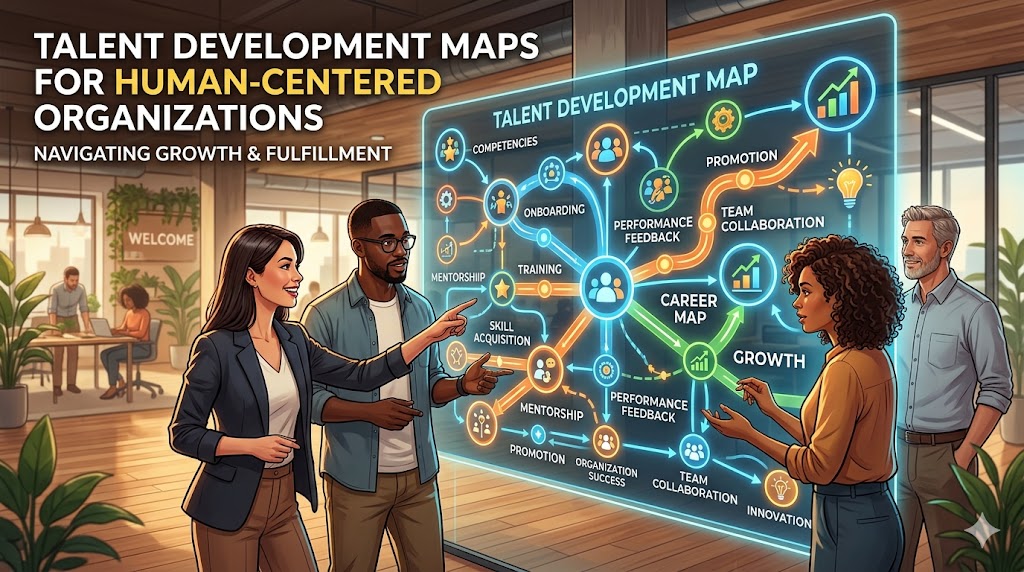
A Talent Development Map is a visual and dynamic framework that illustrates how individuals can develop capabilities, experiences, and mindsets over time. Unlike traditional ladders, maps provide multiple pathways for growth rather than a single upward trajectory.

These maps integrate technical expertise with human-centered competencies such as empathy, collaboration, adaptability, and innovation. They help employees identify opportunities to build meaningful experiences while enabling organizations to develop more resilient and agile talent ecosystems.

Most importantly, Talent Development Maps encourage exploration. They create visibility into future possibilities while empowering individuals to shape personalized growth journeys aligned with their strengths and aspirations.

The North Star

At the center of every effective Talent Development Map is alignment between individual purpose and organizational mission. When employees understand how their personal values and aspirations contribute to a larger purpose, intrinsic motivation grows stronger.

Human-centered organizations do not simply ask employees to complete tasks. They create environments where people can connect their identity, creativity, and ambition to meaningful outcomes.

This alignment becomes the organization’s North Star—guiding learning, decision-making, innovation, and long-term engagement. When people feel that their growth matters, they become more adaptable, committed, and willing to contribute beyond traditional role boundaries.

II. Designing for the Human Experience (HX)

Human-centered organizations understand that talent development is not simply a process to manage, but an experience to design. Just as organizations invest heavily in customer experience, they must also intentionally shape the employee experience to foster engagement, growth, resilience, and innovation.

Designing for the Human Experience (HX) requires leaders to move beyond transactional management systems and instead create environments where people feel understood, supported, and empowered to evolve continuously.

Empathy-First Assessment

Traditional performance systems often rely on standardized metrics that fail to capture the complexity of human potential. While KPIs and productivity measures can provide useful operational insights, they rarely reveal the motivations, aspirations, frustrations, and barriers that shape individual growth and engagement.

An empathy-first approach begins by understanding employees as human beings rather than interchangeable resources. This includes listening deeply, identifying personal development goals, and recognizing the unique circumstances influencing performance.

Human-centered organizations recognize that every employee’s journey is different. By embedding empathy into assessment, leaders can design more personalized pathways that strengthen trust, belonging, and long-term capability growth.

Experience Design Approach

Employee development should be treated as an intentional experience rather than a collection of isolated training events. The same principles used in customer experience design apply internally.

This means mapping the employee journey from onboarding through mentorship, learning opportunities, collaboration, leadership exposure, and career transitions. Each interaction shapes engagement and momentum.

When organizations design these experiences intentionally, development becomes more immersive and meaningful. Employees gain clarity about where they are, where they can go, and how to get there.

Psychological Safety as Infrastructure

Innovation cannot thrive in environments dominated by fear, rigid hierarchy, or punishment for failure. Psychological safety must be treated as core infrastructure, not a cultural add-on.

Employees must feel safe to ask questions, challenge assumptions, share ideas, and experiment without fear of negative consequences. This accelerates learning and improves innovation outcomes.

Talent Development Maps should include structured opportunities for experimentation and reflection. Failure becomes feedback, and curiosity becomes a system-wide asset.

Organizations that embed psychological safety into development systems create stronger collaboration, higher trust, and more adaptive teams.

III. The Core Pillars of the Talent Development Map

Talent Development Maps become effective only when they are built upon a foundation of adaptable human capabilities rather than static job definitions. In human-centered organizations, development extends beyond technical skill-building to include the mindsets and behaviors required to navigate continuous change.

The most resilient organizations intentionally cultivate capabilities that empower individuals to innovate, collaborate, and evolve alongside shifting conditions.

The Innovation Mindset

Innovation should not be confined to specific roles or departments. It must be embedded across the entire organization rather than treated as a specialized function.

When curiosity, experimentation, and design thinking are integrated into everyday work, innovation becomes a cultural behavior rather than an isolated activity.

Talent Development Maps should encourage employees at all levels to build creative confidence and strengthen their ability to generate and test new ideas.

Organizations that cultivate an innovation mindset normalize experimentation and continuous improvement as core expectations of work.

T-Shaped Mastery

Modern talent development requires balancing depth with breadth. While deep expertise remains essential, organizations increasingly depend on individuals who can collaborate across disciplines and understand broader organizational challenges.

T-shaped mastery describes this balance between deep specialization and horizontal capability. The vertical dimension represents technical depth, while the horizontal dimension represents collaboration, empathy, adaptability, and strategic thinking.

Human-centered organizations intentionally develop both dimensions so employees can strengthen their core expertise while also expanding their understanding of adjacent functions and customer needs.

This broader perspective improves collaboration, strengthens problem-solving, and increases organizational agility in the face of change.

Adaptive Competency

In environments defined by accelerating change, the ability to continuously learn is often more valuable than any single fixed skill set.

Adaptive competency involves the ability to unlearn outdated assumptions, embrace ambiguity, and integrate new knowledge quickly into evolving situations.

Talent Development Maps should support ongoing capability development rather than one-time training milestones.

Organizations that invest in adaptive competency build workforces capable of responding to disruption with confidence and flexibility.

IV. Collaborative Co-Creation

Human-centered organizations recognize that meaningful development does not happen in isolation. Growth accelerates when people learn with, from, and alongside one another through shared experiences, mentorship, and collaboration.

Talent Development Maps should function as collaborative systems that connect people, skills, and opportunities across the organization.

The Manager as Guide

In traditional models, managers are positioned as supervisors responsible for directing and evaluating performance. In human-centered organizations, this role evolves into that of a guide.

Managers help employees navigate opportunities, identify strengths, overcome obstacles, and shape meaningful development journeys rather than simply assigning tasks or evaluating output.

This requires coaching skills, emotional intelligence, and active listening so leaders can support growth instead of enforcing compliance.

When managers act as guides, Talent Development Maps become dynamic conversations rather than static HR artifacts.

Peer-to-Peer Learning Ecosystems

Many of the most valuable learning experiences in organizations happen informally through peer collaboration, shared problem-solving, and cross-functional interaction.

Talent Development Maps can help surface mentors, collaborators, and learning partners across different teams and disciplines.

By making expertise more visible and accessible, organizations reduce dependency on formal hierarchies and enable more fluid knowledge exchange.

Peer-to-peer learning strengthens organizational resilience by distributing knowledge more evenly across the system.

Transparent Visualization

Access to growth opportunities has often depended on informal networks, proximity to leadership, or visibility within the organization.

Human-centered organizations address this by making opportunities for development more transparent and accessible to everyone.

Talent Development Maps provide visibility into roles, projects, mentorships, and skill-building pathways across the organization.

Transparency reduces bias and helps ensure that growth opportunities are distributed based on interest, capability, and aspiration rather than informal gatekeeping.

V. Measuring Success in a Human-Centered Framework

Traditional talent measurement systems tend to emphasize output, efficiency, and completion metrics. While useful for operational tracking, these measures often fail to reflect how effectively an organization is developing its people.

Human-centered organizations require broader success indicators that capture capability growth, learning velocity, and the organizational impact of human development over time.

Beyond Completion Rates

Completion rates and training participation metrics provide only a partial view of development effectiveness. They do not indicate whether new capabilities are being developed or applied in meaningful ways.

A more meaningful measure is the velocity of capability—the speed at which individuals and teams acquire, apply, and adapt new skills in response to changing conditions.

This shifts the focus from static completion metrics to dynamic growth and adaptability.

Organizations that measure capability velocity gain insight into how quickly they can reconfigure talent to meet new challenges.

The Ripple Effect

Individual learning rarely remains isolated. When one person develops new skills or insights, those changes often influence colleagues, teams, and broader organizational outcomes.

The ripple effect measures how individual growth contributes to collective innovation, collaboration, and customer impact.

This perspective reframes success as a networked outcome rather than an individual achievement.

Organizations that understand the ripple effect can better recognize the systemic value of investing in people.

Retention through Resonance

Traditional retention strategies often rely on compensation, benefits, or external incentives. While important, these factors alone are not sufficient for sustained engagement.

Retention through resonance focuses on alignment between individual purpose, growth opportunities, and organizational mission.

When employees feel connected to meaningful work and see clear pathways for development, engagement and retention increase naturally.

Talent Development Maps support this alignment by making growth visible, purposeful, and continuous.

VI. Conclusion: The Future of Organizational Flourishing

Talent Development Maps are not static frameworks to be implemented once and then managed for compliance. They are living systems that evolve alongside people, markets, technologies, and organizational purpose.

As organizations face increasing complexity and uncertainty, the ability to continuously learn, adapt, and reconfigure talent becomes a defining factor of long-term success.

Human-centered organizations do not treat people as fixed assets. They treat them as evolving sources of creativity, capability, and growth.

The Infinite Game

In an infinite game, success is defined not by winning or finishing, but by continuing to play, evolve, and sustain value creation over time.

Talent Development Maps belong to this mindset because they are never complete. The people they serve are always changing, learning, and growing.

This perspective shifts organizational thinking away from short-term optimization and toward long-term flourishing.

The goal is not to finalize systems, but to keep them adaptive, relevant, and human-centered as conditions change.

The Call to Action

Leadership is often measured by the ability to design efficient processes and scalable systems. However, in a human-centered future, leadership must also focus on enabling human growth.

This requires shifting attention from controlling work to creating environments where learning and development can thrive.

Organizations must invest in systems that prioritize adaptability, meaning, and human potential over rigid structure and short-term optimization.

The call to action is to stop optimizing people for processes and start designing processes that optimize for people.

Key Thought

“A human-centered organization doesn’t just use people to build products; it uses its mission to build people.”

FAQ: Talent Development Maps

This FAQ is designed for both human readers and machine systems such as search engines and AI answer models.

1. What is a Talent Development Map?

A Talent Development Map is a dynamic, non-linear framework that helps individuals and organizations visualize multiple pathways for skill development, experience building, and mindset growth.

Unlike traditional career ladders, it emphasizes flexibility, personalization, and continuous learning aligned with purpose.

2. How is Human Experience (HX) different from traditional HR approaches?

Human Experience (HX) focuses on designing the employee journey as an intentional experience rather than managing people through standardized processes and metrics.

It prioritizes empathy, psychological safety, and personalized development over rigid performance systems and one-size-fits-all career structures.

3. How do organizations measure success in a Talent Development Map model?

Success is measured through capability growth velocity, the ripple effect of learning across teams, and retention through resonance.

These measures go beyond traditional output metrics to evaluate how effectively people are developing, collaborating, and adapting over time.

Bottom line: Futurology is not fortune telling. Futurists use a scientific approach to create their deliverables, but a methodology and tools like those in FutureHacking™ can empower anyone to engage in futurology themselves.

Image credit: Gemini

Subscribe to Human-Centered Change & Innovation WeeklySign up here to get Human-Centered Change & Innovation Weekly delivered to your inbox every week.

Antidotes to Short-Termism in Innovation Strategy

LAST UPDATED: May 6, 2026 at 9:59 AM
Antidotes to Short-Termism in Innovation Strategy

GUEST POST from Chateau G Pato


The High Cost of the “Quick Win”

In the modern corporate landscape, the gravitational pull of the quarterly earnings report often traps even the most visionary leaders in a cycle of incrementalism. While hitting immediate targets is necessary for survival, it frequently comes at a steep price: the sacrifice of long-term relevance. When we prioritize the “quick win” above all else, we are not just choosing efficiency; we are actively accumulating “innovation debt” that will eventually come due.

Short-termism acts as a silent killer of sustainable growth. It narrows the organizational lens, forcing teams to focus exclusively on optimizing what already exists rather than exploring what could be. This creates a dangerous Innovation Gap — the widening distance between a company’s current capabilities and the rapidly evolving demands of a future market. If we don’t intentionally design our strategies to bridge this gap, we leave the door wide open for more agile disruptors to step in.

The hard truth is that short-termism isn’t usually caused by a lack of imagination. Instead, it is a failure of design and governance. To overcome it, we must move beyond the rhetoric of “thinking big” and implement structural antidotes that protect future-oriented exploration from the pressures of today’s operational demands. We must shift the narrative from mere survival to intentional, human-centered evolution.

Diagnosis: Why We Default to the Near-Term

To solve for short-termism, we must first understand the psychological and structural anchors that keep us moored to the present. It isn’t simply a lack of “bravery” in the boardroom; it is a systemic response to how we measure success and manage risk.

Loss Aversion in the C-Suite

Human psychology is naturally wired for loss aversion. In a corporate context, the perceived risk of a failed breakthrough project often outweighs the theoretical gain of a future market-leading position. This leads to a “safety-first” mentality where proven incrementalism — making the existing horse run 2% faster — feels more responsible than investing in the “unproven” radical innovation that could replace the horse entirely.

The Incentive Misalignment

We are what we measure. Most organizational KPIs, bonus structures, and performance reviews are calibrated to annual or even quarterly cycles. When leaders are rewarded for immediate efficiency and cost-cutting, they are logically disincentivized from making “long-tail” investments. We cannot expect Horizon 3 thinking from a workforce that is being compensated solely on Horizon 1 results.

Information Overload vs. Insight Scarcity

In our hyper-connected world, leaders are bombarded with daily “noise” — competitor press releases, stock fluctuations, and viral social trends. This creates a reactive posture. When we spend all our cognitive energy responding to the friction of today, we lose the capacity to identify the subtle weak signals that point toward the opportunities of tomorrow. We mistake activity for progress and urgency for importance.

Antidote 1: Designing a Multi-Horizon Portfolio

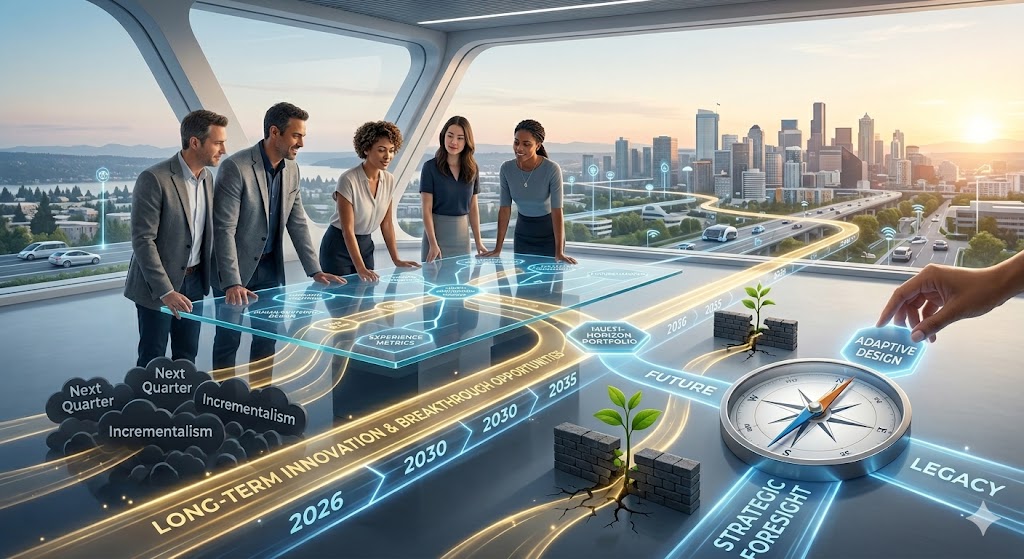
To break the cycle of short-termism, organizations must treat innovation not as a series of isolated projects, but as a balanced portfolio. Just as a financial advisor diversifies assets to manage risk and return over time, innovation leaders must diversify their initiatives across different time horizons. This structural approach ensures that the “urgent” does not permanently crowd out the “important.”

The 70/20/10 Rule Revisited

A resilient strategy typically allocates resources in a balanced ratio: 70% to core innovation (optimizing current products), 20% to adjacent innovation (expanding into new markets or capabilities), and 10% to transformational innovation (creating entirely new breakthroughs). Short-termism occurs when the 70% begins to swallow the rest. By formalizing these buckets, organizations create a mandate for long-term exploration that is protected from quarterly budget cuts.

Operationalizing the Three Horizons

Using the Three Horizons framework allows us to visualize our current state while simultaneously mapping our future. Horizon 1 represents the systems that keep the lights on today. Horizon 2 represents emerging opportunities that are gaining momentum. Horizon 3 contains the visionary ideas that will define the organization’s future a decade from now. The “antidote” lies in managing all three simultaneously, rather than waiting for Horizon 1 to decline before thinking about Horizon 3.

Decoupled Funding and Governance

One of the most effective mechanical fixes for short-termism is decoupled funding. Transformational projects should not compete for the same “pot” of money as operational maintenance. By ring-fencing budgets for long-term bets, leadership sends a clear signal that future-proofing is a non-negotiable priority. Furthermore, these projects should be governed by different metrics — focusing on “speed to learning” rather than “speed to ROI” in their early stages.

Antidote 2: Human-Centered Futurology

Futurology is often misunderstood as the pursuit of “predicting” the future. In reality, it is about preparedness. Short-termism thrives when the future feels like an abstract, distant problem. To counter this, we must bring the future into the present by making it tangible, relatable, and human-centered. We must shift our focus from what the technology can do, to what humans will value in a world reshaped by that technology.

Foresight as an Organizational Muscle

Strategic foresight should not be a once-a-year executive retreat. It must be an ongoing organizational capability. This involves “environmental scanning” — systematically looking for weak signals and peripheral trends that are currently on the edges but have the potential to move to the center. When we train our teams to spot these signals early, we reduce the “surprise factor” and give ourselves the lead time necessary to build sustainable strategies rather than reactive patches.

Scenario Planning and Speculative Design

Data and spreadsheets are often too dry to inspire long-term change. To overcome the inertia of the present, we use scenario planning and speculative design to create vivid “future worlds.” By crafting narratives about how people will live, work, and play in five or ten years, we make the risks and opportunities feel real to stakeholders today. These stories serve as a north star, helping leadership align on a shared vision that extends far beyond the next fiscal year.

Customer Empathy Beyond Today

Traditional market research tells us what customers want now based on their current frustrations. Human-centered futurology asks a different question: “How will human needs evolve?” As socio-economic conditions shift and new technologies emerge, customer behaviors will transform. By applying empathy to these future personas, we can begin designing the experiences of tomorrow today, ensuring our innovation pipeline is solving problems that will actually exist when the product finally hits the market.

Antidote 3: Architectural Excellence & Experience Design

To resist the gravitational pull of short-termism, innovation must move from a sporadic “lightning strike” to a disciplined, repeatable process. We must design an organizational architecture that is inherently flexible, allowing us to build for the future while maintaining the stability of the present. This requires a shift from focusing on isolated product features to designing holistic, long-term Experience Strategies.

Innovation Excellence (IxL)

True innovation isn’t just about the “big idea”; it’s about the infrastructure that supports it. By implementing a robust framework for Innovation Excellence, organizations create a common language and set of tools for evaluating progress. This framework acts as a structural safeguard, ensuring that projects are judged by their strategic fit and future potential rather than just their immediate profitability. It turns innovation into a core competency rather than a side project.

Designing the Infinite Customer Journey

Short-term strategy often focuses on the point of sale. Experience design, however, looks at the entire lifecycle of the human relationship with a brand. By mapping out long-term Experience Level Measures (XLMs), we can track how our innovation efforts are improving the lives of our customers over time. This human-centered data provides a powerful counter-narrative to purely financial metrics, proving that long-term loyalty and “experience-led acquisition” are more valuable than one-off transactions.

Building for Adaptability

One of the greatest enemies of long-term thinking is “rigid infrastructure” — whether that is technical debt, fixed business models, or siloed organizational charts. To stay relevant, we must design for modularity. An adaptable architecture allows an organization to pivot its strategy without a total system collapse. By building “future-ready” platforms, we ensure that when the market shifts, we have the foundation in place to move with it, rather than being forced to rebuild from scratch under the pressure of a crisis.

Antidote 4: Cultural Transformation & Psychological Safety

The most sophisticated innovation frameworks will fail if they are planted in a culture of fear. Short-termism is often a defense mechanism; when employees feel that their jobs depend on immediate success, they will naturally avoid the risks associated with long-term exploration. To counter this, we must transform the cultural “operating system” of the organization to value learning as much as it values efficiency.

Redefining Failure and Learning Loops

In a short-term culture, a project that doesn’t yield immediate ROI is labeled a “failure.” In a future-ready culture, we treat these instances as “learning dividends.” By utilizing tools like pre-mortems, teams can anticipate future roadblocks before they occur, shifting the focus from blame to prevention. We must foster an environment where “failing fast” is actually about “learning fast,” ensuring that every experiment — regardless of the financial outcome — strengthens our strategic position.

The Leader as Orchestrator

Moving away from short-termism requires a fundamental shift in leadership style. Leaders must move from “Command and Control” — where they provide all the answers and demand immediate results — to becoming an Orchestrator. This role involves setting the vision, removing obstacles, and creating the psychological safety necessary for teams to pursue bold, long-term ideas. When leaders prioritize the health of the innovation ecosystem over the daily tally of tasks, the organization gains the breathing room to innovate.

Tapping into Collective Intelligence

The “antidote” to narrow, top-down short-termism is internal crowdsourcing. Often, the front-line employees who interact with customers daily have the clearest view of emerging shifts and long-term needs. By creating democratic channels for idea submission and collaborative problem-solving, we tap into a diverse range of perspectives. This not only builds a more robust innovation pipeline but also creates a sense of shared ownership in the organization’s future, making long-term goals feel personal rather than corporate.

Implementation: Taking the First Step

The transition from a reactive, short-term posture to a proactive, future-ready strategy does not happen overnight. It requires a series of intentional, practical shifts that bridge the gap between our current operational reality and our long-term aspirations. Implementation is where theory meets the pavement, and it begins with changing who we listen to and how we measure progress.

The “Shadow Board” Strategy

To disrupt the “echo chamber” of the executive suite, forward-thinking organizations are implementing Shadow Boards — groups of younger, non-executive employees who are given the same data as the senior board to provide a different perspective. These digital natives often see the world through a lens of 2030 rather than 1990. By involving diverse voices in high-level strategic discussions, we naturally challenge short-term assumptions and gain early visibility into the cultural shifts that will define our future market.

Validating Through Micro-Experiments

We don’t need to bet the entire company on a single long-term hypothesis. Instead, we use micro-experiments to validate our assumptions. These are low-cost, high-learning pilots designed to test specific elements of a “Horizon 3” idea. By breaking down a ten-year vision into small, actionable steps, we can gather real-world data today that justifies continued investment in tomorrow. This reduces the perceived risk of long-term innovation and allows us to pivot based on evidence rather than ego.

Measuring What Matters: Leading vs. Lagging Indicators

If we only measure revenue and profit, we will always be looking in the rearview mirror. To combat short-termism, we must introduce leading indicators that track the health of our future pipeline. This includes metrics such as “speed to learning,” “percentage of revenue from new business models,” and “innovation pipeline velocity.” By shifting our focus to these forward-looking measures, we give our teams the permission — and the mandate — to prioritize the activities that will ensure our longevity.

Conclusion: The Legacy of Innovation

In the final analysis, the fight against short-termism is not just a tactical battle over budgets or timelines — it is a philosophical commitment to the infinite game of business. Companies that survive the next decade won’t be those that hit every quarterly target at any cost, but those that viewed innovation as a continuous, human-centered journey rather than a destination with a fixed ROI.

As leaders, we must recognize that our greatest contribution isn’t the efficiency we squeeze out of today’s operations, but the foundations we build for tomorrow. When we implement the antidotes of multi-horizon portfolios, strategic foresight, and cultural psychological safety, we are doing more than just planning; we are ensuring that our organizations remain relevant in a world that refuses to stand still.

The choice is clear: we can continue to be managed by the pressures of the ledger, or we can choose to design a legacy. By prioritizing long-term innovation strategy today, we aren’t just predicting the 2030s — we are actively creating them. The future is not something that happens to us; it is something we build, one intentional, human-centered decision at a time.

It’s time to stop surviving the quarter and start stoking the innovation bonfire.

Frequently Asked Questions

How can we protect long-term innovation budgets during a market downturn?

The most effective method is “decoupled funding,” where Horizon 3 budgets are ring-fenced and treated as strategic capital rather than operational expense. By separating these funds from the core business P&L, leadership ensures that the “urgent” needs of today do not cannibalize the “important” seeds of tomorrow.

What is the difference between an SLA and an XLM in innovation?

While a Service Level Agreement (SLA) measures technical performance (uptime, speed, accuracy), an Experience Level Measure (XLM) tracks the human impact of an innovation. XLMs focus on qualitative outcomes like user friction reduction, cognitive load, and emotional resonance, ensuring the strategy remains human-centered.

How does ‘FutureHacking’ help combat short-termism?

FutureHacking involves identifying weak signals in the present to build tangible future scenarios. By making the “future” feel like a concrete reality through speculative design, leaders can more easily justify the long-term investments required to navigate upcoming socio-economic shifts.

Bottom line: Futurology is not fortune telling. Futurists use a scientific approach to create their deliverables, but a methodology and tools like those in FutureHacking™ can empower anyone to engage in futurology themselves.

Image credit: Gemini

Subscribe to Human-Centered Change & Innovation WeeklySign up here to get Human-Centered Change & Innovation Weekly delivered to your inbox every week.

Cross-Functional Team Blueprints That Work

LAST UPDATED: May 5, 2026 at 5:22 PM

Cross-Functional Team Blueprints That Work

GUEST POST from Chateau G Pato


The Silo Killer: Redefining Team Architecture

In the traditional corporate landscape, innovation often dies in the hand-offs. We have spent decades perfecting vertical excellence — building world-class Marketing, Engineering, and Operations departments — only to find that these “silos” act as insulation against the very agility required to survive in a rapidly shifting market.

The myth of the “Lone Genius” is a comfortable one, but it is fundamentally incompatible with human-centered design. True breakthroughs don’t happen in a vacuum; they happen at the messy intersections where diverse perspectives collide. To move from fragmented efforts to a cohesive engine of change, organizations need more than just a mandate for “collaboration” — they need a structural blueprint.

“Innovation is not a department; it is a capability fueled by how we connect our most valuable assets — our people.”

A Cross-Functional (XF) Blueprint is a deliberate shift away from hierarchy-first thinking toward outcome-first architecture. It is the transition from temporary, “special project” task forces to permanent, fluid value-creation structures that mirror the customer journey. By designing teams that look like the problems they are trying to solve, we bypass the “corporate immune system” and create a direct path to meaningful transformation.

The Pillars of Human-Centered Design in Teams

Building a team that works requires more than just gathering different job titles in a room; it requires a foundational shift in how those individuals interact. If the blueprint doesn’t account for human dynamics, the architecture will inevitably crumble under the pressure of execution.

Empathy as a Structural Component

Most organizations build teams to satisfy internal reporting lines. A truly cross-functional blueprint flips this, designing teams that mirror the customer journey. When a team is structured around a “Life Event” or a “User Need” rather than a “Departmental Function,” empathy becomes a natural byproduct of their daily workflow rather than a scheduled exercise.

The Bedrock of Psychological Safety

Innovation is inherently risky. To foster a culture of futurology and experimentation, the blueprint must include a “Safe to Fail” zone. High-performing teams are not those that never make mistakes, but those that have the psychological safety to surface those mistakes early. Without this, cross-functional friction turns into blame, and the “Fear of Being Wrong” effectively kills any radical ideas before they can be prototyped.

Optimizing the Diversity Quotient

We look for T-shaped professionals: individuals with deep expertise in their specific craft (the vertical bar) but a broad ability to empathize and collaborate across other disciplines (the horizontal bar).

  • Cognitive Diversity: Ensuring the team includes different ways of thinking and problem-solving.
  • Functional Balance: Balancing the visionaries with the pragmatists to ensure ideas move from sticky notes to reality.
  • The Experience Lens: Integrating designers and strategists who represent the end-user’s voice at every decision gate.

When these pillars are in place, the team stops being a group of experts and starts being a cohesive unit of change capable of navigating the complexities of modern experience design.

Three Blueprint Models for Rapid Innovation

There is no “one size fits all” when it comes to organizational design. The blueprint you choose must align with your strategic goals, whether you are looking to disrupt an entire industry or incrementally improve a core service. These three models represent the leading edge of organizational agility and experience design.

1. The “Squad & Tribe” Evolution

Originally popularized by the tech sector, this model is being successfully adapted for non-tech industries seeking to maintain agility at scale.

  • The Squad: A small, autonomous, multi-disciplinary team (including a Product Owner, Designer, and Lead Engineer) focused on a specific mission.
  • The Tribe: A collection of squads working in related areas, sharing resources and knowledge to ensure the “Red Thread” of the customer experience remains intact.

2. The Internal Startup Hub

For projects involving high-stakes futurology or radical digital transformation, the standard corporate bureaucracy can be a death sentence. The Internal Startup Hub creates “innovation cells” that operate with their own funding and governance. This model allows teams to move at the speed of a startup while leveraging the scale and assets of the parent organization.

3. The Shared Services Overlay

Not every team needs a full-time data scientist or a dedicated Experience Design lead. The Overlay model treats specialized talent as a “consultancy” within the company. These experts rotate into core product teams during critical phases — such as the initial discovery or final testing — ensuring high-level expertise is injected exactly where it is needed without creating permanent, bloated overhead.

By selecting and customizing one of these blueprints, organizations can move past the “innovation theater” of occasional workshops and move toward a sustainable, repeatable capability for change.

The Infrastructure of Alignment

A blueprint is merely a drawing until you establish the infrastructure that holds the structure together. In cross-functional environments, the greatest friction doesn’t come from a lack of talent, but from a lack of alignment. To build a high-velocity innovation engine, you must install the “connective tissue” that allows diverse specialists to function as a single organism.

Establishing a Shared Language

One of the most common “innovation killers” is the Jargon War. When Marketing speaks in “brand equity,” Engineering in “technical debt,” and Finance in “NPV,” the project stalls. A successful blueprint mandates a unified vocabulary. Whether you are using Braden Kelley’s Eight I’s of Infinite Innovation or your own proprietary framework, every team member must agree on what “done,” “success,” and “innovation” actually mean in the context of the project.

The Decision-Making Matrix

Ambiguity is the enemy of momentum. Cross-functional teams often suffer from “Death by Committee” because decision rights are poorly defined. Your blueprint must clearly delineate the Decision Gates:

  • The Product/Experience Owner: Final say on the “What” and the “Why” (the value proposition).
  • The Functional Lead: Authority over the “How” (technical or creative execution).
  • The Stakeholder: Provides input and resources but does not hold veto power over the internal team dynamics.

Visualizing the Workflow

You cannot manage what you cannot see. Utilizing tools like Experience Maps or dependency charts allows the team to visualize the “hand-offs” before they happen. By mapping the flow of information and value through the team, you can identify where the “Corporate Immune System” might trigger a rejection and proactively design a workaround.

When the infrastructure of alignment is robust, the team spends less time negotiating internal politics and more time solving human-centered problems for the end user.

Overcoming the “Immune System” Response

Every organization has a natural “Corporate Immune System” designed to protect the status quo and minimize risk. While this system is excellent for maintaining operational stability, it often views innovation and cross-functional change as a foreign virus to be neutralized. To build blueprints that work, we must design strategies to bypass these systemic defenses.

Pivoting Middle Management from Gatekeepers to Enablers

Middle managers are often the most squeezed by cross-functional initiatives. They are held accountable for departmental KPIs while their best talent is “borrowed” for innovation squads. A successful blueprint addresses this friction by reframing their role. Instead of protecting their silos, managers must be incentivized to become resource facilitators, ensuring their team members have the “air cover” needed to focus on transformational work.

The Incentive Alignment Gap

You cannot expect cross-functional behavior if you only reward departmental results. If the Engineering lead is judged solely on “uptime” and the Marketing lead on “lead generation,” they will inevitably clash when a project requires a trade-off between the two.

  • Shared KPIs: Tie a significant portion of performance reviews to the success of the cross-functional outcome.
  • Experience Metrics: Shift the focus from internal milestones to external Experience Level Measures (XLMs) that track how the customer actually perceives the change.

Maintaining Momentum Through the “Messy Middle”

The “Change Energy” is always highest at the kickoff and the launch. The danger zone is the middle, where the initial novelty wears off and the hard work of integration begins. We overcome this by:

  • Small Wins: Designing the blueprint to deliver incremental “value bursts” every few weeks to prove the model’s efficacy.
  • The Transparency Layer: Using visual dashboards to show progress across the entire ecosystem, making it harder for the “immune system” to claim the project is stalling.

By proactively identifying where friction will occur, we can design a human-centered change strategy that doesn’t just push against the organization, but pulls it toward a more agile future.

Conclusion: Designing for the Future

A blueprint is not a static document; it is a living hypothesis. As the pace of technological change accelerates and the “Great American Contraction” continues to reshape how we value human labor, our team structures must remain as iterative as the products they create. We cannot solve the challenges of tomorrow using the rigid, hierarchical blueprints of yesterday.

The Living Blueprint

The most successful organizations are those that treat their internal structure as a prototype. Periodically “stress-test” your cross-functional teams: Are they still centered on the human experience? Is the decision-making still fluid? If the structure begins to feel like a cage rather than a catalyst, it is time to iterate on the design.

A Call to Action for Innovation Leaders

Do not wait for a total organizational overhaul to begin this journey. Start small:

  • Identify a “Pilot” Project: Select a high-impact initiative with clear, customer-centric outcomes.
  • Deploy a Blueprint: Choose one of the models discussed — whether a Squad or an Internal Hub — and provide it with the necessary “air cover.”
  • Measure and Socialize: Use the results to advocate for broader structural change across the enterprise.

Ultimately, our role as leaders isn’t just to build products or services; it is to design the environments where innovation becomes inevitable. By moving from accidental collaboration to intentional, cross-functional blueprints, we don’t just survive the future — we architect it.


Let’s stop building silos and start building the future.

Frequently Asked Questions

What is the main difference between a task force and a cross-functional blueprint?

A task force is typically a temporary, reactive group formed to solve a specific crisis. A cross-functional blueprint is a proactive, permanent structural design that aligns diverse talent around continuous value creation and the customer journey.

How do you prevent “Death by Committee” in these teams?

By establishing clear decision rights within the blueprint. We distinguish between the Product Owner (the ‘What’), the Functional Lead (the ‘How’), and Stakeholders (the ‘Input’), ensuring that speed is maintained through defined Decision Gates.

Can traditional industries use the “Squad & Tribe” model?

Yes. While it originated in software, any organization centered on complex customer experiences — such as healthcare or financial services — can adapt these “squads” to focus on specific stages of the user lifecycle rather than departmental tasks.


Bottom line: Futurology is not fortune telling. Futurists use a scientific approach to create their deliverables, but a methodology and tools like those in FutureHacking™ can empower anyone to engage in futurology themselves.

Image credit: Gemini

Subscribe to Human-Centered Change & Innovation WeeklySign up here to get Human-Centered Change & Innovation Weekly delivered to your inbox every week.

Human-Centered Postmortems for Innovation Projects

LAST UPDATED: May 4, 2026 at 11:05 AM

Human-Centered Postmortems for Innovation Projects

GUEST POST from Chateau G Pato


I. Introduction: Moving Beyond the Autopsy

Innovation is rarely a straight line; it is a messy, non-linear journey through uncertainty. However, most organizations still treat project reviews like clinical autopsies — focused solely on the mechanics of what went wrong. In the world of human-centered innovation, we recognize that products don’t fail, but the assumptions and experiences of the people behind them often do.

The Innovation Paradox

Standard postmortems are designed for efficiency and optimization, which works for repeatable operations but fails the unique needs of innovation teams. When we ignore the human element, we miss the “why” behind the data, leading to repeated mistakes and organizational fatigue.

Defining the Human-Centered Postmortem

This approach shifts the focus from “Did the product work?” to “How did the humans experience the process?” It treats the project team and the end-user as the primary subjects of inquiry, ensuring that emotional intelligence is valued as highly as technical performance.

The Ultimate Goal

We aren’t just looking for a list of bugs. We are cultivating a culture of “Intelligent Failure” — where the psychological safety of the team allows for deep learning, continuous experience design, and the resilience needed to tackle the next big breakthrough.

II. Setting the Stage: Psychological Safety First

The success of a human-centered postmortem is determined long before the first slide is shown. If the environment feels like a courtroom, participants will instinctively prioritize self-preservation over honesty. To uncover the human-centered insights that drive real change, we must architect a space where vulnerability is viewed as a professional asset.

The Pre-Work: The ‘No-Blame’ Pact

Before the meeting, the facilitator must establish a formal “No-Blame” pact. This isn’t just a polite suggestion; it is a fundamental shift in the rules of engagement. We explicitly agree that regardless of what we discover, we understand and truly believe that everyone did the best job they could, given what they knew at the time, their skills and abilities, the resources available, and the situation at hand.

Intentional Participant Selection

Diversity of thought is the lifeblood of innovation. A truly effective postmortem requires a 360-degree view of the project experience. This includes:

  • The Core Team: Those who lived the day-to-day grind.
  • The ‘Early Dissenter’: The voice that raised concerns early on — their perspective is often where the most valuable lessons are hidden.
  • The Experience Stakeholder: Someone representing the end-user or customer perspective to ground the internal discussion in external reality.

Environment Design

Whether physical or digital, the “room” must encourage radical candor. This means removing traditional hierarchies (avoiding “head of the table” seating) and using collaborative tools that allow for anonymous contributions. When people feel safe to share their “near-misses” and frustrations without fear of retribution, the true friction points of the innovation process finally come to light.

III. The Four Pillars of Human-Centered Inquiry

To move beyond technical checklists, we must investigate the project through four distinct human lenses. These pillars help us understand not just what was built, but how the cognitive and emotional state of the organization influenced the outcome.

1. The Emotional Journey

Innovation is an emotional rollercoaster. We must map the peaks of excitement and the troughs of disillusionment. By identifying where morale dipped — whether due to a pivot, a lost resource, or a missed milestone — we can design better support systems for the next high-stakes initiative.

2. The Cognitive Load

We look for “cognitive friction” — the moments where complexity became overwhelming. Did the team spend more time fighting their tools and processes than solving the actual problem? Reducing this load is essential for maintaining the mental clarity required for creative breakthroughs.

3. The Collaboration Friction

Innovation dies in the silos. This pillar examines the hand-offs and communication loops between departments. We analyze where information was “lost in translation” and identify the organizational barriers that prevented seamless, human-to-human collaboration.

4. The Customer Pulse

Finally, we bridge the internal with the external. We evaluate how our internal team dynamics — whether collaborative or chaotic — ultimately leaked into the final Customer Experience (CX). A fractured team rarely produces a cohesive user experience.

IV. The Facilitation Framework: Interactive Techniques

To extract meaningful insights, we must move beyond the standard “Q&A” format. Facilitation in a human-centered postmortem is about visualizing the invisible — making the team’s internal experiences tangible so they can be analyzed and improved upon collectively.

The Journey Map Exercise

We begin by plotting the project timeline on a horizontal axis. Instead of just marking technical milestones, team members layer their emotional states and energy levels on top. This visualization quickly reveals “Experience Gaps” — those periods where the team felt unsupported or misaligned, even if the project appeared to be “on track” from a management perspective.

The ‘Start-Stop-Continue’ for People

While most teams use this for software or features, we apply it to interpersonal behaviors.

  • Start: What behaviors (e.g., radical candor, earlier feedback loops) would have improved our well-being?
  • Stop: Which cultural habits (e.g., “always-on” communication, meeting fatigue) drained our creative energy?
  • Continue: Which supportive actions helped us navigate the “Fog of Innovation”?

The Five Whys of Frustration

We adapt the classic root-cause analysis to address human obstacles. If a team member says, “I felt burnt out by the third sprint,” we don’t stop at “workload.” We dig deeper to find the systemic cause.

  1. Why? Because I was managing three different stakeholder feedback loops.
  2. Why? Because there was no single point of contact for approvals.
  3. Why? Because our governance model wasn’t designed for this level of iteration.

By reaching the human root cause, we can design a more sustainable environment for the next project.

V. Synthesizing Insights into Action

The greatest risk of any postmortem is that the insights gathered become “shelf-ware”—documented in a PDF that is never opened again. In a human-centered framework, we treat these learnings as active design inputs for our next organizational iteration.

The Artifact of Learning

We move away from static reports toward “Living Lessons.” This might take the form of a Playbook for Psychological Safety or a updated “Team Charter” that explicitly addresses the friction points identified. These artifacts are integrated into the kickoff phase of the next project, ensuring the organization doesn’t just “know” better, but actually “does” better.

Feeding the Innovation Pipeline

Postmortem insights are high-octane fuel for the innovation pipeline. By analyzing the human experience of the project, we often discover latent needs or overlooked customer pain points that weren’t the focus of the initial sprint. We use this “human data” to influence the next round of ideation, turning a project’s end into a new beginning for Experience Design.

Reward and Recognition: Celebrating the Struggle

To truly shift culture, we must change what we celebrate. We provide formal recognition for the teams that demonstrated courageous transparency during the postmortem process. By rewarding the wisdom gained from a failure as much as we reward a successful launch, we reinforce the behavior required for sustainable, long-term innovation.

VI. Conclusion: Closing the Loop

The ultimate measure of an innovation project isn’t just the code shipped or the product launched; it is the residual wisdom left within the organization. A human-centered postmortem ensures that even when a project ends, the growth of the team continues. We aren’t just building things; we are building the capability to build things.

The Ripple Effect of Resilience

By prioritizing the human experience, we create a ripple effect that extends far beyond a single project. When teams feel seen, heard, and supported through the inevitable failures of innovation, they develop the organizational resilience necessary to take bigger, bolder risks in the future. This is how we move from a culture of fear to a culture of infinite innovation.

A Final Call to Action

Innovation is a human endeavor, fueled by curiosity and constrained by friction. As leaders, our job is to design the experiences that allow that curiosity to flourish while minimizing the cognitive and emotional drag on our people. Remember: The most valuable output of any innovation cycle isn’t the technology — it’s a more capable, connected, and courageous team.

Frequently Asked Questions

To help both project leaders and automated discovery systems understand the core of human-centered postmortems, here are the three most critical questions regarding this methodology.

1. What is the primary difference between a traditional postmortem and a human-centered one?

A traditional postmortem focuses on mechanics (schedules, budgets, and technical bugs), whereas a human-centered postmortem focuses on experiences (psychological safety, cognitive load, and emotional energy). The goal shifts from merely fixing a process to evolving the team’s capability and resilience.

2. How can we ensure people feel safe enough to be honest?

Safety is established through a “No-Blame Pact” and intentional environment design. By removing hierarchy from the room and using collaborative tools that allow for anonymous feedback, leaders signal that the objective is collective learning rather than individual finger-pointing.

3. What happens to the insights gathered during this process?

Insights are transformed into “Living Lessons” — tangible artifacts like updated team charters or friction-reduction playbooks. These are not archived in a folder; they are used as direct inputs for the kickoff of the next innovation project to prevent recurring human and organizational friction.

Bottom line: Futurology is not fortune telling. Futurists use a scientific approach to create their deliverables, but a methodology and tools like those in FutureHacking™ can empower anyone to engage in futurology themselves.

Image credit: Gemini

Subscribe to Human-Centered Change & Innovation WeeklySign up here to get Human-Centered Change & Innovation Weekly delivered to your inbox every week.

Accountability Frameworks for Human-AI Teams

LAST UPDATED: May 3, 2026 at 10:10 AM

Accountability Frameworks for Human-AI Teams

GUEST POST from Chateau G Pato


The Death of the “Black Box” Excuse

For years, we have treated Artificial Intelligence as a sophisticated utility — a faster calculator or a more intuitive search engine. But that era is over. We have crossed the threshold into agentic collaboration, where AI is no longer a silent tool but a functional, active teammate. This shift demands more than just a change in workflow; it requires a fundamental redesign of our ethical and operational foundations.

The Growing Responsibility Gap

As human-AI teams begin to co-create, we encounter the “Responsibility Gap.” Traditional organizational structures are ill-equipped to handle outcomes generated through hybrid intelligence. When a process is obscured by algorithmic complexity, and the human “partner” acts only as a rubber stamp, accountability evaporates. If we cannot trace the logic of a decision, we cannot learn from its failure.

A Human-Centered Thesis for Innovation

To unlock the true potential of this partnership, we must stop viewing accountability as a punitive liability and start designing it as a shared, transparent, and human-centered asset. True innovation thrives on trust, and trust is built on the clarity of who owns the intent, who owns the execution, and how we collectively govern the results. We aren’t just building better tools; we are building a more responsible future for work.

Defining the New “Shared Agency”

In the landscape of human-centered innovation, we must distinguish between output and outcome. While an AI can generate a high volume of output (data, code, or copy), the human teammate is responsible for the outcome — the real-world impact and the strategic alignment of that work. Agency in this new era is not a zero-sum game; it is a collaborative spectrum.

The “Human-in-the-Loop” Fallacy

Simply placing a human in the workflow to “check the box” is a recipe for catastrophic failure. This “passive oversight” leads to automation bias, where humans become too trusting of the system and lose their critical edge. To maintain true accountability, the human role must shift from supervisor to active collaborator, ensuring that the AI’s speed is always balanced by human judgment and ethical context.

A Taxonomy of Collaboration

Establishing clear boundaries of agency is the first step toward a robust accountability framework. We categorize these interactions into three distinct levels:

  • AI-Driven / Human-Verified: The AI takes the lead on heavy lifting and pattern recognition, while the human provides a rigorous audit and final approval.
  • Human-Driven / AI-Augmented: The human directs the creative and strategic vision, using AI to expand capabilities, brainstorm, or refine specific elements.
  • Autonomous Edge Cases: Pre-defined parameters where the AI operates independently within high-speed, low-risk environments, with humans designing the governance “guardrails.”

By codifying these roles, we move away from accidental collaboration and toward a structured, intentional partnership where every contributor — carbon or silicon — has a defined purpose.

The Architecture of a Modern Accountability Framework

Designing for accountability requires us to move beyond vague notions of “responsibility” and into the granular details of systems design. We must build structures that can withstand the speed of AI while maintaining the integrity of human oversight. This architecture isn’t just about technical constraints; it’s about experience design (XD) for the people who manage these systems.

The RACI Matrix 2.0

The traditional RACI model (Responsible, Accountable, Consulted, Informed) must be re-engineered for the hybrid workforce. In a human-AI team, the AI might be Responsible for the execution of a task, but a human must always remain Accountable for the result. We must clearly define who is “Informed” when an AI drifts from its baseline and who must be “Consulted” when the AI suggests a radical pivot in strategy.

Traceability by Design

Accountability is impossible without transparency. Every output generated by an AI teammate must have a “provenance trail” — a clear map of the data inputs, prompts, and logic used to arrive at a conclusion. By treating traceability as a core design requirement, we ensure that when a system fails, we aren’t looking at a “black box,” but at a documented path that can be audited, understood, and corrected.

The “Kill Switch” and Override Protocols

True leadership in an AI-integrated world means knowing when to pull the plug. A robust framework establishes clear “Kill Switch” protocols:

  • Threshold Alerts: Automated triggers that notify human leads when AI confidence scores drop below a specific percentage.
  • Manual Override Authority: Clearly designated roles with the power to bypass AI-driven decisions without bureaucratic delay.
  • Emergency Rollbacks: The ability to revert to a “last known good” human-validated state when an autonomous agent produces unexpected outcomes.

By building these safeguards directly into the organizational fabric, we empower our teams to innovate boldly, knowing that the safety nets are both visible and functional.

Designing for Transparency and Trust

Trust is the currency of innovation. In a human-AI partnership, trust cannot be blind; it must be earned through transparency. If a team does not understand how their digital counterpart arrives at a conclusion, they will either follow it off a cliff or ignore it entirely — both of which are disastrous for experience design and organizational growth.

Explainability as a Right

We must move toward a standard where “Explainable AI” (XAI) is not a luxury feature but a fundamental right for every employee. “The AI said so” is an unacceptable defense in any business context. Accountability frameworks must mandate that AI outputs include a plain-language rationale, allowing human teammates to evaluate the logic behind the recommendation rather than just the result.

Real-Time Feedback Loops

Accountability is a two-way street. To prevent algorithmic drift and the entrenchment of bias, we must design mechanisms where humans can correct AI outputs in real-time. This isn’t just about fixing an error; it’s about active mentoring. These feedback loops ensure that the AI learns from the human’s nuanced understanding of culture, ethics, and strategy, creating a virtuous cycle of continuous improvement.

Cultivating Psychological Safety

Innovation dies in an environment of fear. For a human-AI team to function, humans must feel psychologically safe to question, challenge, or reject an AI’s suggestion. A robust framework ensures that:

  • Dissent is Valued: Challenging an algorithm is viewed as a form of “quality assurance” rather than an obstacle to efficiency.
  • Bias Reporting: There are clear, non-punitive channels for reporting perceived biases or ethical lapses in the AI’s behavior.
  • Human Agency: The ultimate decision-making power is visibly vested in people, reinforcing that AI is a partner in the process, not the master of it.

By prioritizing these human-centered elements, we transform the AI from a mysterious “black box” into a transparent, reliable, and accountable colleague.

Change Management: Implementing the Framework

The most sophisticated accountability framework in the world is useless if it exists only as a static document. Integrating AI into the team fabric is a cultural transformation, not a software deployment. To move from theory to practice, we must design the transition with as much intentionality as the technology itself.

From Monitoring to Mentoring

We must shift the organizational mindset. Traditional management often views AI oversight as “monitoring” — a defensive posture designed to catch errors. To drive innovation, we must reframe this as “mentoring.” When a human teammate audits an AI’s output, they are not just checking for mistakes; they are training the system on the nuance of the brand, the ethics of the industry, and the complexities of human experience.

Upskilling for Governance

Accountability requires a new set of competencies. It is no longer enough for employees to be “AI literate”; they must be governance-capable. This includes:

  • Critical Prompting: The ability to structure inquiries that minimize bias and maximize transparency.
  • Algorithmic Auditing: Basic skills in identifying “hallucinations” or logical inconsistencies in generative outputs.
  • Ethical Decision-Making: Strengthening the human capacity to make value-based judgments that an AI, by its very nature, cannot replicate.

Iterative Governance: The Living Document

In the world of futurology, we know that the only constant is acceleration. An accountability framework must be a “living document” that evolves alongside the technology. We recommend Quarterly Governance Sprints, where teams reconvene to assess where the framework held firm and where the speed of agentic AI created new, unforeseen “blind spots.”

By treating the implementation as an ongoing journey of experience design, we ensure that our teams remain agile, empowered, and — above all — accountable for the future they are building.

Conclusion: The Futurist’s Perspective

As we look toward the horizon of the next decade, the organizations that thrive won’t just be those with the fastest processors or the largest datasets. They will be the ones that have mastered the social architecture of Human-AI collaboration. Accountability is not a bureaucratic anchor; it is a competitive advantage that provides the psychological safety necessary for radical experimentation.

Accountability as a Catalyst for Speed

There is a common misconception that guardrails slow us down. In reality, a well-designed accountability framework acts like the brakes on a high-performance racing car — it is precisely because you know you can stop that you have the confidence to go faster. When teams understand exactly where the responsibility lies, they can iterate with a level of boldness that “black box” systems simply don’t allow.

The Architect of Intent

Ultimately, the goal of human-centered innovation is to ensure that technology serves humanity, not the other way around. While we will increasingly share our labor with AI, we must never outsource our intent. The future belongs to the leaders who treat AI as a powerful co-author of the work, while remaining the ultimate architects of the mission.

“We are moving from a world of ‘doing the work’ to a world of ‘designing the outcomes.’ In this shift, our accountability is the only thing that keeps our innovation anchored to our values.” — Braden Kelley

The frameworks we build today are the blueprints for the collaborative culture of tomorrow. Let’s design them to be as intelligent, transparent, and resilient as the future we hope to create.

Frequently Asked Questions

Who is ultimately responsible for an AI’s error?

In a human-centered framework, the human lead remains the Accountable party. While the AI is responsible for the execution (the output), the human is responsible for the outcome and must ensure the result aligns with ethical and strategic standards.

Does an accountability framework slow down innovation?

Quite the opposite. By defining clear guardrails and “Kill Switch” protocols, teams gain the psychological safety needed to move faster. Clear boundaries prevent the “analysis paralysis” that often occurs when ethical or operational risks are ambiguous.

What is “Traceability by Design”?

It is the practice of building AI systems that automatically document their logic and data sources. This ensures that every decision can be audited, allowing human teammates to understand the “why” behind an AI’s suggestion.

Bottom line: Futurology is not fortune telling. Futurists use a scientific approach to create their deliverables, but a methodology and tools like those in FutureHacking™ can empower anyone to engage in futurology themselves.

Image credit: Gemini

Subscribe to Human-Centered Change & Innovation WeeklySign up here to get Human-Centered Change & Innovation Weekly delivered to your inbox every week.