Breaking the 70% Barrier
GUEST POST from Chateau G Pato
I. Introduction: The Persistent Phantom of the 70% Failure Rate
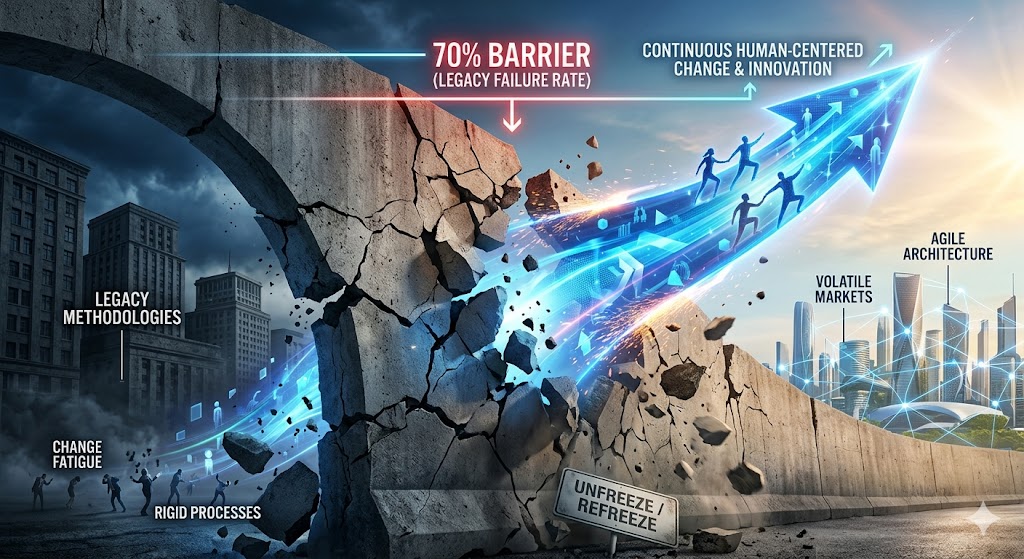
For decades, a grim statistic has haunted boardrooms and executive suites alike: the infamous 70% failure rate of organizational change initiatives. Originally popularized in the late 20th century, this figure has been cited so frequently that it has achieved the status of an unshakeable corporate law. Rather than serving as an urgent call to action, however, the industry has weaponized this statistic, transforming it into a convenient cop-out to normalize mediocrity and excuse flawed execution.
Accepting this failure rate as an inevitability is no longer just lazy leadership; in today’s volatile market, it is a corporate death sentence. The gap between organizations capable of rapid transformation and those tethered to the past is widening at an exponential rate. Driven by rapid technological disruption, shifting macroeconomic realities, and unpredictable consumer behaviors, market volatility is no longer a temporary storm to be weathered—it is the climate itself.
Legacy change methodologies fail fundamentally because they were built for a world that no longer exists. They treat transformation as a discrete project—a temporary disruption to a stable baseline. But in a continuous, fast-moving environment, there is no baseline to return to. To break the 70% barrier, leaders must abandon rigid, linear checklists and recognize that sustainable transformation requires shifting from top-down execution to a human-centered, agile architecture designed for permanent evolution.
II. The Structural Flaws of Legacy Change Methodologies
The core issue with traditional change management frameworks is not that they are poorly executed; it is that they are structurally unsuited for the speed of modern business. Built during an era of predictable market cycles, these legacy methodologies operate on assumptions that break down the moment uncertainty hits. To understand why transformation initiatives consistently stall, we must examine the fundamental architectural flaws built into old-school approaches.
The Fallacy of the “Unfreeze-Change-Refreeze” Model
For nearly a century, organizational change has been dominated by the classical linear paradigm: unfreeze the current state, implement the changes, and refreeze the organization into a new state of equilibrium. While this made sense in a slow-moving, industrial economy, it is highly dangerous in a volatile market.
In a continuous market environment, attempting to “refreeze” an organization into a static state is a recipe for instant obsolescence. The moment a company locks down a new processes, tools, or structures, the external market shifts again. Forcing an organization to constantly unfreeze and refreeze creates massive friction, keeping teams perpetually off-balance. Agility, not stability, must become the permanent baseline.
Process Over People: The Checklist Trap
Legacy frameworks consistently over-index on rigid project management metrics while treating the human element as an afterthought. Success is too often measured by completing a series of sequential checkboxes:
- Has the steering committee met?
- Was the corporate email announcement sent?
- Did employees complete the mandatory training module?
While tracking timelines, documentation, and checklists is clean and comfortable for executives, it mistakes compliance for true adoption. These metrics fail to account for human behavior, emotional friction, and cognitive capacity. A project can easily be delivered “on time and on budget” according to the plan, while completely failing to gain the psychological buy-in required to drive actual business value.
The Illusion of Control
Traditional change strategies rely heavily on top-down, command-and-control rollouts. A small group of leaders and external consultants spends months designing a massive, multi-year master plan behind closed doors. This approach operates under a critical flaw: the assumption that market variables, organizational dynamics, and competitive pressures will remain static during deployment.
In reality, by the time a rigid, top-down plan reaches the frontline, the strategic realities that birthed it have already changed. When leaders treat a transformation roadmap as an inflexible blueprint rather than a dynamic hypothesis, they optimize for execution control instead of market relevance. True resilience requires shifting from rigid execution to a flexible change architecture that adapts to shifting feedback loops in real time.
III. The Real Drivers of Transformation Fatigue
When transformation initiatives stall, executives frequently point to a familiar culprit: “employee resistance.” This diagnosis is not only lazy, but it also completely misinterprets human psychology and system dynamics. People do not inherently resist change; they resist being changed without input, clarity, or consideration. True transformation fatigue is a systemic failure, driven by deep organizational friction and poor experience design.
The Weight of Change Saturation
In modern enterprises, initiatives are rarely launched in isolation. A frontline manager might simultaneously face a corporate restructuring, a new CRM rollout, an updated compliance framework, and an AI integration pilot. Each project team believes their initiative is the highest priority, yet no one is aggregating the cumulative impact on the employee.
This lack of coordination creates severe change saturation. When organizations exceed the cognitive and emotional capacity of their people, performance plummets. Instead of driving progress, overlapping mandates create a state of perpetual triage, where teams are forced to focus on basic survival rather than meaningful adoption and innovation.
Reframing Resistance as a Valuable Feedback Loop
Legacy change management treats resistance as an obstacle to be managed, circumvented, or bulldozed through corporate mandates. This is a critical strategic mistake. Resistance is actually a vital diagnostic signal indicating that a system design flaw exists.
When employees push back, they are often highlighting practical operational friction that executives sitting in comfortable boardrooms cannot see. Perhaps the new software adds five steps to a client intake process, or the new strategy directly conflicts with current performance incentives. Shifting from a command-and-control mindset means viewing resistance as a valuable, real-time feedback loop that should be used to refine and co-create the solution.
The Culture vs. Strategy Disconnect
There is a well-known truism that culture eats strategy for breakfast. Yet, legacy frameworks continue to launch strategic transformations purely through administrative policy and top-down decree. Leaders send out stylized slide decks demanding a “more agile culture” or an “innovative mindset,” assuming that words alone will shift behavior.
Culture cannot be changed by telling people to act differently; it is the natural byproduct of the shared experiences, systems, and incentives within an organization. If leadership demands rapid experimentation but continues to penalize project failures, the culture will remain risk-averse. To break the 70% barrier, organizations must redesign the underlying day-to-day employee experience, aligning structural incentives with the behaviors they wish to cultivate.
IV. Shifting to Human-Centered Change Architecture
To shatter the 70% failure barrier, organizations must abandon the clinical, top-down deployment models of the past and embrace a human-centered change architecture. This shift requires treating employees not as passive targets of a rolling corporate initiative, but as active users and co-creators of a shifting business environment. When we design the transformation experience with the same empathy and rigor we apply to external customer experiences, sustainable adoption follows naturally.
Co-Creation Over Cascading
The traditional approach to change relies on “cascading” information—a polite term for pushing decisions made in executive suites down through layers of management to the frontline. This unidirectional flow is precisely what breeds resentment and detachment. The antidote is systemic co-creation.
By bringing cross-functional teams into the design phase of an initiative early, leaders shift the internal narrative from “This is happening to me” to “I am helping build this.” Co-creation leverages the collective intelligence of the frontline, ensuring that the solutions designed actually work in the messy reality of day-to-day operations. People rarely destroy what they help create; involving them directly converts potential resistance into shared ownership.
The Experience Design Matrix
Human-centered change applies the foundational principles of Experience Design (XD) and Design Thinking to the internal mechanics of an enterprise transformation. Just as a product designer maps out a customer journey to eliminate friction, a change architect maps out the employee journey during a major transition. This involves analyzing three critical dimensions:
- Friction Points: Identifying where new tools, processes, or workflows will disrupt established habits, and building bridge mechanisms to ease the transition.
- Emotional Highs and Lows: Anticipating the inevitable dip in confidence and productivity that occurs when people move from a state of mastery to a learning curve, and providing targeted support at those precise moments.
- Cognitive Load: Measuring the mental energy required to learn new systems alongside daily operational duties, and adjusting implementation speeds to avoid burnout.
Psychological Safety as Infrastructure
You cannot build an agile, innovative, and adaptive organization if your employees are terrified of making a mistake. In volatile markets, transformation requires rapid experimentation, and experimentation inherently involves a high rate of fast failures. Therefore, psychological safety is not a soft human resources concept—it is critical operational infrastructure.
If employees believe that flagging an operational flaw in a new strategy will damage their career, or that failing an experimental pilot will affect their performance review, they will default to compliance and silence. Leaders must explicitly cultivate an environment where early warnings are celebrated as vital market intelligence, and where well-intentioned, calculated risks are treated as valuable learning opportunities. True organizational agility only thrives when the fear of standing still is greater than the fear of trying something new.
V. Operationalizing Agility in Volatile Markets
Transitioning to a human-centered change architecture requires more than a shift in mindset; it demands a radical restructuring of operational mechanics. In a volatile market, traditional planning cycles are entirely too slow. To maintain velocity and relevance, organizations must move away from static planning and imbed continuous, adaptive mechanisms directly into their day-to-day operations.
Dynamic Strategy and Portfolio Architecture
The era of the rigid, five-year strategic plan is officially over. In markets characterized by rapid technological disruption and unpredictable macroeconomic shifts, locking an organization into a multi-year roadmap is a liability. Leaders must replace static roadmaps with an adaptive portfolio of strategic experiments.
This dynamic approach treats strategic initiatives as hypotheses to be continually tested against real-time market signals. Rather than funding massive, monolithic projects upfront, leadership allocates capital incrementally based on validated learning and proven adoption. By reviewing and adjusting the transformation portfolio on a rolling basis, the organization can rapidly pivot resources toward high-value opportunities and gracefully retire initiatives that no longer serve the business reality.
Micro-Changes and Minimum Viable Adjustments (MVAs)
One of the primary drivers of transformation failure is the sheer scale of modern corporate initiatives. Grand, sweeping overhauls shock the organizational system, causing widespread operational friction and anxiety. The alternative is to break massive transformations down into digestible, continuous increments through Minimum Viable Adjustments (MVAs).
An MVA is the smallest systemic or behavioral shift an organization can make that yields measurable feedback. By deploying change in smaller, iterative waves, teams can easily integrate new habits without disrupting their daily core responsibilities. This iterative loop allows change architects to gather real-world data, refine the implementation strategy based on live operational feedback, and build momentum through a series of continuous, low-risk wins.
Building Continuous Innovation Capability
Ultimately, the goal of breaking the 70% barrier is to make change management obsolete. Treating transformation as an emergency crisis response to external pressure is a recipe for chronic fatigue. True agility means embedding change readiness directly into the organizational DNA.
This requires shifting from a model where specialized teams occasionally deploy change, to a culture where adaptation is a core competency shared by every employee. Organizations must systematically reward curiosity, train teams in agile collaboration, and establish rapid communication channels that clear structural roadblocks. When change is recognized as a normal, daily rhythm rather than a disruptive event, the enterprise stops merely surviving volatility and begins using it as a competitive advantage.
VI. Conclusion: The New Mandate for Leadership
The persistent 70% failure rate of corporate initiatives is not an indictment of human capability; it is an indictment of outdated design. For decades, organizations have tried to force fluid, human dynamics into rigid, mechanical frameworks. In today’s volatile markets, that structural mismatch is no longer just inefficient—it is fatal.
From Gatekeepers to Change Architects
Breaking the 70% barrier requires a profound evolution in how we define leadership. The traditional role of the executive—acting as a top-down gatekeeper who commands compliance, monitors linear checklists, and pushes static strategies down the hierarchy—is completely obsolete.
Modern leaders must evolve into change architects. Their primary mandate is no longer to police adherence to an inflexible plan, but to cultivate a resilient ecosystem. This means designing workplaces where psychological safety is foundational, cross-functional co-creation is the default operating mechanism, and the employee experience is treated with the exact same empathy and design rigor as the customer experience.
The Bottom Line
Volatile markets will continue to chew up and spit out organizations that rely on legacy, unfreeze-refreeze mindsets. Survival and growth demand a complete rewrite of how we design, scale, and sustain organizational evolution.
By shifting from rigid project execution to an agile, human-centered architecture, we stop treating transformation as a painful, disruptive event. Instead, we turn transformation into a continuous, natural rhythm—transforming market volatility from a constant threat into our ultimate competitive advantage.
Frequently Asked Questions
Why do traditional, linear change management frameworks fail in volatile markets?
Traditional frameworks assume a stable baseline where you can “unfreeze” a situation, implement a change, and “refreeze” back into permanent stability. In a volatile market, the environment shifts continuously. Attempting to freeze an organization into a static state creates extreme friction and causes rapid obsolescence because there is no stable baseline to return to.
What is a Minimum Viable Adjustment (MVA) in change architecture?
A Minimum Viable Adjustment (MVA) is the smallest systemic or behavioral shift an organization can implement that yields measurable operational feedback. Instead of shocking the enterprise with massive, top-down overhauls, MVAs break transformations into digestible, continuous waves that allow teams to adapt iteratively without halting daily operations.
How does a human-centered approach view employee resistance?
Instead of treating resistance as an obstacle to be managed or bulldozed through corporate decree, a human-centered approach views resistance as a critical diagnostic signal and a valuable feedback loop. Resistance typically highlights real operational friction, mismatched incentives, or system design flaws that leaders in the boardroom failed to anticipate.
Image credit: Gemini
 Sign up here to get Human-Centered Change & Innovation Weekly delivered to your inbox every week.