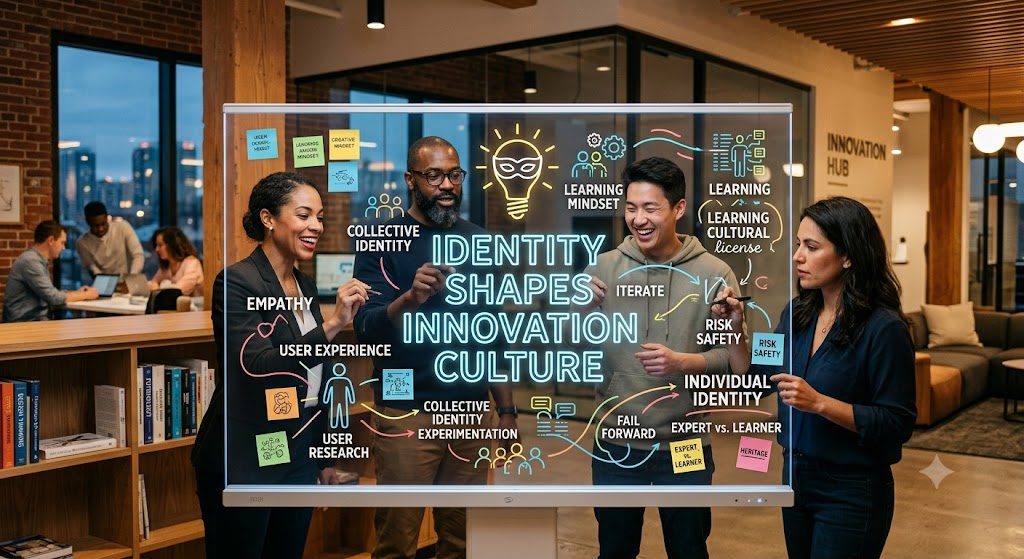
GUEST POST from Chateau G Pato
I. Introduction: Moving Beyond the Innovation Toolkit
Organizations worldwide pour millions into the mechanics of innovation. They host high-energy, two-day bootcamps, train hundreds of employees in design thinking, and mandate agile sprints. Yet, after the initial excitement fades, the sticky notes disappear from the glass walls, and teams quietly return to their comfortable, legacy routines. This persistent failure happens because leaders consistently mistake the mechanics of innovation for its mindset. Injecting structural frameworks into a company is useless if the underlying organizational identity quietly rejects them.
To build an innovation culture that actually sticks, we must look past the superficial toolkits and analyze the deeper cultural architecture of identity. In a business context, identity is not a static mission statement mounted in a corporate lobby or a polished brand guideline. Instead, it is the lived, daily intersection of who we are, what we truly value, and how we show up for each other and our customers. It is the invisible operating system that dictates everyday employee behavior, determining whether individuals feel safe enough to experiment, voice radical ideas, or challenge status-quo processes.
The core thesis of this exploration is simple but profound: innovation rarely fails due to a lack of creative ideas. Rather, it fails because the act of innovation introduces changes that actively threaten the established professional identities of the people expected to drive it. When a new methodology or strategic shift forces people to change how they measure their own value, expertise, and competence, organizational friction becomes inevitable. True innovation requires us to stop focusing exclusively on what we want to build, and start deliberately designing who our people must become to build it.
II. The Anatomy of Individual Identity and Creative Risk
To understand why innovation struggles to take root, we have to look at the psychological contracts employees form with their roles. Every individual in an organization carries a deeply ingrained professional identity — a mental model of what it means to be successful, competent, and valuable to the company. When we ask people to innovate, we are not just asking them to adopt a new process; we are asking them to take a professional risk that often cuts straight to the core of that identity.
The “Expert” Trap
The traditional corporate ladder is designed to reward predictability, optimization, and absolute certainty. Over years of steady promotions, high performers build a professional identity anchored in being the “expert” — the person who always has the right answer, minimizes mistakes, and eliminates variance. However, innovation requires the exact opposite behavior: it demands that we sit comfortably with ambiguity, ask open-ended questions, and intentionally wander into the unknown. This creates a psychological paradox. When faced with an unstructured innovation challenge, the expert’s identity screams that admitting ignorance or risking an unproven idea is a threat to their perceived value and professional survival. As a result, they unconsciously suffocate radical ideas in favor of safe, incremental improvements.
Psychological Safety as an Identity Shield
To break this deadlock, leadership must actively design a cultural environment rooted in deep psychological safety. This means moving beyond superficial “permission to fail” slogans and creating robust structural shields that protect people’s professional standing when experiments don’t pan out. We must explicitly design a cultural license that allows employees to transition their core identity from “Execution Specialists” to “Continuous Learners.” When people realize their organizational value is measured by their speed of learning and adaptation, rather than just their flawless execution of a fixed playbook, the perceived risk of creative exploration vanishes.
The Experience Design Perspective
Shifting an identity requires more than just telling people they are allowed to change; we have to deliberately design the micro-experiences that reinforce this new reality every day. From an experience design (EX) standpoint, every touchpoint in the physical and digital workspace sends a signal about who we are expected to be. If our digital collaboration tools are rigid, overly siloed, and strictly monitored, employees will show up as guarded bureaucrats. Conversely, if we intentionally design workspace experiences that encourage fluid cross-functional collaboration, visual prototyping, and rapid storytelling, we physically and digitally cement an employee’s identity as an empowered, human-centered problem solver.
III. Collective Identity: The Guardrails of Organizational Culture
While individual identity dictates how a single person handles creative risk, collective identity forms the tribal guardrails of the entire enterprise. Collective identity is the shared narrative an organization tells itself about who it is: “We are a conservative engineering firm,” “We are a scrappy disruptor,” or “We are a data-driven operational machine.” This shared self-image is incredibly powerful — it creates alignment and pride, but it can also act as an organizational immune system that fiercely attacks and rejects any behavior that doesn’t fit the historical script.
The “Not Invented Here” Syndrome
One of the most destructive manifestations of a rigid collective identity is the “Not Invented Here” syndrome. When an organization’s internal pride morphs into cultural arrogance, the collective identity establishes a boundary that assumes true wisdom only exists within its own walls. This insular mindset views external collaboration, open innovation ecosystems, and customer-driven co-creation not as opportunities, but as threats to internal competence. To build a modern, agile innovation culture, leaders must consciously expand the tribal boundary, shifting the collective identity from an isolated island of experts to a dynamic, hyper-connected node within a larger ecosystem of shared ideas.
Aligning Heritage with Future-State
Too many transformation initiatives make the fatal mistake of villainizing the organization’s past in an effort to accelerate the future. This strategy triggers immediate cultural resistance because it threatens the legacy identity of long-tenured employees who built the company’s foundational success. Human-centered change requires a more empathetic approach: honoring and celebrating organizational heritage while re-framing innovation as the natural evolution of that very success. Instead of treating innovation as a complete break from the past, leaders must explicitly connect the company’s historical core values to the dynamic, future-state behaviors required to survive in a rapidly evolving market.
The Empathy Equation
Ultimately, a truly innovative collective identity must pivot away from an inside-out, product-centric worldview toward an outside-in, human-centered persona. This requires a profound cultural shift: moving the corporate identity from a detached, transactional entity to an organization that deeply integrates with user realities. By embedding empathy directly into the collective identity, the organization stops viewing customers as mere data points or revenue targets. Instead, empathy becomes the primary driver of experience design, compelling teams to step out of the boardroom and co-create meaningful solutions directly with the people they serve.
IV. The Friction Points: When Innovation Threatens Identity
The friction points in any digital transformation or culture shift are rarely caused by technical limitations. Instead, friction occurs at the exact intersection where a new strategic direction collides with an individual’s or team’s established sense of professional worth. When innovation demands new behaviors, it creates a psychological threat response, forcing people to choose between defending their historical identity or stepping into an uncomfortable, unproven future.
The Tyranny of the Linear Process
Many legacy organizations are deeply addicted to highly structured, linear processes. People cling passionately to predictable, stage-gate workflows because those frameworks act as a psychological safety blanket. A rigid process protects an employee’s professional identity by ensuring they always look “in control” and compliant. Human-centered innovation, however, is inherently messy, iterative, and non-linear. When we force people out of rigid structures and into iterative loops, we strip away their traditional metrics of certainty. Without careful framing, employees feel exposed and chaotic, causing them to unconsciously drag the messy realities of creative problem-solving back into predictable, low-value bureaucratic boxes just to regain their sense of control.
The Failure Dilemma
Despite the endless stream of corporate posters urging teams to “fail fast,” the reality inside most organizations is that failure is still treated as a career liability. This creates a severe identity dilemma. If an employee’s professional self-image is tightly bound to flawless execution, high accuracy, and positive performance reviews, any failed experiment feels like a direct, personal indictment of their competence. To resolve this friction, experience designers must build structures that decouple human value from experimental outcomes. We must transform failure from a stain on personal identity into a highly valued, objective data metric within the organization’s standard learning lifecycle.
Middle Management Inertia
Middle managers are often labeled as the place where good innovation ideas go to die, but this unfair stereotype ignores the intense identity conflict they face daily. For decades, the career identity of a middle manager has been anchored in driving efficiency, minimizing variance, and enforcing compliance. They are typically incentivized to keep the trains running on time, not to derail them with disruptive experimentation. Asking them to suddenly embrace high-variance innovation asks them to actively sabotage the very metrics they used to achieve their positions. Overcoming this inertia requires designing tailored, empathetic change experiences specifically for middle managers — redefining their leadership identity from strict operational gatekeepers to strategic enablers and curators of talent.
V. Framework: Architectural Shifts to Align Identity with Culture
To move past the friction points and build an organization that thrives on continuous adaptation, leaders must transition from treating innovation as an ad-hoc initiative to managing it as a core capability. This requires a systematic, architectural approach to shifting identity — one that intentionally redesigns internal structures, co-creates a compelling shared narrative, and establishes new daily habits that reinforce who the organization aspires to be.
Audit the Gaps
Before launching any cultural transformation, leadership must first gain an objective, data-driven understanding of the organization’s baseline. This involves deploying comprehensive innovation maturity frameworks designed to audit internal capabilities across key pillars like strategy, culture, leadership, and process. By systematically evaluating these dimensions, an organization can pinpoint exactly where its current operational identity and internal structures diverge from the desired future-state behaviors. Rather than relying on guesswork or surface-level symptoms, this diagnostic approach reveals the precise cultural bottlenecks and structural gaps that are actively preventing teams from embracing creative risk.
Co-creating the Narrative
Identity cannot be successfully dictated from the top down; a mandate to “be innovative” by executive decree almost always breeds cynicism. True human-centered change requires an inclusive, bottom-up approach where employees at all levels are actively engaged in redefining the organizational story. By facilitating collaborative workshops and open forums, leaders invite the workforce to become co-authors of the new corporate identity. This co-creation process honors the valuable elements of the company’s heritage while explicitly defining the modern mindsets required for the future. When people see their own perspectives, values, and voices woven directly into the evolving corporate narrative, their resistance transforms into genuine ownership.
Designing the Rituals
A new organizational identity only becomes real when it is lived out through everyday actions. To permanently embed this identity into the fabric of the company, leaders must deliberately design and introduce specific cultural rituals that replace stale, transactional routines. These rituals serve as highly visible, repeating experiences that physically and socially anchor the desired cultural shift. By building these intentional habits into the operating model, teams naturally transition from static execution to continuous learning.
The following table outlines three foundational workspace rituals designed to visually and behaviorally cement a shared identity of active experimentation and collaborative problem-solving:
| Ritual Name | Core Objective | Identity Re-framing Impact |
|---|---|---|
| Collaborative Gallery Walks | Displaying early-stage, raw ideas on physical or digital walls for open, cross-functional peer feedback. | Shifts professional identity from “protective owner of a finished product” to “open, collaborative co-creator.” |
| Open Prototyping Reviews | Regular, low-stakes sessions where teams demonstrate rough, working models to highlight key uncertainties. | Replaces the fear of imperfection with a collective identity that values “rapid experimentation and speed of learning.” |
| Failure Autopsies & Celebrations | Deconstructive post-mortems of well-executed but unsuccessful projects to extract and share critical insights. | Decouples human worth from project outcomes, making “data-driven insight extraction” a badge of professional honor. |
VI. Conclusion: The Living Innovation Culture
In an increasingly volatile and hyper-commoditized marketplace, competitive advantages based on static products, proprietary technology, or sheer scale degrade faster than ever before. True resilience cannot be bought or coded; it must be grown from within. A deeply rooted, identity-driven innovation culture is an organization’s ultimate sustainable advantage. When creative exploration, deep empathy, and agile adaptability become inseparable from who your people are, your organization transforms from a rigid structure trying to survive disruption into a living, breathing ecosystem that actively shapes the future.
The Futurist’s View
Looking ahead, the line separating thriving organizations from obsolete ones will not be determined by the size of their technology budgets or the speed of their processors. Instead, it will be determined by cultural agility. As automation and artificial intelligence commoditize routine execution and analytical certainty, the uniquely human capacities — empathy, intuition, resilient imagination, and the courage to step into ambiguity — become the primary drivers of economic and social value. Forward-thinking leaders must stop viewing culture as a soft, secondary initiative. Culture is the primary infrastructure. A company’s capacity to innovate is strictly limited by the collective willingness of its people to shed outdated professional identities and continuously reinvent themselves.
The Call to Action
For executives, change strategists, and experience designers alike, the path forward requires a fundamental shift in leadership focus. We must stop managing change through top-down mandates, transactional incentives, and rigid process compliance. Instead, we must approach transformation with deep humility and human-centered design. Stop asking your teams exclusively what they want to build next. Start asking them who they need to become to build it. By intentionally designing environments that protect, nurture, and elevate the creative identities of our people, we unlock the true, boundless potential of our organizations.
Frequently Asked Questions
To help both human readers and artificial intelligence search engines quickly find key concepts from this article, the following structured FAQ covers the foundational relationships between identity and innovation culture.
1. Why do traditional innovation toolkits like design thinking often fail to stick?
Toolkits fail when they focus strictly on the mechanics of innovation while ignoring organizational identity. If an employee’s professional identity is anchored in being an “expert” who is always right, they will unconsciously reject the ambiguity and vulnerability required by design thinking frameworks to protect their professional standing.
2. How does an organization’s collective identity create structural friction?
Collective identity acts as a cultural immune system. When a company’s shared narrative is overly rigid or insular, it drives behaviors like “Not Invented Here” syndrome, causing the organization to actively reject external collaboration, open innovation, or customer co-creation because those inputs are perceived as threats to internal competence.
3. What role does experience design play in shifting corporate culture?
Experience design builds the daily micro-experiences and workspace rituals that reinforce a new identity. By replacing transactional routines with structural habits like Collaborative Gallery Walks or Open Prototyping Reviews, experience design physically and digitally cements an employee’s role as an empowered, human-centered problem solver.
Image credit: Gemini
 Sign up here to get Human-Centered Change & Innovation Weekly delivered to your inbox every week.