Author Archives: Braden Kelley

About Braden Kelley

Braden Kelley is a Human-Centered Experience, Innovation and Transformation practice lead at HCL Technologies, a popular innovation speaker, and creator of the FutureHacking™ and Human-Centered Change™ methodologies. He is the author of Stoking Your Innovation Bonfire from John Wiley & Sons and Charting Change (Second Edition) from Palgrave Macmillan. Braden is a US Navy veteran and earned his MBA from top-rated London Business School. Follow him on Linkedin, Twitter, Facebook, or Instagram.

Failing Fast Leads to More Failure

Most Companies Fail at Innovation Because...One scary statistic is that 70% of change initiatives fail. An overwhelming proportion of new product launches fail. Most new businesses fail.

The sad fact is that failure is all around us.

Is this why so many organizations talk about a fear of failure being one of their major innovation stumbling blocks?

And, so what mantra do many innovation and growth gurus expound as a solution?

“We need to fail fast.”

“We need to fail forward.”

“We need to fail smart.”

So, the solution most innovation consultancies put forward to organizations already coping with the wide ranging effects of failure, is to tell their employees that they need to fail more.

Say what?

If you can’t tell already, I really hate the whole fail fast mantra. Can we kill it yet?

You don’t want to fail fast, you want to learn fast.

And so, if you switch to learning fast instead, the efforts of your employees should then become laser focused on identifying what you need to learn with each iteration, or each experiment.

And your focus should also then become all about how well you are instrumenting for the learning you are trying to achieve.

This is more consistent with failing forward, but WE ARE NOT FOCUSED ON FAILURE.

Focusing on failure, leads to failure. Failure becomes the expected outcome.

Instead, we are focused on learning fast, and we can learn equally well from success as we can from failure – if our learning instrumentation is good.

The way that you achieve success in change AND in innovation, is by working hard to move the potential causes of failure farther forward in the innovation or change project lifecycle so that you have an opportunity to either design the flaws or obstacles out, or communicate them out by forcing the tough conversations during your planning process (for change or innovation) — this comes before you even begin executing your plan.

You’ve got to surface the sources of resistance, the faulty assumptions, and the barriers to be overcome — early.

Then we build a plan focused not on quick wins, but on maintaining transparency and momentum throughout the change implementation.

You may have noticed that I use the terms innovation and change almost interchangeably (often in the same sentence). This is because innovation is all about change, and because many of the barriers to change inside organizations are the same barriers that innovators face.

As an answer to these challenges, I created the Change Planning Toolkit™ to help organizations beat the 70% change failure rate by providing a suite of tools that allow change leaders to make a more visual, collaborative approach to change efforts. At the center of the approach sits the Change Planning Canvas™, very visual, very collaborative ala Lean Startup to help you prototype and evolve your change approach before you ever begin. The toolkit comes with a QuickStart Guide and my latest book Charting Change was designed to ground people in the philosophies that will help them succeed with both little C change efforts (projects) and big C change efforts (digital transformations, mergers, acquisitions, INNOVATION, etc.).

So, stop bringing more failure into your organization, and instead bring the tools into your organization that will help you achieve more success!

SPECIAL UPDATE
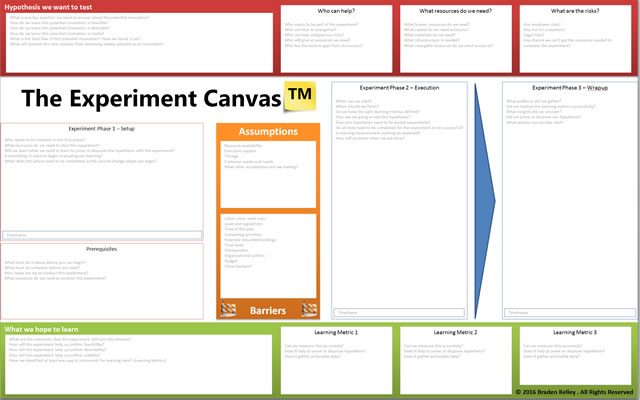
The Experiment Canvas

To help everyone accelerate their learning and to achieve better success in their human-centered innovation efforts, I will be creating and licensing a Human-Centered Innovation Toolkit™ to innovation consultants and practitioners around the world. I have been sharing early elements with my clients and I’m proud to be able to give you all a valuable taste of the kinds of tools that will be in this toolkit when it launches later this year by providing advance access to the first free download – The Experiment Canvas™. Designed to be used iteratively, and to quickly capture in a visual, collaborative way (in similar fashion the Change Planning Toolkit™).

Download The Experiment Canvas™ as a 35″x56″ scalable FREE PDF poster download

If you’re not clear on what the Change Planning Toolkit™ can do for you, please join me Thursday, June 8th at 9am PDT on Twitter for an Ask Me Anything (aka #AMA) session on the Change Planning Toolkit™ using the hashtag #cptoolkit and well, ask me anything!

A future #AMA on the Human-Centered Innovation Toolkit™ is coming soon too!
Innovation Audit from Braden Kelley

Subscribe to Human-Centered Change & Innovation WeeklySign up here to get Human-Centered Change & Innovation Weekly delivered to your inbox every week.

Innovation vs. Invention vs. Creativity

Innovation vs. Invention vs. Creativity

by Braden Kelley

There is so much talk about innovation these days, it’s hard to sometimes distinguish the signal from the noise.

In fact, the word innovation gets thrown around so much that it leaves people wondering:

What’s really innovative?

Well, most of the time that people talk about something being innovative, what they describe isn’t innovative, but instead inventive or creative. These three are all very different. Here is how I like to distinguish the differences between creativity, invention and innovation:

  1. Creativity – creates something interesting
  2. Invention – creates something useful
  3. Innovation – creates something so valuable that it is widely adopted, replacing the existing solution in a majority of appropriate use cases

Very few creative sparks result in an invention and very few inventions become innovations.

And the painful truth is that many great inventions take 20-30 years to be realized. Timing your investment is the key to whether you waste a big wad of cash, or still have it to spend when the optimal time to invest in a potential innovation comes.

If you look at most technology-based innovations, whether it’s the mp3 or the VCR, they were invented 20-30 years before they reached wide adoption in the marketplace, and for Gorilla Glass we’re talking more like 50 years.

To further emphasize the importance of timing…

Look at Webvan vs. Amazon Fresh

Look at Pets.com vs. Chewy.com (acquired by Petsmart)

Now these aren’t innovations, but you get my point. You have to know where you are on the commercialization timeline…

And most importantly, sometimes you have to look BACKWARDS before you look forwards, so you know where on the commercialization timeline you are.

If you’re working on a potential innovation now, are you sure it’s a potential innovation?

Are you sure now is the time to go big?

Read more about Premature Innovation

You might also enjoy Are You Innovating for the Past or the Future?

Image credit: Pexels

Innovation Audit from Braden Kelley

Subscribe to Human-Centered Change & Innovation WeeklySign up here to get Human-Centered Change & Innovation Weekly delivered to your inbox every week.
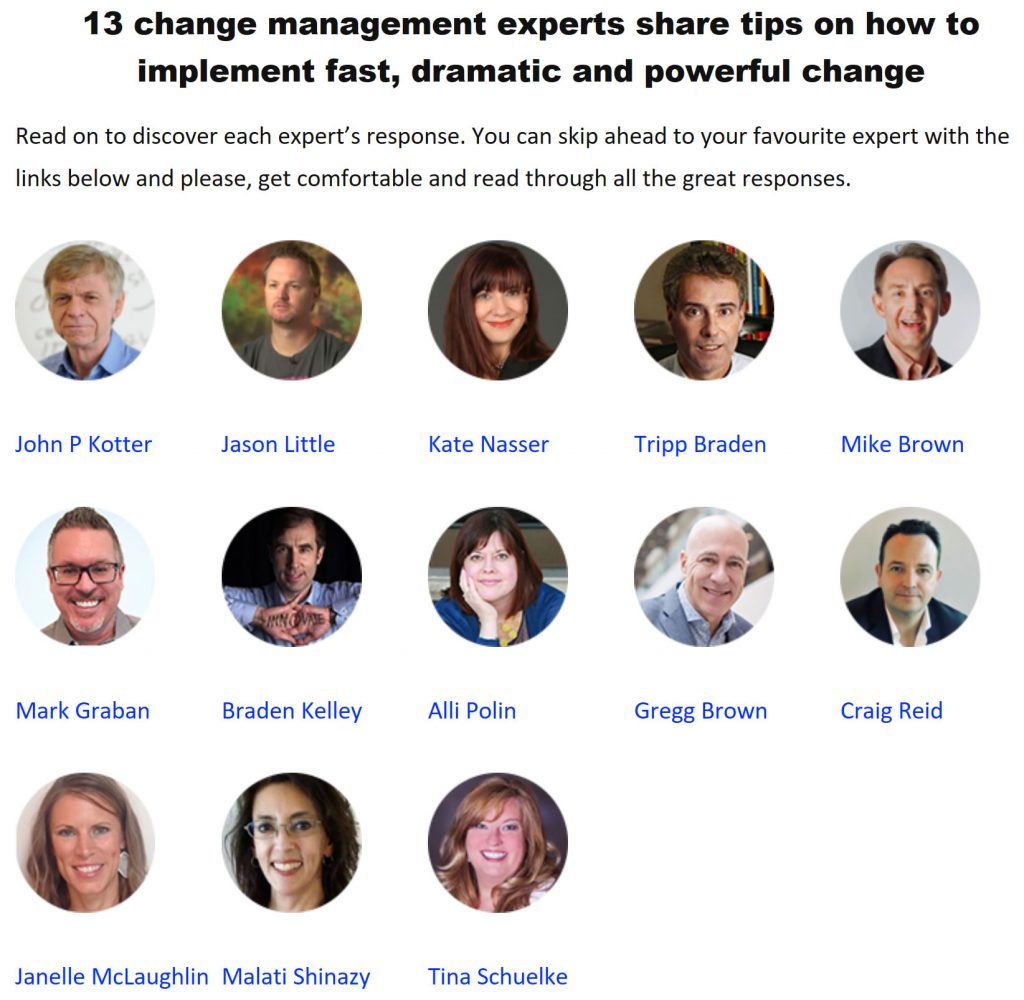
13 Change Management Experts Share Their Tips

13 Change Management Experts Share Their Tips

Recently my colleague Daniel Lock collected and published points-of-view (POV) from 13 change management experts on implementing fast, dramatic and powerful change.

Here is mine:

If your change effort or project begins in a Microsoft Word document, you’re already in a whole world of trouble. Change is a human endeavor, so the most powerful way to embark on creating a dramatic and powerful change on an aggressive timeline is to surface the key challenges and opportunities as early as possible.
That doesn’t happen with a single individual tapping away at the keys entering prose or data into a traditional project charter. Instead, I recommend taking the following three steps to accelerate your change effort or project and increase its chances of success:

1. Evaluate the Change Readiness of Your Organization

Too often we just jump in and announce the start of projects and change initiatives without even looking around to see if the resources that are going to be crucial to our success are even available.

Convene a cross-functional change planning team to identify the resources you are going to need to successfully complete the project (physical, financial, human, etc.). Then begin to draft an initial high level project schedule including when different resources will need and map that against their availability (including their commitments to other existing and potential projects and change initiatives) to create a change readiness heat map.

My PCC Change Readiness Framework and Worksheet from the Change Planning Toolkit™ are also useful tools for evaluating your change readiness.

2. Architect Your Organization for Change

One of the biggest barriers to successful change initiatives is viewing change management as a subset of project management when we should really all be instead viewing project management as a subset of change management, and but one of Five Keys to Successful Change.

Consciously approaching the design of our organization and how it operates from the outside as changes in the environment dictate changes inside our organization can benefit from using a tool like the Architecting the Organization for Change framework.

3. Develop a Holistic View of the Change You’re Trying to Make

Change planning should never be a solo activity. You must identify those individuals who can verbalize the current and desired states, the risks and resources, identify the potential barriers and benefits, craft effective communications, etc.

You need to also involve people who know how to leverage a human-centered approach to affecting change using The Eleven Change Roles and who can build and maintain momentum by understanding and harness The Eight Change Mindsets that cause people to choose change.

I truly believe that only by taking a more visual, collaborative approach to change and capturing the key information on a single page using the Change Planning Canvas™ as you build your change plan, will you ever create and sustain the alignment necessary to beat the 70% change failure rate.

Click here to read responses from the 12 other change management experts


Accelerate your change and transformation success

Subscribe to Human-Centered Change & Innovation WeeklySign up here to get Human-Centered Change & Innovation Weekly delivered to your inbox every week.
Check Out My Latest Interview with DisrupTV

I had the opportunity recently to sit down with DisrupTV co-hosts R “Ray” Wang and Vala Afshar to be part of Episode 63.

DisrupTV is a weekly Web series that airs live at 11:00 a.m. PT/ 2:00 p.m. ET every Friday. Brought to you by the Constellation Executive Network.

You can watch my segment from the program here:

Or if you would prefer to check out Episode 63 below in its entirety, you’ll see my interview segment in the middle of two other interviews with Jeff Gothelf, Author of “Sense & Respond” and Heather Clancy, Editorial Director at GreenBiz Group.

Innovation Audit from Braden Kelley

Subscribe to Human-Centered Change & Innovation WeeklySign up here to get Human-Centered Change & Innovation Weekly delivered to your inbox every week.
Building a Culture of Continuous Innovation

Building a Culture of Continuous Innovation

Excerpt from the May/June 2017 edition of The European Business Review

Every company begins as the nimble startup, organized around the solution to a single customer problem and executing that solution better than anyone else in the market (including incumbents with deep pockets). But this emerging leader soon becomes a follower as the organization evolves and scales into a more complex (but capable) next generation incumbent. Inevitably, every growing organization finds itself so focused on capturing all of the business for its existing solutions, that it finds itself becoming disconnected from evolving customer preferences.

The companies that last the longest manage to fulfill existing customer needs with well-delivered solutions, and identify new customer needs to satisfy as customer preferences continue to shift. But many large or growing companies fail to do so quickly enough, especially in our new digital reality where it is easier than ever to start and scale a solution around the globe with limited resources. Innovation is the key to remaining relevant with customers. Winning the War for Innovation is the key to remaining alive.

Click to access a PDF version of the Building a Culture of Continuous Innovation article
 
Click to continue reading the article on The European Business Review site

Innovation Audit from Braden Kelley

Subscribe to Human-Centered Change & Innovation WeeklySign up here to get Human-Centered Change & Innovation Weekly delivered to your inbox every week.

Ten Reasons You Might Suck at Innovation

Ten Reasons You Might Suck at InnovationIn a popular previous article we looked at the Top 10 Reasons Not to Innovate. In this article we will look at Ten Reasons You Might Suck at Innovation as we explore the following question:

Do you need an innovation intervention?

Unless you feel that your innovation program is a runaway success and exceeding your expectations, the answer might very well be…

yes.

Ten Reasons You Might Suck at Innovation

  1. Nobody can articulate your definition of innovation (or you don’t have one)
  2. Nobody can articulate your innovation vision/strategy/goals (or you don’t have them)
  3. People struggle to tell the story of one or more innovations launched to wide adoption by the organization
  4. Most of what passes as innovation inside the organization would actually be classified as improvements (not innovation) by people outside the organization
  5. The organization no longer makes external innovation perspectives available to a wide audience
  6. Nobody takes the time to participate in our innovation efforts anymore
  7. Your organization is unable to accept insights and ideas from outside the organization and develop them into concepts that can be scaled to wide adoption
  8. Innovation program leadership has difficulty getting time on the CEO’s calendar any more
  9. Your innovation team is trying to do all of the innovating instead of helping to accelerate the innovation efforts of others
  10. Your pace of innovation is slower than the organizations you compete with for market share, donations, votes, etc.

What is an innovation intervention?

An innovation intervention is a professionally directed, education process resulting in a face to face meeting of consultants, leaders and/or managers with the organization in trouble with innovation. People who struggle with innovation are often in denial about their situation and unwilling to seek treatment. They may not recognize the negative effects their behavior has on themselves and others. Intervention helps the person make the connection between their use of innovation and the problems in their organization. The goal of intervention is to present the innovation user with a structured opportunity to accept help and to make changes before things get even worse.

This may be a somewhat tongue in cheek adaptation of a definition from the substance abuse context*, but it’s almost scary how much I didn’t have to change in the switching of contexts. To make it easier for people to accept help, I came up with the Ten Reasons You Might Suck at Innovation above, and a service offering to hopefully fit within your purchasing authority and your budget (especially if you split it up into two installments of $4,999.99).

Purchasing an Innovation Intervention for $9,999.98 + expenses (or two payments of $4,999.99 + expenses) will get you a three day engagement including:

  • A cross-functional and/or cross-site innovation maturity study using my 50 question innovation audit, including analysis of the results, and presentation of the findings
  • One or two days on-site:
    • Seeing where and how your innovation happens
    • Conducting interviews to understand the structure of your innovation programs, processes, and other key elements of your innovation infrastructure
    • Walking through past innovation successes and failures
  • The balance of the three days will then be spent analyzing the on-site observations and creating a set of actionable recommendations
  • Up to five (5) copies of my book Stoking Your Innovation Bonfire for you and your leadership team
  • Up to ten (10) sets of my Nine Innovation Roles cards for you and your leadership team
  • Up to five (5) copies of my book Charting Change for you and your leadership team
  • A 10% discount on any future keynote speeches or innovation training sessions for your organization
  • A 10% discount on any Change Planning Toolkit™ site license purchases for your organization
  • A 10% discount on any Disruptive Innovation Toolkit™ site license purchases for your organization

Together we’ll get your innovation efforts back on track towards success and build a foundation capable of sustaining continuous innovation. Forward-thinking organizations that haven’t begun an innovation program or a focus on innovation and want to get off to a strong start will be able to leverage the Innovation Intervention service too.

Free Consultation with Braden Kelley

Image credit: calbaptist.edu

*Thanks to the NCADD (National Council on Alcoholism and Drug Dependence, Inc.) for the inspiration

Subscribe to Human-Centered Change & Innovation WeeklySign up here to get Human-Centered Change & Innovation Weekly delivered to your inbox every week.

What’s Next – The Human-Centered Innovation Toolkit™

What's Next - The Human-Centered Innovation Toolkit™… and a new Innovation Intervention service.

People have been asking me recently – What’s next?

I think managers and leaders are wondering now that I’ve written two popular books (Charting Change and Stoking Your Innovation Bonfire) and a chapter in a third (A Guide to Open Innovation and Crowdsourcing), if I’ll ever write another book.

But, they’re also curious given all the great tools in the Change Planning Toolkit™ that can fundamentally transform how we plan our projects and change initiatives, helping individuals and organizations move beyond theory to practice, whether I’ll ever create anything similar to help companies increase their innovation success.

The answer to both questions is a resounding YES!

I am pursuing, in parallel, the Define, Design, and Develop phases on a number of different tools to form the basis of a Human-Centered Innovation Toolkit™ for organizations to leverage in pursuit of my evolution of value innovation.

If you’ve attended one of my innovation keynotes or workshops you’ve seen how my innovation viewpoint (Innovation is All About Value) leads to all types of innovation, including disruptive innovation, and how it links to LEAN methodologies so that organizations can organize and execute across the entire spectrum of improvement and innovation possibilities.

Some of my most recent clients, including The Bank of Montreal and OSF Healthcare, have received an advance preview of some of the early components of the upcoming Human-Centered Innovation Toolkit™.

At the same time, I am also finishing efforts to define a new Innovation Intervention service offering to help organizations who have started an innovation effort or built an innovation program, only to see it go off the rails. I will work with organizations in an Innovation Intervention to help them get back on track towards success and build a foundation capable of sustaining continuous innovation. Forward-thinking organizations that haven’t begun an innovation program or a focus on innovation and want to get off to a strong start will be able to leverage this upcoming Innovation Intervention service too.

Finally, when I do write a third book, it will probably dig deeper into how to build an organization wired for continuous change, including successfully executing a digital transformation and sustaining full spectrum innovation and improvement excellence.

So, this is what’s next.

If you’d like to find out more about my Innovation Intervention or Human-Centered Innovation Toolkit™ in advance of their launch, in order to get a jump on your competition, please contact me.

Stay tuned for more information on these efforts soon!

Innovation Audit from Braden Kelley

Subscribe to Human-Centered Change & Innovation WeeklySign up here to get Human-Centered Change & Innovation Weekly delivered to your inbox every week.

Interview with Change Management Review

Interview with Change Management Review

I recently had the opportunity to sit down with Theresa Moulton of the Change Management Review™ Podcast, about my work as a popular keynote speaker, workshop facilitator, and thought leader on the topics of continuous innovation and change, and some of my work with clients to create innovative strategies, digital transformations, and increased organizational agility.

But mostly in this information-packed interview, I reveal key lessons from the Change Planning Toolkit™ and my book Charting Change, including what’s hard about change, and how the visual, collaborative approach of the Change Planning Toolkit™ can revolutionize how we plan our projects and change initiatives.

1. Click here to visit the Change Management Review interview page

2. Click here to get your copy of Charting Change

3. Click here for more information on the Change Planning Toolkit™


Accelerate your change and transformation success

Subscribe to Human-Centered Change & Innovation WeeklySign up here to get Human-Centered Change & Innovation Weekly delivered to your inbox every week.

2017 Thinkers50 Nominations Now Open

2017 Thinkers50 Nominations Now OpenEvery two years Suntop Media ranks the top 50 management thought leaders and bestows the Thinkers50 Global Ranking of Management Thinkers. The ranking relies on nominations and voting from the community, meaning that the public decides who is selected.

Click here to nominate me by entering the following information:

Your Name
Your Email
Your Global Ranking Nominee: Braden Kelley
Notes (optional): Braden Kelley is an in-demand workshop leader and keynote speaker on the topics of innovation, digital transformation and organizational change. He is the creator of the revolutionary Change Planning Toolkit™ and the author of two popular books, ‘Charting Change’ from Palgrave Macmillan and ‘Stoking Your Innovation Bonfire’ from John Wiley & Sons. Braden has written hundreds of articles for publications including The Washington Post, Wired, and The Atlantic. And, in his spare time he created the site that became http://innovationexcellence.com – the world’s most popular innovation web site, and tweets from @innovate.

Click here to nominate me by entering the above information.


In addition, they are taking nominations for Distinguished Achievement Awards in the following categories:

  • Breakthrough Idea
  • Digital Thinking
  • Ideas Into Practice
  • Future Thinker
  • Innovation
  • Leadership
  • Strategy
  • Talent

The INNOVATION category is where I would greatly appreciate your nomination, but I also firmly believe the Change Planning Toolkit™ qualifies me for the BREAKTHROUGH IDEA and IDEAS INTO PRACTICE categories, but I’ll leave that up to you!

Click here to nominate me for the Distinguished Achievement Award by filling in the following fields with whatever information you would like (I’ve included some thought starters):

Your Name
Your Email
Your Nominee for Breakthrough Idea Award: Braden Kelley
Your Nominee for Ideas Into Practice Award: Braden Kelley
Your Nominee for Innovation Award: Braden Kelley

Notes (optional): Braden Kelley created the revolutionary Change Planning Toolkit™ to help organizations plan their projects and change initiatives in a more visual, collaborative way so that teams stand a better chance of beating the 70% change effort failure rate. He is the author of two popular books, ‘Charting Change’ from Palgrave Macmillan and ‘Stoking Your Innovation Bonfire’ from John Wiley & Sons, and continues to be an insightful innovation voice for publications including InnovationManagement.se, SAP’s Digitalist magazine, ProjectManagement.com, and Innovation Excellence. In his spare time he tweets from @innovate.

Click here to nominate me for the Distinguished Achievement Award by filling in the above fields.


There is also a short form at http://www.thinkers50.com/scanning/identify-new-thinkers/ that you can use for identifying new thinkers (and all of the above info works). 😉


I am deeply grateful for your continuing support.

Sincerely,

Braden

Subscribe to Human-Centered Change & Innovation WeeklySign up here to get Human-Centered Change & Innovation Weekly delivered to your inbox every week.

What is your level of Innovation Maturity?

Innovation Maturity Introduction

When it comes to innovation, no two companies are likely to be pursuing innovation in the same way, and they are also likely to be at different stages of innovation maturity. Because of this, even if you found out what your competitor’s innovation strategy was, it would be of no use to you. It is necessary for an innovation strategy to be tailored to your organization’s level of innovation maturity, your corporate strategy, and your innovation vision.

Free Innovation Maturity AssessmentAn organization’s innovation maturity level is important because you must first master a certain set of basic innovation capabilities before implementing more advanced innovation approaches into your strategy. For example, an organization just getting started on their innovation journey would be foolish to try and implement open innovation in their organization. Every organization should get their idea generation (including evolution), idea evaluation, and idea commercialization policies and processes working well with their employees first before opening themselves up to the outside world. Your organization’s innovation strategy must be appropriate to your level of innovation maturity for your innovation efforts to be successful.

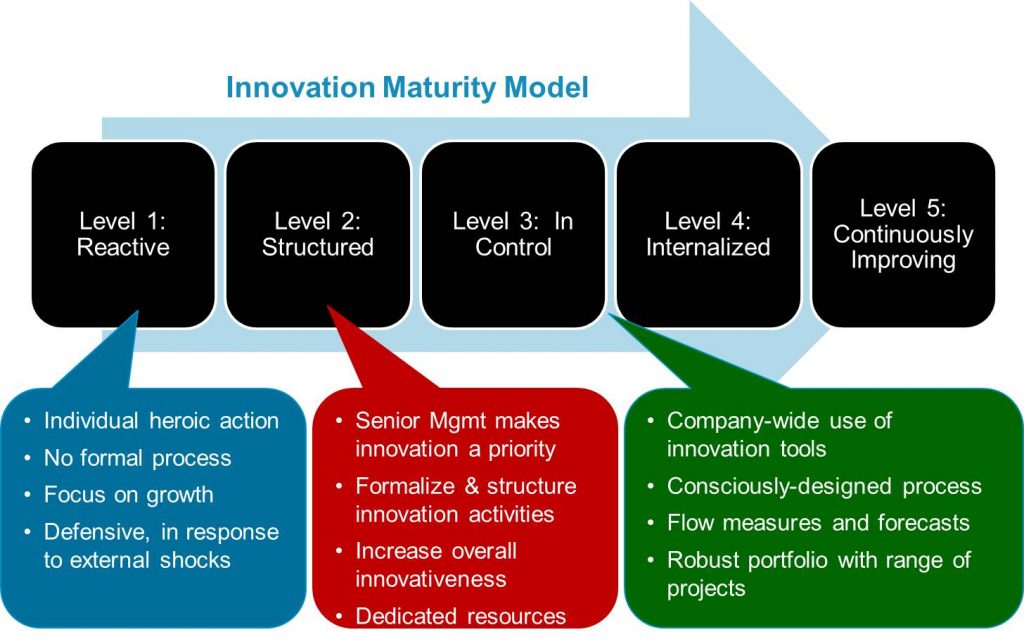
I developed the graphic below to explain the different levels of innovation maturity based on some thinking from Wharton professors Christian Terwiesch and Karl T. Ulrich, and I think it allows executives to determine at a glance where their organization is across the spectrum. I hope you find it useful.

Free Innovation Maturity Assessment

Special OfferTo help people evaluate their level of innovation maturity against the above graphic, I am sharing the 50 question innovation maturity assessment I use with clients. The assessment is most powerful when answers are gathered at multiple levels of the organization across several groups and several sites, but you can also fill it out yourself and get instant feedback – for FREE.

To get even more out of the innovation maturity assessment, for a nominal fee, I can help you organize a multiple group and/or multiple physical location survey of people in the organization to capture not just your level of innovation maturity, but also to provide preliminary innovation diagnostics on the areas of innovation challenge and opportunity in your organization.

I can set up a research study to capture a baseline innovation maturity level and analyze the data to unlock insights about the relative health of your innovation efforts. For a limited time, I will provide this service for the special introductory price of $499.99.

Click here to purchase the innovation diagnostic service
(Get help using the innovation maturity assessment across multiple sites and job functions and analyzing the results)

Innovation Maturity Model

Innovation Maturity Assessment Scoring Key (showing level of maturity)

Point totals are translated to the innovation maturity model as follows:

  • 000-100 = Level 1 – Reactive
  • 101-130 = Level 2 – Structured
  • 131-150 = Level 3 – In Control
  • 151-180 = Level 4 – Internalized
  • 181-200 = Level 5 – Continuously Improving

Click here to access the Innovation Maturity Assessment

Innovation Maturity Assessment Instructions

1. Read each statement and determine how much you agree with each one, using this scale:

  • 0 – None
  • 1 – A Little
  • 2 – Partially
  • 3 – Often
  • 4 – Fully

2. Select the answer for each question that is most appropriate.

The form will score the innovation maturity assessment and return a result to you via email along with the SCORING KEY and the Innovation Maturity Model graphic. Store the result as a baseline and come back annually and re-take the assessment to measure your progress!

Click here to access the Innovation Maturity Assessment

Click here to purchase the innovation diagnostic service
(Get help using the innovation maturity assessment across multiple sites and job functions and analyzing the results)

* Graphic adapted from the book Innovation Tournaments by Christian Terwiesch and Karl Ulrich

Subscribe to Human-Centered Change & Innovation WeeklySign up here to get Human-Centered Change & Innovation Weekly delivered to your inbox every week.