
Monthly Archives: September 2022

You Can’t Innovate Without This One Thing

You Can't Innovate Without This One Thing

GUEST POST from Robyn Bolton

It just landed on your desk. Or maybe you campaigned to get it. Or perhaps you just started doing it. How the title of “Innovation Leader” got to your desk doesn’t matter nearly as much as the fact that it’s there, along with a budget and loads of expectations.

Of course, now that you have the title and the budget, you need a team to do the work and deliver the results.

Who should you look for? The people that perform well in the current business, with its processes, structures, and (relative) predictability, often struggle to navigate the constant uncertainty and change of innovation. But just because someone struggles in the process and structure of the core business doesn’t mean they’ll thrive creating something new.

What are the qualities that make someone a successful innovator?

70 answers

A lot of people have a lot to say about the qualities and characteristics that make someone an innovator. When you combine the first four Google search results for “characteristics of an innovator” with the five most common innovation talent assessments, you end up with a list of 70 different (and sometimes conflicting) traits.

The complete list is at the end of this article, but here are the characteristics that appeared more than once:

  1. Curious
  2. Persistent
  3. Continuously reflective
  4. Creative
  5. Driven
  6. Experiments
  7. Imaginative
  8. Passionate

It’s a good list, but remember, there are 62 other characteristics to consider. And that assumes that the list is exhaustive.

+1 Answer

It’s not. Something is missing.

There is one characteristic shared by every successful innovator I’ve worked with and every successful leader of innovation. It’s rarely the first (or second or third) word used to describe them, but eventually, it emerges, always said quietly, after great reflection and with dawning realization.

Vulnerability.

Whether you rolled your eyes or pumped your fist at the word made famous by Brene Brown, you’ve no doubt heard it and formed an opinion about it.

Vulnerability is the “quality or state of being exposed to the possibility of being attacked or harmed, either physically or emotionally.”  Without it, innovation is impossible.

Innovation requires the creation of something new that creates value. If something is new, some or all of it is unknown. If there are unknowns, there are risks. Where there are risks, there is the possibility of being wrong, which opens you up to attack or harm.

When you talk to people to understand their needs, vulnerability allows you to hear what they say (versus what you want them to say).

In brainstorming sessions, vulnerability enables you to speak up and suggest an idea for people to respond to, build on, or discard.

When you run experiments, vulnerability ensures that you accurately record and report the data, even if the results aren’t what you hoped.

Most importantly, as a leader, vulnerability inspires trust, motivates your team, engages your stakeholders, and creates the environment and culture required to explore, learn, and innovate continuously.

n + 1 is the answer

Just as you do for every job in your company, recruit the people with the skills required to do the work and the mindset and personality to succeed in your business’ context and culture.

Once you find them, make sure they’re willing to be vulnerable and support and celebrate others’ vulnerability. Then, and only then, will you be the innovators your company needs.


Here’s the full list of characteristics:

  1. Action-oriented, gets the job done
  2. Adaptable
  3. Ambitious
  4. Analytical, high information capacity, digs through facts
  5. Associative Thinker, makes uncommon connections
  6. Breaks Boundaries, disruptive
  7. Business minded
  8. Collaborative
  9. Compelling Leader
  10. Competitive
  11. Consistent
  12. Continuously reflects (x3)
  13. Courageous
  14. Creative (x3)
  15. Curious (x4), asks questions, inquisitive, investigates
  16. Delivers results, seeks tangible outcomes
  17. Disciplined
  18. Divergent Thinker
  19. Driven (x3)
  20. Energetic
  21. Experiments (x2)
  22. Financially oriented
  23. Flexible, fluid
  24. Formally educated and trained
  25. Futuristic
  26. Giving, works to benefit others, wants to make the world better
  27. Goal-oriented
  28. Has a Growth mindset
  29. Highly confident
  30. Honest
  31. Imaginative (x2)
  32. Influential, lots of social capital
  33. Instinctual
  34. Intense
  35. Iterating between abstract and concrete thinking
  36. Learns through experiences
  37. Likes originality, seeks novelty
  38. Loyal
  39. Motivated by change, open to new experiences
  40. Networks, relates well to others
  41. Observes
  42. Opportunistic mindset, recognizes opportunities
  43. Opportunity focused
  44. Passionate (x2)
  45. Patient
  46. Persistent (x4)
  47. Persuasive
  48. Playful
  49. Pragmatic
  50. Proactive
  51. Prudent
  52. Rapidly recognizes patterns
  53. Resilient
  54. Resourceful
  55. Respects other innovators
  56. Seeks understanding
  57. Self-confident
  58. Socially intelligent
  59. Stamina
  60. Takes initiative
  61. Takes risks
  62. Team-oriented
  63. Thinks big picture
  64. Thrives in uncertainty
  65. Tough
  66. Tweaks solutions constantly
  67. Unattached exploration
  68. Visionary
  69. Wants to get things right
  70. Willing to Destroy

And the sources:

Image Credit: Pixabay

Subscribe to Human-Centered Change & Innovation WeeklySign up here to get Human-Centered Change & Innovation Weekly delivered to your inbox every week.

Human-Centered Innovation

Leading with Empathy and Purpose

Human-Centered Innovation

GUEST POST from Art Inteligencia

We are living in an era of accelerated disruption, where agility, adaptability, and authenticity are vital. Organizations that thrive are those that place human beings — their needs, values, and experiences — at the center of their innovation efforts. Human-centered innovation is not a one-time initiative; it’s a leadership philosophy and cultural mindset. It combines empathy, purpose, and co-creation to solve the right problems and deliver sustainable impact.

The Mindset Shift: From Product-First to People-First

Historically, innovation has often been driven by technical feasibility and operational efficiency. While important, these elements alone rarely produce breakthrough outcomes. Human-centered innovation flips the script — starting not with the solution, but with the people experiencing the problem. This mindset demands curiosity, humility, and a deep commitment to designing with — not just for — stakeholders.

Case Study 1: Mayo Clinic’s Center for Innovation

Challenge:

Mayo Clinic wanted to elevate the patient experience and align care delivery more closely with patient needs and expectations.

Approach:

They established the Center for Innovation to embed human-centered design principles into their healthcare system. Teams of clinicians, designers, and technologists collaborated directly with patients to map pain points and ideate solutions. The focus wasn’t just on what could be improved, but what should be improved from the patient’s perspective.

Outcome:

Through co-creation, Mayo Clinic redesigned waiting areas, streamlined appointment systems, and introduced more transparent communication tools. These changes improved patient satisfaction, reduced stress, and fostered stronger doctor-patient relationships — while also enhancing care team productivity and morale.

Principles of Human-Centered Innovation

  1. Empathy-Driven Discovery: Immerse yourself in users’ contexts through ethnographic research, journey mapping, and storytelling.
  2. Inclusive Co-Creation: Involve diverse stakeholders — especially those directly impacted — throughout the innovation process.
  3. Rapid Iteration: Prototype early, test frequently, and learn fast to ensure solutions are viable, feasible, and desirable.
  4. Systemic Thinking: Understand the interdependencies within the ecosystem to design scalable, sustainable solutions.
  5. Purpose-Led Transformation: Align innovation efforts with the organization’s mission and societal impact goals.

Case Study 2: IBM’s Enterprise Design Thinking

Challenge:

IBM needed to reinvigorate its innovation practices to better align product development with evolving customer expectations.

Approach:

They launched Enterprise Design Thinking — a framework designed to embed empathy and agility across the enterprise. Cross-functional teams, including sponsor users, collaborated in iterative cycles of alignment, ideation, and feedback. Tools like Hills (clear problem statements) and Playbacks (structured feedback loops) ensured consistent engagement and learning.

Outcome:

Projects accelerated dramatically, reducing time-to-market by over 50%. User satisfaction scores rose as products better reflected actual needs. Internally, the initiative boosted employee engagement, cross-team collaboration, and a shared innovation language across the organization.

Embedding Human-Centered Change

Innovation isn’t just about ideas — it’s about people driving meaningful change. Leaders must create the conditions for empathy and experimentation to flourish. This means fostering psychological safety, celebrating curiosity, and removing friction from collaboration. Human-centered innovation becomes sustainable when it’s woven into leadership behaviors, reward systems, and strategic priorities.

Ultimately, innovation rooted in human need unlocks greater loyalty, differentiation, and relevance. It ensures we are solving the right problems — not just building faster solutions. And in a world demanding more inclusive, equitable, and regenerative approaches, human-centered design isn’t just an advantage. It’s a responsibility.

Extra Extra: Futurology is not fortune telling. Futurists use a scientific approach to create their deliverables, but a methodology and tools like those in FutureHacking™ can empower anyone to engage in futurology themselves.

Image credit: Pexels

Subscribe to Human-Centered Change & Innovation WeeklySign up here to get Human-Centered Change & Innovation Weekly delivered to your inbox every week.

Importance of Measuring Your Organization’s Innovation Maturity

Importance of Measuring Your Organization’s Innovation Maturity

by Braden Kelley

Is our organization a productive place for creating innovation? How does our organization’s innovation capability compare to that of other organizations?

Almost every organization wants to know the answers to these two questions.

The only way to get better at innovation, is to first define what innovation means. Your organization must have a common language of innovation before you can measure a baseline of innovation maturity and begin elevating both your innovation capacity and capabilities.

My first book Stoking Your Innovation Bonfire, was created to help organizations create a common language of innovation and to understand how to overcome the barriers to innovation.

The Innovation Maturity Assessment

One of the free tools I created for purchasers of Stoking Your Innovation Bonfire, and for the global innovation community, was an innovation maturity assessment with available instant scoring at http://innovation.help.

My 50 question innovation audit measures each individual’s view of the organization’s innovation maturity across a number of different areas, including: culture, process, funding, collaboration, communications, etc.

When multiple individuals at the same organization complete the questionnaire, it is then possible to form an organizational view of the organization’s level of innovation maturity.

Each of the 50 questions is scored from 0-4 using this scale of question agreement:

  • 0 – None
  • 1 – A Little
  • 2 – Partially
  • 3 – Often
  • 4 – Fully

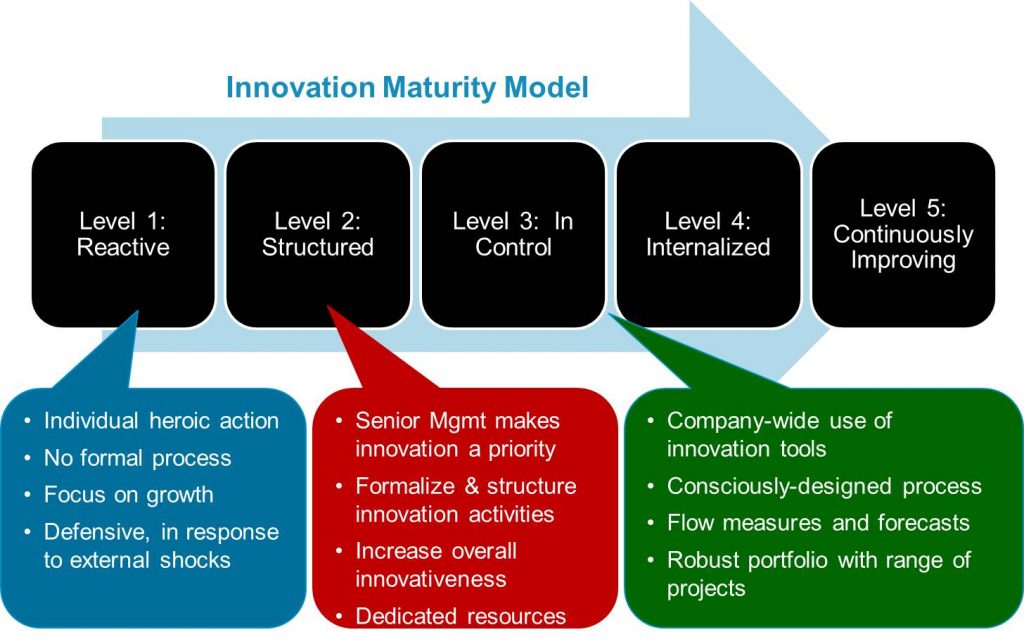
To generate an innovation maturity score that is translated to the innovation maturity model as follows:

  • 000-100 = Level 1 – Reactive
  • 101-130 = Level 2 – Structured
  • 131-150 = Level 3 – In Control
  • 151-180 = Level 4 – Internalized
  • 181-200 = Level 5 – Continuously Improving

Innovation Maturity Model

Image adapted from the book Innovation Tournaments by Christian Terwiesch and Karl Ulrich

Innovation Maturity is Organization-Specific

The best way to understand the innovation maturity of your organization is to have a cross-functional group of individuals across your organization fill out the assessment and then collate and analyze the submissions. This allows us to make sense of the responses and to make recommendations of how the organization could evolve itself for the better. I do offer this as a service at http://innovation.help.

What Do the Numbers Say About the Average Level of Innovation Maturity?

To date, the innovation maturity assessment web application at http://innovation.help has gathered about 400 seemingly valid responses across a range of industries, geographies, organizations and job roles.

The average innovation maturity score to date is 102.91.

This places the current mean innovation maturity score at the border between Level 1 (Reactive) and Level 2 (Structured). This is not surprising.
Looking across the fifty (50) questions, the five HIGHEST scoring questions/statements are:

  1. We are constantly looking to improve as an organization (3.12)
  2. I know how to submit an innovation idea (2.83)
  3. Innovation is part of my job (2.81)
  4. It is okay to fail once in a while (2.74)
  5. Innovation is one of our core values (2.71)

The scores indicate that the typical level of agreement with the statements is “often” but not “always.”

Looking across the fifty (50) questions, the five LOWEST scoring questions/statements are:

  1. Six sigma is well understood and widely distributed in our organization (1.74)
  2. We have a web site for submitting innovation ideas (1.77)
  3. There is more than one funding source available for innovation ideas (1.79)
  4. We have a process for killing innovation projects (1.82)
  5. We are considered the partner of first resort for innovation ideas (1.83)

The scores indicate that the typical level of agreement with the statements is “partially.”

What does this tell us about the state of innovation maturity in the average organization?

The numbers gathered so far indicate that the state of innovation maturity in the average organization is low, nearly falling into the lowest level. This means that on average, our organizations are focused on growth, but often innovate defensively, in response to external shocks. Many organizations rely on individual, heroic action, lacking formal processes and coordinated approaches to innovation. But, organizations are trending towards greater prioritization of innovation by senior management, an introduction of dedicated resources and a more formal approach.

The highest scoring questions tell us that our organizations are still in the process of embedding a continuous improvement mindset. We also see signs that many people view innovation as a part of their job, regardless of whether they fill an innovation role. Often, people know how to submit an innovation idea. And, we can infer that an increasing number of organizations are becoming more comfortable with the notion of productive failure, and communicating the importance of innovation across the organization.

Finally, the lowest scoring questions show us that process improvement methodologies like six sigma haven’t penetrated as many organizations as one might think. This means that many organizations lack the experience of having already spread a shared improvement methodology across the organization, making the spread of an innovation language and methodologies a little more difficult. We also see an interesting disconnect around idea submission in the high and low scoring questions that seems to indicate that many organizations are using off-line idea submission. Zombie projects appear to be a problem for the average organization, along with getting innovation ideas funded as they emerge. And, many organizations struggle to engage partners across their value and supply chains in their innovation efforts.

Conclusion

While it is interesting to look at how your organization might compare to a broader average, it is often less actionable than creating that deeper understanding and analysis of the situation within your unique organization.

But no matter where your organization might lie now on the continuum of innovation maturity, it is important to see how many variables must be managed and influenced to build enhanced innovation capabilities. It is also important to understand the areas where your organization faces unique challenges compared to others – even in comparing different sites and/or functions within the same organization.

Creating a baseline and taking periodic measurements is crucial if you are serious about making progress in your level of innovation maturity. Make your own measurement and learn how to measure your organization’s innovation maturity more deeply at http://innovation.help.

No matter what level of innovation maturity your organization possesses today, by building a common language of innovation and by consciously working to improve across your greatest areas of opportunity, you can always increase your ability to achieve your innovation vision, strategy and goals.

Keep innovating!

This article originally appeared on the Edison365 Blog

Subscribe to Human-Centered Change & Innovation WeeklySign up here to get Human-Centered Change & Innovation Weekly delivered to your inbox every week.
Designing Workplaces That Inspire Innovation

Beyond the Cubicle

Designing Workplaces That Inspire Innovation

GUEST POST from Chateau G Pato

Cast your mind back to the quintessential office of the past: a sprawling grid of beige cubicles, each a miniature fortress of solitude. Designed for individual output and managerial control, these spaces implicitly signaled that work was about compartmentalized tasks and structured conformity. Yet, as a human-centered change and innovation thought leader, I’ve observed a profound and growing disconnect. In an era where innovation is the very lifeblood of competitive advantage, the traditional cubicle farm isn’t just inefficient—it actively stifles the very creativity it needs to cultivate.

The future of work, in all its evolving forms—physical, remote, and hybrid—demands a radical reimagining of our workspaces. We must move **beyond the cubicle** to design environments that genuinely inspire breakthrough thinking, foster deep collaboration, and nurture the human spirit. An innovation-inspiring workplace isn’t merely aesthetically pleasing; it’s a strategically crafted ecosystem that understands human psychology, optimizes for different modes of work, encourages serendipitous discovery, and provides the essential balance between focused effort and rejuvenating rest. It’s about designing for the complete human experience, recognizing that our surroundings profoundly shape our mood, productivity, and ultimately, our capacity for creative thought.

The Human Impact: How Thoughtful Design Unleashes Creativity

What truly transforms a space from a functional necessity into a catalyst for innovation?

  • Fostering Cognitive Flow & Choice: Recognizing that different tasks demand varied cognitive states, innovative workplaces offer a spectrum of settings. From quiet zones for deep concentration (allowing uninterrupted “flow” states) to vibrant, open areas for dynamic collaboration, to cozy nooks for informal one-on-one discussions – choice empowers individuals to optimize their environment for peak performance and creative output.
  • Engineering Serendipitous Collisions: The “water cooler effect” is real. Design choices that subtly encourage chance encounters and informal conversations (e.g., strategically placed coffee stations, central atriums, accessible staircases) are powerful. These unplanned interactions are fertile ground for cross-pollination of ideas, leading to unexpected solutions and deeper connections.
  • Stimulating the Senses & Inspiring Minds: Human beings thrive on stimulation. Thoughtful design incorporates elements that inspire and energize: abundant natural light, biophilic elements (plants, natural materials), vibrant colors, diverse textures, and visible displays of ongoing projects or organizational vision. These elements reduce cognitive fatigue and spark imagination.
  • Empowering Experimentation & Play: Spaces equipped for rapid ideation, spontaneous whiteboarding, and even light physical prototyping (e.g., dedicated maker spaces, reconfigurable furniture, writable walls) send a clear message: experimentation is not just tolerated, it’s actively encouraged. These “playgrounds for ideas” reduce the perceived risk of failure.
  • Prioritizing Holistic Well-being: Innovation is mentally and emotionally demanding. Workplaces that genuinely prioritize employee well-being—through ergonomic furniture, access to outdoor spaces, quiet wellness rooms, and areas for mental and physical breaks—contribute to sustained creative output and reduce burnout. A well-rested mind is a creative mind.
  • Seamless Technological Integration: The physical space must fluidly integrate with necessary technology. This means reliable connectivity, intuitive collaboration tools, and seamless transitions between individual digital work and collective virtual interactions, ensuring that technology serves, rather than hinders, human connection and creativity.

Case Study 1: Google – Designing for Playful Productivity

Google’s Campuses: A Living Ecosystem of Innovation

Google’s offices globally are legendary for their unconventional and often playful designs, frequently likened to adult playgrounds. While some initially dismissed them as mere extravagance, the underlying philosophy is profoundly tied to fostering psychological safety, informal collaboration, and continuous innovation on a massive scale.

  • The Human Challenge: To attract and retain the world’s top engineering and creative talent, and to cultivate a culture where complex problem-solving and radical new ideas could emerge from serendipitous interactions, rather than rigid hierarchies.
  • Workplace Design in Action: Google’s campuses feature an astonishing variety of unique spaces: themed micro-kitchens overflowing with snacks, brightly colored shared areas, reconfigurable “maker spaces,” and unconventional meeting zones (e.g., giant slides, outdoor cabanas). The design deliberately encourages movement and chance encounters. Engineers are encouraged to mingle with marketers, designers with data scientists, often over a casual meal or a coffee. Whiteboard walls are ubiquitous, inviting spontaneous ideation and problem-solving. This fosters a sense of psychological freedom to be curious and experimental.
  • The Outcome: While not the sole factor, Google’s consistent track record of groundbreaking innovations (e.g., Gmail, Chrome, Android, Google Maps) and its perennial status as a top employer are inextricably linked to a culture and a workplace specifically designed to stimulate curious thought, informal knowledge sharing, and a deep sense of psychological safety that allows for bold risk-taking and rapid experimentation. The physical environment directly reinforces the cultural values of curiosity, collaboration, and even playful disruption.

**The Lesson:** A thoughtfully curated, human-centric physical environment can be a powerful amplifier for continuous innovation and a magnetic force for top talent.

Case Study 2: Pixar – The Serendipity Machine

Pixar Animation Studios: Engineering Creative Collisions

Pixar, renowned for its paradigm-shifting animated films, attributes much of its unparalleled creative success to a deliberate architectural design philosophy, championed by none other than Steve Jobs, particularly in the central atrium of their Emeryville campus.

  • The Human Challenge: To foster seamless collaboration and spontaneous cross-pollination of ideas among highly specialized creative teams—animators, storytellers, technologists, sound designers—who might otherwise remain siloed in their specific expertise.
  • Workplace Design in Action: Jobs insisted that Pixar’s main building revolve around a massive central atrium where mailboxes, the sole cafeteria, all meeting rooms, and even the main restrooms were strategically located. His vision was to literally “force collisions”—accidental, unplanned encounters between individuals from different departments. The architectural layout was meticulously designed to make it nearly impossible for anyone to navigate the building without passing through this central common area. The idea was simple: if people from different disciplines met unexpectedly, they might start conversations they wouldn’t have otherwise, leading to unforeseen ideas, creative problem-solving, or a deeper understanding of each other’s work.
  • The Outcome: This intentional design has been widely credited with fostering Pixar’s unique and highly effective collaborative culture, directly leading to the “creative collisions” that underpin many of their innovative storytelling and technological advancements. The physical space actively encourages informal knowledge sharing, builds strong interpersonal bonds, and strengthens the social fabric of the organization—all critical components for deep, sustained creative work.

**The Lesson:** Strategic architectural design can deliberately engineer serendipitous human interactions, proving that intentional physical space can directly ignite creative breakthroughs.

Designing Your Innovation Hub: A Human-Centered Blueprint

Whether you’re crafting a new corporate campus, optimizing an existing office, or building a thriving hybrid model, the human-centered principles for inspiring innovation remain universal:

  1. Start with Deep Empathy: Before any design decisions, truly understand the diverse ways your teams work, their varying needs for focus vs. collaboration, and what genuinely energizes or drains their creativity. Conduct ethnographic studies, empathy interviews, and journey mapping.
  2. Design for Multi-Modal Work: Avoid monolithic solutions. Offer a spectrum of spaces and digital tools that cater to different work modes—from quiet zones for deep focus to vibrant collaborative hubs, and seamless virtual meeting environments. Empower choice.
  3. Prioritize Organic Connection & Flow: Think beyond static desks. Design pathways, both physical and digital, that encourage fluid movement and spontaneous interactions. Ensure technology seamlessly supports collaboration, bridging the gap between in-person and remote team members.
  4. Cultivate Psychological Safety Through Space: The physical and virtual environment should tangibly signal a culture of trust and psychological safety. Create spaces that feel welcoming for risk-taking, open experimentation, and transparent sharing of ideas, reinforcing that “failure” is a learning opportunity.
  5. Treat Your Workplace as a Living Lab: Don’t design it once and forget it. Treat your workplace design as an ongoing experiment. Continuously gather feedback (both formal and informal), observe how people interact with the space, and be willing to iterate, adapt, and evolve your environment as your organization and the nature of work itself change.

The era of the restrictive cubicle is behind us. The future belongs to workplaces—physical, virtual, and hybrid—that profoundly understand and actively respond to the complex needs of the human beings who inhabit them. By thoughtfully designing environments that spark curiosity, facilitate authentic connection, and unapologetically celebrate creativity, we can unlock an unprecedented wave of innovation, transforming not just our offices, but the very nature and potential of work itself.

“We shape our buildings; thereafter they shape us.”
– Winston Churchill

Extra Extra: Because innovation is all about change, Braden Kelley’s human-centered change methodology and tools are the best way to plan and execute the changes necessary to support your innovation and transformation efforts — all while literally getting everyone all on the same page for change. Find out more about the methodology and tools, including the book Charting Change by following the link. Be sure and download the TEN FREE TOOLS while you’re here.

Image credit: Unsplash

Subscribe to Human-Centered Change & Innovation WeeklySign up here to get Human-Centered Change & Innovation Weekly delivered to your inbox every week.

Proof Innovation Takes More Than Genius

Proof Innovation Takes More Than Genius

GUEST POST from Greg Satell

It’s easy to look at someone like Steve Jobs or Elon Musk and imagine that their success was inevitable. Their accomplishments are so out of the ordinary that it just seems impossible that they could have ever been anything other than successful. You get the sense that whatever obstacles they encountered, they would overcome.

Yet it isn’t that hard to imagine a different path. If, for example, Jobs had remained in Homs, Syria, where he was conceived, it’s hard to see how he would have ever been able to become a technology entrepreneur at all, much less a global icon. If Apartheid never ended, Musk’s path to Silicon Valley would be much less likely as well.

The truth is that genius can be exceptionally fragile. Making a breakthrough takes more than talent. It requires a mixture of talent, luck and an ecosystem of support to mold an idea into something transformative. In fact, in my research of great innovators what’s amazed me the most is how often they almost drifted into obscurity. Who knows how many we have lost?

The One That Nearly Slipped Away

On a January morning in 1913, the eminent mathematician G.H. Hardy opened his mail to find a letter written in almost indecipherable scrawl from a destitute young man in India named Srinivasa Ramanujan. It began inauspiciously:

I beg to introduce myself to you as a clerk in the Accounts Department of the Port Trust Office at Madras on a salary of £ 20 per annum. I am now about 23 years of age. I have had no university education but I have undergone the ordinary school. I have been employing the spare time at my disposal to work at Mathematics.

Inside he found what looked like mathematical nonsense, using strange notation and purporting theories that “scarcely seemed possible.” It was almost impossible to understand, except for a small section that refuted one of Hardy’s own conjectures made just months before. Assuming some sort of strange prank, he threw it in the wastebasket.

Throughout the day, however, Hardy found the ideas in the paper gnawing at him and he retrieved the letter. That night, he took it over to the home of his longtime collaborator, J.E. Littlewood. By midnight, they realized that they had just discovered one of the greatest mathematical talents the world had ever seen.

They invited him to Cambridge, where together they revolutionized number theory. Although Ramanujan’s work was abstract, it has made serious contributions to fields ranging from crystallography and string theory. Even now, almost a century later, his notebooks continue to be widely studied by mathematicians looking to glean new insights.

A Distraught Young Graduate

Near the turn of the 20th century, the son of a well-to-do industrialist, recently graduated from university, found himself poorly married with a young child and unemployed. He fell into a deep depression, became nearly suicidal and wrote to his sister in a letter:

What depresses me most is the misfortune of my poor parents who have not had a happy moment for so many years. What further hurts me deeply is that as an adult man, I have to look on without being able to do anything. I am nothing but a burden to my family…It would be better off if I were not alive at all.

His father would pass away a few years later. By that time, the young Albert Einstein did find work as a lowly government clerk. Soon after, in 1905, he unleashed four papers in quick succession that would change the world. It was an accomplishment so remarkable that it is now referred to as his miracle year.

It would still be another seven years before Einstein finally got a job as a university professor. It wasn’t after 1919, when a solar eclipse confirmed his oddball theory, that he became the world famous icon we know today.

The Medical Breakthrough That Almost Never Happened

Jim Allison spent most of his life as a fairly ordinary bench scientist and that’s all he really wanted to be. He told me once that he “just liked figuring things out” and by doing so, he gained some level of prominence in the field of immunology, making discoveries that were primarily of interest to other immunologists.

His path diverged when he began to research the ability of our immune system to fight cancer. Using a novel approach, he was able to show amazing results in mice. “The tumors just melted away,” he told me. Excited, he practically ran to tell pharmaceutical companies about his idea and get them to invest in his research.

Unfortunately, they were not impressed. The problem wasn’t that they didn’t understand Jim’s idea, but that they had already invested — and lost — billions of dollars on similar ideas. Hundreds of trials had been undertaken on immunological approaches to cancer and there hadn’t been one real success.

Nonetheless, Jim persevered. He collected more data, pounded the pavement and made his case. It took three years, but he eventually got a small biotech company to invest in his idea and cancer immunotherapy is now considered to be a miracle cure. Tens of thousands of people are alive today because Jim had the courage and grit to stick it out.

Genius Can Come From Anywhere

These are all, in the end, mostly happy stories. Ramanujan did not die in obscurity, but is recognized as one of the great mathematical minds in history. Einstein’s did not succumb to despair, but became almost synonymous with genius. Jill Allison won the Nobel Prize for his work in 2018.

Yet it is easy to see how it all could have turned out differently. Ramanujan sent out letters to three mathematicians in England. The other two ignored him (and Hardy almost did). Einstein’s job at the patent office was almost uniquely suited to his mode of thinking, giving him time to daydream and pursue thought experiments. Dozens of firms passed on Allison’s idea before he found one that would back him.

We’d like to think that today, with all of our digital connectivity and search capability, that we’d be much better at finding and nurturing genius, but there are indications the opposite may be true. It’s easy to imagine the next Ramanujan pulled from his parents at a border camp. With increased rates of depression and suicide in America, the next Einstein is probably more likely to succumb.

The most important thing to understand about innovation is that it is something that people do. The truth is that a mind is a fragile thing. It needs to be nurtured and supported. That’s just as true for a normal, everyday mind capable of normal, everyday accomplishments. When we talk about innovation and how to improve it, that seems to me to be a good place to start.

— Article courtesy of the Digital Tonto blog
— Image credit: MisterInnovation.com (Pixabay)

Subscribe to Human-Centered Change & Innovation WeeklySign up here to get Human-Centered Change & Innovation Weekly delivered to your inbox every week.
Innovation Without Borders

Building a Collaborative Ecosystem

Innovation Without Borders

GUEST POST from Art Inteligencia

Imagine a single tree, however majestic, trying to thrive in a vast, arid desert. Its growth is limited by its solitary access to resources. Now, picture a thriving rainforest, a vibrant tapestry of interconnected life, where every organism contributes to a larger, self-sustaining system. This ecological metaphor vividly illustrates the profound shift occurring in the world of innovation.

For too long, organizations treated innovation like that lone tree, fiercely guarding internal R&D, proprietary patents, and closely held knowledge. While internal capabilities remain crucial, this siloed approach is no longer sufficient to navigate the exponential complexity and speed of today’s challenges. As a human-centered change and innovation thought leader, I’ve observed this fundamental truth: the future of breakthrough innovation isn’t born from isolated genius, but from the power of interconnectedness. It’s about cultivating a vibrant, human-centric innovation ecosystem – a collaborative network that gracefully transcends traditional organizational boundaries.

An innovation ecosystem is a dynamic web of diverse entities – startups, academic institutions, research labs, other companies (even “co-opetitors”), government bodies, and individual experts – all interacting, sharing, and co-creating value. It’s a powerful acknowledgment that no single organization possesses all the talent, knowledge, or perspectives needed to tackle humanity’s grandest challenges, or even to sustain its competitive edge in a rapidly evolving market. By intentionally building and nurturing these external connections, organizations can unlock exponential creativity, accelerate problem-solving, and access capabilities far beyond their internal reach, fostering a collective intelligence that is truly unstoppable.

Why Innovation Ecosystems Are the New Competitive Arena

Embracing an open, collaborative approach to innovation offers transformative benefits that siloed approaches simply cannot match:

  • Unlocking Radical Diversity: Ecosystems seamlessly integrate varied backgrounds, disciplines, cultures, and experiences. This rich tapestry of perspectives sparks truly novel thinking, uncovers critical blind spots, and generates solutions that are robust and globally relevant.
  • Accelerating Breakthroughs: Complex, multi-faceted challenges can be efficiently broken down and tackled simultaneously by multiple specialized partners. This significantly compresses discovery, research, and development cycles, bringing solutions to market at unprecedented speed.
  • De-risking & Optimizing Resources: Innovation is inherently risky and resource-intensive. By distributing the burden of R&D investment and intellectual exploration across multiple partners, individual risk is mitigated, and collective resources (financial, intellectual, and human) are leveraged with far greater efficiency.
  • Fueling New Business Models & Value: Interactions within ecosystems frequently spark the discovery of entirely new value propositions, untapped market segments, and innovative collaborative business models that would be impossible to conceive or execute in isolation.
  • Attracting and Retaining Elite Talent: Organizations known for their open, collaborative, and purpose-driven ecosystems become irresistible magnets for top talent. The most ambitious individuals seek impactful work, diverse learning opportunities, and the chance to contribute to solutions far greater than any single entity can achieve.

Case Study 1: LINX Consortium – The Power of Shared Scientific Pursuit

The LINX Consortium: Forging the Future of Semiconductors Together

The semiconductor industry operates at the bleeding edge of science and engineering, demanding continuous breakthroughs in materials and manufacturing. Developing these next-generation components often requires astronomical resources and expertise far beyond what even the largest corporations can command internally. The LINX (Laboratory for Innovation in Nanomaterials and X-ray Technology) consortium, a groundbreaking collaboration between a leading European semiconductor manufacturer and several world-class universities and research institutes, epitomizes a successful innovation ecosystem.

  • The Challenge: To rapidly develop and scale next-generation nanomaterials and advanced X-ray technologies, crucial for future semiconductor devices. This required deep scientific insight, specialized equipment, and interdisciplinary collaboration that no single entity possessed.
  • Ecosystem in Action: LINX pooled financial resources, shared access to highly specialized laboratory facilities and cutting-edge analytical tools. University researchers brought foundational scientific breakthroughs and theoretical models, while the industrial partner provided real-world manufacturing challenges, market insights, and engineering validation. Crucially, they fostered a culture of radical transparency and mutual learning, openly sharing pre-competitive research results to accelerate collective progress.
  • The Outcome: LINX significantly accelerated the development of novel materials with superior properties, leading directly to breakthroughs in chip performance and energy efficiency that would have been unattainable for any single participant within the same timeframe and cost. Moreover, the collaborative environment nurtured a new generation of interdisciplinary talent, ready to drive future innovation.

**The Lesson:** For grand scientific and technological challenges, a shared vision and pooled intellectual resources within an ecosystem lead to accelerated breakthroughs beyond individual capacity.

Case Study 2: Nespresso – Brewing a Circular Economy

Nespresso’s Circular Economy Collaborations: Transforming Waste into Value

Nespresso, a global pioneer in portioned coffee, faced a formidable sustainability dilemma: how to effectively recycle its used aluminum coffee capsules on a massive, global scale. Building the necessary infrastructure independently was simply impossible, given the diverse waste management systems across different countries and cities. Their ingenious solution was to construct a sprawling, multi-stakeholder innovation ecosystem centered on circularity.

  • The Challenge: Establish a robust, globally accessible recycling infrastructure for used aluminum coffee capsules, overcoming complex logistical hurdles and ensuring high consumer participation. This was a critical challenge for their brand reputation and long-term sustainability.
  • Ecosystem in Action: Nespresso strategically partnered with a diverse array of entities: local governments, municipal waste management companies, postal services, and even other private sector recycling firms. They innovated jointly to develop diverse collection points, including dedicated Nespresso recycling bags, drop-off locations at boutiques, and even convenient postal collection services. They collaborated with specialized recycling plants to develop bespoke processes that efficiently separated aluminum from coffee grounds (which were then composted into fertilizer). Beyond recycling, they also partnered with organizations like the Rainforest Alliance to ensure sustainable, ethical sourcing of coffee beans, embedding their environmental commitment throughout their entire value chain.
  • The Outcome: This expansive, collaborative network allowed Nespresso to achieve remarkably high recycling rates in numerous markets, dramatically reducing waste and landfill impact. This ecosystem not only solved a critical environmental challenge but also significantly bolstered Nespresso’s brand reputation as a leader in sustainability, offering a tangible value proposition for environmentally conscious consumers.

**The Lesson:** Tackling global sustainability challenges often requires a collaborative ecosystem, transforming potential liabilities into competitive advantages through shared responsibility and innovative partnerships.

Building Your Collaborative Innovation Ecosystem: A Human-Centric Blueprint

Creating and nurturing a thriving innovation ecosystem extends far beyond mere contractual agreements. It demands a deliberate, human-centered approach to collaboration, built on trust and shared purpose:

  1. Define Your Collective North Star (Compelling Shared Purpose): Before partnerships, identify the grand challenge or common vision that genuinely unites potential collaborators. A clear, inspiring shared purpose is the magnetic force that draws in diverse partners and aligns their efforts.
  2. Cultivate Deep Trust and Radical Transparency: Foster an environment of open communication, shared objectives, and a willingness to be vulnerable about challenges and successes. Trust is the most vital currency in any collaborative endeavor, nurtured through consistent, ethical interactions.
  3. Actively Seek & Embrace Diverse Perspectives: Deliberately seek partners who bring fundamentally different skills, knowledge bases, cultural backgrounds, and ways of thinking. The richer the diversity of human intellect, the more robust and creative the solutions will be.
  4. Establish Agile Governance & Clear Roles: While valuing flexibility, a well-defined, lightweight framework for decision-making, intellectual property sharing, and conflict resolution is essential. Clarity minimizes friction and maximizes productive output.
  5. Design for Human Connection & Open Communication: Beyond formal meetings, create intentional platforms and opportunities for informal networking, spontaneous idea exchange, and relationship building between individuals from different partner organizations.
  6. Measure Collective Impact, Not Just Individual Gains: Shift your focus from isolated metrics to celebrating shared successes and synergistic value creation. Emphasize how the ecosystem as a whole is achieving something greater than the sum of its parts.
  7. Lead by Example (Be the Ultimate Partner): Demonstrate genuine reciprocity, flexibility, active listening, and an unwavering commitment to mutual benefit. Your behavior will set the tone for the entire ecosystem.

In an era where no organization can afford to innovate in isolation, the capacity to build, participate in, and orchestrate vibrant, human-centered innovation ecosystems will be the ultimate differentiator. It’s a profound shift from competitive isolation to expansive, collaborative co-creation, unlocking a future of limitless possibilities for human progress and shared prosperity.

“If you want to go fast, go alone. If you want to go far, go together.”
– African Proverb

Extra Extra: Futurology is not fortune telling. Futurists use a scientific approach to create their deliverables, but a methodology and tools like those in FutureHacking™ can empower anyone to engage in futurology themselves.

Image credit: Gemini

Subscribe to Human-Centered Change & Innovation WeeklySign up here to get Human-Centered Change & Innovation Weekly delivered to your inbox every week.

Why Diversity and Inclusion Are Entrepreneurial Competencies

Why Diversity and Inclusion Are Entrepreneurial Competencies

GUEST POST from Arlen Meyers, M.D.

A competency is the ability to do something successfully. There are many entrepreneurial competencies. One of them is interdisciplinary teamwork and collaboration i.e. the ability of individuals to form partnerships with a team of professionally diverse individuals in a participatory, collaborative, and coordinated approach to share decision making around issues as the means to achieving improved health outcomes .

In the public health world, D & I means dissemination and implementation i.e. how does a intervention come into common use or become the standard of care. Here is what you need to know about it.

In the education and student success world, D, E & I means diversity, equity and inclusion. Here is the case for it.

In the entrepreneurial world, D, E & I is even more expansive and is measured by:

  1. Your ability to lead high performance teams both face to face and virtually
  2. How you create psychological safety – Here are four ways to boost psychological safety.
  3. The composition of your teams
  4. International representation
  5. Demographic representation
  6. Functional representation (marketing, engineering, finance, etc)
  7. Results
  8. Persona representation: coaches, teachers, cynics, mentors, etc
  9. Listening to both good rebels and bad rebels
  10. The people on your leadership team, advisory board and board of directors
  11. How you incorporate ideas from industries outside of your own. Sickcare cannot be fixed from inside.
  12. How you avoid bias and noise to influence outcomes and variability in decision making.
  13. How you avoid colorism in your sales and marketing approach.
  14. Ownership, not just fairness
  15. Improving your emotional intelligence along the narcissistic-empathy spectrum

Measuring the results or your efforts requires people analytics.

Are you ready to innovate?

I’m a privileged, old white guy who won the ovary lottery. My child of immigrant, first generation to college father got an advanced degrees. Consequently, I was able to grow up in the right ZIP code and take advantage of the opportunities afforded to me by sheer dumb luck. As a result, I wound up being an academic surgeon and worked at the same place for 40 years until I retired as an emeritus professor to pursue my next encore side gig, including working with several non-profits that sit at the intersection of sick care, higher education, biomedical and clinical entrepreneurship and diversity, equity and inclusion.

Four key arguments make the case for diversity, equity, and inclusion.

What are the barriers to leading DEI?

Rather than making leaders solely responsible for their own effectiveness, these researchers allow a balance between managerial competences and the many constraints that limit leaders. With bounded leadership, they look past the leader’s characteristics and consider the many constraints they encounter at the individual, team, organizational and stakeholder levels.

In bounded leadership, there are five distinct abilities leaders require to be effective:

  • Anticipation competence: The ability to predict market patterns and conditions, which are essential to the organization, such as future trends or customer needs
  • Mobilization competence: The ability to inspire employees to put an extraordinary effort into their work
  • Self-reflection competence: The ability to analyze past experiences and draw useful conclusions
  • Values-creation competence: The ability to promote a leader’s values in the organization
  • Visionary competence: The ability to create an attractive vision of the organization, communicate this vision to followers and empower them to implement it

Each of these competencies presents several hurdles: cultural (difficulties in changing values and norms), emotional (strong negative emotions that prevent rational behavior), entitlement (formalized organizational responsibilities and hierarchy), ethical (leaders’ dilemmas), informational (difficulties in processing or collecting data), motivational (problems with inspiring others) and political (office politics and power plays).

Competencies are measured by entrustable professional activities defined by a performance rubric. Creating diverse, equitable, inclusive teams that deliver expected results is one of them. But, getting from said to done takes more than education, training and policy changes.

Being DEI competent is not about changing your mind. It requires changing your mindset.

Image credit: Pixabay

Subscribe to Human-Centered Change & Innovation WeeklySign up here to get Human-Centered Change & Innovation Weekly delivered to your inbox every week.

Innovation with Soul

How Purpose Fuels Sustainable Growth

Innovation with Soul - How Purpose Fuels Sustainable Growth

GUEST POST from Chateau G Pato

Imagine an orchestra playing without a conductor, each musician technically proficient but lacking a unified vision. Or a ship with a powerful engine, yet no compass. In today’s hyper-competitive landscape, many organizations treat innovation like these: a flurry of activity, focused on new features or optimized processes, yet often devoid of a cohesive direction. As a human-centered change and innovation thought leader, I’ve observed a profound truth: the most groundbreaking, resilient, and truly sustainable innovation doesn’t just come from smart ideas; it springs from a deep, authentic **soul—a compelling sense of purpose.**

Purpose is far more than a glossy mission statement or a fleeting marketing campaign. It’s the enduring “why” that defines your organization’s existence beyond mere profit. It’s the fundamental impact you strive to make on the world. When innovation is imbued with this purpose, it transcends transactional novelty, becoming a powerful force for good that naturally cultivates sustainable growth—not just financially, but in terms of human capital, brand resilience, and societal impact.

The Irresistible Force of Purpose-Driven Innovation

How does this intangible “soul” translate into tangible innovation and sustained growth?

  • Igniting Intrinsic Motivation: When employees genuinely connect their daily work to a larger, meaningful cause, their engagement, creativity, and willingness to tackle complex challenges skyrocket. They’re not just executing tasks; they’re contributing to a vision they believe in, leading to more audacious and impactful breakthroughs.
  • Clarity Amidst Chaos (Strategic Compass): In a world of endless opportunities and disruptions, a clear purpose acts as an unwavering compass. It helps leaders and teams filter out distractions, focus innovation efforts on initiatives that truly align with core values and societal impact, and avoid resource drain on misaligned projects.
  • A Magnet for Top Talent: Today’s workforce, especially younger generations, actively seeks meaning and positive impact in their careers. Purpose-driven organizations inherently attract passionate, values-aligned innovators who want their skills to contribute to something bigger than themselves, creating a self-sustaining talent pipeline.
  • Forging Unbreakable Customer Loyalty: Consumers are increasingly scrutinizing the values behind the brands they support. Organizations that authentically embody a purpose beyond profit forge deeper, emotional connections with their customers, fostering fierce loyalty that withstands economic fluctuations and competitive pressures.
  • Building Inherent Resilience: When confronted with crises or radical market shifts, organizations anchored by a strong purpose possess a profound sense of stability. Their “why” provides the unwavering core that enables them to innovate adaptively, finding creative new pathways to fulfill their mission even when their original methods are no longer viable.

Case Study 1: Patagonia – A Business to Save the Planet

Patagonia: Weaving Environmental Purpose into Every Thread

Patagonia, the iconic outdoor apparel and gear company, stands as a beacon of how purpose can drive revolutionary innovation and sustainable growth. Their audacious mission, “We’re in business to save our home planet,” isn’t a mere slogan; it’s the DNA encoded into every operational and innovative decision.

  • The Challenge: The apparel industry is notoriously resource-intensive, wasteful, and environmentally damaging. Patagonia committed to producing high-quality outdoor gear while actively minimizing its ecological footprint—a seemingly contradictory goal for a growing business.
  • Purpose in Action: This purpose has driven continuous, radical innovation. Patagonia pioneered the use of recycled polyester, organic cotton, and responsibly sourced down. Their famous “Worn Wear” program actively encourages customers to repair, reuse, and even sell back their gear, directly challenging the fast-fashion consumption model. When faced with the dilemma of harmful chemicals in their durable water repellent (DWR) coatings, they invested years and millions into R&D to find less toxic, high-performance alternatives, even if it meant temporary product compromises and market risk.
  • Sustainable Growth: Despite (or perhaps because of) their anti-consumerism stance, Patagonia has achieved remarkable financial success and profitability. Their unwavering authenticity and transparent commitment to environmental stewardship have cultivated a fiercely loyal customer base and attracted top talent deeply aligned with their cause. Their innovation extends beyond product features; it aims to drive systemic change in the industry and foster conscious consumption.

**The Lesson:** A deep, uncompromising environmental purpose doesn’t hinder growth; it compels continuous innovation that cultivates profound loyalty and market leadership.

Case Study 2: Etsy – Humanizing Digital Commerce

Etsy: Empowering Creators, Connecting Humanity

Etsy, the global online marketplace for unique and handcrafted goods, offers a compelling narrative of how purpose can fuel sustainable innovation in the digital realm. Their core mission, “To keep commerce human,” has been the guiding principle behind their platform’s evolution and enduring success.

  • The Challenge: In an era dominated by impersonal, mass-produced e-commerce, Etsy aimed to create a digital space that celebrated individuality, artistry, and genuine connection between independent makers and conscious buyers. The challenge was scaling while retaining this human touch.
  • Purpose in Action: Etsy’s purpose has shaped every innovative feature. They prioritized intuitive seller tools that foster community, enable personal branding, and streamline the unique challenges of handmade production. They innovated with features like “Etsy Studio” (for craft supplies) and “Etsy Wholesale” to provide more diverse avenues for their creative entrepreneurs to thrive. Even during periods of intense financial pressure, their leadership famously committed to a “turnaround to save the business and its soul,” reaffirming their dedication to seller success and community trust over purely short-term financial gains. Their commitment to offsetting 100% of global shipping emissions reflects a broader social and environmental responsibility directly tied to “human commerce.”
  • Sustainable Growth: By remaining steadfast to its purpose—championing small businesses and ethical consumption—Etsy carved out a distinct, defensible niche. This purpose-driven approach fostered a vibrant, loyal ecosystem of creators and consumers, allowing them to scale globally (serving millions of sellers and buyers) while fiercely maintaining their authentic identity and values.

**The Lesson:** A human-centric purpose, even within a vast digital platform, fosters innovation that builds deep community, enduring trust, and sustainable market success.

Cultivating Your Organization’s Soul: A Path to Purpose-Driven Innovation

So, how can you infuse this vital purpose into your organization’s innovation engine?

  1. Unearth Your Authentic “Why”: Beyond quarterly earnings, what genuine, positive impact does your organization truly aspire to make on the world? This isn’t a branding exercise; it’s a profound, often iterative, reflection that resonates with your history, your people, and your ultimate vision for a better future.
  2. Weave Purpose into Every Strategy: Ensure your purpose isn’t confined to a wall plaque. Integrate it explicitly into your strategic planning, your R&D investment priorities, your talent acquisition, and every innovation roadmap. Every new initiative should clearly link back to and amplify your “why.”
  3. Empower and Connect Your People: Help every employee understand how their daily tasks contribute to the organization’s larger purpose. Foster an environment where they feel safe and empowered to propose and champion ideas that directly align with this purpose, not just profit targets. Celebrate purpose-driven initiatives.
  4. Communicate with Radical Transparency: Share your purpose journey—including both successes and authentic challenges—with all stakeholders, internal and external. Authenticity builds trust and amplifies your message far more effectively than any manufactured claim.
  5. Measure Beyond the Financials: Develop metrics that go beyond traditional financial indicators. Track your purpose-driven impact, whether it’s environmental footprint reduction, community well-being improvements, employee engagement linked to purpose, or customer advocacy driven by shared values.

Innovation without purpose is like a ship without a compass—it may boast powerful engines and sail swiftly, but it risks drifting aimlessly or, worse, running aground on unforeseen obstacles. When innovation is truly driven by a deep, authentic soul, it not only creates groundbreaking solutions but also builds a resilient, magnetic organization poised for truly sustainable growth and profound impact in an ever-evolving world.

“The two most important days in your life are the day you are born and the day you find out why.”
– Mark Twain

Extra Extra: Because innovation is all about change, Braden Kelley’s human-centered change methodology and tools are the best way to plan and execute the changes necessary to support your innovation and transformation efforts — all while literally getting everyone all on the same page for change. Find out more about the methodology and tools, including the book Charting Change by following the link. Be sure and download the TEN FREE TOOLS while you’re here.

Image credit: Unsplash

Subscribe to Human-Centered Change & Innovation WeeklySign up here to get Human-Centered Change & Innovation Weekly delivered to your inbox every week.

The Experience Economy

Why Design Thinking is Your New Competitive Edge

GUEST POST from Art Inteligencia

Remember when companies competed fiercely on product features, then on service quality? Today, that battlefield has shifted. We live squarely in the Experience Economy, a landscape where customers don’t just buy what you sell; they invest in the emotions, the convenience, the sense of belonging, and the holistic journey your brand orchestrates. From that initial flicker of interest to long after a transaction, every single touchpoint shapes their perception, their loyalty, and their willingness to advocate for you.

As a human-centered change and innovation thought leader, I’ve witnessed organizations stumble when they cling to old paradigms. In this new reality, your competitive edge is no longer just about what you create, but about **how you make people feel**. And the most powerful methodology to master this nuanced art is **Design Thinking.**

Design Thinking is not a fleeting trend or a niche methodology for creative agencies. It’s a profound, empathetic shift in problem-solving that places human needs, desires, and behaviors at its absolute core. It’s an iterative, non-linear process that challenges ingrained assumptions, reframes complex problems, and propels teams to discover truly innovative solutions that resonate deeply with the people they serve.

Beyond Features: Orchestrating Unforgettable Experiences

To truly flourish in the Experience Economy, organizations must transcend a mere feature-list mentality and adopt a holistic, human-centric approach. Design Thinking equips them to build solutions that embody these critical outcomes:

  • Profound Empathy & Insight: It forces you to step into your users’ shoes, understanding their motivations, pain points, and unspoken desires through deep ethnographic research, immersive interviews, and genuine observation – moving far beyond mere surveys.
  • Problem Clarity & Reframing: Instead of rushing to solutions, Design Thinking demands a pause to truly define the *right* problem from the user’s perspective. This often involves reframing the challenge, uncovering root causes, and identifying hidden opportunities previously overlooked.
  • Expansive Ideation & Rapid Prototyping: It liberates teams to generate a vast array of potential solutions through divergent thinking. This is swiftly followed by building rapid, low-fidelity prototypes and testing them directly with users. The goal isn’t perfection; it’s learning quickly and cheaply to iterate towards the optimal solution.
  • Continuous Learning & Agility: Design Thinking inherently fosters a culture of iterative learning. Every “failure” or unexpected user feedback becomes a valuable data point, propelling continuous refinement and ensuring that solutions remain relevant in a dynamic environment.
  • Seamless Cross-Functional Collaboration: It naturally breaks down internal silos, bringing together diverse expertise – from engineers and marketers to customer service and finance – to co-create holistic experiences that span an entire organization, ensuring consistency and coherence.

Case Study 1: Kaiser Permanente – Humanizing Healthcare Journeys

Transforming Healthcare with Patient-Centered Design

Kaiser Permanente, a sprawling integrated healthcare provider in the U.S., delivered strong medical outcomes but often struggled with patient satisfaction due to complex processes and an impersonal environment. Recognizing that patient experience was becoming as crucial as clinical excellence, they embarked on a journey of human-centered redesign.

  • The Challenge: Improve the emotionally charged patient experience, particularly during stressful moments like emergency room visits, without compromising medical quality or drastically increasing costs.
  • Design Thinking in Action: Kaiser Permanente didn’t just survey patients. Multidisciplinary teams immersed themselves in the patient journey: they shadowed patients and staff, observed interactions in waiting rooms, and conducted deep empathy interviews. They uncovered anxieties stemming from long waits, confusing signage, and a lack of clear communication. They learned that small changes, like allowing patients to choose their own gown color, significantly boosted their sense of control and dignity. One of their most famous innovations involved redesigning the nurse shift change: instead of huddling in a back room, nurses now conducted handovers at the patient’s bedside, increasing transparency, reducing errors, and making patients feel more involved in their own care.
  • The Outcome: This empathetic approach led to innovations ranging from simplified wayfinding and redesigned waiting areas to standardized communication protocols. The result was a significantly more human-centered healthcare experience, leading to improved patient satisfaction scores, measurable reductions in medical errors, and enhanced staff morale, all stemming from a profound understanding of the patient’s emotional journey.

**The Lesson:** Design Thinking moves beyond efficiency, focusing on the emotional landscape of the user, leading to compassionate solutions that benefit both people and the bottom line.

Case Study 2: Commonwealth Bank of Australia – Reimagining Digital Banking with Empathy

Reimagining Banking for the Digital Age

Commonwealth Bank of Australia (CBA), one of the nation’s largest financial institutions, faced the challenge of an increasingly commoditized and impersonal banking landscape, particularly for digitally-native younger customers. They understood that their future competitive advantage lay in delivering intuitive, seamless, and emotionally reassuring digital experiences.

  • The Challenge: Simplify inherently complex banking processes, enhance digital engagement, and build deep trust in a rapidly evolving financial ecosystem where traditional loyalty was eroding.
  • Design Thinking in Action: CBA made Design Thinking a foundational element of its digital transformation. They established dedicated “customer rooms” where cross-functional teams (comprising designers, developers, product managers, and even frontline branch staff) directly observed customers interacting with prototypes of new digital features. They moved beyond traditional focus groups, actively bringing customers into the ideation, testing, and refinement phases. For instance, when overhauling their mobile banking app, they deeply explored common pain points like bill payments and money transfers, meticulously simplifying workflows based on actual user behavior and expressed needs. They iteratively built and tested dozens of versions of seemingly simple features, ensuring each step felt intuitive, secure, and empowering.
  • The Outcome: This human-centered rigor led to a highly acclaimed mobile banking app featuring intuitive tools like “Spend Tracker” for budget management and streamlined payment flows, alongside a significantly more user-friendly online platform. By empathizing with the emotional journey of banking—from anxiety about managing finances to the joy of reaching savings goals—they built digital products that felt profoundly empathetic and empowering.

**The Lesson:** By deeply understanding the human emotions tied to financial interactions, Design Thinking enabled CBA to create digital solutions that fostered trust and loyalty, not just transactional efficiency.

Embrace Design Thinking: Architecting Your Experiential Future

For organizations determined to lead in the Experience Economy, integrating Design Thinking is no longer an optional extra; it is the strategic imperative. Here’s your roadmap:

  1. Cultivate Profound Empathy: Train and empower your teams to truly listen, observe, and feel what your customers experience. Go beyond data points; immerse yourselves in their lives. Conduct ethnographic research, build detailed customer journey maps, and lead with empathy interviews.
  2. Champion Problem Reframing: Resist the urge to jump to solutions. Encourage your teams to step back, question assumptions, and redefine problems from the user’s perspective, unlocking unexpected avenues for innovation.
  3. Promote Relentless Prototyping & Iteration: Shift your culture from “big-bang” launches to rapid, low-fidelity prototyping and continuous testing cycles. Embrace “fail fast, learn faster” as a mantra for accelerating insights.
  4. Forge Cross-Functional Power Teams: Deliberately break down internal silos. Bring together diverse expertise from across your organization—from R&D to marketing to customer service—early and often, to ensure holistic, seamless solutions.
  5. Foster a Culture of Psychological Safety: Create an environment where testing new ideas, challenging the status quo, and learning from “failures” is not just tolerated, but actively celebrated. Risk-taking is the engine of innovation.

In a world where products are rapidly commoditized and services easily replicated, the human experience stands as the ultimate, enduring differentiator. Design Thinking provides the robust, empathetic methodology to consistently deliver those exceptional, unforgettable experiences—transforming fleeting customers into fervent loyalists and securing your organization’s indelible position as a true leader in the Experience Economy.

“If you want to create breakthrough products, you need to think like a designer. You need to fall in love with the problem, not the solution.”
– Tim Brown, IDEO

Extra Extra: Futurology is not fortune telling. Futurists use a scientific approach to create their deliverables, but a methodology and tools like those in FutureHacking™ can empower anyone to engage in futurology themselves.

Image credit: Gemini & Braden Kelley

Subscribe to Human-Centered Change & Innovation WeeklySign up here to get Human-Centered Change & Innovation Weekly delivered to your inbox every week.

Your Next Best Action is Up to You

Your Next Best Action is Up to You

GUEST POST from Mike Shipulski

If you don’t know why you’re doing what you’re doing, you can try to remember why you started the whole thing or you can do something else. Either can remedy things, but how do you choose between them? If you’ve forgotten your “why”, maybe it’s worth forgetting or maybe something else temporarily came up that pushed your still-important why underground for a short time. If it’s worth forgetting, maybe it’s time for something else. And if it’s worth remembering, maybe it’s time to double down. Only you can choose.

If you still remember why you’re doing what you’re doing, you can ask yourself if your why is still worth its salt or if something changed, either inside you or in your circumstances, that has twisted your why to something beyond salvage. If your why is still as salty as ever, maybe it’s right to stay the course. But if it’s still as salty as ever but you now think it’s distasteful, maybe it’s time for a change.

When you do what you did last time, are you more efficient or more dissatisfied, or both? And if you imagine yourself doing it again, do you look forward to more efficiency or predict more dissatisfaction? These questions can help you decide whether to keep things as they are or change them.

What have you learned over the last year? Whether your list is long or if it’s short, it’s a good barometer to inform your next chapter.

What new skills have you mastered over the last year? Is the list long or short? If you don’t want to grow your mastery, keep things as they are.

Do the people you work with inspire you or bring you down? Are you energized or depleted by them? If you’re into depletion, there’s no need to change anything.

Do you have more autonomy than last year? And how do you feel about that? Let your answers guide your future.

What is the purpose behind what you do? Is it aligned with your internal compass? These two questions can bring clarity.

You’re the only one who can ask yourself these questions; you’re the only one who can decide if you like the answers; and you’re the only one who is responsible for what you do next. What you do next is up to you.

Fork in the road” by Kai Hendry is licensed under CC BY 2.0.

Subscribe to Human-Centered Change & Innovation WeeklySign up here to get Human-Centered Change & Innovation Weekly delivered to your inbox every week.