
Tag Archives: Trends

Building a Global Sensing Network – Revisited

Building a Global Sensing Network - RevisitedWhen I first wrote about Building a Global Sensing Network I wrote in the specific context of the war for innovation and the need to make sure you’re fighting it outside your organization — not inside.

We looked at how most organizations hire the most clever, educated, experienced and motivated people you could afford and then direct them to come up with the best customer solutions possible, organize and execute their production and marketing predictably and efficiently, and do their best to outmaneuver the competition.

In short, most organizations pursue success by building a fortress from which the organization can defend its intellectual property and its market position utilizing the human resources it can assemble within the castle walls. At the same time most organizations focus on achieving organizational success by achieving the greatest overlap possible between the skills, abilities and talents of each job applicant and the job description for each role.

But most organizations (referred to as Typical Organizations in the graphic below) fail to harness ALL of the skills, abilities and talents of the individuals they have in their organization to achieve greater performance as a collective. In my mind this is painful, wasted human capital – painful for the organization (lost potential revenue and profitability) and painful for the individual (boredom, stress, and disappointment).
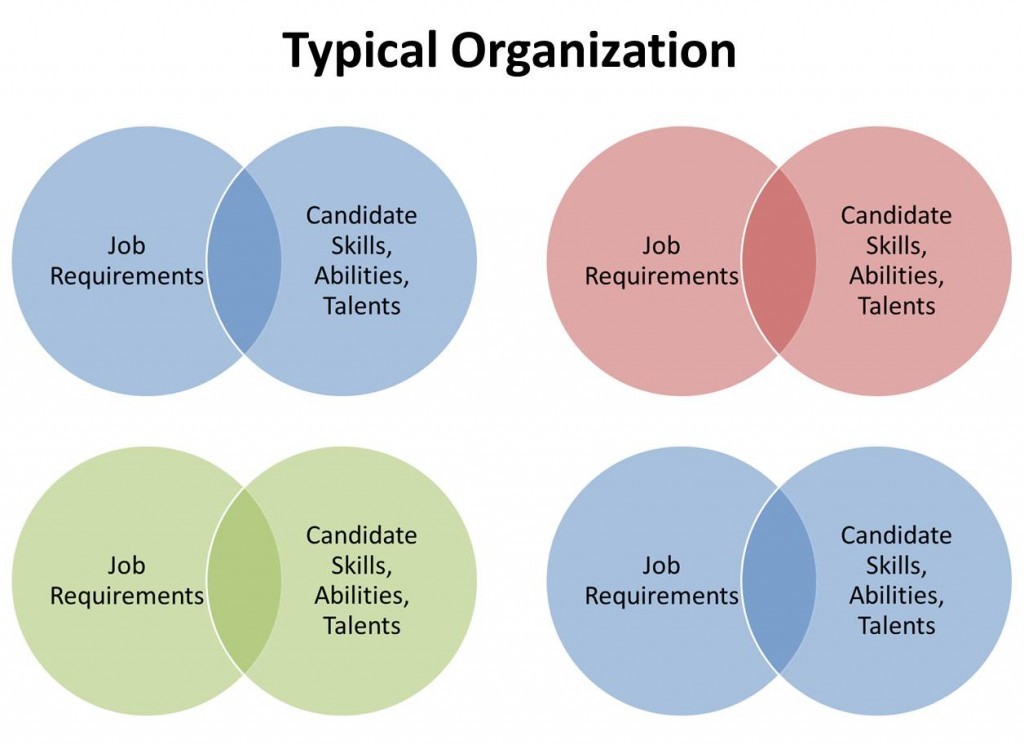
Typical Organization

But, a handful of more progressive, innovative organizations are trying to do better to harness the passions AND the skills, abilities, and talents of their individuals to better achieve the collective’s ability to generate revenue and profits (or other appropriate benefits) by engaging their employees in the innovation efforts of the organization, and allowing their employees to take some of their skills, abilities and talents and apply them to help fulfill other job descriptions. This looks something more like this:
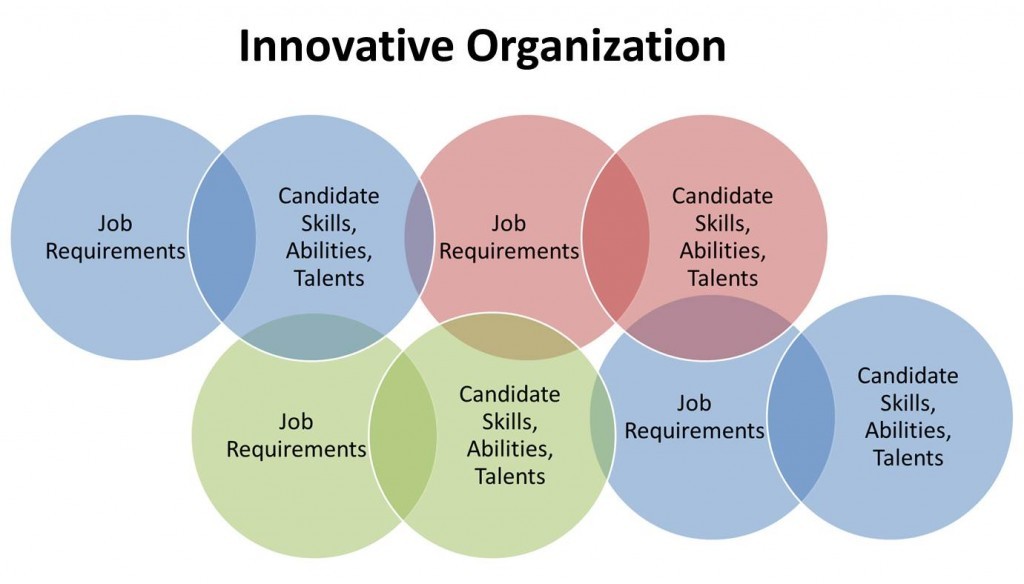
Innovative Organization

But in the most progressive organizations, they not only provide a way to better harness a more complete set of their employees’ skills, abilities and talents to more than one job description, but they also find a way to harness more of the skills, abilities, and talents that employees are currently realizing outside the organization in their hobbies, volunteer work, or other places.

And the successful organizations of the future will not stop there. They will also harness the connections their employees have outside the organization to increase the innovation capacity of the organization, and better engage not only partners in helping to fulfill the needs of different job descriptions, but they will also even engage their customers in achieving the work of the organization.

Where customer or partner skills, abilities and talents intersect with the job requirements, work can get done, and where customer or partner skills, abilities or talents intersect with employee skills, abilities or talents intersect, communities and connections have the chance to form and be nurtured. This is what organizations of the future will look like:
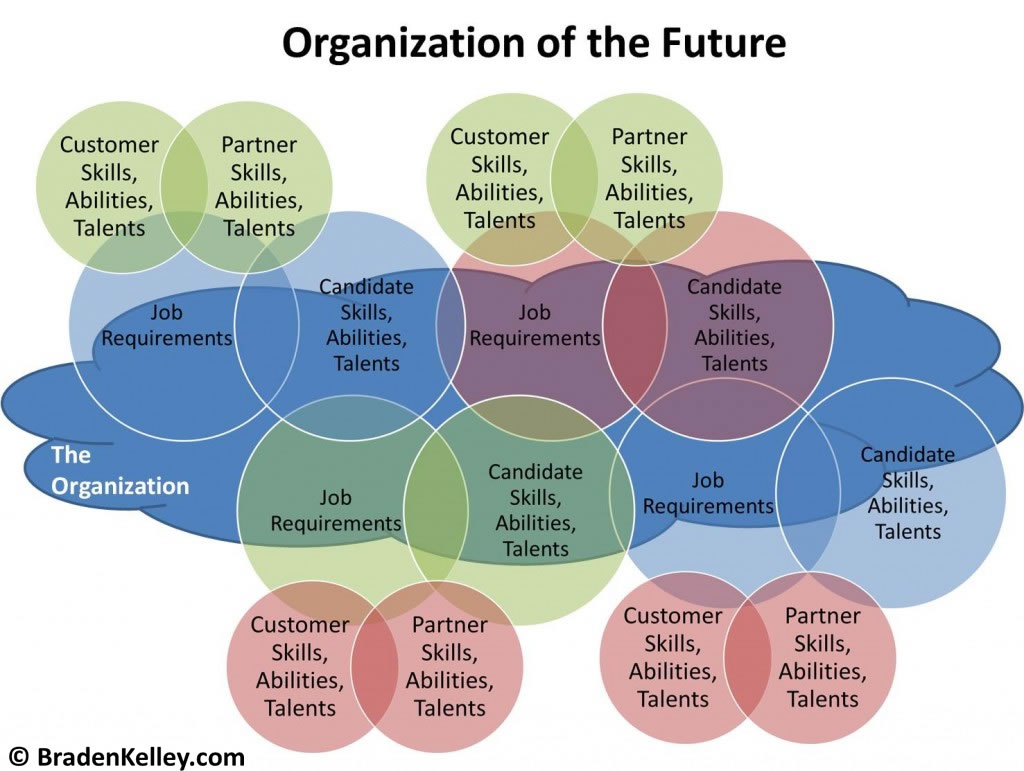
Organization of the Future

In this scenario, where innovative organizations begin to move beyond better harnessing the internal innovation capacity of their employees, to also harnessing the external capacity to work (and to innovate) of individuals outside of the organization (and to expand the scope of the collective), and to attract partners and customers to participate, organizations that allow and even encourage employees to develop a personal brand and greater external connections, will claim an outsized share of the potential benefits to both the mission of the organization and to its innovation efforts.

If your employees lack the external exposure, the external connections, and the external personal brand equity and awareness, how much harder will it be for your organization to:

  • Attract the best partners to your innovation efforts
  • Recruit the best customers to co-create with you
  • Build a strong pipeline of potential future internal talent

Through this lens you can see that in the future, successful innovation and change will be determined not just by how strong the brand of your organization is (or the collective), but also will be shaped by the strength of the personal brands of the collective’s component individuals.

As the commercial battlefield continues to change, future business success will be built upon more fluid boundaries and the ability to leverage skills, abilities and talents of people and other organizations outside the company and also the ability to:

  1. Utilize expert communities.
  2. Identify and gather technology trend information, customer insights and local social mutations from around the globe.
  3. Mobilize the organization in organic ways to utilize resources and information often beyond its control.
  4. Still organize and execute production and marketing predictably and efficiently in the middle of all this complexity.

Market leaders in our evolving reality will be increasingly determined not by an organization’s ability to outmaneuver the competition in a known market, but by their ability to identify and solve for the key unknowns in markets that will continue to become more global and less defined. Future market leaders will be those organizations that build superior global sensing networks and do a better job at making sense of the inputs from these networks to select the optimal actionable insights to drive innovation and change.

By this point, hopefully you are asking yourself three questions:

1. How do I create more fluid boundaries in my organization?

2. What does a global sensing network look like?

3. How do I build one?

One View of a Global Sensing Network
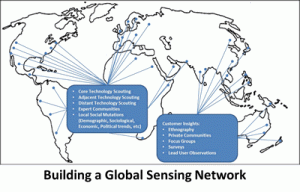
Building a Global Sensing NetworkThe purpose of a global sensing network is to allow an organization to collect and connect the partial insights and ideas that will form the basis of the organization’s next generation of customer solutions. This involves collecting and connecting:

Click to access this framework as a scalable 11″x17″ PDF download

1. Customer Insights

  • Ethnography
  • Private Communities
  • Focus Groups
  • Surveys
  • Lead User Observation

2. Core Technology Trends

3. Adjacent Technology Trends

4. Distant technology trends

5. Local social mutations

  • Demographic trends
  • Sociological trends
  • Economic trends
  • Political trends (including regulation)
  • Behavioral trends

6. Expert Communities

  • University Research
  • Government Research
  • Corporate Research
  • Charitable Research
  • Hobbyists

To actually build a global sensing network you need to start from the inside out. You have to take a look around inside your organization and see what employees you have, what natural connections they have, and where they are currently located on the globe. At the same time you need to understand how employees in your organization naturally connect with each other and define what core, adjacent and distant technologies mean in the context of your organization. You must also look and see what tools you have inside the organization for managing insights, expertise and information within the organization, and what expert communities you may already have connections into.

I would recommend beginning to establish your global sensing network inside your organization before venturing to build it out completely with the resources and connections that you will naturally need outside your organization. This will enable you to get some really great feedback from employees on the connections that will be necessary to foster and manage outside of your organization and to prepare your information sharing systems and internal communications to enable increased sharing and improved innovation inputs and outputs.
Accelerate your change and transformation success

It is likely that many organizations will already be gathering some level of customer insight information from ethnography, private communities, focus groups, surveys, lead user observation, etc. but not have a good infrastructure, policies or procedures in place for sharing this information. If you’re truly serious about creating a deep innovation capability and working to achieve innovation excellence in the same way that you pursue operational excellence, you should experiment with your systems by making customer information more available.

Next, you should leverage your employees and existing partnerships to reach outside the organization to organize and establish stronger communication channels with the relevant expert communities, including those focused on university research, government research, charitable research, corporate research (industry associations and competitors), and even to inventors or hobbyists.

And then finally from the connections you’ve built to this point, you should have identified where you have good people internally to provide information on local social mutations (local developments of interest spawned by local demographic, sociological, economic, political and behavioral trends), and where you have gaps. Hopefully by this point you may have also identified people outside your organization in countries around the world that you already have formal or informal connections to that can be leveraged to fill the gaps in your global sensing network footprint.

Conclusion

If you’re already involved in innovation and change, or have read a lot on the topic, it should be obvious to you why your organization needs a global sensing network.

Building a global sensing network helps organizations:

  • Accelerate their innovation efforts
  • Create more fluid organizational boundaries
  • Embrace a more open approach to innovation
  • Monitor emerging and evolving technologies
  • Track changes in customer behavior in the unending search for new insight-driven ideas

But the main that should jump out as you look at the download titled Building a Global Sensing Network is that innovation can come from anywhere, so you need to be listening everywhere.

The purpose for building a global sensing network is much like the purpose for having a SETI program. We know that there must be intelligent life outside the four walls of our organization, but to find it, we must be listening. And we must be listening so that we can amplify, combine and triangulate the weak signals that we might pick up so that we can find the next innovation and change that our organization is capable of delivering – before the competition. After all, there is a war for innovation and change out there. The only true unknown is who’s going to win.

I hope you’ll come join me on this journey to improve the pace and execution of innovation and change efforts in our organizations!

Sign up for Change Planning Toolkit™ launch updates

Click to access this framework as a scalable 11″x17″ PDF download

Subscribe to Human-Centered Change & Innovation WeeklySign up here to get Human-Centered Change & Innovation Weekly delivered to your inbox every week.

The Digital Innovation Talent Shortage

The Digital Innovation Talent ShortageI was watching our Seattle Seahawks lose to the Green Bay Packers on Sunday and was surprised to see a series of television ads air during the game from GE, not touting how great their products are, but why GE is a great place for software developers to come work.


Each 30 second advertisement will have cost GE nearly $700,000, meaning that GE probably spent $2 million last Sunday. First I’ll share the ads and then I’ll share my thoughts on their significance.

All three advertisements are in this single video from ad agency BBDO:

  • Advertisement #1 (Parents’ reaction to Owen taking a developer job at GE)
  • Advertisement #2 (Fellow students’ reaction to Owen taking a job with GE)
  • Advertisement #3 (Friends’ reaction to Owen taking a developer job with GE)

All three ads highlight the gap between most people’s industrial age thinking and our new digital reality, and close with the tagline:

“The digital company. That’s also an industrial company.”

A year ago, together with Linda Bernardi, a Chief Innovation Officer at IBM, the two of us wrote about this very subject in our article for the world’s most popular innovation web site, Innovation Excellence:

You’re Either a Technology Business or You’re Out of Business

The sad truth is that most companies don’t realize this. GE, based on this ad campaign, obviously does. I won’t re-visit all of the points in the article, but instead I encourage you to read it, and for now I’ll focus on additional thoughts emerging since then. One thing I did after publishing this article with Linda, was ask the following question at my previous employer:

“Are we a technology company that happens to serve customers in the health insurance industry, or are we a health insurance company with an IT department?”

Does anyone want to guess what the majority of people answered?

The healthcare industry is undergoing a period of incredible change, but they are not the only ones. Technology is transforming market and customer expectations faster than executives and employees can transform their thinking. Customers expect more, they demand more, in every industry, and this is opening the door both for new entrants and for existing competitors to rearrange the market share picture, IF they take strategic actions focused on transforming into a more digital, more collaborative, more innovative organization. The questions every organization should be asking themselves include:

  1. How can we modify the architecture of our organization to cope with the increasing pace of change?
  2. How can we increase our organizational agility?
  3. How can we retain the talent we need to power a true digital transformation?
  4. How can we attract the talent we need to fill the gaps in our skills base to empower a successful digital transformation and to drive success in the marketplace as a social business?

I see GE’s ad campaign as the canary in the coal mine, an example of a large company awakening to one of the major challenges every organization faces in continuing to stay relevant (and profitable) in a rapidly changing, digital, always connected world.

The fact is that almost every organization needs more digital innovation talent…

And you know what?

There is a shortage…

Keeping up with the pace of technological change is hard enough. Conducting a digital transformation, and becoming a true social business is even harder, but INCREDIBLY important to your current and future success. The companies that realize this and commit to a coordinated digital transformation, embracing the fact that they are a technology company serving a particular industry and a certain set of customers will have a better chance of attracting the scarce talent they need to complete the work to emerge out the other side. And you MUST do this before every other company out there piles on and causes an incredibly bloody fight for the scarce digital innovation talent out there, and the market share that is at risk.

I will be writing more about how to increase your organizational agility and to achieve a successful digital transformation in the coming months in the run up to the publishing of my second book by Palgrave Macmillan on organizational change and the Change Planning Toolkit™.

Are you going to be like GE and admit that you need to change the way you think of yourself as an organization and change the perception potential employees have of you in the marketplace?

Are you ready to become a social business?

Do you have what you need to achieve a successful digital transformation?

Are you ready to admit that you need help getting there?

Image credit: news-leader.com


Accelerate your change and transformation success

Subscribe to Human-Centered Change & Innovation WeeklySign up here to get Human-Centered Change & Innovation Weekly delivered to your inbox every week.

Do You Agree or Disagree with Samsung’s Vision of the Future?

Samsung recently posted a video highlighting their vision of the future and the evolution of the Internet of Things (IoT).

The movie highlights their tagline ‘In Sync with Life’

While certain of the benefits highlighted in Samsung’s IOT video might be interesting, I found myself left with more questions than answers, including:

How necessary is this?

Would this really improve my life?

Is it simplifying anything or in reality, more likely to add complexity and configuration frustration?

Would this create a future that’s more human or less human?

Could I live without this?

What are the health effects of increasing the amount of unnatural frequencies being transmitted through the air?

Does this look like a better or worse future to you?


Accelerate your change and transformation success

Subscribe to Human-Centered Change & Innovation WeeklySign up here to get Human-Centered Change & Innovation Weekly delivered to your inbox every week.

Apple Announces Name Change to App-le

Apple Announces Name Change to App-le

First Apple changed its name from Apple Computer to Apple to better reflect a business focus that was extending beyond computers to music players, smartphones, digital music sales, and more.

And last week Apple announced a flurry of new products including:

  • iPhone 6s and iPhone 6s plus
  • All new Apple TV
  • iPad Pro
  • watchOS 2
  • iOS9

What was clear from the announcements is that Apple’s view the future of computing and entertainment is an App-centric one.

First Apple created Apps for the iPod. Anyone remember the iPod? Apple barely does. They still make iPods, but they’ve been dropped from the main menu on Apple’s web site and relegated to the text links at the bottom of the page. Then they create Apps for the iPhone and the iPad and the watch. And this past week Apple announced their App-centric vision for the future of television.

What is this vision?

It’s pretty simple really. Want to watch major league baseball (MLB) on your television, buy the MLB app. Want to watch HBO, buy the app. Cartoon Network? Get the app. You get the idea.

Why does Apple have this vision?

This App-centric vision of entertainment grows their ecosystem and enables Apple to make money not only from hardware sales, but also from commissions in the sale of all of these Apps. And as people buy more apps, they lock themselves further into Apple’s hardware, by design.

Apple’s App-centric vision for the future of television is good for creators of popular, quality content like HBO, the National Football League (NFL), Premier League Football, CNN, BBC, and for movie-centric aggregators (Netflix, Amazon). The evolving App-centric approach to television also has the benefit to the content creators of enabling them to build Apps that yes play full-screen video (what people expect), but also to integrate information, commerce and social elements into their Applications as they see fit. The downside is that content creators will lose the perceived safety that cable network bundling offers.

But the smartest, best run content creators are more likely to gradually embrace this App-centric possible future, and as a result Apple’s App-centric television future is likely to be a disaster for cable companies and other television-centric aggregators (Hulu, Sling). Why would you need an intermediary like a cable company when you can go straight to the source?

Cable companies could however try to beat Apple to the App Store model and potentially also beat them to the Spotify model for television if they move quickly. But are speed and courage what cable companies are known for?

YouTube and Facebook could also be big winners in Apple’s App-centric television future as both sites could become the home for a treasure trove of free sample shows, a place for people to discover new content to subscribe to. Facebook has made a big push into video the past few years, making this potential area of growth possible for them.

Apple missed the App-centric transition in music, and they had to go out and overpay for Beats to try and catch up to Spotify and others. They’ve also missed the early days of the App-centric transition in paid video apps as well, with Netflix enjoying the early success. They don’t want to get completely left behind, so they are making their big push towards an App-centric television future. The only question is how?

Will Apple look to create a subscription service like Netflix or Spotify as their App, or focus on promoting content creator Apps (NFL, CNN, etc.) through an App Store, both, or something completely different?

No matter which direction Apple chooses, it’s clear that with Apple it is all about the apps. So will Apple change its name to App-le? Probably not. But, they’ve made it very

clear that their vision for the future is an App-centric one. Will they be able to realize it?

Image credit: mashable.com

This article originally appeared on Linkedin


Accelerate your change and transformation success

Subscribe to Human-Centered Change & Innovation WeeklySign up here to get Human-Centered Change & Innovation Weekly delivered to your inbox every week.

Drowning in a Sea of Content

Drowning in Content

In #MyIndustry, content creation (I’m an author, keynote speaker and publisher), there is already a flood of content and the flood waters will not recede anytime soon. In fact, the rate of content creation is increasing as more companies launch content marketing and inbound marketing campaigns to pull customers to them.

Before the Internet came along, content was naturally limited by the potential throughput possible through a relatively fixed number of available channels:

  • Handful of TV stations
  • Radio stations
  • 1 or 2 local newspapers
  • A few dozen magazines
  • A handful of book publishers

Things remained relatively stable for several decades, then beginning in about 1980 this began to change. Cable and satellite television began to arrive taking television from a handful of stations to hundreds. The number of magazines began to grow, doubling between 1980-2000 according to Pew Research, online services and eventually the Internet emerged to provide a plethora of alternatives to traditional newspapers, and satellite and internet radio arrived. At the same time Amazon, Lulu and others launched the self-publishing revolution.

The amount of content available to people has exploded over the last 35 years. I saw a statistic recently that more than 1 TRILLION photos will be taken in 2015, compared to 2.7 Trillion photos cumulatively stored through the end of 2014.

With the rate of the content deluge increasing and with none of it draining out the bottom of the Internet bathtub, it will become harder and harder for a content creator like myself to capture people’s attention and to afford to continue to deliver quality insights from research, collaboration, and connection.

Being a content creator is a lot like being a space object, there are lots of asteroids in space, and it is easy to float around as an asteroid, but to carefully tend and cultivate an ecosystem that helps you attract enough mass and an atmosphere capable of generating and growing life is much harder.

Creating unique and differentiated insights to power content that educates, informs, or entertains (or potentially all three) is hard enough, but if you want to create something with its own source of gravity, you need to collect and harness many more skills, while also looking for potential collaborators with complimentary skills.

This will always be true for artists, musicians, authors, and any other kind of content creator. There is no going back?

So, what’s your center of gravity?

And how can you make it stronger?

In my own content creation sphere, I continue to work to strengthen the center of gravity in the innovation arena by working on a site redesign with my great Innovation Excellence co-Founders and the digital professionals at Juice Interactive, and growing a new center of gravity in the change arena with some new partners as we seek contributing authors for an upcoming launch of Charting-Change.com.

Helping to make innovation and change insights accessible for the greater good is what drives me, and I’ll keep doing it as long as I possibly can!

Image credit: Bunchcast


Accelerate your change and transformation success

Subscribe to Human-Centered Change & Innovation WeeklySign up here to get Human-Centered Change & Innovation Weekly delivered to your inbox every week.

Listen to Crowd Computing is Dead, Long Live the Cloud!

by Braden Kelley

The Innovation Excellence version of my recent article Cloud Computing is Dead, Long Live the Cloud! has done so well that Umano has decided to turn it into an audio-article that you can listen to while you work, drive, etc. if you were too busy to read it when it came out. 😉

Here is the audio file for your listening enjoyment:

(sorry, umano seems to have gone out of business)

Hopefully I will be able to bring you more of my articles narrated in this way for those of you who prefer to listen to content instead of read it.

Keep innovating!


Accelerate your change and transformation success

Subscribe to Human-Centered Change & Innovation WeeklySign up here to get Human-Centered Change & Innovation Weekly delivered to your inbox every week.

Microsoft’s Latest Vision of Future Productivity

Microsoft's Latest Vision of Future ProductivityI came across the latest vision of future productivity from Microsoft today and thought I would share it with you, along with a whole series of previous videos from Microsoft taking a look at the same subject area, ranging from 2009-2015. It is interesting to see what has changed and what has stayed the same over those six years in their view of the future.


So, here is Microsoft’s latest vision of future productivity:

And here is a closer in, more present-oriented view of changes in how people think about technology, collaboration, and productivity from Julia White, General Manager, WW Office Marketing, Microsoft:

(sorry, someone made this video private)

It can also be interesting to see how visions of the future evolve over time, so here is Microsoft’s vision of the future from October 2011:

And their 2009 vision:

Does anything jump out that has either worked its way into Microsoft’s vision of the future of productivity or worked its way out of their vision that is notable?

I’d be curious to hear your thoughts and reactions to this series of videos and where you think things are going in the near term and longer term.


Accelerate your change and transformation success

Subscribe to Human-Centered Change & Innovation WeeklySign up here to get Human-Centered Change & Innovation Weekly delivered to your inbox every week.

Microsoft Stomps on Google Glass

Microsoft Stomps on Google Glass

Wow!

I have to start that word, because I’m not sure how else to describe what has just emerged from Microsoft Research in the new Microsoft HoloLens.

And as I say in the title, if you watch the video below you’ll clearly see that Microsoft has just busted Google Glass – both lenses.

I said from the beginning that Google Glass would never catch on as a consumer product, because they look dumb, cost a lot of money, and don’t really fit into most people’s lives (or add much of anything to them). Recently Google shut down its consumer facing Google Glass program while they try to fix its shortcomings.

Microsoft’s HoloLens on the other hand, if you’ve ever read Innovation is All About Value (if not, follow the link) then you’ll quickly see after watching the video above that Microsoft’s new potential innovation ticks all three boxes in my innovation success prediction framework:

  • Value Creation – Takes 3D objects from your screen and brings them to your physical environment AND lets you interact with them (my mind races thinking about the possibilities).
  • Value Translation – Watch the video. If you don’t see how this might fit first into many professions out there and enable some amazing rapid prototyping without building anything (watch out 3D printing companies!), and possibly also into your personal life, I’ll be shocked.
  • Value Access – Microsoft is already engaging partners to add more value to what is essentially a platform, not a product.

Microsoft HoloLens

Microsoft is being intentionally coy about saying when it will be releasing the Microsoft HoloLens, but some people are predicting it will be available in the Windows 10 launch timeframe, which Microsoft is also being vague about saying only “later in the year” – which for my money usually means Q4 (or maybe Q3) depending on how the preview version does in the wild.

So what do you think of Microsoft’s new HoloLens?

I for one will be reaching out to my friends at Microsoft (you know who you are) to get a personal preview for a further write-up in Innovation Excellence (the world’s most popular innovation web site), so stay tuned!


Accelerate your change and transformation success

Subscribe to Human-Centered Change & Innovation WeeklySign up here to get Human-Centered Change & Innovation Weekly delivered to your inbox every week.

Trendspotting Trifecta

Innovation Perspectives - Trendspotting Trifecta‘Who should be responsible (if anyone) for trend-spotting and putting emerging behaviors and needs into context for a business?’
I believe this question should really be broken up because there are three VERY different (and incredibly important) pursuits intermingled here:

  1. Trend spotting
  2. Putting emerging behaviors into context for a business
  3. Putting emerging needs into context for a business

Only at the very beginning of a business, when it is all or nothing for a small team of founders, should responsibility for these three tasks be combined. The reason responsibility for these three different pursuits should be split up is because each requires a different way of thinking, that often requires different types of people to generate the most relevant and actionable insights.

As I’ve written before, insights and execution are the real keys to business success, and in building any successful innovation – the insights come first. So, combining these three pursuits properly and getting the insights correct is incredibly important – otherwise you’ll design, build, and distribute a solution that misses the mark with customers.

Trend spotting requires big picture thinking, a talent for separating the notable from the unimportant, the ability to see how potential trends connect together, and the vision to see the impact of this trend intersection (what megatrends might they point to, etc.).

Putting emerging behaviors into context for a business requires an incredible capacity for insightful observation, the ability to spot influential thinkers who are good at identifying and describing changing behaviors, and the skills to synthesize a collection of perspectives into a cohesive view of the future. This view of the future must of course have a strong chance of being correct.

Putting emerging needs into context for a business is incredibly difficult and requires understanding how emerging trends and behaviors will intersect with new technologies and other business capabilities to expose new customer needs. Those new needs then represent potential growth areas for businesses to enter with new solutions. The goal of course is to identify and act upon these emerging needs before the competition has the opportunity to observe these needs as expressed behaviors and actions and react.

The one skill that all three share in common however, is the ability to disconnect one’s own perspective from the changing perspectives of others. Whether you as an organization choose to hire people into these roles, hire in consultants to provide this insight, or to spread the responsibilities around the organization, you must have a strategy.

Personally, I believe organizations may soon begin creating insight networks within their organizations in the same way that they currently do with innovation. This means having a central insights team at Corporate HQ with strong executive support that is responsible for managing the process, the distributed global network, its training/certification, and its outputs. This does not have to mean starting a new team – companies could incorporate these responsibilities within an existing dedicated-innovation infrastructure. So, can an insight management software industry be far behind?

And last but not least you will need to assign people to monitor trends and emerging behaviors and needs from Six Ways to Sunday:

  1. Demographic and Psychographic Changes
  2. Legal and Political Changes
  3. Different Geographies
  4. Different Industries
  5. New Supplier and Technology Capabilities
  6. New Business Capabilities and Business Models

Do you have a strategy and responsibilities in place for spotting trends and emerging needs/behaviors in your organization?

What are you waiting for?

Build a Common Language of Innovation

Subscribe to Human-Centered Change & Innovation WeeklySign up here to get Human-Centered Change & Innovation Weekly delivered to your inbox every week.