Idea to P&L
LAST UPDATED: December 3, 2025 at 4:09PM

GUEST POST from Chateau G Pato
The biggest enemy of internal innovation is not a lack of funding or creativity; it is organizational friction. We’re excellent at the initial spark — the hackathon, the idea challenge — but we fail consistently in the messy middle: the transition of an idea from a protected Innovation Lab to an accountable Business Unit. This journey requires a structured approach that explicitly manages the shift from high-tolerance learning metrics to high-pressure revenue metrics.
This challenge demands a Human-Centered approach. The people and teams must change their behaviors, their metrics, and their risk profile at specific points. We must stop thinking of the innovation pipeline as a single, fluid pathway and recognize it as three distinct environments, each with its own governance and culture. The map from Idea to P&L is defined by three critical Change Management Gates.
The Three-Stage Innovation Transit System
An internal innovation must successfully transit three stages, each marked by a change in focus, metrics, and most importantly, ownership.
Stage 1: The Innovation Lab (Discovery & Validation)
This is the protected environment where the idea is born and the Problem/Solution Fit is established. The culture is one of Psychological Safety and rapid, low-cost experimentation. The goal here is purely learning velocity.
- Owner: Innovation Team / Dedicated Idea Owner.
- Funding: Grant or Seed Budget (focused on burn rate).
- Metrics: User desirability scores, successful MVP pivots, cost of learning, and completion of Risk Reduction Milestones (e.g., proving the technology works, proving the customer needs it).
The first Change Management Gate — The Validation Gate — is passed when the team can prove, with early user data, that the innovation solves a genuine, urgent customer problem and has a clear, if small, path to monetization.
Stage 2: The Accelerator (De-risking & Scaling)
Once validated, the innovation needs protection from the rigid P&L structures of the core business while being forced to adopt Business Rigor. This stage is about establishing Product/Market Fit and building the operational infrastructure required for scale. The team must unlearn the scrappy habits of the lab and learn the discipline of business planning.
- Owner: The new Venture or dedicated Accelerator Leadership, often with joint sponsorship from the Innovation Team and a potential Business Unit leader.
- Funding: Transitional Budget (focused on operational scaling).
- Metrics: Customer acquisition cost (CAC), lifetime value (LTV), early revenue figures, and stability of the Minimum Viable Operation (MVO). The focus shifts from “Can we build it?” to “Can we sell it sustainably?”
The second Change Management Gate — The Commercialization Gate — is passed when the innovation achieves established, repeatable commercial traction, a positive unit economic model, and the core business unit agrees to assume financial responsibility.
Stage 3: The Business Unit (Optimization & P&L)
The innovation now transitions to the operational world. It receives full funding and full P&L Accountability. The culture shifts from experimentation to optimization and continuous improvement. The innovation leader must now unlearn the constant need for radical change and learn to operate within established corporate constraints (e.g., compliance, annual budgeting, HR structure).
- Owner: Core Business Unit (BU) Leadership, often with the original innovation champion integrating into the BU team.
- Funding: Operational Budget (focused on margin).
- Metrics: Gross Margin, market share, YoY growth, and integration with existing corporate systems.
Case Study 1: The Manufacturing Giant’s Digital Service Offering
Challenge: New Business Model Cannibalization Fear
A global industrial manufacturer (“MegaCorp”) developed an internal IoT-enabled maintenance service (a subscription model) in its Lab. The innovation team proved Problem/Solution Fit, showing customers wanted to buy “uptime” rather than “parts.” However, the core Parts Sales BU feared the new service would cannibalize their highly profitable parts revenue, leading them to resist taking ownership at the Commercialization Gate.
The Human-Centered Intervention: The Transitional BU
MegaCorp created a separate, temporary Transitional Business Unit (TBU) reporting directly to the CEO for 18 months. This TBU served as the Accelerator Stage (Stage 2) and was given a specific mandate: Generate $5M in revenue using the service model, and its success metrics would explicitly ignore any perceived impact on the Parts Sales BU. This TBU was shielded from the core P&L fears.
The P&L Lesson:
The TBU successfully proved the revenue model was additive, not just cannibalistic, targeting a new segment of customers. Critically, it allowed the Parts Sales BU leadership to unlearn their fear of service revenue through observed data rather than abstract analysis. After 18 months, the successful TBU was folded into a newly-formed Digital Services BU with clear P&L accountability, proving that organizational structures must be designed to manage fear and resistance during the crucial transition phase.
Case Study 2: The Retail Bank’s Automated Lending Tool
Challenge: Regulatory Friction Stalling Scale
A regional bank (“SafeBank”) developed an AI-driven lending tool in its Lab, proving it could process small business loan applications in minutes instead of weeks — a clear Product/Market Fit. However, the Legal and Compliance BU halted the innovation at the Commercialization Gate (Stage 2 to 3 transition), citing regulatory risk associated with AI model transparency and auditability.
The Human-Centered Intervention: Embedded Compliance Design
Instead of battling the Legal team, the Accelerator team embedded a compliance officer into their engineering team (Co-Creation). The compliance officer’s success metric was changed from preventing deployment to designing a compliant path to deployment. The innovation team had to unlearn their engineering-first mindset and learn to design compliance rules directly into the code as a core feature.
The P&L Lesson:
By treating compliance as a design constraint rather than a roadblock, the team created a tool that automatically generated the required audit reports. This collaborative approach built reciprocal trust. The Legal BU confidently signed off on the innovation, and it was integrated directly into the Retail Lending P&L with immediate positive impact on customer experience and loan volume. The innovation successfully reached the P&L stage because its owners proactively managed systemic friction.
Conclusion: It’s All About Governance
The journey from Idea to P&L is fundamentally a governance journey. Innovation leaders must create clear, documented rules for each of the three stages, defining metrics that prioritize learning in the Lab, rigor in the Accelerator, and return in the Business Unit. When ownership is ambiguous, the innovation stalls; when metrics are misaligned, the innovation dies. Your internal innovation pipeline must be a deliberate, human-centered change management mechanism.
“An innovation without a path to P&L is a hobby. An innovation with a mapped journey is a growth engine.”
Frequently Asked Questions About Idea to P&L Mapping
1. What is the “Commercialization Gate”?
The Commercialization Gate is the critical transition point between the Accelerator Stage (Stage 2) and the final Business Unit Stage (Stage 3). It is passed when the internal innovation achieves repeatable commercial traction, proves a positive unit economic model, and a Core Business Unit agrees to assume full financial (P&L) accountability for its scaling and operations.
2. How should metrics change between the Lab and the Accelerator?
Metrics must shift from focusing on learning to focusing on business rigor. In the Lab (Stage 1), metrics are qualitative (e.g., user desirability, risk reduction milestones). In the Accelerator (Stage 2), metrics become quantitative business indicators (e.g., Customer Acquisition Cost, Lifetime Value, early revenue figures, and operational stability).
3. What is the biggest organizational friction point in the Idea to P&L journey?
The biggest friction point is often the fear of cannibalization and the resistance to unlearning. Core Business Units resist adopting innovations that might disrupt their existing profitable model (even if necessary for future growth). Effective change management must be employed to provide transitional governance (like a TBU) to de-risk the new idea until it proves its value.
Your first step toward mapping your Idea to P&L journey: Create a simple one-page checklist for your Commercialization Gate. Include five non-negotiable proof points that must be achieved before any Core Business Unit is asked to assume P&L responsibility (e.g., $1M in revenue, 80% customer retention, zero critical security flaws).
Extra Extra: Because innovation is all about change, Braden Kelley’s human-centered change methodology and tools are the best way to plan and execute the changes necessary to support your innovation and transformation efforts — all while literally getting everyone all on the same page for change. Find out more about the methodology and tools, including the book Charting Change by following the link. Be sure and download the TEN FREE TOOLS while you’re here.
Image credit: Pixabay
 Sign up here to get Human-Centered Change & Innovation Weekly delivered to your inbox every week.

 We have worked with Fortune 500 companies and other organizations over the past 26 years deploying Outcome-Driven Innovation (ODI), a proven
  In setting up an innovation and insights group from scratch, first want to define how you define success. What does this group hope to achieve? What issues is it addressing? What are the barriers to success?
 Many corporate innovation leaders don’t have the luxury of starting an innovation and insights function “from scratch” as they’re often saddled with the inspiring (?) vision of a senior leader, a mandate to make use of resources who don’t fit in elsewhere, or the herculean task of filling a gap in a company’s growth plan which has few degrees of freedom to actually go and try something new. So on the rare occasions when this is the starting place, here are the top five things I consider strong precursors of success:
 It doesn’t matter whether your organization is B2B, B2C, a charity, a government entity, or all four. Every innovation and insights organization must begin with their customers in mind, and make sure that they have the buy-in of key internal organizations (their customers in this context) to pick up their outputs and turn them into new or renewed product and/or service offerings. Unless the rest of the organization converts your ideas into new sources of value for the organization or utilizes them to increase existing sources of value, then eventually your group will become the victim of budget cuts.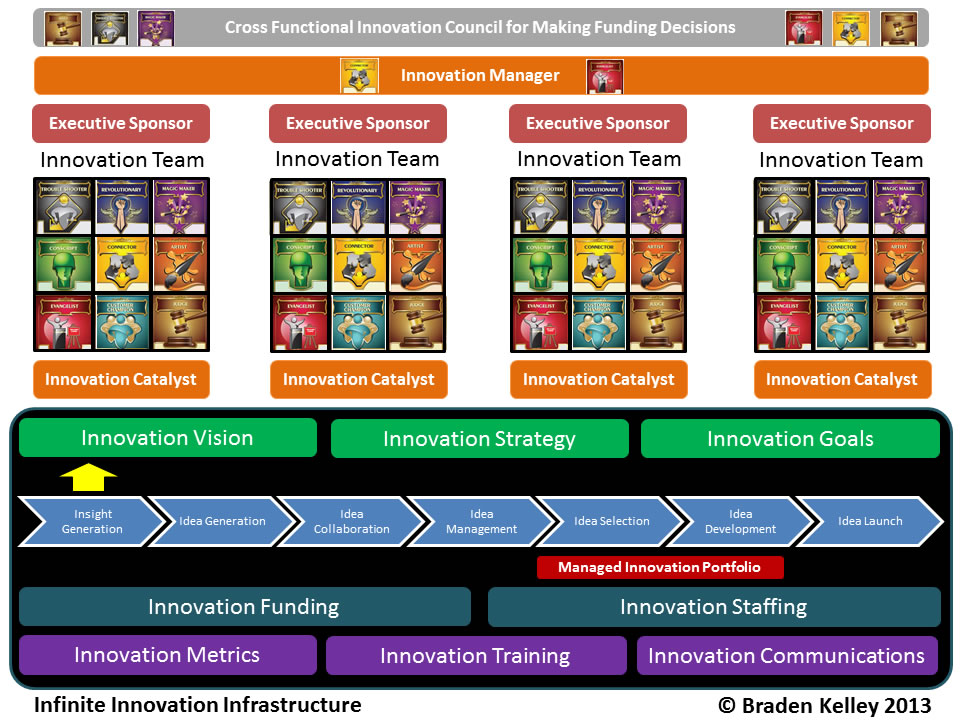
 The most critical thing the leader of a new insight and innovation group needs to consider in order to be successful is stakeholder expectations. Are stakeholders seeking insights and innovations that improve today’s business? Are they hoping to go build exciting new disruptive ventures? Or are they trying to create a more enabling culture of innovation? Those are distinctly different mandates, and a lack of clarity can lead a new leader to move in the wrong direction.

 More Than Magic
 On May 1st I will be the keynote