
by Braden Kelley and Art Inteligencia
What Is Innovation? (Short Answer)
Innovation is turning a useful idea into a widely adopted solution that people value more than whatever they used before. My definition: “Innovation transforms the useful seeds of invention into widely adopted solutions valued above every existing alternative.” Innovation isn’t the same as invention, creativity, or improvement. Until people choose it over their alternatives, it isn’t innovation yet.
If nobody adopts it, it isn’t innovation yet. It’s an invention waiting for a reason.
“What is innovation?” is the question people ask me more than any other. Most answers define it loosely as “new ideas” or “something new” — which lets organizations call almost anything innovation. Below you’ll find what each part of my definition means, how innovation differs from invention, creativity, and improvement, real examples (and some famous near misses), why every organization needs a shared definition, and a simple test for whether something is truly an innovation.
What Does Each Part of the Definition of Innovation Mean?
“Innovation transforms the useful seeds of invention into widely adopted solutions valued above every existing alternative.” — Braden Kelley
I’ve refined this definition over many years because each phrase does a specific job:
- “Useful seeds of invention.” Innovation starts with an invention or a new combination of existing ideas. The seed doesn’t have to be yours, and it doesn’t have to be brand-new. Many of the most important innovations recombine or borrow ideas from somewhere else.
- “Transforms.” This is the hard work between idea and impact: developing it, delivering it, building a business model around it, and helping people make the change required to adopt it. It’s where most of the effort — and most of the failure — happens.
- “Widely adopted.” This is the threshold most so-called innovations never cross. Adoption has to happen among the people it was meant for, not just a handful of early enthusiasts.
- “Valued above every existing alternative.” Useful isn’t enough. An innovation must be valuable enough that people willingly switch to it. And the alternative includes doing nothing, or sticking with the workaround people already use.
I explain why I define innovation this way — and why every organization needs a clear definition of its own — in this short video: What Is Innovation? (Ask the Consultant, Episode One).
Useful gets an idea noticed. Valuable gets it adopted.
How Is Innovation Different From Invention, Creativity, and Improvement?
These words get used interchangeably, but they describe different things:
| Term | What it is | Example |
|---|---|---|
| Creativity | Generating new ideas | A brainstorm full of concepts |
| Invention | Creating something new that works | A patented prototype |
| Improvement | Making something that already exists better | A faster version of the same product |
| Innovation | A new solution people adopt because they value it above every alternative | A product or service that replaces how people used to do something |
Creativity and invention are inputs to innovation. Improvement can be extremely valuable, but it usually makes the existing solution better rather than replacing it. Innovation requires both adoption and displacement: people stop doing things the old way because they found something better. For a deeper look at how invention, innovation, and lasting impact differ, see 7 Differences Between Invention, Innovation, and Impact (With Examples).
What Are Some Examples of Innovation?
Here are well-known examples that pass every part of the definition — across products, services, processes, and business models:
- The smartphone. For most people, it replaced a separate phone, camera, music player, and paper map — because they valued one connected device above all of those alternatives.
- Streaming video. It displaced DVD rental because watching instantly at home was valued above a trip to the store and late fees.
- Mobile money (M-Pesa in Kenya). It let people without bank accounts send, receive, and store money using a basic mobile phone — and it was widely adopted because it beat carrying cash or relying on informal transfers.
- The shipping container. A process innovation that standardized how goods are moved, transforming the cost and speed of global trade.
- The surgical safety checklist. A low-tech innovation in how care is delivered, showing that innovation doesn’t require advanced technology — just a better way that people adopt.
And here are famous near misses that show what the definition demands:
- Google Glass. An impressive invention that was never widely adopted by consumers, who didn’t value it above the phone already in their pocket — and had real concerns about privacy and social acceptance.
- The Segway. Novel and useful, but for most people it wasn’t valued above walking, cycling, or driving.
The difference between these two lists isn’t the sophistication of the technology. It’s whether people chose it.
Why Does Your Organization Need a Clear Definition of Innovation?
Without a shared definition, everything new gets labeled innovation — the hackathon, the lab, the app update, the rebrand. That funds activity instead of outcomes and makes it easy to mistake motion for progress. I describe the most common versions of this costume in 7 Types of Innovation Theater.
A clear definition does three things for an organization:
- It aligns funding. If innovation requires adoption, you fund the work of getting people to adopt — not just the work of building.
- It aligns measurement. You measure adoption, value, and what got replaced, not idea counts. For how to do that, see 12 Metrics That Actually Measure Innovation Value.
- It aligns responsibility. Someone has to own adoption, not just invention.
My advice is simple: choose a definition, then spread it widely so that everyone — not only the innovation team — uses the same standard.
An organization that can’t define innovation can’t manage it, measure it, or fund it well.
How Can You Tell If Something Is Really an Innovation?
Use this four-question test, drawn directly from the definition:
- Is it useful? Does it solve a real problem for real people?
- Is it valued above every existing alternative — including doing nothing?
- Has it been widely adopted by the people it was meant for?
- Did people willingly switch from what they used before?
If the answer to all four is yes, you have an innovation. If not, you may have a promising invention, a valuable improvement, or a pilot that hasn’t crossed the adoption threshold yet.
I’d add one human-centered question: adopted by whom, and better for whom? An innovation that wins customers while burning out employees or harming a community deserves a harder look.
Innovation isn’t measured at launch. It’s measured by what people stop using because they found something better.
FAQ: What Is Innovation?
What is innovation in simple words?
Innovation is turning a useful idea into something people widely adopt because they value it more than what they used before. Braden Kelley defines it as: “Innovation transforms the useful seeds of invention into widely adopted solutions valued above every existing alternative.”
What is the difference between innovation and invention?
Invention is creating something new that works. Innovation happens when that invention, or a new combination of ideas, is widely adopted because people value it above every existing alternative. An invention that nobody adopts is not yet an innovation.
What are some examples of innovation?
Well-known examples include the smartphone, streaming video replacing DVD rental, mobile money such as M-Pesa in Kenya, the shipping container, and the surgical safety checklist. Each was widely adopted because people valued it above the alternatives they used before.
Why is innovation important?
Innovation is how organizations stay relevant as customer needs, technologies, and competitors change. It creates new value for customers, employees, and society, and organizations that fail to innovate are eventually replaced by alternatives people value more.
What makes something an innovation?
Something is an innovation when it is useful, valued above every existing alternative including doing nothing, widely adopted by the people it was meant for, and chosen willingly over what they used before. Novelty alone does not make something an innovation.
Image credits: Gemini
Content Authenticity Statement: The topic area, key elements to focus on, etc. were decisions made by Braden Kelley, with a little help from Google Gemini and M365 CoPilot to clean up the article, add images and create infographics.
 Sign up here to get Human-Centered Change & Innovation Weekly delivered to your inbox every week.

 We have worked with Fortune 500 companies and other organizations over the past 26 years deploying Outcome-Driven Innovation (ODI), a proven
 In setting up an innovation and insights group from scratch, first want to define how you define success. What does this group hope to achieve? What issues is it addressing? What are the barriers to success?
 Many corporate innovation leaders don’t have the luxury of starting an innovation and insights function “from scratch” as they’re often saddled with the inspiring (?) vision of a senior leader, a mandate to make use of resources who don’t fit in elsewhere, or the herculean task of filling a gap in a company’s growth plan which has few degrees of freedom to actually go and try something new. So on the rare occasions when this is the starting place, here are the top five things I consider strong precursors of success:
 It doesn’t matter whether your organization is B2B, B2C, a charity, a government entity, or all four. Every innovation and insights organization must begin with their customers in mind, and make sure that they have the buy-in of key internal organizations (their customers in this context) to pick up their outputs and turn them into new or renewed product and/or service offerings. Unless the rest of the organization converts your ideas into new sources of value for the organization or utilizes them to increase existing sources of value, then eventually your group will become the victim of budget cuts.
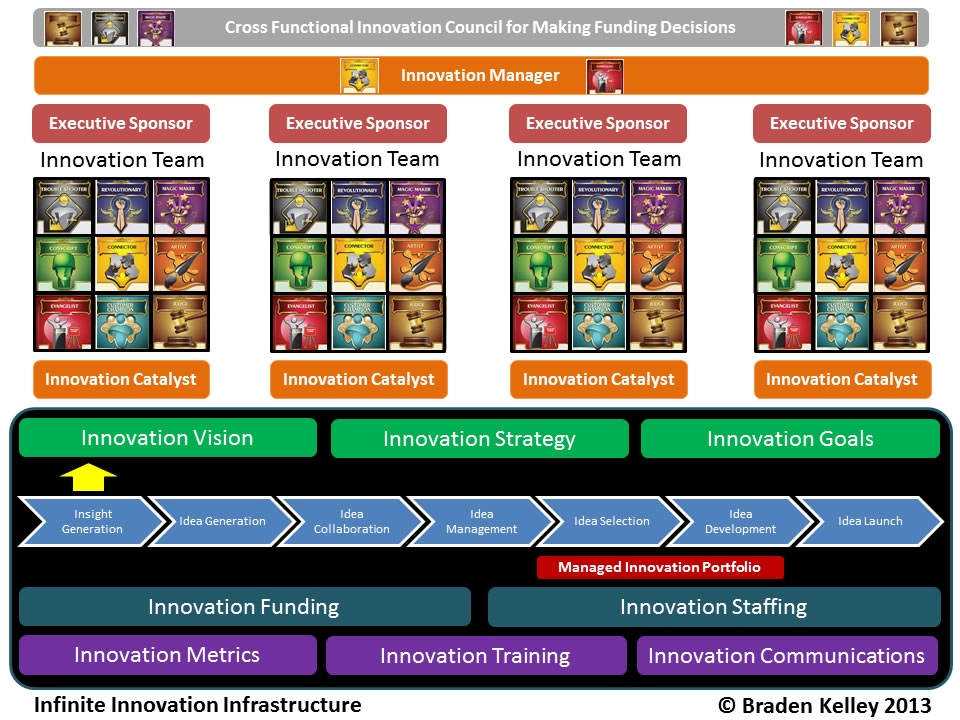
 The most critical thing the leader of a new insight and innovation group needs to consider in order to be successful is stakeholder expectations. Are stakeholders seeking insights and innovations that improve today’s business? Are they hoping to go build exciting new disruptive ventures? Or are they trying to create a more enabling culture of innovation? Those are distinctly different mandates, and a lack of clarity can lead a new leader to move in the wrong direction.