Now that we have all been stuck inside for almost two years, many of us are suffering from an exacerbation of worthless meeting syndrome (WMS) , most recently remotely.
Of course, worthless meeting syndrome is a well-described chronic disease which has periodic exacerbations. It can be endemic or global with recovery and remissions. Here are the signs and symptoms.
One meeting expert notes that bad meetings are the bane of the corporate world — and yet despite what appears to be an overwhelming consensus that they’re often unnecessary and unproductive, many workplaces continue to struggle to avoid them. In this piece, the authors discuss the psychological pitfalls that lead us to schedule and attend too many meetings, and share strategies to help employees, managers, and organizations overcome those challenges. While there’s no way to completely eliminate the universal human biases that drive these tendencies, a greater awareness of the psychological factors at play can help us all work towards healthier communication norms, more-effective interactions, and cleaner calendars.
My recommended treatment is to refuse to attend any meetings:
Where there is no agenda
Where it is informational that could be communicated some other way
Where we discuss what we discussed last time without taking action
Where my input is required to inform a decision or take action on something
Where there is no psychological safety
Where a working group could have done the grunt work offline and reported their findings for approval or modification
On weekends or nights unless absolutely required due to mission critical time zone issues or deadlines
The meeting last longer than 45 min, if not 30
No one takes minutes and there are action items for next (if necessary) meeting
There are more than 7 people in the meeting
Lobby your congressional delegation to make them illegal As remote work becomes more widespread, the parliament of Portugal recently passed a law banning bosses from contacting employees after working hours by phone, message or email. Violations of the new law — designed to “respect the privacy of the worker,” including rest and family time — could result in fines. Employees there have also been given the right to opt out of remote work, and to be reimbursed for expenses incurred while working from home.
Note: Ivermectin has not been shown to be clinically effective.
If your boss insists that you attend and you are accused of not being a team player, then get a note from your doctor. They are available online at www.wms.com
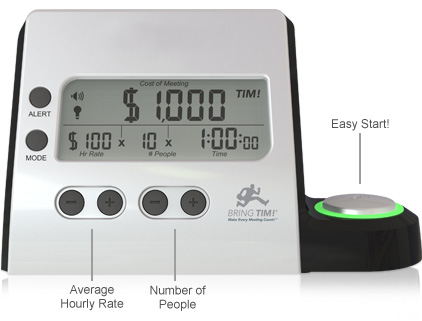
For the meeting junkie who has everything, we are also offering a clock at our WMS store that not only measures the length of the meeting, but also the prorated amount of money you are paying for the people to attend the meeting, similar to the US National Debt clock.
Image credit: BringTIM.com
Sign up here to get Human-Centered Change & Innovation Weekly delivered to your inbox every week.
Given that innovation is responsible for roughly 85% of economic growth, it’s without a doubt a pretty big deal for the success of both individual organizations, as well as for the society at large.
However, to achieve the level of impact that many are looking for from innovation, you can’t simply “create something new”, and then just hope the results will come. You will need to commit to systematically pursuing those results by scaling viable ideas into products or businesses that create value – at scale.
That is of course easier said than done. If you think it’s hard to come up with innovations, just try scaling one up. In this article, we’ll explore the topic in more detail and provide you with actionable tips on how to actually scale an innovation.
What does it mean to scale an innovation?
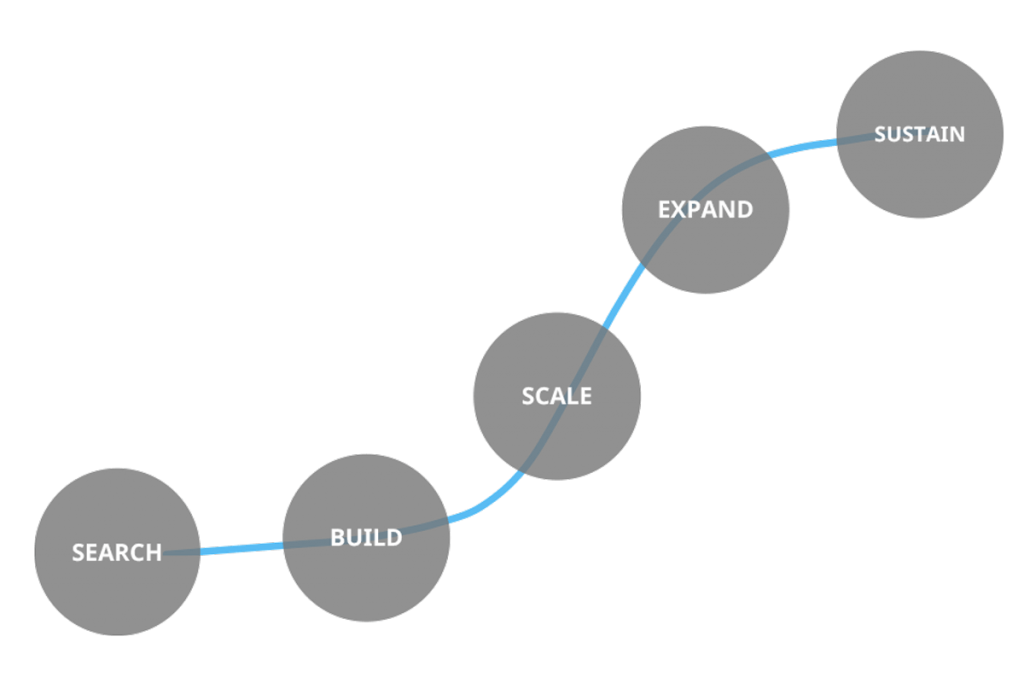
To explain what it means to scale an innovation, let’s first take a step back and look at the lifecycle of an innovation.
To begin, every innovation starts from a rough idea or concept. Often you may have a specific goal in mind, or a problem to be solved, but sometimes it can just be a cool idea that you think could really make an impact. From there, you first need to validate that the idea makes sense, and then build a product or a service that meets a real need in the market.
With these steps taken care of, the next part is to scale the innovation. At this point, we have all the pieces in place to create value, but we haven’t yet unlocked that value for the vast majority of the available market.
So, as you may see from the chart above, scaling is the part where most of the value creation and impact comes from. With that said, we can define scaling an innovation as the process of expanding the presence and the use of the innovation to be as widespread as possible to maximize that impact.
Scaling innovation is the process of expanding the presence and the use of the innovation to be as widespread as possible to maximize the impact the innovation can have.
While on paper that sounds straightforward enough, it’s extremely important to first clarify the vision of what successful scaling looks like for your innovation, and what metrics you will use to measure your success here. For some, it might just be revenue or profit, for others it could be the number of customers or users, the impact you’ve delivered, and so on.
Most of these metrics are of course related, but when you start with the end in mind and gradually work backwards from there, you are much more likely to succeed because everyone in the organization will know what it actually is that you’re aiming for.
With that goal in mind, you can start narrowing in on the methods required to get there, which is what we’ll be focusing on next.
Dimensions of scaling an innovation
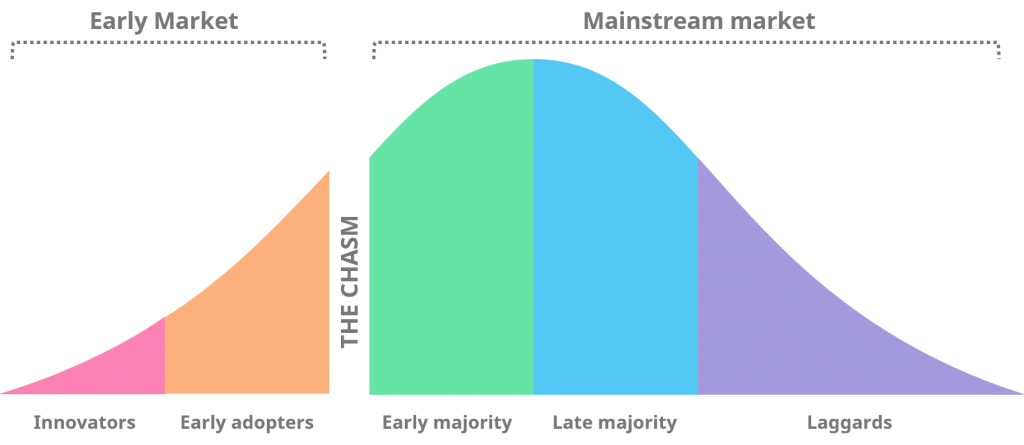
Traditionally, scaling innovation is seen as a matter of advancing the adoption, or the diffusion, of innovation. This is best visualized with a chart depicting the adoption curve, which you’ll find below.
The idea is that to scale an innovation, you need to cross that chasm and go from a few early adopters to the mainstream market where the volumes are significantly higher.
While that is certainly true, we can dig a bit deeper to understand scaling in a more nuanced, and more practical, way.
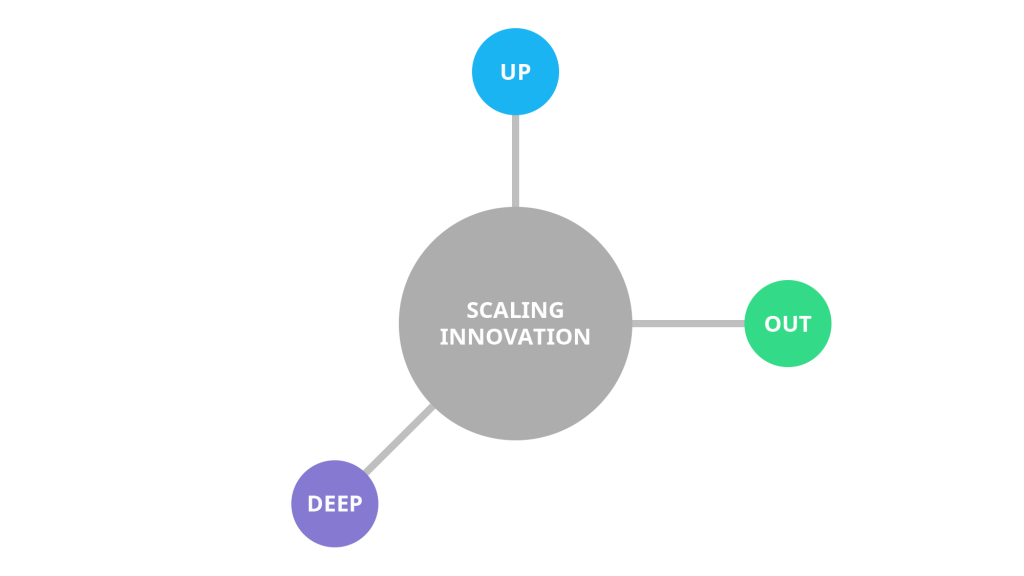
In reality, there are three dimensions to scaling an innovation.
Let’s look at each of them a little closer.
Scaling Up
First, scaling up is about creating the preconditions for scaling effectively.
Before we start talking about scaling up, we’ll assume that the basic prerequisites for scaling are in place, namely that there’s a clear vision and a product-market fit for your innovation, and that the market potential is large enough for there to be something to scale to, even if the market isn’t there today.
Assuming those prerequisites are there, you need to ensure that:
you can produce enough of the innovation to scale
you can do that efficiently enough to be financially and operationally viable
For some products, such as software and other immaterial goods, that first part is pretty straightforward. For others, such as most complex manufactured goods, even the first one will be a real challenge.
Having said that, the second part of being efficient enough will prove to be a challenge for virtually every innovation. Even for a software product, acquiring, serving, and retaining customers profitably at scale is often more difficult than people realize. For other, fundamentally less scalable goods and services, this is often excruciating.
In addition to these two more practical aspects, there’s a third and more ambiguous component to scaling up, and that is the social and institutional adoption of the innovation.
How well you scale up affects how large of a scale you can ultimately reach.
For example, with an innovation as mundane as the modern umbrella, men who used it were initially ridiculed. So, before the umbrella could really take off as an innovation, societal norms needed to change. In other cases, there may be regulatory hurdles or other institutional considerations that might need to be addressed before an innovation can ultimately scale.
Regardless of the specifics, scaling up is necessary for every innovation that wants to reach significant scale.
However, what many people don’t pay enough attention to is that how well you scale up affects how large of a scale you can ultimately reach. If you can’t produce the goods at volume, and at low enough of a price while still being profitable at a unit economics level, there’s an obvious limit to your potential to scale.
Scaling Out
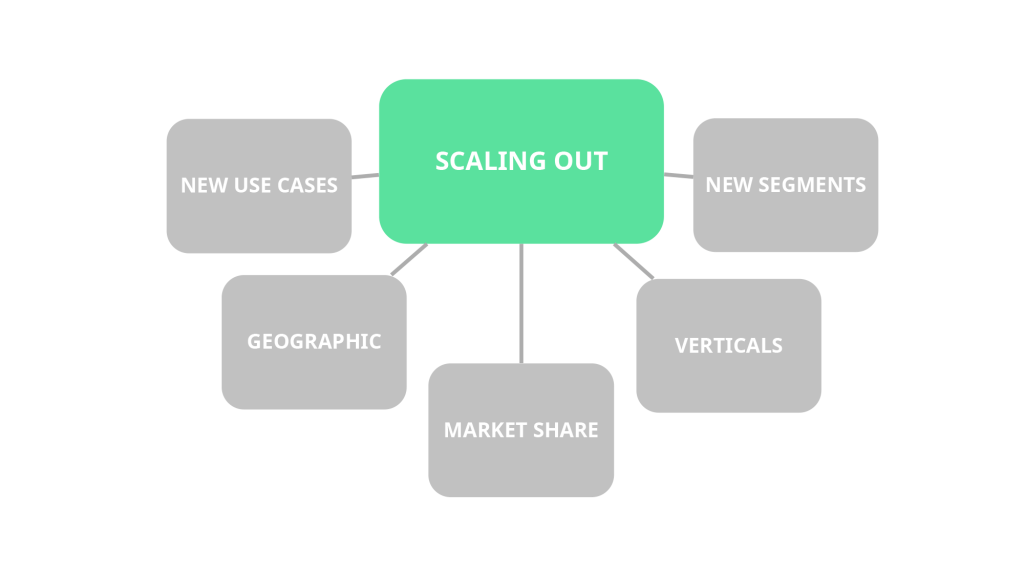
Scaling out is what most people think of when it comes to scaling an innovation. It’s the geographical or demographical expansion of the innovation to a larger audience.
In its simplest form, scaling out simply means getting a wider market share and audience for the innovation within an existing market. As we covered earlier, this typically means moving from those early adopter market segments towards the mainstream.
Scaling out is what most people think of when it comes to scaling innovation as it’s where you expand the innovation to a larger audience.
However, it doesn’t have to be limited to just that. Sometimes the same products or services can be sold and used in other geographical areas, or even in other industries or entirely different use cases, both of which unlock new markets and additional demand, and thus lead to a larger impact for the innovation. A well-known example of this is Tesla using their experience and innovations in electric car batteries to expand to stationary energy storage.
Regardless of which path you choose, often these efforts to scale out to new segments or industries do require additional work to adapt the innovation or its positioning to the differing characteristics of these new segments, markets, and audiences.
Scaling out to new market segments can increase complexity a lot, so be mindful of the operational implications of your strategic decisions here.
This naturally adds complexity, which makes the scaling up part we covered earlier more challenging. So, be mindful of how you scale out and what the operational implications of your strategic decisions here will be.
Scaling Deep
The third, and the least well-known method for scaling innovation is scaling deep. This essentially means that you unlock more impact for your innovation by expanding and maximizing the use of it, typically for the people who already have access to it.
This usually requires you to either change people’s behavior to increase usage, or alternatively come up with innovative means for improving the utilization rate by enabling more people to make use of the same assets. Scaling deep is partly a matter of culture and mindset, and partly a more practical matter of having the right components in place for enabling and encouraging active use of the innovation.
A classic, albeit somewhat controversial example of the first type would be social media algorithms. They are designed to provide users with engaging content to keep them entertained and thus stay in the service for longer, which leads to more revenue from the same number of users.
An example of the second type would be cloud computing. By adding network, virtualization, and software layers on top of the computing hardware, cloud providers can get more use out of the same hardware, which unlocks value for both the service provider and the customers.
This is how Amazon not just significantly reduced costs in one of their major cost centers, IT infrastructure, but actually turned that into Amazon Web Services (AWS), an additional growth business that now accounts for the majority of the profits for the entire organization.
Scaling deep is about unlocking more impact for your innovation by expanding and maximizing the use of it. This can help reduce the need to scale up or out, or alternatively maximize the impact from doing so.
Scaling Deep can reduce the need to scale up or out, or alternatively, maximize the impact from doing so. As such, it’s an excellent compliment for most innovations. However, it’s just that: a compliment. Your primary method of scaling should always be either to Scale Up or Scale Out depending on whether your bottleneck is more on the supply or demand side.
Even in the case of AWS, which has created entirely new vectors for scaling out and has dramatically subsidized their costs for scaling up, it obviously wouldn’t have been possible without Amazon already being at significant scale.
What’s the takeaway? These dimensions are distinct but very much intertwined.
If you can scale on all three of these dimensions in a coordinated way, you will not only be much more likely to achieve significant scale with your innovation in the first place, but also maximize the potential for scale and impact from those efforts. If you build momentum on one of the dimensions, some of that momentum will carry over to the other dimensions, which again helps you accelerate change going forward.
As such, pay attention to each of these dimensions and try to consider all of them in your plans to scale innovation. That doesn’t mean you should focus on all three from the get-go, on the contrary, but planning with the big picture in mind can allow you to make much more educated decisions.
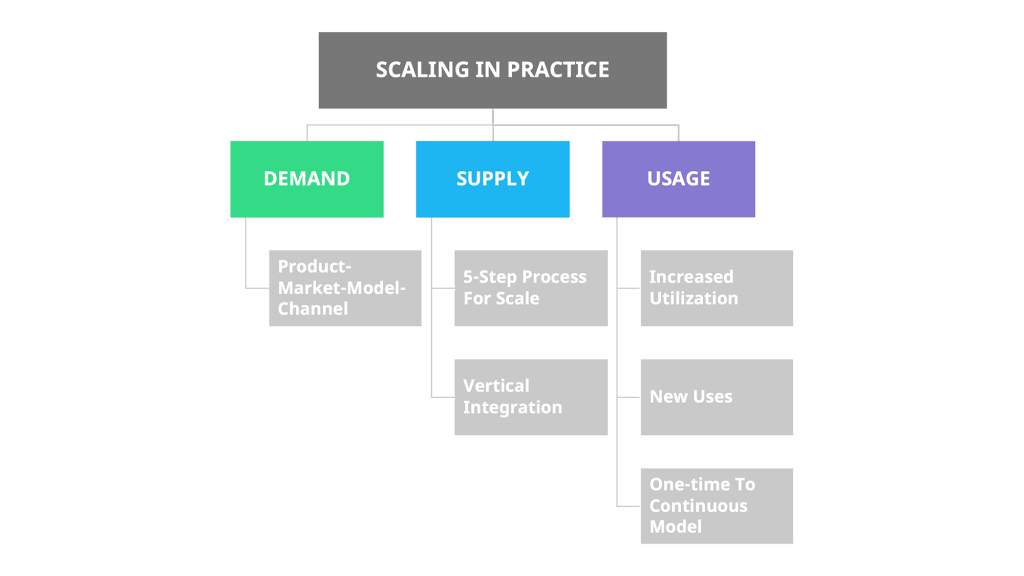
Scaling innovation in practice
As we’ve established above, there unfortunately isn’t a one-size fits all solution to scaling innovation.
Achieving breakthrough success with an innovation, which is the goal of scaling innovation, always requires many related and adjacent (usually more incremental) innovations.
This is an extremely common pattern that you will see happening over and over again if you just start paying attention to it. Square co-founder Jim McKelvey has done a great job in describing that in more detail in his recent book called the Innovation Stack.
A well-known example is the lightbulb. Edison patented his famous design back in 1879, but most households didn’t yet have access to electricity, so it wasn’t something they could benefit from. It took countless other innovations and another 45 years before even half of US homes had one, even though the benefits were obvious.
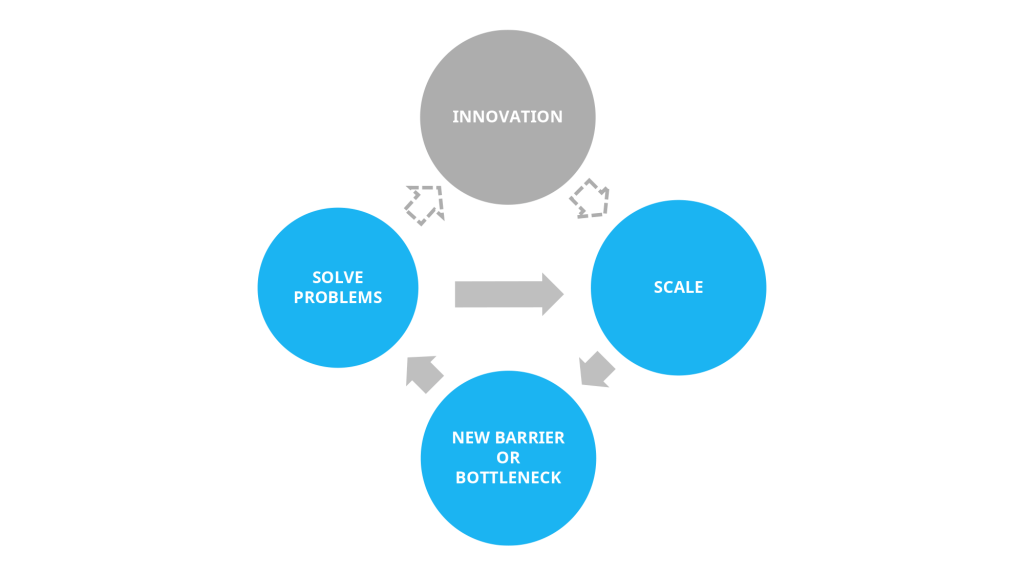
In practice, scaling an innovation is simply an iterative and exploratory process where you focus on eliminating whatever bottleneck is preventing you from scaling, one by one. And, as we saw in the example of the lightbulb, sometimes these can be much bigger and more fundamental than you may think at first.
Often you can just copy solutions other people have already used for the same or a similar problem (which you should always go for if you can), but many times you will also need to innovate something completely new and occasionally even go beyond your core product.
With that said, there are some common patterns that can be helpful for structuring your thinking when faced with some of these bottlenecks. However, as each innovation is ultimately new, and thus unique, these won’t necessarily fit every case.
Having said that, we’ll share one framework for each dimension of scaling below. We’ve also created a toolkit that includes the frameworks as editable templates, along with some examples and other supporting material, which you can download here.
Demand side
For most organizations and innovations, the demand side is likely the source of most bottlenecks.
The way we see it, this is not just about drumming up interest and demand for your product, but also about making sure that it fits the needs and budgets of the buyers in your market. And of course, you need to make sure you’re in a market, or at least one that has the potential to become, large enough to accommodate your scaling efforts.
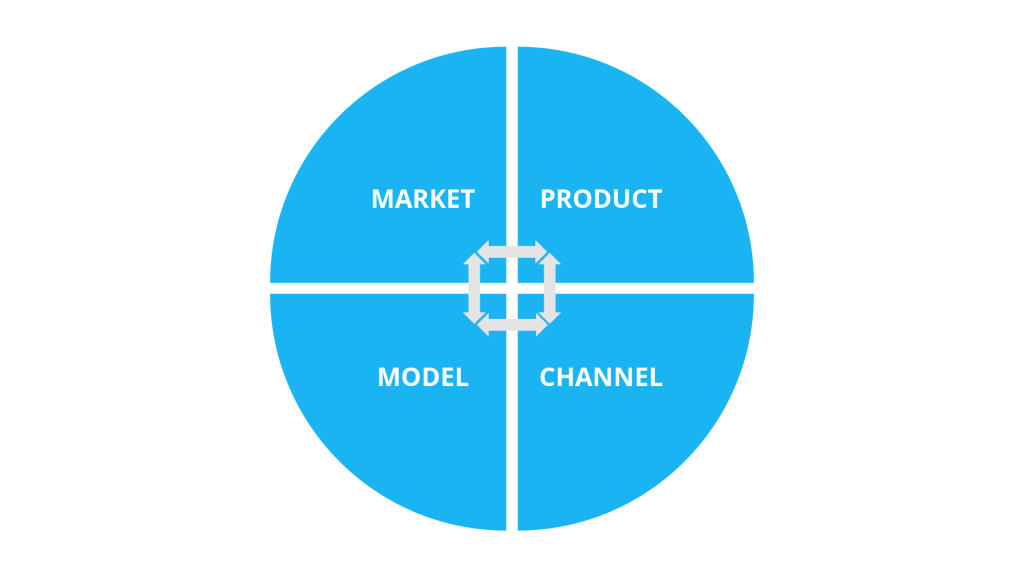
Unlike what people often think, product-market fit isn’t enough for a business to be scalable. You also need to have the right business and operating models, as well as use the right channels.
In other words, scaling out isn’t just about product-market fit, as people often mistakenly think. You also need to have the right business and operating models and use the right channels. Brian Balfour has written an excellent five-part series about this, which I highly recommend you read.
The basic idea is pretty simple: your business needs to align all of these aspects in a cohesive manner to be able to scale. If even one of them is wrong, growth will feel like, as Balfour puts it, “pushing a boulder uphill”. It will take way too much capital, effort, and time. However, get the four elements right together, and the growth will come naturally.
What’s important to understand here is that the model isn’t a static picture you just do once. If the market changes, or you run into challenges that force you to change one of these elements, you’ll need to review each element and make sure the big picture still works.
Supply side
For some products and businesses, especially those with physical products, the supply side often becomes a key consideration.
Here, the bottlenecks can be extremely varied, and dependences on external suppliers can lead to challenges that are hard to overcome.
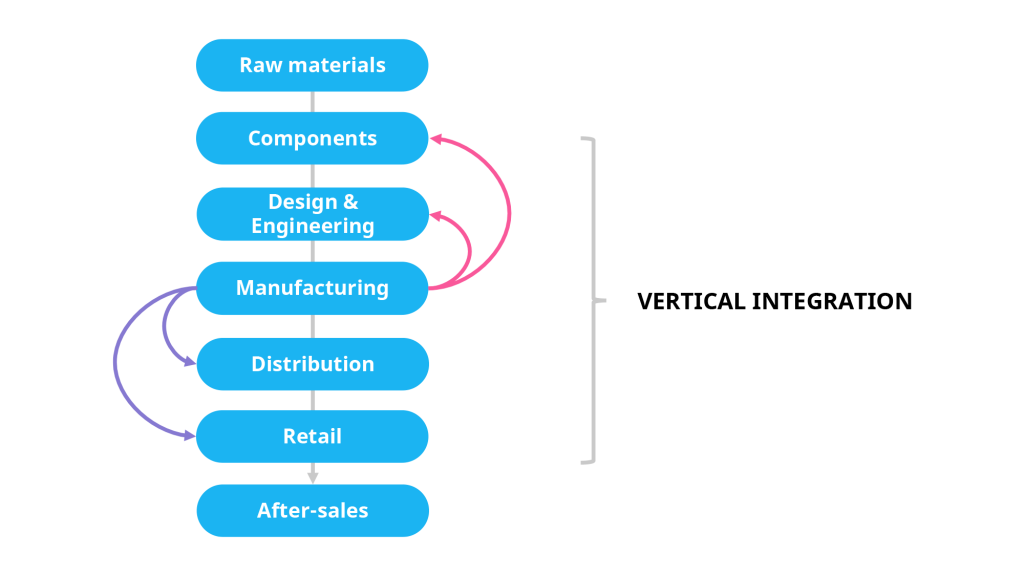
In general, what top innovators do differently from the rest of the companies is that they almost always vertically integrate their value chain as they are working towards scaling up.
There are many benefits to this approach, such as reduced overhead, but the key differences are in increased quality, and most importantly, the company’s ability to control their own destiny and innovate more freely because they’re not being constrained by their supply chain.
Top innovators vertically integrate their value chain to address bottlenecks and turn cost centers into additional sources of growth and profit.
The classic example is Apple, and the way that they control both the hardware and software of their products. In recent years, they’ve been increasing that integration in both directions. They’re moving upstream to offer more services on top of their operating systems, as well as downstream by designing their own processors, which has provided them with a big performance advantage.
However, there are many others. Amazon, Microsoft, Tesla, Google, Netflix, Nvidia, and pretty much every innovative company is trying to do the same in the scope of their own business.
The basic idea is again simple: if a part of your supply chain becomes a major bottleneck, or is a major cost center, you should try to take control of those parts to address the bottlenecks and turn cost centers into additional sources of growth and profit, just like Amazon has done with AWS, but also warehousing and shipping.
That isn’t to say that vertical integration wouldn’t be challenging or have downsides. It certainly is and does. Because of these limitations, it’s generally advisable to only vertically integrate to the parts of your supply chain that either are a clear bottleneck or could become a key competitive advantage for you. However, top innovators often have little choice but to take these steps if they want to move fast enough and have enough control to be able to scale their innovation to its full potential.
Another key consideration on the supply side is simply the architecture of your products and services, and the process you have for delivering them. It’s obviously much easier to have a scalable architecture and automated processes for purely software or content focused businesses, but how you craft these does play a huge role for complex physical products too.
This is again a very extensive topic on its own, but the goal should be to try to make the manufacturing, delivery, and service of your products as seamless and scalable as possible. As with everything else we’ve discussed so far, this too is an iterative process.
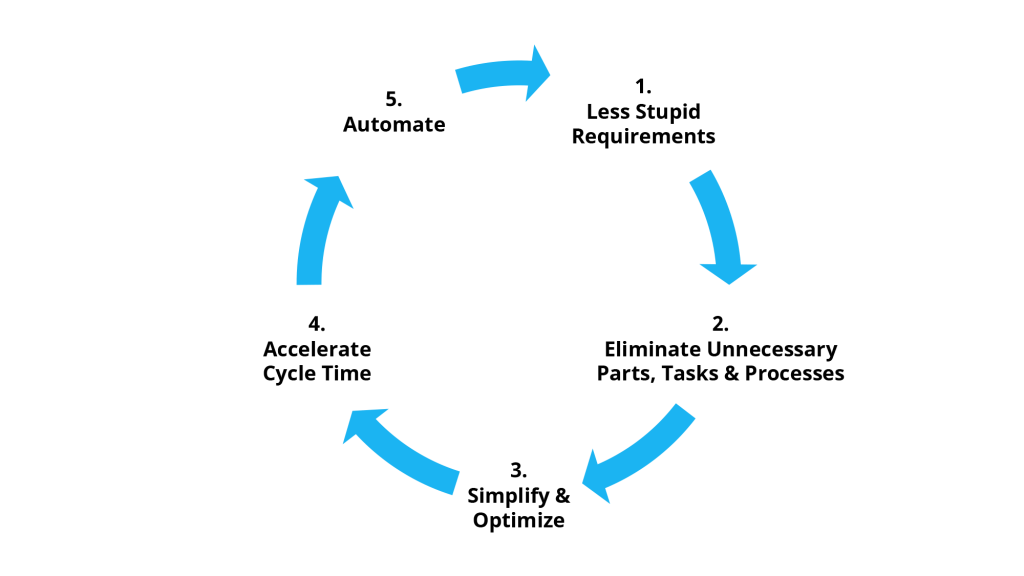
However, to provide you with a slightly more practical framework to get started, here’s Elon Musk explaining how he’s learned to approach this topic after his early struggles of trying to do that with the extremely complex products at SpaceX and Tesla.
While Musk specifically talks about the process in the scope of engineering for scale, these same principles also apply to your organization and internal processes too.
And, as Musk explained in the video, it’s easy to get tempted by the promises of optimizing for efficiency and automation, but if you haven’t addressed the big picture first, these will often end up just being a big waste of time and money.
So, make sure to start by first eliminating those unnecessary requirements and parts or tasks, and try to simplify the design before you focus too much on optimizing for efficiency and automating.
Utilization
In addition to supply and demand, we still have the third dimension of utilization to cover. The idea with this “scaling deep” part is to find creative ways to make the most out of existing supply to either unlock new demand, maximize the utilization of those assets, or simply to increase your customer retention by finding ways to get more value for them from your products.
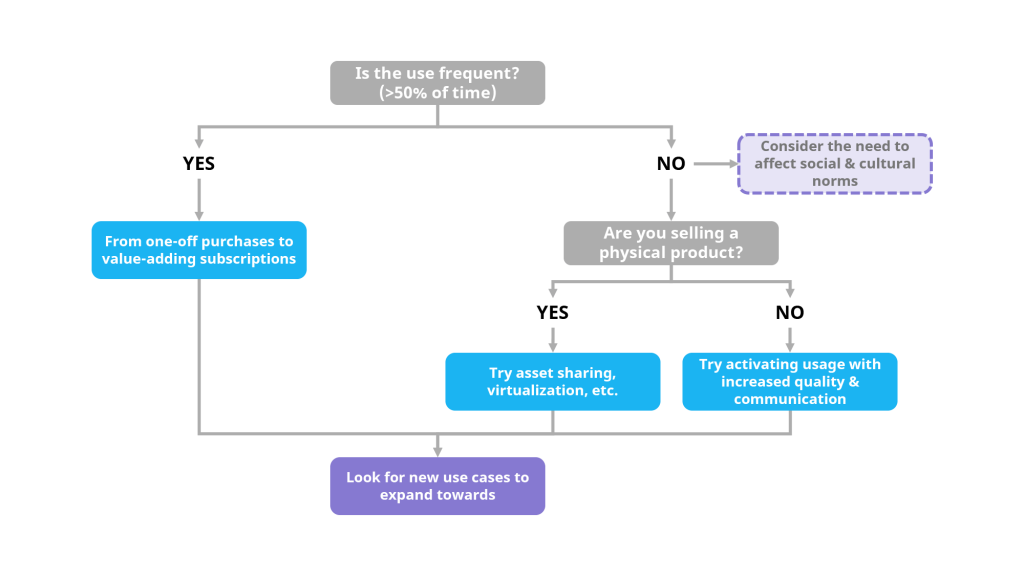
As you may have guessed by now, the specifics vary quite a lot on a case-by-case basis, but the flowchart below can hopefully serve as a starting point for your efforts in this area.
To summarize, there are three common paths you may take here.
The first is to find ways to increase the usage of assets that are only being used a fraction of the time through practices such as asset sharing and virtualization.
The second is to move from one-off purchases to a subscription to eliminate friction and increase the usage of the services.
The third is to find additional ways to expand the use of the product. This is usually done either by finding new value-adding uses for the same product, or simply by activating usage through means such as improved quality, usability, better communication etc.
However, sometimes it might even be necessary to work around tougher and more pervasive issues, such as regulatory considerations or even the changing of societal norms.
While increased utilization isn’t often that glamorous or exciting, it can really make a difference in making your business and operating models efficient enough to allow you to scale volume faster and more sustainably.
Conclusion
Scaling an innovation won’t be easy. It will always take years, and an endless amount of hard work with an extreme focus on solving each and every bottleneck standing in your way.
Hopefully you’ll find some of the frameworks and playbooks we’ve introduced in this article useful for shaping your thinking, and for building your organization and processes, but you’ll inevitably come across plenty of challenges where you’ll just need to figure out the solutions yourself. Still, if you want to truly succeed with innovation, that’s what you’re in for.
So, be prepared for those challenges, and be realistic with your expectations and timelines. For example, the “growth gap” can easily sneak up on your organization if top management has unrealistic expectations for the financial returns of innovation.
In general, large organizations have some disadvantages, but they also have huge advantages when it comes to scaling an innovation, so look for ways to leverage those advantages to your benefit.
And finally, make sure to surround yourself with top talent that’s prepared for the ride. Scaling innovation is teamwork, and it takes a special kind of a team to pull it off. You need people that are used to constant change, have a growth mindset, and the skills needed to solve whatever problems your domain may have.
As mentioned, scaling innovation is a journey that happens in small increments, and at times, it will feel frustrating. But if your team persists, keeps on learning and solving problems, you can eventually close in on whatever the full potential of your innovation is.
Image credits: Pexels, Viima
This article was originally published in Viima’s blog.
Sign up here to get Human-Centered Change & Innovation Weekly delivered to your inbox every week.
In today’s ever-evolving business landscape, the ability of a team to embrace challenges, learn from setbacks, and continuously strive for improvement is paramount. This adaptability is rooted in what psychologists Carol Dweck and her colleagues have termed the “growth mindset.” It’s characterized by the belief that abilities and intelligence can be developed through dedication, hard work, and the right strategies. This article delves into the principles of fostering a growth mindset within your team and presents two real-world case studies that illustrate its transformative power.
Principles of a Growth Mindset
Embrace Challenges: Encourage your team to step out of their comfort zones and tackle difficult projects.
Learn from Criticism: Constructive feedback should be seen as a tool for improvement rather than a personal attack.
Persistence: Promote perseverance, even when tasks become tough, and celebrate small victories along the way.
Effort is Essential: Recognize hard work and effort as pathways to mastering new skills and achieving goals.
Celebrate Growth: Acknowledge progress and development, not just end results.
The Roadmap to Cultivating Growth Mindset
Implementing a growth mindset culture requires consistent effort and intention. Start by exemplifying the mindset yourself and follow through with coaching, training, and an environment that allows for experimentation and constructive failure.
Case Study 1: XYZ Tech Innovators
Background: XYZ Tech Innovators was a startup struggling with high employee turnover and stalling project deadlines. The leadership team identified a fixed mindset culture as the core issue.
Approach: The company implemented a series of workshops focused on the principles of a growth mindset. Managers were trained to deliver constructive feedback focused on effort and strategies rather than innate talent. The company also encouraged employees to set personal growth goals and paired them with mentors.
Outcome: The initiative transformed the workplace environment. Employees started taking on more ambitious projects, and team collaboration improved. Within a year, employee turnover decreased by 30%, and project completion rates soared by 50%.
Case Study 2: ABC Retail Group
Background: ABC Retail Group was facing stagnation in innovation and product development. Team members were hesitant to pitch new ideas, fearing failure and criticism.
Approach: To shift the cultural mindset, ABC Retail Group introduced an “Innovation Lab” where employees could experiment with new ideas without the pressure of immediate success. The lab was a failure-tolerant environment where learning from mistakes was encouraged and expected.
Outcome: Within six months, the lab produced several viable new products. Team members reported feeling more creative and less anxious about proposing ideas. The company’s innovation index, a measure of new product success, increased by 40% in the following year.
Conclusion
Instilling a growth mindset within your team is a dynamic and rewarding process. As evidenced by these case studies, the benefits extend beyond individual performance improvements to foster a culture of continuous learning, innovation, and resilience. By embracing the core principles of a growth mindset, your team can navigate challenges more effectively and unlock unprecedented levels of success.
Bottom line: Futurology is not fortune telling. Futurists use a scientific approach to create their deliverables, but a methodology and tools like those in FutureHacking™ can empower anyone to engage in futurology themselves.
Image credit: Pexels
Sign up here to get Human-Centered Change & Innovation Weekly delivered to your inbox every week.
Never has the need for transformation been so dire or so clear. Still, that’s no guarantee that we will muster the wisdom to make the changes we need to. After all, President Bush warned us about the risks of a global pandemic way back in 2005 and, in the end, we were left wholly vulnerable and exposed.
It’s not like pandemics are the only thing to worry about either. A 2018 climate assessment warns of major economic impacts unless we make some serious shifts. Public debt, already high before the current crisis, is now exploding upwards. Our electricity grid is insecure and vulnerable to cyberattack. The list goes on.
All too often, we assume that mere necessity can drive change forward, yet history has shown that not to be the case. There’s a reason why nations fail and businesses go bankrupt. The truth is that if a change is important, some people won’t like it and they will work to undermine it in underhanded and insidious ways. That’s what we need to overcome.
A Short History Of Change
For most of history, until the industrial revolution, people existed as they had for millennia and could live their entire lives without seeing much change. They farmed or herded for a living, used animals for power and rarely travelled far from home. Even in the 20th century, most people worked in an industry that changed little during their career.
In the 1980s, management consultants began to notice that industries were beginning to evolve more rapidly and firms that didn’t adapt would lose out in the marketplace. One famous case study showed how Burroughs moved aggressively into electronic computing and prospered while its competitor NCR lagged and faded into obscurity.
In 1983, McKinsey consultant Julien Phillips published a paper in the journal, Human Resource Management, that described an “adoption penalty” for firms that didn’t adapt to changes in the marketplace quickly enough. His ideas became McKinsey’s first change management model that it sold to clients.
Yet consider that research shows in 1975, during the period Phillips studied, 83% of the average US corporation’s assets were tangible, such as plant, machinery and buildings, while by 2015, 84% of corporate assets were intangible, such as licenses, patents and human capital. In other words, change today involves mostly people, their knowledge and behaviors than it does strategic assets.
Clearly, that changes the game entirely.
What Change Looks Like Today
Think about how America was transformed after World War II. We created the Interstate Highway System to tie our nation together. We established a new scientific infrastructure that made us a technological superpower. We built airports, shopping malls and department stores. We even sent a man to the moon.
Despite the enormous impact of these accomplishments, none of those things demanded that people had to dramatically change their behavior. Nobody had to drive on an Interstate highway, work in a lab, travel in space or move to the suburbs. Many chose to do those things, but others did not and paid little or no penalty for their failure to change with the times.
Today the story is vastly different. A crisis like Covid-19 required us to significantly alter our behavior and, not surprisingly, some people didn’t like it and resisted. We could, as individuals, choose to wear a mask, but if others didn’t follow suit the danger remained. We can, as a society, invest billions in a vaccine, but if a significant portion don’t take it, the virus will continue to mutate at a rapid rate, undermining the effectiveness of the entire enterprise.
Organizations face similar challenges. Sure they invest in tangible assets, such as plant and equipment, but any significant change will involve changing people’s beliefs and behaviors and that is a different matter altogether. Today, even technological transformations have a significant human component.
Making Room For Identity And Dignity
In the early 19th century, a movement of textile workers known as the Luddites smashed machines to protest the new, automated mode of work. As skilled workers, they saw their way of life being destroyed in the name of progress because the new technology could make fabrics faster and cheaper with less workers of lower skill.
Today, “Luddite” has become a pejorative term to describe people who are unable or unwilling to accept technological change. Many observers point out that the rise of industry created new and different jobs and increased overall prosperity. Yet that largely misses the point. Weavers were skilled artisans who worked for years to hone their craft. What they did wasn’t just a job, it was who they were and what they took pride in.
One of the great misconceptions of our modern age is that people make decisions based on rational calculations of utility and that, by engineering the right incentives, we can control behavior. Yet people are far more than economic entities, They crave dignity and recognition, to be valued, in other words, as ends in themselves rather than as merely means to an end.
That’s why changing behaviors can be such a tricky thing. While some may see being told to wear a mask or socially distance as simply doing what “science says,” for others it is an imposition on their identity and dignity from outside their community. Perhaps not surprisingly, they rebel and demand to have their right to choose be recognized.
Building Change On Common Ground
The biggest misconception about change is that once people understand it, they will embrace and so the best way to drive change forward is to explain the need for change in a very convincing and persuasive way. Change, in this view, is essentially a communication exercise and the right combination of words and images is all that is required.
Yet as should be clear by now that is clearly not true. People will often oppose change because it asks them to alter their identity. The Luddites didn’t just oppose textile machinery on economic grounds, but because it failed to recognize their skills as weavers. People don’t necessarily oppose wearing masks because they are “anti-science,” but because they resent having their behavior mandated from outside their community.
In other words, change is always, at some level, about what people value. That’s why to bring change about you need to identify shared values that reaffirm, rather than undermine, people’s sense of identity. Recognition is often a more powerful incentive than even financial rewards. In the final analysis, lasting change always needs to be built on common ground.
Over the next decade, we will undergo some of the most profound shifts in history, encompassing technology, resources, migration patterns and demography and, if we are to compete, we will need to achieve enormous transformation in business and society. Whether we are able to do that or not depends less on economics or “science” than it does on our ability to trust each other again.
How to transform innovative bottom-up initiatives into a movement spread across the company? How to scale your innovation program widely? Here are a few lessons learned from creating innovation programs in Europe, and tweaking them to Africa and Middle-East contexts.
Leveraging local and global innovation
Supplementing wisely central techno-pushed innovation with local innovation, closer to the fields and to the user needs, opening new windows of opportunities, is the goal of the open andlocal innovation approach developed for Orange Africa.
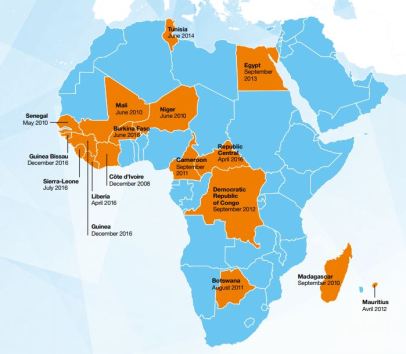
The purpose is to balance the technical expertise from a central innovation division, with the possibility of bottom-up initiatives, experimenting locally up to 100 innovative solutions every semester with the circa 20 countries where Orange operates in Africa and Middles-East.
The local innovation focus is on agility, pragmatism, and value created for the users and for Orange business, while leveraging a key technological asset that Orange can bring to the innovative service.
One emblematic story is the birth of Orange Money, a mobile money service solving the problem of money transfer and payment for unbanked people. The idea was born in Kenya, and it clearly could not have emerged in Europe where everyone is banked, even kids! Orange developed centrally a platform capable of supporting all African countries in their progressive roll-out over 18 countries: ten years later, 50 millions users signed in for Orange Money. Furthermore, the central Orange Money platform enables local developments blossom, tailored to each country needs, and being picked-up, and replicated from one country to another over the region.
This is probably the most brilliant innovation of Orange over the decade, still no cutting-edge tech embedded: it’s low tech (SMS). As it solves a real user problem, it transforms people’s life, and got a massive adoption rate.
Conducting short experiments in connection with business units
I created Orange intrapreneurship program 5 years ago, with a view to help innovative ideas transition more fluently into business, with the help of a sponsoring business unit, and to open the innovation doors to every Orange employee, letting them benefit from a tunnel of goodwill around their idea. The program acted like an innovation center of expertise or incubator. It clearly involved the business units very upstream: I’m a strong believer in co-developing innovations that create opportunities for business units, giving them a competitive advantage or solving one of their problems. “Find out the business unit problem that your innovation is solving”, I kept saying to the innovators I mentored!
Now we are adapting the process for the 20 countries of Orange Africa taking into account contextual particularities. We keep the employees participation and the business unit ownership aspects, but we also try to test refinements on the exploration stage. The key here is to conduct innovation exploration with short experiments in connection with business units:
achieving quick business wins with innovative process improvement, impacting internal organization, and not only new product and services: for instance, streamlining the authentification process for new customers;
mixing employees and business representatives with startups that help experimenting quickly; this has been pioneered by Orange Belgium, and these teams are called innovation squads like in the Spotify vocabulary;
keeping the process nimble, in a stretched time frame of a few weeks, so as to conduct a high number of experiments, confronting mock-ups to users, and collecting a maximum of users’ feedback, finding The Right IT before any product development.
Our target is to build proximity with our target users, rather than falling in love with our product, to explore and conduct short experiments, and pave the way to exploitation capitalizing on users’ feedback.
Designing innovation program, boosting innovation community
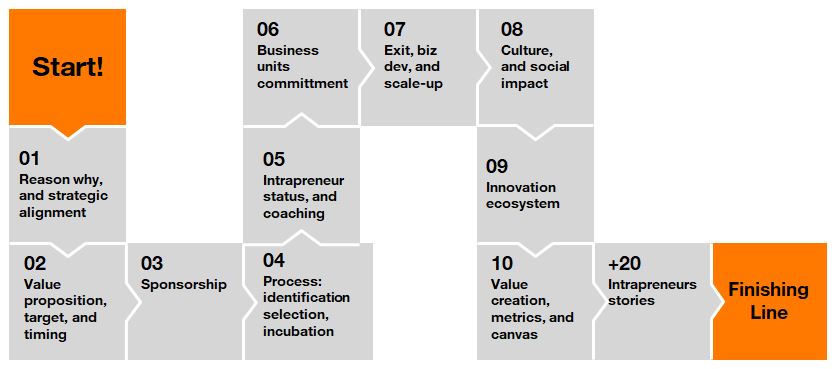
I’ve been through 10 steps to design an corporate entrepreneur program in my book The Intrapreneurs’ Factory. These 10 milestones are also an appropriate framework to design the innovation process with the countries of Orange Africa.
It’s important first of all to define the reason why you start the program, what problem you’re trying to solve, what goals and KPIs will make the management team satisfied if they are reached. Then, some delicate gates are:
Finding out the right sponsor, both visible and accessible; sometimes a deputy sponsor can compensate a lack of avaibility!
Involving the business side soon enough in the process to trigger ownership, and further facilitate the exit, aka the transition from exploration to exploitation;
Closely coaching the process along the way, sharing the innovation tools from design thinking and lean start-up, bespoke tools to design mock-ups, and conduct experiment, but also the very peculiar mindset of the successful innovator: flexible and stubborn at the same time as says Jeff Bezos, as the key relies in the management of iteration in short cycles.
To operate this innovation process, we move together with a community of 20 staggering innovation champions, representing the countries of Orange Africa. Not only we discuss the innovation process to test locally, but we share view on innovation organization, and share success stories during a weekly Radio Innovation.
Weekly Radio Innovation also puts forward tremendous testimonials to inspire the innovation community:
from innovation managers and communities connected to Africa: Seedstars startups competition and programs for African entrepreneurs; Make Sense Africa incubator and the Dakar Citylab; Norrsken Kigali innovation hub, the startups gateway to East Africa; YUX Design Agency from Senegal, validating innovation ideas with users; innovation in the informal sector in Africa with GoodPoint/Archipel-co.com; Total Africa open innovation in Chad; Entrepreneurship Communities for innovation in Africa, with Archipel&Co and Africa Farmers Club; Liferay digital platform, and an Africa’s approach to tech and innovation; Innovation in Africa with Vodafone;
from startups growing their business in Africa: cloud telephony for SMEs, with Mteja from Kenya, and AfricaTalks; South-African MFS Africa: moving money across countries with one API that makes Africa look like one country; Kenya Pezesha loan marketplace for small African businesses; Chari.ma from Morocco, market place for local businesses; African startups investment report by Briter Bridges;
from Orange collaborators illustrating the group assets: Orange Ventures Africa seeds challenge; Social listening with Orange Data Studio in Guinea; Orange Fab Belgium innovation squads; Orange Senegal design thinking toolbox; Orange Slovakia open innovation; Orange Amman innovation team; First 100% digital mobile offer Flex by Orange Polska; Orange Romania innovation ecosystem, and cooperation with startups;
from broader innovation experts: innovation community management at Gefco; Booster incubation studio at Total; innovation in the energy industry, Innovation Vesta Wind Systems; collaborating with startups through the Venture Client Model, by 27pilots.
For these innovation champions in charge of setting-up an organization for innovation in their country, the challenge is to seek for integration (integrating seamlessly innovation with the business) before seeking for success. These mind-boggling testimonials feed them, upgrade their skills, and consolidate their innovation culture.
Scaling-up innovation oragnization
Once the innovation program gets traction, the next step is about scaling-up the approach, engaging progressively all participants. If all Orange countries commit to the innovation process in Africa, that will lead to the tremendous portfolio of 100 creative solutions experimented per semester, 200 on a yearly basis on the regional footprint: what a eye-catching achievement!
At the innovation project level, one can use the scale-up canvas to check whether the project is ready to grow, and move from a start-up to a scale-up stage.
At the program level, Is your innovation organization resilient? is the topic of a short assessment I have designed to know how your innovation organization fare across 10 key areas, and cements its resilience. Whether you are leading open innovation, internal innovation, participative innovation and intrapreneurship, digital factory or disruptive labs, you will learn from this tool which works like an innovation calculator, it’s actually quite fun to run it! To start, click here, see how you rank, and get pieces of advice for improvement.
Innovation organization doesn’t thrive without innovation culture: organization and process without culture are like a factory without raw materials; culture without organization and process is appropriate to initiate a handful of innovation projects, but doesn’t scale.
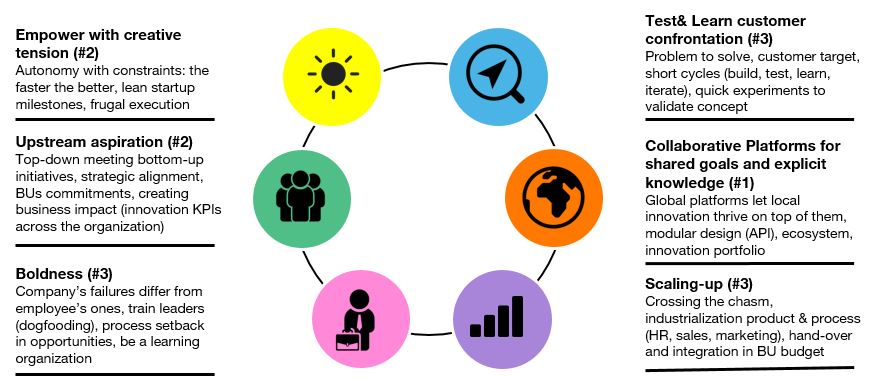
To set-up a streamlined innovation process, I find these 3 organization pieces to be paramount:
1. Test and learn iterative path
Share the virus of test and learn in short cycles with your innovators; confronting the value proposition with the customer target as soon as possible to capture insights, and iterating positively on your solution as on your target users; avoiding the product bias pitfall: ‘don’t fall in love with your product, fall in love with the user problem’ as Ash Maurya says; spending the initial time on materializing the value proposition, designing mock-up to let users clearly visualize it and express feedback and insights; sorting out the key hypothesis to validate and the appropriate tests to perform, and capturing The Right It, without yet engaging in significant product development;
2. Collaborative platforms design
Open innovation blossoms with shared goals and explicit knowledge; to facilitate knowledge sharing, entice innovators to create a platform that let others create value on top of it, applying modular design from the very beginning; having in mind end-users and developers ecosystem as 2 different user targets; exposing building blocks (APIs) that can be quickly reused internally and externally to create instantly new businesses;
Once product market fit is on the trend to prove true, the innovator’s venture shall anticipate the acceleration of sales and operations, the scale-up. Crossing the chasm and industrializing processes (marketing, product, sales, recruitment and on-boarding, partnerships) requires preparation, just as if you were upgrading your sailboat from a promenade near the coast to a transatlantic journey with heavy wind blowing. Have also in mind that the corporate scale-up has simultaneously to win.
2. Innovation Culture
To instill an innovation culture, I find these 3 cultural pieces quite efficient:
Unleashing creativity and autonomy is fine, but a framework actually helps innovators; At Google, they say ‘innovation loves constraints’, and ‘the faster, the better’: speed is a constraint that pushes you to focus on the core, and to eliminate the superfluous, leading to frugal execution. ‘Less is more’ claimed famous designer Mies van der Rohe. In that sense, speed triggers a positive tension;
2. Upstream aspiration with C-level and business units commitment
Innovators often start bottom-up initiatives; at a certain point, innovators need to be aspired with C-level and business units support to leverage the corporation assets; explain to these sponsors how innovation differs from ideation, and that it seeks for business impact, just like marketing and sales: innovation is about conquering new customers, improving loyalty, differentiating from competition, creating value for the users and for the company; align innovators endeavors with corporation strategy, and gain credibility with quick wins in your innovation portfolio; you’ll know you have succeeded when business units will include innovation KPIs across the organization;
3. Stimulation of boldness, and risk taking spirit
innovation contests and crowdsourcing stimulate ideation if appropriate recognition comes along; if we want employees to further engage with boldness in execution, failure has to be accepted as part of the innovation process, as Gore company shows it with its Celebrate Failure event; do not underestimate that, while a company has dozen of successful projects to hide a failure behind the curtain, it’s not possible for an employee to offset an experience on his resume; how to detect opportunities out of setbacks, how to become a learning organization is a necessary culture: ‘I never fail, I either succeed or learn’ claimed Nelson Mandela. It requires training for the employees and for the leaders: letting the leaders embrace and learn from failure during a ‘eat your own dog food’ workshop is a fruitful practice I’m a great believer in.
In this era of constant digital connectivity, consumers are experiencing an overwhelming fear of missing out (FOMO) on the latest trends, experiences, and opportunities. This fear has a profound effect on consumer decision-making and shapes how they engage with brands, products, and services. To truly understand FOMO’s impact, we must delve into its psychological roots and explore two compelling case studies.
Psychological Roots of FOMO:
Fear of missing out stems from the basic human desire for social connection, the need for validation, and the fear of being left behind. Countless studies have shown that individuals have a fundamental longing to be part of a community, to share experiences, and to feel accepted. FOMO amplifies these desires in the digital age, fueling anxiety-driven decision-making.
Case Study 1: The Influence of FOMO on Buying Behavior
In recent years, the beauty industry witnessed a significant rise in FOMO-driven purchasing behaviors. Brands cleverly utilize social media platforms and influencers to create a sense of scarcity and urgency, inducing FOMO within consumers. A prime example of this phenomenon is the limited-edition makeup collaborations, which generate immense buzz and excitement. By tapping into consumers’ FOMO, brands create a fear of not having the exclusive item, leading to impulsive purchases and even waiting in long queues.
An in-depth analysis conducted by a major cosmetics company revealed that 70% of consumers who bought limited-edition products did so due to FOMO. Furthermore, the study found that consumers were inclined to share their purchases on social media platforms, seeking validation and admiration from their peers. Thus, FOMO not only influences purchase decisions but also contributes to the amplification of social status online.
Case Study 2: The Effect of FOMO on Travel Choices
The travel industry faces a unique challenge in catering to FOMO-driven decision-making. Consumers are bombarded with picturesque imagery of exotic destinations, luxurious resorts, and thrilling experiences. This abundance of options creates a sense of FOMO, as individuals fear missing out on the next best travel experience. Travel companies have capitalized on this psychological state by emphasizing “limited availability” and “exclusivity” in their marketing strategies.
A case study conducted by a prominent travel agency demonstrated the impact of FOMO on consumer behavior. They offered two identical vacation packages: Package A was available without any time restrictions, while Package B was advertised as limited to the first 50 bookings. Despite Package B being slightly more expensive, it received 70% more bookings within 48 hours. The fear of missing out on an exclusive opportunity significantly influenced consumers’ travel choices, even at an increased cost.
Mitigating FOMO:
As human-centered professionals, it is crucial to understand the phenomenon of FOMO and its impact on consumer decision-making. To cater to consumers effectively, brands should consider the following strategies:
1. Transparent Communication: Be open and honest with consumers, providing clear information about product availability or event schedules.
2. Curated Exclusivity: Offer limited-edition products or experiences thoughtfully, but without exploiting consumers’ FOMO. Ensure that exclusivity is based on genuine benefits rather than artificial scarcity.
3. Customer Empowerment: Encourage consumers to make decisions based on their true preferences, rather than succumbing to FOMO. Provide ample information, resources, and reviews to help them make well-informed choices.
Conclusion
Understanding the fear of missing out (FOMO) is essential for human-centered professionals to navigate the ever-changing consumer landscape effectively. By recognizing the psychological roots of FOMO and analyzing case studies, we can see its tangible impact on consumer decision-making. Brands that acknowledge and address FOMO while promoting transparency, curated exclusivity, and customer empowerment are more likely to build trust, loyalty, and meaningful connections with their audience, ultimately shaping a more conscious consumer culture.
SPECIAL BONUS: The very best change planners use a visual, collaborative approach to create their deliverables. A methodology and tools like those in Change Planning Toolkit™ can empower anyone to become great change planners themselves.
Image credit: Pixabay
Sign up here to get Human-Centered Change & Innovation Weekly delivered to your inbox every week.
Organizational Change Management (OCM) is an incredibly important part of management science, but a very immature part.
So immature in fact that as the profession began to coalesce the unfortunate decision was made to anchor on the term change management to describe the profession.
This is an unfortunate choice because IT professionals, construction professionals, and others had already been using the change management term for many years to mean the careful tracking and execution of changes from a steady state, tracking of change orders and contract addendums, etc.
So, what is change management in an enterprise context?
My Definition of Change Management
“Change Management manages the change activities necessary to achieve the change objectives.”
Simple and straight to the point…
What Five Things Are Key to Change Management?
But Change Management is but one of five change practice areas in my Five Keys to Successful Change framework that each require focused attention.
Change Management NOT a Subset of Project Management
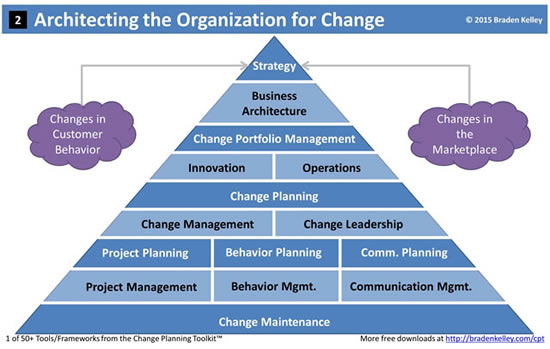
It is also problematic that many business professionals mistakenly view Change Management as a subset of Project Management, but we should really practice it the other way around. I represent this visually in another of my change frameworks – Architecting the Organization for Continuous Change – which is available along with the Five Keys to Successful Change in the Ten Free Tools I make available from the 70+ tools of the Change Planning Toolkit™ at the core of my Human-Centered Change methodology.
The other components in the Five Keys to Successful Change framework are equally important and even less mature in their professional practice, and the entire profession suffers from a lack of effective tools, making it less than surprising that 70% of change initiatives fail.
Where Can I Get Change Management Tools?
It is because of this lack of tool availability that I created the Human-Centered Change methodology and its growing library of 70+ tools captured in the Change Planning Toolkit™. I’ve then explained how to use all of these tools in my book Charting Change along with a lot of important change best practices and new thinking for professionals, not just from myself but from a carefully selected roster of guest experts.
What is Involved in Change Management?
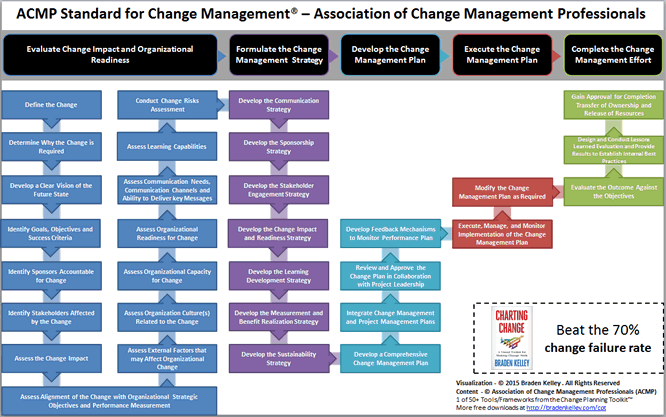
If you’re not sure what change management is and you’d like to know all of the subcomponents, I’ve created a nice poster-size visualization of the Association of Change Management Professionals’ (ACMP) Standard for Change Management methodology that is available as part of the ten free downloads and separately as a 35″ x56″ poster that you can print on a plotter and hang up on your wall.
You’ll see that the Association of Change Management Professionals (ACMP) visualization identifies five core practice areas:
Evaluate Change Impact and Organizational Readiness
Formulate the Change Management Strategy
Develop the Change Management Plan
Execute the Change Management Plan
Complete the Change Management Effort
What Are The Typical Change Management Activities?
Under each of these headings you have a lot of the typical change management activities like:
Sponsorship
Organizational Readiness
Communications
Stakeholder Management
Training
Etc.
Change Management is again but one of five keys to successful change, and is the one that focuses on the productive execution of a well crafted change plan by passionate change leaders.
But, each of these headings and practice areas deserve multiple posts by themselves and so we’ll save those details for another day.
As we stand on the precipice of a transformative era, it’s compelling to envision what the future holds for work. Driven by exponential technological advancements and shifting societal norms, the landscape of work is evolving in unprecedented ways. Key drivers—automation, the gig economy, and remote work—are not just buzzwords but fundamental pillars shaping the future. Let’s delve into how these elements are redefining the labor market, referencing exemplary case studies, and exploring strategies for companies and individuals to thrive in this brave new world.
Automation: Friend or Foe?
Automation is, arguably, the most contentious aspect of the future of work conversation. Concerns about job displacement are legitimate, but the story is nuanced. Automation promises efficiency, cost-saving, and the potential to elevate human roles to more intellectually stimulating tasks.
Case Study: Amazon Robotics
Amazon’s use of robotics in their fulfillment centers serves as an illuminating example. Initially, there was palpable anxiety over massive layoffs due to the introduction of robots. However, Amazon managed to create a symbiotic relationship between man and machine. In these centers, robots handle repetitive and strenuous tasks like picking and sorting, while human associates are reallocated to roles that require decision-making, problem-solving, and technical maintenance.
Through effective re-skilling programs and an emphasis on human-robot collaboration, Amazon didn’t just retain its workforce but expanded it. The company opened new job avenues in robot maintenance, software development, and quality control, showcasing an exemplary model for the coexistence of automation and human labor.
The Gig Economy: Flexibility at a Cost?
The gig economy offers unparalleled flexibility and democratizes access to work by connecting freelancers with global opportunities. Platforms like Uber, Airbnb, and Upwork have unlocked new avenues for income generation, empowering people to tailor work around their lifestyles. However, this model raises critical questions about job security, benefits, and work-life balance.
Case Study: Upwork
Upwork, a leading freelancing platform, has revolutionized how companies source talent and freelancers find work. For freelancers, it offers the ability to choose projects that align with their skills and interests, often allowing them to command higher rates than traditional employment might offer. Yet, the challenge remains: freelancers face the volatility of inconsistent paychecks and the absence of employer-provided benefits.
Some companies, recognizing these pitfalls, have begun to offer hybrid gig arrangements. One such organization is Toptal, which selectively connects top freelancers with elite clients while providing a supportive ecosystem. Toptal offers benefits such as healthcare options and financial consulting, mitigating some of the traditional downsides of gig work and pointing towards a more sustainable gig economy model.
Remote Work: A Paradigm Shift
The COVID-19 pandemic acted as a catalyst for widespread adoption of remote work, underscoring its feasibility and benefits. Beyond the immediate advantages of reduced commuting and flexible hours, remote work has profound implications for global talent acquisition, company culture, and office infrastructure.
Case Study: GitLab
GitLab, a fully remote company, provides a compelling blueprint for zero-office operations. With employees distributed across the globe, GitLab has mastered the art of remote collaboration. Key to their success are meticulously designed processes and tools, such as asynchronous communication channels, transparent project management systems, and a strong emphasis on documentation.
This approach has enabled GitLab to tap into a diverse talent pool unrestricted by geographic boundaries, bolstering innovation and inclusivity. Furthermore, cost savings on physical office spaces are redirected towards employee welfare and advanced technologies, enhancing overall productivity and satisfaction.
Preparing for the Future: Strategic Implications
For organizations and individuals, navigating the future of work demands a proactive stance. Companies must reimagine their operational frameworks, from integrating advanced automation technologies and nurturing remote cultures to offering equitable gig arrangements.
For Organizations:
Invest in Re-skilling: Automation necessitates new skills. Continuous learning and development programs are crucial to prepare the workforce for evolving roles.
Foster a Remote Culture: Embrace tools and practices that facilitate remote work, ensuring inclusivity and engagement.
Adopt Ethical Gig Practices: Establish policies that ensure fair compensation, benefits, and security for gig workers.
For Individuals:
Embrace Lifelong Learning: Stay adaptable by continuously updating skill sets to remain relevant in an automated landscape.
Build a Personal Brand: For gig workers, a strong personal brand and diverse portfolio are key to standing out in a competitive market.
Prioritize Well-being: In a flexible yet demanding work environment, maintaining a healthy work-life balance is essential.
Conclusion
The future of work, characterized by the triad of automation, the gig economy, and remote work, holds immense promise and challenges. By harnessing the potential of these elements thoughtfully, we can craft a more equitable, dynamic, and innovative world of work. As we move forward, collaborative efforts between organizations, workers, and policymakers will be vital to ensuring that this future is not just technologically advanced but also inclusive and humane. The journey has just begun, and the possibilities are boundless.
SPECIAL BONUS: The very best change planners use a visual, collaborative approach to create their deliverables. A methodology and tools like those in Change Planning Toolkit™ can empower anyone to become great change planners themselves.
Image credit: Pixabay
Sign up here to get Human-Centered Change & Innovation Weekly delivered to your inbox every week.
From the early days when HR was referred to as workforce management or personnel management, to the emergence of scientific management and labor unions, the practice of human resources has been constantly evolving.
The name for the practice and principles of getting the most out of people in business has continued to change too, with the latest term ‘human resources’ coming into being along with an acceptance that human factors were more important than physical factors and monetary rewards for motivation.
The Accelerating Pace of Change
But, in an era when the pace of change and transformation are constantly accelerating and innovation is increasingly important to maintaining relevance, should we still be focused on ‘human resources’? Or does our view and language need to evolve?
Every day customer experience becomes more crucial to market success, and more people are talking about happy employees as being the key to happy customers. But, are employers backing up this talk?
Today most digital transformations have at their heart, several elements of an evolved customer relationship management (CRM) approach and often one or more customer journey maps.
The Shift from HCM to ERM
So, should we be shifting our views from a focus on Human Capital Management (HCM) to a focus on ERM (Employee Relationship Management) and EX (Employee Experience) to mirror how we are thinking about the importance of employees as something not to be managed but instead to be empowered, supported and developed?
And how will Generation Z change expectations of employers?
Making a shift in our mindset and our language when it comes to employees, could also cause us to focus on different metrics – shifting from a focus on controlling the costs of salaries and benefits to optimizing employee lifetime value (ELV).
Unlocking the True Value of Employees
Employees are not just a cost, they are a source of incredible value and to unlock their full potential we must invest in helping them maximize the value they can create, access, and translate for customers. Me must go beyond training and invest in even more powerful initiatives like human libraries and internal internships to help each employee not just do the job they were hired to do, but to do the job they were born to do.
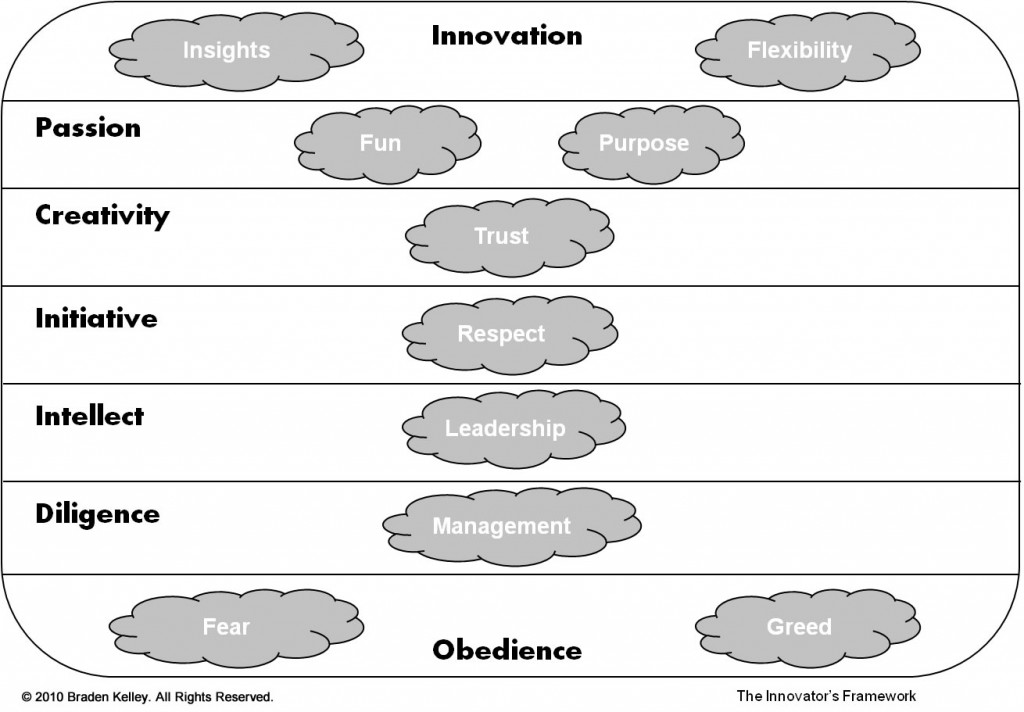
Building on the work of London Business School’s Gary Hamel and shifting to an Employee Relationship Management (ERM) mindset we can get beyond the obedience, diligence and intellect that fear, greed, management and leadership can deliver, and instead focus on unlocking the initiative, creativity, passion and innovation that will drive the organization to higher levels of success and continuing relevance with customers.
Employee Relationship Management (ERM) is the Future of HR
We must reimagine our approach to the humans in our organizations and to recognize and leverage their uniqueness instead of treating them as replaceable cogs in a machine.
The time has come for organizations to manage both the experiences and the relationships with each of their employees as individuals to make the collective stronger, healthier, and more resilient.
Now is the time to build a conscious, measured, professional approach to Employee Relationship Management (ERM).
What say you?
Sign up here to get Human-Centered Change & Innovation Weekly delivered to your inbox every week.
 Sign up here to get Human-Centered Change & Innovation Weekly delivered to your inbox every week.
















 (one of the many concepts introduced in my first book