I was first introduced to the principle of Taking Personal Responsibility when I attended a number of experiential workshops facilitated by Robert Kiyosaki who is now well known globally as the successful entrepreneurial author of the “Rich Dad Poor Dad” book series. At that time, in the late 1980s, the concept simply involved taking personal responsibility for your role in getting the results you get, in both challenging and problematic situations.
This principle has since evolved as the most crucial foundation for developing our emotionally intelligent, conscious, and transformational leadership capabilities. Largely through focusing on the development of self-awareness and self-regulation skillsets, which are especially important skills to cultivate in times of extreme uncertainty.
Blaming, Justifying, and Denying
Taking personal responsibility involves encouraging people to step up and out of blaming themselves or others, out of justifying their position or denying what is really going on to largely avoid the cognitive, emotional, and visceral results and consequences of their actions.
Which are essentially, largely unconscious defensive reactions to the problem or situation. So, it sounds quite simple, yet, even now, it’s still largely a countercultural principle, and a neurologically challenging one, because we are wired to survive (fight/flight/freeze) in the face of what we perceive as danger!
Especially when many of us are living in an oppositional blaming and shaming political environment, or within a passively or aggressively defensive organizational culture. Where a large section of the community, has been forced by the constraints of the pandemic, into fearing that their security and survival needs will not be met. Alternately, the great resignation and the nature of the virtual hybrid workplace have increased some people’s fears about even being able to get their jobs done!
All of this creates distorted thoughts and language that focus on “scarcity” where many people are fearing that they are not “enough” and do not have “enough” to deal with their current circumstances. Rather than leaning towards exploring and eliciting the possibilities and opportunities available in our abundant world. As there is no clear playbook about how people can effectively and responsibly lead and manage in this unique 21st-century context, many people are floundering, languishing into largely emotionally overwhelmed states.
Where it is easier, and sometimes safer, to be a victim, blame and shame others for their helpless or powerless situation, or to justify and deny any need to change their perspective about it, never mind their role in causing their own anxious and unresourceful emotional states.
Back to Leadership Basics
Yet, it is more important than ever, for leaders and managers to help people:
Take ownership of their consequences and be responsible for the emotional, cognitive, and visceral results of their actions,
Authentically connect, empower, and enable people and communities to flourish,
Provide safe, transparent, trusted environments and interdependence where people can dare to think differently and potentially thrive.
This means that the range of crises, uncertainty, and disruptions we are experiencing now is forcing us to go back to basic 101 management and leadership principles.
According to McKinsey & Co in a recent article “A Leaders Guide – communicating with teams, stakeholders and communities during Covid 19” – “Crises come in different intensities. As a “landscape-scale” event, the coronavirus has created great uncertainty, elevated stress and anxiety, and prompted tunnel vision, in which people focus only on the present rather than toward the future. During such a crisis, when information is unavailable or inconsistent, and when people feel unsure about what they know (or anyone knows), behavioral science points to an increased human desire for transparency, guidance, and making sense out of what has happened”.
The Maturity Continuum – Shifting to I and We
The principle of taking personal responsibility has evolved and been enhanced significantly through the work of Steve Covey, in the “Seven Habits of Effective People” and provides the core foundations for transformational and conscious leadership through the “Maturity Continuum”:
Dependence is the paradigm of you – you take care of me; you come through for me; you didn’t come through for me; I blame you for the results. Dependent and approval-seeking people need others to get what they want.
Independence is the paradigm of I – I can do it; I am responsible; I am self-reliant; I can choose. Independent people get what they want through their own efforts.
Interdependence is the paradigm of we – we can do it; we can cooperate; we can combine our talents and abilities and create something greater together. Interdependent people combine their efforts with the efforts of others to achieve their greatest success.
Putting the Maturity Continuum to Work
In the early 2000s I was an associate of Corporate Vision, Australia’s first culture change and transformation consultancy, now the globally successful Walking the Talk organisation, for fourteen years.
Where every culture, leadership, team development, or change program we designed and presented, introduced taking personal responsibility, as a fundamental, core learning principle. Aligning it with the principle of – For things to change first I must change, which deeply challenged and disrupted people’s belief systems, habitual mindsets, thinking styles, and ways of acting.
As a seasoned coach of twenty years, these two core principles seem to still profoundly challenge the majority of my coaching clients across the world, no matter how senior their role or position is, or how knowledgeable, skilled, and experienced they are!
Where many managers and leaders have failed to self-regulate, lack self-awareness, and have unconsciously slipped into feeling victimized, powerless, helpless, and in some instances, even hopeless about their futures where some are:
Feeling frozen, inert, paralyzed, overwhelmed, and immobilized in their abilities to affect any kind of positive change in both their work and home environments.
Unconsciously slipping into blaming and shaming others for their situations,
Justifying their inertia through a range of “reasonable reasons” and “elaborate stories” about how it’s “not their fault” or it’s not “up to them” to make any change.
Simply denying their current consequences, or the importance of needing to take positive actions, and make changes.
Unmotivated, lack any desire for control, or have the personal power to affect change in their situation.
Initiating Taking Personal Responsibility
To accept and share responsibility starts with being bravely willing to courageously connect with our whole selves and consciously stepping back to hit our internal pause button, retreat into silence and stillness, and compassionately ask:
What happened?
What can I/we learn from it?
What can I/we then do to create it?
Taking personal responsibility becomes a compassionate, creative, and courageous exercise in continuous learning, self-awareness, and emotional self-regulation in ways that safely disrupt people’s defensiveness and awaken them to the possibility of being personally powerful in tough situations.
It is also the basis for taking intelligent actions catalyze and cause positive outcomes, that deliver real solutions to crises, complex situations, and difficult business problems.
This is the first in a series of three blogs on the theme of taking responsibility – going back to leadership basics.
Find out about our learning products and tools, including The Coach for Innovators, Leaders, and Teams Certified Program, a collaborative, intimate, and deeply personalized innovation coaching and learning program, supported by a global group of peers over 9-weeks, starting Tuesday, October 18, 2022. It is a blended and transformational change and learning program that will give you a deep understanding of the language, principles, and applications of an ecosystem focus, human-centric approach, and emergent structure (Theory U) to innovation, and upskill people and teams and develop their future fitness, within your unique context. Find out more about our products and tools.
Image credit: Pixabay
Sign up here to get Human-Centered Change & Innovation Weekly delivered to your inbox every week.
In the ever-evolving landscape of work, organizations are increasingly recognizing that fostering a positive employee experience is crucial. Traditionally, companies focused on tangible benefits like compensation and office perks. However, it is becoming clearer that emotional well-being is fundamental to a holistic employee experience. As a thought leader in change and innovation, I am committed to exploring how organizations can integrate emotional well-being into their core strategies for sustainable growth and employee satisfaction.
The Importance of Emotional Well-being
Emotional well-being refers to an individual’s ability to manage and express emotions healthily. In the workplace, it impacts productivity, creativity, and overall job satisfaction. Employees who feel emotionally supported are more engaged, motivated, and loyal. Thus, emotional well-being is not just a benefit but a strategic pillar in crafting an exceptional employee experience.
Case Study #1: Google’s Comprehensive Mental Health Program
Google, known for its pioneering employee policies, has been at the forefront of integrating emotional well-being into the employee experience. The company recognized that stress and mental health issues were affecting productivity and employee satisfaction.
Google’s approach includes a comprehensive mental health program that offers resources such as counseling services, stress management workshops, and meditation classes. They also provide tools and platforms for ongoing peer support.
The results have been impressive. Google reports increased employee retention and engagement scores, along with a noticeable decrease in burnout-related issues. The company’s success underscores the importance of addressing emotional well-being proactively.
Case Study #2: Salesforce’s Ohana Culture
Salesforce has adopted the Hawaiian concept of “Ohana,” meaning family, to craft a nurturing and supportive workplace environment. This culture emphasizes empathy, mutual support, and open communication as central to the employee experience.
Salesforce’s initiatives include offering personalized mental health resources such as therapy sessions and wellness reimbursements. They also conduct regular mental health surveys to tailor support to employee needs effectively.
By treating employees like family, Salesforce has achieved remarkable results. Employee satisfaction scores are high, and the company has become recognized as one of the best places to work globally. Salesforce’s approach highlights how cultural integration of emotional well-being can lead to profound organizational benefits.
Integrating Emotional Well-being into Organizational Strategy
To successfully integrate emotional well-being into the employee experience, organizations must move beyond traditional benefits and adopt a holistic approach:
Leadership Commitment: Senior leaders must champion emotional well-being initiatives, demonstrating commitment from the top levels of management.
Tailored Programs: Programs should be adaptable to meet diverse employee needs, considering varying cultural and personal backgrounds.
Open Communication: Encourage open dialogue about mental health to de-stigmatize these discussions and foster a supportive environment.
Continuous Feedback: Regularly solicit employee feedback to adapt and improve emotional well-being initiatives.
Conclusion
As organizations strive to innovate and remain competitive, embedding emotional well-being into the employee experience is not merely an option but a necessity. The insights from Google and Salesforce demonstrate that when employees feel emotionally supported, companies benefit in terms of productivity, retention, and reputation.
Empowering employees to thrive emotionally creates a ripple effect that enhances business performance and contributes to a more humane and sustainable workplace culture. By prioritizing emotional well-being, companies can build a workforce that is not only successful but truly fulfilled.
Extra Extra: Futurology is not fortune telling. Futurists use a scientific approach to create their deliverables, but a methodology and tools like those in FutureHacking™ can empower anyone to engage in futurology themselves.
Image credit: Pixabay
Sign up here to get Human-Centered Change & Innovation Weekly delivered to your inbox every week.
A remote or hybrid work culture requires a new approach to managing remote teams: use empathy and grace to keep your team connected.
GUEST POST from Douglas Ferguson
Managing remote teams goes beyond using the right tools and tech for communication: intangibles like grace and empathy are an essential part of successfully leading teams.
Remote work undoubtedly changes team dynamics and communication. Making the most of distance work requires us to humanize remote work and challenge the culture of isolation that remote companies typically face.
In this article, we’ll discuss:
Remote Work Culture
Conflict in Remote Teams
Exercising Empathy Online
Building Psychologically Safe Remote Teams
Transforming Your Remote Team Management
Remote Work Culture
The nature of remote work undoubtedly changes company culture. As team members prepare to work remotely, they lose out on the real human connections gained from working in person. As a result, it can be challenging for coworkers and management to truly connect with each other.
By intentionally creating a remote work culture of connectedness, remote companies can navigate the hurdle of separation and bring team members together regardless of where they may be working.
Strong remote work culture counteracts the effects of isolation and unites team members around their shared purpose or common goal.
When managing remote teams, it’s important to:
Encourage feelings of camaraderie
Ensure regular effective communication
Shift your work culture to a balance of synchronous and asynchronous work
Conflict in Remote Teams
Making the transition to successful remote work culture isn’t easy, especially with regard to conflict resolution. This lack of face-to-face interaction makes miscommunication easier than ever before. While all team members may be focused on achieving a common goal, in the digital world it’s easier for words, and actions to get lost in translation, causing conflict between team members.
According to a study on remote work conflict, 81% of workers reportedly experience conflict and 39% of workers think about leaving their jobs as a result of a virtual conflict. Moreover, workplace conflicts are increasing in remote teams as employees are no longer able to verbally and visually communicate as they would in a physical workplace.
Exercising Empathy Online
With more workplace conflicts happening online, it’s up to companies to head off these communication challenges as proactively as possible. Experts suggest that empathy may be the cure-all to virtual drama in the remote working world.
When managing remote teams, maintaining team members’ well-being, morale, and engagement from afar requires intentionally exercising empathy.
Practice exercising empathy with your remote teams by:
1. Connecting with Your Team
Managing remote teams with empathy starts with establishing and maintaining a meaningful connection with your team.
Improve team connections with the following:
Ice breakers that add team-building and play to a meeting
Regular check-ins with team members
Video chats so team members can see facial expressions
Consistantant communication via platforms like Slack, Trello, or Asana
2. Actively Listening
Listening is an essential part of empathy, especially in remote teams. Listening allows remote teams to contextualize conversations and can help team members avoid unnecessary conflict.
Actively listen by asking intentional questions during check-ins to identify challenges team members might be facing. Experts recommend using prompts to help check-in.
3. Creating Opportunities to Ask for Help
It’s not always easy for employees to speak up and ask for help. Team leaders can demonstrate empathy by showing other members of the team that it’s okay to ask for assistance. By being vulnerable with your teams and asking for help yourself, you’ll open the door for others to feel as though it’s okay to ask for help as well.
4. Equipping Team Members
Ensuring that team members have everything they need to complete their work is another way to embody empathy. Be sure to ask thoughtful questions and offer materials and tools proactively to ensure your team is properly equipped to do their jobs.
Be sure to ask questions such as:
What traditional resources does my team not have access to when working remotely?
Do any team members have accessibility needs?
What tools do all team members need?
5. Encouraging Transparency
Transparency is key when managing remote teams. Without in-person conversation, information isn’t always as readily understood in the virtual realm, so it’s essential to regularly share important and accurate information.
Provide feedback and guidance regularly to team members
6. Increasing Recognition
Recognition is essential in helping employees feel valued and validated. Employee recognition for remote teams can take on many forms from a shoutout via email or a monthly gift certificate. A small gesture of gratitude goes a long way online as it reminds your team members that you see the work they do and you value them as a critical part of the team.
Building Psychologically Safe Teams
Another element of successfully managing remote teams is creating a sense of psychological safety. When team members feel psychologically safe, they’re most confident to share their ideas, ask for help, and perform their best work. Creating this environment in the virtual realm allows employees to work without the fear of being punished, judged, or ignored.
Empathy and psychological safety go hand-in-hand. Team members are all responsible for creating this environment for each other.
Promote an environment of psychological safety by:
When managing a remote team, it’s essential to provide multiple forms of contact. Share your contact information for video chat, email, instant messaging, telephone calls, and other platforms. By diversifying your methods of communication, you’ll give your team every opportunity to stay in contact with you.
2. Increase Flexibility
Flexibility is a valuable element when managing remote teams. From offering flexible hours to allowing team members to set their own deadlines, allowing more flexibility will help build trust and boost morale with your remote teams.
3. Use Remote Work Advantageously
Focus on the advantages of remote work and hire a diverse and dynamic team. Remote work gives companies access to the global workforce, allowing them to hire the best in the business from any country in the world.
4. Find a Balance for Asynchronous and Synchronous work
When managing remote teams, there is untapped potential in understanding, and utilizing synchronous and asynchronous work times. With remote workers, we have discovered the benefits of deep focus that asynchronous work has to offer. This allows for flexibility across timezones, teams accomplish more in a shorter amount of time, and it allows for synchronous time to be more focused and productive. Managing remote teams takes a leadership team that understands the importance of synchronous and asynchronous work.
5. Accept Adjustment Periods
In learning how to best manage remote teams, don’t forget to be patient. Transitioning to a remote-only or hybrid workplace will take time. From troubleshooting technological issues during meetings to learning new habits to improve your virtual workplace, allowing team members to learn as they go is an important part of managing your remote team.
Working remotely comes with its own set of risks and rewards. Want to learn more about how to navigate the ins and outs of managing remote teams? Connect with us to discover how to implement empathy and grace as you lead your remote team to success.
Change is a constant in today’s rapidly evolving world. Organizations that thrive are those that effectively communicate change initiatives, ensuring clarity, alignment, and engagement among their stakeholders. As a thought leader in human-centered change and innovation, I aim to equip you with actionable strategies that enhance communication during change initiatives.
Understanding the Importance of Communication in Change
Communication is the lifeline of any successful change initiative. Without it, uncertainty, resistance, and confusion can erode even the best-laid plans. Crafting a compelling narrative around why the change is happening, who it impacts, and what the benefits are is essential to gaining buy-in and reducing resistance.
Strategy 1: Building a Clear and Unified Message
A unified message serves as the foundation of any successful change communication strategy. It’s crucial that everyone from leadership to front-line employees shares the same understanding of the change.
“A unified message creates a clear vision, fosters trust, and drives engagement across all levels of an organization.”
Consider Case Study: Fortune 500 Tech Corporation. When the company decided to pivot its product line to include more cloud-based solutions, they knew a clear message was key. They developed a communication framework that outlined the “why,” “what,” and “how” – why the change was needed, what the new direction entailed, and how it would be implemented. This message was communicated consistently across all teams, through town halls, newsletters, and dedicated intranet hubs. This strategic communication plan ensured everyone was on the same page and minimized confusion and disruption.
Strategy 2: Leveraging Storytelling for Emotional Connection
Studies have shown that humans are hardwired to respond to stories. Communicating change through storytelling helps create a relatable context, making the change more personal and impactful.
In Case Study: Global Retail Chain, when the company began a digital transformation journey, they employed storytelling to connect with employees emotionally. Leaders shared personal stories about how digital tools positively impacted their work-life balance and productivity. By aligning the transformation with real-life benefits, employees became more receptive and enthusiastic about embracing new technologies.
Strategy 3: Engaging Stakeholders Early and Often
Engagement isn’t a one-time activity. Successful change communication thrives on continuous dialogue. Invite feedback, address concerns, and provide regular updates to maintain momentum and build trust.
For instance, the retail chain from our case study conducted monthly feedback sessions, allowing employees to voice concerns and suggest improvements. This continuous engagement built a sense of community and ownership, further smoothing the change process.
Strategy 4: Utilizing Multiple Communication Channels
Diversifying communication methods ensures that messages reach everyone, respecting different preferences and schedules. Use a mix of emails, face-to-face meetings, video updates, and social media to cater to diverse audiences.
In the tech corporation case study, by employing various channels, the company ensured no one was left out. Employees could access information at their convenience, an approach that was particularly beneficial given remote work dynamics.
Strategy 5: Training and Support
Change can be intimidating. Providing adequate training and support empowers employees to adapt more readily and performing effectively in the new environment.
The retail chain implemented comprehensive training sessions focusing on new digital tools, pairing them with ongoing support and mentorship programs. This not only eased the transition but also equipped employees with new skill sets, transforming apprehension into opportunity.
Conclusion
Effective communication isn’t about what you say, but how you make others feel during a change. It’s about creating understanding, reducing fear, and fostering inspiration. By building clear messages, employing storytelling, engaging stakeholders, utilizing diverse channels, and offering support, organizations can transform change from a challenge into an opportunity.
As we’ve seen in the case studies of the Fortune 500 Tech Corporation and the Global Retail Chain, tailored strategies can lead to successful change communications, ultimately leading to sustained growth and innovation.
Let us embrace change not as a disruption, but as an avenue for growth. Stay innovative, stay connected, and continue to propel forward.
Extra Extra: Futurology is not fortune telling. Futurists use a scientific approach to create their deliverables, but a methodology and tools like those in FutureHacking™ can empower anyone to engage in futurology themselves.
Image credit: Pexels
Sign up here to get Human-Centered Change & Innovation Weekly delivered to your inbox every week.
In the not-so-distant past, remote work was often seen as an occasional luxury. Fast forward to today, and it has become a significant, often preferable, reality for millions of employees worldwide. This shift—accelerated by global events and technological advancement—has brought about a remote work revolution that demands a fresh perspective on the employee experience. As organizations rethink their strategies, it’s crucial to center human needs in the design and implementation of remote work policies.
The New Paradigm
The traditional work environment has been significantly disrupted, leading to newfound flexibility and autonomy. But as appealing as remote work is, it also introduces challenges that can impact an employee’s sense of belonging, job satisfaction, and productivity. To address these, companies must foster transparent communication, promote work-life balance, and create spaces for social interaction—physically or virtually.
“Remote work is not just about working from a different location, but rather creating a dynamic ecosystem that can adapt to an employee’s personal and professional needs.” Braden Kelley
Case Study 1: TechVision
Background
TechVision, a rapidly-growing software firm, recognized early the potential drawbacks of remote work. It understood that despite the liberating nature of flexible work schedules, employees might feel isolated and overlooked in a virtual environment.
Initiatives and Outcomes
To combat these challenges, TechVision introduced several initiatives:
Virtual Lounges: These digital meeting rooms are always open, encouraging employees to drop in for casual chats. This fosters a sense of community and reduces feelings of isolation.
Flexible Working Hours: Acknowledging diverse personal schedules, TechVision allows employees to define their own working hours, provided they meet deliverable deadlines.
Monthly Home Office Stipend: Understanding that an efficient home workspace is crucial, the company provides a stipend for employees to enhance their home office setup.
As a result, TechVision noticed a 20% increase in employee satisfaction and a 15% boost in productivity, proving that a thoughtful approach to remote work could yield significant benefits.
Case Study 2: GlobalInnovate
Background
GlobalInnovate, a multinational design firm, faced the challenge of maintaining creativity and collaboration in a remote setup. Vital brainstorming sessions had to transition from the boardroom to the online space, sometimes losing the dynamic energy critical to innovation.
Initiatives and Outcomes
GlobalInnovate employed the following strategies:
Virtual Reality Collaboration Tools: By adopting VR meeting platforms, the firm recreated the spatial dynamics of an in-person meeting, fostering more natural interactions.
Regular Creative Jams: These unstructured sessions are dedicated purely to creative exploration, allowing teams to ideate freely without the pressure of immediate deliverables.
Global Work Sprints: Employees from different time zones collaborate intensively on projects for a week, followed by a comprehensive review and reflection process.
These approaches have sustained GlobalInnovate’s creative output, with the firm reporting a 30% rise in innovative solutions proposed by their teams over a six-month period.
Conclusion
The remote work revolution isn’t merely a shift in location; it’s a transformation in how we perceive and execute work itself. Organizations, by re-imagining the employee experience to ensure connectivity, flexibility, and creativity, can turn the challenges of remote work into opportunities for growth and innovation. As we move forward, it’s imperative that we continue to pioneer strategies that place human experience at the forefront of the remote work landscape.
Extra Extra: Futurology is not fortune telling. Futurists use a scientific approach to create their deliverables, but a methodology and tools like those in FutureHacking™ can empower anyone to engage in futurology themselves.
Image credit: Pixabay
Sign up here to get Human-Centered Change & Innovation Weekly delivered to your inbox every week.
BMNT Editor’s note: This is the fourth in a series explaining the common beginner-steps needed to get an innovation practice off the ground or improve an existing innovation practice. Find our first post, explaining the goals of implementing a structure to guide innovation and training workers how to use it, here. The second installment, on how to create an innovation thesis to guide your team’s activities, is here. The third piece, on how to assemble the right team for the job, is here.
GUEST POST from Brian Miller
Steve Blank, the godfather of Silicon Valley, says that “for innovation to contribute to a company or government agency, it needs to be designed as a process from start to deployment.” At the start, you need a steady influx of new project ideas to replace and restore eroding capabilities. Investors refer to this influx as “deal flow,” and it is considered the single most important factor in their success. Here are the key principles and practices to generate the deal flow your innovation practice needs to succeed.
1. Open your pipeline wider than you feel comfortable
It’s cliche to say this, but get comfortable with the uncomfortable. It may take hundreds of initial problems to find a few dozen pilot projects, and only a handful of successful programs may result from those pilots. A rigorous process, like the Innovation Pipeline®, ensures you manage the risk and uncertainty of innovation along with your finite resources. When venture capital investors raise a fund, they initially invest only about 40 percent to 60 percent of it. Cash reserves, known as “dry powder,” are held back so investors can quickly invest more in the early bets that pan out. Translating this to the government, resources are first invested in validating a project (explore). Only after validation are significant investments made in deploying a new capability (exploit).
The Innovation Pipeline
To get started, you must first understand what you’re doing and where problems will come from. Are you gathering problems from your organization’s workforce (if you’re trying to improve your structure, processes, and culture), your customer base (if you’re trying to improve their job), or both?
If the former, you could use or create an internal portal, akin to a digital comment box with more rigor. If the latter, you could use a tool like SurveyMonkey or something more sophisticated. If that’s not feasible right away, just do it manually. An innovation pipeline needs a lot of inputs at the beginning in order to produce disruptive solutions at the end. It’s the fuel for innovation, so walk the halls of your organization, cold-call your customers, or deputize people already embedded in key places to be your eyes and ears, spotting and assessing opportunity by collecting problems for you.
2. Scope and prioritize problems at the atomic level to find the right project ideas
You will need to see a lot of problems, and rigorously assess them, to find the needs that will lead to transformative change. You cannot be too selective up front, so prepare for the volume by using a simple framework to deconstruct problems into their atomic units.
A Key Beneficiary has a basic need in order to achieve a desired outcome. This problem-centric approach will help you scope and prioritize all the in-bound opportunities so you can easily focus on certain beneficiaries or certain desired outcomes.
Pro-tip: If your pipeline is brand-new, focus on a beneficiary group that you can co-opt, like insurgents, to build momentum in your organization. Or focus on the desired outcomes that align to your organization’s stated and published strategic priorities. If you’re still stuck, revisit your innovation thesis (or create one if you haven’t already) to help guide your problem sourcing and triage in-bound opportunities.
3. Respond to everyone
Do not leave hundreds or thousands of people hanging if you collect their problems. If your problem sourcing is yet another black box in a large organization, apathy will quickly set in and your projects will dry up. Rather than leave problem-submitters guessing, be honest with them about (1) how you will decide what will get worked on, and (2) that not everyone’s problem will get worked on directly. This communication can be as simple as a Senior Leader announcement at a town hall, or it can be memorialized in an Innovation Doctrine that lays out the fundamental principles that guide coordinated action in your organization.
Pro-tip: the best innovation programs provide all problem owners with valuable information in exchange for their input. For example, pointing them in the direction of the office that can help them solve a simple problem; connecting them to someone experiencing a similar one, so they can band together; or just showing them a dashboard of your deal flow so they can see where their problem ranks or fits with others. A transparent and responsive innovation practice keeps contributors motivated to pursue their ideas and contribute to new ones in the future.
4. Look for patterns
Not every problem will get worked on. Even with infinite resources, you must prioritize based on your innovation thesis. However, seeing patterns in hundreds or thousands of problems, even the ones you set aside, will reveal the root cause of something greater. For example, you may find lots of problems related to testing new software. Instead of fixing each one, fix the process for testing, evaluating, and approving new software tools, eliminating an entire category of problems in one project.
5. Generate short, descriptive problem statements
Your success or failure is based on a disciplined commitment to problem-centric innovation. The best way to keep yourself honest is to initially frame projects as problem statements that provide sufficient background on the origins of the problem to be solved. This kick-starts the next stage of innovation (Curation) and ideally identifies (for the purpose of recruitment) at least some of the key stakeholders around a problem, their basic needs, and an early definition of success.
Pro-tip: a great problem statement should be shareable with and understandable by anyone. The goal is to present a clear articulation of the opportunity and to expand the coalition around the problem so that others can help you solve it.
Next, you’ll rigorously assess and prioritize your problems, and you’ll begin to interview and observe people affected by them. In the next post, we’ll share more insights on how to do it, so you know you can trust the data that results and amplify the confidence in your decisions.
Image credits: BMNT, Pixabay
Sign up here to get Human-Centered Change & Innovation Weekly delivered to your inbox every week.
Many would-be innovators obsess over ideas, wait for inspiration to strike, and believe that with the right idea, success can miraculously come overnight.
However, as we’ve written before, that’s just not going to happen. In fact, usually the only thing separating the winning innovators from the rest is execution. It makes all the difference in the world, and yet, it’s still a vastly underrated capability.
As part of our coaching program, we’ve asked hundreds of corporate innovators and innovation leaders to reflect on their strengths and weaknesses. And, by far, the most common answer is that they’re great at coming up with ideas and thinking about the big picture but lack the patience and discipline to see things through to results.
As such, it’s safe to say that as a community, we innovators need to take a hard look in the mirror and admit that this an area where most of us have a lot of room for improvement.
So, in today’s article, we’ll explore the topic of executing innovation in more detail to try to understand what the problems associated with it are, and what successful execution of an innovation really takes. This is designed to be a guide to help leaders get it right, but I think there’s a lot that every innovator regardless of job title can learn from.
What does executing innovation mean?
Before we dive deeper, it’s probably a good idea to clarify what we mean with the term “executing innovation”, and how it relates to “implementing innovation”.
These are often used interchangeably, but I think it’s useful to distinguish them from one another. The way we like to put this is as follows:
Implementing innovation is the process of taking an idea and then turning that into reality.
Executing innovation, on the other hand, is the entire process of creating value with innovation.
In other words, implementation is what you do for an individual idea to make that happen. Execution covers the implementation, but also the process of turning that (along with many other ideas and innovations) into something that actually creates value and can be scaled up.
Implementation isn’t always easy, but it’s still typically a linear project that you can usually plan out in advance. Execution, on the other hand, is a much more complex and multidisciplinary effort.
To succeed at delivering value, you need to get a lot of things right. And with innovation, there are many assumptions in that plan. Some of those assumptions will always prove to be false, and you’ll need to deviate from the plan.
That combination of multidisciplinary collaboration and the need to deviate from original plans often leads to a myriad of practical challenges in many large organizations.
However, before we dive deeper into those challenges, let’s first take a step back to realize why execution is so critical.
Why execution is critical for innovation success
There’s a reason for innovation being defined as the act of introducing something new.
Everyone has ideas. Many can even implement some form of them, typically a prototype, but few successfully realize the full potential of the idea by truly executing on it successfully.
To clarify, ideas are an important starting point, but with every great idea, there are hundreds or even thousands of people across the world who’ve had the same exact idea.
Most never start working on it. Many give up in the process. Some make it to market, and a few might even make that into a feasible business. There are usually only a couple of winners. Those are the ones that succeeded in executing that idea.
Everyone has ideas, but few successfully realize the full potential of their ideas. The ones that do are the ones that know how to execute well.
This is of course a bit of an oversimplification but should help explain the fundamental importance of proper execution.
And that is not just true for individual ideas and innovations, but it’s also the case for corporate strategies at large. Look at any given industry, and it’s quite likely that you’ll see many companies with a nearly identical strategy. Again, the difference comes down to how well the company succeeded in executing that strategy.
In other words, your idea or strategy sets the ceiling for your impact if successful, but execution determines how close to that ceiling you’ll get. Even the best idea or strategy is worth nothing unless it’s executed well.
On the other hand, even with a mediocre strategy or idea, you can achieve remarkable success if you just execute it well enough. There are dozens of well-known companies like McDonald’s and FedEx that are obvious examples of this. There’s nothing particularly remarkable or distinctive about their ideas or strategies. They weren’t the first in their respective fields, they just executed on their ideas brilliantly.
What’s more, if you’re a strong executor, you’ll soon find out the limits of the original strategy or idea, at which point you can adapt and change course accordingly. But, it doesn’t work the other way around.
Thus, no matter the situation, execution will always be more important than your idea or strategy.
Misconceptions about executing innovation
As you might have realized by now, execution is of course a massive, nuanced, context-specific and very complex endeavor. In practice, it’s an endless jungle of interlinked choices and actions affecting one another that you need to navigate with limited information to get to the other side.
Thus, the space of possible challenges and problems you might encounter is pretty extensive. So, instead of looking at the individual problems themselves, it’s more helpful for us to try to understand the common misconceptions that ultimately lead to teams underappreciating execution and thus subsequently failing at it.
A big factor behind most of these is the fundamental uncertainty that innovation is always associated with. Because you can’t know everything in advance, it’s not going to be a nice and linear process of doing simple steps one after another. Instead, it’s a messy and iterative process of creative problem-solving.
Anyway, with that, here are the top four that I most commonly see innovation leaders and their teams have.
1. The leader’s job is just to get the big picture right
This is probably the most common problem I’ve come across, and it’s especially common among inexperienced executives, or ones that otherwise lack execution experience, such as some management consultants and academics.
There are many shapes this one might take, and we’ll return to it later, but what it ultimately comes down to is the glorification of strategy work and/or surface-level creativity.
In business school, and in consulting, we’re taught to think about the big picture as the job of top management. We’re led to believe that a leader or innovator takes in a market analysis, compares a few scenarios, chooses a positioning, and then paints an inspiring vision to show direction for the company. Then the pieces will simply fall in place and success happens.
While the above mentioned are of course still useful activities, if you’ve ever actually turned an innovative idea into a successful business, you know that in practice, there’s a lot more to it than that, and experienced executives are of course well aware of that
Strategic choices can be made across the organization, but the responsibility for execution always lies at the top.
As Professor Martin has well put it, CEOs should stop thinking that execution is somebody else’s job, and the same applies for every innovation leader. Strategic choices can be, and frequently are, made where the action is. Yet, the responsibility for execution always lies at the top. After all, there’s a reason for the CEO being the Chief Executive Officer.
2. I don’t need to understand the details
The second is closely related to our first one. It’s easy to think that as a leader or visionary innovator, you’re the person responsible for the vision, ideas, and big picture decisions, and then the experts will then figure things out in practice. After all, that’s why you hired them, right?
Well, that might work if you’re operating in a static industry where all the variables are known and static, but with innovation that really isn’t the case.
You need to get the big picture right, but it isn’t enough to succeed. You need to also have the right product, business model, technology, customer experience, customer acquisition channels and tactics, operating models, etc. All of these have a wide variety of choices that depend on one another and changes in any of the areas will force you to change many of the other pieces in the puzzle too.
With innovation, the devil is in the details!
As an innovation leader, connecting the dots is ultimately your job, and you can’t do that without understanding the details.
That’s why you’ll find an obsession for the details in pretty much every successful innovator, both past and present. They have the same in-depth understanding and attention to detail as the best artists, athletes and top representatives of other fields do too.
So, while you absolutely need to engage with and empower the experts, they are experts in their own field and likely don’t know how to consider all the other moving pieces in the puzzle. As an innovation leader, connecting the dots is ultimately your job, and you can’t do that without understanding the details.
It’s the one responsibility you simply can’t delegate away.
3. Execution requires a clear and unambiguous plan
Even if you are an experienced executive and value the importance of execution highly, it doesn’t mean you couldn’t fail when executing innovation. Here the most common problems occur if the leader’s experience comes primarily from operations within the known and well understood confines of “business as usual”.
When the environment is well understood, and the scale large from the get-go, it’s of course valuable to try to plan carefully, analyze business cases and craft detailed project plans prior to execution.
Also, since everyone knows that innovation is a risky endeavor, it of course makes sense to try to reduce those risks before your start a big innovation project to try to avoid major mistakes and generally just ensure that you’ve done a good job in planning and preparation before committing to the project.
This often leads to large companies commissioning all kinds of market studies and strategy projects. Some of those can certainly be useful in increasing your understanding of the landscape, but most invest way too much time, energy, and money into these. Also, every now and then these projects seem to be ordered only to have a scapegoat in case something goes wrong.
Regardless, there’s a fundamental problem: with innovation, you can’t have all the answers in advance. You’ll always need to make a number of assumptions upon which your plan relies on, some of which will inevitably prove to be wrong.
With innovation, you won’t have all the answers in advance.
Thus, if you require innovators to propose clear, detailed and unambiguous plans for you, or conversely create such plans and then hold innovators accountable for successfully executing them, it just won’t work out. And, whenever it then comes to surface that everything hasn’t gone according to the plan, innovation projects are frequently shut down, even if they’d still hold a lot of potential.
You obviously still need to align with the strategy, plan ahead, and have a disciplined approach to execution, but it’s not so much about creating a detailed roadmap, as it is about choosing direction and figuring out which questions or problems you’ll need to address first.
In other words, you need to embrace the uncertainty and the fact that you can’t have a perfectly unambiguous and detailed plan before starting to execute it. Instead, figure out what the assumptions and uncertainties in your plan are and commit to a disciplined learning effort to figure out the right path forward.
4. Innovation is fun
There’s a stereotype around people working in innovation being these visionaries that are bursting with great ideas and seem to come up with great new concepts all the time. And as mentioned in the intro to this article, that is often true.
That skillset is of course very useful for innovation, but there’s also a downside. There are naturally exceptions, but many of us working on innovation can find execution too boring and repetitive, and/or lack the perseverance, discipline, and patience needed to succeed at it.
Innovators often spend too much on the creative and “fun parts” of innovation, as opposed to what’s really needed to turn an idea into a successful innovation
As a group, we generally love creative work, and are always looking for fresh, new stimuli to feed that inspiration. That often leads us to spend too much time and effort on the “fun parts” of innovation, and too little on the not so fun, more repetitive, and laborious parts of the process that execution essentially is comprised of. The reality is that for every minute you spend coming up with ideas, you’ll probably need to spend a day, a week, or even more implementing those ideas.
So, if your innovation team is primarily filled with, or led by, such “idea people”, which is quite common, then there’s a big risk of a systematic lack of respect for and capabilities in execution. This will lead to a very suboptimal culture for innovation, and ultimately disappointing business outcomes.
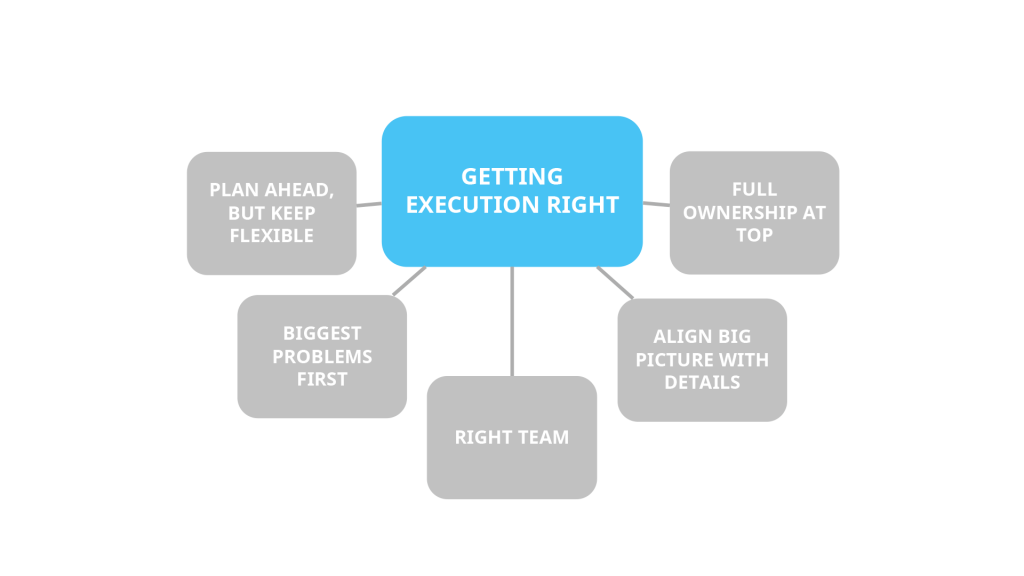
Getting Execution Right
As already mentioned, there are a lot of similarities between successful execution in “business as usual”, and in innovation. However, there are also clear differences between the two.
So, to help you navigate the differences, and to succeed at executing on whatever innovation you’re working on, here are the five most important factors to keep in mind whenever you’re trying to execute on an innovation and build something truly novel.
1. Take the path most likely to succeed, but keep your options open
As mentioned, with innovation planning and strategy work need to be done a bit differently than you would with an existing business.
Good decisions here make it much easier for your team to figure out how to move forward and can save a lot of time money going down the wrong path. Regardless, you’ll soon end up at another crossroads and need to make another decision. Heck, sometimes you might even come across a dead-end and need to backtrack to an earlier crossroads. Sometimes Plan C or D is the way to go.
The point is that no matter which path you choose, you won’t see what’s ahead all the way to the end.
Thus, good strategy work requires you to embrace uncertainty, test assumptions critically, and think deeply about the real-life feasibility of each path ahead.
And it’s certainly not a one-time project you do at the beginning, but more of a continuous learning process as you unravel the puzzle piece by piece.
If you keep an open mind and build your teams and products to embrace that uncertainty, you can quickly recover and learn from setbacks, as well as embrace new opportunities you couldn’t even think of before you set out. This is what’s known as cognitive and organizational flexibility.
2. Solve the biggest problems first
As humans, most of us have a bit of a tendency to go for the comfortable low-hanging fruits and procrastinate on the hard but important problems, as well as uncomfortable truths.
I’ve certainly been guilty of this on many occasions, even while writing of this article. Getting a number of small things done makes us feel like we’re making good progress, but unfortunately that’s often a bit of a false sensation as we might not really be any better off than when we began.
With the inherit uncertainty in innovation, that is naturally a bit of a problem. When you’re executing any given innovation, there’s countless things that need to be done so it’s easy to just start checking off boxes like building more features, creating marketing materials, getting compliance approvals, or whatever you may have on your agenda.
But, it’s the big things that make or break your innovation early on. For example: will a customer benefit from my product, how much are they willing to pay, can I even build the product I’ve envisioned, etc.
While you need to care about the details, it’s the big things that make or break your innovation early on. So, start from the big problems, even if it hurts!
The key is finding a way to figure out what these big problems or critical assumptions are, and then find ways to quickly test and address them. This allows you to quickly figure out if you’re on to something, which of course saves a lot of time and money for you in the inevitable case that you weren’t quite there from the get-go.
Also, if you get the big things right, you can already deliver most of the value, and that means you can more quickly start capturing some of that value to get a return for your investments.
Plus, if you tackle these early on when you still have a small team, changing course will be much quicker and easier, and you’ll have spent much less money solving the same important problems than you would with a larger team later on.
In most businesses, these critical assumptions revolve around how much value you can deliver to customers, and how valuable they see that to be. However, in certain circumstances, those can be related to something entirely different, such as the feasibility of implementation when developing a new breakthrough drug.
Solving for the hardest problems first does generally require a bit more of a leadership commitment as you won’t always be able to show quick wins as early on, but at least it can save you from an embarrassing and costly failure like CNN+.
3. Build the right team
It might be a bit of an obvious statement, but it’s still probably worth pointing out: innovation is a bit of a team sport. So, to do well at it, you need the right team.
However, what might not be as obvious is that ‘the right team’ means in practice. In our experience, there are two key parts to this:
Multidisciplinary team with talented individuals in each area
Leadership and individuals that share the right mindset for innovation
The prior is pretty self-explanatory. Innovation is almost always a cross-disciplinary effort. The specifics depend on what kind of an innovation you’re working on, but usually you need expertise in at least design, engineering, commercial and operational matters.
The most impactful innovations are actually comprised of a stack of innovations in many of these areas, each designed to work together to address a specific problem or ‘job’ for the customer. Thus, if you have talent at every position, the outcome will be much more than the sum of its parts.
The latter, however, is the part that many teams fail to appreciate. Innovation is, by definition, doing something that others haven’t succeeded at before, so the journey won’t be easy.
Your team will face a lot of uncertainty and struggles, and will still need to perform at their best, often under a lot of pressure. That requires a very specific type of culture within the team, but also the right mindset for each individual. You want people that can cope with uncertainty and are able to remain optimistic and overcome difficult situations while still being realistic and ruthlessly critical of their own capabilities. They need to have an innate passion to strive for excellence, and a lot of discipline, grit, and perseverance.
And, of course, because it’s a team sport, people need to be able to work well together and perform as a team. This, however, isn’t usually much of an issue as long as people can leave their egos at the door. The struggles you will face together as a team will build bonds and gel you into a team.
4. Make sure every decision and detail are aligned
As we already discussed, you don’t need (and usually can’t have) a clear and unambiguous plan for an innovation project where every role and task would be charted out in advance. However, as we also discussed, the devil is often in the details and seemingly small things can derail the project from its goals?
So, what gives?
Well, the point is that with innovation, you need to keep an eye on everything. As an innovation leader, you need to maintain excellent awareness of both the big picture and the details throughout the project. But, because the environment changes dynamically and you need to move fast, you can’t really do that work upfront.
Nor can you just look at some KPIs and financial reports to figure out if things are moving in the right direction because the important things won’t show up in these for quite a while, and at that point, it’s often too already too late to react.
As a leader, your primary job is to keep up with what’s going on both with the ever-changing big picture, and the details on the ground so that you can spot problems early and intervene before it’s too late, no matter where the issues might arise from. If you don’t understand how everything works in practice and know what problems everyone is working on and why, it will be pretty much impossible to do that.
Some might see the latter as micro-management, but it doesn’t mean you have to dictate what everyone does. It just means that as a leader, you need to be the person that connects the dots and then empowers the team to succeed. There’s a clear difference.
Which brings us nicely to our last point.
5. Take full ownership for the execution
As we’ve covered, execution is the make-or-break part in the lifecycle for every innovation.
It’s always a bit of an exploratory process where you need to remain flexible, while still moving forward quickly and executing at a high level.
And, at the same time, seemingly inconsequential low-level choices related to implementation turn out to become existential issues for any innovation project.
Again, you don’t need to decide everything on behalf of your team. In fact, often it’s best to let the experts solve problems and do their job, as long as you can give them the right guidance and constraints to work with. Instead, you need to think of every potential problem as your fault and then figure out a way to get past them together with your team.
The bottom line is that being an innovation leader isn’t easy. It takes a lot of time and work to understand and stay on top of things, but as already mentioned, that’s the one thing you can’t really skip, automate, or delegate. Essentially everything else you can.
The only way to succeed at that is to take full ownership and commit to the process.
Conclusion
We’ve covered a lot of ground, so let’s do a bit of a recap.
Innovation isn’t a linear project that you can plan out in advance and monitor progress with a Gantt chart. There will always be plenty of surprises. Many unpleasant, but usually some positive ones too. You’ll need to be flexible enough to react to these and alter course accordingly.
It’s an inherently messy and iterative process of figuring out a way to build new things and align all the pieces so that everything works out.
Fundamentally, an innovation leader’s job is to show direction and try to keep track of everything that’s happening, align those puzzle pieces together with the big picture while always being on the lookout for potential problems and then eliminate those before they derail the project, as there will be many.
It’s not an easy or comfortable job, but if you can get it right, it’s an incredibly rewarding one.
Ironically, despite all the talk about practical issues and attention to detail being vital, this has been a bit of a high-level overview on the topic. So, if you’re interested in learning more about the details related to what we’ve discussed today, I have a couple of practical recommendations for you:
First, the best way to learn to innovate is by doing. So, get your hands dirty, keep these tips in mind, do your best, and I’ll guarantee you’ll learn a lot.
But, if you currently don’t quite have the time to commit to an innovation project, a good alternative way to learn more about innovation management is with our Innovation System online coaching program. We’ve now made the program completely free of charge for the first 1000 readers to sign up for it.
This article was originally published in Viima’s blog.
Image credits: Unsplash, Viima
Sign up here to get Human-Centered Change & Innovation Weekly delivered to your inbox every week.
In today’s fast-paced digital landscape, traditional leadership styles are undergoing a significant transformation. The rise of technology and the acceleration of digital transformation processes demand leaders who are not only adaptive but also capable of fostering innovation and guiding organizations through the complexities of change. This article explores the evolving leadership styles suited for the digital age and presents case studies of organizations and leaders who have successfully navigated this transformation.
Embracing Agile Leadership
Agile leadership emphasizes flexibility, collaboration, and rapid decision-making. In a digital world, this style enables organizations to respond swiftly to market changes, technological advancements, and consumer demands. Agile leaders prioritize transparency, empower teams, and encourage continuous feedback to drive innovation.
Case Study 1: Spotify’s Agile Framework
Spotify, the digital music streaming service, exemplifies agile leadership. The organization employs a unique framework that divides teams into “squads,” each responsible for specific projects or features. These squads operate autonomously, with a high degree of flexibility and accountability. The leadership at Spotify focuses on setting clear goals and providing guidance while allowing squads the freedom to innovate and make decisions.
This agile approach has empowered Spotify to regularly release updates and enhancements, keeping the service fresh and responsive to user needs. The success of this leadership transformation lies in Spotify’s ability to cultivate a culture of trust, collaboration, and empowerment, which are crucial elements for thriving in the digital age.
Fostering Transformational Leadership
Transformational leadership goes beyond managing change; it inspires and motivates employees to go above and beyond, aligning their goals with the organization’s vision. In a digital context, transformational leaders are visionary, communicative, and capable of guiding their teams through disruption and innovation.
Case Study 2: Microsoft’s Cultural Renaissance
Under the leadership of CEO Satya Nadella, Microsoft underwent a significant cultural and strategic transformation. Nadella’s leadership style shifted towards empowerment, empathy, and fostering a growth mindset within the company. A key element was breaking down silos and encouraging cross-collaboration among different teams.
Nadella’s transformational leadership has revitalized Microsoft’s product offerings and improved employee engagement. His focus on empathy and understanding has encouraged a culture where innovative ideas can flourish, leading to the development of successful new products and services that are at the forefront of the digital era.
Leading with Emotional Intelligence
In the digital age, emotional intelligence (EI) is crucial for effective leadership. Leaders with high EI can navigate the complex interpersonal dynamics of diverse, often remote teams, fostering environments where employees feel valued and understood.
As organizations continue to adapt to the demands of the digital world, transforming leadership styles is not just a competitive advantage—it’s a necessity. By embracing agile and transformational leadership, and leading with emotional intelligence, leaders can guide their organizations through the challenges and opportunities of the digital age, creating resilient, innovative, and successful enterprises.
Conclusion
The digital age calls for adaptive, visionary leaders who are prepared to transform organizational cultures and lead with empathy and agility. The case studies of Spotify and Microsoft offer valuable insights into how modern leadership styles can drive innovation and success in a rapidly changing world.
Extra Extra: Futurology is not fortune telling. Futurists use a scientific approach to create their deliverables, but a methodology and tools like those in FutureHacking™ can empower anyone to engage in futurology themselves.
Image credit: Pixabay
Sign up here to get Human-Centered Change & Innovation Weekly delivered to your inbox every week.
In today’s rapidly evolving business environment, the need for organizational change is unavoidable. Organizations must adapt, innovate, and evolve to survive and thrive. At the heart of this transformation lies leadership. Effective leadership is pivotal in orchestrating change and guiding organizations through periods of transition. In this article, we will explore the essential roles that leaders play in driving organizational change, supported by two compelling case studies.
The Leadership Advantage in Change Management
Leadership is more than just setting the direction; it is about inspiring and engaging people to willingly pursue a new path. Successful leaders champion change, communicate a clear vision, and foster a culture that is open to new ideas. They also play a critical role in aligning resources, managing risks, and ensuring that the organizational structure supports the desired change.
1. Creating a Compelling Vision
A compelling vision acts as a North Star for organizational change. It is the leader’s responsibility to develop and articulate a vision that resonates with employees, customers, and stakeholders. This vision must be clear, inspirational, and aligned with the organization’s core values and objectives.
2. Communication and Engagement
Change initiatives often fail due to insufficient communication. Leaders must ensure that communication is ongoing, transparent, and two-way. Engaging with employees at all levels to gather feedback and address concerns is crucial for minimizing resistance and building trust.
3. Building a Change-Ready Culture
Leaders play a key role in creating and nurturing an organizational culture that embraces change. By encouraging innovation and rewarding flexibility, leaders reinforce behaviors conducive to change.
Case Study 1: Transforming a Traditional Retailer
A well-established retail company faced declining sales as consumer preferences shifted towards online shopping. Under the leadership of a forward-thinking CEO, the company embarked on a transformational journey. The CEO communicated a vision of becoming a customer-centric omnichannel retailer. Multiple initiatives were launched, including enhancing the online shopping experience and integrating digital touchpoints in physical stores.
Throughout the process, leadership played a crucial role. The CEO encouraged open communication forums where employees could voice concerns and ideas. Leadership training programs were implemented to equip managers with change management skills. As a result, the company successfully repositioned itself in the market, achieving a renewed competitive edge.
Case Study 2: Digital Transformation in Healthcare
A large healthcare provider recognized the need for digital transformation to improve patient care and operational efficiency. The initiative was championed by the CIO, who set forth a bold vision for leveraging technology to enhance service delivery.
Leadership was instrumental in this change journey. The CIO established cross-functional teams to break down silos and encourage collaboration. Regular updates and successes were communicated to all staff, with feedback loops to address challenges. By fostering an environment of continuous learning and adaptation, the healthcare provider successfully implemented electronic health records and telehealth services, significantly improving patient satisfaction.
Conclusion
Effective leadership is indispensable in navigating organizational change. By crafting a compelling vision, promoting transparent communication, and fostering a culture that welcomes change, leaders can drive successful transformations. As demonstrated in the case studies, the journey is fraught with challenges, but with the right leadership approach, organizations can emerge stronger and more resilient.
Extra Extra: Futurology is not fortune telling. Futurists use a scientific approach to create their deliverables, but a methodology and tools like those in FutureHacking™ can empower anyone to engage in futurology themselves.
Image credit: Unsplash
Sign up here to get Human-Centered Change & Innovation Weekly delivered to your inbox every week.
How do we become disengaged? What triggers disengagement in employees? When employees are engaged they embody the vision, values, and purpose of the company. The ultimate goal is to have a team of passionate contributors who are driven toward innovation and are positive and innovative problem solvers. As Leaders, we need to understand what causes our team to be disengaged if we want to shift them towards innovation.
Problems
When considering the signs of disengagement, often the first thing that comes to mind is laziness, apathy, and dissidence. These are merely symptoms, and as leaders, we need to dig deeper to discover what is happening at the core of our company and organizational culture that is causing these symptoms to surface.
To fully understand disengagement we first need to realize there are 3 employee classifications, according to Gallup; engaged, not engaged, and actively disengaged. Less than 31% of U.S workers were engaged in their jobs in 2014 and while it is easy to see the signs of an employee who is not engaged, actively disengaged employees tend to blend in as they are choosing this path, and just want to blend in.
There are a few telltale signs to look out for:
No initiative in employee performance
Unhealthy Activities
Silence can indicate a problem in the workplace
Lack of learning and lack of motivation
Wasted weekends
When we begin to look at our company culture and organizational culture we can start defining what the cause of this dissidence is. Systemic cultural issues can be due to:
Lack of challenge in the workplace
Lack of recognition
Lack of communication
Lack of trust
Siloed teamwork
Missing transparency
Disengaged employees sometimes need a spark. They are almost never bad employees, check out these 5 tips to reengage the disengaged.
1. How Might We
Addressing a lack of challenge in the workplace can seem like a difficult task, but one easy shift a leader can make lies in reframing. The first step in this type of reframing is identifying themes and insights for your company. This sheds light on problem areas for clients and employees alike. Reframing the insights to include ‘How might we’ creates an opportunity for would-be innovators to freely share ideas openly because it is framed as a possibility rather than a perfected final product. Reframing to these 3 words suggests that a solution is possible and it opens the door for a variety of creative ideation and problem-solving. When we pose a question to the team in the form of ‘How Might We’ we are encouraging them rather than inhibiting them. This combats disengagement by inviting each member of the team to voice their ideas in determining the solution. Every idea is valuable, and when you create a psychologically safe environment for all voices to be heard, your team will be fully unleashed.
2. Embrace Flexibility
The future of work is shifting, and with it many organizations are realizing that the traditional way we worked in the past, 9-5 in the office, may not necessarily be the best for unlocking teams’ full potential. The Bureau of Labor Statistics estimates that 50 million jobs are work-at-home capable. This means offering employees options for in-office, remote, or hybrid schedules is not only feasible, but it could increase positive productivity, and decrease the percentage of disengaged employees.
3. Employee Experience
Understanding the expectations and needs of your employees is vital to a company’s team health. When we work to recognize employees on a deeper level we can begin to change the culture to one that is thriving with ideas. Transparency and psychological safety will elevate your team and pave the way for healthy interactions that are sure to combat disengaged employees. A critical organization system we utilize is our Employee User Manual. This document is intended to open up conversations company-wide, to ensure every employee has the ability to share preferences, growth plans, and core values. By leading teams with an exercise such as this, you are building a foundation of psychological safety, transparency, and trust.
4. Compassion and Empathy
As leaders, there has never been a better time to build meaningful relationships with employees and communities alike. Nurturing these relationships is key to keeping disengaged employees happy, productive, and satisfied with their work.
“High-performing leaders of today are different. They’re empathetic, they think about people and society, and they really listen. There will always be financially-driven executives, but they’re getting pummeled and won’t be effective today,”
Empathy, ethics, and values lining up between leaders and teams has the potential to increase retention, cultivate ideas, and deliver a healthy work environment.
5. Motivation and Talent
Disengaged employees may simply be lacking the recognition to develop their talents. It is reported that 69% of employers say they are struggling to find the talent that they need, but with a shift in organizational culture, that talent may be present and in need of a little nurturing to fully blossom. As Terry Lee outlines, there is great potential inside everyone. It’s up to great leaders to bring it out in four nurturing ways:
Training
Leaders should connect with their teams as they help them better understand their importance and the value they bring to the organization.
Connection
Leaders should connect with their teams as they help them better understand their importance and the value they bring to the organization. Every leader should understand their company’s mission and articulate that message to staff consistently and authentically.
Challenges
When team members complete meaningful tasks, they may receive an intrinsic reward. One way to amplify this reward is by talking to teams to determine what they think are the most important parts of their job. Then leaders can help them structure their day around tasks that give them a feeling of purpose.
Coaching
Team members need coaches to meet them where they’re at. They help staff identify what options they may have to reach goals and then set the appropriate challenges that lead them to success.
Shifting Work Culture to Engage the Disengaged
At Voltage Control we believe that every team member has potential that is waiting to be released. We believe that change is necessary to remain relevant in the world of work, and through interventions and training, we can help leaders and teams unlock and unleash that potential.

 Sign up here to get Human-Centered Change & Innovation Weekly delivered to your inbox every week.