Category Archives: Design

Innovation Ripe for the Plucking

Innovation Ripe for the PluckingToo often we all run around trying to pluck a gamechanging idea out of thin air that nobody has ever seen, solving a problem that has never been solved, when really if the truth be told, there are still lots of existing problems with lots of solutions that are still waiting for a simple, elegant solution.

Is Quirky’s new ‘Pluck’ one of those simple, elegant solutions that you wish you had thought of? Are there other products that do this job better. Are you jealous of the margins they are likely to earn on such a simple product (assuming people are willing to pay the $12.99 asking price)?

Well, whatever you think, the Pluck is a great example of how innovation can come from the simple just as much as it can come from the complex, because innovation after all is about transforming the useful seeds of invention into solutions valued above every existing alternative – and then making the result widely adopted.

So, are you overcomplicating things in your search for innovation?

Moral of the story – Don’t be afraid to break a few eggs in your quest for innovation.


Build a common language of innovation on your team

Subscribe to Human-Centered Change & Innovation WeeklySign up here to get Human-Centered Change & Innovation Weekly delivered to your inbox every week.

How to Design Like Apple

Steve Jobs was a notorious perfectionist. Apple engineers and designers went through hundreds of revisions on every prototype that made it into his hands. But Jobs’ maniacal obsession paid off. No gadget on the market is as instantly recognizable nor as coveted as the latest iteration of an Apple product. The company’s dedication to sleek design and intuitive, user-friendly technology has made each iPad, iPhone and Macbook launch an enormous success.

And how did Jobs and Apple do it? The company follows a set of simple but strict rules to ensure that every product meets Jobs’ standards for clean and flawless design. First, design must complement and improve the product’s usability, never detract from it. And of course, Apple’s sleek and uncomplicated aesthetic must be reflected by every component of the product, no matter how small.

Apple’s design philosophy sounds simple, but putting it into practice is more difficult. Check out Online MBA’s latest video to see Apple’s philosophy boiled down into five principles that any designer or brandmaker can leverage in their own work.

A GUEST POST from my friends at OnlineMBA.com


Build a common language of innovation on your team

Subscribe to Human-Centered Change & Innovation WeeklySign up here to get Human-Centered Change & Innovation Weekly delivered to your inbox every week.

Innovation in the Fairway

Innovation in the Fairway

Twenty-three-year-old inventor Arnold Du Toit was recently named Britain’s best young entrepreneur by PC World Business for the Rolley. Here is some background information about Arnold from the announcement:

“Arnold started his firm when he was 21 years old in his final year of university. The idea came about after his friend complained that a full round of 18 holes took too long. Arnold captured the judges’ imaginations with his entrepreneurial spirit in getting the Rolley to market by overcoming financial and patent issues. The judges praised the Rolley’s design, with its lightweight fold-up dynamics that make it easily transportable, and his use of social media. They were also excited by the potential to rent fleets of Rolleys to golf courses and Arnold’s plans to diversify the technology into security, airports and factories.”

When I came across this announcement, a couple of things struck me. First, the power of programs like the Enterprise Associate Scheme at London South Bank University to stimulate innovation and entrepreneurship by supporting aspiring inventors and entrepreneurs in their quest to find out whether they may have the next great innovation.

Second, it was interesting in speaking with Arnold that the concept of a hop-on power trolley has been around for some time, but has not made the leap yet from invention to innovation. As I have said before, true innovation is typically a slow process, and often we forget that. Inventions do not often turn into innovations until the solution has passed a certain price/performance threshold and until a certain person in the chain of inventors identifies where the biggest value is created by the solution, and helps people access that value and translates that value for the target customers better than any of those that came before them. It looks to me like the Rolley may be achieving the right combination of value creation, value access, and value translation to become a successful innovation. Only time will tell.

I had the opportunity to interview Arnold recently about his experience in developing the Rolley and the text of the interview and some bonus material follows:

1.Why is now the right time for the Rolley?

The Rolley stands at the forefront of Electric Vehicle (EV) management, which is what the Drive Daddy Ltd Brand is all about. Using our TWINDRIVE technology we are introducing the Hop-On Rolley Golf now, but this is the only first of many innovative Rolley concepts. We have other concepts in the pipeline including our Rolley Port/Lift… project with factories and logistic sectors that will feature our new EV technology. There is no better time than now to be thinking about where the future of transport is going. The popularity of hybrid cars, electric bicycles, folding “transportables” and the growing need to for space conservation are all intersecting to point to a future where smart lifestyle products such as the Rolley will be an increasingly integrated part of our life.

2. Does the Rolley augment or transform the golfing experience? How so?

Rolley Video PrepGolf is a delicate and well-refined sport and leisure activity, with quality, confidence and professionalism at its core. The Rolley Golf offers freedom to golfers who want or need to maximise their golf performance and get exercise to maintain health, without hindering the consistent energy needed to complete a round of 18/36 holes. Some golfer need to relax during the back nine or simply do not have the time to otherwise get the most out of the memberships, given that young golfers need to typically invest 4 hours on average to complete a round (their through rate). Golfers can either walk freely with the Rolley Golf in power assisted trolley mode, utilize the Rolley Remote-Control, or green to tee or on a steep long incline utilize the unit in a swift Hop-On & ride mode. Rolley Golf boasts a compact and lightweight folding dynamic which rivals or betters the current power assisted trolleys which do not offer a hop-on aspect.

3. Why hasn’t someone done this before?

Hop-On is our own unique design/engineering philosophy, allowing golfers to walk, or to hop on and rolley about so they can streamline and focus performance effort where its needed, their swing. The idea of a ride-on golf trolley has been around since the 60s, Google this if you like. But these, albeit great concepts, focused primarily on the ride-ability and not on what golfers actually want to-date. So the Rolley grabs an entirely new market with a Hop-On Philosophy. Golfers and people in general are smart by nature. Therefore the Rolley Golf caters for choice, and how you chose your choices is how you determine smartness (that is a little deep) and we are working with a unique team of young creatives based in London, YawnCreative.com, who are helping us share the Hop-On Rolley revolution. This is our greatest value proposition (USP).

4. Tell us about the Enterprise Associate Scheme and how it helped make the Rolley a reality

London South Bank University’s Enterprise Associate Scheme (EAS) acts as a board of investors who (like Dragons Den) allow entrepreneurs to pitch for a 2 year business incubator, with Legal, Patent protection, Finance, business support, office space, laboratories, machine shops… and a Masters degree in Enterprise (and trust me, completing a masters and trying to run your own start-up is a hand-full, many late night classes, but worth every minute). Well, if you are lucky enough and you make the cut (only 3-4 ideas a year get chosen out of hundreds of applications), then they financially support you, and offer unique financing processes to help you develop your idea and business into concepts. And, if you really gun-it then you could even reach manufacturing and sales in your two year stint as a enterprise associate. And for this “investment” – which is hard to quantify (around £100-200k of value) – they only have a 10% share in your company. The support can even continue in terms of free office space and IP protection for as long as you have a business. I believe it is the closest to winning the lottery that any hard working entrepreneur can get. Especially as they take you through this EAS from as little as an idea on a napkin (providing you can sell your pitch of course).

5. Who are the inventors, entrepreneurs, or innovators that have inspired you?

I am proudly the inventor of TWINDRIVE and the Rolley innovations, but I work in a business incubator where you are surrounded by aspiring and hungry entrepreneurs who alone can make you happy it is Monday again and sad when Friday arrives. Luckily we can even work weekends! These young venturists support and drive you through the rough patches (which there are many, many of these). On the other hand, I love meeting people and I have met some great and inspiring Inventors through the EAS such as James Barnham (to name one of many) and also some truly amazing entrepreneurs such as Neil Whitehead from Stuff ID. There is also a truly supportive group of mentors from all walks of life. But the one person who requires a stand alone recognition for inspiration is my farther David du Toit – my foundation and idol.

6. Tell us about your aha moment

Rolley FounderI have many loves in life – women, cars, golf and engineering. These passions help me notice opportunities. I spotted one on the golf course one day playing a round with dad, as one of his friends was a little tired (hungover) and tried to hop on his power trolley. This unfortunately did not carry him as he’d hoped but instead broke. Frustrated at the £800 he spent on it (about $1300), he started giving it the 7 iron. Through the shards of plastic and circuitry I got my eureka moment for a final year project – this was back in 2006. I developed the concept of a hop-on golf trolley during 2008/2009 as a final year project for my undergraduate course in Engineering Design at London South Bank University (LSBU). The chap with the busted up power trolley would soon become my first customer 🙂

7. What was the obstacle that almost kept the Rolley from becoming a reality?

If I look back at who I was two years ago, I would have to say finance was a big obstacle, but you soon realise that there are ways around the money hurdle. It gave me a good lesson, and over time I’ve learned to negotiate and present opportunities to those who hide behind invoices. Strategic partnerships can also be a smart way of sharing technology platforms, finance and advice. They can also be founded upon contract and equity sharing, thus reducing the hard cash requirements of the venture. Another real hurdle would be time, but being aware of the constraints that this presents helps has helped reinforce the golden rule of under promising and over delivering.

8. Do you have any advice to other inventors/entrepreneurs/innovators out there?

Look after every single person who seeks advice from you, or admires a quality that they see in you. As entrepreneurs in our day and age it is vital to support each other. Seek events and enterprising communities that will provide mutual encouragement and support. In London we have the Virgin Media Pioneers, and this is a great place to share advice and meet like minded folk. Your contacts, and I mean “real relationships with honest people”, and working to create win-win relationships are going to be two ways to move things forward. Most importantly, where possibly try not to re-invent the wheel. Look at your idea and see if there are companies who do an aspect of your invention better that you, talk to them, and remember that any new revenue stream for a smart company must be structured as a win-win. And, of course please feel free to follow @RolleyGolf to see our progress 🙂

Conclusion

I will be interested to see how the Rolley progresses. Arnold and the crew have embarked on a world tour to launch the product and are producing a video to showcase it (sneak peek here). It will be interesting to see whether now is the time for the hop-on golfing revolution to begin.

The Rolley is not the first invention addressing the hop-on golf trolley idea, but will it be the first one to bridge the gap between invention and innovation?

To watch some of the progression in this solution area, here are two other takes on the hop-on golf trolley. The first is the SWIGO from three and a half years ago, followed by the MANTYS from 21 months ago:


Subscribe to Human-Centered Change & Innovation WeeklySign up here to get Human-Centered Change & Innovation Weekly delivered to your inbox every week.

Latest Apple Innovation You Won’t See

Apple announced a new Macbook Pro with a Retina Display and an all flash architecture, but I think its most important design innovation is one you won’t see. The video below gives a good introduction to what they’ve done with the new Macbook Pro from a design perspective, but more importantly it reinforces some things we should all think about when trying to innovate:

After looking at the new tech that they packed into the design, the two most important inventions I saw that are likely to become innovations were:

  1. The asymetrical fans to reduce perceptible fan noise
  2. Expanding the unibody approach to incorporate the display

Asymetrical fans to spread out the noise signatures and make it seem quieter to the user?

Why didn’t anyone think of that sooner?

Well, I’m sure someone else did, but Apple seems to be the first one to ship it in a notebook in quantity, and if it works well I’m sure the rest of us who don’t want to spend $2,200 for a laptop will benefit as other manufacturers rush to adopt the approach.

A nice subtle pop song choice for the background too – Paradise.

Watch the video, be inpired, and be reminded that reimagining things and paying attention to detail are always key to designing insanely great products. 🙂

Happy innovating!

Subscribe to Human-Centered Change & Innovation WeeklySign up here to get Human-Centered Change & Innovation Weekly delivered to your inbox every week.

Stop Praying for Education Reform

Stop Praying for Education ReformWhen it comes to education, we should adopt Nike’s famous motto and ‘Just Do It’.

In the United States (and probably many other countries around the world), it has become a popular pastime to complain about the state of the public schools. People complain about school funding, teacher performance, curriculum, class sizes, and more things than I care to remember right now.

And while the Gates Foundation and many other great organizations are trying to come up with new ways to make education delivery and administration better, the fact remains that education funding is likely to get worse (not better) and any reform is likely to take a long time to implement in the face of stiff resistance.

So what are parents to do?

Well, in my interview with Seth Godin at the World Innovation Forum (2010), he suggested that parents are going to have to take increasing responsibility for educating their own children at home AFTER they get home from school. The interview is one of many innovation interviews I’ve done, and is below for your reference:

But, I’ve been thinking lately that while parents may be interested in supplementing the education their children receive at school in order to help them succeed in the innovation economy (a topic for another day), they may NOT possess the knowledge, skills, abilities (or maybe even the desire) to succeed at this admirable task.

I have another idea.

It is time for us as parents and community members to stop praying for education reform, and instead take action. I’ve given you the WHY, now let’s look at the WHO, WHAT, and WHERE.

The WHO

You! Many people have knowledge and skills that they can share with kids. Skills and knowledge that will help prepare the next generation for the realities of a workplace that demands more flexible thinking, creativity, problem solving, and entrepreneurial skills.

The WHAT

Let’s face facts. Today’s schools are designed to mass-produce trivia experts and basic competency in reading, writing, and arithmetic (and maybe some history, science, and other important subjects).

But, to succeed in the innovation economy, the next generation is going to need to be proficient in at least these ten things:

  1. Creativity
  2. Lateral Thinking
  3. Problem Solving
  4. Innovation (of course!)
  5. Interpersonal Skills
  6. Collaboration
  7. Negotiation
  8. Partnerships
  9. Entrepreneurship
  10. And much, much more…

The WHERE

Our workplaces and our schools may be the most common places for citizens in our societies to congregate, but there is another place where we could come together to supplement our childrens’ educations…

Congregations: (a definition)
1. The act of assembling.
2. A body of assembled people or things; a gathering.

Now, the word is often used in a religious context, but not all people are religious (or even belong to a religious congregation). But, we have buildings all over the world that are designed for people to come together to study or pray together – or that belong to the government and can be used by the general public. We can use these buildings as gathering places to educate our children for the innovation economy.

Conclusion

We need to come together as societies and communities and fill the gaps in our educational systems that are unlikely to go away any time soon. We need to stop waiting for others to fix the problems and instead do what we can as individuals by coming together to solve this key challenge for continued prosperity. We must do this now.

Who’s with me?

Subscribe to Human-Centered Change & Innovation WeeklySign up here to get Human-Centered Change & Innovation Weekly delivered to your inbox every week.

Designing Innovation – Can Government Help?

Designing Innovation - Can Government Help?Can government help companies innovate, or do they tend to get in the way instead?

The answer is that often regulations tend to impede innovation and progress. Other key aspects of a country’s ability to innovate are the relative risk tolerance of its citizenry and whether it is culturally accepted to try and fail at something.

The United States leads the world in innovation because it has created the perfect storm of a risk tolerant citizenry, where failure is sometimes a badge of honor, and a government that invests in basic research, helps to commercialize it, and for the most part tends to go out of the way from a regulatory standpoint.

Other countries have looked to America with envy, often as some of their most innovative citizens were leaving to realize their visions in the New World. That is now starting to change, however. Some of the best and brightest are returning to their home countries from America and other governments are looking to replicate, or even improve upon, some of the factors that have led to success in America.

One of those countries is now Britain. Britain has been home to some phenomenal inventors over the past several centuries, but in the recent past the Brits have not been as successful at turning invention into innovation as the Americans. They are now working to change that.

When I was living there I saw several initiatives to spur innovation and new industries, and I also saw a growing innovative spirit. One of the top innovation agencies in the world, WhatIf?! (primary focus on product/service innovations), is located there and the country is full of design talent to go with its heritage of invention. This is allowing the creation of new global leaders like Dyson and Tesco with the right stuff to become leaders across the globe instead of only across Britain.

There is an interesting article on how Britain jumpstarts design (sorry, BusinessWeek unpublished it). America was the innovation leader in the last century. Who will be the innovation leader in this century? Will it be Britain, America, or someone else?

Who do you think it will be?

Build a Common Language of Innovation

Subscribe to Human-Centered Change & Innovation WeeklySign up here to get Human-Centered Change & Innovation Weekly delivered to your inbox every week.

Winning Design – Nine Innovation Roles Interactive Card Deck

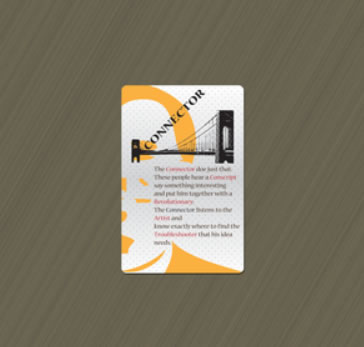
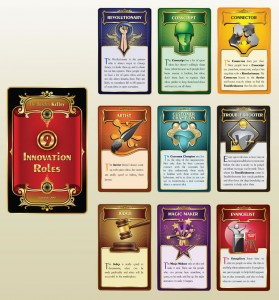
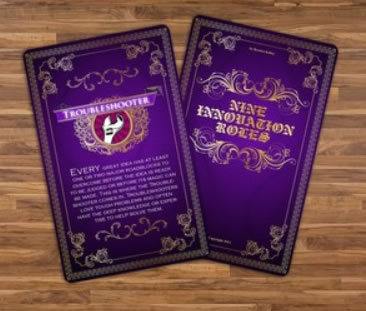
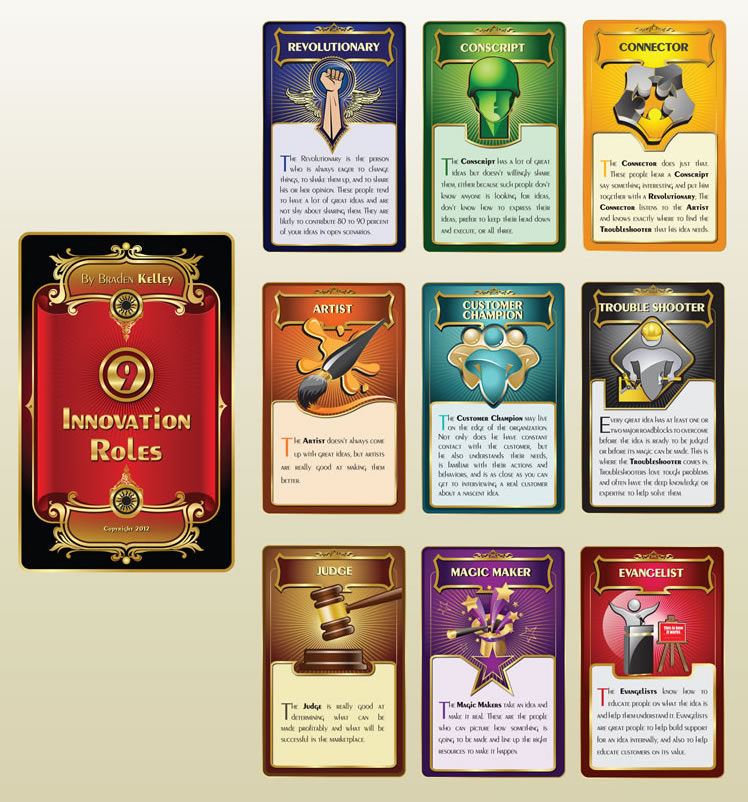
I am proud to announce the winning design for the Nine Innovation Roles Interactive Card Deck.

It comes to you from a $500 design contest I ran on the popular crowdsource site – CrowdSpring. As I wrote previously I was unsure whether to use 99Designs or CrowdSpring and even went so far as to throw it out as a question to the audience here to see what the wisdom of the crowd said. In the end, CrowdSpring won the business over 99Designs because they took the time to interact with me on Twitter when I was busy also asking my 12,800+ Twitter followers the same question.

Nine Innovation Roles Card Deck Coming Soon

Winning Design - Nine Innovation Roles Interactive Card Deck

Now I will post the winning design on my IndieGoGo project page to build the funding momentum for the project there. Some of you may remember that I first tried to start a project on Kickstarter but was summarily rejected – I guess for not being cool enough or arty enough. No matter. I look forward to working with the folks at IndieGoGo instead.

If you’re not familiar with The Nine Innovation Roles, check out this presentation:

Build a Common Language of Innovation

Subscribe to Human-Centered Change & Innovation WeeklySign up here to get Human-Centered Change & Innovation Weekly delivered to your inbox every week.

Please Help Pick Nine Innovation Roles Card Design

We are in the final day of the CrowdSpring $500 design contest for designing the Nine Innovation Roles Card Deck. Once I pick a winner then I will need to pick a printer for the large format cards.

There are some very interesting and widely diverse designs to choose from for the Nine Innovation Roles Card Deck and I’d love to hear your vote on which winner I should choose in the comments below by adding a comment that says “Design One” or “Design Seven” or “Design Nine”, etc.

Here are the designs so far:

Design One

Design 1 - Nine Innovation Roles Card Deck

Design Two

Design 2 - Nine Innovation Roles Card Deck

Design Three

Design 3 - Nine Innovation Roles Card Deck

Design Four

Design 4 - Nine Innovation Roles Card Deck

Design Five

Design 5 - Nine Innovation Roles Card Deck

Design Six

Design 6 - Nine Innovation Roles Card Deck

Design Seven

Design 7 - Nine Innovation Roles Card Deck

Design Eight

Design 8 - Nine Innovation Roles Card Deck

Design Nine

Design 9 - Nine Innovation Roles Card Deck

Build a Common Language of Innovation

Subscribe to Human-Centered Change & Innovation WeeklySign up here to get Human-Centered Change & Innovation Weekly delivered to your inbox every week.

Nine Innovation Roles Card Deck Coming Soon

People have been asking me to do more with The Nine Innovation Roles since I started speaking about them at conferences and events around the world, and now I am finally doing something to answer these requests.

I am pleased to announce a crowdfunding project on Indiegogo to fund the creation of an interactive card game focused on The Nine Innovation Roles – after finding out innovation is not allowed on Kickstarter.

At the same time there is a $500 design contest underway on Crowdspring to create the designs for the card deck – and possibly posters too!

Nine Innovation Roles Crowdspring Project

I am trying to raise $2,500 on Indiegogo to cover the design contest prize and fees, and the initial printing costs for 1,000 Nine Innovation Roles Card Decks.

You can show your support for this project by pledging any amount or by picking any of the great perks available for as little as $15.

If you are an innovation product seller or service provider, for $300 you can reserve one side of a card in the deck to be your very own in every pack sold (starting with an initial print run of 1,000 card decks), or for $500 you can have a whole card to yourself (FRONT and BACK).

Build a Common Language of Innovation

Subscribe to Human-Centered Change & Innovation WeeklySign up here to get Human-Centered Change & Innovation Weekly delivered to your inbox every week.

Innovation Not Allowed on Kickstarter?

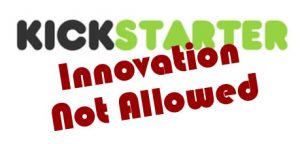
Kickstarter Logo - No Innovation AllowedI’m in the throes of bringing The Nine Innovation Roles to life in an interactive card game for use in workshops and team meetings, and as someone who writes about harnessing external talent, it only made sense that I should post a project on Kickstarter to engage in a bit of crowdfunding to fund:

  • A design contest on CrowdSpring or 99Designs
  • The costs of an initial production run of the Nine Innovation Roles card decks.

Imagine my surprise when Kickstarter rejected my non-fiction publishing project submission.

Is innovation not allowed on Kickstarter?

I re-read the guidelines, submitted an appeal figuring there must have been some sort of mistake, and waited for a favorable response.

But, again I was surprised to receive notification that my appeal was rejected.

An email asking for clarification, in advance of this article, went unanswered.

So I am left to assume that yes, innovation is not allowed on Kickstarter. I should have seen the writing on the wall when I did a search for “innovation” on Kickstarter and it returned a nearly empty set of search results.

I guess crowdfunding the publishing of a tool to help make teams and organizations more successful at innovation wasn’t sexy or artsy enough for Kickstarter.

But, the news isn’t all doom and gloom.

Some of you may remember that I put out an open call a couple of weeks ago asking for opinions on whether I should post my design contest on CrowdSpring or 99Designs. I also tweeted the same question, and well, CrowdSpring answered one of my tweets and the folks at 99Designs didn’t. And as someone who also writes about social business, guess who I’m trusting to host the design contest for The Nine Innovation Roles card decks?

You guessed it, CrowdSpring.

Luckily, unlike Kickstarter, the folks at CrowdSpring believe in supporting innovation projects and I’ve launched a $500 design contest on their platform that is open to the world here:

Nine Innovation Roles Crowdspring Project

I really look forward to seeing how the global community of graphic designers will interpret the Nine Innovation Roles and help me breathe life into them and create a beautiful, fun deck of cards to be used along with some interactive exercises in workshops and team meetings to increase the innovation success of teams or organizations.

Oh, and if you’re looking to fund your innovation project, you might want to invest your time somewhere else other than Kickstarter – where innovation is not allowed.

I will now be considering some secondary platforms for my crowdfunding project. Do you have any favorites?

UPDATE: I’ve launched a crowdfunding project on IndieGoGo after being rejected by Kickstarter.

Happy innovating (and designing)! 🙂

Build a Common Language of Innovation

Subscribe to Human-Centered Change & Innovation WeeklySign up here to get Human-Centered Change & Innovation Weekly delivered to your inbox every week.