In support of my crowdfunding project over on IndieGoGo I am offering an incredible deal to the first TEN (10) individuals to grab this perk:
In exchange for each $500 investment, the first TEN (10) people anywhere in the world will get:
One of only TEN (10) spots in an online seminar where I will personally train you on how to facilitate a Nine Innovation Roles workshop or public seminar
A share of any Nine Innovation Roles Workshop leads that I can’t fulfill myself
A Nine Innovation Roles Seminar Pack – which includes TEN (10) Nine Innovation Roles Group Diagnostic Tools to use with your first set of workshop participants (a $199.99 value)
This is a great opportunity to add the Nine Innovation Roles Group Diagnostic Workshop to your roster of innovation services that you offer to clients. You should be able to charge between $2,000-$5,000 + expenses for each of the sessions you facilitate depending on the length and amount of custom content, so you should recoup your $500 investment after running your first workshop or public seminar.
The Nine Innovation Roles diagnostic workshop will create a fun, interactive experience for innovation teams or organizations to use to help people better understand what roles they fill on innovation projects, why the team’s or organization’s innovation efforts are failing, and how they can together improve the innovation performance of their teams or organization.
So, grab this Amazing Innovation Keynote and Nine Innovation Roles Workshop Deal and help your innovation teams be more successful in the future. Don’t wait. Be one of only TEN (10) people worldwide to get this perk, or pre-order the seminar kit and run run workshops or seminars on your own.
Sign up here to get Human-Centered Change & Innovation Weekly delivered to your inbox every week.
It’s a wedding proposal from an actor in my hometown to his now bride to be, and is a great example of re-imagining a traditional activity in our society – the marriage proposal.
The things I love about it are not the actual creative execution but the principles exemplified by the experience:
If you have a great product or service, people will be willing to help you sell it
If it’s really good, they may go out of their way to help you sell it – or even do so without asking your permission
Oregon fosters creativity 😉
Focus on more than the transaction – Make magic!
Skills can from other contexts can be valuable to the current challenge
Have fun with everything you do and you’ll have better results 🙂
Don’t just ask people to help, make it fun to help
Give people something to talk about and feel the love spread 🙂
Even if your customers or community do the sales pitch – YOU’VE GOT TO CLOSE
What magic are you making?
Are there boring transactional parts of your business that could use a little love and magic?
Don’t be afraid to invest in reducing the friction in your adoption process. You’ll improve the value access performance in your innovation equation:
Innovation Success (or even business success)
= Value Creation
+ Value Access
+ Value Translation
I came across Yougme Moon’s “Anti-Creativity Checklist” over at the Harvard Business Review after a tweet from @lindegaard and it got me thinking…
In order to build a culture capable of encouraging innovation or creativity (or both), you must first do an inventory of the psychology and mental models in play in your organization.
One great way to do this would be to build an ‘anti-innovation checklist’ or an ‘anti-creativity checklist’. If you start watching the vocabulary that people use in meetings where ideas are being discussed, the behavior of senior leadership as it relates to these areas, and most importantly – how people respond – you’ll get a better sense of where your organizational challenges lie with respect to innovation and creativity. Wouldn’t that make such an exercise of great value to an organization?
Anyways, as an example, I’ve pulled out the fourteen items on Yougme Moon’s checklist from the video above, which you may just want to watch:
Play it safe. Listen to that inner voice.
Know your limitations. Don’t be afraid to pigeonhole yourself.
Remind yourself: It’s just a job.
Show you’re the smartest guy in the room. Make skepticism your middle name.
Be the tough guy. Demand to see the data.
Respect history. Always give the past the benefit of the doubt.
Stop the madness before it can get started. Crush early-stage ideas with your business savvy.
Been there, done that. Use experience as weapon.
Keep your eyes closed. Your mind too.
Assume there is no problem.
Underestimate your customers.
Be a mentor. Give sound advice to the people who work for you.
Be suspicious of the “creatives” in your organization.
When all else fails, act like a grown-up.
What is on your “anti-innovation checklist” or your “anti-creativity checklist”?
Please feel free to share yours in the comments below.
Not much has changed since 2010 when on Blogging Innovation (which has now become Innovation Excellence) we asked the following question as part of a series of Innovation Perspectives:
What product or sector is in desperate need of innovation?‘.
Here was my response:
When I first saw this topic I wanted to write about education innovation, but I resisted when a couple of the contributing authors chose this topic. I wrote about the publishing industry instead, but then in 2009 I came across a Phil McKinney article and had the opportunity to meet Sir Ken Robinson then too, and my passions for an education revolution were stirred.
We sit at the nexus of amazing new education technology capabilities, the globalization of work, and an incredible transformation in the needs of employers. The path forward is not the same as the road behind, but our education system is proceeding as if it were.
“We need our children to be Masters of Mystery and Einsteins of Insight.”
– Braden Kelley
Instead of pursuing the current education mantra of more, better, faster, we need to instead rethink how we educate our children because we need to prepare them for a different world. A world in which flexibility, adaptibility, creativity, and problem solving will be prized ahead of the deep technical knowledge that is fast becoming a commodity and easily available.
I’ve said here before that the keys to business success are insight and execution. We are ending an era of incredible business focus on execution excellence and are entering an era of an increasing business focus on insight. Excellent execution will always be valued and required, but more and more components of this execution are shifting from the developed world to the lower-wage developing world.
We are currently in a race to the middle when it comes to standard of living as the developing countries like China, India, Brazil and others climb up the pyramid and developed countries like the United States, Italy, Greece and others slide down. Those developing countries wanting to stay near the top of the flattening standard of living pyramid will have to re-tool their education systems to to prepare their populations to grab as big a share as possible of the higher-wage insight-driven jobs.
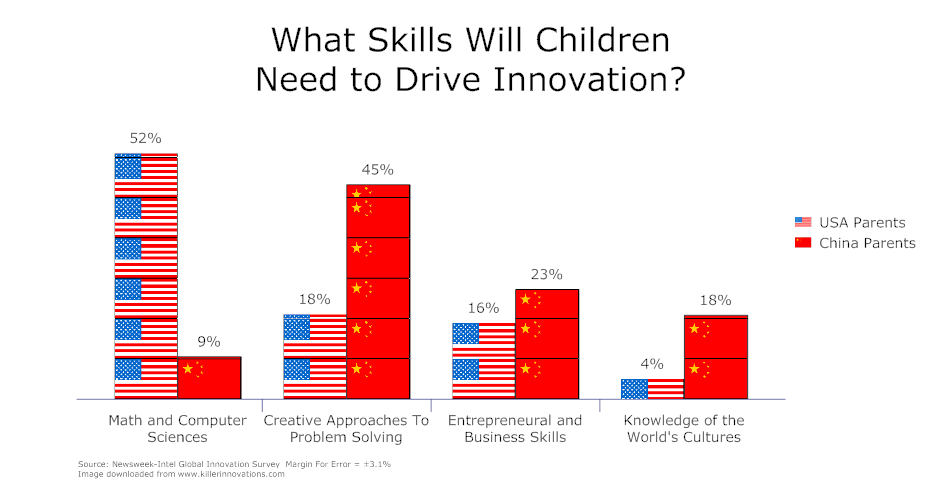
Here is an interesting chart from a Newsweek-Intel Study reformatted by Phil McKinney:
Looking at the differences in perspectives between the American and Chinese respondents in the research, I came to two possible conclusions:
I am Chinese
The United States (and many other developed countries) are headed in the wrong direction and better change course on education fast
You may think that my views on education are too business-focused, but look, even the arts are being globalized (look at Cirque du Soleil).
I believe that we underestimate children’s ability to understand the real world and I think that the education system and the business world need each other more than they realize. We need to re-imagine our public-private partnerships and expectations when it comes to education, and we need to start educating today’s young kids for tomorrow’s world.
The fact is that we are pushing the limits of taking today’s understanding of science to improve productivity an standard of living. Going forward we will need to break through currently held physical and natural limits and an expanded understanding of our physical and natural worlds. This will require a new generation of scientists and workers who can synthesize approaches from different cultures and disciplines, that are masters of creative approaches to problem solving, and that have the entrepreneurial spirit to breakthrough perceived barriers. Are these the kind of students we’re educating?
What kind of students is your country educating?
As an added bonus, if you haven’t seen it, I encourage to check out Sir Ken Robinson’s video on “Creativity versus Literacy” here:
Sign up here to get Human-Centered Change & Innovation Weekly delivered to your inbox every week.
One of the best Twitter names that I’ve come across in the past few years is @ShowerThinker – almost as cool as mine – @innovate. It’s an account for an inventor that makes post-it notes for the shower called Aqua Notes.
This Twitter name captures a well-understood fact – that a lot of great ideas (and ultimately innovations) come to us not from brainstorming, but from the connection to our subconscious that occurs in the shower (or pretty much anywhere else in the bathroom). If so many great ideas come to us when our active mind is elsewhere, then why is such little attention paid to this source of innovation.
A lot has been written about creativity and the brain, left brain vs. right brain thinking, and how often the brain just needs to get out of its own way for creativity to occur as there is no single creative area of the brain.
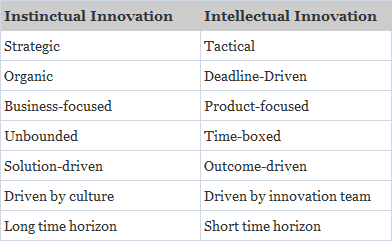
In my own cuarto de bano moment, I came up with this contrasting phrase to help us frame the conversation – Instinctual Innovation versus Intellectual Innovation.
Intellectual Innovation begins with active efforts to capture and develop ideas using techniques such as brainstorming, greenhousing, etc.
Instinctual Innovation springs forth from a collection of sometimes un-connected information that collects in an individuals brain. Often ideas that form the basis for instinctual innovation rattle around as part of a collection of problems in search of solutions for a long time before emerging.
I’ve created this table to lay out some of the differences:
Innovation has garnered a lot of attention in the press over the past couple of years, and many executives have the word rolling off their tongues quite easily now. In some organizations this has translated into employees being trained to be better intellectual innovators, or into creativity consultants helping stimulate the organization’s intellectual innovation for a particular project.
But much less attention is being paid to instinctual innovation. To build sustainable instinctual innovation you have to train members of your organization to be business innovators. You also need to provide members with a set of clear and actionable innovation goals along with a simple visual framework to decipher them. And, most importantly you have to invest in the organizational change necessary to create a culture of continuous innovation.
Then, and only then, will instinctual innovation be best able to emerge from any part of the organization on its own timeline and integrate with the intellectual innovation that is also going on at the same time.
Intellectual innovation can help drive the short-term growth of an organization. But, when combined with instinctual innovation, the two together can create an innovation engine to power the organization now and into the future.
What do you think?
Sign up here to get Human-Centered Change & Innovation Weekly delivered to your inbox every week.
A pioneer in research on play, Dr. Stuart Brown says humor, games, roughhousing, flirtation and fantasy are more than just fun. Plenty of play in childhood makes for happy, smart adults – and keeping it up can make us smarter at any age.
Pascal Wattiaux (whom I met after writing the Gever Tulley article) recommended an article on play from the Brick Journal, Issue 6. The article recounts an adventure in the Middle East with LEGO’s Serious Play – a consulting method, pioneered by LEGO, that centers on play. The article highlights four Serious Play consulting companies coming together to work with the 300 incoming graduate students for the King Abdullah University of Science and Technology (KAUST) in Saudi Arabia. Here is an excerpt:
“The community building began with the students placed into teams and, led by Jens Hoffmann of Strategic Play, proceeded with the team members building LEGO models to represent themselves, their ideal teammate and what each individual would contribute to their team during the two day workshop. From there, the teams created a group model, with the team members building and writing about how their community could service society. While the models were challenging to think about, the students all were creative in their models and bonded while building the group model, with groups getting more and more animated in their discussions and building. Building was punctuated by comments and laughs as teams built different models and items. With a common goal, the teams began to bond, regardless of language and culture, and by the end of the day, each table had a shared model, a shared language and shared view of the world.”
So not only does play help to create happy, smart adults but it helps to create stronger emotional bonds and collaboration among team members. This second excerpt highlights the learnings from the two-day LEGO Serious Play workshop:
“Afterwards, there was a final session devoted to evaluating the lessons learned. Bashar Al Safadi of Omniegypt was the host of this session, where the teams discussed what they learned from all of their activities. From their discussions, the top points were determined and presented to all of the teams. And through all the differences the students had when they first met, they found they had a lot in common – and they all had learned to communicate and have fun with each other.
After the session ended, many of the students took pictures with their new classmates and now friends, but one team took some of the ping-pong balls they used and signed them as a group, as a keepsake of their first meeting. At Discover KAUST, the students discovered more than a college. They discovered a community.”
You may have heard the saying “The family that plays together stays together.” Well, there is everything to be said for finding a place for play in the workplace (especially if it increases employee engagement and innovation), but can managers accept that?
What do you think?
Image Credits: KAUST, LEGO Serious Play
Sign up here to get Human-Centered Change & Innovation Weekly delivered to your inbox every week.
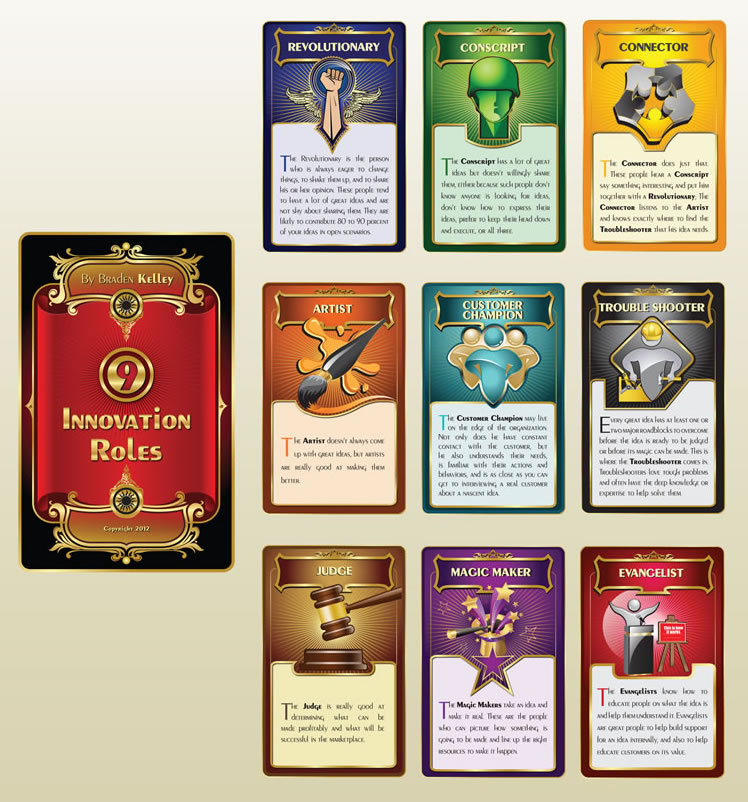
I’m in the throes of bringing The Nine Innovation Roles to life in an interactive card game for use in workshops and team meetings, and as someone who writes about harnessing external talent, it only made sense that I should post a project on Kickstarter to engage in a bit of crowdfunding to fund:
The costs of an initial production run of the Nine Innovation Roles card decks.
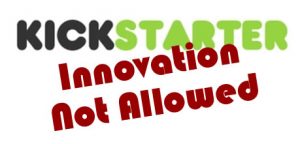
Imagine my surprise when Kickstarter rejected my non-fiction publishing project submission.
Is innovation not allowed on Kickstarter?
I re-read the guidelines, submitted an appeal figuring there must have been some sort of mistake, and waited for a favorable response.
But, again I was surprised to receive notification that my appeal was rejected.
An email asking for clarification, in advance of this article, went unanswered.
So I am left to assume that yes, innovation is not allowed on Kickstarter. I should have seen the writing on the wall when I did a search for “innovation” on Kickstarter and it returned a nearly empty set of search results.
I guess crowdfunding the publishing of a tool to help make teams and organizations more successful at innovation wasn’t sexy or artsy enough for Kickstarter.
But, the news isn’t all doom and gloom.
Some of you may remember that I put out an open call a couple of weeks ago asking for opinions on whether I should post my design contest on CrowdSpring or 99Designs. I also tweeted the same question, and well, CrowdSpring answered one of my tweets and the folks at 99Designs didn’t. And as someone who also writes about social business, guess who I’m trusting to host the design contest for The Nine Innovation Roles card decks?
You guessed it, CrowdSpring.
Luckily, unlike Kickstarter, the folks at CrowdSpring believe in supporting innovation projects and I’ve launched a $500 design contest on their platform that is open to the world here:
I really look forward to seeing how the global community of graphic designers will interpret the Nine Innovation Roles and help me breathe life into them and create a beautiful, fun deck of cards to be used along with some interactive exercises in workshops and team meetings to increase the innovation success of teams or organizations.
Oh, and if you’re looking to fund your innovation project, you might want to invest your time somewhere else other than Kickstarter – where innovation is not allowed.
I will now be considering some secondary platforms for my crowdfunding project. Do you have any favorites?
I had coffee with a clever marketing and sales consultant recently and one of the topics we discussed was the impact of location on a group’s ability to innovate. At the time we spoke about getting people to think in new ways by getting people to think in new places. That is to say that if you always meet in the same places to try and be creative as a team, don’t you ultimately get the same types of thinking? In other words, do you hit a creativity plateau by meeting in the same places all the time?
That of course is part of the reason that companies have off-sites, but I would argue further that the “same places” includes the typical locations for off-sites. I would argue that if you are trying to get people to think differently that you have to take people to an unusual, unexpected location. I would argue that you announce one location for the meeting that you have no intention of going to, get everybody to assemble there, and then go somewhere else. What this achieves is that in the time leading up to the meeting people start preparing mentally for what to expect and how things will go, but then when they show up and you announce you are going somewhere else, you will generate buzz and excitement, the walls of expectation will come tumbling down and you will get people to begin thinking in a different way than they were prepared to think.
That is only half the battle though. My next recommendation would be to pre-arrange for people to bring portable seating with them or bring it for everyone yourself. Then if you are trying to get new thinking, get radical but relevant. For the approach I am to suggest, you must keep the groups small, tailored to the venue you select (you don’t want to be asked to leave, or at least not too quickly).
For example, salespeople for BestBuy who are trying to figure out how to do things differently might go meet in an auto dealership, or a Nordstrom’s, or a 7-eleven. Find a place out of the way and start your meeting. If asked to leave, have your meeting on the sidewalk outside or in the parking lot (going back inside as needed). The site you choose should be related to your business but not directly related – notice Circuit City was not an example.
The site could also however be related to your topic. A meeting to talk about how to better understand what customers want could be held at a busy intersection with stop lights in case you wanted to ask real people what they think. Just please make sure to be careful and not get yourself run over when trying to ask people questions(stay on the sidewalk).
If you meet at someone else’s business, please try to choose a slow time of day and stay off to the side and out of the way. If you’re looking for more “natural” thinking, then meeting in the woods, by a river, or on a hill can also be good. Regardless of where you choose to meet, just be sure to debrief at the site, or literally just outside your own building before returning to work.
If you try this approach to uncovering new thinking I think you will be pleasantly surprised, and I would love it if you send in your stories and photographs of different unusual places you meet and what the topic for the meeting was. I look forward to seeing your “Out of Four Walls” thinking!
Sign up here to get Human-Centered Change & Innovation Weekly delivered to your inbox every week.
Whether you’re in business, school, jail, or debt, that’s how it all gets rolling. First there’s the idea, then there’s the manifestation of the idea — assuming, of course, that the person with the idea has their act together.
If you have any doubt, take a look around you.
Everything you see began as an idea: The microchip, the chocolate chip, the fishing net, the internet, the company you work for, and the company you keep. All of it. Everything. Even the Universe, some say, began as an idea in the mind of the Creator. There are two schools of thought on this subject.
The first ascribes the origin of ideas to the efforts of inspired individuals who, through a series of spontaneously occurring or purposeful mental processes, arrive at a useful new possibility.
The second school ascribes the appearance of ideas to a transcendent force, a.k.a. the “Collective Unconscious,” the “Platonic Realm,” the “Muse,” or the “Mind of God.”
According to this perspective, ideas are not created, but already exist, becoming accessible to human beings who have tuned themselves enough to be able to receive them.
The first approach is usually considered Western, with a strong bias towards thinking. It is best summarized by Rene Descartes “I think therefore I am” maxim. Most business people subscribe to this approach, as it gives great weight to the power of the mind.
The second approach is usually considered Eastern, with a strong bias towards feeling. It is best summarized by the opposite of the Cartesian view: “I am therefore, I think.” Most artists and creative types are associated with this approach, with its focus on intuitive knowing — a way of understanding that does not lend itself to analysis and quantification.
Both approaches are valid. Both are effective. And both are used at different times by all of us, depending on our mood, circumstances, and conditioning. No matter what our preferred approach, however, the challenge remains the same for all of us: how to honor, develop and manifest our ideas. This is a challenge made increasingly more difficult these days by the fact that, somehow, ideas have gotten a bad rap. If you have one (and most of us do), chances are good you usually apologize before talking about it (if you talk about it at all) with some variation of “Uh… er… um… it’s just an idea.” Most of us, in fact, have made a habit of discounting ideas — in ourselves and in others. “A dime a dozen” is all we think they’re worth.
And so the prophecy comes true.
Our ideas are diminished, not because they are worthless, but because we do not know how to elicit their value. We do not understand how to cultivate them. Afraid we will be judged, or worse, fail — we toss them out long before their time. Like Jack’s mother, of Beanstalk fame, we throw our magic beans out the window, doubting they had any real value in the first place.
Thanks to Val Vadeboncoeur for finding most of these quotes.
“The only real valuable thing is intuition.” – Albert Einstein
“Trust yourself. You know more than you think you do.” – Benjamin Spock
“Systems die; instincts remain.” – Oliver Wendell Holmes
“It is through science that we prove, but through intuition that we discover.” – Henri Poincare
“Intuition becomes increasingly valuable in the new information society precisely because there is so much data.” – John Naisbitt
“A hunch is creativity trying to tell you something.” – Frank Capra
“It is always with excitement that I wake up in the morning wondering what my intuition will toss up to me, like gifts from the sea. I work with it and rely on it. It’s my partner.” – Jonas Salk
“All human knowledge thus begins with intuitions, proceeds thence to concepts, and ends with ideas.” – Immanuel Kant
“Trust your own instinct. Your mistakes might as well be your own, instead of someone else’s. – Billy Wilder
“Your time is limited, don’t waste it living someone else’s life. Don’t be trapped by dogma, which is living the result of other people’s thinking. Don’t let the noise of other’s opinion drown your own inner voice. Everything else is secondary.” – Steve Jobs
“The more and more each is impelled by that which is intuitive, or the relying upon the soul force within, the greater, the farther, the deeper, the broader, the more constructive may be the result.” – Edgar Cayce
“I feel there are two people inside me — me and my intuition. If I go along against her, she’ll screw me every time, and if I follow her, we get along quite nicely.” – Kim Basinger
“Intuition is the supra-logic that cuts out all the routine processes of thought and leaps straight from the problem to the answer.” – Robert Graves
“The intuitive mind is a sacred gift and the rational mind is a faithful servant. We have created a society that honors the servant and has forgotten the gift.” – Albert Einstein
“You must train your intuition. You must trust the small voice inside which tells you exactly what to say, what to decide.” – Ingrid Bergman
“The power of intuitive understanding will protect you from harm until the end of your days.” – Lao Tzu
“People who lean on logic and philosophy and rational exposition end by starving the best part of the mind.” – William Butler Yeats
“Conclusions arrived at through reasoning have very little or no influence in altering the course of our lives.” – Carlos Casteneda
“Intuition will tell the thinking mind where to look next.” – Jonas Salk
“Trust your hunches. They’re usually based on facts filed away just below the conscious level.” – Dr. Joyce Brothers
“Follow your instincts. That’s where true wisdom manifests itself.” – Oprah Winfrey
Sign up here to get Human-Centered Change & Innovation Weekly delivered to your inbox every week.

 Sign up here to get Human-Centered Change & Innovation Weekly delivered to your inbox every week.
 Here was my response:
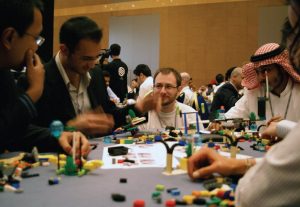 “The community building began with the students placed into teams and, led by Jens Hoffmann of Strategic Play, proceeded with the team members building LEGO models to represent themselves, their ideal teammate and what each individual would contribute to their team during the two day workshop. From there, the teams created a group model, with the team members building and writing about how their community could service society. While the models were challenging to think about, the students all were creative in their models and bonded while building the group model, with groups getting more and more animated in their discussions and building. Building was punctuated by comments and laughs as teams built different models and items. With a common goal, the teams began to bond, regardless of language and culture, and by the end of the day, each table had a shared model, a shared language and shared view of the world.”
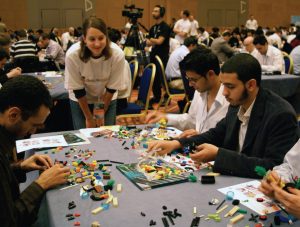 “Afterwards, there was a final session devoted to evaluating the lessons learned. Bashar Al Safadi of Omniegypt was the host of this session, where the teams discussed what they learned from all of their activities. From their discussions, the top points were determined and presented to all of the teams. And through all the differences the students had when they first met, they found they had a lot in common – and they all had learned to communicate and have fun with each other.
 I’m in the throes of bringing

 I had coffee with a