From my experience, 80% of innovations within most companies are “dot solutions.” That is, innovations are typically developed by individuals from a single domain of expertise. Deep expertise is valued. Dig deep wells.
While spending time recently at 3M, I learned that 80% of their innovations are “line solutions.” That is, multiple domains of expertise are involved. For example, they might blend expertise from adhesives with expertise from abrasives to develop a new solution. Although this may be unusual within other organizations, at 3M, this is the norm. They are masterful at connecting dots.
But is this connected approach valuable?
They shared with me some recent research they’ve been conducting. The results are fascinating.
In a nutshell, they found that…
Line thinkers within 3M – based on the number of patents they contributed to in different areas of expertise – contributed significantly higher financial returns for the organization.
In other words, the people who became exceptionally deep experts and never used that expertise to contribute to different parts of the business were less valuable than those who made contributions to a wide range of products.
The financial impact of line thinking is staggering.
And although this approach is not the norm in most organization, it can certainly be encouraged through shifting the culture to one that recognizes and rewards these types of contributions.
(for more on my perspectives on dot vs line thinking, please read my article from a while back – this is a critical concept for innovation – I discuss it further in “Best Practices Are Stupid”)
Sign up here to join 17,000+ leaders getting Human-Centered Change & Innovation Weekly delivered to their inbox every week.
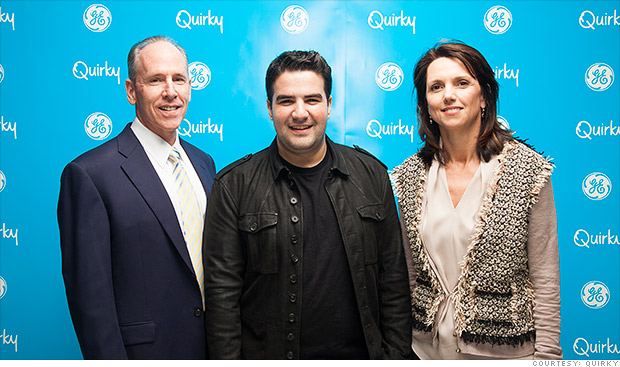
Last week GE and Quirky announced a new partnership where GE will make some of its library of patents available as part of Quirky’s new inspiration platform, allowing inventors to use some of its patents in their potentially novel consumer product invention ideas. This on its surface is a very interesting and logical open innovation partnership. Some people are talking about it as a crowdsourcing partnership, but it isn’t really because the work product is not well-defined and being sourced from multiple competing providers. No, this is an open innovation partnership.
Here is the Quirky and GE partnership announcement video:
It is very interesting to me that GE chose to partner with Quirky and not someone like Innocentive, NineSigma, Idea Connection or someone else. I’m curious what others think this indicates about the future of these firms. Personally, I think that this is something that Quirky is better equipped to make happen than these other firms, and that Innocentive and others still fill an important need using a completely different approach (challenge-driven innovation).
Whether or not GE creates any sizable new businesses from their participation in this partnership, I still think this is a brilliant marketing move by Beth and her team and it will be interesting to see whether any impactful inventions come from people leveraging GE’s patent portfolio.
Here is Quirky’s video announcing their inspiration platform (which they raised $68 million to help build):
There is one thing that bugs me a wee bit about Quirky. My tagline since 2006 has been “Making innovation insights accessible for the greater good” and it feels like they’ve swiped it to create theirs – “Making invention accessible.” Surely as creative people they could have invented their own tagline instead of swiping mine. 😉 (wink)
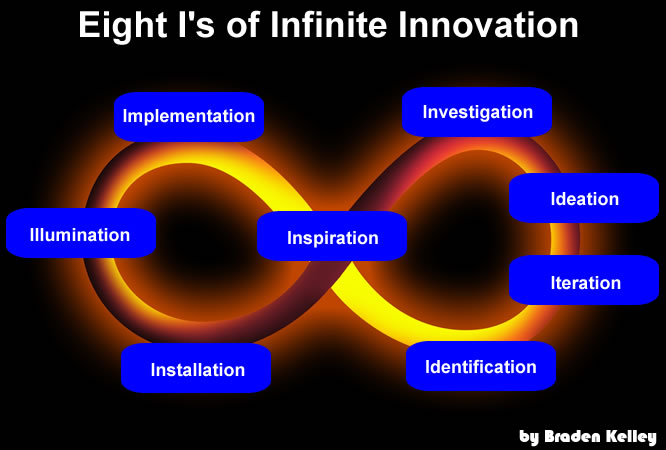
But, there is another idea of mine trapped in this announcement that I’d like to highlight and set free, and that is the idea that innovation is not just about ideas, but that other factors are equally important – including inspiration, investigation, and iteration. These are captured in my incredibly popular Eight I’s of Infinite Innovation framework.
Be sure and follow this article link to the Eight I’s of Infinite Innovation if you missed the link above, or if you’re not clicking away to learn more, here is a quick list of the eight stages:
Inspiration
Investigation
Ideation
Iteration
Identification
Implementation
Illumination
Installation
Personally I don’t think their platform appears to go far enough to deliver inspiration or to empower investigation, and as a software and internet guy I would be happy to help Quirky and GE strengthen the solution if they’re interested in making this platform more successful.
Will any successful innovations come out of this GE and Quirky partnership?
I’d love to hear what you think.
Image credits: GE, Quirky
Sign up here to get Human-Centered Change & Innovation Weekly delivered to your inbox every week.
In the world of innovation, there seems to be this belief that we’re supposed to let everybody be free thinkers and let them do whatever they want. But this actually destroys innovation. We need structure. We need constraints.
I’ll give you a really simple example.
If you’ve been following my blog, you’ll notice that about a month ago, I made a bit of a change.
Now, instead of just writing whenever I feel inspired to do so or writing about whatever I want, I created structure.
Mondays, there’s a Monday Morning Movie. Tuesday, there’ll always be the transcription of the movie and an occasional Tuesday Travel Tip. Wednesday is my Wednesday Work Wisdom. And Friday is my Friday Fun Fact. (Check out my article to see how the makers of Star Trek effectively used the Power of Positive Constraints https://tinyurl.com/brye9ct)
As a result, over the past month, without fail, there has been a minimum of four blog entries and, in some weeks there have been five or six.
You’ll notice that when I didn’t have structure, when I didn’t have those positive constraints, there would be some weeks where I would have only one entry. And there would even be periods of time where I wouldn’t write at all.
Constraints are actually a good thing. First of all, they give us structure, forcing us to think more clearly around something specific. But it also sets a tone for what we need to get done. If I’m committing to completing certain things every day, and I can do those activities consistently, that’s very valuable.
And it’s not just about publicly declaring what you will get done. There’s another value that comes from having positive constraints: It reduces the level of thinking you need to do so that it allows you to be more creative.
If I gave you a blank sheet of paper and said, “Hey, come up with a great idea on how to improve your business,” you might come up with a lot of ideas. Probably, most would be pretty bad.
And I suspect that you would actually struggle to generate even a few great ideas. When given no constraints, we don’t know where to begin.
On the other hand, if we worked on defining a really good problem statement – identifying what is the one area of your business where there is the greatest opportunity; identifying where you differentiate yourself from your competitors – that might actually give you even better results, more creativity, and even more value.
Constraints are not bad. We seem to believe that people should “think outside the box,” but anybody who’s been following my work knows that my philosophy is to find a better box (aka constraints).
Being organized, having structure, and working within constraints are not bad. These are things that will actually increase and enhance your level of creativity.
So, look at an area in your life where you’re struggling to get things done. Maybe part of the issue is confusion and a lack of clarity. A lack of clarity comes out of a lack of constraints.
Constraints will give you clarity. Anytime that you feel stuck or confused, think about what structures you could put in place that would keep you accountable, that would keep you on track and on target, and improve your level of creativity.
When you start to think about positive constraints as a positive thing, I promise you, you will enhance your creativity massively.
Sign up here to join 17,000+ leaders getting Human-Centered Change & Innovation Weekly delivered to their inbox every week.
Today I’m going to talk about ways that you can work a heck of a lot less, while having a much better life.
I’s like to talk about a philosophy that I call the “20/80/80 principle.” It’s a way for extracting the greatest amount of value out of what you’re doing, with the least amount of effort, thus freeing you up to do other things.
Now, if you’re going to use this general mindset of freeing yourself up, you need to recognize that it’s not just about making more money. It’s also about freeing yourself up from the current burdens that you may have in terms of lifestyle, and some of the decisions you’ve made.
Back in 1999, I was living in New Jersey. I had a three-bedroom house. It was a gorgeous place. I had furniture. I had lots of great things. And then I moved to England. When I moved to England, I ended up moving into a fully furnished one-bedroom apartment. Because I was moving across the Atlantic, I didn’t want to bring a lot of things with me, so I really got rid of everything.
Everything that I owned literally fit into two boxes – my clothes, my belongings, anything that I needed. Now, of course, living in a furnished apartment was great, because I didn’t have to worry about furniture, dishes, and things of that nature. But I owned almost nothing.
I discovered back then, that there is this freedom, this liberation, that comes from not having a lot of things and from being able to actually live the simplest life possible. There’s less clutter around you, therefore, there are less things to worry about. And because you’re spending less money, you don’t have to worry about making as much money. It give you freedom.
We often hear the expression, necessity is the mother of invention. The reality is though, that when you work out of necessity, your invention is limited. When you come from a place of freedom where you’re able to start living the life as you want to live, you tap into true creativity.
Therefore, instead of accumulating, what you need to do is start appreciating.
What you want to do is simplify your life. You want to be able to look at how you spend your money. Look at your house. Look at your car. And really ask yourself what would be the benefit of getting rid of them. Or downsizing to the point where you have less clutter and fewer financial obligations.
What you get out of that is more freedom. If you do this, it will then free you up to make completely different decisions with your life: how you choose to live your life and how you choose to work.
I know, for myself, having done this,that it is a liberating experience. By getting rid of things, you actually add to the positivity of your life and to the energy you’re able to create. Because you’re not innovating and creating from a place of need, desperation, or survival. Instead you are innovating from a perspective of freedom, pull, creativity, and passion.
So the first step to this is to really just take a hard look at your life and where you’re spending your money and what you have. And then ask yourself, “What do I really, truly need?” Once you do this, you can move onto the next step (which we’ll talk about Wednesday), which is a process and philosophy for being able to, not just free up your belongings, but free up your time.
When you free up your lifestyle and everything around you, and you free up your time, you then have this incredible freedom to truly create extraordinary things.
Sign up here to join 17,000+ leaders getting Human-Centered Change & Innovation Weekly delivered to their inbox every week.
Contrary to conventional wisdom, opposites do not attract. In fact, it has been scientifically proven that opposites repel. The reality is, like attracts like. As a result, your organization has a bunch of people who think the same way. People have personalities, and so do organizations. Many would call this their culture. This is an appropriate word since it is related to the word “cult.” Everyone in your organization most likely fits the mold. There are four primary organizational personalities:
Analytical: Organizations that value expertise and intelligence, like pharmaceutical companies, research labs (like NASA), and many financial institutions.
Results-Oriented: Organizations that value the bottom line, quarterly earnings results, and stock price like large, publicly traded organizations.
People-Centered: Organizations that value relationships and their impact on society, like non-profits and NGOs.
Creative: Organizations that value imagination and ingenuity, like advertising/branding agencies and some entrepreneurial start-ups.
The key word in each description above is “value.”
The personality of your organization is not determined by the work you do, the industry you are in, or the people you hire. It is determined by what is valued. Ask yourself which of the attributes above – analysis, results, people, or creativity – is valued the most. Don’t just look at your performance management system. What is truly valued, when push comes to shove, by your leadership? Who really gets promoted? What always gets recognized and rewarded?
Here’s the important point: Your organization’s personality will give you a hint at what is not valued.
This is your organization’s innovation blind spot. Non-profits are notorious for not valuing traditional business lessons. Large corporations are known for not truly appreciating creative individuals who think differently. In order to innovate more effectively, you need to first identify your innovation blind spot – what is not valued – and make a concerted effort to encourage these people, behaviors, and activities. Although your organization will have a single personality, you need to be adept at all four sets of innovation skills.
P.S. Personality Poker is a great tool for identifying your innovation personality and specific innovation blind spots.
Sign up here to join 17,000+ leaders getting Human-Centered Change & Innovation Weekly delivered to their inbox every week.
Most people think brainstorming sessions are all about ideas – much in the same way Wall Street bankers think life is all about money.
While ideas are certainly a big part of brainstorming, they are only a part.
People who rush into a brainstorming session starving for new ideas will miss the boat (and the train, car, and unicycle) completely unless they tune into the some other important dynamics that are also at play:
1. INVESTIGATION: If you want your brainstorming sessions to be effective, you’ll need to do some investigating before hand. Get curious. Ask questions. Dig deeper. The more you find out what the real issues are, the greater your chances of framing powerful questions to brainstorm and choosing the best techniques to use.
2. IMMERSION: While good ideas can surface at any time, their chances radically increase the more that brainstorm participants are immersed. Translation? No coming and going during a session. No distractions. No interruptions. And don’t forget to put a “do not disturb” sign on the door.
3. INTERACTION: Ideas come to people at all times of day and under all kinds of circumstances. But in a brainstorming session, it’s the quality of interaction that makes the difference — how people connect with each other, how they listen, and build on ideas. Your job, as facilitator, is to increase the quality of interaction.
4. INSPIRATION: Creative output is often a function of mindset. Bored, disengaged people rarely originate good ideas. Inspired people do. This is one of your main tasks, as a brainstorm facilitator — to do everything in your power to keep participants inspired. The more you do, the less techniques you will need.
5. IDEATION: Look around. Everything you see began as an idea in someone’s mind. Simply put, ideas are the seeds of innovation — the first shape a new possibility takes. As a facilitator of the creative process, your job is to foster the conditions that amplify the odds of new ideas being conceived, developed, and articulated.
6. ILLUMINATION: Ideas are great. Ideas are cool. But they are also a dime a dozen unless they lead to an insight or aha. Until then, ideas are only two dimensional. But when the light goes on inside the minds of the people in your session, the ideas are activated and the odds radically increase of them manifesting.
7. INTEGRATION: Well-run brainstorming sessions have a way of intoxicating people. Doors open. Energy soars. Possibilities emerge. But unless participants have a chance to make sense of what they’ve conceived, the ideas are less likely to manifest. Opening the doors of the imagination is a good thing, but so is closure.
8. IMPLEMENTATION: Perhaps the biggest reason why most brainstorming sessions fail is what happens after — or, shall I say, what doesn’t happen after. Implementation is the name of the game. Before you let people go, clarify next steps, who’s doing what (and by when), and what outside support is needed.
Sign up here to get Human-Centered Change & Innovation Weekly delivered to your inbox every week.
Some years ago, there was a big problem at one of America’s most treasured monuments — the Jefferson Memorial in Washington, DC.
Simply put, birds — in huge numbers — were pooping all over it, which made visiting the place a very unpleasant experience.
Attempts to remedy the situation caused even bigger problems, since the harsh cleaning detergents being used were damaging the memorial.
Fortunately, some of the National Parks managers assigned to the case began asking WHY — as in “Why was the Jefferson Memorial so much more of a target for birds than any of the other memorials?”
A little bit of investigation revealed the following:
The birds were attracted to the Jefferson Memorial because of the abundance of spiders — a gourmet treat for birds.
The spiders were attracted to the Memorial because of the abundance of midges (insects) that were nesting there.
And the midges were attracted to the Memorial because of the light.
Midges, it turns out, like to procreate in places were the light is just so — and because the lights were turned on, at the Jefferson Memorial, one hour before dark, it created the kind of mood lighting that midges went crazy for.
So there you have it: The midges were attracted to the light. The spiders were attracted to the midges. The birds were attracted to the spiders. And the National Parks workers, though not necessarily attracted to the bird poop, were attracted to getting paid — so they spent a lot of their time (and taxpayer money) cleaning the Memorial.
How did the situation resolve? Very simply.
After reviewing the curious chain of events that led up to the problem, the decision was made to wait until dark before turning the lights on at the Jefferson Memorial.
That one-hour delay was enough to ruin the mood lighting for the midges, who then decided to have midge sex somewhere else.
No midges, no spiders. No spiders, no birds. No birds, no poop. No poop, no need to clean the Jefferson Memorial so often. Case closed.
Now, consider what “solutions” might have been forthcoming if those curious National Parks managers did not stop and ask WHY:
Hire more workers to clean the Memorial
Ask existing workers to work overtime
Experiment with different kinds of cleaning materials
Put bird poison all around the memorial
Hire hunters to shoot the birds
Encase the entire Jefferson Memorial in Plexiglas
Move the Memorial to another part of Washington
Close the site to the general public
Technically speaking, each of the above “solutions” was a possible approach — but at great cost, inconvenience, and with questionable results.
They were, shall we say, not exactly elegant solutions.
Now, think about YOUR business… YOUR company… YOUR life.
What problems are you facing that could be approached differently simply by asking WHY…. and then WHY again… and then WHY again.. until you get to the core of the issue?
If you don’t, you may just end up solving the wrong problem.
THE FIVE WHYS TECHNIQUE
Name a problem you’re having
Ask WHY it’s happening
Get an answer
Then WHY about that
Get an answer
Then ask WHY about that — and so on, five times
Sign up here to get Human-Centered Change & Innovation Weekly delivered to your inbox every week.
You are alive today. You were alive yesterday. You were alive the day before that. This is good news from a survival perspective. Unfortunately it is bad news from an innovation perspective.
Your brain is wired to keep you alive.
Your brain makes the assumption that because you were alive yesterday, what you did previously is safe. Therefore repeating the past is good for survival. As a result, doing things differently, even if it seems like an improvement, is risky. Perpetuating past behaviors, from the brain’s reptilian perspective, is the safest way.
This is why innovation is difficult for most individuals and organizations.
Innovation is about change. It is about doing something different than you did previously. It is about trying something that you have not done before, and therefore may feel is a danger to your survival.
How does the brain’s survival instinct prevent innovation–and what can you do about it?
Here are seven ways to outsmart your brain:
Challenge No. 1: The brain wants pains solved first. The brain is wired to minimize loss. We want to keep what we already have. Equally, we are not interested in something new, until we address our pains. The brain seeks preservation over pleasure.
Solution: Recognize that people want their pains solved more than anything else. Be the aspirin. Innovation is not just about creating something new and different. It should solve a problem that people have. Infomercials are especially effective at demonstrating this.
Challenge No. 2: Expertise is the enemy of innovation. We build neural pathways to known solutions. What we know best (or in some cases have heard most recently) becomes our default answer. Unfortunately, once we find an answer to a problem, we stop looking for other possible solutions. As a result, the tried and true wins out and we get more of the same.
Solution: Keep looking. Although this sounds simple, don’t stop with the obvious answers. Keep pushing until you are out of ideas and then still push forward. Ask “who else has solved a problem like this?” A whitening toothpaste was developed by studying how laundry detergent whitens clothes. A medical device manufacturer learned how angioplasty balloons expand and contract by studying car airbag deployment.
Challenge No. 3: The brain wants solutions, not problems. In the world of business, we hear the expression, “Don’t bring me problems, bring me solutions.” From a survival perspective this makes sense. When faced with the possibility of being eaten by a lion, we don’t want to study our navel. Action is critical. However, in the world of innovation, the “problem” is actually more important.
Solution: Ask better questions. Einstein reputedly said, “If I had an hour to save the world, I would spend 59 minutes defining the problem and one minute finding solutions.” Instead of asking for broad ideas such as how to increase revenues, first identify the specific growth opportunities, untapped markets, emerging trends and current roadblocks. Then find solutions to those more focused challenges.
Challenge No. 4: The brain craves commonality. Contrary to conventional wisdom, opposites do not attract. It is safer to be in a tribe of people who think the same way. Things get done quickly. It feels effortless. But the downside is that it thwarts innovation.
Solution: Work with people who are not like you. Find people with different backgrounds, personality styles, and interests. Appreciate their contribution to you and your professional efforts. For example, I am someone who is disorganized and despises plans or planning. As a result, the first person I bring on to my team is a detail-oriented project manager who can make sure ensure that I get everything done.
Challenge No. 5: The brain sees what it believes. The brain uses a pattern matching technique called “confirmation bias.” In a nutshell, it rejects anything that is inconsistent with your belief structure. This is why two people can listen to the same political candidate and hear completely different things. From an innovation perspective, this may have us get attached to certain ideas, despite evidence proving that they are probably duds.
Solution: Avoid getting wed to your ideas by getting someone to play devil’s advocate. Any time you think to yourself, “Wow, this is a great idea,” get someone to poke holes in your logic. Don’t go to the same people for input. Seek out people who you suspect would reject the idea. Learn from them. Refine your solution based on numerous perspectives, not just your own biases.
Challenge No. 6: Your brain only sees a fraction of reality. What you focus on expands, to the exclusion of everything else. The brain’s reticular activating system is designed to filter out 99.99 percent of the stimuli out there. This prevents the brain from being overwhelmed by information. Unfortunately, as a result, you miss out on opportunities because you cannot even see they are there. When you are a technology expert, the solution to every problem involves software/hardware. Opportunities are limited to your frame of reference.
Solution: Sometimes you need to purposefully retrain the brain. Attend conferences unrelated to your work. Read magazines from different industries. This is why I don’t read books on innovation, but instead read about neuroscience, psychology, and sports performance. This helps me see more of the world and find opportunities in places I wouldn’t have thought to look.
Challenge No. 7: The brain thinks too much: The dorsolateral prefrontal cortex is the judgmental part of the brain. It is analytical and calculating. This is great for decision-making that requires logic. But it can kill innovation. When athletes choke, they are over thinking and constrict the neural pathways that allow access to their deeper capabilities.
Solution: Quiet that part of the brain through meditation, yoga, showering or any other relaxing activity. This allows you to gain access to the creative parts of your brain. Aristotle found his greatest breakthroughs while napping. One company found that they could speed up the development of new product ideas through meditation first thing in the morning.
The brain is incredibly powerful. And it does its job exceptionally well: perpetuate the species. It does this by ensuring the survival of the individual and the gene pool. Although this is of course valuable, it does limit our ability to try new things. Perpetuating the past is the surest way to survive. But for organizations, doing what you did in the past is the fastest path to extinction. By knowing how your brain is wired, you can choose to both survive and thrive.
Sign up here to join 17,000+ leaders getting Human-Centered Change & Innovation Weekly delivered to their inbox every week.
A while back on the drive home from the Seattle-Tacoma airport (SEA) after a trip where I served as an innovation speaker at an event, I noticed a large building by the side of the freeway advertising Indoor Sky Diving. The sign peaked my curiosity to investigate what indoor sky diving could possibly mean and so I set up a visit with iFly Seattle co-founder Lysa Adams.
My visit surfaced three key innovation-related concepts I would like to discuss:
Challenging Orthodoxies
Changing Perspectives
Tunnel Vision
1. Challenging Orthodoxies
Rowan and I talk a lot here on Innovation Excellence about how challenging orthodoxies is one way to identify insights to drive innovation efforts, and it made me wonder:
Have they successfully challenged the skydiving orthodoxies that you need the following to experience the thrill of skydiving or ‘flying’?
To jump out of an airplane
To carry and deploy a parachute
To learn several parachuting skills before progressing to sky diving
What if you could experience experience sky diving without the parachute and the airplane and the training?
Well, after my visit it was clear that iFly and SkyVenture have successfully challenged these orthodoxies with the indoor flying centers they’ve built here in Seattle and 22 other locations around the world including Hollywood, Dubai, and Singapore.
The facility itself seemed to be well-designed, recycling the air through two fan-driven intersecting circles of air that are accelerated from about 30mph through the basement up to 100-160 mph through the chamber up and back around again. Integrated into the space around the necessary apparatus are meeting rooms for corporate team-building events and party rooms for private functions. Organizations as diverse as Microsoft, Boeing, and the military have used the facility. It’s a pretty a cool facility and it was even a fair amount of fun just to watch others fly from the integrated viewing area.
So what is indoor skydiving and how can you experience the thrill of skydiving and ‘flying’ without the plane or the parachute? Well here is a video that shows an amateur learning the basic skills in their first session:
In a vertical wind tunnel people are able to fly in any of the four different skydiving positions – stomach, back, sitting, and head down (after mastering the previous one) – supported by wind speeds typically of 100 miles per hour or higher (an indoor hurricane). The vertical wind tunnel at iFly Seattle is state of the art, allowing wind speeds of up to 160 miles per hour.
I had the opportunity to learn how to fly and try it out for a couple of minutes, and I looked pretty much like the novices in the video above. I was flying successfully by my second minute, floating up beyond the reach of the instructor temporarily, and never felt any of the fear I might have felt if I had done my ‘flying’ by jumping out of an airplane. It was an amazing experience, and I could see how it could be very addictive.
So other than challenging orthodoxies, what does any of this have to do with innovation?
2. Changing Perspectives
Innovation often comes from looking at things from a different perspective, or from observing something potentially valuable to your target customers in another context that you can adapt and bring to them as a new solution offering.
This change in perspective can come from using creativity tools like Edward de Bono’s ‘Six Thinking Hats’ or other tools like mind mapping, brainstorming, brainwriting, SCAMPER, SIT, or from building and tapping into a Global Sensing Network.
Or it can come from physically changing your orientation. In the case of sky diving, sometimes sky diving teams have to get down on their bellies on wheelie boards on the concrete to show each other the tricks they plan to do in the air or in the vertical wind tunnel. It’s hard for the brain to imagine in a vertical orientation what is going to take place in a horizontal orientation, and this simple physical shift makes all the difference.
If it doesn’t come natural to our brains to imagine the horizontal from the vertical, imagine the trouble our brains have imagining different business contexts without being immersed in them. We often have to go see the other context for ourselves as a result, but a Global Sensing Network can help avoid this need to some extent. But this requirement to see things for ourselves highlights something very important. Because changing perspectives presents a challenge for our human brains, it presents an opportunity for us to work to achieve competitive separation.
Imagine the competitive advantage your organization could build over the other organizations in your context if you could build up your perception shifting muscles to recognize the relevant challenges and opportunities in other geographies and contexts faster than the competition?
3. Tunnel Vision
Do you remember what is like the first time you learned to drive a car? Do you remember how much you had to focus on every little detail from how hard you were pushing the accelerator to how fast you were moving the steering wheel left or right? But how much attention do you pay to these things now?
It came to me as I was staring at the vertical wind tunnel and talking with Lysa Adams about the challenges that beginners have when they learn to jump out of a plane and deploy a parachute, that when it comes to the human brain we have tunnel vision while learning a new skill. This tunnel vision, caused by our lack of experience, causes us to focus on a very small subset of parameters in the environment and makes it impossible for us to notice a lot of the other things going on around us or to focus our attention more broadly.
When it comes to innovation, most organizations suffer from innovation tunnel vision because as they look to involve more employees in their innovation efforts, they don’t give their employees the opportunity to learn and practice new innovation skills. Instead in many organizations we expect employees to just be innovative.
When it comes to creativity skills that tap into our right brain capacity, it is important to remember that as we master right brain skills they move to the left brain. And, when your left brain is occupied, then the right brain can go into a more creative mode. This is why you have many of your most creative ideas in the shower, or while you are driving, etc.
When the left brain is occupied it is less likely to intervene and criticize the ideas your right brain comes up with while they are embryonic and partially formed and kill them before you develop them further. When the left brain is not jumping in and trying to determine whether the ideas are logical or not, the right brain can focus on pure creativity.
This is why it is so important to create things like a common language of innovation, a shared innovation vision/strategy/goals, and to have a structured innovation process. If these things are all very clearly understood across the organization, then your innovation tunnel vision opens up a bit wider to allow you to identify more relevant insights and come up with better ideas. But you can’t stop there. If you want to engage all employees in innovation in your organization (or even a subset), and you want to open up the innovation tunnel vision in your organization even wider, then you must provide innovation training to every employee in the organization (or your chosen subset).
The faster you can get your employees to a level of comfort with your innovation language, vision/strategy/goals, process, and tools, the sooner they will be driving innovation with their knees, eating a Big Mac, and changing your innovation soundtrack – all with the windows down letting in new stimulus and fresh air into your innovation efforts.
Every organization has innovation tunnel vision, the question is how wide or narrow your field of vision is and how much you’re doing to pry the blinders farther apart.
Conclusion
We all are innovative in our own way, which is why I created the Nine Innovation Roles. But at the same time, we all have a certain level of innovation capacity, and if we develop that capacity we can achieve much more. If you want to get better at innovation as an individual or as an organization, you must learn new skills and you must practice them. Otherwise you will be an innovation belly flier forever. Thanks to Darren (my instructor at iFly Seattle – who used to be involved with Cirque du Soleil) and to Lysa Adams I was able to fly for the first time, but if I want to progress to back flying or sit flying on the way to head down flying and doing tricks, I must practice – in the same way that you must practice innovation in your organization. To conclude, I’ll leave you with this video of one of the instructors showing off and some team flying:
If you ever get the chance to try out indoor skydiving or ‘flying’, I highly recommend it as an amazing, fun experience. The cost runs about $60 for some basic instruction and a couple of instructor monitored flights (without the whole parachute or jumping out of the plane part). Happy innovating (or flying)!
Sign up here to get Human-Centered Change & Innovation Weekly delivered to your inbox every week.
When it comes to education, we should adopt Nike’s famous motto and ‘Just Do It’.
In the United States (and probably many other countries around the world), it has become a popular pastime to complain about the state of the public schools. People complain about school funding, teacher performance, curriculum, class sizes, and more things than I care to remember right now.
And while the Gates Foundation and many other great organizations are trying to come up with new ways to make education delivery and administration better, the fact remains that education funding is likely to get worse (not better) and any reform is likely to take a long time to implement in the face of stiff resistance.
So what are parents to do?
Well, in my interview with Seth Godin at the World Innovation Forum (2010), he suggested that parents are going to have to take increasing responsibility for educating their own children at home AFTER they get home from school. The interview is one of many innovation interviews I’ve done, and is below for your reference:
But, I’ve been thinking lately that while parents may be interested in supplementing the education their children receive at school in order to help them succeed in the innovation economy (a topic for another day), they may NOT possess the knowledge, skills, abilities (or maybe even the desire) to succeed at this admirable task.
I have another idea.
It is time for us as parents and community members to stop praying for education reform, and instead take action. I’ve given you the WHY, now let’s look at the WHO, WHAT, and WHERE.
The WHO
You! Many people have knowledge and skills that they can share with kids. Skills and knowledge that will help prepare the next generation for the realities of a workplace that demands more flexible thinking, creativity, problem solving, and entrepreneurial skills.
The WHAT
Let’s face facts. Today’s schools are designed to mass-produce trivia experts and basic competency in reading, writing, and arithmetic (and maybe some history, science, and other important subjects).
But, to succeed in the innovation economy, the next generation is going to need to be proficient in at least these ten things:
Creativity
Lateral Thinking
Problem Solving
Innovation (of course!)
Interpersonal Skills
Collaboration
Negotiation
Partnerships
Entrepreneurship
And much, much more…
The WHERE
Our workplaces and our schools may be the most common places for citizens in our societies to congregate, but there is another place where we could come together to supplement our childrens’ educations…
Congregations: (a definition)
1. The act of assembling.
2. A body of assembled people or things; a gathering.
Now, the word is often used in a religious context, but not all people are religious (or even belong to a religious congregation). But, we have buildings all over the world that are designed for people to come together to study or pray together – or that belong to the government and can be used by the general public. We can use these buildings as gathering places to educate our children for the innovation economy.
Conclusion
We need to come together as societies and communities and fill the gaps in our educational systems that are unlikely to go away any time soon. We need to stop waiting for others to fix the problems and instead do what we can as individuals by coming together to solve this key challenge for continued prosperity. We must do this now.
Who’s with me?
Sign up here to get Human-Centered Change & Innovation Weekly delivered to your inbox every week.
 Sign up here to join 17,000+ leaders getting Human-Centered Change & Innovation Weekly delivered to their inbox every week.
 Midges, it turns out, like to procreate in places were the light is just so — and because the lights were turned on, at the Jefferson Memorial, one hour before dark, it created the kind of mood lighting that midges went crazy for.
 A while back on the drive home from the Seattle-Tacoma airport (SEA) after a trip where I served as an
 It came to me as I was staring at the vertical wind tunnel and talking with Lysa Adams about the challenges that beginners have when they learn to jump out of a plane and deploy a parachute, that when it comes to the human brain we have tunnel vision while learning a new skill. This tunnel vision, caused by our lack of experience, causes us to focus on a very small subset of parameters in the environment and makes it impossible for us to notice a lot of the other things going on around us or to focus our attention more broadly.
 When it comes to education, we should adopt Nike’s famous motto and ‘Just Do It’.