Category Archives: Change

Most Companies Fail at Innovation Because…

Most Companies Fail at Innovation Because...Most companies fail at innovation because they fail at change.

There you go, there is the entire article in a single sentence. Please click the like button or leave a comment on your way out, and I’ll turn out the lights.

I’m actually serious, but I didn’t come to this single sentence overnight, but through decades of research and experience. It coalesced however this morning in an interview with Chad McAllister that will air next month.

This sentence also highlights the reason why after writing the popular Stoking Your Innovation Bonfire (a book about innovation) and traveling the world delivering innovation keynotes and workshops, that my next book for Palgrave Macmillan (@PalgraveBiz) will be about change, not innovation.

Because after all, my life’s work is to help others change the world for the better by creating and sharing valuable tools and insights that hopefully serve to accelerate innovation and change in communities around the world.

I will continue on to say though that if you want to be successful at innovation you need to get better at planning, leading, managing, and maintaining change.

If you doubt the linkage, please check out my other article Managing Innovation is About Managing Change. This will give you a great example of how innovation inflicts change on the organization.

And if you’d like to learn more about making your organization more change capable, then I encourage you to check out my article Change the World – Step One, which is the first in a series of articles I will be publishing here in the run up to the launch of my book in January 2016 to help organizations build a stronger, more sustainable approach to change. This first article outlines the Four Keys to Successful Change, with much more content and a whole Change Planning Toolkit™ being released over the next few months.


Accelerate your change and transformation success

Subscribe to Human-Centered Change & Innovation WeeklySign up here to get Human-Centered Change & Innovation Weekly delivered to your inbox every week.
Change the World – Step One

Change the World - Step OneDo you want to change the world?

Even just one tiny corner of your own world?

Change often feels overwhelming, scary even, and frequently we don’t know where to begin.

Stoking Your Innovation Bonfire focused on helping organizations identify and remove barriers to innovation, and has also served as a great innovation primer for innovation practitioners all over the world.

As people choose and commit to going down the innovation path in a measured way, one of the first things they discover is that many things will have to change inside the organization and in how the entity engages with others outside the organization for their new product or service ideas to successfully walk the transitional path from insight to idea to experiment to implementation project to market offering and market success.

Because of this, my next book and most of my future articles here on Innovation Excellence in the run up to the release of my Change Planning Toolkit™ will be focused on helping people build a strong foundation for achieving successful organizational change. This series of articles will culminate with the launch of a new book from Palgrave Macmillan in January 2016 on the best practices and next practices of organizational change and an introduction to my Change Planning Toolkit™.

So, if we’re hoping to change the world, our world, whether that is with a big W or a little one, where should we begin?

Let’s begin by painting a background for the landscape of organizational change.

Four Keys to Successful Change

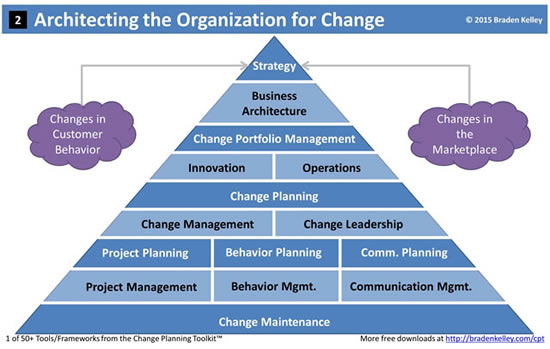
Above you’ll see a visualization of the Four Keys to Successful Change. Leave one out and eventually your change effort, no matter how big or small, will eventually fail. If you’re setting setting out to change the world, even a small corner of it, then you’ll want to be sure to consider each of the four keys and make sure that you proceed in a measured way that takes each into account.

Let’s look at each briefly in turn before we look at each area in more detail in future posts, and eventually in the book in January 2016.

The Four Keys to Successful Change

1. Change Planning

Change Planning is the first key to successful organizational change, and it focuses on drawing out the key issues of the necessary change and puts some structure and timeline around them. You will find you have a better experience and a more successful outcome if you use a more visual, collaborative method using something like the Change Planning Toolkit™ I will be releasing soon to help you create the necessary change plans, goals, metrics, etc.

2. Change Leadership

Change Leadership is the second key to successful organizational change, and is important because good change leadership provides the sponsorship, support and oversight necessary for the change activities to receive the visibility, care, and attention they need to overcome inertia and maintain momentum throughout the process of transformation.

3. Change Management

Change Management represents the third key to successful organizational change, and it is probably the one most people think of when they think about organizational change because it focuses on managing the change activities necessary to achieve the change objectives. The term itself has some challenges however as the term also refers to the management of code changes during the software development process and its relationship with project management is confused. We will dig more into the relationship between project management and change management in a future article.

4. Change Maintenance

Change Maintenance represents the fourth and probably most neglected key to successful organizational change. Many change leaders lose interest after the major launch milestones are achieved, and this is a real risk to sustained success of the change effort. During the change maintenance phase is when you measure the outcomes of the planned change activities and reinforce the change, to make sure the change effort has met the change objectives and when you ensure that the behavior change becomes a permanent one. Neglect this phase and people often slip back into their old, well worn patterns of behavior.

Conclusion

This is the first article in a series to help make changing the world seem a little less overwhelming, a little less scary. I hope you have found the article and the framework a useful first building block as we work together to build a strong foundation for successful organizational change. To be alerted when the Change Planning Toolkit™ becomes available, please be sure and click the link below to join the mailing list, and stay tuned for the next article in this series!

Sign up for updates on the Change Planning Toolkit™ (Charting Change Insiders)

Image credit: Youthventure.org


Accelerate your change and transformation success

Subscribe to Human-Centered Change & Innovation WeeklySign up here to get Human-Centered Change & Innovation Weekly delivered to your inbox every week.

Your Chance to Help Change Change

Your Chance to Help Change ChangeMy first book Stoking Your Innovation Bonfire was designed to help organizations identify and remove barriers to innovation, but readers also found it to be a great primer on how to take a structured, sustainable approach to innovation, and as a result the book has found its way into university courses and libraries around the world.

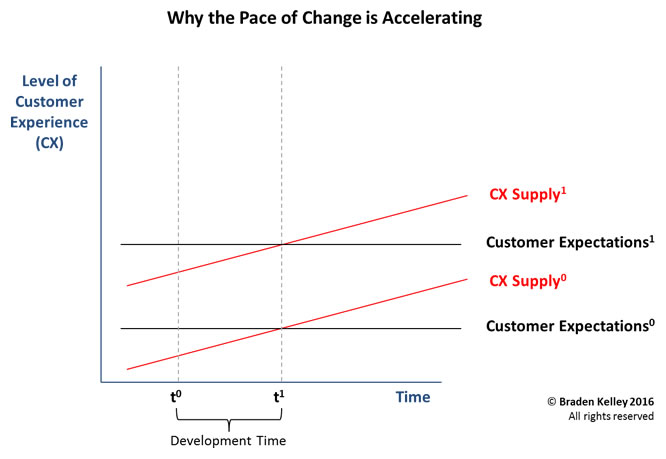
I’ve been thinking over the last few years about where I could provide the most value in a follow-up book, and it came to me that innovation is really all about change and that where most organizations fail to achieve innovation is in successfully making all of the changes necessary to transform their inventions into innovations. At the same time, the world has changed, the pace of change is accelerating and organizations are struggling to cope with the speed of changes required of them, including the digital transformation they need to make.

So, my next book, this time for Palgrave Macmillan, will focus on highlighting the best practices and next practices of organizational change. And where does any successful change effort begin?

With good planning. But it is really hard for most people to successfully plan a change effort, because it is hard to visualize everything that needs to be considered and everything that needs to be done to affect the changes necessary to support an innovation, a digital transformation effort, a merger integration, or any other kind of needed organizational change.

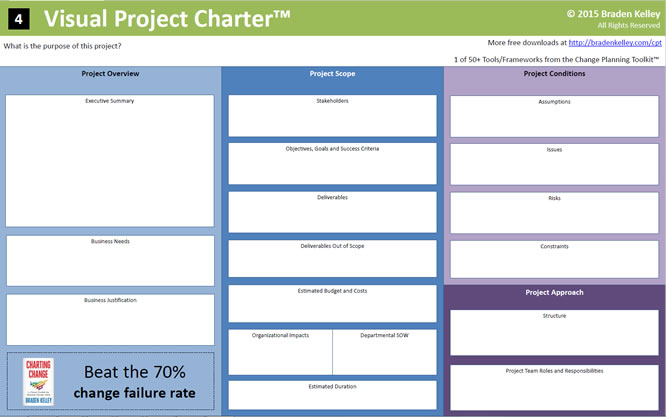
But my Change Planning Toolkit™ and my new book (January 2016) are being designed to help you get everyone literally all on the same page for change. Both the book and my collaborative, visual Change Planning Toolkit™ are nearly complete. But before they are, I’d like to engage you, the intelligent, insightful Innovation Change Management community to help contribute your wisdom and experience to the book.

I’m looking for a few change management tips and quotes attributable to you (not someone else) to include in the book along with the other best practices and next practices of organizational change that I’ve collected and the introduction to my Change Planning Toolkit™ that I’m preparing.

It’s super simple to contribute. Just fill out the form, and the best contributions will make it into the book or into a series of articles that I’ll publish here and on a new site focused on organizational change that I’m about ready to launch.

I look forward to seeing your great organizational change quotes and tips!

UPDATE: The book is now out! Grab a copy here:


Accelerate your change and transformation success

Subscribe to Human-Centered Change & Innovation WeeklySign up here to get Human-Centered Change & Innovation Weekly delivered to your inbox every week.

Conference Wrapup – Change Management 2015

Change Management 2015

Recently I had the opportunity to attend the Association of Change Management Professionals’ (ACMP®) annual conference in Las Vegas, Nevada, titled appropriately Change Management 2015. The event represented a convening of nearly 1,000 change management professionals from around the globe, including countries as geographically dispersed as Qatar and Australia, but with the bulk of the attendees being from the United States, Canada, and Australia.

Nearly 1,000 attendees is a pretty decent size, much bigger than any innovation event that I’ve ever been to, but this larger number of attendees is quite small when you consider the number of people serving in official or unofficial change management roles around the world (either as employees or consultants), or when compared to the number of project managers (estimated at 16.5 million people around the world) and potentially as many as 1.5 million six sigma black belts and green belts sprinkled around the world.

Meanwhile, a couple of the leading training organizations in the change management space have trained just short of 100,000 people in the principles of change management.

If you agree that proactively managing change in organizations is at least as important as the practice of Six Sigma, and potentially as important as project management, that means that as the pace and importance of change continues to gather steam, there could be the need to train between 1.4 million and 16.4 million change management professionals in the next few years.

Professionalizing the Change Management Profession

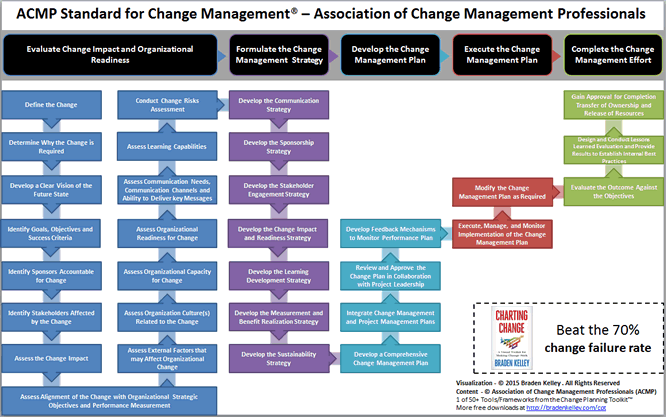
One of the things that occured at the conference was the highlighting of the ACMP Standard for Change Management™ and the new ACMP Qualified Education Provider™ (QEP™) program. Both of these are steps along the way to building momentum for a change management certification that the ACMP® hopes will become the gold standard for people worldwide to highlight that they have the skills knoweldge, and experience to be recognized as a Certified Change Management Professional™ (CCMP™).

Kicking it off with Dan Pink

The opening keynote at the event was delivered by Dan Pink, author of ‘Drive’ and several other books. Much of his speech was about the societal impacts of the greater availability of information that we enjoy today, and how that will also affect our ability to sell, to influence, and to affect change. In sales, it used to be that the seller nearly always had more information than the buyer, that is rarely the case any more. Because of this shift in information availability, experts are being called on more to be a curator of information than as a way to access information. Dan highlighted how nearly everything that we do in business involves sales and change, yet business schools and MBA programs teach neither sales nor change (they might teach a course on leadership if you’re lucky). And if the ABC’s of sales used to be “Always Be Closing” then the new ABC’s of sales are Attunement, Buoyancy and Clarity.

One interesting personal productivity insight that Dan shared was the idea that asking yourself questions before doing something is a better preparation method than positive self talk. Another was how by reducing your feelings of personal power before going into a conversation can actually increase your effectiveness at getting people to do something. And finally, consider these points related to change:

  • Context is more important than the individual
  • When engaging people for change, it’s very important to use the audience’s language not yours
  • Instead of focusing on changing people’s minds, focus on making it easy for people to do something
  • When information goes down easier it is more likely to stick (rhyming, distillation, etc.)

The IBM Research Perspective

There was a great quote from Hilary Bland of IBM at the conference that illustrates the necessary future direction and importance of change management:

“The ability to anticipate, manage and capitalize on pervasive change is often the difference between market leadership and extinction.”

Between IBM’s research study in 2008 and their followup study in 2014, they’ve seen a shift from organizations managing change on projects to organizations increasingly focusing on enterprise transformation. While the 2008 study examined how organizations manage change and gained practical knowledge, the 2014 study gained insights into the new environment of continuous transformation & the attributes of organizations that are highly successful in managing change.

One of the findings from IBM’s 2014 study was that 74% of respondents are concerned employees are not fully prepared to adapt to an increasingly digital work environment. This sentiment also manifests in the finding that only 20% of organizations successfully deliver on more than 75% of their projects.

And while the digital revolution provides new opportunities to lead change – bottom-up, top-down, sideways – the fact is that 87% of the IBM study respondents stated that not enough focus is currently placed on change management in critical projects and that only 44% of high performance change organizations understand change benefits – Scary!

On final interesting tidbit from the 2014 IBM Research findings – In 2008 only 20% of surveyed companies were using internal resources to manage change projects, but this number is 84% now – highlighting a perceived need for companies to build their own internal change management capability instead of relying on consultants.

Here is a link to the latest IBM study ‘Making Change Work 2014’ – https://ibm.biz/BdRV9y

Gearing Up for Change – A Case Study

Columbia Sportswear shared several learnings from the change management components of their SAP upgrade, including:

  • Success comes not from just saying things multiple times but doing things multiple times
  • We had to stress that company success is determined by the quality of and access to data
  • Initially we were given a tiny training budget, so we went out and got data to build support for an increase
  • We used learnings from a previous failure to build support for our new approach
  • Our first steps were to capture tribal knowledge, map processes, and write standard operating procedures (SOP’s)
  • We then trained execs in our change methodology and did monthly change surveys to
  • We won support from senior management to bring in long term temporary employees to free up our super users to participate in the project. This was a priority!
  • Focus was key! The company had to say “We’re going to do this upgrade, make/sell products, and nothing else!” – and then of course remind people…
  • We had to get creative in our communications, both in terms of building new communication channels and creative messaging, but also we had to work really hard not to talk about the system being changed, but instead focus on how this was a company evolution.

The Culture Question

There were several good culture questions and comments that came up from various sessions, including:

  • When it comes to culture change, you have to define which parts of the culture you’re going to retain too.
  • Findings from IBM’s study on making change work… 1. Lead at all levels 2. Make change matter 3. Build the muscle
  • People at IBM got social really fast around the topic of change because managers were looking at profiles and who was contributing
  • Engagement = Communication + Co-creation
  • Successful change efforts blend effective approaches to the task side and the people side
  • Pace of change is both a driver for change management and a resistor
  • Accountability key to embedding your change into normal operations
  • People hate being off plan. They will want to tell people about the green behind the red. Consider only allowing people time with the boss to discuss yellow/red projects and how the boss can help, instead of making people feel like they have to be green.
  • When change saturation exists, consider having cross-functional resource conversations to look for solutions.
  • “Change has to start by doing less” -Lisa Bodell
  • “Change Leaders should keep these three things in mind – Ask killer questions, Reverse assumptions, and Kill a stupid rule” – Lisa Bodell

Learning as it Relates to Change

There was a great session at the Conference with Christine Cox, PhD. looking at breakthroughs in organizational learning. Some of the key takeaways included:

  • People who multitask (or who sit next to multitaskers during lectures) exhibit lower comprehension
  • Memory can be improved by relating learning to yourself
  • To harness emotion for better learning you want to tap into people’s emotions without overactivating them
  • People strongly remember moments where they made connections and generated those connections or insight
  • Learning is also increased when the right social elements are added
  • Give people opportunity to share what they’ve learned and reflect on its self-relevance
  • Spacing is also important for learning. No cramming!
  • 12 hour learning spacing that includes a night’s sleep helps comprehension more than 12 hours of spacing during waking hours
  • Instructional design should perhaps shift from content delivery to creating the space for insight
  • Incorporating some forms of generation into the learning situation – like polls, guided reflection, writing answers, explaining to another, hearing from another – can increase retention

All Trains Change for Change

Carmen Bianco, the President of the Manhattan Transit Authority (MTA) discussed how our world is changing and how the MTA has to focus on technology, strategy and culture. One of the big questions the MTA is grapplin with is:

How can we get more technology underground so that we can get more train cars per hour moving through the system?

The MTA is ordering 1,000 new train cars and growth is causing them to explore how they can change their culture to be more customer-focused and how they can move more train cars per hour and how they can get more people into each train car. Carmen’s initial focus on culture change has been on top executives so that the middle of the organization knows they’re serious. For change to filter all of the way down, the alignment and commitment has to work its way down. Carmen feels that if he can get everyone on his team to be that good boss, that’s a home run because it effects countless numbers of people. Carmen has also instituted no meeting days at MTA where he requires managers to get out with their employees and then do a debrief with him at the end of the day.

Carmen spoke about the challenge they face with 44% of executives and 41% of operating supervisors becoming pension eligible soon. The potential retirement of 44% of managers next year is both a risk and an opportunity to culture change progress. He spoke about how just when it seemed like he wasn’t changing the culture, the super storm came and provided a galvanizing opportunity. He marveled as he watched the MTA perform with the customer in mind (even sacrificing sleep). He feels blessed to have a phenomenal group of employees who have come up with ideas like FastTrack, where we had 900 employees working in the same area. At first citizens and the media ridiculed the idea, but now people are asking ‘When are you bringing this to my neighborhood?’ The creation of FastTrack reminded me of that scene in the Apollo 13 movie. It’s a good idea to keep that Apollo 13 scene ‘What do you have?’ in mind for constraint-focused brainstorming.

A Whirlwind Tour of Change

The Nike and Peoplefirm session highlighted the importance of communication strategies and creativity in change. PG&E and BeingFirst highlighted how building a change capability within an organization takes time (within PG&E it has taken 2 1/2 years just to START). Year 1 at PG&E may have focused on a lot of change leadership training, but year 2 has to be more about demonstrating results. An internal change group can act as middleware translator between consultants and the organization on a range of projects. Change saturation was discussed many times at the conference, and PG&E talked about how they monitor it at a workgroup level, monitoring what initiatives are effecting different workgroups. In the Marriott session it was highlighted that the most used change tools at Marriott include change overview, stakeholder analysis and communication plan. Chris Churchill and Paul O’Keeffe of Accenture spoke about Agile Change Management and the importance of integrating your change process into your Aigle process, including your task wall or kanban wall process.

Finally, closing keynote speaker Lisa Bodell offered these Eight Statements for Change that she advises organizations work to answer in the affirmative:

  1. People in our organization actively think about pushing boundaries and use trends
  2. Our employees are comfortable asking provocative questions
  3. People think on their feet
  4. People see it through
  5. We are Looking forward 5-10 years
  6. We constantly push for continual improvement
  7. We purposefully hire diverse teams
  8. We look at adjacencies and distant companies and apply best practices

The conference definitely was a whirlwind, and I’d like to thank the Change Management 2015 conference organizers for inviting me to cover the event for the Innovation Excellence audience. Hopefully they’ll have me back as a speaker next year at Change Management 2016 in Grapevine, Texas.

In 2016 my new change management content site will be in full swing and my second book for Palgrave Macmillan (@PalgraveBiz) comes out in January 2016 to highlight the best practices and next practices of organizational change and introduces the new collaborative, visual change planning toolkit. I’ve got some great guest experts lined up as contributors and am finalizing the final few sponsors and contributors in the next couple of months (along with the manuscript), so stay tuned!


Accelerate your change and transformation success

Subscribe to Human-Centered Change & Innovation WeeklySign up here to get Human-Centered Change & Innovation Weekly delivered to your inbox every week.

People-Centric Marketing

by Braden Kelley

People-Centric MarketingWe live in an increasingly complex world where both the volume of change and the pace of change are accelerating. But it is not just change that is accelerating, choice is proliferating as well.

Witness the example of General Mills’ Cheerios. Introduced in 1941, there are now 13 varieties of Cheerios on the market, not including snack mixes introduced in 2008.

In its 70+ year history, General Mills introduced no variations in the first 35 years; all of the new varieties have been introduced during the second half of Cheerios’ lifespan, with eight of 13 new varieties being introduced in the last decade. The 13 current varieties of Cheerios (with launch dates) according to Wikipedia are:

  1. Cheerios (1941)
  2. Honey Nut Cheerios (1979) (see above)
  3. Apple Cinnamon Cheerios (1988)
  4. MultiGrain Cheerios (Original in the UK) (released 1992, relaunched 2009)
  5. Frosted Cheerios (1995)
  6. Yogurt Burst Cheerios (2005)
  7. Fruity Cheerios (2006) (Cheerios sweetened with fruit juice)
  8. Oat Cluster Crunch Cheerios (2007) (sweetened Cheerios with oat clusters)
  9. Banana Nut Cheerios (2009) (sweetened Cheerios made with banana puree)
  10. Chocolate Cheerios (2010) (Cheerios made with cocoa)
  11. Cinnamon Burst Cheerios (2011) (Cheerios made with cinnamon)
  12. Dulce de Leche Cheerios (2012) (sweetened Cheerios made with caramel)
  13. MultiGrain Peanut Butter Cheerios (2012) (Multigrain Cheerios with sorghum, not wheat, and peanut butter)

We have an overwhelming amount of choice in the supermarket, but we also have an ever growing roster of entertainment options as well:

  • Terrestrial, cable, satellite, and on demand television
  • Internet television (NBC.com, Comcast.com, Netflix, Amazon Prime, Hulu Plus)
  • Television on DVD or DVR
  • Over the air, satellite, and internet radio
  • YouTube, Vimeo, Vine and streaming music
  • Instagram, Facebook, Twitter, Google+
  • Console, PC, Tablet, and Smartphone gaming
  • Snapchat and Wechat
  • Live events and recordings of live events
  • and on and on

Advertising is proliferating:

  • TV and radio advertising
  • Out of Home advertising (Billboards, buildings, airplanes, buses, trucks, etc.)
  • Print advertising (Magazines, newspapers, etc.)
  • Movie and TV product placements
  • Movie theater advertising
  • Airborne advertising
  • In game product placements
  • Digital advertising (banners, videos, etc.)
  • Mobile advertising
  • Naming rights (stadiums, etc.)

Marketing is proliferating too:

  • Direct marketing (direct mail, email, telemarketing, etc.)
  • Partner marketing
  • Search Engine Optimization (aka SEO)
  • Search Engine Marketing (aka SEM)
  • Social Media marketing
  • Inbound marketing
  • Content marketing
  • Viral marketing
  • Loyalty and retention marketing
  • Spam
  • and my least favorite (contact form marketing – aka spam)

With this deluge of choice and competition for our attention, people are in fact more annoyed and less affected by advertising and marketing than ever before.

Growing Customers in a Deluge

So in today’s world, how do most effectively cultivate future customers, strengthen the relationship with existing customers, and maintain connections and grow commitment over time?

There is no single answer of course, but effective marketing in today’s world of endless choice and competition for people’s attention requires the appropriate mix of push and pull and recognizes that the ROI from marketing efforts should not all be attributed to the last click but instead is attributed to the overall customer journey and uses technology that allows you to connect together the different customer touchpoints and impressions over time to help you better understand how your holistic revenue generation system is working. Because effective marketing is not about converting leads, but instead about building relationships.

When your marketing efforts focus on building a relationship, trust, and even partnership with your customers, your organization stands to benefit more than by just seeking the quick scale. Even non-customers can be referrers and recommenders, and as companies grow, a single individual can have a customer, partner, and a competitor relationship with the same organization.

Are you living in marketing’s past?

So if marketing today is more about the customer journey, building relationships and even co-creation, then it becomes even more important to build understanding and trust. The power of the story, the power of experience, and the role of content in this new world become increasingly important in capturing and holding people’s attention. You’ll notice that I said people not customers or prospects, and their is an important reason underlying it.

Because of our increasingly interconnected and always on world, where Yelp has grown to become a more powerful engine of influence than neighbors and co-workers, it’s getting harder to tell who is an influencer and must tell a consistent story not just to prospects, but to all people. And in a world where algorithms determine whether you even appear in the places your potential customers trust, having the right content in the right places, at the right time, so that people (not just prospects) can find it at the various stops along the often long, meandering non-customer to prospective customer evolutionary path.

Embracing an expanded marketing focus on non-customers may be hard for some marketers, but others will see the importance of it in growing and maintaining the long-term health of the organization’s sales pipeline and brand equity.

How do you grow new customers?

Well, by growing the level of comfort and trust that people have in your organization and its employees. There are many ways to do this, but they require a strategy that first seeks to understand the typical paths that people take from non-customer to customer. A lot of people talk about trying to loyalize customers, or turning customers into advocates, and while that may sound logical, there is a flaw in that thinking. The flaw is that people can be influencers and advocates for your products and services before they become a customer (or who may never become a customer) if you’re doing a good job with your people-centric marketing.

When you better understand the journeys people take from non-customer to customer you can better understand what parts of the story to tell when and where. And often as you shift from a lead-generation, prospect-driven marketing focus to a people-centric one, you will start to see that in order to build the comfort and the trust and the excitement, that it will be more about barriers than benefits, more about problems than solutions.

As marketers we love to talk about benefits and solutions, but where we really need to focus is problems and barriers. Where is the friction? Where is the confusion? What are the chasms to be crossed? What are the pitfalls to be avoided?

When we start to understand these things, we will start to understand the stories and the content that need to be told and created in order to provide the jet pack to accelerate an individual from one level of comfort, trust, and purchase readiness to the next. The better we grasp what people are seeking to understand in order to evolve their level of comfort and trust, the better we can do at shaping our messages and our strategy to meet people where they are.

Who’s your thought leader?

This is where having a thought leader on staff comes into play, and why you might want to hire one or convert an existing employee or two into one. The job of the thought leader is to be a storyteller, a brand advocate, and ultimately to be the person that builds those bridges across the chasms and guides non-customers along their journey of understanding by demonstrating understanding of the problems, barriers, and pitfalls that non-customers and customers face, and helping to educate them on some of the ways that progress can be made and success created.

There is nothing wrong with trying to lead the thoughts of others. Someone has to lead, or at least to provoke. Just keep your ego at bay and focus on being a discussion leader and a facilitator within the topic area you are focusing on and key in on the transitions that you are trying to encourage. Ultimately what you are doing is growing customers, but there is no set timetable for when a non-customer might become a customer, and we’re not focused on speed as much as we are on acceleration. The closer we can draw non-customers to us, the more likely they are to want to become employees, partners, co-creators, advocates, or even aid in creating post-purchase rationalization instead of buyers remorse.

But the sad part is that most companies don’t recognize the importance of thought leaders, and the unique skillset that some people in understanding the journey and the problems, pitfalls, barriers, chasms, and transitions that matter to non-customers. Most consultancies want their consultants on the road billing every possible hour, and don’t allow anyone to focus on this important area of growing future customers. They dabble, and maybe they publish a white paper here or there that looks just like the white paper their five other competitors just put out, but they don’t commit to any marketing activities that result in immediate lead generation. There are a few consumer product companies that are doing surprisingly well in this area, but the two areas of greatest opportunity probably lie in the business-to-business (B2B) and service industries (consulting, legal services, etc.).

I’ve done a bit of work in these areas helping companies like Innocentive, Planview, Imaginatik, and Crowd Computing create single content input, multiple content output strategies to help evolve their ranks of non-customers along their journey with some informational pieces.

Thought leaders can and should play a large role in your innovation efforts as Evangelists (see my Nine Innovation Roles) and in helping your organization do a better job of value translation and value access (see my article on Innovation is All About Value). As you launch innovations into the marketplace, a people-centric marketing approach can make a huge difference in translating the potential value better for customers and non-customers alike and identifying areas of opportunity for improved value access (based on the thought leaders’ understanding of the non-customer’s journey) that can be communicated within the organization and new value access offerings that complete the core value creation of the innovation.

I hope by now you see the importance of focusing more on people-centric marketing and in understanding non-customers as well (or better) as we currently understand our customers.

But, of course in order to become a thought leader, someone must inevitably find what you have to say worth following.

So identify the thought leaders in your organization, or hire one, and start building your people-centric marketing strategy today!

Image source: bashfoo.com


Accelerate your change and transformation success

Subscribe to Human-Centered Change & Innovation WeeklySign up here to get Human-Centered Change & Innovation Weekly delivered to your inbox every week.

Planning to Spread

We’ve all seen the viral videos that seemingly come out of nowhere to garner millions of views on YouTube, videos like this one where five people play one guitar singing Gotye’s “Somebody That I Used to Know”, which as of this date has garnered more than 163 million video views:

And if you add up all of the other postings of this same video, the total number of video views goes much, much higher.

Now, surely Gotye’s version of the song couldn’t have possibly garnered more views than this viral sensation that Walk Off the Earth’s cover created, could it?

Um, actually it did. To date Gotye’s official video has captured nearly 600 million video views, or nearly FIVE TIMES as many video views. So, it hasn’t turned out all bad for Gotye.

Now you might ask yourself, how could the huge success of the Walk Off the Earth viral campaign be trumped by traditional marketing if viral marketing is supposed to be the silver bullet?

Well, the truth is that whether you pursue traditional marketing and advertising or supposedly “viral” marketing activities, the goals are the same:

  1. Awareness
  2. Interest
  3. Desire
  4. Action

And it is within that first bullet point, that you find the viral component that any marketing activity or any evangelism activity (for innovation, for change, etc.) should always contain – spreadability.

Now, WordPress doesn’t seem to think that spreadability is a word, but let’s assume for a moment that it is and focus on the fact that most of the time, one of your goals in business (and your personal life) is spreadability. Ultimately, in many cases, success is determined by whether or not you can get your idea to spread.

This is true whether we are talking about an IT project, a Six Sigma continuous improvement effort, a change initiative, a Lean event, a marketing campaign, or a project commercializing an invention into a potential innovation.

So, can anyone guarantee that an idea or marketing campaign will spread?

The short answer is no.

Sorry, I wish I had better news for you, but the fact is that nobody can guarantee that your idea or your marketing campaign will go viral. Why?

You’re dealing with humans living in a complicated world. We’re not all built the same and the same person can have different reactions to the same stimulus (driven by mood and context among other things). This can result in a perfectly spreadable idea or message being stopped dead in its tracks, depriving you of all of the potential downstream sharing that you might have been hoping for or counting on.

Sorry, you can’t guarantee spreadability, despite what opportunistic marketing consultants claiming to know the magic formula might tell you.

Spreading ChangeBut, an idea can be built to spread.

And I’d like to share with you a simple framework, for free, that you can download and spread far and wide.

Click here to download the “Planning to Spread” starter worksheet as a PDF.

It’s based on the same priniciples as mind mapping and it will help you start either with a particular node in mind (someone you’d like to reach and influence) and work backwards, identifying both how to evolve your idea to best influence that particular node, and how you might be able to reach them (at the same time). Or you can work from the idea outwards. Focusing primarily on the WHO and the WHY as you move outward.

The key questions to consider as you are “Planning to Spread” your idea are the following:

  1. What is your idea or message? (Does it resonate with my target audience?)
  2. Who are you trying to reach?
  3. How will you reach them?
    • When will they be most receptive to the message or idea?
    • Where will they be most receptive to the message or idea?
  4. Why will they engage? (What value will they get?)
  5. Why will they share? (What value will they derive?)
  6. How will they share?

Working your way thoughtfully through these questions will increase the chances that your idea or message will spread, but they won’t guarantee it. Going through the process however will help you refine your idea or message, help you think through the mechanics of how you might encourage and increase engagement, and may even help you uncover flaws in your idea or message that you missed (and give you a chance to fix them).

Planning to Spread WorksheetHappy spreading!
(and please let me know in the comments below any things I might have missed)

So what am I trying to spread?

Well, in the run up to my second book (this time focusing on the best practices and next practices of organizational change), soon I will be releasing a new collaborative, visual change planning toolkit to help organizations work smarter by planning their change initiatives (and projects) in a less overwhelming, more human way that will help get everyone literally on the same page.

This is the idea that I will be spreading and there are many ways that you can benefit.

One way is by becoming a case study volunteer. I’m looking to select a handful of companies to teach how to use the toolkit for free and feature their experience in my next book on the best practices and next practices of organizational change. If you would like to get a jump on the competition by increasing your speed of change (and your ability to work smarter), register your interest here.

But there are several other ways you can benefit, and all of them can be found here (including upcoming chances for consultants to train on the methodology and boost their revenue and success as they work with their clients around the world to deliver positive change). I’ll be focusing on teaching and tools, not consulting.

What message or idea are you trying to spread?


Accelerate your change and transformation success

Subscribe to Human-Centered Change & Innovation WeeklySign up here to get Human-Centered Change & Innovation Weekly delivered to your inbox every week.

Is working smarter for suckers?

Work Smarter Manifesto

Last night I dreamed about the extremely unbalanced view of work in our societies, and woke up wondering whether working smarter is for suckers.

Why is that we lionize the workaholics among us and penalize those that find ways to be more efficient?

Why is that we say “thank you for working so hard” to someone who takes sixty hours to complete a task and penalize the person who figures out how to do it in twenty hours by giving them more work to do?

Out of one side of our mouth we talk about the importance of work life balance and out of the other side we praise those who worked the weekend. What’s worse, we often also speak behind the back of those who find a way to leave promptly at 5 PM every day, and look down upon them instead of admiring them.

There is the old saying “Work smarter, not harder”, but what’s the point when you get punished for doing so?

Where’s the reward?

We reward companies for getting more efficient and more profitable by raising their stock price. Where’s the reward for the individual for finds a way to get more efficient?

And why do people who work neither hard or smart get a free ride?

I am reminded of the saying “If you want something done, give it to a busy person.”

The attitudes about work in our society that make this quote a truism, along with the penalties for working smarter, make it nearly impossible to achieve work life balance in our culture unless you’re lazy and difficult to fire.

People marvel at how much I seem to achieve between working full-time, traveling the world delivering keynotes on innovation and change, writing books and articles, helping to run Innovation Excellence, and getting ready to launch a new collaborative, visual change planning toolkit.

The only way I’m able to pull it off is by doing my best not to explode while I work harder at working smarter.

Books like Essentialism by Greg McKeown (and many other similar ones) serve as a great continuing education and gentle reminders for the legions of us trying to working smarter.

My wife also helps keep me focused only on the ground in front of me and becoming comfortable with whatever forward progress I’m able to make on my content creation efforts as I move through the world and all of the requirements and expectations that I’ve signed up for. The importance of family also lead me to protect evenings and weekends against potentially encroaching work.

Work Smarter Not HarderBut many organizations, and our culture at large, definitely doesn’t make it easy by inflicting their own inefficient processes, policies, and expectations on us.

So, what could we do better as organizations and leaders to teach people how to be more efficient in their jobs and have the foresight to let them use that improved efficiency to allow them to go home at a decent hour to their families?

We must remember, all parents have another job to go home to, and single employees have passions to explore that work probably is not fulfilling.

Help your employees work smarter and let them reap the rewards and you too will be rewarded with a stronger next generation of employees, increased employee retention, and MORE INNOVATION. Not a bad deal, right?

P.S. For my part soon I will be releasing a new collaborative, visual change planning toolkit to help organizations work smarter by planning their change initiatives (and projects) in a less overwhelming, more human way that will help literally get everyone one the same page.

I’m looking to select a handful of companies to teach how to use the toolkit for free and feature their experience in my next book on the best practices and next practices of organizational change. If you would like to get a jump on the competition by increasing your speed of change (and your ability to work smarter), register your interest here.


Accelerate your change and transformation success

Subscribe to Human-Centered Change & Innovation WeeklySign up here to get Human-Centered Change & Innovation Weekly delivered to your inbox every week.

Innovation Keynote and Change Planning Workshop Special

January Innovation and Change Planning Toolkit Special

To kickoff January with a bang I thought I would make a special offer to companies and event organizers who would like to get an excellent innovation keynote for their company or event attendees AND get a jump on your competitors by getting trained on how to use my new collaborative, visual change planning toolkit before they do.

This will be a great way to help innovation, change and project managers build strong momentum and results early in 2015.

Here is the offer:

Stoking Your Innovation BonfireBook me between January 21 and March 31, 2015 for either a:

  • 60-90 minute Innovation Keynote
  • 2-4 hour Innovation Workshop
  • 1 Day Innovation Masterclass

… and your attendees will at no additional charge:

  1. Be one of the first groups to get their hands on my revolutionary collaborative, visual change planning toolkit
  2. Get a 1 Day Workshop focused on organizational change and how to use the change planning toolkit

Buy an innovation keynote and get a full-day change planning toolkit workshop for free!

What could be better than that?

Book Braden Kelley for your event

P.S. If you missed my recent webinar ‘Innovation is All About Change’, click here and use PASSCODE 1515 to access the FREE recording (link expired).


Accelerate your change and transformation success

Subscribe to Human-Centered Change & Innovation WeeklySign up here to get Human-Centered Change & Innovation Weekly delivered to your inbox every week.

Agile Change Management is Coming

Agile Change Management

How fast is your organization capable of changing to continue to remain relevant and successful in the marketplace?

The world is changing at an accelerating pace as new technologies are discovered, developed, released and adopted by consumers faster than ever before. At the same time companies are rising to global scale faster and large, successful companies are disappearing faster too.

In this new reality that we all face, organizations of all types are going to need to:

  • Change how they change
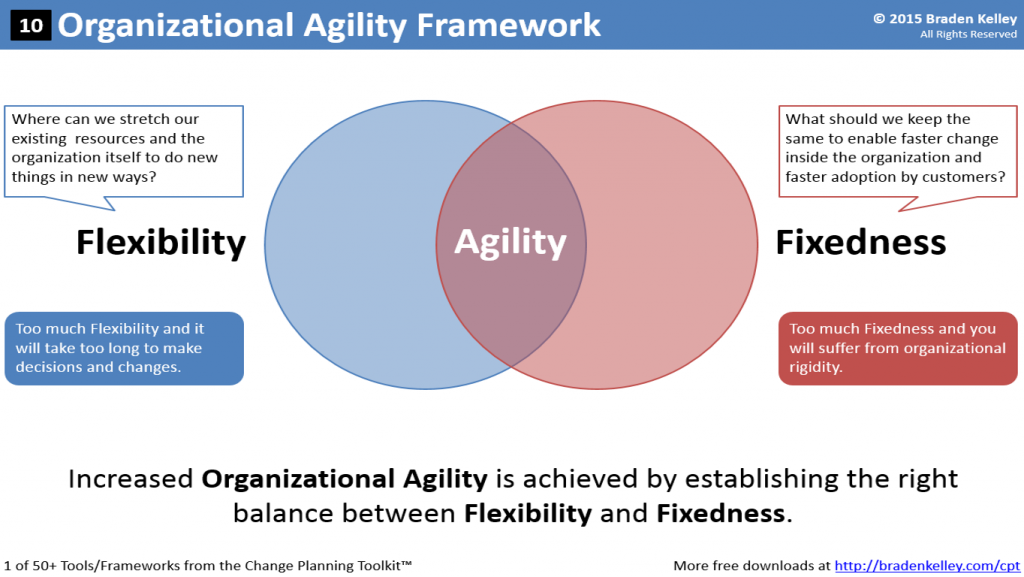
  • Increase their organizational agility
  • Increase the flexibility of the organization
  • Become capable of continuous change
  • Inhibit the appearance and/or growth of change gaps that can doom your company

It is because of this tidal wave of change and a recognition that there is a need in the marketplace for more human change processes and tools that make change seem less overwhelming, that my next book for Palgrave Macmillan will focus on the best practices and next practices of organizational change (aka change management), and I’ve developed a new collaborative, visual change planning toolkit to go with it (but more about that later).

One way to do all of the items in the bulleted list above is to take more of an agile approach to change, to adopt some of the values and principles of the Agile Software Development methodology and use those to create a set of what could be described as Agile behaviors within the organization. If you are not familiar with the Agile Software Development methodology, I have included below the Agile Software Development Manifesto from http://agilemanifesto.org that details the values and principles of Agile Software Development. As you read through the manifesto I hope you’ll see that the values and principles can easily be applied to other endeavors outside of software development, whether that might in the project management discipline of your organization, or within your larger change initiatives.

Manifesto for Agile Software Development

We are uncovering better ways of developing software by doing it and helping others do it.

Through this work we have come to value:

  1. Individuals and interactions over processes and tools
  2. Working software over comprehensive documentation
  3. Customer collaboration over contract negotiation
  4. Responding to change over following a plan

That is, while there is value in the items on the right, we value the items in bold more.

Principles behind the Agile Manifesto

We follow these principles:

  • Our highest priority is to satisfy the customer through early and continuous delivery of valuable software.
  • Welcome changing requirements, even late in development. Agile processes harness change for the customer’s competitive advantage.
  • Deliver working software frequently, from a couple of weeks to a couple of months, with a preference to the shorter timescale.
  • Business people and developers must work together daily throughout the project.
  • Build projects around motivated individuals. Give them the environment and support they need, and trust them to get the job done.
  • The most efficient and effective method of conveying information to and within a development team is face-to-face conversation.
  • Working software is the primary measure of progress.
  • Agile processes promote sustainable development. The sponsors, developers, and users should be able to maintain a constant pace indefinitely.
  • Continuous attention to technical excellence and good design enhances agility.
  • Simplicity–the art of maximizing the amount of work not done–is essential.
  • The best architectures, requirements, and designs emerge from self-organizing teams.
  • At regular intervals, the team reflects on how to become more effective, then tunes and adjusts its behavior accordingly.

Agile and Constant Change

FIGURE 1

You will see in FIGURE 1 that constant change sits at the center, Agile Values providing the initial direction for an organization with a committed goal of becoming more agile. Radiating out from Agile Values as we pursue success in coping with constant change will be our Agile Principles. But, ultimately we can’t live our values or follow our principles if we don’t exhibit behaviors that personify those values and principles. Unless our organizations begin to behave in a more agile way then the potential of truly becoming more agile will remain just words, and go largely unfulfilled.

It is because of the challenge of behaving in a new way that I encourage all of your to make a move towards a formal pursuit of organizational agility. To help you in this pursuit, I will soon be releasing my brand new collaborative, visual change planning toolkit for companies to use on their own (with free training for a select few who agree to use it and document their experience for the book). In addition I will be launching separate training for consultants so they can use the tools with clients in their change management and project management practices. Please register your interest here.

Using this new set of change planning and execution tools and processes will not only make change seem less overwhelming, but it will also help you build alignment behind your effort, help you work through as a group how to LITERALLY all get on the same page for change, and create a more agile organization as adoption of the tools spreads.

Stay tuned for more great change content coming soon!

In the meantime, check out the different ways to get involved.


Accelerate your change and transformation success


SPECIAL BONUS: You can now access my latest webinar ‘Innovation is All About Change’ compliments of CoDev with passcode 1515 (link expired)


Subscribe to Human-Centered Change & Innovation WeeklySign up here to get Human-Centered Change & Innovation Weekly delivered to your inbox every week.

Innovation is All About Change – Webinar Recording

Innovation is All About Change - Webinar RecordingThe hardest part of making any change is taking that first step. We may point our shoulders in the direction we want to travel, but planning our change journey and mapping the steps to get there can still feel overwhelming. This is true for co-creation and open innovation projects, change programs — even personal change.

Often it helps to be with others who are on a similar path. It also helps to have tools that simplify steps and offer motivation. I’m delighted to invite you to view an exclusive conversation/webinar with me and my friends at CoDev (including host Cheryl Perkins of Innovationedge) that we recorded on January 15, 2015.

Click here and use PASSCODE 1515 to access the FREE recording of this webinar (link expired)

In this interactive 60-minute session, I share key tools and guidelines from my new, not-yet-published book from Palgrave Macmillan and give you some insights into what is in my new collaborative, visual change planning toolkit.

I discuss:

  • How organizational change and project/ portfolio management tie together
  • Useful frameworks to move from the ‘what’ to the ‘how’
  • Best (and next) Innovation practices
  • Roles and responsibilities based on the Nine Innovation Roles (from his last book Stoking Your Innovation Bonfire.)
  • How innovation is all about change

I encourage you to view the webinar recording with other members of your senior management team, and anyone else you think might have interest in the intersection of change initiatives, project management, and innovation.

Click here and use PASSCODE 1515 to access the FREE recording of this webinar (link expired)


Build a common language of innovation on your team

Subscribe to Human-Centered Change & Innovation WeeklySign up here to get Human-Centered Change & Innovation Weekly delivered to your inbox every week.