LAST UPDATED: May 9, 2026 at 9:32 AM
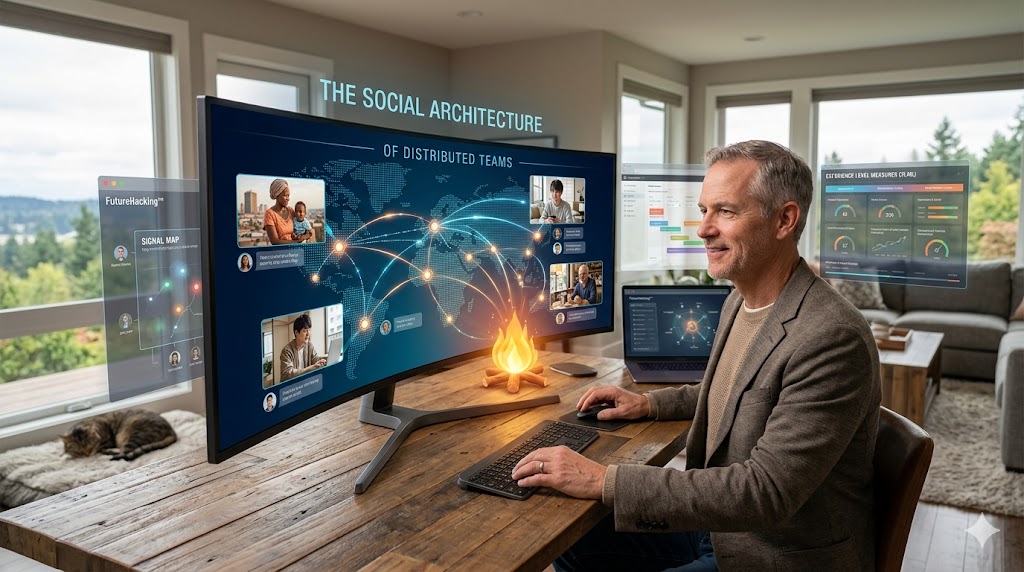
GUEST POST from Chateau G Pato
I. The Structural Integrity of Connection
In a distributed environment, the “walls” of our organization are no longer made of drywall and glass, but of the digital interactions we choose to prioritize. To maintain structural integrity, we must look at the invisible forces that bind us together.
Digital Proxemics
We must redefine the concept of “closeness.” Physical distance is a constant, but digital distance is variable. By understanding how team members perceive their proximity through communication frequency and quality, we can bridge gaps before they lead to isolation. It is about creating a sense of “presence” that doesn’t rely on being in the same room.
The Synchronous/Asynchronous Balance
The architecture of a great day requires a rhythm. We must move away from the “all-day meeting” culture, which is often a symptom of low trust, and toward a model that respects deep work.
- Asynchronous: For updates, documentation, and thoughtful reflection.
- Synchronous: For complex problem-solving, emotional connection, and celebration.
From Accidental Collaboration to Designed Serendipity
In the office, innovation often happened by accident at the water cooler. In a distributed model, we cannot leave innovation to chance. We must intentionally design digital “intersections” where different minds can collide. This is the shift from relying on passive osmosis to active, human-centered design of our social interactions.
II. Building Trust in the Absence of Sight
In a physical office, management often relies on “presence” as a proxy for productivity. In a distributed social architecture, we must dismantle this visibility bias and replace it with a foundation of mutual accountability and psychological safety.
Flipping the Script: From Paranoia to Autonomy
Distributed work fails when leaders default to paranoia-based management—monitoring keystrokes or demanding constant status “pings.” To build a resilient team, we must shift toward outcome-based autonomy. This requires clear alignment on the “What” and “Why,” while granting individuals the human agency to determine the “How” and “When.” Trust is not earned through surveillance; it is built through consistent delivery and shared purpose.
Vulnerability as a Leadership Tool
Human-centered change starts at the top. Leaders must be willing to model transparency by acknowledging the inherent challenges of remote work—whether that is “Zoom fatigue,” the blur between home and office, or the feeling of isolation. When leaders demonstrate vulnerability, it signals to the rest of the organization that it is okay to be human, fostering a culture of authenticity rather than a performance of “busyness.”
Psychological Safety in Bits and Bytes
Innovation requires the freedom to experiment and the safety to fail. In a digital workspace, we must be even more intentional about creating environments where dissenting voices are heard and “half-baked” ideas are welcomed.
- Low-Stakes Spaces: Creating digital channels specifically for brainstorming and “messy” collaboration.
- Inclusive Dialogue: Ensuring that the loudest voices in a video call don’t drown out the thoughtful contributions of quieter, or more reflective, team members.
Ultimately, trust is the “social glue” that prevents a distributed team from becoming a collection of isolated freelancers. It transforms a group of people working apart into a cohesive unit working together.
III. The Experience Design of Digital Workspaces
We often mistake a “digital workspace” for a collection of software licenses. However, true social architecture recognizes that the digital environment is the primary place where work happens. If the environment is cluttered, friction-heavy, or dehumanizing, the output will inevitably suffer.
Moving Beyond Tooling to Flow
Adding more tools to a team often results in “digital friction”—the cognitive load of switching contexts, managing notifications, and searching for fragmented information. Experience design requires us to curate our tech stack with the same care an architect uses to design a physical office. We must prioritize “flow” over features, ensuring that tools facilitate human connection rather than obstructing it.
Implementing Experience Level Measures (XLMs)
Standard Service Level Agreements (SLAs) tell us if the software is “up,” but they don’t tell us if the employees are “down.” To build a high-performing distributed team, we must adopt Experience Level Measures (XLMs). These metrics capture the qualitative sentiment of the workforce:
- Does the technology empower or frustrate the user?
- Do our digital processes create a sense of belonging or a sense of isolation?
- Is the “digital commute” between apps draining the team’s creative energy?
Designing the Virtual “Third Space”
In urban planning, the “Third Space” is the social environment separate from the two usual social environments of home and the office. In a distributed world, we must intentionally design these spaces within our digital architecture. These are not for tasks or tickets; they are for the social lubrication that builds culture.
- Digital Lounges: Persistent video or audio rooms for casual “co-working.”
- Cultural Artifacts: Digital boards that track shared wins, personal milestones, and team lore.
A well-designed digital workspace acts as a force multiplier, transforming a disparate group of individuals into a synchronized, high-functioning community.
V. FutureHacking™ the Distributed Workforce
The social architecture of today is merely the foundation for the organizational shifts of tomorrow. As we look toward the horizon, we must use FutureHacking™ techniques to anticipate how emerging technologies and shifting social contracts will redefine what it means to be a “team.”
Scanning for Signals: Agentic Collaboration
We are entering an era of agentic AI, where digital agents will act as autonomous participants within our teams. The social architecture must adapt to include these non-human entities. We must ask ourselves: How do we integrate AI “teammates” into our workflows without losing the human-centered empathy that drives true innovation? The goal is to leverage AI to handle the “drudgery” of coordination, freeing humans to focus on high-value creative problem-solving.
The Rise of the “Fluid” Team
The boundary of the organization is becoming increasingly porous. We are seeing a move toward more “fractional” and gig-based experts joining distributed teams for specific sprints. Our social architecture must be pluggable—allowing new members to onboard rapidly, absorb the culture through well-designed digital artifacts, and contribute immediately without the friction of traditional corporate silos.
Scaling Empathy Across Borders
As distributed teams become truly global, the challenge shifts from managing time zones to managing cultural empathy. We must design our interactions to be inclusive of diverse perspectives and cognitive styles.
- Signal Picking: Actively looking for subtle shifts in team sentiment that might indicate “digital burnout” or cultural misalignment.
- Human-Centered Agility: Building a structure that is flexible enough to pivot based on the human needs of the collective, rather than staying rigid to a specific tool or process.
By FutureHacking™ our social architecture, we ensure that our distributed teams are not just surviving the present, but are actively designed to thrive in the complex, agentic, and interconnected future of work.
Conclusion: Designing for the Human Element
The transition to a distributed model is often treated as a technical challenge to be solved with more bandwidth or faster processors. However, the true frontier is the social architecture—the invisible scaffolding of trust, intentionality, and empathy that allows a group of people to become a team. We must remember that innovation and change don’t happen in a vacuum; they happen in the spaces between us.
Summary of the Blueprint
To build a resilient distributed organization, we must commit to three core pillars:
- Intentional Connection: Moving from accidental office encounters to designed serendipity and digital proxemics.
- Qualitative Measurement: Using Experience Level Measures (XLMs) to ensure our digital workspaces empower rather than drain our people.
- Radical Transparency: Erasing the proximity hierarchy and replacing it with a shared language of narrative and purpose.
If you do not intentionally design your social architecture, your culture will inevitably disintegrate into the silos of your software. The goal of the future-ready leader is not just to manage work from anywhere, but to foster a sense of belonging from everywhere. By putting human-centered design at the heart of our distributed strategies, we ensure that as our teams move further apart physically, they grow closer together in pursuit of a shared vision.
The social architecture of the future isn’t about the “where”—it’s about the “how.” Let’s design it with purpose.
Bottom line: Futurology is not fortune telling. Futurists use a scientific approach to create their deliverables, but a methodology and tools like those in FutureHacking™ can empower anyone to engage in futurology themselves.
Image credit: Gemini
 Sign up here to get Human-Centered Change & Innovation Weekly delivered to your inbox every week.