LAST UPDATED: May 9, 2026 at 5:19 PM
GUEST POST from Chateau G Pato
The Innovation-Conflict Paradox
In many corporate environments, conflict is viewed as a systemic failure — a breakdown in communication or a lack of team cohesion. We are taught to “de-escalate” and “keep the peace.” However, if we look at conflict through the lens of innovation, we see something different: friction is the prerequisite for fire.
The paradox lies in our approach. Most organizations treat conflict as a fire to be extinguished as quickly as possible. This leads to the “compromise trap,” where teams reach a middle ground that is safe but ultimately uninspired. When we rush to end the discomfort of disagreement, we often extinguish the very energy required to ignite a breakthrough.
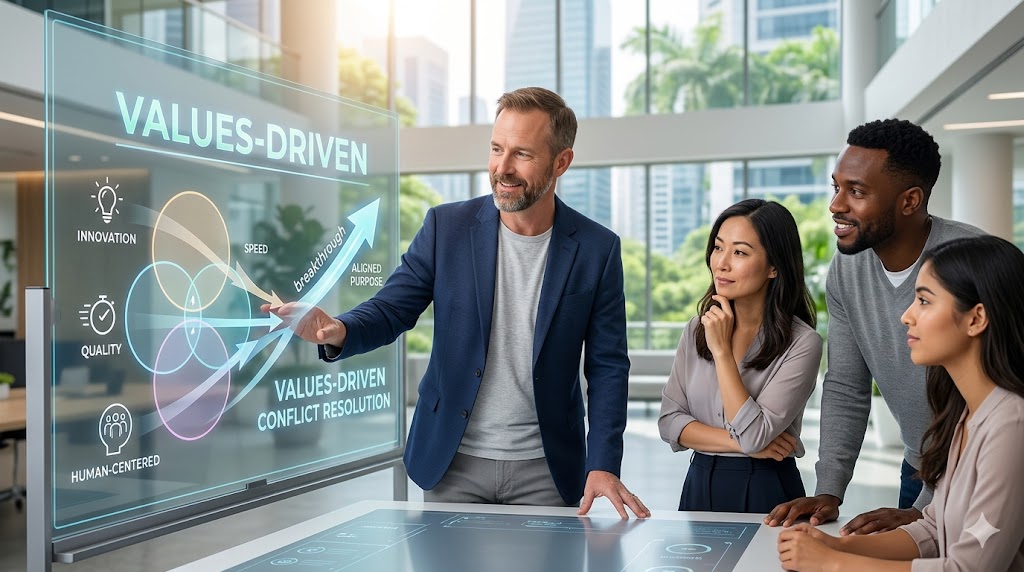
To build a future-ready organization, we must shift our paradigm. We are moving away from transactional conflict management — which focuses on who is right and who is wrong — toward Values-Driven Conflict Resolution. This approach uses the organization’s core values as a strategic North Star, transforming interpersonal friction into creative fuel.
Grounding Conflict in Shared Values
When conflict arises, it often feels personal. However, in a high-performing innovation culture, most disagreements aren’t actually about personalities — they are about competing priorities. Without a clear North Star, these disputes devolve into a “battle of wills.” By grounding our resolution process in shared values, we provide the team with an objective tie-breaker that transcends individual ego.
Adopting a human-centered lens means acknowledging that professional friction is frequently rooted in a perceived threat to one’s values or goals. If one team member values stability while another values disruption, conflict is inevitable. The goal isn’t to eliminate these differences, but to align them toward a common “Why.” When the overarching purpose is clear, we can appreciate diverse perspectives as necessary components of a holistic solution.
Central to this transition is the creation of psychological safety. For values-driven resolution to work, individuals must feel safe enough to voice “productive disagreement” without fearing for their status or safety within the group. It is the responsibility of leadership to ensure that the friction of ideas never becomes a friction of people. When trust is the foundation, conflict becomes a collaborative tool rather than a destructive force.
The Framework: The Values-Alignment Audit
To move beyond the surface level of a dispute, we must apply a structured diagnostic approach. The Values-Alignment Audit is designed to strip away the emotional noise and reveal the strategic core of the disagreement. It shifts the conversation from a subjective clash of opinions to an objective evaluation of organizational priorities.
Step 1: Identify the Value Clash
The first step is to name the tension. Most innovation-stifling conflicts are actually invisible tug-of-wars between two positive values. Are we debating Speed vs. Quality? Innovation vs. Compliance? Or perhaps Customer Experience vs. Operational Efficiency? By identifying the specific values at play, we stop fighting people and start weighing priorities.
Step 2: Externalize the Problem
Conflict becomes toxic when it is internalized. Using human-centered design principles, we “externalize” the conflict by placing it on the table between the participants. The mindset shifts from “Me vs. You” to “Us vs. This Value Mismatch.” This psychological distancing allows collaborators to work together to solve the friction, rather than defending their own territory.
Step 3: The Futurologist’s Perspective
Finally, we must apply a temporal lens to the resolution. A solution that solves a conflict today but undermines our long-term brand promise or cultural integrity is a failure. We must ask: “Does this resolution serve our future selves?” By assessing the long-term impact, we ensure that our decisions today are building the organization we want to be tomorrow.
Moving from Compromise to Synthesis
In the traditional model of conflict resolution, the goal is often compromise. In a compromise, both parties give something up to meet in the middle. While this may end the argument, it often results in a “diluted” solution — a beige outcome that lacks the conviction required for true innovation. As change leaders, we must reject the mediocrity of the middle ground.
Instead, we strive for synthesis. Synthesis is the process of taking two seemingly opposing ideas and combining them to create a third, superior option that didn’t exist before. This is where Design Thinking becomes a powerful tool for resolution. By re-framing the conflict as a design challenge — using “How Might We” statements — we can bridge the gap between values like Standardization and Personalization without sacrificing the integrity of either.
Consider a high-stakes pivot where a team is divided between Technical Perfection and Market Readiness. A compromise would be to release a buggy product late. A synthesis, however, might involve a phased rollout or a modular architecture that satisfies the need for immediate feedback while maintaining a roadmap for excellence. When we stop viewing values as “either/or” and start seeing them as “yes/and,” we unlock the creative potential hidden within our disagreements.
Strategic Tools for Leaders
Values-driven resolution requires more than just a change in mindset; it requires a practical toolkit that leaders can deploy when the heat of innovation begins to singe the edges of collaboration. These tools are designed to make the invisible visible and turn abstract tensions into actionable data.
The Value Canvas
Borrowing from the tradition of visual collaboration, the Value Canvas is a shared workspace where stakeholders map their competing priorities. By physically plotting “Value A” against “Value B,” teams can identify where they are aligned and where their perspectives diverge. This visual transparency removes the “hidden agendas” that often derail productive debate and allows the group to iterate on the resolution just as they would a product prototype.
Language as a Catalyst
The words we choose dictate the emotional temperature of the room. We must train ourselves to shift from adversarial language to collaborative inquiry. Instead of saying “I disagree with that direction,” which can trigger a defensive response, try: “I am concerned this choice conflicts with our core value of [Value X]. How might we honor that value while still achieving this goal?” This subtle shift moves the speaker from an opponent to a guardian of the organization’s integrity.
Pre-Mortems as Prevention
The best way to manage conflict is to anticipate it. Before a project kicks off, conduct a Value Pre-Mortem. Ask the team: “If this project fails due to a values clash six months from now, what would that look like?” By identifying potential friction points — such as Security vs. Speed — before they become high-stakes crises, you can design the resolution mechanisms into the project’s governance from day one.
Conclusion: Conflict as a Design Requirement
In the evolving landscape of work, we must stop viewing conflict as an obstacle to be avoided and start seeing it as a design requirement. A team that never disagrees is a team that is likely stagnating, operating within the safe confines of the status quo. To innovate is to challenge, and to challenge is to create friction.
As we move deeper into an era defined by automation and agentic AI, the technical “how-to” will increasingly be handled by machines. This elevates the importance of uniquely human capabilities. Values-driven conflict synthesis — the ability to navigate deep-seated disagreements and emerge with a more robust, ethically aligned truth — will become one of the greatest competitive advantages a leader can possess.
The goal of the modern organization is not to achieve a sterile, conflict-free harmony. Instead, it is to build a culture where the heat of disagreement is consistently channeled through the prism of shared values. When we do this, we don’t just solve problems; we design a more resilient, human-centered future.
“Don’t aim for harmony at the expense of progress. Aim for alignment at the height of the heat.”
Frequently Asked Questions
Why is conflict considered a prerequisite for innovation?
Conflict represents the collision of diverse perspectives and priorities. Without this friction, teams often settle for the safest, most obvious ideas. By harnessing disagreement through a values-driven lens, organizations can move past superficial consensus to reach breakthrough solutions that are both creative and strategically aligned.
What is the difference between compromise and synthesis?
Compromise usually involves both parties “giving up” something to reach a middle ground, often resulting in a diluted or mediocre outcome. Synthesis, however, uses design thinking to integrate the core needs of both sides into a new, superior “third way” that honors the integrity of the competing values without sacrificing quality.
How can leaders prevent toxic conflict in high-pressure environments?
Prevention starts with establishing psychological safety and using tools like the “Value Pre-Mortem.” By identifying potential value clashes before they become personal and establishing shared language that focuses on organizational values rather than individual egos, leaders can keep the focus on the problem rather than the person.
Bottom line: Futurology is not fortune telling. Futurists use a scientific approach to create their deliverables, but a methodology and tools like those in FutureHacking™ can empower anyone to engage in futurology themselves.
Image credit: Gemini
 Sign up here to get Human-Centered Change & Innovation Weekly delivered to your inbox every week.