LAST UPDATED: May 6, 2026 at 8:01 PM
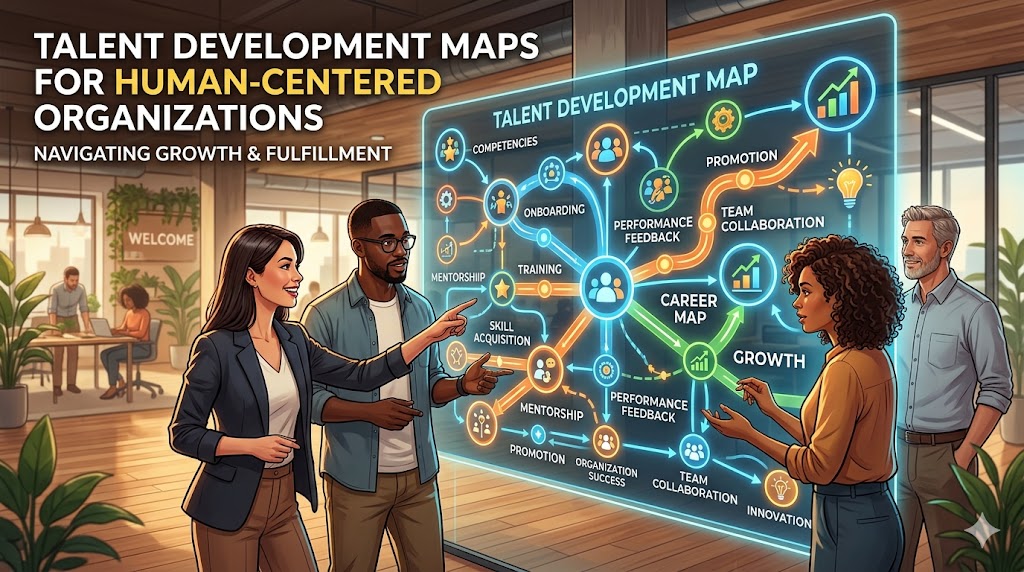
GUEST POST from Chateau G Pato
I. The Shift: From Rigid Ladders to Dynamic Maps
Modern organizations can no longer rely on rigid career ladders designed for stability and predictability. In a rapidly changing environment shaped by technological acceleration, evolving workforce expectations, and continuous disruption, organizations need more adaptive and human-centered approaches to talent development.
The Death of the Linear Path
Traditional corporate hierarchies were built around standardization, specialization, and incremental progression. While effective in industrial-era organizations, these models often fail to support the flexibility and agility required today.
Employees increasingly seek meaningful work, cross-functional experiences, and opportunities for continuous learning. Static job descriptions and predetermined promotion tracks frequently limit creativity, discourage experimentation, and constrain human potential.
Human-centered organizations recognize that growth is rarely linear. Careers now evolve through lateral moves, project-based experiences, skill expansion, and collaborative exploration across disciplines.
Defining the Map
A Talent Development Map is a visual and dynamic framework that illustrates how individuals can develop capabilities, experiences, and mindsets over time. Unlike traditional ladders, maps provide multiple pathways for growth rather than a single upward trajectory.
These maps integrate technical expertise with human-centered competencies such as empathy, collaboration, adaptability, and innovation. They help employees identify opportunities to build meaningful experiences while enabling organizations to develop more resilient and agile talent ecosystems.
Most importantly, Talent Development Maps encourage exploration. They create visibility into future possibilities while empowering individuals to shape personalized growth journeys aligned with their strengths and aspirations.
The North Star
At the center of every effective Talent Development Map is alignment between individual purpose and organizational mission. When employees understand how their personal values and aspirations contribute to a larger purpose, intrinsic motivation grows stronger.
Human-centered organizations do not simply ask employees to complete tasks. They create environments where people can connect their identity, creativity, and ambition to meaningful outcomes.
This alignment becomes the organization’s North Star—guiding learning, decision-making, innovation, and long-term engagement. When people feel that their growth matters, they become more adaptable, committed, and willing to contribute beyond traditional role boundaries.
II. Designing for the Human Experience (HX)
Human-centered organizations understand that talent development is not simply a process to manage, but an experience to design. Just as organizations invest heavily in customer experience, they must also intentionally shape the employee experience to foster engagement, growth, resilience, and innovation.
Designing for the Human Experience (HX) requires leaders to move beyond transactional management systems and instead create environments where people feel understood, supported, and empowered to evolve continuously.
Empathy-First Assessment
Traditional performance systems often rely on standardized metrics that fail to capture the complexity of human potential. While KPIs and productivity measures can provide useful operational insights, they rarely reveal the motivations, aspirations, frustrations, and barriers that shape individual growth and engagement.
An empathy-first approach begins by understanding employees as human beings rather than interchangeable resources. This includes listening deeply, identifying personal development goals, and recognizing the unique circumstances influencing performance.
Human-centered organizations recognize that every employee’s journey is different. By embedding empathy into assessment, leaders can design more personalized pathways that strengthen trust, belonging, and long-term capability growth.
Experience Design Approach
Employee development should be treated as an intentional experience rather than a collection of isolated training events. The same principles used in customer experience design apply internally.
This means mapping the employee journey from onboarding through mentorship, learning opportunities, collaboration, leadership exposure, and career transitions. Each interaction shapes engagement and momentum.
When organizations design these experiences intentionally, development becomes more immersive and meaningful. Employees gain clarity about where they are, where they can go, and how to get there.
Psychological Safety as Infrastructure
Innovation cannot thrive in environments dominated by fear, rigid hierarchy, or punishment for failure. Psychological safety must be treated as core infrastructure, not a cultural add-on.
Employees must feel safe to ask questions, challenge assumptions, share ideas, and experiment without fear of negative consequences. This accelerates learning and improves innovation outcomes.
Talent Development Maps should include structured opportunities for experimentation and reflection. Failure becomes feedback, and curiosity becomes a system-wide asset.
Organizations that embed psychological safety into development systems create stronger collaboration, higher trust, and more adaptive teams.
III. The Core Pillars of the Talent Development Map
Talent Development Maps become effective only when they are built upon a foundation of adaptable human capabilities rather than static job definitions. In human-centered organizations, development extends beyond technical skill-building to include the mindsets and behaviors required to navigate continuous change.
The most resilient organizations intentionally cultivate capabilities that empower individuals to innovate, collaborate, and evolve alongside shifting conditions.
The Innovation Mindset
Innovation should not be confined to specific roles or departments. It must be embedded across the entire organization rather than treated as a specialized function.
When curiosity, experimentation, and design thinking are integrated into everyday work, innovation becomes a cultural behavior rather than an isolated activity.
Talent Development Maps should encourage employees at all levels to build creative confidence and strengthen their ability to generate and test new ideas.
Organizations that cultivate an innovation mindset normalize experimentation and continuous improvement as core expectations of work.
T-Shaped Mastery
Modern talent development requires balancing depth with breadth. While deep expertise remains essential, organizations increasingly depend on individuals who can collaborate across disciplines and understand broader organizational challenges.
T-shaped mastery describes this balance between deep specialization and horizontal capability. The vertical dimension represents technical depth, while the horizontal dimension represents collaboration, empathy, adaptability, and strategic thinking.
Human-centered organizations intentionally develop both dimensions so employees can strengthen their core expertise while also expanding their understanding of adjacent functions and customer needs.
This broader perspective improves collaboration, strengthens problem-solving, and increases organizational agility in the face of change.
Adaptive Competency
In environments defined by accelerating change, the ability to continuously learn is often more valuable than any single fixed skill set.
Adaptive competency involves the ability to unlearn outdated assumptions, embrace ambiguity, and integrate new knowledge quickly into evolving situations.
Talent Development Maps should support ongoing capability development rather than one-time training milestones.
Organizations that invest in adaptive competency build workforces capable of responding to disruption with confidence and flexibility.
IV. Collaborative Co-Creation
Human-centered organizations recognize that meaningful development does not happen in isolation. Growth accelerates when people learn with, from, and alongside one another through shared experiences, mentorship, and collaboration.
Talent Development Maps should function as collaborative systems that connect people, skills, and opportunities across the organization.
The Manager as Guide
In traditional models, managers are positioned as supervisors responsible for directing and evaluating performance. In human-centered organizations, this role evolves into that of a guide.
Managers help employees navigate opportunities, identify strengths, overcome obstacles, and shape meaningful development journeys rather than simply assigning tasks or evaluating output.
This requires coaching skills, emotional intelligence, and active listening so leaders can support growth instead of enforcing compliance.
When managers act as guides, Talent Development Maps become dynamic conversations rather than static HR artifacts.
Peer-to-Peer Learning Ecosystems
Many of the most valuable learning experiences in organizations happen informally through peer collaboration, shared problem-solving, and cross-functional interaction.
Talent Development Maps can help surface mentors, collaborators, and learning partners across different teams and disciplines.
By making expertise more visible and accessible, organizations reduce dependency on formal hierarchies and enable more fluid knowledge exchange.
Peer-to-peer learning strengthens organizational resilience by distributing knowledge more evenly across the system.
Transparent Visualization
Access to growth opportunities has often depended on informal networks, proximity to leadership, or visibility within the organization.
Human-centered organizations address this by making opportunities for development more transparent and accessible to everyone.
Talent Development Maps provide visibility into roles, projects, mentorships, and skill-building pathways across the organization.
Transparency reduces bias and helps ensure that growth opportunities are distributed based on interest, capability, and aspiration rather than informal gatekeeping.
V. Measuring Success in a Human-Centered Framework
Traditional talent measurement systems tend to emphasize output, efficiency, and completion metrics. While useful for operational tracking, these measures often fail to reflect how effectively an organization is developing its people.
Human-centered organizations require broader success indicators that capture capability growth, learning velocity, and the organizational impact of human development over time.
Beyond Completion Rates
Completion rates and training participation metrics provide only a partial view of development effectiveness. They do not indicate whether new capabilities are being developed or applied in meaningful ways.
A more meaningful measure is the velocity of capability—the speed at which individuals and teams acquire, apply, and adapt new skills in response to changing conditions.
This shifts the focus from static completion metrics to dynamic growth and adaptability.
Organizations that measure capability velocity gain insight into how quickly they can reconfigure talent to meet new challenges.
The Ripple Effect
Individual learning rarely remains isolated. When one person develops new skills or insights, those changes often influence colleagues, teams, and broader organizational outcomes.
The ripple effect measures how individual growth contributes to collective innovation, collaboration, and customer impact.
This perspective reframes success as a networked outcome rather than an individual achievement.
Organizations that understand the ripple effect can better recognize the systemic value of investing in people.
Retention through Resonance
Traditional retention strategies often rely on compensation, benefits, or external incentives. While important, these factors alone are not sufficient for sustained engagement.
Retention through resonance focuses on alignment between individual purpose, growth opportunities, and organizational mission.
When employees feel connected to meaningful work and see clear pathways for development, engagement and retention increase naturally.
Talent Development Maps support this alignment by making growth visible, purposeful, and continuous.
VI. Conclusion: The Future of Organizational Flourishing
Talent Development Maps are not static frameworks to be implemented once and then managed for compliance. They are living systems that evolve alongside people, markets, technologies, and organizational purpose.
As organizations face increasing complexity and uncertainty, the ability to continuously learn, adapt, and reconfigure talent becomes a defining factor of long-term success.
Human-centered organizations do not treat people as fixed assets. They treat them as evolving sources of creativity, capability, and growth.
The Infinite Game
In an infinite game, success is defined not by winning or finishing, but by continuing to play, evolve, and sustain value creation over time.
Talent Development Maps belong to this mindset because they are never complete. The people they serve are always changing, learning, and growing.
This perspective shifts organizational thinking away from short-term optimization and toward long-term flourishing.
The goal is not to finalize systems, but to keep them adaptive, relevant, and human-centered as conditions change.
The Call to Action
Leadership is often measured by the ability to design efficient processes and scalable systems. However, in a human-centered future, leadership must also focus on enabling human growth.
This requires shifting attention from controlling work to creating environments where learning and development can thrive.
Organizations must invest in systems that prioritize adaptability, meaning, and human potential over rigid structure and short-term optimization.
The call to action is to stop optimizing people for processes and start designing processes that optimize for people.
Key Thought
“A human-centered organization doesn’t just use people to build products; it uses its mission to build people.”
FAQ: Talent Development Maps
This FAQ is designed for both human readers and machine systems such as search engines and AI answer models.
1. What is a Talent Development Map?
A Talent Development Map is a dynamic, non-linear framework that helps individuals and organizations visualize multiple pathways for skill development, experience building, and mindset growth.
Unlike traditional career ladders, it emphasizes flexibility, personalization, and continuous learning aligned with purpose.
2. How is Human Experience (HX) different from traditional HR approaches?
Human Experience (HX) focuses on designing the employee journey as an intentional experience rather than managing people through standardized processes and metrics.
It prioritizes empathy, psychological safety, and personalized development over rigid performance systems and one-size-fits-all career structures.
3. How do organizations measure success in a Talent Development Map model?
Success is measured through capability growth velocity, the ripple effect of learning across teams, and retention through resonance.
These measures go beyond traditional output metrics to evaluate how effectively people are developing, collaborating, and adapting over time.
Bottom line: Futurology is not fortune telling. Futurists use a scientific approach to create their deliverables, but a methodology and tools like those in FutureHacking™ can empower anyone to engage in futurology themselves.
Image credit: Gemini
 Sign up here to get Human-Centered Change & Innovation Weekly delivered to your inbox every week.