LAST UPDATED: May 4, 2026 at 11:05 AM
GUEST POST from Chateau G Pato
I. Introduction: Moving Beyond the Autopsy
Innovation is rarely a straight line; it is a messy, non-linear journey through uncertainty. However, most organizations still treat project reviews like clinical autopsies — focused solely on the mechanics of what went wrong. In the world of human-centered innovation, we recognize that products don’t fail, but the assumptions and experiences of the people behind them often do.
The Innovation Paradox
Standard postmortems are designed for efficiency and optimization, which works for repeatable operations but fails the unique needs of innovation teams. When we ignore the human element, we miss the “why” behind the data, leading to repeated mistakes and organizational fatigue.
Defining the Human-Centered Postmortem
This approach shifts the focus from “Did the product work?” to “How did the humans experience the process?” It treats the project team and the end-user as the primary subjects of inquiry, ensuring that emotional intelligence is valued as highly as technical performance.
The Ultimate Goal
We aren’t just looking for a list of bugs. We are cultivating a culture of “Intelligent Failure” — where the psychological safety of the team allows for deep learning, continuous experience design, and the resilience needed to tackle the next big breakthrough.
II. Setting the Stage: Psychological Safety First
The success of a human-centered postmortem is determined long before the first slide is shown. If the environment feels like a courtroom, participants will instinctively prioritize self-preservation over honesty. To uncover the human-centered insights that drive real change, we must architect a space where vulnerability is viewed as a professional asset.
The Pre-Work: The ‘No-Blame’ Pact
Before the meeting, the facilitator must establish a formal “No-Blame” pact. This isn’t just a polite suggestion; it is a fundamental shift in the rules of engagement. We explicitly agree that regardless of what we discover, we understand and truly believe that everyone did the best job they could, given what they knew at the time, their skills and abilities, the resources available, and the situation at hand.
Intentional Participant Selection
Diversity of thought is the lifeblood of innovation. A truly effective postmortem requires a 360-degree view of the project experience. This includes:
- The Core Team: Those who lived the day-to-day grind.
- The ‘Early Dissenter’: The voice that raised concerns early on — their perspective is often where the most valuable lessons are hidden.
- The Experience Stakeholder: Someone representing the end-user or customer perspective to ground the internal discussion in external reality.
Environment Design
Whether physical or digital, the “room” must encourage radical candor. This means removing traditional hierarchies (avoiding “head of the table” seating) and using collaborative tools that allow for anonymous contributions. When people feel safe to share their “near-misses” and frustrations without fear of retribution, the true friction points of the innovation process finally come to light.
III. The Four Pillars of Human-Centered Inquiry
To move beyond technical checklists, we must investigate the project through four distinct human lenses. These pillars help us understand not just what was built, but how the cognitive and emotional state of the organization influenced the outcome.
1. The Emotional Journey
Innovation is an emotional rollercoaster. We must map the peaks of excitement and the troughs of disillusionment. By identifying where morale dipped — whether due to a pivot, a lost resource, or a missed milestone — we can design better support systems for the next high-stakes initiative.
2. The Cognitive Load
We look for “cognitive friction” — the moments where complexity became overwhelming. Did the team spend more time fighting their tools and processes than solving the actual problem? Reducing this load is essential for maintaining the mental clarity required for creative breakthroughs.
3. The Collaboration Friction
Innovation dies in the silos. This pillar examines the hand-offs and communication loops between departments. We analyze where information was “lost in translation” and identify the organizational barriers that prevented seamless, human-to-human collaboration.
4. The Customer Pulse
Finally, we bridge the internal with the external. We evaluate how our internal team dynamics — whether collaborative or chaotic — ultimately leaked into the final Customer Experience (CX). A fractured team rarely produces a cohesive user experience.
IV. The Facilitation Framework: Interactive Techniques
To extract meaningful insights, we must move beyond the standard “Q&A” format. Facilitation in a human-centered postmortem is about visualizing the invisible — making the team’s internal experiences tangible so they can be analyzed and improved upon collectively.
The Journey Map Exercise
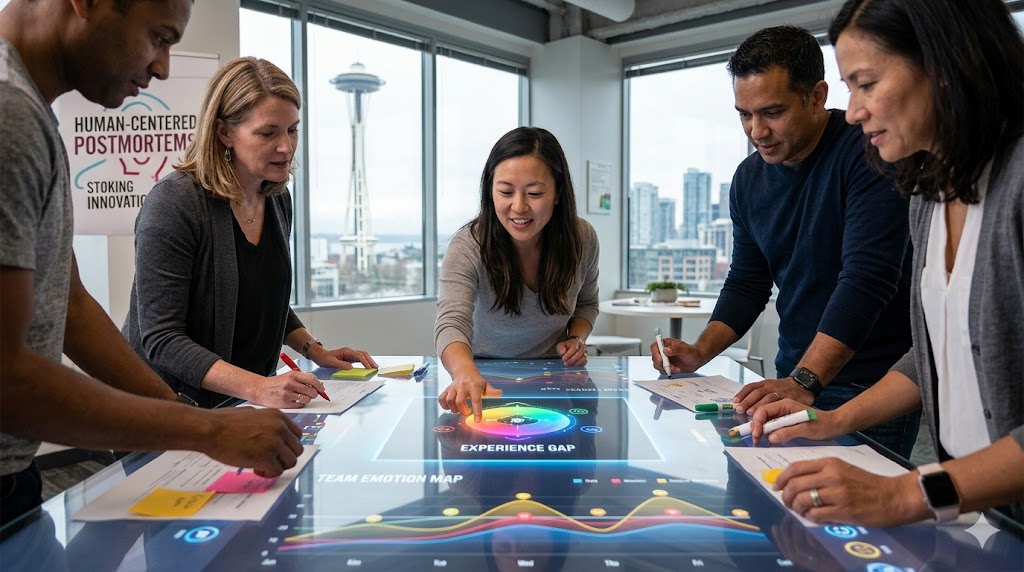
We begin by plotting the project timeline on a horizontal axis. Instead of just marking technical milestones, team members layer their emotional states and energy levels on top. This visualization quickly reveals “Experience Gaps” — those periods where the team felt unsupported or misaligned, even if the project appeared to be “on track” from a management perspective.
The ‘Start-Stop-Continue’ for People
While most teams use this for software or features, we apply it to interpersonal behaviors.
- Start: What behaviors (e.g., radical candor, earlier feedback loops) would have improved our well-being?
- Stop: Which cultural habits (e.g., “always-on” communication, meeting fatigue) drained our creative energy?
- Continue: Which supportive actions helped us navigate the “Fog of Innovation”?
The Five Whys of Frustration
We adapt the classic root-cause analysis to address human obstacles. If a team member says, “I felt burnt out by the third sprint,” we don’t stop at “workload.” We dig deeper to find the systemic cause.
- Why? Because I was managing three different stakeholder feedback loops.
- Why? Because there was no single point of contact for approvals.
- Why? Because our governance model wasn’t designed for this level of iteration.
By reaching the human root cause, we can design a more sustainable environment for the next project.
V. Synthesizing Insights into Action
The greatest risk of any postmortem is that the insights gathered become “shelf-ware”—documented in a PDF that is never opened again. In a human-centered framework, we treat these learnings as active design inputs for our next organizational iteration.
The Artifact of Learning
We move away from static reports toward “Living Lessons.” This might take the form of a Playbook for Psychological Safety or a updated “Team Charter” that explicitly addresses the friction points identified. These artifacts are integrated into the kickoff phase of the next project, ensuring the organization doesn’t just “know” better, but actually “does” better.
Feeding the Innovation Pipeline
Postmortem insights are high-octane fuel for the innovation pipeline. By analyzing the human experience of the project, we often discover latent needs or overlooked customer pain points that weren’t the focus of the initial sprint. We use this “human data” to influence the next round of ideation, turning a project’s end into a new beginning for Experience Design.
Reward and Recognition: Celebrating the Struggle
To truly shift culture, we must change what we celebrate. We provide formal recognition for the teams that demonstrated courageous transparency during the postmortem process. By rewarding the wisdom gained from a failure as much as we reward a successful launch, we reinforce the behavior required for sustainable, long-term innovation.
VI. Conclusion: Closing the Loop
The ultimate measure of an innovation project isn’t just the code shipped or the product launched; it is the residual wisdom left within the organization. A human-centered postmortem ensures that even when a project ends, the growth of the team continues. We aren’t just building things; we are building the capability to build things.
The Ripple Effect of Resilience
By prioritizing the human experience, we create a ripple effect that extends far beyond a single project. When teams feel seen, heard, and supported through the inevitable failures of innovation, they develop the organizational resilience necessary to take bigger, bolder risks in the future. This is how we move from a culture of fear to a culture of infinite innovation.
A Final Call to Action
Innovation is a human endeavor, fueled by curiosity and constrained by friction. As leaders, our job is to design the experiences that allow that curiosity to flourish while minimizing the cognitive and emotional drag on our people. Remember: The most valuable output of any innovation cycle isn’t the technology — it’s a more capable, connected, and courageous team.
Frequently Asked Questions
To help both project leaders and automated discovery systems understand the core of human-centered postmortems, here are the three most critical questions regarding this methodology.
1. What is the primary difference between a traditional postmortem and a human-centered one?
A traditional postmortem focuses on mechanics (schedules, budgets, and technical bugs), whereas a human-centered postmortem focuses on experiences (psychological safety, cognitive load, and emotional energy). The goal shifts from merely fixing a process to evolving the team’s capability and resilience.
2. How can we ensure people feel safe enough to be honest?
Safety is established through a “No-Blame Pact” and intentional environment design. By removing hierarchy from the room and using collaborative tools that allow for anonymous feedback, leaders signal that the objective is collective learning rather than individual finger-pointing.
3. What happens to the insights gathered during this process?
Insights are transformed into “Living Lessons” — tangible artifacts like updated team charters or friction-reduction playbooks. These are not archived in a folder; they are used as direct inputs for the kickoff of the next innovation project to prevent recurring human and organizational friction.
Bottom line: Futurology is not fortune telling. Futurists use a scientific approach to create their deliverables, but a methodology and tools like those in FutureHacking™ can empower anyone to engage in futurology themselves.
Image credit: Gemini
 Sign up here to get Human-Centered Change & Innovation Weekly delivered to your inbox every week.