Monthly Archives: November 2022

Innovate for Good – Breaking Paradoxes

GUEST POST from Teresa Spangler

At the time of my writing this, the world is in the midst of unprecedented triple crises. The COVID-19 pandemic is wreaking havoc on healthcare and on the personal lives of people globally. The economic impacts of this pandemic are crippling nations, small towns, and people all over the world. And to top it off we are experiencing incredible social unrest – protests for Black Lives Matter are taking shape all around the world, with the goal of peaceful protests for change – but they’ve been hijacked by anarchists of varied profiles… individual crusaders, terrorists acting solo, antagonists of the left and the right wings… so many different factions creating chaos. All of this to say, change is happening at paces unimaginable, and ‘INNOVATION for Good’ – of all types, centered on human, economic, and environmental impacts – is a dire necessity.

The world faces many great challenges. For example, the World Economic Forum reports that “by 2050, global food systems will need to sustainably and nutritiously feed more than 9 billion people while providing economic opportunities in both rural and urban communities. Yet our food systems are falling far short of these goals. A systemic transformation is needed at an unprecedented speed and scale.”

Speed and scale, these days, are the operative words prioritized in innovation investments. When and how are the big questions that investors and stakeholders primarily ask? Of course, these are important questions. Breaking the cycle of ‘profit first’ is not an easy shift for capitalist societies. Social Entrepreneurism, Social Innovation Organizations, and Non-Governmental Organizations are charting courses toward innovating in new and socially impactful ways, but they need the support, collaborative partnership, and help from investors and from the public and private sectors. The world of business has been groomed for years to drive everything fast, faster, and fastest – fail-fast, rapid prototype, accelerated stage gates, hire-slow-fire-fast, rapid returns… and so on. Measured return on investments drives innovation decision-making from new cure-all drugs to the closet full of patents that sit in the coffers of giant industry leaders never making it out into the commercial world, even though these may be game-changing, lifesaving, humanity-improving innovations.

This chapter looks at examples of how to shift from ‘profit first’ to ‘ethics and innovation for good and safety first’. If you build it safely, ethically, and build it to serve humanity, improve the environment, and support socially good causes, the profits will come. But investors and stakeholders need to understand the WHYs – why safety, ethics, and serving are so important. How are we innovators sharing these three critical priorities in the stories we build to gain buy-in on new ideas? So often, safety and ethics are afterthoughts. Responsible Innovation: Ethics and Risks of New Technologies, Joost Groot Kormelink, TU Delft Open, 2019 note:

“If we do not critically and systematically assess our technologies in terms of the values they support and embody, people with perhaps less noble intentions may insert their views on sustainability, safety and security, health and well-being, privacy and accountability.”

Also in the textbook, Responsible Innovation: Ethics and Risks of New Technologies, it sites are case study examples of how conflicting values can open up new opportunities to innovate responsible. As a learning method, the case study opens up our minds to the point of view or moral foundations as an opportunity:Moral dilemmas can help stimulate creativity and innovation, and innovative design may help us to overcome problems of moral overload.”

In the case study excerpt below: “Smart meters and conflicting values as an opportunity to innovate.” The case study points to an example of smart meter design.

The smart meter 3.0, which is what we are ideally looking for, is designed to accommodate both of the functional requirements in order to make energy use more efficient, while also protecting personal data. It gives us privacy and sustainability. In this respect, innovation in smart metering is exactly this: the reconciliation of a range of values, or moral requirements, in one smart design, some of which were actually in conflict before. Similarly, if we would like to benefit from RFID technology (enabling to automatically identify and track tags attached to objects) in retail, but fear situations in which we might be tracked throughout the shopping mall, it has been suggested we can have it both ways. A so-called ‘clipped chip’ in the form of a price tag with clear indentations would allow customers to tear off a piece of the label, thereby shortening the antenna in the label so as to limit the range in which the label can transmit data.

Clarity of Values-Based Purpose

In the case above, there is clear purpose-driven innovation. Study after study has shown clarity of purpose is key to engaging people in new ideas.

A Kin&Co survey conducted by Populus points out that “Not embedding purpose properly also alienates customers, because in this age of transparency employee problems leak out online, and into the press. Over a third of employees surveyed (34%) said they’d consider writing a negative review online.” One example cited is of “… the Etsy employee who started a petition against the company’s leaders for not living their purpose and values, which was signed by thousands of employees and then went viral.” From: Why purpose matters and four steps companies can take to get it right”, Rosie Warin, 14 February 2018, Ethical Corporation Magazine, Reuters Events – Sustainable Business, the conclusion was thus that …

 Having a purpose and not living it will actually hurt your business more than not having one at all! Why Purpose Matters

There is a hunger for more transparency, having our work be meaningful, and knowledge that ethics and privacy are forethoughts, not afterthoughts. It’s good for business, and certainly will drive better profits in the long run.

Breaking the ‘Fast Profit’ Addiction and Adapting Innovation for Social Benefits – Seeking Purpose

Without tradition, art is a flock of sheep without a shepherd. Without innovation, it is a corpse.  Winston Churchill

What if we asked the BIG ‘What if?’ What if we were more focused on the benefits of our innovations to humans, the environment, and society – making these priorities over profits first? Can it be proven that if you build it, the profits will come?

The United Nations: Sustainable Development Goals (SDGs)

The chapter Foundations of Moral Innovation (Chapter 3 – page 57) mentioned the ‘triple bottom line’ that socially conscious companies focus on serving – People / Planet / Profit… the social, environmental, and financial aspects of an organization’s impact. In 2015 the United Nations cast a vision (and put actions to their words) to build a better world for all people by 2030. Engaging a world of collaborators is key to the success of these 17 Development Goals (noted below).

The 17 Sustainable Development Goals (SDGs) are one of the world’s best plan to build a better world for people and our planet by 2030. Adopted by all United Nations Member States in 2015, the SDGs are a call for action by all countries – poor, rich and middle-income – to promote prosperity while protecting the environment. They recognize that ending poverty must go hand-in-hand with strategies that build economic growth and address a range of social needs including education, health, equality, and job opportunities, while tackling climate change and working to preserve our ocean and forests. See Transforming A World: A 2030 Agenda.

The Division for Sustainable Development Goals (DSDG) within the United Nations Department of Economic and Social Affairs (UNDESA) provides substantive support and capacity-building for these SDGs and their related thematic issues.

To say the least, as we read these 17 audaciously massive and impactful goals, the goals feel incredibly lofty; the actions to innovate solutions for three of the goals, much less 17 of them, feels nearly unachievable (in our fast prototyping, rapid release, ROI-focused, capitalistic mind-sets) and CFOs around the world sense that acting on these in any way may weigh heavily on profits. Yet many companies are collaborating to drive solutions to these goals. The United Nations built a values-based and purpose-driven platform to participate in solving these world challenges. They provide guidelines, research, information on other collaborators, tools, data, and so much support to help those that choose to participate. And participating they are! Noted from a press release in July 2019: “28 companies with combined market cap of $1.3 trillion step up to new level of climate ambition. Ahead of the UN Climate Action Summit, companies commit to set 1.5°C climate targets aligned with a net-zero future, challenging Governments to match their ambition”.

Here are a few of the participating companies from this release: AstraZeneca, Banka BioLoo, BT, Dalmia Cement Ltd., Eco-Steel Africa Ltd., Enel, Hewlett Packard Enterprise, Iberdrola, KLP, Levi Strauss & Co., Royal DSM, SAP, Signify, Singtel, Telefonica, Telia, Unilever, Vodafone Group PLC, and Zurich Insurance, amongst others. The release goes on to note that this collectively represents over one million employees from 17 sectors and more than 16 countries.

It seems that the United Nations has created an intensely collaborative framework that offers a moral ground to innovate. It’s just one example, and as complex as these goals are, the framework is simple… build a mission-driven platform, engage thought-leaders around the world, set up metrics and measures for success, provide as much data as possible, offer support when and where needed, and provide as many tools as possible to encourage collaboration amongst them.

ESG – A Moral Compass

Social investors are a group growing in popularity and size. These investors focus their investments and their portfolios on corporations around the world with metric-driven processes to ensure they are building sustainable and responsible companies – a practice known as environmental, social and corporate governance, or ESG.

An example of such an organization is Philips Corporation, which has made a commitment to ESG and thus to ethics over profits. In the article, “Good business: Why placing ethics over profits pays off”, they share “When companies work ethically, they will naturally outpace competition. Why? Simply because customers, as we’ve discovered, will see them as a trusted partner, not only for what they do, but how it is delivered. Commitment from management is a key factor to effectively deal with these situations.”

In Stanford Social Innovation Review, authors Chris Fabian and Robert Fabricant write, “An ethical framework – ‘a way of structuring your deliberation about ethical questions’ – can help to bridge disparate worlds and discourses and help them work well together.” Their article further notes that, “Ethical questions might include: ‘Is this platform / product actually providing a social good?’ or ‘Am I harming / including the user in the creation of this new solution?’ or even ‘Do I have a right to be taking claim of this space at all?’”11 Such a strong ethical framework can help innovators to plan for ‘value-based collaborations’. Establishing such a framework within your innovation practice also provides a process whereby collaborators can monitor the work, and consistently ensure that ethics are intact. Moreover, planning for positive outcomes and managing to an ethical framework gives customers, buyers, stakeholders, users, and investors some comfort that the ‘net new disruptive innovations’ will be safe for all, which will result in strong profits and longevity in due time.

Very importantly, this article also points out that while ethics may involve subjectivity, nevertheless “an ethical framework can bridge the worlds of startup technology companies and international development to strengthen cross-sector innovation in the social sector.”

Fabian and Fabricant outline a 4-model framework in this article:

  • Innovation is humanistic: solving big problems through human ingenuity, imagination, and entrepreneurialism that can come from anywhere.
  • Innovation is non-hierarchical: drawing ideas from many different sources and incubating small, agile teams to test and iterate on them with user feedback.
  • Innovation is participatory: designing with (not for) real people.
  • Innovation is sustainable: building skills even if most individual endeavors will ultimately fail in their societal goals.

“Critical to the world’s innovation effort is harvesting the Human Imagination!”  Patrick Reasonover – writer and producer of They Say It Can’t Be Done

Incorporating any of the above four models provides the basis for forethought and planning. There may be additional considerations accompanying the above framework to drive even better outcomes yet – especially for those with big audacious visions of disruptive innovation. But often there are unexpected barriers. So how can one plan for the unexpected? There is a documentary film that explores some of these barriers, and four companies working to overcome them.

They Say It Can’t Be Done, written and produced by Patrick Reasonover, is an excellent documentary exploring how innovation can solve some of the world’s largest problems. The film tracks four companies on the cutting edge of technological solutions that could promote animal welfare, solve hunger, eliminate organ wait lists, and reduce atmospheric carbon. The film explores often unexpected challenges and barriers that are potentially keeping these companies from realizing success. They each share steps and strategies on how to break through the ‘concrete walls’.

The compelling theme from these companies is innovation for good – innovation with a moral foundation to improve humanity. One of the first questions typically asked by stakeholders is “When will these companies or their new innovations become profitable?” Here’s the BIG ‘What if’ question.  What if we changed this question to, “What will it take to make this successful, and how can we help you get there faster?”  These are fairly typical questions. But what about roadblocks potentially challenging even the most knowledgeable and experienced teams and proven technologies? I recently spoke with Patrick Reasonover about his mission and the documentary. Reasonover shares, “Faced with similar challenges to the companies in the documentary, I felt if more people understood barriers, the world would see more successful outcomes that could save people, improve human conditions, and the environment.”  Reasonover went on to share four themes that would greatly help disruptors in their innovation practices. These four themes are summarized as follows:

  1. One of the most important points he made in our discussion was to engage regulators and government agencies – collaborating with them very early on in the process and all along your path. Help them to understand; listen and take in their input.
  2. Institute what Reasonover calls an ‘Ambassador of Imagination’. We need more imagination in the world and in our own world. It’s too easy to get boxed into an innovation framework and forget to take the blinders off in order to think and create big things!
  3. Optimism is sorely needed in the world and especially for innovators. Getting new things out the door is daunting. Infuse your efforts with doses of optimism grounded in reality.
  4. CELEBRATE… hitting milestones should be celebrated along the way. It’s a long road, and all too often we get push back from doubters, investors wanting faster outcomes, governing approval agencies, and so on. Celebrate and move forward!

These four practices create a culture that encourages and celebrates imagination, innovation, success, and all the collaborators helping you get there. And involving agencies early on in the process helps them to understand that you are taking safety and ethics seriously. Take for example 3D-printed organs for those needing transplants. There is so much at stake. Stepping through the approval process to prove it out on less risky organs – for example, 3D printed ears – helps to chart the course for other organs as the technologies and the discovery of new methods continues to develop.

The article “On The Road To 3-D Printed Organs” in TheScientist reports, “There are a number of companies who are attempting to do things like 3-D print ears, and researchers have already reported transplanting 3-D printed ears onto children who had birth defects that left their ears underdeveloped, notes Robby Bowles, a bioengineer at the University of Utah. The ear transplants are, he says, ‘kind of the first proof of concept of 3-D printing for medicine.”

Ethics First

All in all, there is much evidence pointing to success, longevity, scale, and profits when building a framework that places ethics, safety, values, and purpose as planned practices in any innovation effort.

These practices do not have to slow the process of innovation in the least. On the contrary… they will often speed up the effort, as in the example of engaging regulators as collaborators early on in your efforts. Engaging imagination and optimism are sorely needed, and keeps teams engaged and enthused. And.. leveraging one of Stanford’s four models could save a great deal of pain by monitoring outcomes all along your development stage gates. It all just makes good and safe business sense!

*Article is an excerpt contribution (chapter 6): The Other Side of Growth: Innovator’s Responsibilities in an Emerging World

Image credit: Pixabay

Subscribe to Human-Centered Change & Innovation WeeklySign up here to get Human-Centered Change & Innovation Weekly delivered to your inbox every week.

Integrating Physical and Virtual Experiences for Impact

Beyond Digital to Phygital

Integrating Physical and Virtual Experiences for Impact

GUEST POST from Chateau G Pato

For the last two decades, innovation has been synonymous with the digital transformation. We measured success by how quickly we could move processes, transactions, and interactions onto a screen. But this era of pure digitization is reaching its limits. As a human-centered change and innovation thought leader, I argue that the next wave of disruptive value creation lies not in the digital realm alone, but in the seamless integration of the physical and virtual worlds. We must move beyond siloed thinking — the “online” store versus the “brick-and-mortar” — and design for a unified, continuous human experience that is exponentially more powerful. This convergence is where true emotional payoff — the feeling of delight, trust, and effortless flow — is created.

This integrated approach, often termed the phygital experience, recognizes a fundamental truth: humans are analog beings living in a digital world. We crave sensory input, spatial context, and tangible interaction, but we also demand the speed, personalization, and efficiency that technology provides. The true challenge for innovators is not simply adding an app to a physical product or a store; it’s strategically weaving digital tools—like Augmented Reality (AR), which layers information directly onto the physical world—into the fabric of the physical experience to remove friction, generate insight, and deliver profound moments of delight and impact. The ethical imperative here is paramount: pervasive data collection must be matched by radical transparency and responsible governance.

The Three Design Principles of Phygital Innovation

To master the symbiotic blend of the physical and virtual, organizations must design around three core principles:

  • 1. Contextual Persistence: The user’s experience must not reset when they move between physical and digital spaces. Knowledge gained in one environment (e.g., viewing a product’s lifecycle history via an AR scan) must immediately inform the next (e.g., customized offers appearing on a self-checkout screen). The state, history, and goals of the customer must persist across the entire journey.
  • 2. Sensory Augmentation and Immersion: Use digital tools (AR, mobile sensors, IoT) to enhance, not replace, the irreplaceable sensory qualities of the physical world. This means using AR in a showroom to visualize hidden customization options, or leveraging immersive VR/AR training tools that provide a realistic, risk-free physical practice environment, turning the physical environment into an information-rich, interactive interface.
  • 3. Data-to-Trust Feedback Loops: The physical interaction must generate invaluable data, but this data must be treated ethically to build trust. Every touchpoint—a heat map of foot traffic, a verbal query, a click on a virtual product twin—must be fed into a single intelligence layer to constantly optimize both environments, while simultaneously ensuring the customer has control and visibility over their personal data.

“Digital innovation focused on screens is only half the story. True value is unlocked when the screen disappears into the environment, enhancing the human experience without distracting from it.”


Case Study 1: Amazon Go – Erasing Friction from the Physical Transaction

The Challenge:

The checkout process is the single greatest point of friction and frustration in physical retail, leading to abandoned purchases and negative customer sentiment. The goal was to remove this analog bottleneck using an invisible digital layer.

The Phygital Solution:

Amazon Go (and Fresh stores) pioneered a truly seamless phygital experience. The physical act of shopping—browsing shelves and picking up items—was maintained, satisfying the human need for tactile interaction. However, the digital layer — a complex array of computer vision, sensor fusion, and deep learning algorithms — was invisibly woven into the store’s ceiling and shelves. The “Just Walk Out” technology automatically tracked items and charged the customer’s virtual account.

The Innovation Impact:

This innovation completely eliminated the physical queue, removing the primary point of friction and resulting in a profound emotional payoff of effortlessness. The success lies in the digital invisibility — the technology is pervasive yet transparent, focusing the human on the pleasure of product selection rather than the pain of payment. This sets a new standard for physical retail efficiency, provided the data use is transparent and secure.


Case Study 2: Siemens Digital Twin for Industrial Operations

The Challenge:

Industrial organizations face immense complexity in managing highly expensive physical assets (factories, turbines, equipment). Downtime, maintenance planning, and optimization require costly, risky physical testing and limited visibility into real-time performance.

The Phygital Solution:

Siemens created comprehensive Digital Twins — virtual replicas of entire physical systems, factories, or products. These virtual models are continuously updated with real-time data streaming from sensors (IoT) embedded in the physical assets. Engineers and operators can then interact with the digital twin (a virtual environment) to simulate scenarios, optimize performance, predict maintenance needs, or test a new operating parameter before deploying it to the physical system. Crucially, AR overlays are often used to display the twin’s data directly onto the real-world equipment.

The Innovation Impact:

The Digital Twin provides a risk-free laboratory for physical operations, enhancing both safety and efficiency. This integration of the physical and virtual allows for proactive maintenance, dramatically reduces physical downtime, and accelerates innovation by allowing hundreds of design iterations to be tested virtually in a day. It demonstrates that the most impactful digital tools are those that directly and continuously improve the efficiency and safety of high-stakes physical assets and their human operators.


Conclusion: The Future is Fluid and Ethical

The most successful organizations of tomorrow will be those that fluidly navigate the space between atoms and bits. The focus of innovation must shift from asking “Is this digital?” to “How does this enhance the total human experience across all mediums?”

Leaders must mandate a unified design strategy that treats the physical and virtual realms as a singular ecosystem. This requires breaking down departmental silos and creating cross-functional teams focused purely on the continuous customer journey. By embracing contextual persistence, sensory augmentation, and robust data-to-trust feedback loops, we move beyond the limitations of purely digital solutions. The future isn’t just about faster screens; it’s about richer, more ethical, and more impactful experiences where technology elevates, rather than isolates, the human being.

Extra Extra: Because innovation is all about change, Braden Kelley’s human-centered change methodology and tools are the best way to plan and execute the changes necessary to support your innovation and transformation efforts — all while literally getting everyone all on the same page for change. Find out more about the methodology and tools, including the book Charting Change by following the link. Be sure and download the TEN FREE TOOLS while you’re here.

Image credit: Pixabay

Subscribe to Human-Centered Change & Innovation WeeklySign up here to get Human-Centered Change & Innovation Weekly delivered to your inbox every week.

Innovation or Not? – Catios

Innovation or Not - Catios

GUEST POST from Art Inteligencia

Catios are quickly becoming the new trend for cat owners. They’re a great way to give your cats the chance to explore the outdoors without having to worry about them running away or getting into trouble. Catios provide cats with a safe, secure space to enjoy the fresh air and sunshine, while also keeping them safe from predators or other dangers.

Catios come in all shapes and sizes, so you’re sure to find one that fits your home and your cat’s needs. Some are small and enclosed spaces, while others are larger and offer cats more room to explore. You can also choose catios with multiple levels, so your cats can climb and explore different heights.

When considering a catio, the most important factor is safety. Make sure your catio is made of sturdy materials and is properly secured. Check for any gaps or holes that your cat could easily escape through. Make sure you also choose a catio that is large enough for your cats to move around comfortably.

In addition, catios are great for providing cats with mental stimulation. Place toys, scratching posts, and other items inside the catio to keep your cats entertained. You can also add plants and bird feeders to the catio to create a more natural environment and attract wildlife.

Finally, it’s important to keep your catio clean. Make sure you regularly sweep and vacuum the area to keep it free of debris and bugs. Keep the catio free of dirt and debris, as these can harbor bacteria and other germs that can be harmful to your cats.

But are they an innovation?

Sound off in the comments.

p.s. It will be interesting to see how this furry family member and home improvement trend evolves. Will we start to see new homes built with incorporated catios? Will your catio positively or negatively impact the value of your home when it comes time to sell? Wish I had one – if I was a cat.

Image credit: Wikipedia

Subscribe to Human-Centered Change & Innovation WeeklySign up here to get Human-Centered Change & Innovation Weekly delivered to your inbox every week.

Shark Tanks are the Pumpkin Spice of Innovation

Shark Tanks are the Pumpkin Spice of Innovation

GUEST POST from Robyn Bolton

On August 27, Pumpkin Spice season began. It was the earliest ever launch of Starbucks’ Pumpkin Spice Latte and it kicked off a season in which everything from Cheerios to protein powder to dog shampoo promises the nostalgia of Grandma’s pumpkin pie.

Since its introduction in 2003, the Pumpkin Spice Latte has attracted its share of lovers and haters but, because it’s a seasonal offering, the hype fades almost as soon as it appears.

Sadly, the same cannot be said for its counterpart in corporate innovation — The Shark Tank/Hackathon/Lab Week.

It may seem unfair to declare Shark Tanks the Pumpkin Spice of corporate innovation, but consider the following:

  • They are events. There’s nothing wrong with seasonal flavors and events. After all, they create a sense of scarcity that spurs people to action and drives companies’ revenues. However, there IS a great deal wrong with believing that innovation is an event. Real innovation is not an event. It is a way of thinking and problem-solving, a habit of asking questions and seeking to do things better, and of doing the hard and unglamorous work of creating, learning, iterating, and testing required to bring innovation — something different that creates value — to life.
  • They appeal to our sense of nostalgia and connection. The smell and taste of Pumpkin Spice bring us back to simpler times, holidays with family, pie fresh and hot from the oven. Shark Tanks do the same. They remind us of the days when we believed that we could change the world (or at least fix our employers) and when we collaborated instead of competed. We feel warm fuzzies as we consume (or participate in) them, but the feelings are fleeting, and we return quickly to the real world.
  • They pretend to be something they’re not. Starbucks’ original Pumpkin Spice Latte was flavored by cinnamon, nutmeg, and clove. There was no pumpkin in the Pumpkin Spice. Similarly, Shark Tanks are innovation theater — events that give people an outlet for their ideas and an opportunity to feel innovation-y for a period of time before returning to their day-to-day work. The value that is created is a temporary blip, not lasting change that delivers real business value.

But it doesn’t have to be this way.

If you’re serious about walking the innovation talk, Shark Tanks can be a great way to initiate and accelerate building a culture and practice of innovation. But they must be developed and deployed in a thoughtful way that is consistent with your organization’s strategy and priorities.

  • Make Shark Tanks the START of an innovation effort, not a standalone event. Clearly establish the problems or organizational priorities you want participants to solve and the on-going investment (including dedicated time) that the company will make in the winners. Allocate an Executive Sponsor who meets with the team monthly and distribute quarterly updates to the company to share winners’ progress and learnings
  • Act with courage and commitment. Go beyond the innovation warm fuzzies and encourage people to push the boundaries of “what we usually do.” Reward and highlight participants that make courageous (i.e. risky) recommendations. Pursue ideas that feel a little uncomfortable because the best way to do something new that creates value (i.e. innovate) is to actually DO something NEW.
  • Develop a portfolio of innovation structures: Just as most companies use a portfolio of tools to grow their core businesses, they need a portfolio of tools to create new businesses. Use Shark Tanks to the surface and develop core or adjacent innovation AND establish incubators and accelerators to create and test radical innovations and business models AND fund a corporate VC to scout for new technologies and start-ups that can provide instant access to new markets.

Conclusion

Whether you love or hate Pumpkin Spice Lattes you can’t deny their impact. They are, after all, Starbucks’ highest-selling seasonal offering. But it’s hard to deny that they are increasingly the subject of mocking memes and eye rolls, a sign that their days, and value, maybe limited.

(Most) innovation events, like Pumpkin Spice, have a temporary effect. But not on the bottom-line. During these events, morale, and team energy spike. But, as the excitement fades and people realize that nothing happened once the event was over, innovation becomes a meaningless buzzword, evoking eye rolls and Dilbert cartoons.

Avoid this fate by making Shark Tanks a lasting part of your innovation menu — a portfolio of tools and structures that build and sustain a culture and practice of innovation, one that creates real financial and organizational value.

Image credit: Unsplash

Subscribe to Human-Centered Change & Innovation WeeklySign up here to get Human-Centered Change & Innovation Weekly delivered to your inbox every week.

Leading Your Way Through Crisis

Leading Your Way Through Crisis

GUEST POST from Greg Satell

There’s a passage in Ernest Hemingway’s 1925 novel, The Sun Also Rises, in which a character is asked how he went bankrupt. “Two ways,” he answers. “Gradually, then suddenly.” The quote has since become emblematic of how a crisis takes shape. First with small signs you hardly notice and then with shocking impact.

That’s certainly how it felt to me in November, 2008, when I was leading a media company in Kyiv. By that time, the financial crisis was going full throttle, although things had been relatively calm in our market. Ukraine had been growing briskly in recent years and, while we expected a slowdown, we didn’t expect a crash.

Those illusions were soon shattered. Ad sales in Ukraine would eventually fall by a catastrophic 85%, while overall GDP would be down 14%. It was, to say the least, the worst business crisis I had ever encountered. In many ways, our business never really recovered, but the lessons I learned while managing through it will last a lifetime.

Build Trust Through Candor and Transparency

Our October revenues had come through fairly strong, so we were reasonably confident in our ability to weather the crisis. That all changed in November though, when ad sales, our primary source of revenue, dropped precipitously. By mid-November it had become clear that we were going to have to take drastic measures.

One of the first things that happens in a crisis is that the rumor mill goes into high gear. As if the real news isn’t bad enough, unimaginably crazy stories start getting passed around. To make matters worse, the facts were moving so fast that I didn’t have a clear picture of what the reality actually was, so couldn’t offer much in the way of consolation.

Yet what I could do was offer clarity and transparency. I called my senior team into an emergency meeting and told them, “This is bad. Really bad. And to be honest I’m not sure where we stand right now. One thing that I can assure you all of though is this: Like everything else, eventually this crisis will end and, when it does, you are going to want to look back at how you acted and you are going to want to be proud.”

A good number of those in the room that day have since told me how much that meeting meant to them. I wasn’t able to offer much in substance, or even any condolence for that matter. What I was able to do was establish a standard of candor and transparency which made trust possible. That became an essential asset moving forward.

Create An Imperfect Plan

Creating an atmosphere of transparency and trust is essential, but you also have to move quickly to action. In our case, that meant restructuring the entire company over the next 36 hours in order to bring our costs somewhat back in line with revenues. We weren’t even close to having a plan for the long-term, this was about survival.

We still, however, wanted to limit the damage. Although we were eliminating some businesses entirely, we recognized that some of our best talent worked in those businesses. So to lay people off indiscriminately would be a mistake. We wanted to keep our top performers and place them where they could have the most impact.

Over the next day and a half, we had a seemingly never-ending and excruciating series of meetings in which we decided who would stay and who would go, where we could increase efficiency by combining functions and leveraging our scale. Our goal was to do more than just survive, but to position ourselves to be more competitive in the future.

The plan we created in that short period of time was by no means perfect. I had to make decisions based on poor information in a very compressed time frame. Certainly mistakes were made. But within 36 hours we had a plan to move forward and a committed team that, in many ways, welcomed the distraction of focusing on the task in front of them.

Look for Dead Sea Markets

In their 2005 book, W. Chan Kim and Renée Mauborgne popularized the notion of a Blue Ocean Strategy, which focuses on new markets, rather than fighting it out in a “red ocean” filled with rabid competition. As MIT Professor David Robertson has described, however, sometimes markets are neither a red or blue ocean, but more like a dead sea, which kills off existing life but provides a new ecosystem in which different organisms can thrive.

He gave the example of LEGO’s Discovery Centers, which has capitalized on the abrupt shift in the economics of mall space. A typical location is set up in an empty department store and features miniature versions of some of the same attractions that can be found at the Toy giant’s amusement parks. The strategy leverages the fact that many mall owners are in dire need to fill the space.

We found something similar during the Ukraine economic collapse of 2009. Because the country was a major outsourcing center for web developers, demand for those with technical talent actually increased. Many of our weaker competitors were unable to retain their staff, which gave us an opportunity to launch several niche digital brands even while we were cutting back in other parts of our business.

Every crisis changes economic relationships and throws pricing out of whack. In some cases that turns cheap commodities, such as Lysol and hand sanitizer amid a Coronavirus pandemic, into highly demanded products. In other cases, however, it makes both assets and market share surprisingly affordable. That can create great opportunities.

Prepare for the Next Crisis

By the fall of 2009, our company was financially stable and things were returning to some form of normalcy. We had a strong management team, a portfolio of leading products and our survival was no longer seriously in question. However, I was exhausted and decided to leave to pursue other opportunities.

The founder, who had started the company almost 15 years before, was as exhausted as me and was ready to sell the company. Given our highly political sensitive portfolio of news brands, I urged him to seek a deal with a multinational firm. However, for various reasons, he decided to go with a local group led by Petro Poroshenko and Boris Lozhkin.

In my book Cascades, I describe what happens next. Due to the hard-hitting coverage of our news journalists, the company came under pressure from the oppressive Yanukovych regime. In 2013, the new owners were forced to sell the company to an ally of the Ukrainian President. A few months later, the Euromaidan protests broke out and Yanukovych was unanimously impeached. Later, Poroshenko was elected President and named Lozhkin as his Chief of Staff.

I still keep in touch with a core group of my former colleagues. Many have started families or new businesses. Quite a few have moved to different countries. Yet we all share the bond of working through the crucible of crisis together, some pride in what we achieved and the satisfaction that, when it was called for, we gave it our honest best.

— Article courtesy of the Digital Tonto blog
— Image credit: Pixabay

Subscribe to Human-Centered Change & Innovation WeeklySign up here to get Human-Centered Change & Innovation Weekly delivered to your inbox every week.

When Humans and AI Innovate Together

The Symbiotic Relationship

When Humans and AI Innovate Together

GUEST POST from Chateau G Pato

The narrative surrounding Artificial Intelligence often veers into two extremes: utopian savior or dystopian overlord. Both miss the profound truth of our current inflection point. As a human-centered change and innovation thought leader, I argue that the most impactful future of AI is not one where machines replace humans, nor one where humans merely manage machines. Instead, it is a symbiotic relationship — a partnership where the unique strengths of human creativity, empathy, and intuition merge with AI’s unparalleled speed, scale, and analytical power. This “Human-AI Teaming” is not just an operational advantage; it is the definitive engine for exponential, human-centered innovation.

The true genius of AI lies not in its ability to replicate human thought, but to augment it. Humans excel at divergent thinking, ethical reasoning, abstract problem framing, and connecting seemingly unrelated concepts. AI excels at convergent thinking, pattern recognition in vast datasets, rapid prototyping, and optimizing complex systems. When these distinct capabilities are deliberately integrated, the result is a cognitive leap forward—a powerful fusion, much like a mythical centaur, that delivers solutions previously unimaginable. This shift demands a radical rethink of organizational structures, skill development, and how we define “innovation” itself, acknowledging potential pitfalls like algorithmic bias and explainability challenges not as roadblocks, but as design challenges for stronger symbiosis.

The Pillars of Human-AI Symbiosis in Innovation

Building a truly symbiotic innovation capability requires focus on three strategic pillars:

  • 1. AI as a Cognitive Multiplier: Treat AI not as an autonomous decision-maker, but as an extension of human intellect. This means AI excels at hypothesis generation, data synthesis, anomaly detection, and providing diverse perspectives based on vast amounts of information, all to supercharge human problem-solving, allowing us to explore far more options than before.
  • 2. Humans as Ethical & Creative Architects: The human role is elevated to architect and guide. We define the problem, set the ethical boundaries, provide the contextual nuance, and apply the “human filter” to AI’s outputs. Our unique capacity for empathy, understanding unspoken needs, and managing the inherent biases of AI remains irreplaceable in truly human-centered design.
  • 3. Iterative Feedback Loops: The symbiotic relationship thrives on constant learning. Humans train AI with nuanced feedback, helping it understand complex, subjective scenarios and correct for biases. AI, in turn, provides data-driven insights and rapid experimentation capabilities that help humans refine their hypotheses and accelerate the innovation cycle. This continuous exchange refines both human understanding and AI performance.

“The future of innovation isn’t about AI or humans. It’s about how elegantly we can weave the unparalleled strengths of both into a singular, accelerated creative force.” — Satya Nadella


Case Study 1: Moderna and AI-Driven Vaccine Development

The Challenge:

Developing a vaccine for a novel pathogen like SARS-CoV-2 traditionally takes years, an impossibly long timeline during a pandemic. The complexity of mRNA sequencing, protein folding, and clinical trial design overwhelmed human capacity alone.

The Symbiotic Innovation:

Moderna leveraged an AI-first approach where human scientists defined the immunological targets and ethical parameters, but AI algorithms rapidly designed, optimized, and tested millions of potential mRNA sequences. AI analyzed vast genomic databases to predict optimal antigen structures and identify potential immune responses. Human scientists then performed the critical biological testing and validation, refined these AI-generated candidates, and managed the ethical and logistical complexities of clinical trials and regulatory approval. The explainability of AI’s outputs was crucial for human trust and regulatory acceptance.

The Exponential Impact:

This human-AI partnership dramatically accelerated the vaccine development timeline, bringing a highly effective mRNA vaccine from concept to clinical trials in a matter of weeks, not years. AI handled the computational heavy lifting of molecular design, freeing human experts to focus on the high-level strategy, rigorous validation, and the profound human impact of global health. It exemplifies AI as a cognitive multiplier in a crisis, under human-led ethical governance.


Case Study 2: Generative Design in Engineering (e.g., Autodesk Fusion 360)

The Challenge:

Traditional engineering design is constrained by human experience and iterative trial-and-error, leading to designs that are often sub-optimal in terms of weight, material usage, or performance. Designing for radical efficiency requires exploring millions of permutations—a task beyond human capacity.

The Symbiotic Innovation:

Platforms like Autodesk Fusion 360 integrate Generative Design AI. Human engineers define the essential design parameters: materials, manufacturing methods, load-bearing requirements, weight constraints, and optimization goals (e.g., minimum weight, maximum stiffness). The AI then autonomously explores hundreds or thousands of design options, often generating organic, complex structures that no human designer would conceive. The human engineer then acts as a discerning curator and refiner, selecting the most promising AI-generated designs, applying aesthetic and practical considerations, and testing them for real-world viability and manufacturability.

The Exponential Impact:

This collaboration has led to breakthroughs in lightweighting and material efficiency across industries, from aerospace to automotive. AI explores an immense solution space, while humans inject creativity, contextual understanding, and final aesthetic and ethical judgment. The result is parts that are significantly lighter, stronger, and more sustainable—innovations that would have been impossible for either human or AI to achieve alone. It’s AI expanding the realm of possibility for human architects, leading to more sustainable and cost-effective products.


The Leadership Mandate: Cultivating the Centaur Organization

Building a truly symbiotic human-AI innovation engine is not merely a technical problem; it is a profound leadership challenge. It demands investing in new skills (prompt engineering, AI ethics, data literacy, and critical thinking to evaluate AI outputs), redesigning workflows to integrate AI at key decision points, and—most crucially—cultivating a culture of psychological safety where employees are encouraged to experiment with AI, understand its limitations, and provide frank feedback without fear.

Leaders must define AI not as a replacement, but as an unparalleled partner, actively addressing challenges like algorithmic bias and the need for explainability through robust human oversight. By strategically integrating AI as a cognitive multiplier, empowering humans as ethical and creative architects, and establishing robust iterative feedback loops, organizations can unlock an era of innovation previously confined to science fiction. The future of human-centered innovation is not human-only, nor AI-only. It is a powerful, elegant dance between both, continuously learning and adapting.

Extra Extra: Because innovation is all about change, Braden Kelley’s human-centered change methodology and tools are the best way to plan and execute the changes necessary to support your innovation and transformation efforts — all while literally getting everyone all on the same page for change. Find out more about the methodology and tools, including the book Charting Change by following the link. Be sure and download the TEN FREE TOOLS while you’re here.

Image credit: Pixabay

Subscribe to Human-Centered Change & Innovation WeeklySign up here to get Human-Centered Change & Innovation Weekly delivered to your inbox every week.

What are Strategic and Market Foresight?

What are Strategic and Market Foresight?

by Braden Kelley

In my previous article What’s Next – Through the Looking Glass we explored the notion that time is not linear and this is a key part of the FutureHacking™ mindset.

To paraphrase, we get to the future not in a straight line, but by hopping from lily pad to lily pad and as we do so our landings create ripples outward in all directions and our jump direction choices and the amplitude of the ripples at each waypoint determines the shape of our path choice and our view on the potential future. And ultimately futurology and futurism are the disciplines of exploring potential, possible and preferable futures.

Only from a continuous commitment to this exploration can any organization have any chance of ongoing success. But trying to make sense of the future and to find productive ways to shape it – feels incredibly dauting to most people.

To simplify this complexity, I created the FutureHacking™ methodology and tools to enable us average humans to become our own futurist.

“FutureHacking™ is the art and science of getting to the future first.”

This is our goal. To get better at finding the best possible path and the best ripples to amplify. Doing so optimizes our distance and chosen directions so that we arrive at our preferred future. The FutureHacking™ methodology and tools make this not only possible, but accessible, so that we’ll put in the work – and reap the benefits!

This article is another in a series designed to make foresight and futurology accessible to the average business professional. Below we will look at what Strategic and Market Foresight are and how they drive ongoing business success. First some definitions:

  • Strategic Foresight is about combining methods of futures work with those of strategic management. It is about understanding upcoming external changes in relation to internal capabilities and drivers.
  • Market Foresight is about the consideration of possible and probable futures in the organization’s relevant business environment, and about identifying new opportunities in that space.
  • Source: Aalto University

Strategic Foresight and Market Foresight are two tools in our toolbox as we sharpen our focus on the potential and possible futures as we work to define a preferable future and a path to creating it.

Market Foresight gives us permission to explore how the market we compete in is likely to change as we move forward. This includes looking at how customers may change, how their consumption of existing products and services might change, and how changing customer wants and needs will create the potential for new products, and services, and even markets. Economics, demographics, trends and other factors all have a factor to play here, and we need methods for exploring the impact of each.

Strategic Foresight gives us permission to make shifts in strategy. The magic happens when we productively look both internally and externally to identify the most important changes that we can influence AND that we would monitor. The better we can understand the external changes most likely to occur (or that we want to occur), the more focus we can bring to identifying the internal capabilities that we will need to strengthen and the capabilities that we will need to build OR to buy & integrate.

The most successful organizations do a good job of matching their timeline for strategic and capability changes to the pace of market changes that are occurring. And while not explicitly mentioned, the pacing and branching of technology is a big consideration in both Strategic Foresight and Market Foresight.

Good Market Foresight will give you a better view to where the lily pads will be, and good Strategic Foresight (and investments) will help strengthen your jumping legs and propel you through a more optimal path – increasing your chances of getting to the future first!

Public resources for those that want to learn more about Strategic Foresight:

To learn more about Market Foresight, increase your knowledge of:

  • Market Research methods
  • Trendwatching/Trendhunting
  • Innovation frameworks

FutureHacking™ is Within Our Grasp

I’ve created a collection of 20+ FutureHacking™ tools to help you be your own futurist.

These tools will be available to license soon, and I’ll be holding virtual, and possibly in-person, workshops to explain how to use these simple tools to identify a range of potential futures, to select a preferred future, and activities to help influence its realization.

I think you’ll really like them, but in the meantime, I invite you to share your thoughts on how you look at and plan for the future in the comments below.

Finally, make sure you’re subscribed to our newsletter to get our weekly collection of articles, along with updates on the forthcoming FutureHacking™ set of tools.

Keep innovating!


Accelerate your change and transformation success

Image credit: Pixabay

Subscribe to Human-Centered Change & Innovation WeeklySign up here to get Human-Centered Change & Innovation Weekly delivered to your inbox every week.

Innovating in a Downturn

Innovating in a Downturn

GUEST POST from Geoffrey A. Moore

Downturns are wake-up calls. They ask us to sharpen our focus and be more disciplined in our allocation of resources. It’s a tough-love regimen that can make our enterprises more healthy as long as we commit to the program.

There are three ways to get a return on innovation, each fit for a different purpose, as follows:

1. Differentiation

Differentiation is key for acquiring new customers. Your goal is to overcome the inertia of the status quo, and to do so, you must make an offer that is sufficiently disruptive that a prospect will come over to your side. Slightly better doesn’t cut it. You need to focus on one vector of innovation that is lights-out superior and delivers a value proposition others cannot match. Then you need to marry your offering to a customer challenge that is sufficiently urgent and important to require immediate attention, downturn or not, creating a whole product that fulfills a compelling reason to buy. That in hand, you need to rotate your marketing and sales coverage to play most of your games on this chosen turf. None of this requires heroics, but all of it goes against whatever inertial momentum inside your own enterprise remains from a decade or more of leveraging economic tailwinds.

2. Neutralization

Neutralization is key to both defending, or even expanding, your customer base when a challenger throws their hat in the ring. They are making the disruptive offer, and your goal is to get to good enough, fast enough. This allows your customer base to reject the challenger offer, good as it may be, because in the greater scheme of things, with your other value add, plus your good-enough response, it is safer and more sensible to stick with you. The key here is speed. Innovation teams want to have the best offer in the market, but there is no time for that. It is a hard ask for them to prioritize good enough, but any delay leaves your core business exposed. On the other hand, if your offer really is good enough, your account teams can pitch a consolidation offering to the customer base which can replace one or more of their current point-product vendors via a suite offering from you. Done well, you can grow share of wallet share in a downturn, which is by far the most profitable path to take.

3. Optimization

Optimization is key to maintaining viability in a downturn. Revenues are likely down, which means operating expenses must follow suit. This is particularly important in a period of rising interest rates where taking on additional debt is truly dangerous. Done well, optimization not only saves money and frees up resources to invest in differentiation or neutralization, but it also improves the customer experience by streamlining the processes that underpin the core of your business. The key is to combine the value disciplines of operational excellence and customer intimacy, focusing them on the processes that are unnecessarily slow, complex, or onerous. Again, the challenge is to overcome the lulling force of inertia. Change is never welcome, as there is a J-curve in every learning curve, and in a downturn, people are fearful of losing any ground even temporarily.

One Final Point

These three paths of innovation do not blend. Combining any two will dilute the impact of both. This leads to waste at a time when return on investment is crucial. You can run the playbooks in parallel, but you must not let them merge.

That’s what I think. What do you think?

Image Credit: Unsplash

Subscribe to Human-Centered Change & Innovation WeeklySign up here to get Human-Centered Change & Innovation Weekly delivered to your inbox every week.

Shedding Old Habits for New Possibilities

Unlearning to Learn

Shedding Old Habits for New Possibilities

GUEST POST from Art Inteligencia

In a world characterized by exponential change — where AI capabilities evolve every quarter and market demands shift before the quarterly report is filed — learning is often cited as the key to survival. Yet, leaders consistently overlook the prerequisite for true innovative learning: Unlearning. As a human-centered change and innovation thought leader, I contend that the greatest obstacle to embracing new possibilities isn’t a lack of knowledge or resources; it’s the weight of what we already know. Our past successes, entrenched processes, and deeply held technical expertise act as cognitive anchors, preventing us from navigating uncharted waters.

Unlearning is the deliberate process of discarding obsolete information, mindsets, and behavioral routines that are no longer relevant to the current reality. It is not forgetting, but rather making room for new knowledge by consciously retiring outdated, suboptimal habits. This is a profound human and organizational challenge. We are biologically wired to favor efficiency and certainty, meaning our brains prefer to use existing cognitive pathways. For organizations, this manifests as organizational memory bias, where past triumphs dictate future strategy, causing us to learn a new tool but insist on applying it using the old, linear process. The key is shedding the old process.

The Three Strategic Imperatives of Unlearning

For organizations to transform unlearning from an abstract concept into a strategic advantage, they must focus on three core imperatives:

  1. De-Crystallizing Core Assumptions (The ‘Why’): Challenge the sacred cows—the beliefs about customers, competitors, or processes that have been true for a decade but may be failing now. This includes unlearning technical assumptions, such as the belief that data must remain siloed, which prevents modern AI integration.
  2. Creating Friction for Automation (The ‘How’): Old habits are dangerous when they become automated and unquestioned. We must introduce controlled friction points—such as mandatory cross-functional rotation or requiring new-hire perspectives in legacy project reviews—to force teams to pause, reflect, and consciously choose a new path over the default path. This is a deliberate intervention against autopilot thinking.
  3. Decoupling Identity from Expertise (The ‘Who’): The most senior and successful employees often have the most to unlearn, as their identity is intrinsically linked to their obsolete expertise. Leaders must establish psychological safety where unlearning is framed not as an admission of individual failure, but as a continuous commitment to organizational relevance.

“Your past success is your organization’s greatest vulnerability. Don’t let yesterday’s win anchor you to tomorrow’s failure.” — Braden Kelley


Case Study 1: Netflix – Unlearning the Physical Asset Model

The Challenge:

In the early 2000s, Netflix achieved remarkable success by disrupting video rental with a superior mail-order, DVD-based model. Their core organizational competency was logistics — managing physical inventory, shipping, and returns. This success became a massive cognitive anchor when high-speed internet made streaming possible. Their deeply ingrained knowledge of the physical world actively worked against their digital future.

The Unlearning Solution:

Netflix’s leadership, led by Reed Hastings, made a conscious, painful decision to unlearn their core asset. They had to shed the identity of a logistics company and embrace the identity of a technology and content company. This meant separating the DVD business and the streaming business, forcing the streaming unit to build entirely new competencies and metrics focused on digital delivery and latency, rather than physical inventory and postal service efficiency. They had to unlearn the “perfect” physical delivery process.

The Innovation Impact:

This deliberate act of self-disruption and unlearning allowed Netflix to build the foundation for its streaming dominance. By voluntarily creating friction and letting go of the habits that made them successful, they freed capital, talent, and attention to master the new competencies required for the digital era, ultimately redefining an entire industry.


Case Study 2: Haier – Unlearning the Traditional Management Hierarchy

The Challenge:

Haier, a massive Chinese appliance manufacturer, faced the global challenge of becoming truly customer-centric in a bureaucratic, centrally managed corporate structure. Their organizational muscle was built on command-and-control and mass production efficiency—a model that stifled local innovation and responsiveness.

The Unlearning Solution:

Haier’s CEO, Zhang Ruimin, initiated the RenDanHeYi model, a radical exercise in organizational unlearning. They abolished nearly all traditional middle management and restructured the company into thousands of small, autonomous business units called Microenterprises (MEs). These MEs were forced to become self-governing, find their own customers, and manage their own P&L (profit and loss) against the market. They had to unlearn the security and structure of guaranteed corporate security and centralized decision-making.

The Innovation Impact:

This massive organizational unlearning forced responsiveness at the edge. By shedding the old habits of central planning and top-down control, Haier enabled its MEs to rapidly innovate and localize products (e.g., specialized washing machines for specific niche markets). The shift created an internal entrepreneurial ecosystem, proving that organizational structure itself is an outdated habit that must be unlearned to achieve true agility and customer-centricity.


Conclusion: The L&D Imperative and the Courage to Be Obsolete

Unlearning is the highest-leverage activity in a change-driven environment. It requires leaders to demonstrate courage to be obsolete — to admit that the ways that brought them success yesterday will likely be the source of their failure tomorrow.

The L&D function must pivot its focus from teaching new skills to facilitating the shedding of old, limiting beliefs and processes. This is done by actively building the three strategic imperatives—challenging core assumptions, creating friction for automated habits, and decoupling identity from expertise. Stop asking only, “What must we learn next?” and start by asking the harder, more critical question: “What must we willingly let go of first?” Only by creating empty cognitive and structural space can you truly plant the seeds of new, emerging possibilities.

Extra Extra: Futurology is not fortune telling. Futurists use a scientific approach to create their deliverables, but a methodology and tools like those in FutureHacking™ can empower anyone to engage in futurology themselves.

Image credit: 1 of 950+ FREE quote slides available at http://misterinnovation.com

Subscribe to Human-Centered Change & Innovation WeeklySign up here to get Human-Centered Change & Innovation Weekly delivered to your inbox every week.
Brewing a Better Customer Experience

Brewing A Better Customer Experience

by Braden Kelley

There is probably nothing more important to the ongoing success of a business than a consistently excellent customer experience.

How many brands are you loyal to that provide a bad customer experience?

Customer Experience (CX) is more than customer service, more than the brand image your sales and marketing work so hard to project. In simple terms, everything your vendors and employees do on behalf of the company contributes to the customer experience.

But most organizations, and even customer experience professionals don’t think in these terms. It gets too complicated for most organizations. It’s much easier to think about customer touchpoints and pain points that can be identified and improved in a quest to create a great customer experience.

But what defines a great customer experience?

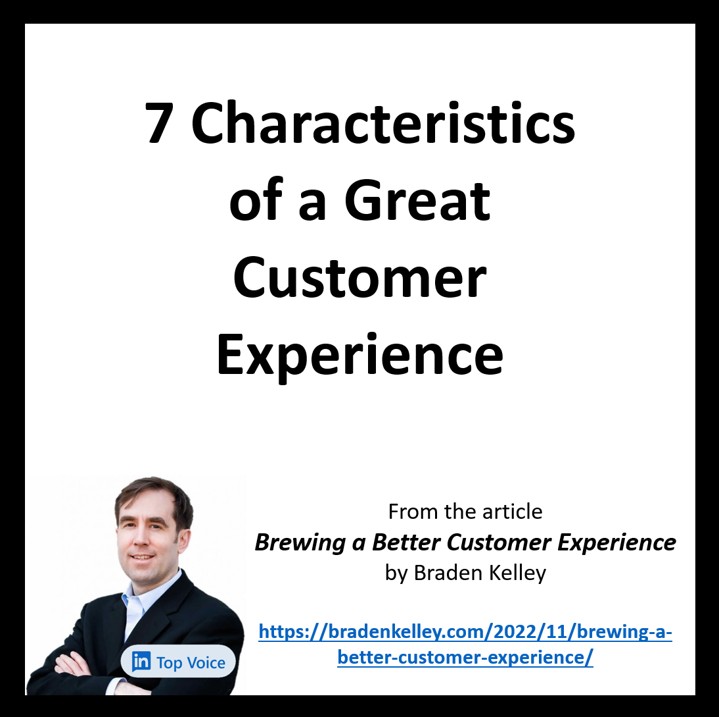
Seven Characteristics of a Great Customer Experience

  1. It’s easy to get to know you
  2. Clear communication
  3. Transparency in what to expect
  4. Effortless transactions (not just shopping, but problem solving and troubleshooting too)
  5. Intentional friction (don’t over-optimize ALL transactions, sometimes waiting actually creates value by teasing the senses)
  6. Interactions that make you feel valued not just as a customer, but as a person too
  7. Occasional unexpected moments of delight

7 Characteristics of a Great Customer Experience

The Seven Characteristics of a Great Customer Experience serve as a set of guiding principles as you train employees, as you engage in service design, and as you pursue technology upgrades.

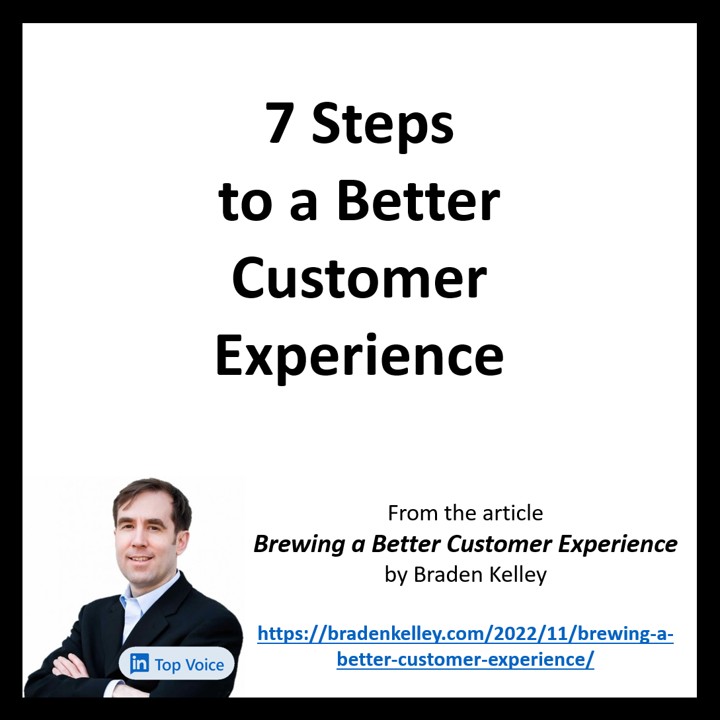
Seven Steps to a Better Customer Experience

And what are the most important steps in a successful journey to a great customer experience?

Seven Steps to a Better Customer Experience

  1. Make a shared commitment as an organization
    • Involve your employees in the conversation to make sure they’re committed and have a chance to help prioritize areas of opportunity
  2. Identify the key components of your current customer experience
    • What creates value for customers? What can’t you change because doing so would destroy value?
  3. Identify your differentiated customer groupings
    • Customers are not a homogeneous group. Create personas for a handful of customer groups that behave in distinctly different ways.
  4. Talk to customers
    • Too many customer experience efforts are birthed and customer journey maps built without the team ever speaking to actual customers. Don’t assume!
  5. Create a customer journey map
    • Make sure you map not only the customer touchpoints and pain points, but any points where lingering actually creates value. Focus each journey map on a single customer persona.
  6. Create a prioritized action plan
    • It’s not enough to map the customer journey, people need to be excited about improving it and have a clear shared vision of when and where this is going to happen
  7. Monitor progress vs. a baseline
    • Creating a journey map and identifying improvement opportunities is important. But, instrumenting and measuring progress towards a better customer experience is a step that many miss. And this step is key to sustaining excitement, momentum, and support for a customer-centric culture over time. This requires technology.

The Seven Steps to a Better Customer Experience provide a simple framework to guide your pursuit of an improved customer experience, not just in the short-term, but also as part of a continuous improvement commitment.

Going Beyond Touchpoints and Pain Points

When CX professionals begin mapping customer journeys, we often do so through the lens of touchpoints, pain points and improvement opportunities. The purpose of these activities is to give everyone a shared picture of the steps a customer goes through and the exchanges that occur between the customer and the company across a certain period of time – a journey.

But, we can more richly understand the customer experience if we go beyond a touchpoint mindset and instead explore the interfaces at which customer interactions occur, the information exchanged, and the intelligence and insights that emerge from each exchange.

In my recent white paper Riding the Data Wave to Digital Disruption I introduced the Five Keys to Digital Transformation, which are:

  1. Information
  2. Interfaces
  3. Intelligence
  4. Interactions
  5. Insights

When considered more broadly, the Five Keys to Digital Transformation can be used to inform your customer experience improvement pursuits.

Central to customer experience is information. We must know what information customers need to be successful with our products and services. We must know what information our employees require to be successful in their job performance in service of our customers and our organization’s success.

Having good intelligence gathering in place provides us with the inputs we need to inform course corrections and better strategic decisions in service of our customers and our company.

Identifying actionable insights helps us understand why customers behave the way they do, what they value, what they prioritize, and ultimately what a good customer experience might look like.

At the edge of your organization are your interfaces, places where the organization connects with suppliers, partners, employees, and customers. Interfaces are the place where information, intelligence and insights are found and interactions occur. The quality of your interfaces is usually determined by ease of use. Interfaces can include your web site, social media, salesforce, call centers, etc.

Interactions occur at the interfaces of the organization. Interactions don’t have to involve people, but often do. We have built interactive voice response systems, chatbots, and artificial intelligence systems to streamline our interactions with our customers. We must consider the customer experience upfront in any technology development project, otherwise we risk implementing a system that will actually cost us customers.

Consciously designing and continuously improving our interactions via delightful interfaces with the right information, intelligence and insights will turbo charge our customer experience potential.

Assembling the Ingredients into the Final Brew

In this article we’ve discussed three distinct layers of crafting a better customer experience:

  1. Focusing on the Seven Characteristics of a Great Customer Experience
  2. Working through the Seven Steps to a Better Customer Experience
  3. Leveraging the Five Keys to Digital Transformation in your customer experience efforts

And much a hand-pulled Guinness, when the three layers appear well-executed together, it’s a beautiful thing to behold.

Consciously designing effective information exchanges at efficient interfaces with delightful interactions should be your north star to experiences you can be proud of.

Pursuing this north star as you craft a better customer experience will ensure that it does indeed have the characteristics of a great one – in the first iteration and after improvement you undertake thereafter.

You now know what it takes to be a customer experience craftsperson. Enjoy the journey!


Accelerate your change and transformation success

Subscribe to Human-Centered Change & Innovation WeeklySign up here to get Human-Centered Change & Innovation Weekly delivered to your inbox every week.