Tag Archives: phygital experience

The Phygital Future

Designing Seamless Experiences Across Worlds

The Phygital Future

GUEST POST from Chateau G Pato

For too long, organizations have treated their physical and digital channels as separate silos, managed by different teams, budgets, and metrics. This disconnect is the root cause of friction, frustration, and failure in the modern customer journey. Customers do not think in channels; they think in experiences.

The future of customer engagement, employee empowerment, and service delivery is Phygital: the seamless, human-centered integration of the digital (technology, data, online) and the physical (locations, people, products). Phygital design is not about adding a screen to a store; it’s about using technology to dissolve the boundaries, focusing entirely on a single, continuous, and highly contextual journey. The goal is to maximize the utility and speed of the digital world while preserving the authenticity and human connection of the physical world.

The Failure of the Digital-First Mandate

The pendulum swung hard toward “Digital-First,” driven by efficiency and the push toward automation. While automation is vital, the pure digital-first mandate often fails at the last mile — the human interaction. Imagine a customer who spends 45 minutes online researching a product, only to have to repeat their entire story to an employee when they walk into a physical store. This is the Phygital Friction Gap — a moment where the digital intelligence is lost, forcing the human to restart the process. This failure occurs because the organization hasn’t designed the two worlds to share context, forcing the customer to carry the burden of the organization’s internal silos.

Phygital design solves this by recognizing that the highest value comes from the intersection, where the speed and intelligence of the digital world elevate the sensory and relational depth of the physical world.

Three Pillars of Seamless Phygital Design

Designing for the Phygital future requires a shift in mindset and strategy, moving from parallel channels to a single, interconnected Experience Architecture.

  1. Contextual Continuity:
    The fundamental rule of Phygital design is Never Ask the Customer to Repeat Themselves. The digital system must carry the customer’s intent, history, and context forward, regardless of the channel they jump to. This requires integrating the CRM, data analytics, and inventory systems so that an in-store associate can see the customer’s browsing history and cart status instantly via a mobile device.
  2. Human-Augmentation, Not Replacement:
    Technology should not be used to replace human interaction, but to augment the human professional. Use AI for mundane, high-volume tasks (data entry, scheduling) to free up employees to focus on high-value, high-empathy interactions (problem-solving, creative consultation). A Phygital environment uses digital intelligence to make the human associate smarter, faster, and more efficient.
  3. Experiential Utility and Delight:
    The physical space must be designed to maximize what the digital cannot offer — sensory experience, immediate gratification, and social connection. If a customer can buy the product cheaper and faster online, the store must offer a compelling reason to visit, such as interactive prototyping, localized expert advice, or a community event. Technology is used to add delight to the physical world, not just efficiency.

Case Study 1: Transforming the Bank Branch into a Consultation Hub

Challenge: Dying Relevance of the Physical Bank Branch

A major retail bank faced the imminent closure of many branches as customers shifted to mobile banking. The few customers who still visited branches were usually facing complex financial problems that demanded significant human expertise and time, clogging up service lines.

Phygital Intervention:

The bank didn’t just add tablets; they re-architected the entire journey. Customers were required to pre-book complex appointments through the mobile app (Digital). This allowed the digital system to collect context and queue the request to the correct specialist before the customer arrived. When the customer walked in, geo-fencing technology alerted the specialist (Physical) to the customer’s arrival. The specialist greeted the customer by name, already possessing their case history, eliminating the need to repeat their issue. This fusion of digital scheduling and physical, informed human contact cut wait times for complex issues by 70% and successfully repositioned the branch as a high-value Consultation Hub rather than a mere transaction counter.

The Ethical Imperative: Transparency and Trust

As we design Phygital experiences, we must address the ethical imperative. The constant collection of data (from location tracking to browsing history) to enable seamlessness can be perceived as invasive. Phygital Trust is built on transparency: customers must understand what data is being used and why, and feel they have genuine control. The seamlessness of the experience should always feel helpful, never creepy.

Case Study 2: Supply Chain Visibility in Manufacturing

Challenge: Lack of Visibility and Trust Between Partners

A global industrial manufacturer struggled with complex, long-lead-time orders, leading to constant back-and-forth communication and mistrust with clients regarding production status. Clients wanted the assurance of seeing the physical process but couldn’t visit the plant.

Phygital Intervention:

The manufacturer implemented a real-time Digital Twin strategy. They placed IoT sensors on key machines and production stations (Physical) and aggregated this data onto a secure, cloud-based platform (Digital). This allowed the client, via a secure web portal, to see the exact stage and location of their custom component in the plant, complete with real-time video feed snapshots and verifiable production data. The physical asset became the source of truth, but the digital interface provided the constant, transparent access the client needed. This Phygital visibility didn’t just improve efficiency; it transformed the client relationship from transactional to one of deep, shared trust, proving the ROI of transparency.

Conclusion: Experience Architecture is the New Battleground

The Phygital Future is here, and it demands that we stop designing for channels and start designing for the human journey. Leaders must champion Experience Architecture — a holistic view of the customer’s path. The organizations that win will be the ones that use the invisible power of data to create visible, human-first magic in the physical world.

“Phygital design is not about technology; it’s about context. It’s the art of giving the human everything they need, exactly where they need it, whether they are holding a smartphone or standing in a store.”

Your first step into the Phygital future: Map one critical customer journey and identify every point where Contextual Continuity is lost when the customer jumps from digital to physical. Eliminate that friction.

Extra Extra: Because innovation is all about change, Braden Kelley’s human-centered change methodology and tools are the best way to plan and execute the changes necessary to support your innovation and transformation efforts — all while literally getting everyone all on the same page for change. Find out more about the methodology and tools, including the book Charting Change by following the link. Be sure and download the TEN FREE TOOLS while you’re here.

Image credit: Pixabay

Subscribe to Human-Centered Change & Innovation WeeklySign up here to get Human-Centered Change & Innovation Weekly delivered to your inbox every week.

Integrating Physical and Virtual Experiences for Impact

Beyond Digital to Phygital

Integrating Physical and Virtual Experiences for Impact

GUEST POST from Chateau G Pato

For the last two decades, innovation has been synonymous with the digital transformation. We measured success by how quickly we could move processes, transactions, and interactions onto a screen. But this era of pure digitization is reaching its limits. As a human-centered change and innovation thought leader, I argue that the next wave of disruptive value creation lies not in the digital realm alone, but in the seamless integration of the physical and virtual worlds. We must move beyond siloed thinking — the “online” store versus the “brick-and-mortar” — and design for a unified, continuous human experience that is exponentially more powerful. This convergence is where true emotional payoff — the feeling of delight, trust, and effortless flow — is created.

This integrated approach, often termed the phygital experience, recognizes a fundamental truth: humans are analog beings living in a digital world. We crave sensory input, spatial context, and tangible interaction, but we also demand the speed, personalization, and efficiency that technology provides. The true challenge for innovators is not simply adding an app to a physical product or a store; it’s strategically weaving digital tools—like Augmented Reality (AR), which layers information directly onto the physical world—into the fabric of the physical experience to remove friction, generate insight, and deliver profound moments of delight and impact. The ethical imperative here is paramount: pervasive data collection must be matched by radical transparency and responsible governance.

The Three Design Principles of Phygital Innovation

To master the symbiotic blend of the physical and virtual, organizations must design around three core principles:

  • 1. Contextual Persistence: The user’s experience must not reset when they move between physical and digital spaces. Knowledge gained in one environment (e.g., viewing a product’s lifecycle history via an AR scan) must immediately inform the next (e.g., customized offers appearing on a self-checkout screen). The state, history, and goals of the customer must persist across the entire journey.
  • 2. Sensory Augmentation and Immersion: Use digital tools (AR, mobile sensors, IoT) to enhance, not replace, the irreplaceable sensory qualities of the physical world. This means using AR in a showroom to visualize hidden customization options, or leveraging immersive VR/AR training tools that provide a realistic, risk-free physical practice environment, turning the physical environment into an information-rich, interactive interface.
  • 3. Data-to-Trust Feedback Loops: The physical interaction must generate invaluable data, but this data must be treated ethically to build trust. Every touchpoint—a heat map of foot traffic, a verbal query, a click on a virtual product twin—must be fed into a single intelligence layer to constantly optimize both environments, while simultaneously ensuring the customer has control and visibility over their personal data.

“Digital innovation focused on screens is only half the story. True value is unlocked when the screen disappears into the environment, enhancing the human experience without distracting from it.”


Case Study 1: Amazon Go – Erasing Friction from the Physical Transaction

The Challenge:

The checkout process is the single greatest point of friction and frustration in physical retail, leading to abandoned purchases and negative customer sentiment. The goal was to remove this analog bottleneck using an invisible digital layer.

The Phygital Solution:

Amazon Go (and Fresh stores) pioneered a truly seamless phygital experience. The physical act of shopping—browsing shelves and picking up items—was maintained, satisfying the human need for tactile interaction. However, the digital layer — a complex array of computer vision, sensor fusion, and deep learning algorithms — was invisibly woven into the store’s ceiling and shelves. The “Just Walk Out” technology automatically tracked items and charged the customer’s virtual account.

The Innovation Impact:

This innovation completely eliminated the physical queue, removing the primary point of friction and resulting in a profound emotional payoff of effortlessness. The success lies in the digital invisibility — the technology is pervasive yet transparent, focusing the human on the pleasure of product selection rather than the pain of payment. This sets a new standard for physical retail efficiency, provided the data use is transparent and secure.


Case Study 2: Siemens Digital Twin for Industrial Operations

The Challenge:

Industrial organizations face immense complexity in managing highly expensive physical assets (factories, turbines, equipment). Downtime, maintenance planning, and optimization require costly, risky physical testing and limited visibility into real-time performance.

The Phygital Solution:

Siemens created comprehensive Digital Twins — virtual replicas of entire physical systems, factories, or products. These virtual models are continuously updated with real-time data streaming from sensors (IoT) embedded in the physical assets. Engineers and operators can then interact with the digital twin (a virtual environment) to simulate scenarios, optimize performance, predict maintenance needs, or test a new operating parameter before deploying it to the physical system. Crucially, AR overlays are often used to display the twin’s data directly onto the real-world equipment.

The Innovation Impact:

The Digital Twin provides a risk-free laboratory for physical operations, enhancing both safety and efficiency. This integration of the physical and virtual allows for proactive maintenance, dramatically reduces physical downtime, and accelerates innovation by allowing hundreds of design iterations to be tested virtually in a day. It demonstrates that the most impactful digital tools are those that directly and continuously improve the efficiency and safety of high-stakes physical assets and their human operators.


Conclusion: The Future is Fluid and Ethical

The most successful organizations of tomorrow will be those that fluidly navigate the space between atoms and bits. The focus of innovation must shift from asking “Is this digital?” to “How does this enhance the total human experience across all mediums?”

Leaders must mandate a unified design strategy that treats the physical and virtual realms as a singular ecosystem. This requires breaking down departmental silos and creating cross-functional teams focused purely on the continuous customer journey. By embracing contextual persistence, sensory augmentation, and robust data-to-trust feedback loops, we move beyond the limitations of purely digital solutions. The future isn’t just about faster screens; it’s about richer, more ethical, and more impactful experiences where technology elevates, rather than isolates, the human being.

Extra Extra: Because innovation is all about change, Braden Kelley’s human-centered change methodology and tools are the best way to plan and execute the changes necessary to support your innovation and transformation efforts — all while literally getting everyone all on the same page for change. Find out more about the methodology and tools, including the book Charting Change by following the link. Be sure and download the TEN FREE TOOLS while you’re here.

Image credit: Pixabay

Subscribe to Human-Centered Change & Innovation WeeklySign up here to get Human-Centered Change & Innovation Weekly delivered to your inbox every week.

Why Two-Dimensional Digital Transformation is No Longer Enough

The Sensory Deficit

Why Two-Dimensional Digital Transformation is No Longer Enough

GUEST POST from Art Inteligencia


The Flatland Trap

For the past decade, organizations have marched to the relentless drumbeat of Digital Transformation (DX). We have spent billions streamlining workflows, migrating to the cloud, and compressing complex human activities into the sleek, frictionless confines of a glass screen. Leaders look at their clean dashboards, their optimized apps, and their back-to-back video calls and congratulate themselves on achieving peak efficiency. But beneath the surface of this operational triumph lies a quiet crisis: we have flattened the human experience.

In our rush to digitize, we have traded rich, analog interactions for a two-dimensional facsimile. We have optimized for speed but stripped away texture, nuance, and serendipity. This is the 2D ceiling. Whether it is an employee trying to collaborate via a grid of muted faces or a customer navigating a sterilized, cookie-cutter user interface, the result is the same: an experiential bottleneck that starves our natural human need for multi-sensory connection.

The truth that forward-looking leaders must face is that two-dimensional digital transformation is no longer enough. Efficiency is no longer a competitive advantage; it is table stakes. True innovation and sustainable, human-centered change must transcend the screen. To future-proof our organizations and build deep, lasting loyalty, we must design strategies that engage the full spectrum of human senses, cognitive processing, and emotional depth. It is time to step out of the flatlands and rehumanize the way we innovate.

The Cost of the Sensory Deficit

When we confine our interactions to a two-dimensional pane of glass, we aren’t just changing the medium — we are fundamentally altering the way humans connect, process information, and build trust. This sensory starvation comes with a steep operational and cultural tax that most organization leaders are completely ignoring.

The Empathy Erosion

Human-centered innovation relies entirely on our ability to deeply understand and connect with the people we serve. However, 2D interfaces inherently flatten user research and employee collaboration. When we reduce human behavior to clicks, scroll depths, and standardized survey forms, we lose the subtle physical cues, sighs, and hesitations that reveal true frustration or delight. We trade deep, empathetic understanding for clinical data points, building solutions for optimized personas rather than real people with complex emotional lives.

The Video Call Fatigue Paradox

We’ve all felt the exhaustion of back-to-back virtual meetings, but it isn’t just “screen fatigue” — it is a cognitive processing failure. In a physical room, our brains effortlessly process hundreds of non-verbal sub-signals: posture, micro-expressions, shared ambient energy, and side glances. In a low-latency, flat digital grid, those signals are distorted or missing entirely. Our brains have to work twice as hard to fill in the blanks, burning immense cognitive fuel just trying to parse basic human nuance. The result isn’t just tired employees; it is a massive drop in psychological safety, creative friction, and spontaneous breakthrough thinking.

Brand Homogenization and the Loss of Texture

From a customer experience standpoint, the obsession with frictionless 2D design has created a dangerous sea of sameness. In the rush to follow standard web and mobile UI/UX design paradigms, every industry has homogenized. Banking apps look like fitness apps, which look like retail platforms. When every company uses the same clean, sterilized digital language, you lose your unique brand “texture.” Loyalty cannot survive in a world where switching to a competitor requires nothing more than downloading an identical-feeling interface.

Redefining the Dimensions of Transformation

To break through the two-dimensional ceiling, we must expand our definition of what “transformation” actually means. It can no longer just be about moving from paper to software or from local servers to the cloud. As leaders and experience designers, we must begin planning across three critical, overlooked dimensions to build environments where humans can truly thrive and co-create.

1. The Spatial Dimension: Escaping the Screen

Human beings did not evolve to understand the world through a flat rectangle; we are spatial creatures. Moving past 2D means designing experiences that blend context, architecture, and technology into seamless, ambient environments. This isn’t just about throwing a headset on someone. It is about using spatial computing, internet-of-things (IoT) ecosystems, and physical-digital (“phygital”) touchpoints to meet people where they are. When technology operates in the periphery and adapts to our physical movements — rather than demanding our undivided visual attention — we reduce cognitive overload and unlock more natural ways to work and connect.

2. The Tactile and Haptic Dimension: The Weight of Trust

Digital processes are incredibly efficient, but they lack weight. In the analog world, physical touch, texture, and tangible resistance stimulate deeper cognitive retention and emotional grounding. Think about the difference between signing a digital document with a generic click versus the deliberate weight of a physical handshake or a physical artifact of achievement. By integrating advanced haptic feedback, intentional physical tools, and tactile workspaces into our transformation strategies, we anchor abstract digital workflows into something real. Touch builds a sense of psychological permanence and trust that a pixel simply cannot replicate.

3. The Social and Energetic Dimension: Designing for the “Vibe”

The biggest failure of purely digital transformation is its inability to capture collective human energy. You cannot schedule serendipity on a calendar invitation, and you cannot replicate a shared creative breakthrough inside a text-based chat channel. There is an unquantifiable “vibe” when passionate people occupy the same collaborative field — a shared rhythm of micro-agreements, spontaneous laughter, and physical posture shifts that drives real innovation. Designing for this social dimension means intentionally creating the spaces, rituals, and collaborative frameworks that allow this raw human energy to spark, instead of forcing every interaction into a transactional, structured format.

The Human-Centered Change Framework: Designing for the Whole Human

Moving beyond the flatlands of 2D transformation requires more than just new tools; it demands an entirely new design philosophy. We must shift our focus from merely optimizing transactions to intentionally designing holistic experiences. This means upgrading our methodologies to account for how people actually feel, move, and interact in a multi-dimensional world.

From UI to UX to SX (Sensory Experience)

For years, organizations have obsessively focused on User Interface (UI) and traditional User Experience (UX) metrics — clicks, page loads, and conversion funnels. To solve the sensory deficit, we must expand our toolkit to encompass Sensory Experience (SX) design. SX design explicitly maps the sensory journey of a change initiative. It forces us to ask: How does this transformation sound? How does it occupy space? What are the physical and tactile artifacts that anchor this new digital reality for our people? When we design for the eyes, ears, and hands simultaneously, we drastically accelerate adoption and reduce the friction of change.

The Futurology Check: Navigating the Next Horizon

Over the next five to ten years, the convergence of advanced technologies will make multi-sensory business strategies a necessity rather than a luxury. As generative AI becomes seamlessly woven into our daily workflows, it will increasingly express itself through spatial audio, adaptive ambient environments, and highly responsive haptic materials. Organizations that remain stuck in a screen-only mindset will find their customer experiences feeling cold and outdated. Forward-looking strategic foresight requires us to build infrastructure today that can handle fluid, multi-dimensional interactions tomorrow.

The Co-Creation Mandate: Overcoming Resistance Through Presence

Top-down mandates fail because they treat people like passive pieces on a chessboard. True, human-centered innovation relies on Participatory Innovation — the active co-creation of the future with the very people who will live it. When we bring teams together in multi-sensory, shared environments — whether physical or advanced spatial collaboration spaces — we break down the emotional barriers that breed resistance. By physically sketching ideas, manipulating tangible tools, and sharing real-time energetic presence, we build collective ownership over the change. Co-creation thrives when people aren’t just looking at a strategy, but are actively building it together.

The Multi-Dimensional Mandate

The true measure of an organization’s maturity is no longer how fast it can migrate to the cloud, how many apps it can launch, or how tightly it can optimize its two-dimensional interfaces. Those are table stakes. In an increasingly automated and AI-driven landscape, the ultimate competitive advantage belongs to the organizations that can foster deep, meaningful human connection. The flattest, fastest strategy is no longer enough if it leaves your workforce burnt out and your customers emotionally detached.

As leaders, innovators, and change agents, we must stop evaluating digital transformation through the narrow lens of operational efficiency alone. We must start measuring it by the depth of engagement, the vitality of our cultures, and the richness of the experiences we create. We must design for the whole human — intellectually, emotionally, and sensorially.

The next decade will not belong to the companies that build the most friction-free digital walls, but to those that fill the sensory deficit and bring texture back to business. By stepping out of the flatlands and embracing a multi-dimensional, human-centered approach to change, we do more than just future-proof our organizations. We rehumanize them. Let’s build a future that doesn’t just look good on a glass screen, but one that people can truly feel.

Frequently Asked Questions

What is the “sensory deficit” in digital transformation?

The sensory deficit refers to the loss of physical texture, nuance, non-verbal cues, and spatial awareness that occurs when rich, analog human interactions are flattened into two-dimensional glass screens (like apps, dashboards, and video grids). While efficient, this 2D environment starves our natural human need for multi-sensory connection, leading to cognitive fatigue and emotional detachment.

How does Sensory Experience (SX) design differ from traditional UX design?

Traditional User Experience (UX) design focuses heavily on digital efficiency within a screen — mapping clicks, layout, and software navigation paths. Sensory Experience (SX) design expands this toolkit to include the physical, spatial, auditory, and tactile aspects of an initiative, intentionally designing for how a change sounds, occupies physical space, and incorporates tangible touchpoints to reduce cognitive load and build trust.

Why is participatory innovation crucial for multi-dimensional change?

Top-down mandates fail because they treat individuals like passive pieces on a board. Participatory innovation actively involves employees and customers in co-creating the future. By bringing people together in shared, multi-sensory physical or spatial environments to manipulate ideas together, you reduce natural resistance and build collective ownership over the transformation.


SPECIAL BONUS: Braden Kelley’s Problem Finding Canvas can be a super useful starting point for doing design thinking or human-centered design.

“The Problem Finding Canvas should help you investigate a handful of areas to explore, choose the one most important to you, extract all of the potential challenges and opportunities and choose one to prioritize.”

Image credit: Gemini

Subscribe to Human-Centered Change & Innovation WeeklySign up here to get Human-Centered Change & Innovation Weekly delivered to your inbox every week.
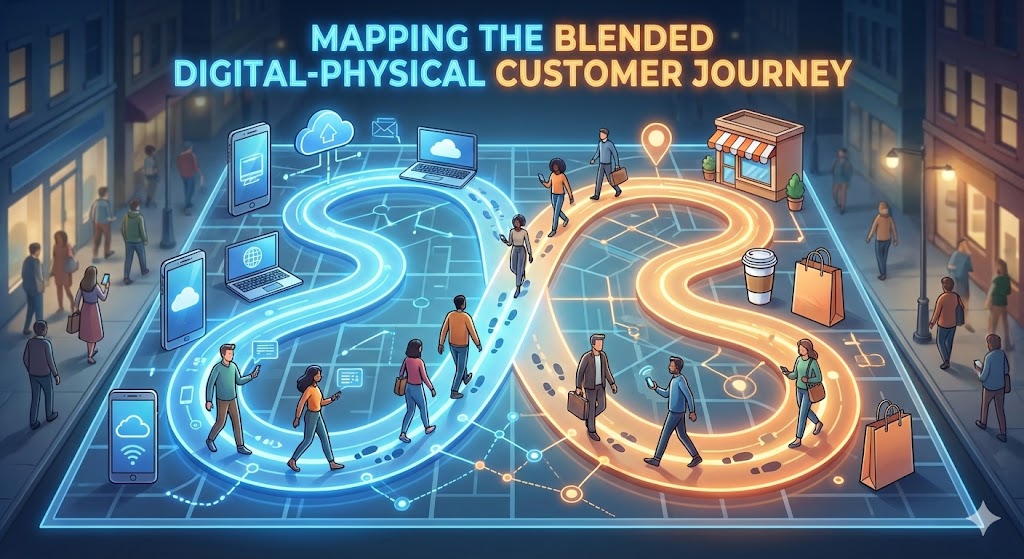
Mapping the Blended Digital-Physical Customer Journey

Experience Architecture

LAST UPDATED: December 27, 2025 at 10:49AM

Mapping the Blended Digital-Physical Customer Journey

GUEST POST from Chateau G Pato

Digital transformation promised seamless experiences. What many organizations delivered instead were faster silos. Customers gained more channels, but lost coherence. Experience architecture emerged as a response to this fragmentation.

Experience architecture is the practice of designing how people move through an ecosystem of interactions over time. It recognizes that experiences are not consumed in isolation, but constructed through sequences, transitions, and memory.

“Great experiences are not designed at the point of interaction. They are designed in the space between interactions.”

Braden Kelley

Why Journey Transitions Matter More Than Touchpoints

Most experience breakdowns occur during transitions: when customers switch channels, repeat information, or encounter conflicting signals. These moments shape perception more than polished interfaces.

Experience architecture focuses on these seams, ensuring that intent, context, and emotion carry forward.

Designing for a Blended Reality

Customers no longer distinguish between digital and physical experiences. They expect continuity across screens, spaces, and people.

Architecting for this reality requires organizations to think in systems rather than channels.

A Practical Experience Architecture Framework

1. Persistent Context

Customer history, preferences, and intent should travel with them. Every interaction should feel informed, not isolated.

2. Emotional Progression

Journeys should reduce anxiety, build confidence, and reinforce trust over time.

3. Organizational Orchestration

Experience architecture aligns teams, platforms, and incentives around shared journey outcomes.

Case Study 1: Financial Services Onboarding

A financial institution redesigned its onboarding journey across digital applications and in-branch verification. Previously, customers felt confused and mistrustful during handoffs.

By architecting the journey holistically, the bank reduced drop-offs and improved satisfaction while lowering operational rework.

Case Study 2: Smart Mobility Services

A mobility provider integrated mobile apps, physical kiosks, and customer support into a unified experience. Real-time context flowed across channels, enabling proactive assistance.

The result was increased usage, fewer support calls, and stronger customer confidence during disruptions.

Experience Architecture as Strategic Infrastructure

Experience architecture is not a design deliverable. It is strategic infrastructure. It shapes how investments are made, how teams collaborate, and how success is measured.

Organizations that treat it as such outperform those that chase isolated improvements.

The Leadership Imperative

Leaders must move beyond channel ownership and optimize for journey outcomes. This requires shared accountability and a willingness to redesign internal systems in service of human experience.

Experience architecture succeeds when leadership treats experience as a system, not a surface.

Frequently Asked Questions

FAQ

Is experience architecture only for digital businesses?
No. Any organization with multiple touchpoints benefits from it.

Does it replace UX or service design?
No. It integrates and aligns them.

Where should organizations start?
Start by mapping transitions, not channels.

Extra Extra: Because innovation is all about change, Braden Kelley’s human-centered change methodology and tools are the best way to plan and execute the changes necessary to support your innovation and transformation efforts — all while literally getting everyone all on the same page for change. Find out more about the methodology and tools, including the book Charting Change by following the link. Be sure and download the TEN FREE TOOLS while you’re here.

Image credits: Unsplash

Subscribe to Human-Centered Change & Innovation WeeklySign up here to get Human-Centered Change & Innovation Weekly delivered to your inbox every week.