In the realm of design and innovation, our goal is to create solutions that empower all individuals, particularly those with disabilities. A user-centered approach is vital, focusing on understanding and prioritizing the needs, wants, and limitations of end-users. By involving people with disabilities in the design process, we open new pathways to creativity and inclusivity.
Designing for disabilities isn’t just about compliance or accessibility—it’s about empathy, real-world application, and human-centered innovation. When you design with empathy, you begin to understand the diverse human experiences and create a product or service that is not only inclusive but also functional and appealing to a broader audience.
The Importance of Inclusive Design
Inclusive design is the practice of creating products that are accessible to as many people as possible. It goes beyond traditional accessibility by considering the full range of human diversity, including different abilities, languages, cultures, genders, and ages. This approach not only helps to remove barriers for people with disabilities but also improves user experience for everyone.
Case Studies
Case Study 1: Microsoft’s Inclusive Design Toolkit
Microsoft has long been a pioneer in the field of inclusive design. Their Inclusive Design Toolkit is a testament to their commitment to accessibility and innovation. Microsoft embraces three key principles: recognize exclusion, solve for one and extend to many, and learn from diversity. By involving people with disabilities throughout the design process, they ensure that products meet a wide variety of needs.
An example of this approach is the Xbox Adaptive Controller. Developed with extensive input from the disabled community, this controller offers a customizable, user-friendly gaming experience for all. The design includes large programmable buttons and ports, making it adaptable for gamers with limited mobility. This project exemplifies how co-design with the disabled community can lead to groundbreaking solutions.
Case Study 2: Google’s Accessible Search and Maps
At Google, accessibility is integrated into initial product design and development phases, not added as an afterthought. One notable product is Google Maps’ accessibility features. Recognizing the navigation challenges faced by individuals with mobility impairments, Google incorporated wheelchair-friendly routes and information about accessible entrances and facilities.
Another inspiring initiative is Google’s Accessibility Scanner app, which helps developers identify areas of improvement in their applications for making their apps more accessible. By developing tools that empower developers and end-users, Google doesn’t just accommodate disabilities—they drive forward inclusive technological advancement.
Conclusion
User-centered design for disabilities goes beyond mere functionality; it’s about creating meaningful and intuitive interactions. As businesses and designers, it’s our responsibility to engage proactively with diverse user groups and shape an inclusive global landscape. By doing so, we not only comply with accessibility standards but push the boundaries of innovation, making the world a more accessible, enjoyable place for everyone.
Together, by focusing on inclusive design, we can achieve a future where technology leaves no one behind—where every product and service enriches the lives of all people, regardless of their abilities.
This article embodies the essence of a user-centered approach in designing for people with disabilities, utilizing real-world case studies that illustrate innovation, empathy, and inclusive practices.
Extra Extra: Because innovation is all about change, Braden Kelley’s human-centered change methodology and tools are the best way to plan and execute the changes necessary to support your innovation and transformation efforts — all while literally getting everyone all on the same page for change. Find out more about the methodology and tools, including the book Charting Change by following the link. Be sure and download the TEN FREE TOOLS while you’re here.
Image credit: Pexels
Sign up here to get Human-Centered Change & Innovation Weekly delivered to your inbox every week.
In the not-so-distant past, remote work was often seen as an occasional luxury. Fast forward to today, and it has become a significant, often preferable, reality for millions of employees worldwide. This shift—accelerated by global events and technological advancement—has brought about a remote work revolution that demands a fresh perspective on the employee experience. As organizations rethink their strategies, it’s crucial to center human needs in the design and implementation of remote work policies.
The New Paradigm
The traditional work environment has been significantly disrupted, leading to newfound flexibility and autonomy. But as appealing as remote work is, it also introduces challenges that can impact an employee’s sense of belonging, job satisfaction, and productivity. To address these, companies must foster transparent communication, promote work-life balance, and create spaces for social interaction—physically or virtually.
“Remote work is not just about working from a different location, but rather creating a dynamic ecosystem that can adapt to an employee’s personal and professional needs.” Braden Kelley
Case Study 1: TechVision
Background
TechVision, a rapidly-growing software firm, recognized early the potential drawbacks of remote work. It understood that despite the liberating nature of flexible work schedules, employees might feel isolated and overlooked in a virtual environment.
Initiatives and Outcomes
To combat these challenges, TechVision introduced several initiatives:
Virtual Lounges: These digital meeting rooms are always open, encouraging employees to drop in for casual chats. This fosters a sense of community and reduces feelings of isolation.
Flexible Working Hours: Acknowledging diverse personal schedules, TechVision allows employees to define their own working hours, provided they meet deliverable deadlines.
Monthly Home Office Stipend: Understanding that an efficient home workspace is crucial, the company provides a stipend for employees to enhance their home office setup.
As a result, TechVision noticed a 20% increase in employee satisfaction and a 15% boost in productivity, proving that a thoughtful approach to remote work could yield significant benefits.
Case Study 2: GlobalInnovate
Background
GlobalInnovate, a multinational design firm, faced the challenge of maintaining creativity and collaboration in a remote setup. Vital brainstorming sessions had to transition from the boardroom to the online space, sometimes losing the dynamic energy critical to innovation.
Initiatives and Outcomes
GlobalInnovate employed the following strategies:
Virtual Reality Collaboration Tools: By adopting VR meeting platforms, the firm recreated the spatial dynamics of an in-person meeting, fostering more natural interactions.
Regular Creative Jams: These unstructured sessions are dedicated purely to creative exploration, allowing teams to ideate freely without the pressure of immediate deliverables.
Global Work Sprints: Employees from different time zones collaborate intensively on projects for a week, followed by a comprehensive review and reflection process.
These approaches have sustained GlobalInnovate’s creative output, with the firm reporting a 30% rise in innovative solutions proposed by their teams over a six-month period.
Conclusion
The remote work revolution isn’t merely a shift in location; it’s a transformation in how we perceive and execute work itself. Organizations, by re-imagining the employee experience to ensure connectivity, flexibility, and creativity, can turn the challenges of remote work into opportunities for growth and innovation. As we move forward, it’s imperative that we continue to pioneer strategies that place human experience at the forefront of the remote work landscape.
Extra Extra: Futurology is not fortune telling. Futurists use a scientific approach to create their deliverables, but a methodology and tools like those in FutureHacking™ can empower anyone to engage in futurology themselves.
Image credit: Pixabay
Sign up here to get Human-Centered Change & Innovation Weekly delivered to your inbox every week.
BMNT Editor’s note: This is the fourth in a series explaining the common beginner-steps needed to get an innovation practice off the ground or improve an existing innovation practice. Find our first post, explaining the goals of implementing a structure to guide innovation and training workers how to use it, here. The second installment, on how to create an innovation thesis to guide your team’s activities, is here. The third piece, on how to assemble the right team for the job, is here.
GUEST POST from Brian Miller
Steve Blank, the godfather of Silicon Valley, says that “for innovation to contribute to a company or government agency, it needs to be designed as a process from start to deployment.” At the start, you need a steady influx of new project ideas to replace and restore eroding capabilities. Investors refer to this influx as “deal flow,” and it is considered the single most important factor in their success. Here are the key principles and practices to generate the deal flow your innovation practice needs to succeed.
1. Open your pipeline wider than you feel comfortable
It’s cliche to say this, but get comfortable with the uncomfortable. It may take hundreds of initial problems to find a few dozen pilot projects, and only a handful of successful programs may result from those pilots. A rigorous process, like the Innovation Pipeline®, ensures you manage the risk and uncertainty of innovation along with your finite resources. When venture capital investors raise a fund, they initially invest only about 40 percent to 60 percent of it. Cash reserves, known as “dry powder,” are held back so investors can quickly invest more in the early bets that pan out. Translating this to the government, resources are first invested in validating a project (explore). Only after validation are significant investments made in deploying a new capability (exploit).
The Innovation Pipeline
To get started, you must first understand what you’re doing and where problems will come from. Are you gathering problems from your organization’s workforce (if you’re trying to improve your structure, processes, and culture), your customer base (if you’re trying to improve their job), or both?
If the former, you could use or create an internal portal, akin to a digital comment box with more rigor. If the latter, you could use a tool like SurveyMonkey or something more sophisticated. If that’s not feasible right away, just do it manually. An innovation pipeline needs a lot of inputs at the beginning in order to produce disruptive solutions at the end. It’s the fuel for innovation, so walk the halls of your organization, cold-call your customers, or deputize people already embedded in key places to be your eyes and ears, spotting and assessing opportunity by collecting problems for you.
2. Scope and prioritize problems at the atomic level to find the right project ideas
You will need to see a lot of problems, and rigorously assess them, to find the needs that will lead to transformative change. You cannot be too selective up front, so prepare for the volume by using a simple framework to deconstruct problems into their atomic units.
A Key Beneficiary has a basic need in order to achieve a desired outcome. This problem-centric approach will help you scope and prioritize all the in-bound opportunities so you can easily focus on certain beneficiaries or certain desired outcomes.
Pro-tip: If your pipeline is brand-new, focus on a beneficiary group that you can co-opt, like insurgents, to build momentum in your organization. Or focus on the desired outcomes that align to your organization’s stated and published strategic priorities. If you’re still stuck, revisit your innovation thesis (or create one if you haven’t already) to help guide your problem sourcing and triage in-bound opportunities.
3. Respond to everyone
Do not leave hundreds or thousands of people hanging if you collect their problems. If your problem sourcing is yet another black box in a large organization, apathy will quickly set in and your projects will dry up. Rather than leave problem-submitters guessing, be honest with them about (1) how you will decide what will get worked on, and (2) that not everyone’s problem will get worked on directly. This communication can be as simple as a Senior Leader announcement at a town hall, or it can be memorialized in an Innovation Doctrine that lays out the fundamental principles that guide coordinated action in your organization.
Pro-tip: the best innovation programs provide all problem owners with valuable information in exchange for their input. For example, pointing them in the direction of the office that can help them solve a simple problem; connecting them to someone experiencing a similar one, so they can band together; or just showing them a dashboard of your deal flow so they can see where their problem ranks or fits with others. A transparent and responsive innovation practice keeps contributors motivated to pursue their ideas and contribute to new ones in the future.
4. Look for patterns
Not every problem will get worked on. Even with infinite resources, you must prioritize based on your innovation thesis. However, seeing patterns in hundreds or thousands of problems, even the ones you set aside, will reveal the root cause of something greater. For example, you may find lots of problems related to testing new software. Instead of fixing each one, fix the process for testing, evaluating, and approving new software tools, eliminating an entire category of problems in one project.
5. Generate short, descriptive problem statements
Your success or failure is based on a disciplined commitment to problem-centric innovation. The best way to keep yourself honest is to initially frame projects as problem statements that provide sufficient background on the origins of the problem to be solved. This kick-starts the next stage of innovation (Curation) and ideally identifies (for the purpose of recruitment) at least some of the key stakeholders around a problem, their basic needs, and an early definition of success.
Pro-tip: a great problem statement should be shareable with and understandable by anyone. The goal is to present a clear articulation of the opportunity and to expand the coalition around the problem so that others can help you solve it.
Next, you’ll rigorously assess and prioritize your problems, and you’ll begin to interview and observe people affected by them. In the next post, we’ll share more insights on how to do it, so you know you can trust the data that results and amplify the confidence in your decisions.
Image credits: BMNT, Pixabay
Sign up here to get Human-Centered Change & Innovation Weekly delivered to your inbox every week.
In today’s rapidly changing world, solving complex social challenges requires more than just good intentions—it demands collaboration, innovation, and strategic partnerships. As a human-centered change and innovation thought leader, I’ve witnessed firsthand the transformative power of cross-sector collaborations. By bringing together diverse groups of stakeholders, we can leverage different perspectives and resources to create solutions with a lasting social impact.
This article explores how partnerships serve as catalysts for innovation and highlights two compelling case studies where collaborations achieved significant social progress.
Why Partnerships Matter in Social Innovation
Social innovation thrives on diversity, common goals, and shared values. Partnerships bring together various entities—nonprofits, governments, corporations, and communities—to pool resources, knowledge, and expertise. This collective approach enables us to tackle multifaceted societal issues that no single organization could address alone. It is the synergy created through these relationships that sparks groundbreaking solutions and drives sustainable change.
Case Study 1: The Alliance to End Plastic Waste
Launched in 2019, the Alliance to End Plastic Waste (AEPW) is a global partnership of nearly 50 companies in the plastics and consumer goods value chain. Their goal is to eliminate plastic waste in the environment, primarily focusing on developing innovative solutions and infrastructure to manage plastic waste effectively.
The AEPW collaborates with governments, environmental organizations, and communities to implement projects that improve waste management systems and promote circular economy practices. For instance, in Indonesia, the Alliance worked with local municipalities to enhance waste sorting and collection, directly resulting in significantly reduced plastic leakage into oceans.
By leveraging the expertise and financial resources of multiple sectors, the AEPW has set a benchmark on how industrial cooperation can lead to scalable environmental solutions with a profound social impact.
Case Study 2: The Global Vaccine Alliance (Gavi)
Founded in 2000, Gavi, the Vaccine Alliance, is a public-private partnership committed to increasing access to immunization in poor countries. By bringing together key international organizations, governments, the vaccine industry, philanthropic institutions, and civil society, Gavi aims to make a substantial impact on public health.
One notable success story is the introduction of the pneumococcal vaccine in developing countries. Through its Advance Market Commitment model, Gavi incentivized pharmaceutical companies to accelerate the availability of these vaccines at affordable prices. As a result, millions of children worldwide have been vaccinated against pneumonia, dramatically reducing child mortality rates in low-income countries.
Gavi’s innovative financing and cooperative strategy demonstrate how partnerships can bridge gaps in public health initiatives, making vaccines more accessible to vulnerable populations globally.
Key Takeaways and Future Directions
These case studies showcase the immense potential of partnerships in driving social innovation. The key to successful collaboration lies in aligning objectives, maintaining transparent communication, and building trust among partners. It is crucial to continuously evaluate the partnership’s impact and adapt strategies for improving effectiveness.
As we look to the future, the scope for partnership-driven social impact is limitless. Emerging technologies, such as artificial intelligence and data analytics, offer new opportunities to enhance collaborative efforts. By harnessing these innovations, we can further empower communities, improve lives, and revolutionize how we address complex social issues.
Ultimately, partnerships in innovation are not just about solving problems—they are about building a better world, together.
Extra Extra: Because innovation is all about change, Braden Kelley’s human-centered change methodology and tools are the best way to plan and execute the changes necessary to support your innovation and transformation efforts — all while literally getting everyone all on the same page for change. Find out more about the methodology and tools, including the book Charting Change by following the link. Be sure and download the TEN FREE TOOLS while you’re here.
Image credit: Pexels
Sign up here to get Human-Centered Change & Innovation Weekly delivered to your inbox every week.
Looking at a satellite image of Ukraine online I realized it was from Capella Space – one of our Hacking for Defense student teams who now has seven satellites in orbit.
National Security is Now Dependent on Commercial Technology
They’re not the only startup in this fight. An entire wave of new startups and scaleups are providing satellite imagery and analysis, satellite communications, and unmanned aerial vehicles supporting the struggle.
For decades, satellites that took detailed pictures of Earth were only available to governments and the high-resolution images were classified. Today, commercial companies have their own satellites providing unclassified imagery. The government buys and distributes commercial images from startups to supplement their own and shares them with Ukraine as part of a broader intelligence-sharing arrangement that the head of Defense Intelligence Agency described as “revolutionary.” By the end of the decade, there will be 1000 commercial satellites for every U.S. government satellite in orbit.
At the onset of the war in Ukraine, Russia launched a cyber-attack on Viasat’s KA-SAT satellite, which supplies Internet across Europe, including to Ukraine. In response, to a (tweeted) request from Ukraine’s vice prime minister, Elon Musk’s Starlink satellite company shipped thousands of their satellite dishes and got Ukraine back on the Internet. Other startups are providing portable cell towers – “backpackable” and fixed. When these connect via satellite link, they can provide phone service and WIFI capability. Another startup is providing a resilient, mesh local area network for secure tactical communications supporting ground units.
Drone technology was initially only available to national governments and militaries but is now democratized to low price points and available as internet purchases. In Ukraine, drones from startups are being used as automated delivery vehicles for resupply, and for tactical reconnaissance to discover where threats are. When combined with commercial satellite imagery, this enables pinpoint accuracy to deliver maximum kinetic impact in stopping opposing forces.
Equipment from large military contractors and other countries is also part of the effort. However, the equipment listed above is available commercially off-the-shelf, at dramatically cheaper prices than what’s offered by the large existing defense contractors, and developed and delivered in a fraction of the time. The Ukraine conflict is demonstrating the changing character of war such that low-cost emerging commercial technology is extremely effective when deployed against a larger 20th-century industrialized force that Russia is fielding.
While we should celebrate the organizations that have created and fielded these systems, the battle for the Ukraine illustrates much larger issues in the Department of Defense.
For the first time ever our national security is inexorably intertwined with commercial technology (drones, AI, machine learning, autonomy, biotech, cyber, semiconductors, quantum, high-performance computing, commercial access to space, et al.) And as we’re seeing on the Ukrainian battlefield they are changing the balance of power.
The DoD’s traditional suppliers of defense tools, technologies, and weapons – the prime contractors and federal labs – are no longer the leaders in these next-generation technologies – drones, AI, machine learning, semiconductors, quantum, autonomy, biotech, cyber, quantum, high performance computing, et al. They know this and know that weapons that can be built at a fraction of the cost and upgraded via software will destroy their existing business models.
Venture capital and startups have spent 50 years institutionalizing the rapid delivery of disruptive innovation. In the U.S., private investors spent $300 billion last year to fund new ventures that can move with the speed and urgency that the DoD now requires. Meanwhile China has been engaged in a Civil/Military Fusion program since 2015 to harness these disruptive commercial technologies for its national security needs.
China – Civil/Military Fusion
Every year the Secretary of Defense has to issue a formal report to Congress: Military and Security Developments Involving the People’s Republic of China. Six pages of this year’s report describe how China is combining its military-civilian sectors as a national effort for the PRC to develop a “world-class” military and become a world leader in science and technology. A key part of Beijing’s strategy includes developing and acquiring advanced dual-use technology. It’s worth thinking about what this means – China is not just using its traditional military contractors to build its defense ecosystem; they’re mobilizing their entire economy – commercial plus military suppliers. And we’re not.
In 2015, before China started its Civil/Military effort, then-Secretary of Defense Ash Carter, saw the need for the DoD to understand, embrace and acquire commercial technology. To do so he started the Defense Innovation Unit (DIU). With offices in Silicon Valley, Austin, Boston, Chicago and Washington, DC, this is the one DoD organization with the staffing and mandate to match commercial startups or scaleups to pressing national security problems. DIU bridges the divide between DOD requirements and the commercial technology needed to address them with speed and urgency. It accelerates the connection of commercial technology to the military. Just as importantly, DIU helps the Department of Defense learn how to innovate at the same speed as tech-driven companies.
Many of the startups providing Ukraine satellite imagery and analysis, satellite communications, and unmanned aerial vehicles were found by the Defense Innovation Unit (DIU). Given that DIU is the Department of Defense’s most successful organization in developing and acquiring advanced dual-use technology, one would expect the department to scale the Defense Innovation Unit by a factor of ten. (Two years ago, the House Armed Services Committee in its Future of Defense Task Force report recommended exactly that—a 10X increase in budget.) The threats are too imminent and stakes too high not to do so.
So what happened?
Congress cut their budget by 20%.
And their well-regarded director just resigned in frustration because the Department is not resourcing DIU nor moving fast enough or broadly enough in adopting commercial technology.
Why? The Defense Ecosystem is at a turning point. Defense innovation threatens entrenched interests. Given that the Pentagon budget is essentially fixed, creating new vendors and new national champions of the next generation of defense technologies becomes a zero-sum game.
The Defense Innovation Unit (DIU) had no advocates in its chain of command willing to go to bat for it, let alone scale it.
The Department of Defense has world-class people and organization for a world that no longer exists
The Pentagon’s relationship with startups and commercial companies, already an arms-length one, is hindered by a profound lack of understanding about how the commercial innovation ecosystem works and its failure of imagination about what venture and private equity funded innovation could offer. In the last few years new venture capital and private equity firms have raised money to invest in dual-use startups. New startups focused on national security have sprung up and they and their investors have been banging on the closed doors of the defense department.
If we want to keep pace with our adversaries, we need to stop acting like we can compete with one hand tied behind our back. We need a radical reinvention of our civil/military innovation relationship. This would use Department of Defense funding, private capital, dual-use startups, existing prime contractors and federal labs in a new configuration that could look like this:
Create a new defense ecosystem encompassing startups, and mid-sized companies at the bleeding edge, prime contractors as integrators of advanced technology, federally funded R&D centers refocused on areas not covered by commercial tech (nuclear and hypersonics). Make it permanent by creating an innovation doctrine/policy.
Reorganize DoD Research and Engineering to allocate its budget and resources equally between traditional sources of innovation and new commercial sources of innovation.
Scale new entrants to the defense industrial base in dual-use commercial tech – AI/ML, Quantum, Space, drones, autonomy, biotech, underwater vehicles, shipyards, etc. that are not the traditional vendors. Do this by picking winners. Don’t give out door prizes. Contracts should be >$100M so high-quality venture-funded companies will play.
Acquire at Speed. Today, the average Department of Defense major acquisition program takes anywhere from nine to 26 years to get a weapon in the hands of a warfighter. DoD needs a requirements, budgeting and acquisition process that operates at commercial speed (18 months or less) which is 10x faster than DoD procurement cycles. Instead of writing requirements, the department should rapidly assess solutions and engage warfighters in assessing and prototyping commercial solutions. We’ll know we’ve built the right ecosystem when a significant number of major defense acquisition programs are from new entrants.
Acquire with a commercially oriented process. Congress has already granted the Department of Defense “Other Transaction Authority” (OTA) as a way to streamline acquisitions so they do not need to use Federal Acquisition Regulations (FAR). DIU has created a “Commercial Solutions Opening” to mirror a commercial procurement process that leverages OTA. DoD could be applying Commercial Solutions Openings on a much faster and broader scale.
Integrate and create incentives for the Venture Capital/Private Equity ecosystem to invest at scale. The most important incentive would be for DoD to provide significant contracts for new entrants. (One new entrant which DIU introduced, Anduril, just received a follow-on contract for $1 billion. This should be one of many such contracts and not an isolated example.) More examples could include: matching dollars for national security investments (similar to the SBIR program but for investors), public/private partnership investment funds, or tax holidays and incentives – to get $10’s of billions of private investment dollars in technology areas of national interest.
Coordinate with Allies. Expand theNational Security Innovation Base (NSIB) to an Allied Security Innovation Base. Source commercial technology from allies.
This is a politically impossible problem for the Defense Department to solve alone. Changes at this scale will require Congressional and executive office action. Hard to imagine in the polarized political environment. But not impossible.
Put Different People in Charge and reorganize around this new ecosystem. The threats, speed of change, and technologies the United States faces in this century require radically different mindsets and approaches than those it faced in the 20th century. Today’s leaders in the DoD, executive branch and Congress haven’t fully grasped the size, scale, and opportunity of the commercial innovation ecosystem or how to build innovation processes to move with the speed and urgency to match the pace China has set.
Change is hard – on the people and organizations inside the DoD who’ve spent years operating with one mindset to be asked to pivot to a new one.
But America’s adversaries have exploited the boundaries and borders between its defense and commercial and economic interests. Current approaches to innovation across the government — both in the past and under the current administration — are piecemeal, incremental, increasingly less relevant, and insufficient.
These are not problems of technology. It takes imagination, vision and the willingness to confront the status quo. So far, all are currently lacking.
Russia’s Black Sea flagship Moskva on the bottom of the ocean and the thousands of its destroyed tanks illustrate the consequences of a defense ecosystem living in the past. We need transformation not half-measures. The U.S. Department of Defense needs to change.
Innovation is often hampered not by the availability of good ideas, but by cultural barriers that exist within an organization. Today’s fast-paced business environment demands that we hack these cultural barriers to create a fertile ground where ideas can flow freely. In this article, we’ll explore how to effectively conduct culture hacking to foster an innovative spirit within your organization, using two compelling case studies as examples.
What is Culture Hacking?
Culture hacking is the process of intentionally addressing, disrupting, and reshaping the cultural elements of an organization to remove obstacles to change and innovation. Instead of massive overhauls, it involves small, strategic shifts that have a significant positive impact over time.
Case Study 1: Google’s ‘20% Time’
One of the most talked-about examples of culture hacking is Google’s implementation of ‘20% Time,’ where engineers were encouraged to spend 20% of their workweek on projects they were passionate about. This cultural change was aimed at enhancing creativity and innovation by giving employees the freedom to explore their ideas without formal oversight.
The Challenge: Google wanted to break free from a rigid work structure to unlock creativity and innovation on a broader scale.
The Hack: Project ‘20% Time’ was introduced with minimal official proclamation but quickly embedded itself in Google’s culture as engineers experimented with new ideas. Successful projects that emerged include Gmail and AdSense, revolutionizing both Google’s offerings and internet advertising as a whole.
The Outcome: By implementing a tangible alteration in work schedules, Google successfully nurtured an environment of sustained innovation and creativity.
Case Study 2: W.L. Gore & Associates’ Flat Lattice Structure
W.L. Gore & Associates, the company behind GORE-TEX, approached their organizational design with a radical hack by adopting a flat lattice structure. There are no conventional managers or divisions; rather, employees are given significant autonomy and leadership is informal, based on followership.
The Challenge: The company recognized that traditional corporate hierarchies often stifled creativity and the free flow of information required for innovation.
The Hack: By eliminating traditional hierarchies, W.L. Gore empowered associates to pursue ideas based on passion and capability, fostering an environment where innovation is a by-product of the freedom to act and engage in decision-making.
The Outcome: This culture hacking strategy has led to continuous innovation with a portfolio of industry-leading products. Additionally, Gore’s consistent appearance on ‘Best Companies to Work For’ lists is a testament to its successful culture reshaping.
Key Steps to Culture Hacking
Implementing culture hacking in your organization requires careful planning and courage to embrace change. Here are some key steps:
Identify Cultural Barriers: Recognize specific cultural aspects that hinder innovation and need addressing.
Small, Strategic Actions: Implement small, strategic changes that align with the larger objectives of the organization without causing major disruptions.
Promote Autonomy and Ownership: Encourage employees to take ownership of their roles and ideas, providing them with the agency to act.
Iterate on Success: Build on successful hacks by iteratively engaging with employees for feedback and refining approaches based on outcomes.
Conclusion
The organizations that succeed in today’s dynamically competitive market will be those able to innovate continuously. Culture hacking offers a grassroots approach to overcoming barriers to innovation, unlocking the creative potential within your team. As the cases of Google and W.L. Gore highlight, sometimes the most profound changes come from those willing to rethink traditional structures and empower individuals to innovate from within.
“Innovation doesn’t just happen; it is cultivated in an environment free of unnecessary barriers where people feel valued and empowered to make a difference.” — Braden Kelley
Extra Extra: Futurology is not fortune telling. Futurists use a scientific approach to create their deliverables, but a methodology and tools like those in FutureHacking™ can empower anyone to engage in futurology themselves.
Image credit: misterinnovation.com
Sign up here to get Human-Centered Change & Innovation Weekly delivered to your inbox every week.
Many would-be innovators obsess over ideas, wait for inspiration to strike, and believe that with the right idea, success can miraculously come overnight.
However, as we’ve written before, that’s just not going to happen. In fact, usually the only thing separating the winning innovators from the rest is execution. It makes all the difference in the world, and yet, it’s still a vastly underrated capability.
As part of our coaching program, we’ve asked hundreds of corporate innovators and innovation leaders to reflect on their strengths and weaknesses. And, by far, the most common answer is that they’re great at coming up with ideas and thinking about the big picture but lack the patience and discipline to see things through to results.
As such, it’s safe to say that as a community, we innovators need to take a hard look in the mirror and admit that this an area where most of us have a lot of room for improvement.
So, in today’s article, we’ll explore the topic of executing innovation in more detail to try to understand what the problems associated with it are, and what successful execution of an innovation really takes. This is designed to be a guide to help leaders get it right, but I think there’s a lot that every innovator regardless of job title can learn from.
What does executing innovation mean?
Before we dive deeper, it’s probably a good idea to clarify what we mean with the term “executing innovation”, and how it relates to “implementing innovation”.
These are often used interchangeably, but I think it’s useful to distinguish them from one another. The way we like to put this is as follows:
Implementing innovation is the process of taking an idea and then turning that into reality.
Executing innovation, on the other hand, is the entire process of creating value with innovation.
In other words, implementation is what you do for an individual idea to make that happen. Execution covers the implementation, but also the process of turning that (along with many other ideas and innovations) into something that actually creates value and can be scaled up.
Implementation isn’t always easy, but it’s still typically a linear project that you can usually plan out in advance. Execution, on the other hand, is a much more complex and multidisciplinary effort.
To succeed at delivering value, you need to get a lot of things right. And with innovation, there are many assumptions in that plan. Some of those assumptions will always prove to be false, and you’ll need to deviate from the plan.
That combination of multidisciplinary collaboration and the need to deviate from original plans often leads to a myriad of practical challenges in many large organizations.
However, before we dive deeper into those challenges, let’s first take a step back to realize why execution is so critical.
Why execution is critical for innovation success
There’s a reason for innovation being defined as the act of introducing something new.
Everyone has ideas. Many can even implement some form of them, typically a prototype, but few successfully realize the full potential of the idea by truly executing on it successfully.
To clarify, ideas are an important starting point, but with every great idea, there are hundreds or even thousands of people across the world who’ve had the same exact idea.
Most never start working on it. Many give up in the process. Some make it to market, and a few might even make that into a feasible business. There are usually only a couple of winners. Those are the ones that succeeded in executing that idea.
Everyone has ideas, but few successfully realize the full potential of their ideas. The ones that do are the ones that know how to execute well.
This is of course a bit of an oversimplification but should help explain the fundamental importance of proper execution.
And that is not just true for individual ideas and innovations, but it’s also the case for corporate strategies at large. Look at any given industry, and it’s quite likely that you’ll see many companies with a nearly identical strategy. Again, the difference comes down to how well the company succeeded in executing that strategy.
In other words, your idea or strategy sets the ceiling for your impact if successful, but execution determines how close to that ceiling you’ll get. Even the best idea or strategy is worth nothing unless it’s executed well.
On the other hand, even with a mediocre strategy or idea, you can achieve remarkable success if you just execute it well enough. There are dozens of well-known companies like McDonald’s and FedEx that are obvious examples of this. There’s nothing particularly remarkable or distinctive about their ideas or strategies. They weren’t the first in their respective fields, they just executed on their ideas brilliantly.
What’s more, if you’re a strong executor, you’ll soon find out the limits of the original strategy or idea, at which point you can adapt and change course accordingly. But, it doesn’t work the other way around.
Thus, no matter the situation, execution will always be more important than your idea or strategy.
Misconceptions about executing innovation
As you might have realized by now, execution is of course a massive, nuanced, context-specific and very complex endeavor. In practice, it’s an endless jungle of interlinked choices and actions affecting one another that you need to navigate with limited information to get to the other side.
Thus, the space of possible challenges and problems you might encounter is pretty extensive. So, instead of looking at the individual problems themselves, it’s more helpful for us to try to understand the common misconceptions that ultimately lead to teams underappreciating execution and thus subsequently failing at it.
A big factor behind most of these is the fundamental uncertainty that innovation is always associated with. Because you can’t know everything in advance, it’s not going to be a nice and linear process of doing simple steps one after another. Instead, it’s a messy and iterative process of creative problem-solving.
Anyway, with that, here are the top four that I most commonly see innovation leaders and their teams have.
1. The leader’s job is just to get the big picture right
This is probably the most common problem I’ve come across, and it’s especially common among inexperienced executives, or ones that otherwise lack execution experience, such as some management consultants and academics.
There are many shapes this one might take, and we’ll return to it later, but what it ultimately comes down to is the glorification of strategy work and/or surface-level creativity.
In business school, and in consulting, we’re taught to think about the big picture as the job of top management. We’re led to believe that a leader or innovator takes in a market analysis, compares a few scenarios, chooses a positioning, and then paints an inspiring vision to show direction for the company. Then the pieces will simply fall in place and success happens.
While the above mentioned are of course still useful activities, if you’ve ever actually turned an innovative idea into a successful business, you know that in practice, there’s a lot more to it than that, and experienced executives are of course well aware of that
Strategic choices can be made across the organization, but the responsibility for execution always lies at the top.
As Professor Martin has well put it, CEOs should stop thinking that execution is somebody else’s job, and the same applies for every innovation leader. Strategic choices can be, and frequently are, made where the action is. Yet, the responsibility for execution always lies at the top. After all, there’s a reason for the CEO being the Chief Executive Officer.
2. I don’t need to understand the details
The second is closely related to our first one. It’s easy to think that as a leader or visionary innovator, you’re the person responsible for the vision, ideas, and big picture decisions, and then the experts will then figure things out in practice. After all, that’s why you hired them, right?
Well, that might work if you’re operating in a static industry where all the variables are known and static, but with innovation that really isn’t the case.
You need to get the big picture right, but it isn’t enough to succeed. You need to also have the right product, business model, technology, customer experience, customer acquisition channels and tactics, operating models, etc. All of these have a wide variety of choices that depend on one another and changes in any of the areas will force you to change many of the other pieces in the puzzle too.
With innovation, the devil is in the details!
As an innovation leader, connecting the dots is ultimately your job, and you can’t do that without understanding the details.
That’s why you’ll find an obsession for the details in pretty much every successful innovator, both past and present. They have the same in-depth understanding and attention to detail as the best artists, athletes and top representatives of other fields do too.
So, while you absolutely need to engage with and empower the experts, they are experts in their own field and likely don’t know how to consider all the other moving pieces in the puzzle. As an innovation leader, connecting the dots is ultimately your job, and you can’t do that without understanding the details.
It’s the one responsibility you simply can’t delegate away.
3. Execution requires a clear and unambiguous plan
Even if you are an experienced executive and value the importance of execution highly, it doesn’t mean you couldn’t fail when executing innovation. Here the most common problems occur if the leader’s experience comes primarily from operations within the known and well understood confines of “business as usual”.
When the environment is well understood, and the scale large from the get-go, it’s of course valuable to try to plan carefully, analyze business cases and craft detailed project plans prior to execution.
Also, since everyone knows that innovation is a risky endeavor, it of course makes sense to try to reduce those risks before your start a big innovation project to try to avoid major mistakes and generally just ensure that you’ve done a good job in planning and preparation before committing to the project.
This often leads to large companies commissioning all kinds of market studies and strategy projects. Some of those can certainly be useful in increasing your understanding of the landscape, but most invest way too much time, energy, and money into these. Also, every now and then these projects seem to be ordered only to have a scapegoat in case something goes wrong.
Regardless, there’s a fundamental problem: with innovation, you can’t have all the answers in advance. You’ll always need to make a number of assumptions upon which your plan relies on, some of which will inevitably prove to be wrong.
With innovation, you won’t have all the answers in advance.
Thus, if you require innovators to propose clear, detailed and unambiguous plans for you, or conversely create such plans and then hold innovators accountable for successfully executing them, it just won’t work out. And, whenever it then comes to surface that everything hasn’t gone according to the plan, innovation projects are frequently shut down, even if they’d still hold a lot of potential.
You obviously still need to align with the strategy, plan ahead, and have a disciplined approach to execution, but it’s not so much about creating a detailed roadmap, as it is about choosing direction and figuring out which questions or problems you’ll need to address first.
In other words, you need to embrace the uncertainty and the fact that you can’t have a perfectly unambiguous and detailed plan before starting to execute it. Instead, figure out what the assumptions and uncertainties in your plan are and commit to a disciplined learning effort to figure out the right path forward.
4. Innovation is fun
There’s a stereotype around people working in innovation being these visionaries that are bursting with great ideas and seem to come up with great new concepts all the time. And as mentioned in the intro to this article, that is often true.
That skillset is of course very useful for innovation, but there’s also a downside. There are naturally exceptions, but many of us working on innovation can find execution too boring and repetitive, and/or lack the perseverance, discipline, and patience needed to succeed at it.
Innovators often spend too much on the creative and “fun parts” of innovation, as opposed to what’s really needed to turn an idea into a successful innovation
As a group, we generally love creative work, and are always looking for fresh, new stimuli to feed that inspiration. That often leads us to spend too much time and effort on the “fun parts” of innovation, and too little on the not so fun, more repetitive, and laborious parts of the process that execution essentially is comprised of. The reality is that for every minute you spend coming up with ideas, you’ll probably need to spend a day, a week, or even more implementing those ideas.
So, if your innovation team is primarily filled with, or led by, such “idea people”, which is quite common, then there’s a big risk of a systematic lack of respect for and capabilities in execution. This will lead to a very suboptimal culture for innovation, and ultimately disappointing business outcomes.
Getting Execution Right
As already mentioned, there are a lot of similarities between successful execution in “business as usual”, and in innovation. However, there are also clear differences between the two.
So, to help you navigate the differences, and to succeed at executing on whatever innovation you’re working on, here are the five most important factors to keep in mind whenever you’re trying to execute on an innovation and build something truly novel.
1. Take the path most likely to succeed, but keep your options open
As mentioned, with innovation planning and strategy work need to be done a bit differently than you would with an existing business.
Good decisions here make it much easier for your team to figure out how to move forward and can save a lot of time money going down the wrong path. Regardless, you’ll soon end up at another crossroads and need to make another decision. Heck, sometimes you might even come across a dead-end and need to backtrack to an earlier crossroads. Sometimes Plan C or D is the way to go.
The point is that no matter which path you choose, you won’t see what’s ahead all the way to the end.
Thus, good strategy work requires you to embrace uncertainty, test assumptions critically, and think deeply about the real-life feasibility of each path ahead.
And it’s certainly not a one-time project you do at the beginning, but more of a continuous learning process as you unravel the puzzle piece by piece.
If you keep an open mind and build your teams and products to embrace that uncertainty, you can quickly recover and learn from setbacks, as well as embrace new opportunities you couldn’t even think of before you set out. This is what’s known as cognitive and organizational flexibility.
2. Solve the biggest problems first
As humans, most of us have a bit of a tendency to go for the comfortable low-hanging fruits and procrastinate on the hard but important problems, as well as uncomfortable truths.
I’ve certainly been guilty of this on many occasions, even while writing of this article. Getting a number of small things done makes us feel like we’re making good progress, but unfortunately that’s often a bit of a false sensation as we might not really be any better off than when we began.
With the inherit uncertainty in innovation, that is naturally a bit of a problem. When you’re executing any given innovation, there’s countless things that need to be done so it’s easy to just start checking off boxes like building more features, creating marketing materials, getting compliance approvals, or whatever you may have on your agenda.
But, it’s the big things that make or break your innovation early on. For example: will a customer benefit from my product, how much are they willing to pay, can I even build the product I’ve envisioned, etc.
While you need to care about the details, it’s the big things that make or break your innovation early on. So, start from the big problems, even if it hurts!
The key is finding a way to figure out what these big problems or critical assumptions are, and then find ways to quickly test and address them. This allows you to quickly figure out if you’re on to something, which of course saves a lot of time and money for you in the inevitable case that you weren’t quite there from the get-go.
Also, if you get the big things right, you can already deliver most of the value, and that means you can more quickly start capturing some of that value to get a return for your investments.
Plus, if you tackle these early on when you still have a small team, changing course will be much quicker and easier, and you’ll have spent much less money solving the same important problems than you would with a larger team later on.
In most businesses, these critical assumptions revolve around how much value you can deliver to customers, and how valuable they see that to be. However, in certain circumstances, those can be related to something entirely different, such as the feasibility of implementation when developing a new breakthrough drug.
Solving for the hardest problems first does generally require a bit more of a leadership commitment as you won’t always be able to show quick wins as early on, but at least it can save you from an embarrassing and costly failure like CNN+.
3. Build the right team
It might be a bit of an obvious statement, but it’s still probably worth pointing out: innovation is a bit of a team sport. So, to do well at it, you need the right team.
However, what might not be as obvious is that ‘the right team’ means in practice. In our experience, there are two key parts to this:
Multidisciplinary team with talented individuals in each area
Leadership and individuals that share the right mindset for innovation
The prior is pretty self-explanatory. Innovation is almost always a cross-disciplinary effort. The specifics depend on what kind of an innovation you’re working on, but usually you need expertise in at least design, engineering, commercial and operational matters.
The most impactful innovations are actually comprised of a stack of innovations in many of these areas, each designed to work together to address a specific problem or ‘job’ for the customer. Thus, if you have talent at every position, the outcome will be much more than the sum of its parts.
The latter, however, is the part that many teams fail to appreciate. Innovation is, by definition, doing something that others haven’t succeeded at before, so the journey won’t be easy.
Your team will face a lot of uncertainty and struggles, and will still need to perform at their best, often under a lot of pressure. That requires a very specific type of culture within the team, but also the right mindset for each individual. You want people that can cope with uncertainty and are able to remain optimistic and overcome difficult situations while still being realistic and ruthlessly critical of their own capabilities. They need to have an innate passion to strive for excellence, and a lot of discipline, grit, and perseverance.
And, of course, because it’s a team sport, people need to be able to work well together and perform as a team. This, however, isn’t usually much of an issue as long as people can leave their egos at the door. The struggles you will face together as a team will build bonds and gel you into a team.
4. Make sure every decision and detail are aligned
As we already discussed, you don’t need (and usually can’t have) a clear and unambiguous plan for an innovation project where every role and task would be charted out in advance. However, as we also discussed, the devil is often in the details and seemingly small things can derail the project from its goals?
So, what gives?
Well, the point is that with innovation, you need to keep an eye on everything. As an innovation leader, you need to maintain excellent awareness of both the big picture and the details throughout the project. But, because the environment changes dynamically and you need to move fast, you can’t really do that work upfront.
Nor can you just look at some KPIs and financial reports to figure out if things are moving in the right direction because the important things won’t show up in these for quite a while, and at that point, it’s often too already too late to react.
As a leader, your primary job is to keep up with what’s going on both with the ever-changing big picture, and the details on the ground so that you can spot problems early and intervene before it’s too late, no matter where the issues might arise from. If you don’t understand how everything works in practice and know what problems everyone is working on and why, it will be pretty much impossible to do that.
Some might see the latter as micro-management, but it doesn’t mean you have to dictate what everyone does. It just means that as a leader, you need to be the person that connects the dots and then empowers the team to succeed. There’s a clear difference.
Which brings us nicely to our last point.
5. Take full ownership for the execution
As we’ve covered, execution is the make-or-break part in the lifecycle for every innovation.
It’s always a bit of an exploratory process where you need to remain flexible, while still moving forward quickly and executing at a high level.
And, at the same time, seemingly inconsequential low-level choices related to implementation turn out to become existential issues for any innovation project.
Again, you don’t need to decide everything on behalf of your team. In fact, often it’s best to let the experts solve problems and do their job, as long as you can give them the right guidance and constraints to work with. Instead, you need to think of every potential problem as your fault and then figure out a way to get past them together with your team.
The bottom line is that being an innovation leader isn’t easy. It takes a lot of time and work to understand and stay on top of things, but as already mentioned, that’s the one thing you can’t really skip, automate, or delegate. Essentially everything else you can.
The only way to succeed at that is to take full ownership and commit to the process.
Conclusion
We’ve covered a lot of ground, so let’s do a bit of a recap.
Innovation isn’t a linear project that you can plan out in advance and monitor progress with a Gantt chart. There will always be plenty of surprises. Many unpleasant, but usually some positive ones too. You’ll need to be flexible enough to react to these and alter course accordingly.
It’s an inherently messy and iterative process of figuring out a way to build new things and align all the pieces so that everything works out.
Fundamentally, an innovation leader’s job is to show direction and try to keep track of everything that’s happening, align those puzzle pieces together with the big picture while always being on the lookout for potential problems and then eliminate those before they derail the project, as there will be many.
It’s not an easy or comfortable job, but if you can get it right, it’s an incredibly rewarding one.
Ironically, despite all the talk about practical issues and attention to detail being vital, this has been a bit of a high-level overview on the topic. So, if you’re interested in learning more about the details related to what we’ve discussed today, I have a couple of practical recommendations for you:
First, the best way to learn to innovate is by doing. So, get your hands dirty, keep these tips in mind, do your best, and I’ll guarantee you’ll learn a lot.
But, if you currently don’t quite have the time to commit to an innovation project, a good alternative way to learn more about innovation management is with our Innovation System online coaching program. We’ve now made the program completely free of charge for the first 1000 readers to sign up for it.
This article was originally published in Viima’s blog.
Image credits: Unsplash, Viima
Sign up here to get Human-Centered Change & Innovation Weekly delivered to your inbox every week.
In today’s fast-paced digital landscape, customers expect seamless and personalized experiences across multiple channels. Whether they’re shopping online, visiting a store, or engaging via social media, consistency and convenience are key. The omni-channel approach goes beyond a multi-channel strategy by creating an interconnected system where the customer experience is consistent and immersive, regardless of the platform.
The Importance of Omni-Channel Experiences
An omni-channel approach is crucial in the current market because customers interact with brands in more ways than ever before. With the rise of mobile devices, wearable technology, and IoT, ensuring coherence across all touchpoints is vital for maintaining customer satisfaction and loyalty. By designing a unified customer journey, brands can better understand their customers, predict their needs, and ultimately drive engagement and sales.
Case Studies
Case Study 1: Starbucks
Starbucks is a prime example of an effective omni-channel customer experience. By integrating its mobile app with in-store experience, the company has transformed the way customers interact with their brand. Customers can order and pay through the app, which reduces wait times and streamlines the purchase process. Additionally, the app tracks rewards and offers personalized promotions based on purchase history. This seamless integration of online and offline channels drives customer loyalty and ensures a consistent experience regardless of how the customer interacts with the brand.
Case Study 2: Disney
Disney’s approach to omni-channel experience is another exemplary model. They provide a comprehensive experience via their My Disney Experience platform. Before visiting the park, guests can plan their visit, book accommodation, and purchase tickets through the app or website. While in the park, the MagicBand technology enhances the experience by serving as a room key, ticket, FastPass, and payment system. This interconnected approach allows Disney to offer a personalized and hassle-free experience, ensuring the magic of Disney reaches customers at every point of their journey.
Strategies for Designing Omni-Channel Experiences
To implement a successful omni-channel strategy, businesses should focus on:
Understanding customer journeys and pain points across all touchpoints.
Implementing a unified data management system to ensure consistent information across channels.
Using technology like AI and machine learning for personalization and predictive analytics.
Ensuring seamless integration of online and offline customer interactions.
Continuously gathering and acting on customer feedback to refine the experience.
Conclusion
Designing customer experiences in an omni-channel world requires a deep understanding of customer needs and the technological tools to meet them. As companies like Starbucks and Disney demonstrate, consistent and interconnected experiences can enhance customer satisfaction and brand loyalty. By focusing on integration and personalization, businesses can create compelling and cohesive journeys that resonate with modern consumers.
Extra Extra: Because innovation is all about change, Braden Kelley’s human-centered change methodology and tools are the best way to plan and execute the changes necessary to support your innovation and transformation efforts — all while literally getting everyone all on the same page for change. Find out more about the methodology and tools, including the book Charting Change by following the link. Be sure and download the TEN FREE TOOLS while you’re here.
Image credit: Pexels
Sign up here to get Human-Centered Change & Innovation Weekly delivered to your inbox every week.
For the past 50 years, innovation has largely been driven by our ability to cram more transistors onto a silicon wafer. That’s what’s allowed us to double the power of our technology every two years or so and led to the continuous flow of new products and services streaming out of innovative organizations.
Perhaps not surprisingly, over the past few decades agility has become a defining competitive attribute. Because the fundamentals of digital technology have been so well understood, much of the value has shifted to applications and things like design and user experience. Yet that will change in the years ahead.
Over the next few decades we will struggle to adapt to a post-digital age and we will need to rethink old notions about agility. To win in this new era of innovation we will have to do far more than just move fast and break things. Rather, we will have to manage four profound shifts in the basis of competition that will challenge some of our most deeply held notions.
Shift 1: From Transistor-Based Computers to New Computing Architectures
In 1965, Intel’s Gordon Moore published a paper that established predicted Moore’s Law, the continuous doubling of transistors that can fit on an integrated circuit. With a constant stream of chips that were not only more powerful, but cheaper, successful firms would rapidly prototype and iterate to speed new applications to market.
Yet now Moore’s Law is ending. Despite the amazing ingenuity of engineers, the simple reality is that every technology eventually hits theoretical limits. The undeniable fact is that atoms are only so small and the speed of light is only so fast and that limits what we can do with transistors. To advance further, we will simply have to find a different way to compute things.
The two most promising candidates are quantum computing and neuromorphic chips, both of which are vastly different from digital computing, utilizing different logic and require different computer languages and algorithmic approaches than classical computers. The transition to these architectures won’t be seamless.
We will also use these architectures in much different ways. Quantum computers will be able to handle almost incomprehensible complexity, generating computing spaces larger than the number of atoms in the known universe. Neuromorphic chips are potentially millions of times more efficient than conventional chips and are much more effective with continuous streams of data, so may be well suited for edge computing and tasks like machine vision.
Shift 2: From Bits to Atoms
The 20th century saw two major waves of innovation. The first, dominated by electricity and internal combustion, revolutionized how we could manipulate the physical world. The second, driven by quantum physics, microbial science and computing, transformed how we could work with the microscopic and the virtual.
The past few decades have been dominated by the digital revolution and it seems like things have been moving very fast, but looks can be deceiving. If you walked into an average 1950s era household, you would see much that you would recognize, including home appliances, a TV and an automobile. On the other hand, if you had to live in a 1900’s era home, with no running water or electricity, you would struggle to survive.
The next era will combine aspects of both waves, essentially using bits to drive atoms. We’re building vast databases of genes and materials, cataloging highly specific aspects of the physical world. We are also using powerful machine learning algorithms to analyze these vast droves of data and derive insights. The revolution underway is so profound that it’s reshaping the scientific method.
In the years to come, new computing architectures are likely to accelerate this process. Simulating chemistry is one of the first applications being explored for quantum computers, which will help us build larger and more detailed databases. Neuromorphic technology will allow us to shift from the cloud to the edge, enabling factories to get much smarter.
The way we interface with the physical world is changing as well. New techniques such as CRISPR helps us edit genes at will. There is also an emerging revolution in materials science that will transform areas like energy and manufacturing. These trends are still somewhat nascent, but have truly transformative potential.
Shift 3: From Rapid Iteration to Exploration
Over the past 30 years, we’ve had the luxury of working with technologies we understand extremely well. Every generation of microchips opened vast new possibilities, but worked exactly the same way as the last generation, creating minimal switching costs. The main challenge was to design applications.
So it shouldn’t be surprising that rapid iteration emerged as a key strategy. When you understand the fundamental technology that underlies a product or service, you can move quickly, trying out nearly endless permutations until you arrive at an optimized solution. That’s often far more effective than a planned, deliberate approach.
Over the next decade or two, however, the challenge will be to advance technology that we don’t understand well at all. As noted above, quantum and neuromorphic computing are still in their nascent stages. Improvements in genomics and materials science are redefining the boundaries of those fields. There are also ethical issues involved with artificial intelligence and genomics that will require us to tread carefully.
So in the future, we will need to put greater emphasis on exploration to understand these new technologies and how they relate to our businesses. Instead of looking to disrupt markets, we will need to pursue grand challenges to solve fundamental problems. Most of all, it’s imperative to start early. By the time many of these technologies hit their stride, it will be too late to catch up.
Shift 4. From Hyper Competition to Mass Collaboration
The competitive environment we’ve become used to has been relatively simple. For each particular industry, there have been distinct ecosystems based on established fields of expertise. Competing firms raced to transform fairly undifferentiated inputs into highly differentiated products and services. You needed to move fast to get an edge.
This new era, on the other hand, will be one of mass collaboration in which government partners with academia and industry to explore new technologies in the pre competitive phase. For example, the Joint Center for Energy Storage Research combines the work of five national labs, a dozen or so academic institutions and hundreds of companies to develop advance batteries. Covid has redefined how scientists collaborate across institutional barriers.
Or consider the Manufacturing Institutes set up under the Obama administration. Focusing on everything from advanced fabrics to biopharmaceuticals, these allow companies to collaborate with government labs and top academics to develop the next generation of technologies. They also operate dozens of testing facilities to help bring new products to market faster.
I’ve visited some of these facilities and have had the opportunity to talk with executives from participating companies. What struck me was how palpable the excitement about the possibilities of this new era was. Agility for them didn’t mean learning to run faster down a chosen course, but to widen and deepen connections throughout a technological ecosystem.
Over the past few decades, we have largely been moving faster and faster down a predetermined path. Over the next few decades, however, we’ll increasingly need to explore multiple domains at once and combine them into something that produces value. We’ll need to learn how to go slower to deliver much larger impacts.
In much the same way that programming languages have garbage collection built in, the human brain is built to prune. The human brain is built to forget more than it remembers. Instead of trying to override our natural tendencies, we must embrace them and see instead see how they empower us to be continuous learners.
“Garbage collection is the process in which programs try to free up memory space that is no longer used by objects.” — FreeCodeCamp
And while knowledge is important, it is perishable, it is transitory, and it is not the highest aspiration.
An understanding of data allows the creation of information
The consumption of information allows the creation of knowledge
The exploration of knowledge allows the creation of insight
The connections between insights allow the creation of wisdom
Curiosity fuels the transformation of data and information into insights and wisdom, while knowledge funnel progression is driven by a quest for efficiency.
Knowledge Funnel
The knowledge funnel is a useful concept learned from Roger Martin in the Design of Business. The concept highlights how any new area creating information (and hopefully knowledge) starts very much as a mystery, but as our understanding of the topic area increases, we begin to identify heuristics and make sense of it. For me, this is where we begin to move from data and information to knowledge, and then as our knowledge increases we are able to codify this knowledge into algorithms.
Importance of Curiosity to a Learn It All Culture
If you want to build a learn-it-all culture, it all starts with curiosity. Curiosity leads to inquiry, and inquiry leads to learning. The achievement of insights is the ideal outcome for learning pursuits, and insights power innovation.
I’ve been writing about the importance of curiosity and its role in innovation since 2011 or before.
“The important thing is not to stop questioning. Curiosity has its own reason for existing.” – Albert Einstein
At an event I attended in New York City in 2011, Peter Diamandis of the XPRIZE Foundation talked about how for him the link between curiosity and innovation is the following:
The reason that curiosity is the secret to innovation success is that the absence of curiosity leads to acceptance and comfort in the status quo. The absence of curiosity leads to complacency (one of the enemies of innovation) and when organizations (or societies) become complacent or comfortable, they usually get run over from behind. When organizations or societies lack curiosity, they struggle to innovate. Curiosity causes people to ask ‘Why’ questions and ‘What if’ questions. Curiosity leads to inspiration. Inspiration leads to insight. Insights lead to ideas. And in a company or society where invention, collaboration and entrepreneurship knowledge, skills, abilities and practice are encouraged, ideas lead to action.
Five Keys to Building a Learn It All Culture
Change is the one constant, and it is continuous. If it wasn’t, all of us would still be hunting animals and collecting berries. Embracing continuous change and transformation allows us to accelerate our understanding of the universe and how our organizations can serve their missions more effectively and efficiently. Continuous change requires continuous learning. To prepare our people and our organization to succeed at continuous learning we need to do these five things:
1. Develop Good Learning Hygiene
Learning is a skill. To build an organization of continuous or lifelong learners, we must first help people learn how to learn. Two of the most important learning skills that we are not taught how to do in school, but that are crucial for success at innovation and other modern pursuits are the following:
Deep Thinking — Few of us are good at deep thinking and as a result, deep learning. Getting people to put all of their devices away is the initial challenge. Feeling comfortable not knowing the answer and sitting at a table with nothing more than a blank piece of paper is really hard. Teaching people how to meditate beforehand can be quite helpful. The goal of course is to get people into the state of mind that allows them to think deeply and capture their idea fragments, nuggets of inquiry and micro-inspirations. This will provide the fuel for collaboration and co-creation and the next key learning skill.
Augmented Learning — We live during amazing times, where if we don’t know something we can Google it or ask Siri, Cortana or Alexa. All of the assistants and search engines available to us, serve to quickly augment our human knowledge, skills and abilities. Knowing how to build good search queries is an incredibly powerful life skill. Teach it.
2. Reinforce Growth Mindset Behaviors
There has been much chatter about the difference between a fixed mindset and a growth mindset. It’s not really a new concept, but instead modern packaging for the level of maturity shown by those successful professionals who are willing to say:
“I don’t know.” and “Let me find out.” and “Failure is an opportunity to learn.”
Two ways organizations can demonstrate their commitment to a growth mindset are to:
Celebrate Failure — Create events or other ways to share some of the most important failures of the month or quarter, and what was learned from each.
Fund Curiosity — If you’re hiring curious people with a growth mindset, then every employee will be curious about something. Find a way to fund their investigation and exploration of what they’re curious about – even if it is not work-related. This is a great way of demonstrating the importance of curiosity to innovation and your commitment to it.
3. Make Unlearning Socially Acceptable
We all want to be the expert, and we work hard to achieve mastery. Meaning, often we hold on too tightly as new solutions emerge. And, to adopt new ways of solving old problems, often we have to unlearn what we think we know before we can learn the new ways. Smart organizations constantly challenge what they think they know about their customers, potential partners, product-market-fit, and even where future competition might come from.
4. Flex Your Reskilling and Retraining Muscles
With the accelerating pace of change, the organizations and even the countries that invest in reskilling and retaining their employees (or citizens) are the organizations and economies that stand the best chance of continued success. As more organizations commit to being purpose-driven organizations, the costs of recruitment actually increase, making it even more important to keep the employees you attract and to reskill and retrain them as your needs change. Especially as the pace of automation also increases…
5. Create Portable Not Proprietary Knowledge
If you gave an employee ten hours to spend to either:
Earn a professional certification
Complete company-created employee training
Which do you think most employees would choose?
Sorry, but most employees view company-created trainings somewhat like the dentist. They do it because they have to.
Work with professional associations to influence certification curriculums towards the knowledge, skills and abilities you need.
Find more and better ways of encouraging mentorship.
Invest in internal internship and innovation programs that allow employees to explore the ideas and the other areas of the business they’re passionate about.
Conclusion
Transitioning from a know-it-all to a learn-it-all culture is no small feat and requires commitment and investment at a number of different levels inside the organization. I’ve highlighted the five keys to building a learn-it-all culture inside your organization, but only you can take the keys and unlock these capabilities inside your organization. Now is the time to invest in your learning transformation.
But smart countries will be thinking bigger. Smart countries will be thinking about how they can transform their educational systems to create a continuous learning mindset in their next generation, finance a move from STEM to STEAM, and commit to ongoing worker reskilling and retraining programs to support displaced workers.
Sign up here to get Human-Centered Change & Innovation Weekly delivered to your inbox every week.

 Sign up here to get Human-Centered Change & Innovation Weekly delivered to your inbox every week.

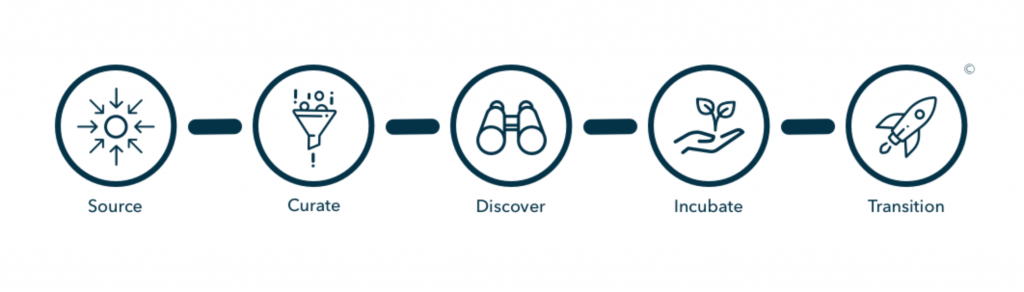






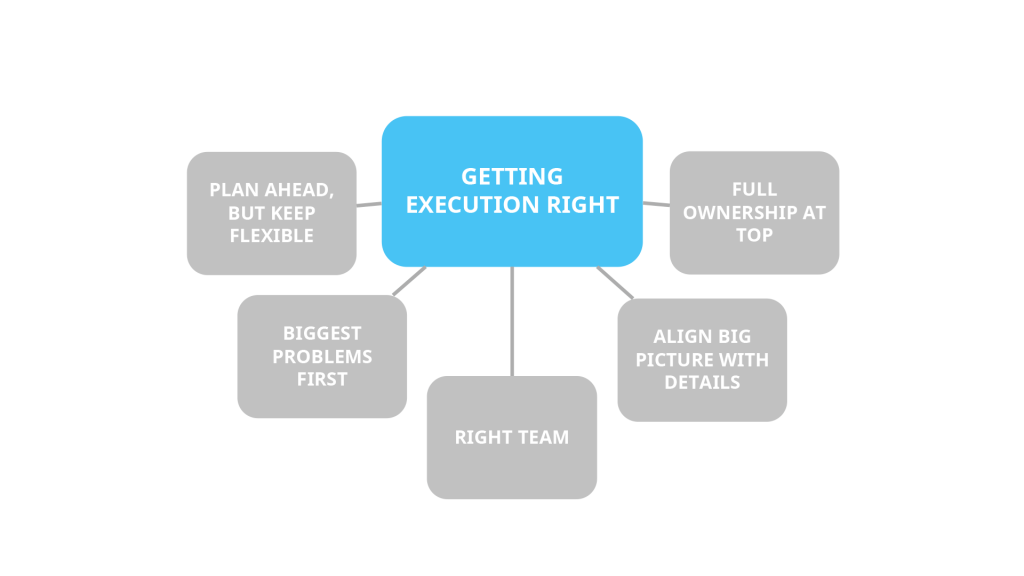






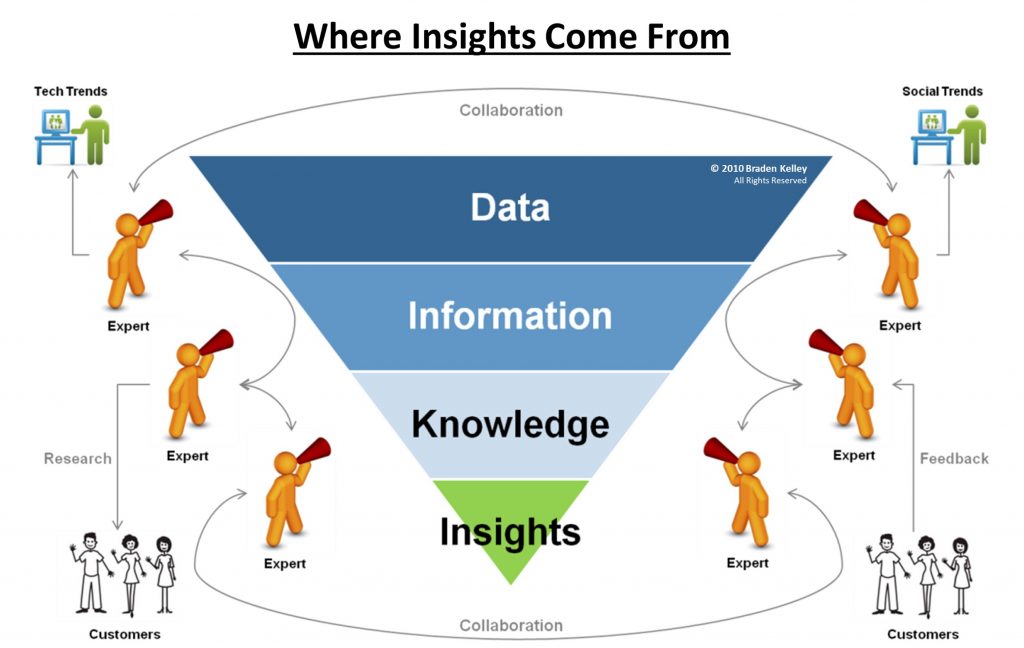
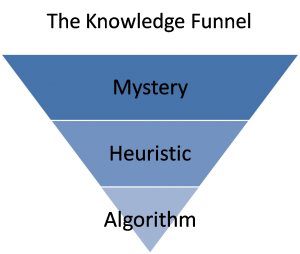 The knowledge funnel is a useful concept learned from Roger Martin in the Design of Business. The concept highlights how any new area creating information (and hopefully knowledge) starts very much as a mystery, but as our understanding of the topic area increases, we begin to identify heuristics and make sense of it. For me, this is where we begin to move from data and information to knowledge, and then as our knowledge increases we are able to codify this knowledge into algorithms.