Monthly Archives: September 2021

Building Trust with Customers Through Transparency and Authenticity

Building Trust with Customers Through Transparency and Authenticity

GUEST POST from Chateau G Pato

Trust is the cornerstone of any successful business relationship. In today’s digital age, customers are more informed and skeptical than ever. They seek brands that not only promise quality but also practice transparency and authenticity. This article explores how companies can build trust with their customers through honest communication and genuine actions.

The Importance of Transparency

Customers today demand transparency from the brands they engage with. Transparency involves openly sharing information that is usually kept behind the curtains – whether it is about business practices, sourcing, pricing, or internal challenges.

Benefits of Transparency

  • Builds credibility
  • Enhances customer loyalty
  • Mitigates risks during crises
  • Fosters a culture of accountability

Case Study 1: Patagonia’s Commitment to Environmental Transparency

Patagonia, the outdoor clothing brand, has long been celebrated for its commitment to environmental sustainability. Their transparency about the supply chain and environmental impact has garnered significant trust from their customers.

Key Transparency Efforts

  • Detailed Footprint Chronicles: They provide detailed reports on the environmental and social impact of each product.
  • Worn Wear Program: Encourages customers to recycle garments by offering discounts on future purchases.
  • Open-Source Supply Chain: They allow customers to trace the origins of their products and verify ethical practices.

By making their processes visible and accountable, Patagonia reinforces their commitment to environmental stewardship and gains customer’s respect and trust.

The Power of Authenticity

Being authentic means staying true to one’s values and promises, even when it is challenging. Authenticity in business creates a genuine connection with customers that goes beyond transactions.

How to Demonstrate Authenticity

  • Stick to your brand values and mission
  • Engage in real conversations with your customers
  • Admit to mistakes and take accountability
  • Showcase real stories and user-generated content

Case Study 2: Ben & Jerry’s Advocacy for Social Issues

Ben & Jerry’s, the beloved ice cream brand, is not just known for its delicious flavors but also for its upfront stance on social and environmental issues. Their authenticity in standing up for these causes has built a loyal customer base that resonates with their values.

Notable Authenticity Efforts

  • Active Campaigning: They consistently involve themselves in contemporary issues like climate change, racial justice, and LGBT equality.
  • Transparency in Ingredients: They advocate for GMO labeling and provide accessible information about their products’ ingredients.
  • Honest Communication: They openly communicate their beliefs and the steps they are taking to make a difference.

Their unapologetic, honest approach to activism mirrors their brand values and helps them connect with customers who share similar views.

Conclusion

Transparency and authenticity are not just buzzwords; they are vital strategies that can significantly enhance customer trust. By being open, honest, and true to their values, companies can foster lasting relationships with their customers. The cases of Patagonia and Ben & Jerry’s illustrate how embracing transparency and authenticity can not only build trust but also distinguish a brand in an increasingly competitive marketplace.

SPECIAL BONUS: The very best change planners use a visual, collaborative approach to create their deliverables. A methodology and tools like those in Change Planning Toolkit™ can empower anyone to become great change planners themselves.

Image credit: Unsplash

Subscribe to Human-Centered Change & Innovation WeeklySign up here to get Human-Centered Change & Innovation Weekly delivered to your inbox every week.

Experience Thinking – The Next Evolution for Design Thinking

Experience Thinking - The Next Evolution for Design Thinking

GUEST POST from Anthony Mills

Prologue

Design Thinking is an incredibly powerful way to approach the design of just about anything that involves an interaction with people (or other intelligent creatures). Its underlying philosophy of Human Centered Design requires that we develop a comprehensive empathic understanding of the customer and their situation in a particular context. This can only happen when we dissect the situation – using the many different Design Methods available to us – to understand the customer’s underlying values, beliefs, motivations, priorities, expectations, and preferences. From this we understand their real needs and desires. This is what we are doing when we work through the divergence of hypothesis formation, the convergence of hypothesis testing, the arrival at a compelling Point of View, and from that the definition of relevant Design Principles. And it is what empowers us to thereafter work through the divergence of solution ideation and the convergence of solution testing – all to arrive at the most optimal solution to the right problem, reframed at the right level. This results in new innovations that resonate with real market needs. Powerful indeed!

But, there are limitations.

The limitations lie not so much in Design Thinking itself, but rather in how Design Thinking is typically used.

The manner in which Design Thinking is typically used is what we refer to as a “static approach.” That is, it is generally used to understand how a customer interacts with a product or service at one particular moment in time – typically the most critical moment in time – or in one particular mode of usage – typically the most critical mode of usage – as though everything were about this one particular “freeze frame”. It may examine, for example, how they sit in a chair, how they use a toothbrush, how they read a user interface, or how they comprehend a set of service instructions. This can work okay for very simple products and services, but not so much for complex ones. Sometimes the lens of focus is zoomed out to examine more moments and more modes, but rarely does it venture so far out as to truly understand the entire product or service experience in its entirety, as well as the overriding brand experience it must convey. To do this, we need a different approach.

A Different Approach

Fortunately, we have a different approach. We call it “Experience Thinking”, or XT. One can think of XT as a more “dynamic” approach to Design Thinking, in that it seeks to examine the entire product / service / brand experience in its totality. By combining the tools of Design Thinking (the Design Methods) with the tools of Customer Experience Design and Customer Experience Management (CX Journey Maps, Stakeholder Analysis, NPS, etc.), it takes the practitioner through the Design Thinking journey for each and every touchpoint in the entire customer experience – or through whichever touchpoints are of interest. This ends up being far more powerful than the narrow-lens focus of static Design Thinking, albeit at the price of additional work.

Experience Thinking is, in fact, what has allowed companies like Apple, Uber, Mercedes, Tesla, Harley Davidson, Patagonia, and Amazon to all produce such highly differentiated offerings that each deliver a coherent and compelling brand experience. In most cases, this brand experience extends well beyond the product or service itself to encompass a far broader value proposition focused on lifestyle or workstyle enhancement. Experience Thinking understands this, and it understands that the emotional and social outcomes involved are just as important (and in some cases more important) than are the functional outcomes. And so offerings get designed that deliver compelling experiences that satisfy those emotional and social outcomes.

Understanding the essence of Experience Thinking then, the next logical question is always, “Okay… so how does one use Experience Thinking? How do they go about carrying it out?” That is a great question.

A Simple Four Step Approach to Using Experience Thinking

In our work with clients, we have a very specific and defined approach to how we do this. It involves four steps.

Step 1 — Foundation: The Brand Experience

We always begin with the brand:

  1. What is the brand persona or brand DNA that defines this brand?
  2. What is this brand’s relative positioning in the market (is it luxury, mid-tier, or value-line)?
  3. What brand promise is this brand making, and what expectations does this then create for its customers?
  4. What brand language (descriptive, visual, and experiential) is being used to convey this brand promise?

And finally, as a consequence of all of the above, what is the overall brand experience we are attempting to deliver, and what, therefore, is the brand experience lens through which we must design the associated product experience or service experience that is to follow-on from this?

These are all crucial questions. For existing brands, the answers are often already known, though they sometimes have to be polished and sharpened a bit. For new brands, we first must answer these questions before proceeding further. An important implication, however, is that this process does not depend on having an existing brand or even an existing product category; it can just as readily be applied to an entirely new brand and/or product category so long as we can define the above points that we intend to deliver for the brand.

Step 2 — Manifestation: The Customer Experience

Once we have defined all of the above, and thus our brand experience lens, we can then move on to the next step, which is to look at either the entire customer lifecycle (eight stages – four on the buy side and four on the own side), or some particular portion of the customer lifecycle that we are specifically interested in.

Using a relatively standard CX Journey Mapping process, we then design our intended customer experience, making sure that at each touchpoint we undertake careful Cognitive Task Analysis so that we fully understand the cognitive and emotional “dance” happening between our offering / brand / business and our customer, as well as capturing all of the on-stage and back-stage stakeholder actions required to stage this experience as designed (the latter can also be complemented with Swim Lane Analysis to help better visualize the timing of each action). Undertaking Cognitive Task Analysis requires a sound understanding of Experience Psychology. As an aid toward this, we recommend reading any of Don Norman’s books, but in particular The Design of Everyday Things.

Step 3 — Translation: The Product (Service) Experience

Next, having defined the intended customer experience, and in so doing understanding the intended attributes of each of its touchpoints (for example, are certain touchpoints to be fast or slow, simple or complex, what human factors or ergonomics concerns have to be considered, what emotional responses need to be evoked, and so on), we then use a tool that in our case we call the Product Experience Framework, or PX Framework (known generically as an alignment model) to map these experience attributes into corresponding product or service attributes. Such attributes might include, for example, size, weight, location, color, finish, actuation force, ease of interpretation, styling, craftsmanship, and so forth.

In using the PX Framework, we step through each and every “event” involved in using the product or receiving the service. Events represent the individual interactions the user has with the product or service, and as such any given touchpoint can include any number of different events. For each such event, we document all of the pertinent attribute details for the product or service. One can see the structure and content of the PX Framework at The Legacy Innovation Product Experience Framework.

Since highly complex products and services tend to involve lots of events (or potential events), this can end up being a very large document. In some cases, therefore, it is helpful to treat each major subsystem separately, with someone watching the overall product integration so as to ensure harmony between all of them.

Step 4 — Realization: The Design

Finally, having the PX Framework in hand, one is at last ready to sit down and actually design the product or service. They now have as an input to this design a clear prescription of what its attributes need to be in order that using the product, or receiving the service, will in fact result in the intended product or service experience, which will in turn convey the intended brand experience for the affected brand.

A New Design Philosophy — The “Designed Experience”

This approach – and Experience Thinking in general – is incredibly different from what so many designers and engineers are accustomed to doing, which is namely to just jump straight into designing a product or service without any idea whatsoever what its attributes need to be to deliver a particular experience. Indeed, they have not even attempted to define in the first place what its product or service experience needs to be, only that it needs to accomplish some outcome in the end; the assumption being that whatever happens along the way toward that outcome is not particularly important – usually an incredibly erroneous assumption!

We believe so strongly in this approach, in fact, that we have wrapped our entire design philosophy around it and have given that philosophy a name. We call it the Designed Experience Approach, and all of the information arising out of these four steps we refer to as the Designed Experience Model. A key tenet of this philosophy (and of Experience Thinking in general) is that the design of a product or service cannot be considered complete until we have first gone through this process of defining its intended product or service experience, together with its intended brand experience. This process must be done, and the resulting insights must be applied, so that we can design all of the product or service attributes accordingly, thus ensuring the final design is in fact capable of delivering its intended experience.

Recently we taught this design philosophy and its accompanying process to a major American automotive OEM in Detroit. The team we were working with there found this to be an incredibly eye-opening approach, because it finally allowed them to make the connection they were looking for between product attributes and the overall intended customer and brand experiences.

Why & Where?

The final two points that need to be made about Experience Thinking are why it is so important, and where it is most applicable. But these two points are best addressed in reverse order.

In terms of where Experience Thinking is most applicable therefore… it is most applicable anywhere we have a branded business and thus a branded line of offerings. Because they are branded, they have a specific brand promise that they must live up to, and ideally this is a brand promise that differentiates and distinguishes the brand from other brands. The need for differentiation is therefore incredibly strong. As a consequence, we must design the products and services associated with this brand in a highly intentional manner so that their attributes can in fact deliver on that brand promise and ensure the level of differentiation we are attempting to achieve. The contrast to this, of course, would be commodity products and services that are undifferentiated. Such products and services need only accomplish their intended outcomes; how they do so and what happens along the way is not overly critical in their case.

In terms of why Experience Thinking is so important then, it is precisely as described above. In those cases where we must espouse and then deliver on a specific brand promise – so that we can differentiate ourselves – our products and services no longer matter by themselves. What matters in these cases is the experience that those products and services are able to deliver. Thus how they go about achieving their intended outcomes, and everything that happens along the way, are all incredibly, incredibly important. They must be things that deliver on our brand promise and thereby reinforce our brand message, which in turn builds our brand value and allows us over time to capture increasing market shares.

The thing is, the vast majority of businesses and their offerings are – to one degree or another – branded. Those who are truly hungry for market leadership tend to be the ones who most readily recognize this and therefore put the most effort into building their brands. This in turn means they are the most eager to embrace Experience Thinking and to use this approach to design their products and services to deliver on their brand promises.

Reflection

The questions to ask yourself, therefore, are:

  1. “Is our brand as differentiated as it needs to be?”
  2. “Does it have a compelling brand promise that lets us define a unique brand experience?”
  3. “Have we defined specific product and service experiences that are aligned to that brand promise and brand experience?”
  4. “Are we designing our products and services to have the attributes they need to deliver on those experiences?”
  5. “Should we – like perhaps some of our competitors are doing – be using Experience Thinking to design our next offerings?”

If the answers to these questions are “no”, “no”, “no”, “no”, and “yes”, then it’s probably time to get serious about shaking up your design process – time to start applying Experience Thinking. Though it does take more time and effort to do, it tends to pay back greatly in terms of commercial success and ongoing brand building.

Image credit: Pixabay

Subscribe to Human-Centered Change & Innovation WeeklySign up here to get Human-Centered Change & Innovation Weekly delivered to your inbox every week.

Balancing Data-Driven Decision Making with Intuition in Innovation

Balancing Data-Driven Decision Making with Intuition in Innovation

GUEST POST from Art Inteligencia

In the fast-paced world of innovation, leaders are often faced with the challenge of making critical decisions that can determine the success or failure of their initiatives. The rise of big data and advanced analytics has given organizations the tools to drive decisions based on empirical evidence. However, the role of intuition—those gut feelings honed by experience and tacit knowledge—remains irreplaceable. In this article, we will explore how to balance data-driven decision making with intuition, providing insights through two revealing case studies.

Case Study 1: Apple and the iPhone

When Steve Jobs introduced the iPhone in 2007, it revolutionized mobile technology. But this groundbreaking innovation wasn’t solely the product of data-driven decision making.

Data-Driven Insights

  • Apple analyzed the shortcomings of existing mobile phones in terms of user experience and functionality.
  • Market data indicated a growing interest in smartphones with internet capabilities, touchscreens, and multimedia features.
  • Advanced analytics helped Apple understand usage patterns, which influenced design elements like the touchscreen interface.

Intuitive Leadership

  • Steve Jobs’ intuition played a critical role in deciding to pursue the development of the iPhone despite potential risks.
  • He envisioned a device that combined a phone, an iPod, and an internet communicator, a concept unheard of at the time.
  • Jobs made bold decisions on user experience features based on his instinctual understanding of what users would love, rather than what traditional market research might suggest.

The iPhone’s success illustrates how data-driven insights and intuitive leadership can complement each other to bring about transformative innovation.

Case Study 2: Netflix’s Transition to Streaming

Netflix has become synonymous with streaming entertainment, but the company’s journey from DVD rental service to streaming giant was not an obvious path.

Data-Driven Insights

  • Netflix leveraged data from its DVD rental service to understand customer preferences and viewing habits.
  • Subscriber data indicated a shift in consumer demand towards digital content delivery, driven by increasing internet speeds and access to devices.
  • Advanced algorithms and predictive analytics were used to recommend content, enhancing user engagement and satisfaction.

Intuitive Leadership

  • Reed Hastings, co-founder, and CEO of Netflix relied on his intuition when deciding to invest heavily in streaming technology, a risky move at that time.
  • Hastings intuitively understood that consumer behavior was shifting towards a preference for on-demand content, even when the data was still emerging.
  • His vision for the future of entertainment included producing original content, an idea driven in equal parts by intuition and data analytics of viewing trends.

By balancing data insights with intuitive foresight, Netflix was able to successfully pivot its business model, fundamentally changing the entertainment landscape.

Strategies for Balancing Data and Intuition

  • Embrace Collaborative Decision-Making: Encourage teams to integrate both data and intuition when making decisions. Promote discussions that leverage diverse perspectives and experiences.
  • Cultivate a Test-and-Learn Culture: Implement policies that allow for experimentation based on intuition while using data to validate or refine these ideas.
  • Leverage Technology Wisely: Use advanced analytics tools to gather actionable insights, but don’t let them overshadow the value of human intuition and creativity.
  • Continuous Learning and Adaptation: Encourage ongoing learning for leaders and teams to enhance their intuitive abilities and stay updated with data analytics advancements.

Conclusion

In the quest for innovation, it is not a question of choosing between data-driven decision making and intuition. Rather, the key lies in finding the right balance, where data provides a solid foundation for insights and intuition injects creativity and foresight into the decision-making process. The cases of Apple and Netflix illustrate how the fusion of data and intuition can lead to groundbreaking innovations that redefine markets and industries. By adopting strategies that honor both elements, organizations can navigate uncertainty and foster a culture of sustained innovation.

Bottom line: Futurology is not fortune telling. Futurists use a scientific approach to create their deliverables, but a methodology and tools like those in FutureHacking™ can empower anyone to engage in futurology themselves.

Image credit: Pixabay

Subscribe to Human-Centered Change & Innovation WeeklySign up here to get Human-Centered Change & Innovation Weekly delivered to your inbox every week.

Don’t Forget to Innovate the Customer Experience

Don't Forget to Innovate the Customer Experience

Too often we speak about Innovation, Customer Experience, Digital Transformation, Employee Experience and Organizational Change as very distinct and separate things.

But is this the right approach?

Those of you who have read both my first book Stoking Your Innovation Bonfire and my second book Charting Change know that the main reason that the second book even exists is because innovation is all about change.

Apple couldn’t bring the iPod, iTunes and the iTunes store to market without inflicting incredible amounts of change upon the organization and building many different new organizational capabilities and hiring many new types of people with many types of expertise new to the organization.

I’ve also written about BIG C and little c change, with BIG C change including transformations of many types (including digital) and little C change including projects and other small initiatives. And yes, every project changes something, so every project is a change initiative. And so yes, project management is in fact a subset of change management, not the typical wrong way ’round that change management is usually made subservient to project management.

Stop it!

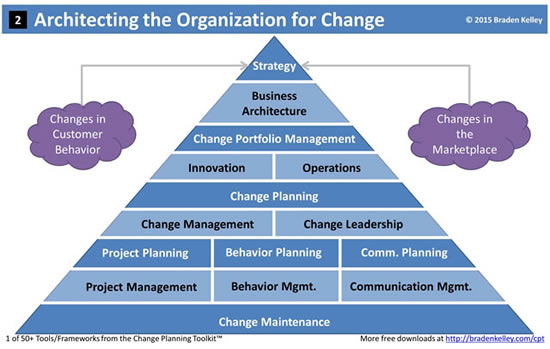
Architecting the Organization for Change

For an invention to have any chance of becoming an innovation, the organization must transform, and to do this well we must design corresponding changes in both employee experience and customer experience to accelerate and integrate:

  1. Value Creation
  2. Value Access
  3. Value Translation

See my important article Innovation is All About Value for more background on these three phrases.

Because of the interconnectedness between innovation, change, transformation, customer experience and employee experience we must look at these different specialties holistically and in a coordinated way if we are to maximize our chances of successfully completing the journey from invention to innovation.

Service Design and Journey Mapping have a role to play, as does Human-Centered Design because people are at the heart of innovation and transformation. These tools can help uncover the customer needs and help visualize what the NEW experiences must look like for both employees and customers to maximize the holistic value created and the ability of customers to access that value as effortlessly as possible.

As we work to design the potential innovation as a product or a service or a combination of the two, we must also consciously design the customer experience and employee experience to enhance to possibilities of this invention becoming an innovation. This includes potentially designing OUT touchpoints in current journeys that people may taken as a given, but maybe no longer need to exist if we are truly keeping the customer and their wants/needs at the center of our focus.

As part of your innovation activities, consider creating customer and employee journey maps, printing them poster size and placing them front and center on your innovation wonder wall so that you can ask your innovation team the following questions:

  1. What is different about this customer or employee touchpoint when considering our potential innovation?
  2. How could we design out the need for this customer or employee touchpoint?
  3. With our potential innovation, what customer or employee touchpoints may no longer be necessary?
  4. With our potential innovation, what new customer or employee touchpoints may we need to create?
  5. What organizational and employee knowledge and capabilities are we missing, that we must have, to deliver the necessary and expected customer and employee experiences?

As we explore these questions, they allow us to look beyond the product or service that forms the basis of the potential innovation that we are creating and create more value around it, to make our customers’ and employees’ experiences of our potential innovation better, and to increase our chances of more successfully translating the holistic value for its potential customers.

Customer and employee experiences are not detached and separate from the new products and services forming the basis of your innovation activities.

The change and transformation that accompany innovation are not separate either.

We must look at all of these specialties together and not see them as isolated things, otherwise we will fail.

So keep innovating, but be sure and consider the change and transformation necessary to help you be successful and how you are going to innovate your customer and employee experiences at the same time!

Subscribe to Human-Centered Change & Innovation WeeklySign up here to get Human-Centered Change & Innovation Weekly delivered to your inbox every week.

Incorporating Diversity and Inclusion Principles in Change Management Efforts

Incorporating Diversity and Inclusion Principles in Change Management Efforts

GUEST POST from Chateau G Pato

In the evolving world of business, the significance of diversity and inclusion (D&I) cannot be overstated. These principles are pivotal not only for building a dynamic workforce but also for steering successful organizational change. The interplay between D&I and change management creates a powerful synergy that drives innovation, fosters employee engagement, and enhances overall performance. In this article, we’ll explore the marriage of D&I principles with change management efforts, illustrated through two compelling case studies.

The Importance of Diversity and Inclusion in Change Management

Diversity as a Catalyst for Change

Diverse teams bring together individuals with varied backgrounds, perspectives, and skills, fueling creativity and problem-solving capabilities. When navigating change, a diverse workforce can anticipate and mitigate a wider array of challenges and opportunities.

Inclusion Ensures Commitment and Engagement

Inclusivity ensures that every employee feels valued and heard, which is critical during transitions. An inclusive approach to change management promotes transparency, trust, and collective ownership, leading to more sustainable and effective change.

Case Study 1: Transforming Customer Service at TelecomCorp

The Challenge

TelecomCorp, a leading telecommunications company, struggled with stagnant growth and declining customer satisfaction. The leadership team decided to overhaul their customer service model to revitalize the brand and improve customer experiences.

Scenario

The company’s workforce was diverse, but previously, this diversity was not leveraged effectively in decision-making processes. To achieve the desired transformation, TelecomCorp integrated D&I principles into their change management strategy.

Change Management Approach

1. Inclusive Leadership Training

  • Executive leaders received coaching on inclusive leadership, ensuring they understood the value of every team member’s input.

2. Employee Resource Groups (ERGs)

  • ERGs for various minority groups were established to facilitate dialogue and gather unique insights directly from frontline employees.

3. Open Feedback Channels

  • Multiple channels for anonymous feedback were created to empower employees to share ideas and concerns without fear of retribution.

Outcome

The incorporation of D&I principles led to a surge in employee engagement and innovation. Frontline employees, who interacted directly with customers, provided key insights that informed new customer service policies. Customer satisfaction scores improved by 30% within a year, showcasing the power of a diverse and inclusive approach to change management.

Case Study 2: Gender Diversity in Manufacturing at AutoMakers Inc.

The Challenge

AutoMakers Inc., a prominent automobile manufacturer, aimed to introduce advanced manufacturing technologies to enhance productivity. The predominantly male workforce, however, showed resistance to change, citing concerns about job security and unfamiliarity with new technologies.

Scenario

Recognizing that a diverse and inclusive environment could ease the transition, AutoMakers Inc. focused on increasing gender diversity in their teams and fostering an inclusive workplace culture.

Change Management Approach

1. Targeted Recruitment

  • The company launched initiatives to recruit more women into engineering and manufacturing roles, promoting gender diversity within the tech transition teams.

2. Mentorship Programs

    • Mentorship programs pairing experienced employees with new hires, particularly women, were created to build confidence and share knowledge on new technologies.

3. Inclusive Communication Strategies

      • Communication materials were crafted to address diverse concerns and learning styles, ensuring that all employees understood and felt comfortable with the changes.

Outcome

The infusion of gender diversity brought fresh perspectives that benefited the technology implementation process. Additionally, male employees showed greater acceptance as they observed the successful integration of female colleagues into traditionally male-dominated roles. This inclusive approach resulted in a smoother transition, with productivity increases of 25% following the technology rollout.

Key Takeaways and Best Practices

1. Leverage Diverse Perspectives

      • Create structures that actively solicit and incorporate diverse viewpoints during planning and implementation phases of change.

2. Promote Inclusive Communication

      • Use communication strategies that consider the diverse backgrounds of employees to ensure everyone comprehends and embraces the change.

3. Foster a Culture of Belonging

      • Develop policies and initiatives that make every employee feel valued and critical to the organization’s success.

Conclusion

Incorporating diversity and inclusion principles in change management efforts is not just a moral imperative—it is a strategic advantage. As demonstrated by TelecomCorp and AutoMakers Inc., a diverse and inclusive approach can lead to highly engaged employees, innovative solutions, and tangible business improvements. As we move further into an era of continuous transformation, let us embrace D&I as core components of our change management frameworks. By doing so, we create resilient organizations poised for sustainable success.

SPECIAL BONUS: The very best change planners use a visual, collaborative approach to create their deliverables. A methodology and tools like those in Change Planning Toolkit™ can empower anyone to become great change planners themselves.

Image credit: Unsplash

Subscribe to Human-Centered Change & Innovation WeeklySign up here to get Human-Centered Change & Innovation Weekly delivered to your inbox every week.
Going with the Flow

How Great Ideas Sometimes Come From Following the Natural Flow of Things

Image: James Homans on Unpslash

GUEST POST from John Bessant

Sometimes it’s the simplest ideas which change the world. Barbed wire is nothing more than a cleverly twisted piece of metal, yet its role in taming the Wild West was much more significant than any cowboys or cavalry. It enabled settlers to graze their herds and property rights to be marked out and defended.

Joe Woodland’s idle scratches in the sand on a Miami beach were the prototype for what became known as the Universal Product Code — and paved the way for bar codes identifying everything from supermarket items to surgical implants.

And a simple metal box transformed the pattern and economics of world trade. Brainchild of Malcolm McLean containerisation changed the way goods were transported internationally, drastically cutting costs and saving time. In 1965 a ship could expect to remain in port being loaded or unloaded for up to a week, with transfer rates for cargo around 1.7 tonnes/hour. By 1970 this had speeded up to 30 tonnes/hour and big shops could enter and leave ports on the same day. Journey times from door to door were cut by over half and the ability to seal containers massively cut losses due to theft and consequently reduced insurance costs.

McLean was a tough entrepreneur who’d already built a business out of trucking. He’d learned the rules of the innovation game the hard way and knew that having a great idea was only the start of a long journey. Realising the value at scale would take a lot of ingenious problem-solving and systems thinking to put the puzzle together. He needed complementary assets — the ‘who else?’ and ‘what else?’ — to realise his vision. And he understood the challenge of diffusion — getting others to buy into your idea and enabling adoption through a mixture of demonstration, persuasion and pressure.

But he wasn’t the first to come up with the idea; that distinction probably goes to another systems thinker who played the innovation game well throughout his unfortunately short life. And, like McClean, he can take a big share of the credit for transforming the pattern of world trade, this time in the 18th century.

Image: David Dibert on Pexels

James Brindley was born in 1716 and spent his early years learning the hard way about how things work — and how to make them work better. He didn’t have much of a formal education, could barely read or write and worked as an agricultural labourer until he was 17. He used his savings to buy his way into an apprenticeship to a millwright, one Abraham Bennett. Bennett was an engineer who preferred to leave much of the work in his business to others while he relaxed (and drank away) the fruits of their labour. Which offered James an opportunity not only to learn fast but to try out ideas. He’d grown up around mills, (both wind and water driven) and was fascinated by their operations.

He got a chance to put some of his innovative ideas into practice when he was given the task, in 1735 of carrying out emergency repairs to a small silk mill. His work so impressed the mill superintendent that he recommended Brindley to others; it wasn’t long before he’d acquired enough experience and skill from different projects to set up on his own as a millwright. He earned the nickname of ‘the Schemer’ because of his approach which was often unconventional but certainly delivered results.

Photo by Ali Arapoğlu from Pexels

Which is how he came to be associated with the Wedgwood brothers who were busy establishing their ceramics business in nearby Stoke on Trent. They sought him out to help with problems they were having in grinding flint, one of the key ingredients in their pottery. Brindley built a series of mills for them, finding ways to improve efficiency and cut costs, and consolidating his reputation They in turn recommended him to John Heathcote, owner of the large Clifton collieries near Manchester who was struggling with a big problem of flooding in his mines.

Brindley’s solution seemed crazy at first — he proposed drawing in more water! But in fact his ingenious idea was to draw water from the nearby river Irwell, pass it through an underground tunnel nearly a kilometre in length and use it to drive a huge mill wheel which drove a pump. It was strong enough to pump out the mine and efficient since it returned the water to the river. It worked — and established his reputation not just as a skilled engineer but as an imaginative problem-solver and innovator.

No-one could call him a lazy man — he worked incessantly on a wide range of projects. But he also spent a lot of time in bed — sometimes days at a time. This was his thinking space, a way of incubating novel and sometimes crazy ideas.

And water was at the centre of his thinking; he seemed to have an intuitive grasp of how it flowed and how those principles could be applied in a wide variety of situations. As he famously replied to an early enquiry about how he had come up with a solution to a complex hydraulic problem he said ‘…it came natural-like…’

And of course one thing about water is that it requires you to think in systems terms, how things are linked together. Brindley had a gift for seeing the interconnected challenges in realising big schemes like the mine pumping system — and for focusing on solving those to enable the whole system to deliver value.

This approach stood him in good stead as he moved into the field for which we best know him — canals. Canals played a critical role in the early Industrial Revolution; they meant that raw materials could get in to factories and their finished products could find their way to ports and be exported around the world. Britain, as ‘the workshop of the world’ depended on the canals as the veins and arteries that enabled the giant to come to life.

And canals represented just the kind of systems challenge which Brindley was so good at. When the Duke of Bridgwater approached him in 1759 to help create a canal to connect his mines in Worsley to the city of Manchester he began a journey which would eventually see him changing the face of Britain, constructing 365 miles of canals criss-crossing the country and revolutionising productivity.

When the Bridgwater Canal was finished in 1761 it helped cut the price of coal in Manchester by 50% and it fell further over the coming years. He followed this with other major projects; he worked with the Wedgwoods to create the Trent and Mersey canal which linked the Potteries to the big industrial cities and ports, providing a way of climbing (through a total of 35 locks) the country and delivering their fragile wares to a global export market. Whether it was shipping coal, flint or other raw materials into cities or transporting their finished wares out to the great ports like Liverpool, Brindley’s canals connected the country.

Photo by Inge Wallumrød from Pexels

It wasn’t easy; quite apart from the eye-watering costs of construction building the canal posed many challenges. Brindley innovated his way around them, coming up with radical ideas for:

  • using natural contours, working with the grain of the land rather than in straight lines. His canals might have been longer as a result but they were much cheaper to dig since this approach reduced the need for tunnels or expensive cuttings
  • cutting narrower canals, which reduced the water consumption and hence the running costs. Of course to make these work required the design of narrow longer boats — something else which Brindley pioneered and which became the dominant design for the waterways
  • pumping and circulatory systems to ensure efficient water flow into and tough the canal systems — and improving the design and productivity of the equipment involved
  • raising and lowering boats as they traversed the country through a series of watertight locks, some of which survive to this day
  • using puddling clay — a watertight ceramic material which he devised (using knowledge picked up from working with the Wedgwoods in their pottery factories) and which offered a watertight base with which to line the canals and solve the problem of water seepage
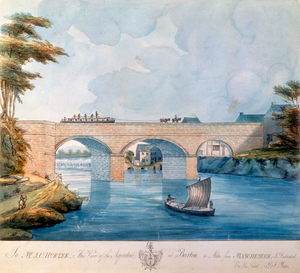
  • imagining and realising things like the Barton viaduct, a bridge carrying the Bridgwater canal over river Irwell 12m below
Image: Watercolour of Barton aqueduct by G.F. Yates 1793, public domain

He also developed another innovation as part of his problem-solving for the coal industry. His narrow boats were nicknamed ‘Starvationers’ on account of the wooden braces across the hull which gave them strength. They looked like an emaciated torso but this design meant they were strong enough to haul tons of coal or iron ore. But there was a bottleneck in terms of loading and unloading and so Brindley designed a system of wooden containers for coal which could be filled and transhipped easily. His first boat with 10 containers began work in 1766, predating Malcolm McLean by close to 200 years.

(The concept was elaborated and really brought to the mainstream by James Outram who linked the idea into a system in which horses pulled containers from mines along rails to the canal where they were quickly transhipped. As the railways emerged to replace horse drawn traffic so this ‘intermodal system’ took off)

Water was what made him and indirectly it was the death of him. In 1771 he’d begun work on another visionary scheme, surveying the route of what was to become the Trent and Mersey canal. But he was caught in a heavy thunderstorm and drenched through. He wasn’t able to dry out properly at the inn where he was lodging and by the time he returned home he was severely ill; he died of pneumonia a few days later.

He left a legacy of innovation, both in the 365 miles of canals which he built and in the locks, pumping stations, tunnels and other engineering solutions to the problem of creating a viable water-based transport system.,

And he also offers a good reminder of some key innovation themes involved in bringing large scale ideas to fruition and having an impact at scale. He might have been nicknamed ‘the Schemer’, improvising his way to solving engineering problems, but he also understood things like:

  • the importance of systems thinking and the need for complementary assets — identifying and putting in place the many interlocking pieces of the puzzle
  • the value of prototypes and working models to help persuade and accelerate adoption. Legend has it that when he was presenting his ideas to a sceptical group of Members of Parliament whose approval he needed for the Bridgwater canal route he used a cheese out of which he carved a model of the aqueduct he proposed to build!
  • the power of open innovation, learning from the many different sectors and projects he worked with and integrating knowledge from these different worlds — for example, using his knowledge of ceramics to develop the puddling clay liners for his canals
  • the importance of business models in laying out the architecture through which ideas can create value. He not only understood the literal flow of water, he was also skilled at managing cash flow, acquiring a reputation for being ‘careful with money’ which undoubtedly helped realise some of the huge schemes with which he was involved.

Subscribe to Human-Centered Change & Innovation WeeklySign up here to get Human-Centered Change & Innovation Weekly delivered to your inbox every week.

The Rise of Sustainable and Eco-Friendly Practices in Shaping the Future of Business

The Rise of Sustainable and Eco-Friendly Practices in Shaping the Future of Business

GUEST POST from Art Inteligencia

In today’s rapidly evolving business landscape, sustainability and eco-friendliness have emerged as critical determinants of success. Companies across the globe are recognizing the urgent need to align their practices with environmental stewardship. This article delves deep into how sustainable and eco-friendly practices are shaping the future of business, supported by compelling case studies.

The Imperative of Sustainability

The pressing need for sustainability is no longer a topic of debate but a widespread acknowledgment across industries. Climate change, resource depletion, and increasing consumer awareness have created a demand for businesses to operate responsibly.

  • Regulatory Pressure: Governments are implementing stringent regulations, pushing companies to adopt sustainable practices.
  • Investor Focus: Investors are increasingly prioritizing Environmental, Social, and Governance (ESG) criteria, which impacts investment decisions.
  • Consumer Demand: Modern customers prefer brands that demonstrate a commitment to environmental and social responsibility.

Case Study 1: Patagonia – The Gold Standard in Sustainability

Patagonia, a renowned outdoor apparel company, stands as a prime example of how sustainability can drive business success and foster brand loyalty.

Key Initiatives:

  • Environmental Advocacy: Patagonia has been an unwavering advocate for environmental protection, donating 1% of its sales to environmental organizations since 1985.
  • Worn Wear Program: This initiative encourages customers to buy used Patagonia products and trade in their old clothing for store credit, promoting a circular economy.
  • Responsible Manufacturing: Patagonia ensures that its manufacturing processes comply with eco-friendly and ethical standards, significantly reducing its carbon footprint.

By seamlessly integrating sustainability into its brand ethos, Patagonia has achieved remarkable success. The company has not only cultivated a fiercely loyal customer base but also inspired other businesses to follow suit.

Case Study 2: Unilever – Leading with Purpose

Unilever, a global consumer goods giant, has demonstrated that sustainability can coexist with profitability. The company’s Sustainable Living Plan, initiated in 2010, aims to decouple its growth from its environmental footprint while increasing its positive social impact.

Key Initiatives:

  • Sustainable Sourcing: Unilever places a strong emphasis on sourcing raw materials sustainably. For instance, the company sources 100% of its palm oil from certified sustainable sources.
  • Reduction in Carbon Emissions: Unilever employs energy-efficient technologies and renewable energy sources to significantly reduce its carbon emissions.
  • Health and Wellbeing: The company’s initiatives extend beyond environmental sustainability. Unilever continually works to improve the health and wellbeing of its consumers through its products.

Unilever’s comprehensive approach to sustainability has not only benefited the environment but also led to business growth. The brands under Unilever’s umbrella that are recognized for their strong sustainability profiles, such as Dove and Ben & Jerry’s, have consistently outperformed others in terms of growth and profitability.

The Road Ahead

The journey towards sustainability is ongoing, but companies that embrace eco-friendly practices gain a competitive edge. The clear advantages include:

  • Brand Differentiation: Sustainable practices set businesses apart in saturated markets.
  • Cost Efficiency: Resource efficiency and waste reduction lead to long-term cost savings.
  • Attracting Talent: Employees are increasingly drawn to companies with strong sustainability commitments.
  • Future-Proofing: Sustainable practices mitigate risks associated with resource scarcity and regulatory changes.

Conclusion

The rise of sustainable and eco-friendly practices signifies a paradigm shift in the way businesses operate. Companies like Patagonia and Unilever exemplify how integrating sustainability into the core of business strategy can drive long-term success and create positive environmental and social impact. As we look to the future, it is evident that sustainability is not merely an option but a business imperative that will shape the future of industries globally.

Bottom line: Futurology is not fortune telling. Futurists use a scientific approach to create their deliverables, but a methodology and tools like those in FutureHacking™ can empower anyone to engage in futurology themselves.

Image credit: Pixabay

Subscribe to Human-Centered Change & Innovation WeeklySign up here to get Human-Centered Change & Innovation Weekly delivered to your inbox every week.

How to Close the Sickcare AI DI Divide

How to Close the Sickcare AI DI Divide

GUEST POST from Arlen Meyers

The digital divide describes those having or not having access to broadband, hardware, software and technology support. It’s long been acknowledged that even as the digital industry exploded out of this country, America lived with a “digital divide.” While this is loosely understood as the gap between those who have access to reliable internet service and those who don’t, the true nature and extent of the divide is often under-appreciated. Internet infrastructure is, of course, an essential element of the divide, but infrastructure alone does not necessarily translate into adoption and beneficial use. Local and national institutions, affordability and access, and the digital proficiency of users, all play significant roles — and there are wide variations across the United States along each of these.

There is also a sickcare artificial intelligence (AI) dissemination and implementation (DI) divide. Infrastucture is one of many barriers.

As with most things American, there are the haves and the have nots. Here’s how hospitals are categorized. Generally, the smaller ones lack the resources to implement sickcare AI, particularly rural hospitals which are, increasingly, under stress and closing.

So, how do we close the AI-DI divide? Multisystems solutions involve:

  1. Data interoperability
  2. Federated learning Instead of bring Mohamed to the mountain, bring the mountain to Mohamed
  3. AI as a service
  4. Better data literacy
  5. IT infrastructure access improvement
  6. Making cheaper AI products
  7. Incorporating AI into a digital health whole product solution
  8. Close the doctor-data scientist divide
  9. Democratize data and AI
  10. Create business model competition for data by empowering patient data entrepreneurs
  11. Teach hospital and practice administrators how to make value based AI vendor purchasing decisions
  12. Encourage physician intrapreneurship and avoid the landmines
  13. Use no-code or low-code tools to innovate

We are still in the early stages of realizing the full potential of sickcare artificial intelligence. However, if we don’t close the AI-DI gaps, a large percentage of patients will never realize the benefits.

Image Credit: Pixabay

Subscribe to Human-Centered Change & Innovation WeeklySign up here to get Human-Centered Change & Innovation Weekly delivered to your inbox every week.

The Importance of Change Leadership in Digital Transformation

The Importance of Change Leadership in Digital Transformation

GUEST POST from Chateau G Pato

In the evolving landscape of the digital age, organizations face unprecedented challenges in staying relevant and competitive. The ability to successfully navigate digital transformation is crucial for survival and growth. At the heart of this transition lies the critical need for effective change leadership. Change leadership is a nuanced and strategic approach that goes beyond mere management of change; it involves inspiring and guiding people through transformation. In this article, I will explore the importance of change leadership in digital transformation and illustrate this with two insightful case studies.

Why Change Leadership Matters

Change leadership is essential for several reasons:

  • Vision and Direction: Leaders articulate a compelling vision for the future, aligning everyone’s efforts towards common goals.
  • Motivation and Engagement: Effective change leaders inspire and motivate employees, fostering a culture of engagement and innovation.
  • Managing Resistance: Proactive identification and addressing resistance to change is crucial for smooth transitions.
  • Building a Roadmap: Leaders create a structured approach to implementing change, ensuring coherent and phased progression.

Case Study 1: General Electric (GE)

The Challenge: GE, a century-old industry giant, faced immense pressure to adapt to the rapidly advancing technological landscape. The challenge was to transition from a traditional manufacturing behemoth into a high-tech enterprise focused on digital solutions.

The Leadership Approach: Jeff Immelt, the then-CEO, spearheaded GE’s digital transformation by championing a vision to become a “Digital Industrial” company. Under his leadership, GE established GE Digital and invested billions in technologies such as the Industrial Internet of Things (IIoT) and analytics.

Key strategies included:

  • Culture Shift: Immelt emphasized a culture of innovation, agility, and continuous learning across the company.
  • Collaboration: Cross-functional teams were created to foster collaboration and break down silos.
  • Investment in Talent: GE hired thousands of software engineers and data scientists to build digital capabilities.

The Outcome: GE’s digital transformation journey had its ups and downs, but it successfully positioned the company as a leader in the industrial internet space. The company’s revenue from digital services grew significantly, and GE Digital became a pivotal part of its overall strategy.

Case Study 2: LEGO Group

The Challenge: In the early 2000s, LEGO Group faced declining sales and increasing competition from digital game markets. The need to evolve and integrate digital strategies into its business model was paramount.

The Leadership Approach: Jørgen Vig Knudstorp, who became CEO in 2004, led LEGO’s turnaround with a strategic focus on digital innovation and customer engagement. His leadership transformed LEGO from a struggling company into a powerhouse of digital creativity.

Key strategies included:

  • Digital Products: Development of digital toys and immersive experiences that integrated physical and digital play.
  • Community Engagement: Engaging with LEGO enthusiasts through online platforms and co-creation opportunities.
  • Streamlined Operations: Overhauling the supply chain and leveraging data analytics to optimize production and distribution.

The Outcome: Through Knudstorp’s visionary leadership, LEGO experienced a remarkable resurgence. Digital platforms like LEGO Digital Designer and LEGO Ideas, combined with innovative products, bolstered the brand’s appeal to new generations. By integrating digital strategies, LEGO not only recovered but thrived, achieving record sales and profitability.

Conclusion

Digital transformation is not merely about implementing new technologies; it requires a transformation of the entire organizational ethos. Effective change leadership plays an indispensable role in guiding organizations through these complex transitions. As demonstrated by GE and LEGO, visionary leaders who prioritize culture, collaboration, and innovation can successfully navigate the tumultuous waters of the digital age. By embracing change leadership principles, organizations can unlock the full potential of digital transformation and secure their place in the future.

SPECIAL BONUS: The very best change planners use a visual, collaborative approach to create their deliverables. A methodology and tools like those in Change Planning Toolkit™ can empower anyone to become great change planners themselves.

Image credit: Pexels

Subscribe to Human-Centered Change & Innovation WeeklySign up here to get Human-Centered Change & Innovation Weekly delivered to your inbox every week.

The Integration of Lean Startup Principles in Innovation Management

The Integration of Lean Startup Principles in Innovation Management

GUEST POST from Art Inteligencia

In today’s rapidly evolving business environment, the integration of Lean Startup principles into innovation management is no longer optional – it’s essential. This approach equips companies with the flexibility and responsiveness required to manage uncertainty and drive sustainable growth. Lean Startup principles, characterized by build-measure-learn feedback loops, minimum viable products (MVP), and pivoting, align seamlessly with the objectives of innovation management. They enable organizations to validate ideas quickly, minimize waste, and focus on delivering customer value. Let’s delve into how these principles can revolutionize innovation management, supported by a couple of compelling case studies.

Case Study 1: Eric Ries and the Birth of IMVU

Eric Ries, the author of The Lean Startup, not only coined the term but also successfully applied these principles to co-found IMVU, a social entertainment company. Here’s how IMVU illustrates the power of Lean Startup principles in innovation management:

  • MVP Development: IMVU started with a basic version of their product that allowed users to create avatars and chat with each other. This MVP tested the market without heavy investment in unnecessary features.
  • Build-Measure-Learn: The team continually iterated on their product based on customer feedback, measuring user engagement metrics, and learning what truly resonated with their audience.
  • Pivoting: IMVU initially targeted instant messaging users but discovered through experimentation that their product had more potential as a social network. This pivot allowed them to realign their strategy to better meet market demands.

By embedding Lean Startup principles into their innovation management process, IMVU was able to conserve resources, rapidly adapt, and achieve market success.

Case Study 2: General Electric’s FastWorks

Transitioning from a startup to a well-established organization, General Electric (GE) offers another compelling case of integrating Lean Startup principles. Through their FastWorks program, GE revolutionized its approach to innovation.

  • Cross-Functional Teams: GE formed dedicated FastWorks teams comprising members from diverse functions. These teams were empowered to rapidly experiment and iterate.
  • Customer Validation: GE encouraged direct interaction with customers early in the development process. One notable success was the development of the energy-efficient industrial dishwasher. By involving customers from the outset, GE identified and addressed key pain points effectively.
  • Metrics for Learning: Instead of focusing on conventional financial metrics, GE emphasized validated learning and customer feedback to guide product development.

GE’s FastWorks initiative underscored the potential of Lean Startup principles in large enterprises, promoting agility, customer focus, and continuous improvement.

Best Practices for Integrating Lean Startup Principles

  • Embrace Uncertainty: Foster a mindset that views uncertainty as an opportunity for learning rather than a risk.
  • Create Cross-Functional Teams: Ensure diverse perspectives and skills are represented to enhance creativity and problem-solving.
  • Prioritize Customer Feedback: Implement mechanisms to gather and act on customer feedback continuously.
  • Iterate Continuously: Develop a culture that encourages rapid experimentation and learning from both successes and failures.
  • Measure What Matters: Focus on metrics that indicate customer value and learning rather than just financial performance.

Conclusion

The integration of Lean Startup principles in innovation management is transformative, enabling companies to navigate uncertainty, respond to customer needs rapidly, and drive sustainable growth. Whether you are a startup or a large enterprise, these principles provide a robust framework for fostering innovation and achieving long-term success. By learning from the successes of IMVU and General Electric, organizations can better equip themselves to meet the dynamic challenges of today’s business environment.

Bottom line: Futurology is not fortune telling. Futurists use a scientific approach to create their deliverables, but a methodology and tools like those in FutureHacking™ can empower anyone to engage in futurology themselves.

Image credit: Pixabay

Subscribe to Human-Centered Change & Innovation WeeklySign up here to get Human-Centered Change & Innovation Weekly delivered to your inbox every week.