Synthetic Data Generation

Fueling Innovation Without Compromising Reality

LAST UPDATED: March 13, 2026 at 2:44 PM

Synthetic Data Generation Innovation Catalyst

GUEST POST from Art Inteligencia


I. The Data Dilemma: Why Innovation Is Starving for Better Data

We live in a time when organizations claim to be “data-driven,” yet many of the most important innovation decisions are still made with incomplete, restricted, or unusable data. Leaders want evidence before they invest. Teams want data before they experiment. And regulators rightly demand protection of customer information. The result is a paradox that slows progress across industries.

The truth is simple: the data that organizations most need in order to innovate is often the data they are least able to access.

Historical datasets are plentiful when organizations are studying the past. But innovation is not about the past. Innovation is about exploring possibilities that have never existed before. When teams attempt to build new products, design new services, or explore entirely new business models, the historical data they rely on often becomes a constraint instead of an enabler.

The Innovation Paradox

The more disruptive or novel an idea becomes, the less historical data exists to support it. That creates an innovation paradox: organizations increasingly rely on data to make decisions, yet the ideas with the greatest potential for impact are the ones least supported by existing data.

When decision-makers cannot find data to justify an idea, they frequently default to safer, incremental improvements rather than bold experimentation. Over time, this dynamic can quietly suffocate innovation cultures. Teams begin optimizing existing processes instead of exploring new opportunities.

In other words, the absence of data often becomes an invisible veto against new ideas.

Why Traditional Data Strategies Fall Short

Most enterprise data strategies were designed to improve operational efficiency, not to enable experimentation. Data warehouses, analytics pipelines, and reporting dashboards are excellent at analyzing what has already happened. They are far less capable of supporting rapid exploration of what might happen next.

Several structural challenges make it difficult for organizations to use traditional data for innovation:

  • Privacy restrictions: Customer data is often highly sensitive and governed by strict regulatory frameworks.
  • Limited access: Critical datasets may sit inside departmental silos or restricted systems.
  • Incomplete information: Real-world datasets frequently contain missing or inconsistent records.
  • Bias in historical data: Past decisions can embed systemic bias into the datasets used to train modern systems.
  • Lack of edge cases: Rare events or unusual scenarios that innovators want to explore rarely appear in historical data.

These constraints create friction for teams attempting to test new ideas. Data scientists cannot access the information they need. Product teams must wait for approvals. Designers cannot simulate the kinds of edge-case experiences that shape truly resilient solutions.

When Data Becomes a Barrier Instead of an Enabler

Ironically, the organizations that invest most heavily in data infrastructure can still struggle to innovate if their data governance frameworks prioritize protection over experimentation. Security and privacy are essential, but when every new initiative requires months of approvals to access usable datasets, teams lose momentum.

Innovation thrives on experimentation. Experimentation requires safe environments where teams can test ideas quickly, learn from failures, and iterate rapidly. Without accessible data, that experimentation becomes slow, expensive, or impossible.

This is where many organizations find themselves today: surrounded by vast quantities of data but unable to safely use it for the kinds of exploration that drive meaningful innovation.

Introducing Synthetic Data as an Innovation Enabler

Synthetic data generation is emerging as a powerful way to break this stalemate. Instead of relying exclusively on sensitive real-world datasets, organizations can generate artificial datasets that replicate the statistical patterns and relationships found in real data without exposing the underlying individuals or proprietary records.

In practical terms, synthetic data allows innovators to simulate realistic scenarios while protecting privacy and maintaining compliance. It creates a sandbox where teams can experiment freely, train algorithms safely, and test ideas that might otherwise remain locked behind regulatory or organizational barriers.

When used responsibly, synthetic data shifts the role of data within organizations. Instead of being merely a historical record of what has already happened, data becomes a tool for exploring what could happen next. That shift — from data as documentation to data as experimentation infrastructure — may prove to be one of the most important enablers of innovation in the years ahead.

II. What Synthetic Data Actually Is (And What It Is Not)

Before organizations can benefit from synthetic data, they must first understand what it actually is. Despite the growing buzz around the term, synthetic data is frequently misunderstood. Some assume it is simply “fake data.” Others believe it is the same thing as anonymized datasets. In reality, synthetic data represents a fundamentally different approach to creating usable information for experimentation, analysis, and innovation.

Synthetic data is artificially generated data that replicates the statistical patterns, relationships, and structures found in real-world datasets without containing the original records themselves. Instead of copying or masking existing information, advanced algorithms and generative models create entirely new data points that behave like the real data they are modeled after.

Think of it less like copying a photograph and more like creating a realistic simulation. The resulting dataset mirrors the dynamics of the original system, but the individual entries are newly generated rather than derived from specific real-world individuals or transactions.

How Synthetic Data Is Generated

Synthetic data generation relies on statistical modeling, machine learning, and increasingly sophisticated artificial intelligence techniques. These systems analyze real datasets to learn the underlying patterns that shape them — relationships between variables, probability distributions, and behavioral correlations.

Once those patterns are understood, generative models can produce new datasets that maintain the same statistical integrity without reproducing any specific original records. The goal is to preserve usefulness for analysis, experimentation, and algorithm training while removing the privacy risks associated with real data.

Several common techniques are used to generate synthetic datasets, including:

  • Statistical sampling models that reproduce probability distributions observed in real data.
  • Generative adversarial networks (GANs) that use competing neural networks to produce increasingly realistic synthetic records.
  • Agent-based simulations that model behaviors of individuals or systems over time.
  • Rule-based generation where domain knowledge is used to define realistic constraints and relationships.

The sophistication of the generation method determines how closely synthetic datasets resemble real-world behavior. High-quality synthetic data preserves meaningful patterns that allow data scientists, product teams, and innovators to test hypotheses with confidence.

Real Data vs. Anonymized Data vs. Synthetic Data

One of the most important distinctions leaders must understand is the difference between real data, anonymized data, and synthetic data. These three approaches represent very different levels of privacy protection and innovation flexibility.

Real data consists of original records collected from customers, users, transactions, or operational systems. This data often contains personally identifiable information or proprietary insights. While it is highly valuable for analysis, it also carries significant privacy, security, and regulatory obligations.

Anonymized data attempts to protect privacy by removing identifying details such as names, addresses, or account numbers. However, anonymization has limits. In many cases, individuals can still be re-identified by combining datasets or analyzing behavioral patterns. This risk has led to increasing regulatory scrutiny around anonymized data practices.

Synthetic data takes a different approach. Instead of modifying real records, it generates entirely new records that reflect the statistical properties of the original dataset. Because the generated data does not correspond to real individuals, the risk of re-identification is dramatically reduced when properly generated and validated.

The result is a dataset that retains analytical usefulness while minimizing exposure of sensitive information.

Why Synthetic Data Preserves Patterns Without Exposing People

The value of synthetic data lies in its ability to preserve the insights embedded in real data without exposing the underlying individuals or proprietary records. When generative models capture the relationships between variables — such as correlations between behaviors, outcomes, and environmental factors — they can recreate those relationships in newly generated datasets.

For example, a synthetic dataset used to train a financial fraud detection model might preserve patterns such as transaction timing, spending anomalies, and geographic patterns. However, none of the generated records would correspond to actual customer accounts or transactions.

In healthcare contexts, synthetic patient datasets can preserve relationships between symptoms, treatments, and outcomes without revealing the identity or medical history of any real patient. This allows researchers and developers to build and test models while protecting patient privacy.

The Strategic Value for Innovators

For innovation leaders, the significance of synthetic data extends far beyond technical curiosity. It represents a new way to think about data availability. Instead of asking, “What data do we have access to?” teams can begin asking, “What data do we need in order to explore this idea?”

Synthetic data generation makes it possible to create datasets tailored to the questions innovators want to explore. Teams can simulate rare events, expand limited datasets, or test entirely new scenarios that have not yet occurred in the real world.

In doing so, synthetic data shifts the role of data from a passive historical record to an active innovation tool. It allows organizations to move from analyzing yesterday’s behavior to safely experimenting with tomorrow’s possibilities.

III. The Innovation Bottleneck Synthetic Data Solves

Innovation depends on experimentation. Teams need the freedom to test ideas, simulate scenarios, and learn from outcomes before committing significant resources. Yet in many organizations, experimentation slows to a crawl not because of a lack of creativity, but because of a lack of accessible, usable data.

Data has become the raw material of modern innovation. Product teams rely on it to test features. Designers depend on it to understand behavior. Data scientists use it to train algorithms and predict outcomes. But when that data is restricted, incomplete, or difficult to access, experimentation stalls. The result is an invisible bottleneck that quietly limits the pace and scale of innovation.

Synthetic data generation addresses this bottleneck by creating safe, realistic datasets that enable organizations to experiment more freely while protecting privacy, maintaining compliance, and reducing operational friction.

Innovation Requires Safe Experimentation

The most innovative organizations treat experimentation as a continuous capability rather than an occasional initiative. Teams run simulations, prototype services, and test algorithms in order to discover what works and what does not. But experimentation requires environments where teams can explore ideas without exposing sensitive customer information or proprietary operational data.

When those safe environments do not exist, experimentation becomes constrained. Teams wait for approvals to access data. Compliance teams become gatekeepers rather than partners. Engineers spend more time navigating governance processes than testing new ideas.

Synthetic data provides a solution by enabling the creation of realistic datasets that can be used safely in testing environments. Instead of waiting for access to sensitive information, teams can immediately begin experimenting with datasets designed specifically for innovation.

Breaking Through Common Data Barriers

Several persistent barriers prevent organizations from fully leveraging their data for innovation. Synthetic data generation helps address each of these challenges in different ways.

  • Privacy and regulatory restrictions. Regulations governing personal and financial data rightfully impose strict limits on how information can be used. Synthetic datasets allow experimentation without exposing real individuals or sensitive records.
  • Limited access to sensitive datasets. In many organizations, only a small group of analysts or engineers are allowed to work with certain types of data. Synthetic versions of those datasets can be shared more broadly with product, design, and innovation teams.
  • Data silos across departments. Business units often maintain separate datasets that cannot easily be combined due to governance or competitive concerns. Synthetic data can be generated in ways that simulate cross-functional insights without exposing proprietary information.
  • Incomplete or inconsistent datasets. Real-world data frequently contains gaps, inconsistencies, and noise. Synthetic data generation can expand datasets to improve coverage and provide more balanced scenarios for experimentation.
  • Lack of edge cases and rare events. Many of the situations innovators need to test — such as fraud attempts, system failures, or unusual customer journeys — occur infrequently in real datasets. Synthetic data can intentionally generate these scenarios so teams can build more resilient solutions.

By removing these barriers, organizations create the conditions necessary for faster experimentation and more confident decision-making.

Enabling Ethical and Responsible AI Development

Artificial intelligence systems require large datasets to train effectively. However, using real-world data for AI training introduces significant ethical and regulatory risks. Sensitive customer information, financial transactions, healthcare records, and behavioral data must be handled with extreme care.

Synthetic data allows organizations to train and test AI systems using datasets that preserve behavioral patterns without exposing personal information. This approach enables developers to refine algorithms, test performance, and identify potential biases before deploying systems in real-world environments.

For organizations seeking to expand their use of AI responsibly, synthetic data can provide a safer pathway toward experimentation and model development.

Accelerating Cross-Team Collaboration

Innovation rarely occurs within a single department. It emerges from collaboration between product teams, designers, engineers, analysts, and business leaders. Yet when access to critical data is restricted, collaboration becomes fragmented.

Synthetic datasets can be shared across teams without exposing confidential or personally identifiable information. This makes it easier for diverse groups to explore ideas together, test new concepts, and build prototypes using realistic data environments.

When data becomes accessible in this way, organizations unlock a more inclusive form of innovation. Instead of limiting experimentation to specialized technical teams, synthetic data allows a broader range of contributors to participate in the discovery process.

Turning Data into an Innovation Platform

The real power of synthetic data lies in how it reframes the role of data inside the organization. Traditionally, data has been treated as a historical asset — a record of past transactions, customer interactions, and operational events. Synthetic data shifts that perspective.

By enabling teams to generate realistic datasets on demand, organizations transform data from a static archive into a dynamic experimentation platform. Teams can simulate scenarios that have never occurred, stress-test systems against unlikely events, and explore future possibilities long before those conditions appear in real life.

In a world where the speed of learning determines the pace of innovation, removing barriers to experimentation can become a powerful competitive advantage. Synthetic data does not eliminate the need for real-world data, but it dramatically expands the range of ideas organizations can safely explore before bringing them into reality.

IV. Four Strategic Use Cases That Matter to Innovators

Synthetic data becomes most valuable when it moves beyond technical experimentation and begins enabling real innovation work inside organizations. For leaders responsible for driving change, improving customer experiences, or building new products, the question is not simply whether synthetic data is possible. The question is where it creates meaningful strategic advantage.

Several emerging use cases are demonstrating how synthetic data can accelerate innovation while reducing risk. These applications allow organizations to explore new ideas safely, test systems more rigorously, and collaborate more effectively across teams.

Safe AI and Machine Learning Training

Artificial intelligence systems are only as good as the data used to train them. Machine learning models require large datasets that capture the complexity of real-world behavior. However, those datasets often contain sensitive customer information, financial records, or proprietary operational data that cannot be freely used for experimentation.

Synthetic data enables organizations to train AI models without exposing real customer information. By replicating the statistical patterns found in production datasets, synthetic datasets can provide the volume and diversity required for algorithm development while dramatically reducing privacy risks.

This approach is particularly valuable during early development stages, when teams need to experiment rapidly with different models, features, and training approaches. Instead of navigating lengthy approval processes to access restricted datasets, developers can begin training models using synthetic equivalents.

The result is faster iteration cycles, safer development environments, and a clearer pathway toward responsible AI deployment.

Simulating Future Customer Behavior

One of the greatest limitations of historical data is that it reflects past behavior rather than future possibilities. Innovation teams frequently need to explore how customers might respond to new products, services, or experiences that do not yet exist.

Synthetic data allows organizations to simulate potential customer behaviors by modeling how individuals might interact with new offerings under different conditions. By generating datasets that represent hypothetical scenarios, teams can test assumptions about demand, engagement, and usage patterns before launching a product into the real world.

This capability becomes especially valuable when organizations are exploring entirely new business models or digital experiences. Synthetic datasets can simulate user journeys, transaction flows, and interaction patterns that have never appeared in historical records.

While these simulations cannot perfectly predict human behavior, they provide innovators with a powerful way to explore possibilities and refine ideas before committing significant resources.

Accelerating Product and Service Design

Designers and product teams often struggle to obtain the kinds of datasets that would allow them to test ideas realistically. Early prototypes are frequently evaluated using small sample sizes, simplified assumptions, or limited testing environments.

Synthetic data can dramatically expand the realism of these testing environments. Product teams can generate datasets that reflect thousands or millions of simulated interactions, allowing them to stress-test designs against a wide range of user behaviors and operational conditions.

For example, a digital service prototype can be tested using synthetic user interaction data that simulates traffic spikes, diverse usage patterns, or unusual edge cases. This allows teams to identify usability issues, performance bottlenecks, and operational risks long before a product reaches customers.

By enabling richer testing environments earlier in the development process, synthetic data helps organizations reduce costly surprises later in the product lifecycle.

Breaking Down Data Silos

Data silos are one of the most persistent obstacles to innovation inside large organizations. Departments often maintain separate datasets that cannot be easily shared due to privacy concerns, competitive sensitivities, or governance restrictions.

These silos prevent teams from seeing the full picture of customer behavior, operational performance, or market dynamics. As a result, innovation efforts become fragmented, and opportunities for cross-functional insights are missed.

Synthetic data offers a pathway to collaboration without exposing sensitive information. Organizations can generate datasets that simulate cross-departmental insights while protecting the underlying proprietary or personal data contained within the original systems.

For example, a synthetic dataset could combine simulated customer interactions, transaction histories, and service experiences in ways that allow teams from marketing, product development, and operations to collaborate more effectively.

By enabling safe data sharing, synthetic data helps organizations move from isolated experimentation toward more integrated innovation ecosystems.

Creating an Innovation Sandbox

When organizations combine these use cases, synthetic data begins to function as something larger than a technical tool. It becomes the foundation of an innovation sandbox — a controlled environment where teams can safely explore ideas, test systems, and simulate complex scenarios.

In this sandbox, innovators are no longer limited by the constraints of real-world data access. They can generate the datasets needed to explore bold ideas, stress-test new concepts, and build solutions that are more resilient before they ever interact with real customers or operational systems.

For organizations committed to accelerating learning and experimentation, synthetic data has the potential to become one of the most powerful enablers of responsible, human-centered innovation.

Synthetic Data Infographic

V. The Hidden Risk: Synthetic Data Can Amplify Bad Assumptions

Synthetic data is a powerful innovation enabler, but it is not inherently neutral. Like any system that relies on models, it reflects the assumptions, inputs, and design choices embedded within it. If those foundations are flawed, the outputs will be flawed as well.

For leaders committed to human-centered change, this is a critical point. Synthetic data does not automatically guarantee fairness, accuracy, or objectivity. It must be designed, validated, and governed with the same rigor applied to any strategic capability.

Synthetic Data Reflects the Model That Creates It

Synthetic datasets are generated using statistical models or machine learning systems trained on real-world data. These models learn patterns, correlations, and distributions from existing information. When they generate new records, they reproduce those learned patterns in artificial form.

This means synthetic data inherits the strengths and weaknesses of the source data and the model architecture. If the original dataset contains bias, gaps, or skewed representations, those characteristics may be preserved or even amplified in the synthetic output.

For example, if historical data under-represents certain customer segments, synthetic data generated from that dataset may also under-represent those segments unless corrective measures are applied during model training and validation.

Innovation leaders must therefore treat synthetic data as a designed artifact, not a neutral byproduct.

The Risk of Embedded Bias

Bias in data is not always intentional. It can emerge from historical inequalities, incomplete data collection practices, or operational decisions made over time. When organizations train models on biased datasets, those biases can become encoded into the synthetic data they generate.

If synthetic datasets are used to train artificial intelligence systems, test products, or simulate customer behavior, embedded bias can propagate into downstream decisions. This can affect hiring tools, credit models, customer segmentation strategies, or product design choices.

The result may not be immediately visible. Synthetic data can appear statistically sound while still reinforcing structural imbalances present in the source data.

Responsible innovation therefore requires deliberate efforts to audit synthetic datasets for representation, fairness, and alignment with organizational values.

The Importance of Validation and Governance

To mitigate risk, organizations must implement clear validation processes for synthetic data generation. Validation ensures that the synthetic dataset accurately reflects relevant statistical properties without reproducing sensitive information or unintended distortions.

Effective governance practices may include:

  • Comparing synthetic and real datasets to evaluate statistical similarity.
  • Testing models trained on synthetic data against real-world benchmarks.
  • Conducting bias and fairness assessments before deployment.
  • Documenting model design decisions and data generation methods.
  • Establishing cross-functional oversight involving data science, compliance, and business stakeholders.

These practices help ensure that synthetic data enhances innovation without compromising ethical standards or organizational integrity.

Human Oversight Remains Essential

Synthetic data generation is a technical process, but its impact is organizational and societal. Human judgment must remain central to how synthetic datasets are designed, validated, and applied.

Innovation leaders should resist the temptation to treat synthetic data as a fully autonomous solution. Instead, it should be viewed as a collaborative capability that combines computational power with human insight.

Domain experts can help define realistic constraints. Compliance teams can identify regulatory requirements. Designers can assess whether simulated scenarios reflect meaningful user experiences. Together, these perspectives ensure that synthetic data aligns with both operational goals and human values.

Designing Synthetic Data with Intent

The most effective synthetic data strategies begin with clear intent. Organizations should ask:

  • What decisions will this dataset support?
  • What risks must it mitigate?
  • What populations or scenarios must it accurately represent?
  • How will we measure quality and reliability?

By framing synthetic data as a designed innovation asset rather than a purely technical output, organizations increase the likelihood that it will strengthen rather than distort decision-making.

Innovation Without Responsibility Is Not Innovation

Synthetic data has the potential to accelerate experimentation, reduce privacy risk, and expand collaboration. But those benefits depend on thoughtful implementation. When organizations pair technical capability with ethical governance, synthetic data becomes a powerful catalyst for human-centered innovation.

The goal is not simply to generate more data. The goal is to generate better conditions for learning, experimentation, and progress — while ensuring that the systems we build reflect the values we intend to uphold.

VI. Why Synthetic Data Is a Strategic Capability (Not Just a Technical Tool)

Many organizations initially approach synthetic data as a niche technical solution — something useful for data scientists, compliance teams, or AI engineers. But when viewed through the lens of innovation and organizational change, synthetic data is far more than a utility. It is a strategic capability that reshapes how experimentation, collaboration, and decision-making occur across the enterprise.

Strategic capabilities are not isolated tools. They are infrastructure-level advantages that enable new behaviors, new business models, and new forms of value creation. Synthetic data belongs in this category because it fundamentally changes what teams can safely test, explore, and learn.

From Data Access to Data Creation

Traditional data strategies focus on access: Who can see the data? Who can use it? What permissions are required? While governance is essential, this access-centric mindset can unintentionally limit innovation speed.

Synthetic data shifts the conversation from access to creation. Instead of asking for permission to use sensitive datasets, teams can generate purpose-built datasets designed specifically for experimentation, simulation, and model development.

This transformation is profound. Data becomes something organizations can intentionally design to support innovation goals rather than something they must carefully guard and ration.

Enabling Faster Learning Cycles

Innovation thrives on short learning cycles. The faster teams can test ideas, gather feedback, and iterate, the faster they can improve outcomes. Synthetic data accelerates these cycles by removing friction associated with data access, privacy approvals, and cross-departmental restrictions.

When teams can immediately generate realistic datasets, they can:

  • Prototype new features without waiting for production data access.
  • Test algorithm changes in controlled environments.
  • Simulate customer journeys under varying conditions.
  • Stress-test systems before deployment.

These capabilities compress the time between idea and insight. That compression becomes a competitive advantage in fast-moving markets.

Supporting Responsible Innovation at Scale

As organizations expand their use of artificial intelligence, automation, and predictive analytics, the demand for high-quality training data increases. However, relying exclusively on real-world data can introduce privacy risks and compliance challenges that slow adoption.

Synthetic data provides a scalable foundation for responsible innovation. By generating datasets that preserve statistical patterns without exposing sensitive records, organizations can expand experimentation without expanding risk proportionally.

This scalability is especially important for global organizations operating across jurisdictions with varying regulatory requirements. Synthetic data can serve as a common innovation substrate that respects privacy while enabling cross-border collaboration.

Shifting from Reactive to Proactive Strategy

Many organizations use data reactively — analyzing past performance to explain what has already happened. While valuable, this approach limits strategic agility. Leaders who rely solely on historical data may struggle to anticipate emerging risks or opportunities.

Synthetic data enables proactive exploration. Teams can generate scenarios that have not yet occurred and evaluate potential responses in advance. This allows organizations to simulate market shifts, operational disruptions, or new customer behaviors before those changes materialize.

By moving from reactive analysis to proactive simulation, synthetic data helps organizations prepare for uncertainty rather than simply respond to it.

Embedding Innovation Infrastructure

When synthetic data capabilities are integrated into development pipelines, experimentation workflows, and governance frameworks, they become part of the organization’s core infrastructure.

This integration transforms synthetic data from a one-off project into an enduring innovation asset. It supports:

  • Continuous experimentation environments.
  • Secure collaboration across departments.
  • Responsible AI development pipelines.
  • Scalable simulation capabilities.

In this sense, synthetic data is not just a technical enhancement. It is an enabling layer that strengthens the organization’s capacity to learn, adapt, and evolve.

From Constraint to Competitive Advantage

Organizations that treat data restrictions as permanent constraints may find themselves limited in their ability to experiment. Organizations that invest in synthetic data capabilities, however, can transform those constraints into opportunities for structured innovation.

By enabling safe experimentation, cross-functional collaboration, and scalable simulation, synthetic data becomes a catalyst for organizational agility.

In a world where adaptability determines long-term success, the ability to create realistic, privacy-preserving datasets on demand is more than a convenience. It is a strategic differentiator.

Synthetic data does not replace real-world insights. Instead, it expands the conditions under which innovation can occur — allowing teams to test ideas earlier, learn faster, and move forward with greater confidence.

VII. Five Questions Leaders Should Ask Before Investing

Technology decisions become transformative only when they are guided by clear strategic intent. Synthetic data is no exception. Before investing in tools, platforms, or models, leaders should pause to define the innovation outcomes they want to enable and the risks they need to manage.

The following questions are designed to help executives, innovation leaders, and cross-functional teams evaluate whether synthetic data is aligned with their organizational goals.

1. What Innovation Experiments Are Currently Blocked by Lack of Data?

Every organization has ideas that never move forward because the necessary data is inaccessible, restricted, or incomplete. Identifying these stalled experiments is the first step toward understanding where synthetic data could create immediate value.

Leaders should ask:

  • Which product concepts cannot be tested due to privacy or compliance constraints?
  • Which AI initiatives are delayed because training data is difficult to access?
  • Which simulations would we run if data were not a barrier?

By mapping innovation bottlenecks to data constraints, organizations can prioritize synthetic data use cases that unlock real momentum rather than pursuing technology for its own sake.

2. Which Datasets Are Too Sensitive to Use Today?

Many organizations hold valuable datasets that contain personally identifiable information, financial records, or proprietary insights. These datasets are often tightly restricted, limiting their use in experimentation environments.

Leaders should identify where sensitivity prevents productive exploration:

  • Customer behavior datasets that cannot be shared across teams.
  • Operational performance data restricted to a small group of analysts.
  • Cross-border data that faces regulatory limitations.

Synthetic data can create privacy-preserving alternatives that retain statistical value without exposing sensitive information. Recognizing these high-sensitivity areas helps organizations target the greatest opportunities for impact.

3. Where Do We Need Rare Scenarios or Edge Cases?

Innovation often requires testing conditions that occur infrequently in real life. Edge cases — such as system overloads, unusual customer journeys, or rare fraud patterns — may not appear often enough in historical data to support thorough analysis.

Synthetic data can intentionally generate these scenarios so teams can stress-test systems, refine algorithms, and improve resilience.

Leaders should consider:

  • What rare events would most impact our customers or operations?
  • Which scenarios are underrepresented in our existing datasets?
  • How could we simulate future risks before they occur?

By proactively modeling these conditions, organizations can build more robust solutions and reduce unexpected failures.

4. How Will We Validate Synthetic Data Quality?

Synthetic data is only valuable if it accurately reflects the statistical relationships and constraints relevant to its intended use. Without validation, organizations risk deploying datasets that appear realistic but fail to support meaningful experimentation.

Leaders should define:

  • What metrics will determine whether the synthetic dataset is fit for purpose?
  • How will we compare synthetic and real datasets for statistical similarity?
  • Who is responsible for ongoing model evaluation and monitoring?

Establishing validation standards ensures synthetic data strengthens innovation rather than introducing unintended distortions.

5. Who Owns Synthetic Data Governance?

As synthetic data becomes integrated into development pipelines and experimentation environments, governance becomes critical. Clear ownership prevents confusion and ensures accountability.

Leaders should define:

  • Which teams oversee model design and updates?
  • How are bias, fairness, and compliance reviews conducted?
  • What documentation standards apply to synthetic data generation?

Effective governance should involve collaboration between data science, compliance, legal, product, and innovation teams. This cross-functional approach ensures that synthetic data aligns with organizational values and regulatory requirements.

From Questions to Strategy

These five questions are not meant to slow adoption. They are meant to ensure alignment. When leaders clearly understand where synthetic data can remove barriers, accelerate experimentation, and improve safety, investment decisions become more focused and impactful.

Synthetic data is most powerful when it is embedded within a broader innovation strategy. By identifying blocked experiments, sensitive datasets, edge-case needs, validation standards, and governance ownership, organizations can move from curiosity to capability.

The goal is not to implement synthetic data everywhere. The goal is to implement it where it meaningfully increases the organization’s ability to learn, adapt, and innovate responsibly.

VIII. The Future: From Data Scarcity to Innovation Abundance

For decades, organizations have operated under a mindset of data scarcity. Data was expensive to collect, difficult to store, and constrained by technical limitations. Even today, despite vast cloud infrastructure and advanced analytics platforms, many teams still experience data as something limited, gated, or difficult to access.

Synthetic data generation introduces a different paradigm — one that shifts the conversation from scarcity to abundance. Instead of waiting for enough real-world examples to accumulate, organizations can intentionally generate datasets that enable exploration, simulation, and experimentation at scale.

This shift does not eliminate the need for real data. Real-world observations remain essential for grounding models, validating assumptions, and ensuring relevance. However, synthetic data expands what is possible between observations. It fills gaps, creates safe testing environments, and enables forward-looking exploration.

Re-framing Data as a Future-Oriented Asset

Traditional data strategies emphasize historical analysis—understanding performance, identifying trends, and explaining outcomes. While valuable, this backward-looking orientation can limit an organization’s ability to anticipate change.

Synthetic data encourages a forward-looking mindset. Teams can generate scenarios that represent potential futures rather than relying solely on what has already occurred. This capability allows innovators to test hypotheses, simulate market shifts, and evaluate strategic options before committing resources.

When data becomes something organizations can create on demand, it transitions from being a passive record to an active design input. That transition fundamentally changes how teams approach experimentation and planning.

Expanding the Boundaries of Experimentation

In a data-abundant environment, experimentation is no longer constrained by dataset size or access limitations. Teams can generate large-scale synthetic datasets to support stress testing, algorithm refinement, and scenario modeling.

This expanded experimentation capacity enables organizations to:

  • Simulate extreme conditions and rare events.
  • Test multiple variations of a product or service before launch.
  • Explore new business models without exposing sensitive information.
  • Run parallel experiments across teams using consistent, privacy-preserving data.

By lowering the cost and friction of experimentation, synthetic data helps shift organizational culture toward continuous learning.

Supporting Responsible Innovation at Scale

As organizations adopt artificial intelligence, automation, and predictive systems more broadly, the demand for high-quality training and testing data grows exponentially. Scaling responsibly requires solutions that balance innovation speed with privacy, compliance, and ethical considerations.

Synthetic data provides a scalable mechanism for supporting innovation initiatives across departments, geographies, and regulatory environments. It enables teams to collaborate using realistic datasets without exposing sensitive information, allowing experimentation to expand without proportionally increasing risk.

This scalability is particularly important in global enterprises where data governance requirements vary across jurisdictions. Synthetic data can serve as a consistent foundation for innovation while respecting local compliance constraints.

Reducing Friction in Innovation Pipelines

Many organizations experience delays not because of a lack of ideas, but because of operational friction in moving from concept to testing. Data approvals, access requests, and compliance reviews can slow experimentation cycles.

By integrating synthetic data into development and innovation workflows, organizations reduce these delays. Teams can generate appropriate datasets directly within controlled environments, accelerating the path from hypothesis to validation.

When friction decreases, learning accelerates. When learning accelerates, innovation compounds.

From Data Infrastructure to Innovation Infrastructure

The long-term impact of synthetic data is not just technical — it is structural. Organizations that embed synthetic data capabilities into their core systems are effectively building innovation infrastructure.

This infrastructure supports:

  • Continuous experimentation environments.
  • Privacy-preserving collaboration across functions.
  • Rapid prototyping with realistic simulations.
  • Forward-looking scenario modeling.

Over time, this capability can transform how organizations think about risk, experimentation, and strategic planning. Instead of treating innovation as a series of isolated initiatives, they can design systems that continuously generate insights and opportunities.

A Shift in Mindset

The move from data scarcity to data abundance requires more than technology adoption. It requires a mindset shift. Leaders must begin to see data not only as something to protect and analyze, but also as something that can be intentionally generated to enable exploration.

In this future-oriented model, synthetic data becomes a bridge between imagination and implementation. It allows teams to explore bold ideas safely, refine them through simulation, and bring them into the real world with greater confidence.

When organizations embrace this perspective, they expand their capacity to learn, adapt, and innovate in environments defined by uncertainty. Synthetic data does not replace reality — it helps organizations prepare for it.

Strategic Framework for Synthetic Data

Closing Thought

Innovation has always depended on imagination. What is changing in the modern era is the ability to test that imagination safely, quickly, and at scale. Synthetic data generation represents more than a technical advancement — it represents an expansion of what organizations can responsibly explore.

When used thoughtfully, synthetic data helps teams move beyond the limits of historical datasets. It enables experimentation without exposing sensitive information, supports collaboration across silos, and creates environments where new ideas can be evaluated before they reach customers or production systems.

But the real opportunity is not simply to generate more data. The opportunity is to generate better conditions for learning. Innovation thrives where curiosity is encouraged, where experimentation is safe, and where insights can be tested without unnecessary friction.

Synthetic data becomes powerful when it is aligned with human-centered principles — when it strengthens privacy, improves access to experimentation, and supports responsible decision-making. It should not replace real-world understanding, but rather complement it, expanding the space in which discovery can occur.

In the end, organizations that treat synthetic data as part of their innovation infrastructure are not just adopting a new tool. They are building a capability that allows them to learn faster, adapt more confidently, and pursue bolder ideas with greater responsibility.

The future of innovation will belong to organizations that can balance rigor with imagination — and synthetic data, applied wisely, can help make that balance possible.

Frequently Asked Questions About Synthetic Data

What is synthetic data and why does it matter for innovation?

Synthetic data is artificially generated data that mimics the statistical patterns and structure of real-world datasets without exposing actual individuals or sensitive records. It allows organizations to experiment, train AI systems, and test new ideas even when real data is limited, restricted, or too sensitive to use. For innovation leaders, synthetic data creates a safe environment to explore possibilities, simulate future scenarios, and accelerate experimentation without compromising privacy or compliance.

How is synthetic data different from anonymized data?

Anonymized data begins as real data and then removes or masks identifying information. While this reduces risk, it can still leave traces that may be re-identified in some circumstances. Synthetic data, on the other hand, is generated by models that reproduce patterns found in real datasets without copying actual records. The result is a dataset that behaves like real data but does not contain real people or events, making it far safer for experimentation, collaboration, and AI training.

What should leaders consider before investing in synthetic data?

Leaders should view synthetic data as a strategic capability rather than just a technical tool. Key considerations include identifying innovation initiatives currently blocked by limited or sensitive data, ensuring proper validation of synthetic datasets, establishing governance over how synthetic data is generated and used, and confirming that the models creating the data do not unintentionally amplify bias. When implemented responsibly, synthetic data can significantly expand an organization’s ability to experiment and innovate.


Disclaimer: This article speculates on the potential future applications of cutting-edge scientific research. While based on current scientific understanding, the practical realization of these concepts may vary in timeline and feasibility and are subject to ongoing research and development.

Image credits: ChatGPT

Subscribe to Human-Centered Change & Innovation WeeklySign up here to get Human-Centered Change & Innovation Weekly delivered to your inbox every week.

Why Building Trust Matters in the Age of Acceleration

Why Building Trust Matters in the Age of Acceleration

GUEST POST from Robert B. Tucker

The recent release of the Jeffrey Epstein files, revealing the involvement of numerous high-profile figures, has laid bare the diminution of trust in modern society —and the urgent need to reverse the slide.

Public reaction to episodes involving powerful insiders, whether in the corporate world, reveals causation in the downward slide. Trust erodes when people suspect the rules are not applied evenly. When powerful systems protect insiders, while ordinary standards apply to everyone else, the result is cynicism and distrust.

The warning lights have been flashing for decades. And now, at a time when artificial intelligence is working its way into all realms of life, and when information and misinformation travel instantly around the globe, and when the speed of change is increasingly exponential, the temptation is to retreat into suspicion and tribalism.

Trust was once the glue that bonded relationships and societies together. Honesty and truthfulness were the operating system that enabled strangers to cooperate, institutions to function, businesses to make deals, and countries and communities to build better futures.

But trust cannot be assumed in today’s world. It must be earned, created, and guarded.

The collapse of trust started decades ago. Surveys from Pew, Gallup, and from social-capital research stretching back to the 1970s all tell a similar story: confidence in institutions, leaders, media, business, and even neighbors has been on the decline for decades.

Harvard sociologist Robert Putnam was among the first to reveal the social dimension of this disintegration in his landmark book, Bowling Alone: The Collapse and Revival of American Community. His research found that civic engagement and community participation peaked in the late 1960s, before steadily declining thereafter. Americans stopped joining clubs and attending church. Neighborhood interaction declined. Shared civic rituals began to fade.

The result has been the slow erosion of social capital – the invisible glue that makes cooperation possible.

The University of Chicago’s General Social Survey is one of America’s longest-running social studies. In 1972, when the study began, nearly half of Americans believed “most people can be trusted.” By 2018, that number had fallen to 33%. In the 2024 survey, trust between fellow human beings had fallen to 25%.

The gold standard of trust measurement is the annual Edelman Trust Barometer. For 25 years, Edelman has tracked confidence in four institutions: government, media, NGOs, and business. Created in response to globalization protests and widening skepticism toward elites, the survey now spans roughly 30 countries and tens of thousands of respondents annually, offering a rare multi-decade, multi-cultural window into the psychological state of trust.

Recent findings show a widening “trust gap” between elites and the general population. As economic growth has not been widely shared, large portions of the public believe capitalism is failing to deliver basic affordability, much less upward mobility.

The new trust destroyers are social media and artificial intelligence, which create lots of advantages in terms of productivity and reach, but which are often used to create deception and fraud as well. Experts see technological change, especially generative AI, having accelerated social fragmentation.

Columbia law professor Tim Wu uses the term “extraction economy” to describe the business model in which tech companies grow powerful, not by selling products directly, but by continuously harvesting something from users – primarily attention, behavior, and personal data. Platforms design algorithms to keep people engaged for as long as possible. Every click, search, or swipe becomes information that can be analyzed, predicted, and ultimately sold to advertisers or used to shape future behavior. The result is not only a concentration of economic and cultural power in a handful of companies, but a relationship devoid of trust.

How To Build Trust in a World of Distrust

If we are serious about building a better future, restoring trust is not peripheral work. It is foundational.

Trust does not drift upward on its own. It must be cultivated deliberately—one clarified expectation, one kept commitment, one repaired mistake at a time. Built patiently, it remains the most renewable resource leadership possesses, and we can start at any time to build trust in a world where nobody trusts anybody anymore.

Robert Putnam demonstrated decades ago that civic engagement and cooperation reinforce one another. Small acts—honoring a deadline, giving credit generously, admitting uncertainty—ripple outward. In organizations navigating technological upheaval, these micro-behaviors create emotional stability that strategy alone cannot supply.

Perhaps the best-known trust guru is Stephen M. R. Covey, who argues that trust is not merely a moral virtue; it is a learnable competency. Covey, the son of famed “Seven Habits” author Stephen Covey, teaches that trust grows from consistent behavior, not charisma or intention. Leaders often harbor the mistaken idea that trust is something bestowed upon them because of position or expertise. Instead, argues Covey, it accumulates through observable habits repeated over time. Covey emphasizes credibility—the alignment of character and competence. Character asks whether you are honest and motivated by shared benefit. Competence asks whether you can deliver results.

Charles Feltman, author of The Thin Book of Trust: An Essential Primer for Building Trust at Work, approaches trust from a unique angle. His definition of trust is relational: “choosing to risk making something you value vulnerable to another person’s actions.” Feltman identifies four assessments people make when deciding whether to trust someone: sincerity, reliability, competence, and care. Most breakdowns occur, says Feltman, not because of dramatic betrayal, but because expectations were never clarified.

In practical terms, this means leaders must become unusually precise communicators. Reliability is strengthened when commitments are explicit and modest rather than vague and ambitious. A manager who promises weekly updates and delivers them faithfully builds more trust than one who announces sweeping transformation but repeatedly misses deadlines. In accelerated environments where plans quickly become obsolete, Feltman encourages renegotiating commitments openly. Silence erodes trust faster than bad news.

Both Covey and Feltman emphasize the power of repair. Distrust grows when mistakes are hidden or minimized. Trust grows when harm is acknowledged quickly and concretely. In organizations facing AI disruption or restructuring, leaders who communicate early and empathetically often preserve loyalty even through painful transitions. People are more willing to endure change when they believe they are being treated honestly.

For leaders, building and maintaining trust is not an abstract academic conversation. In a world shaped by exponential technologies and volatile narratives, trust is a performance advantage. High trust reduces friction and speeds execution. Low trust multiplies oversight, legal review, defensive communication, and second-guessing.

In the Age of Acceleration, building trust truly matters.

This article originally appeared in Forbes

Image credit: Pixabay

Subscribe to Human-Centered Change & Innovation WeeklySign up here to get Human-Centered Change & Innovation Weekly delivered to your inbox every week.

Does Work Need to be Meaningful?

Does Work Need to be Meaningful?

GUEST POST from Mike Shipulski

Life’s too short to work on things that don’t make a difference. Sure, you’ve got to earn a living, but what kind of living is it if all you’re doing is paying for food and a mortgage? How do others benefit from your work? How does the planet benefit from your work? How is the world a better place because of your work? How are you a better person because of your work?

When you’re done with your career, what will you say about it? Did you work at a job because you were afraid to leave? Did you stay because of loss aversion? Did you block yourself from another opportunity because of a lack of confidence? Or, did you stay in the right place for the right reasons?

If there’s no discomfort, there’s no growth, even if you’re super good at what you do. Discomfort is the tell-tale sign the work is new. And without newness, you’re simply turning the crank. It may be a profitable crank, but it’s the same old crank, none the less. If you’ve turned the crank for the last five years, what excitement can come from turning it a sixth? Even if you’re earning a great living, is it really all that great?

Maybe work isn’t supposed to be a source of meaning. I accept that. But, a life without meaning – that’s not for me. If not from work, do you have a source of meaning? Do you have something that makes you feel whole? Do you have something that causes you to pole vault out of bed? Sure, you provide for your family, but it’s also important to provide meaning for yourself. It’s not sustainable to provide for others at your own expense.

Your work may have meaning, but you may be moving too quickly to notice. Stop, take a breath and close your eyes. Visualize the people you work with. Do they make you smile? Do you remember doing something with them that brought you joy? How about doing something for them – any happiness there? How about when you visualize your customers? Do you they appreciate what you do for them? Do you appreciate their appreciation? Even if there’s no meaning in the work, there can be great meaning from doing it with people that matter.

Running away from a job won’t solve anything; but wandering toward something meaningful can make a big difference. Before you make a change, look for meaning in what you have. Challenge yourself every day to say something positive to someone you care about and do something nice for someone you don’t know all that well. Try it for a month, or even a week.

Who knows, you may find meaning that was hiding just under the surface. Or, you may even create something special for yourself and the special people around you.

Image credit: Unsplash

Subscribe to Human-Centered Change & Innovation WeeklySign up here to join 17,000+ leaders getting Human-Centered Change & Innovation Weekly delivered to their inbox every week.

People Love to Repeat Immediate Gratification

People Love to Repeat Immediate Gratification

GUEST POST from Shep Hyken

“Anything that is immediately gratifying will be repeated.” Almost 15 years ago, that was Steve Wynn’s opening line of a keynote speech. Wynn, the founder and chairman of Wynn Resorts, went on to say, “The strongest force on earth is something that affects your self-esteem.”

Wynn was talking about how leaders should treat employees. That is the inspiration for this article. My take on this is simple. When leaders can create a gratifying experience that builds self-esteem for employees, they create fulfillment. In other words, make someone feel good about what they are doing, and they will repeat it and want to keep growing to make it better.

So, how can we create an experience that will be repeated?

Here are four ways:

1. Praise Employees for a Job Well Done: If someone is doing a good job, let them know it. Celebrate their successes and wins. To do this, you must pay attention to what employees are doing.

2. Thank Them for Their Hard Work: It’s one thing to say, “Great job.” It’s another to express genuine appreciation. Thank employees when they step up, work hard, and deliver on your expectations.

3. Educate Employees and Make Them Smarter: Learning is akin to personal growth. Giving people an opportunity to grow will increase their confidence and self-esteem. That growth turns into better employee and customer experiences.

4. Give Them Opportunities to Share Their Stories: This is the big one. In Wynn’s video, he shared the story of an employee who went “above and beyond” to help a hotel guest get their medicine delivered. That became their “North Star” of how employees should treat customers. I recently wrote about these types of stories and how important it is for an organization to not only find them but also share them with their teams. We have a tool I call the Moments of Magic® Card, and it’s the No. 1 culture-changing tool we share with our clients. This ongoing exercise has employees write a short example in just a few sentences about a positive customer or employee experience they created. These are shared at team meetings, and the best get shared throughout the entire company. Some clients compile the examples and assemble a book of their own legendary customer service stories.

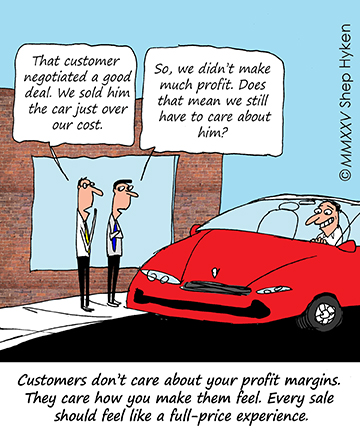
Instant Gratification Shep Hyken Cartoon

Share Their Stories

All four of these are important, but let’s emphasize the Share Their Stories idea. Toward the end of his speech, Wynn talked about how he shared the medicine story with all employees. It motivated others to create their stories. He also mentioned that beautiful chandeliers, handwoven fabrics, onyx, and marble are wasted investments if the customers aren’t treated well. Regardless of how beautiful his resorts are, employees make the difference.

Stories from fellow employees create motivation, and it’s gratifying to them to be recognized and praised for their efforts. This is what gets the best behaviors and practices repeated, and what gets customers to say, “I’ll be back.”

Image credits: Pixabay

Subscribe to Human-Centered Change & Innovation WeeklySign up here to join 17,000+ leaders getting Human-Centered Change & Innovation Weekly delivered to their inbox every week.

Innovación Resiliente

Por qué el futuro pertenece a las organizaciones que piensan en tres dimensiones

Por qué el futuro pertenece a las organizaciones que piensan en tres dimensiones

ÚLTIMA ACTUALIZACIÓN: 11 de marzo de 2026 a las 5:28 PM (ENGLISH LANGUAGE VERSION)

por Braden Kelley y Art Inteligencia


I. La chispa: Un diagrama de Venn que captura una verdad poderosa

La inspiración para este artículo provino de un visual simple pero poderoso compartido en una publicación reciente de Hugo Gonçalves. La imagen ilustraba la relación entre el Pensamiento de Futuro (Future Thinking), el Pensamiento de Diseño (Design Thinking) y el Pensamiento Sistémico (Systems Thinking) utilizando un diagrama de Venn que situaba la Innovación Resiliente en el centro.

A primera vista, el marco parece obvio. Cada disciplina ya está bien establecida en el mundo de la innovación:


  • El Pensamiento de Futuro ayuda a las organizaciones a anticipar múltiples futuros posibles.
  •  

  • El Pensamiento de Diseño se centra en resolver problemas a través de un enfoque centrado en el ser humano.
  •  

  • El Pensamiento Sistémico fomenta el examen de los sistemas de forma holística para comprender la complejidad.

Pero lo que hace que el diagrama sea convincente no son los círculos individuales. Es la visión revelada en sus intersecciones. Cuando estas disciplinas operan juntas en lugar de aisladas, desbloquean capacidades que de otro modo serían difíciles de alcanzar para las organizaciones.

En la intersección del Pensamiento de Futuro y el Pensamiento de Diseño, las organizaciones comienzan a diseñar soluciones para escenarios futuros en lugar de simplemente reaccionar a las condiciones presentes.

Donde el Pensamiento de Diseño se encuentra con el Pensamiento Sistémico, la innovación se vuelve tanto centrada en el ser humano como consciente del sistema, produciendo soluciones que tienen en cuenta la complejidad del mundo real y los efectos dominó.

Y donde el Pensamiento de Futuro se cruza con el Pensamiento Sistémico, las organizaciones adquieren la capacidad de preparar los sistemas para la sostenibilidad a largo plazo y la creciente complejidad.

Innovación Resiliente

Cuando las tres perspectivas se unen, surge algo más poderoso: la capacidad de crear innovaciones que no solo sean deseables y viables hoy, sino lo suficientemente resilientes como para prosperar en múltiples futuros posibles.

En un mundo definido por el cambio acelerado, la incertidumbre y los sistemas interconectados, la innovación resiliente puede ser la capacidad más importante que las organizaciones pueden desarrollar. Y como sugiere este sencillo diagrama, prospera en la intersección de tres formas poderosas de pensar.

II. El problema de la innovación unidimensional

La mayoría de las organizaciones buscan la innovación a través de una única lente dominante. Algunas se apoyan fuertemente en talleres de pensamiento de diseño y prototipado rápido. Otras invierten en prospectiva estratégica para anticipar disrupciones futuras. Otras se centran en el análisis de sistemas para comprender la complejidad y la dinámica organizacional.

Cada uno de estos enfoques proporciona información valiosa. Pero cuando se utilizan de forma aislada, cada uno tiene también limitaciones significativas.

El pensamiento de diseño, por ejemplo, destaca por descubrir las necesidades humanas y traducirlas en soluciones convincentes. Sin embargo, incluso la idea más deseable puede fracasar si ignora los sistemas más amplios en los que debe operar: estructuras regulatorias, cadenas de suministro, normas culturales o incentivos organizacionales.

El pensamiento de futuro ayuda a las organizaciones a explorar la incertidumbre e imaginar múltiples futuros posibles. La planificación de escenarios y el escaneo del horizonte pueden ampliar la conciencia estratégica y reducir las sorpresas. Pero la prospectiva por sí sola rara vez produce soluciones que la gente esté lista para adoptar.

El pensamiento sistémico proporciona la capacidad de mapear la complejidad, comprender los bucles de retroalimentación e identificar puntos de apalancamiento dentro de entornos interconectados. Sin embargo, una visión profunda del sistema no se traduce automáticamente en soluciones que resuenen con los usuarios humanos.

Cuando las organizaciones confían en uno solo de estos enfoques, la innovación a menudo se estanca. Las ideas pueden ser creativas pero poco prácticas, visionarias pero desconectadas del comportamiento humano, o analíticamente sólidas pero difíciles de implementar.

El desafío no es que estas disciplinas sean defectuosas. El desafío es que están incompletas por sí solas.

La innovación actual tiene lugar en entornos que son simultáneamente humanos, complejos e inciertos. Abordar solo una dimensión de esa realidad conduce inevitablemente a puntos ciegos.

La innovación resiliente requiere algo más: la integración de múltiples formas de pensar que juntas permitan a las organizaciones anticipar el cambio, comprender la complejidad y diseñar soluciones que la gente realmente adopte.

III. Pensamiento de Futuro: Anticipar múltiples futuros posibles

Uno de los supuestos más peligrosos que pueden hacer las organizaciones es que el futuro se parecerá mucho al presente. La historia muestra repetidamente que los mercados, las tecnologías y las expectativas de la sociedad pueden cambiar más rápido de lo que incluso los líderes experimentados anticipan.

Aquí es donde el Pensamiento de Futuro se vuelve esencial, y la metodología FutureHacking™ ayuda a que cada uno sea su propio futurista.

El pensamiento de futuro no consiste en predecir un único resultado. En cambio, se centra en explorar una gama de futuros plausibles para que las organizaciones puedan prepararse para la incertidumbre en lugar de reaccionar a ella después de los hechos.

Los practicantes del pensamiento de futuro utilizan herramientas como el escaneo del horizonte, el análisis de tendencias y la planificación de escenarios para identificar señales emergentes de cambio e imaginar cómo esas señales podrían combinarse para dar forma a diferentes entornos futuros.

Al examinar múltiples futuros posibles, las organizaciones amplían su imaginación estratégica. Comienzan a ver oportunidades y riesgos que, de otro modo, permanecerían invisibles cuando la planificación se basa únicamente en el rendimiento pasado o en las condiciones actuales del mercado.

El pensamiento de futuro ayuda a los líderes a hacer mejores preguntas:


  • ¿Qué cambios en el horizonte podrían remodelar nuestra industria?
  •  

  • ¿Qué tecnologías o comportamientos emergentes podrían alterar nuestras suposiciones?
  •  

  • ¿Cómo podrían evolucionar las necesidades de nuestros clientes en la próxima década?

Cuando las organizaciones incorporan el pensamiento de futuro en sus esfuerzos de innovación, adquieren la capacidad de diseñar estrategias y soluciones que sigan siendo relevantes incluso cuando las condiciones cambien.

Sin embargo, la prospectiva por sí sola no crea innovación. Imaginar el futuro es solo el principio. Las organizaciones también deben traducir esas visiones en soluciones que la gente valore y los sistemas puedan sostener.

Es por eso que el pensamiento de futuro se vuelve mucho más poderoso cuando se combina con otras perspectivas, particularmente la creatividad centrada en el ser humano del pensamiento de diseño y la comprensión holística que proporciona el pensamiento sistémico.

IV. Pensamiento de Diseño: Resolver problemas con un enfoque centrado en el ser humano

Si el pensamiento de futuro amplía nuestra visión de lo que podría suceder, el pensamiento de diseño ayuda a garantizar que las soluciones que creamos realmente importen a las personas a las que están destinadas.

El pensamiento de diseño se basa en una premisa engañosamente simple: la innovación tiene éxito cuando comienza con una comprensión profunda de las necesidades, los comportamientos y las motivaciones humanas. En lugar de empezar con la tecnología o las capacidades internas, el pensamiento de diseño comienza con la empatía.

Los practicantes utilizan métodos como la observación, las entrevistas, el mapeo del viaje del cliente (journey mapping) y el prototipado rápido para descubrir ideas sobre cómo las personas experimentan los productos, servicios y sistemas en el mundo real.

A través de este proceso, las organizaciones van más allá de las suposiciones y comienzan a diseñar soluciones que reflejan necesidades humanas genuinas. Las ideas se exploran a través de la experimentación iterativa, lo que permite a los equipos aprender rápidamente qué funciona, qué no y por qué.

Este enfoque ofrece varias ventajas poderosas:


  • Saca a la luz necesidades de los clientes no satisfechas o no articuladas.
  •  

  • Fomenta la experimentación y el aprendizaje rápido.
  •  

  • Aumenta la probabilidad de que las nuevas soluciones sean adoptadas por las personas para las que han sido diseñadas.

El pensamiento de diseño recuerda a las organizaciones que la innovación no consiste simplemente en crear algo nuevo. Se trata de crear algo que la gente decida adoptar.

Sin embargo, incluso la solución más centrada en el ser humano puede fracasar si ignora los sistemas más amplios en los que debe operar. Un producto bellamente diseñado puede tener dificultades frente a restricciones regulatorias, limitaciones de la cadena de suministro o resistencia cultural dentro de las organizaciones.

Es por eso que el pensamiento de diseño por sí solo no es suficiente. Para crear innovaciones que realmente perduren, las organizaciones también deben comprender los complejos sistemas que rodean a esas soluciones.

V. Pensamiento Sistémico: Ver el sistema completo

Mientras que el pensamiento de diseño se centra en las personas y el pensamiento de futuro explora la incertidumbre, el pensamiento sistémico ayuda a las organizaciones a comprender los entornos complejos en los que debe operar la innovación.

Las organizaciones modernas no existen de forma aislada. Funcionan dentro de sistemas interconectados formados por clientes, socios, proveedores, reguladores, tecnologías, culturas y estructuras internas. Los cambios en una parte del sistema a menudo crean efectos dominó en muchas otras.

El pensamiento sistémico anima a los líderes e innovadores a dar un paso atrás y examinar estas relaciones de forma holística en lugar de centrarse solo en los componentes individuales.

Los practicantes utilizan herramientas como mapas de sistemas, diagramas de bucles causales y mapeo de ecosistemas de partes interesadas para identificar patrones, dependencias y bucles de retroalimentación que influyen en los resultados a lo largo del tiempo.

Esta perspectiva proporciona varias ventajas críticas:


  • Revela interdependencias ocultas dentro de entornos complejos.
  •  

  • Ayuda a identificar puntos de apalancamiento donde pequeños cambios pueden crear un gran impacto.
  •  

  • Reduce la probabilidad de consecuencias no deseadas al introducir nuevas soluciones.

Muchas innovaciones fracasan no porque la idea fuera defectuosa, sino porque el sistema circundante nunca fue diseñado para soportarla. Los incentivos pueden estar desalineados. Los procesos pueden resistirse al cambio. La infraestructura puede no existir para escalar la solución.

El pensamiento sistémico ayuda a los innovadores a reconocer estas realidades estructurales a tiempo, lo que les permite diseñar soluciones que encajen dentro de los sistemas en los que operan, o que los remodelen intencionadamente.

Sin embargo, el pensamiento sistémico por sí solo también puede quedarse corto. El análisis profundo de la complejidad no produce automáticamente soluciones que resuenen con las personas o anticipen cambios futuros.

Es por eso que la innovación resiliente surge no de una sola perspectiva, sino de la intersección del pensamiento de futuro, el pensamiento de diseño y el pensamiento sistémico trabajando juntos.

Infografía de Innovación Resiliente

VI. Pensamiento de Futuro + Pensamiento de Diseño: Diseñar soluciones para escenarios futuros

Cuando el pensamiento de futuro y el pensamiento de diseño se unen, la innovación pasa de resolver los problemas de hoy a diseñar soluciones que sigan siendo significativas en el mundo del mañana.

El pensamiento de futuro amplía el horizonte temporal. Ayuda a las organizaciones a explorar tecnologías emergentes, expectativas sociales en evolución y posibles disrupciones que podrían remodelar el entorno en el que operan los productos y servicios.

El pensamiento de diseño aporta la perspectiva humana. Garantiza que las ideas desarrolladas en respuesta a estas posibilidades futuras sigan basándose en las necesidades, motivaciones y comportamientos humanos reales.

Juntas, estas disciplinas permiten a las organizaciones diseñar soluciones no solo para el momento presente, sino para múltiples futuros posibles.

En lugar de preguntar solo “¿Qué necesitan los clientes hoy?”, los equipos comienzan a hacer preguntas más profundas:


  • ¿Cómo podrían evolucionar las expectativas de los clientes en los próximos cinco a diez años?
  •  

  • ¿Qué nuevos comportamientos podrían surgir a medida que las tecnologías maduren?
  •  

  • ¿Cómo podrían las normas sociales cambiantes remodelar lo que la gente valora?

De esta intersección surgen varias prácticas:


  • Crear personajes del futuro que representen cómo podrían comportarse los usuarios en diferentes escenarios.
  •  

  • Construir prototipos basados en escenarios que prueben cómo se desempeñan las soluciones bajo diferentes condiciones futuras.
  •  

  • Utilizar el diseño especulativo para explorar posibilidades audaces antes de que se conviertan en realidad.

Esta combinación ayuda a las organizaciones a evitar una trampa común de la innovación: diseñar soluciones perfectamente optimizadas para un presente que ya está empezando a desaparecer.

Al integrar la prospectiva con el diseño centrado en el ser humano, las organizaciones crean innovaciones que están mejor preparadas para evolucionar a medida que se desarrolla el futuro.

VII. Pensamiento de Diseño + Pensamiento Sistémico

La innovación centrada en el ser humano es más poderosa cuando tiene en cuenta el sistema más amplio.
La integración de la empatía con la conciencia de la complejidad garantiza que las soluciones no solo sean deseables, sino también viables y escalables dentro de los sistemas del mundo real.

Muchas innovaciones bienintencionadas fracasan porque descuidan la dinámica del sistema, lo que conduce a consecuencias no deseadas que pueden socavar la adopción, la eficiencia o el impacto a largo plazo.

Prácticas de ejemplo


  • Mapeo del viaje + Mapeo del sistema: Comprender la experiencia del usuario junto con el sistema más amplio en el que opera.
  •  

  • Análisis del ecosistema de partes interesadas: Identificar a todos los actores, relaciones y dependencias que influyen en los resultados.
  •  

  • Diseñar para la política, la cultura y la infraestructura simultáneamente: Garantizar que las soluciones sean compatibles con el entorno real, no solo con escenarios ideales.

Beneficio: Soluciones que escalan eficazmente y perduran dentro de sistemas complejos, reduciendo el riesgo y maximizando el impacto a largo plazo.

VIII. Pensamiento de Futuro + Pensamiento Sistémico

Combinar la anticipación con la comprensión estructural permite a las organizaciones preparar los sistemas para la sostenibilidad y la complejidad a largo plazo. Esta intersección garantiza que las estrategias y las innovaciones no sean solo reactivas, sino resilientes al cambio y a la disrupción.

Muchas organizaciones fracasan porque planifican para el futuro sin considerar las dinámicas de todo el sistema, lo que las deja vulnerables cuando el cambio ocurre inevitablemente.

Prácticas de ejemplo


  • Mapeo de resiliencia: Identificar las vulnerabilidades y fortalezas del sistema para anticipar riesgos y oportunidades.
  •  

  • Diseño de estrategia adaptativa: Desarrollar estrategias que puedan flexibilizarse y evolucionar a medida que cambian las condiciones.
  •  

  • Creación de capacidades a largo plazo: Invertir en habilidades, procesos y estructuras que sostengan la innovación a lo largo del tiempo.

Beneficio: Las organizaciones se preparan para la volatilidad, siendo capaces de responder a desafíos complejos sin ser descarriladas por la disrupción.

IX. El centro del diagrama de Venn: Innovación resiliente

La verdadera resiliencia en la innovación ocurre en la intersección de las tres disciplinas: Pensamiento de Futuro, Pensamiento de Diseño y Pensamiento Sistémico. Las organizaciones que operan aquí anticipan múltiples futuros posibles, diseñan soluciones que los humanos realmente desean y comprenden los sistemas dentro de los cuales esas soluciones deben sobrevivir.

Este enfoque holístico va más allá de los esfuerzos de innovación aislados, garantizando que las soluciones sean deseables, viables y adaptables en un mundo complejo.

Capacidades en el centro


  • Portafolios de innovación adaptativos: Mantener un conjunto diverso de iniciativas que puedan pivotar a medida que cambian las condiciones.
  •  

  • Experimentación a través de escenarios futuros: Probar soluciones frente a múltiples futuros posibles para validar su robustez.
  •  

  • Transformación de sistemas centrada en el ser humano: Rediseñar procesos, estructuras y políticas para alinearlos con las necesidades humanas reales dentro de las limitaciones sistémicas.

Beneficio: Las organizaciones logran una innovación resiliente que puede prosperar en medio de la incertidumbre, la disrupción y la complejidad, en lugar de simplemente sobrevivir a ellas.

Cita sobre perspectivas de resiliencia en la innovación

X. Qué deben hacer los líderes para desarrollar esta capacidad

Construir una innovación resiliente requiere que los líderes cambien su mentalidad y sus prácticas. Ya no basta con tratar la innovación como un departamento estanco o una iniciativa aislada. Los líderes deben crear activamente las condiciones que permitan que la prospectiva, el diseño y el pensamiento sistémico trabajen juntos.

Cambios prácticos en el liderazgo


  • Dejar de tratar la innovación como un departamento: Integrar la innovación en todos los equipos y funciones, no solo en una unidad.
  •  

  • Desarrollar capacidades de prospectiva, diseño y sistemas conjuntamente: Desarrollar habilidades interdisciplinarias que permitan el pensamiento tridimensional.
  •  

  • Fomentar la colaboración interdisciplinaria: Promover la comunicación y la resolución compartida de problemas entre diferentes áreas de especialización.
  •  

  • Medir la resiliencia, no solo la eficiencia: Rastrear la adaptabilidad a largo plazo, el impacto en el sistema y la preparación para el futuro, no solo los resultados a corto plazo.
  •  

  • Diseñar organizaciones que puedan evolucionar continuamente: Crear estructuras y procesos que permitan el aprendizaje, la adaptación y la iteración constantes.

Al adoptar estas prácticas de liderazgo, las organizaciones pueden garantizar que sus esfuerzos de innovación no solo sean creativos, sino también resilientes y escalables dentro de sistemas complejos.

XI. Una prueba sencilla para su organización

Para evaluar si su organización está realmente desarrollando capacidades de innovación resiliente, hágase tres preguntas críticas:


  1. ¿Estamos diseñando solo para los clientes de hoy o para las realidades del mañana?
    Esta pregunta pone a prueba si su innovación anticipa necesidades y escenarios futuros.
  2.  

  3. ¿Nuestras soluciones funcionan solo en entornos piloto o dentro de sistemas reales?
    Esto evalúa si las innovaciones son escalables y resilientes dentro de los complejos sistemas en los que deben operar.
  4.  

  5. ¿Estamos resolviendo problemas humanos o solo optimizando procesos?
    Esto garantiza que sus soluciones estén genuinamente centradas en el ser humano, no solo que sean operativamente eficientes.

Si la respuesta a cualquiera de estas preguntas es “no”, es probable que la capacidad faltante se encuentre en una de las intersecciones del Pensamiento de Futuro, el Pensamiento de Diseño y el Pensamiento Sistémico. Abordar estas brechas es fundamental para lograr una innovación resiliente.

XII. Reflexión final: La innovación ya no es lineal

El mundo se ha vuelto demasiado complejo para la innovación basada en un solo método. Las organizaciones que prosperen en el futuro serán aquellas que operen en la intersección de:


  • Anticipación: Prepararse para múltiples futuros posibles.
  •  

  • Comprensión humana: Diseñar soluciones que la gente realmente quiera y adopte.
  •  

  • Conciencia del sistema: Garantizar que las soluciones puedan sobrevivir y escalar dentro de los sistemas del mundo real.

La innovación resiliente no proviene de ver el futuro con claridad. Proviene de estar preparado para muchos futuros posibles y de diseñar sistemas y soluciones que puedan adaptarse cuando lleguen. Las organizaciones que dominen este enfoque son las que perdurarán, evolucionarán y prosperarán.

Preguntas frecuentes: Innovación resiliente

1. ¿Qué es la innovación resiliente?

La innovación resiliente es la capacidad de una organización para anticipar múltiples futuros posibles, diseñar soluciones que los humanos realmente deseen y garantizar que esas soluciones sobrevivan y escalen dentro de sistemas complejos. Surge en la intersección del Pensamiento de Futuro, el Pensamiento de Diseño y el Pensamiento Sistémico.

2. ¿Por qué las organizaciones tienen dificultades con la innovación unidimensional?

Muchas organizaciones confían en un único enfoque —como el pensamiento de diseño, el pensamiento sistémico o el pensamiento de futuro— sin integrar los demás. Esto puede dar lugar a soluciones que son deseables pero no viables, o perspicaces pero no accionables, lo que resulta en una innovación que no logra escalar ni adaptarse.

3. ¿Cómo pueden los líderes desarrollar capacidades de innovación resiliente?

Los líderes pueden fomentar la innovación resiliente integrando la colaboración interdisciplinaria, desarrollando capacidades de prospectiva, diseño y sistemas de forma conjunta, midiendo la resiliencia (no solo la eficiencia) y diseñando organizaciones que puedan aprender, adaptarse y evolucionar continuamente.

p.d. Kristy Lundström planteó la cuestión de si “regenerativa” sería un mejor adjetivo que “resiliente”, y yo respondí que depende de dónde se tracen los límites de la palabra resiliente. Tiendo a pensar en ella como una palabra activa en lugar de pasiva, lo que significa que la forma en que veo la palabra incorpora elementos de regeneración y de hacer que las cosas sucedan. ¡Sigue innovando!

Créditos de imagen: ChatGPT, Google Gemini

Declaración de autenticidad del contenido: El área temática, los elementos clave en los que centrarse, etc., fueron decisiones tomadas por Braden Kelley, con un poco de ayuda de ChatGPT para limpiar el artículo y añadir citas.

Suscríbase al semanario Human-Centered Change & InnovationRegístrese aquí para recibir semanalmente en su bandeja de entrada el boletín Human-Centered Change & Innovation.

Making Ring-fenced Funding Work

Toughest Challenge Series: Episode 2

Making Ring-fenced Funding Work

GUEST POST from Geoffrey A. Moore


Inspired by the HP Incubations Team

Here’s the challenge. Everyone gets that you need to ring-fence funding for incubating Horizon 3 initiatives. At the corporate level, with the CEO’s direct sponsorship, this can be managed as a separate operating unit with its own budget. The challenge is when the incubation is nested. That means it is being funded out of the operating budget of a Performance Zone business unit, not from some special set-aside allocation.

Nested incubation represents the majority of internally funded Horizon 3 investments. (M&A is a different vehicle, funded out of capex not opex, and is not subject to the challenges we will discuss here). The reason there is a strong preference for nested incubations is that, if successful, they are of immediate interest to the business unit’s current customer base as well as its partner ecosystem. That is, while there can be high technical risk, there is little to no market risk. That said, it is still early days, the technology is not proven, product-market fit still needs to be determined, so it is in no position to generate ROI in the current fiscal year.

The challenge comes to the fore in a tough year where the corporation has to cut back on its operating expenses. Everybody is expected to take a haircut, tighten their belts, suck it up, and carry on. The problem is, when it comes to managing incubations, this simply does not work. Incubation is all about getting and maintaining momentum. If at any point you take your foot off the accelerator, you will lose momentum, and you will never get it back. Instead, you will salvage what you can from the R&D and write the whole thing off to bad timing. But let’s be clear: this is not management, this is mismanagement.

So, what’s the fix? It starts with the business unit surfacing its incubation opportunity during the annual budgeting process. It proposes to set aside a portion of its next year’s budget dedicated to funding the incubation, with funding released on a VC-model based on milestone attainment. This is documented and agreed to at the Executive Leadership Team level. If bad times hit, the choice is never to take a haircut; it is either to carry on or cancel things altogether, and it is made in dialog with the ELT since either way it could have a material impact on the enterprise’s market valuation.

Once the nested incubation has been agreed to, then the business unit leader is responsible for ensuring its funding stays ring-fenced. In particular, this means that resources assigned to the incubation effort cannot be “borrowed” by the current product lines to temporarily address an urgent need. Again, this is all about maintaining momentum.

To ensure this works as planned, here is a tip from a long-time friend and colleague who is the CFO at a major enterprise:

All ring-fenced items are documented and agreed upon at the ELT level. The way it works is the finance team who work with the budget holder is the guardian of all ring-fenced spend. When changes need to be made, they can’t touch ring-fenced spend. Of course, you have to limit the number of ring-fenced items to give freedom of execution to the leaders, but it’s an effective mechanism.

That’s what he thinks. And that’s what I think too. What do you think?

Image Credit: Google Gemini

Subscribe to Human-Centered Change & Innovation WeeklySign up here to join 17,000+ leaders getting Human-Centered Change & Innovation Weekly delivered to their inbox every week.

5 Ways to Protect Your Career from AI Job Displacement

How To Protect Your Career From AI Job Displacement

GUEST POST from Robert B. Tucker

I don’t want to sound like an alarmist, but if your work involves sitting at a computer, your job could be in jeopardy. The pace of progress in AI has become exponential rather than linear, as AI models are becoming capable of building AI models. As the implications of recent advances cascade throughout the economy, stock markets gyrate, and career anxiety pervades the white-collar sector.

As a futurist and innovation expert advising organizations for over three decades, I have had a front-row seat to many varieties of disruptions. This experience has led me to conclude that technological innovations rarely eliminate those who are willing to experiment and adapt. Most at risk are those who are complacent: those who assume they can get by without fundamentally changing how they operate.

“Something big is happening,” noted AI investor and CEO Matt Shumer, in an influential post read by 80 million people. “I am no longer needed for the actual technical work of my job. I describe what I want to be built, in plain English, and it just appears. Not a rough draft I need to fix. The finished thing. I tell the AI what I want, walk away from my computer for four hours, and come back to find the work done better than I would have done it myself.”

The first big warning of mass job displacement came in 2025, when Anthropic CEO Dario Amodei warned in an Axios interview that AI could eliminate “roughly 50% of entry-level white-collar jobs within 1–5 years, and that unemployment could spike to 10–20% within one to five years. “

Following Matt Shumer’s post last week, Citrini Research earlier this week tapped into a new strain of fears about AI, painting what the Wall Street Journal called a “dark portrait of a future in which technological change inspires a race to the bottom in white-collar knowledge work. “For the entirety of modern economic history, human intelligence has been the scarce input,” Citrini noted. “We are now experiencing the unwind of that premium.” The Dow dropped 820 points on the post.

The question on everyone’s mind right now seems to be: What happens when artificial intelligence can do my job faster, cheaper, and perhaps better than I can? But as a futurist and innovation consultant, I believe there’s a better question that one can ask: In what ways do I protect my career when the pace of AI progress is exponential, rather than linear?

My suggestions are below:

1. Stop Trying to Compete with AI on Efficiency. Compete on value

If your primary value add comes from sitting at a computer processing information, summarizing documents, generating reports, or performing predictable analysis, AI systems are intent on making you redundant. My suggestion here is to alter your value proposition.

In the legal arena, AI can conduct research, analyze and draft contracts, and otherwise do the job of entry-level workers. In healthcare, AI can read scans, analyze lab results, review medical journals, and suggest diagnoses. In customer service, genuinely capable AI agents are often more competent than call center workers. In 2023, AI struggled to write code. Today, at a growing number of companies, AI is writing much of the code.

Three years ago, AI could generate text but struggled to reason. In 2026, it solves complex problems step-by-step. In 2022, AI needed constant prompting. Today, agentic systems are planning and executing multi-stage projects on their own. And where AI once missed human nuance entirely, it is beginning to recognize emotion and adapt responses accordingly. You get the idea; AI is assaulting assumptions about what it can and cannot do at every juncture.

Many professionals unknowingly position themselves as competitors to automation. But competing on efficiency or productivity alone is a losing battle. To shift, ask yourself a different question: What do I uniquely contribute when the data is already available?

2. Become AI-fluent, starting today

NVIDIA CEO Jensen Huang warned in May 2025 at the Milken Institute Global Conference, “You’re not going to lose your job to an AI, you’re going to lose it to someone who uses AI.” Why not be that person instead?

In Build a Better Future: 7 Mindsets for Navigating the Age of Acceleration, I describe the Preparedness Mindset as most important of all — proactively anticipating change rather than reacting too late. Preparedness demands that, regardless of any misgivings about AI, we lean in to it, we become experts in it, and we design effective early warning systems to keep us abreast.

My suggestion is: spend time each week using new AI tools to draft communications, analyze data, brainstorm strategy, simulate customer conversations, and stress-test ideas. In doing so, you are not just learning to use new software. You are learning collaboration with a new type of intelligence. Those who understand what AI can and cannot do become indispensable translators between technology and business results. There’s no time to waste in becoming AI-fluent.

3. Hone your innovation skills

When the personal computer arrived, some employees feared it. Others stayed late learning spreadsheets and word processing. Within a few years, the difference in career trajectory was unmistakable. This same dynamic is unfolding again.

Tens of thousands of white-collar jobs are vanishing as AI starts to bite. Yet today organizations are desperately in need of people with an opportunity mindset – the outward focus to “find a (customer) need and fill it,” and to get new projects done, improve customer experience, motivate teams, enter new markets, and achieve unconventional results.

Human agency — the willingness to initiate action rather than await instruction — becomes a career differentiator. That might mean: proposing new AI-enabled services to clients, redesigning workflows, volunteering for experimental projects, or building personal expertise outside formal job descriptions. History shows that disruption rewards proactive learners who act on their ideas.

4. Move Closer to Problems, Not Tasks

AI replaces tasks faster than it replaces responsibility. Professionals who define themselves narrowly — “I prepare quarterly reports” or “I write marketing copy” — face greater exposure than those who own outcomes.

Executives increasingly value people who solve problems rather than execute assignments.

Consider shifting your identity toward improving customer retention, accelerating product innovation, strengthening culture, managing risk, or enabling growth. Tasks may change as AI evolves. Problems remain. This reflects what I call the Adaptability and Human Agency Mindsets — expanding your role faster than disruption can shrink it.

5. Develop A Long View of Value Creation

Periods of technological upheaval tempt people toward short-term survival thinking. Yet careers are marathons measured over decades. The professionals who flourish are those who continually reinvent how they add value.

Three forward-looking questions:

  • What skills will matter more five years from now?
  • What emerging problems will organizations struggle to solve?
  • Where can I become known as a trusted guide?

The Long View mindset encourages investing in capabilities that compound over time: leadership presence, interdisciplinary thinking, ethical judgment, and strategic foresight. Ironically, these human-centered abilities become more valuable as machines grow more capable.

The Opportunity Hidden Inside the Fear

As the futurist Thomas Koulopoulos observed in Gigatrends: Six Forces That Are Changing the Future for Billions, “As a species, we consistently allow the peril of the present to eclipse the promise of the future, and by doing that, we fail to comprehend just how much we can accomplish.”

Artificial intelligence will undoubtedly reshape entry-level work and certain knowledge professions. But history suggests something equally important: entirely new roles emerge alongside disruption. Entirely new opportunities will inevitably arise as well.

The printing press eliminated scribes but created publishers. The internet disrupted travel agents, yet produced digital marketing, cybersecurity, and platform entrepreneurship. AI will do the same.

The essential question is not whether change is coming. It is whether we as individuals choose to become passengers or navigators.

In an accelerated age, the safest career strategy is not hiding from technology but running toward it — with curiosity, agency, and vision. Those who learn fastest, adapt deliberately, and commit themselves to solving meaningful problems will not merely avoid displacement. They will help build the future that others are still struggling to understand.

This article originally appeared in Forbes

Image credit: Unsplash

Subscribe to Human-Centered Change & Innovation WeeklySign up here to get Human-Centered Change & Innovation Weekly delivered to your inbox every week.

Mapping Customer Experience Risk to the P&L

The “Invisible Drain”

Mapping Customer Experience Risk to the P&L

LAST UPDATED: May 29, 2026 at 4:54 PM

by Braden Kelley and Art Inteligencia


I. Introduction: The Hidden Cost of Poor Customer Experience (CX)

Every organization believes it values its customers. Yet, time and again, businesses lose revenue in ways that are invisible, insidious, and avoidable. This loss is what I call the “Invisible Drain”—the financial leakage caused by friction, frustration, and unmet expectations across the customer journey.

Unlike operational costs that are tracked in spreadsheets or marketing budgets that are accounted for in campaigns, the Invisible Drain does not appear as a line item. It hides in subtle behaviors: customers quietly switching to competitors, abandoning shopping carts, leaving negative reviews, or declining renewal opportunities. Over time, these small losses accumulate into a significant hit to the P&L.

The purpose of this article is to uncover that drain, to show you how to identify where CX failures are costing real money, and to provide practical ways to map those risks directly to the P&L. When organizations understand the financial stakes of every customer touchpoint, they can act decisively—transforming hidden loss into tangible opportunity.

By making the Invisible Drain visible, leaders can move beyond abstract metrics like Net Promoter Score or CSAT and focus on the real outcomes that matter: revenue retention, margin protection, and sustainable growth fueled by exceptional customer experience.

II. Understanding CX Risk

Customer Experience (CX) risk is the potential for negative customer interactions to erode revenue, increase costs, or damage brand reputation. While organizations track operational and financial risks rigorously, CX risk often goes unmeasured, making it invisible until it manifests as lost customers or diminished profits.

CX risk can appear in many forms, including:

  • Churn: Customers leave due to poor experiences or unmet expectations.
  • Service Failures: Delayed support, inconsistent processes, or unresolved complaints that increase operational costs.
  • Lost Opportunities: Friction in the customer journey reduces upsell, cross-sell, or referral potential.
  • Brand Damage: Negative word-of-mouth or social media exposure that indirectly affects revenue and growth.

These risks are often underestimated because the financial impact is not immediately visible on the P&L. CX issues may seem minor in isolation—a delayed delivery, a confusing website flow, or a mismanaged support request—but cumulatively, they drain revenue, reduce margins, and erode long-term customer loyalty.

Understanding CX risk requires looking at the customer journey holistically, identifying points where expectations are not met, and quantifying the potential impact on both revenue and costs. Organizations that take this approach can move from reactive problem-solving to proactive risk management, ultimately protecting both the customer experience and the bottom line.

III. Why CX Risk is “Invisible”

Customer experience risk often remains hidden because traditional business metrics fail to capture its true impact. While organizations monitor sales, costs, and operational efficiency, the subtle erosion of revenue caused by poor experiences rarely shows up in standard financial reports. This invisibility makes CX risk particularly dangerous—it quietly undermines growth before anyone notices.

Several factors contribute to the invisible nature of CX risk:

  • Siloed Departments: Different teams handle sales, support, marketing, and product development independently. CX failures often fall between the cracks, making accountability diffuse.
  • Overreliance on Limited Metrics: Scores like NPS or CSAT provide surface-level insights but don’t fully reveal financial consequences of negative experiences.
  • Short-Term Focus: Quarterly targets and immediate KPIs can overshadow long-term CX considerations, allowing slow leaks to persist unnoticed.
  • Customer Behavior Gaps: Customers rarely voice dissatisfaction for every negative interaction. Silent churn, abandoned carts, and reduced engagement are often invisible until they translate into revenue loss.

Consider a scenario where onboarding friction causes a small percentage of new customers to abandon a subscription within the first three months. Individually, these losses seem minor, but over time they accumulate into a significant financial impact. Without mapping CX touchpoints to P&L, this drain remains unseen—hence the term Invisible Drain.

Making CX risk visible requires connecting experience failures to tangible outcomes, identifying patterns, and translating them into financial terms. Only then can organizations treat CX risk with the same rigor as operational or market risks.

IV. Linking CX to Financial Outcomes

To address the Invisible Drain, organizations must translate customer experience risk into tangible financial terms. CX failures are not just operational issues—they directly impact revenue, costs, and margins. By mapping CX touchpoints to P&L outcomes, companies can quantify the true cost of friction and make data-driven decisions to protect growth.

A practical approach begins by examining each customer interaction along the journey and asking: How could this touchpoint affect revenue, costs, or future opportunities if it fails? Some examples include:

  • Revenue Impact: Delays or confusion during onboarding can reduce customer lifetime value or increase churn.
  • Cost Impact: Frequent support escalations due to unclear processes increase operational expenses.
  • Margin Impact: Lost upsell opportunities or discounts given to appease frustrated customers reduce profitability.

Visualizing the connection helps. Consider a simple framework: CX Touchpoint → Risk → P&L Impact. Each touchpoint carries potential risk; that risk translates into measurable financial outcomes, which then inform prioritization and mitigation strategies.

Quantifying CX risk may involve combining multiple data sources, such as customer surveys, transactional data, operational metrics, and predictive analytics. For example, analyzing churn rates by onboarding experience can reveal the dollar value of friction points. Similarly, tracking complaint resolution times against retention can indicate hidden cost leaks.

By making these connections explicit, executives can see not only where CX risks lie but also how they threaten the bottom line. This clarity enables organizations to invest strategically in improvements, turning customer experience from a perceived cost center into a driver of sustainable revenue and profitability.

V. Identifying High-Risk Areas

Once organizations understand the financial impact of CX risk, the next step is identifying which touchpoints are most vulnerable. Not all interactions carry the same weight—some failures can cost millions, while others have only minor effects. Prioritizing high-risk areas ensures resources are focused where they can deliver the greatest financial and experiential impact.

There are several practical approaches to uncover high-risk CX points:

  • Customer Journey Mapping: Visualize every step in the customer journey to identify friction points, handoff issues, and moments of frustration.
  • Root Cause Analysis of Complaints: Analyze customer complaints and feedback to determine recurring issues and underlying systemic problems.
  • Voice-of-Customer Insights: Leverage surveys, reviews, and social listening to understand where customers experience dissatisfaction or confusion.
  • Predictive Analytics: Use data to identify patterns that indicate future churn or dissatisfaction, enabling proactive intervention before financial impact occurs.

Human-centered design plays a critical role in this process. By observing and empathizing with customers, organizations can uncover risks that quantitative metrics alone might miss, such as emotional frustration, subtle confusion, or unmet expectations that quietly erode loyalty.

The combination of data-driven analysis and human-centered insights provides a comprehensive view of high-risk areas. Once these touchpoints are identified, organizations can take targeted action to mitigate risk, improve the customer experience, and protect the P&L from the Invisible Drain.

VI. Measuring and Prioritizing CX Risk

Identifying high-risk areas is only the first step. To act effectively, organizations must measure the potential financial impact of each risk and prioritize interventions where they will deliver the greatest return. Quantifying CX risk ensures decisions are grounded in evidence rather than intuition.

Several approaches can help measure CX risk in financial terms:

  • Revenue at Risk: Estimate the potential revenue lost due to churn, abandoned purchases, or missed upsell opportunities caused by CX failures.
  • Customer Lifetime Value Erosion: Calculate how friction points reduce the long-term value of customers by shortening retention or decreasing engagement.
  • Cost of Poor Service: Analyze the operational expense incurred from repeated complaints, returns, or service escalations at specific touchpoints.

Once risks are measured, organizations can prioritize them using a simple framework: Impact vs. Likelihood. Touchpoints that have a high financial impact and a high likelihood of failure should be addressed first, while low-impact or unlikely risks may be monitored rather than immediately mitigated.

Combining quantitative data with qualitative insights—such as customer feedback, employee observations, and usability testing—ensures prioritization decisions are accurate and holistic. This approach prevents resources from being wasted on minor issues while focusing efforts on areas that truly protect revenue, margins, and customer loyalty.

Measuring and prioritizing CX risk transforms abstract experience concerns into actionable financial decisions. Organizations gain clarity on where to intervene, creating a roadmap for mitigating risk and safeguarding the P&L from the Invisible Drain.

Mapping CX Risk to the P&L

VII. Connecting CX Risk to the P&L

Measuring and prioritizing CX risk is critical, but the ultimate goal is to translate those insights into financial outcomes that executives and decision-makers can act upon. Connecting CX risk directly to the P&L makes the Invisible Drain visible and creates accountability across the organization.

This connection can be achieved by linking each high-risk touchpoint to specific revenue, cost, and margin impacts:

  • Revenue: Estimate lost sales or reduced renewals caused by friction or poor experiences at key touchpoints.
  • Costs: Quantify additional expenses incurred from repeated service interactions, returns, or complaint management.
  • Margins: Assess the impact of discounts, retention incentives, or lost upsell opportunities driven by CX failures.

Visual frameworks help make these connections clear. A simple but powerful approach is: CX Touchpoint → Risk → P&L Impact. Each touchpoint carries potential risks, which can be quantified and linked to financial outcomes. This framework allows leaders to see not only where the risks exist, but also the tangible dollar value associated with each.

Dashboards and reporting tools can further reinforce this connection. By integrating CX metrics with financial KPIs, organizations can track the real-time impact of experience issues on revenue and costs, creating transparency and urgency. Executives can then allocate resources strategically to mitigate risk and optimize returns.

Cross-functional collaboration is essential. Marketing, operations, product, and customer service teams must work together to understand the financial stakes, address high-risk touchpoints, and implement sustainable improvements. When CX risk is mapped to the P&L, experience management becomes a shared responsibility with clear business outcomes.

VIII. Mitigation Strategies and Innovation Opportunities

Once CX risks are identified, measured, and linked to the P&L, the next step is to act. Mitigation strategies reduce the financial impact of poor experiences, while innovation opportunities turn risk management into a driver of growth.

Practical strategies to mitigate CX risk include:

  • Process Redesign: Simplify and streamline customer journeys to remove friction points and prevent recurring failures.
  • Empowering Employees: Equip frontline staff with tools, authority, and training to resolve issues proactively before they escalate.
  • Digital Tools and Automation: Use technology to improve experience efficiently, such as chatbots for quick support or predictive notifications to prevent errors.
  • Proactive Communication: Anticipate customer needs, set clear expectations, and keep customers informed to reduce uncertainty and dissatisfaction.

Beyond risk mitigation, high-risk areas often reveal opportunities for innovation. Friction points highlight unmet customer needs, enabling organizations to design new products, services, or experiences that differentiate the brand while generating revenue. For example:

  • Redesigning onboarding processes can create a premium, differentiated experience that boosts retention.
  • Improving support interactions may inspire new self-service tools that reduce costs and increase customer satisfaction.
  • Streamlining e-commerce flows can reduce abandoned carts and increase average order value.

By approaching CX risk with a mindset of both mitigation and opportunity, organizations transform potential drains into strategic assets. Risk management becomes a pathway to innovation, improved loyalty, and measurable impact on the bottom line.

CX Risk Management: Innovation vs. Mitigation Matrix

IX. Governance and Continuous Monitoring

Identifying, measuring, and mitigating CX risk (often using a Customer Experience Audit) is not a one-time effort. Sustained impact requires robust governance structures and continuous monitoring to ensure that improvements are maintained and new risks are detected early.

Effective CX governance includes:

  • Cross-Functional Oversight: Create a CX risk committee or council with representation from marketing, operations, product, and customer service to oversee initiatives and ensure alignment with financial objectives.
  • Defined Roles and Accountability: Assign ownership for each high-risk touchpoint so that responsibilities for monitoring, intervention, and improvement are clear.
  • Integration with Financial Planning: Include CX risk metrics in budgeting and P&L reviews to make experience management a part of routine business decision-making.

Continuous monitoring involves tracking CX performance and its financial implications over time. Tools and approaches include:

  • Dashboards linking CX touchpoint metrics to revenue, costs, and margins.
  • Regular analysis of customer feedback, complaints, and behavior patterns to detect emerging issues.
  • Predictive analytics to anticipate potential risk before it affects the bottom line.
  • Periodic audits of processes, technology, and employee training to ensure consistent experience delivery.

By embedding governance and continuous monitoring into organizational processes, companies create a dynamic system that not only protects against the Invisible Drain but also adapts to evolving customer needs. This disciplined approach ensures that CX improvements are sustainable and that the financial benefits are measurable and enduring.

X. Conclusion: From Invisible Drain to Strategic Asset

The Invisible Drain—hidden financial losses caused by poor customer experience—is real, measurable, and preventable. By understanding CX risk, linking it to the P&L, and prioritizing interventions, organizations can turn what was once a silent drain into a strategic asset.

Mapping CX touchpoints to revenue, costs, and margins brings clarity to the financial stakes of every interaction. It transforms abstract metrics like satisfaction scores into actionable insights that executives can understand and act upon. With the right governance, measurement, and continuous monitoring, organizations can protect their bottom line while delighting customers.

Beyond risk mitigation, this approach uncovers opportunities for innovation. High-risk areas highlight unmet needs and friction points that, when addressed, can differentiate the brand, improve loyalty, and generate sustainable growth. CX risk management thus becomes not just a defensive exercise but a proactive strategy for competitive advantage.

In the end, the organizations that succeed are those that treat customer experience as a financial imperative. By making the Invisible Drain visible, measuring it, and acting decisively, businesses can protect revenue, enhance margins, and transform CX from a potential liability into a powerful driver of value.

Visual Aids and Frameworks

Visualizing the connection between CX risk and financial outcomes helps make the Invisible Drain tangible. These frameworks provide clarity for executives, managers, and frontline teams, turning abstract concepts into actionable insights.

CX Touchpoint → Risk → P&L Impact Framework

A simple way to see the financial impact of CX failures is by mapping each touchpoint through risk to its P&L effect. This framework helps teams prioritize interventions based on measurable financial consequences.

Diagram showing CX Touchpoint leading to Risk and then to P&L Impact

High-Risk CX Areas Table

Identifying the most vulnerable points in the customer journey allows organizations to focus resources effectively. The table below is an example of mapping high-risk areas to estimated financial impact.

“Illustrative estimates based on industry research: Temkin Group (2020), Forrester Research (2018-2021), Gartner (2021).”

Table highlighting high-risk CX areas with estimated financial impact

Prioritize → Mitigate → Measure → Monitor Loop

Continuous CX risk management is essential. This cycle ensures risks are addressed, interventions are measured for effectiveness, and monitoring prevents future drains.

Cycle diagram showing Prioritize, Mitigate, Measure, Monitor for CX risk

By integrating these visuals into reports, presentations, and dashboards, organizations can communicate CX risk clearly, justify investments in improvement, and make the Invisible Drain visible to all stakeholders.


Reserve your Customer Experience Risk & Revenue Leakage Diagnostic with Braden Kelley today


Frequently Asked Questions

1. What is the ‘Invisible Drain’ in customer experience?

The ‘Invisible Drain’ refers to the hidden financial losses caused by poor customer experiences that are not immediately visible in traditional business metrics. These losses may appear as silent churn, abandoned sales, or increased operational costs, slowly impacting the P&L.

2. How can organizations link CX risk to the P&L?

Organizations can map each customer touchpoint to potential risks and quantify the associated revenue loss, cost increases, or margin impact. Frameworks like ‘CX Touchpoint → Risk → P&L Impact’ help visualize and measure the financial consequences of poor experiences.

3. What are effective strategies to mitigate high-risk CX areas?

Effective strategies include redesigning processes to reduce friction, empowering employees to resolve issues proactively, leveraging digital tools for efficiency, and continuously monitoring CX metrics. High-risk areas also reveal opportunities for innovation that can enhance revenue and loyalty.


Reserve your Customer Experience Risk & Revenue Leakage Diagnostic with Braden Kelley today


Image credits: ChatGPT, Google Gemini

Content Authenticity Statement: The topic area, key elements to focus on, etc. were decisions made by Braden Kelley, with a little help from ChatGPT to clean up the article and add citations.

Subscribe to Human-Centered Change & Innovation WeeklySign up here to get Human-Centered Change & Innovation Weekly delivered to your inbox every week.

Innovation Should Always Serve the People

Innovation Should Always Serve the People

GUEST POST from Greg Satell

The global activist Srdja Popović once told me that the goal of a revolution should be to become mainstream, to be mundane and ordinary. If you are successful it should be difficult to explain what was won because the previous order seems so unbelievable. That’s what true transformation looks like.

Yet many leaders approach innovation and change as if they were swashbuckling heroes in their own action movie. Companies like Theranos, WeWork and Uber squandered billions of dollars on business models that never made any sense. People post their latest ChatGPT prompts on social media while Elon Musk trolls Twitter.

These days, innovation has become, far too often, solipsistic and self-referential, pursued for the glory of the innovators themselves rather than for the benefit of everyone else and there is increasing evidence the venture-funded entrepreneurship model is crowding out more productive investments. We need to move away from hype and focus on impact.

The Eureka Moment Myth

In 1928, Alexander Fleming, a brilliant but sometimes careless scientist, arrived at his lab after a summer holiday to find that a mysterious mold had contaminated his Petri dishes and was eradicating the bacteria colonies he was trying to grow. Intrigued, he decided to study the mold. That’s how Fleming came to be known as the discoverer of penicillin.

Fleming’s story is one that is told and retold because it reinforces so much about what we love about innovation. A brilliant mind meets a pivotal moment of epiphany and—Eureka!— the world is forever changed. Unfortunately, that’s not really how things work. It wasn’t true in Fleming’s case and it won’t work for you.

The truth is that when Fleming published his results in 1929, few took notice. It wasn’t until 1939, a decade later, that Howard Florey and Ernst Chain came across Fleming’s long forgotten paper, understood its significance and undertook the hard work to transform it into a viable treatment that could actually help people.

Yet even then, to make a significant impact on the world, penicillin had to be produced in massive quantities, something that was far out of the reach of two research chemists. Florey reached out to the Rockefeller Foundation for help and moved to the US to work with American labs. In 1943 the U.S.’s War Production Board enlisted 21 companies to produce supplies for the war effort, saving countless lives and ushering in the new age of antibiotics.

The truth is that innovation is never a single event and is rarely achieved by a single person or organization. Rather, it is a process of discovery, engineering and transformation that typically takes decades to complete.

The Rise Of So-So Innovations

It’s been clear for some time now that we’ve been in the midst of a second productivity paradox. The first one, which lasted from the early 1970s to the mid 1990s, saw diminished productivity gains amid increased investment in information technology and prompted economist Robert Solow to note, “You can see the computer age everywhere but in the productivity statistics.”

In 1996, with the rise of the Internet, productivity growth began to boom again but then disappeared just as abruptly in 2004 and hasn’t returned since. Despite the hype surrounding things such as Web 2.0, the mobile Internet and, most recently, artificial intelligence, productivity growth continues to slump.

Part of the answer may have to do with what economists Daron Acemoglu and Pascual Restrepo refer to as so-so technologies, such as automated customer service, which produce meager productivity gains but displace workers nonetheless. In effect, they give the appearance of progress but don’t really improve our lives.

Consider an airport bar where ordering has been automated through the use of touchscreens. It’s hard to see how, given the high rent, food preparation and other costs, this technology would have a dramatic effect on productivity akin to, say, replacing a horse with a tractor in an agricultural economy. In fact, given that the technology hasn’t been widely deployed outside airports, the major effect seems to be inconveniencing patrons.

Acemoglu and Restrepo argue that a large-scale version of this phenomenon has been occurring since the late 80s. Digital technologies, to a large extent, have displaced labor, but have not had the same offsetting productivity impact as earlier technologies so the overall effect is to decrease wages rather than to raise living standards.
What Innovation Really Looks Like

Katalin Karikó, published her first paper on mRNA-based therapy way back in 1990. Unfortunately, she wasn’t able to win grants to fund her work and, by 1995, things came to a head. She was told that she could either direct her energies in a different way, or be demoted. Katalan chose to stick with it and, if the Covid pandemic had never hit, her name might very well be lost to history.

This type of thing is not unusual. Jim Allison, who won the Nobel Prize for his work on cancer immunotherapy, had a very similar experience when he had his breakthrough, despite having already become a prominent leader in the field. “It was depressing,” he told me. “I knew this discovery could make a difference, but nobody wanted to invest in it.”

The truth is that the next big thing always starts out looking like nothing at all. Things that really change the world always arrive out of context for the simple reason that the world hasn’t changed yet. Kevin Ashton, who himself first came up with the idea for RFID chips, wrote in his book, How to Fly A Horse, “Creation is a long journey, where most turns are wrong and most ends are dead.”

Because digital technology has become so pervasive, offering a substantial architecture that lends itself to tweaking, we’ve lost the plot. Innovation isn’t about Silicon Valley billionaires peacocking around on social media, but solving important problems. We need to shift our focus from disrupting industries to tackling grand challenges.

Building Collaborative Networks And To Tackle Grand Challenges

While researching my book Mapping Innovation, I had the opportunity to interview dozens of great innovators, from world-class scientists to super-successful entrepreneurs and top executives at some of the world’s largest corporations. I was surprised to find that, in almost every case, they were some of the most thoughtful, generous people I’d ever met.

The truth is that, for innovation, generosity is often a competitive advantage. By actively sharing their ideas, innovators build up larger networks of people willing to share with them. That makes it that much more likely that they will come across that random piece of information and insight that will help them crack a really tough problem.

The digital revolution has been, if anything, a huge disappointment and Silicon Valley’s tendency to be solipsistic and self-referential probably has a lot to do with that. The simple fact is that the developers banging away at their laptops can achieve little on their own. To tackle our most significant challenges, such as curing cancer, climate change and global hunger, they need to work effectively with specialists with different skills and perspectives.

What we need today is to build collaborative networks to solve grand challenges. The recent CHIPS Bill is a good start. It not only significantly increases our investment in basic research and development, but also allocates billions of dollars of investments into building regional ecosystems and advanced manufacturing.

Yet the most important thing we need to change is our mindset. We need to focus less on disruption and more on creation and, to create for the world we need to focus on what it means to live in it. We can no longer measure progress in terms of how many billionaires a technology creates. We need to focus on making a meaningful impact on people’s lives.

— Article courtesy of the Digital Tonto blog
— Image credit: Google Gemini

Subscribe to Human-Centered Change & Innovation WeeklySign up here to join 17,000+ leaders getting Human-Centered Change & Innovation Weekly delivered to their inbox every week.

Is There Such a Thing as a Collective Growth Mindset?

Is There Such a Thing as a Collective Growth Mindset?

GUEST POST from Stefan Lindegaard

We often talk about growth mindset as an individual trait but what if mindsets could be shared? What if a team could collectively believe in its ability to learn, adapt, and grow?

I believe it’s possible. In fact, teams with a collective growth mindset often:

  • Learn faster and adapt better to change
  • Handle mistakes and uncertainty with psychological safety
  • Build stronger alignment and collaboration
  • Unlock higher creativity and innovation

Research increasingly supports this. Studies show that shared growth beliefs within teams are linked to higher creativity and performance. It’s less about one person’s mindset and more about how the team thinks, acts, and learns together.

That’s why I created this framework on The Collective Growth Mindset – a team-based approach built on five interconnected areas: Mindset, Shape/Pulse, Communicate, Learn and Network. It’s work in progress but please share your thoughts.

But here’s the real challenge: A collective growth mindset doesn’t just “happen.” It requires leadership, shared practices, and deliberate effort.

So, a few questions for reflection:

  • Does your team have a collective mindset — or just individual ones? If you have a collective mindset, how would you describe this?
  • What helps or hinders your team’s ability to learn and adapt together?
  • How intentional are you about building this as part of your culture?

Let’s learn together!

Image Credit: Stefan Lindegaard

Subscribe to Human-Centered Change & Innovation WeeklySign up here to get Human-Centered Change & Innovation Weekly delivered to your inbox every week.