Tag Archives: Customer Lifetime Value

Customers Don’t Care About Your Profit

They Care About Your Service

Customers Don't Care About Your Profit

GUEST POST from Shep Hyken

Recently, I heard from one of our subscribers, a sales and finance consultant at a luxury automobile dealership. He shared a story about how a customer was almost mistreated.

In the world of auto sales, some salespeople are 100% commission-based, and when they sell a vehicle at a discounted price, there is little to no profit, resulting in a very small commission. This is important, as sometimes these low-commission sales cause employees to treat customers differently than they would for a high-commission sale.

Customers expect to be treated the same regardless of how much or little they pay for their vehicle. Furthermore, they don’t realize, nor do they care, how much of a sales commission is paid to the employee.
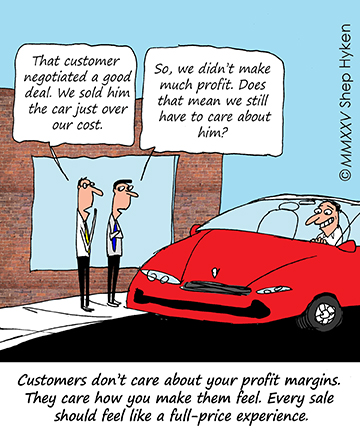
Shep Hyken Customer Service vs Profit Cartoon

That brings us to the customer who bought a two-year-old luxury sports car. The first time it rained, she realized the windshield wipers needed to be replaced. The customer called her salesperson, who explained that he was happy to replace the blades. He went to his sales manager to ask how to handle the replacement and was told to charge her the cost of the blades or to tell her to buy them at Walmart for less than the dealership’s cost and bring them in to have them replaced.

The salesperson was shocked and reminded his sales manager that they were selling a premium brand. Eventually, the manager agreed, but the experience reminded him that profit, or the lack thereof, dictated the level of service the dealership would offer.

Three Customer-First Lessons

With that in mind, let’s use the story as a learning experience for all businesses. Here are three lessons from the story:

  1. The Customer Doesn’t Care about Your Profit: Every customer deserves respect and a consistent experience, whether it’s $20 transaction or a $200,000 one. Profit per interaction shouldn’t determine the level of care.
  2. Know the Lifetime Value of the Customer: The wiper blades may have been a $20 problem, but how the customer was treated for the problem could determine the future sale of a high-end luxury automobile worth thousands of times more. Knowing the average value of a customer will help employees make more informed, customer-focused decisions. Small gestures today can protect long-term loyalty and repeat business.
  3. Consistency Builds Trust: Luxury brands thrive on consistent treatment, but the principle applies to all types of businesses. Today’s customers demand a good customer experience. Train and empower employees to deliver a consistent standard of service, every time, for every customer.

In the end, customers remember the experience, not your profit margins. Get the small things right, and the money follows as you earn their trust, confidence, and loyalty.

Image Credit: Unsplash, Shep Hyken

Subscribe to Human-Centered Change & Innovation WeeklySign up here to join 17,000+ leaders getting Human-Centered Change & Innovation Weekly delivered to their inbox every week.

When You Don’t Have What the Customer Wants

When You Don't Have What the Customer Wants

GUEST POST from Shep Hyken

I recently responded to a question on LinkedIn: A customer is furious about an out-of-stock item. How do you turn their frustration into satisfaction?

I added a second part to that question. What if what the customer wants is something you’ve never had in stock? Some customers might still be angry that you do not have what they want. And even if they aren’t, whether the item is out of stock or you just don’t carry it, that doesn’t mean you can’t make the customer happy.

Before we go further, let me do a very quick recap of how to deal with any upset or complaining customer. This is my five-step process for handling complaints:

  1. Apologize for the problem.
  2. Acknowledge what the problem is.
  3. Discuss the resolution. (In a moment, I’ll cover this in detail.)
  4. Accept ownership. It may not be your fault, but now you own taking care of the customer.
  5. Act with urgency.

So, back to #3, the resolution. Is the item the customer wants temporarily out of stock? If so, when will it be in, and when can the customer expect to receive it? Giving customers information gives them a sense of control.

Shep Hyken Empty Shelves Cartoon

What if you’re out of the item and won’t get any more back in inventory? This is an opportunity to shine. If you can’t suggest a reasonable alternative, does a competitor have what the customer wants? Yes, I’m suggesting sending the customer to a competitor. Even if the sale goes to a competitor, the customer will realize you’re more interested in getting them what they want and need versus making a sale, which can go a long way in building trust that takes the relationship to a higher level.

One of my favorite examples comes from an Ace Hardware store. It was a very cold winter, and a customer was upset to find out the store was out of space heaters. Rather than say, “Sorry,” and send the customer away, the associate called a competitor, confirmed they had a space heater, and asked them to hold it for his customer. And who do you think the customer loved after that experience? (It’s a rhetorical question, but just in case you can’t figure it out … Ace Hardware!)

Any time a customer is unhappy or has a complaint, it’s an opportunity to resolve the problem and turn a Moment of Misery™ into a Moment of Magic®. For inventory issues, it’s an easy fix. Always think to yourself, even if you have to give up the sale to a competitor, “Is what I’m doing right now going to get the customer to come back?” When you have the customer’s best interest in mind, they will!

Image Credits: Unsplash, Shep Hyken

Subscribe to Human-Centered Change & Innovation WeeklySign up here to join 17,000+ leaders getting Human-Centered Change & Innovation Weekly delivered to their inbox every week.

Innovator Lifetime Value

Innovator Lifetime ValueBy now, if you’re in marketing you’re probably familiar with the concept of customer lifetime value. Put simply, it’s the idea that a customer is worth to the organization not just the value of a single transaction, but the collection of all of the transactions that they might make during their relationship with you. And when speaking of customer lifetime value, we generally don’t talk about any single customer, but speak about their value in aggregate, averaging out the high value (many, many purchases) and low value customers (one or a few purchases).

The concept is usually linked to discussions of how much you can afford to spend to acquire a customer and whether a particular advertising or marketing effort is worth undertaking.The concept has been even applied to non-profits (lifetime donor value) and even to social media ROI.

But what’s a good outside innovation partner worth?

As I was speaking with several of the innovation leaders at Intuit on their campus in Mountain View last year, it came to me that organizations should be seeking to build and strengthen relationships with their customers, suppliers, and other potential innovation partners in ways similar to their approach to traditional relationship marketing.

Having helped several clients with their relationship marketing strategies, it seems to me that there is no reason why the same principles can’t or shouldn’t be applied to your potential innovation partner community.

After all, as more and more companies begin to understand and engage in the practice of open innovation, then there will be an advantage accumulated by the organizations that do a good job of building strong and profitable relationships with the most passionate and prolific suppliers, customers, academics, etc. over those organizations that don’t.

What organization out there wouldn’t want to accumulate an innovation advantage, a growth advantage, a relationship advantage over their competitors?

But the real questions are of course:

  1. Do you have the required internal innovation capability built already to support open innovation?
  2. Are you engaging in open innovation already? Or are your competitors?
  3. What are you doing to build strong relationships with you potential innovation partners?
  4. Are you tasking skilled relationship marketers with creating and maintaining these conversations and building these relationships?

So, do you? Are you?

Subscribe to Human-Centered Change & Innovation WeeklySign up here to get Human-Centered Change & Innovation Weekly delivered to your inbox every week.