How to Lead Innovation and Embrace Innovative Leadership

How to Lead Innovation and Embrace Innovative Leadership

GUEST POST from Diana Porumboiu

Leaders are bombarded from all directions with advice on how to behave as leaders. It seems like we all know what it takes to lead innovation, at least in theory, yet the attention is mostly focused on famous innovators who oftentimes are the exceptions, rather than the rule.

What’s more, we tend to forget that the greatest, most famous innovators, with all their qualities and contributions to the world, are not necessarily the best of leaders. Great leaders who rarely make the headlines, if they ever do, are usually less controversial.

However, their lack of fame doesn’t diminish their innovativeness. That’s why this article wants to provide some insights into what it takes to lead innovation with the practices, methods, behaviors, and mindsets of successful innovation leaders.

As our previous article focused on nurturing innovative behaviors in employees, this time we’re down to some practical aspects of leading innovation at an organizational level.

Innovative leadership and commitment

McKinsey research sheds some light on what successful innovators get right, and how their organizations become high performing by committing to a set of essential practices.

In short, their survey revealed that the bar is rising among innovators, and during the past five years they have become more successful at innovation as they committed to a larger array of operating models. In 2016 high performing innovators focused mostly on vision and strategy. But In 2021 they pulled further away from competitors by extending their focus to new business models and to scaling their innovations faster and more effectively.

These are all interesting insights into how innovation practices support the growth of organizations. But what are they telling us about specific abilities and behaviors required to lead innovation? To better understand this, let’s look into some of the research conducted by Linda A. Hill, top expert on leadership, change and innovation, who paints a clearer picture of the specific qualities.

  • Adaptability

In times filled with ambiguity and uncertainty, it’s becoming more difficult to make decisions and guide others on the right path. Adaptability might come natural to some people, but others need to cultivate it through practice, exposure to different circumstances and activities. Developing adaptive behavior helps in taking bolder decisions, an essential aspect for innovation.

We’ve seen in other cases how innovators with strong convictions on their vision or new ideas are not very open to new data. This is tough to balance: maintaining your confidence and showing the way for the team, while remaining adaptable.

Practical tip: Instead of building a detailed project plan for an innovation project, try building a plan based around clear goals and time framed milestones, but leave room for the team to figure out the path to get to them.

  • Comfort with ambiguity

This is closely linked to the previous point because to become comfortable with ambiguity you also have to adapt and operate in a somehow hazy and confusing reality. This is very important especially in the early beginnings of innovation, when the fuzzy front-end stage of the innovation process creates a lot of ambiguity.

But as you might know, innovation means to dive in the unknown from time to time. As a leader you need to navigate the tough road of visualizing the goals for the team while admitting that you might not always know the way. At the same time, you want to get the team on the same journey and help them feel comfortable with that ambiguity.

Practical tip: Managing innovation is one way of becoming more comfortable with ambiguity. We created a free, in-depth guide on how to manage innovation which you might find useful. This is a comprehensive toolkit that can help you plan your strategy, build your processes, and drive more innovation in the oganization. You can find it here.

  • Curiosity

Curiosity pushes innovators to new discoveries. It’s also what fuels learning and change. As a leader you need to be able to learn and prepare for the future. Sure, curiosity, even more than adaptability can’t be easily measured or taught. But curious leaders should always ask questions, and not just any questions.

The best innovators understand things deeply and address root problems, not just surface level symptoms.

Practical tip: Whether you are naturally curious or trying to boost curiosity in the team, the five whys is an effective technique for getting to the root of underlying problems. The idea behind this technique is to ask “why” five times in a row, whether you think you previously received a good answer or not.
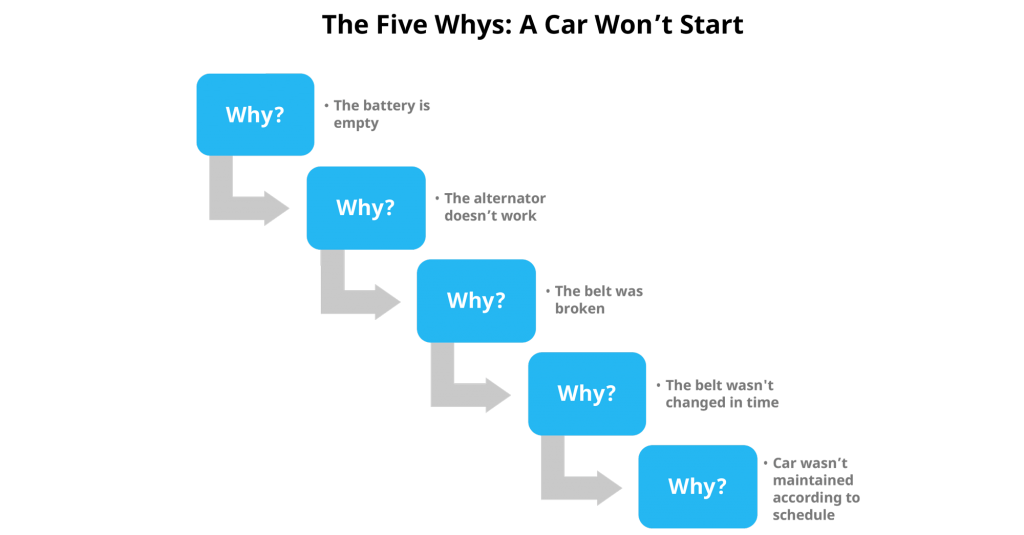
Viima Five Whys

  • Creativity

Creativity plays an important role in innovation, whether it fosters novel ideas or ingenious solutions. However, being creative is not enough to make innovation happen. Many leaders consider creativity an important skill for leading innovation. This begs the question: should leaders be the most creative ones, or should they work to enable creativity in others?

The answer lies somewhere in the middle, as creative leadership is essential in bringing clarity and purpose to the team. A creative leader can change perceptions and show the way. However, the strength of leaders who lead for innovation lies in managing for creativity. So as a leader you don’t have to be the source of all genius ideas but engage people at the right time to do the creative work.

To sum this up, there is a role for leaders in creative work, but not in the traditional sense of generating ideas and asking others to implement them.

Practical tip: If you want to spur creativity in your team try setting constraints and challenge the team to come up with solutions despite perceived challenges. Inevitably, the environment in which you operate will come with some constraints, whether those are operational, financial, legal or of a different nature.

Don’t look at constraints as negative things. Research shows that innovators usually succeed because of constraints, not despite of them. Brian Chesky, Airbnb co-founder & CEO believes “constraints create creativity” and without some of those he probably wouldn’t have done half the creative decisions that would lay the foundations for Airbnb’s remarkable success.

Practical steps to lead innovation

If leading innovation were that simple, we’d have more leaders and organizations excelling at it. However, as difficult as it might sound it’s not impossible and luckily, we have plenty of examples to learn from.

survey conducted by Forbes among 100 innovation leaders revealed that their success lies in actively trying to build and shape their organization for the future. This means that they actively challenge the status quo, experiment, ask questions, are keen observers and engage in conversations with people who are very different from them.

This discovery work of observing, learning, and experimenting leads to better decision making on less risky ideas with higher impact.

Start with the big picture…

The best innovation leaders aren’t just visionaries, who set big goals that show the way to the future. They also enable people to work through the challenges by removing barriers and empowering them to hop on the same boat towards that future.

  • Start with the strategy because any innovation program should be anchored to an organization-wide strategy. Just with the vision and without a tangible business case you don’t really have innovation.
  • Come up with a plan that stirs everyone in the same direction.

Many innovators, especially those who disrupt their industry, are not the best executors and sometimes they don’t have to be, if they have the right people on the job. To this end, collaboration and co-creation are essential, just as it is the empowerment of those who are knowledgeable to make important decisions to get to those goals.

A high-level plan which serves as a good example of how innovators set clear, ambitious goals is Elon Musk’s series of Master Plans, from 2006, 2016 and the 2022 one, to be released soon. These plans played an important role in Tesla’s success, giving a clear direction for the future illustrating how they are actually going to move towards fulfilling their mission of accelerating world’s transition to sustainable energy.

Tesla Unsplash

Of course, there’s more to a plan than an ambitious statement, but people need to be inspired, to feel that through their work they can change the world around them. That being said, an ambitious plan still needs to be flexible to some degree to allow for different ways of achieving it.

The cleverness of these master plans lies in their simplicity which makes them easy to understand and remember. They capture the big picture but still leave room for the team to find the best way of accomplishing them.

…then zoom in on the details

  • To achieve those ambitious goals, leaders need innovative teams, and to nurture internal talent.

With internal scouting systems organizations can develop the skills of existing teams. As is the case with innovation, if you can’t buy something, you have to build it yourself.

It’s beyond the scope of this article to talk about the winning strategies in the war for talent, but there should be a stronger focus on nurturing existing talent and creating the capabilities to innovate through talent development programs, learning opportunities, and a positive employee experience.

Innovation can come from various areas of the organization, and it all comes down to how employees are led to innovate. Former Volkswagen CMO, Luca de Meo managed to unify VW’s branding by discovering and nurturing the mutual sense of purpose of the employees.

He achieved this by involving employees in the creation of a centralized brand. For example, one brainstorming workshop was organized as a design lab to prototype, test, analyze and openly discuss ideas with employees from different departments and areas of expertise.

Engaging employees in innovation work can unlock the wealth of knowledge in an organization. Empowering them to innovate it’s even more powerful, as employees become innovators themselves. As Linda Hill also observes, people’s talents are not used to their fullest, but when it eventually happens, the results show up as well. In Volkswagen’s case, de Meo’s approach was fruitful, the brand moving up the global ranks from 55th to 39th.

…and take one step at a time towards that goal

The last piece to the puzzle, and maybe the most important is to take things one at a time while keeping your options open. There’s a lot of emphasis on the bigger picture, planning and strategy, but these won’t eliminate ambiguity.

So, the best way forward is to keep that vision in mind and help the organization move towards it. You don’t need to know each step in your path in advance, as long as you keep up a good pace and keep moving in the right direction, one step at a time.

Like with all innovative work, you’ll encounter challenges and things won’t ever go as planned, so be prepared to alter the initial plan. That’s why it’s not advised to put all your eggs in one basket. As John Carter explains, you need two interlinked systems that can help you select and grow the best products or ideas.

  • An annualsystematic portfolio planning process, tied to budgeting, and
  • An ongoing, agile, portfolio management process

Another thing to consider is the modular approach, which helps speed up learning. As Rita McGrath explains in this recent article, making your offerings modular you can begin to generate benefits early in the projects’ life. Put together, these two approaches are very helpful in building capabilities that provide economies of scale while still remaining flexible.

Leading innovation by example

In the following section we didn’t go for single success stories of leaders because systematic innovation doesn’t come down to one person. Instead, we’ll show at a higher level how leadership models enabled everyone in the organization to turn innovation into an everyday habit.

Netflix

Even though Netflix might go through a rough patch, we can’t deny its leading position as an innovator in the entertainment industry. From a DVD sales and rental company to a global streaming service, the current organizational structure at Netflix provides plenty of freedom and responsibility to its employees.

Netflix is divided in three main divisions and is maintaining the principles of total quality management: the functional team (CEO, legal, content communication etc.), geographical teams (in charge of local and international streaming) and the product teams who ensures the effectiveness of operations. This unitary form, the corporate headquarters direct strategies implemented in geographical divisions.
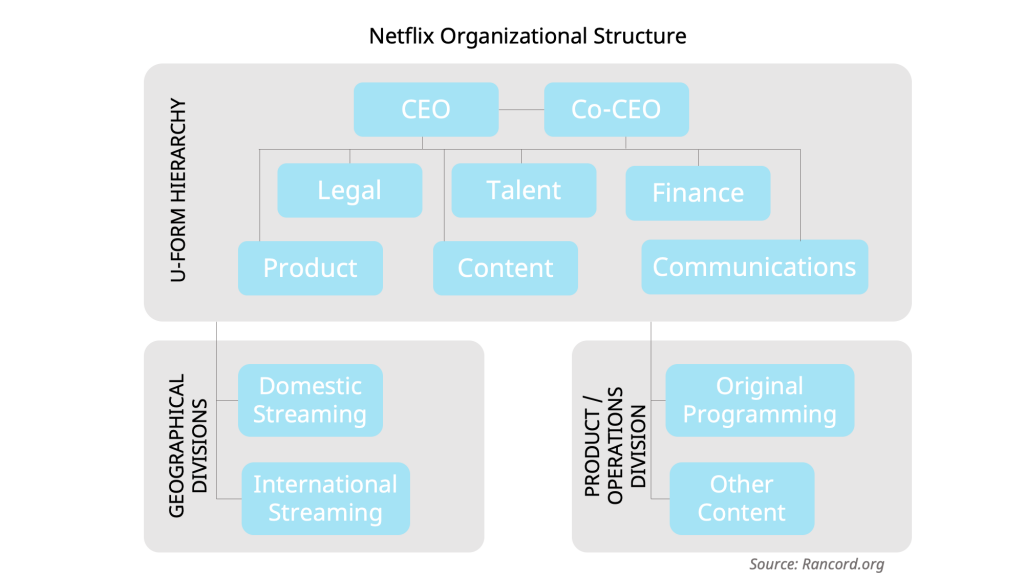
Viima Netflix Org Structure

  • The first division, the functional one, is led by Reed Hastings, CEO and Ted Sarandos, Co-CEO. They meet regularly with the R-staff, the group made of Netflix veterans and the general counsel.
  • The next in line is the E-staff group, made of executives who oversee different teams within the company. They each have a different area of focus, like platform engineering, regional marketing and content.
  • There is also a group of directors, below the vice presidents, who meet to review the current state of the company.

The flat organizational structure at Netflix encourages a culture of independent decision making, openness, high effectiveness, and flexibility. This approach to leadership is based on their business need of staying ahead of the curve by making decisions fast.

Apple

Apple is to this day one of the most innovative companies, and much of its success is attributed to Steve Jobs. However, in this case we won’t focus on his leadership skills, which are rather controversial, but on his legacy and how the company’s structure has evolved over the years.

What makes Apple unique is that it’s organized around expertise, rather than the traditional business units.

This requires open mindedness from senior leaders, to inspire, and influence colleagues to contribute towards the goals. Ultimately, decisions are made in a coordinated manner by the most qualified people. There are no general managers at Apple. Instead, there are expert leaders who need to have 3 main characteristics.

  • Deep expertise.

It’s easier to train an expert to be a manager than to train a manager to be an expert. So, at Apple experts lead experts. They have over 600 experts working on camera hardware technology, and they are led by Graham Townsend (a camera expert himself).

  • Deep immersion in the details.

In Apple’s case leaders should know the details of their organization 3 levels down and be able to push, probe and smell an issue and know which issue is important and where to focus attention. For example, they are very particular with the shape of the corners of their devices. Apple leaders insist on continuous curves, a small difference but executing it demands that they commit to precise manufacturing.

This relentless pursuit of perfection is what differentiates some companies. Even though overdoing it can lead to micromanagement and make feel employees like they are not trusted, you need to strike a balance between the two.

  • Willingness to collaboratively debate.

Having so many teams of experts requires a lot of back and forth and debate. An overly polite culture can hinder creativity, as people might not speak up because they don’t want to upset someone. So, creative abrasion is very important in collaborative work.

To develop the dual lens camera portrait mode, Apple had 40 teams of specialists working together and they disagreed, pushed back, promoted or rejected ideas and build on top of each other’s ideas.

At the same time, leaders should be able to make decisions even when there’s no data available. For this, they first have to listen to everyone. It might be that there is no agreement or reliable information that can help in the decision making, but that’s where good leaders excel and what Jobs did at Apple as well. He used his own judgment to make decisions, even though not everyone was happy about those. Otherwise, debates could go on forever, become bottlenecks or compromises that lead to substandard results.

Apple Unsplash

However, there are also challenges that come with Apple’s managerial structure, which is not very common in other companies. When organizations grow, their leadership also needs to adapt and scale accordingly.

For example, while the number of employees grew eight times, the number of VPs reporting to executives only doubled. To handle all the new responsibilities, they could no longer be immersed in the details. So, they decided to focus on a few core activities that bring most value and those that require less attention are pushed down to people who are trained to handle them. That being said, leadership models need to be flexible in any innovative, growing organization.

Conclusion

With the right leadership, processes and structures in place, innovation can thrive in your organization. As leaders is important to set ambitious goals which can inspire and show the way for your team.

Innovation can seem like an insurmountable task. Even though the details matter and aspiring to excellence is important, you always have to keep focused on the end goal and take one step at a time towards that. At the same time, keep an open mind, stay curious and inspire others to follow suit.

In the end, leading innovation also means building the capabilities, processes and environment that foster innovation and encourage others to become innovators.

This article was originally published in Viima’s blog.

Image credits: Viima, Unsplash, Pexels

Subscribe to Human-Centered Change & Innovation WeeklySign up here to get Human-Centered Change & Innovation Weekly delivered to your inbox every week.

Apple Watch Must Die

At least temporarily, because it’s proven bad for innovation

Apple Watch Must Die

by Braden Kelley

I came across an article in The Hill, titled ‘Apple flexes lobbying power as Apple Watch ban comes before Biden next week‘ that highlighted how Apple has been found guilty by the U.S. International Trade Commission (ITC) of infringing upon the intellectual property of startup AliveCor to provide its wearable electrocardiogram features in its Apple Watch.

Apple is now trying to get President Biden to veto the ruling (I didn’t know that was a thing) so that they can keep selling Apple Watches. In my opinion this is a matter for the courts and yet another example of how big tech (and big companies in general) far too often brazenly misappropriate the intellectual property of the little guys. So much so in Apple’s case that over the last 30+ years a popular term has emerged for it called ‘Sherlocking’.

According to the new Microsoft Bing (with ChatGPT):

Sherlocking is a term that refers to Apple’s practice of copying features from third-party apps and integrating them into its own software¹². The term originated from a search tool named Sherlock that Apple developed in the late 90s and later updated to include features from a similar app named Watson²³.

President Biden must let the courts do their job and not intervene if innovation is to thrive in America.

Apple has been found guilty by the ITC and should be forced to stop selling Apple Watches if that is what the court has decided. They should pay damages and redesign their product to design out the intellectual property theft. And, if they feel they are innocent, then they have an avenue of appeal and should exercise it.

But, bottom line, turning a blind eye to intellectual property theft is bad for innovation. We must encourage and protect entrepreneurship for innovation to thrive.

I’ll leave you with this clip from the movie Tucker to ponder on the way out:

And a trailer from probably the best movie on the subject of the struggle of the innovator against big business, based on the real life story of the inventor of the intermittent wiper – Dr. Robert Kearns, it’s called ‘Flash of Genius’:

Hopefully President Biden will stay out of it and let the courts decide based on the evidence.

Keep innovating!

SPECIAL UPDATE: On February 21, 2023 the Biden Administration elected NOT to veto the ITC ruling, leaving the courts to decide whether Apple is innocent or guilty.

Source: Conversation with Bing, 2/18/2023
(1) Apple ‘Sherlocking’ Highlighted in Antitrust Probe—Google Also …. https://www.itechpost.com/articles/105413/20210422/apple-sherlocking-highlighted-antitrust-probe-google-questioned-over-firewall.htm Accessed 2/18/2023.
(2) What Does It Mean When Apple “Sherlocks” an App? – How-To Geek. https://www.howtogeek.com/297651/what-does-it-mean-when-a-company-sherlocks-an-app/ Accessed 2/18/2023.
(3) Sherlock (software) – Wikipedia. https://en.wikipedia.org/wiki/Sherlock_(software) Accessed 2/18/2023.
(4) All the things Apple Sherlocked at WWDC 2022 – TechCrunch. https://techcrunch.com/2022/06/13/all-the-things-apple-sherlocked-at-wwdc-2022/ Accessed 2/18/2023.

Image credit: Pexels

Subscribe to Human-Centered Change & Innovation WeeklySign up here to join 17,000+ leaders getting Human-Centered Change & Innovation Weekly delivered to their inbox every week.

Both Sides of the Story

Both Sides of the Story

GUEST POST from Mike Shipulski

When you tell the truth and someone reacts negatively, their negativity is a surrogate for significance.

When you withhold the truth because someone will react negatively, you do everyone a disservice.

When you know what to do, let someone else do it.

When you’re absolutely sure what to do, maybe you’ve been doing it too long.

When you’re in a situation of complete uncertainty, try something. There’s no other way.

When you’re told it’s a bad idea, it’s probably a good one, but for a whole different reason.

When you’re told it’s a good idea, it’s time to come up with a less conventional idea.

When you’re afraid to speak up, your fear is a surrogate for importance.

When you’re afraid to speak up and you don’t, you do your company a disservice.

When you speak up and are met with laughter, congratulations, your idea is novel.

When you get angry, that says nothing about the thing you’re angry about and everything about you.

When someone makes you angry, that someone is always you.

When you’re afraid, be afraid and do it anyway.

When you’re not afraid, try harder.

When you’re understood the first time you bring up a new idea, it’s not new enough.

When you’re misunderstood, you could be onto something. Double down.

When you’re comfortable, stop what you’re doing and do something that makes you uncomfortable.

It’s time to get comfortable with being uncomfortable.

Image credit: “mirror image pickup” by jasoneppink is licensed under CC BY 2.0

Subscribe to Human-Centered Change & Innovation WeeklySign up here to join 17,000+ leaders getting Human-Centered Change & Innovation Weekly delivered to their inbox every week.

Radical Transparency is One Key to a Better Customer Experience

Radical Transparency is One Key to a Better Customer Experience

GUEST POST from Shep Hyken

Most customer-focused businesses work very hard to streamline their encounters and interactions with potential clients, curating the experience to the smallest detail so every step of the process can be managed and controlled. It all starts with a customer journey map that optimizes the process. When the process is consistent and predictable, you start to build trust with your customers. And, there’s a way to take that trust to another level, and that’s with transparency.

Darryl “The Hammer” Isaacs, a Kentucky-based attorney, has built a profitable career by being surprisingly straightforward — another word for transparent — with his clients. He has the process down, which means he knows the law and how to litigate. But just as important as winning a lawsuit is how his clients are treated.

Since it opened in 1993, his firm, Isaacs & Isaacs Personal Injury Lawyers, has helped thousands of people recover over $2 billion from insurers. He is a celebrity in the three states where he operates (Kentucky, Indiana and Ohio), with plenty of TV ads and billboards lining the highways. But Isaacs will tell you that his secret goes beyond exposure from a big ad budget. And it isn’t about knowing the law and winning. For him, it’s just as important to build a reputation by being transparent. And he takes the concept to an even higher level by being radically transparent.

I had a chance to learn from Isaacs’ success and his thought process, which he says is based on three concepts: being humble and embracing adversity, providing easy access and trusting the public with your pain.

1. Embrace Humble Beginnings and Adversity

Isaacs’ journey to becoming a lawyer wasn’t easy. It began at age six when he watched his father’s legal swearing-in ceremony. That inspired him to want to practice law, but inspiration wasn’t enough. He failed the bar exam the first two times he took it. No one would blame Isaacs for keeping that information from the public. After all, in the competitive legal field, lawyers like to let clients know about their prestigious law schools, industry awards and big wins. Isaacs recognized the importance of that, but also chose to embrace his “humble beginnings” as a possible advantage. He believed people could relate to his struggle. This transparency makes him real and approachable to his clients. He also has an incredible work ethic. Isaacs says, “I’m not smarter than other lawyers, I just work harder.” His clients may not know about the legal world’s awards and top schools, but they understand and appreciate hard work.

2. Provide Unexpected Access

Have you ever tried to reach the CEO or owner of a successful company? Typically, the bigger and more prosperous the company, the more challenging it is to get through to the business owner or high-level execs. Isaacs is not only successful, but his advertisements and reputation have given him celebrity status in his market. His firm has more than 55 employees, many of whom could act as a “first line” of defense for deflecting calls, emails, letters, etc. But Isaacs embraces the concept of approachability. He happily shares his direct line and cell number with his clients. Text him, and he responds. Call him, and he returns the call. Isaac believes, “If you provide unexpected direct access, clients feel valued and appreciated.”

3. Trust the Public with Your Pain

Similar to the way Isaacs embraces his humble beginnings, he embraces the transparency of results. In an age of social media, it’s nearly impossible to hide any negative news affecting a high-profile business. Issacs says, “The best option is to get comfortable and let the public in.” In other words, embrace the negative and view it as an opportunity to be authentic and transparent. And it goes beyond social media reviews and comments. Isaacs took this concept to a personal level in 2015 when he was hit by a speeding car while riding his bicycle. His neck was broken in two places, and he sustained a traumatic brain injury. The face of a successful company was now in the hospital in a near-death situation. That could have been the beginning of the end for the firm. He might not ever be back. And what if people found out about this? Well, rather than try to keep the news out of the press, Isaacs did a phone interview from the hospital. First, he wanted to let the world know he wasn’t dead and would be back. Second, he was now experiencing a similar condition to many of his clients. Isaacs knew transparency—and even vulnerability—at this level would make him more approachable. The result was an even higher level of trust.

Isaacs uses the word radical, meaning extreme or intense, to demonstrate just how important it is for him and his firm to be transparent. But are his three concepts really that radical or extreme? Maybe, because customers aren’t used to this level of transparency, but isn’t this what customers want? Isaacs’ three concepts could easily form a foundation of transparency that would help any company or brand, big or small, build trust, create confidence and connect emotionally with customers.

This article was originally published on Forbes.com.

Image Credit: Shep Hyken

Subscribe to Human-Centered Change & Innovation WeeklySign up here to get Human-Centered Change & Innovation Weekly delivered to your inbox every week.

A Guide to Harnessing the Power of Foresight

Unlock Your Company’s Full Potential

A Guide to Harnessing the Power of Foresight

GUEST POST from Teresa Spangler

Foresight is the superpower of the 21st century business world, allowing companies to see beyond the horizon and seize opportunities before they become trends.

Innovation has always been the driving force behind progress and growth in the business world. However, in today’s rapidly changing landscape, it has become even more essential to stay ahead of the curve and uncover major shifts and hidden opportunities to remain competitive. Companies that can harness the power of foresight and innovate in response to changing market conditions will be well-positioned to succeed in the years ahead.

So, what exactly is foresight, and how can it be leveraged to drive innovation? Simply put, foresight is the ability to anticipate and prepare for future trends and developments. It involves a deep understanding of the current landscape and an awareness of emerging technologies, consumer preferences, and macroeconomic forces. By staying attuned to these trends and developments, companies can stay ahead of the curve and take advantage of new opportunities.

Company leaders can take several key actions to tap into the power of foresight and drive innovation in their organizations. Here are a few steps to get started:

1. Develop a culture of innovation: To truly drive innovation, creating a culture that encourages and supports creative thinking and risk-taking is essential. This can be accomplished through a variety of means, including:

  • Encouraging open and transparent communication among employees
  • Providing opportunities for employees to share their ideas and collaborate with others
  • Offering training and development programs that help employees develop new skills and knowledge
  • Encouraging a “fail fast, learn fast” mentality

2. Invest in research and development: To stay ahead of the curve and uncover new opportunities, companies must be willing to invest in research and development. This could involve dedicating resources to exploring new technologies, conducting market research, or experimenting with new business models.

  • Protect your ideas is easier now leveraging the blockchain, sign up and protect your ideas at no charge for the first three and manage the features along the sprint cycles. Link

3. Foster partnerships and collaborations: Collaboration is key to unlocking the full potential of innovation. By working with other companies, universities, and organizations, companies can access new ideas, technologies, and expertise that would be difficult to acquire on their own.

  • Your best customers want to be your most collaborative partners. How are you engaging them in foresight and planning for the future?
  • Stay connected to customers: Understanding customer needs and preferences is critical to driving innovation. Companies should regularly engage with customers and solicit feedback to stay attuned to their changing needs.

4. Embrace new technologies: Technology is driving many of the significant shifts and hidden opportunities in the business world. Companies that are able to embrace new technologies and leverage them to improve their products and services will be well-positioned to succeed. Seems so simple these days, but there are so many new technologies.

  • Bring in experts to keep you abreast of new ways technologies are integrating
  • Explore a new technology in with a different set of filters – break it down and break down how you might use it to innovation.

5. Be open to change: Finally, companies must be willing to embrace change and be flexible in their approach. The world is constantly evolving, and companies that are able to adapt and evolve in response to new trends and developments will be better positioned to succeed. Are you tired of hearing BE OPEN TO CHANGE? I imagine so, it’s fatiguing all the change we’ve been through the last 4 years however, change in the world is accelerating, keeping pace can be daunting.

  • Ensure you have people with eyes on the future
  • Create foresight team and create scenarios of your future
  • Imagine the best possible change but also imagine the downside “what ifs”

The business world is changing rapidly, and companies that can stay ahead of the curve and innovate in response to shifting market conditions will be well-positioned to succeed. By tapping into the power of foresight and taking the necessary steps to drive innovation, company leaders can unlock new opportunities and stay ahead of the competition. So why wait? Start taking action today and seize the opportunities that lie ahead.

FutureForward podcasts (and videos) are now available on your favorite Channel:

Image credit: Pixabay

Subscribe to Human-Centered Change & Innovation WeeklySign up here to join 17,000+ leaders getting Human-Centered Change & Innovation Weekly delivered to their inbox every week.

Unlock Hundreds of Ideas by Doing This One Thing

Inspired by Hollywood

GUEST POST from Robyn Bolton

What happened the last time you asked your team for ideas?

A. Nothing. Nada. Zip. Zilch.

B. Got some ideas but nothing new or noteworthy

C. Got lots of ideas, but very few were relevant, new, or big

D. The clouds parted. The angels sang. The Ideas forever transformed our business.

My guess is you answered A, B, or C

(If you answered D, let me know because I need to learn how you did it).

While there are dozens of reasons why D did not happen, the most common one is this:

You asked for ideas.

You said, “Hey, I want to hear your ideas.”

Or maybe you got more specific and said, “I want to hear your ideas about how we can do better.”

What your team heard was “Hey, I want to hear your ideas as long as they’re the ideas I want to hear and pertain to the topics I want to hear about, but I’m not going to tell you the topics, so share at your own risk and may the odds be ever in your favor.”

So your team stayed quiet.

Good news, you can turn the odds in your favor if you do this ONE thing:

Give them constraints.

It seems counterintuitive.

After all, shouldn’t creativity be unconstrained?

Isn’t ideation all about blue sky crazy thinking?

Doesn’t innovation require us to unshackle ourselves from what is practical and dream of what’s possible?

No. No. No.

Constraints fuel creativity

You don’t have infinite money, people, or time. *

Which means you have constraints.

Don’t run from that fact. Don’t hide from it. Don’t ignore it,

Embrace it because it is what fuels creation, innovation, and growth.

No one knew that better than Orson Welles (and he was a pretty creative guy)

“The enemy of art is the absence of limitations,” he told filmmaker Henry Jaglom. “Economically and creatively, that’s the most important advice you can be given. You have limitations; you don’t have $ 1 million to blow up that bridge, so you have to create something else on film to produce the same effect. Instead of having money to hire hundreds of extras, you have to sneak a cameraman in a wheelchair through the streets of New York City and steal the shot, which gives you a look of much greater reality.”

If constraints can create Citizen Kane, imagine what they can do for your business.

Constraints demand focus

Think about the last movie you saw that was way too long. Or the book that could have been an article. Or the meeting that should have been an email.

When you have all the money, time, or resources you need, you can do anything and try to do everything. Unfortunately, the result is usually a bloated confusing mess that leaves your customers feeling like they’ve lost more than they gained.

But when you only have 2 hours or 300 pages to tell a story, 20 minutes instead of four hours for a presentation, or $10,000 to create a new product, you get crystal clear on what you’re trying to accomplish, prioritize what you need, and leave everything else behind.

Constraints cause tension which leads to choices

In The Offer, a fantastic series about the making of The Godfather, there’s a great scene in which the studio executive demands that Francis Ford Coppola cut 45 minutes from the film (and helpfully suggests cutting all the scenes set in Sicily). The reason? So that theaters can host five showings per day instead of four.

Two hours is a constraint.

Sicily is where Michael abandons all hope of a normal life.

The tension between revenue and story, business and art, is real.

Tension requires you to make choices. Constraints shouldn’t always win. But they should always be present.

Constraints create value

The next time you ask for ideas sprinkle in some constraints.

  • “I’d like your ideas for how we can use existing assets to expand into new markets.”
  • “How can we earn more money from existing customers without raising prices?”
  • “What can we stop doing so we can focus on high-priority work and avoid burnout?”

You’ll find that adding a few constraints to your request for ideas will be an offer your team can’t refuse.

*If you do have unlimited people, money, and time, please let me know. I’d love to talk to you.

Image credit: Unsplash

Subscribe to Human-Centered Change & Innovation WeeklySign up here to get Human-Centered Change & Innovation Weekly delivered to your inbox every week.

The Reality Behind Netflix’s Amazing Success

The Reality Behind Netflix's Amazing Success

GUEST POST from Greg Satell

Today, it’s hard to think of Netflix as anything but an incredible success. Its business has grown at breakneck speed and now streams to 190 countries, yet it has also been consistently profitable, earning over $12 billion last year. With hit series like Orange is the New Black and Stranger Things, it broke the record for Emmy Nominations in 2018.

Most of all, the company has consistently disrupted the media business through its ability to relentlessly innovate. Its online subscription model upended the movie rental business and drove industry giant Blockbuster into bankruptcy. Later, it pioneered streaming video and introduced binge watching to the world.

Ordinarily, a big success like Netflix would offer valuable lessons for the rest of us. Unfortunately, its story has long been shrouded in myth and misinformation. That’s why Netflix Co-Founder Marc Randolph’s book, That Will Never Work, is so valuable. It not only sets the story straight, it offers valuable insight into how to create a successful business.

The Founding Myth

Anthropologists have long been fascinated by origin myths. The Greek gods battled and defeated the Titans to establish Olympus. Remus and Romulus were suckled by a she-wolf and then established Rome. Adam and Eve were seduced by a serpent, ate the forbidden fruit and were banished from the Garden of Eden.

The reason every culture invents origin myths is that they help make sense of a confusing world and reinforce the existing order. Before science, people were ill-equipped to explain things like disease and natural disasters. So, stories, even if the were apocryphal, gave people comfort that there was a rhyme and reason to things.

So it shouldn’t be surprising that an unlikely success such as Netflix has its own origin myth. As legend has it, Co-Founder Reed Hastings misplaced a movie he rented and was charged a $40 dollar late fee. Incensed, he set out to start a movie business that had no late fees. That simple insight led to a disruptive business model that upended the entire industry.

The truth is that late fees had nothing to do with the founding of Netflix. What really happened is that Reed Hastings and Marc Randolph, soon to be unemployed after the sale of their company, Pure Atria, were looking to ride the new e-commerce wave and become the “Amazon of” something. Netflix didn’t arise out of a moment of epiphany, but a process of elimination.

The Subscription Model Was an Afterthought

Netflix really got its start through a morning commute. As Pure Atria was winding down, Randolph and Hastings would drive together from Santa Crux on Highway 17 over the mountain into Silicon Valley. It was a long drive, which gave them lots of time to toss around e-commerce ideas that ranged from customized baseball bats to personalized shampoo.

The reason they eventually settled on movies was the introduction of DVD’s. In 1997, there were very few titles available, so stores didn’t stock them. They were also small and light and were easy to ship. Best of all, the movie studios recognized that they had made a mistake pricing movies on videotape too high and planned to offer DVD’s at a level consumers would buy them.

In the beginning, Netflix earned most of its money selling movies, not renting them. However, before long they realized that it was only a matter of time before Amazon and Walmart began selling DVD’s as well. Once that happened, it was unlikely that Netflix would be able to compete, and they would have to find a way to make the rental model work.

The subscription model began as an experiment. No one seemed to want to rent movies by mail, so they were desperate to find a different model and kept trying things until they hit on something that worked. It wasn’t part of a master plan, but the result of trial and error. “If you would have asked me on launch day to describe what Netflix would eventually look like,” Randolph wrote, “I would have never come up with a monthly subscription service.”

The Canada Principle

As Netflix began to grow it was constantly looking for ways to grow its business. One idea that continually came up was expanding to Canada. It’s just over the border, is largely English speaking, has a business-friendly regulatory environment and shares many cultural traits with the US. It just seemed like an obvious way to increase sales.

Yet they didn’t do it for two reasons. First, while Canada is very similar to the US, it is still another country, with its own currency, laws and other complicating factors. Also, while English is commonly spoken in most parts of Canada, in some regions French predominates. So, what looked simple at first had the potential to become maddeningly complex.

The second and more important reason was that it would have diluted their focus. Nobody has unlimited resources. You only have a certain number of people who can do a certain number of things. For every Canadian problem they had to solve, that was one problem that they weren’t solving in the much larger US business.

That became what Randolph called the “Canada Principle,” or the idea that you need to maximize your focus by limiting the number of opportunities that you pursue. It’s why they dropped DVD sales to focus on renting movies and then dropped a la carte rental to focus on the subscription business. That singularity of focus played a big part in Netflix’s success.

Nobody Knows Anything

Randolph’s mantra throughout the book is that “nobody knows anything.” He borrowed the phrase from the writer William Goldman’s memoir Adventures in the Screen Trade. What Goldman meant was that nobody truly knows how a movie will do until it’s out. Some movies with the biggest budgets and greatest stars flop, while some of the unlikeliest indy films are hits.

For Randolph though, it’s more of a guiding business philosophy. “For every good idea,” he says, “there are a thousand bad ideas it is indistinguishable from.” The only real way to tell the difference is to go out and try them, see what works, discard the failures and build on the successes. You have to, in other words, dare to be crap.

Over the years, I’ve had the chance to get to know hundreds of great innovators and they all tell a different version of the same story. While they often became known for one big idea, they had tried thousands of others before they arrived at the one that worked. It was perseverance and a singularity of focus, not a sudden epiphany, that made the difference.

That’s why the myth of the $40 late fee, while seductive, can be so misleading. What made Netflix successful wasn’t just one big idea. In fact, just about every assumption they made when they started the company was wrong. Rather, it was what they learned along the way that made the difference. That’s the truth of how Netflix became a media powerhouse.

— Article courtesy of the Digital Tonto blog
— Image credit: Unsplash

Subscribe to Human-Centered Change & Innovation WeeklySign up here to get Human-Centered Change & Innovation Weekly delivered to your inbox every week.

Latest Innovation Management Research Revealed

The Latest Read on the Evolution of Innovation Management

by Braden Kelley

Recently I had the opportunity to get a preview of InnoLead’s latest research report sponsored by KPMG. The report is now available to members, and I would be really interested to hear your thoughts on its findings:

Benchmarking Innovation Impact 2023

Please let me know where you agree and where you disagree by sounding off in the comments below or over on Twitter (@innovate).

Here are some of my key takeaways after rifling through the report:

1. A shift from transformational innovation to incremental innovation

There are several comparisons of data gathered for this report to data gathered for a previous edition in 2020. One might think that perhaps between 2020 much of the low hanging innovation fruit might have been picked and that companies might be shifting more of their innovation attention towards transformational/radical/disruptive innovation, but the report shows that the opposite is true. Check out the interactive chart here:

The data shows that between 2020 and 2023 respondents have shifted their mix of incremental, adjacent and transformational innovation away from transformational innovation and towards incremental and adjacent.

Some of other areas that you will find in the report include:

  • Team Characteristics
  • Budget & Resources
  • Collaboration & Spaces
  • Focus & Activities
  • Challenges & Enablers

2. The Greatest Innovation Challenges are somewhat predictable

Both of these embedded graphics have tabs that you can click back and forth between to compare the two data sets. In this case we’re comparing large and medium size organizations versus small organizations. There are few surprises here, other than the fact that politics/turf war/alignment and lack of budget are top of the list for organizations of all sizes.

3. Five Other Key Observations From Elsewhere in the Report

  • The vast majority of innovation work does not happen in person
  • Most innovation teams consist of people that could be counted on one or two hands
  • Most innovation budgets are set annually – reducing the ability of organizations to respond to new insights and technologies quickly
  • Organizations are more likely to engage in innovation training and internal idea challenges than running an innovation lab or working with accelerators
  • Leadership support continues to be the top enabler for innovation success

All of the detail, and many more insights live within the pages of the Benchmarking Innovation Impact 2023 report.

For those of you who have already read the report, where did you agree and where did you disagree with the findings?

And for those of you who haven’t had a look at it, you can download the report on the linked name above.

Image credit: Pixabay

Subscribe to Human-Centered Change & Innovation WeeklySign up here to join 17,000+ leaders getting Human-Centered Change & Innovation Weekly delivered to their inbox every week.

Delivering Innovation

How the History of Mail Order Can Help Us Manage Innovation at Scale

Delivering innovation

GUEST POST from John Bessant

2022 was a record year for home delivery of parcels and packages. After the Covid-19 lockdowns the idea of remote shopping became an even bigger reality and changed the behavior patterns of millions. It’s a habit which is hard to break — even when there are increasing disturbances in the delivery end of things like strikes and negative publicity surrounding how packages are actually handled and delivered. Estimates of the market size for this activity vary widely but suggest that it is worth close to $500bn worldwide.

But where did this revolution begin and what’s the innovation history behind remote retailing? For that we need to go back a couple of hundred years and locate ourselves in the beautiful hills of Powys in Wales. In the valley alongside the river Severn is the small town of Newtown, a market center since the 13th century. And in 1856 the home of Pryce Jones, a draper’s assistant who rose to take over the business in which he worked. And for which he had big plans.

He renamed the company the Royal Welsh Warehouse and specialized in selling Welsh flannel. His vision grew out of a belief in the wonderful powers of the soft warm fabric crafted from wool from the sheep he could see on the hillsides all around him. But it was also sharply focused on the potential size of that market — if he could only grow it. Which he did courtesy of two key enabling innovations which reached sufficient maturity to give him the channels to reach his imagined global market.

The channels were the postal system and the railways. Neither was new by this time but they were now coming of age — and enabling hitherto unrealizable dreams to take shape. Back in 1654 Oliver Cromwell had established the idea of a state postal system but it was another 30 years before a reliable system began to operate around the city of London. And another hundred years before Parliament authorized the creation of ‘Penny Posts’ in any town or city; while the idea grew in popularity it was still expensive and local in impact. It wasn’t until the major reforms of the Post Office in 1840 that the idea of a Uniform Penny Post was established, facilitating the safe, speedy and cheap conveyance of letters. With it came the first pre-payment in the form of postage stamps (beginning with the famous Penny Black).

Pryce Jones was quick to spot the possibilities in the newly-emerging postal system and began offering his wares via mail order. The offer was simple; place your order via mail and it will be delivered the next day (effectively anticipating Amazon’s Prime service by 150 years and offering faster delivery!). To explain to his market what he had to offer he developed an illustrated catalogue from which they could choose what they wanted; he launched this in 1861.

He was able to fulfil this delivery promise because the railways had also come of age; from the ‘Rocket’ which George Stephenson demonstrated in 1829 the idea of modern railway network had developed rapidly. The railway came to Newtown and Jones was quick to exploit its possibilities, building a warehouse next to the station and opening his mail order business alongside the post office. He expanded several times and in 1879, he built the Royal Welsh Warehouse, a tall red brick building in the centre of Newtown which still stands today.

His idea paid off; within months his business had started to grow and by the 1880s he had an international operation, counting amongst his patrons included the royal houses of Austria, Britain, Denmark, Germany, Hanover, Italy, Naples, and Russia. Valuable customers not only for their purchases but also for their implicit endorsement. Because Jones wasn’t just skilled at utilising new channels; he also played the role of ‘conveyor’, someone actively encouraging and promoting the use of the new business model along these channels. His mail order catalogue wasn’t simply a price list of items, it was a form of storytelling, complete with pictures and expansive descriptions. He understood the principles of marketing, the need to get consumers to buy into a vision of something which they wanted — and then he was able to fulfil that demand.

(He was also a gifted product innovator; amongst other things he is credited with the invention of the sleeping bag which he patented in 1876 under the name of the Euklisia Rug. He exported the product around the world, at one point landing a contract with the Russian Army for 60,000 rugs.)

Pryce Jones wasn’t alone; like so many innovations the idea of mail order retailing came to several people independently and around the same time, reflecting the changing environment and the enabling technologies. For example in Austria the Thonet family began selling their furniture in 1859 using a mail order catalogue and taking advantage of postal and transport innovations. In fact Pryce Jones’ model was predated by the US luxury goods company Tiffany’s who in 1845 launched their ‘Blue Book’ — arguably the world’s first mail order catalogue though targeted at a very small, select (and wealthy) market.

It wasn’t long before other entrepreneurs began to see the possibilities beyond extending the reach into new markets for particular products. They realised that there was a second side to the new market-place — the suppliers. These days we’re used to seeing examples of ‘platform’ businesses everywhere we look — just glance at your smart-phone to see the array of apps (representing goods and services) being offered across the platform of its shiny screen. But it was 150 years ago that this kind of business model first emerged.

In 1872, Aaron Montgomery Ward from Chicago started his own single-page mail order catalogue; it listed 163 items for sale. He’s credited amongst other things with coining the sales slogan ‘satisfaction guaranteed or your money back!’ The model worked; ten years later the ‘Wish book’ catalogue listed over 10,000 items. Most important was the fact that Ward didn’t manufacture many of these; he effectively created the platform across which the market in multiple goods and services could operate.

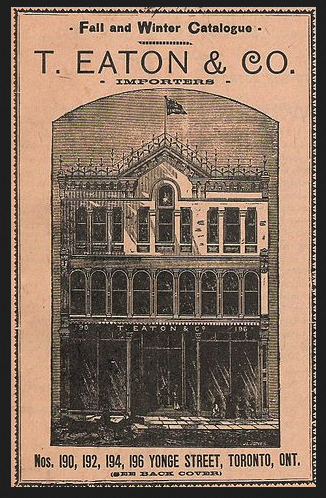
In doing so he paved the way for many others spotting and exploiting a similar opportunity. For example in Canada one of the largest department stores was the Eaton Company originally founded in 1869 to sell dry goods, backed by a growing network of factories.

Eaton Company Catalog

Timothy Eaton saw the possibilities in mail order and in 1884 released its 32 page catalogue. He expressed his vision of a network stretching across the sub-continent of Canada in a note accompany the catalogue; “This catalogue is destined to go wherever the maple leaf grows, throughout the vast Dominion. We have the facilities for filling mail orders satisfactorily, no matter how far the letter has to come and the goods have to go.”

And down in North Redwood, Minnesota Richard Warren Sears , a railroad services agent. began a sideline business by purchasing a batch of watches which had been refused delivery and selling them on to local people. In 1886, he used the profits he earned from it to set up a mail-order business selling watches as R.W. Sears Watch Company. That year he met a watch repairman named Alvah Curtis Roebuck and in 1887 the two of them relocated their business to Chicago. In 1888 they launched a printed catalogue offering a range of luxury goods like watches and jewelry; by 1892 this had grown to a 322 page catalogue which included sewing machines, sporting goods, musical instruments, saddles, firearms, buggies, bicycles, baby carriages, and some clothing.

Sears Roebuck

What Sears and Roebuck (and a growing number of others) were doing was developing the new business model of a platform, using the catalogue as the focal point across which remote retailing could expand. But this wasn’t simply a matter of printing and distributing a catalogue; what they were doing was mastering the art of building an ecosystem for retail innovation. They recognized that simply advertising a wide range of products and services to an expectant public would be a very fast way of losing money and reputation. In order to make the system work they needed to pull together a network and get it working to deliver ‘emergent properties’ — where the whole offered more than the sum of the parts.

Making remote retailing work meant finding ways to procure (or manufacture) a wide range of products and then holding them in a warehouse so they are available for quick delivery. But holding stock takes up space and costs money so the trick is to manage the logistics of sales forecasting, order processing and stockholding, plus being able to ensure rapid and reliable delivery. Which places emphasis on reliable channels — as Pryce Jones discovered.

And underneath this web of suppliers and deliverers is the challenge of cash flow — how to ensure enough money comes back into the system fast enough to cover costs and return a profit which helps keep the supply side engaged. New models for financing and payment began to emerge — not least the concept of paying cash on delivery.

The model expanded throughout the world and was often at the heart of a move from remote shopping to direct retail. The origins of the 20th century department store include a sizeable crossover — for example Kastner & Öhler was the first mail order business in Central Europe. The company was founded in 1873 in Austria, releasing its first mail order catalogue in 1885; as it grew it opened its first department store in 1894 and went on the become one of the household names in European retailing.

Mail order was a powerful business model which worked well during most ot the 20th century — but as we’ve learned so often about innovation, nothing lasts forever. New developments opened up new possibilities and it is not always the existing players who are best placed or able to exploit them. In the early 1980s a new channel began to appear — the internet. It opened up not only new opportunities in terms of potential reach, mirroring what Pryce Jones had seen in the emergence of uniform postal systems a century before. But it also changed the underlying thinking behind some of the core warehousing and logistics underpinning the mail order model.

Jeff Bezos was aware of the opportunity and had created a list of possible sectors to target with an internet-based model. He chose books, and quickly realized that he could not only reach a huge market via this new channel but he could also service it without the high costs of actually warehousing and distributing the books. He recognized the ‘long tail’ possibilities; with his model he could reach people with highly specific needs and connect them to suppliers who could meet that need. He also saw that the underlying business model was available to anyone — the advantages would come to those who could scale early and build a platform. As the major bookseller Barnes and Noble pointed out in their submission to legal authorities in their lawsuit of 1997Amazon was not a bookseller at all, it was a book broker.

Where Amazon and others paved the way for a new model to emerge, putting the platform kind of business on steroids, others were slower to recognise and adapt. The German firm Quelle had grown since its founding in 1927 to become one of the biggest mail order operations in Europe, with a dedicated logistics and warehousing operation near the town of Fürth in Bavaria. It was, along with Tempelhof airport in Berlin, one of the largest industrial sites in Europe stretching over nearly 7 hectares. But a failure to adapt fast enough to the rapid changes being brought about through internet retailing meant that by 2006 it collapsed into bankruptcy. All that remains today is the 90m high Quelle-Turm (Quelle Tower) built in 1964 and now preserved as a landmark to a different industrial era.

One of the features of the model Pryce Jones developed was the stimulus it gave to local producers, enabling the region around Newtown to prosper with new businesses. And something very similar has happened with the internet-driven mail order business built across the huge Alibaba platform in China. In 2003 Jack Ma launched the idea of a Taobao marketplace where people could trade goods and services using the ability of the platform to reach a large and distributed market and display content in rich and interesting formats.

This model is comprised primarily of small businesses but has grown to be the largest digital retail platform in the country and has spawned many ‘Taobao villages’ — areas where over 10% of the population is engaged in online retailing. It has had a huge impact on the rural economy; by August 2019 there were nearly 4500 Taobao villages in 25 provinces and estimates suggest up to half of the rural population has benefitted from this. It is equivalent to around 600,000 small shops and trading businesses employing around 10 million people with an economic value of around $195 billion worth of e-commerce sales.

The story is of course not over. With the rising expectations of a growing market for instant delivery has come a challenge and opportunity around the ‘last mile’ challenge — how to move from the digital world to physical delivery of products. And whilst there are many major traditional logistics players now operating in this space there are challenges on the horizon — for example drone delivery or even 3-D printing of a growing range of physical products. The virtualisation process has only just begun though it may still be a while before the Welsh flannel beloved of Pryce Jones emerges spinning out of a 3-D wool printer in our homes.

But perhaps the best kept secret is the one shrouded in Arctic mists and dating back hundreds of years. Somehow a single enterprise (the mysterious S. Claus operation) has managed the challenge of reliable overnight delivery on a global basis to millions of expectant children; there are clearly lessons still to be learned around wish fulfilment innovation.

You can also hear this as a podcast or watch it as a video.

If you’d like more songs, stories and other resources on the innovation theme, check out my website or listen to my podcast. And if you’d like to learn with me take a look at my online course here

Image credit: Wikimedia Commons, Unsplash

Subscribe to Human-Centered Change & Innovation WeeklySign up here to get Human-Centered Change & Innovation Weekly delivered to your inbox every week.

Elevating the Importance of Construction and Manufacturing

Elevating the Importance of Construction and Manufacturing

GUEST POST from Mike Shipulski

Restaurants aren’t open as much as they used to be because they cannot hire enough people to do the work. Simply put, there are too few people who want to take the orders; cook the food; deliver food to the tables; clear the tables; and wash the dishes. Sure, it’s an inconvenience that we can’t get a table, but because there are other ways to get food no one will starve because restaurants open. And while some restaurants will go out of business, this situation doesn’t fundamentally constrain the economy.

And the situation is similar with manufacturing and construction: no one wants those jobs either. But, that’s where the similarities end. The shortfall of people who want to work in manufacturing and construction will constrain the economy and prevent the renewal of our infrastructure. Gone are the days of relying on other countries to make all your products because we now know it’s not the most cost-effective way to go. But if there is no one willing to make the products, there will be no products made. And if there is no one willing to build the roads and bridges, roads and bridges will suffer. And if there are no products, no good roads, and no safe bridges, there can be no strong economy.

While there is disagreement around why people don’t want to work in manufacturing and construction, I will propose three for your consideration.

Firstly, the manufacturing and construction sectors have an image problem. People don’t see these jobs as high-tech, high-status jobs where the working environment is clean and safe. In short, people don’t see these jobs as jobs they can be proud and they don’t think others will think highly of them if they say they work in manufacturing or construction. And because of the history of layoffs, people don’t see these jobs as secure and predictable and don’t see them as reliable sources of income. This may not be the case for all people, but I think it applies to a lot of people.

Secondly, the manufacturing and construction sectors don’t pay enough. People don’t see these jobs as viable mechanisms to provide a solid standard of living for themselves and their families. This is a generalization, but I think it holds true.

Thirdly, the manufacturing and construction sectors require specialized knowledge, skills, and abilities skills that are not taught in traditional high schools or colleges. And without these qualifications, people are reluctant to apply. And if they do apply and a company hires them even though they don’t have the knowledge, skills, and abilities, companies must invest in training which creates a significant cost hurdle.

So, what are we to do?

To improve their image, the manufacturing and construction trade organizations and professional societies can come together and create a coordinated education program to change what people think about their industries. And states can help by educating their citizens on the importance of manufacturing and construction to the health of the states’ economies. This will be a long road, but I think it’s time to start.

To attract new talent, the manufacturing and construction sectors must pay a higher wage. In the short term, profits may be reduced, but imagine how much profits will be reduced if there are no people to build the products or fix the bridges. And over the long term, with improved business processes and working methods, profits will grow.

To train people to work in manufacturing and construction, we can reinstitute the Training Within Industry program of the 1940s. The Manufacturing Extension Partnership programs within the states can be a center of mass for this work along with the Construction Industry Institute and other construction trade organizations.

It’s time to join forces to make this happen.

Image credit: Pixabay

Subscribe to Human-Centered Change & Innovation WeeklySign up here to get Human-Centered Change & Innovation Weekly delivered to your inbox every week.