Tag Archives: resilience

Change Management Strategies for Organizational Growth

A Comprehensive Guide

Change Management Strategies for Organizational Growth

GUEST POST from Art Inteligencia

Change is the only constant in today’s dynamic business environment. Amidst rapid technological advancements, evolving market demands, and global economic shifts, organizations must continuously adapt to survive and thrive. As a thought leader in human-centered innovation and change, I’ve distilled critical change management strategies that foster organizational growth. In this article, I’ll explore these strategies and elucidate them through two compelling case studies.

1. Embrace a Culture of Continuous Improvement

Successful organizations cultivate a culture that encourages constant enhancement and innovation. This involves empowering employees at all levels to identify inefficiencies and propose improvements. Implementing a continuous improvement mindset can lead to sustained, incremental growth and resilience against market shocks.

Case Study: Toyota

Toyota’s adoption of the Kaizen philosophy epitomizes a culture of continuous improvement. “Kaizen” translates to “change for better,” a principle that Toyota has ingrained in its DNA. Employees at all levels, from assembly line workers to executives, are encouraged to contribute ideas. Daily team meetings, called “morning markets,” provide a forum for discussing suggestions.

One notable initiative was the introduction of the Andon cord—a system allowing any worker to halt production if they noticed a defect. This not only improved quality but also demonstrated Toyota’s commitment to giving employees ownership in the production process. Over time, this approach reduced defects, cut costs, and bolstered Toyota’s reputation for reliability, thereby increasing market share and driving growth.

2. Foster Agile Leadership and Decision-Making

Navigating change requires leaders who are agile and adaptable. Agile leaders can pivot quickly in response to disruptions and ensure that their organization remains aligned with the market. They cultivate a work environment where swift, yet informed decision-making is the norm

Case Study: Spotify

Spotify’s organizational growth can be strongly attributed to its adoption of the Agile framework. Instead of traditional top-down management, Spotify operates in small, autonomous teams known as “squads.” Each squad is responsible for a specific feature or component of the platform and functions like a mini-startup within the company.

These squads are empowered to make decisions and execute changes independently, enabling faster development cycles and quicker responses to market needs. This agility allowed Spotify to outmaneuver larger competitors, consistently deliver innovative product features, and rapidly expand its global user base.

3. Engage Stakeholders Through Transparent Communication

Clear and consistent communication is crucial for any change initiative. Engaging stakeholders—from employees to external partners—through transparent communication builds trust and mitigates resistance to change.

Case Study: GE’s Transformation Under Jack Welch

When Jack Welch assumed the role of CEO at General Electric (GE), he embarked on a massive transformation program known as “boundaryless behavior.” Welch’s vision was to dismantle bureaucratic silos and create a more integrated, competitive company.

One of his critical strategies was transparent and direct communication. Welch held regular town hall meetings, shared the company’s financial performance openly, and involved employees in decision-making processes. Training programs known as “Work-Outs” were established where employees could voice concerns and offer solutions directly to executives. This open dialogue not only enhanced employee morale but also facilitated smoother implementation of change initiatives, ultimately fueling GE’s growth into a powerhouse conglomerate.

4. Leverage Data-Driven Decision Making

Emphasizing data-driven decision-making ensures that organizations navigate change with precision and confidence. By leveraging data analytics, companies can identify trends, pinpoint inefficiencies, and forecast the impact of potential changes.

Case Study: Netflix’s Evolution

Netflix’s transition from a DVD rental service to a leading streaming platform and content creator exemplifies data-driven decision making. Initially, Netflix used data analytics to revolutionize its DVD rental service, predicting customer preferences and optimizing inventory.

As the market evolved, Netflix pivoted to streaming, leveraging viewer data to curate personalized recommendations and drive user engagement. Their data-driven approach also extended to content creation; by analyzing viewer metrics, Netflix identified gaps in the market and produced popular original series like “House of Cards” and “Stranger Things,” which significantly boosted subscriptions and propelled the company’s growth.

5. Develop Resilience Through Continuous Learning

Building an organization that champions continuous learning and skill development prepares the workforce to adapt to future challenges and technological advancements. By investing in continuous professional development, organizations can retain talent and foster innovation.

Case Study: AT&T’s Workforce 2020 Initiative

AT&T recognized the need to adapt to the digital era and launched the Workforce 2020 initiative. This comprehensive, multi-year strategy aimed to reskill its workforce to meet the demands of emerging technologies.

AT&T partnered with leading online education platforms and provided employees with resources to gain new skills in data science, cybersecurity, and other critical areas. By 2020, over half the workforce had participated in reskilling programs, bolstering the company’s innovative capabilities and maintaining its competitive edge in the fast-evolving tech landscape.

Conclusion

Implementing effective change management strategies is not a one-size-fits-all proposition. The success stories of Toyota, Spotify, General Electric, Netflix, and AT&T highlight how a tailored approach grounded in continuous improvement, agile leadership, transparent communication, data-driven decision making, and continuous learning can drive organizational growth. By learning from these exemplars and applying these strategies thoughtfully, organizations can navigate change successfully and foster sustainable growth.

Bottom line: Futurology is not fortune telling. Futurists use a scientific approach to create their deliverables, but a methodology and tools like those in FutureHacking™ can empower anyone to engage in futurology themselves.

Image credit: Pexels

Subscribe to Human-Centered Change & Innovation WeeklySign up here to get Human-Centered Change & Innovation Weekly delivered to your inbox every week.

Change Planning in Times of Crisis

Navigating Uncertainty and Building Resilience

Change Planning in Times of Crisis

GUEST POST from Chateau G Pato

In times of crisis, organizations are faced with unprecedented challenges that require swift and strategic action. The ability to adapt and thrive in the face of uncertainty is a crucial skill that can make or break a business. Change planning is key to managing these transitions effectively and building resilience for the future.

The COVID-19 pandemic serves as a stark reminder of the importance of effective change planning in times of crisis. Businesses across the globe were forced to adapt to rapidly changing circumstances, from transitioning to remote work to radically transforming their business models. Those that were able to navigate this uncertainty with agility and resilience emerged stronger on the other side.

Case Study 1: Airbnb

One such example is Airbnb, a company that faced significant disruption to its business during the pandemic. With travel restrictions in place and a dramatic drop in tourism, Airbnb had to quickly pivot its strategy to survive. By focusing on local stays and experiences, the company was able to adapt to the new reality and maintain its customer base. Through effective change planning, Airbnb demonstrated resilience in the face of crisis.

Case Study 2: Target

Another case study of successful change planning in times of crisis is that of Target, a retail giant that weathered the storm during the 2008 financial crisis. By prioritizing customer needs, streamlining operations, and focusing on innovation, Target was able to emerge from the crisis stronger than ever. The company’s strategic approach to change planning enabled it to not only survive the economic downturn but also thrive in the aftermath.

So, what are the key principles of effective change planning in times of crisis? Firstly, organizations must embrace agility and flexibility, being willing to adapt quickly to changing circumstances. Secondly, leaders must prioritize communication and transparency, keeping employees informed and engaged throughout the change process. Lastly, businesses must focus on innovation and customer-centric strategies to stay ahead of the curve and drive growth in uncertain times.

Conclusion

Navigating uncertainty and building resilience in times of crisis requires strategic change planning and a proactive approach to managing disruption. By learning from case studies like Airbnb and Target, organizations can develop the resilience needed to thrive in the face of adversity. The ability to adapt, innovate, and prioritize customer needs is key to surviving and succeeding in challenging times. By embracing change planning as a core competency, businesses can weather the storm and emerge stronger on the other side.

Bottom line: The Change Planning Toolkit™ is grounded in extensive research and proven methodologies, providing users with a reliable and evidence-based approach to change management. The toolkit offers a comprehensive set of tools and resources that guide users through each stage of the change planning process, enabling them to develop effective strategies and navigate potential obstacles with confidence.

Image credit: Pexels

Subscribe to Human-Centered Change & Innovation WeeklySign up here to get Human-Centered Change & Innovation Weekly delivered to your inbox every week.

Creating a Culture of Change

Building Organizational Resilience

Creating a Culture of Change

GUEST POST from Art Inteligencia

Change is inevitable in today’s fast-paced and ever-evolving business landscape. Organizations that are unable to adapt to change often become stagnant or face the risk of becoming obsolete. However, building organizational resilience is crucial to survive and thrive amidst constant disruption. This article discusses the importance of creating a culture of change within an organization and presents two case study examples of companies that have successfully navigated through turbulent times.

Case Study 1: IBM

IBM is a prime example of a company that transformed its culture to embrace change and build resilience. In the 1990s, IBM was facing immense pressure due to the rise of personal computers and software providers. Their traditional mainframe business was slowly losing relevance. Recognizing the need for change, IBM initiated a cultural shift by investing heavily in research and development, focusing on emerging technologies such as cloud computing and artificial intelligence.

To foster a culture of change, IBM encouraged employees at all levels to embrace innovation and take risks. They established internal programs that encouraged intrapreneurship, allowing employees to develop new ideas and transform them into successful ventures. Furthermore, IBM created robust communication channels to ensure that ideas flowed freely across different departments. This openness and willingness to adapt enabled IBM to not only survive but thrive in the face of disruption, ultimately becoming a leader in the technology industry once again.

Case Study 2: Netflix

Netflix, the global streaming giant, is another prime example of how building a resilient culture can lead to tremendous success. In the early 2000s, Netflix was primarily a DVD rental-by-mail company. However, they recognized the emerging trend of online streaming and understood that the traditional DVD business was going to become obsolete. To adapt, Netflix underwent a radical transformation by shifting their entire business model towards digital streaming.

Building a culture that embraced change and innovation was critical in Netflix’s success. Their CEO, Reed Hastings, believed in empowering employees and giving them the freedom to make decisions. They fostered a culture of experimentation and learning from failures, even famously allowing employees to take unlimited vacation days. This approach encouraged risk-taking and allowed the company to quickly iterate and adapt to consumer demands. Today, Netflix is not only the dominant player in the streaming industry but has also become a major content producer.

Key Strategies for Creating a Culture of Change

These case studies offer valuable insights into the strategies that organizations can adopt to build a culture of change and resilience:

1. Leadership Commitment: Building a culture of change starts at the top. Leaders must commit to fostering an environment that encourages innovation, risk-taking, and open communication.

2. Empowerment and Autonomy: Employees should be given the freedom to experiment, make decisions, and take ownership of their work. Encouraging intrapreneurship can lead to unexpected breakthroughs and foster a culture of resilience.

3. Continuous Learning: Organizations that prioritize learning and development create an adaptable workforce. Invest in training programs, mentorship, and cross-functional collaborations to nurture a learning culture.

4. Effective Communication: Establish channels for open and transparent communication across all levels of the organization. Encourage employees to share ideas, provide feedback, and collaborate across departments.

Conclusion

In today’s rapidly changing business landscape, creating a culture of change is essential for building organizational resilience. The case studies of IBM and Netflix demonstrate that by embracing innovation, empowering employees, and fostering an environment of continuous learning, organizations can not only survive but thrive in the face of disruption. To remain competitive and resilient, organizations must prioritize building a culture that embraces change as its core value.

SPECIAL BONUS: Braden Kelley’s Problem Finding Canvas can be a super useful starting point for doing design thinking or human-centered design.

“The Problem Finding Canvas should help you investigate a handful of areas to explore, choose the one most important to you, extract all of the potential challenges and opportunities and choose one to prioritize.”

Image credit: Pixabay

Subscribe to Human-Centered Change & Innovation WeeklySign up here to get Human-Centered Change & Innovation Weekly delivered to your inbox every week.

Change Leadership and Building Resilience in Organizations

Change Leadership and Building Resilience in Organizations

GUEST POST from Chateau G Pato

In today’s rapidly changing business landscape, organizations need strong leadership and resilience to thrive. Change is inevitable, and effective change management requires leaders who can guide their teams through transitions and build resilience within the organization. This article explores the concept of change leadership and its impact on building resilience, using two case studies to illustrate successful strategies.

Case Study 1 – IBM

IBM, a global technology giant, faced a significant challenge in the early 1990s when it realized that its traditional mainframe business was becoming obsolete. The company recognized the need to shift its focus towards emerging technologies such as cloud computing and artificial intelligence. To lead this transformation, IBM appointed Gerstner as its CEO in 1993.

Gerstner implemented a change leadership approach that involved creating a sense of urgency, establishing a clear vision, and involving employees at all levels. He recognized the importance of building resilience in the organization by aligning the company’s culture with its new strategic direction. Through transparency and open communication, Gerstner instilled trust in his employees and motivated them to embrace the changes.

IBM’s transformation was successful, and the company not only survived but thrived in the technology industry. This case study demonstrates the critical role of change leadership in driving organizational resilience during periods of significant change.

Case Study 2 – Patagonia

Patagonia is an outdoor apparel company known for its commitment to sustainability and social responsibility. In 2011, the company faced a supply chain crisis when environmental organizations exposed the use of harmful chemicals in its products. This revelation threatened Patagonia’s reputation and market position as an eco-friendly brand.

In response, the company’s founder and CEO, Yvon Chouinard, took a proactive approach to address the issue. Chouinard implemented a change leadership strategy that involved owning up to the problem, conducting thorough research on alternative materials and manufacturing methods, and engaging with stakeholders to rebuild trust.

The change leadership approach also emphasized building resilience by fostering a learning culture and empowering employees to adopt innovative practices. Patagonia introduced its “Worn Wear” program that encouraged customers to repair, reuse, and recycle their garments, aligning with its sustainability values.

Patagonia’s commitment to change and resilience paid off. With its transparent approach and focus on sustainability, the company regained customer trust and attracted new environmentally conscious consumers. The case study demonstrates how change leadership and resilience can not only mitigate a crisis but also be a driver for long-term success.

Conclusion

Change leadership is essential for building resilience in organizations. The case studies of IBM and Patagonia demonstrate that effective change leaders create a vision, engage employees, and foster a culture that embraces and adapts to change. By proactively addressing challenges and building resilience within their organizations, both companies achieved significant success.

Leadership that guides organizations through change and builds resilience enables businesses to adapt to evolving market conditions, seize new opportunities, and navigate crises. In an era of constant change, organizations that prioritize change leadership and resilience are more likely to remain competitive and thrive.

Image credit: Pixabay

Subscribe to Human-Centered Change & Innovation WeeklySign up here to get Human-Centered Change & Innovation Weekly delivered to your inbox every week.

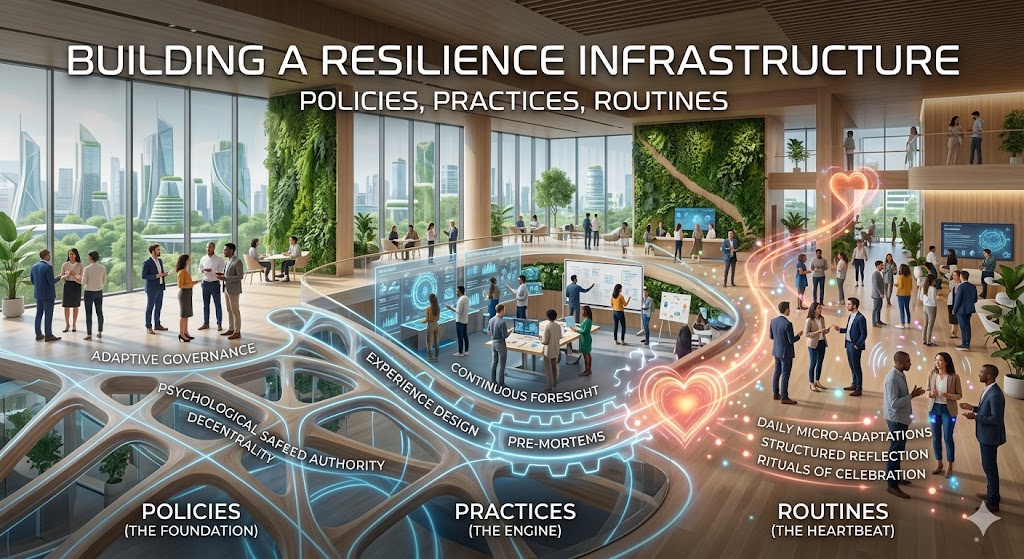
Building a Resilience Infrastructure

Policies, Practices, Routines

Building a Resilience Infrastructure


GUEST POST from Chateau G Pato

Introduction: Shifting from “Bouncing Back” to “Bouncing Forward”

In an era of continuous and accelerating disruption, we must fundamentally rethink our relationship with change. Resilience is no longer merely a reactive trait—a mechanism for “bouncing back” to the status quo after a shock. Instead, it must become a proactive infrastructure designed for “bouncing forward.” It is time to stop treating change as a frustrating anomaly and start designing organizations where continuous adaptability is the baseline state.

As we view this through a human-centered lens, a critical truth emerges: true resilience doesn’t live in risk-mitigation software or crisis management manuals. It lives entirely in your people. Therefore, a modern resilience infrastructure must be intentionally designed around human capabilities, human behaviors, and human limits. Our goal is to systematically mitigate change fatigue while actively fostering the psychological safety required for a true innovation mindset to thrive.

To move from theory to action, we must operationalize adaptability. This requires building a sustainable resilience infrastructure supported by three interconnected pillars:

  • Policies: The structural foundation that provides empowering guardrails rather than bureaucratic roadblocks.
  • Practices: The operational engine and methodologies driving human-centered change.
  • Routines: The cultural heartbeat that makes organizational adaptability a daily habit.

Pillar 1: Policies – The Structural Foundation

In most organizations, policy is synonymous with control. However, in a resilience infrastructure, policy must shift its purpose from control to enablement. To build an organization that can pivot without cracking, we must design structural guardrails that provide clarity without inducing rigidity.

Redefining Policy for Agility

Traditional, rigid policies are the natural enemy of innovation. We must transition toward “adaptive policies”—frameworks that are designed to scale their level of oversight based on the environmental context. When the pace of change accelerates, our policies should facilitate rapid response rather than acting as a bureaucratic anchor. This is about moving from a “rules-based” culture to a “principles-based” culture.

Decentralized Decision-Making

Resilience is strongest at the edges. Experience design teaches us that the employees closest to the customer and the frontline problems are the ones best equipped to navigate a sudden shift. Policies must be rewritten to push decision-making authority down the chain, empowering teams to act on real-time insights without waiting for a centralized hierarchy that may be disconnected from the current reality.

Structural Commitment to Psychological Safety

You cannot build a resilient infrastructure on a foundation of fear. Psychological safety must be more than a leadership buzzword; it must be a structural standard. This means instituting policies that protect employees when they experiment, fail, and share uncomfortable truths. If the “cost of failure” is a career-ending move, your people will choose silence over resilience every time.

Futurology as a Governance Standard

Finally, resilience requires looking beyond the immediate horizon. We must institute policies that make long-term scenario planning and “horizon scanning” a mandatory part of our governance. By making futurology a standard requirement for annual strategic resource allocation, we ensure that the organization is not just reacting to the present, but is structurally prepared for multiple possible futures.

Pillar 2: Practices – The Operational Engine

If policies provide the “why” and the “what,” then practices are the “how.” These are the repeatable methodologies and disciplines that keep the organization’s resilience muscle in a state of constant readiness. To build a resilient operational engine, we must integrate the tools of futurology and experience design into our everyday work flow.

Continuous Foresight and Innovation Portfolios

In a world of constant flux, episodic strategic planning is dead. We must replace the “annual retreat” with a practice of continuous foresight. This involves maintaining a balanced innovation portfolio—investing not just in the “Now” (core business optimization) but also the “Next” (incremental shifts) and the “New” (disruptive breakthroughs). Resilience comes from having multiple bets on the table, ensuring that when one path closes, others are already being paved.

Experience Design in Change Management

The greatest failure in organizational change is treating it as a technical rollout rather than a human transition. We must apply experience design (EX) to the change process itself. By mapping the “Employee Change Journey,” we can identify the specific moments where friction occurs and design interventions that support people emotionally and cognitively. Resilience is maximized when change is designed with people, rather than pushed onto them.

The Practice of “Pre-Mortems”

Resilience isn’t just about surviving a crisis; it’s about anticipating it. We should systematize the “pre-mortem” practice: before any major project or pivot begins, teams must imagine it has failed and work backward to determine why. This disciplined habit of visualizing failure allows us to build preemptive mitigation strategies into the very design of our initiatives, turning potential roadblocks into anticipated turns.

Cross-Pollination and Ecosystem Building

Isolation is the precursor to obsolescence. Resilience requires a radical commitment to cross-pollination. We must develop practices that actively break down departmental silos and encourage collaborative problem-solving across functions. Furthermore, true resilience extends beyond our walls; we must build ecosystems of partners, customers, and even competitors, creating a web of support and shared intelligence that no single organization could maintain on its own.

Pillar 3: Routines – The Cultural Heartbeat

While policies provide the framework and practices provide the tools, it is routines that provide the consistency. Resilience is not a grand gesture performed only during a disaster; it is a muscle built through the daily, mundane interactions of every team member. To make adaptability a permanent part of our culture, we must turn it into a habit.

The Power of Micro-Adaptations

True organizational resilience is the sum of a thousand micro-adaptations. We must design routines that encourage small, low-stakes pivots every day. When teams are accustomed to making minor course corrections in their weekly sprints, the “muscle memory” required for a macro-level organizational shift is already in place. We must stop waiting for the “Big Change” and start practicing the “Small Change” constantly.

The “Sensory” Routine

Resilient leaders don’t guess; they sense. Establishing a routine “sensory” loop—such as a fifteen-minute daily stand-up focused specifically on external signals and internal sentiment—keeps a pulse on the human-centered metrics that matter. We need to monitor change fatigue, creative energy, and engagement levels as rigorously as we monitor revenue. If the human battery is low, the resilience infrastructure will fail regardless of how good the strategy is.

Structured Reflection and Socialized Learning

Learning must be systematized, not left to chance. We must embed structured reflection into our standard weekly cadences. Whether through “after-action reviews” or retrospective routines, the goal is to ensure that every setback is converted into documented, socialized intelligence. A resilient organization is one that never fails at the same thing twice because the routine of learning is faster than the pace of disruption.

Rituals of Celebration

Finally, we must design routines that celebrate the behaviors of resilience, not just the successful outcomes. If we only celebrate “winning,” people will hide their mistakes. Instead, we must create rituals that honor intelligent risk-taking, rapid pivoting, and radical collaboration. By shining a light on the process of adaptation, we reinforce the cultural truth that in this organization, the ability to change is our greatest competitive advantage.

Conclusion: Future-Proofing the Human Experience

Building a resilience infrastructure is not a project with a defined completion date; it is a fundamental shift in how we conceive of organizational existence. We must move away from the fragile architecture of efficiency and toward the robust architecture of adaptability. By aligning our Policies, Practices, and Routines, we create a living system that does not merely survive disruption but is fueled by it.

The synthesis of these three pillars creates a powerful synergy: Policies give your people the permission to act, Practices provide them with the tools to execute, and Routines build the muscle memory necessary to sustain momentum. When these elements work in concert, the organization stops fearing the “Great American Contraction” or the next wave of AI-driven displacement and starts seeing them as canvases for new value creation.

As we look toward the next decade, the ultimate competitive advantage will not be found in the size of your balance sheet or the proprietary nature of your tech stack. It will be found in your Return on Adaptability (ROA). The organizations that thrive will be those that have fundamentally redesigned the human experience of work—transforming change from a perceived threat into a celebrated opportunity for continuous innovation.

The future belongs to the resilient. It’s time to stop waiting for the dust to settle and start building the infrastructure that allows you to dance in the whirlwind.

Frequently Asked Questions

What is the difference between organizational resilience and crisis management?

Crisis management is a reactive function designed to minimize damage during a specific event. Organizational resilience, specifically a “Resilience Infrastructure,” is a proactive, systemic capability that allows an organization to absorb shocks and “bounce forward” into a better state of operation by design.

Why is “Psychological Safety” included in a policy framework?

Innovation and resilience require employees to take risks and report failures early. By codifying psychological safety into policy, an organization moves beyond leadership lip-service and creates a structural guarantee that employees can experiment and adapt without fear of retribution.

How do routines differ from practices in this model?

Practices are the specific “how-to” methodologies and skill sets (like Customer Experience audits or Pre-Mortems). Routines are the rhythmic, daily habits that ensure those practices are actually used. Practices are the tools; routines are the heartbeat that keeps the tools in hand.

Image credit: Google Gemini

Subscribe to Human-Centered Change & Innovation WeeklySign up here to get Human-Centered Change & Innovation Weekly delivered to your inbox every week.
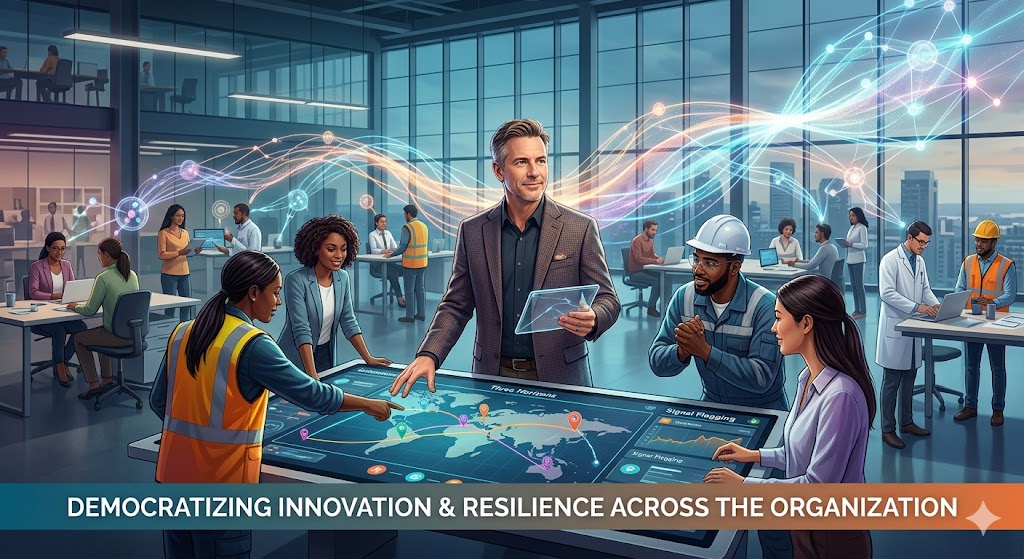
Building Collective Foresight, Not Just Executive Foresight

Democratizing Innovation & Resilience Across the Organization

LAST UPDATED: April 6, 2026 at 7:13 PM

Building Collective Foresight, Not Just Executive Foresight

GUEST POST from Chateau G Pato


I. Introduction: The Strategic Blind Spot

For decades, the corporate world has operated under the “Crystal Ball” Fallacy—the belief that foresight is a rarefied skill reserved exclusively for the C-suite or a handful of elite strategists. This centralized approach assumes that those at the top have a clearer view of the horizon, but in a world defined by volatility and rapid shifts, this perspective is often too narrow and too distant from the ground floor.

In today’s landscape, centralized foresight has become a strategic bottleneck. As the speed of change accelerates, a small group of executives cannot possibly process every “weak signal” emerging from the fringes of technology, customer behavior, and global markets. When the ability to anticipate is trapped in the boardroom, the rest of the organization remains reactive, waiting for instructions rather than actively sensing the environment.

The core thesis of this shift is simple but profound: True organizational resilience does not come from a single “visionary” leader. Instead, it is built by developing a distributed “anticipatory muscle” across the entire workforce. To thrive, we must move beyond executive foresight and embrace Collective Foresight, turning every employee into a sensor for the future.

II. Why Executive Foresight Fails in Isolation

While executive leadership is essential for setting direction, relying solely on top-down foresight creates significant organizational vulnerabilities. When the responsibility for “seeing the future” is restricted to a small group, several critical failure points emerge:

The Echo Chamber Effect

Executives often operate within high-level strategic bubbles. This distance can lead to cognitive bias, where leaders prioritize data that confirms their existing worldview while missing “weak signals” that emerge from the front lines. Those closest to the customer and the technology—the engineers, sales reps, and support staff—often see the cracks in a business model months or years before they appear on a boardroom spreadsheet.

Implementation Friction

A common pitfall of executive-led foresight is the “not invented here” syndrome. When a vision is handed down from on high without broader involvement, it often meets cultural resistance. People naturally support what they help create; by excluding the workforce from the foresight process, organizations miss the opportunity to build the intellectual buy-in necessary for rapid pivots.

The Fragility of Linearity

Executive foresight frequently relies on historical data and linear projections—essentially looking through the rearview mirror to steer forward. Collective foresight, however, leverages diverse, lived experiences. This cognitive diversity is better equipped to spot non-linear shifts and “black swan” events because it draws from a wider variety of mental models and external touchpoints.

Key Insight: Foresight is not a product to be delivered; it is a capability to be distributed. When anticipation is isolated at the top, the organization loses its ability to react in real-time.

III. The Architecture of Collective Foresight

Building a collective foresight capability requires more than just an open-door policy; it requires a structured framework that captures, filters, and synthesizes insights from every corner of the organization. This architecture transforms individual observations into organizational intelligence.

Human-Centered Input: From Data to Insight

While big data provides the “what,” your people provide the “why.” Collective foresight focuses on insight-mining—systematically gathering observations from employees who occupy the “edge” of the organization. These individuals interact with shifting customer frustrations, emerging competitor tactics, and technological friction points daily. By treating every employee as a human sensor, the organization gains a high-resolution view of the market that no dashboard can replicate.

The Three Horizons Model (Revisited)

In a collective framework, the Three Horizons model serves as a collaborative language for innovation rather than just a reporting tool for leadership:

  • Horizon 1: Optimization. The entire workforce identifies ways to improve and defend the current core business.
  • Horizon 2: Evolution. Cross-functional teams explore adjacent opportunities and “next-generation” versions of current offerings.
  • Horizon 3: Revolution. A diverse group of “pathfinders” from different levels identifies disruptive possibilities that could render the current model obsolete.

Diversity as a Strategic Filter

The greatest defense against strategic blind spots is cognitive diversity. The architecture of collective foresight intentionally brings together disparate viewpoints—marketing, engineering, HR, and finance—to stress-test assumptions. When people with different mental models look at the same trend, they see different risks and opportunities. This friction is exactly what produces a robust, multi-dimensional view of the future.

By democratizing access to these frameworks, the organization shifts from a culture of “waiting for instructions” to a culture of active anticipation.

IV. Tools for Democratizing Anticipation

To move from the theory of collective foresight to a functional reality, organizations must provide the infrastructure that allows insights to flow freely. The goal is to lower the barrier to entry so that “sensing the future” becomes a natural byproduct of daily work. Here are the essential tools for democratizing anticipation:

Crowdsourced Trend Scouting

Rather than relying on expensive, static annual reports, forward-thinking organizations implement internal signal-flagging platforms. These are digital spaces where any employee—from the warehouse to the sales floor—can post a “signal”: a new competitor product, a strange customer request, or a niche technological development. By tagging and aggregating these signals, patterns emerge that would be invisible to a centralized strategy team.

Scenario Planning Workshops

Foresight is a muscle that requires regular exercise. Collective scenario planning involves moving away from “telling the future” and toward “practicing the future.” Using cross-functional roleplay and “pre-mortems,” teams can explore “What If?” scenarios together. This creates a shared mental map of potential disruptions, ensuring that if a crisis or opportunity hits, the organization has already mentally rehearsed its response.

Innovation Gamification

To drive engagement, organizations can utilize internal prediction markets or incentive structures. By gamifying the spotting of significant market shifts or technological milestones, you tap into the collective intelligence of the crowd. This doesn’t just generate data; it cultivates a culture of curiosity where employees feel that their unique perspective on the horizon is both valued and rewarded.

FutureHacking™: A Framework for Collective Anticipation

To move beyond mere observation, organizations can employ Braden Kelley’s FutureHacking™ methodology that helps any employee or entrepreneur become their own futurist. This human-centered approach focuses on identifying and analyzing “weak signals”—those subtle indicators of change that are often ignored by traditional strategic planning. By engaging the entire workforce in this process, FutureHacking™ transforms foresight from a static report into a dynamic, ongoing capability. It empowers individuals at every level to look beyond the immediate horizon, challenge existing assumptions, and actively design the future rather than simply reacting to it. This methodology ensures that innovation isn’t just a localized event, but a continuous, organization-wide practice of sensing and responding to the next big shift.

By equipping the workforce with these tools, foresight shifts from a mysterious executive ritual into a transparent, participatory process that builds organizational agility from the ground up.

V. Overcoming the Cultural Barriers

The primary obstacles to collective foresight are rarely technological; they are cultural. Transitioning from a top-down visionary model to a distributed sensing model requires a fundamental shift in how an organization values information and handles dissent.

Psychological Safety: The Bedrock of Foresight

For collective foresight to function, employees must feel safe to share “uncomfortable” truths. If a culture punishes those who point out the obsolescence of a flagship product or the rise of a disruptive competitor, the organization’s early warning system will go silent. Building psychological safety ensures that contrarian views are viewed as strategic assets rather than signs of disloyalty.

The “Not My Job” Syndrome

Foresight is often viewed as an “extra” task that sits outside an employee’s core responsibilities. To overcome this, organizations must redefine foresight as a core competency for every role. Whether in HR, finance, or operations, understanding how the future might impact one’s specific domain is essential for long-term excellence. We must move from the idea of a “Strategy Department” to a “Strategy Culture.”

Incentivizing Curiosity

Most corporate structures are designed to reward execution and efficiency—doing today’s job better. However, collective foresight requires exploration. To bridge this gap, leadership must find ways to celebrate and reward the “scouts” within the company. This means recognizing not just the success of a project, but the value of the insight that prevented a failure or identified a new path forward.

Reframing the Goal: The objective is to shift the internal narrative from “knowing the answer” to “asking the right questions.”

VI. Conclusion: From Prediction to Preparedness

The ultimate goal of fostering collective foresight is not to turn every employee into a fortune teller. It is to move the organization from a posture of prediction to one of preparedness. In a world of constant flux, being “right” about the future is often a matter of luck; being “ready” for multiple futures is a matter of design.

The Shift in Mindset

When foresight is democratized, the internal narrative shifts. It is no longer about following a fixed five-year plan set by the board; it is about maintaining a living, breathing map of possibilities. This shift ensures that the organization remains agile, capable of pivoting not because it was told to, but because it saw the turn in the road coming from a mile away.

The Competitive Advantage

Organizations that master collective foresight move faster than their competitors. This isn’t just because they have better information, but because the “why” of a pivot is already understood at every level of the company. When change is co-created, the friction of implementation evaporates. Strategy becomes a conversation, and innovation becomes a shared responsibility.

Final Call to Action: Stop looking for a crystal ball in the executive suite. Your most powerful early warning system is already on your payroll. Empower your people, build the infrastructure for their insights to reach the surface, and remember: The future is too big for one room to hold.

Frequently Asked Questions

What is the difference between executive foresight and collective foresight?

Executive foresight relies on a small group of leaders to predict the future, often creating bottlenecks and missing “weak signals.” Collective foresight democratizes this process, leveraging the diverse perspectives of the entire workforce to build a more responsive, distributed “anticipatory muscle.”

How can an organization start building collective foresight?

It begins by creating psychological safety and implementing simple tools like signal-flagging platforms. By encouraging employees at all levels to share observations about market shifts or customer friction, foresight moves from a boardroom ritual to a core organizational competency.

Why is cognitive diversity important for strategic planning?

Cognitive diversity acts as a filter against executive bias. When people from different departments—like engineering, sales, and HR—examine the same trend, they identify different risks and opportunities, resulting in a more robust and realistic view of potential futures.

Image credits: Gemini

Subscribe to Human-Centered Change & Innovation WeeklySign up here to join 17,000+ leaders getting Human-Centered Change & Innovation Weekly delivered to their inbox every week.

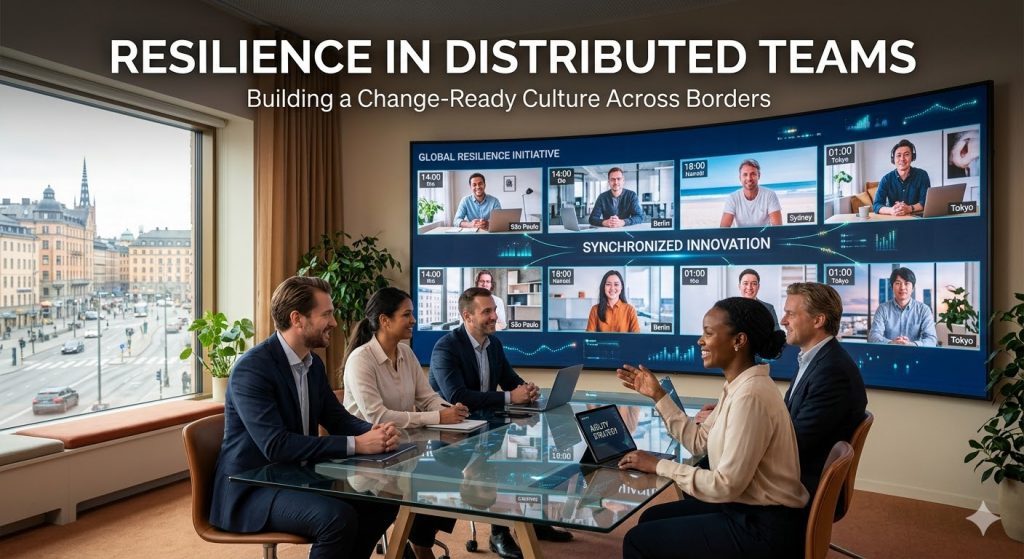
Resilience in Distributed Teams

LAST UPDATED: March 15, 2026 at 06:39 PM

Resilience in Distributed Teams

GUEST POST from Art Inteligencia


I. The New Architecture of Resilience: Beyond “Bouncing Back”

In the traditional corporate lexicon, resilience was often treated as a reactive defense mechanism — a sturdy umbrella to be deployed only when the storm of market volatility or internal restructuring began to pour. We viewed it as the ability to “bounce back” to a previous state of equilibrium. However, in a world defined by human-centered innovation and increasingly distributed teams, that definition is no longer sufficient. To thrive today, we must shift our perspective from recovery to evolution.

Moving from Defensive to Proactive Resilience

True resilience in a modern, borderless organization isn’t about returning to the status quo; it’s about springing forward into a new reality. It is a proactive strategy built into the very fabric of how we work. In a distributed environment, where the physical cues of the office are absent, resilience must be architected intentionally. It is the collective capacity of a team to absorb tension, learn from disruption, and reorganize itself to be even more effective than it was before the challenge arose.

The Distributed Reality: Culture Beyond “Place”

We have moved past the era where “place” was the primary container for organizational culture. When your team spans time zones, languages, and home-office setups, you cannot rely on the “accidental collisions” of the hallway to build strength. The architecture of a distributed team must be fluid yet firm. We are no longer managing a physical site; we are managing a network of human potential. This shift requires us to rethink how we anchor our people — not to a building, but to a shared purpose and a robust digital ecosystem.

The Three Pillars of the Change-Ready Culture

Building this new architecture requires a focus on three fundamental pillars that ensure a team remains “change-ready” regardless of their physical coordinates:

  • Psychological Safety: The bedrock that allows individuals to take risks and speak up without fear of retribution, even through a screen.
  • Operational Agility: The structural flexibility to shift workflows and communication styles as the environment demands.
  • Empathetic Leadership: A leadership style that prioritizes the human experience, recognizing that the person on the other side of the Zoom call is a whole human, not just a resource.

By integrating these pillars, distributed teams transform from a collection of isolated individuals into a dynamic, resilient organism capable of navigating the complexities of the modern innovation landscape.

II. Pillar 1: Strengthening the Human Connection (Psychological Safety)

In a physical office, psychological safety is often reinforced through the micro-signals of human interaction — a nod in the hallway, a shared laugh before a meeting, or the ability to sense the “vibe” of a room. In a distributed environment, these signals are filtered through screens and asynchronous text, creating a “context deficit.” To build a resilient team, we must intentionally over-index on creating a safe harbor for ideas, questions, and even dissent.

Combating Digital Isolation through Intentional Rituals

Isolation is the silent killer of innovation. When individuals feel like “nodes” in a network rather than members of a team, they stop taking risks. Building resilience requires us to move beyond the transactional nature of video calls. We must design intentional rituals that facilitate human connection:

  • The “Check-In” Protocol: Starting meetings not with an agenda item, but with a human-centric pulse check. This isn’t just “How are you?” but “What is your energy level today, and how can we support you?”
  • Working Out Loud: Encouraging teams to share “half-baked” ideas or works-in-progress in public channels. This demystifies the creative process and signals that perfection is not a prerequisite for participation.
  • Asynchronous Appreciation: Using dedicated channels to celebrate small wins and “productive failures” publicly, ensuring that remote contributions are visible and valued.

The Safety to Fail Out Loud (From a Distance)

Resilience is born from the ability to learn quickly from what doesn’t work. In a distributed setting, the fear of “failing quietly” is real — if no one sees the struggle, the learning is lost. We must create a culture where vulnerability is a professional asset.

Leaders must model this by sharing their own hurdles and pivots. When a leader admits, “I missed the mark on this projection, here is what I learned,” it gives the team the “permission to be human.” This transparency reduces the anxiety of performance and allows the team to focus their collective energy on solving problems rather than hiding them.

Architecting Intentional Inclusion

A resilient distributed team is one where every voice has a clear path to the table. Proximity bias — the tendency to favor those we see more often — is a significant threat to psychological safety. To combat this, we must:

  1. Audit Participation: Actively monitoring who is speaking in digital forums and inviting quieter voices into the conversation through direct, supportive prompts.
  2. Standardize Information Access: Ensuring that the “why” behind decisions is documented and accessible to everyone, regardless of their time zone. Information symmetry is a form of respect.
  3. Define the “Right to Disconnect”: Psychological safety includes the safety to step away. Clear boundaries around “deep work” hours and “off-grid” time prevent burnout and demonstrate that the organization values the person’s long-term health over short-term availability.

“Innovation isn’t about the tools we use to talk; it’s about the trust we build that allows us to truly hear each other across the digital divide.” — Braden Kelley

III. Pillar 2: Designing for Operational Agility

In a centralized office, “agility” is often mistaken for “speed” — the ability to pivot quickly because everyone is in the same room. In a distributed environment, true operational agility is about synchronization without constant contact. It is the structural framework that allows a team to remain fluid, responsive, and innovative without the friction of endless status meetings or the bottleneck of centralized decision-making.

The Shift to Asynchronous Innovation

The greatest threat to distributed resilience is “meeting fatigue,” which drains the cognitive energy required for deep, creative work. To build an agile, resilient team, we must treat asynchronicity as a first-class citizen. This means:

  • Documentation as a Culture: Moving away from “oral traditions” where knowledge lives in people’s heads. If a decision isn’t documented in a shared, searchable space, it didn’t happen. This democratizes information and allows innovation to happen at 2:00 AM in Tokyo just as easily as 2:00 PM in New York.
  • Low-Friction Feedback Loops: Utilizing collaborative canvases and threaded discussions to iterate on ideas. This allows for “passive participation,” where team members can contribute when they are in their highest state of flow, rather than when a calendar invite dictates.

The Power of Intentional Clarity

In a distributed world, clarity is kindness. Agility is hindered when team members are unsure of their boundaries or the “Why” behind a pivot. We must replace “supervision” with “alignment.” When every person understands the North Star metric and the constraints of the project, they are empowered to make autonomous decisions that keep the momentum moving forward.

This requires a radical commitment to defining Outcome-Based Success. We stop measuring the “process” (how many hours were spent at a desk) and start measuring the “impact” (what value was created). This shift grants the team the flexibility to manage their own energy and environments, which is a core component of long-term resilience.

Tooling for Flow, Not Friction

The technology stack of a distributed team should act as a force multiplier for human talent, not a digital leash. Operational agility is maintained by selecting tools that:

  1. Reduce Context Switching: Integrating platforms so that communication happens where the work lives (e.g., commenting directly on a design file or a code repository).
  2. Automate the Mundane: Using automation for status updates and administrative tasks to free up “human bandwidth” for complex problem-solving and empathetic connection.
  3. Visualize the Workflow: Utilizing transparent Kanban boards or digital twin environments so that anyone, at any time, can see the state of play without needing to ask for a report.

When operational agility is designed correctly, the “distance” between team members becomes irrelevant. The system itself becomes resilient, capable of absorbing individual absences or regional disruptions without the entire project grinding to a halt.

IV. Pillar 3: Empathetic Leadership and the “Human-First” Pivot

In a distributed environment, the traditional “command and control” model of leadership doesn’t just fail — it actively erodes resilience. When you cannot walk the floor to gauge the energy of your team, leadership must shift from oversight to empathy. This isn’t about being “nice”; it is about the strategic recognition that a team’s cognitive and emotional capacity is the engine of all innovation.

Managing Energy, Not Hours

The most resilient leaders in distributed teams have moved past the industrial-age obsession with the 40-hour “presence” requirement. They understand that creativity and problem-solving are non-linear. To lead with empathy is to manage energy cycles:

  • Respecting the “Deep Work” Sanctuary: Protecting team members from digital interruptions during their peak productivity hours.
  • Normalizing Asynchronous Flexibility: Acknowledging that a team member might need to step away for a midday walk or family commitment to return with a refreshed perspective.
  • Monitoring for Digital Burnout: Actively looking for signs of “always-on” behavior — such as emails sent at 3:00 AM — and coaching individuals to set sustainable boundaries.

The Leader as an Architect of Belonging

In the absence of a physical office, the leader becomes the primary curator of culture. This requires a shift in focus from “what we are doing” to “who we are becoming.” An empathetic leader ensures that every team member, regardless of their geography, feels a sense of belonging and significance.

This is achieved through “High-Touch” digital interactions: 1-on-1 meetings that prioritize career aspirations and personal well-being over task lists, and “Storytelling” sessions where the leader connects daily tasks back to the organization’s larger human-centered mission.

Vulnerability as a Catalyst for Resilience

Resilience is often built in the “gaps” — the moments when things go wrong. An empathetic leader uses vulnerability to bridge these gaps. By being open about their own challenges — whether it’s “Zoom fatigue,” a failed experiment, or the difficulty of balancing work and life — they lower the “perfection barrier” for the rest of the team.

This transparency builds a high-trust environment where team members feel safe to say, “I’m struggling with this pivot,” or “I need help.” When a leader models this behavior, they aren’t showing weakness; they are building a psychologically durable team that can face any market disruption with collective honesty.

“Leadership is no longer about being the smartest person in the room; it’s about creating a digital room where everyone feels smart, safe, and seen.”

V. Overcoming the “Change Gap” in Remote Environments

The “Change Gap” is the cognitive and emotional distance between a leadership decision and the team’s ability to execute it. In a physical office, this gap is bridged by osmosis — hearing conversations, seeing prototypes, and gauging the “mood” of the building. In a distributed environment, the gap can become a canyon. Bridging it requires a Human-Centered Change approach that treats communication as a product, not an afterthought.

Strategic Communication Cascades

When a pivot occurs, information often gets diluted as it travels through Slack channels, email threads, and Jira tickets. To maintain resilience, we must move from broadcasting to cascading:

  • The “Multi-Modal” Approach: Delivering the “Why” behind the change through various medium — a short video for emotional resonance, a detailed document for deep-diving, and an interactive Q&A session for real-time clarity.
  • Repeat to Compete: In a distributed world, people are bombarded with digital noise. A change message must be repeated seven times in seven different ways before it truly enters the team’s collective consciousness.

Building a Shared Vocabulary for Innovation

Misunderstanding is the enemy of agility. When a team is spread across the globe, words like “pivot,” “MVP,” or “urgency” can have different cultural and professional connotations.
A resilient team builds a shared dictionary of change. This means explicitly defining what “success” looks like for a specific initiative and creating common metaphors that bridge geographic divides. When everyone uses the same language to describe a problem, they can solve it 50% faster.

Continuous Feedback Loops: The Digital Pulse

In a distributed setting, you cannot wait for the “Annual Engagement Survey” to see if your team is breaking. Resilience requires real-time sentiment analysis:

  1. Pulse Surveys: Short, two-question surveys (e.g., “Do you have the tools you need today?” and “How is your stress level?”) to catch friction points before they become fires.
  2. Office Hours & AMA (Ask Me Anything): Creating “open-door” digital spaces where the hierarchy is flattened, and any team member can challenge the direction of a change initiative.
  3. Retrospectives as Ritual: Making “Look Back to Leap Forward” sessions a non-negotiable part of the sprint cycle. This ensures that the process of change is being innovated just as much as the product.

By closing the Change Gap, we ensure that the team doesn’t just “endure” a transition, but actively shapes it. This sense of agency is the ultimate fuel for distributed resilience.

VI. Conclusion: The Future is Fluid

As we navigate the complexities of a post-geographic world, we must realize that distributed work is not a compromise—it is an opportunity to build more resilient, inclusive, and innovative organizations. Resilience is not a destination we reach; it is a muscle that must be intentionally exercised through every Slack message, every asynchronous document, and every leadership decision.

Summarizing the Resilience Blueprint

The transition from a “co-located” mindset to a “distributed-first” philosophy requires us to double down on the human elements of work:

  • Psychological Safety ensures that the digital divide does not become a wall of silence.
  • Operational Agility creates the framework for synchronization without the friction of constant surveillance.
  • Empathetic Leadership anchors the team in a shared purpose, prioritizing the energy and well-being of the people behind the screens.

The Call to Action: Empowering the Distributed Change Agent

To build a truly change-ready culture, we must empower every individual to act as a change agent. Resilience is most potent when it is decentralized. Don’t wait for a top-down mandate to start building these habits. You can start tomorrow by:

  1. Replacing one meeting with a well-structured asynchronous document to respect your team’s “flow” state.
  2. Sharing a “Learning Moment” publicly to model the vulnerability that drives psychological safety.
  3. Conducting a “Context Check” at the start of your next call to ensure everyone understands the Why behind your current pivot.

Final Thought: Designing for the Human at the Center

The “distance” in distributed teams is only as wide as the gaps in our empathy and our systems. When we design our workflows, our communication, and our leadership styles with the human experience at the center, the physical miles between us cease to matter. We aren’t just building teams that can survive a crisis; we are building a global network of talent that is ready to innovate through anything.

“In the end, innovation is a team sport — and in a distributed world, the playing field is everywhere.” — Braden Kelley

Frequently Asked Questions

To help teams quickly align on the core principles of distributed resilience, here are the three most critical questions and their strategic answers.

1. What is the biggest barrier to resilience in distributed teams?

The primary barrier is Proximity Bias. This is the unconscious tendency to favor team members who are physically closer or more “visible” in digital channels. It erodes psychological safety for remote workers and creates information silos that slow down innovation.

2. How can we maintain “Agility” without constant status meetings?

Agility is maintained through Asynchronous Innovation. By shifting toward a “Documentation-First” culture — where decisions and progress are logged in shared, searchable spaces — teams can maintain momentum across time zones without sacrificing deep-work hours to meeting fatigue.

3. What is the role of empathy in a change-ready culture?

Empathy is the operating system of resilience. It allows leaders to manage team energy cycles rather than just clock-hours. By recognizing the human context behind the screen, leaders build the trust necessary for teams to pivot quickly during periods of high uncertainty.

Image credit: Google Gemini

Subscribe to Human-Centered Change & Innovation WeeklySign up here to get Human-Centered Change & Innovation Weekly delivered to your inbox every week.
Organizational Stress Tests That Reveal Adaptive Capacity

LAST UPDATED: March 5, 2026 at 4:07 PM

Organizational Stress Tests That Reveal Adaptive Capacity

GUEST POST from Art Inteligencia


Beyond Efficiency to Adaptability

For too long, the corporate world has worshipped at the altar of efficiency. We’ve spent decades leaning out processes, cutting “redundancy,” and optimizing for a world that stays static. But here’s the reality: innovation isn’t about the hours you put in; it’s about the insight you bring out. If your organization is so tightly wound that it has no room for those insights to breathe, you aren’t efficient — you’re brittle.

The Efficiency Trap

Many leaders mistake a streamlined operation for a resilient one. In truth, an over-optimized system often lacks the “slack” necessary to respond to sudden market shifts. When the unexpected happens, these rigid structures don’t bend — they break. True leadership requires moving beyond mere optimization to cultivate adaptive capacity.

Defining Adaptive Capacity

Think of adaptive capacity as the hidden elasticity within your culture, your processes, and your people. It is the structural integrity of the vessel. While your competitors are busy counting the hours spent in meetings, an adaptive organization is focused on the speed and quality of the insights they can navigate to the finish line. It is the difference between a ship that looks good in the harbor and one that can actually survive a gale.

The Thesis: Testing the Vessel

Resilience isn’t a passive trait you hope you have when disaster strikes; it’s a muscle that must be intentionally built and tested. By applying controlled “stress tests” to your organization, you reveal the friction points that stifle change. We don’t test to find failure; we test to ensure that resilience is the vessel strong enough to carry your most transformative ideas all the way to completion.

Test 1: The “Information Vacuum” Stress Test

In a traditional hierarchy, information flows down and permission flows up. But in a fast-moving market, this “wait-and-see” culture is a death sentence for innovation. The Information Vacuum stress test is designed to measure your organization’s autonomous pulse: what happens when the “boss” isn’t there to give the answers?

The Scenario: Removing the Top-Down Directive

Imagine a critical project or a sudden operational hurdle occurs, but the executive leadership team is intentionally silent. No memos, no “all-hands” guidance, and no direct orders for 48 hours. Does the organization freeze, or do the teams closest to the problem step up to solve it?

What This Test Reveals

  • Empowerment of Middle Management: Are your managers leaders, or are they merely “order-takers”? This test exposes whether they have the confidence to make calls based on the insights they bring out from the front lines.
  • Clarity of the “North Star”: Resilience is the vessel, but the “North Star” is the compass. If teams don’t know the ultimate goal, they cannot navigate the vacuum. A successful test shows teams aligning their actions with the company’s core purpose without being told to do so.

The Metric: Time to Autonomous Action

The key performance indicator here isn’t the hours you put in trying to reach a supervisor; it is the Time to Autonomous Action. We measure how long it takes for a team to identify the gap, form a cross-functional response, and execute a decision. If your vessel is leaking authority, the time to action will be infinite. If it is resilient, the “Information Vacuum” becomes a space where your best talent finally has the room to breathe and lead.

Test 2: The “Rapid Pivot” Simulation

In a world of constant disruption, your organization’s greatest risk isn’t a lack of effort; it’s a lack of agility. If innovation is about the insight you bring out, then your business model must be flexible enough to act on those insights instantly. The Rapid Pivot simulation tests whether your resources are liquid or frozen in place.

The Scenario: Removing a Core Revenue Stream

This is a high-stakes tabletop exercise. We simulate a reality where a primary product line, a key customer segment, or a major revenue stream is suddenly rendered obsolete by a competitor’s breakthrough or a regulatory shift. The challenge: The organization must draft a viable “Pivot Plan” within 48 hours to maintain its resilience and market position.

What This Test Reveals

  • Resource Fluidity: Are your budgets and talent pools locked in departmental “silos,” or can they be reallocated to a new opportunity by the end of the day? A resilient vessel doesn’t sink when one compartment floods; it seals the bulkhead and redirects power.
  • Cognitive Flexibility: This test exposes the “Grief Cycle.” Does the leadership team spend their energy mourning the lost product, or do they immediately focus on the next insight? If the culture is too attached to “how we’ve always done it,” the vessel will never reach the finish line.

The Metric: The Pivot Velocity Score

We aren’t measuring the hours you put in to save a dying product; we are measuring the Velocity of Reallocation. How quickly can 20% of your top talent be reassigned to a new “insight-driven” project? If your organizational structure is too rigid to move, your adaptive capacity is zero. A high Pivot Velocity Score indicates an organization that views change not as a threat, but as the ultimate vessel for growth.

Test 3: The “Friction Audit” of the Idea Pipeline

Too many organizations think they have an “innovation problem” when they actually have a “plumbing problem.” If innovation is about the insight you bring out, we have to look at the pipes those insights must travel through. The Friction Audit isn’t about how many ideas you have; it’s about how many of them survive the journey to the finish line.

The Scenario: Tracking the “Wildcard” Idea

We select a high-potential, non-traditional “wildcard” idea from the front lines — the kind of insight that challenges the status quo. We then shadow that idea as it moves up the chain of command. Does it gain momentum, or is it slowly strangled by “business as usual”?

What This Test Reveals

  • The Resilience of the Idea: Does your culture act as a vessel that carries the idea forward, or as a filter that strips away its transformative potential? If an insight has to be “diluted” to get approval, your adaptive capacity is compromised.
  • Psychological Safety: This test measures whether employees feel safe bringing insights out. If the friction is too high, people stop trying. They’ll put their hours in, but they’ll keep their best ideas to themselves to avoid the bureaucratic gauntlet.

The Metric: The Idea Velocity & Vitality Index

We measure the Velocity of Approval (how many layers of management must say “yes” before a pilot can begin) and the Vitality Index (how much of the original “disruptive” insight remains at the end of the process). If your process is designed to eliminate risk rather than manage it, your vessel is too heavy to sail. A resilient pipeline is one where friction is low and the “finish line” is always in sight.

Section V: Analyzing the Results — Identifying the Fragile vs. the Antifragile

Data without action is just noise. Once you have run these stress tests, the goal isn’t to file a report; it’s to rebuild the vessel of resilience. If innovation is about the insight you bring out, then the analysis phase is where we find out why those insights are getting stuck in the hull.

Identifying the Structural Bottlenecks

The stress tests will inevitably expose “choke points” — areas where hierarchy, outdated KPIs, or a “we’ve always done it this way” mentality slows down adaptation. These are the leaks in your vessel. We look for patterns: Is the delay happening at the middle-management layer? Is it a lack of shared vision from the top? Or is the “hours in” culture so pervasive that people are too exhausted to be agile?

Spotting the “Connectors”

During a crisis or a simulation, certain individuals naturally step up to bridge silos. These are your Resilience Champions. They don’t just put the hours in; they are the ones who intuitively know how to carry an insight to the finish line by navigating around bureaucracy. A key part of your analysis is identifying these people and empowering them to lead the cultural shift toward higher adaptive capacity.

Building the Feedback Loop

  • From Fragile to Robust: An organization that breaks under stress. We must identify these points and add the “slack” or autonomy needed to bend instead.
  • From Robust to Antifragile: The ultimate goal. An antifragile organization doesn’t just survive the stress test; it gets better because of it. We use the data to build a Human-Centered Change Architecture that treats every disruption as fuel for the next innovation.

The Ultimate Insight

The result of these tests is a roadmap for transformation. We aren’t just looking for efficiency anymore; we are looking for the Adaptive Capacity that ensures your organization remains relevant long after the current market storm has passed. When you fix the vessel, you ensure the journey to the finish line is not just possible, but inevitable.

Conclusion: Building the Vessel of Resilience

At the end of the day, an organization’s adaptive capacity is its ultimate competitive advantage. We live in an era where the “safe” path is often the most dangerous one. If you aren’t constantly testing your structural integrity, you are simply waiting for a market disruption to do it for you — and by then, it might be too late to plug the leaks.

Summary: Insights Over Hours

As we’ve explored through these stress tests, innovation isn’t about the hours you put in; it’s about the insight you bring out. You can have the most brilliant minds in the world, but if your organizational “vessel” is too rigid, too siloed, or too fearful to move, those insights will never reach the finish line. Resilience is the vehicle that transforms a great idea into a market-shifting reality.

Final Thought: Don’t Wait for the Storm

The goal of these stress tests isn’t to create a culture of anxiety, but a culture of preparedness and empowerment. When you intentionally lean into these simulations, you aren’t just identifying weaknesses; you are building the “muscle memory” of change. You are proving to your teams that they have the permission — and the responsibility — to lead.

“The finish line isn’t a static point; it’s a moving target. Only the most resilient vessels have the agility to chase it down.”

Start small. Run one test. Listen to what the friction tells you. Then, iterate. That is how you build an organization that doesn’t just survive the future, but defines it.

Frequently Asked Questions

1. Why focus on “Adaptive Capacity” instead of just “Efficiency”?

Efficiency is about doing the same thing better; adaptive capacity is about having the structural integrity to do something different when the market shifts. Innovation isn’t about the hours you put in; it’s about the insight you bring out, and you need a flexible vessel to carry those insights to the finish line.

2. How often should an organization run these stress tests?

Resilience is a muscle. I recommend running a “light” version of a stress test — like an Information Vacuum simulation — at least once a year. This ensures your “vessel” stays watertight and your teams remain empowered to lead without waiting for a directive.

3. What is the biggest hurdle to building a resilient organization?

The biggest hurdle is a culture that prioritizes “hours in” over “insights out.” When people are penalized for the friction of a process they didn’t create, they stop innovating. Building resilience requires a human-centered approach that reduces friction and rewards agility.

Image credit: Google Gemini

Subscribe to Human-Centered Change & Innovation WeeklySign up here to get Human-Centered Change & Innovation Weekly delivered to your inbox every week.
Personal Resilience Routines That Sustain Innovative Thinking

LAST UPDATED: February 23, 2026 at 3:41PM
Personal Resilience Routines That Sustain Innovative Thinking

GUEST POST from Art Inteligencia

I. Introduction: The Innovation Burnout Paradox

In the pursuit of the “Next Big Thing,” we often overlook the most fragile component of the innovation engine: the human mind.

The Cognitive Cost of Constant Change

By 2026, the velocity of technological disruption has reached a point where “change fatigue” is no longer a buzzword—it is a baseline reality. Innovation requires a high degree of cognitive bandwidth; it demands the ability to see patterns in chaos and find the “unobvious” path. However, when an innovator is in a state of chronic stress, the brain shifts from the creative prefrontal cortex to the reactive amygdala. We stop looking for the future because we are too busy surviving the present.

Resilience as a Strategic Asset

We must stop viewing resilience as a “soft skill” or a post-crisis recovery tactic. In a high-stakes environment, resilience is a strategic asset. It is the proactive management of your creative energy. Without a structured routine to protect your mental state, your capacity for breakthrough thinking doesn’t just slow down—it vanishes.

The Core Thesis: Regulated Minds Lead Best

The most successful innovators of this decade aren’t the ones working the longest hours; they are the ones with the most regulated nervous systems. To sustain innovative thinking, we must treat our psychology like our technology: it requires regular updates, maintenance, and a secure firewall against the noise of the modern world.

The Braden Kelley Insight: Resistance to change in an organization is often just a symptom of collective exhaustion. When we build personal resilience, the “future” stops being an intimidating threat and starts being a playground for our curiosity.

II. The Physiology of Creativity: Understanding the Baseline

Innovation is a biological process before it is a business process. To sustain creative output, we must understand the “hardware” our ideas run on.

The Prefrontal Cortex vs. The Amygdala

The prefrontal cortex is the seat of our innovation center—it handles complex problem-solving and lateral thinking. However, it is also the most energy-intensive part of the brain. When we are stuck in a cycle of “survival mode,” the amygdala takes over, prioritizing immediate threats over long-term vision. You cannot “brainstorm” your way out of a physiological threat response. Resilience routines serve to keep the amygdala quiet so the prefrontal cortex can stay loud.

The Role of Neuroplasticity in Innovation

In 2026, we understand that the brain is not a static organ; it is a dynamic network. Resilience routines are essentially neuroplasticity training. By intentionally exposing ourselves to diverse perspectives and “recovery periods,” we strengthen the neural pathways associated with divergent thinking. This makes the brain more nimble, allowing it to pivot between “focus mode” and “discovery mode” with less friction.

The Energy/Output Curve

Innovation doesn’t happen at a steady state; it happens in pulses. Every individual has a personal “Peak Curiosity Window”—a time when cognitive load is light and associative thinking is at its highest. Resilience routines help us map this curve, ensuring we spend our most valuable cognitive capital on our most complex innovation challenges rather than administrative clutter.

The Braden Kelley Insight: You cannot force a breakthrough when your “biological battery” is at 5%. Innovation isn’t just about what you think; it’s about the physiological state you are in while you’re thinking it. Protect your physiology to protect your future.

III. Daily Routines: The “Innovator’s Shield”

To be an effective change agent in 2026, you must build a defensive perimeter around your focus. These three daily practices form the “Innovator’s Shield,” protecting your creative spark from the dampening effect of the daily grind.

1. The Morning “Intent Calibration”

The most dangerous habit of a modern leader is “Reactive Waking”—immediately checking emails or news feeds. This cedes control of your brain to other people’s priorities. Instead, implement a 15-minute Intent Calibration. Before touching a device, define the one “unobvious” problem you want your subconscious to work on today. By setting this “North Star” early, you prime your brain to filter the day’s noise for relevant innovation signals.

2. Scheduled “Digital Fasting” Blocks

Innovation requires synthesis, which cannot happen in a state of constant notification pings. Establish “Analog Islands”—blocks of 60 to 90 minutes where you are completely offline. This digital fasting period allows the brain to transition from Linear Processing to Associative Thinking. This is where the dots finally connect, turning disparate data into a cohesive strategy.

3. The Micro-Recovery Pulse

Complexity is exhausting. We must move away from the “8-hour marathon” and toward “Sprinting and Pulsing.” After every high-complexity task, perform a 5-minute Micro-Recovery. This isn’t scrolling social media; it’s a sensory shift—walking, box breathing, or simply looking at a distant horizon. These pulses prevent “cognitive debt” from accumulating, ensuring you have as much creative energy at 4:00 PM as you did at 9:00 AM.

The Braden Kelley Insight: You don’t find time for innovation; you make time by fiercely protecting your bandwidth. The “Shield” isn’t about isolation—it’s about creating the mental space necessary to be truly present when the big problems arrive.

IV. Cognitive Routines: Protecting the “Why”

Resilience isn’t just about how you rest; it’s about how you process information. These cognitive habits ensure your mindset remains agile enough to pivot when the data changes.

1. The Weekly Curiosity Audit

In the rush to execute, we often mistake movement for progress. A Curiosity Audit is a ritualized review where you ask: “What did I learn this week that challenged my existing mental models?” If you can’t answer that, you aren’t innovating; you’re just repeating. This routine forces the brain to value “intellectual discovery” as much as “task completion.”

2. Reframing the “Fail” into “Data”

The emotional weight of a failed project is the leading cause of innovation burnout. Successful resilient thinkers use a linguistic routine to depersonalize setbacks. Instead of saying “We failed,” the routine is to ask, “What was the unexpected signal in this experiment?” By treating every outcome as Experimental Data, you remove the threat to the ego and keep the prefrontal cortex engaged in problem-solving.

3. Strategic Perspective Shifting

Cognitive rigidity is the enemy of innovation. As a daily warm-up, practice Lateral Thinking: pick a problem and force yourself to view it through the lens of a completely different industry (e.g., “How would a hotel manager solve this software latency issue?”). This routine keeps your neural pathways flexible and prevents the “functional fixedness” that kills creative vision.

The Braden Kelley Insight: Your mindset is a muscle. If you only exercise it on “safe” problems, it will atrophy. Cognitive resilience is about building the strength to stay curious even when the results are disappointing. Innovation is the art of staying in the game.

V. Operationalizing Resilience in Teams

Personal resilience is the spark, but team resilience is the power grid. To build a sustainable innovation culture in 2026, leaders must scale individual habits into collective operating procedures.

Psychological Safety as a Collective Routine

Innovation cannot survive in an environment of fear. We must normalize “recovery time” and the open discussion of cognitive load. Scaling resilience means creating a culture where a team member can say, “I am at capacity,” without it being seen as a lack of commitment. This Psychological Safety is the lubricant that allows the gears of change to turn without seizing up under friction.

The “Rest-to-Innovation” Ratio

The most successful organizations of the future understand that Deep Work requires Deep Rest. Leaders should track the “Rest-to-Innovation” ratio—ensuring that high-intensity sprints are followed by “Low-Bandwidth” periods dedicated to reflection and maintenance. If your team is constantly sprinting, they aren’t innovating; they are just running toward burnout.

The Braden Kelley “Resilience Check-in”

Before starting any high-complexity meeting or sprint, implement a 2-minute Cognitive Load Check-in. Ask the team to rate their mental energy from 1 to 10. If the average is low, pivot the meeting from “ideation” (which requires high energy) to “information sharing” (which requires less). This simple routine ensures you aren’t trying to solve 10-point problems with 2-point energy.

The Braden Kelley Insight: A leader’s job isn’t to be the smartest person in the room; it’s to ensure the room has the mental freshness required to solve the problem. When you operationalize resilience, you aren’t just protecting your people; you’re protecting your pipeline.

VI. Conclusion: The Long-Term Vision

As we look toward the horizon of 2026 and beyond, we must accept a fundamental truth: Sustainable innovation is a byproduct of a sustainable life. We cannot expect our organizations to be agile if our people are brittle. Personal resilience routines are not a luxury or a “perk”—they are the essential maintenance required to keep the most sophisticated tool in the world—the human mind—functioning at its peak.

Energy as the Ultimate KPI

The transition from “Time Management” to “Energy Management” is the hallmark of the modern innovator. By protecting our cognitive bandwidth, scheduled analog time, and physiological state, we ensure that we are ready to meet complexity with curiosity rather than fear. When we are resilient, we don’t just survive change; we drive it.

The choice is clear: we can continue to burn out our brightest minds in a race for short-term velocity, or we can build the routines that allow for a lifetime of breakthrough thinking. True leadership in this complex age is about modeling this balance.

The Final Word: Your Creativity is Your Legacy

Innovation isn’t about the hours you put in; it’s about the insight you bring out. Resilience is the vessel that carries those insights to the finish line.

Resilience & Innovation FAQ

1. How does personal resilience impact innovation?

Innovation is a high-energy mental task. Resilience isn’t just about “bouncing back”; it’s about protecting your brain’s hardware. When you are resilient, your brain stays in “discovery mode” (prefrontal cortex) rather than slipping into “panic mode” (amygdala).

2. What is the best daily routine for creative energy?

Start with Intent Calibration: give your subconscious a problem to chew on before you check your phone. Then, use Digital Fasting blocks to cut the noise. This creates the “quiet” necessary for your best ideas to finally surface.

3. Why should teams schedule “recovery time”?

You can’t sprint forever. Organizations that track a Rest-to-Innovation ratio see higher quality output because their people aren’t operating in a state of permanent exhaustion. Fresh minds solve bigger problems.

Image credit: Google Gemini

Subscribe to Human-Centered Change & Innovation WeeklySign up here to get Human-Centered Change & Innovation Weekly delivered to your inbox every week.
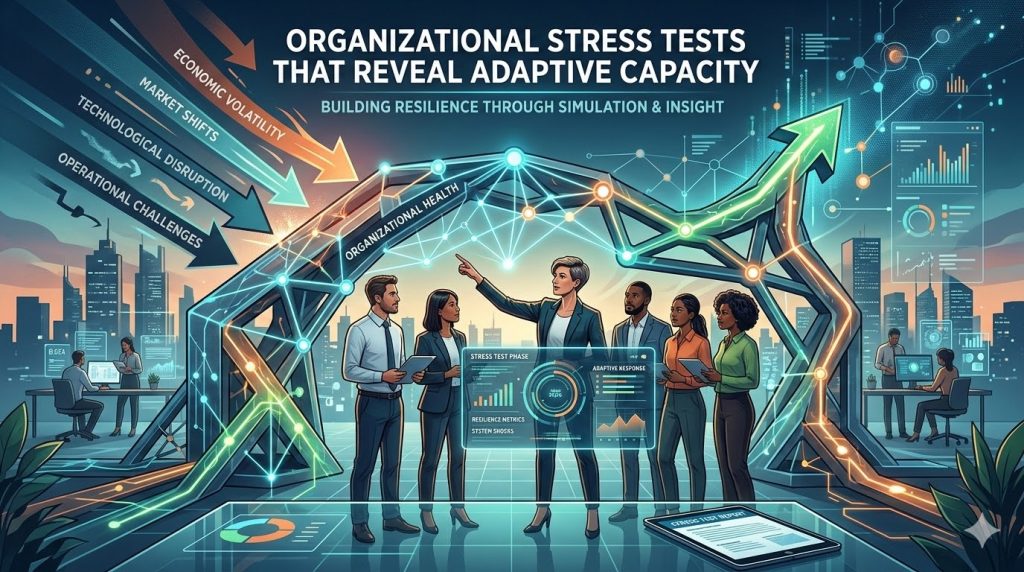
The Human Engine of Continuous Adaptation

Resilience as Innovation

LAST UPDATED: February 5, 2026 at 3:13PM

The Human Engine of Continuous Adaptation

GUEST POST from Chateau G Pato

In the traditional corporate lexicon, resilience is often treated as a defensive trait—the ability to “weather the storm” or “bounce back” to a previous state of stability. But in a world defined by permanent volatility, bouncing back is no longer enough. To thrive in 2026, organizations must redefine resilience not as a recovery mechanism, but as a generative innovation capability.True resilience is the human engine of continuous adaptation. It is the proactive capacity to transform pressure into progress and friction into fuel. As a human-centered change leader, I’ve observed that the most innovative companies don’t just survive disruption; they use the shockwaves of change to crack open legacy thinking and reveal new pathways for value creation.


Moving Beyond Robustness to Anti-fragility

A bridge is robust when it resists a load. An organization is resilient when it learns from the load. When we focus purely on robustness, we build rigid structures that eventually shatter under unprecedented stress. When we focus on human-centered resilience, we empower our people to iterate in real-time.

This shift requires us to address Subjective Time Pressure. When employees feel “bullied by time,” their cognitive bandwidth shrinks, and they default to survival instincts. Innovation requires the opposite: the mental “white space” to see a crisis as a collection of data points rather than a series of threats. By designing conditions that provide temporal agency, leaders allow their teams to process change with curiosity rather than fear.

“The most valuable innovation isn’t a new product; it’s a resilient culture. Products can be copied, and technologies will be disrupted, but a team that has mastered the art of continuous adaptation is an insurmountable competitive advantage.”

— Braden Kelley


Case Studies: Resilience in Action

Case Study 1: The Supply Chain Transformation

A global electronics manufacturer faced a catastrophic disruption when a primary regional hub was taken offline by an environmental crisis. Traditional disaster recovery focused on restoring the status quo. However, the leadership team utilized my Change Planning Toolkit™ to reframe the crisis. Instead of just rebuilding, they empowered cross-functional “Agility Cells” to design a decentralized, AI-driven sourcing model. This wasn’t just recovery; it was a structural innovation. The new system was 15% more cost-effective and reduced lead times by 30%, proving that resilience is the catalyst for the next leap in operational excellence.

Case Study 2: Retail Pivot through Psychological Safety

A national retail chain saw a dramatic shift in consumer behavior that rendered their flagship store model obsolete almost overnight. Rather than implementing top-down layoffs, the CEO fostered psychological safety by launching an internal “Phoenix Initiative.” Store managers—the people closest to the customer—were given the agency to experiment with hyper-local micro-fulfillment and “service-as-an-experience” concepts. By treating their frontline staff as distributed innovators rather than mere executors, the company successfully pivoted 80% of its footprint to a high-growth hybrid model within 12 months.


Tools for Cultivating Adaptive Resilience

To turn resilience into an innovation engine, leaders need a structured approach. It isn’t enough to tell people to “be resilient.” You must provide the scaffolding for it. This involves:

  • The Change Planning Canvas™: Visualizing the transition to ensure everyone understands the why behind the what.
  • Metabolic Alignment: Ensuring the organization’s pace of decision-making matches the pace of market change.
  • Cognitive Slack: Intentionally protecting time for reflection and synthesis during high-stress periods.

Change Planning Canvas

When these tools are in place, resilience stops being an exhausting effort and starts being a natural state of flow. We stop fighting the waves and start learning how to surf them.


Resilience is the ultimate form of innovation because it is the only one that is self-sustaining. As we look toward the future of work, the winners will be those who recognize that their greatest asset isn’t their intellectual property, but the adaptive capacity of their people. By leading with empathy, providing the right visual tools, and reclaiming our agency over time, we can build organizations that are not just built to last, but built to evolve.

For years, innovation has been framed as a forward-looking activity: new ideas, new technologies, new business models. But the most overlooked truth about innovation is that it is not powered by novelty. It is powered by people who can absorb disruption, learn quickly, and adapt continuously.

Resilience is not a soft skill. It is the human engine that makes innovation sustainable over time. Without resilience, innovation becomes episodic—bursts of creativity followed by exhaustion, resistance, or collapse. With it, organizations evolve steadily, even under pressure.

As I often say, “Innovation isn’t about how fast you move when conditions are perfect; it’s about how well you adapt when they aren’t.”

Why Resilience Is the Missing Link in Innovation

Many organizations invest heavily in innovation labs, design thinking workshops, and emerging technologies, yet struggle to translate these efforts into lasting change. The issue is rarely a lack of ideas. It is a lack of human capacity to sustain change.

Resilience enables individuals and teams to stay curious under stress, to reframe setbacks as learning, and to recover quickly when experiments fail. Innovation demands repeated exposure to uncertainty. Resilience determines whether that uncertainty becomes energizing or debilitating.

When resilience is absent, organizations default to risk avoidance, short-term thinking, and defensive behavior. When resilience is present, they experiment, learn, and adapt faster than their competitors.

Case Study 3: Microsoft’s Cultural Reset

When Satya Nadella became CEO of Microsoft, the company faced a familiar innovation challenge: strong legacy products, slowing growth, and an internal culture resistant to change.

Rather than focusing first on new technologies, Nadella emphasized a shift from a “know-it-all” culture to a “learn-it-all” culture. This cultural reframing prioritized psychological safety, growth mindset, and continuous learning.

The result was a more resilient organization. Teams became more open to experimentation and failure. Collaboration improved across silos. Innovation accelerated not because people were pushed harder, but because they felt safer adapting.

Resilience turned cultural humility into a competitive advantage.

Resilience Is Built, Not Declared

Organizations often mistake resilience for grit or endurance. In reality, resilience is about recovery and renewal. It requires intentional design.

Resilient systems balance challenge with support. They create clear priorities, reduce unnecessary friction, and provide space for reflection. Leaders play a critical role by modeling learning, acknowledging uncertainty, and reinforcing progress rather than perfection.

Without these conditions, resilience degrades. Burnout replaces creativity. Innovation becomes performative instead of practical.

Case Study 4: Toyota and Continuous Improvement

Toyota’s long-standing commitment to continuous improvement offers another powerful example of resilience as innovation.

The Toyota Production System encourages employees at all levels to identify problems, stop the line if needed, and propose improvements. Mistakes are treated as signals, not failures.

This approach builds organizational resilience by embedding adaptation into daily work. Small improvements accumulate. Learning compounds. The system remains flexible even as complexity increases.

Toyota’s resilience is not reactive; it is designed into the way work gets done.

The Human Experience of Adaptation

Innovation ultimately happens inside people. Resilience is shaped by how individuals experience change: whether they feel informed or surprised, supported or isolated, empowered or constrained.

Human-centered innovation recognizes that adaptation is emotional as well as cognitive. Anxiety, fatigue, and identity threats can stall even the best ideas.

“You don’t scale innovation by demanding more from people. You scale it by removing what drains them and reinforcing what helps them adapt.”

— Braden Kelley

Resilience as a Strategic Capability

Organizations that treat resilience as a strategic capability outperform those that treat it as a personal responsibility. They invest in leadership development, clarity of purpose, and systems that reinforce learning.

They understand that the pace of change will not slow, and that resilience is the only sustainable response.

Innovation, in this light, becomes less about disruption and more about evolution. Less about heroic breakthroughs and more about consistent progress.

Innovation is often portrayed as a moment—a breakthrough idea, a disruptive product, a bold strategic move. But in reality, innovation is a long game played under conditions of uncertainty, pressure, and constant change. The organizations that win are not simply the most creative. They are the most resilient.

Resilience is the hidden infrastructure of innovation. It is the capacity that allows people, teams, and systems to absorb disruption, learn quickly, and keep moving forward without losing coherence or energy.

As I often say, “Innovation doesn’t start with ideas. It starts with the human capacity to adapt when the old answers stop working.”

Why Innovation Breaks Without Resilience

Most innovation efforts fail not because the idea was wrong, but because the organization could not sustain the journey. Uncertainty creates stress. Stress narrows thinking. Narrow thinking kills experimentation.

Resilience interrupts this cycle. It allows people to stay open when outcomes are unclear and to reframe setbacks as feedback rather than failure.

Without resilience, organizations retreat to what feels safe. With it, they move toward what is necessary.

Case Study 3: Microsoft and the Power of Learning

Microsoft’s resurgence under Satya Nadella is a powerful example of resilience driving innovation.

Nadella recognized that technical excellence alone was not enough. The organization needed to become more adaptable. By emphasizing growth mindset, collaboration, and empathy, Microsoft rebuilt its cultural foundation.

Teams became more willing to experiment, more open to feedback, and less defensive about legacy success. This cultural resilience enabled innovation across cloud computing, AI, and enterprise services.

Innovation followed resilience, not the other way around.

Designing for Human Recovery

Resilience is often misunderstood as toughness. In practice, it is about recovery. Resilient organizations create space to pause, reflect, and learn.

They limit initiative overload. They clarify priorities. They normalize saying “we don’t know yet.” These behaviors reduce cognitive strain and preserve creative energy.

“People don’t resist change because they hate progress. They resist it because they’re exhausted.”

— Braden Kelley

Case Study 4: Toyota and Embedded Adaptation

Toyota’s approach to continuous improvement demonstrates how resilience can be embedded into daily work.

Employees are encouraged to surface problems early, test small improvements, and share learning openly. This creates a system that adapts constantly rather than episodically.

Resilience becomes routine. Innovation becomes cumulative.

The organization does not rely on heroic change initiatives. It evolves continuously.

Resilience as a Leadership Responsibility

Resilience is not an individual burden. It is a leadership responsibility.

Leaders shape resilience through clarity, consistency, and compassion. They influence whether people feel safe experimenting or afraid of being wrong.

When leaders reward learning instead of just outcomes, resilience grows. When they model adaptability, others follow.

The Strategic Payoff

Organizations that invest in resilience outperform those that chase innovation theater. They adapt faster, recover quicker, and sustain momentum longer.

Resilience transforms innovation from a risky bet into a repeatable capability.

In an era defined by volatility, resilience is not optional. It is the price of admission.


Frequently Asked Questions

How does Braden Kelley define resilience in an innovation context?

Braden Kelley defines resilience not as bouncing back to the status quo, but as a generative capability where the organization uses change and disruption as a stimulus for continuous adaptation and new value creation.

Why is psychological safety important for organizational resilience?

Psychological safety allows employees to take the risks necessary for adaptation. Without it, fear of failure leads to rigid thinking and resistance to change, which are the opposites of a resilient, innovative culture.

What role do visual tools play in resilience?

Visual tools like the Change Planning Canvas™ provide clarity and alignment during periods of chaos. They help teams externalize complex problems, reducing cognitive load and allowing for faster, more collaborative decision-making.

To learn more about human-centered innovation and building an adaptive workforce, connect with Braden Kelley for keynotes and workshops.

Image credits: ChatGPT

Subscribe to Human-Centered Change & Innovation WeeklySign up here to get Human-Centered Change & Innovation Weekly delivered to your inbox every week.