Why the Future Belongs to Organizations That Think in Three Dimensions
LAST UPDATED: March 11, 2026 at 6:56 PM (SPANISH LANGUAGE VERSION)
by Braden Kelley and Art Inteligencia
I. The Spark: A Venn Diagram That Captures a Powerful Truth
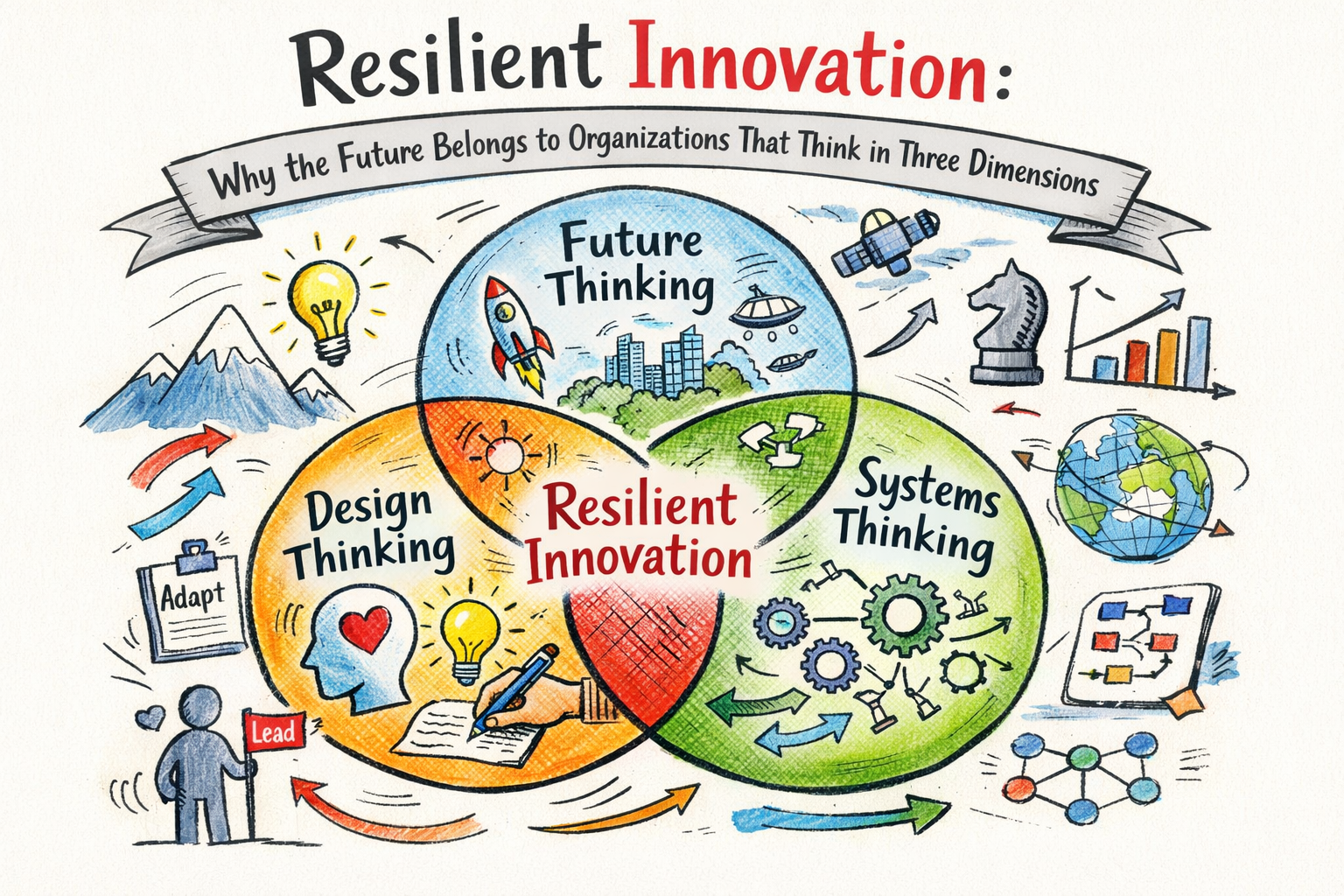
Inspiration for this article came from a simple but powerful visual shared in a recent post by Hugo Gonçalves. The image illustrated the relationship between Future Thinking, Design Thinking, and Systems Thinking using a Venn diagram that placed Resilient Innovation at the center.
At first glance the framework seems obvious. Each discipline is already well established in the innovation world:
- Future Thinking helps organizations anticipate multiple possible futures.
- Design Thinking focuses on solving problems through a human-centered approach.
- Systems Thinking encourages examining systems holistically to understand complexity.
But what makes the diagram compelling is not the individual circles. It is the insight revealed at their intersections. When these disciplines operate together rather than in isolation, they unlock capabilities that are difficult for organizations to achieve otherwise.
At the intersection of Future Thinking and Design Thinking, organizations begin designing solutions for future scenarios rather than merely reacting to present conditions.
Where Design Thinking meets Systems Thinking, innovation becomes both human-centered and system-aware, producing solutions that account for real-world complexity and ripple effects.
And where Future Thinking intersects with Systems Thinking, organizations gain the ability to prepare systems for long-term sustainability and increasing complexity.
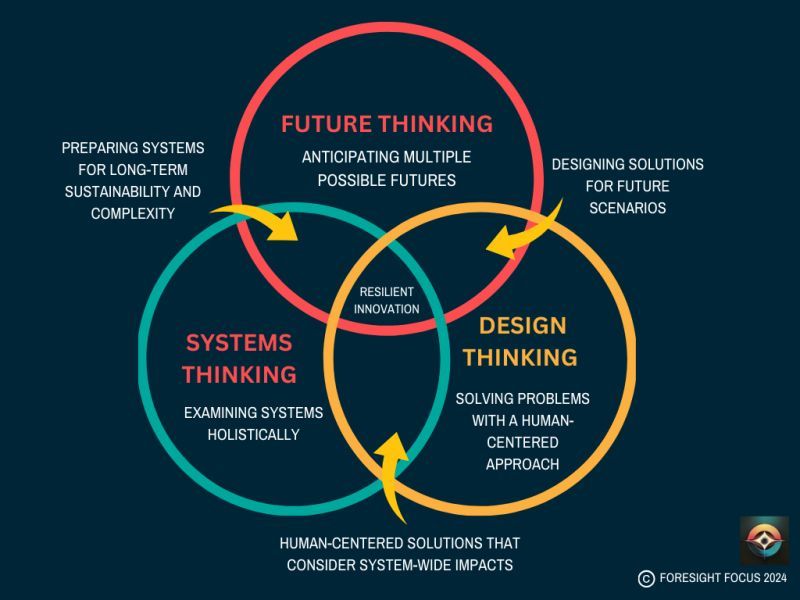
When all three perspectives come together, something more powerful emerges: the ability to create innovations that are not only desirable and viable today, but resilient enough to thrive across multiple possible futures.
In a world defined by accelerating change, uncertainty, and interconnected systems, resilient innovation may be the most important capability organizations can develop. And as this simple diagram suggests, it thrives at the intersection of three powerful ways of thinking.
II. The Problem with One-Dimensional Innovation
Most organizations pursue innovation through a single dominant lens. Some lean heavily into design thinking workshops and rapid prototyping. Others invest in strategic foresight to anticipate future disruption. Still others focus on systems analysis to understand complexity and organizational dynamics.
Each of these approaches provides valuable insight. But when used in isolation, each also has significant limitations.
Design thinking, for example, excels at uncovering human needs and translating them into compelling solutions. Yet even the most desirable idea can fail if it ignores the larger systems it must operate within — regulatory structures, supply chains, cultural norms, or organizational incentives.
Future thinking helps organizations explore uncertainty and imagine multiple possible futures. Scenario planning and horizon scanning can expand strategic awareness and reduce surprise. But foresight alone rarely produces solutions that people are ready to adopt.
Systems thinking provides the ability to map complexity, understand feedback loops, and identify leverage points within interconnected environments. However, deep system insight does not automatically translate into solutions that resonate with human users.
When organizations rely on only one of these approaches, innovation often stalls. Ideas may be creative but impractical, visionary but disconnected from human behavior, or analytically sound but difficult to implement.
The challenge is not that these disciplines are flawed. The challenge is that they are incomplete on their own.
Innovation today takes place in environments that are simultaneously human, complex, and uncertain. Addressing only one dimension of that reality inevitably leads to blind spots.
Resilient innovation requires something more: the integration of multiple ways of thinking that together allow organizations to anticipate change, understand complexity, and design solutions people will actually embrace.
III. Future Thinking: Anticipating Multiple Possible Futures
One of the most dangerous assumptions organizations can make is that the future will look largely like the present. History repeatedly shows that markets, technologies, and societal expectations can shift faster than even experienced leaders anticipate.
This is where Future Thinking becomes essential, and the FutureHacking™ methodology helps everyone be their own futurist.
Future thinking is not about predicting a single outcome. Instead, it focuses on exploring a range of plausible futures so organizations can prepare for uncertainty rather than react to it after the fact.
Practitioners of future thinking use tools such as horizon scanning, trend analysis, and scenario planning to identify emerging signals of change and imagine how those signals might combine to shape different future environments.
By examining multiple possible futures, organizations expand their strategic imagination. They begin to see opportunities and risks that would otherwise remain invisible when planning is based solely on past performance or current market conditions.
Future thinking helps leaders ask better questions:
- What changes on the horizon could reshape our industry?
- Which emerging technologies or behaviors might disrupt our assumptions?
- How might our customers’ needs evolve over the next decade?
When organizations incorporate future thinking into their innovation efforts, they gain the ability to design strategies and solutions that remain relevant even as conditions change.
However, foresight alone does not create innovation. Imagining the future is only the beginning. Organizations must also translate those insights into solutions that people value and systems can support.
That is why future thinking becomes far more powerful when combined with other perspectives — particularly the human-centered creativity of design thinking and the holistic understanding provided by systems thinking.
IV. Design Thinking: Solving Problems with a Human-Centered Approach
If future thinking expands our view of what might happen, design thinking helps ensure that the solutions we create actually matter to the people they are intended to serve.
Design thinking is grounded in a deceptively simple premise: innovation succeeds when it begins with a deep understanding of human needs, behaviors, and motivations. Rather than starting with technology or internal capabilities, design thinking begins with empathy.
Practitioners use methods such as observation, interviews, journey mapping, and rapid prototyping to uncover insights about how people experience products, services, and systems in the real world.
Through this process, organizations move beyond assumptions and begin designing solutions that reflect genuine human needs. Ideas are then explored through iterative experimentation, allowing teams to quickly learn what works, what doesn’t, and why.
This approach offers several powerful advantages:
- It surfaces unmet or unarticulated customer needs.
- It encourages experimentation and rapid learning.
- It increases the likelihood that new solutions will be embraced by the people they are designed for.
Design thinking reminds organizations that innovation is not simply about creating something new. It is about creating something people will choose to adopt.
However, even the most human-centered solution can fail if it ignores the broader systems in which it must operate. A beautifully designed product may struggle against regulatory constraints, supply chain limitations, or cultural resistance within organizations.
This is why design thinking alone is not enough. To create innovations that truly endure, organizations must also understand the complex systems surrounding those solutions.
V. Systems Thinking: Seeing the Whole System
While design thinking focuses on people and future thinking explores uncertainty, systems thinking helps organizations understand the complex environments in which innovation must operate.
Modern organizations do not exist in isolation. They function within interconnected systems made up of customers, partners, suppliers, regulators, technologies, cultures, and internal structures. Changes in one part of the system often create ripple effects across many others.
Systems thinking encourages leaders and innovators to step back and examine these relationships holistically rather than focusing only on individual components.
Practitioners use tools such as system maps, causal loop diagrams, and stakeholder ecosystem mapping to identify patterns, dependencies, and feedback loops that influence outcomes over time.
This perspective provides several critical advantages:
- It reveals hidden interdependencies within complex environments.
- It helps identify leverage points where small changes can create large impact.
- It reduces the likelihood of unintended consequences when introducing new solutions.
Many innovations fail not because the idea was flawed, but because the surrounding system was never designed to support it. Incentives may be misaligned. Processes may resist change. Infrastructure may not exist to scale the solution.
Systems thinking helps innovators recognize these structural realities early, allowing them to design solutions that fit within — or intentionally reshape — the systems they operate within.
Yet systems thinking alone can also fall short. Deep analysis of complexity does not automatically produce solutions that resonate with people or anticipate future shifts.
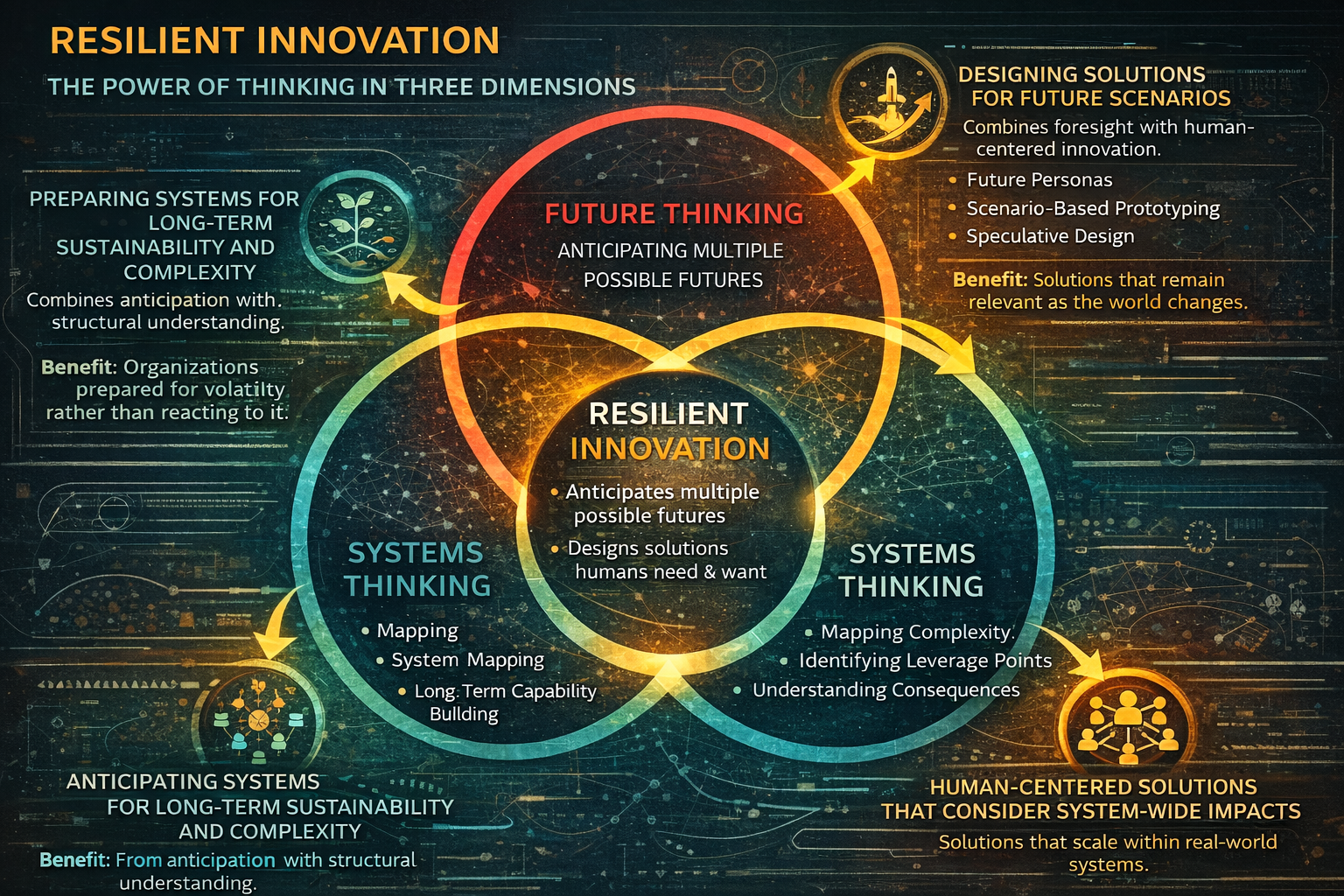
This is why resilient innovation emerges not from any one perspective, but from the intersection of future thinking, design thinking, and systems thinking working together.
VI. Future Thinking + Design Thinking: Designing Solutions for Future Scenarios
When future thinking and design thinking come together, innovation shifts from solving today’s problems to designing solutions that remain meaningful in tomorrow’s world.
Future thinking expands the time horizon. It helps organizations explore emerging technologies, evolving social expectations, and potential disruptions that could reshape the environment in which products and services operate.
Design thinking brings the human perspective. It ensures that ideas developed in response to these future possibilities remain grounded in real human needs, motivations, and behaviors.
Together, these disciplines allow organizations to design solutions not just for the present moment, but for multiple possible futures.
Rather than asking only “What do customers need today?” teams begin asking deeper questions:
- How might customer expectations evolve in the next five to ten years?
- What new behaviors could emerge as technologies mature?
- How might shifting social norms reshape what people value?
Several practices emerge from this intersection:
- Creating future personas that represent how users might behave in different scenarios.
- Building scenario-based prototypes that test how solutions perform under different future conditions.
- Using speculative design to explore bold possibilities before they become reality.
This combination helps organizations avoid a common innovation trap: designing solutions perfectly optimized for a present that is already beginning to disappear.
By integrating foresight with human-centered design, organizations create innovations that are better prepared to evolve as the future unfolds.
VII. Design Thinking + Systems Thinking
Human-centered innovation is most powerful when it takes the wider system into account.
Integrating empathy with complexity awareness ensures that solutions are not only desirable but also viable and scalable within real-world systems.
Many well-intentioned innovations fail because they neglect system dynamics—leading to unintended consequences that can undermine adoption, efficiency, or long-term impact.
Example Practices
- Journey Mapping + System Mapping: Understand the user experience alongside the broader system in which it operates.
- Stakeholder Ecosystem Analysis: Identify all the players, relationships, and dependencies that influence outcomes.
- Designing for Policy, Culture, and Infrastructure Simultaneously: Ensure solutions are compatible with the real-world environment, not just ideal scenarios.
Benefit: Solutions that scale effectively and endure within complex systems, reducing risk and maximizing long-term impact.
VIII. Future Thinking + Systems Thinking
Combining anticipation with structural understanding enables organizations to prepare systems for long-term sustainability and complexity. This intersection ensures that strategies and innovations are not just reactive but resilient to change and disruption.
Many organizations fail because they plan for the future without considering system-wide dynamics, leaving them vulnerable when change inevitably occurs.
Example Practices
- Resilience Mapping: Identify system vulnerabilities and strengths to anticipate risks and opportunities.
- Adaptive Strategy Design: Develop strategies that can flex and evolve as conditions change.
- Long-Term Capability Building: Invest in skills, processes, and structures that sustain innovation over time.
Benefit: Organizations become prepared for volatility, able to respond to complex challenges without being derailed by disruption.
IX. The Center of the Venn Diagram: Resilient Innovation
True innovation resilience happens at the intersection of all three disciplines: Future Thinking, Design Thinking, and Systems Thinking. Organizations that operate here anticipate multiple possible futures, design solutions humans actually want, and understand the systems those solutions must survive inside.
This holistic approach moves beyond isolated innovation efforts, ensuring solutions are desirable, viable, and adaptable in a complex world.
Capabilities at the Center
- Adaptive Innovation Portfolios: Maintain a diverse set of initiatives that can pivot as conditions change.
- Experimentation Across Future Scenarios: Test solutions against multiple possible futures to validate robustness.
- Human-Centered System Transformation: Redesign processes, structures, and policies to align with real human needs within systemic constraints.
Benefit: Organizations achieve resilient innovation that can thrive amidst uncertainty, disruption, and complexity, rather than merely surviving it.
X. What Leaders Must Do to Build This Capability
Building resilient innovation requires leaders to shift their mindset and practices. It’s no longer enough to treat innovation as a siloed department or isolated initiative. Leaders must actively create the conditions that allow foresight, design, and systems thinking to work together.
Practical Leadership Shifts
- Stop Treating Innovation as a Department: Embed innovation across teams and functions, not just in a single unit.
- Build Foresight, Design, and Systems Capabilities Together: Develop cross-disciplinary skills that enable three-dimensional thinking.
- Encourage Cross-Disciplinary Collaboration: Foster communication and shared problem-solving across different expertise areas.
- Measure Resilience, Not Just Efficiency: Track long-term adaptability, system impact, and future-readiness, not only short-term outputs.
- Design Organizations That Can Evolve Continuously: Create structures and processes that allow constant learning, adaptation, and iteration.
By adopting these leadership practices, organizations can ensure that their innovation efforts are not only creative but also resilient and scalable within complex systems.
XI. A Simple Test for Your Organization
To evaluate whether your organization is truly building resilient innovation capabilities, ask three critical questions:
- Are we designing only for today’s customers, or tomorrow’s realities?
This question tests whether your innovation anticipates future needs and scenarios.
- Do our solutions work only in pilot environments, or within real systems?
This evaluates whether innovations are scalable and resilient within the complex systems they must operate in.
- Are we solving human problems, or just optimizing processes?
This ensures that your solutions are genuinely human-centered, not just operationally efficient.
If the answer to any of these is “no,” the missing capability likely lies at one of the intersections of Future Thinking, Design Thinking, and Systems Thinking. Addressing these gaps is critical for achieving resilient innovation.
XII. Final Thought: Innovation Is No Longer Linear
The world has become too complex for single-method innovation. Organizations that thrive in the future will be those that operate at the intersection of:
- Anticipation: Preparing for multiple possible futures.
- Human Understanding: Designing solutions people actually want and will adopt.
- System Awareness: Ensuring solutions can survive and scale within real-world systems.
Resilient innovation does not come from seeing the future clearly. It comes from being prepared for many possible futures and designing systems and solutions that can adapt when they arrive. Organizations that master this approach are the ones that will endure, evolve, and thrive.
FAQ: Resilient Innovation
1. What is resilient innovation?
Resilient innovation is the ability of an organization to anticipate multiple possible futures, design solutions humans actually want, and ensure those solutions survive and scale within complex systems. It emerges at the intersection of Future Thinking, Design Thinking, and Systems Thinking.
2. Why do organizations struggle with one-dimensional innovation?
Many organizations rely on a single approach—such as design thinking, systems thinking, or future thinking—without integrating the others. This can lead to solutions that are desirable but not viable, or insightful but not actionable, resulting in innovation that fails to scale or adapt.
3. How can leaders build resilient innovation capabilities?
Leaders can foster resilient innovation by embedding cross-disciplinary collaboration, developing foresight, design, and systems capabilities together, measuring resilience (not just efficiency), and designing organizations that can continuously learn, adapt, and evolve.
p.s. Kristy Lundström posed the question of whether regenerative would be a better adjective than resilient, and I responded that it depends on where you draw the boundaries on the word resilient. I tend to think of it as an active word instead of a passive one, meaning the way that I look at the word incorporates elements of regeneration and making *#&! happen. Keep innovating!
Image credits: ChatGPT, Google Gemini
Content Authenticity Statement: The topic area, key elements to focus on, etc. were decisions made by Braden Kelley, with a little help from ChatGPT to clean up the article and add citations.
 Sign up here to get Human-Centered Change & Innovation Weekly delivered to your inbox every week.
 Drum roll please…