Tag Archives: infrastructure

The Energy Grid Revolt

FCEVs, and the Pragmatic Pivot in Eco-Conscious Mobility

LAST UPDATED: June 19, 2026 at 4:11 PM
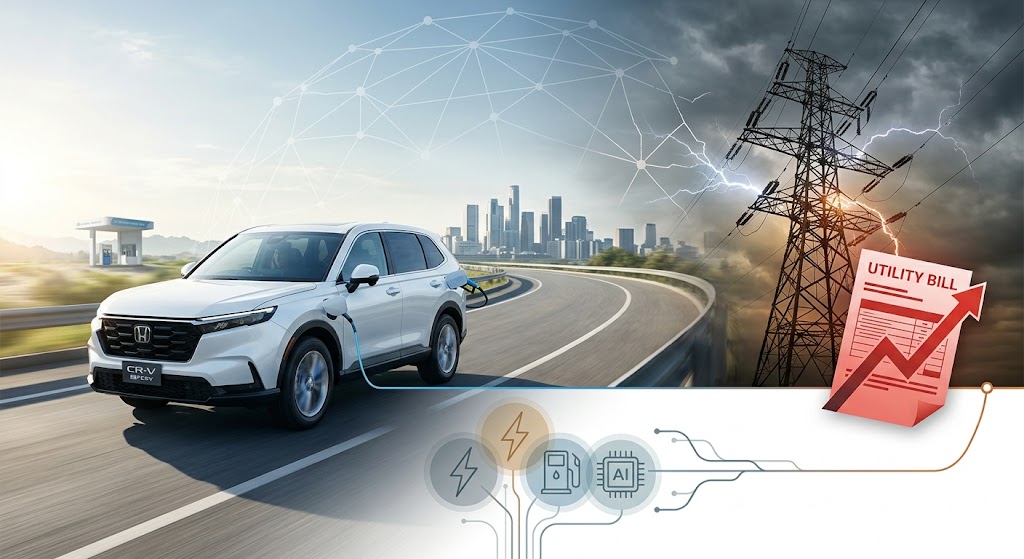
Honda CR-V e:FCEV plug-in hybrid charging next to a stressed electrical grid utility tower

GUEST POST from Art Inteligencia


The Great Grid Contraction and the Consumer Revolt

A perfect storm is hitting the aging American energy grid. On one side, residential electricity costs are hitting historic highs as utilities scramble to fund infrastructure upgrades. On the other, the nation faces a massive, unprecedented surge in energy demand driven by the expansion of AI data centers — a technological race America must win to maintain global economic leadership.

For the everyday consumer, this collision is creating massive experience friction. The original economic promise of electric vehicles — the idea of “fueling up for cheap at home” — is rapidly eroding when charging a high-capacity battery overnight becomes a glaring, high-impact line item on a strained household budget. Forcing millions of new vehicles onto the grid while simultaneously enacting localized natural gas bans creates a single point of failure that stresses both family finances and municipal infrastructure.

The Strategic Pivot: A Case for Pragmatic Change Management

True innovation never forces people into an unstable, single-source bottleneck. Instead of top-down mandates that ignore current physical and economic realities, a human-centered approach to mobility demands a strategic pause. We must allow power generation infrastructure to catch up to our digital ambitions while diversifying our energy portfolio to keep the economy resilient.

By hitting the brakes on aggressive EV sales timelines and restoring energy choice through the repeal of natural gas restrictions, we can protect the grid for vital computing infrastructure. This pragmatic pivot shifts the spotlight back to highly efficient internal combustion hybrids and adaptive, forward-looking alternatives like the plug-in hydrogen fuel cell hybrid. It is time to design for the world we actually inhabit, ensuring a stable foundation for both physical mobility and digital transformation.

Case Study: Is the Honda CR-V e:FCEV a True Innovation?

The traditional fuel cell electric vehicle (FCEV) market has long suffered from a classic chicken-and-egg dilemma: consumers won’t buy hydrogen cars without a refueling network, and stakeholders won’t build stations without cars on the road. Past pioneers forced an rigid, all-or-nothing infrastructure choice onto the driver. The Honda CR-V e:FCEV represents a true paradigm shift because it introduces a human-centered, adaptive approach — the co-creation of convenience.

Hand-assembled at Honda’s Performance Manufacturing Center in Marysville, Ohio, the vehicle represents a major technological leap by combining two distinct zero-emission engineering principles into a single, cohesive customer experience.

The Twin-Engine Topology: Designing for Real-World Ecosystems

Instead of forcing the driver to rely solely on public hydrogen networks, the CR-V e:FCEV integrates a dual-energy architecture that adapts directly to the user’s daily habits and local infrastructure constraints:

  • The 17.7-kWh Plug-In On-Board Battery: This lithium-ion system grants approximately 29 miles of pure electric, battery-powered range on a full charge. For the eco-conscious consumer, this handles the vast majority of local, daily commuting entirely on household electricity. Because the battery capacity is modest compared to a massive 100-kWh pure electric vehicle, it charges rapidly on standard Level 1 or Level 2 equipment without triggering expensive panel upgrades or severe local grid stress.
  • The Next-Generation Fuel Cell Stack: Co-developed through a landmark engineering joint venture with General Motors, this advanced proton-exchange membrane system represents a massive manufacturing milestone. Built at Fuel Cell System Manufacturing (FCSM) in Michigan, the co-developed stack achieves double the durability while reducing production costs by two-thirds compared to previous generations. Feeding from dual 10,000 psi high-pressure tanks holding 4.3 kilograms of compressed hydrogen gas, it delivers an overall 270-mile EPA range rating and refuels completely in just 3 to 5 minutes.

The Verdict from an Experience Design Perspective

From an innovation management standpoint, the CR-V e:FCEV is a brilliant bridge architecture. It systematically mitigates “range anxiety” and “charging-station downtime friction” simultaneously. True human-centered design acknowledges the messiness of the world as it exists today rather than designing for an idealized, frictionless future. By treating the consumer as an active partner and offering energy flexibility, Honda has created a blueprint for resilient, adaptive mobility.

The Macro Outlook: The Global and American Infrastructure Split

An innovation is only as powerful as the ecosystem that supports it. While the Honda CR-V e:FCEV represents a masterful piece of human-centered engineering, its market viability is completely dependent on regional infrastructure architecture. When we analyze the landscape through a global lens, we see a stark divergence in how different societies are structuring the future of clean mobility.

The American Landscape: Severe Regional Fragmentation

In the United States, the deployment of consumer hydrogen infrastructure remains highly fractured and localized. Outside of California—where early public-private investments attempted to establish initial hydrogen corridors—the vast majority of the American continent remains a complete refueling desert for retail hydrogen consumers. Because of this stark geographical limitation, Honda is rolling out the CR-V e:FCEV as a regional, lease-only vehicle, targeted primarily at markets with established hydrogen ecosystems.

This dynamic illustrates the critical importance of systemic change management: a technological breakthrough cannot scale if the surrounding infrastructure remains trapped in a localized silo. Until federal and state initiatives prioritize comprehensive midstream hydrogen logistics and production, fuel cell vehicles in America will largely serve as specialized, pilot-program solutions rather than mainstream alternatives.

The Global Matrix: Strategic Infrastructure Realignment

Beyond American borders, the strategic playbook changes rapidly, driven by unique geographic, economic, and geopolitical imperatives:

  • Europe: The European strategy leans heavily on high-traffic, industrial, and heavy commercial transport corridors. Rather than deploying sparse consumer networks, European nations are prioritizing high-capacity hydrogen refueling hubs along primary freight routes, recognizing that fuel cell technology provides the rapid turnaround times and high-payload capabilities required to decarbonize commercial logistics and public transit networks.
  • Asia-Pacific (Japan, South Korea, China): In these high-density urban economies, hydrogen is viewed as a pillar of long-term energy security and a necessary alternative to widespread battery electrification. In cities characterized by massive, multi-tenant residential high-rises, overnight at-home charging for millions of individual battery-electric vehicles is structurally and logistically impossible. Consequently, national policy initiatives are aggressively subsidizing high-pressure hydrogen distribution networks to power both consumer fleets and regional distributed energy grids.

The Strategic Takeaway: Mobility is Not a Monolith

The global divergence in hydrogen adoption proves that the “Future of Mobility” will not be a singular, globally standardized platform. True innovation leaders do not design for a fictional, universally uniform market. They recognize that physical, economic, and geographic constraints dictate technology adoption, requiring diverse, localized innovation architectures to successfully bridge the transition toward a more resilient energy ecosystem.

The Strategic Pause: Aligning Grid Capacity with Sovereign AI Leadership

Forcing a premature, top-down transition to heavy battery-electric vehicles (BEVs) before a stable, affordable, and robust electrical grid exists is an administrative mandate lacking empathy for real-world economic conditions. True innovation requires us to zoom out and analyze the broader macro-ecosystem. Today, a profound industrial conflict is brewing: the rapid, exponential computing requirements of the artificial intelligence revolution are colliding directly with consumer grid capacity.

Winning the global race to lead the AI industry demands unprecedented amounts of stable, high-density, uninterrupted baseload power for next-generation data centers. This computational infrastructure is the primary engine of our future economy. We cannot afford to compromise this critical digital runway by overloading the grid with artificial peak demands from enforced vehicle electrification and short-sighted municipal mandates.

The Policy Recalibration: Pausing Mandates and Restoring Portfolio Diversity

To ensure American economic resilience and technological sovereignty, we must implement a pragmatic change management strategy at the civic, county, and state levels:

  • Implementing a Strategic EV Sales Mandate Pause: Policymakers must temporarily halt aggressive timelines and purchasing mandates for pure electric vehicles. This strategic pause buys critical time for public utilities and independent power producers to build out modern, high-capacity generation infrastructure, transition to safer nuclear or advanced clean energy options, and stabilize regional distribution lines.
  • Repealing Punitive Natural Gas Bans: Restoring balance requires immediately dismantling localized municipal and state bans on residential and commercial natural gas infrastructure. Forcing space heating, water heating, and cooking completely onto an already strained electrical grid creates a precarious single point of failure. Reinstating natural gas options ensures a diversified energy portfolio and protects citizens from catastrophic grid failures during peak seasonal demand.

The Eco-Conscious Portfolio Approach

From an experience design perspective, innovation should be participatory, not enforced through economic scarcity or utility rate shocks. While the power grid catches up to our digital ambitions, eco-conscious consumers should be empowered to direct their attention toward a highly efficient, diverse mobility portfolio:

  1. Ultra-Efficient ICE and Traditional Hybrids: Highly optimized internal combustion and standard hybrid technologies deliver exceptional fuel economy (often exceeding 40 to 50 MPG) and immediate carbon reduction today, entirely utilizing existing refueling infrastructure without placing a single watt of additional demand on a fragile electrical grid.
  2. Plug-In Hydrogen Hybrids (FCEV/BEV Blends): Vehicles engineered with the topology of the Honda CR-V e:FCEV offer an ideal blueprint. By utilizing a small, easily managed battery for local trips and a high-pressure fuel cell stack for extended range, they demonstrate how we can transition toward zero-emission transportation without demanding massive, system-wide grid overhauls.

The path forward requires a shift in focus from subsidizing individual vehicle purchases to fundamentally upgrading our systemic infrastructure. By stabilizing our foundational power generation first, we protect the consumer’s economic reality, maintain grid reliability, and fuel the computational power required to lead the next century of technological innovation.

Conclusion: Designing for the World We Have, Not the One We Want

True change management requires the harmonious alignment of economics, technology, and human behavior. When top-down administrative mandates outpace the physical realities of infrastructure, the system breaks down. Today, as skyrocketing utility costs trigger a widespread consumer revolt and the computational demands of the AI revolution reshape our energy landscape, the primary survival mechanism for both households and economies is flexibility.

The path forward cannot be dictated by rigid, single-source mandates that ignore regional grid limitations. Instead, we must embrace an ecosystem-wide perspective that balances our digital ambitions with physical constraints. By implementing a pragmatic pause on aggressive vehicle electrification, restoring energy choice through the repeal of short-sighted natural gas bans, and allowing power generation infrastructure the runway it needs to catch up, we ensure a more stable and resilient economy.

The Blueprint for Adaptive Mobility

The Honda CR-V e:FCEV serves as a profound beacon of this necessary transition. It stands as an explicit engineering reminder to automakers, regulators, and policy architects alike: the most elegant technology is fundamentally useless if it ignores the economic, geographic, and systemic realities of the environment it inhabits.

By offering a dual-energy paradigm—combining local plug-in convenience with long-range hydrogen capability—it demonstrates how true human-centered innovation can co-create convenience with the consumer. As we look toward the future direction of mobility in America and across the globe, our success will not be measured by how quickly we can force a single solution, but by how skillfully we design diverse, adaptive, and resilient portfolios that empower human progress.

Frequently Asked Questions (FAQ)

What is a plug-in hydrogen fuel cell hybrid vehicle (FCEV)?

Unlike standard fuel cell vehicles that rely exclusively on hydrogen gas, a plug-in fuel cell hybrid integrates a modest, rechargeable lithium-ion battery package with a hydrogen fuel cell stack. This dual-energy architecture allows drivers to plug into standard electrical outlets for short, everyday trips while utilizing high-pressure hydrogen for extended range and rapid 3-to-5-minute refueling on longer journeys.

Can the Honda CR-V e:FCEV run purely on electricity without hydrogen?

Yes. The vehicle features a 17.7-kWh onboard battery that delivers an EPA-rated 29 miles of pure electric driving. For daily, local commuting, you can operate the vehicle entirely as a battery-electric vehicle (BEV), charging it at home overnight without using a single gram of hydrogen gas.

Why are some experts advocating for a strategic pause on absolute EV sales mandates?

The transition to massive, pure-battery electric vehicles is placing extreme stress on an aging electrical grid, contributing to skyrocketing utility rates for consumers. Simultaneously, the explosive growth of artificial intelligence requires massive, uninterrupted baseload power for regional data centers. A strategic pause on vehicle mandates allows public utilities critical time to build out modern power generation infrastructure without triggering grid failures or economic instability.

How does repealing natural gas bans protect the consumer energy experience?

Forcing space heating, water heating, and cooking completely onto the electrical grid creates a precarious single point of failure and drastically increases residential peak loads. Repealing natural gas bans restores energy choice and portfolio diversity, ensuring households remain resilient during extreme weather events while reducing the immediate, artificial demand on regional power grids.

Where can the Honda CR-V e:FCEV be driven today?

Because consumer high-pressure hydrogen refueling infrastructure is highly fractured and primarily localized in California, Honda is rolling out the CR-V e:FCEV through a specialized, regional lease program. It is specifically designed as a bridge innovation, maximizing its utility in regions with established hydrogen ecosystems while offering plug-in electrical flexibility anywhere standard charging equipment is available.


Disclaimer: This article speculates on the potential future applications of cutting-edge scientific research. While based on current scientific understanding, the practical realization of these concepts may vary in timeline and feasibility and are subject to ongoing research and development.

Image credits: Gemini

Subscribe to Human-Centered Change & Innovation WeeklySign up here to get Human-Centered Change & Innovation Weekly delivered to your inbox every week.

We Must Prepare for Future Crises Like We Prepare for War

We Must Prepare for Future Crises Like We Prepare for War

GUEST POST from Greg Satell

In a 2015 TED talk, Bill Gates warned that “if anything kills ten million people in the next few decades, it’s most likely to be a highly infectious virus rather than a war. Not missiles, but microbes.” He went on to point out that we have invested enormous amounts of money in nuclear deterrents, but relatively little to battle epidemics.

It’s an apt point. In the US, we enthusiastically spend nearly $700 billion on our military, but cut corners on nearly everything else. Major breakthroughs, such as GPS satellites, the Internet and transistors, are merely offshoots of budgets intended to help us fight wars more effectively. At the same time, politicians gleefully propose budget cuts to the NIH.

A crisis, in one sense, is like anything else. It eventually ends and, when it does, we hope to be wiser for it. No one knows how long this epidemic will last or what the impact will be, but one thing is for sure — it will not be our last crisis. We should treat this as a new Sputnik moment and prepare for the next crisis with the same vigor with which we prepare for war.

Getting Artificial Intelligence Under Control

In the Terminator series, an automated defense system called Skynet becomes “self aware” and launches a nuclear attack to end humanity. Machines called “cyborgs” are created to hunt down the survivors that remain. Clearly it is an apocalyptic vision. Not completely out of the realm of possibility, but very unlikely.

The dangers of artificial intelligence, however, are very real, although not nearly so dramatic. Four years ago, in 2016, I published an article in Harvard Business Review outlining the ethical issues we need to address, ranging from long standing thought experiments like the trolley problem to issues surrounding accountability for automated decisions.

Unlike the Terminator scenario, these issues are clear and present. Consider the problem of data bias. Increasingly, algorithms determine what college we attend, if we get hired for a job and even who goes to prison and for how long. Unlike human decisions, these mathematical models are rarely questioned, but affect materially people’s lives.

The truth is that we need our algorithms to be explainable, auditable and transparent. Just because the possibility of our machines turning on us is fairly remote, doesn’t mean we don’t need too address more subtle, but all to real, dangers. We should build our systems to serve humanity, not the other way around.

The Slow-Moving Climate Crisis

Climate change is an issue that seems distant and political. To most people, basic needs like driving to work, heating their homes and doing basic household chores are much more top of mind than the abstract dangers of a warming planet. Yet the perils of climate change are, in fact, very clear and present.

Consider that the National Oceanic and Atmospheric Administration has found that, since 1980, there have been at least 258 weather and climate disasters where overall damages reached or exceeded $1 billion and that the total cost of these events has been more than $1.7 trillion. That’s an enormous amount of money.

Yet it pales in comparison to what we can expect in the future. A 2018 climate assessment published by the US government warned that we can expect climate change to “increasingly affect our trade and economy, including import and export prices and U.S. businesses with overseas operations and supply chains,” and had similar concerns with regard to our health, safety and quality of life.

There have been, of course, some efforts to slow the increase of carbon in our atmosphere that causes climate change such as the Paris Climate Agreement. However, these efforts are merely down payments to stem the crisis and, in any case, few countries are actually meeting their Paris targets. The US pulled out of the accord entirely.

The Debt Time Bomb

The US national debt today stands at about 23.5 trillion dollars or roughly 110% of GDP. That’s a very large, but not catastrophic number. The deficit in 2020 was expected to be roughly $1 trillion, or about four percent of GDP, but with the impact of the Coronavirus, we can expect it to be at least two to three times that now.

Considering that the economy of the United States grows at about two percent a year on average, any deficit above that level is unsustainable. Clearly, we are far beyond that now and, with baby boomers beginning to retire in massive numbers, Medicare spending is set to explode. At some point, these bills will have to be paid.

Yet focusing solely on financial debt misses a big part of the picture. Not only have we been overspending and under-taxing, we’ve also been massively under investing. Consider that the American Society of Civil Engineers has estimated that we need to spend $4.5 trillion to repair our broken infrastructure. Add that infrastructure debt to our financial and environmental debt it likely adds up to $30-$40 trillion, or roughly 150%-200% of GDP.

Much like the dangers of artificial intelligence and the climate crisis, not to mention the other inevitable crises like the new pandemics that are sure to come, we will eventually have to pay our debts. The only question is how long we want to allow the interest to pile up.

The Visceral Abstract

Some years ago, I wrote about a concept I called the visceral abstract. We often fail to realize how obscure concepts affect our daily lives. The strange theories of quantum mechanics, for example, make modern electronics possible. Einstein’s relativity helps calibrate our GPS satellites. Darwin’s natural selection helps us understand diseases like the Coronavirus.

In much the same way, we find it easy to ignore dangers that don’t seem clear and present. Terminator machines hunting us down in the streets is terrifying, but the very real dangers of data bias in our artificial intelligence systems is easy to dismiss. We worry how to pay the mortgage next month, but the other debts mounting fade into the background.

The news isn’t all bad, of course. Clearly, the Internet has made it far easier to cope with social distancing. Technologies such as gene sequencing and supercomputing simulations make it more likely that we will find a cure or a vaccine. We have the capacity for both petty foolishness and extreme brilliance.

The future is not inevitable. It is what we make it. We can choose, as we have in the past, to invest in our ability to withstand crises and mitigate their effects, or we can choose to sit idly by and give ourselves up to the whims of fate. We pay the price either way. How we pay it is up to us.

— Article courtesy of the Digital Tonto blog
— Image credit: Pixabay

Subscribe to Human-Centered Change & Innovation WeeklySign up here to get Human-Centered Change & Innovation Weekly delivered to your inbox every week.
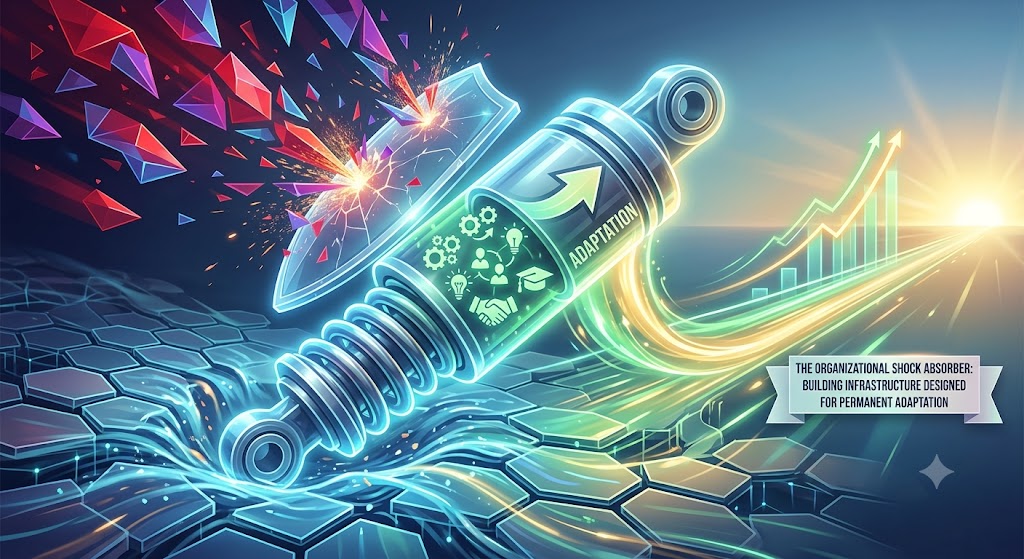
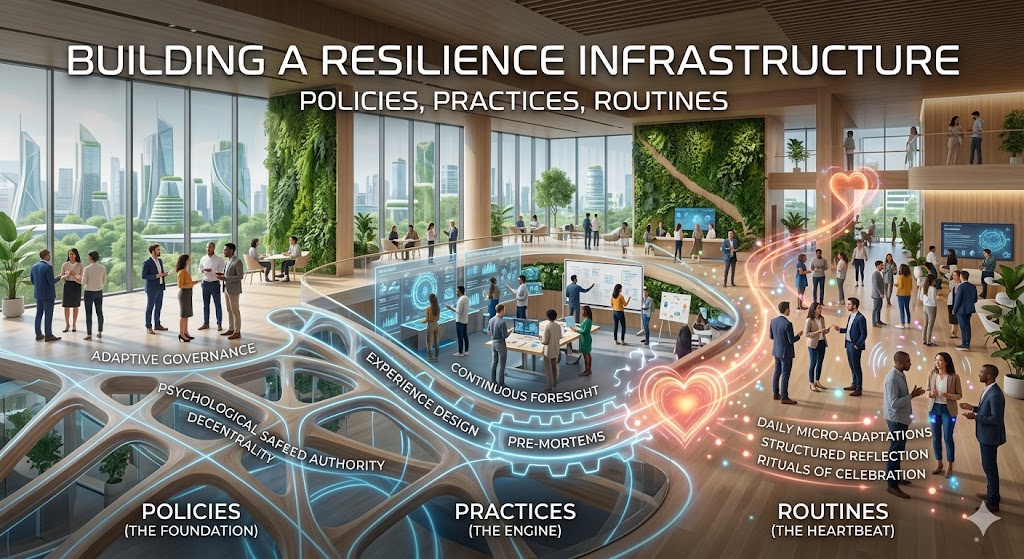
Building a Resilience Infrastructure

Policies, Practices, Routines

Building a Resilience Infrastructure


GUEST POST from Chateau G Pato

Introduction: Shifting from “Bouncing Back” to “Bouncing Forward”

In an era of continuous and accelerating disruption, we must fundamentally rethink our relationship with change. Resilience is no longer merely a reactive trait—a mechanism for “bouncing back” to the status quo after a shock. Instead, it must become a proactive infrastructure designed for “bouncing forward.” It is time to stop treating change as a frustrating anomaly and start designing organizations where continuous adaptability is the baseline state.

As we view this through a human-centered lens, a critical truth emerges: true resilience doesn’t live in risk-mitigation software or crisis management manuals. It lives entirely in your people. Therefore, a modern resilience infrastructure must be intentionally designed around human capabilities, human behaviors, and human limits. Our goal is to systematically mitigate change fatigue while actively fostering the psychological safety required for a true innovation mindset to thrive.

To move from theory to action, we must operationalize adaptability. This requires building a sustainable resilience infrastructure supported by three interconnected pillars:

  • Policies: The structural foundation that provides empowering guardrails rather than bureaucratic roadblocks.
  • Practices: The operational engine and methodologies driving human-centered change.
  • Routines: The cultural heartbeat that makes organizational adaptability a daily habit.

Pillar 1: Policies – The Structural Foundation

In most organizations, policy is synonymous with control. However, in a resilience infrastructure, policy must shift its purpose from control to enablement. To build an organization that can pivot without cracking, we must design structural guardrails that provide clarity without inducing rigidity.

Redefining Policy for Agility

Traditional, rigid policies are the natural enemy of innovation. We must transition toward “adaptive policies”—frameworks that are designed to scale their level of oversight based on the environmental context. When the pace of change accelerates, our policies should facilitate rapid response rather than acting as a bureaucratic anchor. This is about moving from a “rules-based” culture to a “principles-based” culture.

Decentralized Decision-Making

Resilience is strongest at the edges. Experience design teaches us that the employees closest to the customer and the frontline problems are the ones best equipped to navigate a sudden shift. Policies must be rewritten to push decision-making authority down the chain, empowering teams to act on real-time insights without waiting for a centralized hierarchy that may be disconnected from the current reality.

Structural Commitment to Psychological Safety

You cannot build a resilient infrastructure on a foundation of fear. Psychological safety must be more than a leadership buzzword; it must be a structural standard. This means instituting policies that protect employees when they experiment, fail, and share uncomfortable truths. If the “cost of failure” is a career-ending move, your people will choose silence over resilience every time.

Futurology as a Governance Standard

Finally, resilience requires looking beyond the immediate horizon. We must institute policies that make long-term scenario planning and “horizon scanning” a mandatory part of our governance. By making futurology a standard requirement for annual strategic resource allocation, we ensure that the organization is not just reacting to the present, but is structurally prepared for multiple possible futures.

Pillar 2: Practices – The Operational Engine

If policies provide the “why” and the “what,” then practices are the “how.” These are the repeatable methodologies and disciplines that keep the organization’s resilience muscle in a state of constant readiness. To build a resilient operational engine, we must integrate the tools of futurology and experience design into our everyday work flow.

Continuous Foresight and Innovation Portfolios

In a world of constant flux, episodic strategic planning is dead. We must replace the “annual retreat” with a practice of continuous foresight. This involves maintaining a balanced innovation portfolio—investing not just in the “Now” (core business optimization) but also the “Next” (incremental shifts) and the “New” (disruptive breakthroughs). Resilience comes from having multiple bets on the table, ensuring that when one path closes, others are already being paved.

Experience Design in Change Management

The greatest failure in organizational change is treating it as a technical rollout rather than a human transition. We must apply experience design (EX) to the change process itself. By mapping the “Employee Change Journey,” we can identify the specific moments where friction occurs and design interventions that support people emotionally and cognitively. Resilience is maximized when change is designed with people, rather than pushed onto them.

The Practice of “Pre-Mortems”

Resilience isn’t just about surviving a crisis; it’s about anticipating it. We should systematize the “pre-mortem” practice: before any major project or pivot begins, teams must imagine it has failed and work backward to determine why. This disciplined habit of visualizing failure allows us to build preemptive mitigation strategies into the very design of our initiatives, turning potential roadblocks into anticipated turns.

Cross-Pollination and Ecosystem Building

Isolation is the precursor to obsolescence. Resilience requires a radical commitment to cross-pollination. We must develop practices that actively break down departmental silos and encourage collaborative problem-solving across functions. Furthermore, true resilience extends beyond our walls; we must build ecosystems of partners, customers, and even competitors, creating a web of support and shared intelligence that no single organization could maintain on its own.

Pillar 3: Routines – The Cultural Heartbeat

While policies provide the framework and practices provide the tools, it is routines that provide the consistency. Resilience is not a grand gesture performed only during a disaster; it is a muscle built through the daily, mundane interactions of every team member. To make adaptability a permanent part of our culture, we must turn it into a habit.

The Power of Micro-Adaptations

True organizational resilience is the sum of a thousand micro-adaptations. We must design routines that encourage small, low-stakes pivots every day. When teams are accustomed to making minor course corrections in their weekly sprints, the “muscle memory” required for a macro-level organizational shift is already in place. We must stop waiting for the “Big Change” and start practicing the “Small Change” constantly.

The “Sensory” Routine

Resilient leaders don’t guess; they sense. Establishing a routine “sensory” loop—such as a fifteen-minute daily stand-up focused specifically on external signals and internal sentiment—keeps a pulse on the human-centered metrics that matter. We need to monitor change fatigue, creative energy, and engagement levels as rigorously as we monitor revenue. If the human battery is low, the resilience infrastructure will fail regardless of how good the strategy is.

Structured Reflection and Socialized Learning

Learning must be systematized, not left to chance. We must embed structured reflection into our standard weekly cadences. Whether through “after-action reviews” or retrospective routines, the goal is to ensure that every setback is converted into documented, socialized intelligence. A resilient organization is one that never fails at the same thing twice because the routine of learning is faster than the pace of disruption.

Rituals of Celebration

Finally, we must design routines that celebrate the behaviors of resilience, not just the successful outcomes. If we only celebrate “winning,” people will hide their mistakes. Instead, we must create rituals that honor intelligent risk-taking, rapid pivoting, and radical collaboration. By shining a light on the process of adaptation, we reinforce the cultural truth that in this organization, the ability to change is our greatest competitive advantage.

Conclusion: Future-Proofing the Human Experience

Building a resilience infrastructure is not a project with a defined completion date; it is a fundamental shift in how we conceive of organizational existence. We must move away from the fragile architecture of efficiency and toward the robust architecture of adaptability. By aligning our Policies, Practices, and Routines, we create a living system that does not merely survive disruption but is fueled by it.

The synthesis of these three pillars creates a powerful synergy: Policies give your people the permission to act, Practices provide them with the tools to execute, and Routines build the muscle memory necessary to sustain momentum. When these elements work in concert, the organization stops fearing the “Great American Contraction” or the next wave of AI-driven displacement and starts seeing them as canvases for new value creation.

As we look toward the next decade, the ultimate competitive advantage will not be found in the size of your balance sheet or the proprietary nature of your tech stack. It will be found in your Return on Adaptability (ROA). The organizations that thrive will be those that have fundamentally redesigned the human experience of work—transforming change from a perceived threat into a celebrated opportunity for continuous innovation.

The future belongs to the resilient. It’s time to stop waiting for the dust to settle and start building the infrastructure that allows you to dance in the whirlwind.

Frequently Asked Questions

What is the difference between organizational resilience and crisis management?

Crisis management is a reactive function designed to minimize damage during a specific event. Organizational resilience, specifically a “Resilience Infrastructure,” is a proactive, systemic capability that allows an organization to absorb shocks and “bounce forward” into a better state of operation by design.

Why is “Psychological Safety” included in a policy framework?

Innovation and resilience require employees to take risks and report failures early. By codifying psychological safety into policy, an organization moves beyond leadership lip-service and creates a structural guarantee that employees can experiment and adapt without fear of retribution.

How do routines differ from practices in this model?

Practices are the specific “how-to” methodologies and skill sets (like Customer Experience audits or Pre-Mortems). Routines are the rhythmic, daily habits that ensure those practices are actually used. Practices are the tools; routines are the heartbeat that keeps the tools in hand.

Image credit: Google Gemini

Subscribe to Human-Centered Change & Innovation WeeklySign up here to get Human-Centered Change & Innovation Weekly delivered to your inbox every week.