
Tag Archives: Policies

Regulations and Policies Promoting Sustainability

Regulations and Policies Promoting Sustainability

GUEST POST from Art Inteligencia

The drumbeat of sustainability has grown from a faint whisper to a resounding roar. Once relegated to the fringes of corporate social responsibility, sustainability is now a core strategic imperative for businesses, a critical concern for citizens, and an undeniable challenge for governments. But how do we truly accelerate this vital transition? The answer, surprisingly to some, lies not just in market forces or individual action, but significantly in the **intelligent application of regulations and policies.**

For too long, the narrative has often pitted regulation against innovation, suggesting that rules inherently stifle progress. As a practitioner of human-centered change and innovation, I argue precisely the opposite: thoughtfully designed regulations and policies are powerful catalysts for innovation, driving businesses to find more efficient, less impactful, and ultimately more profitable ways of operating. They create a level playing field, reward pioneering efforts, and fundamentally shift the calculus of what’s possible and profitable.

Beyond Compliance: The Dual Engine of “Push” and “Pull”

Effective regulations and policies operate on a sophisticated “push” and “pull” dynamic. **”Push” mechanisms** establish essential baselines, prohibit demonstrably harmful practices, and set minimum performance standards. Consider stringent emissions limits for industrial facilities, bans on certain toxic chemicals, or mandates for responsible waste disposal. These “push” measures compel businesses to directly confront and reduce their negative environmental footprint, often necessitating immediate operational adjustments.

However, the true transformative power often emerges from **”pull” mechanisms.** These incentives, subsidies, and market signals actively draw businesses towards desired sustainable behaviors, reward pioneering efforts, and cultivate vibrant markets for green products and services. Examples include generous tax credits for renewable energy installations, agricultural subsidies tied to sustainable farming practices, or government procurement policies that prioritize eco-certified goods. These “pull” forces don’t just mitigate harm; they proactively shape industries and economies towards a greener, more resilient future.

Case Study 1: The European Union’s Groundbreaking Circular Economy Action Plan

One of the most ambitious and comprehensive examples of policy driving systemic sustainability is the European Union’s **Circular Economy Action Plan**. Recognizing that our current linear “take-make-dispose” economic model is fundamentally unsustainable, the EU has embarked on a profound, systemic shift towards a circular economy. This visionary framework aims to minimize waste, keep resources in use for as long as possible, and design products for maximum durability, reuse, and recycling.

This isn’t a singular regulation but a holistic, interconnected suite of policies, including:

  • Extended Producer Responsibility (EPR) Schemes: Mandating that producers bear responsibility for their products throughout their lifecycle, including collection and recycling. This “push” incentivizes designing products that are easier to recycle or reuse, fostering innovation in materials and reverse logistics.
  • Product Design Requirements (Ecodesign): New and expanded rules ensure products are inherently more durable, repairable, and recyclable. These ecodesign mandates now cover a broader range of products beyond energy-related goods, extending to textiles, furniture, and electronics. This directly challenges manufacturers to innovate in materials science, modular design, and even business models, promoting “product-as-a-service” offerings.
  • Ambitious Waste Management Targets: Stringent targets for recycling and waste reduction are set for member states, driving significant investment in advanced sorting, recycling technologies, and the infrastructure necessary for a circular economy.
  • Green Public Procurement (GPP): Public authorities are increasingly mandated or encouraged to leverage their substantial purchasing power to buy sustainable products and services. This creates a powerful “pull” market, signaling strong demand for circular solutions and accelerating their mainstream adoption.
  • Forthcoming Digital Product Passports: These passports will provide comprehensive, transparent information about a product’s origin, durability, repairability, and end-of-life options. This transparency empowers both consumers and businesses to make informed choices, simplifies repair processes, and streamlines material recovery, further pushing industries towards deeper circularity.

The tangible impact is evident: companies across Europe are fundamentally rethinking their entire value chains. This policy framework has spurred a remarkable surge in repair services, remanufacturing initiatives, and sophisticated material recovery solutions, demonstrating how policy can catalyze profound industrial transformation.

Case Study 2: Singapore’s Carbon Tax and Green Finance Initiatives

While many nations grapple with carbon pricing, Singapore offers a compelling case study of a nation implementing a **carbon tax** as a core policy tool to drive sustainability and innovation. Unlike cap-and-trade systems, a carbon tax provides a direct and predictable price signal, incentivizing businesses to reduce emissions. Singapore’s carbon tax, initially S$5 per tonne of greenhouse gas (GHG) emissions, is set to increase to S$25 per tonne in 2024-2025 and S$45 per tonne in 2026-2027, with a long-term goal of S$50-80 per tonne by 2030. This rising price signal creates a powerful “push” for companies to invest in energy efficiency, adopt cleaner technologies, and explore renewable energy sources.

Complementing this “push,” Singapore has also aggressively pursued **Green Finance initiatives** (a “pull” mechanism) to support this transition. The Monetary Authority of Singapore (MAS) has launched various schemes, including:

  • Green Bond Grant Scheme: Encouraging the issuance of green bonds by companies to finance environmentally friendly projects.
  • Sustainable Bond Grant Scheme: Supporting the issuance of sustainability-linked bonds and other sustainable debt instruments.
  • Green and Sustainability-Linked Loan Grant Scheme: Providing grants for companies to obtain green and sustainability-linked loans, incentivizing financing for green projects and sustainable business practices.

The combination of a predictable carbon price and robust green finance mechanisms has spurred significant innovation in Singapore. Industries are actively seeking ways to decarbonize operations, from adopting industrial heat pumps and optimizing energy consumption to exploring carbon capture technologies. The financial sector is innovating new products and services to support green investments, creating a virtuous cycle where policy drives investment, and investment drives further sustainable innovation. This dual approach illustrates how a clear economic signal, coupled with supportive financial mechanisms, can effectively accelerate a nation’s sustainability agenda.

The Human Element: Orchestrating Mindset Shifts and Collaborative Action

Beyond the direct economic and technological shifts, effective regulations and policies play a crucial, often underestimated, role in shaping human behavior and fostering a pervasive culture of sustainability. When the “rules of the game” are redefined, individuals and organizations are compelled to adapt. While this adaptation can initially present challenges, it invariably ignites creativity and problem-solving, pushing boundaries that might otherwise remain untouched.

For policies to be truly impactful and foster continuous innovation, they must be meticulously crafted:

  • Clarity and Consistency: Businesses require certainty to commit to long-term strategic investments. Ambiguous or frequently shifting regulations breed hesitancy and undermine confidence.
  • Performance-Based, Not Prescriptive: Rather than dictating *how* a company must achieve sustainability (e.g., “you must use X technology”), policies should focus on *what* needs to be achieved (e.g., “reduce emissions by Y%”). This allows for diverse, innovative solutions tailored to specific contexts.
  • Collaborative Design and Iteration: Engaging a broad spectrum of stakeholders – industry leaders, academic experts, civil society organizations, and even citizens – in the policy-making process ensures that regulations are practical, effective, and perceived as fair. This collaborative approach also allows for continuous improvement and adaptation.
  • Supportive of Early Adopters and R&D: Policies should actively include mechanisms that reward pioneering efforts, provide incentives for research and development in sustainable technologies, and help de-risk crucial, but sometimes uncertain, sustainable investments.

The Intelligent Path Forward

The journey towards a truly sustainable future is not a passive current to be drifted upon. It demands intentional design, courageous leadership, and a collective willingness to embrace profound change. Regulations and policies, far from being shackles on the hands of progress, are in fact the essential guiding rails and powerful accelerators that can help us navigate the complex, intertwined terrain of environmental responsibility and economic prosperity.

By integrating a deep understanding of the human-centered aspects of change – how policies influence individual and organizational decision-making, encourage cross-sector collaboration, and unlock latent creativity – we can craft regulatory frameworks that not only mitigate environmental harm but actively promote a vibrant, innovative, and truly sustainable global economy. It’s time to champion policies that make sustainability not just an ethical imperative, but the intelligent, economically viable, and ultimately inevitable path forward.

Extra Extra: Futurology is not fortune telling. Futurists use a scientific approach to create their deliverables, but a methodology and tools like those in FutureHacking™ can empower anyone to engage in futurology themselves.

Image credit: Pixabay

Subscribe to Human-Centered Change & Innovation WeeklySign up here to get Human-Centered Change & Innovation Weekly delivered to your inbox every week.
Building a Resilience Infrastructure

Policies, Practices, Routines

Building a Resilience Infrastructure


GUEST POST from Chateau G Pato

Introduction: Shifting from “Bouncing Back” to “Bouncing Forward”

In an era of continuous and accelerating disruption, we must fundamentally rethink our relationship with change. Resilience is no longer merely a reactive trait—a mechanism for “bouncing back” to the status quo after a shock. Instead, it must become a proactive infrastructure designed for “bouncing forward.” It is time to stop treating change as a frustrating anomaly and start designing organizations where continuous adaptability is the baseline state.

As we view this through a human-centered lens, a critical truth emerges: true resilience doesn’t live in risk-mitigation software or crisis management manuals. It lives entirely in your people. Therefore, a modern resilience infrastructure must be intentionally designed around human capabilities, human behaviors, and human limits. Our goal is to systematically mitigate change fatigue while actively fostering the psychological safety required for a true innovation mindset to thrive.

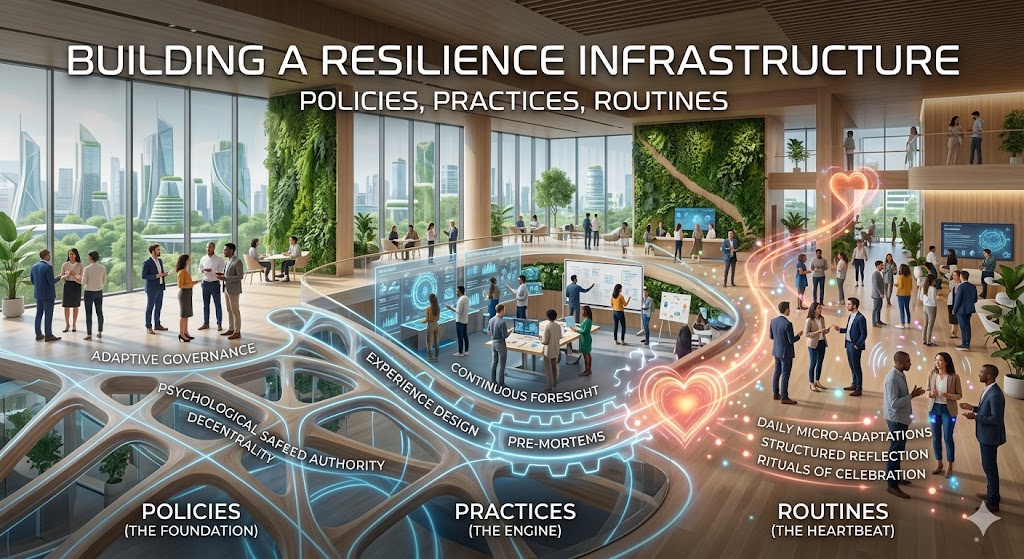
To move from theory to action, we must operationalize adaptability. This requires building a sustainable resilience infrastructure supported by three interconnected pillars:

  • Policies: The structural foundation that provides empowering guardrails rather than bureaucratic roadblocks.
  • Practices: The operational engine and methodologies driving human-centered change.
  • Routines: The cultural heartbeat that makes organizational adaptability a daily habit.

Pillar 1: Policies – The Structural Foundation

In most organizations, policy is synonymous with control. However, in a resilience infrastructure, policy must shift its purpose from control to enablement. To build an organization that can pivot without cracking, we must design structural guardrails that provide clarity without inducing rigidity.

Redefining Policy for Agility

Traditional, rigid policies are the natural enemy of innovation. We must transition toward “adaptive policies”—frameworks that are designed to scale their level of oversight based on the environmental context. When the pace of change accelerates, our policies should facilitate rapid response rather than acting as a bureaucratic anchor. This is about moving from a “rules-based” culture to a “principles-based” culture.

Decentralized Decision-Making

Resilience is strongest at the edges. Experience design teaches us that the employees closest to the customer and the frontline problems are the ones best equipped to navigate a sudden shift. Policies must be rewritten to push decision-making authority down the chain, empowering teams to act on real-time insights without waiting for a centralized hierarchy that may be disconnected from the current reality.

Structural Commitment to Psychological Safety

You cannot build a resilient infrastructure on a foundation of fear. Psychological safety must be more than a leadership buzzword; it must be a structural standard. This means instituting policies that protect employees when they experiment, fail, and share uncomfortable truths. If the “cost of failure” is a career-ending move, your people will choose silence over resilience every time.

Futurology as a Governance Standard

Finally, resilience requires looking beyond the immediate horizon. We must institute policies that make long-term scenario planning and “horizon scanning” a mandatory part of our governance. By making futurology a standard requirement for annual strategic resource allocation, we ensure that the organization is not just reacting to the present, but is structurally prepared for multiple possible futures.

Pillar 2: Practices – The Operational Engine

If policies provide the “why” and the “what,” then practices are the “how.” These are the repeatable methodologies and disciplines that keep the organization’s resilience muscle in a state of constant readiness. To build a resilient operational engine, we must integrate the tools of futurology and experience design into our everyday work flow.

Continuous Foresight and Innovation Portfolios

In a world of constant flux, episodic strategic planning is dead. We must replace the “annual retreat” with a practice of continuous foresight. This involves maintaining a balanced innovation portfolio—investing not just in the “Now” (core business optimization) but also the “Next” (incremental shifts) and the “New” (disruptive breakthroughs). Resilience comes from having multiple bets on the table, ensuring that when one path closes, others are already being paved.

Experience Design in Change Management

The greatest failure in organizational change is treating it as a technical rollout rather than a human transition. We must apply experience design (EX) to the change process itself. By mapping the “Employee Change Journey,” we can identify the specific moments where friction occurs and design interventions that support people emotionally and cognitively. Resilience is maximized when change is designed with people, rather than pushed onto them.

The Practice of “Pre-Mortems”

Resilience isn’t just about surviving a crisis; it’s about anticipating it. We should systematize the “pre-mortem” practice: before any major project or pivot begins, teams must imagine it has failed and work backward to determine why. This disciplined habit of visualizing failure allows us to build preemptive mitigation strategies into the very design of our initiatives, turning potential roadblocks into anticipated turns.

Cross-Pollination and Ecosystem Building

Isolation is the precursor to obsolescence. Resilience requires a radical commitment to cross-pollination. We must develop practices that actively break down departmental silos and encourage collaborative problem-solving across functions. Furthermore, true resilience extends beyond our walls; we must build ecosystems of partners, customers, and even competitors, creating a web of support and shared intelligence that no single organization could maintain on its own.

Pillar 3: Routines – The Cultural Heartbeat

While policies provide the framework and practices provide the tools, it is routines that provide the consistency. Resilience is not a grand gesture performed only during a disaster; it is a muscle built through the daily, mundane interactions of every team member. To make adaptability a permanent part of our culture, we must turn it into a habit.

The Power of Micro-Adaptations

True organizational resilience is the sum of a thousand micro-adaptations. We must design routines that encourage small, low-stakes pivots every day. When teams are accustomed to making minor course corrections in their weekly sprints, the “muscle memory” required for a macro-level organizational shift is already in place. We must stop waiting for the “Big Change” and start practicing the “Small Change” constantly.

The “Sensory” Routine

Resilient leaders don’t guess; they sense. Establishing a routine “sensory” loop—such as a fifteen-minute daily stand-up focused specifically on external signals and internal sentiment—keeps a pulse on the human-centered metrics that matter. We need to monitor change fatigue, creative energy, and engagement levels as rigorously as we monitor revenue. If the human battery is low, the resilience infrastructure will fail regardless of how good the strategy is.

Structured Reflection and Socialized Learning

Learning must be systematized, not left to chance. We must embed structured reflection into our standard weekly cadences. Whether through “after-action reviews” or retrospective routines, the goal is to ensure that every setback is converted into documented, socialized intelligence. A resilient organization is one that never fails at the same thing twice because the routine of learning is faster than the pace of disruption.

Rituals of Celebration

Finally, we must design routines that celebrate the behaviors of resilience, not just the successful outcomes. If we only celebrate “winning,” people will hide their mistakes. Instead, we must create rituals that honor intelligent risk-taking, rapid pivoting, and radical collaboration. By shining a light on the process of adaptation, we reinforce the cultural truth that in this organization, the ability to change is our greatest competitive advantage.

Conclusion: Future-Proofing the Human Experience

Building a resilience infrastructure is not a project with a defined completion date; it is a fundamental shift in how we conceive of organizational existence. We must move away from the fragile architecture of efficiency and toward the robust architecture of adaptability. By aligning our Policies, Practices, and Routines, we create a living system that does not merely survive disruption but is fueled by it.

The synthesis of these three pillars creates a powerful synergy: Policies give your people the permission to act, Practices provide them with the tools to execute, and Routines build the muscle memory necessary to sustain momentum. When these elements work in concert, the organization stops fearing the “Great American Contraction” or the next wave of AI-driven displacement and starts seeing them as canvases for new value creation.

As we look toward the next decade, the ultimate competitive advantage will not be found in the size of your balance sheet or the proprietary nature of your tech stack. It will be found in your Return on Adaptability (ROA). The organizations that thrive will be those that have fundamentally redesigned the human experience of work—transforming change from a perceived threat into a celebrated opportunity for continuous innovation.

The future belongs to the resilient. It’s time to stop waiting for the dust to settle and start building the infrastructure that allows you to dance in the whirlwind.

Frequently Asked Questions

What is the difference between organizational resilience and crisis management?

Crisis management is a reactive function designed to minimize damage during a specific event. Organizational resilience, specifically a “Resilience Infrastructure,” is a proactive, systemic capability that allows an organization to absorb shocks and “bounce forward” into a better state of operation by design.

Why is “Psychological Safety” included in a policy framework?

Innovation and resilience require employees to take risks and report failures early. By codifying psychological safety into policy, an organization moves beyond leadership lip-service and creates a structural guarantee that employees can experiment and adapt without fear of retribution.

How do routines differ from practices in this model?

Practices are the specific “how-to” methodologies and skill sets (like Customer Experience audits or Pre-Mortems). Routines are the rhythmic, daily habits that ensure those practices are actually used. Practices are the tools; routines are the heartbeat that keeps the tools in hand.

Image credit: Google Gemini

Subscribe to Human-Centered Change & Innovation WeeklySign up here to get Human-Centered Change & Innovation Weekly delivered to your inbox every week.

Innovation Quotes of the Day – May 29, 2012


“If you get people to ‘freely’ talk about innovation, its importance, its impact and can ‘paint’ the future in broad brush strokes, they achieve a growing clarity and enthusiasm and that often missing critical component – a sense of shared identity.”

– Paul Hobcraft


“The United States leads the world in innovation because it has created the perfect storm of a risk tolerant citizenry, where failure is sometimes a badge of honor, and a government that invests in basic research, helps to commercialize it, and for the most part tends to go out of the way from a regulatory standpoint.”

– Braden Kelley


“Organizations love to run the aforementioned innovation processes through the middle of the enterprise which is designed to eliminate variation. Think about your metrics, hurdle rates and stage-gate systems and it becomes clear that these practices are designed to created stability through standards, policies and similar controls. Innovation moves from the outside of the bell curve, where risk and reward are reversed, and moves to middle over time.”

– Jeff DeGraff


What are some of your favorite innovation quotes?

Add one or more to the comments, listing the quote and who said it, and I’ll share the best of the submissions as future innovation quotes of the day!

Subscribe to Human-Centered Change & Innovation WeeklySign up here to get Human-Centered Change & Innovation Weekly delivered to your inbox every week.