LAST UPDATED: April 7, 2026 at 12:26 PM
GUEST POST from Chateau G Pato
The Strategic Middle
In the world of organizational transformation, middle managers are often unfairly labeled as the “permafrost” — the cold, impenetrable layer where executive vision stalls and frontline enthusiasm withers. However, from a human-centered design perspective, this layer isn’t a barrier by choice; it is a pressurized environment where the demand for stability (Business as Usual) crashes directly into the demand for agility (Change).
The Middle Manager Paradox
Middle managers occupy a unique and often exhausting space. They are the primary bridge between high-level strategy and ground-level execution. While executives focus on the destination, middle managers are tasked with building the vehicle, fueling it, and keeping the passengers from jumping out — all while driving at full speed.
Why Change Fails at the Core
To innovate effectively, we must move beyond the lazy trope of “managerial resistance.” Most failure at this level isn’t due to a lack of will, but a lack of psychological and structural support. When a manager is measured on legacy KPIs while being asked to champion a disruptive future, the friction becomes untenable. True change design requires us to solve for the manager’s experience as much as the customer’s.
The Thesis: Change Isn’t Managed; It’s Coached
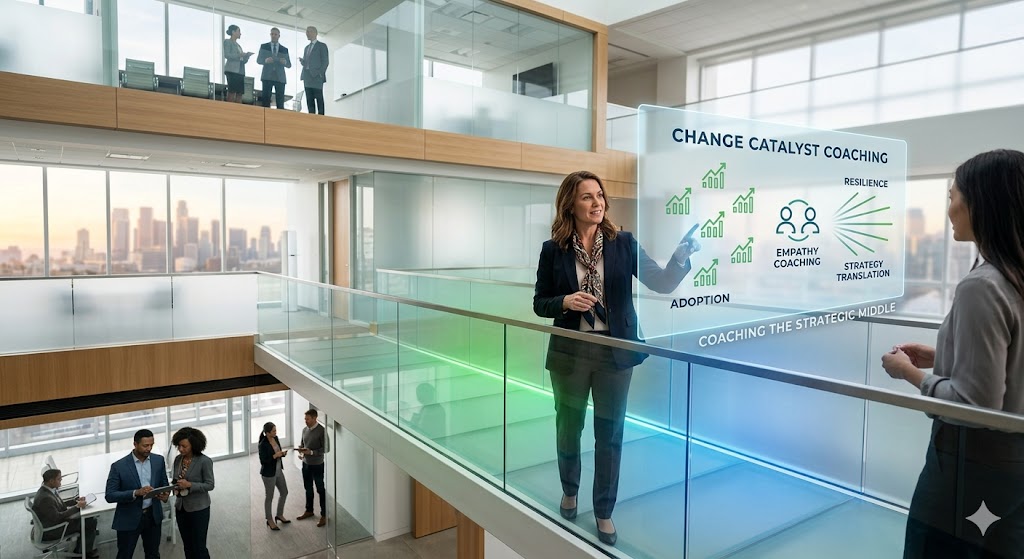
We must shift the paradigm from directive oversight — which relies on compliance — to supportive facilitation. Coaching provides middle managers with the tools to navigate the emotional landscape of their teams, surface hidden obstacles early, and translate abstract corporate goals into meaningful local action. By coaching the middle, we turn a potential bottleneck into a powerful catalyst for sustained innovation.
The Human-Centered Change Framework
Change initiatives fail when we treat people like components in an engine — replaceable, logical, and purely functional. To truly innovate how we approach change coaching for middle managers, we must adopt a human-centered methodology. This framework is not about managing a checklist of tasks; it’s about understanding and designing for the entire experience of the manager navigating the transition.
Empathy as a Business Tool
The cornerstone of human-centered design is empathy. When applied to middle managers, this means proactively seeking to understand their specific friction points, fears, and motivations. The coaching relationship should begin with an **empathy mapping session** designed to explore the manager’s perspective:
- What are they hearing from their teams (resistance, fear) vs. their leaders (pressure, urgency)?
- What are they seeing in the organization (fragmented systems, siloed efforts)?
- What are their deepest pains (fear of failure, workload overload) and potential gains (career growth, successful innovation)?
This exercise provides the raw data needed to tailor the coaching experience and create a plan that addresses their actual challenges rather than perceived ones.
The Experience of Change
Every change initiative is a journey. We often design the endpoint (the new system, the new structure) but fail to design the path. Change coaches must help middle managers view this journey as a critical **user experience (UX)**. A human-centered approach requires us to answer key questions about that journey:
- Does the current workload allow space for adoption and experimentation? (Or are they working a “second shift”?)
- Is the environment psychologically safe? Is failure during the learning curve accepted or penalized?
- How does this change impact the manager’s professional identity and long-term goals?
By intentionally designing for these experience factors, we ensure the manager is equipped, mentally and structurally, to adopt and champion the change.
Visualizing the Impact: The Change Planning Toolkit™
Complexity is the enemy of adoption. In human-centered design, visualization is crucial for clarity. In my work developing the Change Planning Toolkit™, I emphasized the need for managers to move beyond abstract spreadsheets. Coaching middle managers involves helping them use visual canvases and tools to:
- Map the specific impacts of the change on every stakeholder group within their influence.
- Identify hidden dependencies that might cause bottlenecks.
- Co-create adoption strategies *with* their teams, rather than dictating them.
Visual tools reduce cognitive load, foster collaboration, and make complex organizational changes manageable, providing a shared language for the manager, their team, and the coach.
Core Coaching Competencies for the “Middle”
To effectively coach through change, middle managers must evolve from “task masters” into facilitative leaders. This shift requires a specific set of competencies designed to bridge the gap between high-level vision and the human reality of the workplace.
Translating Strategy into Action
One of the greatest points of failure in change initiatives is the “Meaning Gap.” Executives speak in terms of EBITDA, market share, and digital transformation, but frontline employees care about their daily workflows and job security. A coached middle manager acts as a strategic translator.
Coaching helps managers identify the “why” that resonates specifically with their teams. Instead of simply repeating corporate talking points, they learn to frame the change in ways that highlight local benefits, solve immediate frustrations, and align with the team’s values.
Active Listening & Feedback Loops
Traditional management often relies on a “broadcast” model — pushing information down the hierarchy. Human-centered coaching flips this. Managers must become experts in active listening to surface the “ground truth” of the organization.
- Surfacing Obstacles: Learning to ask open-ended questions that reveal hidden technical or emotional barriers before they become crises.
- The Two-Way Dialogue: Moving from “Do you have any questions?” to “What part of this new process feels most difficult for you?”
- Feedback as Fuel: Treating team feedback not as “resistance,” but as valuable data that can be used to refine the change design.
Developing Resilience and Modeling Behavior
In times of transition, the team looks to the manager for cues on how to react. If the manager is anxious or cynical, the team will follow suit. Coaching provides managers with the emotional intelligence tools to navigate their own uncertainty first.
By developing personal resilience, managers can model adaptable behavior. This includes “working in the open,” admitting when they don’t have all the answers, and demonstrating a growth mindset. When a manager can stay grounded in the face of ambiguity, they create a “containment vessel” that allows their team to feel safe enough to take risks and learn new ways of working.
Moving from Gatekeeper to Catalyst
In many traditional hierarchies, the middle manager acts as a gatekeeper — protecting resources, mitigating risk, and ensuring strict adherence to established protocols. However, in a rapidly evolving business landscape, this defensive posture can stifle innovation. Coaching empowers managers to shift their identity toward becoming a catalyst: someone who accelerates the change process by removing friction and empowering others.
Relinquishing Control and Embracing Empowerment
The most difficult hurdle for many managers during change is the fear of losing control. When processes are in flux, the instinct is to micromanage to prevent errors. A human-centered coaching approach helps managers understand that agility requires distributed authority.
Coaches work with managers to identify tasks and decisions that can be delegated to the team. By shifting from “command and control” to “clear intent and support,” managers free themselves to focus on higher-level strategic alignment while giving their team the autonomy to find the best way forward.
Identifying and Amplifying “Positive Deviants”
Change rarely happens all at once. In every team, there are individuals who naturally gravitate toward the new way of working — the positive deviants. These are people who find better ways to succeed despite the challenges of the transition.
Coaching teaches managers how to spot these early adopters and, instead of seeing them as “outliers,” use them as partners in the transformation. By amplifying their successes and sharing their methods, the manager allows the change to spread organically through peer influence rather than top-down mandates.
The Power of Recognition and Small Wins
Large-scale transformation can feel like an endless marathon. Without visible progress, fatigue sets in quickly. Middle managers must be coached to become “detectives of the good,” constantly looking for small wins that validate the new direction.
- Micro-Recognitions: Celebrating the first time a team member uses a new tool, even if they aren’t perfect yet.
- Process Wins: Highlighting when a new workflow saves time, even if the overall project isn’t finished.
- Emotional Validation: Acknowledging the effort and courage it takes to unlearn old habits.
By consistently recognizing these moments, the manager builds the collective confidence of the team, proving that the “new” is not only possible but beneficial.
Overcoming the “Permafrost” (Common Challenges)
The “permafrost” layer isn’t a sign of bad management; it’s a sign of a system in conflict. Middle managers are often buried under the weight of legacy expectations while being told to sprint toward a new horizon. Coaching at this level requires specific interventions to thaw this layer and allow the seeds of change to take root.
The Resource Crunch: Managing the “Second Shift”
One of the primary reasons change fails is that it is treated as an “add-on” to an already full 40-hour week. Coaches must work with managers to perform a brutal prioritization of their current commitments. This involves:
- Identifying “Stop-Doing” Lists: What legacy reports or meetings can be paused to create capacity for the change initiative?
- Integrating Change into Routine: Moving change tasks from “special projects” into the daily flow of work.
- Protecting White Space: Ensuring the manager has the cognitive breathing room to think strategically rather than just reacting to fires.
Managing Up and Down: The Shield and the Sword
Middle managers often feel squeezed between unrealistic executive deadlines and team burnout. A human-centered coach helps the manager master the art of boundary setting.
The manager learns to act as a shield for their team — protecting them from “initiative overload” and shifting priorities — while acting as a sword (or advocate) to the leadership, providing honest data on what is actually achievable. Coaching provides the scripts and the confidence to say, “We can do X, but we must delay Y to ensure the quality of the transition.”
Identifying and Healing “Change Fatigue”
Continuous change is the new normal, but human biology isn’t designed for perpetual high-alert states. Coaches must train managers to recognize the subtle signs of change fatigue before they turn into full-blown burnout:
- Cynicism: When “we’ve tried this before” becomes the default response.
- Disengagement: Silence in meetings or a lack of voluntary participation.
- Reduced Productivity: Even in tasks unrelated to the change.
The coaching intervention here isn’t to “push harder,” but to pause and re-calibrate. This might mean celebrating a plateau, acknowledging the emotional toll of the work, or temporarily slowing the pace of implementation to allow the team’s resilience to recover.
Measuring Success Beyond the Spreadsheet
The true impact of change coaching for middle managers cannot be captured solely by “go-live” dates or budget adherence. To understand if the transformation is sticking, we must look at the human metrics of the organization. Human-centered innovation requires a more nuanced approach to measuring success — one that values the health of the culture as much as the speed of the output.
Qualitative Milestones: The Pulse of the Team
Coaches should help managers look for leading indicators of success that traditional reporting often misses. These qualitative milestones demonstrate that the “permafrost” is thawing and a new culture is emerging:
- Shift in Sentiment: Moving from “Why is this happening to us?” to “How can we make this work for us?”
- Increased Collaboration: A visible rise in cross-functional problem-solving without the need for managerial intervention.
- Proactive Problem-Solving: Team members identifying and fixing bottlenecks in the new process independently.
The Innovation Connection
Effective change coaching creates a powerful side effect: a safer environment for continuous improvement and experimentation. We measure this by observing the frequency and quality of new ideas originating from the middle and frontline. When a manager is coached to be a catalyst, the team stops fearing mistakes and starts seeing them as data points. Success is defined by a team that no longer waits for a “Change Initiative” to improve their own workflows.
Long-Term ROI: Sustainability and Retention
The ultimate return on investment for coaching middle managers is sustainability. Anyone can force a temporary change through sheer willpower, but it won’t last. We measure long-term success through:
- Reduced Turnover: Managers who feel supported and coached are less likely to leave, and their teams are less likely to experience burnout.
- Knowledge Retention: How much of the “new way” remains standard practice six or twelve months after the formal project has ended.
- Adaptive Capacity: The speed at which the team can pivot to the next change. A coached team builds “change muscles” that make future transformations progressively easier.
Conclusion: Building a Culture of Continuous Change
The success of any innovation or change initiative ultimately rests on the shoulders of the middle. They are the operational engine of the organization, and if that engine is stalled by fear, overwhelm, or lack of clarity, the entire enterprise remains stationary regardless of the vision at the top.
Designing the Manager Experience
We must stop viewing middle management as a problem to be solved and start seeing it as a design opportunity. When we apply human-centered principles to the coaching of these leaders, we aren’t just checking off project milestones; we are building organizational resilience. When we design the change experience for the manager, they are finally empowered to design a thriving future for the organization.
The Call to Action
It is time to move beyond the “one-and-done” training workshops. Investing in sustained coaching programs treats middle managers as the strategic partners they truly are. This investment yields dividends far beyond the current project — it creates a leadership tier that is comfortable with ambiguity, empathetic to their teams, and ready to lead through the next wave of disruption.
Final Thought
Innovation is not a destination; it is a capability. By thawing the “permafrost” through coaching, you transform your middle managers from defenders of the status quo into the architects of your future.
Frequently Asked Questions
Why is the “Middle Manager” often the point of failure for change?
It’s rarely about personal resistance. Middle managers are often measured on legacy KPIs (stability) while being tasked with driving transformation (instability). This creates a “structural friction” where they are forced to prioritize current operations over future innovation just to meet their immediate performance goals.
How does coaching differ from traditional change management training?
Training is usually a one-way transfer of information or “how-to” steps. Coaching is a facilitative process that addresses the emotional and psychological barriers of the manager. It provides a safe space to navigate uncertainty, practice new behaviors, and develop the empathy required to lead a team through transition.
What is the first step in implementing a human-centered coaching approach?
The first step is conducting an Empathy Mapping exercise. Before deploying tools or timelines, you must understand the manager’s current reality — what they are hearing, seeing, feeling, and doing. This ensures the coaching intervention solves for their actual pain points rather than a generic set of assumptions.
Image credits: Gemini
 Sign up here to join 17,000+ leaders getting Human-Centered Change & Innovation Weekly delivered to their inbox every week.