Tag Archives: empathy

The Importance of Empathy in Design Thinking

The Importance of Empathy in Design Thinking

GUEST POST from Art Inteligencia

Empathy is at the core of design thinking, the innovative problem-solving approach that puts human needs and experiences at the forefront of the design process. It is the ability to truly understand and share in the feelings and experiences of others, and it is a critical element in creating products, services, and experiences that resonate with users on a deep and meaningful level.

Empathy allows designers to put themselves in the shoes of their users, to see the world from their perspective, and to uncover insights that can inform the design process. By empathizing with users, designers can better understand their needs, desires, and pain points, and create solutions that truly meet their needs.

Case Study 1: OXO Good Grips

One powerful example of the importance of empathy in design thinking is the story of the OXO Good Grips kitchen tools. In the 1980s, Sam Farber noticed that his wife, who was struggling with arthritis, had difficulty using traditional kitchen tools. He realized that there was a need for kitchen tools that were both functional and comfortable to use for people with limited dexterity. Farber and his team at OXO set out to design a line of kitchen tools that were easy to grip and use, with soft, comfortable handles that were easy on the hands. The result was a line of tools that were not only popular among people with arthritis but also became a bestseller among all consumers, demonstrating the power of empathetic design in creating products that meet the needs of a diverse range of users.

Case Study 2: Airbnb

Another compelling case study that illustrates the importance of empathy in design thinking is Airbnb. When the founders of Airbnb, Brian Chesky and Joe Gebbia, were struggling to pay rent, they decided to rent out air mattresses in their living room as a way to make some extra money. They quickly realized that there was a need for affordable, unique, and authentic accommodations for travelers, and they set out to create a platform that connected hosts with travelers looking for a more personalized and local experience. By empathizing with both hosts and travelers, Airbnb was able to create a platform that has revolutionized the travel industry and disrupted traditional hotel accommodations, showing the power of designing with empathy for the needs and experiences of users.

Conclusion

Empathy is a crucial element in design thinking that allows designers to create products, services, and experiences that truly resonate with users. By putting themselves in the shoes of their users and truly understanding their needs and experiences, designers can create solutions that address real-world problems and connect with users on a deeper level. The case studies of OXO Good Grips and Airbnb are just two examples of how empathy in design thinking can lead to innovative and successful products that have a real impact on people’s lives.

Bottom line: Futurology is not fortune telling. Futurists use a scientific approach to create their deliverables, but a methodology and tools like those in FutureHacking™ can empower anyone to engage in futurology themselves.

Image credit: Pixabay

Subscribe to Human-Centered Change & Innovation WeeklySign up here to get Human-Centered Change & Innovation Weekly delivered to your inbox every week.

The Power of Empathy

How to Develop a Human-Centered Design Mindset

The Power of Empathy

GUEST POST from Art Inteligencia

In today’s fast-paced and technology-driven world, designing for human needs has become more important than ever. Human-centered design, also known as empathic design, focuses on understanding the needs and experiences of individuals to create products and services that truly meet their requirements. By adopting this mindset, designers can revolutionize industries and positively impact the lives of people around the globe. In this article, we explore the power of empathy in design through two case study examples that demonstrate the transformative potential of a human-centered approach.

Case Study 1: Airbnb

When Airbnb was founded in 2008, the founders, Brian Chesky and Joe Gebbia, were faced with a market saturated by traditional hotels and limited accommodation options. To differentiate their platform, they decided to incorporate human-centered design principles into their approach. Chesky and Gebbia knew that to truly understand the needs of their potential users, they had to immerse themselves in their shoes. Hence, they embarked on a journey of empathic research by personally living in the homes of their target audience.

Through extensive interviews, observations, and interactions with hosts and guests, Airbnb gained valuable insights into the pain points and desires of their users. They learned that guests sought a more personalized and authentic experience, while hosts wanted to share their homes and make meaningful connections with others. Building on these insights, Airbnb designed their platform to cater to both guest and host needs, allowing users to personalize their bookings, interact with the local community, and build trust through user reviews. The human-centered design approach fueled Airbnb’s rapid growth and disrupted the hospitality industry, leveraging the power of empathy to revolutionize the way people travel and experience new places.

Case Study 2: IDEO

IDEO, an award-winning global design firm, is renowned for its human-centered design mindset. One notable example of their empathic approach is their work with the healthcare system in Ghana. In collaboration with the Ghana Health Service and the Bill & Melinda Gates Foundation, IDEO sought to address the challenges of immunization delivery in rural areas.

IDEO’s team immersed themselves in the local communities, engaging with healthcare workers, parents, and children to gain a deep understanding of the barriers to immunization. They conducted interviews, observed vaccination processes in action, and analyzed the existing infrastructure and resources. Through this empathic research, IDEO uncovered multiple obstacles, such as inadequate refrigeration systems, lack of transportation, and cultural misconceptions about vaccination.

Drawing on these insights, IDEO developed innovative solutions tailored to the specific needs of the Ghanaian communities. They introduced portable solar refrigeration units to ensure the safe storage of vaccines in remote areas, designed transportation systems to reach underserved populations efficiently, and implemented community education programs to dispel myths surrounding vaccines. IDEO’s human-centered design approach not only improved vaccination rates in Ghana but also served as a model for transforming immunization delivery worldwide.

These two case studies exemplify the power of empathy in design. By immersing themselves in the lives of users, both Airbnb and IDEO were able to uncover profound insights that drove meaningful innovation and positive impact. Empathy allows designers to move beyond assumptions and preconceived notions, enabling them to create products and services that truly resonate with the needs and aspirations of users.

To develop a human-centered design mindset, it is crucial to cultivate empathy throughout the design process. This involves actively listening to users, conducting thorough research, and engaging in open-minded conversations. By understanding the context, motivations, and challenges of the target audience, designers can create solutions that go beyond aesthetics, focusing on the overall experience and satisfaction of users.

Conclusion

Empathy is a formidable tool in the hands of designers. By embracing a human-centered design mindset, they can revolutionize industries, enhance user experiences, and positively impact society as a whole. The case studies of Airbnb and IDEO demonstrate how empathy can drive innovation and transform lives. Let us harness the power of empathy and work towards creating a more inclusive and people-centric world through design.

EDITOR’S NOTE: Braden Kelley’s Problem Finding Canvas can be a super useful starting point for doing design thinking or human-centered design.

“The Problem Finding Canvas should help you investigate a handful of areas to explore, choose the one most important to you, extract all of the potential challenges and opportunities and choose one to prioritize.”

Image credit: Pixabay

Subscribe to Human-Centered Change & Innovation WeeklySign up here to get Human-Centered Change & Innovation Weekly delivered to your inbox every week.

The Power of Empathy in Driving Innovation

The Power of Empathy in Driving Innovation

GUEST POST from Art Inteligencia

Empathy is a powerful skill that allows individuals to understand and share the feelings of others. While it is often associated with personal relationships and emotional intelligence, empathy also plays a crucial role in driving innovation. By putting themselves in the shoes of their customers, innovators can gain valuable insights and create products and services that truly address their needs and desires. This article explores the impact of empathy in driving innovation through two intriguing case studies.

Case Study 1 – The Airbnb Story

In 2008, Joe Gebbia and Brian Chesky were two struggling entrepreneurs in San Francisco, struggling to pay their rent. They decided to rent out some space in their apartment and provide a homemade breakfast for guests. To better understand the needs and experiences of their potential customers, the duo decided to step into their shoes.

To gain empathy, Gebbia and Chesky traveled to New York City and rented out their own space using their platform. They lived with the guests, capturing their reactions, preferences, and pain points. This experience turned out to be crucial in shaping Airbnb’s future success.

The empathy-driven insights helped them understand that people craved authentic, unique experiences when traveling. As a result, they shifted their focus from just renting out spaces to creating an entire marketplace for unique and local accommodations. They incorporated features like personal profiles, reviews, and detailed listings to build a sense of trust and connection between hosts and guests.

By putting themselves in the shoes of their customers, Gebbia and Chesky were able to create a platform that revolutionized the way people travel. Today, Airbnb boasts over 7 million listings worldwide and has become a global leader in the hospitality industry.

Case Study 2 – The Apple Story

Apple, under the leadership of Steve Jobs, is renowned for its innovative products that have shaped the technology landscape. One of the key factors contributing to Apple’s success is its ability to empathize with customers and anticipate their needs, even before they realize them.

When developing the iPod, for instance, Apple recognized that ordinary people found existing MP3 players too confusing and cumbersome. To better understand the user experience, the team at Apple conducted extensive research, observed customers, and put themselves in their shoes.

The insights gathered from this empathetic approach led to the creation of a simple and intuitive interface that revolutionized the way people interacted with portable music players. The iPod’s success paved the way for future innovations like the iPhone, iPad, and Apple Watch.

By empathizing with customers and anticipating their desires, Apple has consistently introduced groundbreaking products that transcend consumer expectations, reinvent industries, and propel technological advancements.

Conclusion

These case studies highlight how the power of empathy can drive innovation and shape successful business ventures. By understanding the needs, desires, and pain points of customers through empathy, entrepreneurs can develop products and services that truly resonate with their target audience. Furthermore, empathy encourages a user-centric approach, fueling creativity and unlocking new possibilities for innovation.

In a world that is becoming increasingly interconnected and diverse, empathy is not only an essential skill in personal relationships but also a critical catalyst for driving innovation. As businesses strive to stay competitive and relevant, the power of empathy should not be underestimated. It has the potential to transform industries, disrupt markets, and create products and services that truly make a difference in people’s lives.

Image credit: Pexels

Subscribe to Human-Centered Change & Innovation WeeklySign up here to get Human-Centered Change & Innovation Weekly delivered to your inbox every week.

Why Empathy and Collaboration Are Strategic Agility Metrics

Beyond the Checklist

Why Empathy and Collaboration Are Strategic Agility Metrics

GUEST POST from Chateau G Pato


The Mirage of the Metric

The Agility Paradox: Organizations look incredibly agile on paper—they are checking off sprint goals, hitting project milestones, and deploying software faster than ever. Yet, true strategic pivots still fail or stall under the weight of market realities.

The Flaw of the Checklist: Traditional agility metrics measure activity (velocity, burndown charts, process compliance) rather than capability (adaptability, resilience, cultural alignment). We have optimized for the speed of doing tasks rather than the capacity to absorb transformation.

The Thesis: True strategic agility isn’t a mechanical process; it is a deeply human one. To survive continuous disruption, organizations must elevate empathy and collaboration from soft, secondary considerations into core, measurable strategic metrics that drive sustainable performance.

Redefining Strategic Agility through a Human Lens

What Strategic Agility Actually Means: It is the organizational capacity to spot threats and opportunities early, pivot resources instantly, and execute changes without tearing the cultural fabric apart. It isn’t just about moving fast; it is about changing direction cohesively.

The Human-Centered Change Gap: Processes don’t change; people do. Technology platforms and organizational restructuring are just inanimate plans until human beings choose to adopt them. If your workforce is fatigued, untrusting, or structurally siloed, your strategy is dead on arrival.

Shifting from Compliance to Commitment: Checking a box on a change management framework might ensure legal or administrative compliance, but it completely fails to inspire true commitment. To cultivate a culture that embraces the unknown, organizations must intentionally design psychological safety into the transformation process itself.

Metric #1: Empathy as an Early Warning and Adoption System

Empathy as Data: We must reframe empathy. It is not a vague, soft sentiment; it is a source of deep, operational insight. By actively listening to and understanding customer and employee pain points, leadership gains access to predictive data that reveals hidden friction before it impacts the bottom line.

The Cost of an Empathy Deficit: When organizations push changes from the top down without regard for the human experience, they create an empathy deficit. This manifests as acute change fatigue, passive resistance, low engagement, and quiet quitting—all of which act as an invisible brake on strategic execution.

How to Operationalize and Measure Empathy: To manage empathy strategically, we must make it visible on the leadership dashboard through actionable indicators:

  • Change Saturation Mapping: Quantifying and tracking the total emotional and cognitive load placed on specific teams to avoid hitting a breaking point before a new initiative even launches.
  • Psychological Safety Scores: Utilizing regular, anonymous pulse assessments to measure whether employees feel safe pointing out flaws or risks in a new strategic direction early in the life cycle.
  • The Employee Friction Index: Measuring the qualitative and quantitative lag between a problem being identified by frontline staff and that feedback actually reaching executive decision-makers.

Metric #2: Collaboration as the Engine of Co-Creation

Moving Past Functional Silos: True innovation lives at the intersections of disciplines. Siloed organizations are inherently rigid, slow to respond to market shifts, and prone to internal friction. When departments guard their boundaries rather than sharing insights, strategic agility drops to zero.

Collaboration vs. Communication: Sending more emails, scheduling more status updates, or hosting more meetings isn’t collaboration—that is just noise. True collaboration is the deliberate, cross-functional co-creation of value, where diverse teams actively solve problems together rather than handing off tasks over functional walls.

How to Operationalize and Measure Collaboration: To ensure collaboration drives strategic velocity, leadership must track how effectively teams integrate across boundaries:

  • Cross-Functional Velocity: Tracking the exact duration it takes for a strategic concept to move from a cross-departmental idea to a live, working prototype.
  • Organizational Network Analysis (ONA): Visually mapping how information, trust, and decision-making actually flow across teams, exposing the realities of the informal network versus the rigid boxes of the formal org chart.
  • Co-Creation Ratios: Measuring the percentage of major strategic initiatives designed side-by-side with frontline employees versus those simply mandated to them from the top down.

Experience Design (XD) for the Change Journey

Designing the Employee Change Experience: True transformation requires that we apply the same rigorous experience design principles to our internal team members that we routinely apply to external customer journeys. Employees should not be passive recipients of change; their journey must be intentionally architected.

Reducing Friction Points: Strategic agility stalls when anxiety spikes. By mapping out the change journey, we can identify the specific moments of highest friction—such as major system migrations, sudden structural reorganizations, or shifts in role definitions—and proactively design targeted supportive interventions to smooth the transition.

The Reward: When organizations invest in designing a human-centered change experience, the cultural dynamic shifts. You move away from a workforce that views transformation as a series of existential threats, replacing it with a culture that approaches continuous evolution as a well-designed, collaborative adventure.

Conclusion: The New Agile Dashboard

The Futurist’s Outlook: The future does not belong to the biggest or even the fastest organization, but to the most adaptable. In an era of continuous disruption, the static checklist is a dangerous relic of a predictable world. Survival requires an organization that can organically reconfigure itself in real time.

A Call to Action for Leaders: It is time to radically update the executive dashboard. To build true enterprise resilience, leaders must balance traditional financial and operational metrics with human-centric indicators. If you aren’t measuring the psychological safety, change saturation, and cross-functional trust of your teams, you are flying blind.

The Final Word: True agility cannot be bought off a shelf or installed via a process framework. When empathy and collaboration become embedded as core strategic metrics, agility ceases to be a methodology you practice and naturally becomes the culture you live.

Frequently Asked Questions

Why are traditional agility metrics failing today’s organizations?

Traditional agility metrics like sprint velocity and process compliance measure activity rather than actual capability. They track how quickly tasks are completed within a rigid framework, but fail to measure an organization’s cultural readiness, resilience, and capacity to absorb continuous, strategic change without burning out its people.


How can empathy be treated as a measurable strategic metric?

Empathy can be operationalized by tracking data points that reflect the human experience of change. This includes using Change Saturation Mapping to measure the cognitive load on teams, tracking Psychological Safety Scores to see if employees feel safe surfacing risks early, and measuring the time lag for critical frontline feedback to reach executive leadership.


What is the difference between organizational communication and true collaboration?

Communication is simply the transmission of information, which often manifests as an overwhelming volume of emails, Slack messages, and status meetings. Collaboration is the cross-functional co-creation of value. It occurs when diverse, cross-departmental teams actively solve problems together from the start, breaking down institutional silos.

Bottom line: Futurology is not fortune telling. Futurists use a scientific approach to create their deliverables, but a methodology and tools like those in FutureHacking™ can empower anyone to engage in futurology themselves.

Image credit: Gemini

Subscribe to Human-Centered Change & Innovation WeeklySign up here to get Human-Centered Change & Innovation Weekly delivered to your inbox every week.

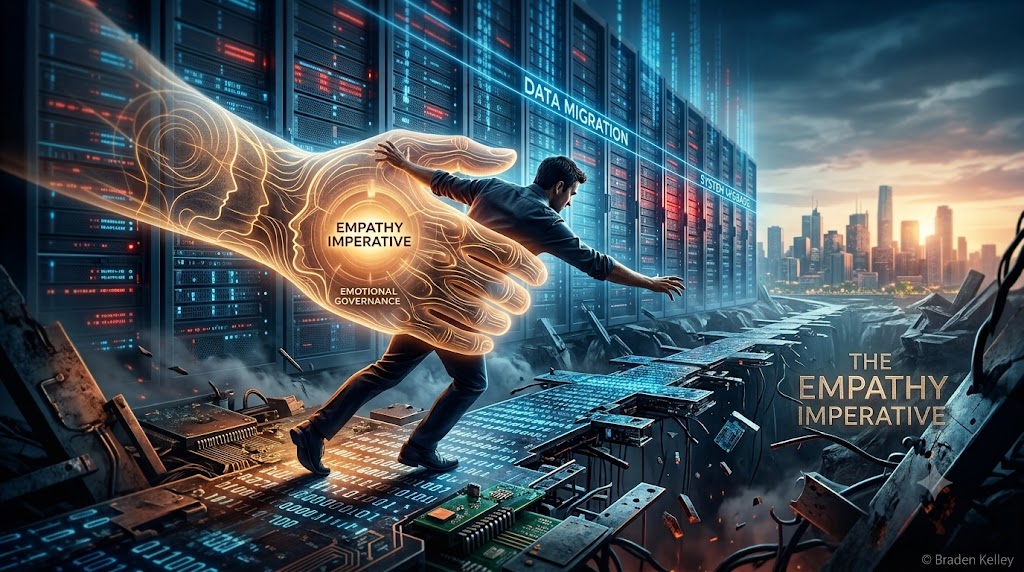
The Empathy Imperative

Why Technical Migrations Fail Without Emotional Governance

The Empathy Imperative

GUEST POST from Chateau G Pato


The Ghost in the Machine

Walk into any corporate boardroom during a major technical migration — whether it’s a massive cloud transition, an enterprise resource planning (ERP) overhaul, or a data architecture upgrade — and you will see the same dashboard. It is a sea of green, yellow, and red status indicators tracking server uptimes, data pipeline integrity, budget burn rates, and code deployment deadlines. The assumption baked into these rooms is as dangerous as it is common: that a successful technical migration is purely an engineering and timeline problem.

Yet, history tells a far more expensive story. Billions of dollars are poured into flawless deployments that check every technical box, only to result in a catastrophic post-launch drop in productivity, a surge in employee turnover, and widespread operational drag. When the system goes live, the code works, but the business stalls. The issue isn’t that the software is broken; it’s that the human operating system has rejected the change. This invisible friction exists because leaders treat technical transitions as structural shifts rather than deeply emotional human experiences.

Introducing Emotional Governance

To bridge this gap, organizations must move beyond traditional, top-down change management and introduce a framework of Emotional Governance. Emotional Governance is the systematic methodology of measuring, managing, and designing for the human emotional transitions that occur during technical shifts. It recognizes that every modified workflow represents a disruption to a person’s daily mastery, autonomy, and professional identity.

When we ignore the emotional infrastructure of a migration, we leave the human element to chance. But when we prioritize empathy as a strategic imperative, aligning emotional governance with technical milestones, we unlock the true return on investment of our innovation. You cannot build a resilient, digital-first organization on top of a bruised, alienated, and resistant workforce. The migration must happen with your people, not to them.

The Architecture of Anxiety

To understand why technical migrations encounter massive, unyielding resistance, leaders must first dismantle the myth of the “stubborn employee.” People rarely resist change simply because they are lazy or contrarian; they resist change when it threatens their survival metrics within an organization. When you replace an enterprise tool, you are not just changing software — you are rewriting the unwritten social contract of how work gets done and how value is perceived.

The Loss of Mastery and Status Anxiety

Every piece of legacy software, no matter how clunky or outdated, represents a domain of human expertise. Over years of use, employees have developed workarounds, mastered shortcuts, and built their professional identity around being the “go-to” expert who can solve any system quirk. They possess deep, institutional mastery.

The moment you mandate a new platform, you instantly reset that mastery to zero. Overnight, a high-performing veteran is reduced to a hesitant novice, fumbling through a new user interface while trying to maintain their usual output. This creates profound status anxiety. The fear of appearing incompetent or slow to adapt triggers a primal self-defense mechanism, forcing employees to cling to the old way of working to protect their perceived value.

The “Invisible Work” Tax

Another major oversight in technical deployments is the failure to account for the heavy emotional and cognitive load placed on teams during the transition phase — what I call the Invisible Work Tax. Leadership frequently expects employees to seamlessly adopt complex new workflows while simultaneously maintaining 100% of their daily operational targets.

The hours spent troubleshooting unfamiliar errors, attending mandatory training modules, and manually re-entering data into an unstable staging environment are completely invisible on executive dashboards. When organizations fail to provide operational breathing room, treating the transition as an “add-on” task rather than a core corporate priority, empathy evaporates. The resulting burnout turns into active resentment toward the technology itself.

The Legacy of Historical Scarring

Finally, no migration occurs in a vacuum. Every organization carries the psychological scar tissue of past, poorly executed IT rollouts. When employees hear the word “upgrade,” they don’t think of innovation; they remember the time a previous platform crashed for three days, or when a top-down mandate forced them to use a tool that made their jobs twice as hard.

This historical scarring breeds a deeply ingrained culture of cynicism. Without deliberate emotional governance to acknowledge and heal those past organizational failures, employees will look at your new migration and say, “This is just another management fad. If I ignore it long enough, it will go away.” To overcome this inertia, you must design an experience that proves this time is fundamentally different.

Designing the Empathy-Driven Migration Framework

Overcoming the architecture of anxiety requires more than standard corporate communication or generic training videos. It demands a fundamental shift from top-down change management to participatory Experience Design. Traditional change management treats people as objects to be managed, pushed, and trained into compliance. Experience design, however, views employees as active users and co-creators of the transition, focusing on how the journey feels from their perspective.

From Push Communication to Participatory Innovation

The classic mistake in technical rollouts is relying on “push” communication — sending broadcast emails or top-down mandates declaring the system is changing and everyone must comply. This approach naturally breeds resistance because it strips users of their agency.

An empathy-driven framework replaces mandates with co-creation. By actively involving frontline users during the vendor selection, testing, and staging phases, you shift the dynamic from a forced transition to a shared journey. When people help build the sandbox, they don’t fight the rules of the game. This collaborative approach ensures that the unique edge cases and daily realities of frontline workflows are built into the architecture from day one, significantly reducing post-launch friction.

The Critical Role of Psychological Safety

To unlock the true return on investment of any technological innovation, leaders must establish a culture of psychological safety during the migration process. If employees are terrified of making mistakes, clicking the wrong button, or slowing down metrics on an unfamiliar platform, they will default to the safest, most restrictive behaviors. They will find underground workarounds, stick to manual processes, or avoid using the new tool altogether.

True human-centered innovation only happens when users feel safe enough to experiment, fail, and learn out loud without fear of penalization. An empathy-driven framework deliberately designs “safe-to-fail” zones — such as extended sandboxes and blame-free staging environments — allowing teams to rebuild their confidence and mastery at a manageable pace. When you secure the human foundation, the technical superstructure will naturally succeed.

Implementing Emotional Governance in Practice

Moving from the philosophy of empathy to operational reality requires structure, intent, and actionable metrics. Emotional governance cannot merely be a set of nice sentiments in a kickoff meeting; it must be built directly into your project management methodology. Just as you have risk registers for security vulnerabilities and data compliance, you must establish an operational framework to manage the emotional risks of your workforce.

The Emotional Risk Audit

Before a single line of code is migrated, organizations must conduct an Emotional Risk Audit. This process goes beyond standard stakeholder mapping to analyze the human disruption coefficient of the upcoming change. Leaders must evaluate every department across two critical dimensions: the degree of workflow disruption and the impact on professional identity.

For example, transitioning a customer service team from a familiar, macro-heavy legacy tool to a modern, AI-assisted platform may look like a massive upgrade on paper. However, the audit might reveal that this team derives its sense of status from knowing those complex legacy shortcuts. By identifying this emotional vulnerability early, leaders can proactively design targeted recognition and transition strategies to protect employee confidence before the technical deployment begins.

Sentiment Metrics vs. Completion Metrics

The traditional way IT project managers measure readiness is fundamentally flawed. Tracking that “92% of staff completed the mandatory 45-minute training video” tells you absolutely nothing about their psychological readiness or their willingness to adopt the tool. It only measures compliance, not alignment.

An empathy-driven migration tracking system prioritizes sentiment metrics over simple completion rates. This involves deploying frequent, lightweight pulse surveys and analyzing qualitative feedback loops to measure real-time frustration peaks, psychological safety levels, and perceived utility. If your technical deployment timeline is at 90% but employee sentiment is at 20%, your migration is failing. Emotional governance gives leaders the visibility to pause, adjust, and address human friction before a rollout becomes a trainwreck.

Empowering Transition Sherpas

The final piece of practical implementation is changing who guides the journey. Relying solely on external consultants or distant IT personnel to drive adoption creates an “us versus them” dynamic. Instead, organizations must identify, train, and empower internal Transition Sherpas.

Transition Sherpas are highly respected, influential frontline peers who are embedded within the affected teams. They are not chosen simply because they are tech-savvy; they are selected for their high emotional intelligence and empathy. Armed with deep knowledge of both the technical tool and the emotional governance framework, these peer leaders act as trusted translators. They handle technical triage, provide safe-to-fail guidance on the floor, and elevate frontline anxieties directly to leadership, ensuring that no employee feels abandoned in the wilderness of change.

Futurology: The Next Frontier of Enterprise Change

As we look toward the horizon of enterprise architecture, the nature of technology deployment is undergoing a fundamental mutation. The traditional model of the “big bang” migration — where an organization spends two years preparing for a massive, disruptive software launch — is rapidly becoming obsolete. In a hyper-connected, AI-driven corporate landscape, migration is no longer a discrete event with a clear start and end date; it is an environment of continuous disruption.

AI-Driven Transitions and Predictive Sentiment

The integration of advanced artificial intelligence into enterprise systems is changing how we understand user adoption. Tomorrow’s emotional governance frameworks will leverage predictive sentiment analysis and hyper-personalized learning pathways to mitigate friction before it manifests as resistance.

Instead of waiting for an employee to experience a frustration peak or submit a support ticket, AI-driven telemetry will detect subtle changes in user behavior — such as prolonged hesitation over a new interface, repeated cursor loops, or micro-delays in standard workflows. By identifying these friction points in real time, the system can dynamically adapt, offering contextual, tailored micro-learning interventions and adjusting the transition pace to match the individual’s cognitive load. Empathy will scale through intelligent design.

The Continuous Migration Era

We are moving decisively into the Continuous Migration Era, where cloud-native applications and decentralized enterprise platforms update perpetually. This shift requires a massive evolution in organizational design. Emotional governance can no longer be treated as a temporary project phase or a specialized change management task force that dissolves after a launch.

To survive in this landscape, organizations must build emotional governance directly into their operational DNA, treating it as a permanent corporate capability. Leaders must establish dedicated Experience Management Offices (XMOs) that continuously monitor human-centered Experience Level Measures (XLMs). When you build an enterprise that expects, embraces, and smoothly processes constant technical evolution, change stops being a source of organizational trauma and becomes your ultimate competitive advantage.

Conclusion: The Human ROI

When we peel back the layers of enterprise strategy, technical specifications, and migration roadmaps, we are left with an undeniable truth: the ultimate bottleneck of any digital transformation is never the technology. It is the collective emotional capacity of your people to absorb, adapt to, and champion that technology. A business cannot build a high-velocity, digital-first future on top of a bruised, alienated, and culturally exhausted workforce.

The True Measure of Success

The true return on investment of a technical migration is not realized on the day the legacy system is turned off; it is realized when your teams actively leverage the new platform to innovate, create, and drive value. That level of engagement cannot be forced through top-down mandates or tracked via superficial compliance checklists. It must be earned through deliberate, human-centered experience design.

As leaders, it is time to elevate our standards. We must stop treating emotional governance as a soft afterthought and start funding, measuring, and prioritizing it with the exact same rigor we apply to our technical architecture. When you secure and respect the emotional infrastructure of your organization, the technical superstructure will inevitably thrive. Stop managing change, and start designing the transition.

Frequently Asked Questions

1. What is Emotional Governance, and how does it differ from traditional change management?

Traditional change management focuses on driving compliance through top-down mandates, push communications, and tracking training completion rates. Emotional Governance is a human-centered framework that treats migrations as an experience design problem. It systematically measures and manages the psychological readiness, status anxiety, and workflow friction of users, shifting the focus from forcing compliance to co-creating the transition with employees.

2. How do you measure the success of emotional governance during a migration?

Instead of relying on superficial completion metrics (like the percentage of staff who watched a training video), success is measured using real-time sentiment metrics, Experience Level Measures (XLMs), and tracking user frustration peaks through continuous qualitative feedback loops. A migration is only successful when technical execution aligns with high employee confidence and psychological safety.

3. What is the role of a Transition Sherpa in this framework?

A Transition Sherpa is an influential, highly empathetic frontline peer embedded within a team undergoing change — not an outside consultant or IT representative. They act as trusted translators on the ground, handling micro-learning, offering safe-to-fail guidance, and escalating frontline anxieties directly to leadership so no employee feels abandoned in the wilderness of a new rollout.


Bottom line: Futurology is not fortune telling. Futurists use a scientific approach to create their deliverables, but a methodology and tools like those in FutureHacking™ can empower anyone to engage in futurology themselves.

Image credit: Gemini

Subscribe to Human-Centered Change & Innovation WeeklySign up here to get Human-Centered Change & Innovation Weekly delivered to your inbox every week.

Are Innovation and Empathy in the Cards?

As part of the leadership team for a new human-centered problem-solving offering for select Oracle customers, I’m always on the lookout for new tools to integrate into our flexible problem-solving process to help clients innovate, grow or transform.

Because our dynamic team of experienced professionals has a diverse range of knowledge, skills and abilities we’re able to co-create solutions to a wide range of business challenges and leverage a wide variety of tools. This means I’m always on the lookout for new tools to better serve our clients, in addition to pursuing my hobby of creating new tools and methodologies in my spare time throughout my career.

My passion for empowering others to succeed in overcoming their business challenges has led to the publishing of two business best-sellers Stoking Your Innovation Bonfire (John Wiley & Sons, 2010) and Charting Change (Palgrave Macmillan, 2016), and the creation of the powerful, visual and collaborative Change Planning Toolkit™, my Nine Innovation Roles™ card deck, and the Human-Centered Innovation Toolkit™ (featuring tools like The Experiment Canvas™).

I create new tools, methodologies and frameworks when I see opportunities to make people more efficient and effective in their jobs and leverage the work of others when I find others have created good solutions. I leverage the Business Model Canvas for business model prototyping, I leverage The Play-to-Win Strategy Canvas v3.0 to help people work through strategic choices, along with other tools when the challenge is appropriate.

Recently I have been looking at a variety of card decks to evaluate their suitability to use alongside design thinking and other methodologies that form the basis of the Oracle FUEL approach.

Here are a few I’ve been evaluating lately:

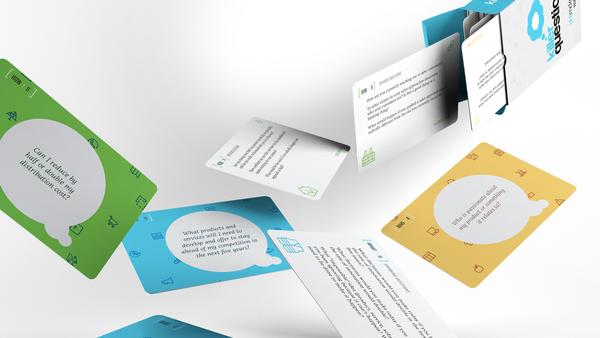
Killer Questions Cards

1. Killer Questions – Volume 1 from Phil McKinney, author of Beyond the Obvious and CEO of CableLabs
(More info at https://innovation.tools/)

Brainstorming is a fairly useless exercise the way that most people facilitate it. There are much more effective ways to get ideas and most of the approaches that work better share at their core a more targeted and collaborative approach. The Killer Questions card deck is composed of just that, a collection of questions if left unanswered or unexplored, could lead to blind spots and disruption opportunities for new entrants (or your competition). The questions are categorized into three types:

  1. Who
  2. What
  3. How

And the questions include things like:

  • Who does not use my product because of my assumptions about their skill or ability
  • What emotional, psychological, or status benefits could people derive from using my product?
  • How could users avoid interacting with my product or service but still get the same value?

But the cards don’t just contain a single question. These are examples of guiding questions on the front of a few cards, but on the back of each card you will also find 3-5 supporting questions to help your team explore the guiding question more fully.

Overall, I consider the cards a useful tool for groups including: product teams wanting to continuously stretch themselves as they revaluate product direction, or for expanded innovation teams looking to broaden their search horizons.

Innovation Deck cards by Andrey Schukin

2. The Innovation Deck by Andrey Schukin, CTO at Interprefy AG
(More info at http://www.innovationfast.com/)

Where the Killer Questions deck is organized around questions, The Innovation Deck is organized around topics/tactics and triggers. For each topic/tactic there is either a set of instructions or a set of questions.

The Innovation Deck is composed of three different types of cards that will help you:

  1. Examine
  2. Explore
  3. Evaluate

Examine Card example:

EMOTION

  • People don’t buy things they need. They buy things they want.
  • How do you make sure that the product will trigger an emotional response from the customer?
  • What elements of your product will make the customer want to use it?

I would almost include the triggers cards as a fourth card type, because instead of a topic and questions the cards have a collection of words to see if any of the words inspire thought or conversations rather than giving people a guiding topic or tactic.

Overall, I consider these cards as a useful tool for product teams looking at a product to challenge or stretch the existing product direction for the future.

Nine Innovation Roles cards from Braden Kelley

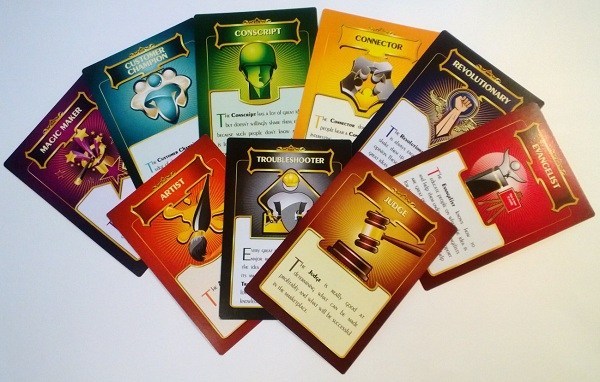
3. Nine Innovation Roles – a card deck by Braden Kelley, author of Stoking Your Innovation Bonfire
(More info at http://9roles.com)

The following is an excerpt from my book that explains some of the thinking behind The Nine Innovation Roles™:

“Too often we treat people as commodities that are interchangeable and maintain the same characteristics and aptitudes. Of course, we know that people are not interchangeable, yet we continually pretend that they are anyway — to make life simpler for our reptile brain to comprehend. Deep down we know that people have different passions, skills, and potential, but even when it comes to innovation, we expect everybody to have good ideas.

I’m of the opinion that all people are creative, in their own way. That is not to say that all people are creative in the sense that every single person is good at creating lots of really great ideas, nor do they have to be. I believe instead that everyone has a dominant innovation role at which they excel, and that when properly identified and channeled, the organization stands to maximize its innovation capacity. I believe that all people excel at one of nine innovation roles, and that when organizations put the right people in the right innovation roles, that your innovation speed and capacity will increase.”

The Nine Innovation Roles™ are:

  1. Revolutionary
  2. Conscript
  3. Connector
  4. Artist
  5. Customer Champion
  6. Troubleshooter
  7. Judge
  8. Magic Maker
  9. Evangelist

To make my Nine Innovation Roles™ framework accessible to as many people as possible inside organizations all around the world to explore and improve innovation team dynamics and success, I am happy to announce that I have now made the print-ready files for the cards available here for FREE download, and you can either work with the vendor I use – adMagic – or work with a local printer in your part of the world.

LPK Roadblocks Cards

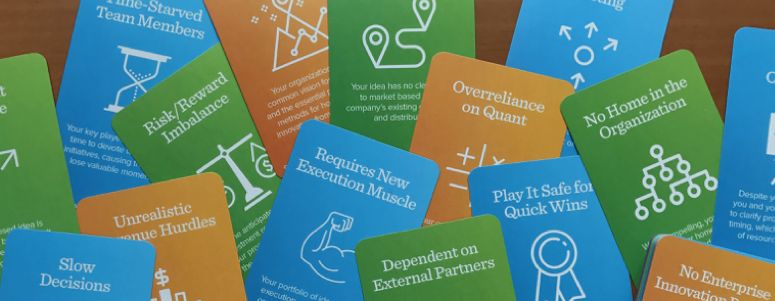
4. LPK Roadblocks by LPK, a brand and innovation consultancy
(More info at https://roadblocks.lpklab.com/)

The LPK Roadblocks deck is focused on innovation roadblocks and helping organizations whose innovation efforts might have stalled, get unstuck. There are six kinds of cards in the deck:

  1. Voting cards
  2. Question cards
  3. Create Your Own Roadblock cards
  4. Organization Roadblocks
  5. Project Roadblocks
  6. Idea Roadblocks

There are two main ways to use the cards, with selection and voting integrated into both:

  1. Root Cause Discovery
  2. Beginning, Middle and End

Organization Roadblocks include things like “Unrealistic Revenue Hurdles” and “Lip-Service Leadership,” while Project Roadblocks including things like “Untested Assumptions” and “Unclear Objectives”, while Idea Roadblocks include things like “Risk/Reward Imbalance” and “No Route to Market.”

Overall, I find these cards to be a useful tool when you run into a client that says they are struggling to innovate or that they’re not innovating as much as they’d like.

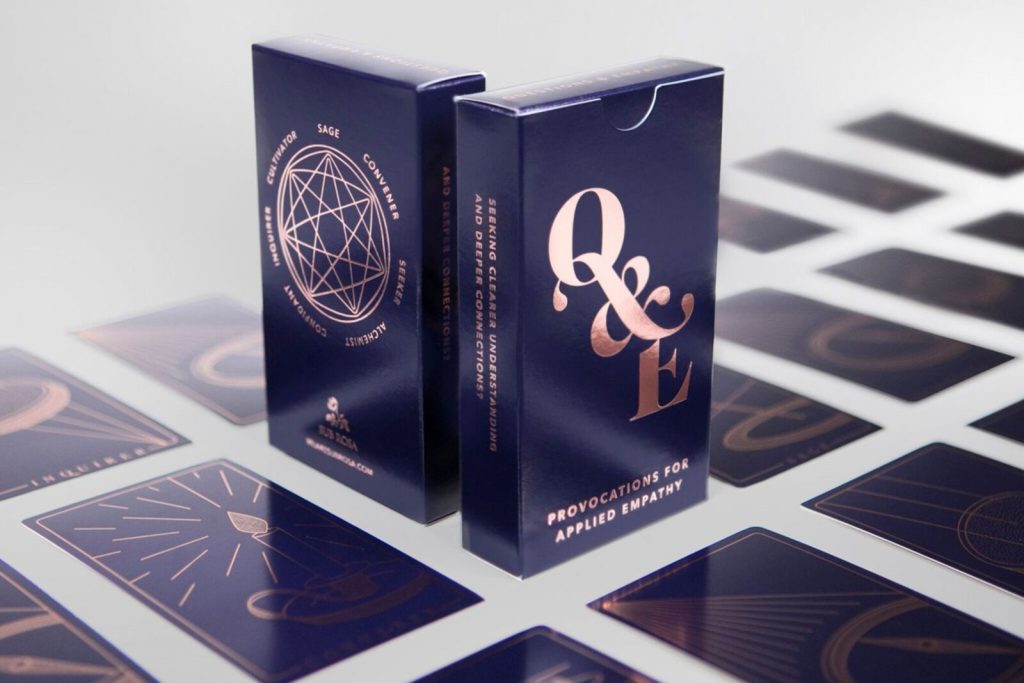
Questions & Empathy Cards

5. Questions & Empathy – a card deck by SubRosa, a brand strategy and design practice
(More info at https://www.questionsandempathy.com/)

SubRosa’s Questions & Empathy cards are composed of seven empathy archetype cards and a set of exploratory questions for each archetype. The seven archetypes are:

  1. Sage
  2. Inquirer
  3. Convener
  4. Alchemist
  5. Confidant
  6. Seeker
  7. Cultivator

Overall, I find these cards to be a useful tool for better understanding yourself and your own empathetic style and over time they could help you approach empathy from more angles than you would without them, but I struggle to see as is how they can actually help you practice applied empathy. The archetypes are useful, but I think I might create my own question cards to help my team better apply empathy within the empathize/understand phase of design thinking.

Conclusion

Whether you’re trying to innovate or just to build up your empathy muscles, I hope you see that there are some great, extremely portable resources to help with either. Of course, there are other card decks out there, but these will give you a few to explore and see whether there is a fit for your design thinking or innovation undertakings. If you’re pursuing a digital transformation or business transformation you can:

If you missed the links to the cards decks above, here they are again:

  1. Killer Questions – Volume 1
  2. The Innovation Deck
  3. Nine Innovation Roles (English/Spanish/Swedish)
  4. LPK Roadblocks
  5. Questions & Empathy


Accelerate your change and transformation success

Subscribe to Human-Centered Change & Innovation WeeklySign up here to get Human-Centered Change & Innovation Weekly delivered to your inbox every week.

The Role of Empathy in Human-Centered Design

The Role of Empathy in Human-Centered Design

GUEST POST from Art Inteligencia

The concept of empathy has gained traction in recent years. Empathy is typically defined as the capacity to understand or feel what another person is experiencing and to share their feelings. In the design world, empathy is often heralded as the one tool that can help create truly human-centered designs. This article looks at the role of empathy in the context of human-centered design (HCD) and provides case study examples of companies that have successfully leveraged empathy to design user experiences that truly resonated with their users.

The concept of HCD is built on understanding the user on a deeper level. It is more than just understanding a user’s demographic characteristics or their technical needs. HCD seeks to understand the user’s emotions, their values, and their aspirations. It is an approach that seeks to craft user experiences that are not only practical, but also emotionally rewarding. Empathy is the key tool for unlocking the potential of HCD.

At its heart, empathy is about understanding and caring deeply for users and their experiences. Designers must be willing to go beyond just understanding the technical requirements of a user and instead strive to understand the value they add to their lives. To effectively leverage empathy for HCD, designers must have an understanding of the user that goes beyond just demographics or data points. They must be willing to dive deep into the holistic user experience – from their beliefs to their motivations, their joys and their fears – and create designs that acknowledge all these different facets of a user.

Empathy can be used to create experiences that are tailored to the individual user. Just as different users have different needs and values, different designs can be crafted to address different users’ needs and aspirations. Through this approach, designers can create experiences that are truly tailored to each individual user, and this is the heart of HCD.

To better illustrate how empathy can be used to create human-centered designs, here are two case study examples:

Case Study 1 – Airbnb

Airbnb’s success is largely attributed to its ability to create user experiences that are both practical and emotionally engaging. Through their empathy-driven approach, they have created a platform that deeply connects users with each other and allows for personalized experiences. For example, Airbnb’s “Experience” service provides users the opportunity to explore the cities they visit with unique experiences tailored to their individual interests.

Case Study 2 – Apple

Apple is a company that understands the importance of empathy in design. Their products have long been known for their user-friendly interfaces and thoughtful user experience design. Through their empathy-driven design approach, they have crafted products that are so intuitive to use that they have become a household name.

These case studies demonstrate how the use of empathy in design can result in user experiences that users truly love. By taking the time to understand and honor the individual user, designers can create designs that truly resonate with their users.

Conclusion

Empathy is a powerful tool for design that can be used to create user experiences that are both practical and emotionally rewarding. It is the key to unlocking the potential of human-centered design, and companies such as Airbnb and Apple have demonstrated the immense potential of empathy for creating truly user-centric experiences.

SPECIAL BONUS: Braden Kelley’s Problem Finding Canvas can be a super useful starting point for doing design thinking or human-centered design.

“The Problem Finding Canvas should help you investigate a handful of areas to explore, choose the one most important to you, extract all of the potential challenges and opportunities and choose one to prioritize.”

Image credit: Pexels

Subscribe to Human-Centered Change & Innovation WeeklySign up here to get Human-Centered Change & Innovation Weekly delivered to your inbox every week.

Measuring Competencies Like Empathy and Collaboration

Certifying Soft Skills
Measuring Competencies Like Empathy and Collaboration

GUEST POST from Chateau G Pato
LAST UPDATED: January 19, 2026 at 12:29PM

For decades, the corporate world has operated on a convenient fiction: that “hard skills” — coding, accounting, engineering — are the solid bedrock of business, while “soft skills” are the fuzzy, unenforceable garnishes. We hire for the hard, and we fire for the lack of the soft.

As we navigate an era defined by rapid technological disruption and the rise of Artificial Intelligence, this distinction is not just obsolete; it is dangerous. When machines can crunch numbers faster and generate code cleaner than any human, the true differentiator for an organization — the engine of sustainable innovation and successful change management — becomes the intensely human capacity to connect, understand, and co-create.

The problem has never been that organizations don’t value empathy or collaboration. The problem is that they haven’t known how to measure them with rigor. If we cannot measure it, we cannot manage it, and we certainly cannot certify it. To build truly human-centered organizations, we must crack the code on credentialing the very competencies that make us human.

“We are entering an age where your technical expertise gets you in the room, but your ability to empathize and collaborate determines your impact once you are there. Innovation is a social endeavor; if we can’t measure the quality of our connection, we can’t improve the quality of our creation.”

— Braden Kelley

Moving Beyond the “Vibe Check”

The historical skepticism toward certifying soft skills stems from a reliance on self-assessment. Asking an employee, “How empathetic are you on a scale of 1 to 10?” is useless data. True measurement requires moving from sentiment to demonstrated behavior in context.

We must shift our focus from assessing internal states (how someone feels) to external applications (what someone does with those feelings to drive valuable outcomes). A certification in empathy, for example, shouldn’t signify that a person is “nice.” It should signify that they possess a verified toolkit for uncovering latent user needs and the emotional intelligence to navigate complex stakeholder resistance during change initiatives.

Case Study 1: The “Applied Empathy” Badge in Service Design

The Challenge

A prominent financial services firm found that its digital transformation efforts were stalling. Their product teams were technically proficient but were building solutions based on assumptions rather than user realities, leading to poor adoption rates. They needed to embed deep user understanding into their development lifecycle.

The Measurement Solution

Instead of a generic communications workshop, the firm worked to develop an “Applied Empathy Practitioner” certification. To earn this, candidates had to pass a rigorous, multi-stage evaluation:

  • Scenario-Based Simulation: Candidates engaged in role-play scenarios with “difficult customers,” evaluated not on appeasement, but on their ability to use active inquiry to uncover the root cause of frustration.
  • Portfolio of Evidence: Candidates had to submit documented examples of how an insight gained through empathetic interviewing directly altered a product roadmap or service feature. They had to prove the application of the skill.

The Outcome

The certification became a prerequisite for lead design roles. The company saw a 40% reduction in post-launch rework because consumer friction points were identified earlier. They moved empathy from a “nice-to-have” trait to a measurable, certifiable professional competency linked to reduced risk.

Case Study 2: Certifying Collaboration in a Siloed Tech Giant

The Challenge

A global software enterprise was struggling with innovation velocity. While individual departments were high-performing, cross-functional projects frequently died on the vine due to territorialism and a lack of psychological safety. They needed leaders who could act as bridges, not gatekeepers.

The Measurement Solution

The organization realized that certifying collaboration couldn’t be based on a multiple-choice test. They developed a “Master Collaborator” credential focused on network dynamics and team environment:

  • Organizational Network Analysis (ONA): Instead of just asking “Are you a team player?”, the company used anonymized metadata to map communication flows. They identified individuals who served as high-trust connectors between disparate groups.
  • 360-Degree “Safety” Index: Peers and subordinates evaluated candidates specifically on their ability to create psychological safety—the environment where people feel safe to take risks and voice dissenting opinions without fear of retribution.

The Outcome

Leaders who achieved this certification were placed in charge of critical, high-risk innovation initiatives. The data showed that teams led by certified collaborators brought new products to market 25% faster, primarily because information flowed freely and failures were treated as learning opportunities rather than punishable offenses.

“In the symphony of innovation, empathy isn’t just a note — it’s the harmony that binds the orchestra together, allowing every voice to resonate.”

— Braden Kelley

Case Study 3: Google’s Project Oxygen

Google, a pioneer in data-driven decision-making, launched Project Oxygen in 2008 to identify what makes a great manager. Through extensive analysis of over 10,000 performance reviews, feedback surveys, and interviews, they discovered that technical skills ranked eighth on the list of top behaviors. Instead, top managers excelled in coaching, empowering teams, and showing genuine concern for team members’ success and well-being — hallmarks of empathy.

To certify these competencies, Google developed comprehensive training programs and certification pathways
integrated into their leadership development. Managers undergo rigorous assessments, including peer reviews, self-evaluations, and behavioral interviews focused on specific actions like “is a good coach” and “has a clear vision and strategy for the team.” Successful participants earn internal certifications that directly influence promotions, compensation, and leadership opportunities.

The impact has been profound. Teams led by certified managers report higher satisfaction scores, lower attrition rates, and up to 20% better performance metrics in areas like project delivery and innovation output. This case study illustrates how quantifying soft skills through structured, data-backed feedback can translate into measurable business outcomes, proving that empathy isn’t just nice — it’s a competitive advantage.

Case Study 4: IBM’s Digital Badge Program

IBM has been at the forefront of skills certification with their open badges initiative, launched in 2015. This program extends beyond technical proficiencies to include soft skills like collaboration, agility, and empathy. For instance, to earn a “Collaborative Innovator” badge, employees must complete real-world projects involving cross-functional teams, submit detailed evidence of their contributions, and receive endorsements from at least three peers or supervisors.

A particularly compelling application was during IBM’s transition to hybrid work models following the global pandemic. Employees pursuing certification participated in immersive virtual reality simulations where they navigated complex team conflicts, such as resolving disagreements in diverse groups. These scenarios tested empathy through active listening exercises, inclusive decision-making, and emotional support simulations. Performance is evaluated using AI analytics that score interactions based on predefined empathy and collaboration rubrics.

Badges are issued on a blockchain platform, ensuring they are secure, verifiable, and portable across careers. Data from IBM indicates that employees with soft skill badges are 15% more likely to be promoted internally and report 25% higher job satisfaction levels. Moreover, teams with a higher density of certified collaborators exhibit faster problem-solving times and more innovative patent filings. IBM’s model showcases how blending technology with human-centric evaluation can standardize soft skill certification while preserving the authenticity of interpersonal dynamics.

The Future of Human-Centered Credentialing

Certifying these skills is not about creating a new layer of bureaucracy. It is about signaling value. By creating rigorous standards for empathy, collaboration, adaptability, and resilience, we provide a roadmap for employees to develop the skills that actually matter in a volatile future.

These certifications cannot be “one-and-done.” Just as technical certifications require renewal, soft skill credentials must be dynamic, requiring ongoing evidence of application in increasingly complex scenarios. This ensures that the skills are living capabilities, not just framed certificates.

As leaders in human-centered change, we must champion the idea that the “hardest” skills to master — and the most valuable to measure — are the ones that connect us.

Frequently Asked Questions

Why is it difficult to measure soft skills like empathy?

Soft skills are inherently subjective and context-dependent. Unlike technical skills which have binary outcomes (the code works or it doesn’t), soft skills like empathy rely on behavioral indicators, the perception of others, and the ability to apply emotional intelligence in varied scenarios, making quantitative measurement challenging.

How can organizations effectively certify collaboration?

Effective certification moves beyond self-assessments and utilizes 360-degree feedback mechanisms, Organizational Network Analysis (ONA) to see who genuinely connects silos, and scenario-based evaluations that test a person’s ability to foster psychological safety and manage conflict constructively.

What is the business value of certifying soft skills?

Certifying soft skills provides a tangible framework for creating a human-centered culture. It leads to better innovation through diverse perspectives, faster adoption of change initiatives due to higher trust, and improved retention by valuing the human element of work.

Extra Extra: Because innovation is all about change, Braden Kelley’s human-centered change methodology and tools are the best way to plan and execute the changes necessary to support your innovation and transformation efforts — all while literally getting everyone all on the same page for change. Find out more about the methodology and tools, including the book Charting Change by following the link. Be sure and download the TEN FREE TOOLS while you’re here.

Image credits: Google Gemini

Subscribe to Human-Centered Change & Innovation WeeklySign up here to get Human-Centered Change & Innovation Weekly delivered to your inbox every week.

Combining Big Data with Empathy Interviews

Triangulating Truth

Combining Big Data with Empathy Interviews

GUEST POST from Chateau G Pato
LAST UPDATED: January 15, 2026 at 10:23AM

Triangulating Truth: Combining Big Data with Empathy Interviews

By Braden Kelley

In the hallowed halls of modern enterprise, Big Data has become a sort of secular deity. We bow before dashboards, sacrifice our intuition at the altar of spreadsheets, and believe that if we just gather enough petabytes, the “truth” of our customers will emerge. But data, for all its power, has a significant limitation: it can tell you everything about what your customers are doing, yet it remains profoundly silent on why they are doing it.

If we want to lead human-centered change and drive meaningful innovation, we must stop treating data and empathy as opposing forces. Instead, we must practice the art of triangulation. We need to combine the cold, hard “What” of Big Data with the warm, messy “Why” of Empathy Interviews to find the resonant truth that lives in the intersection.

“Big Data can tell you that 40% of your users drop off at the third step of your checkout process, but it takes an empathy interview to realize they are dropping off because that step makes them feel untrusted. You can optimize a click with data, but you build a relationship with empathy.” — Braden Kelley

The Blind Spots of the Spreadsheet

Data is a rearview mirror. It captures the digital exhaust of past behaviors. While it is incredibly useful for spotting trends and identifying friction points at scale, it is inherently limited by its own parameters. You can only analyze the data you choose to collect. If a customer is struggling with your product for a reason you haven’t thought to measure, that struggle will remain invisible on your dashboard.

This is where human-centered innovation comes in. Empathy interviews — deep, open-ended conversations that prioritize listening over selling — allow us to step out from behind the screen and into the user’s reality. They uncover “Thick Data,” a term popularized by Tricia Wang, which refers to the qualitative information that provides context and meaning to the quantitative patterns.

Case Study 1: The “Functional” Failure of a Health App

The Quantitative Signal

A leading healthcare technology company launched a sophisticated app designed to help chronic patients track their medication. The Big Data was glowing initially: high download rates and excellent initial onboarding. However, after three weeks, the data showed a catastrophic “churn” rate. Users simply stopped logging their pills.

The Empathy Insight

The data team suggested a technical fix — more push notifications and gamified rewards. But the innovation team chose to conduct empathy interviews. They visited patients in their homes. What they found was heartbreakingly human. Patients didn’t forget their pills; rather, every time the app pinged them, it felt like a reminder of their illness. The app’s sterile, clinical design and constant alerts made them feel like “patients” rather than people trying to live their lives. The friction wasn’t functional; it was emotional.

The Triangulated Result

By combining the “what” (drop-off at week three) with the “why” (emotional fatigue), the company pivoted. They redesigned the app to focus on “Wellness Goals” and life milestones, using softer language and celebratory tones. Churn plummeted because they solved the human problem the data couldn’t see.

Triangulation: What They Say vs. What They Do

True triangulation involves three distinct pillars of insight:

  • Big Data: What they actually did (the objective record).
  • Empathy Interviews: What they say they feel and want (the subjective narrative).
  • Observation: What we see when we watch them use the product (the behavioral truth).

Often, these three pillars disagree. A customer might say they want a “professional” interface (Interview), but the Data shows they spend more time on pages with vibrant, casual imagery. The “Truth” isn’t in one or the other; it’s in the tension between them. As an innovation speaker, I often tell my audiences: “Don’t listen to what customers say; listen to why they are saying it.”

Case Study 2: Reimagining the Bank Branch

The Quantitative Signal

A regional bank saw a 30% decline in branch visits over two years. The Big Data suggested that physical branches were becoming obsolete and that investment should shift entirely to the mobile app. To the data-driven executive, the answer was to close 50% of the locations.

The Empathy Insight

The bank conducted empathy interviews with “low-frequency” visitors. They discovered that while customers used the app for routine tasks, they felt a deep sense of anxiety about major life events — buying a first home, managing an inheritance, or starting a business. They weren’t coming to the branch because the branch felt like a transaction center (teller lines and glass barriers), which didn’t match their need for high-stakes advice.

The Triangulated Result

The bank didn’t close the branches; they transformed them. They used data to identify which branches should remain as transaction hubs and which should be converted into “Advice Centers” with coffee-shop vibes and private consultation rooms. They used the app to handle the “what” and the human staff to handle the “why.” Profitability per square foot increased because they addressed the human need for reassurance that the data had initially misinterpreted as a desire for total digital isolation.

Leading the Change

To implement this in your organization, you must break down the silos between your Data Scientists and your Design Researchers. When these two groups collaborate, they become a formidable force for human-centered change.

Start by taking an anomaly in your data — something that doesn’t make sense — and instead of running another query, go out and talk to five people. Ask them about their day, their frustrations, and their dreams. You will find that the most valuable insights aren’t hidden in a server farm; they are hidden in the stories your customers are waiting to tell you.

If you are looking for an innovation speaker to help your team bridge this gap, remember that the most successful organizations are those that can speak both the language of the machine and the language of the heart.

Frequently Asked Questions on Insight Triangulation

Q: What is the primary danger of relying solely on Big Data for innovation?

A: Big Data is excellent at showing “what” is happening, but it is blind to “why.” Relying only on data leads to optimizing the status quo rather than discovering breakthrough needs, as data only reflects past behaviors and cannot capture the emotional friction or unmet desires of the user.

Q: How do empathy interviews complement quantitative analytics?

A: Empathy interviews provide the “thick data” — the context, emotions, and stories that explain the anomalies in the quantitative charts. They allow innovators to see the world through the user’s eyes, identifying the root causes of friction that data points can only hint at.

Q: What is “Triangulating Truth” in a business context?

A: It is the strategic practice of validating insights by looking at them from three angles: what people say (interviews), what people do (observations), and what the data shows (analytics). When these three align, you have found a reliable truth worth investing in.

Extra Extra: Because innovation is all about change, Braden Kelley’s human-centered change methodology and tools are the best way to plan and execute the changes necessary to support your innovation and transformation efforts — all while literally getting everyone all on the same page for change. Find out more about the methodology and tools, including the book Charting Change by following the link. Be sure and download the TEN FREE TOOLS while you’re here.

Image credits: Pixabay

Subscribe to Human-Centered Change & Innovation WeeklySign up here to get Human-Centered Change & Innovation Weekly delivered to your inbox every week.

Metrics for Systemic Human-Centered Design Success

Measuring Empathy

LAST UPDATED: December 23, 2025 at 1:51PM

Metrics for Systemic Human-Centered Design Success

GUEST POST from Chateau G Pato

Empathy is frequently praised and rarely operationalized. In too many organizations, it lives in sticky notes, inspirational posters, and kickoff workshops — disconnected from how decisions are actually made. As human-centered design matures from a project-level practice into an enterprise capability, empathy must become measurable, repeatable, and systemic.

Measuring empathy is not about stripping humanity from design. It is about ensuring that human understanding survives scale, complexity, and quarterly pressure.

Re-framing Empathy as a Capability

Empathy is often misunderstood as an individual trait. In reality, sustainable empathy is an organizational capability supported by structures, incentives, and feedback loops. The question leaders should ask is not “Are our designers empathetic?” but rather “Does our system consistently produce empathetic outcomes?”

Metrics provide the answer.

A Practical Empathy Measurement Framework

1. Human Insight Integrity

These metrics assess whether decisions are grounded in real human understanding:

  • Percentage of strategic initiatives informed by primary research
  • Recency of customer insights used in decisions
  • Inclusion of marginalized or edge users

Outdated or secondhand insights are a hidden empathy killer.

2. Experience Friction Reduction

Empathy should reduce unnecessary effort and stress:

  • Time-on-task improvements
  • Drop-off and abandonment rates
  • Emotion-based experience ratings

3. Organizational Behavior Change

Look for evidence that empathy is shaping behavior:

  • Frequency of cross-functional research participation
  • Leadership presence in customer interactions
  • Reuse of validated insights across teams

4. Long-Term System Health

At scale, empathy improves system resilience:

  • Reduction in rework and failure demand
  • Employee engagement and retention
  • Trust and loyalty over time

“Empathy is not proven by how deeply we feel in a workshop, but by how consistently our systems change behavior in the real world. If you can’t measure that change, empathy remains a belief instead of a capability.”

Braden Kelley

Case Study 1: Retail Banking Transformation

A large retail bank invested heavily in digital channels but continued to see declining trust. By introducing empathy metrics focused on customer anxiety and clarity, the bank discovered that customers felt overwhelmed rather than empowered.

Design teams simplified language, reduced choice overload, and measured success through emotional confidence indicators. Within eighteen months, complaint volume dropped while product adoption increased — a clear signal of systemic empathy at work.

Case Study 2: Public Transportation Services

A metropolitan transit authority applied empathy metrics to rider experience. Beyond punctuality, they measured perceived safety, clarity of wayfinding, and stress during disruptions.

By addressing emotional pain points and tracking their reduction, the authority improved satisfaction without major infrastructure investment, proving that empathy can outperform capital expenditure.

Embedding Empathy into Governance

Empathy metrics only matter if they influence decisions. Leading organizations embed them into:

  • Executive dashboards
  • Investment prioritization
  • Performance reviews

When empathy metrics sit alongside financial and operational metrics, they shape trade-offs instead of reacting to them.

The Future of Human-Centered Measurement

As AI and automation accelerate, empathy will become a primary differentiator. Organizations that can measure and manage it will design systems that are not only efficient, but humane.

The goal is not perfect empathy. The goal is continuous human understanding at scale.

Frequently Asked Questions

FAQ

Why are empathy metrics necessary?
They ensure human needs remain visible and actionable as organizations scale.

Do empathy metrics replace qualitative research?
No. They amplify and sustain qualitative insights over time.

What is the first empathy metric to implement?
Track how often real customer insights directly inform decisions.

Extra Extra: Because innovation is all about change, Braden Kelley’s human-centered change methodology and tools are the best way to plan and execute the changes necessary to support your innovation and transformation efforts — all while literally getting everyone all on the same page for change. Find out more about the methodology and tools, including the book Charting Change by following the link. Be sure and download the TEN FREE TOOLS while you’re here.

Image credits: Pixabay, Google Gemini

Subscribe to Human-Centered Change & Innovation WeeklySign up here to get Human-Centered Change & Innovation Weekly delivered to your inbox every week.