Why Technical Migrations Fail Without Emotional Governance
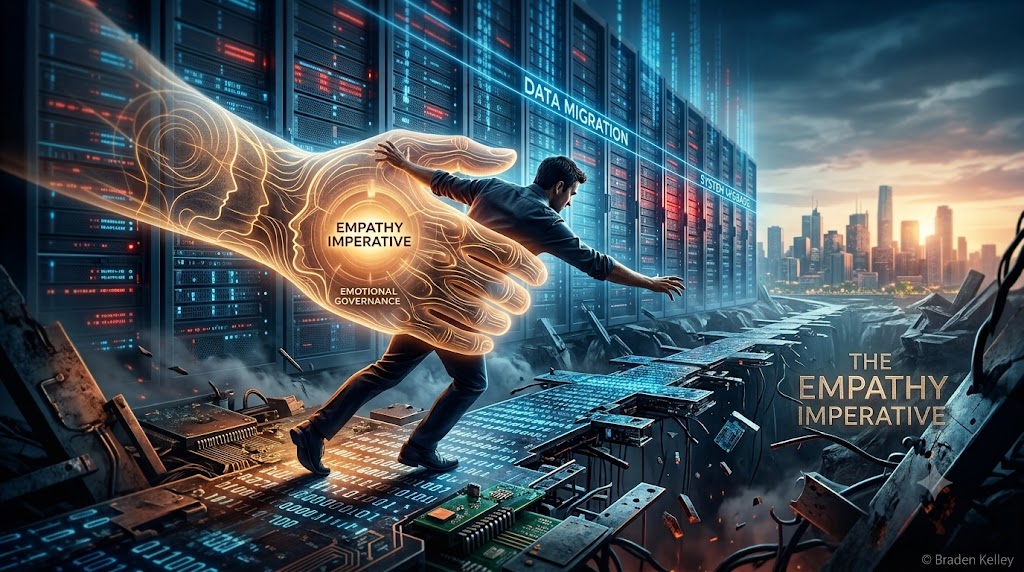
GUEST POST from Chateau G Pato
The Ghost in the Machine
Walk into any corporate boardroom during a major technical migration — whether it’s a massive cloud transition, an enterprise resource planning (ERP) overhaul, or a data architecture upgrade — and you will see the same dashboard. It is a sea of green, yellow, and red status indicators tracking server uptimes, data pipeline integrity, budget burn rates, and code deployment deadlines. The assumption baked into these rooms is as dangerous as it is common: that a successful technical migration is purely an engineering and timeline problem.
Yet, history tells a far more expensive story. Billions of dollars are poured into flawless deployments that check every technical box, only to result in a catastrophic post-launch drop in productivity, a surge in employee turnover, and widespread operational drag. When the system goes live, the code works, but the business stalls. The issue isn’t that the software is broken; it’s that the human operating system has rejected the change. This invisible friction exists because leaders treat technical transitions as structural shifts rather than deeply emotional human experiences.
Introducing Emotional Governance
To bridge this gap, organizations must move beyond traditional, top-down change management and introduce a framework of Emotional Governance. Emotional Governance is the systematic methodology of measuring, managing, and designing for the human emotional transitions that occur during technical shifts. It recognizes that every modified workflow represents a disruption to a person’s daily mastery, autonomy, and professional identity.
When we ignore the emotional infrastructure of a migration, we leave the human element to chance. But when we prioritize empathy as a strategic imperative, aligning emotional governance with technical milestones, we unlock the true return on investment of our innovation. You cannot build a resilient, digital-first organization on top of a bruised, alienated, and resistant workforce. The migration must happen with your people, not to them.
The Architecture of Anxiety
To understand why technical migrations encounter massive, unyielding resistance, leaders must first dismantle the myth of the “stubborn employee.” People rarely resist change simply because they are lazy or contrarian; they resist change when it threatens their survival metrics within an organization. When you replace an enterprise tool, you are not just changing software — you are rewriting the unwritten social contract of how work gets done and how value is perceived.
The Loss of Mastery and Status Anxiety
Every piece of legacy software, no matter how clunky or outdated, represents a domain of human expertise. Over years of use, employees have developed workarounds, mastered shortcuts, and built their professional identity around being the “go-to” expert who can solve any system quirk. They possess deep, institutional mastery.
The moment you mandate a new platform, you instantly reset that mastery to zero. Overnight, a high-performing veteran is reduced to a hesitant novice, fumbling through a new user interface while trying to maintain their usual output. This creates profound status anxiety. The fear of appearing incompetent or slow to adapt triggers a primal self-defense mechanism, forcing employees to cling to the old way of working to protect their perceived value.
The “Invisible Work” Tax
Another major oversight in technical deployments is the failure to account for the heavy emotional and cognitive load placed on teams during the transition phase — what I call the Invisible Work Tax. Leadership frequently expects employees to seamlessly adopt complex new workflows while simultaneously maintaining 100% of their daily operational targets.
The hours spent troubleshooting unfamiliar errors, attending mandatory training modules, and manually re-entering data into an unstable staging environment are completely invisible on executive dashboards. When organizations fail to provide operational breathing room, treating the transition as an “add-on” task rather than a core corporate priority, empathy evaporates. The resulting burnout turns into active resentment toward the technology itself.
The Legacy of Historical Scarring
Finally, no migration occurs in a vacuum. Every organization carries the psychological scar tissue of past, poorly executed IT rollouts. When employees hear the word “upgrade,” they don’t think of innovation; they remember the time a previous platform crashed for three days, or when a top-down mandate forced them to use a tool that made their jobs twice as hard.
This historical scarring breeds a deeply ingrained culture of cynicism. Without deliberate emotional governance to acknowledge and heal those past organizational failures, employees will look at your new migration and say, “This is just another management fad. If I ignore it long enough, it will go away.” To overcome this inertia, you must design an experience that proves this time is fundamentally different.
Designing the Empathy-Driven Migration Framework
Overcoming the architecture of anxiety requires more than standard corporate communication or generic training videos. It demands a fundamental shift from top-down change management to participatory Experience Design. Traditional change management treats people as objects to be managed, pushed, and trained into compliance. Experience design, however, views employees as active users and co-creators of the transition, focusing on how the journey feels from their perspective.
From Push Communication to Participatory Innovation
The classic mistake in technical rollouts is relying on “push” communication — sending broadcast emails or top-down mandates declaring the system is changing and everyone must comply. This approach naturally breeds resistance because it strips users of their agency.
An empathy-driven framework replaces mandates with co-creation. By actively involving frontline users during the vendor selection, testing, and staging phases, you shift the dynamic from a forced transition to a shared journey. When people help build the sandbox, they don’t fight the rules of the game. This collaborative approach ensures that the unique edge cases and daily realities of frontline workflows are built into the architecture from day one, significantly reducing post-launch friction.
The Critical Role of Psychological Safety
To unlock the true return on investment of any technological innovation, leaders must establish a culture of psychological safety during the migration process. If employees are terrified of making mistakes, clicking the wrong button, or slowing down metrics on an unfamiliar platform, they will default to the safest, most restrictive behaviors. They will find underground workarounds, stick to manual processes, or avoid using the new tool altogether.
True human-centered innovation only happens when users feel safe enough to experiment, fail, and learn out loud without fear of penalization. An empathy-driven framework deliberately designs “safe-to-fail” zones — such as extended sandboxes and blame-free staging environments — allowing teams to rebuild their confidence and mastery at a manageable pace. When you secure the human foundation, the technical superstructure will naturally succeed.
Implementing Emotional Governance in Practice
Moving from the philosophy of empathy to operational reality requires structure, intent, and actionable metrics. Emotional governance cannot merely be a set of nice sentiments in a kickoff meeting; it must be built directly into your project management methodology. Just as you have risk registers for security vulnerabilities and data compliance, you must establish an operational framework to manage the emotional risks of your workforce.
The Emotional Risk Audit
Before a single line of code is migrated, organizations must conduct an Emotional Risk Audit. This process goes beyond standard stakeholder mapping to analyze the human disruption coefficient of the upcoming change. Leaders must evaluate every department across two critical dimensions: the degree of workflow disruption and the impact on professional identity.
For example, transitioning a customer service team from a familiar, macro-heavy legacy tool to a modern, AI-assisted platform may look like a massive upgrade on paper. However, the audit might reveal that this team derives its sense of status from knowing those complex legacy shortcuts. By identifying this emotional vulnerability early, leaders can proactively design targeted recognition and transition strategies to protect employee confidence before the technical deployment begins.
Sentiment Metrics vs. Completion Metrics
The traditional way IT project managers measure readiness is fundamentally flawed. Tracking that “92% of staff completed the mandatory 45-minute training video” tells you absolutely nothing about their psychological readiness or their willingness to adopt the tool. It only measures compliance, not alignment.
An empathy-driven migration tracking system prioritizes sentiment metrics over simple completion rates. This involves deploying frequent, lightweight pulse surveys and analyzing qualitative feedback loops to measure real-time frustration peaks, psychological safety levels, and perceived utility. If your technical deployment timeline is at 90% but employee sentiment is at 20%, your migration is failing. Emotional governance gives leaders the visibility to pause, adjust, and address human friction before a rollout becomes a trainwreck.
Empowering Transition Sherpas
The final piece of practical implementation is changing who guides the journey. Relying solely on external consultants or distant IT personnel to drive adoption creates an “us versus them” dynamic. Instead, organizations must identify, train, and empower internal Transition Sherpas.
Transition Sherpas are highly respected, influential frontline peers who are embedded within the affected teams. They are not chosen simply because they are tech-savvy; they are selected for their high emotional intelligence and empathy. Armed with deep knowledge of both the technical tool and the emotional governance framework, these peer leaders act as trusted translators. They handle technical triage, provide safe-to-fail guidance on the floor, and elevate frontline anxieties directly to leadership, ensuring that no employee feels abandoned in the wilderness of change.
Futurology: The Next Frontier of Enterprise Change
As we look toward the horizon of enterprise architecture, the nature of technology deployment is undergoing a fundamental mutation. The traditional model of the “big bang” migration — where an organization spends two years preparing for a massive, disruptive software launch — is rapidly becoming obsolete. In a hyper-connected, AI-driven corporate landscape, migration is no longer a discrete event with a clear start and end date; it is an environment of continuous disruption.
AI-Driven Transitions and Predictive Sentiment
The integration of advanced artificial intelligence into enterprise systems is changing how we understand user adoption. Tomorrow’s emotional governance frameworks will leverage predictive sentiment analysis and hyper-personalized learning pathways to mitigate friction before it manifests as resistance.
Instead of waiting for an employee to experience a frustration peak or submit a support ticket, AI-driven telemetry will detect subtle changes in user behavior — such as prolonged hesitation over a new interface, repeated cursor loops, or micro-delays in standard workflows. By identifying these friction points in real time, the system can dynamically adapt, offering contextual, tailored micro-learning interventions and adjusting the transition pace to match the individual’s cognitive load. Empathy will scale through intelligent design.
The Continuous Migration Era
We are moving decisively into the Continuous Migration Era, where cloud-native applications and decentralized enterprise platforms update perpetually. This shift requires a massive evolution in organizational design. Emotional governance can no longer be treated as a temporary project phase or a specialized change management task force that dissolves after a launch.
To survive in this landscape, organizations must build emotional governance directly into their operational DNA, treating it as a permanent corporate capability. Leaders must establish dedicated Experience Management Offices (XMOs) that continuously monitor human-centered Experience Level Measures (XLMs). When you build an enterprise that expects, embraces, and smoothly processes constant technical evolution, change stops being a source of organizational trauma and becomes your ultimate competitive advantage.
Conclusion: The Human ROI
When we peel back the layers of enterprise strategy, technical specifications, and migration roadmaps, we are left with an undeniable truth: the ultimate bottleneck of any digital transformation is never the technology. It is the collective emotional capacity of your people to absorb, adapt to, and champion that technology. A business cannot build a high-velocity, digital-first future on top of a bruised, alienated, and culturally exhausted workforce.
The True Measure of Success
The true return on investment of a technical migration is not realized on the day the legacy system is turned off; it is realized when your teams actively leverage the new platform to innovate, create, and drive value. That level of engagement cannot be forced through top-down mandates or tracked via superficial compliance checklists. It must be earned through deliberate, human-centered experience design.
As leaders, it is time to elevate our standards. We must stop treating emotional governance as a soft afterthought and start funding, measuring, and prioritizing it with the exact same rigor we apply to our technical architecture. When you secure and respect the emotional infrastructure of your organization, the technical superstructure will inevitably thrive. Stop managing change, and start designing the transition.
Frequently Asked Questions
1. What is Emotional Governance, and how does it differ from traditional change management?
Traditional change management focuses on driving compliance through top-down mandates, push communications, and tracking training completion rates. Emotional Governance is a human-centered framework that treats migrations as an experience design problem. It systematically measures and manages the psychological readiness, status anxiety, and workflow friction of users, shifting the focus from forcing compliance to co-creating the transition with employees.
2. How do you measure the success of emotional governance during a migration?
Instead of relying on superficial completion metrics (like the percentage of staff who watched a training video), success is measured using real-time sentiment metrics, Experience Level Measures (XLMs), and tracking user frustration peaks through continuous qualitative feedback loops. A migration is only successful when technical execution aligns with high employee confidence and psychological safety.
3. What is the role of a Transition Sherpa in this framework?
A Transition Sherpa is an influential, highly empathetic frontline peer embedded within a team undergoing change — not an outside consultant or IT representative. They act as trusted translators on the ground, handling micro-learning, offering safe-to-fail guidance, and escalating frontline anxieties directly to leadership so no employee feels abandoned in the wilderness of a new rollout.
Bottom line: Futurology is not fortune telling. Futurists use a scientific approach to create their deliverables, but a methodology and tools like those in FutureHacking™ can empower anyone to engage in futurology themselves.
Image credit: Gemini
 Sign up here to get Human-Centered Change & Innovation Weekly delivered to your inbox every week.