Tag Archives: customer service

Customer Service is Like Being Married

Customer Service is Like Being Married

GUEST POST from Shep Hyken

The buying cycle for a customer typically includes a little research, talking to a salesperson, making the purchase, and whatever happens after the sale. That could include a follow-up from the salesperson, dealing with customer service for a problem, or any other interaction you have with the company or brand after the sale is made.

Many companies spend a lot of money and expend tremendous effort to get you in the door or to their website. They entice you with marketing messages, advertising, and anything else that could tip the scale to move a customer from thinking about buying to actually making the purchase.

Marketing messages and advertising campaigns create credibility. A salesperson’s promises make you feel good about doing business with them and their company. And if all goes well, eventually, a sale is made.

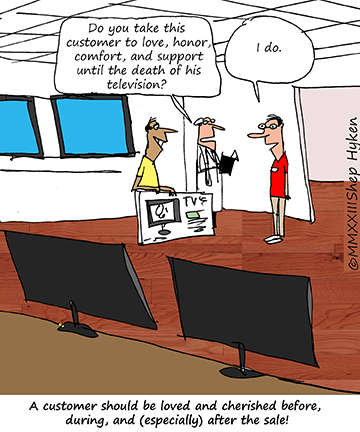
Some refer to this moment as “closing the deal.” I always joke about that phrase. “Closing the deal” signifies an ending, but in reality, it’s the beginning of the financial relationship. To put it in dating terms, everything else was courting the customer. Once the customer decides to buy, it’s like you proposed to them, and they said, “Yes.” And when the sale is finally made, it’s like getting married. And that is far from the end. It’s actually the beginning.

Once you can officially call someone a customer (versus a prospect), it’s time to keep them. In other words, you want to make the relationship last.

According to the American Psychological Association, in 2022, approximately 40-50% of first marriages end in divorce. And the No. 1 reason for divorce is simple: a lack of commitment. So, my question to a business is, “What percentage of your customers churn out after the first sale?” In other words, what’s the divorce rate of your customers?

Once the sale is made, there is the honeymoon phase, in which the customer is excited about the purchase, and you let the customer know how excited you are about doing business with them. How long does that last? Ideally, the honeymoon phase should never end. While the excitement compared to the first time doing business may ebb and flow, the customer should always feel appreciated and, in marital terms, loved.

So what do you do to court your customers and, more importantly, keep your customers in the honeymoon phase? You don’t need to answer me. Spend time with your team and discuss what you do after the sale is made to keep your clients from divorcing you and starting a new relationship with a competitor.

Image Credit: Pixabay

Subscribe to Human-Centered Change & Innovation WeeklySign up here to join 17,000+ leaders getting Human-Centered Change & Innovation Weekly delivered to their inbox every week.

Top 10 Human-Centered Change & Innovation Articles of May 2023

Top 10 Human-Centered Change & Innovation Articles of May 2023Drum roll please…

At the beginning of each month, we will profile the ten articles from the previous month that generated the most traffic to Human-Centered Change & Innovation. Did your favorite make the cut?

But enough delay, here are May’s ten most popular innovation posts:

  1. A 90% Project Failure Rate Means You’re Doing it Wrong — by Mike Shipulski
  2. ‘Innovation’ is Killing Innovation. How Do We Save It? — by Robyn Bolton
  3. Sustaining Imagination is Hard — by Braden Kelley
  4. Unintended Consequences. The Hidden Risk of Fast-Paced Innovation — by Pete Foley
  5. 8 Strategies to Future-Proofing Your Business & Gaining Competitive Advantage — by Teresa Spangler
  6. How to Determine if Your Problem is Worth Solving — by Mike Shipulski
  7. Sprint Toward the Innovation Action — by Mike Shipulski
  8. Moneyball and the Beginning, Middle, and End of Innovation — by Robyn Bolton
  9. A Shortcut to Making Strategic Trade-Offs — by Geoffrey A. Moore
  10. 3 Innovation Types Not What You Think They Are — by Robyn Bolton

BONUS – Here are five more strong articles published in April that continue to resonate with people:

If you’re not familiar with Human-Centered Change & Innovation, we publish 4-7 new articles every week built around innovation and transformation insights from our roster of contributing authors and ad hoc submissions from community members. Get the articles right in your Facebook, Twitter or Linkedin feeds too!

Have something to contribute?

Human-Centered Change & Innovation is open to contributions from any and all innovation and transformation professionals out there (practitioners, professors, researchers, consultants, authors, etc.) who have valuable human-centered change and innovation insights to share with everyone for the greater good. If you’d like to contribute, please contact me.

P.S. Here are our Top 40 Innovation Bloggers lists from the last three years:

Subscribe to Human-Centered Change & Innovation WeeklySign up here to get Human-Centered Change & Innovation Weekly delivered to your inbox every week.

Customers Have Bad Days Too

Customers Have Bad Days Too

GUEST POST from Shep Hyken

You’ve probably experienced this. No matter how hard you try to please some customers, they aren’t happy. It’s frustrating, but at the same time, it’s reality.

And speaking of reality, no matter how good you are at creating an amazing customer experience, it is the customer’s perception that counts. Their perception is their reality.

I once went to an amazing restaurant – at least, I was told it was amazing. That evening, I had a bad cold. The people I was with raved about the food, however, I didn’t have the same experience. It had nothing to do with the food. It had to do with how I was feeling.

When customers aren’t responding to the excellent service you’re providing the way you want them to, you might refer to them as “difficult” customers. The question to ask is, “What’s making them difficult?” Maybe they have a legitimate gripe. Maybe they have unreasonable expectations. Or maybe, as in my example of the restaurant, they aren’t feeling well.

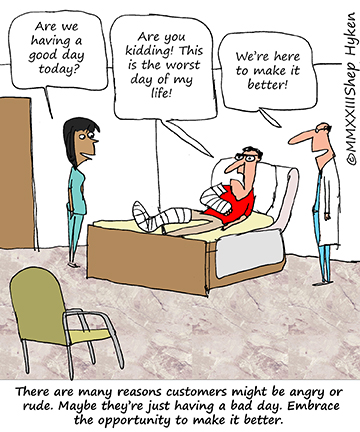
I was reading a LinkedIn post from Valerie Choniuk, the national director of patient experience at Agilon Health, who described exactly what I’m referring to. A hospital may be known for its compassionate treatment and commitment to taking care of its patients, but if patients are in great pain, they may not be able to “enjoy” the experience you provide. That patient may be the nicest person in the world, but because of the pain, may become a difficult customer. To Choniuk’s point, “Patients are not purposely GIVING us a hard time. They are HAVING a hard time.”

Sure, some people are chronic curmudgeons. You may never be able to make them happy. Accept it. Other customers are very nice people just having a bad day. You must accept that, too. Continue to do your best, regardless. If you can turn the mood of a person having a bad day into something better, you can declare victory. But don’t stress over it if you can’t.

Not every experience you create for your customers will be exceptional, no matter how hard you try. But the point is that you try. Nobody is perfect, and things can go wrong. That’s okay. It’s how you fix it that makes the difference. And then there are days when it seems things did go well, but you still can’t make that customer happy, no matter how hard you try. It’s like a professional sports team that played a great game but lost. It’s going to happen. It’s not your fault. If you can sleep at night knowing you did your best, you should sleep well.

So do your best, and remember, sometimes customers are just having a bad day!

Image Credit: Pixabay

Subscribe to Human-Centered Change & Innovation WeeklySign up here to join 17,000+ leaders getting Human-Centered Change & Innovation Weekly delivered to their inbox every week.

Eliminating 100% of Live Customer Service is a Mistake!

Eliminating 100% of Live Customer Service is a Mistake!

GUEST POST from Shep Hyken

You need help. You call customer support. Nobody’s home!

Actually, somebody is there. They just aren’t taking support calls. Someone at home—as in a corporate office—has decided to eliminate live, human-to-human customer support, pushing the customer to a digital option such as a chatbot, frequently asked questions page, etc.

My opinion is that this could happen in the distant future, but I can’t imagine that in the next few years there will be 100% digital and AI automated customer support. And here’s why. If all you are is an automated company, you have no way to emotionally connect with your customers. That means your customers have only one way to compare you to direct competition that sells exactly what you do, and that is price.

At that point, the only way to keep your customer is to always have the lowest price, and that is typically not a viable long-term strategy.

Recently I wrote about Frontier Airlines’ decision to drop traditional live phone support, and the reviews have not been good. That said, I give them credit for a bold move that may be just a little ahead of its time—and time will tell. Maybe the reactions are from initial shock. Perhaps there have been glitches that can be fixed for a smoother experience in the near future. We’ll know in six months. If the current reactions continue, at best, some changes will be made, provided the airline wants to stay in business.

I had a chance to interview Paulo Almeida, the CEO of Clientscape, on Amazing Business Radio. We talked about the possibility of AI and automation taking over the contact center. We briefly discussed Frontier Airlines, but more importantly, Almeida articulated the perfect answer to my question:

How do you feel about complete elimination of a human-to-human customer support department?

Almeida responded, “If you’re working in an industry that chooses to automate everything, you can potentially become a commodity. If that is what a company wants to do, the only difference from one company to the next will be what they charge. If that’s the only way a customer makes a decision, the company will go bankrupt!”

“It is not a sustainable financial model. It’s the human factor that makes the difference. It’s about giving the customer the care they deserve. That’s a way to differentiate. For example, Apple may make some of the best products, but they also have some of the best support. If their reputation for support goes away, they will no longer be perceived as having the best product. They will also lose pricing power. When that disappears, they could be on the path to failure. They will lose customers, and the cost to get them back will be extravagant.”

Almeida used a powerful word to summarize a decision to eliminate a human connection, and that word is bankrupt. I can buy into this for some companies, but there will always be exceptions.

People have said, “What about Amazon?!” Yes, Amazon is a digital company, and it has great digital customer support. However, if you need to talk to someone, you can. It’s a last resort, but when you do so, it’s typically a very pleasant experience. Amazon knows how far it can go with automation before it has to say, “It’s time to talk to one of our reps.”

Many products and services are becoming automated. To Almeida’s point, 100% automation is a mistake. Without a human-to-human relationship, how can you create an emotional connection? How can you differentiate yourself from other automated companies? You can’t. You’re a commodity.

More automation and AI technology are in our future. It shouldn’t surprise you that at some point in time planes will be flown by computers, not pilots. We’re already seeing self-driving trucks moving across the country. Companies like Tesla, Google and others are investing tens of billions into autonomous self-driving vehicles (even if they are still a long way from success). Amazon and Walmart are betting on alternative delivery methods that include drones and robots. And yes, some customer service functions are being handled by automation and artificial intelligence (AI).

We can’t fight progress. I love seeing products and services get better through automation. But I’m concerned about the companies and brands that are distancing themselves from their customers by not letting them connect with customer support people, who are also brand ambassadors for the company.

If the leadership of a company thinks the customer support agents’ only role is to fix a problem, then shame on them. Your agents can do much more. If they handle a call well, they can confirm that the customer made the right decision to do business with you and give them the confidence to do even more business. So, at least for now, don’t miss that opportunity. Don’t make the mistake of 100% elimination of live customer support.

Image Credit: Pixabay

This article originally appeared on Forbes.com

Subscribe to Human-Centered Change & Innovation WeeklySign up here to join 17,000+ leaders getting Human-Centered Change & Innovation Weekly delivered to their inbox every week.

Customer Service is a Team Sport

Customer Service is a Team Sport

GUEST POST from Shep Hyken

The other day I was having breakfast with 11 of my friends. The server came over, introduced herself, and said, “I’ll be taking care of you.” She took our orders, and a few minutes later, a different server dropped off three of our meals. Then, two more servers brought a few more meals a moment later, and another server showed up just after that with the rest of our meals. It wasn’t until after all the meals were served that our original server came over to ask if everything tasted great.

Was it this server’s job to simply take our orders and let others do the work? No!

I observed all of the people who brought us our meals. They also had other tables to attend to. And, I noticed that our server was dropping food off at different tables.

Different restaurants may have different processes, but in this one, the food is prepared, plated and set on a counter with heat lamps. Once the food is ready, it doesn’t matter whose table the food is for, whoever is available to take the hot food out immediately becomes responsible for the meal.

I liked what I was seeing. The employees recognized that customer service is a team sport. It’s everyone’s job to make sure the customers leave happy.

Shep Hyken Waiter Cartoon

Unfortunately, I’ve also witnessed the opposite at a restaurant. The food is set out on the counter, but the server responsible for it is busy taking care of another table. So, the food just sits there while other employees ignore it – because it’s not for one of “their guests.” Talk about a lack of team spirit!

Another example of this lack of team spirit is something I once saw at an airport. A baggage handler was driving a load of bags out to an airplane, and one of them fell off. I watched as numerous other baggage handlers drove by it. They would slow down, look at the bag sitting there by itself on the tarmac and then drive away. At least a half-dozen employees drove by the bag and did nothing. I’m pretty sure that the passenger arrived at their destination and was disappointed when their luggage didn’t show up at the baggage carousel.

The point of these examples is that everyone must take care of the customer, regardless of who the customer “belongs” to. If they see that something isn’t right, they shouldn’t just ignore it like the baggage handlers did.

Lately, I’ve resurrected a concept I used to cover in keynote speeches: every employee has at least two jobs. The first is to do the job they were hired to do. The second is to take care of the customer. When all employees understand that, the customer will most certainly have a better experience.

Image Credit: Shep Hyken, Pixabay

Subscribe to Human-Centered Change & Innovation WeeklySign up here to join 17,000+ leaders getting Human-Centered Change & Innovation Weekly delivered to their inbox every week.

Customers Care About the Destination Not the Journey

Customers Care About the Destination Not the Journey

GUEST POST from Shep Hyken

On a recent flight, the captain of the airplane announced over the PA system what time we would arrive at our destination. That would have been enough to make most people happy. However, he continued his announcement with a three-minute-plus speech. We learned that we would take off to the west, make a U-turn a few minutes later to head east, how high we would go, the various cities we would be flying over, that we would take a right turn as we approached the runway to land, and more. I looked around and noticed many people were annoyed or had stopped paying attention to the long-winded announcement.

The point is most customers don’t care as much about the details of the journey as they care about the destination.

Here’s another example, which has nothing to do with a journey but does have to do with an overload of details that can hurt a sale or erode the customer experience. Some people love a fancy, expensive sports car, while others just want reliable transportation. Even though these customers essentially want the same thing – a car to get them from one place to another – they are very different customers.

Shep Hyken Lobster Cartoon

A few years ago, my wife and I were looking for a new car. We narrowed it down to the make and model – even the color – we thought we wanted. We walked into the dealership and were approached by a salesperson who was very friendly and engaging. Then, we told him what we were looking for. So, he took us over to the exact car we wanted. He was very excited. He started to share details about the size of the engine, how many cylinders, how quickly the car could accelerate from zero to 60, the RPMs, and other details that mattered nothing to us.

Had he asked why we were interested in this model car, he would have realized we had no real interest in such details. Our version of the destination was that we wanted a nice-looking car (and it was) that was comfortable, safe, and easy to drive. Maybe we wanted to know a few other details about the car, but nothing to the extent he was sharing. Had he paid attention, he would have noticed he had us when he said, “I have the exact car you’re looking for.”

My point is that most customers don’t care about the details behind the experience or product they are buying. It’s up to us to recognize this and respond accordingly. All they want to know is what awaits them at their metaphorical destination.


Image Credit: Shep Hyken, Pixabay

Subscribe to Human-Centered Change & Innovation WeeklySign up here to join 17,000+ leaders getting Human-Centered Change & Innovation Weekly delivered to their inbox every week.

Frontier Airlines Ends Human-to-Human Customer Service

Frontier Airlines Ends Human-to-Human Customer Service

GUEST POST from Shep Hyken

In a bold move to cut costs, Frontier Airlines announced that it would no longer offer human-to-human customer support. As a customer service expert, I was surprised at this move. I have waited to see the fallout, if any, and thought the company might backpedal and reinstate traditional phone support. After almost two months, it hasn’t returned to conventional customer support. The dust has settled a bit, and people (passengers and employees) are adjusting to the decision.

The decision to go digital is different from the decision Northwest Airlines (which eventually merged with Delta) made in 1999 to introduce online check-in to its passengers. The idea behind that technology, and eventually the technology driving online reservations, was to give the customer a better and more convenient experience while at the same time increasing efficiency. The big difference in that decision versus Frontier’s was that there has always been (and still is) an option to connect to a live agent. If passengers didn’t want to use the self-service tools the airline provided, they could still talk to someone who could help them.

That does not appear to be the case with Frontier. There is no other option. The airline is relying on digital support. If you check the website for ways to contact them outside of their self-service options on the site or mobile app, you can use chat, email or file a formal written complaint. Chat is in the moment, and can deliver a good experience—even if it’s AI doing the chatting (and not a human). Email or a written complaint could take too long to resolve an immediate problem, such as rebooking a flight for any last-minute reason.

For some background, Frontier Airlines is a low-cost carrier based in Denver. It has plenty of competition, and when you combine that with rising expenses in almost every area of business and a tough economy, Frontier, just like any other company in almost any industry, is looking to cut costs. In a recent Forbes article, I shared the prediction that some companies will make the mistake of cutting expenses in the wrong places. Those “wrong places” are anywhere the customer will notice. Cutting off phone support to a live human, just one of Frontier’s cost-cutting strategies, is one of those places the customer may notice first.

If a customer wants to change or cancel a flight, make a lost-luggage claim and more, if they have the information they need on hand and the system is intuitive and easy to navigate, the experience could be better than waiting on hold for a live agent. Our customer service research found that 71% of customers are willing to use self-service options. That said, the phone is still the No. 1 channel customers prefer to use when they have a problem, question or complaint.

Frontier’s decision to stop human-to-human customer support has generated controversy and criticism from customers/passengers and employees. The company’s management defends its decision, stating that they need to cut costs to remain competitive. They claim you can eventually reach a human, but their passengers will first have to exhaust the digital options. While self-service automated customer support may help the airline cut costs and increase efficiency, it obviously frustrates customers and negatively impacts employees.

The big concern is that 100% digital or self-service support is still too new. We are still a long way from technology completely replacing the human-to-human interactions we’re used to in the customer service and support worlds. Efficiency is important, but so is the relationship you maintain with your customers and employees. It takes a balance. The best companies figure this out.

Consider this: Video did not kill the radio star. ATMs were predicted to eliminate the need for bank tellers. And for the foreseeable future, technology will not kill live, human-to-human interactions. Frontier customers looking to save money will be forced to adapt to its new way of customer service. Knowing this upfront will help. But also consider this, something I’ve been preaching for several years: The greatest technology in the world hasn’t replaced the ultimate relationship-building tool between a customer and a business, and that is the human touch.

This article was originally published on Forbes.com.

Image Credit: Pixabay

Subscribe to Human-Centered Change & Innovation WeeklySign up here to get Human-Centered Change & Innovation Weekly delivered to your inbox every week.

10 Ways to Rock the Customer Experience In 2023

10 Ways to Rock the Customer Experience In 2023

GUEST POST from Shep Hyken

As of today, 2022 is behind us. It was quite a year. Some businesses are still recovering from the impact of the pandemic, and then came employment issues, supply-chain problems and a shaky economy. All that makes for a company’s leaders having to use every skill they ever learned in their careers.

Our CX research indicated that 2022 was worse for customer service than the prior year. So we don’t continue that trend in 2023, I’ve created a list of tactics to help you. And while these may seem basic, they are essential to your organization’s success. With that in mind, here are ten ways that you can rock the customer experience in 2023:

1. Manage First and Last Impressions

There may not be anything more basic than this. Start with a strong first impression—and not just the first time a customer interacts with you. It could be the 500th time. First impressions set the tone for whatever is to follow, be it the first interaction or the 500th. As for last impressions, be sure to end strong. Last impressions create lasting impressions.

2. Give Back

Customers gravitate toward companies and brands that give back. Forty-five percent of the customers we surveyed in our annual customer experience research said that a company that gives back to the community or stands for a social cause is important to them. That’s almost half of your customers.

3. Be Customer-Focused

My definition of customer-focused is more than just delivering a good customer service experience. In addition to paying attention to customer service and CX, every decision you make keeps the customer in mind. Even if you are considering a change that will negatively impact the customer, you think it through, understand the ramifications and strategize how to overcome or handle the decision’s impact.

4. Empower Your Employees

If you want to keep your best employees and want them to take care of your customers, you need to hire good people, train them to do their job and then let them do it. Customers become frustrated when they encounter employees who aren’t able to make smart decisions. By the way, employees become frustrated as well, and that’s not good for the culture.

5. Practice Proactive Customer Service

This how you create customer confidence. Reach out to them proactively if you know of a problem. For example, the cable company that reaches out to its customers to let them know about an outage before they turn on their TV or computer. Or the retailer that emails, texts or calls a customer to let them know their purchase is delayed. While nobody likes bad news, knowing in advance gives the customer a sense of control and knowledge that the company is working on the problem.

6. Make It Personal

Find ways to personalize the experience. Customers like to be recognized and remembered. Make your customers feel as if you know them.

7. Have an Abundance Mindset, Especially When It Comes to Time

Zig Ziglar used to say, “You will get all you want in life if you help other people get what they want.” In this case, help customers get the most out of their experience with you and your products. That may mean spending a little more time selling, supporting and relationship-building with your customers. One of the big “loyalty killers” in business is when employees rush a customer to get to the next customer. Customers know it, feel it and don’t like it. An extra minute or two can be the difference between a customer coming back—or not.

8. Be Convenient

Eliminate anything (or at least as much as you can) that causes friction. Don’t make customers wait, don’t make them go through extra steps or do anything that is in the least bit inconvenient. Seventy percent of the customers we surveyed said they would pay more for convenience, and 68% said a convenient experience alone will make them come back.

9. Practice the “Employee Golden Rule”

My Employee Golden Rule goes like this: Do unto employees as you want done unto your customers. In other words, treat the people you work with as well (if not better) than your customers. That sets the tone from the inside and is felt by the customer on the outside.

10. Be Helpful

Ace Hardware is known as “The Helpful Hardware Place.” That’s their secret sauce. It separates them from their direct competitors (Home Depot, Menards, Walmart, etc.). I was interviewing an Ace executive for one of my customer service books, and he said, “Our competition has friendly customer service. So do we, but we also provide helpful service.” Think about how to help your customers be more successful when they buy whatever it is you sell.

BONUS: Show Appreciation

Don’t ever forget to say, “Thank you.” It doesn’t matter if it’s in person, on the phone, a text or an old-fashioned, hand-written note. Customers must always know you appreciate them for their business.

Some of these ideas may seem basic—even common sense. Maybe they are, but they are also essential to delivering the experience that gets customers to say, “I’ll be back!”

This article was originally published on Forbes.com.

Image Credit: Unsplash

Subscribe to Human-Centered Change & Innovation WeeklySign up here to get Human-Centered Change & Innovation Weekly delivered to your inbox every week.

Customer Experience versus Customer Service

Customer Experience versus Customer Service

GUEST POST from Shep Hyken

As I talk to people about their experiences with the companies and brands they do business with, they often use the terms customer service and customer experience interchangeably. Are they confused? Do they not know the difference? Maybe, maybe not. And in the end, it doesn’t matter. They don’t care, and neither should you.

All you should worry about is giving them the experience they want, expect and deserve – regardless of what your customers call it.

Here are some of the different definitions the public gives to customer service:

  • Customer service is a group of people who help me when I have a problem or a complaint.
  • Customer service is the way people treat me.
  • Customer service is a friendly experience.
  • Customer service is easy and convenient.

And every once in a while, someone will use the words customer experience to describe the same. I’ve heard many other definitions of customer service and customer experience. The idea here is that customers have their definitions, and yours doesn’t matter. However, and this is important, regardless of how they define customer service or customer experience, the outcome needs to be the same: the customer always wants to be happy.

Now the word happy is my word. Customers will say they want to be happy, delighted, satisfied, pleased, and more. What drives all of that is an experience that might include friendly, knowledgeable employees, excellent customer support when there’s a problem, a simple, convenient experience, not having to wait, fast response times, employees who have empathy when it’s needed, and more. The list can get quite long, and it’s different for different types of businesses. Depending on your business, you may include something that other businesses might not.

In the end, does it really matter what customers call their experience? And does it really matter what we call it? The answer, as I’ve already mentioned, is no. What is important is that the company has every employee in alignment with what they want the customer to experience. It’s about the outcome. Whatever words we use internally, be it customer service, customer experience, or any other term that describes the outcome and process we want to create for the customer, it doesn’t matter. All that matters is that we create the experience that meets our customers’ expectations, makes them happy, and gets them to say, “I’ll be back.”

Image Credit: Unsplash

Subscribe to Human-Centered Change & Innovation WeeklySign up here to get Human-Centered Change & Innovation Weekly delivered to your inbox every week.

23 Ways in 2023 to Create Amazing Experiences

23 Ways in 2023 to Create Amazing Experiences

GUEST POST from Shep Hyken

Happy New Year! I’m not one for New Year’s resolutions, which are often broken. Instead, I like setting and resetting my goals for the year, and in my world, those goals focus on delivering an amazing customer service experience. So, I’ve created a list of simple ways to deliver the experience that everyone wants. Here are twenty-three ways to help you and your teams provide an amazing customer experience in 2023.

  1. Manage the first impression. It sets the tone for what’s to follow.
  2. Manage last impressions. They create lasting impressions.
  3. Demonstrate your knowledge and expertise. Customers want to work with people who “know their stuff.”
  4. Make the customer feel like a person. Customers are not a sale, an account number, a prospect, etc. They are people.
  5. Respond quickly to calls and emails. Fast response time creates confidence.
  6. Don’t make customers wait on hold. Making customers wait for unreasonable amounts of time is a sign of disrespect.
  7. Be nice and show empathy. Create a warm human-to-human experience.
  8. Be available. How easy are you to reach? And if you’re not available, go back and read No. 5 again.
  9. Treat employees the way you want customers to be treated. How employees are treated will be felt on the outside by customers.
  10. Eliminate friction. If there is anything in the process of doing business with you that’s hard on the customer, find a way to eliminate or mitigate it.
  11. Act like a leader. My friend Mark Sanborn says, “You don’t need a title to be a leader.” Be the person everyone admires and wants to emulate.
  12. Always be polite. Say please and thank you. It shows you respect and appreciate your customers.
  13. Be proactive. If you know there’s a problem, let the customer know before they call you. Any form of proactive communication is always appreciated.
  14. Have an abundance mindset. Be generous – and don’t keep score. Zig Ziglar used to say, “You will get all you want in life if you help other people get what they want.”
  15. Give customers the gift of your time. An extra few minutes with a customer goes a long way in building a relationship.
  16. Give back to your community or contribute to a cause. Besides being a nice thing to do, customers gravitate to companies that “give back.”
  17. Have a “helpful” mindset. What can you do to help your customers be more successful?
  18. Don’t make excuses when problems arise. Instead, think in terms of explanations. Excuses show weakness. Explanations are reasons that can be followed up with how you plan to fix the problem.
  19. Be flexible. Excellent customer service lies in flexibility. Rules should be guidelines.
  20. Avoid phrases customers hate, such as, “It’s not my department,” or, “That’s our company policy.” I refer to these as loyalty killers.
  21. Train and empower your employees. If you have good people and train them well, let them do their job. Customers love working with empowered employees.
  22. Be customer focused. That means that every decision you make keeps the customer in mind. That doesn’t mean every decision will make the customer happy, such as a price increase, but at least you’ve considered the impact or result of your decisions.
  23. Express appreciation. Say, “Thank you!” Depending on how your customers like to communicate, it could be in person, on the phone, in an email, a text or an old-fashioned hand-written note.

As you look at this list, you’ll see nothing complicated. The ideas may seem rather basic. But don’t be fooled by the simplicity. These are precisely the strategies and tactics that will make your customers say, “I’ll be back!”

Again, Happy New Year, and may 2023 be your best year yet – and each year better than the last!

Image Credit: Unsplash

Subscribe to Human-Centered Change & Innovation WeeklySign up here to get Human-Centered Change & Innovation Weekly delivered to your inbox every week.