Category Archives: Strategy

7 Ways to Outsmart Your Brain And Be More Innovative

GUEST POST from Stephen Shapiro

You are alive today. You were alive yesterday. You were alive the day before that. This is good news from a survival perspective. Unfortunately it is bad news from an innovation perspective.

Your brain is wired to keep you alive.

Your brain makes the assumption that because you were alive yesterday, what you did previously is safe. Therefore repeating the past is good for survival. As a result, doing things differently, even if it seems like an improvement, is risky. Perpetuating past behaviors, from the brain’s reptilian perspective, is the safest way.

This is why innovation is difficult for most individuals and organizations.

Innovation is about change. It is about doing something different than you did previously. It is about trying something that you have not done before, and therefore may feel is a danger to your survival.

How does the brain’s survival instinct prevent innovation–and what can you do about it?

Here are seven ways to outsmart your brain:

Challenge No. 1: The brain wants pains solved first. The brain is wired to minimize loss. We want to keep what we already have. Equally, we are not interested in something new, until we address our pains. The brain seeks preservation over pleasure.

Solution: Recognize that people want their pains solved more than anything else. Be the aspirin. Innovation is not just about creating something new and different. It should solve a problem that people have. Infomercials are especially effective at demonstrating this.

Challenge No. 2: Expertise is the enemy of innovation. We build neural pathways to known solutions. What we know best (or in some cases have heard most recently) becomes our default answer. Unfortunately, once we find an answer to a problem, we stop looking for other possible solutions. As a result, the tried and true wins out and we get more of the same.

Solution: Keep looking. Although this sounds simple, don’t stop with the obvious answers. Keep pushing until you are out of ideas and then still push forward. Ask “who else has solved a problem like this?” A whitening toothpaste was developed by studying how laundry detergent whitens clothes. A medical device manufacturer learned how angioplasty balloons expand and contract by studying car airbag deployment.

Challenge No. 3: The brain wants solutions, not problems. In the world of business, we hear the expression, “Don’t bring me problems, bring me solutions.” From a survival perspective this makes sense. When faced with the possibility of being eaten by a lion, we don’t want to study our navel. Action is critical. However, in the world of innovation, the “problem” is actually more important.

Solution: Ask better questions. Einstein reputedly said, “If I had an hour to save the world, I would spend 59 minutes defining the problem and one minute finding solutions.” Instead of asking for broad ideas such as how to increase revenues, first identify the specific growth opportunities, untapped markets, emerging trends and current roadblocks. Then find solutions to those more focused challenges.

Challenge No. 4: The brain craves commonality. Contrary to conventional wisdom, opposites do not attract. It is safer to be in a tribe of people who think the same way. Things get done quickly. It feels effortless. But the downside is that it thwarts innovation.

Solution: Work with people who are not like you. Find people with different backgrounds, personality styles, and interests. Appreciate their contribution to you and your professional efforts. For example, I am someone who is disorganized and despises plans or planning. As a result, the first person I bring on to my team is a detail-oriented project manager who can make sure ensure that I get everything done.

Challenge No. 5: The brain sees what it believes. The brain uses a pattern matching technique called “confirmation bias.” In a nutshell, it rejects anything that is inconsistent with your belief structure. This is why two people can listen to the same political candidate and hear completely different things. From an innovation perspective, this may have us get attached to certain ideas, despite evidence proving that they are probably duds.

Solution: Avoid getting wed to your ideas by getting someone to play devil’s advocate. Any time you think to yourself, “Wow, this is a great idea,” get someone to poke holes in your logic. Don’t go to the same people for input. Seek out people who you suspect would reject the idea. Learn from them. Refine your solution based on numerous perspectives, not just your own biases.

Challenge No. 6: Your brain only sees a fraction of reality. What you focus on expands, to the exclusion of everything else. The brain’s reticular activating system is designed to filter out 99.99 percent of the stimuli out there. This prevents the brain from being overwhelmed by information. Unfortunately, as a result, you miss out on opportunities because you cannot even see they are there. When you are a technology expert, the solution to every problem involves software/hardware. Opportunities are limited to your frame of reference.

Solution: Sometimes you need to purposefully retrain the brain. Attend conferences unrelated to your work. Read magazines from different industries. This is why I don’t read books on innovation, but instead read about neuroscience, psychology, and sports performance. This helps me see more of the world and find opportunities in places I wouldn’t have thought to look.

Challenge No. 7: The brain thinks too much: The dorsolateral prefrontal cortex is the judgmental part of the brain. It is analytical and calculating. This is great for decision-making that requires logic. But it can kill innovation. When athletes choke, they are over thinking and constrict the neural pathways that allow access to their deeper capabilities.

Solution: Quiet that part of the brain through meditation, yoga, showering or any other relaxing activity. This allows you to gain access to the creative parts of your brain. Aristotle found his greatest breakthroughs while napping. One company found that they could speed up the development of new product ideas through meditation first thing in the morning.

The brain is incredibly powerful. And it does its job exceptionally well: perpetuate the species. It does this by ensuring the survival of the individual and the gene pool. Although this is of course valuable, it does limit our ability to try new things. Perpetuating the past is the surest way to survive. But for organizations, doing what you did in the past is the fastest path to extinction. By knowing how your brain is wired, you can choose to both survive and thrive.

Subscribe to Human-Centered Change & Innovation WeeklySign up here to join 17,000+ leaders getting Human-Centered Change & Innovation Weekly delivered to their inbox every week.

Marketing Throwdown – Pull versus Push

Marketing Throwdown - Pull versus PushDescribing push marketing is easy (or at least it should be). Push marketing is the traditional marketing and advertising seen everywhere. Push marketing starts with the product or service, identifies the features or benefits that potential customers will find most compelling, and then utilizes targeting and segmentation to “push” carefully crafted marketing messages out via a variety of advertising, sales, and social media channels to the most likely potential customers.


But, stray into the pull marketing universe and prepare to be inundated by a plethora of widely divergent definitions. Some people would define pull marketing as similar to push, but instead of marketing to potential customers, potential decision makers or consumers (or even influencers) are targeted so that hopefully they will pull customers to the business. Still other people talk about technology push versus market pull in the context of determining which products get developed and sold (or should be developed and sold). Making it even more confusing, some people call the direct advertising to consumers of prescription medications like Viagra a pull marketing strategy. So just what is a pull marketing strategy then anyways? Who’s right?

I would argue that none of them are correct. While the communications produced might to talk to different groups of people than traditional marketing or in a slightly different way, they all are still, at their core, push marketing strategies. Pull marketing is something else entirely (and should be in order to maximize your investment in marketing). While push marketing focuses on the most likely potential customers, pull marketing should be focused on a totally different group of people – non-customers who are not yet ready to become customers at this time.

An effective pull marketing strategy begins with extensive research into what makes a person evolve from someone who is disinterested and unaware of a solution area, to seeing how it might fit into their personal or professional lives and make it better. This usually involves the creation of content that will raise awareness, interest, inspiration, and understanding of the whole solution area, and the need for it, not just the features and benefits of one company’s particular product or service. Pull marketing strategies are very uncomfortable for most marketers, and as a result most companies have no pull to balance their push.

So which is better push marketing or pull marketing?

Any organization that is interested in sustained revenue and profitability growth over time should invest in both, but most companies are seduced by the immediate payback of push marketing and pursue only push marketing strategies. Meanwhile, pull marketing helps grow new potential customers (or accelerates their purchase readiness timeline), so it is equally important in the long run. Smart companies, organizations that intend to succeed in the long run, need to invest in both push and pull marketing strategies in order to keep their sales pipeline full both for now AND for the future. And if your company is focused on innovation, then the more disruptive that you try to be, the more important that having a pull component to your marketing strategy will become. Push or pull? The answer lies in… the balance.


Build a common language of innovation on your team

Subscribe to Human-Centered Change & Innovation WeeklySign up here to get Human-Centered Change & Innovation Weekly delivered to your inbox every week.

New Thought Paper – Winning the War for Innovation

New Thought Paper - Winning the War for InnovationThere is a war for innovation brewing, and building a deep innovation capability is the only way to win it. The question is, will you lead the charge onto the innovation battlefield, or will you let your competitors bring the fight to you?

As an increasing number of industries become commoditized, innovation has become an important way to distinguish your company from the competition, and a necessary investment just to maintain your existing market position.

In this thought paper, I lead the charge against the status quo. I explore how your organization can stay relevant, grow, and thrive with an innovation framework that addresses four key areas: Leadership & Structure, Processes & Tools, People & Skills, and Culture & Values.

To download my new FREE thought paper on Winning the War for Innovation, please visit the link below.

Download a copy of Winning the War for Innovation

And grab a copy of my book designed to help you build a continuous innovation infrastructure!

Subscribe to Human-Centered Change & Innovation WeeklySign up here to get Human-Centered Change & Innovation Weekly delivered to your inbox every week.

Eight I’s of Infinite Innovation – PDF Version

Eight I's of Infinite Innovation - PDF VersionIn the wake of my hugely popular article on Innovation Excellence I’ve decided to make it available as a PDF.

Download the Eight I’s of Infinite Innovation PDF now

Some authors talk about successful innovation being the sum of idea plus execution, others talk about the importance of insight and its role in driving the creation of ideas that will be meaningful to customers, and even fewer about the role of inspiration in uncovering potential insight. But innovation is all about value and each of the definitions, frameworks, and models out there only tell part of the story of successful innovation.

To achieve sustainable success at innovation, you must work to embed a repeatable process and way of thinking within your organization, and this is why it is important to have a simple common language and guiding framework of infinite innovation that all employees can easily grasp. If innovation becomes too complex, or seems too difficult then people will stop pursuing it, or supporting it.

Some organizations try to achieve this simplicity, or to make the pursuit of innovation seem more attainable, by viewing innovation as a project-driven activity. But, a project approach to innovation will prevent it from ever becoming a way of life in your organization. Instead you must work to position innovation as something infinite, a pillar of the organization, something with its own quest for excellence – a professional practice to be committed to.

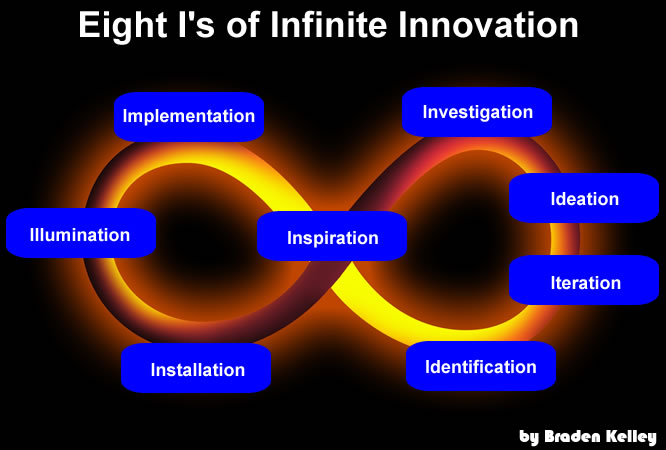
So, if we take a lot of the best practices of innovation excellence and mix them together with a few new ingredients, the result is a simple framework organizations can use to guide their sustainable pursuit of innovation – the Eight I’s of Infinite Innovation. This new framework anchors what is a very collaborative process. Here is the framework and some of the many points organizations must consider during each stage of the continuous process…

To continue reading, download the PDF

Subscribe to Human-Centered Change & Innovation WeeklySign up here to get Human-Centered Change & Innovation Weekly delivered to your inbox every week.

Eight I’s of Infinite Innovation

Eight I's of Infinite Innovation

Some authors talk about successful innovation being the sum of idea plus execution, others talk about the importance of insight and its role in driving the creation of ideas that will be meaningful to customers, and even fewer about the role of inspiration in uncovering potential insight. But innovation is all about value and each of the definitions, frameworks, and models out there only tell part of the story of successful innovation.

To achieve sustainable success at innovation, you must work to embed a repeatable process and way of thinking within your organization, and this is why it is important to have a simple common language and guiding framework of infinite innovation that all employees can easily grasp. If innovation becomes too complex, or seems too difficult then people will stop pursuing it, or supporting it.

Some organizations try to achieve this simplicity, or to make the pursuit of innovation seem more attainable, by viewing innovation as a project-driven activity. But, a project approach to innovation will prevent it from ever becoming a way of life in your organization. Instead you must work to position innovation as something infinite, a pillar of the organization, something with its own quest for excellence – a professional practice to be committed to.

So, if we take a lot of the best practices of innovation excellence and mix them together with a few new ingredients, the result is a simple framework organizations can use to guide their sustainable pursuit of innovation – the Eight I’s of Infinite Innovation. This new framework anchors what is a very collaborative process. Here is the framework and some of the many points organizations must consider during each stage of the continuous process:

1. Inspiration

  • Employees are constantly navigating an ever changing world both in their home context, and as they travel the world for business or pleasure, or even across various web pages in the browser of their PC, tablet, or smartphone.
  • What do they see as they move through the world that inspires them and possibly the innovation efforts of the company?
  • What do they see technology making possible soon that wasn’t possible before?
  • The first time through we are looking for inspiration around what to do, the second time through we are looking to be inspired around how to do it.
  • What inspiration do we find in the ideas that are selected for their implementation, illumination and/or installation?

2. Investigation

  • What can we learn from the various pieces of inspiration that employees come across?
  • How do the isolated elements of inspiration collect and connect? Or do they?
  • What customer insights are hidden in these pieces of inspiration?
  • What jobs-to-be-done are most underserved and are worth digging deeper on?
  • Which unmet customer needs that we see are worth trying to address?
  • Which are the most promising opportunities, and which might be the most profitable?

3. Ideation

  • We don’t want to just get lots of ideas, we want to get lots of good ideas
  • Insights and inspiration from first two stages increase relevance and depth of the ideas
  • We must give people a way of sharing their ideas in a way that feels safe for them
  • How can we best integrate online and offline ideation methods?
  • How well have we communicated the kinds of innovation we seek?
  • Have we trained our employees in a variety of creativity methods?

4. Iteration

  • No idea emerges fully formed, so we must give people a tool that allows them to contribute ideas in a way that others can build on them and help uncover the potential fatal flaws of ideas so that they can be overcome
  • We must prototype ideas and conduct experiments to validate assumptions and test potential stumbling blocks or unknowns to get learnings that we can use to make the idea and its prototype stronger
  • Are we instrumenting for learning as we conduct each experiment?

Eight I's of Infinite Innovation

5. Identification

  • In what ways do we make it difficult for customers to unlock the potential value from this potentially innovative solution?
  • What are the biggest potential barriers to adoption?
  • What changes do we need to make from a financing, marketing, design, or sales perspective to make it easier for customers to access the value of this new solution?
  • Which ideas are we best positioned to develop and bring to market?
  • What resources do we lack to realize the promise of each idea?
  • Based on all of the experiments, data, and markets, which ideas should we select?

You’ll see in the framework that things loop back through inspiration again before proceeding to implementation. There are two main reasons why. First, if employees aren’t inspired by the ideas that you’ve selected to commercialize and some of the potential implementation issues you’ve identified, then you either have selected the wrong ideas or you’ve got the wrong employees. Second, at this intersection you might want to loop back through the first five stages though an implementation lens before actually starting to implement your ideas OR you may unlock a lot of inspiration and input from a wider internal audience to bring into the implementation stage.

6. Implementation

  • What are the most effective and efficient ways to make, market, and sell this new solution?
  • How long will it take us to develop the solution?
  • Do we have access to the resources we will need to produce the solution?
  • Are we strong in the channels of distribution that are most suitable for delivering this solution?

7. Illumination

  • Is the need for the solution obvious to potential customers?
  • Are we launching a new solution into an existing product or service category or are we creating a new category?
  • Does this new solution fit under our existing brand umbrella and represent something that potential customers will trust us to sell to them?
  • How much value translation do we need to do for potential customers to help them understand how this new solution fits into their lives and is a must-have?
  • Do we need to merely explain this potential innovation to customers because it anchors to something that they already understand, or do we need to educate them on the value that it will add to their lives?

8. Installation

  • How do we best make this new solution an accepted part of everyday life for a large number of people?
  • How do we remove access barriers to make it easy as possible for people to adopt this new solution, and even tell their friends about it?
  • How do we instrument for learning during the installation process to feedback new customer learnings back into the process for potential updates to the solution?

Conclusion

The Eight I’s of Infinite Innovation framework is designed to be a continuous learning process, one without end as the outputs of one round become inputs for the next round. It’s also a relatively new guiding framework for organizations to use, so if you have thoughts on how to make it even better, please let me know in the comments. The framework is also ideally suited to power a wave of new organizational transformations that are coming as an increasing number of organizations (including Hallmark) begin to move from a product-centered organizational structure to a customer needs-centered organizational structure. The power of this new approach is that it focuses the organization on delivering the solutions that customers need as their needs continue to change, instead of focusing only on how to make a particular product (or set of products) better.

So, as you move from the project approach that is preventing innovation from ever becoming a way of life in your organization, consider using the Eight I’s of Infinite Innovation to influence your organization’s mindset and to anchor your common language of innovation. The framework is great for guiding conversations, making your innovation outputs that much stronger, and will contribute to your quest for innovation excellence – so give it a try.

Download as a PDF

Haga clic aquí para la versión en Español

Subscribe to Human-Centered Change & Innovation WeeklySign up here to get Human-Centered Change & Innovation Weekly delivered to your inbox every week.

Veracity Required for Innovation Success

Veracity Required for Innovation SuccessA recent post by Jeffrey Phillips titled Velocity is the Only Innovation Outcome That Matters sparked respectful disagreement inside me.

I believe that when it comes to innovation, veracity is more important than velocity. Let’s look at the definition of the word veracity from our friends over at Merriam-Webster:

Veracity

1: devotion to the truth : truthfulness
2: power of conveying or perceiving truth

In my opinion it is more valuable to spend time on identifying the right customer insight and the right way to communicate with customers about the solution which you create to serve the insight, than it is to spend the same amount of time inventing faster or launching faster.

In fact your innovation velocity can exceed your innovation veracity as shown in this article.

And many a company has fallen foul of going too fast and thinking an invention will become an innovation when they are ready to launch it, including Microsoft with the Windows Tablet and Apple with the Newton, only to find that customers were not ready to adopt it as an innovation until years later.

Velocity is definitely important, but more isn’t necessarily better. Many times the competitor with a lesser innovation velocity but greater innovation veracity has ended up winning. Look at Apple and the iPod, the iPhone, the iPad, etc.

It’s also more important to look for the barriers to adoption than it is to look for the barriers to creation. Innovation is all about value and this is why it is so important to pay just as much attention to value access and value translation, as you do to value creation, because it takes doing all three really well with a solution with real innovation veracity to find innovation success.

Fail to identify a solution with real innovation veracity and you are likely to miss potential elements of optimal value creation, you will likely struggle to make its value accessible, and there is a greater likelihood that you will fail to properly translate the value of the solution for your customers.

So, taken another way, the search for innovation success is a search for truth. You must therefore unlock the inner truths of your intended customers (think unmet needs or jobs-to-be-done), you must search in areas that your intended customers will feel are true for your brand, and areas that feel true to employees given the company’s mission and values. When your pursuit of innovation centers around truth and when you commit to a focused effort to increase your innovation capability – and to pursue Innovation Excellence – then and only then do you have your best chance at innovation success.

What innovation truths are you searching for?

How much innovation veracity can you create?


Build a Common Language of Innovation

Subscribe to Human-Centered Change & Innovation WeeklySign up here to get Human-Centered Change & Innovation Weekly delivered to your inbox every week.

New White Paper on External Talent Strategies

Innocentive - New White Paper on External Talent StrategiesFollowing on the heels of a recent thought leadership webinar (link to recording) on the same topic, this white paper explores the intersection of talent management and open innovation strategies. The paper dives into why having an external talent strategy is becoming increasingly important and how it can help your company accelerate innovation, shows how leading organizations manage their open innovation and crowdsourcing efforts (including case study examples of companies like P&G), and provides proven strategies and steps to take for attracting talent to your organization’s innovation efforts.

Download this Complimentary White Paper

Subscribe to Human-Centered Change & Innovation WeeklySign up here to get Human-Centered Change & Innovation Weekly delivered to your inbox every week.

Making Innovation Sustainable – Part 1 of 4

Making Innovation Sustainable - Part 1 of 4Key Dangers:

  • Viewing innovation as a temporary, extraordinary effort in response to a crisis, or pursuing innovation as a competitive response.
  • Treating innovation as the domain of only the R & D or Marketing department, or some other subgroup.
  • Treating innovation as a project-based activity, instead of as an integral organizational capability to be invested in and professionally managed.

Success can be blinding. Organizations often drive themselves by trying to look through the windscreen and in the rearview mirror, only to get blindsided by something from the left or the right. Put another way, organizations often focus on what they’ve already done and moving it forward (often in an incremental way). Organizations also invest in defending and extending the core products and services that made them successful — focusing a huge amount of energy on protecting their flank. Don’t get me wrong, incremental innovation is important, but all of your competitors are trying to make their products and services incrementally better than yours at the same time. At best, your efforts will allow you to maintain or make slight improvements in revenue and profitability.

Success can be blinding. Organizations often drive themselves by trying to look through the windscreen and in the rearview mirror, only to get blindsided by something from the left or the right. Put another way, organizations often focus on what they’ve already done and moving it forward (often in an incremental way). Organizations also invest in defending and extending the core products and services that made them successful — focusing a huge amount of energy on protecting their flank. Don’t get me wrong, incremental innovation is important, but all of your competitors are trying to make their products and services incrementally better than yours at the same time. At best, your efforts will allow you to maintain or make slight improvements in revenue and profitability.

And of course, companies that fail to invest in at least incremental innovation efforts often find themselves getting less and less competitive in the marketplace. Ultimately, the organizations that create sustainable success are those that invest in not only identifying and implementing the change that their customers desire and require, but also the change that is necessary inside the organization to deliver it.

Who Innovates?

Do you have a group of innovation elites in your organization? Maybe these are folks in Marketing or in Research & Development. Or do you make a concerted effort for all of your employees to feel that it is part of their job to innovate? If people feel that innovation is someone else ’ s job, then they ’ re not going to participate, and you are going to miss out on a whole spectrum of interesting innovation ideas. The fact is that markets are too big, too complex, and opportunities for insight lie in too many different reference industries and geographies for any small number of people to be able to successfully sense and ideate. I heard Dr. Alph Bingham, founder of Innocentive, recently talking about who actually solves most of their challenges, and he said that if you were to classify people across a spectrum of those who you believed would be most likely to solve the challenges on the left and those you believed would be least likely to solve the challenges on the right, most of the solutions come from the right-hand side. So if the best solutions are most likely to come from those you would deem least likely, wouldn’t it make sense to include everyone in your organization in your innovation efforts? And possibly people outside your organization?

Innovating in a Crisis

Companies that only have the courage to innovate when there is a crisis, or a competitive response is needed, will be unable to achieve sustainable innovation. Not only that, but their innovation attempts are likely to lack the vision necessary to leap ahead of the crisis or competition — instead they will merely meet the threat and keep the organization as a reactionary pursuer of innovation instead of becoming a leader. This is the GM approach to innovation — constantly trying to catch up to where Toyota was five years ago — instead of trying to jump the next curve and regaining a leadership position. Innovating in crisis often means that the main motivator is going to be fear. Fear does not serve as an effective motivator for innovation. We know because of the inverse correlation between the fear of failure and the quantity and quality of innovation in organizations. Organizations looking to innovate in a crisis cannot do so over and over, and so they must find a way to transform feelings of fear into a believable, committed challenge mentality. To make an analogy: When the Russians launch Sputnik, you have to commit to an innovation moonshot.

Innovation Is Not a Project

Often when companies attempt to innovate because of a crisis or in response to the competition, they pursue innovation as a project. When you pursue innovation as a project, the organization does not build any kind of innovation capability. Instead a group of people come together to tackle a particular challenge, and when the work is complete everyone goes back to their day jobs. None of the learnings are retained in a meaningful and easy-to-access manner for future projects, and there is no opportunity for policies and processes to be refined for greater efficiency next time. You may be pursuing a portfolio of innovation projects, but innovation itself is not a project. Projects start and stop, but for innovation to be sustainable, it must be continuous. This often means investing in a small core team of people (maybe only allocating part of their time) to serve as innovation shepherds — identifying and cataloging innovation best practices and building the innovation capabilities of the organization so that all innovation projects in the portfolio
may benefit.

Excerpted from Stoking Your Innovation Bonfire. You can read ahead by getting the book or downloading the sample chapter, or by checking out parts 2-4 here:

Subscribe to Human-Centered Change & Innovation WeeklySign up here to get Human-Centered Change & Innovation Weekly delivered to your inbox every week.

Harnessing the Global Talent Pool to Accelerate Innovation

In this webinar hosted by Innocentive I explore how organizations can utilize open innovation and crowdsourcing resources as an essential talent management strategy to drive their business.

You can engage me to create a webinar or white paper for your audience here.

Subscribe to Human-Centered Change & Innovation WeeklySign up here to get Human-Centered Change & Innovation Weekly delivered to your inbox every week.

Embedding Innovation

Distributing Innovation Knowledge for Innovation Success

Embedding InnovationIs innovation in your organization a project?

Or are you trying to embed innovation into your organization as a new core competency?

Is innovation part of the new business as usual you are trying to create for sustained growth?

If so, you must take real actions to not only create a culture of continuous innovation but to sustain it.

You must consciously and continuously manage two of the key tensions that often inhibit innovation:

  1. Exploitation versus Exploration – Maximizing existing revenue possibilities while also creating new revenue opportunities
  2. Executive Mindset versus Entrepreneurial Mindset – Unleashing your executives to create predictability and repeatability in the existing business while also unleashing intrapreneurs to create new businesses

To be successful in the long run, you must pursue operational excellence AND innovation excellence at the same time.

And you must provide your entire workforce with the tools and training to support continuous, sustainable innovation.

Ideally this would include:

  1. Creating a common language of innovation in your organization
  2. Communicating an innovation vision, strategy, and goals across the organization
  3. Creating instructor-led and/or e-learning with Human-Centered Change & Innovation founder Braden Kelley to set a baseline understanding in your organization of your innovation process and the innovation tools available to help stimulate increased innovation in your organization
  4. Give your employees a steady diet of innovation inspiration and education by embedding an RSS Feed (or feedburner) from Human-Centered Change & Innovation into your corporate portal or into your Idea Management System
  5. Get involved with the Human-Centered Change & Innovation blog to showcase the fantastic innovation work you are doing and to be one of the first organizations to get an inside look at what others are doing

Subscribe to Human-Centered Change & Innovation WeeklySign up here to get Human-Centered Change & Innovation Weekly delivered to your inbox every week.