Category Archives: Leadership

Artificial Intelligence Powered Teamwork

Artificial Intelligence Powered Teamwork

GUEST POST from David Burkus

Over the past year, leaders have been asking the same questions trying to leverage AI-Powered teamwork: “What should I be doing with ChatGPT?” “How should we be rolling this out to our team?” “What does this mean for the future of work?”

They’re important questions, but they all kind of miss the mark. Because they treat AI like it’s just another IT rollout. Like that time your company moved from email to Slack. Or when everyone was forced to learn a new payroll system. But AI isn’t just another piece of software.

AI isn’t a tool. AI is a teammate.

And until we start treating it that way, we’re going to keep missing the real opportunity.

Why “Tool Thinking” Falls Short

Most people respond to AI in one of three ways. They see it as a threat. They see it as a tool. Or they see it as a teammate.

If you see AI as a threat, you’re going to hesitate. And hesitation is the enemy of progress. You’ll wait. You’ll hold back. But AI isn’t slowing down. And the people who do embrace it — whether they’re colleagues in your department or competitors across the industry — are only going to get better, faster, and more efficient. That puts your performance at risk by comparison. Compared to those using AI, you will performer slower.

If you see AI as a tool, you’re on slightly better footing. You’ll look for ways to automate the repetitive stuff. Email summaries. Meeting notes. Draft responses. All helpful. All productive. But you’re still missing the big value. You’re simplifying, not improving. You’re staying in neutral.

But if you treat AI as a teammate, that’s where transformation starts.

That’s when AI becomes a collaborator. A partner in decision-making. A quiet force that helps your team think more clearly, solve problems faster, and deliver better outcomes.

That’s when you start to unlock the full potential of AI-powered teamwork. That’s when it truly makes you smarter.

Step One: From Slower to Simpler

The first mindset shift is from threat to tool. From slower to simpler. Think about the annoying parts of your job. The copy-paste chores. The tedious admin. The stuff you’re way too smart to be wasting time on. AI can take that off your plate today.

Summarize the endless email chain. Done. Draft that status report. Done. Transcribe your meeting and highlight key action items. Double done.

Not sure where to start? Try this: open whatever AI platform you prefer — ChatGPT, Claude, Gemini, Grok, doesn’t matter — and type:

“Here’s what I do in my job every day. Ask me questions to understand it better, then show me how you could help.”

It will ask follow-ups. It will start mapping your workflows. It will suggest ways to make your day easier, your output faster, and your mind a little clearer.

Congratulations! You’ve moved from slower to simpler.

Step Two: From Simpler to Smarter

Once you’re using AI to simplify tasks, it’s time to use it to sharpen your thinking. Because smarter teams don’t just offload work. They upgrade their decision-making. They collaborate with AI, not just delegate to it.

How? Try turning AI into a devil’s advocate. Feed it your current strategy or plan, then ask:

“Tell me why this could fail.”

You’re not asking it to make decisions. You’re using it to challenge assumptions. To highlight blind spots. To play the role of critic — without the ego. AI provides friction without awkwardness. No one gets defensive when a bot questions your logic.

Want to go deeper? Try these prompts:

  • “What are we overlooking?”
  • “What assumptions might not be true?”
  • “Give me three stronger alternatives to this approach.”

Want to make the feedback even more useful? Ask the AI to role-play:

  • “Think like a strategic consultant.”
  • “Respond like a customer.”
  • “What would a competitor say?”

This is how AI-powered teamwork gets smarter, not just simpler. You’re not just getting a second opinion. You’re getting sharper thinking, without the politics.

Step Three: Make It a Team Habit

And here’s where the real breakthrough happens: when AI becomes a shared part of your team’s workflow — not just your personal productivity hack.

Use it in meetings to take notes. To draft action items. To highlight decisions made.

But also, use it before meetings. Drop your agenda into the chatbot and ask what you’re missing. Run your strategy plan through it and ask for feedback before your next off-site.

This only works if the whole team adopts it. And that’s where leaders come in.

Leaders need to be intentional. Because while AI can streamline collaboration, it can also introduce risks. If team members outsource their attention to a bot, they may stop listening. If everything’s recorded, people may speak up less. The quiet voices might go even quieter.

That’s why leadership still matters. Psychological safety? Still your job. Empathy? Still your job. Motivation and morale? Still your job.

AI can’t do that for you. But what it can do is give you more time to focus on it. Because when the bots handle the mechanics, you can focus on the human side of leadership — the part that never gets automated.

The Future of AI-Powered Teamwork

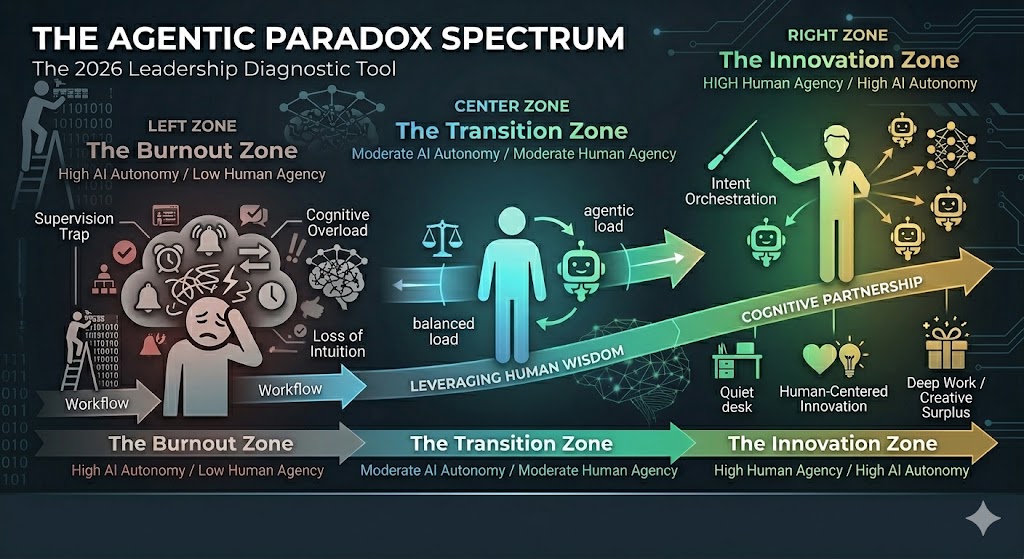
So, where’s your team right now? Are you stuck in “slower,” resisting change? Are you in “simpler,” just automating inbox chores? Or are you starting to work “smarter,” using AI to enhance how your team thinks and collaborates?

Wherever you are, there’s room to grow. Don’t just ask what AI can do. Ask how your team can do better work with it. Try a prompt. Test an idea. Challenge a plan. Start treating AI like a teammate, not a tool. Because the future of AI-powered teamwork isn’t about tech. It’s about trust. It’s about how you use new capabilities to build better teams, make better decisions, and do work that actually matters.

And that’s something worth getting smarter about.

Image credit: Google Gemini

Subscribe to Human-Centered Change & Innovation WeeklySign up here to get Human-Centered Change & Innovation Weekly delivered to your inbox every week.

Top 10 Human-Centered Change & Innovation Articles of March 2026

Top 10 Human-Centered Change & Innovation Articles of March 2026Drum roll please…

At the beginning of each month, we will profile the ten articles from the previous month that generated the most traffic to Human-Centered Change & Innovation. Did your favorite make the cut?

But enough delay, here are March’s ten most popular innovation posts:

  1. Resilient Innovation — by Braden Kelley
  2. Has AI Killed Design Thinking? — by Braden Kelley
  3. Mapping Customer Experience Risk to the P&L — by Braden Kelley
  4. Moral Uncertainty Engines — by Art Inteligencia
  5. Necesita un Diagnóstico de Riesgo de Experiencia del Cliente y Fuga de Ingresos — por Braden Kelley
  6. Layoffs, AI, and the Future of Innovation — by Braden Kelley
  7. Organizational Digital Exhaust Analysis — by Art Inteligencia
  8. You Need a Customer Experience Risk & Revenue Leakage Diagnostic — by Braden Kelley
  9. Stereotypes – Are They Useful and Should We Use Them? — by Pete Foley
  10. Is There Such a Thing as a Collective Growth Mindset? — by Stefan Lindegaard

BONUS – Here are five more strong articles published in February that continue to resonate with people:

If you’re not familiar with Human-Centered Change & Innovation, we publish 4-7 new articles every week built around innovation and transformation insights from our roster of contributing authors and ad hoc submissions from community members. Get the articles right in your Facebook, Twitter or Linkedin feeds too!

Build a Common Language of Innovation on your team

Have something to contribute?

Human-Centered Change & Innovation is open to contributions from any and all innovation and transformation professionals out there (practitioners, professors, researchers, consultants, authors, etc.) who have valuable human-centered change and innovation insights to share with everyone for the greater good. If you’d like to contribute, please contact me.

P.S. Here are our Top 40 Innovation Bloggers lists from the last five years:

Subscribe to Human-Centered Change & Innovation WeeklySign up here to get Human-Centered Change & Innovation Weekly delivered to your inbox every week.

10 Agent Empowerment Rules That Prevent “I Know What the Customer Deserves” Quits

10 Agent Empowerment Rules That Prevent 'I Know What the Customer Deserves' Quits

by Braden Kelley and Chateau G Pato


What Agent Empowerment Rules Prevent “I Know What the Customer Deserves” Quits? (Short Answer)

Ten agent empowerment rules that prevent “I know what the customer deserves” quits: (1) name the moment-of-truth mandate, (2) fund recovery power, not only apology scripts, (3) kill handle-time as the only score, (4) give exception authority with a clear band, (5) design escalation as help, not punishment, (6) retire scripts that forbid honesty, (7) close the loop from agent insight to policy, (8) protect time for judgment, not denser throughput, (9) measure first-contact human success, not containment, and (10) dual-recognize insight and care. Agents quit when moral clarity meets operational helplessness.

Customers feel the gap when agents are not allowed to close it. Agents feel the gap until they leave.

Why Don’t Exit Surveys Catch These Quits?

I have sat with contact-center leaders who could recite their NPS to one decimal place and still could not explain why their best agents left. The exit form said “opportunity.” The hallway said something else: I know what the customer deserves — and I’m not allowed to deliver it.

That is not a soft skills gap. It is a design failure. Soft landings for customers require frontline power — decision rights, recovery budgets, honest language, and metrics that reward finishing the human job. These ten rules are for human service agents in the moment of truth — not AI agents acting on a customer’s behalf. Empathy posters do not replace a mandate.

Rule Quit-risk prevented Costume version
1. Moment-of-truth mandate “Let me check with my supervisor” as the only move Empowerment in the town hall; none in the playbook
2. Fund recovery power Apology without a fix Empathy training without a wallet
3. Kill handle-time as only score Punishing agents who finish the job Green AHT, red customer
4. Exception authority with a band Approval theater for small make-goods Manager PIN for a $40 credit
5. Escalation as help Escalation scored as failure “Should have contained”
6. Retire scripts that forbid honesty Forced gaslighting Brand voice that bans candor
7. Insight → policy loop Same break reported weekly Feedback dump; no redesign
8. Protect judgment time Faster humans, thinner care AI “frees” agents into denser AHT
9. First-contact human success Ending contact while problem stays Deflection as CX strategy
10. Dual-recognize insight and care Best diagnosticians leave Agent of the month for shortest handle

1. Why Must You Name the Moment-of-Truth Mandate?

The rule: Write what the agent is empowered to decide, ship, or stop in the live interaction — before the next coaching cascade.

Quit-risk prevented: Ambiguity that forces “let me check with my supervisor” as the brand’s only move.

Costume: “Empowered agents” in the town hall; no decision rights in the playbook.

Run it: One-page mandate per journey. Supervisors review exceptions against the band — not against fear. If the mandate is not written, it is not empowerment. It is a slogan.

2. How Do You Fund Recovery Power — Not Only Apology Scripts?

The rule: Budget refunds, rebooks, credits, expedites, and make-goods as design — not as “leakage.”

Quit-risk prevented: Agents who can only apologize while the customer’s problem stays unbroken.

Costume: Empathy training without a wallet.

Run it: Recovery budget owned at team level. Track recovery that saves the relationship — not only the cost of recovery. Care without power is theater. For why belief in CX rarely funds frontline power, see 9 Reasons Companies Underinvest in CX.

3. Why Kill Handle-Time as the Only Score?

The rule: Demote average handle time from steering wheel to constraint light. Pair it with completion, effort, and recontact.

Quit-risk prevented: Punishing the agent who stayed long enough to finish the job.

Costume: Green AHT, red customer, burnt-out agent.

Run it: Dual scorecard. A green handle time cannot close a red human-success review. For the maturity path from SLAs to human-success measures, see 5 Stages from SLAs to XLAs.

4. What Does Exception Authority With a Clear Band Look Like?

The rule: Define the exception band agents may use without permission theater — and expand it with demonstrated judgment.

Quit-risk prevented: Twelve-step approvals for a $40 make-good while the customer burns.

Costume: “Empowerment” that still requires three systems and a manager PIN.

Run it: Band by journey risk. Publish examples of good exceptions. Coach the edge cases — don’t criminalize care.

5. How Do You Design Escalation as Help, Not Punishment?

The rule: Escalation paths that preserve context, dignity, and speed — for customer and agent.

Quit-risk prevented: Agents who escalate and get scored as failure; customers who repeat their story four times.

Costume: Escalation as a trap door; QA that marks “should have contained.”

Run it: Context-preserving handoff. Score escalation quality on outcome, not volume avoided. Containment is a tactic. It is not a north star.

6. Why Retire Scripts That Forbid Honesty?

The rule: Allow truthful language when policy hurts — what you can and cannot do, why, and the next real step.

Quit-risk prevented: Agents forced to gaslight (“your call is important”) while knowing the truth.

Costume: Brand voice guides that ban candor.

Run it: Honest playbooks for known failure modes. Legal and compliance co-own clarity — not spin. Forced dishonesty is a retention tax.

7. How Do You Close the Loop From Agent Insight to Policy?

The rule: Frontline patterns climb from person → pattern → policy with a named owner and date.

Quit-risk prevented: Agents who report the same break weekly and watch nothing change.

Costume: VoC dashboards; agent feedback in a dump; no redesign.

Run it: Weekly “three friction themes” from agents into journey owners. Publish what changed. Listening without action is scorekeeping. For the program diagnostic, see 11 Signs Your CX Program Is Scorekeeping, Not Sense-Making.

8. How Do You Protect Time for Judgment — Not Denser Throughput?

The rule: When AI or automation absorbs glue work, defend reclaimed minutes for care and judgment — don’t refill them as denser AHT targets.

Quit-risk prevented: Faster humans, thinner humanity; agents as the leftover of automation.

Costume: “AI frees agents for higher-value work” with no calendar or metric change.

Run it: Explicit capacity policy after automation. Judgment metrics, not only occupancy. For signals that frontline power is shrinking while AI slides expand, see 8 Signals You’re Preparing for the Wrong Future of Work.

9. Why Measure First-Contact Human Success, Not Containment?

The rule: Success = the customer completed the job with confidence. Containment is a tactic, not a north star.

Quit-risk prevented: Agents rewarded for ending the contact while the problem stays.

Costume: Deflection dashboards as CX strategy.

Run it: First-contact resolution, time-to-confidence, and recontact for the same intent — owned metrics with journey owners. If ending the call is winning, finishing the job is optional.

10. What Does Dual Recognition of Insight and Care Require?

The rule: Promote and praise agents who fix moments and surface system truth — not only those who hit script and AHT.

Quit-risk prevented: The best diagnosticians leave; the most compliant remain.

Costume: Agent of the month for shortest handle time.

Run it: Dual recognition — care outcomes plus insight that changed policy. Make both career-safe. If only compliance is celebrated, only compliance stays.

How Do You Audit Agent Empowerment Before the Next CX Review?

Before the next CX or workforce review, run five go/no-go questions. If you cannot answer them, you are funding surveys while starving power:

  1. What can an agent decide without a supervisor in the top three failure journeys?
  2. Is recovery funded — or only apologized for?
  3. Which metric still punishes finishing the job?
  4. What agent insight changed policy last month?
  5. Would a skilled agent say they are allowed to deliver what customers deserve?

If your best agents know what customers deserve and cannot deliver it, you are not running a CX program. You are running a moral injury machine with a survey on top.

Frequently Asked Questions

What is agent empowerment in CX?

Agent empowerment in CX means human service agents have written decision rights, recovery budgets, honest language, exception bands, and metrics that reward finishing the customer’s job — not only ending the contact. Empathy training without power is not empowerment.

Why do customer service agents quit?

Many skilled agents quit when they know what the customer deserves but cannot deliver it — blocked by handle-time theater, script walls, approval ladders, containment KPIs, and insight loops that never change policy. Moral clarity meeting operational helplessness is a retention failure, not a “mindset” problem.

How do you empower contact center agents?

Name moment-of-truth mandates, fund recovery, demote handle time as the only score, give clear exception bands, design escalation as help, allow honest scripts, close agent insight into policy, protect judgment time after automation, measure first-contact human success, and dual-recognize care and system insight.

What metrics replace handle time?

Pair handle time as a constraint with first-contact resolution, time-to-confidence, effort, and recontact for the same intent. A green handle time should not close a review when human success is red. Containment and deflection are tactics — not the definition of CX success.

How do you prevent frontline burnout in CX?

Prevent burnout by aligning authority with care: recovery power, exception bands, metrics that reward finishing the job, protected judgment time when AI absorbs glue work, and career recognition for insight that changes policy. Burnout often follows moral injury — knowing the right thing and being blocked from doing it.

Image credits: Unsplash

Content Authenticity Statement: The topic area, key elements to focus on, etc. were decisions made by Braden Kelley, with a little help from Google Gemini and Cursor to clean up the article, add images and create infographics.

Subscribe to Human-Centered Change & Innovation WeeklySign up here to get Human-Centered Change & Innovation Weekly delivered to your inbox every week.

It Starts with Choosing What to Do

It Starts with Choosing What to Do

GUEST POST from Mike Shipulski

In business you’ve got to do two things: choose what to do and choose how to do it well. I’m not sure which is more important, but I am sure there’s far more written on how to do things well and far less clarity around how to choose what to do.

Choosing what to do starts with understanding what’s being done now. For technology, it’s defining the state-of-the-art. For the business model, it’s how the leading companies are interacting with customers and which functions they are outsourcing and which they are doing themselves. In neither case does what’s being done define your new recipe, but in both cases it’s the first step to figuring how you’ll differentiate over the competition.

Every observation of the state-of-the-art technologies and latest business models is a snapshot in time. You know what’s happening at this instant, but you don’t know what things will look like in two years when you launch. And that’s not good enough. You’ve got to know the improvement trajectories; you’ve got to know if those trajectories will still hold true when you’ll launch your offering; and, if they’re out of gas, you’ve got to figure out the new improvement areas and their trajectories.

You’ve got to differentiate over the in-the-future competition who will constantly improve over the next two years, not the in-the-moment competition you see today.

For technology, first look at the competitions’ websites. For their latest product or service, figure out what they’re proud of, what they brag about, what line of goodness it offers. For example, is it faster, smaller, lighter, more powerful or less expensive? Then, look at the product it replaced and what it offered. If the old was faster than the one it replaced and the newest one was faster still, their next one will try to be faster. But if the old one was faster than the one it replaced and the newest one is proud of something else, it’s likely they’ll try to give the next one more of that same something else.

And the rate of improvement gives another clue. If the improvement is decreasing over time (old product to new product), it’s likely the next one will improve on a new line of goodness. If it’s still accelerating, expect more of what they did last time. Use the slope to estimate the magnitude of improvement two years from now. That’s what you’ve got to be better than.

And with business models, make a Wardley Map. On the map, place the elements of the business ecosystem (I hate that word) and connect the elements that interact with each other. And now the tricky part. Move to the right the mature elements (e.g., electrical power grid), move to the middle the immature elements (things that are clunky and you have to make yourself) and move to the middle the parts you can buy from others (products). There’s a north-south element to the maps, but that’s for another time.

The business model is defined by which elements the company does itself, which it buys from others and which new ones they create in their labs. So, make a model for each competitor. You’ll be able to see their business model visually.

Now, which elements to work on? Buy the ones you can buy (middle), improve the immature ones on the far left so they move toward the central region (product) and disrupt the lazy utilities (on the right) with some crazy technology development and create something new on the far left (get something running in the lab).

Choosing what to work on starts with Observation of what’s going on now. Then, that information is Oriented with analysis, synthesis and diverse perspective. Then, using the best frameworks you know, a Decision is made. And then, and only then, can you Act.

And there you have it. The makings of an OODA loop-based methodology for choosing what to do.

For a great podcast on John Boyd, the father of the OODA loop, try this one.

And for the deepest dive on OODA (don’t start with this one) see Osinga – Science, Strategy and War.

Image credit: Google Gemini

Subscribe to Human-Centered Change & Innovation WeeklySign up here to join 17,000+ leaders getting Human-Centered Change & Innovation Weekly delivered to their inbox every week.

How to Consciously Develop More Courage

How to Consciously Develop More Courage

GUEST POST from Tullio Siragusa

In order to achieve your goals and to make your dreams come true, the most vital thing needed is courage. The biggest hurdle preventing you from achieving goals and reaching your desired destination is a fear.

Fear can cost you a lot. Fear can impact your self-confidence. It may distract your attention from achieving something worthy. It may even badly affect your health and most probably your wealth too.

Courage is a tool that can help bear greater risks and in return provide significant gains. Courage will help you initiate activities despite of fear, and put you on a path of growth and learning.

Courage = the ability to take more risks = more growth and learning = personal success.

It’s a powerful formula if you know how to leverage fear to your advantage.

Fear Can Be Your Friend

Fear is a feeling, developed because of a chemical reaction. It is often not real but rather fabricated by our imaginations, limited thinking and insecurities.

It depends on us on how we use this chemical reaction, either to our advantage or detriment.

To boost your courage, you can learn to use your fears in a positive way so that it can give you maximum benefits and advantages.

The first belief to break from is that fear is tied to disastrous outcomes. There are some good fears too. Let’s look at an example.

Imagine you have to fulfill a task for a very well trusted client. If the deadline isn’t met, the fear of losing that client will automatically trigger you to remain active and do what it takes to finish the task on time.

Similarly, if you have a presentation the next day, your fear of doing a poor job might help you to invest in more practice. When it comes to fear always try to figure out the intensity and appropriate logical way to solve it efficiently.

Stretch Your Comfort Zone

Going above and beyond your comfort zone, in order to stretch what you are currently capable of doing, is not easy. Fear and anxiety are key symptoms of going outside your comfort zone.

“Nothing truly exciting happens in life, until you go beyond your comfort zone. Want to grow? Learn to love being uncomfortable.”

Once you step out of your comfort zone you develop more courage gradually. Stepping out of your comfort zone will present you with various unexpected situations and scenarios. This is the point where fear kicks in because handling unexpected situations is usually a next level task where a lot of courage is needed to cope with the anxiety of stretching beyond your current capabilities.

Start by taking small steps. Courage cannot be developed overnight. Asking for help is a great way to practice expanding your courage. The short conversations you start having with those willing to help you, can turn over time into longer deep dives with peers, University fellows, friends of friends, and so on.

The simple act of asking for help expands your courage and helps you stretch beyond your comfort zone in a healthy and safe way.”

Knowing your limits and behaving accordingly will also help in developing your courage. It’s not always unexpected and strange things that require us to face them courageously, but rather courage is also demanded to let things be that are not within your control. Letting things unfold naturally and patiently will also boost your courage.

Accept Your Imperfections

No human is perfect in this world. Making mistakes is a part of life. Be bold enough to accept your mistakes and never ever hesitate to apologize for your actions or words which may have hurt someone’s feelings and emotions.

Relationships also play a key role in boosting your courage, and the best relationships are based on mutual authenticity and vulnerability. The more real you are with someone, the more courage you develop to speak your truth.

Be Mindful

Some people are naturally mindful as if they have inherited the trait genetically, while other people learn through practice and hard work.

Mindfulness means having a full mind actively present. If you are not a mindful type person, don’t worry.

Meditation will help you in learning how to be mindful. Find a quiet and peaceful place free of distractions. Sit there for almost 20 minutes and focus on your ‘in’ and ‘out’ of breathing. Try not to think of anything else in those 20 minutes of meditation. Meditation can be done anywhere but it will be more helpful if done in a quiet place.

Mindfulness and the practice of meditation will help you overcome your fear very courageously. For example, during medication the emotion of fear can be attributed to just a chemical reaction triggered by a thought, and with more self-awareness you can begin to remove the value given to it.

Meditation is a great way to hack a recurring thought that is triggering fears, that isn’t based on reality, and neutralize it.

Own Your Self-Worth

The most effective way to practice being courageous is learning to say “no” and always give importance to your needs first. Not having a habit of saying “no” will lead you towards a miserable life where making others happy will leave your own happiness behind.

Never underestimate yourself and never ever tolerate negative and toxic people around you. There should be no room in your heart for such people who don’t even think before bashing someone’s confidence and ultimately their courage.

I want to make it clear that there is no magic pill to boost your courage within a day. Hard work, passion and a lot of patience is needed. A lot of practice, meditation and regularly going beyond your comfort zone can get you the desired results.

Once you understand the real meaning of fear and the process of this chemical reaction, you’ll start taking advantage of it knowing that it is not real, but instead, it is self-made and fabricated.

Never let your fears hold the steering wheel that will deviate you from your path towards courage. Stay confident and motivated, believe in yourself and don’t forget to ask for help.

Originally published at tulliosiragusa.com on October 28, 2019.

Subscribe to Human-Centered Change & Innovation WeeklySign up here to get Human-Centered Change & Innovation Weekly delivered to your inbox every week.
Why Networks Can Outperform Hierarchies

(And Vice Versa)

Why Networks Can Outperform Hierarchies

GUEST POST from Greg Satell

I still remember the bright autumn day in 2014 when I turned off of the main road in Exton, Pennsylvania onto a remote path. I was going to meet Brian J. Robertson, the creator of a hot new “flat” management approach called Holacracy. I was skeptical, because it seemed to be a cumbersome way to go about governance, but I was open to learning about it.

Many companies, most famously Zappos, were enthusiastically adopting it and there was no shortage of hype among the punditry about abolishing hierarchies. Brian, for his part, was gracious and patient with me, explaining how and why everything worked. Still, I had my doubts and remained unconvinced.

Recently, Stanford’s Bob Sutton pointed to Ronnie Lee’s research that confirmed my (and his) suspicions. While flatter structures can promote creativity, we need hierarchies to execute well. The truth is that hierarchies form naturally and, rather than trying to ignore that basic fact, we need to design enterprises with hierarchical networks in mind.

Evolution, Religion and Leadership

It’s become common today for many, especially in the academic world, to dismiss religion as the product of ancient superstition. Yet in The Righteous Mind, social psychologist Jonathan Haidt makes a powerful case that it plays an important evolutionary role. “There is now a great deal of evidence that religions do in fact help groups to cohere, solve free rider problems and win the competition for group-level survival,” he wrote.

So while many pundits often portray bureaucratic hierarchies as an anachronistic byproduct of the industrial revolution, it seems significant that religions tend to have hierarchical structures. Even religious activities that can be done individually, such as Buddhist meditation, are often led by someone who has an elevated group status.

So it stands to reason that hierarchy plays a similar governance role in organizations, helping to coordinate group activity by setting priorities, establishing basic rules and norms and, when needed, providing impetus to change direction and adapt to external events. Clearly, these are essential governance functions in any enterprise.

Many would say that, in an increasingly digital environment that helps us communicate and coordinate across boundaries of time and space, we simply don’t need the same levels of bureaucratic governance that we used to. However, what Professor Lee found in the startups he researched was that the levels of hierarchy increased significantly over the last 50 years, most probably due to the greater levels of complexity involved in work.

It’s important to note that, even after years of hype, it’s hard to find examples of successful non-hierarchical organizations. Even the rare exceptions, such as the Orpheus Chamber Orchestra, aren’t quite as flat in how they organize work as it would first seem. Zappos would eventually back away from Holacracy as would other early adopters, such as Medium.

Hierarchies Are Networks

The term “network” is often misconstrued. In management circles, it is often used to mean an organic, unfathomable, amorphous structure, but really a network is just any system of nodes connected by links. So, in that sense, any conceivable organizational structure is a network, even a typically hierarchical organizational chart.

The important question is what kind of networks do we want our organizations to be? If we look at the evidence from thousands of years of human civilization, we’d have to conclude that some sort of command and control mechanism is needed. At the same time, as our competitive environment becomes more complex, we want information to be able to go to where it is needed without getting stuck in leadership bottlenecks.

A bit of network science can be helpful here. For functional purposes, networks have two salient characteristics: clustering and path length. Clustering refers to the degree to which a network is made up of tightly knit groups while path length is a measure of social distance—the average number of links separating any two nodes in the network.

Ideally our organizational networks would have a high degree of clustering—to promote close collaboration and teamwork—as well as short path lengths so that information can get from one part of the enterprise to any other part with speed and efficiency. Intuitively, it seems like those two priorities are in conflict. However, thanks to some breakthroughs in network science in the late 90s, we know that such “small world” networks are not only achievable, but common.

What’s really important isn’t how your organizational chart is constructed, but how you design for connection and there are some common sense ways to do that.

Understanding Formal And Informal Structures

Every organization has both formal and informal structures. For example, while ostensibly open source communities have little formal organization, in practice they are very hierarchical, with high-status individuals driving the direction of the project. At the same time, even in a formal organization, there are informal relationships as when, say, you work in sales and your brother-in-law works in logistics in a very different part of the company.

Network scientists call people who link disparate networks in an organization boundary spanners and they are crucial for maintaining culture as an organization grows. Once you understand the importance of boundary spanners, you can start redesigning programs and platforms to optimize for connection.

There are a number of ways to network your organization by optimizing organizational platforms for connection. Facebook’s Engineering Bootcamp found that “bootcampers tend to form bonds with their classmates who joined near the same time and those bonds persist even after each has joined different teams.” At Experian, leadership found that a biking club led to boundary spanning collaborations at work, so they helped more clubs to get organized.

One striking example of how even small tweaks can improve connectivity is a project done at a bank’s call center. When it was found that a third of variation in productivity could be attributed to informal communication outside of meetings, the bank arranged for groups to go on coffee break together, increasing productivity by as much as 20% while improving employee satisfaction at the same time.

Perhaps most famously, Steve Jobs designed the headquarters both at Apple and Pixar to encourage random collisions among employees. It seems we’ve been asking the wrong question. The problem isn’t how we dismantle hierarchies, but how we connect them.

Leading Hierarchical Networks

For decades we’ve been hearing that we need to eliminate bureaucracy and break down silos. Yet there is little evidence of any success. In fact, when management guru Gary Hamel, who has been leading the call to “bust bureaucracy,” surveyed readers at Harvard Business Review he found that levels of organization had increased, not decreased.

The inescapable conclusion is that we’ve failed to do away with hierarchies because they serve a useful purpose. We need them. In much the same way, the much maligned “silos” form around centers of capability as a result of close collaboration. These are good things. We don’t want to eliminate them, we want to support and empower them.

So instead of trying to break down silos, we need to connect them. Network science tells us that it takes just a small amount of boundary spanning “random connections,” in order to bring social distance crashing down. We can’t just look at organizational charts, but need to focus on how meaningful relationships form in the real world.

The role of leadership in organizations has changed. It is no longer merely to plan and direct work, but to inspire meaning and empower belief. As I wrote in Cascades, the key to transformational change is small groups, loosely connected by united by a shared purpose. The job of leaders today is to help those groups connect and forge a common purpose.

If we are to lead effectively in an increasingly ecosystem-driven world, we need to empower networked hierarchies.

— Article courtesy of the Digital Tonto blog
— Image credit: Google Gemini

Subscribe to Human-Centered Change & Innovation WeeklySign up here to join 17,000+ leaders getting Human-Centered Change & Innovation Weekly delivered to their inbox every week.

Leading Through Uncertain Times

Leading Through Uncertain Times

GUEST POST from David Burkus

One of the biggest myths in leadership—especially when leading through uncertainty—is that strong leaders always appear rock-solid and unwavering. That they must exude confidence, provide a flawless roadmap, and convince everyone that the future is secure and under control. According to this myth, certainty equals strength, and any expression of doubt is a liability.

But here’s the truth: rigid confidence in a fragile plan is a recipe for disaster.

The act of planning is more important than any one plan. Why? Because when leading through uncertainty, no plan survives its first contact with reality. The philosopher Mike Tyson put it more bluntly: “Everybody has a plan until they get punched in the face.” Whether it’s a global crisis, an unexpected shift in the market, or internal organizational upheaval, uncertainty guarantees that what looked good on paper will eventually fall short.

The real job of leading through uncertainty isn’t about having the right answer in advance—it’s about building the capacity to learn, adapt, and course-correct as events unfold.

The False Confidence Temptation

It’s easy to see why the myth of the all-knowing, confident leader has endured. In high-stress situations, people crave clarity. They want someone to reassure them that everything will be okay. And leaders, sensing that pressure, often feel the need to perform certainty—even if they don’t feel it.

So, they commit early. They communicate loudly. And then when facts change—as they always do in uncertain times—they feel trapped. Trapped by the story they’ve already told. Trapped by the perception of strength they feel compelled to maintain. As a result, they stick to plans that no longer work, hoping their authority will carry the day.

Meanwhile, their teams are watching—and not just watching decisions. They’re watching adaptability. And when leaders don’t adapt, trust begins to erode.

Why False Confidence Fails

Uncertainty exposes the flaws in static leadership. When leaders cling to their original plans, they send an implicit message: “I’m more committed to being right than I am to doing what’s right.”

That mindset doesn’t just limit a leader’s effectiveness—it damages the team’s morale. Employees begin to withhold concerns or ideas because they believe the direction is locked in. They stop offering feedback, stop speaking up, and start disengaging.

Even worse, when a leader projects confidence without substance, it creates false security. Teams may charge forward based on outdated assumptions, only to find themselves caught unprepared when the landscape shifts. In these moments, the cost of inflexibility isn’t just lost opportunities—it’s lost credibility.

But the inverse is also true. When leaders are transparent about what they don’t know, and quick to adjust when new information arrives, they model something far more powerful: humility, agility, and resilience.

Embrace the Discomfort of Not Knowing

Leading through uncertainty begins with a mindset shift: from knowing to learning.

Satya Nadella, the CEO of Microsoft, put it best when he said leaders must move from being “know-it-alls” to “learn-it-alls.” That shift is more than clever. It’s essential. Because when uncertainty hits, your old playbook won’t cut it. The market changes. Customer needs evolve. What worked last quarter may not apply today.

If you’re stuck thinking “I’ve got this figured out,” you’re missing what the moment is trying to teach you.

Great leaders ask great questions: “What are we missing?” “What could go wrong?” “What does the team see that I don’t?” By doing so, they unlock insights that top-down planning alone can’t deliver.

Paradoxically, vulnerability builds trust. When leaders admit they don’t have all the answers, but they’re committed to finding better ones, teams respond with greater openness and creativity. They don’t need their leader to be infallible. They need their leader to be present, curious, and real.

Rehearse for Change, Don’t Just React to It

Uncertainty isn’t a rare event anymore. It’s the default setting.

And in this environment, the most successful leaders don’t just prepare for the known—they rehearse for the unknown.

Think of a quarterback. They don’t memorize a playbook and call it a day. They run drills for dozens of scenarios. They rehearse breakdowns, coverage changes, weather shifts—anything that might happen on game day. Why? Because in high-pressure moments, instinct takes over. Preparation becomes performance.

Leadership is no different. When faced with unexpected change, your ability to pivot comes from prior practice.

That’s why modern leaders rehearse for change. Not just Plan A, but Plans B, C, and D. And they do it with their teams. What if our biggest customer leaves? What if a key supplier goes dark? What if our product suddenly faces a new competitor?

These aren’t pessimistic questions. They’re practical ones. And talking through them isn’t fear-mongering—it’s building resilience.

When teams rehearse together, they’re better equipped to respond together. They know where to go, who needs support, and what priorities must shift. That shared preparedness builds confidence—not in the plan, but in the team’s ability to adapt.

Communicate Early, Often, and Honestly

In uncertain times, silence is dangerous. When leaders don’t communicate, teams don’t relax—they spiral.

The absence of information is rarely interpreted generously. If leaders don’t speak up, people start filling the void with their own assumptions. And human nature being what it is, those assumptions usually lean toward worst-case scenarios.

That’s why leaders must communicate promptly and transparently—even if they don’t have all the answers.

Transparency doesn’t mean having everything figured out. It means being clear about what you know, what you’re doing, and what you’re still working on. The message can be as simple as:

  • “Here’s what’s happening.”
  • “Here’s what we’re doing about it.”
  • “Here’s what we need from you.”

This clarity transforms uncertainty from a threat into a shared challenge. It gives people agency. It builds trust. And it reinforces the most important message a team can hear: “We’re in this together.”

Model Adaptability, Not Perfection

When the world is unpredictable, your leading through uncertainty playbook should be built around adaptability—not perfection.

That means acknowledging when circumstances change. Updating your direction when new facts emerge. And giving your team permission to do the same. It’s not enough to say “we’re agile” in principle. You have to live it in practice.

And perhaps most importantly, you need to create space for your team to learn with you. Ask for input. Share lessons learned. Celebrate smart adjustments, even if they came after a mistake. The goal isn’t to be flawless—it’s to be flexible.

The Real Strength in Leading Through Uncertainty

If there’s one thing we’ve learned from recent years, it’s that the ground will keep shifting. There will always be new disruptions, new challenges, and new unknowns. But the best leaders don’t fear that reality. They prepare for it. They build cultures of learning, resilience, and trust. They lead not by pretending to have all the answers, but by modeling the pursuit of better ones.

Leading through uncertainty isn’t about being the one who always knows. It’s about being the one who always learns. It’s about modeling curiosity, building flexibility, and fostering trust.

Because the truth is, your team doesn’t need a hero with all the answers. They need a human who’s willing to listen, adapt, and learn alongside them.

That’s the kind of leadership that endures—even when the future doesn’t go according to plan.

Image credit: Pexels

Subscribe to Human-Centered Change & Innovation WeeklySign up here to get Human-Centered Change & Innovation Weekly delivered to your inbox every week.
How Good is Your Situational Awareness?

How Good is Your Situational Awareness?

GUEST POST from Mike Shipulski

Business and life are all about choosing how you want to allocate your time and money. In life, it’s your personal time and money and in business it’s the company’s.

If you’ve ever done any winter hiking, you know that it’s important to know the terrain. If there’s a mountain in the way, you either go over it or around it. But there is one thing you can’t do is pretend it’s not there. If you go around it, you’ve got to make sure you have enough energy, food, water and daylight to make the long trek to shelter. If you go over it, you’ve got to make sure you have the ice picks, crampons, down jackets and climbing skills to make it up and down to shelter. With winter hiking, the territory, gear and team capability matter. And the right decision is defined by situational awareness.

And what of the shelter? Does it sleep five, six or seven? And because you have seven on your team, it’s not really shelter if it sleeps five. And if you don’t know how many it sleeps, you’re not situationally aware. And if you’re not situationally aware, on five may fit in the shelter and two will freeze to death. Maybe before your trip you should look at the map and learn all the shelters their locations and how many the can hold. The right action and the safety of your crew depends on your situational awareness.

And the decision depends on how much daylight do you have left. Before you left basecamp it was possible to know when the sun will set. Did you take the time to look at the charts? Did you take advantage of the knowledge? If you don’t have enough sunlight, you’ve got to go over the top. If you do, you can take the leisurely great circle route around the mountain. And if you don’t know, you’ve got to roll the dice. I’d prefer to be aware of the situation and keep the dice in my pocket. And for that, you need to be aware of the situation.

Winter hiking is difficult enough even when you have maps of the terrain, weather forecasts, locations of the shelters and knowledge of when the sun will set. But it’s an unsafe activity when there are no maps of the territory, the weather is unknown and there’s no knowledge of the shelters. But that’s just how it is with innovation – the territory has never been hiked, no maps, no weather forecast, and shelters are unknown. With innovation, there’s no situational awareness unless you create it. And that’s why with innovation, the first step is to create the maps. No maps, no possibility of situational awareness.

The best people at situational awareness are the military. They know maps and they know how to use them. The know to do recon to position the enemy on the map and they know to use the situational awareness (the map, the enemy’s location, and their direction of travel) to decide how what to do. If the enemy’s force is small and in poorly defensible position, there are a certain set of actions that are viable. If the enemy force is large and has the high ground, it’s time to sit tight or retreat with dignity. (To be clear, I’m a pacifist and this military example does mean I condone violence of any kind. It’s just that the military is super good at situational awareness.)

If you’re not making maps of the competitive landscape, you’re doing it wrong. If you’re not moving resources around and speculating how the competition will respond based on the topography and your position within it, you’re not sharpening your situational awareness and you’re not taking full advantage of the information around you. If you don’t know where the mountains are you can’t avoid them or use them to slow your competition. And if you don’t know know where the shelters are an how many miles you can hike in a day, you don’t know if you’re overextending your position and putting your crew at risk.

Winter is coming. If you’re not creating maps to build situational awareness, what are you doing?

Image credit: Mrs. Gemstone

Subscribe to Human-Centered Change & Innovation WeeklySign up here to join 17,000+ leaders getting Human-Centered Change & Innovation Weekly delivered to their inbox every week.

Leaders Must Think Like Futurists as Change Accelerates

Leaders Must Think Like Futurists as Change Accelerates

GUEST POST from Robert B. Tucker

With war in Iran disrupting the global energy supply, AI breakthroughs threatening jobs, and political, demographic, and social forces colliding everywhere, we may be entering an age where disruption is the permanent new normal.

The question is what to do about it.

In this new age of constant acceleration, traditional approaches to planning are out the window. Leaders who rely on methods that worked in the past may find themselves reacting to events, forever firefighting, and playing catch-up. In an age defined by compounding disruptions, leaders cannot rely solely on incremental planning, quarterly metrics, or yesterday’s assumptions.

What this moment demands is a different discipline altogether: the ability to think like futurists and visionaries and reinvent how we navigate the future.

That was the central message delivered recently by leading futurist Rachel Hatch of the Institute for the Future, at the 2026 REACH Ideas and Action Summit in California’s Central Coast region. “The future is far too complex and uncertain and combinatorial to predict,” Hatch told the gathering of industry, government, and nonprofit leaders at the UC Santa Barbara campus.

“If someone’s pretending that they can predict the future, they probably shouldn’t be trusted. But what we can do is to help people think more systematically and creatively about how the future might be different. And adopt certain foresight tools to guide us forward.”

The Institute was founded in 1968 to study long-term societal and technological change. The Palo Alto, California, nonprofit conducts foresight research that helps businesses, governments, and nonprofits to map scenarios and better prepare for change.

Hatch and her fellow researchers collaborate with organizations as varied as the Episcopal Church, public transit agencies, universities, nonprofits, and economic development consortia such as REACH, which organized the one-day conference on the UCSB campus.

In times like these, noted Hatch, leaders must do two things at once: improvisation and imagination. “Most of you are already improvising all day long, responding to surprises, disruptions, funding shifts, political whiplash, labor shortages, new technologies, and changing expectations. But tapping your imagination, and opening the mental space to think deeply and systematically about what might come next, is often crowded out by urgency.”

To Hatch, this reactive leadership style is a mistake. In such environments, preparedness becomes a core leadership discipline. “Preparedness does not mean predicting the future with precision. It means developing the habits, mindsets, and frameworks that allow us to respond wisely to multiple plausible futures before they arrive at full force.”

Hatch made this point memorably by recalling an exercise the Institute conducted in 2008, led by IFTF colleague Jane McGonigal. Using a game called Superstruct, one of the scenarios the group explored was the possibility of an out-of-control global respiratory pandemic. Participants were invited to imagine a scenario where a virus went rogue and ponder, “If this were to happen, what would you do? How would you respond?”

One participant in the 2008 exercise mentioned digging old paint masks out of the garage. Another imagined supply chains breaking down. A third wondered how parents would work while simultaneously schooling their children at home. The value of the exercise, Hatch noted, was not that people would someday declare themselves “fully prepared to face a pandemic,” but that they developed what she called “a little bit more of a readiness posture” by allowing themselves to imagine a future they would rather not contemplate.

That phrase—readiness posture—is exactly right for today’s mass uncertainty and acceleration. And it encapsulates the value of futurist thinking. We cannot know with pinpoint accuracy which event will happen on which date. After all, the future is, as Hatch put it, “far too complex and uncertain and combinatorial” for that.

But we can think more systematically and creatively about how the future might be different, and we can use that thinking to make better choices now. Which is where the futurist tool of strategic foresight comes in.

Hatch defined foresight as “a set of tools, processes, and mindsets for developing strategy and making decisions under conditions of uncertainty.” Techniques can be taught. Tools can be adopted. Yet the hardest part is shifting our thinking and letting in different points of view. “Helping leaders loosen their grip on the ‘official future’ that they have been assuming will happen— takes humility, curiosity, and courage. And often a new mindset.”

Hatch identified several cognitive traps that make future-focused thinking difficult. One is the bias toward precision metrics: the belief that the more data we gather, the more certainty we possess. Data matters, of course. But when leaders become intoxicated by dashboards and forecasts, they often mistake numerical precision for strategic insight. The result is overconfidence, followed by disruption.

Another trap is what she calls “official futures.” Every organization has one: a default set of assumptions about what the market will do, how customers will behave, how technology will unfold, or what success will look like three years from now. These assumptions can create alignment, but they can also become blinders. As Hatch reminded her audience, Nokia once looked unassailable. The official future said so—right until it didn’t.

Then there is the deeply human issue of anxiety about change. Fear narrows imagination. Stress locks us into defensive postures. When people feel under threat, they want to protect the budget, the institution, the business model, the identity, the orthodoxy. But that instinct, however understandable, can make it harder to see emerging possibilities. In my language, this is why adaptability and anticipatory thinking must be cultivated before disruption peaks, not afterward.

Perhaps Hatch’s most fascinating insight came from neuroscience. Research suggests that when people think about their future selves, the brain often responds much as it does when thinking about a stranger. In other words, the future self can feel abstract, distant, and only weakly connected to the present self. That helps explain why leaders, institutions, and even regions so often underinvest in long-term resilience. The future feels real intellectually, but not viscerally.

So how do leaders overcome these traps? Hatch’s answer is both practical and powerful: collect signals of change. These are “vivid, surprising, specific observations about how the world is changing today.” They are not vague trend statements. They are concrete clues—new behaviors, strange business models, emerging technologies, shifting values—that reveal how the future is already arriving in uneven ways.

Futurist and science fiction writer William Gibson famously said, “The future is already here. It’s just not evenly distributed.” Hatch rightly brought that line into her lecture, and it speaks to one of the most under-appreciated disciplines in leadership: learning to spot the future early, while it is still scattered, local, and easy to dismiss.

Hatch’s examples were appropriately provocative. One involved a startup called Rent-a-Human, where AI agents deploy humans into the physical world to perform tasks they themselves cannot do. Another focused on the growing scale of prediction markets and what Hatch called the possible “gamblification economy,” in which younger generations (disillusioned about conventional paths to prosperity) turn increasingly to betting, speculation, and crypto as alternative financial strategies. These examples may sound fringe, even absurd. But as the pioneer of modern futures thinking Jim Dator observed, any useful statement about the future should sound ridiculous at first.

As a fellow futurist, what I especially appreciated was Hatch’s insistence that foresight must lead to action. “Foresight should never be about bright, shiny futures,” she said. “It’s not about naval gazing.” The point is not to marvel at novelty. The point is to make better decisions, allocate resources more wisely, and build stronger institutions while there is still time to do so.

When the pace of change was slower, leaders could get by with experience, instinct, and incremental adjustment. That era is over. In the Age of Acceleration, the advantage will go to those who can widen the time horizon, detect signals early, challenge the official future, and build what Rachel Hatch aptly calls a readiness posture.

Thinking like a futurist is no longer a niche exercise for specialists; it is becoming the defining leadership competency of our time.

This article originally appeared in Forbes

Image credit: Pexels

Subscribe to Human-Centered Change & Innovation WeeklySign up here to get Human-Centered Change & Innovation Weekly delivered to your inbox every week.

Accelerating Change in Consumer Packaged Goods

Accelerating Change in Consumer Packaged Goods

GUEST POST from Geoffrey A. Moore

I had the pleasure of engaging with a team of executives from a Global 2000 Consumer Packaged Goods (CPG) company, and as always from such encounters, I learned something new.

The team is focused on accelerating change, and I was sharing with them the zone management model, and how each zone is intended to keep a characteristic pace. The Productivity Zone, by design, goes the slowest because its job is to take extra time in order to reduce risk and cost. The Incubation Zone, again by design, goes the fastest because its job is to take extra risk and pretty much ignore cost in order to reduce time.

What the team made me realize is that, given all the change coming at them (and, yes, we had been talking a lot about Generative AI and related technologies), they needed their Productivity Zone to speed up, come what may. The more I thought about it, the more I realized that this is not just a single CPG enterprise talking. Every Volume Operations enterprise at its core runs on processes. There is no other way to operate at scale, which means the Performance Zone is completely dependent on them. But here’s the thing—all those mission-critical processes are invented, maintained, and improved by the Productivity Zone.

So, here’s the challenge in a nutshell: How can you possibly speed up something that is inherently designed to go slow? Or, to make the goal more specific, how do you incubate a truly disruptive process and then, at the right moment, use it to transform your most conservative organizations?

Readers of this blog will not be surprised to hear me advocate for aligning the zone management framework with the Technology Adoption Life Cycle as a roadmap for how best to navigate these waters. Here’s how it plays out in four acts:

  1. Act One: Incubate, focusing on early adopters who are looking to explore the opportunities, leveraging a project model. You intend to prove the feasibility of the new process, and you will do whatever it takes to do so. Your goal is to show what good could look like while at the same time taking technical risk off the table, leaving adoption risk as the primary remaining challenge.
  2. Act Two: Transform, focusing exclusively on a single underperforming function led by pragmatists in pain, leveraging a solution model. You intend to use the breakthrough technology to completely revamp the process in question, taking it from underperforming to stellar. Your goal is to create a credible set of references to support your transition to Act Three.
  3. Act Three: Perform, focusing first on processes adjacent to those addressed by Act Two, ones that are performing adequately but could definitely be improved, led by pragmatists who are reluctant to change until they see others go first. You intend to create a groundswell of adoption that will convert their reluctance to change into a fear of missing out. Your goal is to lead with a “killer app,” highlighting whatever portion of your technology that can deliver a quick win, and then follow that up with a complete roll-out.
  4. Act Four: Secure, focusing on the revamped process end to end, monitoring quality from final deliverable back through each step, working with process managers who will be maintaining their portion of the new system. You intend to continuously improve following a data-driven approach supplemented with whatever analytics and AI can provide. Your goal is to operate at scale with unprecedented productivity and agility.

The key point of this framework is that it is linear. You take it one act at a time, and you do not skip over any acts. Your key metric is time to complete, both at the level of each act and of the whole play. With respect to anything transformational, know that most people appreciate it may take more than one year, and no one will give you three years. So you have a maximum of eight quarters to get to Act Four (which will be ongoing thereafter).

That’s what I think. What do you think?

Image Credit: Pexels

Subscribe to Human-Centered Change & Innovation WeeklySign up here to join 17,000+ leaders getting Human-Centered Change & Innovation Weekly delivered to their inbox every week.