Soft Landing vs. Hard Landing
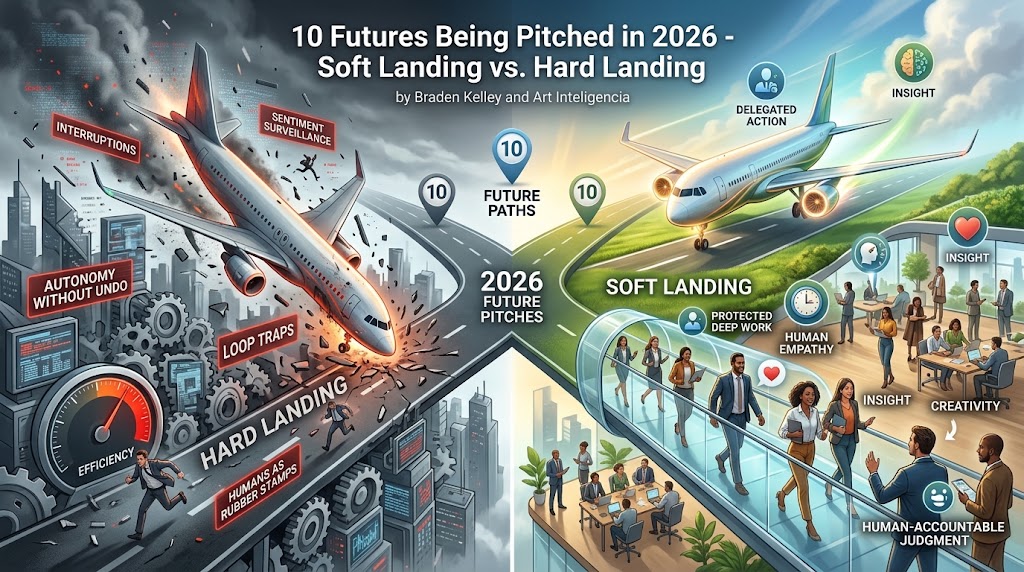
by Braden Kelley and Art Inteligencia
What Is a Soft Landing vs a Hard Landing? (Short Answer)
A hard landing is a future where technology does more of everything — including the human parts of work — and people are left with leftovers, interruptions, and less agency. A soft landing is a future where machines absorb fragmentation and low-judgment transaction so humans can spend larger blocks of time on insight, empathy, decision making, direction setting, problem definition, creativity, and collaboration.
Ten futures being pitched in 2026: the agentic enterprise, the end of busywork, hyper-personalization, autonomous customer service, experience-led management (XLAs), adaptive environments, AI-native innovation, post-survey listening, the civic scoreboard, and human–AI collaboration as the default job. Each pitch has both landings. Soft landings are designed. Hard landings arrive when efficiency is the only value on the dashboard.
The Pitch Is Not the Landing
Futurology has a bad habit: it sells the vehicle and skips the runway. 2026 is loud with promised futures — agents that act, workdays without busywork, rooms that adapt, governments you can finally compare. None of that is destiny. The same capability can make people more human or less human. The difference is design: whose attention is protected, whose interest is optimized, and whether someone can undo what the system just did in their name.
| Future being pitched | Hard landing | Soft landing |
|---|---|---|
| 1. Agentic enterprise | Autonomy without undo | Delegated action with trust |
| 2. End of busywork | Denser interruptions | Protected deep work |
| 3. Hyper-personalization | Surveillance | Memory that serves the person |
| 4. Autonomous service | Loop traps, no escalation | AI for routine; humans for exception |
| 5. Experience-led management | Paper XLAs | Red experience can stop a green SLA |
| 6. Adaptive environments | Nervous system as funnel | Adaptive hospitality |
| 7. AI-native innovation | Theater at higher RPM | Faster learning with kill criteria |
| 8. Post-survey listening | Sentiment surveillance | Dialogue + closed loops |
| 9. Civic scoreboard | Weaponized rankings | Fair peer comparison, local ownership |
| 10. Hybrid jobs | Humans as rubber stamps | Human-accountable judgment |
1. The Agentic Enterprise
The pitch: AI agents that act — refund, reschedule, route, orchestrate — not merely chat. Work moves from answers to delegated action.
Hard landing: Systems with authority and no undo. Opaque decisions optimized for the brand. Customers trapped; employees inheriting messes they cannot explain. Autonomy without a trust contract.
Soft landing: Delegated action with clarity (when AI is acting), competence (finish the job, keep context), control (override, reach a human), and care (optimize for the person’s stated goal). The agent is hospitality with a spine, not a cheaper maze.
2. The End of Busywork
The pitch: AI absorbs task switching — draft, search, summarize, schedule, classify — so calendars open for strategy.
Hard landing: Ten minutes saved, ten interruptions poured back in. People become faster transaction machines. Motion still impersonates progress; the day is denser, not deeper.
Soft landing: Glue work automated; judgment kept human. Deep-work blocks protected as policy, not privilege. The question is not “how much faster?” It is “what human capability do we want more of now?”
3. Hyper-Personalization at Scale
The pitch: Every journey remembers you. The brand that knows your name — and your next need — wins.
Hard landing: Surveillance with a smile. Memory that ignores consent. Recommendations that steer toward what is easiest to sell. Remembering everything except dignity.
Soft landing: Memory in service of the person’s stated goal. Explanation, minimization, opt-out. Personalization that feels like being recognized, not managed.
4. Autonomous Customer Service
The pitch: Most routine issues resolved without a human. Containment looks like a cost miracle.
Hard landing: Loop traps, lost context, blocked escalation. Two or three failed attempts and the customer switches. “Self-service” that is really forced service.
Soft landing: AI handles multi-step routine work. Humans take complexity, emotion, and exception — with context intact. Resolution and recoverability beat deflection as the definition of winning.
5. Experience-Led Management (XLAs over SLAs)
The pitch: Stop managing only by uptime. Measure whether humans succeeded — then commit to it.
Hard landing: Paper XLAs. Beautiful language, same SLA incentives. A green dashboard still closes the review while people quietly fail the job.
Soft landing: Experience Level Measures with owners. A red human-success score can stop a “healthy” service review. SLAs keep the lights on; XLAs steer.
6. Adaptive / Ambient Environments
The pitch: Spaces that sense occupancy, mood, and need — lighting, sound, flow that shift with you.
Hard landing: The nervous system treated as a conversion funnel. Adaptation without consent. Comfort used to extract attention and spend.
Soft landing: Adaptive hospitality — accessibility, cognitive rest, dignity. Environments that notice people and adjust so they can do the human job they came to do.
7. AI-Native Innovation
The pitch: Faster ideation, prototypes, and insight at machine speed. Innovation becomes a default capability, not a lab.
Hard landing: Innovation theater at higher RPM. Idea cemeteries with better graphics. More pilots, same inability to scale or kill.
Soft landing: Faster learning loops tied to sponsors, kill criteria, and adopted human outcomes. Speed in service of contact with reality — not a denser costume.
8. The Post-Survey Listening Future
The pitch: Conversational and agentic voice of the customer replaces forms nobody fills out. Feedback becomes dialogue.
Hard landing: Always-on sentiment surveillance. Insight that never funds action. Customers talked about, still not heard.
Soft landing: Dialogue with consent. Closed loops people can feel. Listening that changes the work — hear, understand, act, confirm — not a new dashboard for the old inaction.
9. The Civic Scoreboard
The pitch: AI makes public value comparable — peer-relative outcomes per dollar, local scoreboards citizens can actually use.
Hard landing: Weaponized rankings. Fog replaced by partisan dashboards. Performance gaps smeared as crimes; methods too opaque to challenge.
Soft landing: Human-centered civic instruments — primary sources, transparent methods, local ownership. Performance, structure, and integrity kept on separate panels so accountability can survive scrutiny.
10. Human–AI Collaboration as the Default Job
The pitch: Every role becomes hybrid. Agents as coworkers. The intelligent enterprise as the new normal.
Hard landing: Role anxiety with no redesign. Humans as rubber stamps for the model. Unowned decisions. Managers still coordinating tasks while judgment goes untrained and unrewarded.
Soft landing: Jobs redesigned around what stays human-accountable. Managers develop people’s judgment. Hybrid work has a contract: what the machine may do, what a person must own, and how you recover when the collaboration fails.
How Do You Choose a Soft Landing for a 2026 Future Pitch?
Before you buy the story — vendor, board slide, or internal moonshot — run the landing, not the brochure:
- Whose attention gets protected if this works — or does every efficiency get refilled with noise?
- Whose interest is optimized — the human in the journey, or the cost curve?
- What can be undone — and how does a person reach a human without being punished?
- What human endeavor grows — insight, empathy, problem definition, collaboration — if the machine takes the glue?
- What would the hard landing look like — and who would feel it first?
The future is not what gets pitched. It is what you design the landing to be. 2026 will not run out of stories. It will run out of leaders willing to specify the human outcome before they fund the machine.
Frequently Asked Questions
What is the difference between an AI soft landing and a hard landing?
A hard landing is when technology does more of everything, including human work, leaving people with interruptions and less agency. A soft landing is when machines absorb fragmented, low-judgment tasks so humans can spend more time on insight, empathy, decisions, direction, problem definition, creativity, and collaboration. Soft landings are designed; hard landings follow when efficiency is the only goal.
What futures are being pitched in 2026?
Ten prominent pitches are the agentic enterprise, the end of busywork, hyper-personalization at scale, autonomous customer service, experience-led management with XLAs, adaptive environments, AI-native innovation, post-survey conversational listening, civic AI scoreboards, and human–AI collaboration as the default job. Each can land as more human or less human depending on design.
How do you choose a soft landing for AI and future-of-work bets?
Ask whose attention is protected, whose interest is optimized, what can be undone, which human endeavors will grow, and who would feel a hard landing first. Fund the human operating model — owners, consent, recovery, and incentives — not only the capability demo.
Is a soft landing the same as slowing down AI adoption?
No. A soft landing can move quickly on glue work — drafting, routing, summarizing, classifying — while going slower on authority, personalization, and decisions that require dignity and accountability. Speed without a human contract is usually a hard landing with better branding.
What should leaders do before buying a 2026 future-of-work pitch?
Name the hard landing in human terms, specify the soft landing in behaviors and decision rights, and refuse to fund a pitch that cannot say who is protected, who is optimized, and how failure is reversed. The brochure is not the runway.
Image credits: Google Gemini
Content Authenticity Statement: The topic area, key elements to focus on, etc. were decisions made by Braden Kelley, with a little help from Google Gemini and Cursor to clean up the article, add images and create infographics.
 Sign up here to get Human-Centered Change & Innovation Weekly delivered to your inbox every week.