Category Archives: Leadership

5 Scenarios for Agentic Organizations

And What Leaders Must Own in Each

5 Scenarios for Agentic Organizations

by Braden Kelley and Chateau G Pato


What Must Leaders Own in Agentic Organizations? (Short Answer)

Five scenarios for agentic organizations — and what leaders must own in each: (1) Agentic Front Door — customer-acting agents; leaders own consent, undo, escalation, and brand accountability. (2) Agentic Operating Model — work-orchestrating agents; leaders own fairness, EX, and who gets meaningful work. (3) Agentic Decision Systems — agents that approve or choose within policy; leaders own decision rights, undo, and who can be asked why. (4) Agentic Innovation & Change — agents that accelerate experiments; leaders own problem framing, kill criteria, and adoption. (5) Agentic Ecosystem — agents that act across vendors and partners; leaders own seam promises, liability, and recovery across the handoff.

An agentic organization authorizes AI systems to act — route, refund, rebook, assign, escalate, negotiate, trigger workflows — not only to chat or recommend. Autonomy for the model is not a strategy. Ownership for the human who can still be held to account is.

Why Don’t Agents Automate Ownership?

I have watched rooms celebrate “agentic” the way they once celebrated sticky notes and digital transformation: as if naming the technology were the same as designing the landing.

Agents that act are a different animal from chatbots that reply. They refund. They rebook. They assign work. They approve inside a band. They negotiate across a seam. That is not a UX upgrade. It is a transfer of authority — and authority without designed ownership is a hard landing waiting for a Tuesday.

Soft landings are designed. In every agentic scenario, something remains non-delegable: consent, mandate, accountability, fairness, and the promise the brand will still keep when the agent gets it wrong.

Scenario Agents do Leaders must own
1. Agentic Front Door Act for customers (refund, rebook, route) Consent, undo, escalation, brand accountability
2. Agentic Operating Model Orchestrate internal work Fairness, EX, judgment time, meaningful work
3. Agentic Decision Systems Approve or choose inside policy bands Decision rights, why on Tuesday, undo/appeal
4. Agentic Innovation & Change Accelerate drafts, demos, pilots Problem frame, kill criteria, adoption owners
5. Agentic Ecosystem Act across vendors and partners Seam ownership, liability, cross-entity recovery

1. What Must Leaders Own in an Agentic Front Door Scenario?

The scenario: The primary customer path is an agent that does — refund, reschedule, rebook, update, route — not a FAQ that chats. Multi-step journey work moves at machine speed.

Agents do: Execute customer intent across systems without waiting for a ticket to crawl through three departments.

Hard landing: Autonomy without consent, undo, or human handoff. Containment becomes the KPI. The brand is optimized; dignity is optional. Customers are trapped in loops that photograph well in the steering committee.

Leaders must own: Clarity of what the agent may do; competence thresholds before it acts; customer control to stop, reverse, and escalate; care at the moment of failure; a named human recovery path. Soft landing is delegated action with a trust contract — not a cheaper call-center costume. For the customer trust design behind this scenario, see When AI Agents Act on Your Behalf: Designing Agentic Customer Experience That Earns Trust.

2. What Must Leaders Own When Agents Orchestrate the Operating Model?

The scenario: Internal work is assigned, scheduled, triaged, and progressed by agents across tickets, cases, and handoffs. Glue shrinks. Throughput rises. The calendar looks free — until it does not.

Agents do: Route, prioritize, draft, chase, and assemble the next step so humans spend fewer hours on fragmentation.

Hard landing: Humans become faster exception handlers. Saved minutes refill with denser interruptions. “Efficiency” strips judgment time and frontline agency. People become the leftover of automation — not the point of it.

Leaders must own: What work agents absorb versus what humans keep; protected contiguous time for judgment; employee experience as a design constraint, not a wellness poster; fairness in routing (who gets the grind, who gets growth); metrics that name human success, not only cycle-time vanity. Soft landing means glue automated, meaning kept. For the designed split of human versus machine work, read The AI Soft Landing.

3. What Must Leaders Own in Agentic Decision Systems?

The scenario: Agents approve, deny, price, allocate, or recommend within policy bands — finance, risk, access, offers, exceptions. High-volume choices move without a meeting. Edge cases escalate — in theory.

Agents do: Decide inside declared rules at a speed no committee can match.

Hard landing: Humans as rubber stamps. Unowned model choices. “The system decided” as a career-safe shrug. No undo when the band was wrong — and nobody left who can be asked why on Tuesday.

Leaders must own: Explicit decision rights (what the agent may decide alone); auditability so a human can reconstruct the choice; undo and appeal; a named person accountable for outcomes, not only for “the model’s accuracy”; the mandate to narrow or widen the band when reality contradicts the policy. Soft landing is speed with someone who can still be held to account.

4. What Must Leaders Own When Agents Accelerate Innovation and Change?

The scenario: Agents draft personas, roadmaps, prototypes, pilots, and change artifacts before lunch. Innovation velocity looks historic. The room fills with demos.

Agents do: Generate options, simulate, document, and accelerate demo day until the portfolio looks busy.

Hard landing: Faster wrong. Synthetic empathy. Pilots without mandate. Adoption theater. Innovation cosplay at higher RPM — more output, less impact that lands on Tuesday.

Leaders must own: Problem framing before acceleration; match of method to decision rights; behavior falsification (not applause demos); kill criteria with social permission to stop; adoption owners after the markers dry. Soft landing means agents own the draft; humans own the design and the landing. For habits that protect this ownership, see 9 Habits of Human-Centered Innovators That Still Matter in the Age of AI.

5. What Must Leaders Own in an Agentic Ecosystem Scenario?

The scenario: Agents representing the company, customer, and partners negotiate, book, fulfill, and escalate across organizational boundaries. Email chains and war rooms shrink. Multi-entity orchestration becomes normal.

Agents do: Cross the seam that used to require humans with calendars, contracts, and courage.

Hard landing: Orphan seams. “Not our agent” blame. Liability that lives nowhere. A brand promise broken between two green systems — each vendor’s SLA fine, the customer’s Tuesday ruined.

Leaders must own: Who owns the seam when agents disagree; contractual and ethical boundaries for partner agents; recovery power that spans entities; customer-visible accountability when the multi-agent path fails; stop conditions when optimization conflicts with dignity. Soft landing is multi-agent speed with a single human promise that still holds.

How Do Leaders Check Ownership Before an Agentic Investment?

Before the next agentic program, run five go/no-go questions. If you cannot answer them, you are buying autonomy without a landing:

  1. Where will the agent act — not only chat or recommend?
  2. Who owns consent, undo, and escalation in that scenario?
  3. What human work are we freeing — and what contiguous time will we protect for judgment?
  4. Who can be asked why when the agent chooses?
  5. Who owns the seam when agents cross teams or partners?

For the work humans should keep when glue shrinks, see 11 Human Endeavors AI Should Free (Not Replace). For how the agentic enterprise pitch lands soft or hard, read 10 Futures Being Pitched in 2026 — Soft Landing vs Hard Landing. For signals you are preparing for the wrong future, use 8 Signals You’re Preparing for the Wrong Future of Work.

Agents can own the action. Leaders own the landing — consent, mandate, accountability, fairness, and the promise after failure.

Frequently Asked Questions

What is an agentic organization?

An agentic organization authorizes AI systems to act — route, refund, rebook, assign, escalate, negotiate, and trigger workflows — not only to chat or recommend. It is an operating model with non-human actors holding authority, which makes designed human ownership of consent, mandate, accountability, and recovery essential.

What must leaders own in an agentic enterprise?

Leaders must own what agents cannot: consent, undo, and escalation at the front door; fairness and judgment time in the operating model; decision rights and accountability when agents choose; problem framing, kill criteria, and adoption in innovation; and seam ownership, liability, and recovery when agents act across partners.

What are scenarios for agentic AI in organizations?

Five common scenarios: agentic front door (customer-acting agents), agentic operating model (work orchestration), agentic decision systems (approvals inside policy bands), agentic innovation and change (accelerated bets and artifacts), and agentic ecosystem (cross-vendor and partner action). Each needs a different leadership ownership list.

How do you avoid a hard landing with AI agents?

Design the landing before you scale autonomy. Name where agents will act, who owns consent and undo, what human work you are freeing and protecting, who can be asked why when the agent chooses, and who owns the seam across teams or partners. Autonomy without ownership is a hard landing on Tuesday.

What is the difference between agentic CX and an agentic organization?

Agentic CX focuses on customer-facing agents that act on a customer’s behalf — and the trust contract of clarity, competence, control, and care. An agentic organization is broader: agents also orchestrate internal work, decide inside policy, accelerate innovation, and act across partner ecosystems. CX is one scenario; the organization has five places where leaders must own the landing.

Image credits: Cursor

Content Authenticity Statement: The topic area, key elements to focus on, etc. were decisions made by Braden Kelley, with a little help from Google Gemini and Cursor to clean up the article, add images and create infographics.

Subscribe to Human-Centered Change & Innovation WeeklySign up here to get Human-Centered Change & Innovation Weekly delivered to your inbox every week.

Winning with Artificial Intelligence in 90 Days

Winning with Artificial Intelligence in 90 Days

Exclusive Interview with Charlene Li

The rapid evolution of artificial intelligence (AI) has shifted the technology from a futuristic curiosity to the primary engine of modern organizational growth. In an era defined by data-driven decision-making, the ability to effectively harness machine learning and predictive analytics is no longer just a competitive advantage; it is a fundamental requirement for long-term viability. However, the path to integration is rarely linear. Many organizations find themselves caught between the urgent need for transformation and the daunting reality of legacy infrastructure, talent shortages, and the cultural shifts required to move beyond small-scale pilots toward true enterprise-wide intelligence.

While the potential for increased efficiency and innovation is clear, the execution remains a significant hurdle.

The organizations that thrive in this new landscape are those that treat AI as a core strategic pillar rather than a plug-and-play software update. This requires a rethink of how human talent and machine intelligence coexist, ensuring that the technology enhances human capability rather than simply automating existing inefficiencies. Overcoming these challenges involves not just technical prowess, but a disciplined approach to change management and a clear vision for how intelligence will redefine the value the organization provides to its customers.

Today we will dive deep into what it takes to quickly achieve success with artificial intelligence with our special guest.

Creating a 90-Day Blueprint to Win with Artificial Intelligence

Charlene LiI recently had the opportunity to interview Charlene Li, a New York Times bestselling author, keynote speaker, and AI transformation strategist. Her latest book, Winning with AI: The 90-Day Blueprint for Success, co-authored with Dr. Katia Walsh, gives senior leaders a practical framework for moving from AI experimentation to measurable business value. Her prior books include The Disruption Mindset, Open Leadership, and Groundswell. Fast Company named her one of the most creative people in business, and she has worked with global organizations including 14 of the Dow Jones Industrial 30 companies. She is the founder of Altimeter Group (acquired by Prophet) and currently leads Quantum Networks Group.

Below is the text of my interview with Charlene and a preview of the kinds of insights you’ll find in Winning with AI: The 90-Day Blueprint for Success presented in a Q&A format:

1. What confusion is being created by speaking of “AI” as one thing when there are different kinds of AI, and how does this hold back AI adoption?

When people say “AI,” they’re usually thinking ChatGPT. But ChatGPT is generative AI — and that’s just one of three types of AI showing up in business today. There’s also predictive AI, which has been quietly running in your CRM, your fraud detection, and your streaming recommendations for years. And there’s agentic AI, which takes autonomous action toward a goal rather than waiting for a prompt.

The Oracle (predictive), the Creator (generative), and the Agent (agentic) — that’s how Katia and I describe them in Winning with AI. They do fundamentally different things, and they require fundamentally different things from you.

The conflation matters because it leads to bad decisions. Leaders see a generative AI demo, get excited, and ask their teams to “do something with AI” — when the actual business problem might be better solved with predictive AI (and probably already could’ve been three years ago). Or they hear “agentic AI” and assume their organization is ready to deploy autonomous agents when they haven’t even gotten generative AI into their workforce yet.

The winners aren’t choosing among types — they’re using all three strategically, in combination. A customer care transformation might use predictive AI to route inquiries, generative AI to draft responses, and agentic AI to handle routine cases autonomously. Once you can see the three distinctly, the question stops being “what can I do with AI?” and starts being “what can AI do for me?” That’s the question that actually unlocks value.

2. What are some of the key characteristics of AI inertia and some of the best ways to break free?

We call it pilot purgatory — and almost every organization we work with is stuck there. The signs are easy to spot: dozens of disconnected pilots, lots of conference attendance, lots of slide decks, no measurable financial impact. An MIT study found 95% of AI initiatives fail to scale. That’s not a technology failure. It’s a failure of leadership and culture.

The classic characteristics:

    • Use cases as a strategy. Many use cases equals procrastination. A long list of pilots is how organizations look busy without committing to anything.
    • Diffused accountability. When the CIO, CFO, and CMO all “share” responsibility for AI, no one owns the outcome.
    • Waiting for the foundation to be perfect. Clean data, the right platform, the perfect org structure — these become reasons to delay rather than constraints to solve through.
    • Confusing motion with progress. Running pilots feels like progress. It isn’t, unless those pilots are tied to your most important business problems.

To break free: pick your biggest strategic problems, figure out how AI solves them, invest heavily in those solutions, and move with urgency. Appoint one AI value owner who lives, breathes, and dreams AI outcomes. Kill pilots that aren’t on a path to scale. And replace “fail fast” with “learn fast” — nobody actually rewards failure, and the language of failure lets people walk away from things that should be pushed through.
Speed is the new moat. The companies that win aren’t the ones with the best technology. They’re the ones that adapt faster than their competitors.

3. There are still a lot of people out there not using AI (or not realizing that they are). What are some of the best ways for people to get started with AI?

Most people are already using AI — every spam filter, every Google Maps route, every recommendation on a streaming service is AI. So the real question is: how do you get started with the kind of AI that’s reshaping work right now, which is generative AI?

My advice is genuinely simple. Pick one of the major tools — Claude, ChatGPT, Gemini, Copilot — and start using it for one real task you do every week. Not a toy task. A real one. Drafting an email. Prepping for a meeting. Summarizing a long document. Brainstorming an approach to a problem you’re stuck on.

Two practical tips that make a big difference:

Write better prompts. A good prompt has a role (“Act as a marketing strategist”), instructions (what you want done), context (the background the AI needs), and an output format (memo, table, slide outline). Then refine through dialogue. Most people give AI two sentences and judge it on the result. Give it two paragraphs and you’ll be amazed.

Try the flipped interaction. Instead of asking AI for an answer, ask it to ask you questions until it has enough context to give a good answer. For example, at the end of a prompt, add this sentence: “Ask me any clarifying questions you may have.” It turns your prompt into a conversation.

I think of AI fluency as learning to eat with chopsticks: at first you’re concentrating on every motion, and eventually it’s just how you eat. You won’t get there by reading about it. You get there by using it. Every day. On real work.

4. Does AI safety really matter? It seems like all of the major AI players are just focused on speed and getting to AGI before China, am I wrong?

You’re not wrong about what the AI players are doing. But you’re probably not playing that game – more on that below. First, I’d push back on the framing that safety and speed are opposites.

Think of Formula 1. The drivers who win championships have absolute confidence in their brakes, their crash structures, their fire suppression systems. That’s why they can push so hard on speed. Safety is what makes speed possible. The companies moving fastest on AI adoption aren’t the ones cutting corners on responsibility — they’re the ones with the highest ethical standards, because trust eliminates friction. When your team knows where the guardrails are, when your customers trust your intentions, when your board has confidence in your approach, you can move at the speed AI demands.

The 2024 Edelman Trust Barometer found that 43% of people would reject AI in products and services if they don’t believe the innovation has been thoroughly scrutinized. That’s not a PR problem — it’s a revenue and competitive position problem.

On the AGI race specifically, the geopolitical framing oversimplifies what’s actually a much more textured conversation about how AI is deployed within companies, governments, and communities. Most leaders I work with aren’t worrying about AGI — they’re worrying about whether their AI customer service tool is treating customers fairly, whether their AI-driven hiring screen is introducing bias, and whether their data is being used in ways customers didn’t consent to. Those are the safety questions that matter for the next five years, regardless of what the frontier players are doing.

5. Where is the government being too hands off with AI and its impacts, and what conversations should governments and societies be having about AI and its impacts that they’re not?

I’ll be careful here because I’m not a policy person — I work with the leaders implementing AI inside organizations. But from that vantage point, a few things stand out.

The conversation we aren’t having enough is about workforce transition. Not “will AI take jobs” — we’ve been arguing about that abstractly for three years. The real question is what happens to the millions of people whose roles will substantially change in the next five years, and who’s responsible for helping them adapt. Right now, that’s mostly being left to individual employers, and the gap between what enlightened employers are doing and what the median employer is doing is enormous. That gap will become a societal problem long before regulators catch up.

The second underdiscussed conversation is about education. We’re training a generation of students with curricula designed for a pre-AI world. By the time we figure out what AI fluency looks like in K–12, the kids who needed it most will be in the workforce.

Third — and this is where I’d actually like to see governments lean in more — is data. Most AI regulation focuses on the models. The leverage is in the data: who owns it, how it can be used, what consent looks like in a world where data collected for one purpose can be repurposed for AI training that wasn’t imagined when it was collected.

That said, regulations always lag technology. Anchoring your responsible and ethical AI policy in your organization’s values rather than waiting for rules is the right move, regardless of what governments do.

6. What are the key pillars that form the basis of a strong AI foundation for those who seek to take full advantage of AI in their organization?

In Winning with AI, Katia and I lay out four building blocks. They develop together, not sequentially.

Mindset — the cultural ability to move at AI’s speed. Speed, focus, customer-centricity, experimentation, and learning from setbacks rather than treating them as evidence that the technology doesn’t work. Without the right mindset, you can have the best tools in the world, and they’ll sit unused.

Skillset — AI fluency across the workforce, not just in IT. Everyone needs to understand what AI can and can’t do, how to use it responsibly, and how to apply it to their actual work.

Toolset — the technical foundation. We tell leaders to build with LEGO, not cathedrals. Modular, interchangeable components you can swap as the technology evolves, sitting on top of data that’s good enough to start with.

Decision-set — the governance and decision-making structures that let you move fast without breaking things. Who decides what, how quickly, with what oversight.

The mistake organizations make is treating these as a sequence — first we’ll fix the data, then we’ll train people, then we’ll deploy. That sequence will take you a decade. The right approach is to build the blocks while delivering value, using each AI application to strengthen multiple blocks at once.

And one piece that wraps all four: leadership. Without active, visible commitment from the top, the four building blocks don’t compound. With it, they accelerate.

7. Of all the outcomes that the different types of AI can achieve, which activities create the most value for organizations?
Winning with AIWe frame the value AI creates in three areas: engagement, efficiencies, and reinvention.

Engagement is about deepening relationships with customers and employees through personalization, prediction, and proactive service. Anticipating what someone needs before they articulate it.

Efficiencies are about doing what you already do, faster and cheaper. This is where most organizations start — and where most get stuck. Efficiency gains are real, but they’re easy for competitors to replicate, which means they don’t create lasting advantage.

Reinvention is the most transformational and the most uncomfortable. It’s not asking “how can we do what we do faster?” — it’s asking “what becomes possible now that the old constraints are gone?” New business models. New revenue streams. New markets that were never economical before.

The trap is thinking efficiency is AI’s value. We call it the efficiency trap. Companies that limit themselves to efficiency are using a strategic weapon as a cost-cutting tool. The real competitive advantage comes from engagement and reinvention.

A great example: Coursera. Translation used to cost about $10,000 per course, which made global expansion economically impossible at the scale of their 5,000+ course catalog. Generative AI eliminated that constraint overnight. CEO Jeff Maggioncalda saw it immediately and launched Project Genesis by the end of 2022. That’s reinvention — AI removing a constraint that defined the business model.

If I had to pick one activity that creates the most value, it would be: using AI to remove a constraint that has shaped your industry’s economics for so long that nobody questions it anymore.

8. There was a lot of talk for a while about becoming an AI-first organization. Is this something that companies should be trying to do?

No. Be AI-ready instead.

“AI-first” is a technology company’s framing. It puts the technology in the driver’s seat, which sounds visionary but in practice produces dozens of disconnected pilots with no strategic impact. You end up chasing AI because it’s shiny rather than because it solves a real problem.

“AI-ready” is a business leader’s framing. It puts strategy in the driver’s seat. You’re building the culture, the skills, the decision systems, and the technical foundation that let AI create real value against the strategic priorities you already have.

Said simply: AI-first is a technology mindset. AI-ready is a business mindset.

You don’t actually need an AI strategy. You need a business strategy that uses AI. Anyone selling you on an AI strategy is selling you the wrong thing.

9. What should people be doing as individuals to maintain their value to their organizations and to grow their careers?

Three things, in order.

One: develop genuine AI fluency. Not “I’ve used ChatGPT a few times” fluency. Real fluency — the kind where AI is woven into how you think, prepare, decide, and communicate. The people and organizations who get to AI fluence in 2026 will pull dramatically ahead of those who don’t, and the gap will be very hard to close once it opens.

Two: deepen what’s uniquely human. AI can amplify cognition at speeds and scales no individual can match. What it can’t do is exercise empathy, self-reflection, intuition, judgment, and wisdom. These five traits — the foundation of what Katia and I call “superhumans” in the book — become more valuable, not less, as AI handles more of the cognitive work. The leaders who pair AI’s reach with these distinctly human capacities are the ones creating the most value.

Three: build a lifelong learning practice. The shelf life of any specific skill is shrinking. The skill that doesn’t depreciate is the ability to learn — quickly, repeatedly, with intellectual humility. Normalize not knowing. Embed reflection into how you work. Treat curiosity as a professional asset, not a side hobby.

If you do those three things, you’ll be more valuable in the future than you are today, regardless of what happens to your specific role.

10. What have organizations gotten wrong about rolling out AI and what can the early adopters do to recover from botched initial rollouts?

The biggest things organizations get wrong:

  • Treating AI as a technology project. It’s a business initiative for value creation that happens to use technology. When IT owns it, it stays small.
  • Use cases instead of strategy. A laundry list of pilots is procrastination dressed up as progress.
  • Diffused accountability. Without a single AI value owner, the work fragments.
  • Skipping the people work. Throwing tools at employees without addressing the fear underneath. Until fear is replaced by trust, no amount of training will change behavior.

If you’ve already botched the rollout, here’s the recovery path:

Stop and audit. What’s actually scaling, what’s not, what’s draining resources without producing value? Be honest. Sunset the dead ends.

Appoint one accountable AI leader. If no single person is accountable for AI value creation across the enterprise, fix that this quarter. Not part-time, not committee-led — one person whose performance is measured on the value that AI creates.

Pick one strategically meaningful problem and go after it. Not the easiest problem. The one whose solution would matter most to the business.

Learn from Ally Bank. When generative AI emerged, Ally’s CIO Sathish Muthukrishnan deliberately chose the most resistant audience — customer service agents — and a low-stakes problem: summarizing customer calls. The result was so valuable that the agents who’d been most skeptical became the loudest advocates: “Don’t take this away from me.” Targeting the skeptics with a real win is one of the most powerful change strategies we’ve seen.

A botched rollout isn’t a death sentence. It’s actually a useful clearing of the underbrush — assuming you learn from it.

11. Several studies have come out recently about the negative effects of AI on human cognition. Any tips for how to best use AI without degrading your brain?

This is a real concern and worth taking seriously. The risk isn’t AI itself — it’s lazy AI use. Using AI to skip thinking rather than to enhance it.

A few habits I’ve found useful:

Think first, then prompt. Before going to AI for an answer, write down what you think. Coursera’s Jeff Maggioncalda calls this cognitive bootstrapping — write your perspective on a decision, then ask AI to challenge it: “What are the strengths and weaknesses of this view? What are my blind spots? What would you recommend I improve?” AI sharpens your thinking instead of replacing it.

Treat AI outputs as drafts, not deliverables. Read critically. Push back. Ask why. Verify facts. The moment you stop questioning AI’s outputs is the moment your thinking starts to atrophy.

Protect deep work. Schedule time for thinking that doesn’t involve AI at all. Reading, writing, reflecting, walking — the unstructured time where your brain consolidates what it knows. AI can compress research, but it can’t compress wisdom. That still has to come from lived experience, integrated over time.

Notice the difference between using AI to accelerate something you understand and using AI to substitute for understanding. Acceleration is healthy. Substitution erodes you.

The promise of AI isn’t to do our thinking for us. It’s to help us think better. The discipline is staying on the right side of that line.

12. Any question you wish I had asked but didn’t?

Yes — I’d love a question about the human possibility on the other side of this.

Most AI conversation is about risk, displacement, and disruption. Those are real. But the conversation Katia and I get most excited about is what becomes possible when AI handles the cognitive work that has been depleting people for decades — the synthesis, the routing, the routine analysis — and frees up human capacity for what only humans can do.

We call those people “superhumans” — not because they’re enhanced by technology in some sci-fi sense, but because they finally have the room to be more deeply human. To exercise empathy, self-reflection, intuition, judgment, and wisdom at a level that’s been crowded out by cognitive overload.

The first companies to deliberately develop and organization filled with superhumans won’t just have a competitive advantage. They’ll be creating an entirely new form of value — one we haven’t fully named yet. That’s the future I want leaders thinking about. Not “how do I survive AI?” but “what becomes possible for my people on the other side of this?”

Dream it. Then build it.

Conclusion

Thank you for the great conversation Charlene!

I hope everyone has enjoyed this peek into the mind of one of the women behind the insightful new title Winning with AI: The 90-Day Blueprint for Success!

Image credits: Charlene Li, Pexels

Subscribe to Human-Centered Change & Innovation WeeklySign up here to join 17,000+ leaders getting Human-Centered Change & Innovation Weekly delivered to their inbox every week.


8 Signals You’re Preparing for the Wrong Future of Work

8 Signals You’re Preparing for the Wrong Future of Work

by Braden Kelley and Chateau G Pato


How Do You Know You’re Preparing for the Wrong Future of Work? (Short Answer)

You are preparing for the wrong future of work when your AI and “future of work” investments optimize efficiency and throughput while shrinking human agency, judgment, and contiguous time — and nobody can say what stays human-accountable on Tuesday. Eight signals: headcount math before job design, saved time refilled as denser busyness, agents with mandate and humans with monitoring, volume metrics in a judgment era, prompt training without practice, “keeping up” as strategy, frontline power shrinking while AI slides expand, and a tool stack you can demo but a landing you cannot describe.

The corrective habit is not “move faster on AI.” It is designing the landing — what machines absorb, what stays human-accountable, and whose attention gets protected when the efficiency gains arrive.

The Wrong Future Looks Like Progress

We rehearse the wrong ending when we confuse activity with direction. The board deck shows copilots. The roadmap has agents. Someone declares that “the future of work is here.” And yet the calendar still looks like confetti, the front line still cannot recover a bad moment, and the business case still opens with subtraction before anyone maps what work becomes.

That is not falling behind on technology. That is building a hard landing — machines doing more of everything, including the human parts of work, while people inherit leftovers, interruptions, and less authority. A soft landing, by contrast, protects insight, empathy, decision making, direction, problem definition, creativity, and collaboration. The signals below tell you which landing you are actually buying.

Signal Hard landing Right future
1. Headcount math first Hollow roles; volume competition with the model Map cognitive labor before subtraction
2. Denser busyness More task switching; no deep work Reclaimed time funds depth
3. Agents mandated; humans monitored Loop traps; rubber-stamp people Delegated action with undo and handoff
4. Volume metrics win Faster at the wrong things Dual scorecard: reliability + judgment
5. Prompts, not practice Tool fluency in broken jobs Managers develop judgment on live work
6. Keeping up as strategy Random automation; no coherent landing Name the soft landing you refuse to miss
7. Frontline power shrinks Attrition; failure demand; brand damage Fund authority at the moment of truth
8. Stack demo, no human contract Unowned decisions; no landing owner Division of cognitive labor on one page

1. What Signal Shows You’re Optimizing for Headcount Before Job Design?

The signal: Every AI business case opens with FTE reduction, cost takeout, or “do more with less” — before anyone maps what work becomes, who decides, and what capability must grow.

Why it seduces leaders: Finance understands subtraction. Job redesign sounds slow, political, and annoyingly specific about power.

Hard landing: Humans compete with the model on volume. Roles hollow out. Judgment work never earns protected blocks because nobody was asked to protect it.

Right future: Start with cognitive labor — what machines absorb, what stays human-accountable, what managers must develop. Subtraction may follow. It should not lead.

2. What Happens When Saved Time Becomes Denser Busyness?

The signal: Efficiency gains from AI, automation, or self-service are immediately reinvested as more tickets, more pings, more micro-approvals — not protected deep-work blocks.

Why it seduces leaders: “We’re getting more done.” Utilization dashboards stay green. Motion still masquerades as progress.

Hard landing: Task switching accelerates. Strategic thinking never gets contiguous minutes. Burnout wears a productivity costume.

Right future: Explicit policy: a defined share of reclaimed time funds depth, not density. Calendar design is part of the AI bet — not an afterthought for people who “find time.”

3. Why Is It a Bad Sign When Agents Get Mandate and Humans Get Monitoring?

The signal: Autonomy ships for bots — refund, route, decide — while people get tighter scripts, scorecards, and surveillance, not undo, escalation, or recovery power.

Why it seduces leaders: Agents scale. Humans are framed as “the risk.” Containment metrics improve on slides that never show the trapped customer.

Hard landing: Customers stuck in loops. Employees rubber-stamp the model. Trust erodes on both sides of the glass.

Right future: Clarity, competence, control, care — delegated action with human handoff and authority at the moment of truth. Scale the routine. Protect the exception.

4. How Do Volume Metrics Reveal the Wrong Future of Work?

The signal: Handle time, tickets closed, tokens generated, outputs per hour — still the hero numbers — while insight, quality of decision, and human success stay soft or unmeasured.

Why it seduces leaders: Old scorecards are auditable. Judgment is harder to metricize. Volume is easy to put on a quarterly review.

Hard landing: People optimize what gets measured. The organization gets faster at the wrong things — including automating work that should have stayed human.

Right future: A dual scorecard — reliability plus human success. A few judgment metrics with owners. Experience-led management applied to work itself, not only customer journeys.

5. Why Does Prompt Training Without Practice Signal the Wrong Future?

The signal: Future-of-work readiness equals tool training, certification, and prompt libraries — not spaced practice on real work, manager coaching, or redesigned workflows where the new way is the easy way.

Why it seduces leaders: Training is procurable, completable, and reportable. You can count completions. You cannot count Tuesday.

Hard landing: Prompt-fluent people in broken jobs. Capability theater. Adoption without transformation.

Right future: Managers as developers of judgment. Practice on live work. Enablement tied to decision rights — not a badge for attending the copilot webinar.

6. What Does It Mean When “Future of Work” Means Keeping Up?

The signal: Strategy is reactive — vendor roadmaps, competitor panic, “we need an AI strategy by Q3” — with no articulation of whose attention gets protected or what human endeavor should grow if this works.

Why it seduces leaders: Urgency feels like leadership. Naming tradeoffs feels like delay. “We’re not falling behind” is a comforting story.

Hard landing: Random automation. No coherent landing. Every team improvises a different future while the operating model stays frozen.

Right future: Foresight with constraints — name the soft landing, the hard landing you refuse, and who owns the design. The future is not what gets pitched. It is what you design the landing to be.

7. Why Is Shrinking Frontline Power While AI Slides Expand a Warning Sign?

The signal: Customer-facing and operational roles lose staffing, recovery budget, and decision authority — while executive decks celebrate “AI-powered experience” and agentic service.

Why it seduces leaders: Automation is cheaper at the point of contact. Slides scale faster than enablement. Containment looks like efficiency until the humans leave.

Hard landing: I know what they deserve; I am not allowed to deliver it. Regrettable attrition. Failure demand. Brand damage that no agent can recover because recovery power was the first thing cut.

Right future: Fund authority where the moment of truth lives. Agents handle routine multi-step work. Humans own exception, dignity, and the judgment call that saves the relationship.

8. What If You Can Demo the Stack but Not Name What Stays Human?

The signal: Leaders can walk through copilots, agents, and platforms — but stumble when asked: What decisions must remain human-accountable? What gets undone? What would a hard landing feel like for employees first?

Why it seduces leaders: Demos photograph well. Philosophy sounds like foot-dragging. Procurement has a date.

Hard landing: Unowned decisions. Humans as exception handlers for the model. No one responsible for the landing after the pilot party.

Right future: Before the next pilot — division of cognitive labor on one page, a review date, and a named owner after go-live. If you cannot describe the landing, you are not ready to buy the stack.

How Should Leaders Test Future-of-Work Readiness?

Before the next AI or “ways of working” investment, run five go/no-go questions. If you cannot answer them, you are building a hard landing while calling it transformation:

  1. Whose contiguous time are we protecting — and what policy enforces that?
  2. What metric still punishes judgment — and who owns changing it?
  3. What can an employee or customer undo when the system gets it wrong?
  4. What frontline power are we funding, not only automating?
  5. What human endeavor grows if this works — and who owns that outcome on Tuesday?

If you want the designed alternative spelled out, read The AI Soft Landing — and for ten futures being sold right now, each with a hard and human-centered landing, see 10 Futures in 2026: Soft Landing vs Hard Landing.

The wrong future of work is not falling behind. It is building a hard landing while calling it transformation. Spot the signals early, and you still have time to design a future where work gets more human — not less.

Frequently Asked Questions

What is the wrong future of work?

The wrong future of work is one where efficiency and throughput are the only values on the dashboard — AI and automation absorb more of the human parts of work, saved time becomes denser busyness, and people lose agency, judgment, and contiguous time. It is a hard landing disguised as progress.

How do you know if your AI strategy is wrong?

Warning signs include business cases that start with headcount reduction before job redesign, agents with autonomy while humans get tighter monitoring, volume metrics that still dominate, and leaders who can demo tools but cannot name what stays human-accountable or what can be undone when the system fails.

What is the difference between a soft landing and hard landing at work?

A hard landing gives machines more of everything — including tasks that require judgment — and leaves people with leftovers and interruptions. A soft landing deliberately automates fragmentation and low-judgment transaction so humans can spend larger blocks on insight, empathy, decision making, creativity, and collaboration.

Why does AI sometimes make work worse?

AI makes work worse when efficiency gains are reinvested as more tickets and pings instead of protected deep work, when roles are hollowed out without redesign, when frontline recovery power shrinks, and when organizations measure volume instead of judgment. The tool works; the landing was never designed.

How should leaders prepare for the future of work?

Leaders should map cognitive labor before subtraction, protect reclaimed time for depth, give agents delegated action with human undo and escalation, align metrics with judgment, fund frontline authority, and name the soft landing they want — with a division of cognitive labor, review date, and owner after go-live.

Image credits: Google Gemini

Content Authenticity Statement: The topic area, key elements to focus on, etc. were decisions made by Braden Kelley, with a little help from Google Gemini and Cursor to clean up the article, add images and create infographics.

Subscribe to Human-Centered Change & Innovation WeeklySign up here to get Human-Centered Change & Innovation Weekly delivered to your inbox every week.

The Trapped Value Playbook

Creating and Closing Multi-million Dollar Deals

Trapped Value PLaybook

GUEST POST from Geoffrey A. Moore


Dear Readers,

I want to forewarn you that this article is quite long. For those of you who prefer delving into it at your leisure, I’ve arranged for a downloadable version. Happy reading, and I look forward to your insights and discussions in the comments section.

The Concept

Most ROI comes from productivity improvements, and most productivity improvements come from releasing trapped value. The reason is simple. All systems trap value all the time, the only question is, where is it getting trapped today? That is, systems are implemented to help make people more productive than they were, and they do so with varying degrees of success. But to whatever degree that success has been achieved, that simply resets the bar. The old bottlenecks have been addressed, but that just surfaces the new bottlenecks. There is no such thing as a system with no bottlenecks (see Second Law of Thermodynamics 😉), so there is always the opportunity to release trapped value.

Let me give some examples:

  • On a macro scale, much of the trapped value that IT released in the 1980s and 1990s was in the supply chain. The technology that broke through the bottlenecks of communication and coordination included ERP systems for global commerce, the internet for global communications, and client-server infrastructure for standardized universal enablement.
  • In the 2000s attention shifted from the supply chain to the delivery chain with a focus on consumer markets, and especially those that dealt in services and digital goods. Here traditional media, broadcast advertising, and retail distribution, as powerful as they all were, represented massive waste as well as lost opportunity because they could not close the loop with the prospect nor serve them in the moment they were ready to transact. Smart mobile devices, cloud computing, machine learning, predictive analytics, real-time transaction processing, and home delivery were able to close this loop and thereby transform whole swaths of the consumer economy.
  • In the current era, at the macro level, the trapped value of highest priority has shifted back to enterprise markets, in particular those that require professional engagement to deliver products, sales, services, and customer success. Here generative AI and data amalgamation look to be game-changing resources, the former enabling untrained users to interact directly with the most sophisticated IT systems available, the latter feeding those systems with an ever-broadening stream of real-time data and transaction history. The trapped value to be released is tied to the current lack of user empowerment in the moment of engagement. That is, while predictive AI has for some time been able to come up with the right answers, most professionals are unable to access that help in real-time; and while ML and AI could be fed some of the data it craves, much more was trapped in data silos and thus not available in any timely manner. As a consequence, although we have had business intelligence for some time, we have largely been unable to translate it into operational intelligence in a scaled way.

There is one final point to make at the macro level before we transition to major account selling. How does releasing trapped value translate into customer return on investment, and how does that in turn help vendors set a good price? Here’s the deal. If you help your customer release a dollar of trapped value, they are happy to give you a dime. If you ask for fifteen cents, they hesitate, if you ask for twenty cents, they begin to think you’re gouging. So, let’s use ten percent to set our sights if for no other reason than it makes the math easier. The equation is simple. You want a million-dollar deal? Find a way to release ten million dollars of trapped value. You want a ten-million-dollar deal? Find a way to release a hundred million dollars worth. You want a hundred-million-dollar deal? Find a way to release one billion dollars in trapped value. Yes, these are very large numbers, but the larger the target enterprise, the more plausible they become, so this playbook is directed toward the Global 2000 and the public sector, two places where billions of dollars of trapped value are commonplace.

Creating the multi-million-dollar deal

So much for the macro level. Multi-million-dollar don’t happen there. They happen at the level of specific accounts, in specific industries, in specific geographies, at specific points in time. The question we need to answer is, how does trapped value show up locally?

It turns out this is a tough question to answer. After all, it is not as if your prospects haven’t been trying to improve their productivity already. Nonetheless, simply by asking the question from an outsider’s perspective, and by being intellectually curious as to where the real answers might lie, account teams can bring unique value-add to their target customers. Specifically, they can help construct a trapped value map.

A trapped value map is analogous to what oil companies create when their exploration & production divisions are prospecting for petroleum reservoirs. It’s very expensive to come up empty in that business, and so they invest considerably in seismic studies before they commit. By contrast, how many sales interactions have you witnessed where the team, to stick with the oil industry analogy, begins by presenting their drilling history, then demos their oil rigs, and then, because they always want to be closing, asks the prospect when they can get started drilling? They call it “solution selling,” but they don’t even know what the problem is.

Co-creating a trapped-value map

The goal is to co-create this map with your target customer. They are stuck, so they need you to help them get unstuck. But you need them too, not only because they have the domain knowledge as to where the bodies are buried, but also because it is their buy-in that will drive the deal. Both of you need to bring imagination, intellectual curiosity, and attention to detail to this effort because it won’t be easy. Wherever the trapped value is, it is not obvious, or it would have already been detected and dealt with.

One way to start the journey is to begin by just asking people. You want to engage with a cross-section of managers, work teams, and executives. In each case, the dialog is informal, the questions you pose are open-ended. Start with “What is working well?” Be sure to capture their answers because this is the stuff you will likely want to protect. Then move on to, “What is holding you back?” Sometimes they know and can tell you, sometimes they know but are reluctant to tell you, and sometimes you just have to hold up a mirror so they can see it for themselves. Regardless, you need to spend time walking in their shoes, observing what they do, inspecting the way they are using their systems, and just as importantly, how their systems are using them. You need to bring a beginner’s mind and design thinking to develop a fresh perspective that could support taking novel actions. Specifically, you are looking for the intersection of their trapped value with your disruptive innovation, the one that will release the trapped value, the place where you will drill for oil.

To give you a closer look at the work involved, here is an outline for a typical trapped value discovery workshop:

Kickoff

  • Explain the concept of releasing trapped value as the foundation for ROI.
  • Use the example of Amazon Prime as compared with brick-and-mortar retail, or the example of Amazon Web Services as compared with enterprise data centers.
  • Share personal experiences of trapped value—e.g. stuff that gets in the way of you doing your best work or getting things done expeditiously.

Brainstorm trapped-value bottlenecks in your enterprise’s operating model from multiple points of view, including those of:

  • A customer
  • A customer-facing employee
  • An internal-facing employee
  • A partner
  • An investor

Identify bottlenecks in your overall industry’s operating model, examining things like:

  • Resource-consuming regulatory regimes
  • Fragmented installed bases
  • Locked-in customers
  • Process steps that add more cost than value
  • Dropped connections due to latency delay
  • “Brittle” communication mechanisms that cause outages
  • Absence of telemetry and lack of available data
  • Prioritization disconnects leading to poor implementations

Prioritize bottlenecks in terms of potential ROI from removing them:

  • Target the “big rocks”
  • Don’t “major in minors”
  • Don’t try to solve these problems yet
  • Do try to quantify them and put them in rank order

Double-click on the top priority items:

  • Employ a “Five Whys?” approach to begin to get at root causes.
  • Identify “interventions” that could materially improve things.
  • Discuss past attempts that may not have succeeded.
  • Discuss the potential impact a disruptive technology could have
  • Discuss customer examples or war stories that reflect successes.

Summarize and outline next steps.

Sometimes you may find that the trapped value is glaringly obvious, but that might just mean you don’t really understand the trap. In other words, if the right answer is staring everyone in the face, but no one is doing anything about it, then it is likely for some reason there is no permission to pursue it. It may be political, it may be cultural, but intransigent resistance to change is at least part of the problem. Now, do you still want your multi-million-dollar deal? Well then, you not only will have to break the bottleneck at the operational level, you’ll have to solve for the change management problem as well.

That said, keep in mind that your goal at this point is not to solve the problem. Rather, it is to understand it deeply. You are doing diagnosis, not prescription. Eventually, you will convert to prescription, but know that when you do, you will also be capping the size of the deal. That is, one of the barriers to closing a multi-million-dollar deal is to close a million dollar deal instead. Everything has to close eventually, and sometimes the right thing to do is to take the million dollar deal (or the one hundred thousand dollar deal, or even the ten thousand dollar deal) today, and kick the multi-million can down the road. But don’t kid yourself. You don’t get a lot of bites at the apple, and the probability is, once you have set your price envelope, it will not get expanded any time soon.

The trapped value map, by contrast, represents an open-ended narrative, one that can be taken on in chapters, with more to come. At present, we don’t know what the answers will be. Nobody does. We are just assessing whether the problem is material enough to spend the time, talent, and management attention necessary to come up with a feasible solution. Facilitating this assessment is a gift that the account team can bring to the prospect. When conducted with integrity and skill, it positions your company as a trusted advisor, regardless of whether this particular effort bears fruit or not. That’s because you and the customer have been sitting on the same side of the table, working together to co-create something that uniquely describes their challenges in a way that makes them more actionable to address.

Transitioning to the Proposal: Co-creating a V2MOM

A great way to transition from the trapped value map to a full-on proposal is to use the V2MOM framework as a template for getting everyone on the same page. Working one-on-one with your customer sponsor, or in an ideation workshop with a small customer team, address the following:

  • Vision. What is the outcome we are seeking to bring about? Where is the trapped value today? What will things look like once the trapped value has been released? Why is this a big deal?
  • Values. What values get realized if we accomplish our vision? One of these should highlight the financial ROI, but the others can be more qualitative. Will this effort improve our ability to deliver on our mission? Will it help us fulfill one of our brand promises? Will it free our workforce to be more effective? Will it help us recruit and retain the talent we need?
  • Methods. What are all the things we have to get done in order to secure the outcome promised by our vision? The goal here is to describe the whole product, which includes not only whatever products and services are funded by the proposal but also any other deliverables from partners or from the customer team itself that will be required to achieve the desired outcome.
  • Obstacles. For each method in the whole product, what are the challenges we anticipate having to overcome? What is our current thinking about how we will do so?
  • Measures. What are the measures that will confirm we are realizing the outcome promised in our vision? What are the intermediate milestones that will ensure we are progressing toward that goal in a timely fashion?

It is hard to overestimate the positive impact of doing this work with the customer prior to developing a proposal. Not only does it get everyone on the same side of the table, all pulling together, but the level of confidence that the vision can be achieved goes way up, as does the sense of inclusion resulting from simply being heard.

Converting the V2MOM into a formal proposal

Creating major proposals is something account teams do for a living, so we don’t need to address all that here. What is needed, however, is a playbook that constructs that proposal from the outside in rather than from the inside out.

Bad proposals are all about you. They are inside-out presentations and documents that explain what a great company you are, how wonderful your products are, how many references and endorsements you have, why you are so superior to the competition, and why all those bad things they say about you aren’t true. Just remember one thing — nobody cares!

Great proposals, on the other hand, are all about the customer:

  • They start with grounding everyone in the problem to be solved or the opportunity to be captured. They do so in an authentic way that is neither slanted nor self-serving but genuinely positions the customer to make good, if challenging, choices.
  • They “size the prize.” The co-creation team gives its best assessment of the trapped-value costs it seeks to eliminate as well as the unrealized gains it seeks to achieve. Taken together these constitute the targeted ROI and set the 10X mark for positioning a fair price for the solution.
  • They map the solution to the problem, not the other way around. Each plank in the proposal has a clear reason to be, all based on releasing trapped value.
  • They address the whole product, focusing on the sold products and services, but also including both the roles of partners and allies and their responsibilities to the customers themselves, thereby giving the customer a complete picture of what it will take to succeed.
  • They position the proposed solution relative to reference competitors who represent the best alternatives to what is being proposed. These alternatives are honored for what they are. At the same time, the proposal makes clear why they fall short and why what is being proposed is preferable instead.

Building a Stairway to Heaven

Multi-million-dollar deals have grandiose objectives that capture the minds and hearts of visionaries, raise skeptical hackles with pragmatists, and scare the pants off of conservatives. Getting them funded normally requires building a coalition of the willing across all three constituencies. The framework for so doing is called a stairway to heaven.

Here’s the framework:

Capitalizing on Disruption

The point of the framework is that all four steps will play a part in capturing the total ROI from the proposal. Conservative personas will be most interested in the bottom stair, pragmatists under duress, the second one up, pragmatists with options, the third, and visionaries, the topmost. To build the kind of coalition of the willingness necessary to fund a multi-million dollar deal, you meet with as many key stakeholders one-on-one as you can, directing their attention to the stair that is of most interest to them, and showing how the plan will meet their needs, when and where that stair is expected to be addressed, and what measures will verify and validate that this has been achieved.

Conclusion

Freud is famous for saying, “Sometimes a cigar is just a cigar.” The same is true of frameworks. By themselves they achieve nothing. People do all the work. But people can often work at cross purposes not only for each other but for their intended objectives as well. Good frameworks can help them align to be more effective, and with that thought in mind, let me wish you and your team great success.

That’s what I think. What do you think?

Image Credit: Pexels, Geoffrey Moore

Subscribe to Human-Centered Change & Innovation WeeklySign up here to join 17,000+ leaders getting Human-Centered Change & Innovation Weekly delivered to their inbox every week.

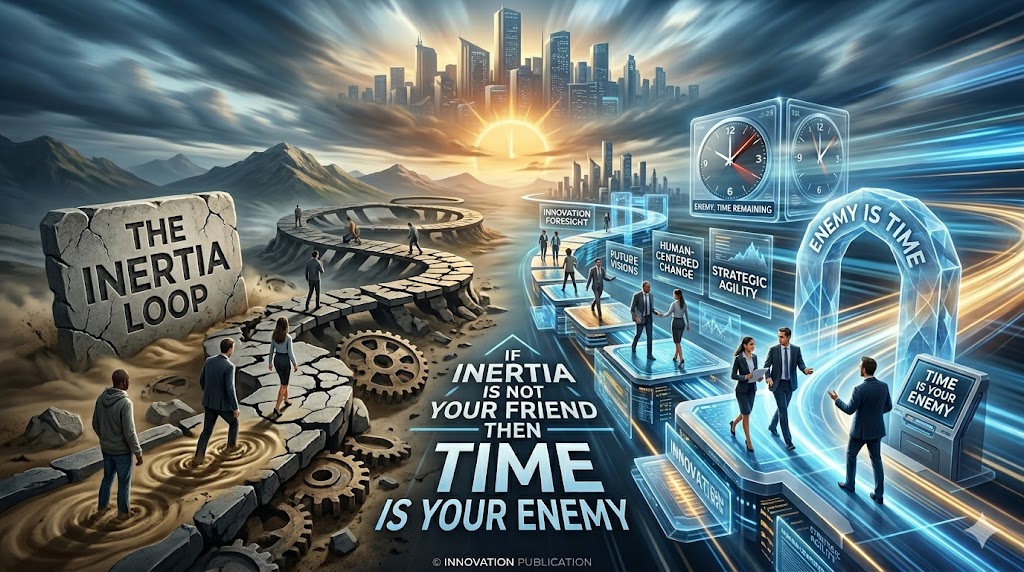
Is Your Innovation Fire Fading?

LAST UPDATED: April 28, 2026 at 3:46 PM

Is Your Innovation Fire Fading?

by Braden Kelley

A common misconception in business is that innovation fails simply because of a shortage of good ideas. In reality, the “fire” is more often extinguished by the structural context in which those ideas are born.

Organizations often focus their energy on brainstorming sessions and ideation workshops, assuming that more ideas will lead to more success. However, volume and diversity are merely preconditions; they cannot overcome a rigid organizational environment.

The Reality: Strategic and Cultural Fire Extinguishers

Innovation is frequently hindered by structural barriers, poor information flow, and misaligned psychology. Without the right enabling conditions, even the most brilliant concepts will stall.

Key Themes for Transformation

  • Strategy vs. Experimentation: Innovation without strategy is merely experimentation, while strategy without innovation results in nothing more than incremental improvement.
  • Human-Centered Insight: Sustainable innovations are almost always rooted in deep, human-centered insights regarding customer needs and frustrations.
  • Structural Alignment: True innovation capability requires organizational structures and digital infrastructure that support rapid experimentation and collaboration across teams.

The Ten Dimensions of Innovation Health

To build a sustainable innovation capability, an organization must evaluate its performance across ten core diagnostic areas. These dimensions help identify whether your innovation “fire” has a strong foundation or is being restricted by hidden barriers.

  1. Vision: A compelling, shared starting point that inspires people to challenge the status quo.
  2. Strategy: Integrating innovation efforts into the broader strategic framework to avoid random experimentation.
  3. Goals: Using specific, measurable targets and leading indicators to focus creative energy.
  4. Insights: Generating deep, human-centered data about customer frustrations and unmet desires.
  5. Idea Generation: Creating conditions for a high volume and wide diversity of ideas across the organization.
  6. Idea Evaluation: Ensuring fair, rigorous, and innovation-friendly processes that guard against incremental bias.
  7. Idea Development: Providing dedicated pathways, resources, and rapid prototyping to turn concepts into reality.
  8. Organizational Psychology: Addressing the mindsets, autonomy, and fear of failure that dictate innovation behavior.
  9. Information and Structural: Optimizing organizational structures and information flows to remove “innovation drag.”
  10. Sustainability: Building innovation as a lasting, self-reinforcing capability rather than a one-time initiative.

Download Your FREE Innovation Health Checks

The Innovation Health Checks are designed to move beyond subjective feelings and toward evidence-based diagnostics. To get the most value from these tools, leadership teams should follow a disciplined approach to the audit process.

Evidence Over Aspiration

When rating your organization, it is critical to be honest and specific. You must base your scores on evidence and observable behavior rather than your intentions or what you believe should be happening. Scoring statements honestly ensures that you are diagnosing the actual state of your innovation “fire.”

Continuous Improvement and Maturity

Innovation health is not a one-time measurement. By repeating these health checks every 6–12 months, you can track your progress over time and identify new barriers that may emerge as your organization’s innovation capability matures.

From Diagnosis to Roadmap

While the Innovation Health Checks provide the diagnostic tools to identify where your fire is fading, they are designed to work in tandem with deeper strategic frameworks. These checks reveal the “what” and the “where,” serving as the essential starting point for any leader committed to building a sustainable culture of innovation and purpose.

Take the Next Step

Ready to clear the barriers identified in your scores?

Stoking Your Innovation Bonfire provides the comprehensive roadmap and deep-dive strategies required to transform these insights into a lasting competitive advantage.


Free download

10 Innovation Health Checks

Audit your leadership team’s innovation capacity with the full PDF toolkit drawn from Braden Kelley’s framework.

⇓  Download PDF


Get the book

Stoking Your Innovation Bonfire

Move your organization from incremental improvement to transformational growth with Braden Kelley’s complete roadmap.

Read the book →

Image credits: ChatGPT

Subscribe to Human-Centered Change & Innovation WeeklySign up here to get Human-Centered Change & Innovation Weekly delivered to your inbox every week.

People Are Always the Hardest Part

People Are Always the Hardest Part

GUEST POST from Mike Shipulski

The toughest part of all things is the people part.

Hold on to being right and all you’ll be is right. Transcend rightness and get ready for greatness.

Embrace hubris and there’s no room for truth. Embrace humbleness and everyone can get real.

Judge yourself and others will pile on. Praise others and they will align with you.

Expect your ideas to carry the day and they won’t. Put your ideas out there lightly and ask for feedback and your ideas will grow legs.

Fight to be right and all you’ll get is a bent nose and bloody knuckles. Empathize and the world is a different place.

Expect your plan to control things and the universe will have its way with you. See your plan as a loosely coupled set of assumptions and the universe will still have its way with you.

Argue and you’ll backslide. Appreciate and you’ll ratchet forward.

See the two bad bricks in the wall and life is hard. See the other nine hundred and ninety-eight and everything gets lighter.

Hold onto success and all you get is rope burns. Let go of what worked and the next big thing will find you.

Strive and get tired. Thrive and energize others.

The people part may be the toughest part, but it’s the part that really matters.

Image credit: Pixabay

Subscribe to Human-Centered Change & Innovation WeeklySign up here to join 17,000+ leaders getting Human-Centered Change & Innovation Weekly delivered to their inbox every week.

Entrepreneurial Efforts Must Fit with the Brand

Entrepreneurial Efforts Must Fit with the Brand

GUEST POST from Mike Shipulski

To meet ever-increasing growth objectives, established companies want to be more entrepreneurial. And the thinking goes like this – launch new products and services to create new markets, do it quickly and do it on a shoestring. Do that Lean Startup thing. Build minimum viable prototypes (MVPs), show them to customers, incorporate their feedback, make new MVPs, show them again, and then thoselaunch.

For software products, that may work well, largely because it takes little time to create MVPs, customers can try the products without meeting face-to-face and updating the code doesn’t take all that long. But for products and services that require new hardware, actual hardware, it’s a different story. New hardware takes a long time to invent, a long time to convert into an MVP, a long time to show customers and a long time to incorporate feedback. Creating new hardware and launching quickly in an entrepreneurial way don’t belong in the same sentence, unless there’s no new hardware.

For hardware, don’t think smartphones, think autonomous cars. And how’s that going for Google and the other software companies? As it turns out, it seems that designing hardware and software are different. Yes, there’s a whole lot of software in there, but there’s also a whole lot of new sensor systems (hardware). And, what complicates things further is that it’s all packed into an integrated system of subsystems where the hardware and software must cooperate to make the good things happen. And, when the consequences of a failure are severe, it’s more important to work out the bugs.

And that’s the rub with entrepreneurship and an established brand. For quick adoption, there’s strong desire to leverage the established brand – GM, Ford, BMW – but the output of the entrepreneurial work (new product or service) has to fit with the brand. GM can’t launch something that’s half-baked with the promise to fix it later. Ford can come out with a new app that is clunky and communicates intermittently with their hardware (cars) because it will reflect poorly on all their products. In short, they’ll sell fewer cars. And BMW can’t come out with an entrepreneurial all-electric car that handles poorly and is slow off the start. If they do, they’ll sell fewer cars. If you’re an established company with an established brand, the output of your entrepreneurial work must fit with the established brand.

If you’re a software startup, launch it when it’s half-baked and fix it later, as long as no one will die when it flakes out. And because it’s software, iterate early and often. And, there’s no need to worry about what it will do to the brand, because you haven’t created it yet. But if you’re a hardware startup, be careful not to launch before it’s ready because you won’t be able to move quickly and you’ll be stuck with your entrepreneurial work for longer than you want. Maybe, even long enough to sink the brand before it ever learned to swim. Developing hardware is slow. And developing robust hardware-software systems is far slower.

If you’re an established company with an established brand, tread lightly with that Lean Startup thing, even when it’s just software. An entrepreneurial software product that works poorly can take down the brand, if, of course, your brand stands for robust, predictable, value and safety. And if the entrepreneurial product relies on new hardware, be doubly careful. If it goes belly-up, it will be slow to go away and will put a lot of pressure on that wonderful brand you took so long to build.

If you’re an established brand, it may be best to buy your entrepreneurial products and services from the startups that took the risk and made it happen. That way you can buy their successful track record and stand it on the shoulders of your hard-won brand.

Image credit: Slashgear.com

Subscribe to Human-Centered Change & Innovation WeeklySign up here to join 17,000+ leaders getting Human-Centered Change & Innovation Weekly delivered to their inbox every week.

Aesthetics – Part One

Aesthetics - Part One

GUEST POST from Geoffrey A. Moore

The Infinite Staircase offers readers a metaphysics and an ethics shaped by the 21st century’s understanding of how the world came to be. It has little to say, however about esthetics, and that is too large a part of human experience to neglect. With that in mind, I am going to address the topic in two short essays.

The first essay, the one you have in hand, is an interaction with The Cambridge Dictionary of Philosophy’s entry on the topic. I found myself constantly quarreling with it, and I wanted to sort out why, hence this piece. What I see now is that I was clearing a space to dig deeper into the issues I truly care about. That’s what the second essay is intended to do.

Of course, this begs the question, do you even need to read this essay? I mean, just because I have to clear my throat before I speak doesn’t mean you have to listen to it. That said, if you are academically oriented, or have ever taken courses in philosophy, I suggest you do read this if only to clarify your own point of view. If, on the other hand, you are simply interested in the nature of the esthetic experience itself, feel free to ignore this piece, but do keep an eye out for the next essay.

Essay #1: A Dialog with Cambridge

NOTE: The format of the dialog is to present the Cambridge material in blockquote format and my responses to it in normal text.

Aesthetics: the branch of philosophy that examines the nature of art and the character of our experience of art and of the natural environment.

The purpose of esthetics, as of any academic discipline, is to investigate a body of forces in order to better understand its nature and determine how best to incorporate it into our strategies for living. In the case of esthetics, the forces under study create psychological experiences, and it is these experiences that provide the data upon which the discipline is based.

Because the concept of experience is central to the understanding of esthetics, we need to get clear about its meaning. In particular, we need to distinguish between two common understandings of the term, one of which is central, the other of which is tangential to our purposes.

Here are the two definitions, taken from the Oxford English Dictionary:

  1. The actual observation of facts or events considered as a source of knowledge.
  2. The fact of being consciously the subject of a state or condition, or of being consciously affected by an event.

Definition 2 is the one that is central to our purpose. We are interested in the impact of an object on a subject, what it is like to be “consciously affected,” something that depends very much on the properties of both the subject and the object. We investigate this experience first by examining the residue of its impact on the subject and then by seeking attributes in the object that account for it.

This is where Definition 1 comes in. It is a tactic we use in pursuing a better understanding of what is happening under Definition 2. But we need to be careful here as we cannot objectively observe the facts in question—they are inherently subjective and can only be contemplated internally or reported externally. That means there can be no purely objective basis for esthetics. We must keep both subject and object in view at all times, focusing specifically on what is happening when we are being internally affected by an externally occasioned event.

It emerged as a separate field of philosophical inquiry during the eighteenth century in England and on the Continent. Recognition of aesthetics as a separate branch of philosophy coincided with the development of theories of art that grouped together painting, poetry, sculpture, music, and dance (and often landscape gardening) as the same kind of thing, les beaux arts, or the fine arts.

The fine arts are indeed all within the scope of esthetics. As a group, however, they are highly refined. Their force tends to be more ethereal than many people can experience, particularly modern audiences that are more global and less privileged than the eighteenth century thinkers who created the concept initially. As a result, we should not position the fine arts as the centerpoint of our category but rather at one end of a more inclusive spectrum, albeit one we have as yet to define.

Baumgarten coined the term ‘aesthetics’ in his Reflections on Poetry (1735) as the name for one of the two branches of the study of knowledge, i.e. for the study of sensory experience coupled with feeling, which he argued provided a different type of knowledge from the distinct, abstract ideas studied by “logic.” He derived it from the ancient Greek aisthanomai (to perceive), and “the aesthetic” has always been intimately connected with sensory experience and the kinds of feelings it arouses.

“Sensory experience coupled with feeling” is as good a starting point as any for capturing the full spectrum of aesthetic experience. It is still too general, as there are many such experiences that are not aesthetic, but it gives us a point of departure. The challenge is that when we try to convert any such experience into knowledge, of necessity we must express ourselves in language, and this can be confusing because the experience itself is pre-linguistic.

That is, to use the framework of The Infinite Staircase, sensory experience coupled with feeling takes place on the stairs of desire, consciousness, values, and culture—all prior to the stairs of language, narrative, analytics, and theory. When we use these higher stairs to explain what is happening on the lower ones, we are prone to imposing their structure in ways that ride roughshod over the subtleties of the actual experience. This is reflected throughout the list of questions that follow.

Questions specific to the field of esthetics are: Is there a special attitude, the aesthetic attitude, which we should take toward works of art and the natural environment, and what is it like?

The answer is no. This is an example of analytics seeking to reposition experiences that arise from below by proposing that they descend from above. That is, the refined analytical intellect is positioning itself at the center of an experience during which it was not even present. This is a big mistake, one that implies aesthetic experiences are reserved for the few who possess refined sensibilities when in fact they are universal.

Is there a distinctive type of experience, an aesthetic experience, and what is it?

The answer is yes, and in the lexicon of philosophy, it falls into the category of qualia. The entry on qualia from Wikipedia provides a useful introduction, defining it as subjective conscious experiences, examples of which include the perceived sensation of pain of a headache, the taste of wine, and the redness of an evening sky. As qualitative characteristics of sensation, qualia stand in contrast to propositional attitudes, where the focus is on beliefs about experience rather than what it is directly like to be experiencing.

Now, to be fair, pain does not qualify as an aesthetic experience, but the taste of wine and the color of red certainly do. The key point is that all the examples stand in contrast to propositional attitudes, the domain of analytics, which can be about aesthetic experience but not integral to it.

Is there a special object of attention that we can call the aesthetic object?

Yes, there is. It is whatever body of forces that are creating the impact on the subject, be that the wine, the evening sky, a painting, a story, or a piece of wood. But the object alone cannot be said to be inherently aesthetic. Only after it has evoked a sensory experience coupled with feeling can it be so termed, and then only with respect to subjects in whom that experience has been evoked.

Finally, is there a distinctive value, aesthetic value, comparable with moral, epistemic, and religious values?

Yes, there is. To put things in perspective

  • Moral value consists of behavior that is beneficial to others and consistent with social norms.
  • Epistemic value consists of justified true beliefs that lead to effective action in the world.
  • Religious value consists of spiritual experiences and commitments that provide sacred and undeniable guidelines for life in the world.

In such a context, aesthetic value consists of pleasurable, contemplative, non-utilitarian, resonating experiences that we characterize as beautiful, refreshing, and inspiring.

Some questions overlap with those in the philosophy of art, such as those concerning the nature of beauty, and whether there is a faculty of taste that is exercised in judging the aesthetic character and value of natural objects or works of art.

The nature of beauty is indeed an elusive topic, one where we need to be humble, but with respect to the faculty of taste, we can be more assertive. In the eighteenth century, judgments of taste were appropriated by a social class that privileged refinement and intellect over sensibility and joy. In the nineteenth century, the Romantic movement aggressively worked to overthrow and reverse this polarity, and in the twentieth, cultural relativism worked to deny the validity of any aesthetic judgments that extended beyond the personal preferences of the person making them within the norms of the culture they are inhabiting. All three positions contain an element of truth, and none by itself does a good job of accounting for the overall nature of beauty. The good news is that they are not incompatible with one another, so a synthesis of all three can potentially provide a stable foundation for esthetic theory.

Aesthetics also encompasses the philosophy of art. The most central issue in the philosophy of art has been how to define ‘art’. Not all cultures have, or have had, a concept of art that coincides with the one that emerged in Western Europe during the seventeenth and eighteenth centuries. What justifies our applying our concept to the things people in these other cultures have produced?

It is justifiable to apply our concepts to our experience of things other cultures have produced and how they stack up against our cultural norms. We just should not apply them to their experiences or the status of the things in their culture. The temptation to do so derives from seeking to locate the aesthetic force solely in the object. That is not a tenable claim.

There are also many pictures (including paintings), songs, buildings, and bits of writing that are not art. What distinguishes those pictures, musical works, etc., that are art from those that are not?

They do not evoke the pleasurable, contemplative, non-utilitarian, resonating experiences we call beautiful, refreshing, and inspiring.

Various answers have been proposed that identify the distinguishing features of art in terms of form, expressiveness, intentions of the maker, and social roles or uses of the object.

None of these topics is off limits, but each one can take us down a rabbit hole if we try to use it as definitive of what constitutes art. That begs the question of how we would define art, but we will leave that to the second essay.

Since the eighteenth century, there have been debates about what kinds of things count as “art.” Some have argued that architecture and ceramics are not art because their functions are primarily utilitarian, and novels were for a long time not listed among the “fine arts” because they are not embodied in a sensuous medium. Debates continue to arise over new media and what may be new art forms, such as film, video, photography, performance art, found art, furniture, posters, earthworks, and computer and electronic art. Sculptures these days may be made out of dirt, feces, or various discarded and mass-produced objects, rather than marble or bronze. There is often an explicit rejection of craft and technique by twentieth-century artists, and the subject matter has expanded to include the banal and everyday, and not merely mythological, historical, and religious subjects as in years past. All of these developments raise questions about the relevance of the category of “fine” or “high” art.

When discussing esthetics in general, over-rotating to fine or high art is simply a mistake. It is a valid subcategory, but not to the exclusion of other sensory experiences coupled with esthetic feelings. Once again, we see the analytical intellect overstepping its bounds, seeking to impose itself as an arbiter of aesthetic value when its proper role is to be an interpreter of aesthetic experience.

Another set of issues in philosophy of art concerns how artworks are to be interpreted, appreciated, and understood. Some views emphasize that artworks are products of individual efforts, so that a work should be understood in light of the producer’s knowledge, skill, and intentions. Others see the meaning of a work as established by social conventions and practices of the artist’s own time, but which may not be known or understood by the producer. Still, others see meaning as established by the practices of the users, even if they were not in effect when the work was produced. Are there objective criteria or standards for evaluating individual artworks?

All these views are legitimate in their own right, provided we surface the context in which the judgment is made. What is not legitimate is to overrule a rival approach, asserting one’s own as the only valid one. Overall, the goal is to get as much insight as possible into the body of forces at work in an esthetic experience, any way we can.

There has been much disagreement over whether value judgments have universal validity, or whether there can be no disputing about taste if value judgments are relative to the tastes and interests of each individual (or to some group of individuals who share the same tastes and interests). A judgment such as “This is good” certainly seems to make a claim about the work itself, though such a claim is often based on the sort of feeling, understanding, or experience a person has obtained from the work. A work’s aesthetic or artistic value is generally distinguished from simply liking it. But is it possible to establish what sort(s) of knowledge or experience(s) any given work should provide to any suitably prepared perceiver, and what would it be to be suitably prepared?

With respect to this question, we should acknowledge that university degree programs in the humanities do purport to teach this kind of knowledge and thereby suitably prepare the perceiver to appreciate the works being studied. As a practical exercise, this is invaluable. Where things can go astray is when the judgment “this is good” floats free of its moorings in culture-specific subject-object relationships and imposes itself as objective fact.

It is a matter of contention whether a work’s aesthetic and artistic values are independent of its moral, political, or epistemic stance or impact.

They are independent. Clearly works of art can have moral, political, or epistemic dimensions, but these are outboard of the aesthetic dimension. When criticism seeks to interpret art through these kinds of filters, be they Marxist, feminist, deconstructionist, or the like, we have left the realm of the humanities behind and ceded authority instead to the social sciences.

Philosophy of art has also dealt with the nature of taste, beauty, imagination, creativity, representation, expression, and expressiveness; style; whether artworks convey knowledge or truth; the nature of narrative and metaphor; the importance of genre; the ontological status of artworks; and the character of our emotional responses to art.

The paragraph above represents a laundry list of what for me are all the interesting topics. It warrants an entire essay of its own. That will be the subject of the essay to follow.

Work in the field has always been influenced by philosophical theories of language or meaning, and theories of knowledge and perception, and continues to be heavily influenced by psychological and cultural theory, including versions of semiotics, psychoanalysis, cognitive psychology, feminism, and Marxism.

Here we see more ceding of authority to the social sciences. It is not that they have nothing to add. It is that they are appropriating the aesthetic experience to promote another agenda. That agenda may indeed be worthwhile, but it cannot substitute for aesthetic analysis.

Some theorists in the late twentieth century have denied that the aesthetic and the “fine arts” can legitimately be separated out and understood as separate, autonomous human phenomena; they argue instead that these conceptual categories themselves manifest and reinforce certain kinds of cultural attitudes and power relationships. These theorists urge that aesthetics can and should be eliminated as a separate field of study, and that “the aesthetic” should not be conceived as a special kind of value. They favor instead a critique of the roles that images (not only painting, but film, photography, and advertising), sounds, narrative, and three-dimensional constructions have in expressing and shaping human attitudes and experiences.

And this is the ultimate ceding of authority to the social sciences, to which I am viscerally opposed.

That’s what I think. What do you think?

Part Two coming soon!

Image Credit: Pexels

Subscribe to Human-Centered Change & Innovation WeeklySign up here to join 17,000+ leaders getting Human-Centered Change & Innovation Weekly delivered to their inbox every week.

The Agentic Paradox

Why Giving AI More Autonomy Requires Us to Give Humans More Agency

LAST UPDATED: April 10, 2026 at 7:11 PM

The Agentic Paradox

by Braden Kelley and Art Inteligencia


The Rise of the Machine “Doer”

For the past few years, we have lived in the era of Generative AI — a world of sophisticated chatbots and creative assistants that respond to our prompts. But as we move deeper into 2026, the landscape has shifted. We are now entering the age of Agentic AI. These are not just tools that talk; they are autonomous systems capable of executing complex workflows, making real-time decisions, and acting on our behalf across digital ecosystems.

On the surface, this promises the ultimate efficiency. We imagine a future where the “busy work” vanishes, leaving us free to innovate. However, a troubling Agentic Paradox has emerged: as we grant machines more autonomy to act, many humans are finding themselves with less agency. Instead of feeling liberated, workers often feel like they are merely “babysitting” algorithms or reacting to a relentless stream of machine-generated outputs.

This disconnect creates a high-stakes leadership challenge. If we focus solely on the autonomy of the machine, we risk creating an “algorithmic anxiety” that stifles the very human creativity we need to thrive. To succeed in this new era, leaders must realize that the more powerful our AI agents become, the more we must intentionally “upgrade” the agency, authority, and strategic focus of our people.

The Thesis: The goal of innovation in 2026 is not to build the most autonomous machine, but to build a human-centered ecosystem where AI agents manage the tasks and empowered humans manage the intent.

The Hidden Cost: The Cognitive Load Crisis

The promise of Agentic AI was a reduction in workload, but for many organizations, the reality has been a shift in the type of work rather than a reduction of it. This has birthed the Cognitive Load Crisis. While an autonomous agent can process data and execute tasks 24/7, it lacks the contextual wisdom to understand the nuances of organizational culture or ethical gray areas. This leaves the human “orchestrator” in a state of perpetual high-alert.

Instead of performing deep, meaningful work, leaders and employees are becoming trapped in the Supervision Trap. They are forced to manage a relentless firehose of machine-generated notifications, approvals, and “check-ins.” This creates a fragmented mental state where the human mind is constantly context-switching between different agent streams, leading to a unique form of 2026 burnout — digital exhaustion without the satisfaction of tactile achievement.

Furthermore, as AI agents take over more of the “doing,” we see an erosion of Deep Work. When every minute is spent verifying the output of an algorithm, the quiet space required for radical innovation and strategic foresight vanishes. We are effectively trading our long-term creative capacity for short-term operational speed.

  • Notification Fatigue: The mental tax of being the constant “emergency brake” for autonomous systems.
  • Loss of Intuition: The danger of becoming so reliant on agentic data that we lose our “gut feel” for the market.
  • The Feedback Loop: A system where humans spend more time managing machines than mentoring people.

To break this cycle, we must stop treating AI agents as simple productivity tools and start treating them as entities that require a new architecture of human attention. If we don’t manage the cognitive load, our most talented people will eventually shut down, leaving the “Magic Makers” of our organization feeling like mere cogs in a machine-led wheel.

Agentic Paradox Spectrum Infographic

Redefining Roles: From “The Conscript” to “The Architect”

As the landscape of work shifts, so too must our understanding of how individuals contribute to the innovation ecosystem. In my work on the Nine Innovation Roles, I’ve often highlighted how different archetypes fuel organizational growth. In this agentic age, we are seeing a dramatic migration of these roles. If we are not intentional, our best people will default into the role of The Conscript — those who are merely drafted into service to support the AI’s agenda, performing the monotonous tasks of verification and data cleanup.

The goal of a human-centered transformation is to automate the role of the “Conscript” and elevate the human into the role of The Architect or The Magic Maker. When the AI handles the heavy lifting of execution, the human is finally free to focus on Intent. This is where true agency resides. Agency is not the ability to do more; it is the power to decide what is worth doing and why it matters to the human beings we serve.

However, there is a dangerous “Agency Gap” emerging. If an organization implements AI agents without redefining human job descriptions, employees lose their sense of ownership. When the machine becomes the primary creator, the human “spark” is extinguished. We must ensure that AI serves as the support staff for human intuition, not the other way around.

The Migration of Value

The AI Agent Role The Human Agency Role
The Conscript: Handling repetitive execution and data synthesis. The Architect: Designing the systems and ethical frameworks for the AI.
The Facilitator: Coordinating schedules and managing basic workflows. The Revolutionary: Identifying the “radical” shifts the AI isn’t programmed to see.
The Specialist: Performing deep-dive technical analysis at scale. The Magic Maker: Applying empathy and storytelling to turn data into a movement.

By clearly delineating these roles, leaders can close the Agency Gap. We must empower our teams to move away from “monitoring” and toward “orchestrating.” This transition is the difference between a workforce that feels obsolete and one that feels essential.

Agentic Workforce Migration Infographic

FutureHacking™ the Cognitive Workflow

To navigate the complexities of 2026, organizations cannot rely on reactive strategies. We must use FutureHacking™ — a collective foresight methodology — to map out how the relationship between human intelligence and agentic automation will evolve. This isn’t just about predicting technology; it’s about engineering the “Human-Agent Interface” so that it scales without crushing the human spirit.

The core of this approach involves identifying the Innovation Bonfire within your team. In this metaphor, the AI agents are the fuel — abundant, powerful, and capable of sustaining a massive output. However, the humans must remain the spark. Without the human spark of intent and empathy, the fuel is just a cold pile of logs. FutureHacking™ allows teams to visualize where the “fuel” might be smothering the “spark” and adjust the workflow before burnout sets in.

By engaging in collective foresight, teams can proactively decide which cognitive territories are “Human-Core.” These are the areas where we intentionally limit AI autonomy to preserve our creative agency and cultural identity. It’s about choosing where we want the machine to lead and where we require a human to hold the compass.

  • Mapping the Friction: Identifying which agent-led tasks are creating the most mental “drag” for the team.
  • Defining Non-Negotiables: Establishing which parts of the customer and employee experience must remain 100% human-centric.
  • Intent Modeling: Shifting the focus from “What can the agent do?” to “What outcome are we trying to hack for the future?”

When we FutureHack our workflows, we move from being passive recipients of technological change to being the active architects of our organizational destiny. We ensure that as the machine gets smarter, our collective human intelligence becomes more focused, not more fragmented.

Framework: The “Agency First” Operating Model

Building a resilient organization in the age of Agentic AI requires more than just new software; it requires a new operating philosophy. We must move away from a model of Machine Management and toward a model of Intent Orchestration. This framework provides three critical steps to ensure that human agency remains the primary driver of your business value.

1. Cognitive Offloading, Not Task Dumping

The goal of automation should be to reduce the mental noise for the employee, not just to move a task from a human to a machine. If a human still has to track, verify, and worry about every step the agent takes, the cognitive load hasn’t decreased — it has merely changed shape.
The Strategy: Design “set and forget” guardrails that allow agents to operate within a defined ethical and operational “sandbox,” only alerting the human when a decision falls outside of those parameters.

2. The “Human-in-the-Loop” Upgrade

We must shift the role of the worker from Monitor to Mentor. In the old model, the human checks the machine’s homework for errors. In the “Agency First” model, the human coaches the agent on why certain decisions are better than others, treating the AI as an apprentice. This reinforces the human’s position as the source of wisdom and authority, preventing the “Conscript” mentality.

3. Intent-Based Leadership

Management must evolve to focus on the Intent rather than the Activity. In a world where agents can generate infinite activity, “busyness” is no longer a proxy for value. Leaders must empower their teams to spend their time defining the “Commander’s Intent” — the high-level objectives and human-centered outcomes that the AI agents must then figure out how to achieve.

Intent Based Leadership Blueprint Infographic

The Agency Audit: Ask your team this week: “Does this new AI agent give you more time to think strategically, or does it just give you more machine-generated work to manage?” The answer will tell you if you are facing an Agentic Paradox.

Conclusion: Leading the Human-Centered Revolution

The true test of leadership in 2026 is not how quickly you can deploy autonomous agents, but how effectively you can protect and amplify the human spirit within your organization. As we navigate the Agentic Paradox, we must remember that technology is a force multiplier, but it requires a human “integer” to multiply. Without a clear sense of agency, even the most advanced AI becomes a source of friction rather than a source of freedom.

By addressing the Cognitive Load Crisis and intentionally moving our teams out of “Conscript” roles and into “Architectural” ones, we do more than just improve efficiency — we future-proof our culture. We ensure that our organizations remain places of meaning, creativity, and purpose.

The “Year of Truth” demands that we be honest about the mental tax of automation. It calls on us to use FutureHacking™ not just to map out our tech stacks, but to map out our human potential. The companies that win the next decade won’t be those with the smartest agents; they will be the ones that used those agents to give their people the time and agency to be truly, radically human.

“Innovation is a team sport where the machines play the support roles so the humans can score the points.”

Are you ready to hack your agentic future?

Frequently Asked Questions

What is the primary difference between Generative AI and Agentic AI?

Generative AI focuses on creating content (text, images, code) based on human prompts. Agentic AI goes a step further by having the autonomy to execute multi-step workflows, make decisions, and interact with other systems to complete a goal without constant human intervention.

How can leaders identify if their team is suffering from the Agentic Paradox?

Look for signs of the “Supervision Trap,” where employees spend more time managing and verifying machine outputs than performing strategic work. If your team feels busier but reports a decline in creative output or “Deep Work,” they are likely experiencing the paradox.

What role does FutureHacking™ play in managing AI integration?

FutureHacking™ is a collective foresight methodology used to visualize the long-term impact of AI on organizational roles. It helps teams proactively define “Human-Core” territories, ensuring that as AI scales, it supports rather than smothers human agency and innovation.

Image credits: Google Gemini

Content Authenticity Statement: The topic area, key elements to focus on, etc. were decisions made by Braden Kelley, with a little help from Google Gemini to clean up the article, add images and create infographics.

Subscribe to Human-Centered Change & Innovation WeeklySign up here to get Human-Centered Change & Innovation Weekly delivered to your inbox every week.

Five Elements of the Changemaker Mindset

Five Elements of the Changemaker Mindset

GUEST POST from Greg Satell

Chances are, you work in a square-peg business, because that’s the best way to make money. You work diligently to improve the pegs and to get them to where they need to go better, faster and cheaper. It is through quality and consistency that you can best serve your customers, beat your competition and win in the marketplace.

The problem comes when your square-peg business meets a round-hole world. When that happens, following traditional best practices will only result in getting better and better at doing things people care about less and less. Round holes don’t concern themselves how good your square pegs are or how efficiently you can produce them.

Make no mistake. Eventually, every business eventually finds itself in a round-hole world. That’s why good companies fail. Not because they become stupid and lazy, but because the world changes and they lose relevance. Clearly, in the midst of disruption the only viable strategy is to adapt and shift from a traditional manager mindset to a changemaker mindset.

1. Don’t Look For A Great Idea, Identify A Good Problem

“Build a better mousetrap and the world will beat a path to your door,” Ralph Waldo Emerson is said to have written and since that time thousands of mousetraps have been patented. Still, despite all that creative energy and all those ideas, the original “snap trap,” invented by William Hooker in 1894, remains the most popular.

We’ve come to glorify ideas, thinking that more of them will lead to better results. This cult of ideas has led to a cottage industry of consultants that offer workshops to exercise our creative capabilities. They walk us through exercises like Brainstorming and SWOT analysis. We are, to a large extent, still chasing better mousetraps with predictably poor results.

The truth is that every great change leader starts out with a problem they just couldn’t look away from. Change doesn’t begin with an idea. It starts with identifying a meaningful problem. That’s why it’s so important that before you start an initiative you ask questions like, “What problem are we trying to solve? Is there a general consensus that it’s a problem we need to solve? How would solving it impact our business?

Make no mistake. Change isn’t about ideas. It’s about solving meaningful problems that people care about.

2. Anticipate Resistance

The biggest misconception about change is that if everyone just understood it, they would embrace it. That’s almost never true. Make no mistake, if you intend to create genuine impact, you will get pushback. Some people will hate it with every fiber of their being. Not for any rational logic, necessarily, just because for whatever reason, it offends their dignity, their identity, their sense of self.

In Rules for Radicals, the legendary activist Saul Alinsky observed that every revolution inspires a counterrevolution. That is the physics of change.

Every action provokes a reaction because, if an idea is important, it threatens the status quo, which never yields its power gracefully. Clearly, if you intend to influence an entire organization, you have to assume the deck is stacked against you and anticipate resistance.

A simple truth is that humans form attachments to people, ideas and other things and, when those attachments are threatened we tend to lash out in ways that don’t reflect our best selves. As much as we may hate to admit it, we all do it from time to time. Anyone who has ever been married or part of a family knows that.

That’s why anytime you ask people to change what they think or what they do, there will always be those who will work to undermine what you are trying to achieve in ways that are dishonest, underhanded and deceptive. Once you are able to internalize that, you can begin to move forward.

3. Identify A Keystone Change

Every change effort begins with some kind of grievance: Costs need to be cut, customers better served, or employees more engaged. Wise managers transform that grievance into a “vision for tomorrow” that will not only address the grievance but also move the organization forward and create a better future.

This vision, however, is rarely achievable all at once. Tough and significant problems have interconnected root causes, so trying to achieve an ambitious vision all at once is more likely to devolve into a long march to failure than it is to achieve results. That’s why it’s crucial to start with a Keystone Change, which represents a clear and tangible goal, involves multiple stakeholders, and paves the way for bigger changes down the road.

​​For example, when Paul O’Neill set out to turnaround Alcoa in the 1980s, he started by improving workplace safety, which also paved the way to improvements in operational excellence. At Experian, when CIO Barry Libenson set out to move his company to the cloud, he started with internal APIs. In both cases, the stakeholders who were won over in achieving the keystone change also played a part in bringing about the larger vision.

Focusing on a keystone change allows you to get out of the business of selling an idea and into the business of selling a success. When people see that something is working, even at a small scale, they want to be involved. They can bring in others who can bring in others still. That’s how you can grow your initiative to create the critical mass that moves the system toward widespread change.

4. Mobilize People To Influence Institutions

In the early 1990s, writer and activist Jeffrey Ballinger published a series of investigations about Nike’s use of sweatshops in Asia. People were shocked by the horrible conditions that workers—many of them children—were subjected to. In most cases, the owners lived outside the countries where the factories were located and had little contact with their employees.

At first, Nike’s CEO, Phil Knight, was defiant. “I often reacted with self-righteousness, petulance, anger. On some level I knew my reaction was toxic, counterproductive, but I couldn’t stop myself,” he would later write in his memoir, Shoe Dog. He pointed out that his company didn’t own the factories, that he’d worked with the owners to improve conditions and that the stories, as gruesome as they were, were exceptions.

The simple truth is that change rarely, if ever, starts at the top because it is people with power that create the status quo. They are attached to what they’ve built and take pride in their accomplishments, just like the rest of us. That’s why, to bring about genuine change—change that lasts—you need to mobilize people to influence institutions (or those, like Knight, who yield institutional power).

Eventually, that’s what happened at Nike. The protests took their toll. “We had to admit,” Knight remembered, “We could do better.” Going beyond its own factories, the company established the Fair Trade Labor Association and published a comprehensive report of its own factories. Today, the company’s track record may not be perfect, but it’s become more a part of the solution than a part of the problem.

If you want to create change in your organization, think about the institutions—both internal and external—that can bring it about. Which departments have budgets that can be deployed in service of change? Which external organizations, whether those are partners, suppliers, customers, industry organizations or regulators that could impact your change environment? Then think about who you can mobilize to influence those institutions.

5. Shift Your Mindset

Most of the time, we operate with a manager mindset and that works fine. We build consensus and execute with predictable outcomes. Our colleagues are motivated, customers are satisfied and everybody is happy. However, in an era of disruption it’s only a matter of time until we need to adapt and drive transformation. That’s never easy.

To pull it off we need to shift from a manager mindset to a changemaker mindset in which we no longer assume an environment of predictability, but explore unknowns in an atmosphere of uncertainty. Not everybody will be willing to make the journey with us, so rather than relying on a consensus, we will need to build a coalition and leave some people behind.

We start not by trying to convince skeptics, but by going to where there is already energy in favor of change. Once we identify those who are already enthusiastic about change, we can empower them to succeed and build on that success until we hit a tipping point (about 10%-25% of the organization) and the transformation becomes self-sustaining.

What makes our current era so challenging is that we often need to operate with both mindsets simultaneously. We can’t afford to put everything on hold while changes are underway, so we need to approach some things as managers and some as changemakers. It can be difficult and stressful, but it’s what needs to be done.

Perhaps most of all, we need to internalize the reality, proven time and time again, that transformation is not only possible, but that it does not have to come from the top. Anyone, anywhere can achieve enormous change. But first, you need to adopt a changemaker mindset.

— Article courtesy of the Digital Tonto blog
— Image credit: Unsplash

Subscribe to Human-Centered Change & Innovation WeeklySign up here to join 17,000+ leaders getting Human-Centered Change & Innovation Weekly delivered to their inbox every week.