Category Archives: Leadership

Your Response is Your Responsibility

Your Response is Your Responsibility

GUEST POST from Mike Shipulski

If you don’t want to go to work in the morning, there’s a reason. If’ you/re angry with how things go, there’s a reason. And if you you’re sad because of the way that people treat you, there’s a reason. But the reason has nothing to do with your work, how things are going or how people treat you. The reason has everything to do with your ego.

And your ego has everything to do with what you think of yourself and the identity you attach to yourself. If you don’t want to go to work, it’s because you don’t like what your work says about you or your image of your self. If you are angry with how things go, it’s because how things go says something about you that you don’t like. And if you’re sad about how people treat you, it’s because you think they may be right and you don’t like what that says about you.

The work is not responsible for your dislike of it. How things go is not responsible for your anger. And people that treat you badly are not responsible for your sadness. Your dislike is your responsibility, your anger is your responsibility and your sadness is your responsibility. And that’s because your response is your responsibility.

Don’t blame the work. Instead, look inside to understand how the work cuts against the grain of who you think you are. Don’t blame the things for going as they go. Instead, look inside to understand why those things don’t fit with your self-image. Don’t blame the people for how they treat you. Instead, look inside to understand why you think they may be right.

It’s easy to look outside and assign blame for your response. It’s the work’s fault, it’s the things’ fault, and it’s the people’s fault. But when you take responsibility for your response, when you own it, work gets better, things go better and people treat you better. Put simply, you take away their power to control how you feel and things get better.

And if work doesn’t get better, things don’t go better and people don’t treat you better, not to worry. Their responses are their responsibility.

Image credit: Mrs. Gemstone

Subscribe to Human-Centered Change & Innovation WeeklySign up here to join 17,000+ leaders getting Human-Centered Change & Innovation Weekly delivered to their inbox every week.

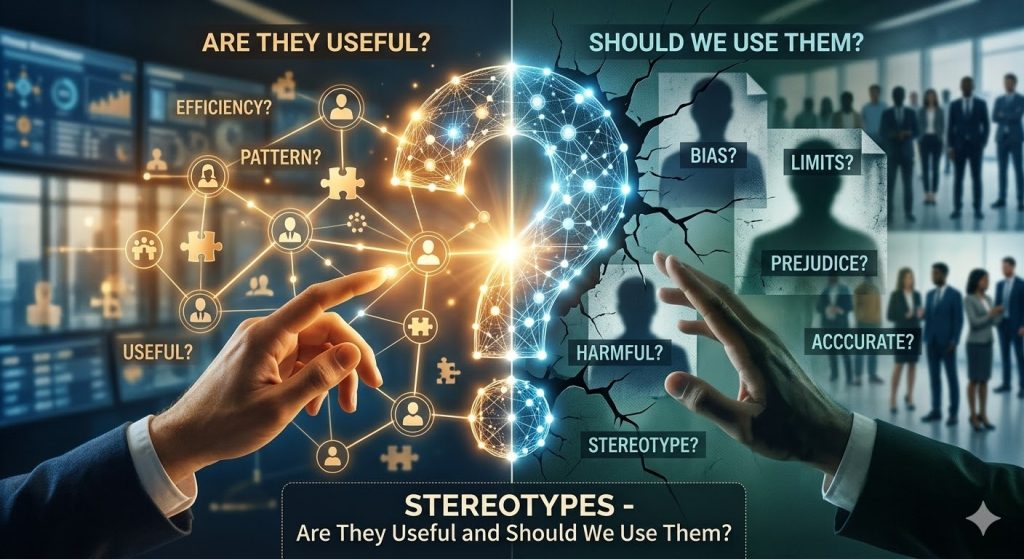
Stereotypes – Are They Useful and Should We Use Them? 

Stereotypes - Are They Useful and Should We Use Them? 

GUEST POST from Pete Foley

I recently got a call from an ex colleague looking to staff up a technology innovation organization.  She was looking for suggestions for potential candidates, and when I asked her for a bit more more information, her first criteria was that she was looking for a ‘Gen Z’. This triggered an interesting conversation around how useful generational and other stereotypes are.

At one level, they are almost invaluable.  We use stereotypes, categorization and other grouping strategies all of the time, both consciously and unconsciously.   Grouping things together is a pragmatic part of how we as humans deal with large numbers of anything, whether it’s people, tasks, objects or pretty much anything, and are often a key tool in prediction. They are not always accurate or precise, but they are often a first step in how we distill large amounts of data or choices down to more manageable numbers, and/or how we begin to understand something unfamiliar. If a stranger were to point an unfamiliar gun at us at a stop sign, we can quickly determine that they are probably dangerous, likely a criminal, and that the gun is likely deadly. That kind of categorization and stereotyping might be the difference between life and death.

But these grouping strategies can also mislead us, especially if we don’t use them effectively.   For example, in the case of generational stereotypes, when dealing with large numbers of people, it can be useful to break them down into generational groups. A targeted marketing campaign may benefit from knowing that people over a certain age are more likely to use different social media platforms than people under 20.  Or a physician and patient may benefit from knowing certain age groups are more likely to face certain health issues and need screening for certain diseases.  Stereotypes can also address fundamental differences in life experiences between generations.  For example, Gen Z grew up immersed in a digital world, whereas earlier generations grew up acquiring digital skills, perhaps changing how we design interfaces for Medicare versus home schooling?. 

But the key lies in the phrase ‘large groups of people’.  There are times when its really useful and beneficial to make approximations on when dealing with large groups. But as tempting as it can be when having to make a quick judgement, or to quickly filter a large number of people, as in my friends original question, applying them to individuals is often misleading, and risks throwing the baby out with the bathwater. 

No matter what grouping strategy we apply, we need to be really careful about applying them at an individual level. And there are of course many different ways to group things, whether it’s categorization, archetypes, stereotypes, sensory cues or many others, depending upon context and goals.  I’ve deliberately blurred the lines between these, because in reality, people tap into different ones depending upon goals, contexts, personal experience or personal knowledge.  And to a large degree, similar principles apply to all of them.  That leads to a couple of concepts, which while pretty obvious, I think are worth sharing or reiterating:  

1. Stereotypes can be useful when applied to large groups of people, but judging an individual through that lens is disingenuous in both directions. Take gender as an example. There are distinct, scientifically measured differences between men and women if we look at them at the large group level. These differences can be physical, behavioral or both.  Perhaps the least controversial is that ON AVERAGE, men are taller and stronger than women. But importantly there is also massive overlap between genders, and there are many, many individual women who are taller and stronger than individual men. We intuitively get that, and nobody would recruit for a job that requires hard physical labor by ruling out women. But conversely, if we are designing a clothing line, we’d be foolish to ignore those average differences when developing sizing options and inventory. Gender differences are potentially useful when dealing with large numbers, but potentially highly misleading on an individual basis

Similarly, using generational stereotypes to target ‘digital natives’ for a tech job may superficially sound reasonable, as it did to my friend.  But it risks ignoring strong candidates who may reside outside of that category.  Even if Gen Z as a whole may arguably have a more intuitive understanding of tech, there are many individual Millennials, X’ers and Boomers who are more technically savvy than individual Z’ers.  Designing software targeted at large groups of specific age groups may benefit from group categorization, but choosing who to write it on that basis is a lot less effective, if at all.  

2. Grouping is how we often manage complex decisions. Faced with more than a few individual choices, pragmatically, we often have to find some way to narrow choice to manageable numbers. For example, in Las Vegas we have 2,500 restaurants. When deciding where to eat, we cannot consider each one individually. We instead use grouping filters like location, cost, cuisine, familiarity or ratings. It’s not perfect, it’s often not a conscious strategy, and we may miss a great restaurant, but it beats the alternative of starving while we cross reference 2500 individual options. Recruitment these days is similar. Most job openings get multiple candidates that we must narrow to manageable numbers. But we need to be careful that we carefully select criteria that benefit us and candidates. Those may vary by context. But especially as we defer screening and decision making to AI and automation, it’s so important that we really understand what those criteria are, and how they benefit our search. I’d argue that generational stereotypes are a particularly ineffective filter in narrowing our choices for many things, especially for recruiting or career management.

3.  Not all stereotypes or categories are accurate.  Even if they feel intuitively right, they may be neither accurate or predictive.  In part this is because they are often based on (superficial) correlation, instead of causation. For example, historically a common stereotype was that women were considered less able at math and science than men.  It was true that for a long time men were better represented in these fields.  But the stereotype that men were were more skilled was fundamentally inaccurate.  We now know there is no gender difference in that innate ability.  But a mixture of social factors, and a feedback loop created by a self fulfilling stereotype created an illusion of meaningful difference.  Conversely, men were considered less empathic than women.  The actual science is far less clear on this, and there may be some small innate gender differences.  But if they exist, they are sufficiently small that it’s hard to separate whether this is due to self reporting biases, socialization, or meaningful differences in biology. But certainly the difference is too small to preclude men from careers that require a high level of empathy, a stereotype that existed for quite some time in, for example, fields such as nursing, which were long dominated by women. 

Even today, only 13% of registered nurses in the US are male, and only 31% of engineers are women  Self fulfilling stereotypes can be particularly hard to see through, let alone break, because they reinforce their own illusion. 

But all of this said, some stereotypes can still be useful.  Take the stereotype that the Swiss are punctual, organized and ‘on time’.  If you are planning on catching a train for an important flight, nearly 95% of trains in Switzerland arrived on time in 2025. In Italy, the number was less than 75%.  That of course doesn’t guarantee than the Swiss train will be on time, or the Italian one won’t. But it does make it prudent to add a bit more padding into an Italian travel itinerary, or at least research back up options!

And then there are examples like the tomato.  No matter how you pronounce it, the tomato is technically a fruit.  But it is commonly used as a vegetable.  So is it more practically useful to categorize it as a fruit or vegetable? I’d argue vegetable.  

In conclusion, stereotype, categories, grouping and similar mechanisms are a fundamental part of the way we as humans deal with large amounts of data.  And at least at one level, as the amount of data we are exposed to explodes, we are going to need those filters more than ever.  But they can also be highly misleading, especially when applied to individuals, so we need to understand when and how to use them, and treat them with a lot of caution.  

Image credits: Google Gemini

Subscribe to Human-Centered Change & Innovation WeeklySign up here to join 17,000+ leaders getting Human-Centered Change & Innovation Weekly delivered to their inbox every week.

Four Things I Have Learned About Ideas

Four Things I Have Learned About Ideas

GUEST POST from Greg Satell

I’ve always been inspired by ideas. Some, like Aristotle’s logic, shape the world for millennia. Others, like Einstein’s relativity, completely change our conceptions of what is possible. Still others, like mRNA vaccines, seem to emerge at just the right time. Ideas are what have marked humanity’s progress from living in caves to civilizations.

Yet bad ideas can destroy just as completely as good ideas can create. Fascism led Europe to effectively wipe itself out in little more than a decade. Communism relegated hundreds of millions of people to poverty and struggle. Corporate debacles like like Enron, WeWork and Theranos, have shown us that the wrong idea can cost billions.

We need to handle ideas with care, being open enough to new ones so that we don’t miss out on opportunities, but skeptical enough that we don’t get taken in by ones that do harm. What I’ve learned researching innovation and change is that creating, parsing and evaluating ideas is a skill that must be practiced and honed over time. Here are 4 things to keep in mind.

1. Ideas Can Come From Anywhere

Albert Einstein was an outcast in the world of physics when he unleashed four papers on the world that would change the field forever. When Jim Allison discovered cancer immunotherapy, it took him three years to find anyone who would invest in it. Katalin Karikó was told to abandon her research into mRNA vaccines or be demoted.

In The Structure of Scientific Revolutions, science historian Thomas Kuhn explained why breakthroughs so often happen this way. As the world changes and evolves, flaws in existing models become more evident, eventually becoming untenable. That’s what sets the stage for a paradigm shift. “Failure of existing rules is the prelude to a search for new ones,” he wrote.

Yet new paradigms almost always need to be championed by outsiders or newcomers rather than acknowledged experts. As the physicist Max Planck put it “a new scientific truth does not triumph by convincing its opponents and making them see the light, but rather because its opponents eventually die, and a new generation grows up that is familiar with it.”

In Mapping Innovation, I showed how data and real-world experience bear this out. On the innovation platform Innocentive (now Wazoku Crowd), problems tend not to be solved within the domain in which they arose, but by a practitioner in an adjacent field. In fact, a study analyzing 17.9 million papers found the most highly cited work tended to come from highly specialized experts partnering with an outsider.

2. Ideas Need To Develop Over Time

In 1891, Dr. William Coley had an unusual idea. Inspired by an obscure case, in which a man who had contracted a severe infection was cured of cancer, the young doctor purposely infected a tumor on his patient’s neck with a heavy dose of bacteria. Miraculously, the tumor vanished and the patient remained cancer free even five years later.

It was a breakthrough, of sorts, but for more than a 100 years Coley’s work was viewed with skepticism and, in truth, there were serious problems with it. Coley couldn’t explain the underlying mechanism by which an infection could cure cancer and he couldn’t replicate his results with any consistency. When radiation therapy began showing success, most people forgot about Coley’s and his work.

Yet a small cadre of supporters kept the faith alive. His daughter, Helen Coley Nauts, would establish the Cancer Research Institute in 1953 to support immune-based approaches to cancer treatment. Over the next four decades, glimmers of hope would appear from time to time, but no one could make Dr. Coley’s idea work.

Then, in 1995 there was a breakthrough. Following a hunch, Jim Allison figured that maybe the problem wasn’t that our bodies couldn’t identify and fight cancer cells, but that something was switching the immune response off. If we could switch it back on, we would have a completely new tool to fight cancer. Allison would win the Nobel Prize for his work on the development of the first cancer immunotherapy drug in 2018.

Dr. Coley had the right idea from the start, but it wasn’t enough. It would take over a century to develop better understanding of cancer, genomics, as well as tools like recombinant DNA to make it work. Literally thousands of researchers worked around the globe for decades to make good on an initial insight.

3. Ideas Need Ecosystems

When Jim Allison was finishing up graduate school in the early 1970s, they had just discovered T cells and he was fascinated. He would later tell me how he was amazed about how all these things could be flying around our bodies killing things and somehow not hurt us. He decided to focus his career on figuring out how it all worked.

Over the next decade, Jim and his colleagues started piecing together a larger picture of how the immune system worked through a vast array of signals and receptors that regulate our immune response, triggering it to increase activity and to shut down once the threat has dissolved. A colleague had noticed that one of these molecules inhibited tumor growth.

Dr. Coley and Jim Allison occupied world’s. To Coley, the immune system was like an on/off switch and, triggering the immune system should lead directly to an immune response to fight cancer. Yet Allison was part of a much larger ecosystem that led to a different understanding that allowed him to target a specific receptor in the regulation system. That opened the floodgates and now cancer immunotherapy is a major field of its own.

The simple fact is that ideas need ecosystems. Look at any major technology and it’s not the initial invention that creates the impact, but the secondary and tertiary technologies. Electricity needed appliances to change the world. The internal combustion engine needed vehicles. Computers needed software and the Internet.

We can’t just look at nodes, but must consider networks. It’s through those connections that we create the combinations that can help us solve important problems.

4. You Need To Let The Muse Know You’re Serious

One of the toughest things about ideas is that they can only be validated forward, never backward. You never know if you have the right idea until it’s been tested in the real world and, even then, there could be some confounding factor you may be missing. As Kevin Ashton put it, “Creation is a long journey, where most turns are wrong and most ends are dead.”

That’s tough work. You can’t just expect lightning to strike. Truly creative people know you have to work at it every day. Sometimes it goes easier and sometimes it’s a bit tougher. There are constant disappointments and true epiphanies are rare. But if you keep with it you’ll find that most days you can come up with something, even if it’s something small.

Somebody told me once that you have to let the muse know that you’re serious. Producing ideas leads to more ideas, which allows you to start creating connections between them. The more you produce, the better the chances are that some of those connections will be novel and lead to something important. That’s how you produce an idea that matters.

But even then the work isn’t over, because the world your idea enters into keeps evolving and changing. That’s why you need to share it and encourage others to build on it so that it can grow and reach its true potential. Ideas must combine and recombine so that they can memetically evolve. For our ideas to succeed, we need to serve them well.

As Daniel Dennett put it, “A scholar is just a library’s way of making another library.”

— Article courtesy of the Digital Tonto blog
— Image credit: Google Gemini

Subscribe to Human-Centered Change & Innovation WeeklySign up here to join 17,000+ leaders getting Human-Centered Change & Innovation Weekly delivered to their inbox every week.

Feedback Giving Secrets

Feedback Giving Secrets

GUEST POST from David Burkus

A large part of doing your best work ever involves getting feedback on your performance. Feedback is how you know where to improve and where to build upon your strengths. Giving feedback is a requirement for unlocking greater performance, both individually and in teams.

But many leaders struggle to give feedback.

Sometimes this is because giving feedback, particularly constructive feedback is uncomfortable. It’s not fun to tell someone they’re under-performing. And sometimes it’s because the tactics leaders are taught to reduce that discomfort are—to put it bluntly—terrible. We’re told to combine positive and constructive criticism and sometimes even to “sandwich” in the constructive feedback around two pieces of praise.

But if you’ve ever tried this tactic, you know it doesn’t reduce the discomfort and it often makes the conversation less clear. So, don’t.

That’s the big secret to giving great feedback. Don’t mix messages. Give positive feedback and constructive feedback at different times and in different ways.

And in this article, we’ll review a few simple steps to make both positive and constructive feedback conversations less awkward and more productive.

Giving Positive Feedback

There are three keys to giving great positive feedback: 1) Do it right away, 2) Be specific, and 3) Explain why it matters.

Do It Right Away

The first key to giving great positive feedback is to do it right away. As soon as you notice someone’s exceptional actions, praise them for it. Don’t document and wait until the next check-in or performance review, comment on the behavior by the end of that day. The more quickly you offer someone praise, the more they understand that their performance matters and that they matter. Sometimes leaders want to praise publicly, so leaders will wait for the next team-wide meeting and praise a few different people. But that diminishes the importance of the individual actions by delaying the praise. And besides, there is no rule that says you can only praise someone’s actions once.

Be Specific

The second key to giving great positive feedback is to be specific. Comment on the specific behavior you observed as well the specific situation they were in. And get specific about why their action or idea was so good. While you should give your people praise like “I’m proud of you” and “You’re awesome,” too much vague praise starts to feel stale and insignificant. So, when you’re giving feedback on a specific action, be as specific as possible. As a bonus, most of the time, when a specific action is praised, people want to do more of it. You may get more of what you measure, but you always get more of what you praise.

Explain Why It Matters

The third key to giving great positive feedback is to explain why it matters. This isn’t about just saying “I really appreciated that.” Instead, it’s about connecting the specific action you’re praising to the larger whole of team or organizational success. People want to know the work they do matters, but it’s often hard to see how their day-to-day tasks fit into the bigger picture and lead to organizational success. So, the best time to help them see the whole team and the significance of their role in it is when you’re praising the actions that lead to team-wide wins.

Giving Constructive Feedback

Likewise, there are three keys to giving great constructive feedback:

  1. Comment on behavior, not intent,
  2. Co-create solutions, and
  3. Close with potential

Comment On Behavior

The first key to giving great constructive feedback is to comment on the behavior—that’s it. Comment solely on the action you observed or words you heard. Many times, when giving constructive criticism we guess at the rationale behind the behavior. This is a distraction. We’re not mind readers; we’re going to guess wrong from time to time. And when we do (or even if we guess right and the other person is in denial) we can end up moving the conversation away from the behavior that needs to change and into an unproductive argument about someone’s mindset. If the goal is to change behavior, focus on behavior.

Co-Create Solutions

The second key to giving great constructive feedback to is co-create solutions. Once you’ve commented on the behavior, and maybe even explained its effect on the rest of the team, it’s time to find a better way to behave moving forward. However, often leaders tend to just dictate what the person should do. But if you want the behavior change to stick, you have to involve the person responsible for the action. You have to co-create a solution. Instead of telling them what to do, take the time to ask questions that guide and direct them toward finding a better way to behave. You’ll get more buy-in and you’ll increase their autonomy and hence motivation to change.

Close With Potential

The third key to giving great constructive feedback is to close with potential. End on a high note. But more importantly, end on a note that emphasizes your belief in their ability to improve. In perhaps one of the best studies on teacher feedback among students, researchers found that 19 simple words at the top of the paper had a dramatic effect on whether students took the time to revise and improve. Those words: “I’m giving you this feedback because I have very high expectations and I know that you can reach them.” If leaders did the same at the closing moments of a constructive feedback conversation, that would dramatically improve the chances of people improving.

Part of the reason giving feedback is so uncomfortable for leaders is that it feels like judging people and not coaching them. And that’s why the closing moments of feedback are so important, whether it’s closing positive feedback with an explanation of why those actions are appreciated or closing constructive feedback with a comment on that person’s potential. Those final moments of the conversation make the difference between feedback that can be readily applied and feedback that’s quickly discarded. Giving feedback is about the behavior, but it’s also about why it’s so important to improve. Great feedback empowers everyone to do their best work ever.

Image credit: Pexels

Originally published at https://davidburkus.com on January 17, 2022.

Subscribe to Human-Centered Change & Innovation WeeklySign up here to get Human-Centered Change & Innovation Weekly delivered to your inbox every week.

Does Work Need to be Meaningful?

Does Work Need to be Meaningful?

GUEST POST from Mike Shipulski

Life’s too short to work on things that don’t make a difference. Sure, you’ve got to earn a living, but what kind of living is it if all you’re doing is paying for food and a mortgage? How do others benefit from your work? How does the planet benefit from your work? How is the world a better place because of your work? How are you a better person because of your work?

When you’re done with your career, what will you say about it? Did you work at a job because you were afraid to leave? Did you stay because of loss aversion? Did you block yourself from another opportunity because of a lack of confidence? Or, did you stay in the right place for the right reasons?

If there’s no discomfort, there’s no growth, even if you’re super good at what you do. Discomfort is the tell-tale sign the work is new. And without newness, you’re simply turning the crank. It may be a profitable crank, but it’s the same old crank, none the less. If you’ve turned the crank for the last five years, what excitement can come from turning it a sixth? Even if you’re earning a great living, is it really all that great?

Maybe work isn’t supposed to be a source of meaning. I accept that. But, a life without meaning – that’s not for me. If not from work, do you have a source of meaning? Do you have something that makes you feel whole? Do you have something that causes you to pole vault out of bed? Sure, you provide for your family, but it’s also important to provide meaning for yourself. It’s not sustainable to provide for others at your own expense.

Your work may have meaning, but you may be moving too quickly to notice. Stop, take a breath and close your eyes. Visualize the people you work with. Do they make you smile? Do you remember doing something with them that brought you joy? How about doing something for them – any happiness there? How about when you visualize your customers? Do you they appreciate what you do for them? Do you appreciate their appreciation? Even if there’s no meaning in the work, there can be great meaning from doing it with people that matter.

Running away from a job won’t solve anything; but wandering toward something meaningful can make a big difference. Before you make a change, look for meaning in what you have. Challenge yourself every day to say something positive to someone you care about and do something nice for someone you don’t know all that well. Try it for a month, or even a week.

Who knows, you may find meaning that was hiding just under the surface. Or, you may even create something special for yourself and the special people around you.

Image credit: Unsplash

Subscribe to Human-Centered Change & Innovation WeeklySign up here to join 17,000+ leaders getting Human-Centered Change & Innovation Weekly delivered to their inbox every week.

Why Building Trust Matters in the Age of Acceleration

Why Building Trust Matters in the Age of Acceleration

GUEST POST from Robert B. Tucker

The recent release of the Jeffrey Epstein files, revealing the involvement of numerous high-profile figures, has laid bare the diminution of trust in modern society —and the urgent need to reverse the slide.

Public reaction to episodes involving powerful insiders, whether in the corporate world, reveals causation in the downward slide. Trust erodes when people suspect the rules are not applied evenly. When powerful systems protect insiders, while ordinary standards apply to everyone else, the result is cynicism and distrust.

The warning lights have been flashing for decades. And now, at a time when artificial intelligence is working its way into all realms of life, and when information and misinformation travel instantly around the globe, and when the speed of change is increasingly exponential, the temptation is to retreat into suspicion and tribalism.

Trust was once the glue that bonded relationships and societies together. Honesty and truthfulness were the operating system that enabled strangers to cooperate, institutions to function, businesses to make deals, and countries and communities to build better futures.

But trust cannot be assumed in today’s world. It must be earned, created, and guarded.

The collapse of trust started decades ago. Surveys from Pew, Gallup, and from social-capital research stretching back to the 1970s all tell a similar story: confidence in institutions, leaders, media, business, and even neighbors has been on the decline for decades.

Harvard sociologist Robert Putnam was among the first to reveal the social dimension of this disintegration in his landmark book, Bowling Alone: The Collapse and Revival of American Community. His research found that civic engagement and community participation peaked in the late 1960s, before steadily declining thereafter. Americans stopped joining clubs and attending church. Neighborhood interaction declined. Shared civic rituals began to fade.

The result has been the slow erosion of social capital – the invisible glue that makes cooperation possible.

The University of Chicago’s General Social Survey is one of America’s longest-running social studies. In 1972, when the study began, nearly half of Americans believed “most people can be trusted.” By 2018, that number had fallen to 33%. In the 2024 survey, trust between fellow human beings had fallen to 25%.

The gold standard of trust measurement is the annual Edelman Trust Barometer. For 25 years, Edelman has tracked confidence in four institutions: government, media, NGOs, and business. Created in response to globalization protests and widening skepticism toward elites, the survey now spans roughly 30 countries and tens of thousands of respondents annually, offering a rare multi-decade, multi-cultural window into the psychological state of trust.

Recent findings show a widening “trust gap” between elites and the general population. As economic growth has not been widely shared, large portions of the public believe capitalism is failing to deliver basic affordability, much less upward mobility.

The new trust destroyers are social media and artificial intelligence, which create lots of advantages in terms of productivity and reach, but which are often used to create deception and fraud as well. Experts see technological change, especially generative AI, having accelerated social fragmentation.

Columbia law professor Tim Wu uses the term “extraction economy” to describe the business model in which tech companies grow powerful, not by selling products directly, but by continuously harvesting something from users – primarily attention, behavior, and personal data. Platforms design algorithms to keep people engaged for as long as possible. Every click, search, or swipe becomes information that can be analyzed, predicted, and ultimately sold to advertisers or used to shape future behavior. The result is not only a concentration of economic and cultural power in a handful of companies, but a relationship devoid of trust.

How To Build Trust in a World of Distrust

If we are serious about building a better future, restoring trust is not peripheral work. It is foundational.

Trust does not drift upward on its own. It must be cultivated deliberately—one clarified expectation, one kept commitment, one repaired mistake at a time. Built patiently, it remains the most renewable resource leadership possesses, and we can start at any time to build trust in a world where nobody trusts anybody anymore.

Robert Putnam demonstrated decades ago that civic engagement and cooperation reinforce one another. Small acts—honoring a deadline, giving credit generously, admitting uncertainty—ripple outward. In organizations navigating technological upheaval, these micro-behaviors create emotional stability that strategy alone cannot supply.

Perhaps the best-known trust guru is Stephen M. R. Covey, who argues that trust is not merely a moral virtue; it is a learnable competency. Covey, the son of famed “Seven Habits” author Stephen Covey, teaches that trust grows from consistent behavior, not charisma or intention. Leaders often harbor the mistaken idea that trust is something bestowed upon them because of position or expertise. Instead, argues Covey, it accumulates through observable habits repeated over time. Covey emphasizes credibility—the alignment of character and competence. Character asks whether you are honest and motivated by shared benefit. Competence asks whether you can deliver results.

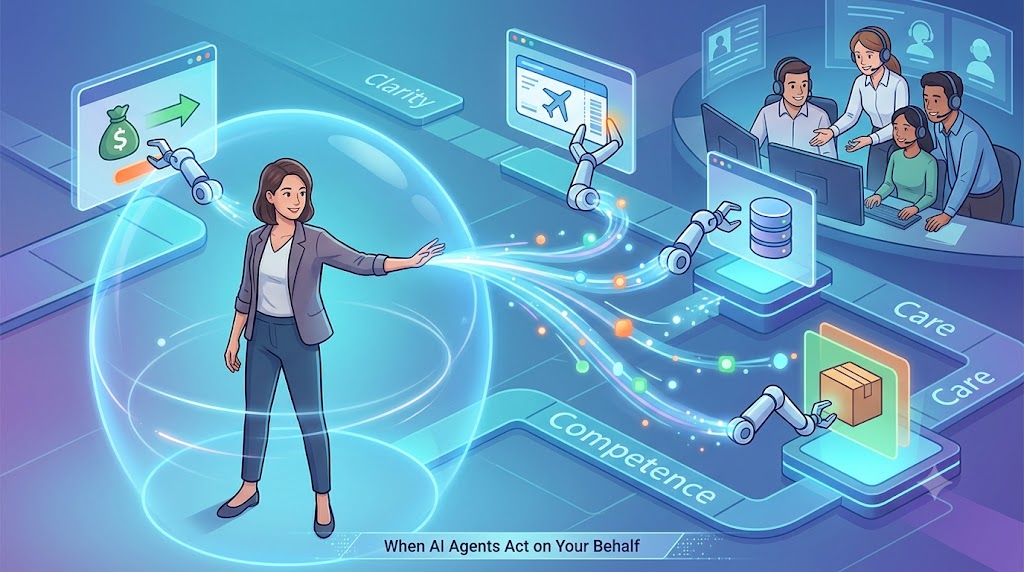
Charles Feltman, author of The Thin Book of Trust: An Essential Primer for Building Trust at Work, approaches trust from a unique angle. His definition of trust is relational: “choosing to risk making something you value vulnerable to another person’s actions.” Feltman identifies four assessments people make when deciding whether to trust someone: sincerity, reliability, competence, and care. Most breakdowns occur, says Feltman, not because of dramatic betrayal, but because expectations were never clarified.

In practical terms, this means leaders must become unusually precise communicators. Reliability is strengthened when commitments are explicit and modest rather than vague and ambitious. A manager who promises weekly updates and delivers them faithfully builds more trust than one who announces sweeping transformation but repeatedly misses deadlines. In accelerated environments where plans quickly become obsolete, Feltman encourages renegotiating commitments openly. Silence erodes trust faster than bad news.

Both Covey and Feltman emphasize the power of repair. Distrust grows when mistakes are hidden or minimized. Trust grows when harm is acknowledged quickly and concretely. In organizations facing AI disruption or restructuring, leaders who communicate early and empathetically often preserve loyalty even through painful transitions. People are more willing to endure change when they believe they are being treated honestly.

For leaders, building and maintaining trust is not an abstract academic conversation. In a world shaped by exponential technologies and volatile narratives, trust is a performance advantage. High trust reduces friction and speeds execution. Low trust multiplies oversight, legal review, defensive communication, and second-guessing.

In the Age of Acceleration, building trust truly matters.

This article originally appeared in Forbes

Image credit: Pixabay

Subscribe to Human-Centered Change & Innovation WeeklySign up here to get Human-Centered Change & Innovation Weekly delivered to your inbox every week.

Making Ring-fenced Funding Work

Toughest Challenge Series: Episode 2

Making Ring-fenced Funding Work

GUEST POST from Geoffrey A. Moore


Inspired by the HP Incubations Team

Here’s the challenge. Everyone gets that you need to ring-fence funding for incubating Horizon 3 initiatives. At the corporate level, with the CEO’s direct sponsorship, this can be managed as a separate operating unit with its own budget. The challenge is when the incubation is nested. That means it is being funded out of the operating budget of a Performance Zone business unit, not from some special set-aside allocation.

Nested incubation represents the majority of internally funded Horizon 3 investments. (M&A is a different vehicle, funded out of capex not opex, and is not subject to the challenges we will discuss here). The reason there is a strong preference for nested incubations is that, if successful, they are of immediate interest to the business unit’s current customer base as well as its partner ecosystem. That is, while there can be high technical risk, there is little to no market risk. That said, it is still early days, the technology is not proven, product-market fit still needs to be determined, so it is in no position to generate ROI in the current fiscal year.

The challenge comes to the fore in a tough year where the corporation has to cut back on its operating expenses. Everybody is expected to take a haircut, tighten their belts, suck it up, and carry on. The problem is, when it comes to managing incubations, this simply does not work. Incubation is all about getting and maintaining momentum. If at any point you take your foot off the accelerator, you will lose momentum, and you will never get it back. Instead, you will salvage what you can from the R&D and write the whole thing off to bad timing. But let’s be clear: this is not management, this is mismanagement.

So, what’s the fix? It starts with the business unit surfacing its incubation opportunity during the annual budgeting process. It proposes to set aside a portion of its next year’s budget dedicated to funding the incubation, with funding released on a VC-model based on milestone attainment. This is documented and agreed to at the Executive Leadership Team level. If bad times hit, the choice is never to take a haircut; it is either to carry on or cancel things altogether, and it is made in dialog with the ELT since either way it could have a material impact on the enterprise’s market valuation.

Once the nested incubation has been agreed to, then the business unit leader is responsible for ensuring its funding stays ring-fenced. In particular, this means that resources assigned to the incubation effort cannot be “borrowed” by the current product lines to temporarily address an urgent need. Again, this is all about maintaining momentum.

To ensure this works as planned, here is a tip from a long-time friend and colleague who is the CFO at a major enterprise:

All ring-fenced items are documented and agreed upon at the ELT level. The way it works is the finance team who work with the budget holder is the guardian of all ring-fenced spend. When changes need to be made, they can’t touch ring-fenced spend. Of course, you have to limit the number of ring-fenced items to give freedom of execution to the leaders, but it’s an effective mechanism.

That’s what he thinks. And that’s what I think too. What do you think?

Image Credit: Google Gemini

Subscribe to Human-Centered Change & Innovation WeeklySign up here to join 17,000+ leaders getting Human-Centered Change & Innovation Weekly delivered to their inbox every week.

Do You Have an Empty Tank?

Do You Have an Empty Tank?

GUEST POST from Mike Shipulski

Sometimes your energy level runs low. That’s not a bad thing, it’s just how things go. Just like a car’s gas tank runs low, our gas tanks, both physical and emotional, also need filling. Again, not a bad thing. That’s what gas tanks are for – they hold the fuel.

We’re pretty good at remembering that a car’s tank is finite. At the start of the morning commute, the car’s fuel gauge gives a clear reading of the fuel level and we do the calculation to determine if we can make it or we need to stop for fuel. And we do the same thing in the evening – look at the gauge, determine if we need fuel and act accordingly. Rarely we run the car out of fuel because the car continuously monitors and displays the fuel level and we know there are consequences if we run out of fuel.

We’re not so good at remembering our personal tanks are finite. At the start of the day, there are no objective fuel gauges to display our internal fuel levels. The only calculation we make – if we can make it out of bed we have enough fuel for the day. We need to do better than that.

Our bodies do have fuel gages of sorts. When our fuel is low we can be irritable, we can have poor concentration, we can be easily distracted. Though these gages are challenging to see and difficult to interpret, they can be used effectively if we slow down and be in our bodies. The most troubling part has nothing to do with our internal fuel gages. Most troubling is we fail to respect their low fuel warnings even when we do recognize them. It’s like we don’t acknowledge our tanks are finite.

We don’t think our cars are flawed because their fuel tanks run low as we drive. Yet, we see the finite nature of our internal fuel tanks as a sign of weakness. Why is that? Rationally, we know all fuel tanks are finite and their fuel level drops with activity. But, in the moment, when are tanks are low, we think something is wrong with us, we think we’re not whole, we think less of ourselves.

When your tank is low, don’t curse, don’t blame, don’t feel sorry and don’t judge. It’s okay. That’s what tanks do.

A simple rule for all empty tanks – put fuel in them.

Image credit: Pixabay

Subscribe to Human-Centered Change & Innovation WeeklySign up here to join 17,000+ leaders getting Human-Centered Change & Innovation Weekly delivered to their inbox every week.

VC-Backed Firms in Regulated Industries

The Times They Are A-Changin’

VC-Backed Firms in Regulated Industries

GUEST POST from Geoffrey A. Moore

This week I have had conversations with executive teams of VC-backed firms working in three different regulated industries: Healthcare, Telco, and Financial Services. All of them reported that their sales pipelines were around 3X what they were a year ago. We didn’t dig into why, although I expect that it means the incumbent providers are under increasing pressure to modernize their operating models and streamline their infrastructure models to meet customer demand and pricing pressure.

The reason we did not get to discuss why this is happening is that each of the teams was more focused on how — how do we adapt our playbook to this new development? You might not think an upsurge in demand would be a problem, but all three of these firms are at least an order of magnitude sub-scale to properly address the demands of their target customers. How do you ride such a wave demand without wiping out? How do you scale and not break your company?

Understanding the Dynamics of the Situation

The easiest way to see what is going on here is to examine it through the lens of the Hierarchy of Powers. Here’s how it plays out:

  • Category Power. The category is shifting from resisting the next wave to embracing it, albeit reluctantly, because the status quo is deteriorating, and it is clear something has to change. This leads to the upsurge in RFPs and RFIs that each company is now seeing. Budget is being created whereas before it had to be scrounged. This is great news for each enterprise, but it has its challenges.
  • Company Power. Compared to the Tier 1 prospects each of these companies is targeting, their own is tiny indeed. All of them lack the global reach and depth of personnel their customers require. Nonetheless, these are their most valuable prospects, so they must find a way to engage. That’s the core of the challenge.
  • Market Power. Each company has already focused on a single vertical—that is how they got as far as they have. Now they are going to have to focus even more rigorously in order to control their exposure to too much demand coming at them too fast and too soon. To secure market power, to become the go-to vendor for their category of offer for this vertical, they must prioritize the right subset of prospects and do whatever it takes to get them over the line.
  • Offer Power. This is where each company shines. It is why they are each attracting the attention of companies that a year ago were not returning their calls. Their products, however, are highly complex, and the implementations even more so, so they cannot support runaway growth. Moreover, the regulated industries they serve impose rigorous, one might even say onerous, demands, creating a whole series of hoops to jump through before they can get to the other side. How do you “catch the wave” when the sign on the beach says “proceed with caution”?
  • Execution Power. At the end of the day, this is the crux of the challenge. How can a subscale company with a world-class offer meet the demands of a regulated industry dominated by behemoth enterprises? How should it adapt its playbook?

Adapting the Playbook

Given this change in dynamics, here are the kinds of adaptions that are called for:

  • Control your destiny by narrowing your focus. The key for all three enterprises is to win a handful of Tier 1 accounts that the rest of the industry looks to for best practices. Winning these accounts will establish them as the go-to choice for the industry as a whole. This objective trumps all others, and every organization inside the company needs to reprioritize its workload accordingly.
  • Hold fast to your priorities. This is an internal transformation that requires strict discipline to execute. In the past, it was OK to step off the path to address an impromptu request because the demand for everyone’s time was less insistent. Now it is not. Use weekly commits as a way to make workloads visible, and intervene whenever they are drifting off course.
  • Stay very focused on your top-tier target accounts. Every one of them is a priority, even when they may not be giving you all the reception you want. Conversely, all other prospects are a distraction even when they are inviting you in.
  • Continue to serve your existing customer base. These are not the Tier 1 players we are targeting, but they are references that can help win those accounts. In addition, they are the early adopters who put their faith in you. You must do right by them.
  • Align with a big friend. Your target customers need you to bring many more resources to the table than you have inside your company. The good news is that these same customers work with global service providers who specialize in helping them on-board next-generation offers. You need to secure strong support from at least one of these, and you probably cannot easily support more than one, so pick one you think you can trust, and go all in with them on your go-to-market planning.
  • Let the big friend help you clear your regulatory hurdles. Time is your scarcest resource, and unfortunately, regulated industries are not good at moving swiftly. It’s a mismatch in operating models. VC-backed companies take risks to save time; regulated industries take time to reduce risk. This is not something you are well positioned to deal with. Global services firms, on the other hand, already have relationships with the regulatory authorities you must interface with, not to mention the bandwidth to work through the mandated processes. Do whatever you can to get their help in expediting whatever needs to be done.
  • Create the solution playbook that you and your GSI friend will co-deliver. Do not let the GSI take over the implementation. You know a lot more about what it takes to make your solution work than they do. But you can make sure that the work is profitable for them by giving them the playbook and letting them bill for their time. You don’t need the services revenue anywhere near as much as you need the Tier 1 account win.
  • Defer inbound requests that take you off strategy. You don’t have to say no. You just have to say, not yet. Given the amount of stress that any Tier 1 engagement will put on your firm, taking even one account that is off-script risks breaking your camel’s back.
  • Defer inbound interest around an acquisition. You are at an inflection point in value creation that is potentially extraordinary, the very outcome you and your investors have been preparing for. This is not the time to let go of the reins, particularly if they are going to get handed to an established enterprise whose culture is likely to clash with yours. Moreover, you cannot afford the distraction of all the due diligence that M&A discussions necessarily entail. M&A cannot solve your Tier 1 problem. You have to do that yourself.

Now, to be clear, there are exceptions that could overrule any one of the prescriptions above, so each team needs to review them in light of its own history and circumstances. The key point is that when the market is shifting from a state of scarcity to one of abundance, there is a short time window to catch that wave. The large competitors cannot move fast enough to do this themselves — that is why they are interested in making an acquisition. You are agile enough to do so, but you are painfully subscale — hence the need for the somewhat drastic prescriptions above. Navigating this part of the journey is tricky, but if you stay focused on winning (and keeping!) a handful of Tier 1 accounts, you are making the best bet.

That’s what I think. What do you think?

Image Credit: Google Gemini

Subscribe to Human-Centered Change & Innovation WeeklySign up here to join 17,000+ leaders getting Human-Centered Change & Innovation Weekly delivered to their inbox every week.

Top 10 Human-Centered Change & Innovation Articles of February 2026

Top 10 Human-Centered Change & Innovation Articles of February 2026Drum roll please…

At the beginning of each month, we will profile the ten articles from the previous month that generated the most traffic to Human-Centered Change & Innovation. Did your favorite make the cut?

But enough delay, here are February’s ten most popular innovation posts:

  1. Three Myths That Kill Change and Transformation — by Greg Satell
  2. Why a Customer Experience Audit is Non-Negotiable in 2026 — by Braden Kelley
  3. Innovation Lessons from the 50 Most Admired Companies of 2026 — by Braden Kelley
  4. Is Your Customer Experience a Lie? — by Braden Kelley
  5. Important or Urgent? — by Stefan Lindegaard
  6. The Greatest Inventor You’ve Never Heard of — by John Bessant
  7. 5 Simple Keys to Becoming a Powerful Communicator — by Greg Satell
  8. Do You Have What It Takes to be a Visionary? — Exclusive Interview with Mark C. Winters
  9. Temporal Agency – How Innovators Stop Time from Bullying Them — by Art Inteligencia
  10. Causal AI – Moving Beyond Prediction to Purpose — by Art Inteligencia

BONUS – Here are five more strong articles published in January that continue to resonate with people:

If you’re not familiar with Human-Centered Change & Innovation, we publish 4-7 new articles every week built around innovation and transformation insights from our roster of contributing authors and ad hoc submissions from community members. Get the articles right in your Facebook, Twitter or Linkedin feeds too!

Build a Common Language of Innovation on your team

Have something to contribute?

Human-Centered Change & Innovation is open to contributions from any and all innovation and transformation professionals out there (practitioners, professors, researchers, consultants, authors, etc.) who have valuable human-centered change and innovation insights to share with everyone for the greater good. If you’d like to contribute, please contact me.

P.S. Here are our Top 40 Innovation Bloggers lists from the last five years:

Subscribe to Human-Centered Change & Innovation WeeklySign up here to get Human-Centered Change & Innovation Weekly delivered to your inbox every week.