Category Archives: education

Exploring the Impact of Human-Computer Interaction

Exploring the Impact of Human-Computer Interaction

GUEST POST from Chateau G Pato

In today’s digital age, interactions between humans and computers have become an integral part of our daily lives. Human-Computer Interaction (HCI) refers to the design, development, and study of interactive systems that facilitate seamless communication between humans and computers. This field has revolutionized various industries and transformed the way we live, work, and interact. In this article, we will explore the impact of HCI on two case study examples.

Case Study 1 – Healthcare Industry

The healthcare industry has witnessed significant advancements through the application of HCI principles. One notable case study is the implementation of electronic health record (EHR) systems. These systems allow healthcare professionals to securely store and access patients’ medical information in a digital format. HCI plays a crucial role in designing user-friendly interfaces that enhance the accuracy, efficiency, and usability of EHR systems.

For instance, the adoption of user-centered design principles in EHR systems has led to improvements in information organization, task efficiency, and error reduction. By understanding the needs and workflows of healthcare professionals, HCI experts have successfully integrated features like intuitive user interfaces, context-awareness, and decision support systems. These advancements not only improve healthcare professionals’ productivity but also enhance patient safety and healthcare quality.

Moreover, HCI has facilitated the development of patient-centric systems in healthcare. For example, wearable devices and smartphone applications enable individuals to monitor their health conditions and communicate with healthcare providers. HCI techniques ensure that these systems provide a seamless experience, empowering patients to actively participate in their healthcare management. From reminders for medication adherence to real-time health tracking, HCI has revolutionized how patients engage with healthcare services, leading to better health outcomes.

Case Study 2 – Education Sector

HCI has made substantial contributions to the education sector, transforming pedagogical approaches and improving learning outcomes. One compelling case study is the integration of technology in classrooms, such as interactive whiteboards and collaborative learning platforms. HCI principles help create engaging and interactive interfaces that facilitate effective knowledge transfer and student engagement.

For instance, interactive whiteboards enable teachers to develop multimedia-rich lessons, encouraging active student participation. HCI considerations ensure that these boards have user-friendly interfaces, allowing educators to seamlessly navigate through content and incorporate various media elements like images, videos, and interactive quizzes. By creating a dynamic learning environment, HCI has enhanced student engagement and knowledge retention.

Furthermore, HCI has played a pivotal role in the development of online learning platforms and Massive Open Online Courses (MOOCs). Through HCI techniques, these digital learning platforms provide personalized learning experiences, adaptive assessments, and social interactions among learners. HCI principles guide the design of intuitive, accessible, and customizable interfaces that cater to diverse learner needs, ultimately promoting effective and accessible education beyond traditional classroom settings.

Conclusion

Human-Computer Interaction has had a profound impact on various industries, significantly transforming healthcare and education. The case study examples discussed highlight the power of HCI in creating user-friendly systems that enhance productivity, safety, and engagement. As technology continues to advance, the field of HCI will undoubtedly play a critical role in shaping the future of human-computer interactions, ensuring seamless experiences and enriching lives.

Bottom line: Futurology is not fortune telling. Futurists use a scientific approach to create their deliverables, but a methodology and tools like those in FutureHacking™ can empower anyone to engage in futurology themselves.

Image credit: Pixabay

Subscribe to Human-Centered Change & Innovation WeeklySign up here to get Human-Centered Change & Innovation Weekly delivered to your inbox every week.

Predictions for the Future of Education

Predictions for the Future of Education

GUEST POST from Chateau G Pato

The Education sector is rapidly evolving and no one is quite sure what the future holds. It’s clear that technology advancements and changes in the way we approach day-to-day learning are here to stay, but there are a few noteworthy trends that may indicate what the future may hold.

1. Moving to Online Learning

The increase in digital technology over the past decade has made the move to online learning inevitable. In recent years, many educational institutions have begun offering online courses or even entire degree programs. This is proving to be an incredibly popular option among students who may not otherwise have access to more traditional learning.

In Finland, the University of Jyväskylä has taken a unique approach to the online learning revolution. Rather than offering traditional classes, the university offers an “open university” platform, where students can learn from experts without actually enrolling in a course. This approach has proven to be successful, and it’s likely that more educational institutions will begin adopting this model.

2. Personalized Learning

As technology advances, so too do our abilities to offer personalized learning. Through tracking systems, teachers can customize lesson plans and course material to better suit each student’s individual needs. Not only does this ensure that each student gets the most out of their education, but it also allows educators to detect and address potential problems before they become serious.

The Walton Family Foundation, for example, is providing schools with the resources necessary to implement personalized learning strategies. This has proven to be a successful approach in some areas, and it’s likely that more educational institutions will begin adopting similar strategies in the near future.

3. Increased Attention on Social and Emotional Development

In recent years, there has been an increased focus on the importance of social and emotional development in students. The prevalence of mental health issues among children and adolescents has forced educators to reassess their methods and approach the issue from a more holistic perspective.

In the United Kingdom, the government is currently working to ensure that social and emotional development is given the attention it deserves in the classroom. They are currently exploring ways to make sure that every school has access to the necessary resources and programs to ensure that students are emotionally and mentally supported.

Conclusion

These are just a few of the trends that may indicate what the future may hold when it comes to the education sector. As technology continues to develop and new methods are explored, we can only wait to see what the future of Education has in store.

Bottom line: Futurology is not fortune telling. Futurists use a scientific approach to create their deliverables, but a methodology and tools like those in FutureHacking™ can empower anyone to engage in futurology themselves.

Image credit: Pixabay

Subscribe to Human-Centered Change & Innovation WeeklySign up here to get Human-Centered Change & Innovation Weekly delivered to your inbox every week.

Developing Design Thinking Skills Through Experiential Learning

Developing Design Thinking Skills Through Experiential Learning

GUEST POST from Chateau G Pato

Design thinking is an innovative problem-solving approach that emphasizes looking for creative solutions to complex problems. It encourages people to rethink the way they view an issue, break it down into smaller components, and then come up with solutions that could be developed through experimentation and collective learning. It is an important skill to have in all areas of life, from business to education and beyond.

Fortunately, experiential learning is one of the best ways to develop design thinking skills. This hands-on learning strategy gives participants the opportunity to gain knowledge and skills through direct experience in a range of contexts. Through this approach, individuals can broaden their horizons while engaging in an environment of learning and creative problem solving.

Case Study #1 – StarDesign

StarDesign is an industry leading tech company that utilizes experiential learning to develop design thinking skills in its employees. The company regularly puts its staff members in various challenging situations and calmly encourages them to look for creative solutions.

In one instance, a team of five was asked to develop one brand idea into five operational models for a new product launch. To foster creative thinking, the team was given the task to brainstorm a range of solutions that could be implemented. Through the experience, each member gained an understanding of how design thinking can be utilized to create value and innovate in an ever-changing industry.

Case Study #2 – The Adopt A School Program

The Adopt A School Program is a nonprofit organization in California that is focused on educating and developing young minds. The organization has developed an experiential learning approach to build design thinking skills in fifth graders. Through the program, young students are put into various design thinking challenges that encourage them to search for creative solutions. The organization has also implemented group activities such as team building events and creative brainstorming sessions.

The Adopt A School Program has helped to build an innovative culture in the classrooms by encouraging students to take risks and think outside the box. Through this approach, students have developed a better understanding of “thinking outside the box” and have gained a unique perspective on problem solving.

Conclusion

Experiential learning is an invaluable tool for developing design thinking skills. Through hands-on applications, people can gain an understanding of the unique problem-solving method and apply it to their own life. By engaging in challenging situations, they can expand their horizon and innovate through creative problem solving.

Image credit: Pexels

Subscribe to Human-Centered Change & Innovation WeeklySign up here to get Human-Centered Change & Innovation Weekly delivered to your inbox every week.

Training Innovators in Interdisciplinary Thinking

Training Innovators in Interdisciplinary Thinking

GUEST POST from Art Inteligencia


The Silo Crisis in Modern Innovation

Organizations today find themselves trapped in a paradox of their own making. We possess more specialized knowledge, more advanced tools, and more data than at any point in human history. Yet, groundbreaking innovation remains frustratingly elusive. The culprit isn’t a lack of talent or capital; it is the rigid, functional silos — R&D, marketing, operations, finance — that slice our organizations into isolated fiefdoms. These departments have developed their own languages, metrics, and subcultures, creating artificial barriers that stifle collective intelligence.

Breakthrough value rarely occurs within the comfortable confines of a single discipline. Instead, it ignites at the messy, unpredictable intersections where disparate fields collide. When we look at the most transformative shifts in business and society, they are inherently interdisciplinary. To thrive in a landscape defined by accelerating technological disruption and shifting human expectations, organizations must move away from training hyper-specialized cogs. We must instead cultivate “T-shaped” innovators — professionals who possess deep domain expertise but excel in the art of collaborative translation.

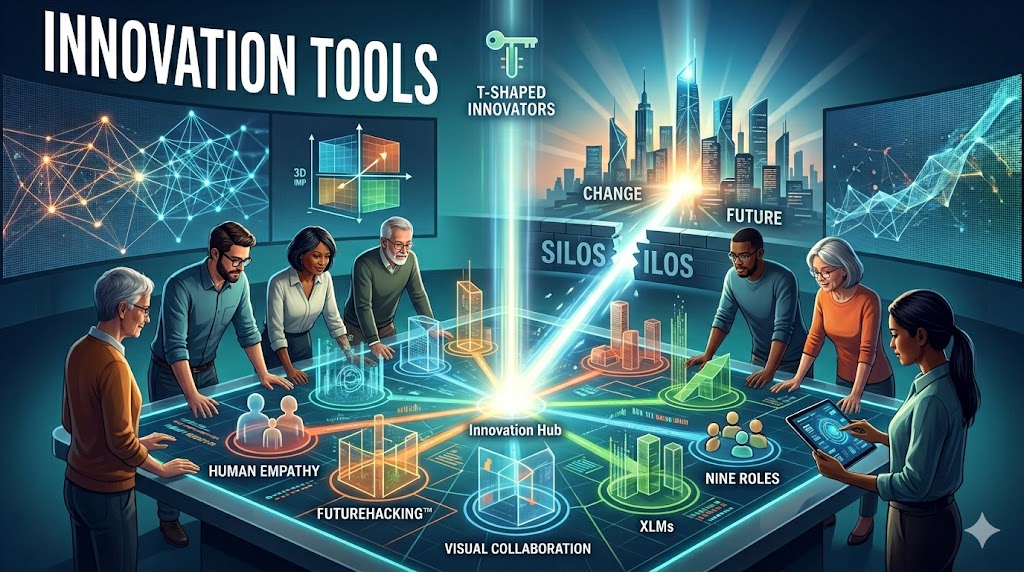
Training innovators in interdisciplinary thinking is not an academic exercise in multi-tasking; it requires a fundamental rewiring of organizational culture. It demands that we move beyond standard skill acquisition to intentionally foster a mindset rooted in deep empathy, cognitive flexibility, and visual collaboration. If we want to build a future-ready enterprise, we must first build the connective tissue that allows our people to think, create, and change across boundaries.

The Core Pillars of the Interdisciplinary Mindset

To build a workforce capable of breaking through functional silos, we must first define the mental architecture of an interdisciplinary thinker. Interdisciplinary capability is not merely an accumulation of diverse facts; it is a distinct cognitive framework built upon three foundational pillars that allow individuals to navigate, translate, and synthesize complex ideas across boundaries.

1. Human-Centered Empathy as a Universal Translator

In a siloed organization, departments often protect their own turf by retreating behind specialized jargon and insular goals. Human-centered empathy serves as the ultimate antidote to this fragmentation. When we anchor the innovation process deeply in the lived experiences, unmet needs, and emotional realities of the end-user, we create a common purpose that transcends departmental politics.

Training innovators in this pillar requires shifting their primary question from a technology-first or finance-first perspective (“What can we build or sell?”) to a human-first perspective (“Whose life are we improving, and why?”). When an engineer, a marketer, and a financial analyst all focus intensely on the same human persona, their disciplinary differences melt away, replaced by a shared vocabulary of human value.

2. Cognitive Agility and Perspective-Shifting

True innovators do not look at a business challenge from a single stationary point. They possess the cognitive agility to rapidly shift perspectives, viewing a single problem through multiple distinct lenses in quick succession. Interdisciplinary training must deliberately cultivate this mental flexibility.

An agile thinker must learn to adopt the healthy skepticism of the scientist, the deep empathy of the designer, the practical execution focus of the operator, and the long-term vision of the futurist. By intentionally practicing these mental pivots, innovators learn to appreciate the validity of other departments’ constraints rather than viewing them as arbitrary roadblocks to progress.

3. Comfort with Ambiguity and the “Magic Maker” Persona

Linear, predictable processes are comfortable, but they rarely yield disruptive breakthroughs. The intersection of multiple disciplines is inherently messy, chaotic, and non-linear. Therefore, a core pillar of the interdisciplinary mindset is a high tolerance for ambiguity — the ability to operate effectively when the destination is not yet clear and the rules have not yet been written.

In our innovation frameworks, we often reference the concept of the Magic Maker — the individual who thrives in this unstructured middle zone, turning abstract, cross-functional concepts into tangible reality. Training innovators means pushing them out of the comfort of rigid checklists and teaching them to embrace iterative experimentation, prototyping, and the fast-cycle learning that occurs when different fields collide.

Overcoming the “Language Barrier” of Separate Disciplines

Even when professionals possess the right mindset, interdisciplinary collaboration often grinds to a halt because teams simply cannot understand one another. Decades of corporate specialization have created distinct tribal dialects within organizations. To build a cohesive engine of innovation, we must dismantle these communication barriers and establish shared structures for value creation.

1. Demolishing the Jargon Wall

Specialized vocabulary is a double-edged sword. While it allows deep experts to communicate efficiently with their peers, it acts as an exclusionary wall to outsiders. When an agile developer talks about “story points,” a marketer discusses “attribution models,” and a finance lead focuses on “amortization,” collaboration gives way to confusion and alienation.

Overcoming this requires an intentional effort to establish a shared organizational lexicon for innovation and change. Interdisciplinary training must teach experts to translate their specialized insights into plain, outcome-oriented language. The goal is not to dumb down the expertise, but to democratize it, ensuring that ideas are judged on their strategic merit rather than the eloquence of their departmental slang.

2. From SLAs to XLMs (Experience Level Measures)

Traditional corporate structures rely heavily on Service Level Agreements (SLAs) to govern cross-departmental handoffs. However, SLAs are inherently siloed and transactional; they measure operational efficiency (e.g., system uptime, response times) rather than holistic value. When every department hits its individual SLA targets but the final product still fails the customer, the organization is suffering from a systemic breakdown.

To train interdisciplinary innovators, we must shift our metrics from SLAs to XLMs (Experience Level Measures). XLMs capture the qualitative, cross-functional impact of business processes on human beings — whether they are customers or employees. By measuring success based on the end-to-end experience rather than isolated operational outputs, we force disparate disciplines to align their efforts toward a singular, cohesive human outcome.

3. The Power of Visual Collaboration and Canvases

When communication fails, visual tools can bridge the gap. Human beings are inherently visual creatures, yet corporate documentation remains overwhelmingly text-heavy, buried in dense slide decks and multi-page requirements documents that invite misinterpretation.

Interdisciplinary training should champion the use of collaborative, visual frameworks, such as dedicated change planning and project canvases. These tools act as a democratization layer. By mapping out problem spaces, stakeholders, risks, and value propositions on a single, shared visual canvas, engineers, marketers, and executives can literally see where their work intersects. Visual collaboration strips away corporate hierarchy and linguistic barriers, allowing teams to co-create rapidly and iteratively in real time.

Designing the Interdisciplinary Curriculum

Developing interdisciplinary innovators requires moving past passive learning models. We cannot simply lecture employees on the value of collaboration and expect them to transform. Instead, organizations must deploy an experiential curriculum that forces cognitive friction, sharpens foresight, and builds practical collaboration skills through deliberate practice.

1. FutureHacking™ and Signal Picking as Training Tools

To think across boundaries, innovators must learn to anticipate how shifts in one domain will spark ripples in another. We train individuals in this capability through our FutureHacking™ methodology, specifically focusing on the practice of cross-industry “Signal Picking.” Trainees are taught to actively scan the horizon for weak signals of change — technological, cultural, economic, or regulatory — outside of their primary industry.

A core curriculum exercise involves the use of a cross-impact matrix. Trainees are given a set of seemingly unrelated signals — for instance, a breakthrough in biosynthetic materials and a shift in urban millennial housing trends — and tasked with mapping their intersection. This forces the brain out of linear thinking and trains innovators to uncover hidden opportunities and systemic threats long before they manifest in the mainstream marketplace.

2. Experiential Rotations and Deep Shadowing

Empathy cannot be taught entirely via a slide presentation; it must be felt. An effective interdisciplinary curriculum incorporates short-term, high-impact experiential rotations and “deep shadowing” programs. This is not about training an engineer to become a marketer, but rather allowing them to sit in the marketer’s chair during a critical campaign launch or customer research cycle.

By immersing themselves in the daily realities, operational constraints, and pressures of another department, trainees build firsthand emotional intelligence. They witness the unintended friction that their own department’s outputs might cause down the line, fundamentally changing how they approach cross-functional solution design when they return to their primary roles.

3. The “Nine Innovation Roles” Alignment Exercise

Every successful innovation initiative requires a diverse ecosystem of mindsets, but teams often fail because they do not understand their internal dynamics. In our training programs, we leverage the Nine Innovation Roles framework to help individuals identify their natural innovation archetypes and learn how to collaborate intentionally with complementary profiles across the organization.

During this alignment exercise, trainees discover whether they lean toward being a strategic guide, an institutional anchor, or roles like The Conscript (the reluctant but vital operational realist) or The Magic Maker (the creative synthesizer who thrives in unstructured ambiguity). By mapping these roles transparently across a cross-functional team, trainees learn to value the cognitive diversity of their peers, transforming potential friction points into collaborative strengths.

Structural Support: Building the Infrastructure for Interdisciplinary Growth

Training individuals in interdisciplinary thinking is only half the battle. If you drop a highly collaborative, T-shaped innovator back into a rigid, traditional corporate hierarchy, the system will eventually reject them. To sustain a culture of cross-pollination, organizations must build the structural scaffolding and governance models that allow interdisciplinary capabilities to take root and flourish.

1. The Role of the Experience Management Office (XMO)

To prevent interdisciplinary insights from getting trapped in organizational vacuums, companies need a dedicated champion at the structural level. This is the primary function of an Experience Management Office (XMO). Unlike a traditional Project Management Office (PMO) that focuses primarily on timelines, budgets, and operational task execution, the XMO acts as the organization’s connective tissue.

The XMO is tasked with overseeing cross-functional training, managing the deployment of visual collaboration methodologies, and ensuring that qualitative customer and employee insights are shared transparently across all departments. By acting as a centralized hub for decentralized thinking, the XMO helps scale interdisciplinary training from an isolated HR initiative into a core business capability.

2. Rewarding the “In-Between” Spaces

Human behavior follows incentives. One of the greatest barriers to long-term interdisciplinary innovation is the traditional Key Performance Indicator (KPI) framework. When employees are evaluated solely on vertical, siloed achievements — such as lines of code written, leads generated, or calls closed — they have zero professional incentive to step outside their comfort zones and collaborate across boundaries.

Organizations must intentionally redesign their performance management systems to reward the “in-between” spaces. This means establishing shared, cross-departmental goals, recognizing individuals who actively facilitate cross-pollination, and carving out dedicated time for collaborative experimentation. When people see that bridging disciplines is actively incentivized and celebrated by leadership, the structural walls that separate them begin to crumble naturally.

Conclusion: The Future Belongs to the Connectors

The challenges facing the modern enterprise are too complex, too interconnected, and too fast-moving to be solved by any single department or discipline. When we restrict our thinking to functional silos, we don’t just limit our operational efficiency; we starve our organizations of the diverse perspectives required to create truly breakthrough value. Training innovators in interdisciplinary thinking is the ultimate antidote to this stagnation.

Innovation is not a distinct department on an organizational chart — it is a pervasive organizational capability driven by individuals who can confidently bridge worlds. By intentionally cultivating an interdisciplinary mindset, breaking down communication and language barriers, deploying experiential learning frameworks, and reinforcing these efforts with robust structural governance like an XMO, we do more than just optimize our product development pipeline.

We build highly agile, deeply empathetic organizations capable of shaping the future rather than merely reacting to it. In the next era of business, the ultimate competitive advantage will not belong to the organizations that possess the most data or the deepest pockets, but to those that can connect the dots between disparate fields to deliver cohesive, human-centered value.

Frequently Asked Questions

Why is interdisciplinary thinking critical for modern innovation?

Modern business challenges are too complex to be solved within functional silos. True breakthrough innovation occurs at the intersections of different fields. By training teams in interdisciplinary thinking, organizations dismantle communication barriers, leverage cognitive diversity, and design holistic, human-centered solutions rather than fragmented, isolated outputs.

What is the difference between an SLA and an XLM?

Service Level Agreements (SLAs) are traditional, siloed metrics that track transactional and operational efficiency, such as system uptime or response rates. Experience Level Measures (XLMs), on the other hand, measure the qualitative, cross-functional impact of business processes on the actual human experience. XLMs force disparate departments to align toward a singular, shared human outcome.

How does an Experience Management Office (XMO) support innovation?

An XMO acts as the organizational connective tissue that prevents cross-disciplinary insights from being lost in functional vacuums. Unlike a PMO focused strictly on project timelines and budgets, the XMO manages the scaling of interdisciplinary training, champions the use of visual collaboration tools, and ensures that human-centered insights are shared fluidly across the entire enterprise.


SPECIAL BONUS: Braden Kelley’s Problem Finding Canvas can be a super useful starting point for doing design thinking or human-centered design.

“The Problem Finding Canvas should help you investigate a handful of areas to explore, choose the one most important to you, extract all of the potential challenges and opportunities and choose one to prioritize.”

Image credit: Gemini

Subscribe to Human-Centered Change & Innovation WeeklySign up here to get Human-Centered Change & Innovation Weekly delivered to your inbox every week.

Growth Mindset Pedagogy that Actually Changes Behavior

LAST UPDATED: March 8, 2026 at 11:48 AM

Growth Mindset Pedagogy that Actually Changes Behavior

GUEST POST from Art Inteligencia


I. Introduction: The Dilution of Growth Mindset

In the decade since Carol Dweck’s seminal work entered the mainstream, “Growth Mindset” has transitioned from a groundbreaking psychological insight into a ubiquitous corporate and educational buzzword. However, this popularity has come at a cost: the dilution of the concept into a harmless platitude. To truly change behavior, we must first strip away the misconceptions that have turned a rigorous developmental tool into a synonym for “having a positive attitude.”

The “False” Growth Mindset Trap

Many organizations and educators fall into the trap of a “False Growth Mindset.” This is the belief that simply praising effort or being open-minded is sufficient. In reality, a growth mindset is not about trying harder at a failing strategy; it is the physiological and psychological process of developing talent through deliberate practice, course correction, and the belief that abilities are malleable. When we praise effort without focusing on the process that leads to learning, we inadvertently reinforce a fixed mindset by rewarding stagnation disguised as busyness.

The Performance Gap: Knowledge vs. Action

There is a significant gap between understanding the theory of growth and executing it under pressure. In high-stakes environments—whether a boardroom or a testing hall—the biological urge to avoid failure often overrides the intellectual desire to grow. This “Performance Gap” exists because our pedagogical structures often still reward “getting it right the first time” while punishing the messy, iterative stages of innovation. Knowing about a growth mindset is a cognitive state; practicing it is a behavioral discipline.

The Thesis: Architectural Pedagogy

To move beyond the philosophy of growth, we must redesign our pedagogy. It is not enough to tell people they can grow; we must build an architecture of failure, feedback, and psychological safety that makes growth the path of least resistance. This article explores how to move from a culture of “perfectionism” to a culture of “continuous iteration,” where the goal is not the absence of mistakes, but the speed and quality of the learning derived from them.

II. Beyond Effort: The Three Pillars of Behavioral Change

If growth mindset pedagogy is to move beyond a mere “feel-good” philosophy, it must provide a concrete behavioral scaffolding. Behavior doesn’t change through inspiration alone; it changes through the consistent application of new habits and the structural reinforcement of those habits. To achieve true behavioral transformation, we must focus on three specific pillars: Strategy-Shifting, Metacognition, and Iterative Assessment.

1. Strategy-Shifting over Persistence

One of the most dangerous misconceptions in growth mindset coaching is the glorification of “grit” as sheer, blind persistence. In an innovation context, trying harder at a failing strategy isn’t a growth mindset—it’s a fixed mindset trap disguised as hard work. Effective pedagogy teaches learners to treat their methods as hypotheses. When a student or employee hits a wall, the instruction should not be “try again,” but “pivot the process.”

  • The Pivot Mindset: Recognizing when a current mental model has reached its limit.
  • Resource Seeking: Teaching that seeking help or new tools is a sign of strategic intelligence, not a lack of innate ability.
  • The “Failure Analysis” Protocol: Deconstructing why a specific approach failed to separate the person’s identity from the tactical error.

2. Metacognition as a Core Competency

Metacognition—thinking about how we think—is the engine of behavioral change. Without it, learners are simply reacting to stimuli. To build a growth-oriented pedagogy, we must bake reflection into the workflow. This means shifting the focus from the output (the “what”) to the cognitive journey (the “how”).

In practice, this involves “Learning Out Loud.” When a leader or educator models their own struggle with a complex problem, they demonstrate that the “clutter” of learning is a natural state. Metacognitive prompts such as “What part of this task was the most frustrating, and what does that tell you about your current skill level?” turn obstacles into data points for future growth.

3. The “Power of Yet” in Assessment

Traditional assessment is terminal; it marks the end of a learning journey with a grade or a performance rating. This reinforces a fixed mindset because it implies that the “learning” is over and the result is a permanent judgment of capability. Growth mindset pedagogy utilizes Iterative Scoring.

By shifting to a “Not Yet” framework, we transform assessment from a post-mortem into a diagnostic tool. This involves:

  • Draft-Based Evaluation: Rewarding the distance traveled between the first version and the final product.
  • Redo-Loops: Allowing (and requiring) learners to apply feedback immediately to the same task to close the neural loop between mistake and correction.
  • Competency Tracking: Focusing on the mastery of specific micro-skills rather than an aggregate, opaque score.

III. Designing the Environment for Risk

A growth mindset cannot survive in a vacuum; it requires an ecosystem that provides psychological safety as a core infrastructure. If the surrounding culture punishes early-stage failure or prioritizes “first-time accuracy” over long-term mastery, any pedagogical effort to instill a growth mindset will be seen as a trap. To change behavior, we must engineer environments where the cost of a mistake is lower than the value of the lesson learned.

Psychological Safety as Infrastructure

Psychological safety is the belief that one will not be punished or humiliated for speaking up with ideas, questions, concerns, or mistakes. In an innovation-led pedagogy, this isn’t just a “soft skill”—it is the literal operating system for growth. When learners feel safe, their brains remain in a state of neuroplasticity, open to new information. When they feel threatened by judgment, the brain shifts into a defensive “fixed” state, prioritizing self-preservation over skill acquisition.

Building this infrastructure requires:

  • The “Mistake Bank”: Publicly documenting and discussing failed experiments to de-stigmatize the “messy middle” of innovation.
  • Conflict Competence: Teaching learners how to challenge ideas vigorously without attacking the individual’s identity.

The Role of Vulnerability in Leadership and Teaching

Growth mindset pedagogy is most effective when it is modeled from the top down. If a leader or educator presents themselves as an infallible “expert,” they inadvertently signal that the goal is to *reach* a state of perfection where learning is no longer necessary. This reinforces the fixed mindset.

Instead, “Learning Out Loud” becomes a powerful pedagogical tool. When a leader shares their own “Pivot Moments”—times they were wrong, how they discovered they were wrong, and the specific strategy shift they used to recover—they provide a behavioral blueprint for their team. This vulnerability bridges the gap between the “Expert Mindset” (protecting what you know) and the “Explorer Mindset” (seeking what you don’t yet know).

Removing “High-Stakes” Early Barriers

We often ask people to innovate while simultaneously judging them on high-fidelity metrics. This is a structural contradiction. Effective pedagogy utilizes Low-Fidelity Learning Moments where the stakes are intentionally suppressed to allow for radical experimentation.

By lowering the “barrier to entry” for a new skill or idea, we allow the learner to engage in the Rapid Iteration Cycle. This involves:

  • Sandboxing: Creating protected environments where “breaking things” has no external consequences.
  • The 80% Rule: Encouraging the release of “good enough” drafts early to solicit feedback before the learner becomes emotionally over-invested in a specific version.
  • Time-Boxing: Limiting the resources spent on early iterations to reduce the “Sunk Cost Fallacy” that often prevents a growth-oriented pivot.

IV. Feedback Loops that Fuel Innovation

In a growth mindset pedagogy, feedback is the fuel for the engine of change. However, traditional feedback—often delivered as a post-mortem “grade” or an annual review—is fundamentally reactive. To change behavior and drive innovation, we must transform feedback into a dynamic, forward-looking guidance system that happens in real-time rather than in retrospect.

Micro-Feedback vs. Summation

The brain learns best when the interval between an action and its consequence is minimized. Summation (the final grade) tells a learner where they landed, but Micro-Feedback tells them how to adjust their trajectory while they are still in flight. By breaking down complex projects into smaller, observable behaviors, we can provide “pings” of data that allow for immediate neural recalibration.

  • High-Frequency, Low-Friction: Moving from formal 60-minute reviews to 2-minute “sidebar” observations.
  • Actionable Data Points: Replacing vague praise (e.g., “Good job”) with specific process observations (e.g., “I noticed you tested three different headlines before settling on this one; that iterative approach strengthened the hook”).

Peer-to-Peer Critique Culture

Innovation is rarely a solo sport. A robust growth pedagogy decentralizes the source of feedback, moving it away from a single “authority figure” and into the hands of the collective. When peers are taught the “Art of the Pivot,” they become mirrors for one another’s processes. This reduces the defensive “ego-shielding” often triggered by top-down criticism and replaces it with a shared mission of discovery.

Implementing this requires a structured “Critique Protocol”:

  • “I Like, I Wish, What If”: A framework that balances validation with constructive gaps and generative possibilities.
  • The “Red Team” Exercise: Intentionally assigning peers to find the “point of failure” in a proposal, not to discourage the creator, but to strengthen the final output.

Feed-Forward: The Future-Oriented Shift

Traditional feedback focuses on the past—what went wrong that cannot be changed. Feed-Forward focuses on the next iteration. It asks: “Based on what we saw here, what is the one specific adjustment that will maximize the impact of the next attempt?” This shift is vital for maintaining a growth mindset because it treats every mistake as a functional asset for the future.

By focusing on the “next best move,” we keep the learner’s cognitive load focused on solution-generation rather than guilt-processing. This reinforces the behavioral habit of looking for the lesson in every setback and immediately applying it to the next cycle of innovation.

V. Measuring What Matters

The greatest threat to a growth mindset pedagogy is a legacy measurement system. If we preach iteration but continue to reward only the “perfect” final output, the learner will naturally revert to safe, fixed-mindset behaviors to protect their metrics. To bridge the gap between pedagogy and practice, we must redefine our KPIs (Key Performance Indicators) to value the process of discovery as much as the attainment of results.

Rewarding the Pivot

In a standard environment, a “pivot” is often viewed as a sign of initial failure. In a growth-oriented pedagogy, the pivot is celebrated as an act of high-level cognitive agility. We must create rubrics and evaluation frameworks that provide explicit “credit” for identifying a flaw and successfully course-correcting. This transforms a potential setback into a measurable achievement.

  • The “Discovery Credit”: Valuing the data gathered from a failed experiment as a tangible asset.
  • Strategy Documentation: Evaluating the learner on the quality of their “pivoting logic” rather than just the final version of their project.

The Resilience Metric: Speed of Recovery

One of the most powerful lead indicators of long-term success is not the absence of failure, but the Latency of Recovery. How long does it take for a team or individual to move from the “emotional sting” of a setback to the “analytical deconstruction” of what happened? By measuring and encouraging a faster bounce-back time, we reinforce the behavioral habit of viewing obstacles as temporary data points rather than permanent roadblocks.

This metric focuses on:

  • Time-to-Insight: The duration between a failed test and the formulation of the next hypothesis.
  • Iterative Velocity: The number of meaningful changes made to a project based on feedback over a set period.

Outcome vs. Process: The Balanced Scorecard

While results are ultimately necessary, they are “lagging indicators.” To change behavior, we must focus on “leading indicators”—the repeatable habits that eventually produce those results. A balanced growth scorecard weights the Mastery of the Innovation Process alongside the Quality of the Output.

By incentivizing the “How” alongside the “What,” we ensure that learners don’t just “stumble” into a success they can’t replicate. Instead, they build a robust, repeatable methodology for solving increasingly complex problems. This approach ensures that even if an individual project fails, the individual—and the organization—has grown in its fundamental capacity to innovate.

VI. Conclusion: From Pedagogy to Culture

The transition from a fixed to a growth mindset is not a destination, but a continuous cycle of cultural reinforcement. When growth mindset pedagogy is applied consistently, it ceases to be a teaching method and becomes an organizational immune system against stagnation. The final stage of this behavioral transformation is the movement from individual skill acquisition to a collective capacity for “Infinite Innovation.”

The Ripple Effect: Scaling Individual Growth

As individuals master the art of the pivot and the discipline of metacognition, the collective intelligence of the organization rises. Pedagogy serves as the catalyst, but the culture becomes the container. When every member of a team is equipped with the same “Growth Vocabulary,” the friction of communication decreases. We move from a state of “protecting turf” to a state of “solving problems,” where the best idea wins regardless of where it originated in the hierarchy.

The Call to Action: Engineering the Process

To lead in an era of rapid digital transformation and “The Great American Contraction,” we must stop treating mindset as a personality trait and start treating it as a design requirement. Leaders and educators must move away from simply praising the person and start engineering the process. This means:

  • Redesigning Incentives: Aligning rewards with the behaviors of experimentation and resilience.
  • Normalizing the Struggle: Publicly celebrating the messy, non-linear path that all truly transformative innovations take.
  • Commiting to “Yet”: Maintaining the relentless belief that any gap in current capability is merely a temporary state awaiting the right strategy shift.

By shifting our pedagogical focus from “terminal success” to “continuous evolution,” we don’t just teach people how to learn—we teach them how to thrive in uncertainty. In the end, a growth mindset pedagogy that actually changes behavior doesn’t just produce better students or employees; it produces resilient innovators capable of shaping the future rather than just reacting to it.

Frequently Asked Questions

Does praising effort alone create a growth mindset?

No. Simple “effort praise” can actually backfire if it isn’t tied to a specific process or strategy. To change behavior, pedagogy must focus on how the effort was applied and whether the learner shifted strategies when they hit a roadblock.

How do you measure growth without lowering standards?

Standards remain high, but the timing of the measurement shifts. Instead of a single high-stakes exam, we use iterative assessments and “Resilience Metrics” that reward the speed and quality of a learner’s recovery from an initial failure.

What is the biggest barrier to a growth mindset in organizations?

A lack of psychological safety. If the organizational “immune system” punishes early-stage mistakes, individuals will naturally default to a fixed mindset to protect their status, regardless of how much training they receive.

Image credit: Google Gemini

Subscribe to Human-Centered Change & Innovation WeeklySign up here to get Human-Centered Change & Innovation Weekly delivered to your inbox every week.

Closing the Innovation Skill Gap

A Blueprint for Corporate Universities

Closing the Innovation Skill Gap

GUEST POST from Chateau G Pato
LAST UPDATED: January 29, 2026 at 4:35PM

In a world where change is the only constant, the shelf life of professional skills is shrinking faster than a block of ice in the Sahara. Organizations often find themselves in a precarious position: they have the vision to innovate, but they lack the architectural muscle within their workforce to execute it. This is the innovation skill gap — a canyon that traditional “one-and-done” training workshops simply cannot bridge.

To stoke a sustainable innovation bonfire, we must move beyond episodic learning and toward a holistic, human-centered blueprint for corporate universities. We aren’t just teaching people how to use sticky notes; we are rewiring the organizational nervous system to be curious, empathetic, and resilient in the face of uncertainty.

The Three Pillars of the Innovation Curriculum

Most corporate training fails because it treats innovation as a discrete event rather than a continuous capability. A modern corporate university must anchor its curriculum in three distinct areas:

  • Mindset: Cultivating psychological safety and the “courage to be wrong” as a prerequisite for being right.
  • Toolbox: Providing a standardized set of frameworks — like the Human-Centered Change Toolkit — so that everyone speaks the same language of transformation.
  • Ecosystem: Teaching employees how to look outward, engaging with partners and customers to co-create value.

“Learning and innovation go hand in hand. The arrogance of success is to think that what you did yesterday will be sufficient for tomorrow.”

— Braden Kelley

Obsessing Over the Innovation Skill Gap

Innovation has become a boardroom obsession, yet capability development remains an afterthought. Organizations talk about disruption, agility, and transformation while continuing to rely on learning models designed for stability. This mismatch is at the heart of the innovation skill gap.

The uncomfortable truth is this: you cannot outsource innovation capability. If innovation is truly strategic, then learning how to innovate must be institutionalized. Corporate universities, when designed with intent, offer the most powerful vehicle for doing exactly that.

As I often remind executives, “You don’t build innovation capability by inspiring people once. You build it by teaching them how to make better decisions every day.”

Why the Innovation Skill Gap Persists

Most organizations conflate innovation with creativity. They run ideation sessions, host hackathons, and celebrate bold thinking. But creativity without execution discipline produces frustration, not results.

Innovation requires a distinct set of skills: customer discovery, experimentation, portfolio management, risk calibration, and cross-functional collaboration. These skills are rarely taught systematically, leaving employees to learn through trial and error.

Re-imagining the Role of Corporate Universities

Corporate universities must evolve from content distributors into behavior change platforms. Their role is not to teach what innovation is, but to embed how innovation works into daily operations.

This requires aligning learning pathways with strategic priorities, governance models, and performance metrics. Innovation education cannot sit on the sidelines; it must be woven into how work gets done.

Case Study 1: The Global Manufacturing Shift

A multi-national manufacturing giant realized its engineers were masters of operational excellence but novices in customer empathy. Their corporate university pivoted from purely technical certifications to a “Human-Centered Design Practitioner” track. Instead of classroom lectures, employees were tasked with shadowing end-users in the field.

The result? By training 500 “Innovation Champions” who understood how to translate raw customer frustration into engineering requirements, the company reduced its product development cycle by 30%. They didn’t just close a skill gap; they created a shared mental model for value creation.

Case Study 2: IBM’s Think Academy

IBM recognized that innovation capability could not be left to isolated teams. Through Think Academy, the company scaled design thinking and agile practices across geographies and functions.

What distinguished Think Academy was its insistence on application. Teams applied tools to live projects, leaders participated alongside employees, and success was measured by outcomes rather than course completion.

This approach helped IBM reduce cycle times, improve customer alignment, and create a shared innovation language across the enterprise.

Blueprint: Five Design Principles That Matter

  • Behavior-first design: Define observable actions before designing curriculum.
  • Learning in the flow of work: Tie education to real initiatives.
  • Progressive capability building: Move from awareness to mastery.
  • Leadership immersion: Leaders must learn and model innovation behaviors.
  • Outcome-based measurement: Track impact, not participation.

Case Study 3: Unilever’s Flex Experiences

Unilever re-framed learning as participation. Through Flex Experiences, employees developed innovation skills by joining short-term, high-impact projects aligned to strategic needs.

This model accelerated skill development while breaking down silos. Employees gained hands-on experience, and the organization benefited from faster experimentation and broader engagement.

From Training Programs to Innovation Systems

The most mature corporate universities operate as innovation systems. They integrate learning, coaching, tools, incentives, and governance into a single ecosystem.

When done well, innovation stops being a special initiative and becomes a repeatable organizational capability. That is how the innovation skill gap is closed — not with more courses, but with better systems.

Case Study 4: Re-skilling for Digital Transformation

A legacy financial services firm faced a talent flight as employees felt overwhelmed by the “Digital-First” mandate. The corporate university launched a futurology program designed to demystify emerging technologies. Rather than teaching coding, they taught “algorithmic literacy” and “strategic foresight.”

By empowering “non-technical” staff to act as value translators between the business and the IT department, the firm eliminated the friction of organizational silos. The skill gap was closed not by hiring outsiders, but by upskilling the insiders who already possessed deep institutional knowledge.

The Role of the “Human-Centered” Educator

Corporate universities must stop acting like registrars and start acting like curators of experience. As I often say, innovation is a team sport. If your training doesn’t involve cross-functional collaboration, you aren’t training for innovation; you’re training for more of the same. We must provide the slack — the time, resources, and emotional safety — for employees to experiment without the shadow of immediate ROI hovering over every move.


Frequently Asked Questions

What is the biggest mistake in corporate innovation training?The biggest mistake is treating innovation as a one-time event or a “theatrical” workshop. Sustainable innovation requires continuous training that builds repeatable organizational capabilities and a standardized toolkit.

How can we measure the success of an innovation university?Success should be measured by the “strategic alignment score” and the speed of value translation—how quickly an idea moves from a trained employee’s mind to a validated prototype or pilot.

Why is “Human-Centered Change” important for skill building?Because innovation is fundamentally about change, and change is an emotional process. Training employees in human-centered methodologies ensures they can navigate the resistance and friction that naturally occur when introducing something new.


Looking to transform your workforce? Braden Kelley is an expert innovation speaker and consultant who helps organizations build the capabilities needed to get to the future first.


Extra Extra: Because innovation is all about change, Braden Kelley’s human-centered change methodology and tools are the best way to plan and execute the changes necessary to support your innovation and transformation efforts — all while literally getting everyone all on the same page for change. Find out more about the methodology and tools, including the book Charting Change by following the link. Be sure and download the TEN FREE TOOLS while you’re here.

Image credits: Google Gemini

Subscribe to Human-Centered Change & Innovation WeeklySign up here to get Human-Centered Change & Innovation Weekly delivered to your inbox every week.

Tracking the ROI of Internal Learning Programs

Knowledge Transfer Value

Tracking the ROI of Internal Learning Programs

GUEST POST from Chateau G Pato
LAST UPDATED: January 8, 2026 at 11:55AM

In our modern society, the competitive landscape is defined not by access to information, but by the ability to effectively internalize, transfer, and apply it. We are awash in data, but starved for wisdom. As a champion of Human-Centered Innovation™, I consistently highlight that innovation is change with impact. Yet, too many organizations treat internal learning and development (L&D) as a cost center, an optional extra, or worse — a checkbox activity rather than a strategic imperative for value creation.The true measure of an organization’s agility and innovation capacity lies in its Knowledge Transfer Value (KTV). This goes beyond mere training hours; it’s about the measurable return on investment (ROI) from transforming individual insights into collective capabilities. Without a robust KTV framework, companies fall into the Efficiency Trap, focusing on the number of courses completed rather than the tangible business outcomes achieved. This is a critical failure of strategic intent, allowing the Corporate Antibody to reject vital new skills.

In an era where the shelf life of skills is rapidly diminishing, and agentic AI tools are shifting the nature of work, understanding and optimizing KTV is paramount to sustainable growth.

“The most valuable asset in any organization doesn’t appear on a balance sheet: it’s the untransferred knowledge locked in the heads of your people. Innovation is not just about creating new ideas; it’s about making sure valuable ideas don’t die in a silo. You can’t lead change if you can’t share knowledge.” — Braden Kelley

From Learning Hours to Business Impact

Traditionally, L&D metrics have focused on inputs (budget spent, hours trained, courses offered) and immediate reactions (satisfaction surveys). While these have their place, they tell us little about whether the learning actually changed behavior, improved performance, or contributed to strategic goals. This is the difference between learning activity and learning value.

Tracking KTV requires a fundamental shift in mindset, linking learning initiatives directly to measurable business outcomes. This means identifying the “useful seeds of invention” within employee expertise and planting them throughout the organization. It’s about recognizing that every problem solved by an individual could be a lesson learned by a team, and every team insight could become an organizational capability.

Consider the three domains of Outcome-Driven Change: Cognitive (thinking), Affective (feeling), and Conative (doing). Effective KTV measures how learning programs influence all three, leading to tangible improvements in how employees think about challenges, feel motivated to contribute, and ultimately, what they do to drive results.

Case Study 1: Accelerating Digital Transformation at a Global Bank

The Challenge: A large, traditional banking institution was struggling to digitally transform. Its vast workforce had pockets of advanced digital expertise, but this knowledge wasn’t spreading, leading to slow adoption of new technologies and methodologies.

The KTV Innovation: Instead of mandatory online courses, they launched a “Digital Champions” program. High-performing digital natives were incentivized to become internal coaches and mentors. Their success was measured not by training hours, but by the measurable improvement in the digital literacy scores of their mentees and the reduced error rates in projects they influenced.

The Impact: This peer-to-peer knowledge transfer, explicitly tied to individual performance reviews and team-level KPIs, significantly boosted the bank’s digital fluency. Within 18 months, new digital product launch cycles were cut by 30%, directly attributable to improved internal capabilities. The KTV was clear: faster innovation cycles, lower operational risk, and higher employee engagement.

Case Study 2: Reducing Customer Churn in a SaaS Startup

The Challenge: A rapidly scaling SaaS company faced increasing customer churn. The customer success team had tribal knowledge about preventing churn, but it was inconsistent, leading to varied customer experiences.

The KTV Innovation: They implemented a “Best Practice Playbook” system. When a customer success manager (CSM) successfully prevented a high-risk churn, they were required to document their approach in a structured, searchable playbook. An AI agent then analyzed these playbooks, identifying common patterns and creating “smart alerts” for other CSMs facing similar situations.

The Impact: The KTV was tracked through a direct correlation: for every 10 playbooks added, customer churn decreased by 0.5%. The AI-augmented knowledge transfer transformed individual successes into a scalable, collective capability, significantly improving customer retention and, ultimately, recurring revenue.

Leading Companies and Startups to Watch in 2026

The future of KTV is being shaped by platforms that bridge learning with demonstrable outcomes. Companies like Degreed and EdCast are evolving beyond mere learning experience platforms (LXPs) to become “skills intelligence” hubs, directly linking course completion to skill development and project assignments. Gong and Chorus.ai, traditionally focused on sales enablement, are extending their AI-driven conversation intelligence to automatically extract and codify best practices from internal meetings. Watch for startups like Sana Labs and Arist which are leveraging agentic AI to personalize learning pathways and measure real-world application, making knowledge transfer not just efficient, but highly impactful and measurable.

Conclusion: Knowledge as a Renewable Resource

In 2026, organizations that master KTV will treat knowledge not as a finite resource, but as a renewable one. They will foster cultures where sharing, learning, and applying insights are not just encouraged, but strategically incentivized and rigorously measured. This is the essence of Human-Centered Innovation™ – empowering people to grow, collaborate, and collectively drive meaningful impact.

If you’re looking for an innovation speaker to help your organization quantify the value of its intellectual capital and build a culture of continuous learning, the answer is to unlock the true potential of your people, transforming knowledge into undeniable business value.

Frequently Asked Questions

1. What is the biggest barrier to effective Knowledge Transfer Value (KTV)?

The primary barrier is often cultural: a lack of incentives for sharing, fear of losing individual competitive advantage, or simply insufficient time allocated for knowledge documentation and peer-to-peer transfer. Organizations must actively dismantle these “Corporate Antibody” responses.

2. How can AI help in tracking KTV?

AI can analyze communication patterns, identify knowledge silos, recommend relevant learning content, and even summarize best practices from recorded interactions. By connecting these activities to performance metrics, AI provides clearer insights into the actual impact of knowledge transfer.

3. Is KTV only relevant for technical skills?

Absolutely not. While technical skills are important, KTV is equally critical for soft skills, leadership capabilities, and organizational processes. Transferring effective communication strategies or leadership styles can have a profound, measurable impact on team cohesion and overall business outcomes.

Extra Extra: Because innovation is all about change, Braden Kelley’s human-centered change methodology and tools are the best way to plan and execute the changes necessary to support your innovation and transformation efforts — all while literally getting everyone all on the same page for change. Find out more about the methodology and tools, including the book Charting Change by following the link. Be sure and download the TEN FREE TOOLS while you’re here.

Image credits: Unsplash

Subscribe to Human-Centered Change & Innovation WeeklySign up here to get Human-Centered Change & Innovation Weekly delivered to your inbox every week.

Why Unlearning is More Critical Than Continuous Learning

LAST UPDATED: November 30, 2025 at 7:32PM

Why Unlearning is More Critical Than Continuous Learning

GUEST POST from Chateau G Pato

In the age of exponential change, organizations are suffocated not by a lack of information, but by an abundance of obsolete information. Every firm champions Continuous Learning — the idea that employees must constantly acquire new skills. Yet, few acknowledge that the space in our cognitive and organizational structures is finite. New knowledge cannot take root if the old, comfortable certainties are still occupying the ground.

This is where the Skill of Unlearning becomes paramount. Unlearning is not about forgetting; it’s about choosing to discard the relevance of previously successful mental models and organizational processes that are no longer fit for the current context. It is the conscious, human-centered decision to create cognitive capacity for the new, disruptive ideas necessary for survival.

Unlearning is a strategic necessity. If you cannot unlearn the operating principles of the last decade, you will apply last decade’s solutions to this decade’s problems, and you will fail not from a lack of effort, but from a failure of release.

The Unlearning Imperative: Removing the Ruts of Success

The biggest blocker to unlearning is often past success. When a strategy or process works brilliantly for ten years, it hardens into dogma. This dogma creates three primary barriers that must be addressed through human-centered change:

1. The Organizational Identity Barrier

Many firms derive their identity from their history (“We are the best analog camera manufacturer,” or “We are the best provider of physical media”). When the market shifts, employees struggle to let go of the core competency that defined their professional value. Unlearning requires redefining the organizational mission from what we produce to what problem we solve for the customer, regardless of the technology.

2. The Procedural Rigidity Barrier

The “way we’ve always done things” acts as concrete, resisting new methodologies (e.g., trying to implement Agile development using a rigid waterfall budgeting process). Unlearning requires disrupting the processes that reward the old behavior. You can’t learn radical new product development if the budget cycle punishes every failed experiment. The process itself must be unlearned.

3. The Cognitive Comfort Barrier

For individuals, unlearning is emotionally taxing. It means admitting that a skill they spent decades mastering is now worth less than a skill they don’t yet possess. Leaders must create Psychological Safety where employees are allowed to be temporarily incompetent as they transition to the new model. The fear of looking foolish is the number one killer of unlearning.

Case Study 1: The Insurance Giant and the Digital Channel Shift

Challenge: Dominance of an Obsolete Sales Channel

A large, established insurance company (“LegacyInsure”) dominated its market through a massive, highly successful network of local, commissioned agents. When digital-native competitors offered instantaneous online quotes and sign-ups, LegacyInsure lagged. The problem wasn’t a lack of digital investment; it was the cultural inability of its regional managers to unlearn the value structure of the agent-led model.

The Unlearning Intervention: Mandatory Dual Operating Models

The leadership knew forcing a sudden shift would alienate key personnel. Instead, they mandated a Dual Operating Model for three years, creating a separate, digitally-focused division with zero dependence on the agent network. Critically, regional managers were assigned metrics that rewarded both the old and the new model, forcing them to:

  • Unlearn the assumption that high-touch contact was required for every sale.
  • Learn to value data from self-service customers (Learning).

The Human-Centered Lesson:

By separating the models, the company created a safe space for the new to grow without being suffocated by the old, profitable dogma. The regional managers who embraced the unlearning process transitioned into roles overseeing both digital and agent channels, becoming change champions. Those who couldn’t unlearn their previous success were gently transitioned out over time. The company unlearned its channel dependency and survived the digital wave.

Case Study 2: The Software Company and the Product Pivot

Challenge: Sticking to a Feature Set That No Longer Solved the Core Problem

A B2B software firm (“FeatureSoft”) built its reputation on a product with deep, complex, and highly customizable features. However, the market had shifted to favoring simple, intuitive, cloud-based solutions (the SaaS Revolution). FeatureSoft’s engineers were resistant to the pivot; their professional identity was tied to building complexity.

The Unlearning Intervention: The ‘Kill Your Darling’ Mandate

The CEO issued a direct mandate to unlearn complexity. They created an internal innovation challenge: “Build the simplest possible version of our product that delivers 80% of the customer’s value in a pure SaaS model, using only 20% of the original codebase.” The prize was funding for the team to become the new core product unit.

  • Engineers were forced to unlearn the value of complexity and mastery of the legacy code.
  • They had to learn the value of abstraction and minimal viable product (MVP).

The Human-Centered Lesson:

The challenge transformed the culture. By making the act of simplifying the primary goal, the company inverted the value hierarchy. The engineers, highly intelligent and competitive, embraced the new challenge. They successfully unlearned the need for feature depth and focused on solving the core user problem elegantly, facilitating a market-saving pivot that would have been blocked by the cognitive inertia of its legacy code experts.

Mastering the Unlearning Skill

Unlearning is an active, not passive, process. It requires leadership to institutionalize rituals that challenge the status status quo:

  1. The Pre-Mortem: Before launching any major project, assume the project failed spectacularly two years in. Discuss what old assumption was responsible for that failure.
  2. The Stop Budget: Allocate a percentage of budget not to R&D, but to identifying and stopping obsolete projects, processes, and products. Reward the teams that successfully kill their own initiatives and free up resources.
  3. Reverse Mentoring: Mandate senior leaders be mentored by new, entry-level employees specifically on their lack of knowledge — their fresh, unburdened perspective on customer friction.

Focusing on continuous learning fills the organizational tank; mastering unlearning ensures the tank can be properly emptied and refilled. This is the ultimate skill of human-centered change.

“The measure of intelligence is the ability to change. The measure of organizational intelligence is the ability to unlearn.”

Frequently Asked Questions About the Skill of Unlearning

1. What is the fundamental difference between Unlearning and Forgetting?

Unlearning is not about forgetting information; it is the conscious, deliberate act of discarding the relevance or applicability of a previously successful mental model, process, or assumption. It’s creating space for new knowledge, while forgetting is a passive failure of memory.

2. Why is past success the biggest barrier to Unlearning?

Past success creates dogma. When a process works for a long time, it becomes an entrenched part of the organizational identity and reward system, leading to procedural and cognitive rigidity. This comfort and certainty actively resist any new information that contradicts the profitable “way we’ve always done things.”

3. What is the “Stop Budget” and why is it important for Unlearning?

A Stop Budget allocates funds specifically to identifying and terminating obsolete projects, processes, or products. It’s important because it institutionalizes the reward structure for unlearning, shifting the focus from simply starting new things to actively clearing the internal roadblocks created by the old, allowing resources and attention to be intentionally freed up.

Your first step toward mastering Unlearning: Hold an “Assumption Audit” meeting for your next major project. Before discussing the solution, have everyone write down three ‘truths’ they hold about the market or the customer based on the last five years of success. Then, for 15 minutes, debate why each of those ‘truths’ might be completely false today.

Extra Extra: Because innovation is all about change, Braden Kelley’s human-centered change methodology and tools are the best way to plan and execute the changes necessary to support your innovation and transformation efforts — all while literally getting everyone all on the same page for change. Find out more about the methodology and tools, including the book Charting Change by following the link. Be sure and download the TEN FREE TOOLS while you’re here.

Image credit: Pixabay

Subscribe to Human-Centered Change & Innovation WeeklySign up here to get Human-Centered Change & Innovation Weekly delivered to your inbox every week.

The Future of Artificial Intelligence and Its Impact on Society

The Future of Artificial Intelligence and Its Impact on Society

GUEST POST from Art Inteligencia

As technology advances, so too does the potential of artificial intelligence (AI). AI has already had a tremendous impact on our lives, from controlling our home appliances to driving our cars, and the possibilities are only expanding. As AI continues to evolve, it will have a profound and far-reaching impact on our future society.

1. AI and the Job Market

One of the major impacts of AI will be on the job market. Automation is already taking over many manual labor jobs, and AI will continue to increase the number of jobs that can be automated. This could result in major economic disruption, as traditional jobs are replaced by AI-driven ones. At the same time, AI will create new job opportunities, such as AI engineers, data scientists and software developers.

2. AI and Healthcare

Another impact of AI will be on healthcare. AI has already revolutionized healthcare, and it will continue to do so in the future. AI-driven technologies such as machine learning and deep learning can be used to diagnose diseases more accurately and quickly, enabling better patient care. AI can also be used to analyze large datasets to identify new treatments and therapies, allowing for more personalized care.

3. AI and Education

AI will also have an impact on education. AI-driven technologies can be used to develop more personalized learning experiences, allowing students to learn at their own pace and in their own way. AI can also be used to create virtual classrooms, where students can interact with teachers and other students from around the world.

4. AI and Security & Privacy

Finally, AI will have a major impact on our security and privacy. AI-driven technologies such as facial recognition and voice recognition are already being used to increase security, and this trend is likely to continue. At the same time, however, AI can be used to track our online activities and personal information, raising important questions about our right to privacy.

Conclusion

Overall, AI will have a major impact on our society in the future. It will have a major impact on the job market, healthcare, education, and our security and privacy. It is important to be aware of the potential implications of AI, and to ensure that its development is done in a responsible and ethical manner.

Bottom line: Futurology and prescience are not fortune telling. Skilled futurologists and futurists use a scientific approach to create their deliverables, but a methodology and tools like those in FutureHacking™ can empower anyone to engage in futurology themselves.

Image credit: Pixabay

Subscribe to Human-Centered Change & Innovation WeeklySign up here to get Human-Centered Change & Innovation Weekly delivered to your inbox every week.

Empowering Every Resident with Tools for Change and Innovation

Empowering Every Resident with Tools for ChangeWhat if you could empower every citizen with tools that will help your city, state or country innovate and change faster than the competition for a penny a person?
Well, now it’s possible…

A revolution is beginning, and the smart cities, states, countries, and even organizations, are arming themselves with the tools they need to win…

The Change Planning Toolkit™ has been designed to create a more visual, collaborative and agile method for getting everyone literally all on the same page for change. The Change Planning Toolkit™’s collection of tools, frameworks, and worksheets and the approach outlined in the book Charting Change operate together in a spirit built upon the standards created by the Project Management Institute (PMI) and the Association of Change Management Professionals (ACMP) and the interactive approaches that the Lean Canvas and Business Model Canvas have made comfortable for people.

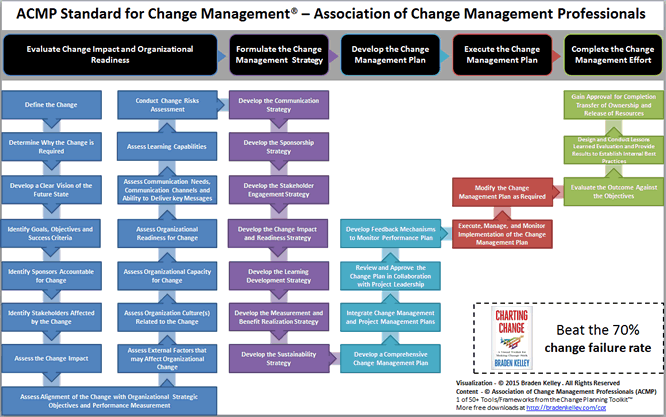
ACMP Standard Visualization

The Change Planning Toolkit™ is anchored in the best practices of organizational change and project management. At its center is the Change Planning Canvas™, a powerful tool that will help you beat the 70% change failure rate by enabling you to quickly visualize, plan, and execute projects and change initiatives alike. The more than fifty (50) tools in the Change Planning Toolkit™ will help you deliver projects and change efforts on time, while simultaneously accelerating implementation and adoption.

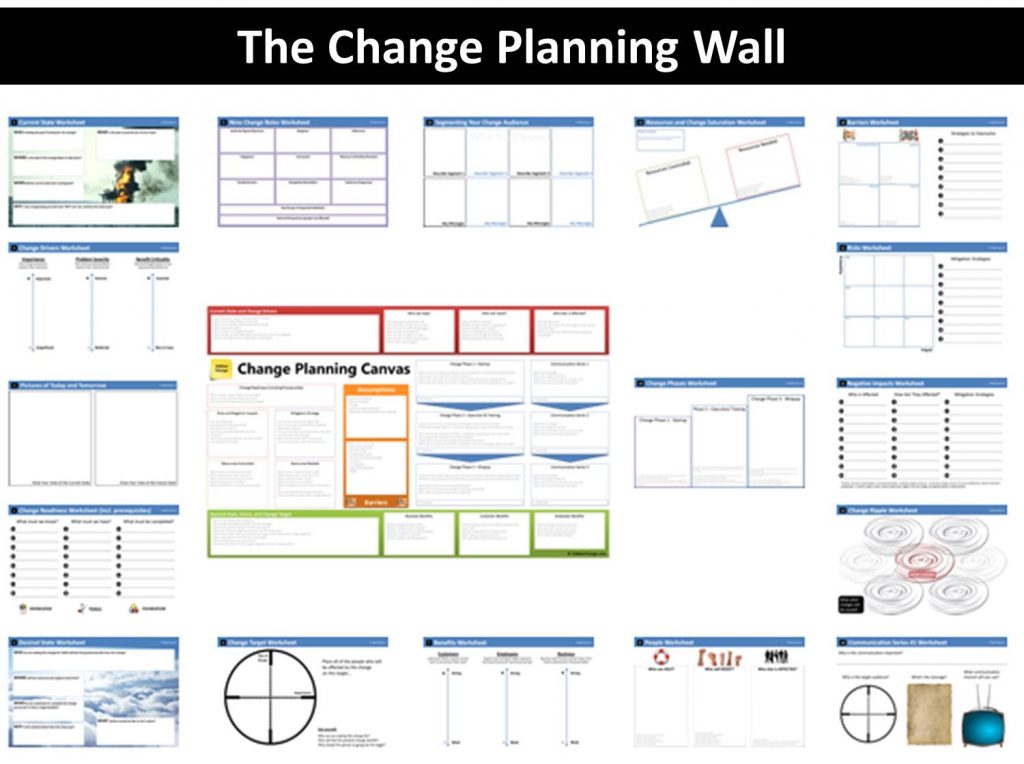
Change Planning Wall

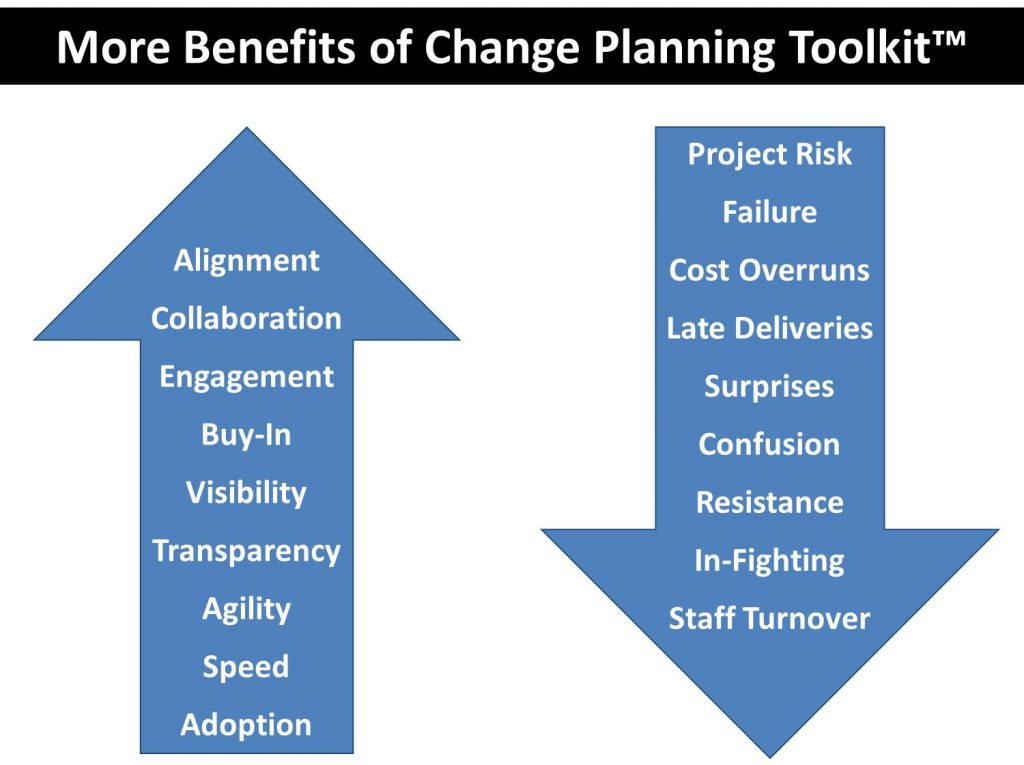
If the benefits are not clear, be sure and get your 10 Free Change Planning Tools and you’ll get a better sense of the power of the Change Planning Toolkit™ (it is visual after all) and check out the additional benefits in the image below:

Change Planning Toolkit Benefits

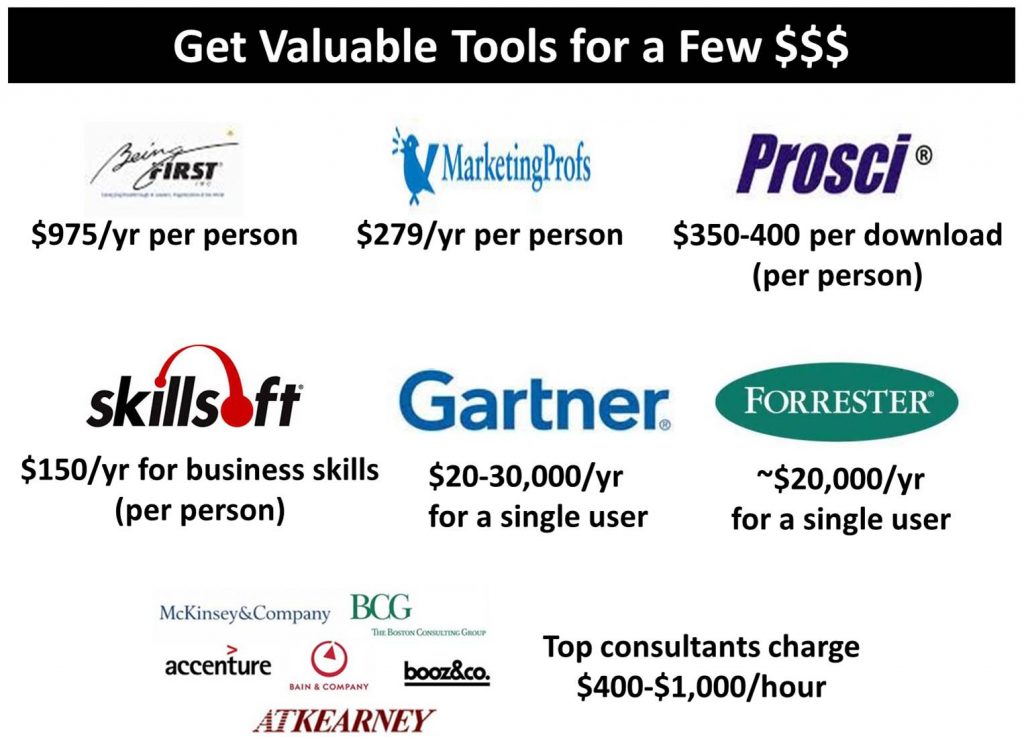
The Change Planning Toolkit™ is breaking away from the business model where people traditionally license intellectual property in the innovation and management information space by the named user, where fees for example are:

1. Gartner — $20,000-30,000 per year for a single user
2. Forrester — ~$20,000 per year for a single user
3. BeingFirst — $975 per year for a single user
4. ProSci — $350-400 per download (for a single user) or $4,000+ per user for training
5. MarketingProfs.com — $279 per year for a single user
6. Skillsoft — $150 per year for business skills training for a single user

… or you can hire a top consultant to do some knowledge transfer to your organization for $400-$1,000 per hour (or more).

Change Planning Toolkit Valuable Tools

Now, what is Change Planning Toolkit™ offering that is different?

First, the Change Planning Toolkit™ provides an integrated system of tools far more powerful and far more capable of increasing organizational agility than any other.

Second, the Change Planning Toolkit™ is now available using two business model variations not usually offered in the intellectual property space, which include:

1. Access for Every Employee (aka the Site License option)

  • Access for EVERY employee in your organization, priced at a very affordable $2/yr per employee plus a $299.99 annual fee
  • Includes access to a QuickStart Guide to get you up and running quickly
  • Includes access to POSTER SIZE versions of key tools, including the Change Planning Canvas™ and Visual Project Charter™
  • SPECIAL OFFER – The next three (3) firms to purchase a full-day training session (which includes train-the-trainer) will receive a free* Change Planning Toolkit™ site license

——————————————————————————–
Book a Training Session and get a free* site license
——————————————————————————–

2. Access for Every Resident (aka the City/State/Country License option)

  • Access for EVERY resident of your city, state, or country. Priced at a very affordable $0.01/yr per resident ($1,000/yr minimum)
  • Yes, that is right. Cities, states and countries are all eligible for a license that makes these tools available to all residents for just a PENNY per year per resident!
  • SPECIAL OFFER #1 – Purchase a city, state, or country license worth more than $25,000 and get up to 50 people trained to use the toolkit and how to train others to use it (training fees waived for one session, expenses still to be reimbursed)
  • SPECIAL OFFER #2 – Purchase a city, state, or country license worth more than $100,000 and get up to 200 people trained to use the toolkit and how to train others to use it (training fees waived for four (4) sessions in up to two (2) locations with two adjacent days per location, expenses still to be reimbursed)
  • SPECIAL OFFER #3 – Purchase a city, state, or country license worth more than $1,000,000 and get up to 1,000 people trained to use the toolkit and how to train others to use it (training fees waived for twenty (20) sessions in up to ten (10) locations with two adjacent days per location, expenses still to be reimbursed)

——————————————————————————–
CONTACT ME to get access for all of your residents
——————————————————————————–

Some educational institutions may be able to apply for grants from the government to cover the cost of the license and training as part of their efforts to raise the skills of their local residents. Central Wyoming College is an example of an educational institution that won a Federal grant to do just that. It’s possible.

And these licenses are available for both the:

  1. Change Planning Toolkit™
  2. Human-Centered Innovation Toolkit™ (coming soon)

Become a Human-Centered Innovation Toolkit™ Patron

The Human-Centered Innovation Toolkit™ will be coming soon, and you can become a Patron by helping to fund its completion through a site license or a city/state/country license and as a reward get instant access to the POSTER SIZE version of The Experiment Canvas™ and the many other tools I’ve already completed. You’ll then of course get access to the rest of the toolkit as I complete it. You’ll get this instant access at a permanent 50% discount off the normal $2/yr per employee or $0.01/yr per resident, meaning your cost will be a paltry $1/yr per employee or $0.005/yr per resident for the lifetime of the license.

SPECIAL BUNDLE DISCOUNT:

— Get instant access for both the Change Planning Toolkit™ and the Human-Centered Innovation Toolkit™ (coming soon) for all of your residents for a low bundle price of $0.014/yr per resident ($1,000/yr minimum) – that’s less than a penny-and-a-half per resident (a full 60% discount off the second license).

——————————————————————————–
CONTACT ME to get a jump on the competition
——————————————————————————–

Empower Your Residents and Employees to Cope with the Accelerating Pace of Change

So don’t wait, act today and get access for all of your employees or all of your residents to these powerful, intuitive and beautifully visual and collaborative tools that will help increase the speed of innovation and change in your organizations to cope with the accelerating pace of change in the world all around us. Countries all around the world are fighting to be the destination of choice of aspiring entrepreneurs and bold innovators and to rise in comparative rankings like the:

World’s 50 Most Innovative Countries (license cost based on population)

  1. Switzerland ($84,541)
  2. Sweden ($99,206)
  3. Netherlands ($170,328)
  4. United States ($3,264,740)
  5. United Kingdom ($655,111)
  6. Denmark ($57,118)
  7. Singapore ($57,845)
  8. Finland ($55,413)
  9. Germany ($806,361)
  10. Ireland ($47,492)
  11. ————————————–
    State of California ($392,500)
    ————————————–

  12. South Korea ($507,050)
  13. Luxembourg ($5,841)
  14. Iceland ($3,343)
  15. Japan ($1,260,452)
  16. France ($649,387)
  17. Hong Kong ($74,019)
  18. Israel ($83,232)
  19. Canada ($366,261)
  20. Norway ($53,308)
  21. Austria ($85,924)
  22. ————————————–
    State of Texas ($278,625)
    ————————————–

  23. New Zealand ($46,049)
  24. China ($13,882,327)
  25. Australia ($246,417)
  26. Czech Republic ($105,551)
  27. Estonia ($13,058)
  28. Malta ($4,205)
  29. Belgium ($114,438)
  30. Spain ($460,701)
  31. Italy ($597,980)
  32. Cyprus ($11,876)
  33. ————————————–
    New York City ($85,504)
    ————————————–

  34. Portugal ($102,648)
  35. Slovenia ($20,713)
  36. Latvia ($19,446)
  37. Slovakia ($54,322)
  38. UAE ($93,976)
  39. Bulgaria ($70,453)
  40. Malaysia ($311,642)
  41. Poland ($385,636)
  42. Hungary ($97,879)
  43. Lithuania ($28,306)
  44. —————————————
    Chicago ($27,205)
    —————————————

  45. Croatia ($42,098)
  46. Romania ($192,375)
  47. Turkey ($804,175)
  48. Greece ($108,929)
  49. Russia ($1,433,750)
  50. Chile ($183,135)
  51. Vietnam ($954,146)
  52. Montenegro ($6,263)
  53. Qatar ($23,381)
  54. Ukraine ($444,051)

Are you happy with your country’s position on the World’s 50 Most Innovative Countries list?

Are you happy with your company’s level of organizational agility or level of innovation success?

Is your organization or country keeping up with the accelerating pace of change?

If not, then you need these tools. And if you are satisfied with your competitive position, then you need these tools to maintain your current position…

——————————————————————————————————
CONTACT ME to get access for all of your residents or employees
——————————————————————————————————


Accelerate your change and transformation success

Subscribe to Human-Centered Change & Innovation WeeklySign up here to get Human-Centered Change & Innovation Weekly delivered to your inbox every week.