Author Archives: Chateau G Pato

About Chateau G Pato

Chateau G Pato is a senior futurist at Inteligencia Ltd. She is passionate about content creation and thinks about it as more science than art. Chateau travels the world at the speed of light, over mountains and under oceans. Her favorite numbers are one and zero. Content Authenticity Statement: If it wasn't clear, any articles under Chateau's byline have been written by OpenAI Playground or Gemini using Braden Kelley and public content as inspiration.

Using Technology to Predict and Prepare for Shifting Consumer Trends

Using Technology to Predict and Prepare for Shifting Consumer Trends

GUEST POST from Chateau G Pato

In the current consumer-driven market, it is becoming increasingly crucial for businesses to stay ahead of customer demands and stay informed on the emergence of new trends. By utilizing the vast possibilities of modern technology, businesses can easily access customer data, comprehend rapidly changing consumer trends, and optimize their profits. Adopting these readily available solutions in advance can help businesses rise above their competitors and meet customers’ needs in a timely manner.

Businesses have an unlimited number of methods to apply in their market research. One of the essential approaches is identifying shifts in consumer trends by leveraging predictive analysis and machine learning algorithms. This modern method makes use of large amounts of customer data and provides customers with personalized packages that best satisfy their requirements. On the other hand, advanced analytics and automation technology make it possible for businesses to rapidly process customer feedback and anticipate the requirements of their target demographic.

Case Study 1: Walmart

Walmart has successfully implemented predictive analytics and automation technology into their business strategy to anticipate customer needs and make their operations run more efficiently. By collecting data from customer interactions, transactions, and sales, Walmart is able to detect changes in consumer behavior and use those insights to optimize their store layout and product selection. Automation tools are also used to manage responses to customer queries quickly, streamline supply chain operations, and deliver accurate customer service.

Case Study 2: Amazon

Amazon has also successfully utilized technology to predict and prepare for shifting consumer trends. By combining predictive analytics and machine learning algorithms, Amazon can use customer data to anticipate customer needs and provide tailored recommendations to match those needs. Amazon also uses automation technology to ensure its internal processes run as smoothly as possible, from inventory control to shipping and delivery.

Conclusion

Businesses have a vast array of tools at their disposal to accurately analyze and predict consumer trends. These technologies allow businesses to remain in tune with the rapidly shifting demands of customers and optimize their operations accordingly. By utilizing the power of predictive analytics and automation, businesses can stay one step ahead of the competition and ensure they are delivering the best possible experience for their customers.

Bottom line: Futurology is not fortune telling. Futurists use a scientific approach to create their deliverables, but a methodology and tools like those in FutureHacking™ can empower anyone to engage in futurology themselves.

Image credit: Pixabay

Subscribe to Human-Centered Change & Innovation WeeklySign up here to join 17,000+ leaders getting Human-Centered Change & Innovation Weekly delivered to their inbox every week.

Change Management: A Leader’s Guide to Effective Implementation

Change Management: A Leader's Guide to Effective Implementation

GUEST POST from Chateau G Pato

Change is a natural part of life, and so businesses must learn to make timely adjustments to stay competitive and successful in the long-term. As a leader, it is your responsibility to ensure that change is properly implemented and managed so that you and your organization are placing strategic efforts where needed. This article serves as a guide to help business leaders implement effective change management strategies in their organization.

What is Change Management?

Change management is a structured process of organizing and controlling a company’s adjustment efforts. It is considered the cornerstone of large-scale transformation and is executed with the general idea of limiting risks and maximizing the potential of positive outcomes from change initiatives. It includes four core components: analysis, planning, implementation, and review. Through these four components, organizations can strategically transform their operations, core systems, and approaches to mission-critical processes.

Why is Change Management Important?

Change management is important because it helps organizations respond to their changing environments efficiently and effectively. It serves as a system of checks and balances and ensures that all change initiatives are properly justified, planned, and implemented. The process also helps businesses minimize the waste of resources and ensure that teams involved in various projects are best working towards the same goal.

Case Study 1 – The Transformation of Microsoft

Microsoft launched an extensive internal transformation project in 2014 to update its core operations, systems, and approaches. This involved a massive overhaul of the company’s internal processes, such as switching to an agile development method. Microsoft implemented a comprehensive change management approach, which included extensive training, workforce planning, and organizational realignment initiatives. The transition was a success and enabled Microsoft to remain a leader in their industry.

Case Study 2 – The Reorganization of National Grid

National Grid, a major electric and gas utility provider, restructured its organization to meet new customer demands and market trends. The company implemented a state-of-the-art change management system to execute the reorganization process across all departments and subsets of the company. This involved a rigorous assessment process, strategic workforce planning, detailed metrics, and advanced decision-making methods. The reorganization successfully enabled National Grid to better respond to changes in its environment and remain competitive in the industry.

Conclusion

Effective change management helps organizations respond to changes in their industry and remain competitive in the long-term. As a leader, it is important to understand the various components of change management and ensure that initiatives are properly planned and implemented. By considering the two case studies provided in this guide, business leaders can gain invaluable insight into the tools and processes that can help their organization successfully manage change.

Image credit: Pixabay

Subscribe to Human-Centered Change & Innovation WeeklySign up here to join 17,000+ leaders getting Human-Centered Change & Innovation Weekly delivered to their inbox every week.

Design Thinking for Non-Designers

How to Approach the Problem Solving Process

GUEST POST from Chateau G Pato

In the world of design, getting started with creative problem solving can feel intimidating if you don’t have a design background. Understanding how to approach a problem from a different perspective is key to success when it comes to finding viable solutions. In this article, we’ll be discussing the basics of design thinking and introducing two case studies that demonstrate how it can be used for both creative and practical problem solving.

What is Design Thinking?

Design thinking is an approach to problem solving that focuses on human-centered solutions. It was popularized by design firm IDEO, which is known for its innovative products, like the now-ubiquitous Apple Mouse and the Segway. Design thinking is based on the idea that creative solutions and useful products can be used to meet pressing needs in any project. When it comes to problem solving, design thinking encourages a multidisciplinary approach that includes ideation, prototyping and iterative testing.

At its core, design thinking is about asking the right questions and understanding what the user needs from a product or service. The process starts with an initial investigation into the problem, followed by brainstorming to find possible solutions. Once potential ideas have been identified, the next step involves prototyping and experimentation to discover the best approach. Iterative testing and user feedback help to identify areas for improvement, while also informing the end result. Ultimately, the design thinking process can identify both creative and practical solutions that address the original problem.

Case Study 1 – McKinsey & Co: Designing an App for the Nonprofit Sector

In 2020, McKinsey & Co partnered with the World Wildlife Fund to design a mobile app that would help the nonprofit sector better organize its data. In order to create a product that could truly serve the needs of the sector, the team began by conducting research on the current state of data management and the pain points among nonprofits. Once they identified the problem, they used design thinking to create a product that would solve it.

The team conducted interviews, ran surveys and observed user behavior in order to gain deeper insight into the nonprofit sector and better understand their goals. This enabled them to develop an app prototype that addressed the identified pain points and provided innovative solutions for the nonprofit sector. After consulting with the target audience and refining the product, the final version of the app was released and it quickly became a success.

Case Study 2 – Zenden: Delivering Smart Energy Solutions

This example highlights how design thinking can be used to create a product that meets current needs. Zenden, an energy-focused startup, wanted to create a smart energy system that would improve the efficiency of renewable energy sources and reduce carbon emissions. The team used the design thinking process to develop a solution that would meet this goal.

The team first conducted research on the current energy landscape and identified challenges stemming from energy availability and sustainability. They then held brainstorming sessions to come up with possible solutions and interviewed energy industry professionals to refine their ideas. After extensive prototyping and testing, the team was able to develop a solution that provided a reliable energy source and drastically reduced energy waste.

Conclusion

Design thinking is an invaluable tool for problem solving that allows creators to understand a problem from a human-centered perspective and come up with creative solutions that meet users’ needs. Both of the cases presented here demonstrate how design thinking can be used to create products that consider the needs of the user and deliver potential solutions. With the right approach, even those without a design background can create products that meet the needs of their audience.

SPECIAL BONUS: Braden Kelley’s Problem Finding Canvas can be a super useful starting point for doing design thinking or human-centered design.

“The Problem Finding Canvas should help you investigate a handful of areas to explore, choose the one most important to you, extract all of the potential challenges and opportunities and choose one to prioritize.”

Image credit: Unsplash

Subscribe to Human-Centered Change & Innovation WeeklySign up here to get Human-Centered Change & Innovation Weekly delivered to your inbox every week.

Building Explainable AI that Humans Can Trust

LAST UPDATED: April 13, 2026 at 5:31 PM

Building Explainable AI that Humans Can Trust

GUEST POST from Chateau G Pato


The Trust Gap in the Age of Intelligence

As we stand on the precipice of a new era of cognitive automation, we are witnessing a widening Trust Gap. While AI capabilities are accelerating at an exponential rate, our ability to understand, interrogate, and emotionally connect with these systems is lagging behind.

The Paradox of Power

We find ourselves in a unique technological paradox: the more powerful an AI model becomes, the more “opaque” it tends to be. Modern neural networks are often described as Black Boxes — systems where the inputs and outputs are visible, but the internal logic remains a mystery. For a consumer looking for a movie recommendation, this opacity is a minor inconvenience. However, for a human-centered organization, “it just works” is no longer a sufficient standard.

Defining the Stakes

In high-stakes environments — healthcare diagnostics, financial credit modeling, and human resources — the cost of “blind trust” is too high. Without legibility, we risk:

  • Systemic Bias: Dark logic hiding discriminatory patterns.
  • Reduced Adoption: Skilled professionals rejecting tools they cannot verify.
  • Legal Liability: An inability to provide “the right to an explanation” in regulated industries.

The Human-Centered Thesis

Trust is not a technical feature you “toggle on” in the code; it is a human experience that must be designed. Explainable AI (XAI) shouldn’t just be an engineering audit trail. It must be an exercise in empathy and experience design, ensuring that as systems get smarter, they also become more relatable and accountable to the humans they serve.

The Pillars of Human-Centered Explainability (HCX)

To move beyond the “Black Box,” we must shift our focus from technical interpretability to Human-Centered Explainability. This approach acknowledges that transparency is only valuable if it is digestible, actionable, and aligned with the user’s intent.

Transparency vs. Translucency

True innovation in AI design requires a distinction between showing everything and showing what matters. Transparency in engineering often results in a “data dump” — thousands of lines of code or weights that overwhelm the human mind.

We advocate for Translucency: a purposeful design choice to reveal the specific logic layers that impact the user’s decision-making process while abstracting the unnecessary noise. It’s about clarity, not just visibility.

The Three “Whys” of XAI

For AI to be considered trustworthy by humans, it must be able to answer three distinct types of inquiry:

  • Global Explainability (The “How”): How does this system function in general? This provides a high-level map of the model’s logic, helping users understand the overarching guardrails and data inputs.
  • Local Explainability (The “Why Me”): Why did the AI make this specific decision at this specific moment? This is the core of experience design, providing a narrative for an individual outcome — such as why a loan was denied or a specific medical scan was flagged.
  • Counterfactual Explainability (The “What If”): What would need to change in the input to achieve a different result? This is the ultimate tool for Human Agency. By showing the path to a different outcome, we empower the user to take action rather than just receive a verdict.

Designing for Intellectual Dignity

At its heart, HCX is about maintaining the intellectual dignity of the human user. When we build explainable systems, we aren’t just checking a compliance box; we are ensuring that the human remains the ultimate “Experience Architect,” using AI as a partner rather than a replacement.

Designing for the “Mental Model”

The most sophisticated algorithm in the world is useless if it creates Cognitive Dissonance — a clash between what the user expects and what the machine delivers. To build trust, we must bridge the gap between the AI’s mathematical weights and the human’s intuitive understanding.

Bridging the Gap

Experience design in AI requires us to map the system’s logic to a Mental Model that a human can recognize. This isn’t about dumbing down the technology; it’s about translating high-dimensional mathematics into the language of human reasoning. When the AI’s “thought process” aligns with human logic, trust is a natural byproduct.

Contextual Relevance: The Persona-First Approach

Explainability is not “one size fits all.” A human-centered approach requires that the explanation be tailored to the persona engaging with the system:

  • The Specialist (e.g., a Radiologist): Needs deep, feature-level data and “saliency maps” to verify clinical findings.
  • The Consumer (e.g., a Patient): Needs clear, empathetic, natural language summaries that focus on impact rather than raw data.
  • The Auditor (e.g., a Compliance Officer): Needs a comprehensive trail of data lineage and bias-detection metrics.

Visualizing Logic and UX

We must use Visual Design to make complexity intuitive. By utilizing heatmaps, feature importance charts, and interactive dashboards, we turn a “judgment” into a “conversation.”

Effective UX design allows users to “peek under the hood” without being blinded by the engine. This visual transparency reduces the cognitive load on the user, moving the interaction from a state of suspicion to one of collaborative Co-Intelligence.

From SLA to XLM: Measuring the Trust Experience

Historically, we have measured AI performance through the lens of technical efficiency — uptime, latency, and predictive accuracy. However, in a world where AI is a collaborative partner, these Service Level Agreements (SLAs) are insufficient. To build truly human-centered systems, we must pivot toward Experience Level Measures (XLMs).

Beyond Accuracy

A model can be 99% accurate, but if that 1% error occurs in a way that feels “inhuman,” “creepy,” or biased, user trust will evaporate instantly. Accuracy is a math problem; trust is a perception problem. We must measure not just how often the AI is right, but how reliable it feels to the human at the other end of the interface.

The Core XLMs for Explainable AI

To quantify the “Trust Experience,” organizations should track specific qualitative and behavioral metrics:

  • Cognitive Load: Does the explanation help the user make a faster decision, or does it overwhelm them with unnecessary complexity?
  • Perceived Agency: Do users feel they have the power to override or influence the AI’s output based on the explanation provided?
  • Appropriate Reliance: Does the user know when to trust the AI and, crucially, when to be skeptical? Over-trust is just as dangerous as under-trust.
  • Explanation Satisfaction: A qualitative measure of whether the user feels the “Why” provided by the system was sufficient for the context of the task.

The Feedback Loop

Measuring trust is not a one-time event. By treating explainability as a dynamic experience, we can create a continuous feedback loop. When a user flags an explanation as “unhelpful” or “confusing,” it provides the essential data needed to refine the model’s communication layer, ensuring the technology evolves in lockstep with human expectations.

Mitigating “The Great American Contraction” through Agency

As AI begins to automate cognitive tasks at scale, we face a pivotal economic and social shift — the Great American Contraction. In this landscape, the fear of displacement is the primary barrier to adoption. To overcome this, we must shift the narrative from “replacement” to “augmentation” through the lens of human agency.

The Fear Factor: Displacement vs. Empowerment

Opaque AI fuels anxiety. When an employee doesn’t understand why a system is making recommendations, they view the technology as a competitor or a threat. By prioritizing Explainability, we transform the AI from a “black box” that replaces judgment into a transparent partner that enhances it.

AI as an Exoskeleton for the Mind

We must design AI to act as a Cognitive Exoskeleton. Just as a physical exoskeleton amplifies a worker’s strength without removing their control, Explainable AI should amplify a professional’s expertise. When a user can see the logic, they retain the “steering wheel,” allowing them to focus on high-value strategy, empathy, and creative problem-solving—the very human traits that AI cannot replicate.

The Evolution of Human-in-the-Loop (HITL)

The traditional “Human-in-the-Loop” model is evolving. It is no longer just about a human clicking “approve.” True human-centered design requires:

  • Interactive Auditing: Interfaces that allow humans to “scrub” through variables to see how the output changes.
  • Real-Time Correction: The ability for a subject matter expert to “teach” the AI by correcting its logic path, not just its result.
  • Collaborative Friction: Designing moments where the AI prompts the human to double-check a low-confidence explanation, ensuring that critical thinking remains sharp.

By embedding explainability into the workflow, we protect the value of human labor. We ensure that even as the demand for routine tasks contracts, the demand for Human-Centric Insight expands.

Ethical Governance and Accountability

Innovation without accountability is a liability. As we integrate AI deeper into the fabric of our organizations, explainability moves from a “nice-to-have” feature to a fundamental pillar of Ethical Governance. We must ensure that our systems are not only efficient but also justifiable.

The Bias Audit: Explainability as a Diagnostic Tool

Black-box systems often inherit and amplify the hidden biases present in their training data. Without explainability, these biases remain invisible until they cause real-world harm. By designing for HCX, we create a built-in diagnostic tool. When we can see why an AI is prioritizing certain variables, we can identify and strip away discriminatory patterns before they scale.

The Right to Explanation: Navigating Regulation

The regulatory landscape is shifting rapidly. With the rise of the EU AI Act and similar global frameworks, “The Right to Explanation” is becoming a legal mandate. Organizations must move beyond defensive compliance and embrace proactive transparency.

  • Data Lineage: Being able to prove where data came from and how it influenced the final decision.
  • Algorithmic Impact Assessments: Regularly reviewing the “Explainability Scores” of deployed models to ensure they meet ethical standards.

Designing for Recourse

Trust is truly tested when things go wrong. A human-centered system must provide a clear “Off-Ramp” for human intervention. This means designing interfaces that don’t just explain an error, but provide a direct path for a human to challenge the output, correct the record, and override the machine.

Accountability means that at the end of every algorithmic chain, there is a human who understands the logic enough to take responsibility for the outcome.

Conclusion: Leading the Change

The future of artificial intelligence will not be won by the organizations with the most complex algorithms, but by those with the most trusted ones. As we navigate the complexities of digital transformation, we must remember that technology serves people — not the other way around.

The Futurologist’s Outlook

In the coming decade, we will see a Great Bifurcation. On one side will be companies that deploy “Black Box” solutions, leading to employee burnout, customer skepticism, and regulatory friction. On the other will be the Experience Leaders — those who champion a “Human-First” AI strategy that prioritizes legibility, empathy, and agency. These leaders will find that explainability isn’t a drag on innovation; it is its primary accelerator.

A Call to Action

Building explainable AI requires a multidisciplinary effort. It demands that data scientists, experience designers, and change leaders sit at the same table to solve for:

  • Clarity: Making the invisible visible.
  • Confidence: Providing the context needed for bold decision-making.
  • Connection: Ensuring AI remains a tool for human flourishing.

We have a unique opportunity to rewrite the social contract between humans and machines. By designing for trust today, we ensure a resilient and innovative tomorrow. Let’s stop building boxes and start building bridges.

Frequently Asked Questions

Why is explainability more important than accuracy in AI?

While accuracy measures how often a model is correct, explainability builds the trust necessary for human adoption. Without understanding the ‘why’ behind a decision, humans cannot ethically or legally take responsibility for AI-driven outcomes, especially in high-stakes industries like healthcare or finance.

What is the difference between Transparency and Translucency?

Transparency often involves a ‘data dump’ of complex code that overwhelms the user. Translucency is a design-led approach that purposefully reveals only the relevant logic layers a human needs to make an informed decision, effectively balancing technical detail with cognitive clarity.

How does Explainable AI (XAI) protect human jobs?

XAI mitigates ‘The Great American Contraction‘ by repositioning AI as a cognitive exoskeleton. By making AI logic legible, we allow professionals to remain ‘in the loop,’ using their unique human judgment to audit, challenge, and refine machine outputs rather than being replaced by them.

Image credits: Gemini

Subscribe to Human-Centered Change & Innovation WeeklySign up here to join 17,000+ leaders getting Human-Centered Change & Innovation Weekly delivered to their inbox every week.

How AI Transparency Impacts Organizational Trust

LAST UPDATED: April 12, 2026 at 8:43 AM

How AI Transparency Impacts Organizational Trust

GUEST POST from Chateau G Pato


I. The New Currency of the Digital Age

In the modern organizational landscape, trust has evolved from a “soft” cultural attribute into a hard currency. As Artificial Intelligence (AI) permeates every layer of the enterprise—from recruitment algorithms to predictive analytics—the traditional methods of building trust are being challenged. We are currently facing a significant Trust Deficit, driven by the inherent skepticism employees and customers feel toward “black box” systems that make life-altering decisions without explanation.

Transparency as Strategy

To bridge this gap, leaders must shift their perspective: transparency is not merely a compliance burden or a legal checkbox. Instead, it is a core innovation strategy. By demystifying how AI operates, organizations can move from a defensive posture to a competitive advantage, fostering an environment where technology is viewed as an ally rather than a hidden supervisor.

The Human-Centered Lens

From an experience design standpoint, the need for transparency is rooted in fundamental human psychology. For an innovation culture to thrive, individuals need to understand the why and how behind the tools they use. When we apply a human-centered lens to AI, we prioritize the dignity of the user, ensuring that automated logic aligns with human values and organizational purpose.

II. The Three Pillars of AI Transparency

To design experiences that resonate and endure, we must move beyond the vague concept of “openness” and ground our AI initiatives in three functional pillars. These aren’t just technical requirements; they are the architectural supports for organizational trust.

1. Algorithmic Legibility

There is a vast difference between explainability and legibility. While an engineer might understand a neural network’s weights, the average employee needs “human-understandable” logic. Legibility is about translating complex mathematical correlations into clear narratives that explain why a specific outcome was reached. If a human can’t follow the breadcrumbs, they won’t trust the path.

2. Data Provenance

Trust is often contaminated at the source. Organizational transparency requires radical honesty about data provenance—where the data comes from, how it was curated, and what inherent biases it may carry. By being upfront about the “ingredients” being fed into the system, we allow for collective scrutiny and continuous improvement, rather than pretending the machine is an objective arbiter of truth.

3. Intentionality

The most critical pillar is the communication of intent. Trust evaporates when AI is introduced under a cloud of ambiguity. Leaders must clearly articulate the purpose: Is this tool designed to augment human capability, sparking a new wave of co-creation? Or is it a cost-cutting measure designed for displacement? True innovation leaders know that aligning AI’s intent with the organization’s human values is the only way to ensure long-term adoption.

III. The Impact on Internal Culture and Change Management

Innovation is a team sport, and like any team, the players must trust the equipment they are using. When we introduce AI into the workplace, we aren’t just deploying software; we are managing a profound cultural shift. Transparency acts as the lubricant that prevents the friction of fear from seizing the gears of progress.

Reducing Fear through Visibility

The greatest enemy of organizational agility is “replacement anxiety.” When AI operates in the shadows, employees naturally assume the worst—that their roles are being silently engineered away. By providing visibility into how AI tools function and the specific tasks they handle, we replace irrational fear with grounded understanding, allowing the workforce to focus on high-value creative work.

Psychological Safety and Risk-Taking

Innovation requires a high degree of psychological safety. If an employee believes a hidden algorithm is judging their every move or evaluating their performance based on opaque metrics, they will stop taking the risks necessary for breakthrough ideas. Transparent AI frameworks ensure that people feel safe to experiment, knowing that the “digital supervisor” is fair, consistent, and understandable.

Empowering the “Human in the Loop”

A transparent system invites participation. When employees understand the logic behind an AI’s output, they are better equipped to provide critical feedback and course-correction. This creates a powerful feedback loop where human insight and machine efficiency reinforce one another. We move away from passive consumption and toward an active, co-creative environment where technology elevates human potential.

IV. Rebuilding External Experience and Brand Design

As experience designers, we know that every touchpoint is a promise made to the customer. When AI enters the customer journey, it shouldn’t be a hidden ghost in the machine. Instead, we must design for intentional friction—moments of clarity that reinforce the brand’s integrity.

The Customer Experience (CX) Connection

There is a fine line between a personalized recommendation and “creepy” surveillance. Hidden AI can feel manipulative, leading customers to wonder if they are being nudged toward decisions that benefit the company rather than themselves. Transparent AI transforms the experience into a partnership, where the system openly says, “I’m suggesting this because you’ve shown interest in X,” turning a transaction into a relationship.

The “Uncanny Valley” of Automation

We must avoid the trap of trying to make AI seem too human. When customers realize they’ve been talking to a bot they thought was a person, the sense of betrayal is immediate. By finding the balance between seamless tech and honest disclosure, we respect the customer’s intelligence. Authenticity is the antidote to the “uncanny valley,” ensuring that high-tech interactions don’t lose their high-touch feel.

Case Studies in Contrast

History—and the market—will remember two types of brands: those that won trust through radical disclosure and those that lost it through “shadow AI.” Brands that proactively label AI-generated content or explain their data usage build a reservoir of goodwill. Conversely, those that hide their algorithms risk a PR catastrophe and a permanent loss of consumer confidence the moment the curtain is pulled back.

V. Operationalizing Transparency (The “How-To”)

Vision without execution is just hallucination. To move from the philosophy of trust to the reality of a transparent organization, we must embed these principles into our operational DNA. This requires a systemic approach to how we select, design, and manage our technological ecosystem.

The Transparency Audit

Before moving forward, we must look at where we stand. Organizations should conduct a comprehensive audit to evaluate the “opacity levels” of their current AI tools. This involves identifying which systems are making autonomous decisions, determining if those decisions can be explained to a layperson, and surfacing any “black boxes” that pose a risk to institutional integrity.

Designing the Interface of Trust

As experience designers, our goal is to surface AI reasoning without creating cognitive overload. This means designing UI/UX components that provide “just-in-time” explanations—simple, accessible tooltips or “Why am I seeing this?” modules that empower the user. We aren’t just showing the math; we are designing for confidence and clarity at the point of interaction.

Governance as Collaboration

Transparency cannot be siloed within the IT department. We must move AI ethics and governance into cross-functional innovation labs where diverse voices—from HR and marketing to legal and frontline staff—can weigh in. When governance is collaborative, the rules of transparency are co-created by the people they impact most, ensuring the system remains both ethical and effective.

VI. Conclusion: The Future Belongs to the Open

As we stand on the precipice of an AI-driven revolution, we must remember that technology is only as effective as the human systems that support it. The transition to artificial intelligence isn’t just a technical upgrade; it’s a social contract. To lead in this new era, we must move beyond the allure of the “magic” black box and embrace the discipline of clarity.

The Long Game

Trust is a fragile asset—painfully slow to build, yet instantaneous to shatter. In a world where AI-generated content and automated decisions are becoming the norm, transparency serves as the ultimate insurance policy. It protects the brand’s reputation and ensures that when the inevitable technical hiccup occurs, the organization has a reservoir of goodwill and understanding to draw upon.

Leading with Clarity

The challenge for today’s leaders is to stop hiding behind the perceived complexity of algorithms. True leadership in the age of AI means having the courage to be open about what the tools can do, what they can’t do, and how they are changing our world. By fostering transparency, we don’t just mitigate risk; we unlock the true potential of organizational agility and human-centered innovation.

The future of work isn’t about humans versus machines—it’s about humans and machines operating in a transparent, high-trust ecosystem that elevates the capabilities of both.

Frequently Asked Questions

1. Why is AI transparency more than just a technical requirement?

Transparency is a cornerstone of experience design and organizational trust. It bridges the “trust deficit” by allowing employees and customers to understand the logic behind decisions, reducing fear and fostering a culture of co-creation.

2. How does transparency impact employee innovation?

It creates psychological safety. When employees understand how AI evaluates their work or processes data, they are more willing to take creative risks and engage with the technology as a partner rather than a competitor.

3. What is the “Uncanny Valley” in AI branding?

It refers to the discomfort felt when an AI mimics human behavior too closely without disclosure. Braden Kelley emphasizes that honest disclosure is the antidote to this discomfort, ensuring brand authenticity remains intact.

Image credits: Gemini

Subscribe to Human-Centered Change & Innovation WeeklySign up here to join 17,000+ leaders getting Human-Centered Change & Innovation Weekly delivered to their inbox every week.

Does Agile Kill Innovation or Support It?

Evidence-Based Answers

LAST UPDATED: April 11, 2026 at 10:03 AM

Does Agile Kill Innovation or Support It?

GUEST POST from Chateau G Pato


The Great Methodology Clash

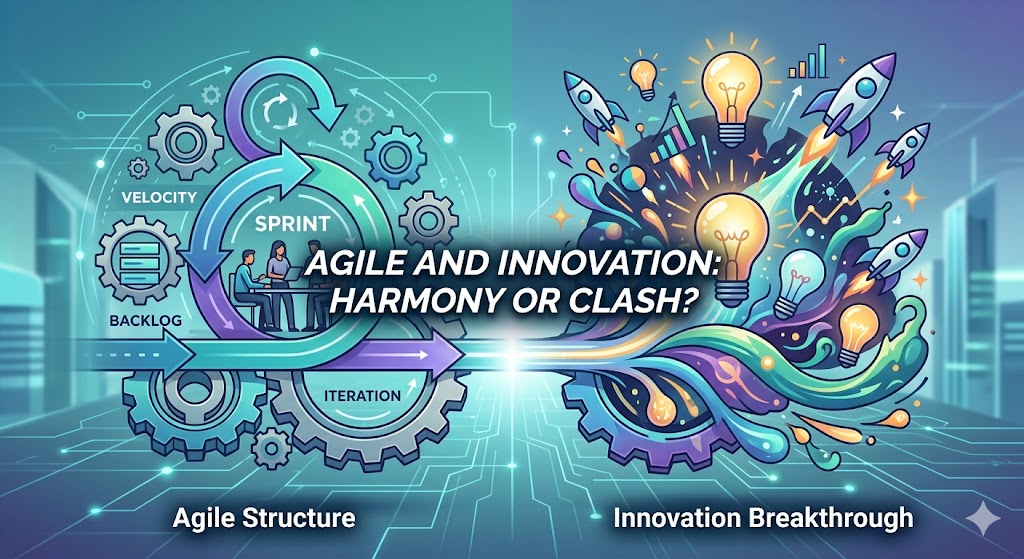
In the modern business landscape, Agile is often sold as the ultimate antidote to stagnation. However, a growing tension exists between the disciplined structure of Agile frameworks and the messy, non-linear reality of pure innovation.

Organizations frequently find themselves caught in a paradox: they adopt Agile to increase speed and responsiveness, yet they often discover that while their output increases, their “Big Ideas” seem to shrink into a series of minor, safe iterations. This phenomenon raises a critical question for leadership: Is the methodology driving us toward breakthroughs, or is it merely optimizing the status quo?

To find the answer, we must look past the anecdotes and marketing hype. This article explores the evidence-based reality of how Agile frameworks — including Scrum, Kanban, and SAFe — impact different types of innovation, from incremental improvements to radical, market-shifting discoveries.

How Agile Fuels the Innovation Engine

Contrary to the belief that structure stifles creativity, when implemented with a human-centered mindset, Agile provides the essential scaffolding for innovation to thrive. By shifting the focus from rigid long-term planning to adaptive learning, Agile frameworks can actually accelerate the journey from a raw idea to a market-ready solution.

De-Risking through Iteration

The “Fail Fast” mentality is often misunderstood as a celebration of failure; in reality, it is about reducing the cost of learning. By breaking down complex innovation projects into smaller, manageable increments, teams can test high-risk assumptions early. This prevents the “Big Bang” failure — where millions are spent on a product that no one actually wants.

The Feedback Loop: Aligning with Human Needs

Continuous integration and frequent review cycles ensure that innovation remains tethered to reality. Instead of innovating in a vacuum, Agile forces a constant dialogue with the end-user. This evidence-based approach ensures that the “Experience Design” isn’t just a hypothesis, but a validated solution that solves real human problems.

Psychological Safety and Autonomy

Innovation requires a culture where people feel safe to take risks. Agile’s emphasis on self-organizing, cross-functional teams empowers individuals to take ownership of their work. This autonomy is a primary driver of intrinsic motivation, which is the “secret sauce” behind most creative breakthroughs.

Eliminating “Innovation Theater”

Traditional waterfall environments often reward “Innovation Theater” — the production of elaborate slide decks and theoretical business cases. Agile demands working prototypes. By prioritizing tangible output over documentation, organizations can more accurately measure progress and pivot resources toward the ideas that demonstrate real potential.

When Agile Becomes a Straightjacket

While the benefits of Agile are well-documented, the methodology can inadvertently become a “innovation killer” if applied dogmatically. When the process becomes the priority over the purpose, the very structures meant to enable speed can end up anchoring a team to the shoreline of incrementalism.

The “Tyranny of the Sprint”

Innovation often requires deep, uninterrupted thinking and “unstructured” time to explore dead ends. The relentless cadence of two-week sprints can create a culture of urgency that prioritizes low-hanging fruit. Teams may gravitate toward tasks they are certain they can finish within the sprint window, effectively self-censoring breakthrough ideas that require longer, more complex exploration.

The Incrementalism Trap

Evidence suggests that Agile is a master at “polishing the stone” but can struggle to “find the diamond.” Because the framework is built on iterative feedback, it excels at evolutionary innovation (making an existing product 10% better). However, it often fails at revolutionary innovation, where the end goal isn’t yet clear enough to be broken down into neat user stories.

Loss of the “North Star”

In a poorly managed Agile environment, the Product Backlog can morph into a never-ending grocery list of features and bug fixes. When teams become obsessed with clearing tickets, they lose sight of the strategic vision. Without a strong “North Star” to guide the experience design, the product risks becoming a disjointed collection of features rather than a cohesive, meaningful solution.

Over-Emphasis on Velocity

What gets measured gets managed. If leadership defines success solely by “Velocity” (the number of story points completed), teams will naturally optimize for output over impact. This creates a “feature factory” where there is no room for the “productive waste” of experimentation, questioning assumptions, or starting over — all of which are vital to the innovation process.

The Evidence-Based Verdict: Context is King

The debate over whether Agile supports or kills innovation is rarely a binary “yes” or “no.” Instead, the evidence points toward a situational reality. Data from high-performing organizations suggests that Agile’s effectiveness is directly tied to the type of innovation being pursued and the horizon in which the team is operating.

The Innovation Horizon Model

To understand the impact of Agile, we must view it through the lens of the Three Horizons of Innovation:

  • Horizon 1 (Incremental): In this space of “polishing the stone,” Agile is an undisputed powerhouse. The evidence shows that iterative cycles significantly improve speed-to-market and quality for existing products.
  • Horizon 2 (Adjacent): Here, Agile requires a hybrid approach. Success depends on integrating Design Thinking to explore new markets before the engineering sprint begins.
  • Horizon 3 (Radical/Disruptive): This is where pure Agile often stumbles. Evidence indicates that radical breakthroughs require “Discovery Tracks” that are decoupled from the standard delivery cadence to allow for high-variance experimentation.

Why “Pure Agile” Isn’t Enough

Industry analysis of failed digital transformations shows a recurring pattern: organizations that adopt Agile without Human-Centered Design often end up building the “wrong thing” faster. The verdict is clear: Agile is a delivery framework, not a discovery framework. To support innovation, it must be paired with methodologies that focus on causal insights and human behavior.

The Cultural Variable

Finally, the evidence suggests that the “Agile-Innovation” link is moderated by culture. In organizations where “Agile” is used as a tool for micromanagement or purely for cost-cutting, innovation invariably dies. Conversely, in cultures that prioritize organizational agility and psychological safety, Agile provides the necessary structure to turn creative sparks into sustainable revenue.

Best Practices: Harmonizing the Two Worlds

Bridging the gap between the rigid requirements of a sprint and the fluid nature of innovation requires a shift from “Dogmatic Agile” to “Pragmatic Agility.” To ensure your methodology supports rather than stifles breakthroughs, consider these evidence-based strategies for harmonization.

Dual-Track Agile: Separate Discovery from Delivery

One of the most effective ways to protect innovation is to implement Dual-Track Agile. In this model, the “Discovery” track focuses on identifying human needs, rapid prototyping, and validating causal links, while the “Delivery” track focuses on building and deploying production-ready code. This ensures that the innovation pipeline is always full of validated ideas before they ever hit a developer’s backlog.

Allocating “Innovation Sprints” and Slack Time

Innovation cannot be scheduled into 15-minute stand-ups. Leading organizations often dedicate specific sprints — sometimes called “Innovation Sprints” or “Hack Weeks” — where the backlog is frozen, and teams are given the autonomy to explore speculative “What If” scenarios. This “slack” in the system is not waste; it is the necessary breathing room for creative synthesis.

Shift KPIs: From Output to Outcomes

If you measure a team by how many story points they finish (Output), they will avoid difficult, innovative tasks. To support innovation, leadership must shift to Outcome-based metrics. Instead of asking “How much did we build?”, ask “What customer behavior did we change?” or “What new revenue leakage did we plug?” Measuring Experience Level Measures (XLMs) ensures the team stays focused on value creation.

The Product Owner as a Visionary, Not a Clerk

For Agile to support innovation, the Product Owner must move beyond simply managing tickets. They must act as a “Chief Innovation Officer” for their product, balancing the immediate needs of the users with the long-term strategic “North Star.” Their role is to protect the team from feature bloat and ensure that every sprint is a step toward a more meaningful human experience.

Conclusion: It’s Not the Tool, It’s the Craftsman

The evidence is clear: Agile does not kill innovation. However, a rigid, dogmatic application of Agile ceremonies — without the balancing force of experience design and strategic foresight — can certainly suffocate it. When we prioritize “following the process” over “responding to human needs,” we lose the very essence of why we innovate in the first place.

To truly support innovation, organizations must move beyond the “Feature Factory” mindset. We must stop treating Agile as a set of handcuffs and start treating it as a flexible framework that empowers teams to explore, experiment, and execute with purpose. The goal isn’t just to move faster; it’s to move faster toward meaningful value.

As you look at your own organizational agility, ask yourself: Is your current velocity moving you toward a breakthrough, or just toward a deadline? Innovation requires the courage to step out of the sprint cycle when the path forward is unclear and the discipline to use Agile to scale that vision once the “North Star” is found.

Final Thought for Leaders

“Don’t let your methodology become your strategy. The most successful organizations are those that use Agile to deliver value, but use Human-Centered Innovation to define what that value should be.”

Frequently Asked Questions

Does Agile only work for incremental improvements?

While Agile is highly effective for incremental (Horizon 1) innovation, it can support radical breakthroughs if paired with a dedicated “Discovery Track.” Without this, the pressure of short sprints tends to favor smaller, safer updates over disruptive changes.

How can leadership prevent Agile from becoming a “Feature Factory”?

Leadership must shift focus from output metrics like “Velocity” or “Story Points” to outcome-based measures (XLMs). By rewarding the value created for the user rather than the volume of code shipped, teams are empowered to prioritize innovation.

What is the biggest risk of using Agile for innovation?

The primary risk is the “Tyranny of the Sprint,” where the relentless two-week cadence discourages the deep, unstructured exploration and “productive failure” necessary for true human-centered breakthroughs.

Image credits: Gemini

Subscribe to Human-Centered Change & Innovation WeeklySign up here to join 17,000+ leaders getting Human-Centered Change & Innovation Weekly delivered to their inbox every week.

The Neuroscience of Creativity and Practical Workplace Applications

LAST UPDATED: April 10, 2026 at 2:41 PM

The Neuroscience of Creativity and Practical Workplace Applications

GUEST POST from Chateau G Pato


Breaking the “Right Brain” Myth

For decades, we’ve been told a seductive but oversimplified story: that the left brain is a cold, calculating machine while the right brain is the wild, colorful source of creativity. As a thought leader in human-centered design, I’ve seen how this myth limits organizational potential by pigeonholing employees into “creative” or “analytical” roles.

Neuroscience now tells us a far more integrated story. Creativity is not a localized spark; it is a whole-brain symphony. It involves the dynamic interaction of multiple large-scale networks that span across both hemispheres. When we innovate, we aren’t just “switching on” our right brain; we are orchestrating a complex collaboration between imagination, focus, and evaluation.

The Economic Imperative of Neural Insight

In the realm of experience design and change management, understanding the “why” behind human behavior is our greatest lever. When we recognize that creativity is a biological process — subject to chemistry, environment, and stress — we move from accidental innovation to intentional design. By aligning our workplace cultures with the way the brain actually functions, we unlock a sustainable competitive advantage that goes beyond mere brainstorming sessions.

The Neural Trio: The Engines of Idea Generation

To master the art of innovation, we must look under the hood at the three primary neural networks that drive the creative process. These aren’t isolated islands; they are a high-speed transit system for information.

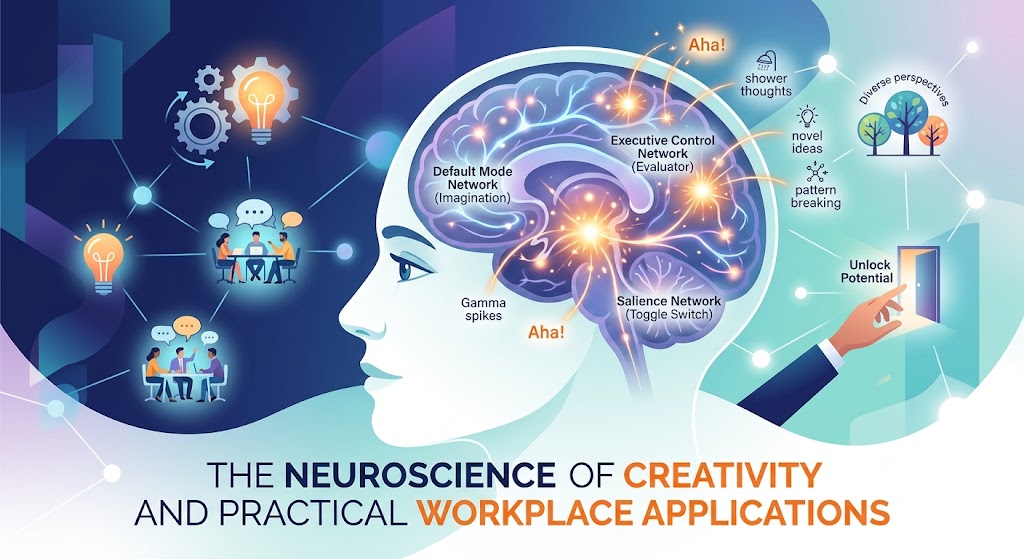
The Default Mode Network (DMN): The “Imagination Network”

The DMN is active when we aren’t focused on the outside world — during daydreaming, reflecting on the past, or envisioning the future. In the context of experience design, this is where incubation happens. It is the network responsible for connecting disparate dots and generating those “out of left field” ideas. If your team is constantly “on task,” they are likely starving their DMN of the oxygen it needs to produce breakthroughs.

The Executive Control Network (ECN): The “Evaluator”

Once the DMN generates a flurry of possibilities, the ECN takes over. This network handles complex cognitive tasks and focused attention. It acts as the editor, filtering out the noise and selecting the ideas that are actually viable. Effective change management requires a strong ECN to bridge the gap between a wild “what if” and a practical “how to.”

The Salience Network: The “Switch”

The Salience Network is the conductor of the orchestra. Its job is to constantly monitor external stimuli and internal consciousness to decide what deserves our attention. It functions as a neural toggle, switching us between the expansive thinking of the DMN and the laser focus of the ECN. A well-designed workplace experience minimizes “cognitive friction,” allowing the Salience Network to switch gears smoothly without burning out the employee.

The Chemistry of “Aha!” Moments

Innovation isn’t just about the architecture of the brain; it is driven by a precise chemical cocktail. When we design experiences or lead change, we are essentially managing the neurochemistry of our teams.

Dopamine and the Reward Loop

Dopamine is often misunderstood as the “pleasure chemical,” but in the world of creativity, it is the chemical of anticipation. It fuels the “drive” to solve a problem. When we encounter a novel challenge or a potential breakthrough, dopamine levels spike, providing the cognitive energy and persistence required to push through the “messy middle” of the creative process.

The Alpha State and the Gamma Spike

Have you ever wondered why your best ideas come in the shower? It’s because your brain has entered an Alpha state — a frequency of 8 to 12 Hz associated with relaxed wakefulness. This relaxation lowers the “noise” of the Executive Control Network, allowing the brain to detect faint signals from the Default Mode Network.

Moments before a breakthrough, there is a literal “Aha!” spike — a burst of Gamma waves (high-frequency neural activity) that signifies the binding of neurons across different regions to form a brand-new connection.

The Role of Neuroplasticity

Perhaps the most empowering discovery in modern neuroscience is neuroplasticity: the brain’s ability to reorganize itself by forming new neural connections throughout life. By intentionally exposing ourselves to diverse perspectives and “human-centered” design challenges, we physically strengthen the pathways required for a Change Mindset. We aren’t just thinking differently; we are literally building a more innovative brain.

Practical Workplace Applications: Designing for the Brain

As a strategist, I believe that knowing how the brain works is useless unless we apply it to how we work. To move from theory to impact, we must design “brain-friendly” environments that respect our biological constraints while amplifying our creative potential.

Cognitive Diversity as a Design Tool

Innovation is a team sport, but it requires more than just different job titles. It requires cognitive diversity — a mix of thinking styles that engage different neural networks. By intentionally pairing those who naturally lean toward the “Imagination Network” (DMN) with those who excel in “Executive Control” (ECN), we create a collective brain that is capable of both radical ideation and disciplined execution.

Psychological Safety and the Amygdala

This is the “Change Management” golden rule: Fear kills innovation. When an employee feels judged or threatened, the amygdala triggers a “fight or flight” response. This diverts blood flow away from the prefrontal cortex — the seat of higher-order thinking — effectively locking the door to the “Imagination Network.” Designing for psychological safety isn’t just about culture; it’s about keeping the brain’s “innovation centers” online.

Environment Design: The Architecture of Insight

Our physical and digital surroundings act as a remote control for our neural states. To optimize for the “Aha!” moment, we must build spaces that support two distinct modes:

  • The Case for “Slow Time”: We must move away from the “cult of busy.” Designing deliberate gaps in the day allows for neural incubation. Without downtime, the brain never has the opportunity to enter the Alpha state necessary for breakthrough insights.
  • Sensory Stimulation: The brain thrives on novelty. By varying light levels, incorporating movement, and using biophilic design (natural elements), we can nudge the Salience Network to stay alert and open to new patterns.

Overcoming Cognitive Biases in Innovation

Our brains are evolved for efficiency, not necessarily for innovation. This efficiency comes in the form of “neural shortcuts” or biases that help us navigate the world quickly but often act as roadblocks to original thinking. To lead human-centered innovation, we must learn to recognize and bypass these biological hurdles.

The Functional Fixedness Trap

The brain is a pattern-matching machine. Functional fixedness is a cognitive bias that limits us to seeing objects or processes only in the way they are traditionally used. In experience design, this often manifests as “we’ve always done it this way.” To break this neural loop, we must use techniques like deconstruction to force the brain to see the raw components of a problem rather than the established pattern.

Confirmation Bias in Change Management

The brain experiences a small hit of dopamine when we find information that confirms our existing beliefs, and a stress response when we encounter information that challenges them. This is why organizational change is so difficult — the status quo literally feels “safer” to our neurons. Overcoming this requires creating a culture of curiosity over certainty, where we reward the seeking of “disconfirming” evidence.

The “Ego-Depletion” Factor

High-order creative thinking and self-regulation are energy-intensive processes that draw from a finite pool of cognitive resources. This is often referred to as ego-depletion. If a team is bogged down by “digital friction” — clunky tools, excessive meetings, or administrative “sludge” — they will lack the neural stamina required for the deep work of innovation. As leaders, our job is to clear the path so their mental energy can be spent on solving the right problems.

Conclusion: From Neural Insight to Organizational Impact

We must stop viewing creativity as an elusive “soft skill” and start treating it as a biological capacity that can be nurtured or stifled. The neuroscience is clear: our brains are not hardwired to be static; they are designed for adaptation. However, that adaptation requires the right conditions — chemistry, culture, and environmental design must align to turn potential into performance.

Designing the “Box”

For years, leaders have told their teams to “think outside the box.” But as human-centered designers, we realize that the “box” is actually the environment we build for our people. If we build a box defined by fear, cognitive overload, and rigid silos, no amount of exhortation will spark innovation. When we design the box to support neural incubation and psychological safety, creativity becomes the natural byproduct of the system rather than an accidental miracle.

The Human-Centered Future

The most successful organizations of the future won’t just be those with the best technology; they will be the ones that best understand the human operating system. By bridging the gap between neuroscience and the workplace, we move closer to a world where “change” isn’t a source of anxiety, but a source of energy.

Innovation is, at its heart, the ultimate expression of human potential. Let’s start designing our organizations to honor the incredible hardware we all carry between our ears.

Frequently Asked Questions

Does “brainstorming” actually work according to neuroscience?

Traditional brainstorming often triggers “evaluation apprehension,” which causes the amygdala to stifle the Default Mode Network. To make it work, you must first allow for individual “neural incubation” (quiet time) followed by a psychologically safe group session to connect the dots.

Can you actually “train” your brain to be more creative?

Yes. Through neuroplasticity, you can strengthen the Salience Network — the brain’s “toggle switch.” By practicing divergent thinking and exposing yourself to diverse sensory experiences, you physically build more efficient pathways for insight.

Why do my best ideas happen when I’m not working?

When you stop focusing on a specific task, your brain enters an “Alpha state.” This relaxation lowers the barriers of the Executive Control Network, allowing the Default Mode Network to link disparate ideas into a “Gamma spike” — the literal neural signature of an “Aha!” moment.

Image credits: Gemini

Subscribe to Human-Centered Change & Innovation WeeklySign up here to join 17,000+ leaders getting Human-Centered Change & Innovation Weekly delivered to their inbox every week.

Rituals That Embed Organizational Identity

LAST UPDATED: April 9, 2026 at 4:39 PM

Rituals That Embed Organizational Identity

GUEST POST from Chateau G Pato


Beyond the Mission Statement: The Identity Gap

In the rush to scale and the frenzy of digital transformation, most organizations fall into the trap of believing that identity is something you describe. We spend months polishing mission statements and plastering core values onto digital handbooks, yet we often find a cavernous gap between those words and the daily lived experience of the workforce. When “who we say we are” doesn’t match “how we actually behave,” the result is cynicism and organizational drift.

The Power of Ritual in Human-Centered Innovation

Authentic organizational identity isn’t a static document; it is a living, breathing pulse anchored by meaningful, repeatable symbolic acts. These are our rituals. Unlike routines, which focus on efficiency and “what” we do, rituals focus on the “why” and the “who.” They serve as the connective tissue of human-centered innovation, moving us beyond sporadic corporate events into a space where purpose is practiced, not just preached.

Anchoring the Future

To embed identity deeply, we must design rituals that act as an anchor in an unpredictable market. Whether we are fueling an Innovation Bonfire or honoring the lessons of a failed project, these practices provide the psychological safety necessary for agility. By intentionally designing how we gather, celebrate, and even mourn, we ensure that our organizational identity isn’t just a poster on the wall — it’s the soul of the enterprise.

The Anatomy of an Organizational Ritual

To effectively embed identity, we must first understand that a ritual is far more than a scheduled meeting. It is a designed experience that bridges the gap between individual contribution and collective purpose. When we approach ritual design through the lens of human-centered innovation, we focus on creating a predictable space — a psychological sanctuary where employees feel safe to experiment, fail, and ultimately, belong.

The Three Pillars of Effective Rituals

  • Intentionality: Every ritual must be tethered to a core value. If the goal is agility, the ritual must reinforce speed and adaptability. Without a clear “why,” a ritual quickly decays into a bureaucratic burden.
  • Participation: Rituals are not spectator sports. They require active engagement where hierarchy is often leveled, moving the workforce from merely observing the culture to actively enacting it.
  • Symbolism: Meaning is often anchored in the physical or digital. Whether it’s a specific artifact passed between team members or a unique digital badge for FutureHacking™ contributions, symbols make abstract goals tangible and memorable.

Ritual vs. Routine: The Soul of the Practice

The distinction between a routine and a ritual is the presence of mindfulness and meaning. A routine, such as clearing a ticket queue or checking email, is focused on efficiency and completion. A ritual, like a “Monday Wins” huddle or a storytelling circle, is focused on connection and identity. While routines keep the gears turning, rituals provide the oil that prevents the human elements of the organization from grinding to a halt.

Rituals for the Innovation Lifecycle

Innovation is often messy, non-linear, and fraught with emotional highs and lows. To sustain a culture of continuous renewal, we must move beyond the “Eight I’s” of the innovation process and focus on the human experience of the journey. Rituals provide the rhythmic structure that allows a team to transition from the ambiguity of ideation to the discipline of execution.

The Innovation Bonfire: Gathering the Spark

The “Innovation Bonfire” is a ritual designed for collective creative energy. Rather than a standard brainstorming session, this is a dedicated time where silos are dismantled and diverse perspectives are gathered to fuel a central challenge. It is a symbolic act of “feeding the flame,” where every contribution — no matter how small — is recognized as vital to the organization’s future warmth and light.

The Failure Funeral: Honor the Learning, Not the Loss

One of the greatest barriers to organizational agility is the fear of setbacks. To combat this, we implement the “Failure Funeral.” When a project is retired or a pilot fails to scale, we don’t bury it in silence. We hold a ritualized “service” to honor the effort and, more importantly, to explicitly articulate and archive the learning gained. This destigmatizes “failure” and transforms it into a necessary deposit into the organizational knowledge bank.

Onboarding the “Conscript” and the “Magic Maker”

Identity is solidified the moment a person joins the fold. Using the Nine Innovation Roles framework, we create rituals that help new hires find their unique fit. Whether they are stepping into the role of The Conscript (those brought in for their specific expertise) or The Magic Maker (those who turn the vision into reality) or any of the other Nine Innovation Roles, the ritual of induction should center on their specific contribution to the collective identity. By naming these roles during onboarding, we anchor the individual to the mission from day one.

Rituals that Drive Customer Centricity

Customer experience (CX) is often reduced to a set of metrics on a dashboard, losing its human essence in the process. To truly embed a customer-centric identity, we must move beyond the data and create rituals that force us to confront the reality of the people we serve. These practices ensure that empathy isn’t just a buzzword, but a foundational element of our organizational DNA.

The Empty Chair: Inviting the Customer to the Table

A simple yet profound ritual is the “Empty Chair” practice. In every high-level strategy meeting or boardroom session, one chair is left vacant to represent the customer. This serves as a constant visual reminder to ask: “What would the person in this chair think of the decision we just made?” It is a ritual of accountability that prevents internal politics from overshadowing external impact.

Experience Level Measure (XLM) Reviews

While Service Level Agreements (SLAs) measure technical compliance, Experience Level Measures (XLMs) measure human sentiment. We transform the standard monthly performance review into an XLM celebration ritual. Instead of just looking at uptime or response speeds, we ritualize the sharing of “Human Impact Stories” — specific instances where our work measurably improved a customer’s life or solved a deep frustration. This re-anchors the team in the Human-Centered Innovation ethos.

Walking the Journey: The Shadow Ritual

To prevent “corporate ivory tower” syndrome, we implement an annual ritual where every leader — from the C-suite down — must spend a day shadowing frontline staff or interacting directly with customers. This “Walking the Journey” ritual is a powerful equalizer; it strips away titles and re-immerses decision-makers in the friction and triumphs of the actual customer experience. It is a ritual of humility and re-connection that keeps our organizational identity grounded in reality.

Embedding Identity in a Hybrid World

The shift to distributed work has fractured the traditional “office culture,” making the intentional design of rituals more critical than ever. Without the physical proximity of a shared workspace, organizational identity can quickly evaporate. We must move beyond the “Zoom Happy Hour” and create digital-first rituals that maintain our connective tissue across time zones and screens.

Digital Campfires: Creating Virtual Belonging

In a remote environment, we replace the physical lobby with “Digital Campfires” — structured, asynchronous, or live spaces dedicated solely to storytelling and cultural alignment. This isn’t a status update; it’s a ritual where team members share their FutureHacking™ insights or celebrate a “Magic Maker” moment. It provides a hearth for the organization, ensuring that even the most distant employee feels the warmth of the shared mission.

Micro-Rituals: The Power of Small Signals

Identity is often reinforced in the “in-between” moments. We encourage the development of micro-rituals: small, repeatable gestures that signal belonging. This might be a specific way a team opens a Slack thread, a unique digital artifact used to signify a “win,” or a 60-second “Mindful Minute” at the start of every video call. These micro-signals act as a pulse, keeping the organizational identity alive in the absence of a shared physical roof.

Scaling the Un-scalable: Evolution without Dilution

As an organization grows, rituals must evolve or risk becoming hollow parodies of themselves. The ritual of scaling involves a “Keep, Toss, or Transform” audit. We must empower local teams to adapt global rituals to their specific cultural or departmental context while maintaining the core symbolic intent. By treating rituals as agile prototypes, we ensure that as the organization expands, our identity scales with it — stronger, not thinner.

Conclusion: The Leader as Chief Ritual Officer

Building a world-class organization doesn’t happen through the sheer force of a strategic plan; it happens through the quiet, consistent application of shared practices. As leaders, we must move beyond the role of administrator and step into the role of Chief Ritual Officer. Our task is to curate the experiences that define who we are when no one is looking and how we show up when the market gets tough.

Consistency Over Intensity

The mistake many organizations make is favoring the high-intensity “event” — the annual retreat or the massive launch party — over the low-intensity, high-frequency ritual. In the world of Human-Centered Innovation, consistency is the bedrock of trust. A ten-minute weekly huddle that authentically honors your values will do more to embed identity than a thousand-page culture deck that sits unread on a server.

Auditing Your Identity

I challenge you to perform a ritual audit of your own team or organization. Look at your recurring meetings, your onboarding processes, and your project post-mortems. Which of these are mere routines designed for efficiency, and which are rituals designed for identity? If you find your culture is drifting, don’t write a new memo — design a new ritual.

Final thought: Strategies provide the map, but rituals provide the fuel for the journey. When your people begin to practice their purpose together, your organizational identity becomes unshakeable. It’s time to stop talking about your culture and start practicing it.

Frequently Asked Questions

How do rituals differ from standard business routines?

While routines focus on efficiency and “what” needs to get done, rituals focus on “why” we do it and “who” we are. A ritual adds a layer of meaning, symbolism, and intentionality to an action, transforming a mundane task into a shared cultural touchstone.

Can rituals be effective in a fully remote or hybrid work environment?

Absolutely. In fact, they are more critical in hybrid settings. By utilizing “Digital Campfires” and micro-rituals — small, repeatable digital signals — organizations can maintain “connective tissue” and a sense of belonging regardless of physical proximity.

How can a leader start implementing rituals without them feeling forced?

The key is consistency over intensity. Start small by identifying an existing routine and layering in a symbolic element that ties back to a core value, such as starting a meeting with a “Human Impact Story” or a “Learning Moment” from a recent setback.

Image credits: Gemini

Subscribe to Human-Centered Change & Innovation WeeklySign up here to join 17,000+ leaders getting Human-Centered Change & Innovation Weekly delivered to their inbox every week.

Inclusive Remote Workshops That Spark Real Innovation

LAST UPDATED: April 8, 2026 at 12:16 PM

Inclusive Remote Workshops That Spark Real Innovation

GUEST POST from Chateau G Pato


I. Introduction: The Remote Innovation Paradox

In the traditional corporate landscape, innovation was often thought to require “the room where it happens.” However, physical proximity does not guarantee psychological safety or creative friction. Today, we face a paradox: while we have more connectivity than ever, many remote workshops feel like a “consolation prize” rather than a strategic advantage.

The Common Pitfalls

  • Digital Fatigue: The cognitive load of “performing” for a camera while navigating complex interfaces.
  • The Loudest Voice Syndrome: Digital environments often amplify those most comfortable with technology or those with the highest organizational authority.
  • Tool-First Planning: Designing sessions around what a software can do, rather than what the people involved need to achieve.

The Inclusive Opportunity

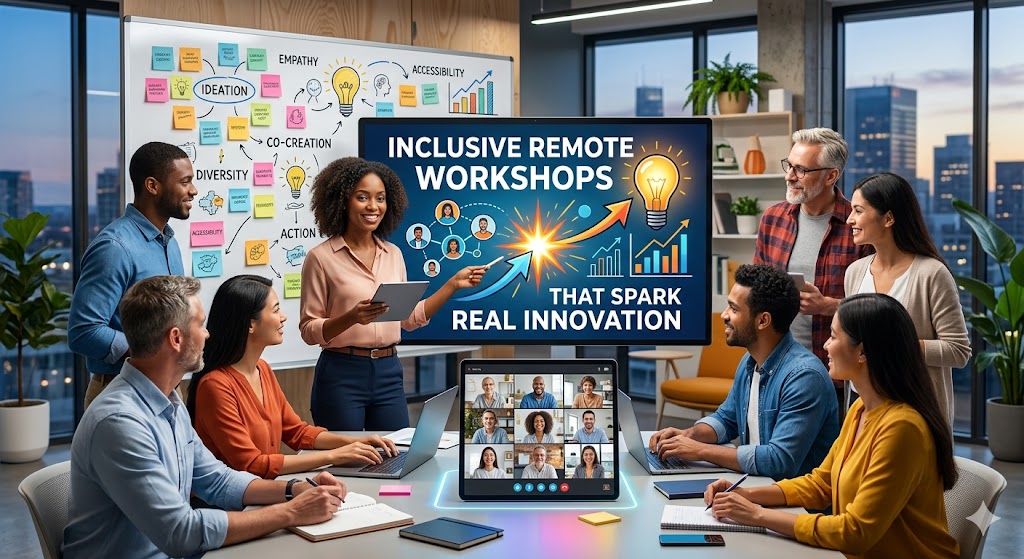
When we shift our perspective from “hosting a meeting” to designing an experience, remote environments become a powerful equalizer. By utilizing asynchronous contributions and intentional facilitation, we can democratize participation — allowing global teams, neurodivergent thinkers, and cross-functional partners to contribute on a level playing field.

The Goal of This Approach

Our objective is to move beyond the superficiality of digital sticky notes. We aim to create a rigorous, human-centered framework that transforms distributed energy into tangible, actionable innovation.

II. Designing for Psychological Safety and Accessibility

Innovation requires a degree of vulnerability that digital environments can inadvertently stifle. To spark real breakthroughs, we must intentionally architect a space where every participant feels both empowered to speak and equipped to contribute.

Pre-Workshop Leveling

The workshop shouldn’t start when the video call begins. Use asynchronous “pre-work” to reduce the pressure of “on-the-spot” thinking. By providing research prompts or ideation boards 48 hours in advance, you accommodate different processing speeds and give quieter voices the confidence of having a prepared contribution.

The Human-Centered Toolkit

Don’t let “shiny object syndrome” dictate your tech stack. Select platforms based on:

  • Low Barrier to Entry: Can a non-technical stakeholder navigate this without a tutorial?
  • Accessibility: Does the tool support screen readers, high contrast, or keyboard-only navigation?
  • Cognitive Load: Does the interface provide focus, or is it a distracting “playground” of features?

Establishing “Digital Ground Rules”

Because digital interactions lack many physical cues, explicit norms are vital. Establish a Manifesto of Participation at the outset:

  • Radical Candor: Challenge ideas, not people.
  • The “Draft” Mindset: All ideas are considered low-fidelity and “in-progress” to encourage risk-taking.
  • Presence Over Multitasking: Explicitly “closing the tabs” to honor the collective time of the group.

III. The Architecture of Inclusion

Inclusive innovation doesn’t happen by accident; it requires a structural shift in how power and presence are managed in a virtual space. We must design the “architecture” of the session to neutralize traditional corporate hierarchies and amplify diverse perspectives.

The Facilitator as an Orchestrator

In a remote setting, the facilitator must move beyond timekeeping to become an inclusion advocate. This involves “active scanning” — monitoring the participant list to ensure engagement isn’t being dominated by a few individuals and intentionally inviting contributions from those who have been quiet.

The Power of Anonymity

One of the greatest advantages of digital platforms is the ability to decouple an idea from the person who shared it. By utilizing anonymous brainstorming and voting, you remove the “HIPPO” effect (Highest Paid Person’s Opinion). When ideas are judged on their merit rather than the job title of the creator, radical innovation has the room to breathe.

Time Zone Empathy and “Follow the Sun” Cycles

True inclusion accounts for the physical reality of the participants. Avoid “Innovation Exhaustion” by:

  • Rotating Meeting Times: Ensure the same global team isn’t always the one joining at midnight.
  • Modular Agendas: Breaking workshops into 90-minute “sprints” that can be handed off across time zones.
  • Shared Artifacts: Using a single “source of truth” (like a persistent digital whiteboard) so teams starting their day can build directly on the work finished by teams ending theirs.

IV. Methodology: From Spark to Flame

The core of any successful innovation workshop is the transition from broad exploration to focused execution. In a remote environment, this “spark” must be carefully nurtured through structured interaction and high-energy facilitation to prevent it from flickering out.

Divergent Thinking in Digital Spaces

Digital canvases offer a unique opportunity for parallel ideation. Unlike a physical whiteboard where only one person can write at a time, remote tools allow every participant to contribute simultaneously. We use rapid-fire prompts — often just 2-3 minutes long — to bypass the internal critic and surface the “fringe” ideas that often lead to true disruption.

Managing the Energy Curve

“Zoom fatigue” is the enemy of creativity. To maintain momentum, we must design for the human attention span:

  • The 90-Minute Rule: No session should exceed 90 minutes without a “bio-break” or a sensory shift.
  • Kinesthetic Engagement: Encouraging participants to stand up, sketch on physical paper, or even find an object in their room that represents a solution.
  • Audio Shifts: Utilizing curated soundtracks during individual ideation time to signal a change in the cognitive “mode.”

Visual Thinking and Digital Prototyping

Innovation becomes real when it becomes tangible. We move quickly from abstract text to low-fidelity visuals. Whether it’s using digital shape libraries to map a process or simple wireframing tools to sketch a user interface, visual artifacts create a shared mental model that words alone cannot achieve.

V. Breaking the Silos (The Experience Design Perspective)

Innovation is a team sport, yet organizational structures often keep the most valuable players in separate locker rooms. From an experience design standpoint, a remote workshop is the perfect venue to dissolve these barriers and foster a holistic view of the problem space.

Intentional Cross-Pollination

In a physical office, people tend to sit with their “tribe.” In a digital workshop, we can use randomized breakout rooms to force “unlikely pairings.” When a front-line customer service representative is paired with a back-end developer or a finance lead, the resulting friction creates sparks that lead to more feasible and desirable solutions.

Active Empathy Mapping

We must ensure the “human” stays at the center of human-centered change. Digital whiteboards allow us to build live empathy maps where teams can collaboratively drop in customer quotes, video snippets, or screenshots of friction points. This shared visual evidence keeps the conversation grounded in real-world needs rather than internal assumptions.

The “Parking Lot” 2.0

Remote sessions often surface brilliant ideas that are unfortunately out of scope for the current sprint. Instead of letting these ideas derail the flow, we utilize a Digital Insights Vault. This isn’t just a list of “to-do later” items; it is a categorized, tagged repository that ensures tangential but valuable insights are captured and routed to the appropriate owners after the session concludes.

VI. Converting Momentum into Action

The most dangerous moment for any innovation initiative is the five minutes after the “Leave Meeting” button is pressed. Without a deliberate transition strategy, the collective energy of the workshop dissipates into the digital void. We must treat the output of the session not as a final product, but as the raw material for immediate execution.

Overcoming “Digital Decay”

In a physical workshop, the presence of charts on a wall creates a lingering memory. In remote settings, we face Digital Decay — the rapid loss of context once a browser tab is closed. To combat this, we ensure that the “North Star” of the session and the most critical insights are summarized into a “Flash Report” delivered within two hours of the workshop’s conclusion.

Immediate Synthesis and Heat-Mapping

We don’t wait for a post-session analysis to find the winners. We use live-categorization and dot-voting to create a heat map of consensus in real-time. By the end of the session, the team should be able to see a visual hierarchy of which ideas have the highest desirability, feasibility, and viability.

The Roadmap Forward: Defining Ownership

A workshop without “Who, What, and When” is just a conversation. Before the session ends, we translate winning concepts into Action Artifacts:

  • The Owner: Assigning a single “Directly Responsible Individual” (DRI) for each prioritized concept.
  • The Velocity Goal: Defining what the “Minimum Viable Progress” looks like in the next 48 hours.
  • The Feedback Loop: Scheduling the follow-up “Check-In” during the session itself to maintain accountability.

VII. Conclusion: The Future is Distributed

The shift to remote and hybrid work is not a temporary hurdle to be cleared; it is a fundamental expansion of how we solve problems. High-impact innovation isn’t about the physical room — it’s about the intentionality of the relationships and the rigor of the process we design.

Key Takeaways

When we prioritize inclusion and human-centered design in our digital spaces, we don’t just “get through” a meeting; we unlock a level of collective intelligence that traditional office settings often stifle. By leveraging anonymity, asynchronous preparation, and cross-functional “collision,” we create a culture where ideas are judged on their merit, and every voice has a path to contribution.

A Call to Action

I challenge every leader, strategist, and facilitator to stop simply “hosting meetings.” Our role is to design experiences that respect human energy, bridge geographic divides, and turn the spark of a distributed team into the flame of real-world innovation. The tools are ready — it’s time for our methods to catch up.

Frequently Asked Questions

Practical insights for leaders transitioning to inclusive, high-impact remote collaboration.

How do you manage “The Loudest Voice” in a virtual setting?

By utilizing silent, parallel ideation and anonymous voting tools. This ensures that the merit of an idea takes precedence over the seniority or extroversion of the person sharing it.

What is the ideal duration for a remote innovation workshop?

I recommend 90-minute modules. Human attention and “Zoom fatigue” peak at this point. If more time is needed, break the day into distinct sprints with significant sensory breaks in between.

Why is “pre-work” essential for inclusion?

Asynchronous preparation allows neurodivergent thinkers and non-native speakers the time to process information and formulate ideas without the pressure of an immediate “on-the-spot” spotlight.

Image credits: Gemini

Subscribe to Human-Centered Change & Innovation WeeklySign up here to join 17,000+ leaders getting Human-Centered Change & Innovation Weekly delivered to their inbox every week.

Change Coaching for Middle Managers

LAST UPDATED: April 7, 2026 at 12:26 PM

Change Coaching for Middle Managers

GUEST POST from Chateau G Pato


The Strategic Middle

In the world of organizational transformation, middle managers are often unfairly labeled as the “permafrost” — the cold, impenetrable layer where executive vision stalls and frontline enthusiasm withers. However, from a human-centered design perspective, this layer isn’t a barrier by choice; it is a pressurized environment where the demand for stability (Business as Usual) crashes directly into the demand for agility (Change).

The Middle Manager Paradox

Middle managers occupy a unique and often exhausting space. They are the primary bridge between high-level strategy and ground-level execution. While executives focus on the destination, middle managers are tasked with building the vehicle, fueling it, and keeping the passengers from jumping out — all while driving at full speed.

Why Change Fails at the Core

To innovate effectively, we must move beyond the lazy trope of “managerial resistance.” Most failure at this level isn’t due to a lack of will, but a lack of psychological and structural support. When a manager is measured on legacy KPIs while being asked to champion a disruptive future, the friction becomes untenable. True change design requires us to solve for the manager’s experience as much as the customer’s.

The Thesis: Change Isn’t Managed; It’s Coached

We must shift the paradigm from directive oversight — which relies on compliance — to supportive facilitation. Coaching provides middle managers with the tools to navigate the emotional landscape of their teams, surface hidden obstacles early, and translate abstract corporate goals into meaningful local action. By coaching the middle, we turn a potential bottleneck into a powerful catalyst for sustained innovation.

The Human-Centered Change Framework

Change initiatives fail when we treat people like components in an engine — replaceable, logical, and purely functional. To truly innovate how we approach change coaching for middle managers, we must adopt a human-centered methodology. This framework is not about managing a checklist of tasks; it’s about understanding and designing for the entire experience of the manager navigating the transition.

Empathy as a Business Tool

The cornerstone of human-centered design is empathy. When applied to middle managers, this means proactively seeking to understand their specific friction points, fears, and motivations. The coaching relationship should begin with an **empathy mapping session** designed to explore the manager’s perspective:

  • What are they hearing from their teams (resistance, fear) vs. their leaders (pressure, urgency)?
  • What are they seeing in the organization (fragmented systems, siloed efforts)?
  • What are their deepest pains (fear of failure, workload overload) and potential gains (career growth, successful innovation)?

This exercise provides the raw data needed to tailor the coaching experience and create a plan that addresses their actual challenges rather than perceived ones.

The Experience of Change

Every change initiative is a journey. We often design the endpoint (the new system, the new structure) but fail to design the path. Change coaches must help middle managers view this journey as a critical **user experience (UX)**. A human-centered approach requires us to answer key questions about that journey:

  • Does the current workload allow space for adoption and experimentation? (Or are they working a “second shift”?)
  • Is the environment psychologically safe? Is failure during the learning curve accepted or penalized?
  • How does this change impact the manager’s professional identity and long-term goals?

By intentionally designing for these experience factors, we ensure the manager is equipped, mentally and structurally, to adopt and champion the change.

Visualizing the Impact: The Change Planning Toolkit™

Complexity is the enemy of adoption. In human-centered design, visualization is crucial for clarity. In my work developing the Change Planning Toolkit™, I emphasized the need for managers to move beyond abstract spreadsheets. Coaching middle managers involves helping them use visual canvases and tools to:

  • Map the specific impacts of the change on every stakeholder group within their influence.
  • Identify hidden dependencies that might cause bottlenecks.
  • Co-create adoption strategies *with* their teams, rather than dictating them.

Visual tools reduce cognitive load, foster collaboration, and make complex organizational changes manageable, providing a shared language for the manager, their team, and the coach.

Core Coaching Competencies for the “Middle”

To effectively coach through change, middle managers must evolve from “task masters” into facilitative leaders. This shift requires a specific set of competencies designed to bridge the gap between high-level vision and the human reality of the workplace.

Translating Strategy into Action

One of the greatest points of failure in change initiatives is the “Meaning Gap.” Executives speak in terms of EBITDA, market share, and digital transformation, but frontline employees care about their daily workflows and job security. A coached middle manager acts as a strategic translator.

Coaching helps managers identify the “why” that resonates specifically with their teams. Instead of simply repeating corporate talking points, they learn to frame the change in ways that highlight local benefits, solve immediate frustrations, and align with the team’s values.

Active Listening & Feedback Loops

Traditional management often relies on a “broadcast” model — pushing information down the hierarchy. Human-centered coaching flips this. Managers must become experts in active listening to surface the “ground truth” of the organization.

  • Surfacing Obstacles: Learning to ask open-ended questions that reveal hidden technical or emotional barriers before they become crises.
  • The Two-Way Dialogue: Moving from “Do you have any questions?” to “What part of this new process feels most difficult for you?”
  • Feedback as Fuel: Treating team feedback not as “resistance,” but as valuable data that can be used to refine the change design.

Developing Resilience and Modeling Behavior

In times of transition, the team looks to the manager for cues on how to react. If the manager is anxious or cynical, the team will follow suit. Coaching provides managers with the emotional intelligence tools to navigate their own uncertainty first.

By developing personal resilience, managers can model adaptable behavior. This includes “working in the open,” admitting when they don’t have all the answers, and demonstrating a growth mindset. When a manager can stay grounded in the face of ambiguity, they create a “containment vessel” that allows their team to feel safe enough to take risks and learn new ways of working.

Moving from Gatekeeper to Catalyst

In many traditional hierarchies, the middle manager acts as a gatekeeper — protecting resources, mitigating risk, and ensuring strict adherence to established protocols. However, in a rapidly evolving business landscape, this defensive posture can stifle innovation. Coaching empowers managers to shift their identity toward becoming a catalyst: someone who accelerates the change process by removing friction and empowering others.

Relinquishing Control and Embracing Empowerment

The most difficult hurdle for many managers during change is the fear of losing control. When processes are in flux, the instinct is to micromanage to prevent errors. A human-centered coaching approach helps managers understand that agility requires distributed authority.

Coaches work with managers to identify tasks and decisions that can be delegated to the team. By shifting from “command and control” to “clear intent and support,” managers free themselves to focus on higher-level strategic alignment while giving their team the autonomy to find the best way forward.

Identifying and Amplifying “Positive Deviants”

Change rarely happens all at once. In every team, there are individuals who naturally gravitate toward the new way of working — the positive deviants. These are people who find better ways to succeed despite the challenges of the transition.

Coaching teaches managers how to spot these early adopters and, instead of seeing them as “outliers,” use them as partners in the transformation. By amplifying their successes and sharing their methods, the manager allows the change to spread organically through peer influence rather than top-down mandates.

The Power of Recognition and Small Wins

Large-scale transformation can feel like an endless marathon. Without visible progress, fatigue sets in quickly. Middle managers must be coached to become “detectives of the good,” constantly looking for small wins that validate the new direction.

  • Micro-Recognitions: Celebrating the first time a team member uses a new tool, even if they aren’t perfect yet.
  • Process Wins: Highlighting when a new workflow saves time, even if the overall project isn’t finished.
  • Emotional Validation: Acknowledging the effort and courage it takes to unlearn old habits.

By consistently recognizing these moments, the manager builds the collective confidence of the team, proving that the “new” is not only possible but beneficial.

Overcoming the “Permafrost” (Common Challenges)

The “permafrost” layer isn’t a sign of bad management; it’s a sign of a system in conflict. Middle managers are often buried under the weight of legacy expectations while being told to sprint toward a new horizon. Coaching at this level requires specific interventions to thaw this layer and allow the seeds of change to take root.

The Resource Crunch: Managing the “Second Shift”

One of the primary reasons change fails is that it is treated as an “add-on” to an already full 40-hour week. Coaches must work with managers to perform a brutal prioritization of their current commitments. This involves:

  • Identifying “Stop-Doing” Lists: What legacy reports or meetings can be paused to create capacity for the change initiative?
  • Integrating Change into Routine: Moving change tasks from “special projects” into the daily flow of work.
  • Protecting White Space: Ensuring the manager has the cognitive breathing room to think strategically rather than just reacting to fires.

Managing Up and Down: The Shield and the Sword

Middle managers often feel squeezed between unrealistic executive deadlines and team burnout. A human-centered coach helps the manager master the art of boundary setting.

The manager learns to act as a shield for their team — protecting them from “initiative overload” and shifting priorities — while acting as a sword (or advocate) to the leadership, providing honest data on what is actually achievable. Coaching provides the scripts and the confidence to say, “We can do X, but we must delay Y to ensure the quality of the transition.”

Identifying and Healing “Change Fatigue”

Continuous change is the new normal, but human biology isn’t designed for perpetual high-alert states. Coaches must train managers to recognize the subtle signs of change fatigue before they turn into full-blown burnout:

  • Cynicism: When “we’ve tried this before” becomes the default response.
  • Disengagement: Silence in meetings or a lack of voluntary participation.
  • Reduced Productivity: Even in tasks unrelated to the change.

The coaching intervention here isn’t to “push harder,” but to pause and re-calibrate. This might mean celebrating a plateau, acknowledging the emotional toll of the work, or temporarily slowing the pace of implementation to allow the team’s resilience to recover.

Measuring Success Beyond the Spreadsheet

The true impact of change coaching for middle managers cannot be captured solely by “go-live” dates or budget adherence. To understand if the transformation is sticking, we must look at the human metrics of the organization. Human-centered innovation requires a more nuanced approach to measuring success — one that values the health of the culture as much as the speed of the output.

Qualitative Milestones: The Pulse of the Team

Coaches should help managers look for leading indicators of success that traditional reporting often misses. These qualitative milestones demonstrate that the “permafrost” is thawing and a new culture is emerging:

  • Shift in Sentiment: Moving from “Why is this happening to us?” to “How can we make this work for us?”
  • Increased Collaboration: A visible rise in cross-functional problem-solving without the need for managerial intervention.
  • Proactive Problem-Solving: Team members identifying and fixing bottlenecks in the new process independently.

The Innovation Connection

Effective change coaching creates a powerful side effect: a safer environment for continuous improvement and experimentation. We measure this by observing the frequency and quality of new ideas originating from the middle and frontline. When a manager is coached to be a catalyst, the team stops fearing mistakes and starts seeing them as data points. Success is defined by a team that no longer waits for a “Change Initiative” to improve their own workflows.

Long-Term ROI: Sustainability and Retention

The ultimate return on investment for coaching middle managers is sustainability. Anyone can force a temporary change through sheer willpower, but it won’t last. We measure long-term success through:

  • Reduced Turnover: Managers who feel supported and coached are less likely to leave, and their teams are less likely to experience burnout.
  • Knowledge Retention: How much of the “new way” remains standard practice six or twelve months after the formal project has ended.
  • Adaptive Capacity: The speed at which the team can pivot to the next change. A coached team builds “change muscles” that make future transformations progressively easier.

Conclusion: Building a Culture of Continuous Change

The success of any innovation or change initiative ultimately rests on the shoulders of the middle. They are the operational engine of the organization, and if that engine is stalled by fear, overwhelm, or lack of clarity, the entire enterprise remains stationary regardless of the vision at the top.

Designing the Manager Experience

We must stop viewing middle management as a problem to be solved and start seeing it as a design opportunity. When we apply human-centered principles to the coaching of these leaders, we aren’t just checking off project milestones; we are building organizational resilience. When we design the change experience for the manager, they are finally empowered to design a thriving future for the organization.

The Call to Action

It is time to move beyond the “one-and-done” training workshops. Investing in sustained coaching programs treats middle managers as the strategic partners they truly are. This investment yields dividends far beyond the current project — it creates a leadership tier that is comfortable with ambiguity, empathetic to their teams, and ready to lead through the next wave of disruption.

Final Thought

Innovation is not a destination; it is a capability. By thawing the “permafrost” through coaching, you transform your middle managers from defenders of the status quo into the architects of your future.

Frequently Asked Questions

Why is the “Middle Manager” often the point of failure for change?

It’s rarely about personal resistance. Middle managers are often measured on legacy KPIs (stability) while being tasked with driving transformation (instability). This creates a “structural friction” where they are forced to prioritize current operations over future innovation just to meet their immediate performance goals.

How does coaching differ from traditional change management training?

Training is usually a one-way transfer of information or “how-to” steps. Coaching is a facilitative process that addresses the emotional and psychological barriers of the manager. It provides a safe space to navigate uncertainty, practice new behaviors, and develop the empathy required to lead a team through transition.

What is the first step in implementing a human-centered coaching approach?

The first step is conducting an Empathy Mapping exercise. Before deploying tools or timelines, you must understand the manager’s current reality — what they are hearing, seeing, feeling, and doing. This ensures the coaching intervention solves for their actual pain points rather than a generic set of assumptions.

Image credits: Gemini

Subscribe to Human-Centered Change & Innovation WeeklySign up here to join 17,000+ leaders getting Human-Centered Change & Innovation Weekly delivered to their inbox every week.