Author Archives: Chateau G Pato

About Chateau G Pato

Chateau G Pato is a senior futurist at Inteligencia Ltd. She is passionate about content creation and thinks about it as more science than art. Chateau travels the world at the speed of light, over mountains and under oceans. Her favorite numbers are one and zero. Content Authenticity Statement: If it wasn't clear, any articles under Chateau's byline have been written by OpenAI Playground or Gemini using Braden Kelley and public content as inspiration.

How Mental Models Shape Organizational Change Readiness

LAST UPDATED: April 20, 2026 at 1:03 PM
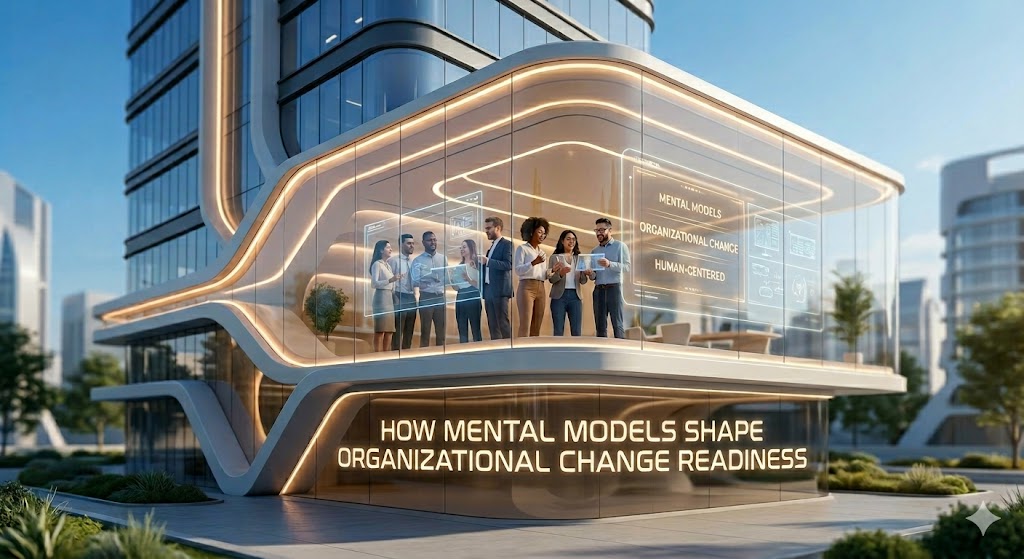
How Mental Models Shape Organizational Change Readiness

GUEST POST from Chateau G Pato


The Hidden Architecture of Change

In the realm of organizational transformation, we often witness a recurring paradox: a strategy is meticulously crafted, the technology is state-of-the-art, and the budget is ample, yet the initiative stalls. This failure rarely stems from a lack of logistics; rather, it occurs because the strategy hits the “human firewall.”

To navigate this, we must understand Mental Models — the internal representations of external reality that act as the cognitive operating system for our workforce. These models dictate how people perceive challenges, interpret leadership cues, and ultimately decide whether to lean into or recoil from a new direction.

“Organizational change readiness is not a logistical state, but a psychological one.”

True readiness is achieved only when we move beyond process mapping and begin the deeper work of challenging, expanding, and replacing the outdated cognitive frameworks that keep an organization anchored to its past. By addressing the mindset before the milestone, we transform change from a forced march into a collective evolution.

The Anatomy of Organizational Mental Models

Mental models are the invisible scaffolding of an organization. They are the deeply ingrained assumptions, generalizations, and even pictures or images that influence how we understand the business environment and how we take action. Within an organization, these frameworks manifest in three primary layers:

The “Way We Do Things Here”

Over time, individual observations coalesce into a shared organizational consciousness. This is where calcified culture resides. When a mental model remains unchallenged for too long, it stops being a perspective and starts being treated as an objective truth. This “cultural inertia” is the primary opponent of any innovation effort.

The Ladder of Inference

Employees do not experience change neutrally. According to the Ladder of Inference, they select specific data from a change announcement, add their own cultural meaning, make assumptions, and draw conclusions that lead to beliefs. If their mental model is rooted in past organizational trauma, they will climb this ladder toward resistance before the first town hall meeting is even over.

Individual vs. Collective Frameworks

There is often a significant friction point between personal career mental models (focused on security and specialized mastery) and organizational shift models (focused on agility and cross-functional blurring). Understanding this misalignment is critical for experience design; we must design the change to bridge the gap between “what is best for the company” and “how I perceive my value.”

By identifying these layers, leaders can stop fighting the symptoms of resistance and start addressing the underlying cognitive architecture that dictates readiness.

Identifying Cognitive Barriers to Readiness

Before we can install a new way of working, we must identify the psychological roadblocks that prevent people from letting go of the old one. These barriers are often unconscious, functioning as a defensive reflex against the perceived instability of innovation.

The Status Quo Bias

The brain is a prediction machine that seeks to conserve energy. The Status Quo Bias is our neurological preference for the “known,” even when the current state is demonstrably suboptimal. In an organizational context, employees will often defend a broken process simply because it is familiar, perceiving the certainty of current pain as safer than the uncertainty of future gain.

Loss Aversion in Experience Design

In human-centered change, we must account for Loss Aversion — the principle that the pain of losing something is psychologically twice as powerful as the joy of gaining something of equal value. When we introduce new experience designs or service metrics, employees don’t initially see the improved outcome; they see the loss of their established expertise, their routine, and their perceived status.

Fixed vs. Growth Mindsets and Learned Helplessness

Organizational history heavily weights current readiness. If an organization has a history of “flavor of the month” initiatives that fail to launch, employees develop Learned Helplessness. Their mental model shifts to a fixed state: “This too shall pass if I just ignore it.” Breaking this requires more than enthusiasm; it requires a structural demonstration that the environment has changed, allowing a growth mindset to safely re-emerge.

By auditing these cognitive barriers, leaders can move away from “blaming the people” and start designing the path to bypass these natural human resistances.

Strategy: Re-Wiring the Organizational Mindset

Shifting an organization’s mental model is not about “selling” a change; it is about facilitating a collective cognitive reorganization. This requires leaders to move from being directors of tasks to being architects of understanding.

Surfacing the Invisible

You cannot change what you cannot see. The first step in “re-wiring” is to make existing mental models explicit. Through Experience Mapping and open dialogue, leaders must encourage teams to articulate the “unspoken rules” they follow. When these assumptions are brought into the light, the organization can collectively decide which models serve the future and which are relics of a previous era.

Reframing the Narrative

The brain reacts to “change” as a threat, but it reacts to “evolution” as an opportunity. Strategy must focus on reframing the narrative from disruption — which implies loss — to value evolution. We aren’t just changing how we work; we are evolving our capacity to deliver human-centered value. This shift in language helps move the workforce out of a defensive posture and into a creative one.

The Role of Futurology: Pre-Experiencing the Future

Resistance is often fueled by a lack of imagination. By utilizing Scenario Planning and futurology tools, we can help employees “pre-experience” the future. When people can visualize their place within a new system, the “future” stops being a nebulous threat and starts being a tangible destination. This reduces the cognitive load of the transition and builds a proactive state of readiness.

By integrating these strategies, we move the needle from simple compliance to true cognitive alignment, ensuring the organizational “brain” is fully synced with its strategic heart.

Design Thinking for Mindset Shift

To effectively bridge the gap between current and future mental models, we must apply the principles of human-centered design to the change process itself. This ensures that the transition is not just a top-down mandate, but a designed experience that accounts for human psychology.

Empathy Mapping for Change

Traditional change management focuses on what people need to do. Human-centered change focuses on what people see, hear, think, and feel. By utilizing empathy mapping, leaders can identify the specific cognitive load and emotional friction points that a change initiative introduces. This allows us to design interventions that address the actual anxieties of the workforce rather than just their technical skills.

Prototyping New Behaviors

Mental models are reinforced by experience. Therefore, to change a model, we must provide a new experience. Instead of a massive, organization-wide rollout, we can prototype the change through small-scale experiments. These “safe-to-fail” pilots allow teams to test new ways of working, proving to themselves that the new mental model works before the stakes are raised.

Creating Psychological Safety and Feedback Loops

For a mindset to shift, people must feel safe enough to admit that their old way of thinking is no longer valid. This requires radical psychological safety. We must build feedback loops where “mental model friction” is treated as valuable data rather than resistance. When employees feel they can openly discuss their struggles with the new direction, they become active participants in the design of the future, rather than passive recipients of it.

By treating the change process as a design challenge, we move away from rigid implementation and toward a fluid, responsive evolution that respects the human element of innovation.

Conclusion: Building a “Change-Fluent” Culture

The ultimate goal of addressing mental models is not just to survive a single transformation, but to build a “change-fluent” organization. In a world of accelerating disruption, the competitive advantage belongs to those who can unlearn as quickly as they learn.

From Rigid to Adaptive

We must move away from the “unfreeze-change-refreeze” model of the past. Modern innovation requires a permanent state of fluidity. By building the capacity for continuous re-evaluation, we ensure that the organization’s mental models remain mirrors of the current reality, rather than monuments to past success.

The Leader as a Curator of Perspectives

In this new paradigm, the role of leadership shifts. A leader’s job is no longer to have the “right” mental model, but to facilitate the collision of diverse perspectives. By encouraging teams to challenge each other’s assumptions and bring different lenses to a problem, leaders can spark the friction necessary for true innovation to occur.

As we look toward a future shaped by rapid technological and societal shifts, we must remember a fundamental truth: We don’t see the organization as it is; we see it as we are. If we want to change the organization, we must first be willing to change the lens through which we view it.

The Bottom Line: Real innovation requires more than a new toolkit; it requires a new mindset. Change readiness is the degree to which an organization can collectively unlearn the past to make room for the future.

Audit Your Readiness: Mental Model Diagnostic

Use these questions to identify where your organization’s current “cognitive operating system” may be resisting necessary change:

  • The “Why” Test: When a new process is proposed, is the primary response “Why do we need this?” or “How will this help us evolve?”
  • The Sacred Cow Identification: What are the “unspoken truths” in this department that no one is allowed to challenge during a meeting?
  • Historical Weight: Can your team list three specific times a past innovation failed, and how are those failures currently dictating their willingness to try again?
  • The Empathy Gap: Can leadership accurately describe the top three fears a front-line employee has regarding the upcoming transition?
  • Language Audit: Is the internal vocabulary regarding the project focused on “implementation” (mechanical) or “experience” (human-centered)?
  • The Safety Check: When an employee points out a flaw in the new strategy, are they rewarded for their insight or labeled as a “blocker”?

Frequently Asked Questions

Why do mental models matter more than tools during a change initiative?

Tools and processes are only as effective as the people using them. If the workforce’s internal “operating system” (their mental models) is programmed to value the status quo, they will naturally use new tools to achieve old results. Addressing the mindset ensures the tools are used to drive true innovation.

How can leaders identify hidden mental models in their teams?

Leaders can surface hidden models by looking for recurring “organizational myths” or phrases like “that’s not how we do things here.” Using techniques like Experience Mapping and the Ladder of Inference helps teams articulate their underlying assumptions, making them visible and, therefore, changeable.

Does “human-centered change” mean avoiding difficult transitions?

No. Human-centered change isn’t about avoiding difficulty; it’s about acknowledging and designing for the cognitive and emotional load that change creates. By reducing unnecessary friction and building psychological safety, organizations can move through difficult transitions faster and more effectively.

Image credit: Google Gemini

Subscribe to Human-Centered Change & Innovation WeeklySign up here to get Human-Centered Change & Innovation Weekly delivered to your inbox every week.
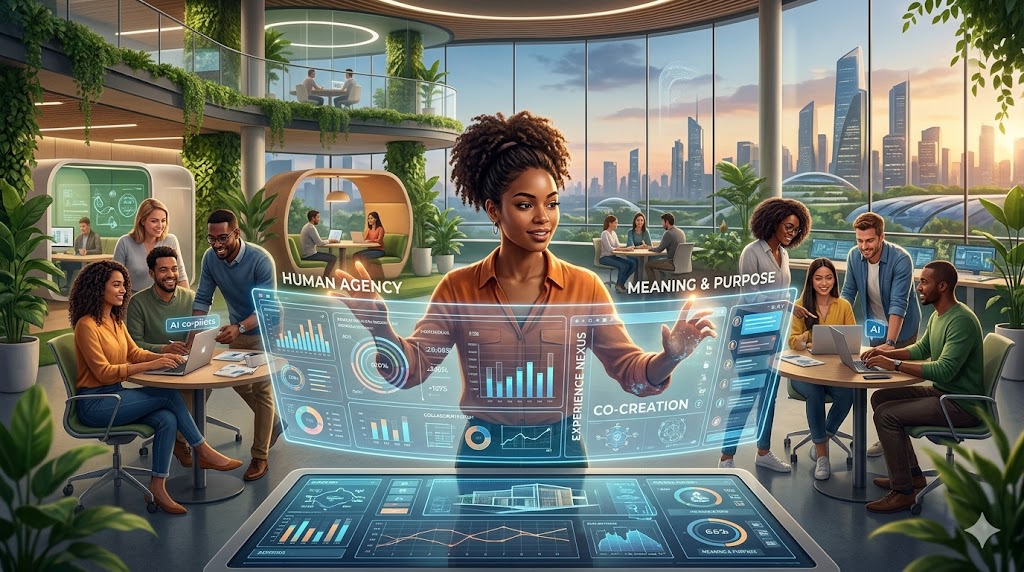
The Agency Revolution

What People Really Want from Employers Today

LAST UPDATED: April 19, 2026 at 5:38 PM

The Agency Revolution

GUEST POST from Chateau G Pato


The Death of the “Conscript” Mentality

For decades, the traditional employment contract was built on a transactional foundation: the “Conscript” model. Organizations expected employees to trade their time, compliance, and cognitive labor for a steady paycheck and a cubicle. But the world has shifted. In a landscape defined by rapid technological acceleration and shifting social values, the era of the industrial-era conscript is officially over.

Today, people are looking to be Architects and Magic Makers. They are no longer content being cogs in a machine; they want to be the designers of the machine itself. This shift represents a fundamental move from passive participation to active contribution. If innovation is truly the act of removing friction from the human experience, then as leaders, we must start by removing the friction within our own organizational structures.

“The most attractive employers in 2026 aren’t those offering the flashiest perks, but those who provide the highest level of Human Agency.”

In this article, we explore how the most successful organizations are moving away from managing “headcount” and toward empowering individuals to own their impact, drive change, and find a sense of true agency in their professional lives.

Radical Transparency & Psychological Safety: The Fuel for Change

Innovation and change are inherently risky endeavors. If an employee fears that a failed experiment or a dissenting opinion will lead to professional exile, they will naturally default to the status quo. Psychological safety is not a “soft” HR concept; it is the essential fuel for an agile organization. Without it, your innovation engine is running on an empty tank.

To move forward, leaders must dismantle the “Zero-Error Trap.” In many corporate cultures, the cost of being wrong is perceived as higher than the benefit of being right. This creates a culture of silence where employees hide their best ideas and mask emerging problems. To thrive, we must shift the focus from “avoiding failure” to “maximizing learning velocity.”

Achieving this requires Radical Communication Loops. We need to create direct, unfiltered lines of communication from the “edges” of the organization — where the employees interact with customers — to the “center” where strategy is formed. When people see that their insights lead to tangible change, they stop being observers and start being owners.

  • Safety as Fuel: Creating an environment where curiosity is prioritized over compliance.
  • Dismantling the Zero-Error Trap: Celebrating the “intelligent failure” that provides a competitive roadmap.
  • Edge-to-Center Feedback: Ensuring the front lines have a voice in the boardroom.

The “Agency First” Model: Automating the Mundane to Elevate the Human

We are entering an era where the value of a human being in the workplace is no longer measured by their ability to perform repetitive tasks. The “Agency First” model focuses on Cognitive Offloading — using AI and automation to strip away the “mental noise” of administrative drudgery. This isn’t about replacement; it’s about liberation. When we automate the mundane, we don’t just save time; we reclaim the cognitive bandwidth necessary for deep thought and creative problem-solving.

This shift requires a fundamental evolution in management: moving from Monitor to Mentor. Instead of supervisors checking machine-generated outputs, the modern employee takes on the role of a system architect or “AI Coach.” They are responsible for the Human-in-the-Loop upgrade, ensuring that technology serves human goals rather than the other way around.

Ultimately, people today want to focus on Intent. In a world of infinite digital “busyness,” the most valuable skill is the ability to define the Commander’s Intent — the “why” behind the work. By letting intelligent systems handle the “how,” employees are empowered to steer the ship rather than just rowing in the galley. This is how we move from a workforce that is merely busy to a workforce that is profoundly impactful.

“The goal of digital transformation isn’t to make people work more like machines; it’s to use machines so that people can work more like humans.” — Braden Kelley

The Experience Nexus: Co-Creating the Workplace

In the past, organizations treated Customer Experience (CX) and Employee Experience (EX) as separate silos. Today, we realize they are two sides of the same coin. I call this the Experience Nexus. To deliver a seamless external brand, you must first design a seamless internal culture. We are seeing the rise of the Experience Management Office (XMO) — a centralized hub that integrates CX, EX, and Partner Experience (PX) to ensure every touchpoint is human-centered.

Modern employees don’t want to be passive recipients of HR policies; they want to be active designers. This is where the Employee Advisory Board comes in. By involving staff in the co-creation of the workplace — from hybrid work rituals to the selection of software — you shift the dynamic from “us vs. them” to a shared mission. When people help build the house, they care more about the foundation.

However, co-creation requires Radical Transparency regarding the data we collect. As we move toward neuroadaptive workplaces and advanced sensing, maintaining Data Sovereignty is critical. People want to know what is being measured and why. They want the assurance that technology is being used to support their flourishing, not just to track their keystrokes. Transparency builds the trust that makes innovation possible.

  • Unified Experience: Bridging the gap between how we treat customers and how we treat our team.
  • Co-Design Principles: Moving from top-down mandates to collaborative culture-building.
  • Privacy as a Pillar: Respecting individual sovereignty in an increasingly digital environment.

Meaning as the North Star (Not Just “Happiness”)

There is a common misconception in leadership circles that the ultimate goal is “employee happiness.” While happiness is wonderful, it is a trailing indicator. The leading indicator — the one that actually drives retention and brilliance — is Meaning. People don’t just want to feel good at work; they want to feel that their work matters. They want to see the direct line between their daily tasks and the success of the customer.

This shift requires us to rethink performance management entirely. We need to move away from the industrial mindset of “weeding out” low performers and toward a philosophy of “Re-potting.” Often, an employee isn’t failing; they are simply planted in the wrong soil. By identifying their unique aspirations and shifting them into roles where their specific talents can flourish, we honor the human being while optimizing the organization.

The Dream Organization is one where the friction between individual aspiration and corporate objectives disappears. When a company’s North Star aligns with the employee’s personal sense of purpose, you don’t need to “manage” them in the traditional sense. You simply need to provide the resources and get out of their way. In 2026, the competitive advantage belongs to the companies that can bridge the gap between “making a living” and “making a difference.”

“Stop trying to engineer happiness. Start designing for significance.”

Conclusion: Getting to the Future First

We are currently living through a profound transition in the nature of work. We are moving from a world where we use tools to perform tasks, to a world where we inhabit intelligent systems. Navigating this shift requires a FutureHacking™ mindset — the ability to look at the horizon not with fear, but with the intent to shape it. The future isn’t something that happens to us; it’s something we build through the choices we make today.

As leaders, our primary call to action is simple yet challenging: Stop trying to “make people happy” and start making their work important. When an individual understands their role in the larger story of innovation and human experience, engagement becomes a natural byproduct rather than a forced metric. We must provide the agency, the safety, and the tools that allow our teams to move from being participants in a process to being masters of their craft.

Change doesn’t happen in the boardroom through slide decks and mandates. It happens in the hearts and minds of the people on the front lines who choose to bring their best selves to work every day. By designing an organization that honors human potential, you don’t just stay competitive — you get to the future first.

The question isn’t whether the workplace will change, but whether you will be the one to lead that change. Let’s build something meaningful together.

Frequently Asked Questions

1. What is the difference between a “Conscript” and a “Magic Maker”?

A “Conscript” is an employee who performs work based on transactional compliance — trading time for a paycheck. A “Magic Maker” is an empowered individual who uses their agency to solve problems, innovate, and create value through human-centered design and passion.

2. Why is psychological safety considered the “fuel” for innovation?

Innovation requires the freedom to experiment and fail. Psychological safety ensures that employees can take calculated risks and share dissenting opinions without fear of retribution, which is essential for rapid learning and organizational agility.

3. What does “re-potting” talent mean in a modern organization?

Rather than traditional performance management that “weeds out” low performers, “re-potting” involves identifying an individual’s unique strengths and moving them into a different role or environment where they can better flourish and contribute to the mission.

Image credit: Google Gemini

Subscribe to Human-Centered Change & Innovation WeeklySign up here to get Human-Centered Change & Innovation Weekly delivered to your inbox every week.

Human-Centered Onboarding for Virtual Environments

LAST UPDATED: April 18, 2026 at 9:55 AM

Human-Centered Onboarding for Virtual Environments

GUEST POST from Chateau G Pato


The Digital Front Door: Reimagining the First Impression

In the traditional physical workplace, onboarding began the moment a new hire walked through the front door. They absorbed culture through the architecture, the buzz of the office, and the immediate, tactile welcome of their peers. In a virtual environment, that “front door” has been replaced by a login screen and a series of calendar invites.

The Transition from Provisioning to Integration

The most common pitfall in remote onboarding is mistaking technical provisioning for human integration. Sending a laptop and a list of passwords ensures an employee can work, but it does nothing to ensure they feel part of a mission. We must shift our focus from the transactional — checking off software installs — to the experiential — fostering a sense of psychological safety and belonging from mile zero.

Addressing the Vulnerability of 2D Spaces

Starting a new role is inherently vulnerable. In a screen-based world, that vulnerability is amplified by a lack of social cues and the “lonely gaps” that occur between Zoom calls. A human-centered approach acknowledges these gaps and intentionally fills them with connection, clarity, and a roadmap that prioritizes the person over the process.

Pre-boarding: Reducing Cognitive and Emotional Load

The period between signing an offer letter and the first day is often a “black hole” of communication. This silence breeds anxiety, as new hires wonder if they made the right choice or what will be expected of them. Human-centered onboarding begins before day one by proactively managing the emotional and cognitive load of the transition.

Closing the “Anxiety Gap”

Effective pre-boarding is about transparency. By providing a clear, visual roadmap of the first week, we eliminate the “fear of the unknown.” This isn’t about giving them work to do; it’s about providing a mental scaffold so they can arrive on their first day feeling prepared rather than overwhelmed.

The Cultural Translation Guide

Every organization has a hidden language — acronyms, Slack etiquette, and unwritten rules about how meetings are conducted. In a physical office, these are picked up through osmosis. In a virtual environment, they must be documented. A “Cultural Translation Guide” serves as a bridge, helping the new hire navigate the digital landscape with confidence.

Key Pre-boarding Actions:

  • The Tech Rehearsal: Ensuring hardware and access are confirmed 48 hours early to prevent first-day technical frustration.
  • The Peer Outreach: A casual “looking forward to working with you” message from a future teammate to establish a human connection early.
  • The Expectations Blueprint: A high-level overview of the onboarding journey, focusing on milestones of connection rather than just tasks.

Designing for Social Capital in a Screen-Based World

In a traditional office, social capital — the network of relationships that allows a team to function effectively — is often built through proximity. In virtual environments, we cannot leave these connections to chance. We must move from “accidental” to “intentional” design to ensure new hires don’t just work alongside a team, but feel truly woven into it.

Engineering Intentional Serendipity

The “water cooler” doesn’t exist in a digital space unless we build it. Human-centered design requires creating low-pressure opportunities for unstructured interaction. This might mean “open-door” virtual rooms, interest-based chat channels, or five-minute social “sparkers” at the beginning of meetings that allow personalities to shine through the professional veneer.

The Cultural Navigator: Buddy System 2.0

A “Cultural Navigator” is more than a technical helper; they are a guide to the team’s social fabric. By pairing a new hire with a peer outside their direct reporting line, we create a safe space for “dumb” questions and honest reflections. This relationship helps bridge the gap between being a “user” on a system and being a colleague in a community.

Accommodating Diverse Interaction Styles

Not everyone builds connection the same way. A human-centered approach provides multiple avenues for engagement:

  • Synchronous: Live video coffee chats for those who thrive on face-to-face energy.
  • Asynchronous: Shared collaborative boards or storytelling threads for those who prefer time to reflect.
  • Micro-Communities: Small, cross-functional groups that break down the intimidating “all-company” Slack channels into manageable social circles.

By prioritizing the quality of connection over the quantity of meetings, we help new hires build the trust and rapport necessary for long-term collaboration and innovation.

Experience Mapping the First 90 Days

Onboarding is not an event; it is a journey of integration. In virtual environments, the momentum often stalls after the first week once the initial meetings conclude. To prevent this, we map the experience across ninety days, shifting the focus from initial orientation to long-term fluency and contribution.

Phase 1: The First Week – Prioritizing Connection

The goal of the first seven days is simple: Connection over Content. Rather than drowning a new hire in documentation, success is defined by their ability to say, “I know who my people are.” We prioritize one-on-one introductions and low-stakes social integration to build a foundation of psychological safety.

Phase 2: The First Month – Establishing Context

Once the social foundation is set, the focus shifts to Context. The new hire needs to understand not just what they are doing, but why it matters. This stage involves deep dives into the organizational “why,” exploring the strategy, customer needs, and how their specific role contributes to the broader mission. Success here is measured by a sense of purpose.

Phase 3: The First Quarter – Enabling Contribution

By the ninety-day mark, the objective is Contribution. This isn’t just about the hire performing their tasks; it’s about them feeling empowered to bring their unique perspective to the table. A human-centered approach encourages new hires to provide “fresh eyes” feedback on existing processes, turning the onboarding experience into a two-way street of innovation.

Tracking Progress Through Milestones:

  • Day 30: The hire has successfully navigated a cross-functional collaboration.
  • Day 60: The hire has identified a “quick win” project that aligns with team goals.
  • Day 90: The hire feels comfortable enough to challenge a status quo or suggest an improvement.

Managers as Experience Architects

In a virtual setting, the manager is the primary lens through which a new hire experiences the organization. Without physical proximity, the role shifts from “overseer” to “experience architect.” This requires a move away from monitoring presence toward a deeper focus on the quality of the human connection.

Empathetic Leadership in 2D

Isolation is often invisible. A human-centered manager learns to listen for what is not being said during video calls. It involves developing a “digital intuition” — noticing changes in engagement, tone, or energy levels. By normalizing conversations about well-being and workload early on, managers build the trust necessary for a new hire to speak up before they feel disconnected.

The Continuous Pulse: Beyond the Annual Review

Traditional feedback cycles are too slow for the rapid pace of virtual integration. Instead, managers should implement “micro-feedback” loops—frequent, low-pressure check-ins that prioritize the human experience. These moments are less about status updates and more about asking: “What is one thing that felt unnecessarily difficult this week?” or “Who have you connected with lately that inspired you?”

Democratizing the Onboarding Process

The best onboarding experiences are not handed down from HR; they are co-designed by the team. Managers should invite the existing team to take ownership of the integration process. This not only lightens the administrative load but ensures that the onboarding remains authentic to the current team culture. When the team is involved in welcoming a new peer, the sense of mutual accountability and belonging is strengthened for everyone.

Managerial Focus Areas:

  • Role Clarity: Using visual tools to define expectations and success metrics immediately.
  • Resource Advocacy: Ensuring the new hire has the specific tools and “permission” to explore the organization beyond their immediate tasks.
  • Inclusion Advocacy: Actively pulling the new hire into conversations and decision-making processes to prevent them from becoming a “passive observer” on the screen.

Conclusion: Onboarding as a Competitive Advantage

In an increasingly virtual world, we must realize that onboarding is not merely an HR function — it is the foundational experience of a company’s culture. If the process feels transactional, distant, or purely technical, we signal to new hires that they are just “resources” in a system. However, when we design for human connection, clarity, and empathy, we transform onboarding into a powerful engine for engagement and long-term innovation.

The Ripple Effect of a Human-Centered Start

A successful integration doesn’t just benefit the individual; it strengthens the entire organizational fabric. When people feel seen and supported from day one, they are more likely to take the creative risks necessary for innovation and remain resilient during periods of change. By treating the digital “front door” with the same intentionality as a physical office, we build teams that are connected by purpose rather than just by software.

A Call to Action

The challenge for modern leaders is to stop “processing” employees and start “powering” people. As virtual environments continue to evolve, the organizations that thrive will be those that prioritize high-touch human experience over high-tech automation. Your culture isn’t defined by the tools you use, but by how you treat people when they are navigating the digital space.

The future of work is remote, but the heart of work remains — and always will be — entirely human.

Frequently Asked Questions

What is the primary difference between traditional and human-centered virtual onboarding?

Traditional onboarding focuses on “provisioning” (hardware and software access), whereas human-centered onboarding focuses on “integration” (belonging, psychological safety, and cultural fluency).

How long should a virtual onboarding experience last?

A human-centered journey typically spans the first 90 days, moving from initial connection in the first week to contextual understanding in the first month, and full contribution by the third month.

How do you build social capital when team members never meet in person?

By engineering “intentional serendipity” — creating structured but low-pressure opportunities for unstructured interaction, such as virtual coffee rooms, peer buddy systems, and interest-based channels.

Image credit: Google Gemini

Subscribe to Human-Centered Change & Innovation WeeklySign up here to get Human-Centered Change & Innovation Weekly delivered to your inbox every week.
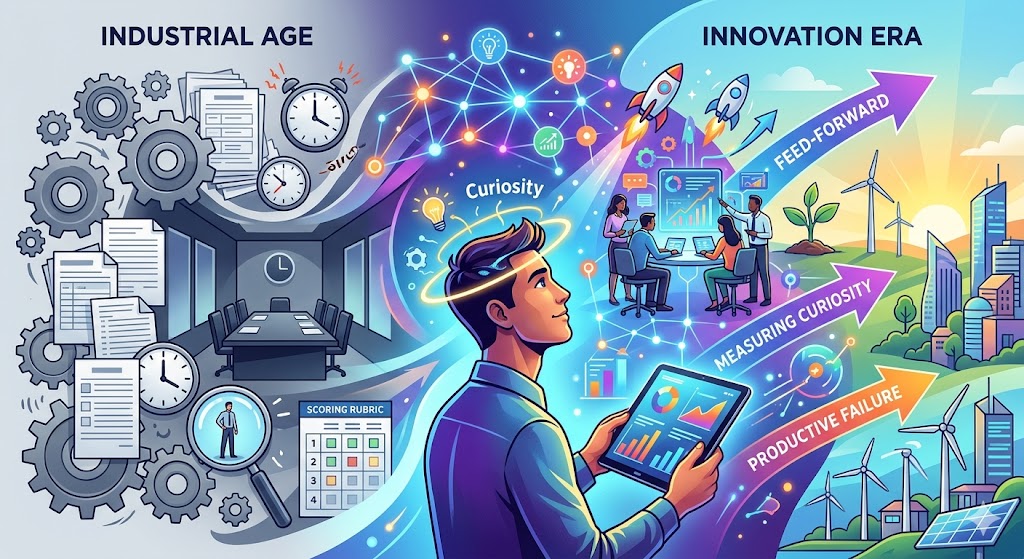
Revisiting Performance Reviews for the Innovation Era

LAST UPDATED: April 17, 2026 at 8:21 AM

Revisiting Performance Reviews for the Innovation Era

GUEST POST from Chateau G Pato


The “Innovation Gap” in Modern HR

The traditional annual performance review is increasingly becoming a relic of a bygone industrial era. To foster a culture of true innovation, we must address the fundamental disconnects between legacy management systems and the needs of a modern, agile workforce.

The Mismatch: Compliance vs. Creativity

Standard Key Performance Indicators (KPIs) are often designed for optimization and predictability. In an innovation context, these rigid metrics act as “creativity killers” by penalizing the very risk-taking and divergent thinking required for breakthrough ideas. If employees are only measured on “hitting the numbers,” they will naturally avoid the uncertainty inherent in pioneering new solutions.

The Velocity Problem

There is a growing friction between the annual review cycle and the rapid loops of modern product development. In a world of “build-measure-learn,” waiting twelve months to course-correct a career path is an eternity. Innovation requires real-time pivots, yet our HR systems often remain stuck in a slow, linear cadence.

Psychological Safety and the Brain

Traditional grading systems and “forced rankings” often trigger a threat response in the human brain. When the prefrontal cortex — the center for creativity and problem-solving — is clouded by the anxiety of a performance rating, innovation ceases. We must redesign these interactions to prioritize psychological safety, allowing the creative brain to remain “online” and engaged.

Shifting from Outputs to Inputs

In the innovation era, measuring success solely by what was delivered is a lagging indicator. To build a sustainable engine of growth, we must shift our focus toward the leading indicators of innovation: the behaviors, mindsets, and inputs that make breakthroughs possible.

Measuring Curiosity and Knowledge Acquisition

In a rapidly changing landscape, the ability to learn is more valuable than what you already know. We must transition from the “What did you finish?” mentality to “What did you learn?”. By valuing the insights gained from customer research and market exploration, we encourage employees to stay curious and keep their skills relevant.

The Value of “Productive Failure”

Innovation is inherently messy and unpredictable. If we only reward successes, we implicitly punish the experiments that didn’t go as planned. We need metrics that reward well-designed experiments — those that were executed with rigour and provided valuable data — regardless of whether they resulted in a product launch. This de-risks the act of trying something new.

Recognizing Network Effects and “Invisible Work”

Breakthroughs rarely happen in isolation. Standard performance reviews often ignore the “Invisible Work” that fuels a creative culture: mentorship, cross-departmental collaboration, and the “dot-connecting” that bridges silos. We must find ways to quantify and celebrate the individuals who act as the glue in our innovation ecosystem, ensuring that collaborative value is just as visible as individual output.

Designing the New Feedback Experience

The structure of the feedback session itself must mirror the Human-Centered Design principles we apply to our products. It should be an iterative, empathetic, and forward-looking experience that reduces cognitive load and maximizes professional growth.

Continuous Iteration over “Big Bang” Events

Just as we have moved from Waterfall to Agile development, we must move from annual reviews to continuous “Syncs.” By breaking feedback into smaller, more frequent interactions, we remove the “recency bias” of annual reviews and allow for real-time course corrections. These micro-feedback loops keep the employee’s development in lockstep with the organization’s evolving needs.

Feed-Forward vs. Feed-Back

While traditional “Feedback” looks in the rearview mirror at past mistakes, “Feed-Forward” focuses on future potential. By shifting the conversation to upcoming design challenges and career aspirations, we transform the manager from a judge into a strategic partner. This approach aligns individual passions with the firm’s future innovation roadmap.

360-Degree Empathy and Social Impact

Innovation is a team sport. To get a holistic view of performance, we must incorporate 360-degree perspectives that measure an individual’s impact on team dynamics and their ability to practice empathy with stakeholders. Success in the innovation era is defined by how well you enable others to succeed, not just your personal contribution.

Tools and Frameworks for Change

Moving beyond theory requires a new set of organizational instruments. To institutionalize a culture of innovation, we must deploy frameworks that prioritize flexibility, strategic alignment, and the unique contributions of every “architect” within the system.

OKRs for Innovation and Growth

While KPIs focus on maintaining the status quo, Objectives and Key Results (OKRs) are designed for stretching boundaries. By aligning personal development goals with the organization’s “North Star,” we ensure that individual efforts are directly contributing to the most critical innovation breakthroughs. This creates a shared language of ambition and progress.

The Innovation Portfolio Approach

Just as we manage product pipelines, we should view an employee’s career through an Innovation Portfolio lens. This means evaluating contributions across three horizons: Core (optimizing current systems), Adjacent (expanding into new areas), and Transformational (high-risk, high-reward future-hacking). This prevents the “efficiency trap” and honors those working on the messy edges of the future.

Co-Creation and Self-Design

In a human-centered organization, the employee is a co-designer of their own role. We must empower individuals to help co-create their own performance metrics based on their unique strengths and their specific position within the innovation ecosystem. When people have agency over how they are measured, they take greater ownership of the outcomes.

Conclusion: Cultivating a Growth Ecosystem

The shift toward innovation-era performance reviews is not merely an HR upgrade; it is a fundamental reconfiguration of the employer-employee relationship. We must move from a culture of surveillance to a culture of enablement.

The Leader as Coach and Experience Designer

In this new paradigm, the manager’s role is redefined. They are no longer a “judge” delivering a verdict once a year, but a Coach and Experience Designer. Their primary responsibility is to remove friction, reduce cognitive load, and design the conditions where creative talent can thrive.

The Bottom Line: A Competitive Necessity

Human-centered performance management is not a “soft” initiative — it is a competitive mandate. In an economy increasingly driven by AI and automation, the human capacity for empathy, complex problem-solving, and “future-hacking” is our most valuable asset. Organizations that fail to measure and reward these traits will lose their best people to those that do.

Call to Action: Prototype Your Future

The time for theorizing has passed. Leaders must begin to prototype new review models today. Start small — test a “Feed-Forward” approach with one team, or replace a quarterly KPI check-in with a learning-based “Sync.” Iteration is the only way to build a performance system that is as dynamic and resilient as the world we are trying to create.

Frequently Asked Questions

What is the main difference between traditional and innovation-era performance reviews?

Traditional reviews focus on past outputs and compliance, often penalizing risk-taking. Innovation-era reviews focus on leading indicators like curiosity, learning velocity, and well-designed ‘productive failures’ that drive future growth.

How do OKRs replace traditional KPIs in performance management?

While KPIs maintain current standards, OKRs (Objectives and Key Results) align individual growth with the organization’s strategic ‘North Star,’ encouraging employees to reach for transformational goals rather than just hitting safe targets.

Why is ‘Feed-Forward’ better than ‘Feedback’ for creative teams?

Feedback often focuses on historical mistakes, which can trigger defensiveness. ‘Feed-Forward’ is a human-centered approach that looks at future potential and upcoming challenges, positioning the manager as a coach rather than a judge.

Image credit: Google Gemini

Subscribe to Human-Centered Change & Innovation WeeklySign up here to get Human-Centered Change & Innovation Weekly delivered to your inbox every week.
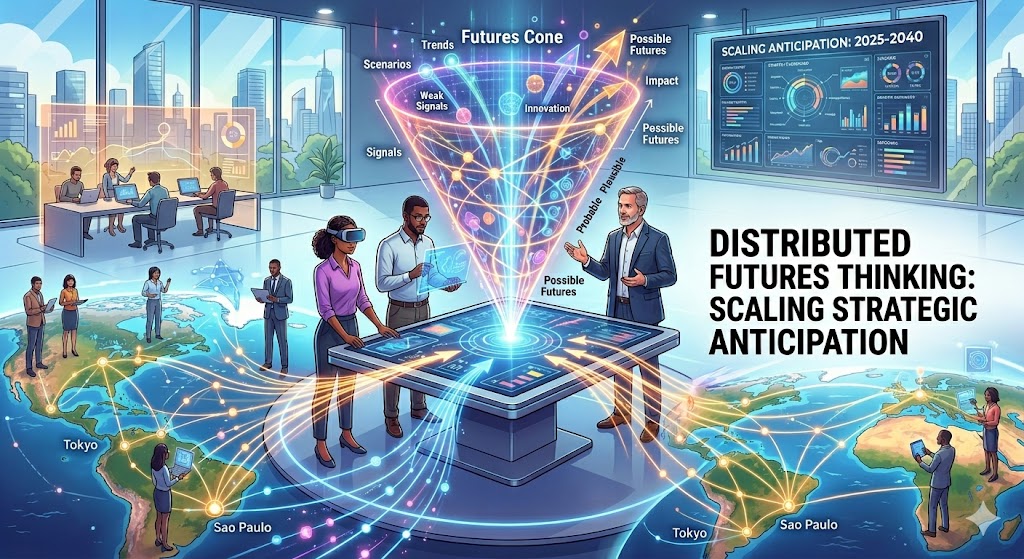
Distributed Futures Thinking – Scaling Strategic Anticipation

LAST UPDATED: April 16, 2026 at 2:21 PM

Distributed Futures Thinking - Scaling Strategic Anticipation

GUEST POST from Chateau G Pato


The Fallacy of the Lone Futurist

For decades, corporate foresight has been treated as an elite, cloistered exercise. Organizations typically tuck their “Futurists” into isolated strategy departments or high-level innovation labs, tasking them with predicting the next decade from the comfort of a boardroom. However, in an era defined by radical volatility and hyper-connectivity, this centralized model has become a dangerous bottleneck.

The reality of modern business is that change does not arrive in a single, predictable wave; it emerges as a series of “weak signals” scattered across disparate geographies, departments, and customer touchpoints. When foresight is siloed, the organization loses its peripheral vision. We can no longer afford “Foresight as a Function” — a niche service provided by the few to the many.

To survive, we must transition toward “Anticipation as a Culture.” This means moving the responsibility of future-gazing out of the executive suite and into the hands of the frontline employees who interact with customers, the engineers seeing technical friction, and the designers observing shifting human behaviors.

“The future is already here — it’s just not evenly distributed. To see it, you must distribute your ability to look.”

Distributed Futures Thinking is the framework for this democratization. By scaling strategic anticipation, we transform a static organization into a living sensor network, capable of not only seeing the future coming but having the collective agility to design it.

The Architecture of Distributed Thinking

Scaling anticipation requires more than just a change in mindset; it requires a structural redesign of how information flows through an organization. We must move away from top-down directives and toward a human-centered architecture that treats every employee as a vital node in a collective intelligence network.

Human-Centered Foresight

Strategic anticipation is often mistaken for cold data analysis. In reality, the most impactful shifts are rooted in human behavior and unmet needs. By applying experience design principles to futurology, we look past the “what” of a trend to understand the “why.” When foresight starts with empathy, it becomes actionable. It allows us to design futures that people actually want to inhabit, rather than simply reacting to technological inevitabilities.

The Sensor Network: Scaling Signal Detection

The frontline is your greatest diagnostic tool. A salesperson in Southeast Asia or a customer success lead in London will notice a shift in sentiment months before it appears in a quarterly report. By distributing the “sensor” function, we create a wide-angle lens for the organization. This network detects “weak signals” — small, seemingly local disruptions that have the potential to scale into industry-wide sea changes.

The Power of Cognitive Diversity

The greatest enemy of foresight is groupthink. When a homogeneous leadership team imagines the future, they often recreate a slightly shinier version of the present. Distributed futures thinking intentionally leverages cognitive diversity — gathering perspectives across different cultures, age groups, and professional disciplines. This variety acts as a natural stress-test for our assumptions, ensuring that our strategic scenarios are robust enough to survive reality.

By democratizing access to these insights, we don’t just predict the future; we create a shared mental map that allows the entire organization to move in sync when the environment shifts.

Scaling the Toolkit: The “How” of Democratized Foresight

The primary barrier to scaling futures thinking is often the perceived complexity of the methodology. To move from a handful of experts to an entire organization of “anticipators,” we must strip away the academic jargon and provide modular, intuitive frameworks that empower teams to act autonomously.

Modular Frameworks for the Masses

Traditional tools like STEEP (Social, Technological, Economic, Environmental, and Political analysis) are powerful but often feel like homework. We reframe these as “Lens Kits” — simple prompts that encourage employees to view their daily work through different horizons. By standardizing the language of Scenario Planning, we enable a marketing manager and a software engineer to collaborate on a “What If?” exercise using the same conceptual shorthand.

“Always-On” Curiosity over Periodic Planning

Strategy is too often a “once-a-year” event. Distributed futures thinking replaces the annual retreat with continuous scanning. Through digital collaboration platforms and internal “signal repositories,” we create a cultural habit of sharing observations in real-time. This turns the organization into a living laboratory where insights are crowdsourced and validated continuously, rather than waiting for a consultant’s report.

Experience Design: Prototyping the Future

Data rarely changes minds; experiences do. This is where experience design becomes the secret weapon of strategic anticipation. We move beyond white papers and create “Future Artifacts” — tangible or digital prototypes that represent a specific scenario. Whether it’s a mockup of a 2030 bank statement or a video of a futuristic customer journey, these artifacts make abstract possibilities feel visceral.

“If you can’t feel the future, you won’t prepare for it. We must design the evidence of tomorrow to spark the decisions of today.” — Braden Kelley

When teams can “touch” a potential future, the strategic implications become clear. It bridges the gap between high-level theory and boots-on-the-ground innovation, ensuring that anticipation leads directly to designing better human experiences.

Overcoming Institutional Inertia

Even with the best tools in place, the greatest threat to distributed futures thinking is the gravity of the “now.” Most organizations are optimized for the present, creating a natural resistance to any signal that threatens current business models or operational efficiencies.

The “Present Bias” Trap

The tyranny of the urgent — driven by quarterly results and immediate KPIs — often suffocates long-term thinking. To scale anticipation, we must adjust the incentive structures. This means rewarding teams not just for hitting today’s targets, but for identifying the disruptions that will make those targets irrelevant tomorrow. We have to make it safe to look up from the grindstone.

Psychological Safety and the “Wild Card”

Innovation dies in environments where being “wrong” is penalized. Distributed foresight requires high levels of psychological safety. If an employee spots a radical shift — a “wild card” event — they must feel empowered to share it without fear of being labeled a distraction. A culture of strategic anticipation treats every outlier as a potential opportunity rather than a nuisance.

The Power of Narrative: Bridging the Gap

Facts and figures are easily dismissed; stories are not. To overcome inertia, we use strategic storytelling to connect future scenarios to today’s reality. By crafting compelling narratives about how our customers’ lives will change, we transform “change” from a threat into a shared mission. We don’t just present a report; we tell the story of our future relevance.

“The hardest part of looking forward is letting go of the certainty of today. Narrative is the bridge that carries the team across that gap.” — Braden Kelley

By addressing these cultural and psychological barriers, we ensure that distributed thinking doesn’t just result in a collection of ideas, but in a fundamental shift in organizational behavior.

From Anticipation to Agility: Closing the Loop

Anticipation without action is merely a daydream. The true value of Distributed Futures Thinking lies in its ability to influence the “now.” Once we have democratized the sensing of signals, we must create clear pathways for those insights to penetrate our operational DNA.

Closing the Insight Loop

For a distributed network to remain motivated, contributors must see their observations translated into tangible outcomes. This requires a formal “Insight-to-Action” pipeline. Whether it’s a small UX tweak based on an emerging behavior or a pivot in the R&D roadmap, the link between a detected signal and an organizational response must be visible and rapid. This feedback loop transforms passive observation into active innovation.

Adaptive Strategy: Strategic Wayfinding

The era of the rigid “Five-Year Plan” is over. In its place, we adopt Strategic Wayfinding — a dynamic approach where strategy is treated as a continuous hypothesis. As new signals are fed into the system from the distributed network, the organization adjusts its course in real-time. This doesn’t mean changing your vision every week; it means being agile enough to change your tactics to reach that vision as the landscape shifts.

Case Studies in Scaled Anticipation

We see this model succeeding in organizations that have decentralized their decision-making.

  • Global Tech Leaders: Companies that utilize internal “prediction markets” to crowdsource the probability of project success or market shifts.
  • Decentralized NGOs: Organizations that empower field workers to act as primary sensors, allowing them to pivot disaster relief efforts before centralized data even hits the dashboard.

When anticipation is distributed, agility becomes a byproduct of awareness. The organization stops reacting to the future and starts moving with it, maintaining a constant state of readiness that competitors simply cannot match.

Conclusion: Designing the Future Together

The future is not a destination we reach; it is a manifestation of the collective choices we make today. When we move beyond the “Lone Futurist” model and embrace Distributed Futures Thinking, we do more than just improve our forecasting — we upgrade our organizational consciousness.

The Call to Collective Intent

Strategic anticipation is the ultimate human-centered endeavor. By empowering every individual within an organization to look forward, we foster a sense of agency and purpose. No longer are employees merely cogs in a machine reacting to external shocks; they become active architects of a shared destiny. This shift in mindset is what separates the legacy companies that fade away from the enduring icons that redefine their industries.

“Innovation is everyone’s job, and so is the future. If you aren’t scaling your vision, you’re narrowing your horizon.”

Final Thought: Anticipation as Survival

In a world of exponential change, the ability to see around corners is no longer a luxury — it is a survival trait. Organizations that democratize foresight will be the ones that navigate uncertainty with confidence and design experiences that truly resonate with the evolving human spirit. The tools are available, the frameworks are ready; all that remains is the courage to trust your people with the future.

Let’s stop trying to predict the future and start designing it — together.

Frequently Asked Questions

What is Distributed Futures Thinking?

Distributed Futures Thinking is a strategic framework that moves foresight out of isolated boardrooms and into the hands of every employee. It transforms an organization into a collective sensor network to detect “weak signals” of change in real-time.

How does it differ from traditional strategic planning?

Unlike traditional planning, which often relies on annual reports and top-down directives, distributed anticipation is “always-on.” It focuses on human-centered signals and cognitive diversity to create a dynamic “Strategic Wayfinding” approach rather than a rigid five-year plan.

Who should lead the effort of scaling anticipation?

While the initiative often begins with innovation or strategy leaders, the goal is democratization. A human-centered change leader facilitates the process by providing modular toolkits, ensuring psychological safety, and fostering a culture of continuous curiosity across all departments.

Image credit: Google Gemini

Subscribe to Human-Centered Change & Innovation WeeklySign up here to get Human-Centered Change & Innovation Weekly delivered to your inbox every week.
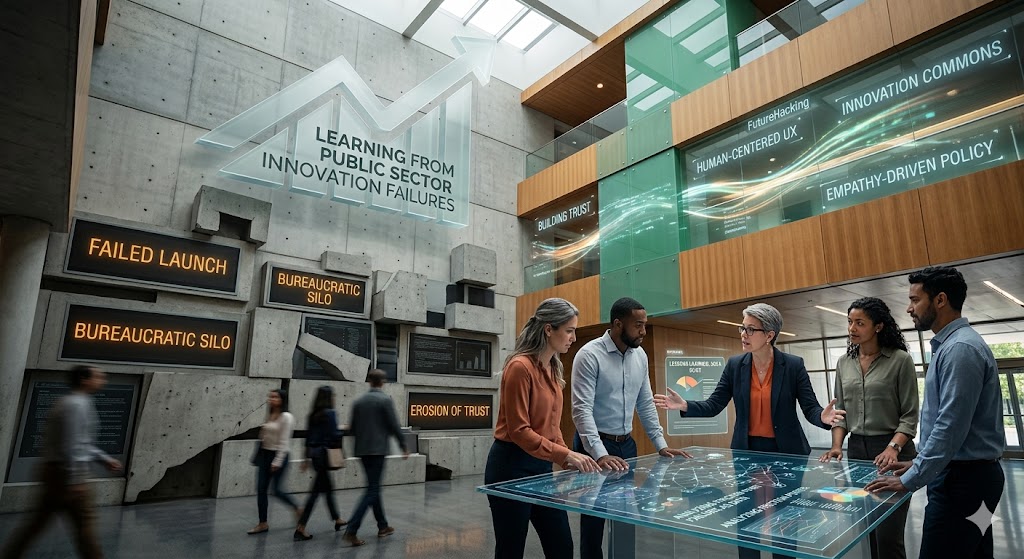
Learning From Public Sector Innovation Failures

LAST UPDATED: April 15, 2026 at 11:41 AM

Learning From Public Sector Innovation Failures

GUEST POST from Chateau G Pato


The High Cost of Playing It Safe

In the public sector, the greatest risk is often the refusal to take one. While private enterprises fear losing market share, public institutions face a more daunting specter: the erosion of public trust. When we play it too safe, we don’t actually avoid failure; we simply invite a slow, systemic decay that I call the “Invisible Friction.”

The Paradox of Public Innovation

There is a fundamental tension between the “Burning Platform” and FutureHacking.” Many government agencies only innovate when forced by a crisis — a literal or metaphorical fire. This reactive stance leads to “Crisis Innovation,” which is a sprint for survival rather than a strategic move toward a better future. To break this cycle, we must move beyond mere compliance and embrace a mindset that treats stagnation as the ultimate failure.

Defining the Gap

We are currently witnessing a widening chasm between private sector user experience (UX) standards and public sector service delivery. Citizens who experience seamless, human-centered design in their daily digital lives find it increasingly unacceptable to navigate opaque, bureaucratic hurdles for essential services. This gap is where trust goes to die.

The Thesis: Failure as a Data Point

Innovation in the public square isn’t about chasing the “New” — it’s about pursuing the “Better.” We must redefine failure as our most expensive form of research and development. In this article, we will explore how to stop fearing the setback and start mining it for the insights required to solve meaningful problems that people actually care about.

The Anatomy of Public Sector Failure

To fix a system, we must first be willing to perform the autopsy on our unsuccessful initiatives. In my work with change leaders, I’ve observed that public sector failures are rarely the result of a single “bad idea.” Instead, they are the byproduct of systemic misalignments and the “Manager Mindset” overshadowing human-centered design.

The “Mousetrap” Trap

Perhaps the most common pitfall is falling in love with a solution before truly understanding the problem. In the rush to appear “innovative,” agencies often procure expensive technology — currently, this is often generative AI — without first identifying a human friction point it is meant to solve. We end up building a “better mousetrap” in a building that actually has a plumbing problem.

Siloed Success is Systemic Failure

Public innovation often suffers from the “Island of Excellence” syndrome. A single department may execute a brilliant pilot, but because the broader organizational infrastructure (procurement, HR, and legal) remains rooted in 20th-century logic, the innovation cannot scale. When we fail to build an Innovation Commons, we ensure that great ideas remain trapped in silos, eventually dying of neglect.

The Policy-Delivery Disconnect

There is often a massive chasm between the legislative intent of a policy and the lived experience of the citizen trying to access it. This is where Experience Design fails. When policy is designed in a vacuum, ignoring the “hidden social contracts” and the emotional reality of the end-user, the digital service delivery becomes a source of frustration rather than empowerment. Failure here isn’t just a technical glitch; it’s a breach of the social contract.

“Innovation isn’t about the technology; it’s about the sociology. If you don’t design for the human heart and the bureaucratic reality, your ‘digital transformation’ is just an expensive way to do the wrong things faster.”

Applying the “Eight I’s of Infinite Innovation” to the Public Square

To move beyond the cycle of trial and error, we must apply a repeatable framework that accounts for the complexity of the public ecosystem. Braden Kelley’s Eight I’s of Infinite Innovation framework provides a lens to see exactly where a public sector project lost its way and how to course-correct for the future.

Inspiration & Ideation: Beyond the Budget Line

Public innovation often fails at the Inspiration stage because it is framed as a mandate rather than a mission. Without a compelling vision that connects to a human outcome, Ideation becomes a sterile exercise in “brainstorming” rather than a purposeful attempt to “FutureHack” a better reality for the citizen. We must ask: What is the human story we are trying to change?

Investigation: The Lens of Empathy

In the public sector, Investigation is often mistaken for simple data collection. True innovation requires moving past labor statistics and demographic charts to understand the “identity stakes” of the people involved. We need to investigate not just the technical requirements, but the emotional barriers and “invisible friction” that prevent a service from being adopted.

Implementation & Integration: Bridging the “Valley of Death”

Most public sector failures happen during Integration. It is relatively easy to run a pilot program (Implementation), but it is incredibly difficult to weave that pilot into the existing fabric of government. To succeed, we must design for the Innovation Commons — creating shared resources and language that allow a new solution to survive the transition from a “cool project” to a “core service.”

By diagnosing failures through these stages, we can identify if our project lacked the right Insights or if it simply failed because we didn’t plan for the Institutional resistance that accompanies any meaningful change.

The Human Element: Overcoming Resistance

Innovation is never a purely technical or administrative exercise; it is a psychological one. In the public sector, the greatest barrier to progress isn’t a lack of funding or outdated software — it is the human response to change. To learn from failure, we must acknowledge that every innovation is a disruption of someone’s status quo.

Anticipating the Counter-Revolution

Newton’s Third Law applies to bureaucracy: every action provokes an equal and opposite reaction. I often talk about the “Counter-Revolution” — the systemic pushback from those who feel their expertise, job security, or “identity stakes” are threatened by a new way of working. Failure often occurs because we design for the citizen but forget to design for the civil servant who must deliver the service.

The “Craic” and Psychological Safety

To innovate effectively, we need to foster a culture of psychological safety. In my work, I often reference the Irish concept of the “Craic” — creating an environment where people can speak the truth, acknowledge the absurdity of a broken process, and “fail safely.” If a mistake in a pilot program leads to a congressional hearing or a front-page scandal, no one will ever take a risk again. We must build containers where “failing forward” is a protected activity.

Admitting Weakness as Strength

The most resilient public sector leaders are those who are transparent about what didn’t work. When we hide our failures, we lose the opportunity to build Radical Transparency with the public. Admitting that a digital portal failed to meet user needs isn’t a sign of weakness; it’s a demonstration of commitment to the human outcome. It shifts the conversation from “Who is to blame?” to “How do we fix this together?”

“You cannot mandate innovation, but you can certainly legislate it out of existence by punishing the curiosity required to find a better way.” — Braden Kelley

Strategic Shifts: From Reactive to Proactive

To truly evolve, public institutions must stop treating innovation as an emergency response. Learning from failure requires a fundamental shift in our temporal perspective — moving away from fixing the past and toward designing the future we want to inhabit.

The Crisis Innovation Trap

Most public sector breakthroughs are born of necessity during a catastrophe. While “Crisis Innovation” proves that bureaucracy can move fast, it is a sustainable strategy for exactly zero organizations. It creates a culture of “Sprints for Survival,” where the moment the pressure subsides, the organization snaps back to its original shape like a rubber band. We must transition these temporary bursts of energy into a permanent capacity for change.

FutureHacking™ the Public Sector

We don’t need better crystal balls; we need better hammers. FutureHacking™ is about identifying the “seeds of the future” that already exist in the present. By analyzing where previous innovations failed to take root, we can identify the systemic blockages — whether they are outdated procurement laws or rigid hierarchical structures — and “hack” them before the next crisis arrives. Proactive innovation is about building the bridge while the weather is still clear.

Reward Curiosity, Not Just Results

If we only reward successful outcomes, we inadvertently incentivize people to only propose “sure bets” — which are rarely innovative. To break the cycle of failure, we must change our Key Performance Indicators (KPIs). We should measure:

  • Velocity of Learning: How quickly did we identify that a path was incorrect?
  • Reduction of Friction: Did this attempt make the next attempt easier?
  • Human Insight: What do we now know about our citizens that we didn’t know six months ago?

By rewarding the curiosity to explore and the candor to report a failure, we create a public sector that is resilient, adaptive, and — most importantly — human.

Conclusion: The Time to Innovate is Always Now

Innovation in the public sector is never a neutral act — it either empowers the citizen or it excludes them. When we fail, we aren’t just losing time or money; we are missing an opportunity to reaffirm the relevance of our institutions in an increasingly complex world. The failures of the past are not anchors; they are the foundation upon which we must build a more responsive, human-centered government.

A Call to Action for Changemakers

To the leaders and civil servants in the trenches: stop chasing the “better mousetrap.” Our goal is not to digitize bureaucracy, but to humanize it. We must have the courage to name the unnamed things — to call out the processes that no longer serve us and to protect the “Conscripts” and “Magic Makers” within our organizations who are trying to find a better way.

The Final Thought

We must move from a state of constant “crisis management” to a permanent state of intentional evolution. In the public square, the greatest innovation isn’t a piece of software or a new policy — it is the persistent, collective courage to try, fail, learn, and try again until the human experience matches the public promise.

“The future isn’t something that happens to us; it’s something we build together. If you aren’t failing occasionally, you aren’t reaching far enough into the future.” — Braden Kelley

This is how we FutureHack the public sector. Let’s get to work.

Frequently Asked Questions

Why do public sector innovation projects fail more visibly than private ones?

Public sector failures are high-stakes because they involve public trust and taxpayer funds. Unlike the private sector, where a product can simply be “sunsetted,” public services are essential; when they fail, they create “invisible friction” that impacts social equity and institutional credibility.

What is the “Mousetrap Trap” in government innovation?

The “Mousetrap Trap” occurs when agencies fall in love with a technical solution — like Generative AI — before clearly defining the human problem. This leads to building “better mousetraps” for buildings that actually have plumbing problems, wasting resources on tools that don’t improve the citizen experience.

How can public leaders foster a culture of “safe failure”?

Leaders must move from a Manager Mindset to a Changemaker Mindset by creating “Innovation Commons.” This involves rewarding curiosity and the “velocity of learning” rather than just successful launches, ensuring teams have the psychological safety to report setbacks without career-ending consequences.

Image credit: Google Gemini

Subscribe to Human-Centered Change & Innovation WeeklySign up here to get Human-Centered Change & Innovation Weekly delivered to your inbox every week.
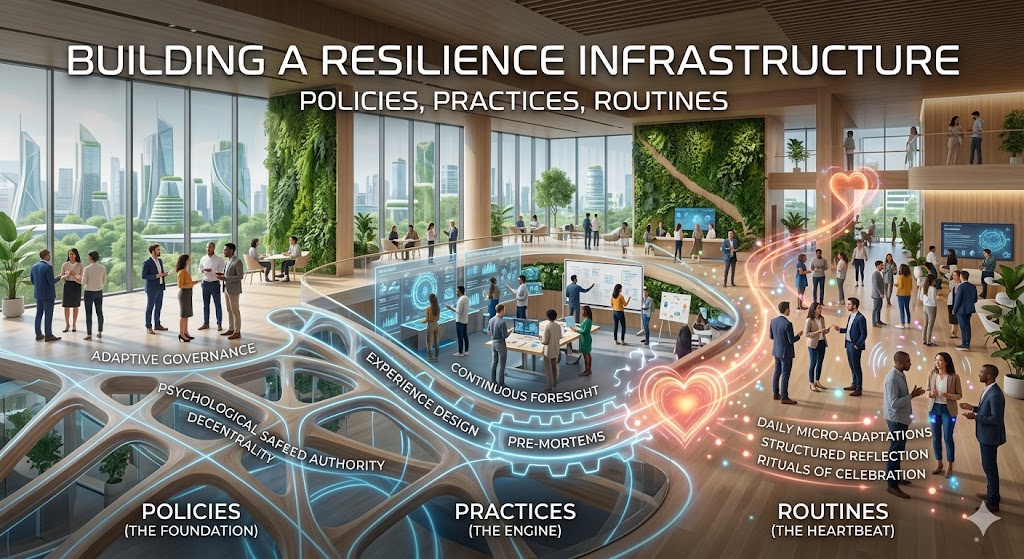
Building a Resilience Infrastructure

Policies, Practices, Routines

Building a Resilience Infrastructure


GUEST POST from Chateau G Pato

Introduction: Shifting from “Bouncing Back” to “Bouncing Forward”

In an era of continuous and accelerating disruption, we must fundamentally rethink our relationship with change. Resilience is no longer merely a reactive trait—a mechanism for “bouncing back” to the status quo after a shock. Instead, it must become a proactive infrastructure designed for “bouncing forward.” It is time to stop treating change as a frustrating anomaly and start designing organizations where continuous adaptability is the baseline state.

As we view this through a human-centered lens, a critical truth emerges: true resilience doesn’t live in risk-mitigation software or crisis management manuals. It lives entirely in your people. Therefore, a modern resilience infrastructure must be intentionally designed around human capabilities, human behaviors, and human limits. Our goal is to systematically mitigate change fatigue while actively fostering the psychological safety required for a true innovation mindset to thrive.

To move from theory to action, we must operationalize adaptability. This requires building a sustainable resilience infrastructure supported by three interconnected pillars:

  • Policies: The structural foundation that provides empowering guardrails rather than bureaucratic roadblocks.
  • Practices: The operational engine and methodologies driving human-centered change.
  • Routines: The cultural heartbeat that makes organizational adaptability a daily habit.

Pillar 1: Policies – The Structural Foundation

In most organizations, policy is synonymous with control. However, in a resilience infrastructure, policy must shift its purpose from control to enablement. To build an organization that can pivot without cracking, we must design structural guardrails that provide clarity without inducing rigidity.

Redefining Policy for Agility

Traditional, rigid policies are the natural enemy of innovation. We must transition toward “adaptive policies”—frameworks that are designed to scale their level of oversight based on the environmental context. When the pace of change accelerates, our policies should facilitate rapid response rather than acting as a bureaucratic anchor. This is about moving from a “rules-based” culture to a “principles-based” culture.

Decentralized Decision-Making

Resilience is strongest at the edges. Experience design teaches us that the employees closest to the customer and the frontline problems are the ones best equipped to navigate a sudden shift. Policies must be rewritten to push decision-making authority down the chain, empowering teams to act on real-time insights without waiting for a centralized hierarchy that may be disconnected from the current reality.

Structural Commitment to Psychological Safety

You cannot build a resilient infrastructure on a foundation of fear. Psychological safety must be more than a leadership buzzword; it must be a structural standard. This means instituting policies that protect employees when they experiment, fail, and share uncomfortable truths. If the “cost of failure” is a career-ending move, your people will choose silence over resilience every time.

Futurology as a Governance Standard

Finally, resilience requires looking beyond the immediate horizon. We must institute policies that make long-term scenario planning and “horizon scanning” a mandatory part of our governance. By making futurology a standard requirement for annual strategic resource allocation, we ensure that the organization is not just reacting to the present, but is structurally prepared for multiple possible futures.

Pillar 2: Practices – The Operational Engine

If policies provide the “why” and the “what,” then practices are the “how.” These are the repeatable methodologies and disciplines that keep the organization’s resilience muscle in a state of constant readiness. To build a resilient operational engine, we must integrate the tools of futurology and experience design into our everyday work flow.

Continuous Foresight and Innovation Portfolios

In a world of constant flux, episodic strategic planning is dead. We must replace the “annual retreat” with a practice of continuous foresight. This involves maintaining a balanced innovation portfolio—investing not just in the “Now” (core business optimization) but also the “Next” (incremental shifts) and the “New” (disruptive breakthroughs). Resilience comes from having multiple bets on the table, ensuring that when one path closes, others are already being paved.

Experience Design in Change Management

The greatest failure in organizational change is treating it as a technical rollout rather than a human transition. We must apply experience design (EX) to the change process itself. By mapping the “Employee Change Journey,” we can identify the specific moments where friction occurs and design interventions that support people emotionally and cognitively. Resilience is maximized when change is designed with people, rather than pushed onto them.

The Practice of “Pre-Mortems”

Resilience isn’t just about surviving a crisis; it’s about anticipating it. We should systematize the “pre-mortem” practice: before any major project or pivot begins, teams must imagine it has failed and work backward to determine why. This disciplined habit of visualizing failure allows us to build preemptive mitigation strategies into the very design of our initiatives, turning potential roadblocks into anticipated turns.

Cross-Pollination and Ecosystem Building

Isolation is the precursor to obsolescence. Resilience requires a radical commitment to cross-pollination. We must develop practices that actively break down departmental silos and encourage collaborative problem-solving across functions. Furthermore, true resilience extends beyond our walls; we must build ecosystems of partners, customers, and even competitors, creating a web of support and shared intelligence that no single organization could maintain on its own.

Pillar 3: Routines – The Cultural Heartbeat

While policies provide the framework and practices provide the tools, it is routines that provide the consistency. Resilience is not a grand gesture performed only during a disaster; it is a muscle built through the daily, mundane interactions of every team member. To make adaptability a permanent part of our culture, we must turn it into a habit.

The Power of Micro-Adaptations

True organizational resilience is the sum of a thousand micro-adaptations. We must design routines that encourage small, low-stakes pivots every day. When teams are accustomed to making minor course corrections in their weekly sprints, the “muscle memory” required for a macro-level organizational shift is already in place. We must stop waiting for the “Big Change” and start practicing the “Small Change” constantly.

The “Sensory” Routine

Resilient leaders don’t guess; they sense. Establishing a routine “sensory” loop—such as a fifteen-minute daily stand-up focused specifically on external signals and internal sentiment—keeps a pulse on the human-centered metrics that matter. We need to monitor change fatigue, creative energy, and engagement levels as rigorously as we monitor revenue. If the human battery is low, the resilience infrastructure will fail regardless of how good the strategy is.

Structured Reflection and Socialized Learning

Learning must be systematized, not left to chance. We must embed structured reflection into our standard weekly cadences. Whether through “after-action reviews” or retrospective routines, the goal is to ensure that every setback is converted into documented, socialized intelligence. A resilient organization is one that never fails at the same thing twice because the routine of learning is faster than the pace of disruption.

Rituals of Celebration

Finally, we must design routines that celebrate the behaviors of resilience, not just the successful outcomes. If we only celebrate “winning,” people will hide their mistakes. Instead, we must create rituals that honor intelligent risk-taking, rapid pivoting, and radical collaboration. By shining a light on the process of adaptation, we reinforce the cultural truth that in this organization, the ability to change is our greatest competitive advantage.

Conclusion: Future-Proofing the Human Experience

Building a resilience infrastructure is not a project with a defined completion date; it is a fundamental shift in how we conceive of organizational existence. We must move away from the fragile architecture of efficiency and toward the robust architecture of adaptability. By aligning our Policies, Practices, and Routines, we create a living system that does not merely survive disruption but is fueled by it.

The synthesis of these three pillars creates a powerful synergy: Policies give your people the permission to act, Practices provide them with the tools to execute, and Routines build the muscle memory necessary to sustain momentum. When these elements work in concert, the organization stops fearing the “Great American Contraction” or the next wave of AI-driven displacement and starts seeing them as canvases for new value creation.

As we look toward the next decade, the ultimate competitive advantage will not be found in the size of your balance sheet or the proprietary nature of your tech stack. It will be found in your Return on Adaptability (ROA). The organizations that thrive will be those that have fundamentally redesigned the human experience of work—transforming change from a perceived threat into a celebrated opportunity for continuous innovation.

The future belongs to the resilient. It’s time to stop waiting for the dust to settle and start building the infrastructure that allows you to dance in the whirlwind.

Frequently Asked Questions

What is the difference between organizational resilience and crisis management?

Crisis management is a reactive function designed to minimize damage during a specific event. Organizational resilience, specifically a “Resilience Infrastructure,” is a proactive, systemic capability that allows an organization to absorb shocks and “bounce forward” into a better state of operation by design.

Why is “Psychological Safety” included in a policy framework?

Innovation and resilience require employees to take risks and report failures early. By codifying psychological safety into policy, an organization moves beyond leadership lip-service and creates a structural guarantee that employees can experiment and adapt without fear of retribution.

How do routines differ from practices in this model?

Practices are the specific “how-to” methodologies and skill sets (like Customer Experience audits or Pre-Mortems). Routines are the rhythmic, daily habits that ensure those practices are actually used. Practices are the tools; routines are the heartbeat that keeps the tools in hand.

Image credit: Google Gemini

Subscribe to Human-Centered Change & Innovation WeeklySign up here to get Human-Centered Change & Innovation Weekly delivered to your inbox every week.
Overcoming Innovation Roadblocks: Strategies for Moving Forward

Overcoming Innovation Roadblocks: Strategies for Moving Forward

GUEST POST from Chateau G Pato

Innovation is key for businesses looking to stay competitive and relevant in today’s fast-paced business world. However, many companies can struggle to successfully innovate due to common roadblocks that can get in the way of successful innovation. Whether it’s a lack of resources, time, or a lack of executive buy-in, there are many common issues that can cause roadblocks in the innovation process. In order to move past these roadblocks and foster a culture of successful innovation, it’s important to develop strategies that will help you move forward.

The first step to overcoming innovation roadblocks is to identify the root issue. There can be many different types of barriers, ranging from financial to cultural, so it’s important to take the time to identify where exactly you’re struggling. Once you’ve identified the obstacles in your way, you can develop strategies to move past them.

The next step is to address potential cultural barriers. Leaders should continue to communicate the importance of innovation throughout the organization and emphasize the use of new ideas and solutions in order to streamline processes. To further foster innovation, you can look to external sources such as pop-up shops, accelerators, and idea competitions. Collaboration with an external source will open up new channels of creativity and provide new perspectives on existing problems.

Build a Common Language of Innovation on your team

It’s also important to consider how you can best allocate resources to foster innovation. While innovation can take up a significant portion of resources, it’s important to invest in resources that will yield the best results. This could involve investing in personnel, technology, materials, or anything else that can help you produce innovative solutions.

Once you have a strategy in place, you should put metrics in place to measure the success of your efforts. This can help you articulate the success of your innovation projects and further convince stakeholders to invest in the process.

Case Study 1 – BSH Home Appliances

To better demonstrate successful innovation strategies, consider the example of BSH Home Appliances. After encountering a few organizational roadblocks, the company decided to invest in a pop-up shop and challenge local students to come up with new ideas for their products. After seeing tangible results, they have decided to make this a part of the company’s annual innovation strategy.

Atlassian

Another example is that of Atlassian, a software company. To overcome executive buy-in roadblocks, they established an internal innovation program that allowed employees to submit ideas and vote on which ones to pursue. This program has allowed the company to not only generate new ways of working but also measure the success of their efforts.

Conclusion

Ultimately, overcoming innovation roadblocks can be difficult, but it’s not impossible. By taking the time to identify the root issue, creating a strategy to foster innovation, and putting metrics in place to measure successes, your organization can move past the roadblocks and foster a culture of innovation. With the help of these strategies and case study examples, you can begin to effectively innovate and stay competitive in today’s business landscape.

Image credit: Pixabay

Subscribe to Human-Centered Change & Innovation WeeklySign up here to get Human-Centered Change & Innovation Weekly delivered to your inbox every week.
The Role of Big Data in Futures Research

The Role of Big Data in Futures Research

GUEST POST from Chateau G Pato

As research evolves and the greater digital age becomes more and more defined by its vastness and capabilities, so too does the way in which research is conducted. No longer are questionnaires, question prompts, and surveys considered to be the only methods scientists have to delve into the future of their chosen discipline, Gathered and collated data has become commonplace, and the big data analytics and insights that come along with this have allowed the research community to unravel the complexities associated with future forecasting. Here, we explore the role of big data in futures research.

In order for scientists to determine what the future may hold in any given field, they rely heavily on the available information that has been gathered from various sources and third-party data centers. This type of data, commonly referred to as “Big Data”, provides researchers with analytical capabilities, the ability to identify trends, and the capacity to draw accurate conclusions regarding future trends.

Big data can be found in virtually all fields, from healthcare to marketing and finance. With advancements in technology, researchers can gather, store, and analyze large amounts of data much more quickly than ever before. Additionally, the advancements in artificial intelligence have allowed researchers to embed algorithms into their analysis to develop more accurate trend predictions for the future.

Case Study 1 – Atlantic Council’s Global Futures Exchange

A great example of this is the work being done by the Atlantic Council’s Global Futures Exchange. This particular project has seen several big data initiatives implemented, such as machine learning algorithms and natural language processing to help it accurately predict future trends in global affairs. By analyzing massive amounts of data related to climate change, geopolitics, terrorism, and more, researchers can better prepare themselves for what the future may hold in a given field.

Case Study 2 – Pacific Institute for Research and Evaluation (PIRE)

Another great example of the role of big data in futures research is the work done by the Pacific Institute for Research and Evaluation (PIRE). This organization has been able to leverage big data to create a predictive model that helps inform their decision making and future forecasts. PIRE uses these models to generate forecasts related to various factors such as the global economy, risk management, and energy efficiency. Using predictive analytics, they were able to identify potential areas of risk before they became issues and equipped themselves with the necessary resources to combat them before they become serious.

Conclusion

It’s clear to see that big data and the insights it provides are becoming increasingly important to futures research. This type of data provides researchers with much more accurate and timely results, enabling them to increase the efficiency of their research. With big data analytics, scientists are now presented with the opportunity to use predictive analytics to identify potential trends and outcomes before they become a reality. By leveraging the power of big data, researchers are more prepared to better understand the future and what it holds in their respective fields.

Bottom line: Futurology is not fortune telling. Futurists use a scientific approach to create their deliverables, but a methodology and tools like those in FutureHacking™ can empower anyone to engage in futurology themselves.

Image credit: Pixabay

Subscribe to Human-Centered Change & Innovation WeeklySign up here to get Human-Centered Change & Innovation Weekly delivered to your inbox every week.

How Augmented and Virtual Reality Will Affect Our Lives

How Augmented and Virtual Reality Will Affect Our Lives

GUEST POST from Chateau G Pato

Augmented and virtual reality (AR/VR) are rapidly advancing technologies that are transforming the world around us. AR and VR technology has been used in a variety of areas, ranging from entertainment and gaming to medical and military applications. As AR and VR become more widely available and affordable, the potential ways they could be integrated into our daily lives continues to grow. With these changes, it is becoming increasingly important to explore how this technology will affect our lives and how we can leverage it for the better.

One potential area of AR and VR use is in medicine. AR and VR could be used in medical training, allowing medical professionals to gain more immersive experiences with anatomy and other medical procedures. On the patient side, AR and VR could be used to provide a more interactive and immersive experience with medical care and consulting. This could even be extended to allow those who are unable to physically be present for medical appointments to participate and become involved in their own medical care.

Another application could be in education. Currently, many educational institutions are already leveraging AR and VR tools to add a more interactive learning experience for their students. From early education to higher education, incorporating AR/VR technology could bring classes to life and give students the opportunity to truly explore their interests in a more immersive way.

Case Study 1

One example of AR and VR being used in both medical and educational applications is the application of Microsoft HoloLens in the medical field. HoloLens is a head-mounted display that uses both AR and VR technology to project an interactive 3D experience into the real world. It has been used in numerous medical and educational settings, such as medical imaging and microscopic exoplanet exploration. HoloLens has also been used in the medical field for students to “intern” with a physician, allowing them to observe and experience a real-world medical procedure.

Case Study 2

The use of AR and VR technology is also being explored for use in the military. A scientist at the Naval Surface Warfare Center has developed a Virtual Reality Battle Lab (VRBL), which is a training platform designed to simulate a battlefield environment in order to more accurately train warriors for defense. The lab uses a range of applications, such as AR and VR goggles, robotics, virtual reality systems, and even live-fire ranges. This technology could be used to help the military better prepare and respond to threats, as well as provide soldiers and personnel with more interactive and immersive scenarios for training and mission planning.

Conclusion

Overall, AR and VR technology have the potential to greatly enhance our lives by providing us with new opportunities and experiences. From medical and educational settings to military scenarios, we can see the potential for AR and VR technology to revolutionize how we interact with the world around us. As this technology becomes increasingly available and affordable, it will be interesting to see what new and exciting ways it will be used in our lives.

Bottom line: Futurology is not fortune telling. Futurists use a scientific approach to create their deliverables, but a methodology and tools like those in FutureHacking™ can empower anyone to engage in futurology themselves.

Image credit: Pexels

Subscribe to Human-Centered Change & Innovation WeeklySign up here to join 17,000+ leaders getting Human-Centered Change & Innovation Weekly delivered to their inbox every week.