LAST UPDATED: April 9, 2026 at 4:39 PM

GUEST POST from Chateau G Pato
Beyond the Mission Statement: The Identity Gap
In the rush to scale and the frenzy of digital transformation, most organizations fall into the trap of believing that identity is something you describe. We spend months polishing mission statements and plastering core values onto digital handbooks, yet we often find a cavernous gap between those words and the daily lived experience of the workforce. When “who we say we are” doesn’t match “how we actually behave,” the result is cynicism and organizational drift.
The Power of Ritual in Human-Centered Innovation
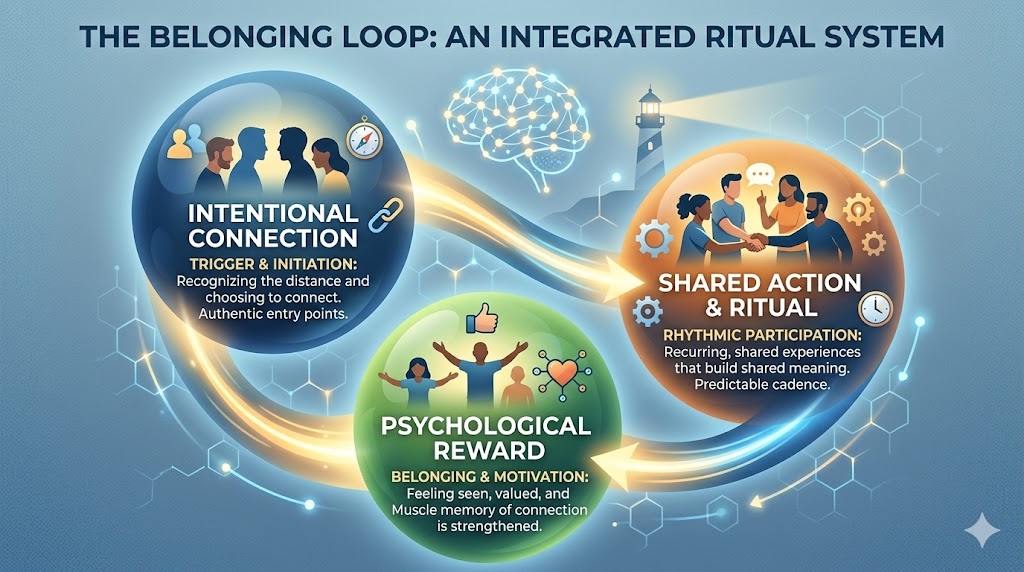
Authentic organizational identity isn’t a static document; it is a living, breathing pulse anchored by meaningful, repeatable symbolic acts. These are our rituals. Unlike routines, which focus on efficiency and “what” we do, rituals focus on the “why” and the “who.” They serve as the connective tissue of human-centered innovation, moving us beyond sporadic corporate events into a space where purpose is practiced, not just preached.
Anchoring the Future
To embed identity deeply, we must design rituals that act as an anchor in an unpredictable market. Whether we are fueling an Innovation Bonfire or honoring the lessons of a failed project, these practices provide the psychological safety necessary for agility. By intentionally designing how we gather, celebrate, and even mourn, we ensure that our organizational identity isn’t just a poster on the wall — it’s the soul of the enterprise.
The Anatomy of an Organizational Ritual
To effectively embed identity, we must first understand that a ritual is far more than a scheduled meeting. It is a designed experience that bridges the gap between individual contribution and collective purpose. When we approach ritual design through the lens of human-centered innovation, we focus on creating a predictable space — a psychological sanctuary where employees feel safe to experiment, fail, and ultimately, belong.
The Three Pillars of Effective Rituals
- Intentionality: Every ritual must be tethered to a core value. If the goal is agility, the ritual must reinforce speed and adaptability. Without a clear “why,” a ritual quickly decays into a bureaucratic burden.
- Participation: Rituals are not spectator sports. They require active engagement where hierarchy is often leveled, moving the workforce from merely observing the culture to actively enacting it.
- Symbolism: Meaning is often anchored in the physical or digital. Whether it’s a specific artifact passed between team members or a unique digital badge for FutureHacking™ contributions, symbols make abstract goals tangible and memorable.
Ritual vs. Routine: The Soul of the Practice
The distinction between a routine and a ritual is the presence of mindfulness and meaning. A routine, such as clearing a ticket queue or checking email, is focused on efficiency and completion. A ritual, like a “Monday Wins” huddle or a storytelling circle, is focused on connection and identity. While routines keep the gears turning, rituals provide the oil that prevents the human elements of the organization from grinding to a halt.
Rituals for the Innovation Lifecycle
Innovation is often messy, non-linear, and fraught with emotional highs and lows. To sustain a culture of continuous renewal, we must move beyond the “Eight I’s” of the innovation process and focus on the human experience of the journey. Rituals provide the rhythmic structure that allows a team to transition from the ambiguity of ideation to the discipline of execution.
The Innovation Bonfire: Gathering the Spark
The “Innovation Bonfire” is a ritual designed for collective creative energy. Rather than a standard brainstorming session, this is a dedicated time where silos are dismantled and diverse perspectives are gathered to fuel a central challenge. It is a symbolic act of “feeding the flame,” where every contribution — no matter how small — is recognized as vital to the organization’s future warmth and light.
The Failure Funeral: Honor the Learning, Not the Loss
One of the greatest barriers to organizational agility is the fear of setbacks. To combat this, we implement the “Failure Funeral.” When a project is retired or a pilot fails to scale, we don’t bury it in silence. We hold a ritualized “service” to honor the effort and, more importantly, to explicitly articulate and archive the learning gained. This destigmatizes “failure” and transforms it into a necessary deposit into the organizational knowledge bank.
Onboarding the “Conscript” and the “Magic Maker”
Identity is solidified the moment a person joins the fold. Using the Nine Innovation Roles framework, we create rituals that help new hires find their unique fit. Whether they are stepping into the role of The Conscript (those brought in for their specific expertise) or The Magic Maker (those who turn the vision into reality) or any of the other Nine Innovation Roles, the ritual of induction should center on their specific contribution to the collective identity. By naming these roles during onboarding, we anchor the individual to the mission from day one.
Rituals that Drive Customer Centricity
Customer experience (CX) is often reduced to a set of metrics on a dashboard, losing its human essence in the process. To truly embed a customer-centric identity, we must move beyond the data and create rituals that force us to confront the reality of the people we serve. These practices ensure that empathy isn’t just a buzzword, but a foundational element of our organizational DNA.
The Empty Chair: Inviting the Customer to the Table
A simple yet profound ritual is the “Empty Chair” practice. In every high-level strategy meeting or boardroom session, one chair is left vacant to represent the customer. This serves as a constant visual reminder to ask: “What would the person in this chair think of the decision we just made?” It is a ritual of accountability that prevents internal politics from overshadowing external impact.
Experience Level Measure (XLM) Reviews
While Service Level Agreements (SLAs) measure technical compliance, Experience Level Measures (XLMs) measure human sentiment. We transform the standard monthly performance review into an XLM celebration ritual. Instead of just looking at uptime or response speeds, we ritualize the sharing of “Human Impact Stories” — specific instances where our work measurably improved a customer’s life or solved a deep frustration. This re-anchors the team in the Human-Centered Innovation ethos.
Walking the Journey: The Shadow Ritual
To prevent “corporate ivory tower” syndrome, we implement an annual ritual where every leader — from the C-suite down — must spend a day shadowing frontline staff or interacting directly with customers. This “Walking the Journey” ritual is a powerful equalizer; it strips away titles and re-immerses decision-makers in the friction and triumphs of the actual customer experience. It is a ritual of humility and re-connection that keeps our organizational identity grounded in reality.
Embedding Identity in a Hybrid World
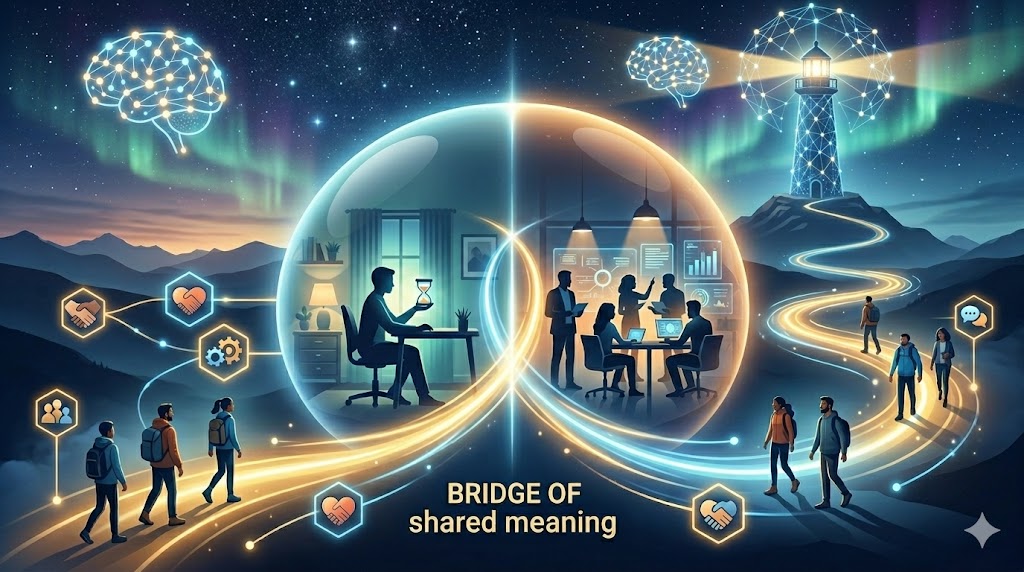
The shift to distributed work has fractured the traditional “office culture,” making the intentional design of rituals more critical than ever. Without the physical proximity of a shared workspace, organizational identity can quickly evaporate. We must move beyond the “Zoom Happy Hour” and create digital-first rituals that maintain our connective tissue across time zones and screens.
Digital Campfires: Creating Virtual Belonging
In a remote environment, we replace the physical lobby with “Digital Campfires” — structured, asynchronous, or live spaces dedicated solely to storytelling and cultural alignment. This isn’t a status update; it’s a ritual where team members share their FutureHacking™ insights or celebrate a “Magic Maker” moment. It provides a hearth for the organization, ensuring that even the most distant employee feels the warmth of the shared mission.
Micro-Rituals: The Power of Small Signals
Identity is often reinforced in the “in-between” moments. We encourage the development of micro-rituals: small, repeatable gestures that signal belonging. This might be a specific way a team opens a Slack thread, a unique digital artifact used to signify a “win,” or a 60-second “Mindful Minute” at the start of every video call. These micro-signals act as a pulse, keeping the organizational identity alive in the absence of a shared physical roof.
Scaling the Un-scalable: Evolution without Dilution
As an organization grows, rituals must evolve or risk becoming hollow parodies of themselves. The ritual of scaling involves a “Keep, Toss, or Transform” audit. We must empower local teams to adapt global rituals to their specific cultural or departmental context while maintaining the core symbolic intent. By treating rituals as agile prototypes, we ensure that as the organization expands, our identity scales with it — stronger, not thinner.
Conclusion: The Leader as Chief Ritual Officer
Building a world-class organization doesn’t happen through the sheer force of a strategic plan; it happens through the quiet, consistent application of shared practices. As leaders, we must move beyond the role of administrator and step into the role of Chief Ritual Officer. Our task is to curate the experiences that define who we are when no one is looking and how we show up when the market gets tough.
Consistency Over Intensity
The mistake many organizations make is favoring the high-intensity “event” — the annual retreat or the massive launch party — over the low-intensity, high-frequency ritual. In the world of Human-Centered Innovation, consistency is the bedrock of trust. A ten-minute weekly huddle that authentically honors your values will do more to embed identity than a thousand-page culture deck that sits unread on a server.
Auditing Your Identity
I challenge you to perform a ritual audit of your own team or organization. Look at your recurring meetings, your onboarding processes, and your project post-mortems. Which of these are mere routines designed for efficiency, and which are rituals designed for identity? If you find your culture is drifting, don’t write a new memo — design a new ritual.
Final thought: Strategies provide the map, but rituals provide the fuel for the journey. When your people begin to practice their purpose together, your organizational identity becomes unshakeable. It’s time to stop talking about your culture and start practicing it.
Frequently Asked Questions
How do rituals differ from standard business routines?
While routines focus on efficiency and “what” needs to get done, rituals focus on “why” we do it and “who” we are. A ritual adds a layer of meaning, symbolism, and intentionality to an action, transforming a mundane task into a shared cultural touchstone.
Can rituals be effective in a fully remote or hybrid work environment?
Absolutely. In fact, they are more critical in hybrid settings. By utilizing “Digital Campfires” and micro-rituals — small, repeatable digital signals — organizations can maintain “connective tissue” and a sense of belonging regardless of physical proximity.
How can a leader start implementing rituals without them feeling forced?
The key is consistency over intensity. Start small by identifying an existing routine and layering in a symbolic element that ties back to a core value, such as starting a meeting with a “Human Impact Story” or a “Learning Moment” from a recent setback.
Image credits: Gemini
 Sign up here to join 17,000+ leaders getting Human-Centered Change & Innovation Weekly delivered to their inbox every week.