LAST UPDATED: April 17, 2026 at 8:21 AM
GUEST POST from Chateau G Pato
The “Innovation Gap” in Modern HR
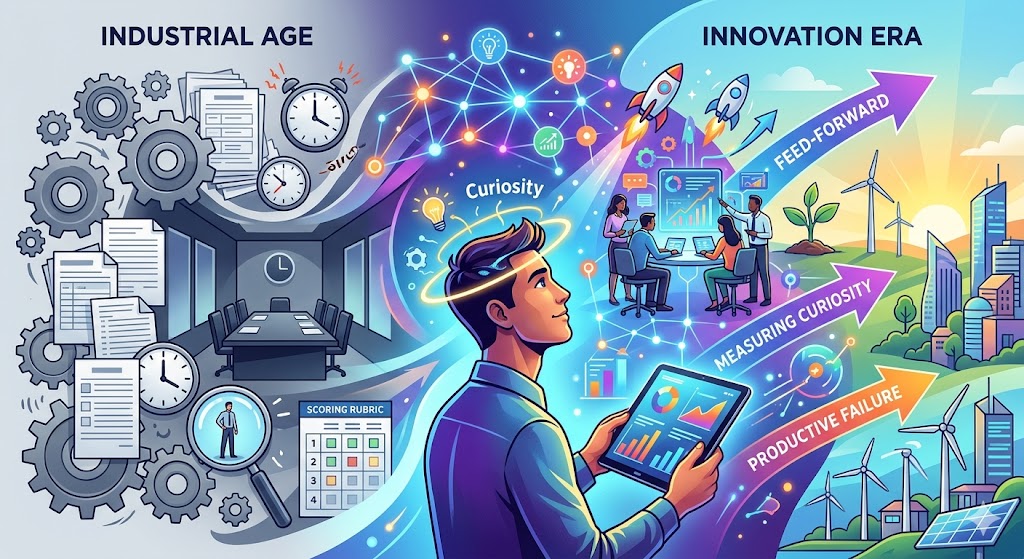
The traditional annual performance review is increasingly becoming a relic of a bygone industrial era. To foster a culture of true innovation, we must address the fundamental disconnects between legacy management systems and the needs of a modern, agile workforce.
The Mismatch: Compliance vs. Creativity
Standard Key Performance Indicators (KPIs) are often designed for optimization and predictability. In an innovation context, these rigid metrics act as “creativity killers” by penalizing the very risk-taking and divergent thinking required for breakthrough ideas. If employees are only measured on “hitting the numbers,” they will naturally avoid the uncertainty inherent in pioneering new solutions.
The Velocity Problem
There is a growing friction between the annual review cycle and the rapid loops of modern product development. In a world of “build-measure-learn,” waiting twelve months to course-correct a career path is an eternity. Innovation requires real-time pivots, yet our HR systems often remain stuck in a slow, linear cadence.
Psychological Safety and the Brain
Traditional grading systems and “forced rankings” often trigger a threat response in the human brain. When the prefrontal cortex — the center for creativity and problem-solving — is clouded by the anxiety of a performance rating, innovation ceases. We must redesign these interactions to prioritize psychological safety, allowing the creative brain to remain “online” and engaged.
Designing the New Feedback Experience
The structure of the feedback session itself must mirror the Human-Centered Design principles we apply to our products. It should be an iterative, empathetic, and forward-looking experience that reduces cognitive load and maximizes professional growth.
Continuous Iteration over “Big Bang” Events
Just as we have moved from Waterfall to Agile development, we must move from annual reviews to continuous “Syncs.” By breaking feedback into smaller, more frequent interactions, we remove the “recency bias” of annual reviews and allow for real-time course corrections. These micro-feedback loops keep the employee’s development in lockstep with the organization’s evolving needs.
Feed-Forward vs. Feed-Back
While traditional “Feedback” looks in the rearview mirror at past mistakes, “Feed-Forward” focuses on future potential. By shifting the conversation to upcoming design challenges and career aspirations, we transform the manager from a judge into a strategic partner. This approach aligns individual passions with the firm’s future innovation roadmap.
360-Degree Empathy and Social Impact
Innovation is a team sport. To get a holistic view of performance, we must incorporate 360-degree perspectives that measure an individual’s impact on team dynamics and their ability to practice empathy with stakeholders. Success in the innovation era is defined by how well you enable others to succeed, not just your personal contribution.
Conclusion: Cultivating a Growth Ecosystem
The shift toward innovation-era performance reviews is not merely an HR upgrade; it is a fundamental reconfiguration of the employer-employee relationship. We must move from a culture of surveillance to a culture of enablement.
The Leader as Coach and Experience Designer
In this new paradigm, the manager’s role is redefined. They are no longer a “judge” delivering a verdict once a year, but a Coach and Experience Designer. Their primary responsibility is to remove friction, reduce cognitive load, and design the conditions where creative talent can thrive.
The Bottom Line: A Competitive Necessity
Human-centered performance management is not a “soft” initiative — it is a competitive mandate. In an economy increasingly driven by AI and automation, the human capacity for empathy, complex problem-solving, and “future-hacking” is our most valuable asset. Organizations that fail to measure and reward these traits will lose their best people to those that do.
Call to Action: Prototype Your Future
The time for theorizing has passed. Leaders must begin to prototype new review models today. Start small — test a “Feed-Forward” approach with one team, or replace a quarterly KPI check-in with a learning-based “Sync.” Iteration is the only way to build a performance system that is as dynamic and resilient as the world we are trying to create.
Frequently Asked Questions
What is the main difference between traditional and innovation-era performance reviews?
Traditional reviews focus on past outputs and compliance, often penalizing risk-taking. Innovation-era reviews focus on leading indicators like curiosity, learning velocity, and well-designed ‘productive failures’ that drive future growth.
How do OKRs replace traditional KPIs in performance management?
While KPIs maintain current standards, OKRs (Objectives and Key Results) align individual growth with the organization’s strategic ‘North Star,’ encouraging employees to reach for transformational goals rather than just hitting safe targets.
Why is ‘Feed-Forward’ better than ‘Feedback’ for creative teams?
Feedback often focuses on historical mistakes, which can trigger defensiveness. ‘Feed-Forward’ is a human-centered approach that looks at future potential and upcoming challenges, positioning the manager as a coach rather than a judge.
Image credit: Google Gemini
 Sign up here to get Human-Centered Change & Innovation Weekly delivered to your inbox every week.
 Drum roll please…