Tag Archives: futures thinking

Building a Foresight Muscle

Integrating Futures Thinking into Your Strategy

Building a Foresight Muscle - Integrating Futures Thinking into Your Strategy

GUEST POST from Chateau G Pato

In the world of human-centered change and innovation, we often talk about agility—the ability to react quickly. But agility alone is no longer enough. The pace of disruption, from Generative AI to climate instability, has made the classic five-year strategic plan feel like an exercise in nostalgia. What companies need now is foresight: the systematic discipline of scanning the horizon for potential threats and opportunities to prepare for a range of plausible futures, not just the one we wish for.

Foresight is not about predicting the future; it’s about creating a more resilient present. It’s the innovation discipline that bridges the gap between today’s operational demands and tomorrow’s existential risks. If your strategy is only built on what happened last quarter, you are driving your organization by looking solely in the rearview mirror. To survive and thrive in the Age of Perpetual Disruption, organizations must move from being reactive to being pre-emptive by integrating futures thinking directly into their core strategic planning process. This requires building a dedicated “Foresight Muscle.”

The Foresight Cycle: From Weak Signals to Strategy

Futures thinking is a cyclical, human-driven process designed to challenge organizational rigidity. The goal is to develop a portfolio of possibilities, often called Scenarios, which force decision-makers to ask, “What if our core assumptions are completely wrong?”

The Three Pillars of Futures Integration:

  • 1. Horizon Scanning (The Data Intake): Systematically monitor technological, economic, political, environmental, and social (T.E.P.E.S.) trends. This moves beyond standard market research to actively seek out weak signals—small, seemingly insignificant anomalies (a niche patent, a fringe academic paper, a micro-community trend) that could compound into massive shifts a decade from now.
  • 2. Scenario Planning (The Cognitive Workout): Develop 3–5 alternative, equally plausible future narratives. These scenarios should not include the “default” future. By immersing executive teams in these plausible worlds, you create experiential learning that reduces the likelihood of future shock.
  • 3. Backcasting (The Strategic Link): Once a desired future state (the most advantageous scenario) is identified, work backward to determine the required actions, milestones, and investments needed today to make that future a reality. This translates abstract foresight into concrete innovation roadmaps.

“Prediction is cheap. Preparation is invaluable. Foresight is the difference between surviving a crisis and capitalizing on a discontinuity.” — Roger Spitz


Case Study 1: Shell and the Power of Scenario Planning

The Challenge:

As early as the 1970s, Royal Dutch Shell, a colossal, capital-intensive energy company, faced immense geopolitical and economic volatility that threatened its long-term stability. Relying on single-point forecasts (predicting one oil price, one political outcome) was a recipe for disaster.

The Foresight Solution:

Shell pioneered the use of Scenario Planning. They developed narratives, such as “The World of Scarcity” and “The World of Abundance,” that explored radical changes in oil supply, regulatory environments, and environmental constraints. Critically, their team was ready when the 1973 oil crisis hit. While other companies were paralyzed by the unexpected shock, Shell was able to quickly recognize the unfolding events as fitting one of their pre-prepared scenarios (The Scarcity World). Because they had already debated the implications of this future, they were able to act decisively while their competitors stalled.

The Strategic Impact:

Shell used foresight not to predict when the crisis would occur, but to train its management to think the unthinkable. This cognitive agility allowed them to reposition assets, secure long-term contracts, and emerge from the crisis significantly stronger than their peers. Their sustained use of scenarios for over four decades demonstrates the power of embedding foresight as a permanent strategic function, not a one-off project.


Case Study 2: Nokia and the Warning Signs Missed

The Challenge:

In the early 2000s, Nokia was the unchallenged king of the mobile phone market. They had internal foresight teams and research labs that were highly aware of the future potential of both touch-screen technology and high-speed data networks (3G/4G). They saw the weak signals of the coming smartphone revolution.

The Failure to Integrate:

Nokia did not lack information; they lacked the organizational fortitude to integrate that information into their core strategy. Their foresight was too isolated. The operational business units, focused on maintaining existing profit margins from hardware, actively resisted internal investment in high-risk, unproven smartphone operating systems (like the future Symbian alternatives). The existing organizational structure and mental models acted as a powerful innovation antibody, rejecting the uncomfortable future presented by their own foresight team.

The Strategic Impact:

When the iPhone launched, it was not a surprise to Nokia’s foresight specialists, but it was a disruptive crisis to the rest of the company because the necessary internal strategic shifts had never been made. This case is a profound lesson: Foresight must be fused with budget allocation and decision-making authority. Having a beautiful set of scenarios is worthless if the organization is incapable of acting on the challenging insights they reveal. Nokia’s demise underscores that strategy without integrated foresight is a slow form of corporate suicide.


Building Your Foresight Muscle: A Human-Centered Approach

Integrating futures thinking is fundamentally a human-centered change effort. It requires challenging biases, fostering intellectual humility, and creating a safe space for counter-narratives. The ultimate human benefit is reduced crisis-induced stress and a shift toward more creative, strategic work. Braden Kelley’s FutureHacking methodology is a great set of tools to leverage if you don’t already have your own toolkit – or to supplement it. Here are three exercises to strengthen your foresight:

  • Challenge Confirmation Bias: Design scenario workshops that actively seek out the data that contradicts your most cherished beliefs. Use diverse teams to reduce the echo chamber effect.
  • Democratize Scanning: Don’t limit horizon scanning to an elite team. Train employees across all levels and geographies — especially customer-facing roles—to recognize and report weak signals. This makes foresight a collective intelligence exercise.
  • Measure Impact, Not Accuracy: Don’t grade your foresight team on whether their prediction came true. Measure their success on whether the scenarios they created led to better, more robust strategic decisions today (e.g., diversifying a supply chain, launching an experimental business unit).

The greatest risk in strategic planning is not being wrong; it’s being rigid. By building a robust foresight muscle — by systematically scanning, scripting scenarios, and backcasting your innovation agenda — you transform your organization from a passive observer of change into an active shaper of its own destiny. Start small, but start now. The future is already signaling its presence; are you listening?

Extra Extra: Because innovation is all about change, Braden Kelley’s human-centered change methodology and tools are the best way to plan and execute the changes necessary to support your innovation and transformation efforts — all while literally getting everyone all on the same page for change. Find out more about the methodology and tools, including the book Charting Change by following the link. Be sure and download the TEN FREE TOOLS while you’re here.

Image credit: Pixabay

Subscribe to Human-Centered Change & Innovation WeeklySign up here to get Human-Centered Change & Innovation Weekly delivered to your inbox every week.

Practical Futures Thinking for Leaders

Beyond the Crystal Ball

Practical Futures Thinking for Leaders

GUEST POST from Art Inteligencia

My partner in crime Braden Kelley’s focus is relentlessly on empowering leaders to navigate and drive change in a world that shifts faster than ever before. We’ve all seen the dazzling presentations of “futurists” with their glossy predictions, but true leadership demands more than passive stargazing. It demands a pragmatic, actionable approach to what’s coming next. That’s why today, I want to demystify strategic foresight in ‘Beyond the Crystal Ball: Practical Futures Thinking for Leaders’.

The future isn’t a fixed destination we can predict; it’s a dynamic landscape we actively shape. The traditional planning cycles, rigid five-year strategies, and reliance on historical data are increasingly insufficient in an age of exponential change. Leaders who merely react to disruptions will inevitably fall behind. Those who thrive will be the ones who cultivate a continuous, systematic practice of futures thinking, moving beyond speculation to strategic preparedness and proactive innovation.

Why “Futures Thinking” Isn’t Just for Futurists

Many leaders shy away from futures thinking, viewing it as an academic exercise detached from daily realities. This is a critical misconception. Practical futures thinking is not about making precise predictions; it’s about:

  • Anticipating Disruption: Identifying emerging trends, weak signals, and potential discontinuities before they become crises.
  • Challenging Assumptions: Breaking free from mental models based on the past, which often limit our perception of future possibilities.
  • Exploring Multiple Futures: Understanding that various plausible futures exist, enabling robust strategies that are resilient across different scenarios.
  • Identifying Opportunities: Spotting white space for innovation and new value creation that might be invisible through a traditional lens.
  • Building Resilience: Developing adaptable plans and organizational capacities to navigate uncertainty rather than being paralyzed by it.
  • Empowering Action: Translating insights about potential futures into concrete strategic choices and immediate innovation initiatives.

This isn’t about guesswork; it’s about structured inquiry, creative exploration, and critical analysis applied to uncertainty. It’s about proactive leadership in a volatile world.

Case Study 1: The Retail Giant That Foresaw the Experience Economy

In the early 2000s, a major department store chain was grappling with declining foot traffic and intense competition from burgeoning e-commerce. Traditional metrics pointed to optimizing store layouts and discount strategies. However, their internal futures thinking unit began to identify weak signals pointing to a profound shift in consumer values.

They didn’t just read reports; they ran workshops using scenario planning. They explored futures where:

  1. “Pure Efficiency” dominated, with consumers only caring about price and speed (Amazon’s rise).
  2. “Hyper-Personalization” was key, driven by advanced AI.
  3. “Experience as the Ultimate Luxury” redefined value, with consumers seeking unique, immersive interactions over mere product acquisition.

Through this exercise, they realized that while efficiency was important, the “Experience as Luxury” scenario presented both the greatest threat and the biggest opportunity for a physical retailer. They foresaw that simply selling products would no longer suffice; they needed to sell experiences.

Practical Futures Thinking in Action: This foresight led to a radical strategic pivot. Instead of doubling down on traditional retail, they began experimenting with in-store cafes, pop-up events featuring local artisans, interactive product demonstrations, and personal styling services. They transformed their flagship stores into “cultural hubs” that offered more than just merchandise. This wasn’t a sudden epiphany; it was the result of a deliberate, human-centered futures thinking process that challenged their core assumptions about what a retail store is. While many legacy retailers struggled and disappeared, this company adapted, evolving its business model to become a destination for unique consumer experiences, carving out a distinct niche that was resilient against pure e-commerce disruption. They didn’t predict the future, they prototyped for it.

Case Study 2: The Healthcare Provider Anticipating the Blurring Lines of Care

A large integrated healthcare provider was historically focused on brick-and-mortar hospitals and clinics. Their operational planning revolved around capacity management, staffing, and insurance models. However, their strategic foresight team initiated a deep dive into the “Future of Health and Wellness.”

They employed a technique called trend analysis and wild cards to explore forces like:

  • The rise of consumer wearables and home diagnostics.
  • The aging global population and increasing chronic disease burden.
  • Advances in AI for diagnostics and remote monitoring.
  • Changing patient expectations for convenience and personalized care.
  • Potential “wild cards” like novel pandemics or widespread mental health crises.

They generated scenarios where traditional hospitals became less central, and care shifted dramatically to homes, community centers, and virtual platforms. They saw a future where “healthcare” blurred with “wellness,” “lifestyle management,” and even “preventative coaching.”

Practical Futures Thinking in Action: This comprehensive analysis helped them understand that simply building more hospitals wasn’t a sustainable long-term strategy. Instead, they began investing heavily in telehealth infrastructure, developing remote patient monitoring programs, partnering with community wellness organizations, and exploring AI-driven preventative health apps. They started training their medical staff not just as diagnosticians but as “health coaches.” By anticipating the shift from reactive, episodic care to proactive, continuous wellness management, this provider positioned itself as a leader in a transformed healthcare landscape. They didn’t just plan for incremental growth; they prepared for a foundational shift in how humans receive and manage their health, enabling them to meet future demand effectively and deliver human-centered care more broadly.

Cultivating a Foresight Culture in Your Organization

Futures thinking isn’t a one-off project; it’s a continuous capability that must be embedded into an organization’s DNA. Here’s how leaders can foster this culture:

  • Designated Foresight Function (Even Small): Dedicate resources (people, time, budget) to systematically scan the horizon, even if it’s just a small cross-functional team meeting monthly.
  • Democratize Access to Insights: Share foresight outputs (scenarios, trend reports, weak signals) broadly across the organization to spark conversations and challenge status quo thinking.
  • Integrate into Strategy & Innovation: Make futures insights an explicit input into annual strategic planning, R&D roadmaps, and new product development processes.
  • Encourage “What If” Thinking: Create safe spaces for employees to ask provocative questions, challenge assumptions, and explore radical possibilities without fear of judgment.
  • Learn from the Edges: Actively seek out perspectives from diverse sources—startups, academics, artists, marginalized communities—who often see the future forming before mainstream.
  • Practice Scenario Planning: Regularly engage leadership and key teams in workshops to build multiple plausible future scenarios and develop robust, adaptable strategies for each.

Beyond the crystal ball lies not certainty, but clarity. Clarity about the forces shaping our world, the potential paths ahead, and the choices we can make today to create a desired future. By embracing practical futures thinking, leaders move from being victims of change to architects of progress, ready to innovate for the human challenges and opportunities that lie ahead. It’s time to build the future, not just observe it.

Extra Extra: Futurology is not fortune telling. Futurists use a scientific approach to create their deliverables, but a methodology and tools like those in FutureHacking™ can empower anyone to engage in futurology themselves.

Image credit: Pixabay

Subscribe to Human-Centered Change & Innovation WeeklySign up here to get Human-Centered Change & Innovation Weekly delivered to your inbox every week.
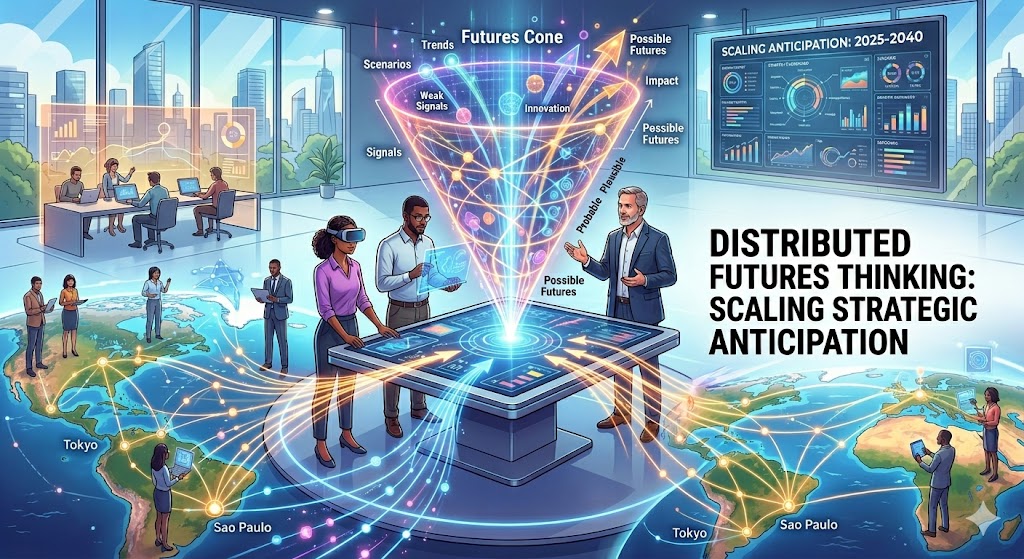
Distributed Futures Thinking – Scaling Strategic Anticipation

LAST UPDATED: April 16, 2026 at 2:21 PM

Distributed Futures Thinking - Scaling Strategic Anticipation

GUEST POST from Chateau G Pato


The Fallacy of the Lone Futurist

For decades, corporate foresight has been treated as an elite, cloistered exercise. Organizations typically tuck their “Futurists” into isolated strategy departments or high-level innovation labs, tasking them with predicting the next decade from the comfort of a boardroom. However, in an era defined by radical volatility and hyper-connectivity, this centralized model has become a dangerous bottleneck.

The reality of modern business is that change does not arrive in a single, predictable wave; it emerges as a series of “weak signals” scattered across disparate geographies, departments, and customer touchpoints. When foresight is siloed, the organization loses its peripheral vision. We can no longer afford “Foresight as a Function” — a niche service provided by the few to the many.

To survive, we must transition toward “Anticipation as a Culture.” This means moving the responsibility of future-gazing out of the executive suite and into the hands of the frontline employees who interact with customers, the engineers seeing technical friction, and the designers observing shifting human behaviors.

“The future is already here — it’s just not evenly distributed. To see it, you must distribute your ability to look.”

Distributed Futures Thinking is the framework for this democratization. By scaling strategic anticipation, we transform a static organization into a living sensor network, capable of not only seeing the future coming but having the collective agility to design it.

The Architecture of Distributed Thinking

Scaling anticipation requires more than just a change in mindset; it requires a structural redesign of how information flows through an organization. We must move away from top-down directives and toward a human-centered architecture that treats every employee as a vital node in a collective intelligence network.

Human-Centered Foresight

Strategic anticipation is often mistaken for cold data analysis. In reality, the most impactful shifts are rooted in human behavior and unmet needs. By applying experience design principles to futurology, we look past the “what” of a trend to understand the “why.” When foresight starts with empathy, it becomes actionable. It allows us to design futures that people actually want to inhabit, rather than simply reacting to technological inevitabilities.

The Sensor Network: Scaling Signal Detection

The frontline is your greatest diagnostic tool. A salesperson in Southeast Asia or a customer success lead in London will notice a shift in sentiment months before it appears in a quarterly report. By distributing the “sensor” function, we create a wide-angle lens for the organization. This network detects “weak signals” — small, seemingly local disruptions that have the potential to scale into industry-wide sea changes.

The Power of Cognitive Diversity

The greatest enemy of foresight is groupthink. When a homogeneous leadership team imagines the future, they often recreate a slightly shinier version of the present. Distributed futures thinking intentionally leverages cognitive diversity — gathering perspectives across different cultures, age groups, and professional disciplines. This variety acts as a natural stress-test for our assumptions, ensuring that our strategic scenarios are robust enough to survive reality.

By democratizing access to these insights, we don’t just predict the future; we create a shared mental map that allows the entire organization to move in sync when the environment shifts.

Scaling the Toolkit: The “How” of Democratized Foresight

The primary barrier to scaling futures thinking is often the perceived complexity of the methodology. To move from a handful of experts to an entire organization of “anticipators,” we must strip away the academic jargon and provide modular, intuitive frameworks that empower teams to act autonomously.

Modular Frameworks for the Masses

Traditional tools like STEEP (Social, Technological, Economic, Environmental, and Political analysis) are powerful but often feel like homework. We reframe these as “Lens Kits” — simple prompts that encourage employees to view their daily work through different horizons. By standardizing the language of Scenario Planning, we enable a marketing manager and a software engineer to collaborate on a “What If?” exercise using the same conceptual shorthand.

“Always-On” Curiosity over Periodic Planning

Strategy is too often a “once-a-year” event. Distributed futures thinking replaces the annual retreat with continuous scanning. Through digital collaboration platforms and internal “signal repositories,” we create a cultural habit of sharing observations in real-time. This turns the organization into a living laboratory where insights are crowdsourced and validated continuously, rather than waiting for a consultant’s report.

Experience Design: Prototyping the Future

Data rarely changes minds; experiences do. This is where experience design becomes the secret weapon of strategic anticipation. We move beyond white papers and create “Future Artifacts” — tangible or digital prototypes that represent a specific scenario. Whether it’s a mockup of a 2030 bank statement or a video of a futuristic customer journey, these artifacts make abstract possibilities feel visceral.

“If you can’t feel the future, you won’t prepare for it. We must design the evidence of tomorrow to spark the decisions of today.” — Braden Kelley

When teams can “touch” a potential future, the strategic implications become clear. It bridges the gap between high-level theory and boots-on-the-ground innovation, ensuring that anticipation leads directly to designing better human experiences.

Overcoming Institutional Inertia

Even with the best tools in place, the greatest threat to distributed futures thinking is the gravity of the “now.” Most organizations are optimized for the present, creating a natural resistance to any signal that threatens current business models or operational efficiencies.

The “Present Bias” Trap

The tyranny of the urgent — driven by quarterly results and immediate KPIs — often suffocates long-term thinking. To scale anticipation, we must adjust the incentive structures. This means rewarding teams not just for hitting today’s targets, but for identifying the disruptions that will make those targets irrelevant tomorrow. We have to make it safe to look up from the grindstone.

Psychological Safety and the “Wild Card”

Innovation dies in environments where being “wrong” is penalized. Distributed foresight requires high levels of psychological safety. If an employee spots a radical shift — a “wild card” event — they must feel empowered to share it without fear of being labeled a distraction. A culture of strategic anticipation treats every outlier as a potential opportunity rather than a nuisance.

The Power of Narrative: Bridging the Gap

Facts and figures are easily dismissed; stories are not. To overcome inertia, we use strategic storytelling to connect future scenarios to today’s reality. By crafting compelling narratives about how our customers’ lives will change, we transform “change” from a threat into a shared mission. We don’t just present a report; we tell the story of our future relevance.

“The hardest part of looking forward is letting go of the certainty of today. Narrative is the bridge that carries the team across that gap.” — Braden Kelley

By addressing these cultural and psychological barriers, we ensure that distributed thinking doesn’t just result in a collection of ideas, but in a fundamental shift in organizational behavior.

From Anticipation to Agility: Closing the Loop

Anticipation without action is merely a daydream. The true value of Distributed Futures Thinking lies in its ability to influence the “now.” Once we have democratized the sensing of signals, we must create clear pathways for those insights to penetrate our operational DNA.

Closing the Insight Loop

For a distributed network to remain motivated, contributors must see their observations translated into tangible outcomes. This requires a formal “Insight-to-Action” pipeline. Whether it’s a small UX tweak based on an emerging behavior or a pivot in the R&D roadmap, the link between a detected signal and an organizational response must be visible and rapid. This feedback loop transforms passive observation into active innovation.

Adaptive Strategy: Strategic Wayfinding

The era of the rigid “Five-Year Plan” is over. In its place, we adopt Strategic Wayfinding — a dynamic approach where strategy is treated as a continuous hypothesis. As new signals are fed into the system from the distributed network, the organization adjusts its course in real-time. This doesn’t mean changing your vision every week; it means being agile enough to change your tactics to reach that vision as the landscape shifts.

Case Studies in Scaled Anticipation

We see this model succeeding in organizations that have decentralized their decision-making.

  • Global Tech Leaders: Companies that utilize internal “prediction markets” to crowdsource the probability of project success or market shifts.
  • Decentralized NGOs: Organizations that empower field workers to act as primary sensors, allowing them to pivot disaster relief efforts before centralized data even hits the dashboard.

When anticipation is distributed, agility becomes a byproduct of awareness. The organization stops reacting to the future and starts moving with it, maintaining a constant state of readiness that competitors simply cannot match.

Conclusion: Designing the Future Together

The future is not a destination we reach; it is a manifestation of the collective choices we make today. When we move beyond the “Lone Futurist” model and embrace Distributed Futures Thinking, we do more than just improve our forecasting — we upgrade our organizational consciousness.

The Call to Collective Intent

Strategic anticipation is the ultimate human-centered endeavor. By empowering every individual within an organization to look forward, we foster a sense of agency and purpose. No longer are employees merely cogs in a machine reacting to external shocks; they become active architects of a shared destiny. This shift in mindset is what separates the legacy companies that fade away from the enduring icons that redefine their industries.

“Innovation is everyone’s job, and so is the future. If you aren’t scaling your vision, you’re narrowing your horizon.”

Final Thought: Anticipation as Survival

In a world of exponential change, the ability to see around corners is no longer a luxury — it is a survival trait. Organizations that democratize foresight will be the ones that navigate uncertainty with confidence and design experiences that truly resonate with the evolving human spirit. The tools are available, the frameworks are ready; all that remains is the courage to trust your people with the future.

Let’s stop trying to predict the future and start designing it — together.

Frequently Asked Questions

What is Distributed Futures Thinking?

Distributed Futures Thinking is a strategic framework that moves foresight out of isolated boardrooms and into the hands of every employee. It transforms an organization into a collective sensor network to detect “weak signals” of change in real-time.

How does it differ from traditional strategic planning?

Unlike traditional planning, which often relies on annual reports and top-down directives, distributed anticipation is “always-on.” It focuses on human-centered signals and cognitive diversity to create a dynamic “Strategic Wayfinding” approach rather than a rigid five-year plan.

Who should lead the effort of scaling anticipation?

While the initiative often begins with innovation or strategy leaders, the goal is democratization. A human-centered change leader facilitates the process by providing modular toolkits, ensuring psychological safety, and fostering a culture of continuous curiosity across all departments.

Image credit: Google Gemini

Subscribe to Human-Centered Change & Innovation WeeklySign up here to get Human-Centered Change & Innovation Weekly delivered to your inbox every week.