LAST UPDATED: April 16, 2026 at 2:21 PM
GUEST POST from Chateau G Pato
The Fallacy of the Lone Futurist
For decades, corporate foresight has been treated as an elite, cloistered exercise. Organizations typically tuck their “Futurists” into isolated strategy departments or high-level innovation labs, tasking them with predicting the next decade from the comfort of a boardroom. However, in an era defined by radical volatility and hyper-connectivity, this centralized model has become a dangerous bottleneck.
The reality of modern business is that change does not arrive in a single, predictable wave; it emerges as a series of “weak signals” scattered across disparate geographies, departments, and customer touchpoints. When foresight is siloed, the organization loses its peripheral vision. We can no longer afford “Foresight as a Function” — a niche service provided by the few to the many.
To survive, we must transition toward “Anticipation as a Culture.” This means moving the responsibility of future-gazing out of the executive suite and into the hands of the frontline employees who interact with customers, the engineers seeing technical friction, and the designers observing shifting human behaviors.
“The future is already here — it’s just not evenly distributed. To see it, you must distribute your ability to look.”
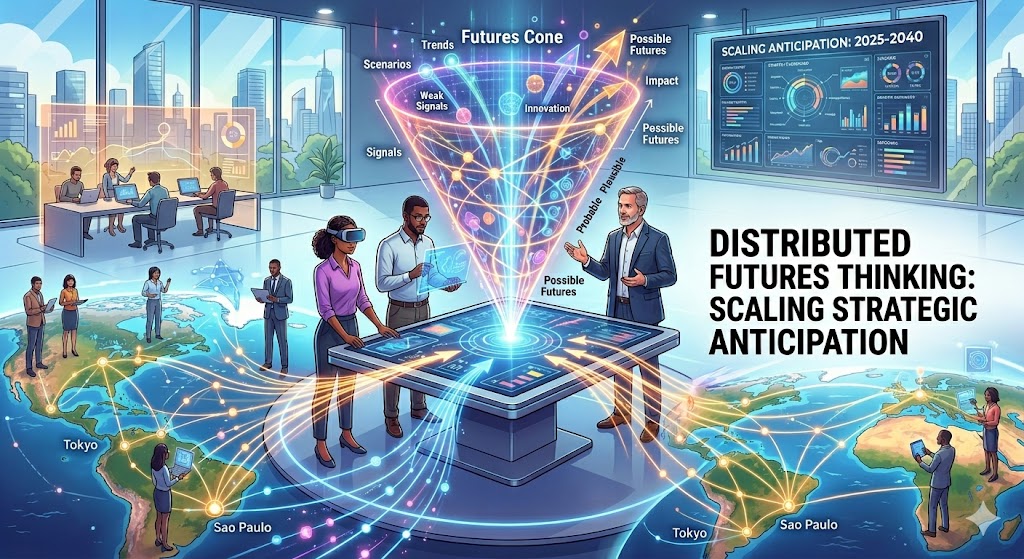
Distributed Futures Thinking is the framework for this democratization. By scaling strategic anticipation, we transform a static organization into a living sensor network, capable of not only seeing the future coming but having the collective agility to design it.
The Architecture of Distributed Thinking
Scaling anticipation requires more than just a change in mindset; it requires a structural redesign of how information flows through an organization. We must move away from top-down directives and toward a human-centered architecture that treats every employee as a vital node in a collective intelligence network.
Human-Centered Foresight
Strategic anticipation is often mistaken for cold data analysis. In reality, the most impactful shifts are rooted in human behavior and unmet needs. By applying experience design principles to futurology, we look past the “what” of a trend to understand the “why.” When foresight starts with empathy, it becomes actionable. It allows us to design futures that people actually want to inhabit, rather than simply reacting to technological inevitabilities.
The Sensor Network: Scaling Signal Detection
The frontline is your greatest diagnostic tool. A salesperson in Southeast Asia or a customer success lead in London will notice a shift in sentiment months before it appears in a quarterly report. By distributing the “sensor” function, we create a wide-angle lens for the organization. This network detects “weak signals” — small, seemingly local disruptions that have the potential to scale into industry-wide sea changes.
The Power of Cognitive Diversity
The greatest enemy of foresight is groupthink. When a homogeneous leadership team imagines the future, they often recreate a slightly shinier version of the present. Distributed futures thinking intentionally leverages cognitive diversity — gathering perspectives across different cultures, age groups, and professional disciplines. This variety acts as a natural stress-test for our assumptions, ensuring that our strategic scenarios are robust enough to survive reality.
By democratizing access to these insights, we don’t just predict the future; we create a shared mental map that allows the entire organization to move in sync when the environment shifts.
Scaling the Toolkit: The “How” of Democratized Foresight
The primary barrier to scaling futures thinking is often the perceived complexity of the methodology. To move from a handful of experts to an entire organization of “anticipators,” we must strip away the academic jargon and provide modular, intuitive frameworks that empower teams to act autonomously.
Modular Frameworks for the Masses
Traditional tools like STEEP (Social, Technological, Economic, Environmental, and Political analysis) are powerful but often feel like homework. We reframe these as “Lens Kits” — simple prompts that encourage employees to view their daily work through different horizons. By standardizing the language of Scenario Planning, we enable a marketing manager and a software engineer to collaborate on a “What If?” exercise using the same conceptual shorthand.
“Always-On” Curiosity over Periodic Planning
Strategy is too often a “once-a-year” event. Distributed futures thinking replaces the annual retreat with continuous scanning. Through digital collaboration platforms and internal “signal repositories,” we create a cultural habit of sharing observations in real-time. This turns the organization into a living laboratory where insights are crowdsourced and validated continuously, rather than waiting for a consultant’s report.
Experience Design: Prototyping the Future
Data rarely changes minds; experiences do. This is where experience design becomes the secret weapon of strategic anticipation. We move beyond white papers and create “Future Artifacts” — tangible or digital prototypes that represent a specific scenario. Whether it’s a mockup of a 2030 bank statement or a video of a futuristic customer journey, these artifacts make abstract possibilities feel visceral.
“If you can’t feel the future, you won’t prepare for it. We must design the evidence of tomorrow to spark the decisions of today.” — Braden Kelley
When teams can “touch” a potential future, the strategic implications become clear. It bridges the gap between high-level theory and boots-on-the-ground innovation, ensuring that anticipation leads directly to designing better human experiences.
Overcoming Institutional Inertia
Even with the best tools in place, the greatest threat to distributed futures thinking is the gravity of the “now.” Most organizations are optimized for the present, creating a natural resistance to any signal that threatens current business models or operational efficiencies.
The “Present Bias” Trap
The tyranny of the urgent — driven by quarterly results and immediate KPIs — often suffocates long-term thinking. To scale anticipation, we must adjust the incentive structures. This means rewarding teams not just for hitting today’s targets, but for identifying the disruptions that will make those targets irrelevant tomorrow. We have to make it safe to look up from the grindstone.
Psychological Safety and the “Wild Card”
Innovation dies in environments where being “wrong” is penalized. Distributed foresight requires high levels of psychological safety. If an employee spots a radical shift — a “wild card” event — they must feel empowered to share it without fear of being labeled a distraction. A culture of strategic anticipation treats every outlier as a potential opportunity rather than a nuisance.
The Power of Narrative: Bridging the Gap
Facts and figures are easily dismissed; stories are not. To overcome inertia, we use strategic storytelling to connect future scenarios to today’s reality. By crafting compelling narratives about how our customers’ lives will change, we transform “change” from a threat into a shared mission. We don’t just present a report; we tell the story of our future relevance.
“The hardest part of looking forward is letting go of the certainty of today. Narrative is the bridge that carries the team across that gap.” — Braden Kelley
By addressing these cultural and psychological barriers, we ensure that distributed thinking doesn’t just result in a collection of ideas, but in a fundamental shift in organizational behavior.
From Anticipation to Agility: Closing the Loop
Anticipation without action is merely a daydream. The true value of Distributed Futures Thinking lies in its ability to influence the “now.” Once we have democratized the sensing of signals, we must create clear pathways for those insights to penetrate our operational DNA.
Closing the Insight Loop
For a distributed network to remain motivated, contributors must see their observations translated into tangible outcomes. This requires a formal “Insight-to-Action” pipeline. Whether it’s a small UX tweak based on an emerging behavior or a pivot in the R&D roadmap, the link between a detected signal and an organizational response must be visible and rapid. This feedback loop transforms passive observation into active innovation.
Adaptive Strategy: Strategic Wayfinding
The era of the rigid “Five-Year Plan” is over. In its place, we adopt Strategic Wayfinding — a dynamic approach where strategy is treated as a continuous hypothesis. As new signals are fed into the system from the distributed network, the organization adjusts its course in real-time. This doesn’t mean changing your vision every week; it means being agile enough to change your tactics to reach that vision as the landscape shifts.
Case Studies in Scaled Anticipation
We see this model succeeding in organizations that have decentralized their decision-making.
- Global Tech Leaders: Companies that utilize internal “prediction markets” to crowdsource the probability of project success or market shifts.
- Decentralized NGOs: Organizations that empower field workers to act as primary sensors, allowing them to pivot disaster relief efforts before centralized data even hits the dashboard.
When anticipation is distributed, agility becomes a byproduct of awareness. The organization stops reacting to the future and starts moving with it, maintaining a constant state of readiness that competitors simply cannot match.
Conclusion: Designing the Future Together
The future is not a destination we reach; it is a manifestation of the collective choices we make today. When we move beyond the “Lone Futurist” model and embrace Distributed Futures Thinking, we do more than just improve our forecasting — we upgrade our organizational consciousness.
The Call to Collective Intent
Strategic anticipation is the ultimate human-centered endeavor. By empowering every individual within an organization to look forward, we foster a sense of agency and purpose. No longer are employees merely cogs in a machine reacting to external shocks; they become active architects of a shared destiny. This shift in mindset is what separates the legacy companies that fade away from the enduring icons that redefine their industries.
“Innovation is everyone’s job, and so is the future. If you aren’t scaling your vision, you’re narrowing your horizon.”
Final Thought: Anticipation as Survival
In a world of exponential change, the ability to see around corners is no longer a luxury — it is a survival trait. Organizations that democratize foresight will be the ones that navigate uncertainty with confidence and design experiences that truly resonate with the evolving human spirit. The tools are available, the frameworks are ready; all that remains is the courage to trust your people with the future.
Let’s stop trying to predict the future and start designing it — together.
Frequently Asked Questions
What is Distributed Futures Thinking?
Distributed Futures Thinking is a strategic framework that moves foresight out of isolated boardrooms and into the hands of every employee. It transforms an organization into a collective sensor network to detect “weak signals” of change in real-time.
How does it differ from traditional strategic planning?
Unlike traditional planning, which often relies on annual reports and top-down directives, distributed anticipation is “always-on.” It focuses on human-centered signals and cognitive diversity to create a dynamic “Strategic Wayfinding” approach rather than a rigid five-year plan.
Who should lead the effort of scaling anticipation?
While the initiative often begins with innovation or strategy leaders, the goal is democratization. A human-centered change leader facilitates the process by providing modular toolkits, ensuring psychological safety, and fostering a culture of continuous curiosity across all departments.
Image credit: Google Gemini
 Sign up here to get Human-Centered Change & Innovation Weekly delivered to your inbox every week.