Innovation or Not – Chemical-Free Farming with Autonomous Robots

Greenfield Robotics and the Human-Centered Reboot of Agriculture

LAST UPDATED: October 20, 2025 at 9:35PM
Innovation or Not - Chemical-Free Farming with Autonomous Robots

GUEST POST from Art Inteligencia

The operating system of modern agriculture is failing. We’ve optimized for yield at the cost of health—human health, soil health, and planetary health. The relentless pursuit of chemical solutions has led to an inevitable biological counter-strike: herbicide-resistant superweeds and a spiraling input cost crisis. We’ve hit the wall of chemical dependency, and the system is demanding a reboot.

This is where the story of Greenfield Robotics — a quiet, powerful disruption born out of a personal tragedy and a regenerative ethos—begins to rewrite the agricultural playbook. Founded by third-generation farmer Clint Brauer, their mission isn’t just to sell a better tool; it’s to eliminate chemicals from our food supply entirely. This is the essence of true, human-centered innovation: identifying a catastrophic systemic failure and providing an elegantly simple, autonomous solution.

The Geometry of Disruption: From Spray to Scalpel

For decades, weed control has been a brute-force exercise. Farmers apply massive spray rigs, blanketing fields with chemicals to kill the unwanted. This approach is inefficient, environmentally harmful, and, critically, losing the biological war.

Greenfield Robotics flips this model from a chemical mass application to a mechanical, autonomous precision action. Their fleet of small, AI-powered robots—the “Weedbots” or BOTONY fleet—are less like tractors and more like sophisticated surgical instruments. They are autonomous, modular, and relentless.

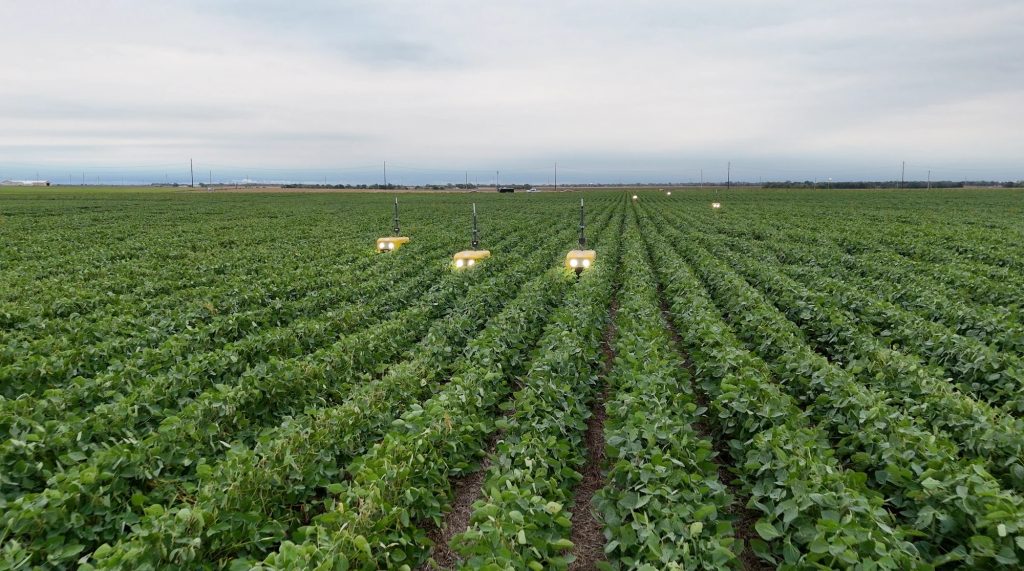
Imagine a swarm of yellow, battery-powered devices, roughly two feet wide, moving through vast crop rows 18 hours a day, day or night. This isn’t mere automation; it’s coordinated, intelligent fleet management. Using proprietary AI-powered machine vision, the bots navigate with centimeter accuracy, identifying the crop from the weed. Their primary weapon is not a toxic spray, but a spinning blade that mechanically scalps the ground, severing the weed right at the root, ensuring chemical-free eradication.

This seemingly simple mechanical action represents a quantum leap in agricultural efficiency. By replacing chemical inputs with a service-based autonomous fleet, Greenfield solves three concurrent crises:

  • Biological Resistance: Superweeds cannot develop resistance to being physically cut down.
  • Environmental Impact: Zero herbicide use means zero chemical runoff, protecting water systems and beneficial insects.
  • Operational Efficiency: The fleet runs continuously and autonomously (up to 1.6 meters per second), drastically increasing the speed of action during critical growth windows and reducing the reliance on increasingly scarce farm labor.

The initial success is staggering. Working across broadacre crops like soybeans, cotton, and sweet corn, farmers are reporting higher yields and lower costs comparable to, or even better than, traditional chemical methods. The economic pitch is the first step, but the deeper change is the regenerative opportunity it unlocks.

The Human-Centered Harvest: Regenerative Agriculture at Scale

As an innovation leader, I look for technologies that don’t just optimize a process, but fundamentally elevate the human condition around that process. Greenfield Robotics is a powerful example of this.

The human-centered core of this innovation is twofold: the farmer and the consumer.

For the farmer, this technology is an act of empowerment. It removes the existential dread of mounting input costs and the stress of battling resistant weeds with diminishing returns. More poignantly, it addresses the long-term health concerns associated with chemical exposure—a mission deeply personal to Brauer, whose father’s Parkinson’s diagnosis fueled the company’s genesis. This is a profound shift: A technology designed to protect the very people who feed the world.

Furthermore, the modular chassis of the Weedbot is the foundation for an entirely new Agri-Ecosystem Platform. The robot is not limited to cutting weeds. It can be equipped to:

  • Plant cover crops in-season.
  • Apply targeted nutrients, like sea kelp, with surgical precision.
  • Act as a mobile sensor platform, collecting data on crop nutrient deficiencies to guide farmer decision-making.

This capability transforms the farmer’s role from a chemical applicator to a regenerative data strategist. The focus shifts from fighting nature to working with it, utilizing practices that build soil health—reduced tillage, increased biodiversity, and water retention. The human element moves up the value chain, focused on strategic field management powered by real-time autonomous data, while the robot handles the tireless, repeatable, physical labor.

For the consumer, the benefit is clear: chemical-free food at scale. The investment from supply chain giants like Chipotle, through their Cultivate Next venture fund, is a validation of this consumer-driven imperative. They understand that meeting the demand for cleaner, healthier food requires a fundamental, scalable change in production methods. Greenfield provides the industrialized backbone for regenerative, herbicide-free farming—moving this practice from niche to normalized.

Beyond the Bot: A Mindset for Tomorrow’s Food System

The challenge for Greenfield Robotics, and any truly disruptive innovator, is not the technology itself, but the organizational and cultural change required for mass adoption. We are talking about replacing a half-century-old paradigm of chemical dependency with an autonomous, mechanical model. This requires more than just selling a machine; it requires cultivating a Mindset Shift in the farming community.

The company’s initial “Robotics as a Service” model was a brilliant, human-centered strategy for adoption. By deploying, operating, and maintaining the fleets themselves for a per-acre fee, they lowered the financial and technical risk for farmers. This reduced-friction introduction proves that the best innovation is often wrapped in the most accessible business model. As the technology matures, transitioning toward a purchase/lease model shows the market confidence and maturity necessary for exponential growth.

Greenfield Robotics is more than a promising startup; it is a signal. It tells us that the future of food is autonomous, chemical-free, and profoundly human-centered. The next chapter of agriculture will be written not with larger, more powerful tractors and sprayers, but with smaller, smarter, and more numerous robots that quietly tend the soil, remove the toxins, and enable the regenerative practices necessary for a sustainable, profitable future.

This autonomous awakening is our chance to heal the rift between technology and nature, and in doing so, secure a healthier, cleaner food supply for the next generation. The future of farming is not just about growing food; it’s about growing change.

Disclaimer: This article speculates on the potential future applications of cutting-edge scientific research. While based on current scientific understanding, the practical realization of these concepts may vary in timeline and feasibility and are subject to ongoing research and development.

Image credit: Greenfield Robotics

Subscribe to Human-Centered Change & Innovation WeeklySign up here to get Human-Centered Change & Innovation Weekly delivered to your inbox every week.

Moving From Disruption to Resilience

Moving From Disruption To Resilience

GUEST POST from Greg Satell

In the 1990s, a newly minted professor at Harvard Business School named Clayton Christensen began studying why good companies fail. What he found was surprising. They weren’t failing because they lost their way, but rather because they were following time-honored principles, such as listening to their customers, investing in R&D and improving their products.

As he researched further he realized that, under certain circumstances, a market becomes over-served, the basis of competition changes and firms become vulnerable to a new type of competitor. In his 1997 book, The Innovator’s Dilemma, he coined the term disruptive technology.

It was an idea whose time had come. The book became a major bestseller and Christensen the world’s top business guru. Yet many began to see disruption as more than a special case, but a mantra; an end in itself rather than a means to an end. Today, we’ve disrupted ourselves into oblivion and we desperately need to make a shift. It’s time to move toward resilience.

The Disruption Gospel

We like to think of ourselves as living in a fast-moving age, but that’s probably more hype than anything else. Before 1920 most households in America lacked electricity and running water. Even the most basic household tasks, like washing or cooking a meal, took hours of backbreaking labor to haul water and cut firewood. Cars were rare and few people traveled more than 10 miles from home.

That would change in the next few decades as household appliances and motorized transportation transformed American life. The development of penicillin in the 1940s would bring about a “Golden Age” of antibiotics and revolutionize medicine. The 1950s brought a Green Revolution that would help expand overseas markets for American goods.

By the 1970s, innovation began to slow. After half a century of accelerated productivity growth, it would enter a long slump. The rise of Japan and stagflation contributed to an atmosphere of malaise. After years of dominance, the American model seemed to have its best days behind it. For the first time in the post-war era, the future was uncertain.

That began to change in the 1980s. A new president, Ronald Reagan, talked of a “shining city on a hill”, and declared that “Government is not the solution to our problem, government is the problem.” A new “Washington Consensus,” took hold that preached fiscal discipline, free trade, privatization and deregulation.

At the same time a management religion took hold, with Jack Welch as its patron saint. No longer would CEO’s weigh the interests of investors with customers, communities, employees and other stakeholders, everything would be optimized for shareholder value. General Electric, and then broader industry, would embark on a program of layoffs, offshoring and financial engineering in order to trim the fat and streamline their organizations.

The End Of History?

There were early signs that we were on the wrong path. Despite the layoffs that hollowed out America’s industrial base and impoverished many of its communities, productivity growth, which had been depressed since the 1970s, didn’t even budge. Poorly thought out deregulation in the banking industry led to a savings and loan crisis and a recession.

At this point, questions should have been raised, but two events in November 1989 would reinforce the prevailing wisdom. First, The fall of the Berlin Wall would end the Cold War and discredit socialism. Then Tim Berners-Lee would create the World Wide Web and usher in a new technological era of networked computing.

With markets opening across the world, American-trained economists at the IMF and the World Bank traveled the globe preaching the market discipline prescribed by the Washington Consensus, often imposing policies that would never be accepted developed markets back home. Fueled by digital technology, productivity growth in the US finally began to pick up in 1996, creating budget surpluses for the first time in decades.

Finally, it appeared that we had hit upon a model that worked. We would no longer leave ourselves to the mercy of bureaucrats at government agencies or executives at large organizations who had gotten fat and sloppy. The combination of market and technological forces would point the way for us.

The calls for deregulation increased, even if it meant increased disruption. Most notably, Glass-Steagall Act, which was designed to limit risk in the financial system, was repealed in 1999. Times were good and we had unbridled capitalism and innovation to thank for it. The Washington Consensus had been proven out, or so it seemed.

The Silicon Valley Doomsday Machine

By the year 2000, the first signs of trouble began to appear. The money rushing into Silicon Valley created a bubble which bursted and took several notable corporations with it. Massive frauds were uncovered at firms like Enron and WorldCom, which also brought down their auditor, Arthur Anderson. Calls for reform led to the Sarbanes-Oxley Act that increased standards for corporate governance.

Yet the Bush Administration concluded that the problem was too little disruption, not too much, and continued to push for less regulation. By 2005, the increase in productivity growth that began in 1996 dissipated as suddenly as it had appeared. Much like in the late 80s, the lack of oversight led to a banking crisis, except this time it wasn’t just regional savings and loans that got caught up, but the major financial center institutions left exposed.

That’s what led to the Great Recession. To stave off disaster, central banks embarked on an extremely stimulative strategy called quantitative easing. This created a superabundance of capital which, with few places to go, ended up sloshing around in Silicon Valley helping to create a new age of “unicorns,” with over 1000 startups valued at more than $1 billion.

Today, we’re seeing the same kind of scandals we saw in the early 2000’s, except the companies being exposed aren’t established firms like Enron, Worldcom and Arthur Anderson, but would-be disrupters like WeWork, Theranos and FTX. Unlike those earlier failures, there has been no reckoning. If anything, tech billionaires like Marc Andreessen and Elon Musk billionaires seem emboldened.

At the same time, there is growing evidence that hyped-up excesses are crowding out otherwise viable businesses in the real economy. When WeWork “disrupted” other workspaces it wasn’t because of any innovation, technological or otherwise, but rather because huge amounts of venture capital allowed it to undercut competitors. Silicon Valley is beginning to look less like an industry paragon and more like a doomsday machine.

Realigning Prosperity With Security

It’s been roughly 25 years since Clayton Christensen inaugurated the disruptive era and what he initially intended to describe as a special case has been implemented as a general rule. Disruption is increasingly self-referential, used as both premise and conclusion, while the status quo is assumed to be inadequate as an a priori principle.

The results, by just about any metric imaginable, have been tragic. Despite all the hype about innovation, productivity growth remains depressed. Two decades of lax antitrust enforcement have undermined competitive markets in the US. We’ve gone through the worst economic crisis since the 1930s and the worst pandemic since the 1910s.

At the same time, social mobility is declining, while anxiety and depression are rising to epidemic levels. Wages have stagnated, while the cost of healthcare and education has soared. Income inequality is at its highest level in 50 years. The average American is worse off, in almost every way, than before the cult of disruption took hold.

It doesn’t have to be this way. We can change course and invest in resilience. There have been positive moves. The infrastructure legislation and the CHIPS legislation both represent huge investments in our future, while the poorly named Inflation Reduction Act represents the largest investment in climate ever. Businesses have begun reevaluating their supply chains.

Yet the most important shift, that of mindset, has yet to come. Not everything needs to be optimized. Not every cost needs to be cut. We cannot embark on changes just for change’s sake. We need to pursue fewer initiatives that achieve greater impact and, when we feel the urge to disrupt, we need to ask, disruption in the service of what?

— Article courtesy of the Digital Tonto blog
— Image credit: Pixabay

Subscribe to Human-Centered Change & Innovation WeeklySign up here to join 17,000+ leaders getting Human-Centered Change & Innovation Weekly delivered to their inbox every week.

Reclaiming a Vision of a World That Works

Reclaiming a Vision of a World That Works

GUEST POST from Robert B. Tucker

If it feels to you like the world has shifted into overdrive of late, you’re not alone. As a futurist, I observe that we’ve crossed over from the familiar Information Age and have entered the Age of Acceleration. Since COVID, the pace of change has become exponential, rather than linear, increasing at an ever-increasing rate.

In the next ten years, we will experience more change than in the past hundred. That’s not hyperbole; it’s the reality of compounding and converging technological, geopolitical, social, and environmental forces.

These MegaForces of Change are rewriting the future in real time. They are creating new winners and losers, reshaping industries and institutions overnight. They are exposing how ill-prepared we are to navigate the whitewater rapids just ahead.

At such an inflection point in human history, it’s easy to feel powerless. It’s natural to feel as if events are happening to us rather than because of us. But that’s why I wrote Build a Better Future: 7 Mindsets for the Age of Acceleration.

After three decades advising corporate managers around the world on strategies for driving growth through innovation, I’m shifting my practice. My new passion is to accelerate human flourishing in light of this accelerated age. My goal is simple: I want to assist not just managers but everybody to regain a sense of agency, purpose, and hope amidst the biggest deluge of change we’ve experienced in our lifetimes. In short, I aspire to change the direction of humanity by helping people change their mindset.

The World Is Changing — But So Can We

Yes, the world is changing crazily, but here’s the good news: the same forces that threaten to destabilize us also contain the seeds of renewal and abundance. From my research with hundreds of innovators, entrepreneurs, and futurists, I’ve found that what separates those who flourish from those who falter isn’t intelligence, resources, or position — it’s mental hygiene.

Among the seven mindsets I explore in Build a Better Future, two feel especially urgent today.

The first is the Preparedness Mindset — the discipline of scanning the horizon, challenging assumptions, and thinking several moves ahead. Prepared leaders don’t wait for the next crisis; they actively anticipate it. They train themselves and their teams to see weak signals of change before they become tidal waves.

When you start thinking like a futurist, something remarkable happens: you start thinking about the direction, implications, threats, and opportunities in change. You begin to see the connections between events rather than reacting to them one headline at a time. You learn to differentiate signals from noise. You stop being a passive consumer of the future and start proactively shaping it.

The discipline of forward-thinking prepares you to make decisions, manage risk, and allocate your attention to what matters most. You begin to pounce on opportunities earlier, adapt faster, and feel less anxious because you have a framework for making sense of the chaos. The future stops being an abstraction — and becomes something you influence, moment by moment.

From Overwhelm to Agency

The second mindset is what I call the Human Agency Mindset. As A.I. grows ever more capable, the winners will be those who focus on nurturing what makes us uniquely human: our empathy, creativity, moral judgment, and the ability to imagine future possibilities no machine can conceive.

We now possess technologies that our ancestors could scarcely imagine. We can split atoms, edit genes, and train machines to mimic human cognition. But as technological capabilities soar, our wisdom capabilities have lagged. The real question isn’t whether we can unleash a certain technology, but whether we should, and what the implications are. How to ensure that progress serves humanity, not the other way around, will be a huge issue going forward because we can’t outsource wisdom. We must cultivate it. The danger isn’t that AI will become “smarter” than us — it’s that we’ll stop exercising our own capacity for creative thought and reflection.

Reclaiming Our Dreams

At the book launch party in Santa Barbara, I told a story about starting as a young journalist working from a tiny San Fernando Valley apartment. It was so small, the joke was you had to go outside to change your mind. But I didn’t mind because I was on fire with how journalism allowed me to subsidize my curiosity. I interviewed and profiled the visionaries and thought leaders of that era, and the experience of being around these tomorrow-builders changed my life. The big thing I became aware of was the importance of mindset in realizing your potential, and in turning visions into reality.

Today, 40 years later, I believe we all need new mindsets for what’s ahead. We need loftier visions that transcend fear and fatalism and misinformation. We need to reclaim a vision of a world that works for all — a world where technology amplifies human creativity, where wisdom keeps pace with innovation, and where we dare to believe that we can solve even the most vexing problems.

With a new set of mindsets, we can see that our best days lie ahead. That our children and grandchildren are not resigned to live lives of quiet desperation. With renewed mindsets, we can believe that nothing about the future is written in stone. The future is what we make it. It’s not something to fear or flee from. It’s something we can build — one mindset, one decision, one act of imagination at a time.

Robert Tucker Webinar November 2025

Image credits: Pexels

Subscribe to Human-Centered Change & Innovation WeeklySign up here to join 17,000+ leaders getting Human-Centered Change & Innovation Weekly delivered to their inbox every week.

The Nuclear Fusion Accelerator

How AI is Commercializing Limitless Power

The Nuclear Fusion Accelerator - How AI is Commercializing Limitless Power

GUEST POST from Art Inteligencia

For decades, nuclear fusion — the process that powers the sun and promises clean, virtually limitless energy from basic elements like hydrogen — has been the “holy grail” of power generation. The famous joke has always been that fusion is “30 years away.” However, as a human-centered change and innovation thought leader, I can tell you that we are no longer waiting for a scientific miracle; we are waiting for an engineering and commercial breakthrough. And the key catalyst accelerating us across the finish line isn’t a new coil design or a stronger laser. It is Artificial Intelligence.

The journey to commercial fusion involves taming plasma — a superheated, unstable state of matter hotter than the sun’s core — for sustained periods. This process is characterized by extraordinary complexity, high costs, and a constant, data-intensive search for optimal control parameters. AI is fundamentally changing the innovation equation by replacing the slow, iterative process of trial-and-error experimentation with rapid, predictive optimization. Fusion experiments generate petabytes of diagnostic data; AI serves as the missing cognitive layer, enabling physicists and engineers to solve problems in days that once took months or even years of physical testing. AI isn’t just a tool; it is the accelerator that is finally making fusion a question of when, not if, and critically, at a commercially viable price point.

AI’s Core Impact: From Simulation to Scalability

AI accelerates commercialization by directly addressing fusion’s three biggest engineering hurdles, all of which directly affect capital expenditure and time-to-market:

  • 1. Real-Time Plasma Control & Digital Twins: Fusion plasma is highly turbulent and prone to disruptive instabilities. Reinforcement Learning (RL) models and Digital Twins — virtual, real-time replicas of the reactor — learn optimal control strategies. This allows fusion machines to maintain plasma confinement and temperature far more stably, which is essential for continuous, reliable power production.
  • 2. Accelerating Materials Discovery: The extreme environment within a fusion reactor destroys conventional materials. AI, particularly Machine Learning (ML), is used to screen vast material databases and even design novel, radiation-resistant alloys faster than traditional metallurgy, shrinking the time-to-discovery from years to weeks. This cuts R&D costs and delays significantly.
  • 3. Design and Manufacturing Optimization: Designing the physical components is immensely complex. AI uses surrogate models — fast-running, ML-trained replicas of expensive high-fidelity physics codes — to quickly test thousands of design iterations. Furthermore, AI is being used to optimize manufacturing processes like the winding of complex high-temperature superconducting magnets, ensuring precision and reducing production costs.

“AI is the quantum leap in speed, turning the decades-long process of fusion R&D into a multi-year sprint towards commercial viability.” — Dr. Michl Binderbauer, the CEO of TAE Technologies


Case Study 1: The Predict-First Approach to Plasma Turbulence

The Challenge:

A major barrier to net-positive energy is plasma turbulence, the chaotic, swirling structures inside the reactor that cause heat to leak out, dramatically reducing efficiency. Traditionally, understanding this turbulence required running extremely time-intensive, high-fidelity computer codes for weeks on supercomputers to simulate one set of conditions.

The AI Solution:

Researchers at institutions like MIT and others have successfully utilized machine learning to build surrogate models. These models are trained on the output of the complex, weeks-long simulations. Once trained, the surrogate can predict the performance and turbulence levels of a given plasma configuration in milliseconds. This “predict-first” approach allows engineers to explore thousands of potential operating scenarios and refine the reactor’s control parameters efficiently, a process that would have been physically impossible just a few years ago.

The Commercial Impact:

This application of AI dramatically reduces the design cycle time. By rapidly optimizing plasma behavior through simulation, engineers can confirm promising configurations before they ever build a new physical machine, translating directly into lower capital costs, reduced reliance on expensive physical prototypes, and a faster path to commercial-scale deployment.


Case Study 2: Real-Time Stabilization in Commercial Reactor Prototypes

The Challenge:

Modern magnetic confinement fusion devices require precise, continuous adjustment of complex magnetic fields to hold the volatile plasma in place. Slight shifts can lead to a plasma disruption — a sudden, catastrophic event that can damage reactor walls and halt operations. Traditional feedback loops are often too slow and rely on simple, linear control rules.

The AI Solution:

Private companies and large public projects (like ITER) are deploying Reinforcement Learning controllers. These AI systems are given a reward function (e.g., maintaining maximum plasma temperature and density) and train themselves across millions of virtual experiments to operate the magnetic ‘knobs’ (actuators) in the most optimal, non-intuitive way. The result is an AI controller that can detect an instability milliseconds before a human or conventional system can, and execute complex corrective maneuvers in real-time to mitigate or avoid disruptions entirely.

The Commercial Impact:

This shift from reactive to proactive control is critical for commercial viability. A commercial fusion plant needs to operate continuously and reliably to make its levelized cost of electricity competitive. By using AI to prevent costly equipment damage and extend plasma burn duration, the technology becomes more reliable, safer, and ultimately more financially attractive as a baseload power source.


The New Fusion Landscape: Companies to Watch

The private sector, recognizing the accelerating potential of AI, is now dominating the race, backed by billions in private capital. Companies like Commonwealth Fusion Systems (CFS), a spin-out from MIT, are leveraging AI-optimized high-temperature superconducting magnets to shrink the tokamak design to a commercially viable size. Helion Energy, which famously signed the first power purchase agreement with Microsoft, uses machine learning to control their pulsed Magneto-Inertial Fusion systems with unprecedented precision to achieve high plasma temperatures. TAE Technologies applies advanced computing to its field-reversed configuration approach, optimizing its non-radioactive fuel cycle. Other startups like Zap Energy and Tokamak Energy are also deeply integrating AI into their core control and design strategies. The partnership between these agile startups and large compute providers (like AWS and Google) highlights that fusion is now an information problem as much as a physics one.

The Human-Centered Future of Energy

AI is not just optimizing the physics; it is optimizing the human innovation cycle. By automating the data-heavy, iterative work, AI frees up the world’s best physicists and engineers to focus on the truly novel, high-risk breakthroughs that only human intuition can provide. When fusion is commercialized — a time frame that has shrunk from decades to perhaps the next five to ten years — it will not just be a clean energy source; it will be a human-centered energy source. It promises energy independence, grid resiliency, and the ability to meet the soaring demands of a globally connected, AI-driven digital economy without contributing to climate change. The fusion story is rapidly becoming the ultimate story of human innovation, powered by intelligence, both artificial and natural.

Disclaimer: This article speculates on the potential future applications of cutting-edge scientific research. While based on current scientific understanding, the practical realization of these concepts may vary in timeline and feasibility and are subject to ongoing research and development.

Image credit: Google Gemini

Subscribe to Human-Centered Change & Innovation WeeklySign up here to get Human-Centered Change & Innovation Weekly delivered to your inbox every week.

Why Words Matter

Why Words Matter

GUEST POST from Mike Shipulski

We all want to make progress. We all want to to do the right thing. And we all have the best intentions. But often we don’t pay enough attention to the words we use.

There are pure words that convey a message in a kind soothing way and there are snarl words that convey a message in a sharp, biting way. It’s relatively easy, if you’re paying attention, to recognize the snarl and purr. But it’s much more difficult to take skillful action when you hear them used unskillfully.

A pure word is skillful when it conveys honest appreciation, and it’s unskillful when it manipulates under the banner of false praise. But how do you tell the difference? That’s where the listening comes in. And that’s where effective probing can help.

If you sense unskillful use, ask a question of the user to get at the intent behind the language. Why do you think the idea is so good? What about the concept do you find so interesting? Why do you like it so much? Then, use your judgment to decide if the use was unskillful or not. If unskillful, assign less value to the purr language and the one purring it.

But it’s different with snark words. I don’t know of a situation where the use of snarl words is skillful. Blatant use of snarl words is easy to see and interpret. And it looks like plain, old-fashioned anger. And the response is straightforward. Call the snarler on their snarl and let them know it’s not okay. That usually puts an end to future snarling.

The most dangerous use of snarl words is passive-aggressive snarling. Here, the snarler wants all the manipulative benefit without being recognized as a manipulator. The pros snarl lightly to start to see if they get away with it. And if they do, they snarl harder and more often. And they won’t stop until they’re called on their behavior. And when they are called on their behavior, they’ll deny the snarling altogether.

Passive-aggressive snarling can block new thinking, prevent consensus and stall hard-won momentum. It’s nothing short of divisive. And it’s difficult to see and requires courage to confront and eviscerate.

If you see something, say something. And it’s the same with passive-aggressive snarling. If you think it is happening, ask questions to get at the underlying intent of the words. If it turns out that it’s simply a poor choice of words, suggest better ones and move on. But if the intent is manipulation, it must be stopped in its tracks. It must be called by name, its negative implications must be be linked to the behavior and new behavioral norms must be set.

Words are the tools we use to make progress. The wrong words block progress and the right ones accelerate it.

Why not choose the right words?

Image credit: Unsplash

Subscribe to Human-Centered Change & Innovation WeeklySign up here to join 17,000+ leaders getting Human-Centered Change & Innovation Weekly delivered to their inbox every week.

Don’t Make Customers Do These Seven Things They Hate

Don't Make Customers Do These Seven Things They Hate

GUEST POST from Shep Hyken

Recently, I had an experience with a company and thought, “I hate this … Why do they make me do this?” This question wasn’t because of curiosity. No, I was thinking that this is something other customers must hate as well, but they make them do it anyway. So, I started a personal brainstorming session to list various processes, requirements, policies, rules, and more that cause customers to question why they continue to do business with these companies. Of course, my mind immediately went to customer service and experience issues, but there’s much more. With that in mind, here are seven practices, steps, processes, and policies that customers hate, but companies make them do it anyway.

Customers Hate:

  1. To Wait – Long hold times and long lines are frustrating and send negative messages, such as the customer’s time isn’t valued or the company is understaffed.
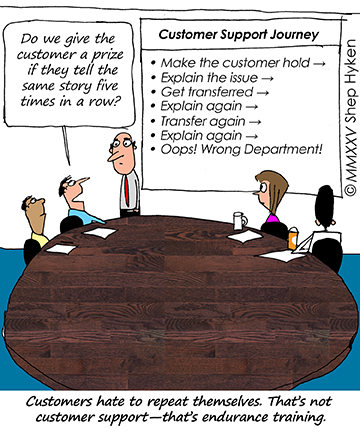
  2. Repeating Anything – Calling customer support and being passed around to different people, having to repeat your story again and again, isn’t fun. Nor is filling out forms that repeat the information you’ve already filled out on previous forms.
  3. Finding Hidden Fees – A stated price should be the price – with no extra fees. I recently checked into a hotel. They told me I had a $30 food and beverage credit as part of my stay – a nice surprise. Upon checking out, I noticed a $30 charge referred to as a “Destination Fee.” I asked about it, and the clerk said it was to cover the $30 food and beverage credit.
  4. Filling Out Bad Surveys – Customers are learning to dislike surveys, especially if they are long. There are right and wrong ways to do surveys. And a bad survey shouldn’t be the last thing a customer experiences when doing business with you.
  5. Listening to Complicated Phone Options – If you’ve called a company and been told to “listen to the following as our options have changed,” so you listen to the many options, and once you choose one, there are even more options … Well, I think you get the picture. There’s better technology to get the customer to the right person or the information they need.
  6. Annoying Pop-Up Windows – If you’ve been on a website and are reading information or an article and pesky pop-up windows keep interrupting you with irrelevant messages and advertising, you’re a victim of annoying pop-up windows.
  7. Anything that Requires Unnecessary Effort – Maybe you have a simple request or question. Why should it take a long time to fill out forms, answer unnecessary questions or more to get an answer?

There is a theme to this list. All of these imply the company doesn’t respect the customer’s time, energy, and effort. The goal should be the opposite: to respect and value your customer’s time, energy, and effort. Don’t create friction and put customers through anything more than necessary to get them what they want. In short, have a goal to be the easiest company to do business with. If you’re serious about it, you’ll find ways to eliminate and mitigate friction. And this list is far from complete. There are many, many other things customers hate doing.

So, here’s your assignment. Sit down with your team and brainstorm all the things they hate to do when doing business with any company. Then, ask what they think customers might hate about doing business with you. This can be processes, steps, policies, and more. Once you have the list, you know what to do. Eliminate all that makes doing business with you painful – or at least make some of the less painful. Don’t make your customers do things they hate doing!

Image Credits: Shep Hyken, Pixabay

Subscribe to Human-Centered Change & Innovation WeeklySign up here to join 17,000+ leaders getting Human-Centered Change & Innovation Weekly delivered to their inbox every week.

The Ongoing Innovation War Between Hackers and Cybersecurity Firms

Last Updated: October 15, 2025 at 8:36PM PDT

The Ongoing Innovation War Between Hackers and Cybersecurity Firms

GUEST POST from Art Inteligencia

In the world of change and innovation, we often celebrate disruptive breakthroughs — the new product, the elegant service, the streamlined process. But there is a parallel, constant, and far more existential conflict that drives more immediate innovation than any market force: the Innovation War between cyber defenders and adversaries. This conflict isn’t just a cat-and-mouse game; it is a Vicious Cycle of Creative Destruction where every defensive breakthrough creates a target for a new offensive tactic, and every successful hack mandates a fundamental reinvention of the defense at firms like F5 and CrowdStrike. As a human-centered change leader, I find this battleground crucial because its friction dictates the speed of digital progress and, more importantly, the erosion or restoration of citizen and customer trust.

We’ve moved past the era of simple financial hacks. Today’s sophisticated adversaries — nation-states, organized crime syndicates, and activist groups — target the supply chain of trust itself. Their strategies are now turbocharged by Generative AI, allowing for the automated creation of zero-day exploits and hyper-realistic phishing campaigns, fundamentally accelerating the attack lifecycle. This forces cybersecurity firms to innovate in response, focusing on achieving Active Cyber Resilience — the ability to not only withstand attacks but to learn, adapt, and operate continuously even while under fire. The human cost of failure — loss of privacy, psychological distress from disruption, and decreased public faith in institutions — is the real metric of this war.

The Three Phases of Cyber Innovation

The defensive innovation cycle, driven by adversary pressure, can be broken down into three phases:

  • 1. The Breach as Discovery (The Hack): An adversary finds a zero-day vulnerability or exploits a systemic weakness. The hack itself is the ultimate proof-of-concept, revealing a blind spot that internal R&D teams failed to predict. This painful discovery is the genesis of new innovation.
  • 2. The Race to Resilience (The Fix): Cybersecurity firms immediately dedicate immense resources — often leveraging AI and automation for rapid detection and response — to patch the vulnerability, not just technically, but systematically. This results in the rapid development of new threat intelligence, monitoring tools, and architectural changes.
  • 3. The Shift in Paradigm (The Reinvention): Over time, repeated attacks exploiting similar vectors force a foundational change in design philosophy. The innovation becomes less about the patch and more about a new, more secure default state. We transition from building walls to implementing Zero Trust principles, treating every user and connection as potentially hostile.

“In cybersecurity, your adversaries are your involuntary R&D partners. They expose your weakness, forcing you to innovate beyond your comfort zone and into your next generation of defense.” — Frank Hersey


Case Study 1: F5 Networks and the Supply Chain of Trust

The Attack:

F5 Networks, whose BIG-IP products are central to application delivery and security for governments and major corporations globally, was breached by a suspected nation-state actor. The attackers reportedly stole proprietary BIG-IP source code and details on undisclosed security vulnerabilities that F5 was internally tracking.

The Innovation Mandate:

This was an attack on the supply chain of security itself. The theft provides adversaries with a blueprint for crafting highly tailored, future exploits that target F5’s massive client base. The innovation challenge for F5 and the entire industry shifts from simply patching products to fundamentally rethinking their Software Development Lifecycle (SDLC). This demands a massive leap in threat intelligence integration, secure coding practices, and isolating development environments from corporate networks to prevent future compromise of the IP that protects the world.

The Broader Impact:

The F5 breach compels every organization to adopt an unprecedented level of vendor risk management. It drives innovation in how infrastructure is secured, shifting the paradigm from trusting the vendor’s product to verifying the vendor’s integrity and securing the entire delivery pipeline.


Case Study 2: Airport Public Address (PA) System Hacks

The Attack:

Hackers gained unauthorized access to the Public Address (PA) systems and Flight Information Display Screens (FIDS) at various airports (e.g., in Canada and the US). They used these systems to broadcast political and disruptive messages, causing passenger confusion, flight delays, and the immediate deployment of emergency protocols.

The Innovation Mandate:

These attacks were not financially motivated, but aimed at disruption and psychological impact — exploiting the human fear factor. The vulnerability often lay in a seemingly innocuous area: a cloud-based, third-party software provider for the PA system. The innovation mandate here is a change in architectural design philosophy. Security teams must discard the concept of “low-value” systems. They must implement micro-segmentation to isolate all operational technology (OT) and critical public-facing systems from the corporate network. Furthermore, it forces an innovation in physical-digital security convergence, requiring security protocols to manage and authenticate the content being pushed to public-facing devices, treating text-to-speech APIs with the same scrutiny as a financial transaction. The priority shifts to minimizing public and maximizing continuity.

The Broader Impact:

The PA system hack highlights the critical need for digital humility
. Every connected device, from the smart thermostat to the public announcement system, is an attack vector. The innovation is moving security from the data center floor to the terminal wall, reinforcing that the human-centered goal is continuity and maintaining public trust.


Conclusion: The Innovation Imperative

The war between hackers and cybersecurity firms is relentless, but it is ultimately a net positive for innovation, albeit a brutally expensive and high-stakes one. Each successful attack provides the industry with a blueprint for a more resilient, better-designed future.

For organizational leaders, the imperative is clear: stop viewing cybersecurity as a cost center and start treating it as the foundational innovation platform. Your investment in security dictates your speed and trust in the market. Adopt the mindset of Continuous Improvement and Adaptation. Leaders must mandate a Zero Trust roadmap and treat security talent as mission-critical R&D personnel. The speed and quality of your future products will depend not just on your R&D teams, but on how quickly your security teams can learn from the enemy’s last move. In the digital economy, cyber resilience is the ultimate competitive differentiator.

Image credit: Unsplash

Subscribe to Human-Centered Change & Innovation WeeklySign up here to get Human-Centered Change & Innovation Weekly delivered to your inbox every week.

Three Reasons You Are Not Happy at Work

And What to Do to Become as Happy as You Could Be

Three Reasons You Are Not Happy at Work

GUEST POST from Stefan Lindegaard

Most people spend years in jobs that feel fine. Not great, not terrible – just fine. But fine isn’t the goal. You deserve to do work that energizes you, challenges you, and gives you a sense of purpose.

Yet too many professionals stay stuck. Why? Because they fall into one (or more) of these three traps:

1. You’ve Let Work Happen to You

The problem: If your career feels like a series of random events rather than intentional choices, it’s because you’ve been reacting instead of leading. Maybe you took the first job that paid well, accepted promotions without questioning whether they aligned with what you wanted, or stayed in a role simply because it was comfortable.

The fix: Take ownership of your career. What do you actually want from your work? More impact? More autonomy? A new challenge? Stop waiting for opportunities to fall into your lap and start actively shaping your path. Schedule time this week to reflect, map out your ideal work life, and make a move toward it.

2. You’re Valuing Stability Over Growth

The problem: If your job is predictable but uninspiring, you might have traded growth for comfort. Sure, stability feels safe, but it comes at a cost – boredom, disengagement, and a slow decline in motivation.

The fix: Push yourself out of autopilot. Challenge yourself to take on a stretch project, learn a new skill, or initiate a conversation about expanding your role. Growth is what fuels long-term satisfaction – without it, even the best job will start to feel dull.

3. You’re Waiting for the ‘Perfect’ Job Instead of Making the Most of Where You Are

The problem: Many people think happiness at work comes from finding the right job or employer. But job satisfaction is not just about where you work – it’s about how you work. If you’re constantly waiting for a better company, a better boss, or a better opportunity, you might miss the chance to make your current role more fulfilling.

The fix: Find ways to bring more purpose and energy into your day now. Connect with colleagues who inspire you. Start a project that excites you. Look for small ways to align your work with what matters to you. The next big move will come – but don’t let the wait stop you from enjoying today.

Happiness at Work Isn’t Luck. It’s a Choice!

You don’t need a new job to feel more engaged, fulfilled, or challenged. You need:

  • A clear direction for where you want to go
  • A commitment to continuous growth
  • A proactive approach to shaping your experience

Are you leading your work life or just letting it happen to you? The choice is yours.

Image Credit: Stefan Lindegaard

Subscribe to Human-Centered Change & Innovation WeeklySign up here to get Human-Centered Change & Innovation Weekly delivered to your inbox every week.
Making Decisions in Uncertainty

This 25-Year-Old Tool Actually Works

Making Decisions in Uncertainty

GUEST POST from Robyn Bolton

Just as we got used to VUCA (volatile, uncertain, complex, ambiguous) futurists now claim “the world is BANI now.”  BANI (brittle, anxious, nonlinear, incomprehensible) is much worse than VUCA and reflects “the fractured, unpredictable state of the modern world.”

Not to get too Gen X on the futurists who coined and are spreading this term but…shut up.

Is the world fractured and unpredictable? Yes.

Does it feel brittle? Are we more anxious than ever? Are things changing at exponential speed, requiring nonlinear responses? Does the world feel incomprehensible? Yes, to all.

Naming a problem is the first step in solving it. The second step is falling in love with the problem so that we become laser focused on solving it. BANI does the first but fails at the second. It wallows in the problem without proposing a path forward. And as the sign says, “Ain’t nobody got time for this.”

(Re)Introducing the Cynefin Framework

The Cynefin framework recognizes that leadership and problem-solving must be contextual to be effective. Using the Welsh word for “habitat,” the framework is a tool to understand and name the context of a situation and identify the approaches best suited for managing or solving the situation.

It’s grounded in the idea that every context – situation, challenge, problem, opportunity – exists somewhere on a spectrum between Ordered and Unordered. At the Ordered end of the spectrum, cause and affect are obvious and immediate and the path forward is based on objective, immutable facts. Unordered contexts, however, have no obvious or immediate relationship between cause and effect and moving forward requires people to recognize patterns as they emerge.

Both VUCA and BANI point out the obvious – we’re spending more time on the Unordered end of the spectrum than ever. Unlike the acronyms, Cynefin helps leaders decide and act.

Five Contexts, Five Ways Forward

The Cynefin framework identifies five contexts, each with its own best practices for making decisions and progress.

On the Ordered end of the spectrum:

  • Simple contexts are characterized by stability and obvious and undisputed right answers. Here, patterns repeat, and events are consistent. This is where leaders rely on best practices to inform decisions and delegation, and direct communication to move their teams forward.
  • Complicated contexts have many possible right answers and the relationship between cause and effect isn’t known but can be discovered. Here, leaders need to rely on diverse expertise and be particularly attuned to conflicting advice and novel ideas to avoid making decisions based on outdated experience.

On the Unordered end of the spectrum:

  • Complex contexts are filled with unknown unknowns, many competing ideas, and unpredictable cause and effects. The most effective leadership approach in this context is one that is deeply uncomfortable for most leaders but familiar to innovators – letting patterns emerge. Using small-scale experiments and high levels of collaboration, diversity, and dissent, leaders can accelerate pattern-recognition and place smart bets.
  • Chaos are contexts fraught with tension. There are no right answers or clear cause and effect. There are too many decisions to make and not enough time. Here, leaders often freeze or make big bold decisions. Neither is wise. Instead, leaders need to think like emergency responders and rapidly response to re-establish order where possible to bring the situation into a Complex state, rather than trying to solve everything at once.

The final context is Disorder. Here leaders argue, multiple perspectives fight for dominance, and the organization is divided into fractions. Resolution requires breaking the context down into smaller parts that fit one of the four previous contexts and addressing them accordingly.

The Only Way Out is Through

Our VUCA/BANI world isn’t going to get any simpler or easier. And fighting it, freezing, or fleeing isn’t going to solve anything. Organizations need leaders with the courage to move forward and the wisdom and flexibility to do so in a way that is contextually appropriate. Cynefin is their map.

Image credit: Pexels

Subscribe to Human-Centered Change & Innovation WeeklySign up here to join 17,000+ leaders getting Human-Centered Change & Innovation Weekly delivered to their inbox every week.

Something Critical Gets Lost When Robots and AI Take Over

Something Critical Gets Lost When Robots and AI Take Over

GUEST POST from Robert B. Tucker

My wife and I just returned from a week in the Côte d’Azur region of France. A miracle of sorts happened! All of our flights were on time! Psychologist Jennifer Freed was not so fortunate.

During an eight-hour flight delay at Dallas-Fort Worth Airport, Freed was unable to talk to a single airline employee at the gate. Monitors kept giving out false information. “Hundreds of people were stranded without any human compassion, comfort, or accurate updates,” Freed fumed on Substack. “I wrote five separate emails to American Airlines only to have each one replied to in a bot-AI way that completely missed the content of my complaints.”

As we leap into the digitized Age of Acceleration, the unstated goal seems to be to reduce or eliminate all human-to-human contact. Automate everything – it’s going to be great. But observers like Jennifer Freed are not so sure. They are noticing a huge side effect that technologists don’t seem to want to admit: humans need face-to-face contact lest they languish.

As a futurist and innovation coach, I sometimes invite my clients to envision what life might be like “over there.” After we’ve gotten across the river and are on the other side of something. While tech visionaries spin tales of utopia and freedom from drudgery on the other bank, in fact, the goal of removing humans from business and social interactions might well have the opposite effect.

In the name of efficiency, convenience, and cost savings, taking humans out of the equation could have far-reaching consequences. In fact, it already has.

Psychologist Jonathan Haidt has looked at the effects of smartphones on the social and psychological development of teens. Many of them are using TikTok for four to five hours a day on average. Haidt warns that the shift from a “play-based childhood” to a “phone-based childhood” amounts to a radical rewiring of social development, and his research leads him to believe it’s doing real damage.

The problem is not just that teens stare at screens instead of each other. The real issue is that the scaffolding of face-to-face trust, emotional attunement, and shared presence is eroding. In The Anxious Generation, Haidt argues that social media provides faux “connection” while subtly replacing eye contact, interpersonal reciprocity, and the unspoken calibration that real human encounters afford.

Various studies echo Haidt’s assertion that humans are not modules you can replace with bots or chat windows. When you eliminate or drastically reduce real, in-person contact — eye to eye, side by side, speech flowing both ways — you strip out the micro-moments where empathy, synchrony, trust, and emotional regulation are built.

In effect, the promise of “automate everything” may economize interactions. But it risks hollowing out the relational substrate of society. As Freed lamented in that Dallas gate delay, the absence of any human to lean on, any eyes to meet, any moment of presence, reveals what robots can’t replicate — and what we lose when we try to put everything on autopilot.

“I remember a time when customer service meant something special,” says Freed. “When a friendly human would take my call and laugh with me about whatever the issue was. I recall when a waitperson would really look at you and take your order with a sense of pride and competent memory.”

This article originally appeared in Forbes

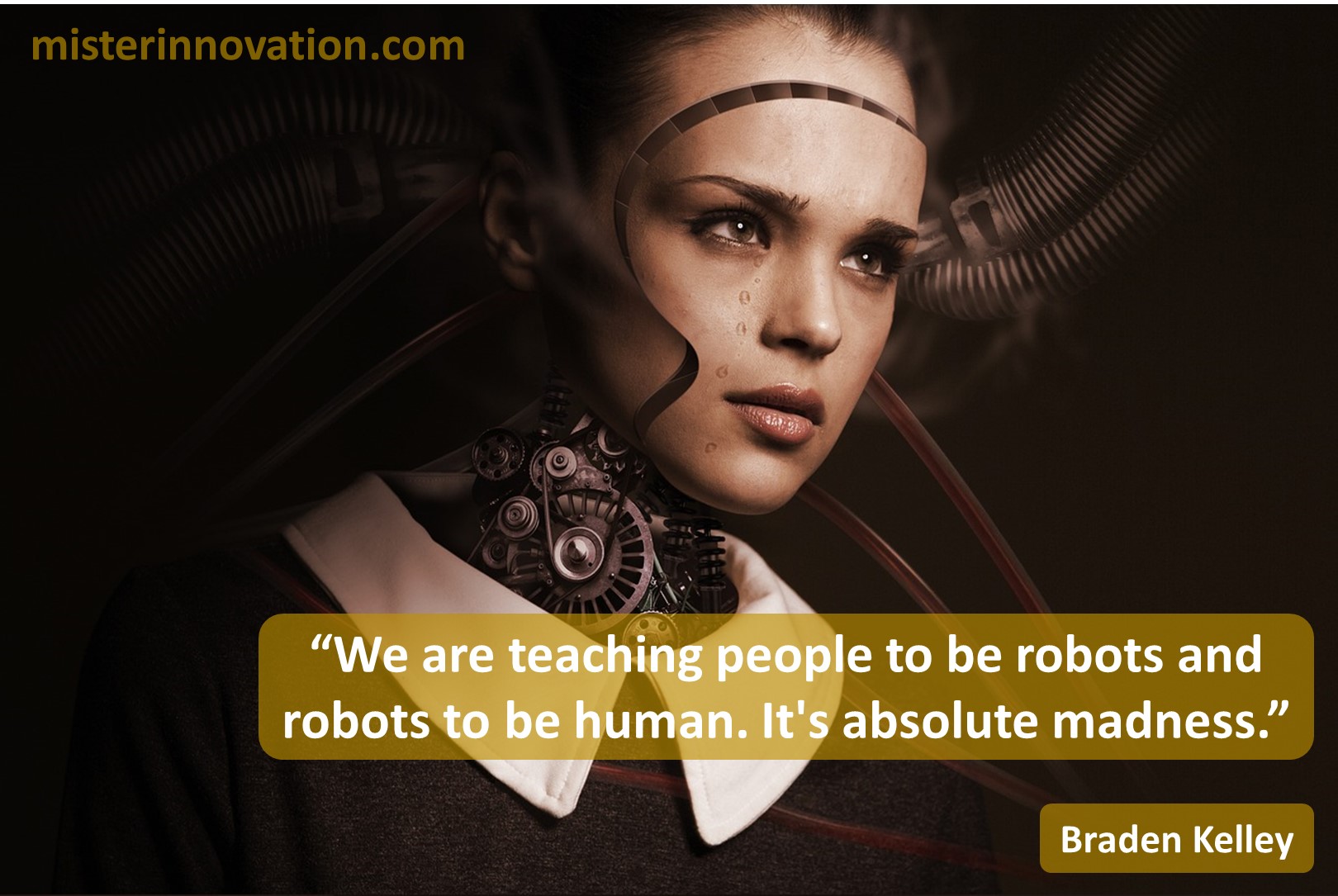
Image credit: 1 of 1,300+ FREE quotes for your presentations at http://misterinnovation.com

Subscribe to Human-Centered Change & Innovation WeeklySign up here to get Human-Centered Change & Innovation Weekly delivered to your inbox every week.